



Abstract
New technologies offer new interactional possibilities for news journalism, but they also pose a challenge to broadcasters who are accustomed to the practices of ‘old’ television news. The web is one such arena where broadcasters are in the process of mastering a sense of sociability and ‘communicative ease’ in relation to audiences. They struggle to find ways to engage audiences in the roles of both viewers and users in line with the technological affordances of the web. Rather little attention has yet been paid to how the general sociability of broadcasting is influenced by the development of digital media. This article presents a case showing how broadcasters orient to their audience(s) in a so-called live news co-production on the web. The main point is to highlight both possibilities and dilemmas in the management of audience-oriented activities on a new technological platform with its different conditions for production and reception. We argue that broadcasters interested in producing web news both need to adhere to the professional principles and standards of ordinary broadcasting, and at the same time show that they are competent enough to also produce unpolished, layman-like material normally associated with unprofessionality.
The journalistic profession is undergoing a paradigm shift (Wilkinson et al., 2009) making it necessary to change the mindsets and attitudes of media personnel, who need to show a willingness to ‘learn more about the potential of each new medium to tell stories in different ways’ (Quinn, 2009: 15). For instance, a range of media platforms is used to develop previously untried forms of news presentation. As both an audiovisual and interactive medium, the web poses particular communicative challenges for news broadcasters as one cannot assume that what works in one medium will work in another (Peirce, 2010). New technology offers new interactional possibilities for news journalism, but due to changing conditions for production and reception it also demands that departures from established broadcast practices of interaction are made. What is presented, how it is presented and to whom must be adapted to the requirements and conditions of that particular media platform (Norrington, 2010).
Broadcasters have always adapted their ways of addressing audiences in line with the affordances of new technologies. Scannell and Cardiff (1991) show, in their study on the early days of radio, how broadcasters did not naturally master the techniques of sounding sociable and inclusive, but talked at listeners rather than to them. Gradually, broadcasters had to learn how to talk in ways that mimicked a ‘conversational’ kind of address, which oriented to the listener as someone who was being personally recognized and addressed instead of part of a mass (Scannell, 2010). The charm of the sociable in broadcasting is its ‘seeming spontaneity and relaxed naturalness’ (Scannell, 1996: 24), and aspects of everyday conversations are therefore integrated into the contexts of broadcast institutions to engage absent or ‘overhearing’ (Heritage, 1985) audiences. In order to achieve a sense of familiarity through ways of talking in a seemingly unforced, ‘natural’ and authentic manner, broadcasting has to be ‘most carefully managed’ (Scannell, 1996: 24). The web is one media platform that poses fresh challenges to broadcasters who again must work at mastering a sense of sociability and ‘communicative ease’ (Hutchby, 2006: 13), and find ways to ‘carefully manage’ activities in order to engage audiences on what is – for many news broadcasters –still a rather new arena.
Like other broadcast companies of its kind, Swedish Public Service Television (SVT) is caught up in the midst of a period of convergence between media platforms, where some of its important goals are to integrate the web and interactive affordances into broadcast news, and to develop new forms for audience participation. In this article, we will examine svt news live, one of SVT’s most recent attempts to extend its news’ reach. It is a 15-minute web exclusive news slot based on live interviews that started airing three times a week in early 2011 before closing down in May 2012. The concept of svt news live rests on the idea that audiences should be oriented to as co-constructors of a news format fit for the web, what we here label as a live co-production. Our overarching aim is to explore svt news live as an illustrative case of how communicative forms and practices of news broadcasting alter when broadcasters transfer from ‘old’ television to web television.
Our focus is on how broadcasters orient to their audience(s) in a live co-production on and for the web. In particular, we examine a number of key departures from what broadcasters do as they orient to audiences on regular television news as opposed to how they orient to audiences on the web. The latter thus constitutes the empirical object, although some comparisons will be made to ordinary television (especially in third section of the article) in order to clearly discern interactional shifts between media platforms. The main point of exploring departures from interactional norms of ‘old’ broadcasting in the context of a live co-production on the web is to highlight both possibilities and dilemmas in the management of audience-oriented activities on a new technological platform. In the process of adapting to the web, broadcasters may not be entirely sure what works in this respect, and what does not.
The study can be said to broadly situate itself within a wider scholarly interest in converging media where questions concerning the role and impact of so-called ‘new’ (social/interactive/digital) media technologies are examined from a range of perspectives (e.g. Beyer et al., 2007; Bolin, 2010; Deuze, 2007; Erdal, 2007; Evans, 2008; Jenkins, 2006; Peirce, 2010; Ytreberg, 2009). It could also in part be seen as a contribution to the debate on the role and status of television, which by many scholars is seen to be seriously challenged by the arrival of new technologies (Spigel and Olsson, 2004; Turner and Tay, 2009). While this literature has focused primarily on the aesthetics of television, convergence of media platforms and overall changes in media use and experiences, our research is anchored in a social interactional approach on broadcast media (Hutchby, 2001; Meyrowitz, 1985; Moe, 2008; Scannell, 1996, 2000; Thompson, 1995, 2005). Broadcasting’s relationship with its audiences was initially conceptualized in the 1950s by Horton and Wohl (1956), who coined the term ‘parasocial interaction’ to capture the experience of being involved in a conversational ‘give-and-take’ with a television personality. In the last decades these relationships have been explored and specified in extensive empirical research on how broadcast talk is designed and audience orientation is achieved (Ekström and Patrona, 2011; Hutchby, 2006; Scannell, 1991; Tolson, 2006).
Apart from a smaller number of studies targeting broadcasting, social interaction and the impact of new media (Beyer et al., 2007; Fitzgerald and McKay, 2012; Thornborrow and Fitzgerald, forthcoming; Tolson, 2010), we know little about how broadcasters’ interactions are influenced in, and by, new media. As noted by Thornborrow and Montgomery (2010), research into the discourse of broadcast news, in particular, has largely focused on the institutional nature of talk (e.g. Clayman and Heritage, 2002). Considerably less attention has been paid to how the general sociability of broadcast news is influenced by the development of digital media (although see Montgomery, 2007). This particular area is where the present study aims to contribute.
Data and disposition
The data consists of 46 15-minute svt news live productions. They were aired at (approximately) 3.00–3.15 p.m. between November 2011 and May 2012 and produced by an editorial team of four people going under the name the News Lab (Sw. Nyhetslabbet), and this was also the name of the blog which was connected to the svt news live programme. Although short-lived, we see svt news live as an important case to study as it displays broadcasting’s struggle (through trial and error) to achieve a communicative ease in relation to audiences on, for them, new social media arenas. Along with other experimental trials in sports broadcasting and also earlier attempts at inviting audiences into backstage news productions on the web, this shows that SVT is eager to put both time and money into efforts that prove that it has the competences required to be successful in the faster social media outlets as well. SVT financed four full-time employees to work on the svt news live project for approximately six months, and supported them with new, innovative technology. We are therefore convinced that svt news live is a very suitable example of how broadcasting practices (here, especially audience orientations) evolve with the advent of new technology.
The study adopts a mix of conversation analysis of media talk (e.g. Hutchby, 2006), approaches to embodied communication (e.g. Goodwin, 2000) and media discourse analysis. The main theme that is examined is the integration and synchronization of technologies in talk and interaction in the web broadcast context. We especially examine two technological aspects in more detail: (1) the role and interactional impact of the laptop in the interview situation, and (2) the synchronization of cameras and the management of microphones in multiparty interview situations.
In the next section, we give an overview of how regular television news broadcasting is structured in the Swedish context because the degree to which these formats have evolved can vary according to country. We also present the general characteristics and broadcast conditions for our particular web case, svt news live. In the following section, we analyse two complex multimodal situations where technologies need to be integrated into talk and synchronized with the host’s and guests’ activities in relation to audiences. We then draw some conclusions that relate to the process of ‘mastering’ a new platform, and the resources that may be required and the risks that may follow when one attempts to be a professional in a context that in some sense requires other competences than the ones used in traditional news.
Two platforms – different interactional conditions
The interactional conditions of conventional television news – Aktuellt
Ordinary Swedish television broadcasts, especially evening primetime news, are anchor-centred, and the news follows a rather established western structure (see Montgomery, 2007, for a more detailed description). That is, after introductions the anchor communicates new items by reading from a teleprompter (with the additional help of scripts); this is mixed with edited news stories and live interviews via a link or in the studio. As recently as 2012, Aktuellt, the main news programme to which svt news live is a satellite production, began using dual presenters in a considerably more advanced technological studio environment, also using laptops as a complement to the traditional scripts on the studio table. This led to some interactional changes from the prior set-up with one presenter, but at the time of svt news live’s introduction on the web in 2011, explicitly launched as a complement to Aktuellt’s evening news, news presenters were still highly oriented to the traditional viewer in continuous looks-to-camera while speaking, except when interviewing someone via a link or in the studio.
Despite the re-designed studio and the addition of another presenter, the conventional viewer orientation is still very much in focus interactionally. Technological gadgets such as laptops function more as props or design tools that indicate accessibility rather than them playing an important role in the interaction. The presenter(s) task is to deliver talk that is oriented to liveness (Auslander 1999; Bourdon, 2000: 531; Ellis, 2000: 32–3; Scannell, 1996). Broadcasters are required to interact in a natural, authentic and relaxed way and not come off as actorly and obviously reading scripts. Part of the careful management of broadcasting is for participants to adhere to this kind of behaviour as they talk (Kroon Lundell, 2009), and Scannell and others (e.g. Tolson, 2006) argue that scripted talk is generally detrimental to liveness. Scripts may be used but should not interfere with a relaxed news delivery directed at ‘me’ as an exclusive viewer.
The cameras and their synchronization with the participants’ actions in conventional broadcast news such as in Aktuellt are set up so as not to interfere with the ‘transparent immediacy’ (Bolter and Grusin, 1999) of the broadcast. That is, camera shots allow viewers to experience events from a first-person perspective, constructing an alleged immediate relationship with what is being watched, achieving ‘immediacy’ by ‘ignoring or denying the presence of the medium and the act of mediation’ (Bolter and Grusin, 1999: 11)
The presenter’s direct look-to-camera signals a feeling of being involved – as a viewer – in a trusting relationship with the broadcaster (Scannell, 2010; cf. Horton and Wohl, 1956). However, when a guest is being interviewed in the studio, the attention of the presenter is re-directed to the guest, and only after their talk is over is the look directed back at the viewer. Thus, in conventional broadcast television, sequences of events are organized as clearly demarcated focused interactions that follow upon one another. According to Goffman (1963: 24), a focused interaction refers to ‘the kind of interaction that occurs when persons gather close together and openly cooperate to sustain a single focus of attention, typically by taking turns’. The look is an important resource in the organization of focused interaction, in the shift between different activities, and in the involvement of audiences in these activities (Ekström, 2012; Kroon Lundell and Ekström, 2013). The look of the broadcaster is adapted to the various sub-formats of television news in order to attend to different – but generally separated – communicative tasks and participant frameworks.
The Aktuellt productions work in every aspect and detail at manifesting a professional news broadcasting public service image where any mishaps, interactional flaws or ‘imperfections’ between people and technology constitute unwanted disruptions as they threaten the professionality of the broadcasters. There is a clear demarcation between the role of broadcaster and the role of viewer, where the authority of the former is continually re-enacted in talk and interaction. Television news as we are used to see it consists of polished and orderly productions made by professional journalists who display their expertise by acting in different, but complementary, roles on the news. As viewers, we are invited to watch the products of their professional work.
The live co-production and its interactional conditions – svt news live
A general aim of the svt news live production, described by the managing editor (interviewed as part of the study), is to produce a live news programme characterized by appearing less polished, and more authentic and open about weaknesses and flaws than traditional news. As mentioned, it also has as its aim to be co-produced with its audience. ‘Interactivity’ and ‘dialogue’ (in their words) are essential. Not only do they want suggestions for possible topics to cover in upcoming broadcasts, but the instant pick-up of voices from audiences in the here-and-now is very much part of the format. They run a blog in connection to their web programmes where the audience is invited to suggest topics or pose questions to guests prior to or during airing.
Unlike the primetime news show Aktuellt that presents news with an unquestioned authority, the News Lab team behind svt news live explicitly states (on their web site) that they do not know the future of news and how to best utilize the web, and that they want the audience’s input and suggestions in this search: ‘Hi! Welcome to us! Come join us, become a part of our editorial team!’ In that sense, ‘the shared continuity of experience’ (Ellis, 2000: 33) which is central to broadcasting’s liveness is enacted in a very concrete way by the use of laptops and chats. However, the team also recognizes another kind of conventional television audience who may just be interested in watching what they do: ‘Or lean back and have our broadcasts served up, whichever you want!’
The main feature of the svt new live broadcast is an interview with one or several guests, most often conducted by the editorial team’s project manager. Being a movable production team that can pick up their gear and go just about anywhere, the interviews can take place at different locations outside of a conventional studio environment. Even though they have this opportunity of moving around, many interviews are still conducted from the Aktuellt newsroom, which, in mid-afternoon when svt news live is airing, is rather quiet, with the odd person coming and going in the background. It is apparent from the many television screens around that the context for svt news live is backstage, where news is being produced. As a rule, the programme is hosted by a male interviewer. A normal interactional set-up involves the interviewer standing by a small table with a laptop and some papers in front of him, and guest(s) appearing at his side. A two-camera set-up is generally used, often operated by one person. This fact undoubtedly alters the conditions for the synchronization between the participants’ activities and how the cameras are operated.
The restricted technological equipment and staff and the backstage interview locations are some of the features that create a less strict interactional environment for the participants to act in. Other manifest signs of informality and ordinariness are the initial greeting (a rather animated ‘Hi!’ accompanied with hand gestures directed at the audience), and in colloquial expressions (‘run along now’ when one guest is changed for another). It is also visible in the host’s and guests’ more casual and personal way of dressing, and in their general body language. Generally, svt news live addresses its audience from a less authoritative and more ‘equal’ position in relation to its own role as news producer, and thus more in line with audience’s ordinary experiences of online media use. The production is clearly designed to meet an expected scepticism among audiences, or even a loss of credibility, in sophisticated and highly developed forms of broadcast. In a live co-production produced for the web, the model to imitate is no longer the live form of theatre performances (Auslander, 1999), but the immediate, personal and informal communicative mode and style of address made possible by interactive, portable technology. This informal, less polished style of producing news partly requires other kinds of competences than traditional news, and can from that viewpoint take on the appearance of amateurish-looking material.
Despite the alleged informal and co-produced news format to which viewers are greeted personally and invited to contribute to, the News Lab team also aspires to produce professional quality material that can be used in the evening news programme Aktuellt. Thus, they not only produce live programming as such but also attempt to create potential news which might make it to the evening news. In this respect, their ambition is not just to produce unpolished material for the benefit of web users but to make news before ‘the real’ news that can be integrated into the latter. So, svt news live tries to achieve two communicative projects in one go; it aims at connecting with audiences on the web in ways that correspond with users’/viewers’ everyday experiences of online media use, and at producing professional news in order to build bridges between platforms with rather different communicative conditions and affordances. We will now turn to a closer examination of two different complex multimodal situations that occur in svt news live.
The integration and synchronization of technologies in talk and interaction in the web broadcast
Generally speaking, audience orientations – that is, such activities that are organized so as to create conditions for sociable relations with audiences – are shaped by a complex coordination of camera work (positions, angles, switching of cameras, etc.) and the organization of talk in front of the camera in relation to artefacts and people. In camera frames, participants, actions and interactions are made visible and focused on while others are concealed. As previously mentioned, live broadcast talk is typically organized as focused interactions within a shared interactional space which is designed for the audience to be invited into (Ekström, 2012; Goffman, 1963: 24; Mondada, 2009). The construction of such a focused interaction is a complex multimodal achievement; it is complex because it involves shifts between several activities as well as changes in participant frameworks and spatial arrangements. It is also complex in the sense that it involves the use of, and orientation to, technologies. In studio-based broadcast talk, as in the case of the television evening news programme Aktuellt, the organization of interaction in front of the camera is managed through detailed planning, scripts and logistics (Ytreberg, 2004). It is a precondition for the production of spontaneous talk not least in complex multi-camera settings.
In the ensuing analysis, we will focus on two kinds of complex multimodal situations, although there are features and interactional elements in both that partly overlap. The first complex multimodal situation deals with the interplay between host, laptop, camera work, orientations of the looks of hosts and guests. The second situation deals with the interplay between host, camera work, orientations of the looks of hosts and participants, microphones and multiparty guests. Both of these situations constitute interactional challenges to broadcasters which they are normally not used to managing in ordinary television news programming.
Complex multimodal situation 1: managing the laptop, camera and guest
The laptop constitutes a central feature in svt news live. It is the main tool for realizing its ambition to maintain an interactive connection to its audience by incorporating chat questions into the live programme. However, it also fulfils the purpose of being a substitute for a traditional script in the absence of a teleprompter, something that svt news live has in common with other broadcast productions with interactive ambitions (see Beyer et al., 2007). The choice not to use a teleprompter is a way to perform a communicative style that distinguishes svt news live from traditional news and demonstrates the experimental character of the programme. It marks svt news live’s orientation towards spontaneity and ‘unscriptedness’, and accentuates ‘the real-time production of news’ as well as the overall flexibility of the production team and its technology.
That the laptop is indeed an important interactional tool for the host, as well as being the fundamental resource in order to accomplish a genuine co-production, is signalled by it being placed the centre of the table where the host and guest(s) are standing. Normally, there is also a script that is placed on the laptop’s keyboard (see Figure 1) to which the host refers when he, for instance, picks up previously noted chat questions made earlier before airing. For him to be able to engage in live co-production and pick up voices from viewers in the here-and-now though, he must orient to the screen as the camera is rolling. With the laptop at waist-level making him having to lean closer to the screen to be able to see the comments flowing in, incorporating the laptop into the talk constitutes a specific challenge. When the host interviews a guest in a typical studio interview, the host/interviewer is positioned to the left and the interviewee to the right from the viewer’s perspective. The unfolding interaction – as the host works at integrating chat questions from the laptop which is placed between the two participants – basically follows the pattern illustrated in Figure 1.
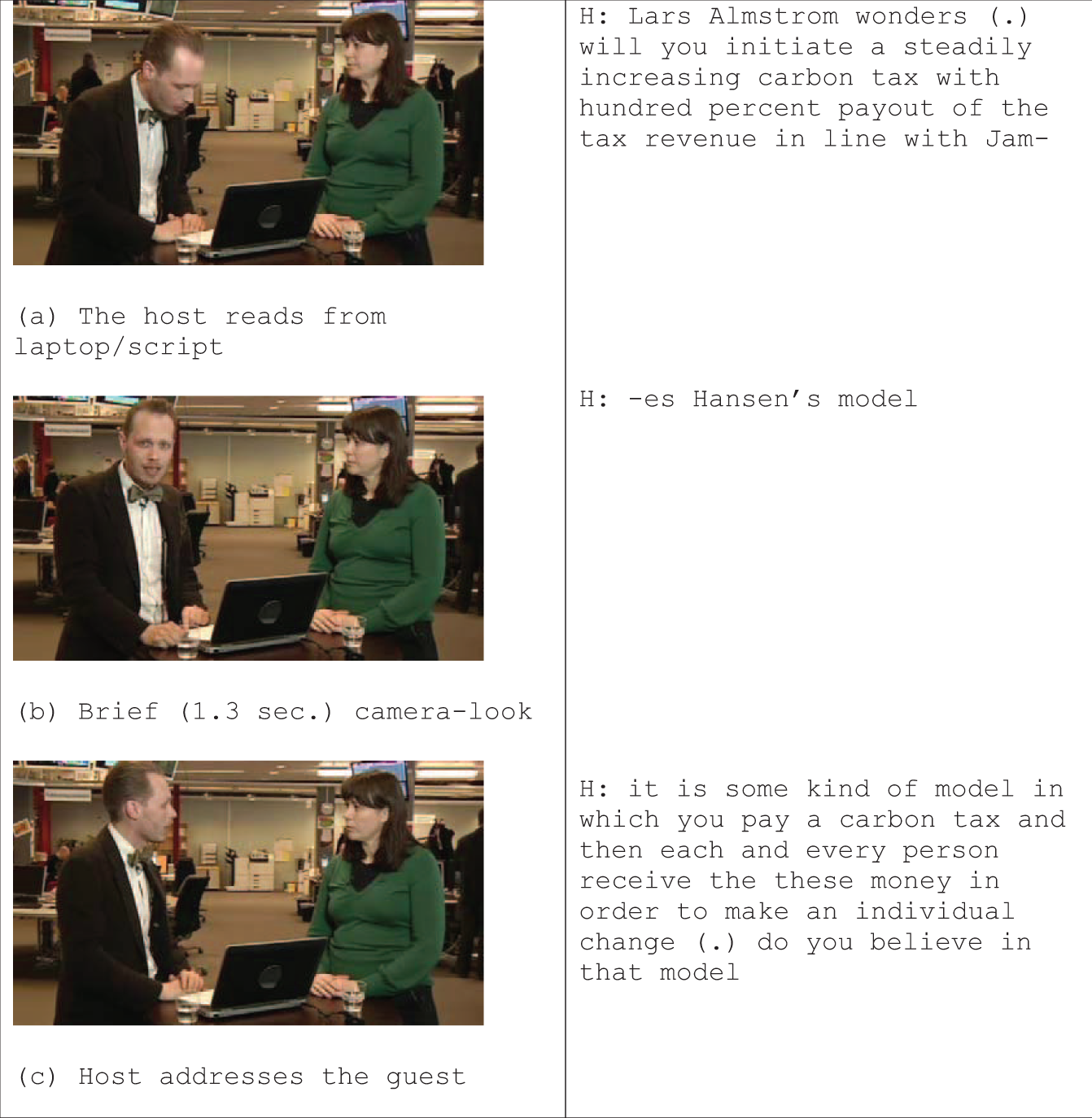
Recurring pattern of involving chat-questions from the laptop.
In this example, the host (1) starts his question-turn with his face distinctly directed towards the laptop. He progresses to pose his question and then rather swiftly (2) looks into the camera, before finally (3) turning his face towards the guest while completing the question. The integration of chat-questions is generally linguistically marked. In this case, the host states the name of the questioner (‘Lars Almström wonders …’), thus explicitly displaying Almström as a ‘contributor’ and co-producer of the programme. On other occasions, the host announces the incorporation by explicitly expressing that it is ‘time for a chat-question’ or ‘something from the chat’.
The brief camera-look (about 1.3 seconds) in the example’s second sequence is particularly interesting as it is a distinct departure from the standard procedure of traditional television news. A news presenter conducting a studio interview may take his gaze off the guest for a quick look at the notes during an interview, but will very rarely, if ever (at least in the context of Swedish news), look into the camera before the interview is finished (Ekström, 2012). The host in svt news live could easily copy this standard broadcast behaviour and simply change between quick glances at the laptop and then go back to looking at the guest. That he chooses to direct his gaze to the camera before asking the next question marks that he feels the need to attend to audiences that are taking the roles of both viewers and active users (i.e. chat contributors). By the shift in face engagement from laptop to camera, the host thus recognizes the dual connection to the audience (Beyer et al., 2007: 220).
It is also a hierarchical kind of look, where the first look (to the laptop) involves the users and contributors from the chat; the second look-to-camera then addresses the viewer; only then does the host turn to the guest as he completes his question and allows her to start on her turn. This example constitutes a departure from the focused interactional sequences of regular television news, as broadcasters in the latter case need not, in general, recognize mixed audience roles but prioritize an orientation to the audience as viewer and synchronize their looks accordingly. The evident orientation towards the laptop and the synchronized incorporation of a chat question also demonstrates that the interactivity with the audience is important for the programme, and that audience questions make a difference to how it progresses.
The look-to-camera illustrated in Figure 1 could also be seen as a kind of ‘interactional repair’ in relation to viewers for paying too much attention to the audience as active contributors by leaning over to look at the laptop and picking up chat users’ voices rather than attending strictly to the needs of viewers by primarily orienting to them. The next example will demonstrate a similar act of repair but this time directed to the present guest to whom the host is talking. In the exchange illustrated in Figure 2, the host interviews the leader of the Left Party, Jonas Sjöstedt. Initially the sequence follows a regular procedure for the incorporation of chat questions, that is, the host (1) looks at his laptop before (2) briefly looking into the camera, after which he (3) looks down at the laptop again and then (4) directs his look towards the interviewee while finalizing his question. The guest then takes his turn and starts answering the question, but as he does so the host (5) physically still orients to the laptop. The interviewee then displays a slight hesitation as he speaks as if not knowing whether to continue or not. At least, this seems to be the ways the host experiences the situation because (6) he excuses himself for having had his attention elsewhere and prompts the interviewee to go on with his talk.
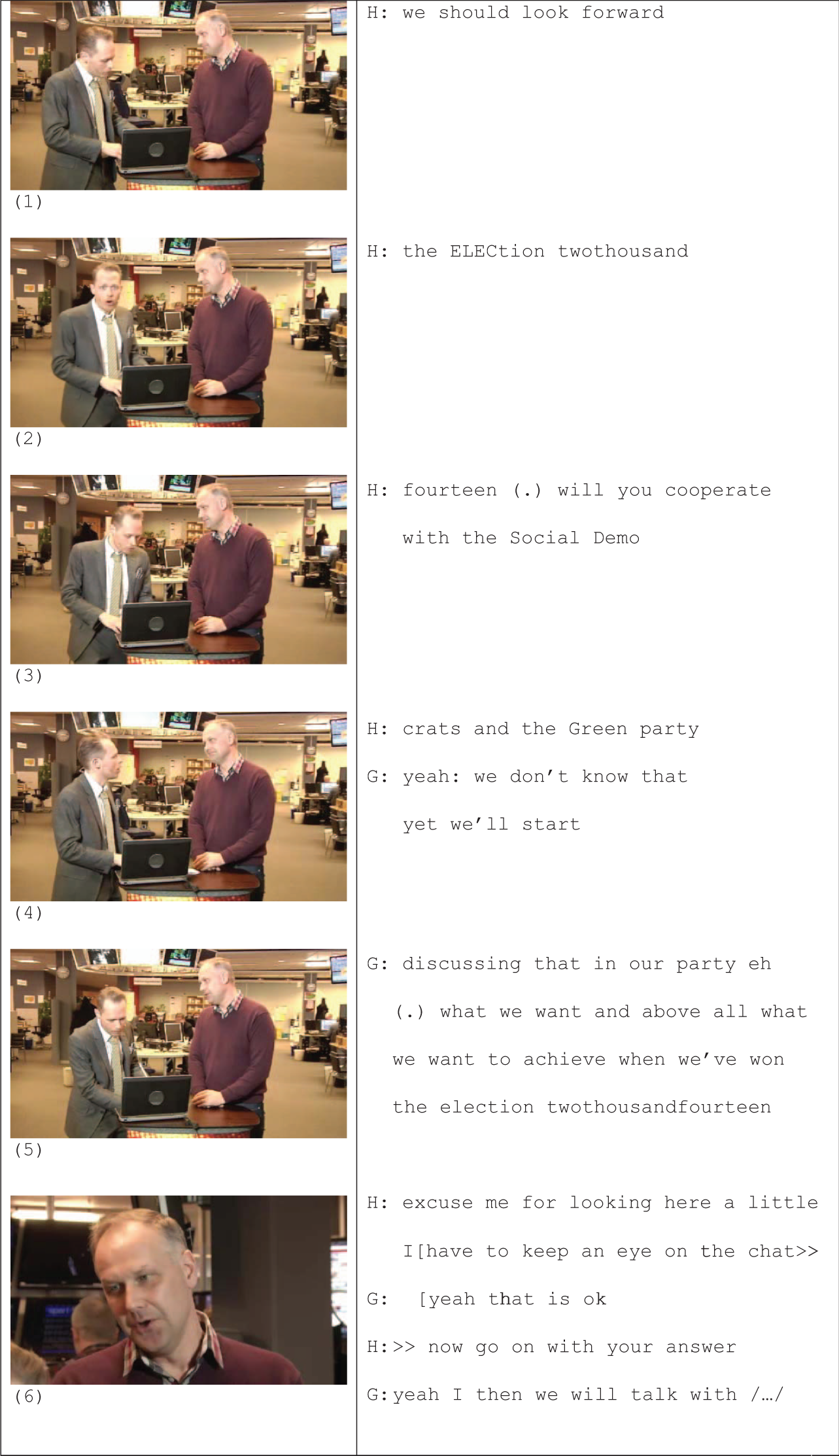
‘Interactional repair’ in relation to studio guest.
While this sequence is played out, there is a camera switch to a head-and-shoulder shot of the interviewee (6) as if to disguise the host’s engagement in his laptop. The top of the host’s head is still visible in the lower left corner as he looms over his computer. The interviewee apparently decides that it is better to look at the host not looking at him than to look at the camera as he delivers his answer. All in all this situation creates a rather strange moment for any viewer accustomed to the conventions of broadcast news as it so obviously breaks with the sociability between both broadcaster and viewer and broadcaster and guest. Generally, cameras operate so as to hide interviewer actions such as looking at notes or communicating with members of staff, that is, activities that take away attention from the interviewee. Moreover, an interviewer would never make a comment about being overtly unfocused as this would violate professional norms in general and specifically also the conduct during interviews.
In this case, it is disputable whether the display of the described departure from conventional professional broadcasting practices is desired or not. On the one hand, the host is obviously prompted to excuse his screen-staring behaviour, and there is also the shot-switch to the interviewee that can be seen as an attempt to disguise the host’s prolonged gaze at the laptop (even though part of his hair is still visible). This suggests that the host’s unfocused attention in relation to his guest is not something that ought to be conveyed to viewers. The fact that the interviewee, even if only for an instant, looks slightly awkward and hesitates as he has no one to direct his gaze at also shows that the laptop orientation in this particular instant does pose a risk, at least when it comes to the sociability among the participants on camera. On the other hand, the activities in this sequence also accentuate ‘the real-time production’ and the co-productive character of the programme. The producers display an essential element (host reading from the chat), which is of central importance for the producers’ ambitions of it being a joint venture together with audiences.
Complex multimodal situation 2: managing the camera, multiparty guests and microphones
The film camera is a technology for extended visibility which facilitates the creation of here-and-now live experiences not limited to common localities. However, the camera shot controls what the viewer can and cannot see. A significant aspect in the production of live broadcast talk is therefore the synchronization between the camera work and the activities in front of the camera, not least activities relating to the participants’ interactions, individually or jointly. Close-ups and switches between camera shots are used to show people involved in conversation as both speakers and listeners.
Even though, in the previous section, we gave examples of how the sociability between viewer and guest versus the host may be disrupted, as the latter departed from established broadcast conventions because of his laptop orientation, broadcast talk, including talk on svt news live, is generally organized as a focused interaction. The participants are positioned close together and a single focus of attention is created in a mutual orientation when it comes to body posture and gaze. The audience is thereby invited into a shared interactional space with the participants on camera/screen. The host is normally standing to the left while interviewing one or several people. Generally, the participants orient to each other by shifting body posture and gaze direction within a common interactional space. Figure 3 illustrates how studio guests, even though they are not addressed by a question, join the host in an orientation to the person who receives, or answers, the host’s question. Thus, all participants can be said to be engaged in the conversation even if they are not the ones speaking in that very moment. The camera creates a restricted frame and focuses on the people who partake in the interaction. Although these conversations are produced with two cameras, shot switches and changes in shot range are rather few. This is partly related to the fact that only one person is operating both cameras. The most typical frame in svt news live is the central-shot illustrated in Figure 3, where the audience can follow how the participants orient to each other in their roles as engaged speakers, recipients and listeners.
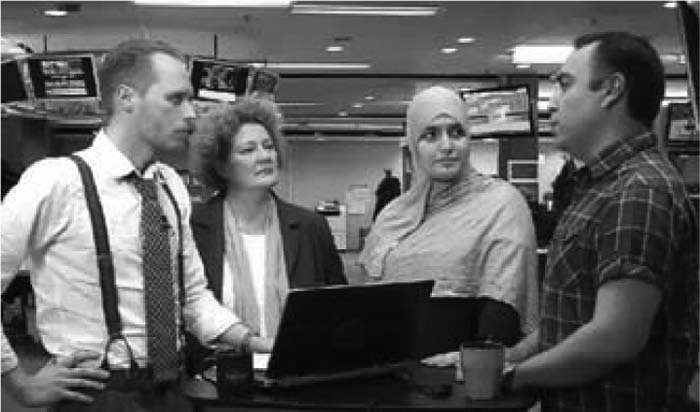
Joint orientation toward current speaker.
In the production of svt news live this camera frame is normally also used in the various activities in which the host either talks directly to the audience in the introduction of the programme, or talks to a person participating via telephone or Skype during airing. In these instances, the other participants who are not involved in the conversation are visible for the audience, but their role in the interaction is unclear. In some cases they seem to perform what can best be described as a disengaged and uncomfortable waiting; they shift their body posture and glance in different, and seemingly odd, directions. At other times, they act as if they are not part of the activity at all, directing their gaze at activities going on outside of the frame available to the audience (Figure 4 [1]).
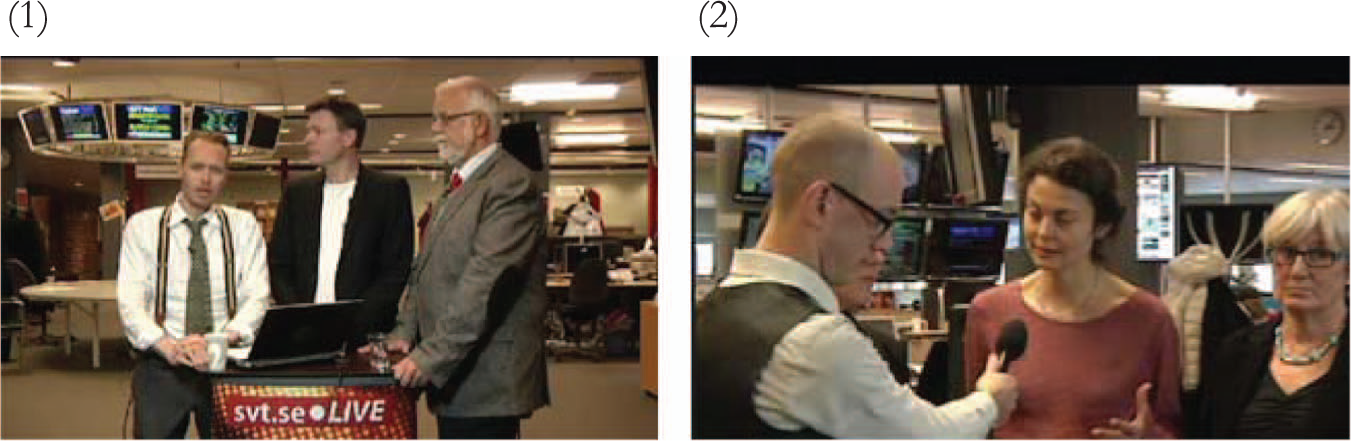
Disengaged or camera-glancing activities.
In the production of conventional television broadcast talk, studio arrangements and zoom-ins are regularly used to separate activities and restrict the frame to those who are involved in a single focused interaction. In the kind of interactions described here, and on quite a regular basis, participants glance at the camera as well during multi-party interviews (Figure 4 [2]). As they do so, not only do they draw the attention to the camera and the act of mediation, but they also appear generally disengaged with what is going on. Occasionally, non-interviewed guests who are present in the frame move in and out of the focused interaction by changing gaze-direction from looks at the person talking to looks beyond the shot-frame. Instead of contributing to a focused interaction, they display an ambiguous participant framework. In formatted studio interviews, such unfocused glances to the camera are very uncommon (Ekström, 2012).
A specific form of departure from conventional television practices on svt news live is that they sometimes use camera angles that prevent the audience seeing what other people (shown on the screen) are oriented to. In such instances, the audience is partly left outside of the focused interaction. This occurs in a filmed sequence where two cameras are set up to capture the interaction. A female interviewee representing the police is asked a question by the host (Figure 5 [1]), but during the interview they switch cameras so that the interviewee is hidden behind another participant in the following frame (Figure 5 [2]). The interviewee is thus less likely to be able to connect with the audience and the chosen visual frame may even risk her credibility as an authoritative source on the programme. The seemingly ‘amateurish’ mode of filming may in fact have consequences for the status that audiences ascribe to those who are interviewed on svt news live.
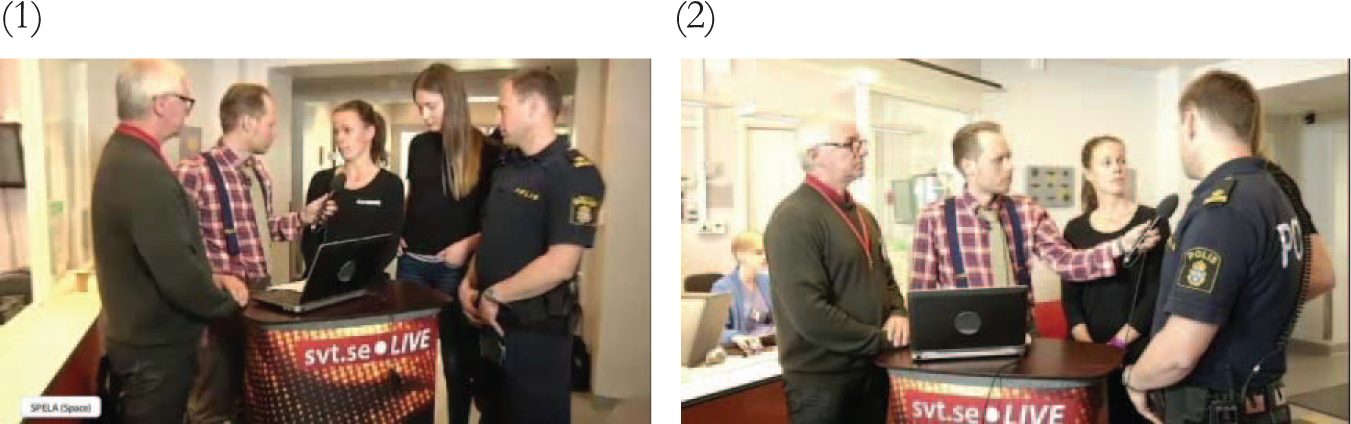
Participants invisible to the audience.
One could ask what these departures from established visual broadcasting conventions actually stand for in this context, and whether they are somehow detrimental to the establishment of sociable relations with audiences. Alternatively, are they perhaps best understood as mistakes during production that can at least partly be explained by the restrictions of the solo-camera operator? On the one hand, they could be seen as flaws if compared to the norms of broadcasting interaction in general when it comes to the workings of the camera and in the ways that guests sometimes behave. On the other hand, it could be seen as broadcasting’s way of adapting to established web norms and practices which have been established in formats other than news reports and presentation. Even if you are a public service professional used to making impersonal, formal and polished news productions with a definite authoritative feel, these examples show that, when transiting to the web, allegedly one needs to adopt certain elements that also resemble the DIY-mode of addressing audiences, who presumably also want to be oriented to in that way. However, the aspiration for a less sophisticated, backstage-look for the production may also possibly taint the reputation of a broadcasting company if it were to backfire. ‘Mistakes’ made on the programme could contribute to a diminished authority for the company.
Nevertheless, Figures 4 and 5 demonstrate the centrality of how technologies are managed, and how talk and camera work is synchronized in the production of audience-friendly forms of focused interaction. Some of the flaws in svt news live would certainly qualify for a blooper collection (cf. Hutchby, 2006: 3), but in the context of the svt news live they do not necessarily turn into comic events because imperfection is in some sense the goal of the programme. Participants oriented outside the frame of talk, performing as if disengaged and sneaking glances to the camera, could risk the programme’s sociability but not necessarily so. It is also dependent, as the final example will show, on how the journalist as a host and interviewer involves the audience in what takes place in the programme (see Figure 6).
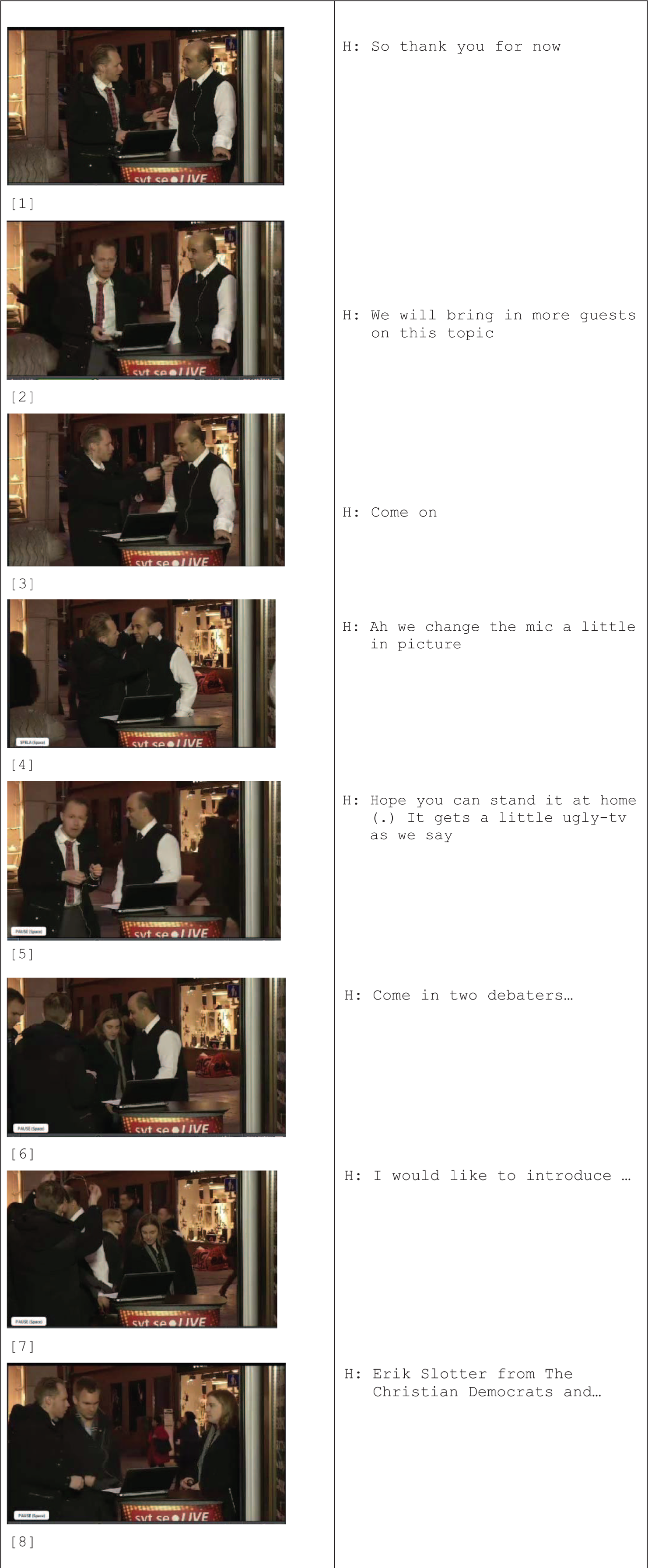
The changing of microphones as an act of sociability.
In this sequence, the host is interviewing a shopkeeper and two politicians in relation to a debate concerning the legislation on installing CCTV cameras in public places and the permissions necessary to do so. The flexible small-scale svt news live studio has situated itself in the street outside a shop. What is illustrated in Figure 6 is a shift from one interview to another and the related shift of microphone. The microphone is a key technology in television talk. In interviews, the hand microphone is often visible; it is a technological artifact that signifies journalism at work and the asymmetric roles inherent in interviewing. In this live broadcast the host assists the interviewees to shift the headset. On camera the host does something that, in traditional television news, is usually a backstage activity handled by studio personnel. The interview moves into – and includes – an activity of dealing with technology, besides what is normally the case, that is, orienting to the activity of posing questions and answering in a clear division of labour between interviewer and interviewee.
In the first two images (Figure 6 [1] and [2]) the journalist closes the first interview with a ‘thank you’ directed at the interviewee. In a look-to-camera he then tells the audience that it is time to involve some other guests. He uses a ‘we’, possibly to imply an inclusion of the audience. The host then moves into the technology-oriented activity (Figure 6 [3] and [4]). With his back to the camera he explains what is going on: ‘we change the mic …’ In contrast to the previous ‘we’, this ‘we’ rather excludes the audience. By explicitly recognizing the activity it is, however, shared with the audience. The host then shifts his gaze, looks to the camera, and apologizes for the activity that they are currently involved in (Figure 6 [5]). In using an even more explicitly exclusive ‘we’ the host involves the audience in a backstage activity. By apologizing, he also recognizes his involvement in an unconventional activity, if this was a traditional television news broadcast. That is, he recognizes that the hooking-up of microphones in between interviews is normally a concealed broadcast practice while simultaneously manifesting that this backstage practice is a part of the svt news live profile.
The host then welcomes the two new guests and, again with his back to the camera, introduces them to the audience (Figure 6 [6] and [7]). The talk is coordinated with changes in body posture so that the three people are positioned in a conventional talk for the audience position (Figure 6 [8]). This example illustrates that the focus on otherwise concealed technology-oriented practices does not necessarily distract from the sociable talk with the audience. On the contrary, the host uses the arrangement of the microphone as an opportunity to involve the audience in the live production, emphasizing its here-and-now character. This is carefully managed in a coordination of spontaneous talk, multiple addresses, gaze shifts, body movements and the actual handling of the microphone. More generally, this example illustrates that it is not the concealment and display of technologies and actions as such that are detrimental to the sociability of broadcasting – at least in these kinds of web contexts – but how it is dealt with and integrated in audience-oriented activities.
Conclusions
We set out to study Swedish Public Service Television’s attempt to adapt and extend their news production to the web platform and supply viewers with live and flexible airings. These airings are reminiscent of established public service news formats (interviews at the centre, a main anchor in focus, generally recognizable patterns of visualization and interactional organization). At the same time, they display a kind of off-character mode of address, with sometimes unpolished and unsynchronized camera work and the partly unfocused behaviour between the host and his guests in backstage environments.
Some key departures from established conventions in broadcast television include orienting to an active user accessible live through a chat that needs to be monitored, while at the same time attending to present guest(s) as well as to those merely watching and not contributing. To manifest that this is a live co-production, the laptop is made the centre-piece and is thus cast as the symbol of the news format’s interactive ambition, where audiences are to be included as co-constructors of news. However, it is not easy simultaneously to manage pre-planned questions in the script, monitor an unfolding live chat and attend to viewer expectations of being acknowledged in looks-to-camera. At times, guests can be left talking into thin (h)air rather than to a host who recognizes them as an acknowledged source of information because the chat takes priority over both viewer and guest orientation. More successfully, though, the host also displays, for the web context, vital competences by incorporating backstage activities and otherwise hidden broadcast practices into the discourse, in order to not disconnect with either the viewer or the guests, such as in the microphone example.
On a general level, one could say that it is not the display or concealment of production technologies (cameras, scripts, etc.) as such – nor the degree of broadcast perfection – that creates or challenges sociability in broadcast communication. It is rather about sincerity (Scannell, 2010) and about the extent to which audiences are involved or left aside. The problem with a quick glance to the camera is not that it breaks an illusion and makes the audience aware of the mediation, as audiences are regularly made aware of meditations. It is the observable act of concealment which is detrimental to audience relations. The case analysed, in which the host arranges the microphone in front of the audience, illustrates, for example, a specific form of imperfection in live web production that departs from regular television broadcasting, but it also illustrates the general practice of taking care of audiences (Scannell, 2010) in carefully managed, and sincere, forms of broadcast talk.
The fact that SVT’s svt news live was rather promptly closed down after about seven months, as was its predecessor Open Newsroom (Sw. Öppen redaktion) a couple of years before, proves that making the transition between media platforms for professional news producers wanting to adapt their ‘products’ to entirely different conditions for reception and production is not an easy task to accomplish. One of the main problems that we believe broadcasters struggle with in this context is that they are just that, that is, established professional broadcasters who have acquired practices to convey their professionality to audiences, even if this is done in sociable ways. The ‘problem’ with the web for broadcasters is that it requires of them to ‘let go’ of the professional broadcasting practices related to the production of ordinary television and produce less polished, ‘imperfect’ news to fit with the DIY-requirements of the web. At the same time, they cannot appear so unpolished as to threaten their professional standards as broadcasters. The ambition for svt news live to both produce live solo-video material with guests in pop-up locations, and at the same time wanting it to be good enough for the evening news, illustrates this very paradox. And perhaps it is this specific paradox that makes broadcasting in the digital era so challenging, not only in relation to audiences, but because the very definition of professionality in broadcasting needs to be re-examined, re-invented and re-established. However, as in the early days of radio, broadcasters are most certainly on their way to mastering the web as well, without losing sociable relations with audiences or their professionalism as journalists; though they may not be there just yet.
Footnotes
Acknowledgements
This article was first presented at the Ross Priory Broadcast Talk Seminar in 2012. We are grateful for comments and and suggestions provided from members of the group and from the anonymous reviewers.
Declaration of conflicting interests
The authors declares that there is no conflict of interest.
Funding
This research received no specific grant from any funding agency in the public, commercial, or not-for-profit sectors.