




Abstract
Tabloidization of news and its potential threat to democracy is a recurring issue in debates among scholars and journalists. Most research focuses on measuring either content or the effects of tabloid-style content and often leaves the antecedents of the content as a ‘black box’. This study compares tabloid journalists to other journalists based on a survey of Danish journalists (N = 1550). It shows that tabloid journalists in many regards hold professional values that differ from the values of other journalists and that they experience different pressures from the organization in which they work. In their journalistic style tabloid journalists emphasize personalization and sensationalist news values more and relevance news values less than other journalists. Finally, tabloid-style journalism is to some extent driven by profit orientation in journalists as well as in their organizations. However, the study also shows that journalists’ adherence to the role as public mobilizer is positively related to personalization, which implies that tabloidization might carry benefits and not only threats to democracy.
Tabloid journalism has been accused of contaminating ‘serious journalism’ with sensationalist news values and a popularized and personalized journalistic style (e.g. Harrington, 2008; Örnebring and Jönsson, 2004; Uribe and Gunter, 2004). Esser (1999) and Sparks (2000) have described tabloidization as a spillover of reporting practices from tabloid newspapers to hard news outlets due to economic pressure in the media business.
The result is allegedly a decline in the quality of journalism with dire consequences for public debate and democracy (e.g. Currah, 2009). Others refute this and point out that the tabloid style makes news less abstract, and more accessible and easier to comprehend (e.g. Baum, 2003; Macdonald, 1998).
The extent and effect of tabloidization of journalistic content is still disputed – including whether it is actually occurring. Numerous studies focus on these questions, while almost no attention has been devoted to the journalists who produce the content. However, studies of professional values and journalistic practices as well as the organizational pressures journalists experience will add to our understanding of the process and the causes of tabloidization.
Tabloid journalists are commonly studied in a vacuum without a benchmark to measure the findings against. Bird (1992) finds that tabloid journalists defend their actions with reference to traditional professional journalistic values, while Deuze (2002) finds that Dutch tabloid journalists make an effort to distinguish themselves from other journalists. This illustrates the need to compare tabloid journalists to other journalists in order to study their particularities. Furthermore, when tabloidization is said to be a spillover of distinct reporting practices from tabloid newspapers to hard news outlets, it means that the popularized, personalized and sensationalist journalistic style is by no means limited to traditional tabloid outlets, but that the question rather is to which degree these reporting styles are present. This makes it interesting to study whether the use of these reporting styles can be explained by professional values and organizational pressures.
The article has two aims. Based on a comprehensive survey of the population of Danish journalists it studies, first, whether tabloid journalists hold different professional values from their colleagues in other media outlets and experience different organizational pressures. Second, the article studies which aspects of these professional values and organizational influences might explain journalists’ use of a reporting style with emphasis on personalization and sensationalist news values.
Some critics claim that tabloid journalism is a result of a hunt for profits (e.g. Barnett, 1998; McManus, 1994). Others argue that the ambition could be to make politics and current affairs comprehensible and interesting to less attentive citizens and give them a chance to voice their concerns in a democratic debate (e.g. Bird, 2000; Macdonald, 1998).
Thus, the study elucidates whether there are differences between tabloid journalists and other types of journalists, and whether these differences are driving a tabloid journalistic style. Such insights will tap into the normative discussion of whether such a style of journalism could also be the result of ‘good’ intentions on the part of journalists rather than just a blind chase for profits.
The article proceeds by describing the aspects of tabloid journalism that will be studied. Next, it outlines expectations about (1) differences between the professional values of and organizational pressures on tabloid journalists and other journalists, and (2) what drives the use of tabloid-style journalism. Subsequently, a survey of Danish journalists is utilized to study these expectations and the implications of the results are discussed.
Tabloid journalism
The term ‘tabloid’ originally refers to a half-sized broadsheet newspaper, but the connotations of tabloid journalism go way beyond the format of the newspaper. The entry for ‘tabloidization’ in The International Encyclopedia of Communication notes that tabloid-style journalism is vaguely defined, but it does identify some key areas where agreement has emerged (Bird, 2008). It points to a more extensive use of narratives and more limited use of an analytical mode, as well as greater emphasis on personal and human interest stories.
In their review, van Santen and van Zoonen (2009) point to sensationalism and human interest stories as important and defining aspects of tabloidization. This is very much in line with Sparks (2000), who also stresses the attention to the private lives of celebrities and ordinary people as well as the emphasis on scandal and popular entertainment. In these definitions the tabloid style is characterized by an emphasis on sensationalism, emotions and the private lives of both celebrities and ordinary people.
The two aspects of tabloid journalism studied in this article are personalization and the application of sensationalist news values.
Personalization
Personalization is a rather broad concept, which is often studied in connection with political journalism (for an overview see Adam and Maier, 2010; Jebril et al., 2013). In this study, which deals with journalism in general and not only political journalism, personalization means the focus on individuals’ private lives, experiences and emotions (MacDonald, 1998; Uribe and Gunter, 2004; van Santen and van Zoonen, 2009: 22). Sparks points out that in tabloid journalism ‘the personal is not only the starting point but also the substance and end point’ (1998: 9). Macdonald (1998) connects the words ‘abstract’, ‘rational’, ‘analytical’ and ‘universal’ to broadsheet papers, and the words ‘experiential’, ‘emotional’, ‘intuitive’ and ‘contingent’ to tabloid papers. Personalization is here defined as including people’s personal experiences and focusing on a problem from a personal and emotional point of view rather than an abstract and analytical point of view.
Sensationalism
Sensationalism is the other aspect of tabloid-style journalism. It regularly appears in the various definitions of tabloid journalism, and is often more or less interchangeable with terms like ‘scandal’ and ‘drama’ (e.g. Barnett, 1998; Örnebring and Jönsson, 2004; Sparks, 2000). Sensationalism is not very well defined either, but is generally associated with stories that are supposed to provoke sensory and emotional reactions, because they are unexpected, dramatic, or appeal to readers’ curiosity (Grabe et al., 2001). This makes it useful to study sensationalist news values as part of tabloid-style journalism. News values have traditionally been perceived as selection criteria applied by journalists to decide which occurrences should become news stories and which should not. But news values are also applied in the presentation and not just in the selection of a story (Staab 1990). Sensationalist stories are often claimed to displace relevant news or hard news (e.g. Bird, 2008; Kalb in Esser, 1999: 292). When sensationalist news values are said to displace relevance news values due to tabloidization it is also useful to include relevance news values in this study. These should be understood as stories that are of social significance to the public and have important consequences for at least some citizens (see e.g. Harcup and O’Neill, 2001).
In sum, tabloid-style journalism refers to a journalistic style that emphasizes personalization and sensationalism, which also drives out hard news based on relevance news values. In the following, I outline how professional values and organizational pressure can be expected to differ between tabloid journalists and other journalists, and which differences can be expected to explain journalists’ use of tabloid-style journalism.
Professional values
There are good reasons to expect differences between tabloid journalists and other journalists when it comes to the organizational pressure they experience and their professional values. Though the professional status of journalism is disputed, scholars generally agree that journalists share a common occupational ideology and that the public service norm is one of the most important professional values (e.g. Deuze, 2005; Hallin and Mancini, 2004). Other professional values can be viewed as means to carry out this public service function. In particular, the objectivity norm and journalistic role perceptions are accentuated in this regard (e.g. Deuze, 2002, 2005; Tumber and Prentoulis, 2005). Also Danish journalists show strong support for a public service obligation and a role as a watchdog that critically scrutinizes societal issues (Skovsgaard et al., 2012). Similar results are found in Sweden (Asp, 2007) and these professional values are generally treasured by journalists around the world (Weaver and Willnat, 2012).
However, Reese (2001) stresses that the professional ideology is not fixed, but constantly interpreted, renegotiated and redefined (see also Deuze, 2005). This interpretation and negotiation process takes place in close interaction with the organization in which the journalist works, because journalists generally depend on their organization to give them access to the public they claim to serve. Compared to other professionals such as lawyers or doctors, who work in the public interest by serving individual clients, journalists are more dependent on their organization to be able to serve the public (Aldridge and Evetts, 2003). News organizations have even been called ‘crucial containers’ due to journalists’ dependence on them in their daily work (Preston, 2009).
Professional ideals are often not entirely compatible with the news organizations’ goals, and scholars have pointed out that professional values are under pressure from the organizations’ profit goals (Hallin and Mancini, 2004; McManus 1994, 2009). A previous study shows that Danish journalists feel quite some influence from competition with other media and audience figures in their daily work (Skovsgaard et al., 2012).
The tension between journalism as a public trust and a commercial product is often emphasized (e.g. Hallin and Mancini, 2004; McManus, 2009). Tabloidization has been claimed to be a result of profits being favoured over the professional norm of serving the public (e.g. Esser, 1999). The tabloids are exposed to substantial pressure to sell newspapers. They are usually sold in single copies from news-stands, whereas broadsheet newspapers are much more frequently sold through subscriptions. This means that tabloids – at least in the short run – are more dependent on the popular appeal of their stories than the daily newspapers. If they do not sell themselves every day, it is reflected in the sales figures the same evening. The same is true for television and radio journalism where ratings are almost instantaneous. In the American debate, ‘tabloidization’ is the term often used to describe the declining quality of television news. McManus (1994) has illustrated how the clash of professional ideals and popular appeal plays out in terms of tabloidization of American television news.
In many other countries, especially in Europe, the television market is quite different, with strong public service broadcasting traditions. In Denmark, where the data in this study was collected, the public service obligations of the two dominant television stations, the Danish Broadcasting Corporation (DR) and TV2, and the dominant radio station (also DR), are written into legislation. As a consequence, they are less exposed to immediate commercial pressure than tabloid newspapers.
This suggests that tabloid journalists experience more organizational pressure for profit than journalists employed elsewhere (including television and radio). This leads to the first expectation:
H1: Tabloid journalists feel more influence from audience figures and competition with other media in their daily work than journalists employed at other types of media.
Since the professional ideology is reinterpreted and renegotiated in close interaction with the organizational context, it can also be expected that different organizational goals and pressures lead to differences in the adherence to professional values among journalists in different types of news organizations. Scholars point out that organizations want employees who act in accordance with the organizations’ goals (e.g. Soloski, 1989). In his classic study, Breed (1955) showed how news organizations exercise social control in the newsroom in subtle and covert ways because they cannot legitimately overrule journalists’ professional judgements on a permanent basis. To some extent this social control socializes journalists into adjusting their professional ideals to the organization’s goals. It can thus be expected that the organizational goals are reflected in the interpretation of and emphasis on professional values in the occupational ideology of the individual journalist.
Tabloid newspapers are said to be driven by a focus on profits rather than public service ethics, which means that tabloid journalists are likely to experience more commercial pressure in their daily work than other journalists. This leads to the expectation that tabloid journalists emphasize a public service notion less than journalists employed at other media types. The same can be expected for professional values that serve as means to implement the public service notion, such as objectivity and democratic role perceptions. Consequently, tabloid journalists will be more profit oriented and adhere more to an entertainment role perception than their colleagues employed elsewhere.
H2: Tabloid journalists emphasize a public service notion less and are more profit oriented than journalists employed at other media types.
Sensationalism and personalization in journalistic practice
Turning to journalistic practice, differences between tabloid journalists and other journalists can also be expected. As mentioned, a journalistic style with emphasis on sensationalist news values and personalization are two aspects that repeatedly appear in definitions of tabloidization (e.g. Esser, 1999; Örnebring and Jönsson, 2004; Uribe and Gunter, 2004; van Santen and van Zoonen, 2009). Critics also argue that the emphasis on sensationalism and scandal replaces the emphasis on the relevance of a story (e.g. Barnett, 1998; Grabe et al., 2001). The term ‘tabloidization’ implies that these aspects originate from tabloid journalism, and the next two expectations for the comparison of tabloid journalists and other journalists are:
H3: Tabloid journalists emphasize sensationalist news values more and relevance news values less than journalists employed in other media types.
H4: Tabloid journalists emphasize personalization in their journalistic style to a higher degree than journalists employed in other media types.
Tabloidization is defined as a spillover of reporting practices from the tabloid newspapers to other, harder news genres. The question is, therefore, to what extent journalists employ these reporting practices, not whether they do (e.g. Esser, 1999; Sparks, 2000). This makes it interesting to examine the whole population of journalists to see which factors explain use of a journalistic style with emphasis on sensationalism and personalization.
Since market-driven journalism is often associated with tabloidization, it is obvious that journalists’ own focus on profit rather than public service should be examined. Another factor is how much pressure they feel in their daily work to build an audience for their news outlet.
Ever since the penny press began to produce dramatic, human interest news in the 1830s, these news practices have been seen as a hunt for profits at the expense of ‘serious’ journalism (Bird, 2008). The argument goes that fragmentation of the media market and increasing competitive pressures have led journalists to apply a sensationalist and personalized style in their stories. Esser expresses the relation very directly in the first sentence of his article on the tabloidization of the news: ‘“Tabloidization” is the direct result of commercialized media, most often promoted by the pressure of advertisers to reach large audiences’ (1999: 291).
Sensationalism is meant to excite the receivers’ curiosity (e.g. Grabe et al., 2001; Örnebring and Jönsson, 2004; van Santen and van Zoonen, 2009). The same is true for an emotionalized journalistic style (e.g. Esser, 1999; Uribe and Gunter, 2004). According to Curran et al. (1980: 303), the less contextualized journalistic style with emphasis on persons and emotions is a recognized and approved strategy for building circulation. The same goes for sensationalist news values that make the journalistic product more accessible to the non-elite audiences and aim at building circulation (Grabe et al., 2001).
This also implies that the more influence audience figures have on journalistic work and the more a journalist is focused on profit rather than public service, the more he or she will apply a personalized journalistic style emphasizing emotions as well as sensationalist news values. In the same vein, critics argue that the emphasis on sensationalism and scandal replaces stories selected for their relevance (Barnett, 1998; Grabe et al., 2001). We can therefore expect that journalists will emphasize relevance news values less if they feel more influence from audience figures and if they are more profit oriented:
H5a: The more profit oriented journalists are and the more influence they perceive audience figures to have in their daily work, the more they will apply sensationalist news values
H5b: The more profit oriented journalists are and the more influence they perceive audience figures to have in their daily work, the less they will apply relevance news values.
H5c: The more profit oriented journalists are and the more influence they perceive audience figures to have in their daily work, the more they will emphasize personalization in their journalistic style.
Some scholars contend that it is too simplistic to understand the use of a personalized journalistic style as a negative trend in the hunt for profits. Bird (2000) and Macdonald (1998, 2000) argue that human interest, emotions and personal experience do not necessarily result in a decline in journalistic quality since these aspects might help people understand an issue better, and increase attention and knowledge among some news consumers (see also Baum, 2003). The personalized journalistic style where ‘ordinary’ citizens are included can also be an attempt to serve the important democratic function of inviting citizens into the public debate and giving voice to their concerns. This is connected to participatory or deliberative democracy, where the function of journalism is to include citizens in a public debate (Strömbäck, 2005). The inclusion of ‘ordinary people’ in the news is thus the first step in getting citizens to participate in democratic deliberations, detecting society’s problems and generating solutions. This leads to the following expectation:
H6: The more journalists adhere to a public mobilizer role, the more they will emphasize personalization in their journalistic style.
Methods
These hypotheses are explored by drawing on a survey of the population of Danish journalists. The high number of respondents allows a comparison of tabloid journalists and journalists employed at other types of news organizations. Other studies of tabloid journalists are entirely or partly based on qualitative designs with in-depth interviews (e.g. Bird, 1992; Deuze, 2002), while the approach of this study gives a benchmark to compare the tabloid journalists against. It also has the advantage over a content analysis – a method often applied to the study of tabloidization – that it makes it possible to study some of the important variables in the production process, which would otherwise be a ‘black box’.
The survey was conducted in close cooperation with the Danish Union of Journalists (Dansk Journalistforbund) during June and early July 2009. The total population of Danish journalists working full-time in media organizations or as freelancers (excluding, for instance, journalists working in public relations and unemployed journalists) was extracted from the union’s member records via a selection of relevant media categories, such as magazines, daily newspapers, radio, television, web media and freelancers, amounting to a total of 5519 journalists. The organization rate of Danish journalists has always been high, and the Danish Union of Journalists estimates that it organizes 90–95% of regular Danish journalists today. This gives us a unique opportunity to survey precisely that population. We were given permission to send an email invitation including a link to the online questionnaire to all 5519 journalists in the union’s directory.
Of the potential respondents, 327 did not belong to the population and 664 questionnaires were not delivered correctly and thus never reached the respondent; 2008 respondents completed the questionnaire, which equals a 44.3% response rate of the total population 1 – a sound result compared to similar surveys in other countries (Weaver and Willnat, 2012).
The union had information on variables such as gender, age, place of residence and media type, which made it possible to compare respondents and non-respondents. The analysis shows that the two groups are largely similar. The proportion of women is a bit larger among the respondents than among the non-respondents, and the same goes for television journalists. However, the differences are quite small and do not present problems in terms of interpreting results.
Since some of the variables in the analysis relate to the journalists’ employers, freelance journalists in the sample were excluded, reducing it from 2008 to 1550 cases, which is the sample analysed.
Measures
The variables in the analyses are based on questions from the survey. Some of the questions differ in the range of response categories because comparison with identical questions from international surveys was emphasized. To ease interpretation of the variables in this article and avoid measures on several different scales, all variables (except the dependent variables, that is, sensationalist and relevance news value and personalization) have been rescaled to range from 0 to 1.
Organizational influences. To measure the organizational influences from competition and audience figures, the journalists were asked to indicate on a scale from 0 to 10 how much competition with other media and audience figures influence their daily work. The variables were rescaled to range from 0 to 1 (all items, question wordings and descriptives for variables can be found in Appendix A).
Professional values. A four-item scale was created to measure profit orientation (α = .67) and rescaled to range from 0 to 1.
To measure how much journalists emphasize the objectivity norm, respondents were asked to indicate on a scale from 0 to 6 how important they perceive objectivity to be in journalistic work. Regarding perceptions of their role in society, the journalists were asked how important they find different journalistic roles that the media fulfil or try to fulfil today. Two scales were formed, based on a principal component analysis; one for a critical active role consisting of six items (α = .79) and one for a public mobilizer role consisting of three items (α = .64). Furthermore, there were single-item measures for a passive mirror role and an entertainment role. All these variables were rescaled to range from 0 to 1.
Sensationalism, relevance and personalization. The journalists were asked how important different aspects should be in the assessment of whether an occurrence should be selected for a news story. Two scales were formed, based on a principal component analysis; one for sensationalist news values (α = .73) and one for relevance news values (α = .77). For the personalized style the journalists were asked a battery of questions on the extent to which they apply different journalistic methods. Based on a principal component analysis a three-item scale for personalized style was formed (α = .67). These measures for news values and a personalized style all range from 0 to 4 (see Appendix A for details).
Analysis
To compare tabloid journalists with other journalists, we first need to define ‘tabloid journalists’. The term ‘tabloid’ originally means the physical format of newspapers. Since the term has come to refer to a distinct journalistic style, no easy definition presents itself. Newspapers in the tabloid format do not necessarily employ what is understood as tabloid-style journalism. In recent years, several ‘serious’ newspapers switched from broadsheet to tabloid format (e.g. The independent and The Times in the UK, and two of the three dominant dailies in Denmark: Jyllands-Posten and Berlingske). Sparks (2000) argues that there is no binary opposition between a serious and a tabloid press, but rather a continuum on which news outlets are positioned. He operates with five types of newspapers: The ‘serious’ press, the ‘semi-serious’ press, the ‘serious-popular’ press, the ‘news-stand tabloid’ press and the ‘supermarket tabloid’ press. Moving from the ‘serious’ press towards the ‘supermarket tabloid’ press means decreasing concentration on public life and increasing focus on private life, as well as decreasing concentration on politics, economics, and society and increasing focus on scandal, sports and entertainment.
The ‘supermarket tabloid’ press is uninteresting for the purpose of the comparison, since it is only marginally concerned with other media’s news agenda. The ‘serious-popular’ press and the ‘news-stand tabloid’ press both contain a large dose of content focused on scandals, entertainment, and private life. However, they are still to some extent concerned with the same news agenda as the more serious press and cover current affairs, politics and economics. But whereas the more ‘serious’ newspapers are more often sold via subscriptions, these tabloids are primarily sold by the copy. Journalists employed at these tabloid newspapers are here defined as tabloid journalists. The advantage is that the definition of tabloid journalists avoids the potential tautology trap – that tabloid-style reporting ends up defining tabloid journalists.
To make the comparison with the Danish data, the distinction between tabloid journalists and other journalists is operationalized as journalists working at the two tabloid newspapers in the category ‘the serious-popular’ press and the ‘news-stand tabloid’ provided above, namely Ekstra Bladet and BT. They are primarily sold in single copies from small shops, gas stations and supermarkets. They contain everything from current affairs and politics to sports and entertainment. In general they are not so far removed from the news agenda of the morning newspapers, but they are characterized by shorter stories, large illustrations and big headlines.
To compare tabloid journalists with journalists employed at other types of media, a one-way ANOVA was conducted to identify statistically significant differences between the mean scores of these groups. To identify what drives the individual journalist to apply tabloid-style journalism, that is, a sensationalist and personalized style, regression analyses were run against the three dependent variables (personalization, sensationalist news values, and relevance news values) with a two-step entry of the variables. The first model consists of the background variables age, education and journalistic experience along with dummies indicating the type of media. In the second model, additional variables for the journalists’ professional values and the influence from the organization were entered, that is, journalists’ profit orientation, perceived influence from audience figures, and adherence to the public mobilizer and the entertainment role.
Results
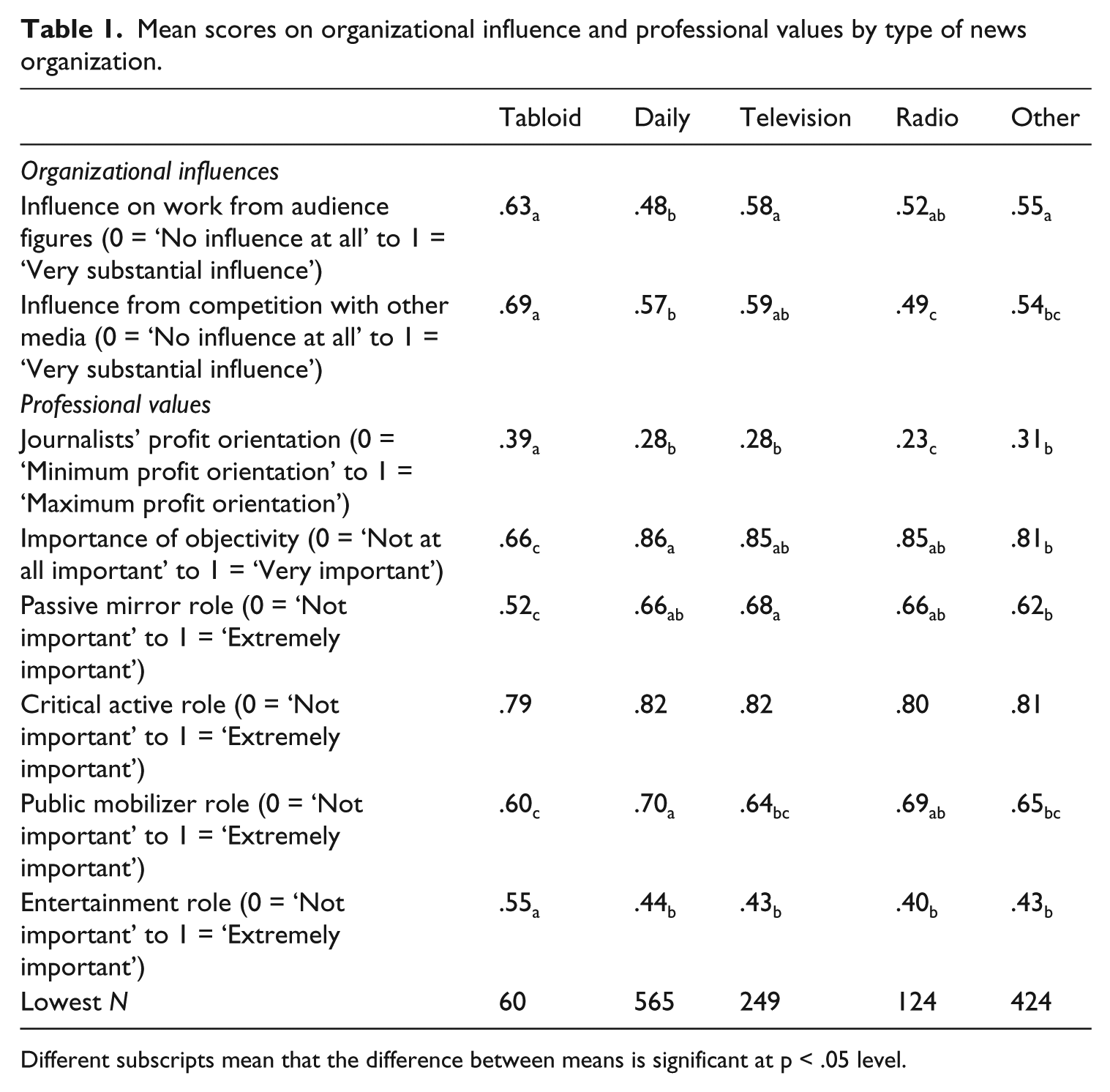
Tabloid journalists do differ from other journalists on several aspects. As expected in hypothesis 1 regarding organizational influence, tabloid journalists experience more pressure from audience figures in their daily work than their colleagues at other types of media outlets (M = .63). However, the difference is only statistically significant in the case of daily newspapers, which might be due to the low N in the tabloid journalist category (see Table 1).
Mean scores on organizational influence and professional values by type of news organization.
Different subscripts mean that the difference between means is significant at p < .05 level.
Tabloid journalists also experience more influence from competition with other media in their daily work than journalists working elsewhere. The results are statistically significant except for the case of television, even though the mean score for tabloid journalists is .10 higher on the 0 to 1 scale (.69 vs. .59). All in all, hypothesis 1 is supported with the exception that the results for the pressure from audience figures are not statistically significant, although they point in the right direction.
Turning to the hypothesis on the differences in professional values, the results are generally quite clear. On a scale measuring orientation towards profits rather than public service, tabloid journalists emphasize profit more than other journalists (see Table 1). This also indicates that they adhere less to the public service obligation usually connected with the professional ideology of journalists than other journalists. The difference is statistically significant, and the results thus support hypothesis 2.
The same goes for the importance of objectivity, which is often viewed as a means to carry out the public service function of journalism (e.g. Tumber and Prentoulis 2005). The perceived importance of objectivity is substantially lower for tabloid journalists than for other journalists. All differences are statistically significant and, except for the category ‘other’, the difference in the mean score is close to .20 on the 0 to 1 scale. The role perceptions show the same pattern. Tabloid journalists adhere less to the passive mirror role and the public mobilizer role and more to the entertainment role than their colleagues at other media. The differences are all in the expected direction and are statistically significant with a few exceptions on the public mobilizer role. Only the results for the critical active role do not follow that pattern. The mean scores for journalists at different types of media are all close to the maximum of the scale, and only minor and insignificant differences appear. This indicates that the ‘watchdog role’ is a widely shared professional value among Danish journalists. Nonetheless, the results lend substantial support for hypothesis 2.
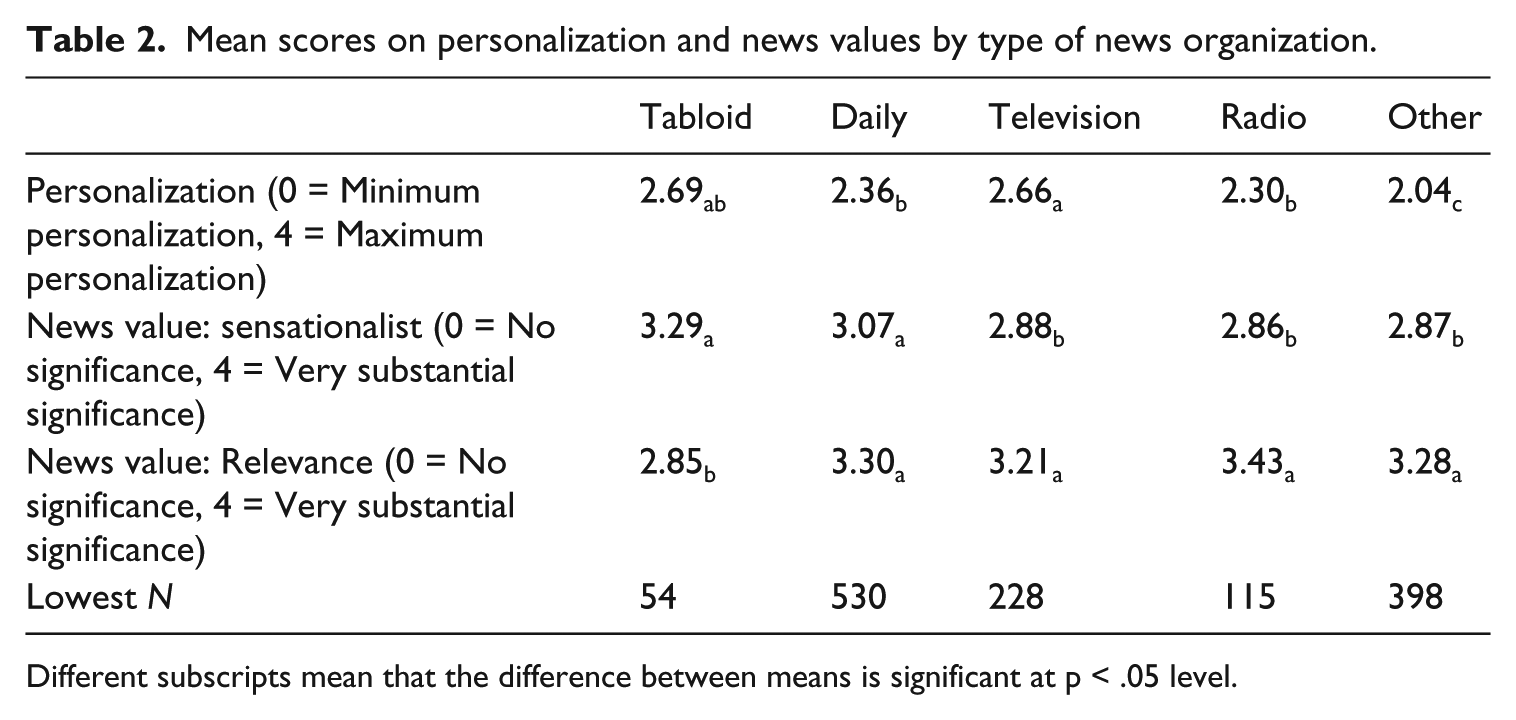
When it comes to tabloid-style journalism, that is, news values and personalization, the results are also quite clear and in the direction expected in hypothesis 3 and 4. Tabloid journalists emphasize sensationalist news values most with a score of 3.29 on a scale from 0 to 4. Journalists employed at other types of news organizations – except journalists at daily newspapers – score below 3 on this scale (see Table 2). The differences are statistically significant except for journalists at dailies where the difference does not reach the desired significance level.
Mean scores on personalization and news values by type of news organization.
Different subscripts mean that the difference between means is significant at p < .05 level.
The results for relevance news values are even clearer. As expected, tabloid journalists have the lowest mean score among the journalists and the difference is statistically significant in all cases. Only tabloid journalists score below 3 on a scale from 0 to 4. Accordingly, hypothesis 3 is supported by the results.
As expected, tabloid journalists also score highest on the personalized journalistic style. However, the difference is only statistically significant in comparison to journalists employed at media types other than daily newspapers, television, and radio. So although the results are in the direction expected in hypothesis 4, they do not support the hypothesis.
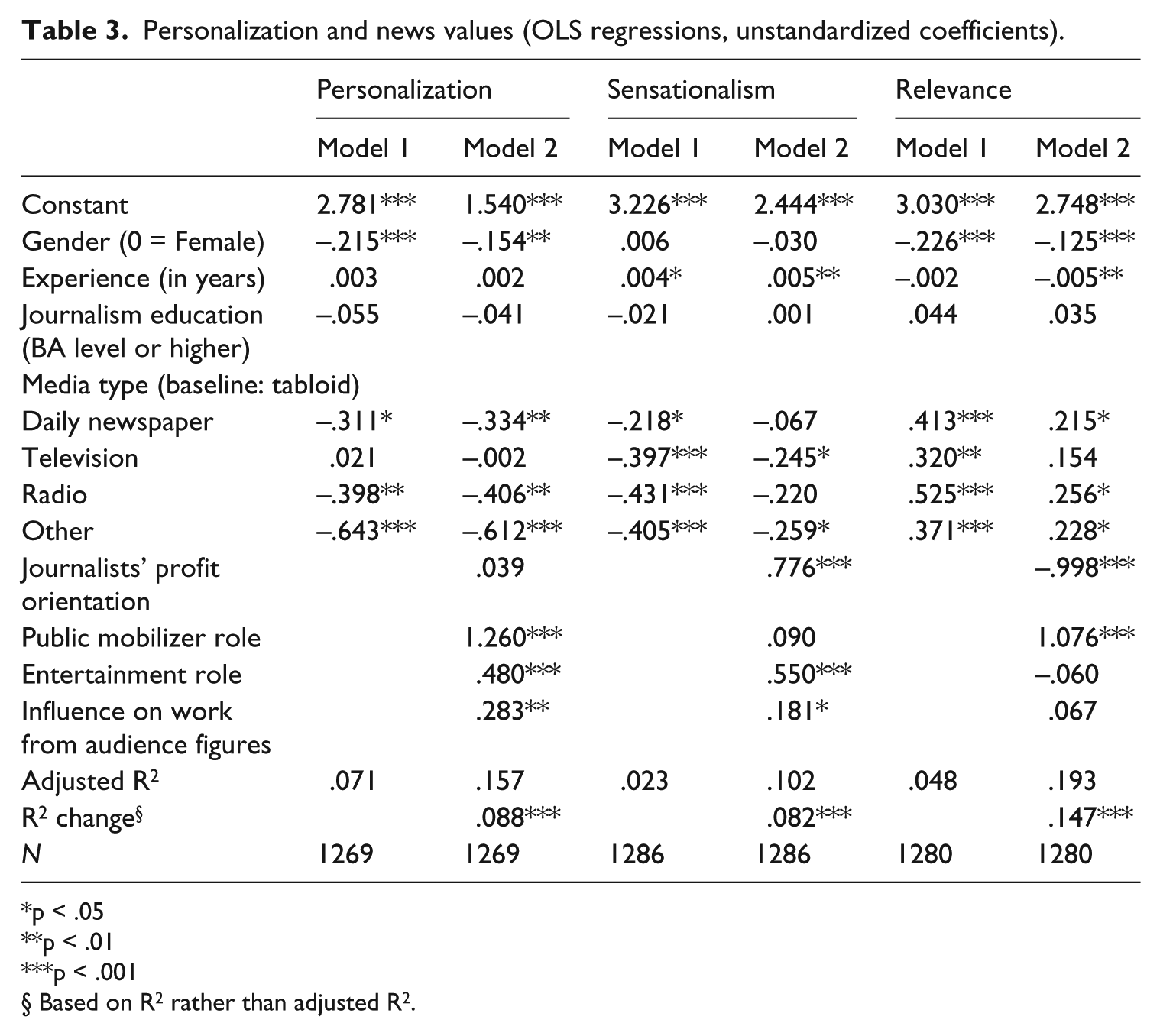
The results show differences between tabloid journalists and other journalists and support the idea of a particular tabloid mind. However, it is not clear which factors actually explain journalists’ use of a tabloid style of journalism. To study this, regression analyses were run against all three dependent variables, that is, personalization, sensationalist news values, and relevance news values (Table 3). The variables were introduced in two steps. The first model contains background variables and media type; the second model introduces professional values and perceived influence from audience figures. The change in R2 from model 1 to model 2 are in all three cases substantial, which indicates that professional values and the influence from audience figures have strong explanatory power in regard to how much journalists employ a tabloid journalistic style. In the case of sensationalist news values and relevance news values, the introduction of professional values and influence from audience figures in model 2 reduces the difference between tabloid journalists and journalists from other media types substantially. This means that the journalists’ profit orientation, their role perceptions, and the influence from audience figures introduced in model 2 indeed explain part of the difference in reporting style between tabloid newspapers and other types of media. It supports the notion that profit goals to some extent explain why tabloid journalists employ sensationalist news values more and relevance news values less than journalists working at other media types and why these practices to some extent are also present in other types of media as implied by the claim of a spillover effect.
Personalization and news values (OLS regressions, unstandardized coefficients).
p < .05
p < .01
p < .001
Based on R2 rather than adjusted R2.
Exactly as expected, the analysis shows that the more profit oriented a journalist is the more he or she adheres to sensationalist news values and the less he or she adheres to relevance news values. Compared to a journalist with a minimum score on profit orientation, a journalist with maximum profit orientation is expected to score almost one point higher on sensationalist news values and one point lower on relevance news values on a scale from 0 to 4. Both results are substantial and statistically significant at the .001 level and clearly support hypothesis 5a and 5b. The results for the public mobilizer role and the entertainment role also lend some support to this hypothesis. The more a journalist supports the entertainment role the more he or she adheres to sensationalist news values, and the more a journalist supports the public mobilizer role, the more he or she adheres to relevance news values. Both results are statistically significant at the .001 level.
The perceived influence from audience figures also has an impact. The more influence from audience figures, the more the journalist adheres to sensationalist news values. The result is in the expected direction, statistically significant, and supports hypothesis 5a. The results do not support the last part of hypothesis 5b, since the influence from audience figures does not have a statistically significant impact on the importance of relevance news values.
Turning to hypothesis 5c, the results show that journalists’ profit orientation does not have a statistically significant effect on personalization. On the other hand, adherence to the entertainment role does have a positive effect on the use of a journalistic style with emphasis on personalization. The result is statistically significant at the .001 level. In the same vein, as expected in hypothesis 5c, the impact of the influence of audience figures is positively related to the use of personalized journalistic style. The result is statistically significant and thus supports the hypothesis. In sum, hypotheses 5b and 5c are only partly supported by the mixed results.
According to hypothesis 6, the personalized style of journalism is not only connected to profits and audience figures, but also to the democratic role of mobilizing the public to participate in democratic debates. And as expected the public mobilizer role has a positive impact on the use of a personalized journalistic style. The result is statistically significant at the .001 level, and a coefficient of 1.260 means that that moving from the lowest to the highest score on the public mobilizer role increases the score on the personalized journalistic style with 1.260 points on a 0 to 4 scale. It thus lends substantial support to hypothesis 6.
Discussion
‘Tabloidization of the news’ is a term often used condescendingly about a decline in journalistic standards driven by the increased commercialization of the news and hunt for profits – also in the quality press. The effects of an increase in personalized, entertaining, emotional and sensational news are debated among scholars. Some see it as a democratic problem since it is an assault on citizens’ ability to take active part in democracy (e.g. Currah, 2009), while others argue that it has the potential to improve this ability (e.g. Bird, 2000; Macdonald, 2000). Empirical studies are inconclusive. Some show that it increases public attention to politics for some groups (e.g. Baum, 2003), others find that it does not (Nguyen, 2012). Prior (2003) finds that this kind of news does not increase political knowledge, while Baum and Jamison (2006) argue that it helps inattentive citizens vote more consistently in line with their preferences.
So the jury is still out on the effects of tabloidization on democracy. Likewise on what leads to tabloidization of news, and therefore this study focuses on the journalists who produce the content. A comparison between tabloid journalists and other journalists shows that tabloid journalists are quite different in terms of adherence to professional values and the organizational pressure they experience in their daily work. This is to some extent also reflected in differences in journalistic practice. Tabloid journalists emphasize sensationalist news values more and relevance news values less than their colleagues at other types of media outlets. When it comes to personalization the picture is less clear. Television journalists and tabloid journalists use a personalized style the most, but differences are small and not statistically significant compared to journalists working at dailies or in radio. This makes sense since journalists often use personal narratives in the news as exemplars (Zillmann and Brosius, 2000).
It might be tempting just to conclude that there is a binary opposition between content produced at tabloid newspapers and content produced at other news outlets. But as implied by the definition of tabloidization as a spillover from tabloid newspapers to hard news outlets, it would be too simplistic to assume a binary ‘either/or’ when it comes tabloid-style journalism (e.g. Esser, 1999; Sparks, 2000). It is rather a question of the degree to which this style is applied by different outlets and different journalists. The results in this article generally support the idea that competitive pressure and profit orientation explain higher levels of tabloid journalistic practice, in hard news outlets as well as tabloid publications.
However, when it comes to personalization the results show that this is by no means exclusively explained by a profit motive. It is true that journalists’ adherence to an entertainment role and the influence they experience from audience figures in their daily work do lead to increased use of a personalized journalistic style. But adherence to a public mobilizer role, in which the main focus is to engage regular citizens in a democratic debate, is a stronger explanation of the use of a personalized journalistic style. This indicates that personalization of the news in the eyes of journalists also serves a democratic function. Thus, journalists apparently also use a personalized style to make politics and current affairs coverage more accessible and engaging, and less abstract, which is in line with scholars who argue that tabloidization has these effects on parts of the audience (e.g. Baum 2003; Jebril et al. 2013; Macdonald 2000). In this sense the results also tap into the debate about whether tabloidization is all bad for democracy, or whether the critique is too much rooted in the idea that everything was better in the old days, not least the news. At least journalists apparently also apply personalization in their journalistic style for democratic purposes.
There are certain limitations to the conclusions that can be drawn based on the results of this study. The data does not explain why tabloid journalists are different from their colleagues working elsewhere. It could be that journalists with distinct professional values and perceptions choose to work at the same type of news organization; or that news organizations choose employees who match the organization’s own values and perceptions of journalism (Sigelman, 1973). The third possible explanation is that journalists’ professional values and perceptions are shaped through a process of social learning in the news organization, that is, journalists internalize the organization’s goals and values and make them their own (e.g. Sigelman, 1973; Soloski, 1989). This makes sense since tabloid journalists do experience different pressures than their colleagues elsewhere. However, this question can only be resolved through a longitudinal study with panel data, which can track the potential changes in journalists’ professional values and perceptions when they are employed in different types of news organizations.
Another obvious limitation is that the study is based exclusively on Danish data. There are substantial differences between media systems in different countries in general and among tabloid newspapers in particular. In the US, ‘tabloid’ usually refers to weekly supermarket tabloids that carry only person-driven feature stories and no traditional hard news (Bird, 2000). In many European countries, including Denmark, tabloids are daily newspapers that carry many personalized and sensational news stories with big headlines and big illustrations, but whose news agenda in general is not so different from that of the hard news outlets. They still carry stories on politics and other current affairs. Another distinction is the public broadcasting system, which dominates in several European countries, but which plays an inferior role in the US. As a consequence, the tabloidization debate in the US often focuses on television (e.g. McManus, 1994), while Europeans are less concerned about this aspect (Brants, 1998).
The results of this study might be especially applicable in countries with media systems that are quite similar to the Danish one, that is, the democratic corporatist media system (Hallin and Mancini, 2004), and we need comparative studies to understand how tabloidization plays out in different contexts and under different conditions.
This study is obviously just one step towards a deeper understanding of the tabloidization of news, but it underlines the need to examine the production side, as studies of tabloidization often focus on content and the effects of tabloidization. A more detailed picture of the origins of tabloidization may help in reaping the democratic benefits – and limiting the other consequences – of the tabloid minds.
Footnotes
Appendix A
Funding
This research received no specific grant from any funding agency in the public, commercial, or not-for-profit sectors.