



Abstract
New and social media are powerful new communication platforms capable of underpinning marketing and communication strategies; the new material mediation of interaction creates new sorts of interactional problems which need to be resolved. We intend to provide qualitative research and reflection on social media and their impact on issues pertaining to public relations activities and communication management. This article analyses management of the online reputation of an Olympic athlete, applying a Goffmanian framework regarding self-presentation. After a theoretical component concerning the concept of celebrity, sport sponsorship and crisis management, the authors focus on the uses and misuses of social media, addressing an exploratory research question, that is: how should a celebrity manage a communication crisis caused by misuse of a social media platform?
In the past decade, online communications have influenced how organizations share messages with the media and the public, as it is imperative to conduct timely, accurate and effective communication exchanges (Taylor and Perry, 2005). In particular companies and individuals attempting to censor posts on the internet have found they tend to achieve the opposite effect, creating huge waves of negative publicity and accelerating the dissemination of the very information they tried to suppress (Li and Bernoff, 2008).
We apply a Goffmanian framework regarding self-presentation (Goffman, 1959) to a case of online interaction between a celebrity and his Twitter followers, specifically within the context of a failed crisis management situation. Building from this framework, we observe the changes and specificities of online communication via social networks, and the different ways of managing an online communication crisis.
As stated by Pinch (2010): ‘the reason Goffman is so evocative in this area is that new media technologies have become part and parcel of everyday interaction. Goffman, as the observer and theorist of everyday interaction par excellence, seems an appropriate starting point.’ We think the Goffmanian dramaturgical model could be applied with some success in discussing how a public persona’s profile on social networking sites operates with special regard to the field of ‘impressions management’. Although he does not explicitly deal with materiality and technology, Goffman recognizes the ways in which the interaction order is materially staged and observes that the choice of technologies may configure interaction in different ways. Our analysis demonstrates how the new material mediation of interaction creates new sorts of interactional problems which need to be resolved.
We provide qualitative research and reflection about social media and analyse management of the online reputation of an Olympic athlete who, from an economic and social point of view, adopts something of a double role, being both the face of a country and that of a company (sponsorship). An Olympic figure skater like Evan Lysacek (gold medallist for figure skating in 2010) represents the image and values of the United States: ‘Evan is an outstanding ambassador for the United States and the Olympic Movement worldwide’, as declared by Scott Blackmun CEO of US Olympic Committee. In this specific case, we are also discussing someone who developed into a brand, carefully constructing his persona around the values of fair play, commitment and integrity, and who presents himself as a role model in both personal and competitive life. Lysacek boasts a strong line-up of sponsors, including Coca-Cola, AT&T, Ralph Lauren, Total Gym, Vera Wang and Toyota.
Ultimately, we would like to point out that technology has shaped athletic culture to such an extent that digital technology has both strengthened traditional media–sport relationships and underpinned the rise of the internet and social media as strategic communication platforms. Lysacek has completely embraced a digital presence through a well-designed website – with sponsors on prominent display – and constant use of new media. After a theoretical component, this article focuses on the uses/misuses of social media and utilizes narrative tools to describe the so-called ‘Twittergate’ events, while content analysis tools are used to assess and evaluate the communication strategies of those involved. Therefore, the purpose of the present article is twofold: (a) to propose a model of analysis for ‘Twitter scandals’ involving celebrities, specifically framing them as disruptions in self-presentation and (b) to shine a light on fan empowerment and its implications for celebrities using social networks as an essential part of their communicative mix.
Methodology
Our analysis was limited to the official pages (Facebook, Twitter and website) of Lysacek and his rival Weir, and to figure skating blogs and fan communities; Table 1 shows the selected sample for the current study. We monitored online communications and gathered information during August 2010, the post-scandal coverage time. The content analysis uncovered the latent meaning of messages encoded in the words, stressing the tone and word choice. The qualitative content analysis allows us to give a subjective interpretation of the content of tweets through a classification process of coding and identifying themes or patterns (Hsieh and Shannon, 2005: 1278).
Twittergate coverage.

We examined the flow of comments via conversation analysis techniques, focusing on the integration of the discourse, such as how the information contained in previous sentences affected the flow of the discussion (Cumming and Ono, 1997). The aim was to analyse the actions and reactions of all actors involved in the new interactive media environment, to identify the sequential pattern and the practices through which this pattern was generated. As narration is a usual mode of sense-making in ambiguous situation, the choice of narrative tools allows us to shed a light on the management of online reputation.
Sport celebrity, new media and crisis management
The success of a company relies on relational variables; indeed, building brand identity is based largely on the perceived value of the brand and on external issues such as image and reputation (Aaker, 1996). Corporate sponsorship has grown as an important element in the communication mix, as celebrities improve communicative ability by cutting through excess background noise (Sherman, 1985), and aiding in the recognition of brand names (Petty et al., 1983). In a context where sponsorship and endorsements represent financial opportunities for athletes (Frank and Cook, 1995; Gamson, 1994) and significant marketing expenditures for their corporate sponsors, the main issue is the centrality of the star and the cult of celebrity. Major global sporting competitions have a promotional value for transnational corporations, because sport is a traditional, lucrative and universal form of popular culture (Andrews and Jackson, 2001).
Celebrity is characterized by the elicitation of positive emotional responses (Rindova et al., 2006), which are derived from the actor’s positive valence (Trope and Liberman, 2000) for the audience to the extent that he/she helps fulfil various behavioural goals, including satisfying a need for gossip, fantasy, identification and attachment (Adler and Adler, 1989; Gamson, 1994; O’Guinn, 2000).
Endorsement works better if there is a sense of intimacy. Sports celebrities are strong stimulators of the sports fan imagination and are the targets of identification and projection processes (Morin, 1957). Harmony and coherence are key factors and consequently the ‘fit’ between sponsor and celebrity is important. The behaviour and the statements of an athlete can affect the related sponsor and this explains why the social media profile is not a personal entertainment tool, but a window acting as a commercial.
Another important factor is likeability in terms of the celebrity’s physical appearance, behaviour and personality (Charbonneau and Garland 2005).
Today, most major social networks have departments dedicated to creating partnerships with celebrities, politicians and sports figures as they need to have a social media presence. As an athlete is now a really marketable commodity, his or her looks and fashion choices are assets, and they also have a work ethic to preserve. For sports celebrities the internet and social media function as a platform for self-presentation (Sanderson, 2008) and expression of dissent (Sanderson, 2009): more stimuli and feedback channels imply a constant pressure and interactivity under the gaze of the world.
When a scandal (concerning a transgression such as illegal and/or immoral events) erupts around an athletic endorser relevant questions arise regarding the resulting impact on corporate brands, especially as sports celebrity scandals are very intriguing to the media (Rowe, 1997). Hughes and Shank (2005) highlight the importance of identifying the issues that drive the public’s perception of the degree of the scandal, in order to allow sports administrators to effectively manage and mitigate its impact. It is relevant for public relations (PR) managers to manage and not disguise problems, especially in the digital era. Since the media’s role in both uncovering and framing the incidence of scandal has been partially taken on by participative journalism and blogs, it is tough to limit the extent and duration of coverage. As we will see, publics ‘make sense’ of it through information-seeking, processing, creating and using (Thomas et al., 1993).
The speed and ease of communicating via the internet has created a new and complex scenario: websites use technical translation strategies, blogs are associated with emotional support functions, and social media establish dialogues with stakeholders (Stephens and Malone, 2010). Social networking has resulted in a revolution in the way people relate to each other and seek/access information (on an open ‘many-to-many’ global platform) because of the logic of interactivity, connectivity and collaboration introduced by new technologies.
How a single tweet can compromise online reputation
What is relevant for our analysis is that Goffman (1959) maintains we usually perform different fronts, our ‘self’ is in some way fragmented into many different selves depending on the setting. However, when we interact through social networks, the same self is presented to a large number of people (even strangers) at the same time.
The rapidity and ease with which readers can recombine information from different sources and compare online entries with one another make it easier to observe some unintentional disruptions. Those are defined by Goffman as mistakes made by the actor while conducting his/her performance, acknowledging the fact that a performer is indeed ‘acting’ a part which does not necessarily reflect the private dispositions of an individual.
This insight is particularly relevant when discussing the tweets of celebrities. A public Twitter account, in fact, means that the single post can be re-searched and de-contextualized for public display. This leads to the fact that unintentional disruptions occurring on a Twitter page can be easily witnessed, preserved and ultimately exposed in a smaller span of time. Moreover, Twitter followers of a celebrity are not necessarily close friends, confidants or even fans: they can be fans of rival celebrities checking the competition.
Goffman separates disruptions into three categories: unintentional gestures, inopportune intrusions and faux pas. Our case study could be considered an unintentional disruption which consists of a series of faux pas. Lysacek has always presented himself as a nice young man with great talent who won the Olympics. With his reply he unwittingly jeopardized his own image. Everything began with a reply to a comment left on the official Lysacek Twitter page, by a fan, named TahitianFantasy: ‘Hey Evan, is Johnny Weir really a guy? Hard to tell from the photos I’ve seen, LOL;)’.
It is not coincidental that the derogatory comment left on Lysacek’s page involved the fellow American skater Weir and questioned his gender, since Weir is well known both for his refusal to conform to classical masculine standards and for his long-time rivalry with Lysacek. At the centre of the rivalry was Weir’s androgyny and Lysacek’s masculinity, on and off the ice. The first ‘faux pas’ committed by Lysacek was to answer the comment, despite his followers suggesting to delete the offensive question. This faux pas was aggravated by the choice of an ambiguous answer: ‘Verdict is still out.’
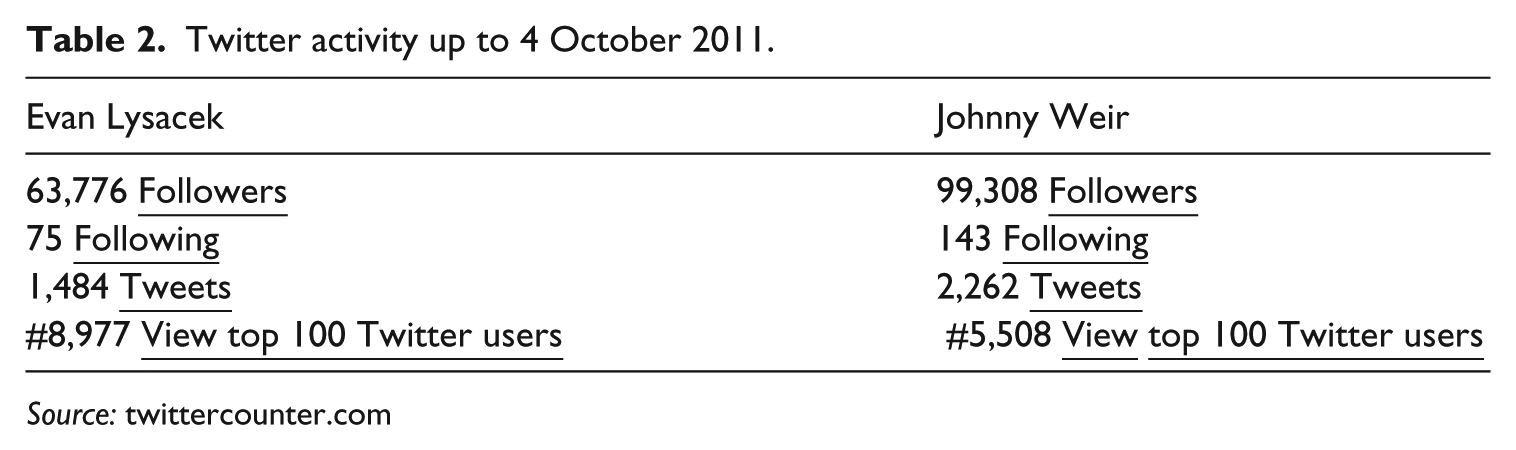
In opposition to real-life faux pas, online disruptions seem to carry a heavier weight, judging from the response of Lysacek followers. Even long-time fans 1 were contacting him to express how offensive his remark was and inviting him to give public explanation or excuses to Weir. This is probably because replying to a comment on a Twitter page requires a series of deliberate actions which render the act of replying itself as intentional and premeditated. Since not every fan’s question can receive an answer, the ones that do acquire more importance. With special regard to this matter Lysacek has been on Twitter since 31 March 2009, but his usage of the tool appears to be not as frequent as Weir’s (at least one entry per day). If we consider Weir joined Twitter in 2009 as well, the fact that the number of Lysacek tweets is half the number of Weir’s tweets is an indication of their different activity (Table 2). During our monitoring we observed a spike in Lysacek Twitter activity during and immediately after the 2010 Olympics, when his rivalry with Weir seemed to extend to the realm of social networking: they both posted more than one entry per day, never mentioning the other. Given this, it can be argued Lysacek usually does not answer specific fans’ posts since he tends to use Twitter as a stage for his fans more than as a tool to connect with them. In contrast, Weir often posts pictures of himself or details of his activities in response to specific fans’ requests.
Twitter activity up to 4 October 2011.
Source: twittercounter.com
From a social networking point of view, the main problem with the Lysacek tweet has more to do with timing than with morals (Park et al., 2012): on the internet things escalate much faster than in an offline setting. Lysacek’s reply remained online for up to 12 hours, while he was tweeting about other things.
The delay in taking proper action gave Twitter followers the opportunity to screen-capture Lysacek’s Twitter account, and in less than an hour those screen-caps were plastered all over the internet, and on gossip websites, like Perez Hilton’s blog. 2 At this point Lysacek took action, posting a new tweet saying, ‘It’s been brought to my attention that a non verified, unofficial EvanIsacek Twitter is out there. That is fake.’ The comment is then re-tweeted by his agent Yuki Saegusa and followed by a short notice, posted on Twitter as well, saying: ‘The fake Twitter is NOT Lysacek is Iysacek with a capital i. I would NEVER even think the things that were tweeted under that account.’
Later Lysacek makes an announcement on his Facebook wall, which is otherwise synchronized with his Twitter account saying, ‘I post my tweets at http://www.twitter.com/EvanLysacek/ only’ (Figure 1). It all seemed to come to an end when Lysacek made a final tweet stating, ‘my representatives have reported the fake account to Twitter. It’s out of my hands now.’
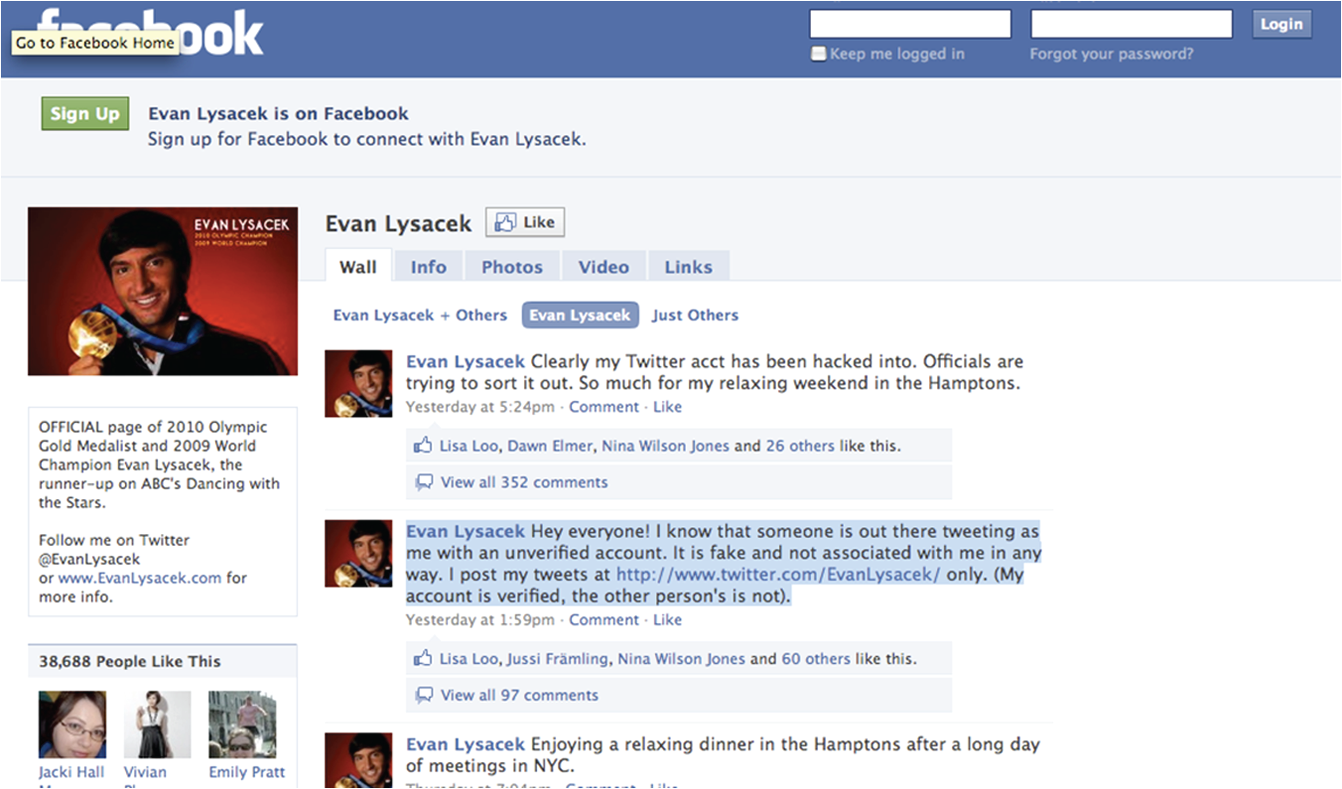
Lysacek Facebook profile.
This is a strategy often used in PR crisis management, aimed at deflecting attention onto something else, in this case the fake Twitter account. However, Lysacek forgot to delete the offending tweet from his verified account, and followers had the time to screen-cap. The chosen narrative is based on the opposition between the fake Twitter page, where offensive comments were made, and the verified Twitter account. Once the screen-caps revealed that the tweet indeed arrived from the account Lysacek verified not only with the Twitter administrators but with his own words, the situation went downhill. Lysacek’s Wikipedia entry was edited by users who inserted mocking comments about his PR crisis, such as ‘dapper is as dapper does and dapper does not know how to handle a PR crisis’. It was indeed Lysacek himself who gave the bloggers the means to verify that the offending tweet came from his official account: the account is spelled with a capital ‘L’, it has over 57,000 followers, it is verified by Twitter’s administrators (Figure 2).
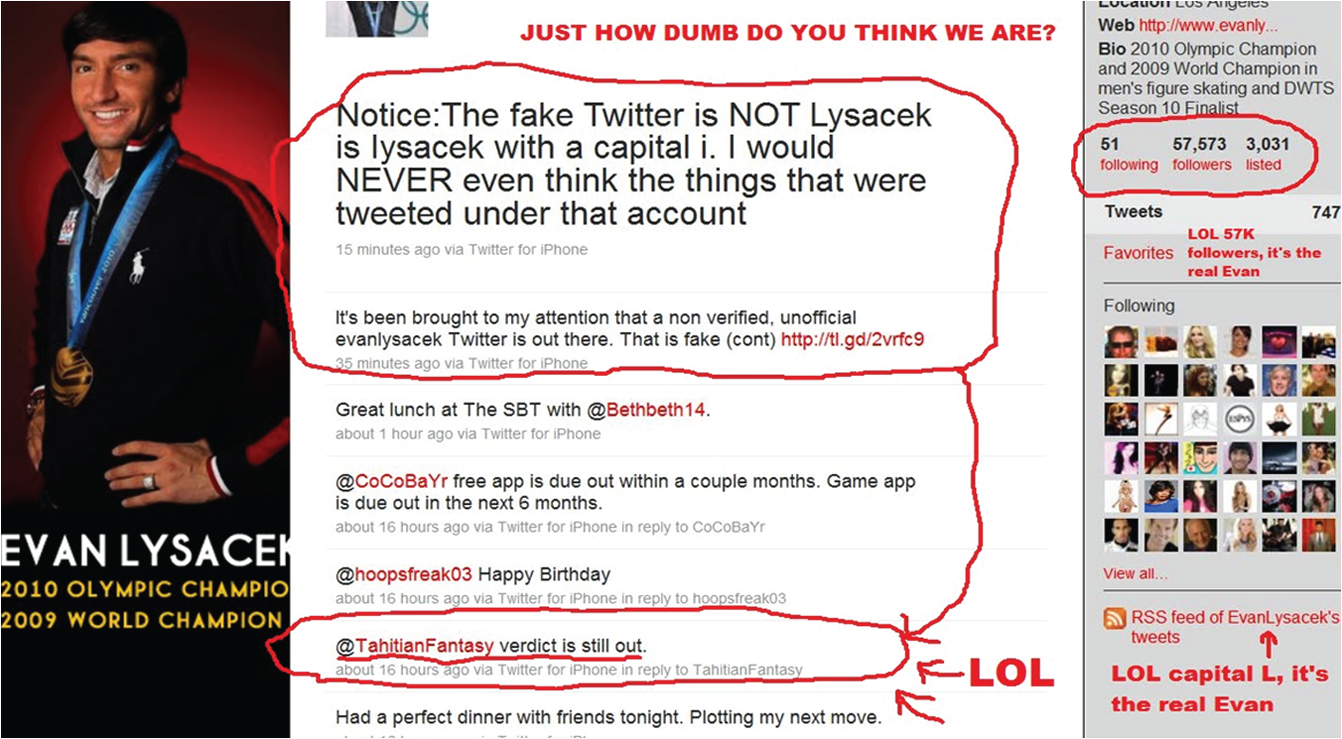
Lysacek’s twitter page as re-edited by fans.
Blogs devoted to exposing Evan’s behaviour began to spring up online collecting critical comments (such as ‘just how dumb do you think we are?’ and ‘thinks we are stupid=real Evan’), 3 while the incriminating screen-captures, coupled with timelines and additional evidence of Lysacek’s lies, are uploaded in free hosting Web. The source code of Lysacek’s page is even posted online to prove that it is not a fan production (Figure 3).
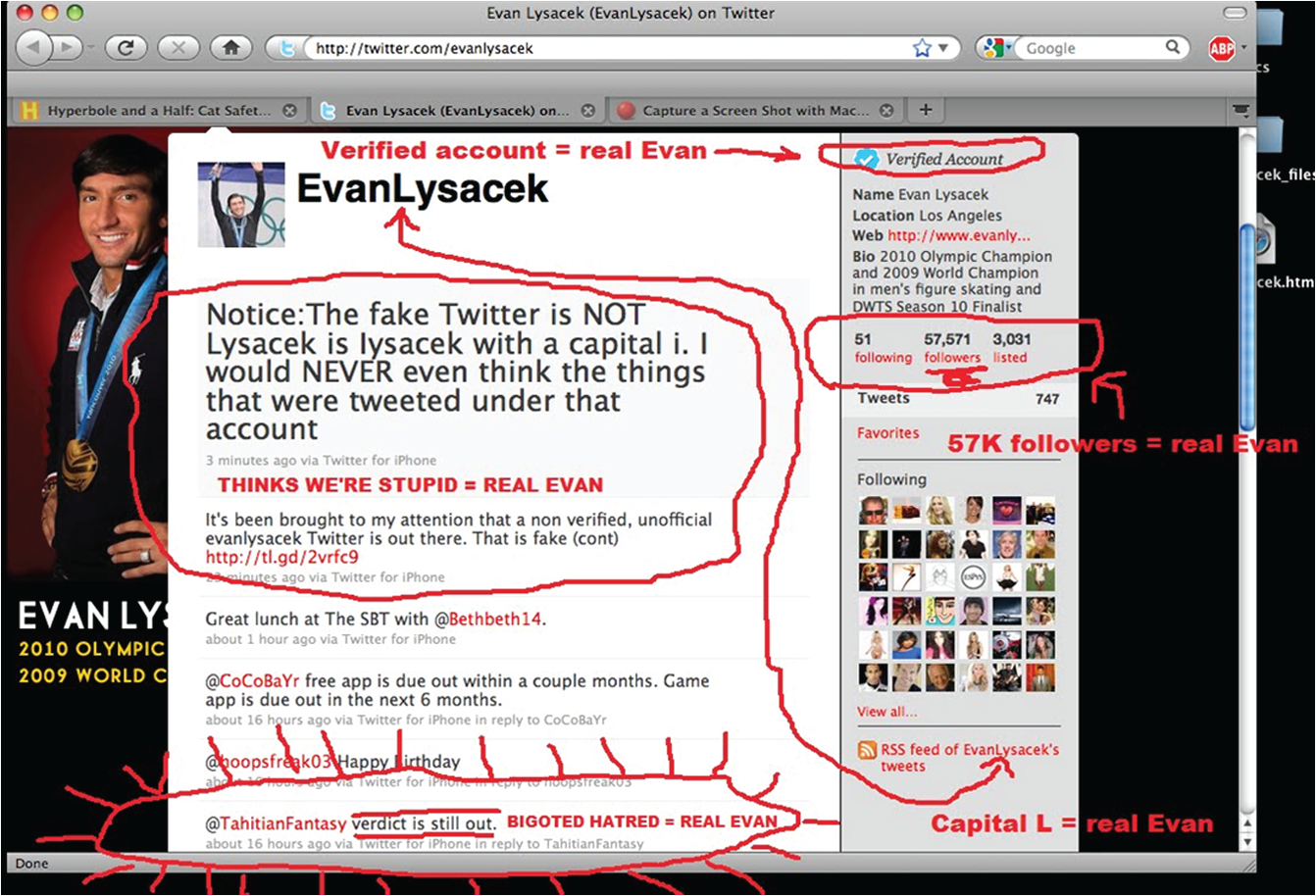
Lysacek’s twitter page as re-edited by fans.
Remarkably, there was a fake Twitter account under the name @EvanIsacek, now renamed @notevanidiot, whose owner contributed to the unveiling of the origin of the comment about Weir, and repeatedly distanced himself from the incriminating tweet, opening up a new account saying, ‘I am extremely disappointed in my actual person. No one should ever make a comment like that. I, fake Evan, promise to be better than that.’
The situation required a change in strategy and this led to the official statements, both on Twitter and Facebook, that the verified account @EvanLysacek has been hacked: ‘Clearly my Twitter has been hacked. Officials are trying to sort it out. So much for my relaxing weekend in the Hamptons.’
Lysacek then proceeds to delete every tweet for the three months, included the tweet about the fake account and of course the tweet about Weir, with the clear intention of making the new ‘I was hacked’ narrative more believable. But he does not delete the posts referring to the fake Twitter account on his Facebook profile. If the Twitter account was hacked in April, as Lysacek claimed in his last post, both the tweet about Weir and the tweets about the fake account are to be considered infected by the hacker, therefore made by the hacker and not by Lysacek.
Yet the fact that Lysacek posted the story of the fake account on his Facebook page proves that those tweets were indeed made by him and not by the hacker. This leads to the idea that a hacker entered Lysacek’s Twitter account and made just one tweet about Weir, questioning his gender. Once again the narrative is not handled in a proper way. There are also problems with the framing of this narrative, since in the same tweet Lysacek announces his Twitter account has been hacked and then makes a comment about this situation ruining his ‘relaxing weekend in the Hamptons’. He is clearly trying to obfuscate what this situation is really ruining which is his online reputation.
One’s reputation is produced through the use of self-presentational performances that are either publicly validated or discredited by interested parties based upon the context in which interaction occurs (Branaman and Lemert, 1997). Thus feedback from others plays a large role in shaping one’s reputation.
At this point it does not matter any more if Lysacek’s account has been really hacked or not, what counts is the credibility of his performance within this narrative. Given the fact that Lysacek has already been caught lying about the tweet, it is not a surprise that bloggers placed his statements under the microscope once again. The ‘I’ve been hacked’ narrative is not only a typical last resource in managing a communication crisis that has developed online – and is therefore considered a ‘standard lie’ – but it also hides one more negative aspect. It jeopardizes the trust relationships that have been built through the social network. Since there is often more than one public Twitter page for each public persona, verifying one’s Twitter account is a crucial step in building a trustworthy relationship with the online fandom. Once this step is taken, people are led to believe that what is posted on a celeb page concerns his/her real private thoughts and beliefs, allowing them to react within this frame. Disrupting this frame is at the same time difficult and risky
When @FSonline, an official skating magazine, confirmed the account was hacked on behalf of Lysacek’s team, bloggers and followers did not accept the news asking for impartial verification. Even given the fact that Lysacek was having trouble with his Twitter, his reticence to take responsibility for what had been said on his public account transformed a simple faux pas into a communicative breakdown. The fact that many blogs and fans’ communities are producing material devoted both to mocking and stigmatizing Lysacek’s behaviour is proof of the importance of taking responsibility upon oneself in case of a faux pas, in order to avoid a communication breakdown (Table 1). Apart from the spreading of screen-caps, fan-labour also produced YouTube video mash-ups, Wikipedia entries, fan-fiction and even a series of haikus re-interpreting the episode in verse. After 36 hours, Lysacek finally apologized to Weir on his Twitter page, writing, ‘Apologies to @JohnnyGWeir. Am taking measures to make sure something like this never happens again. The comment was insensitive, hurtful and offensive. Cannot apologize enough to Johnny and his fans.’
Expressive responsibility on Twitter
It must be noted that even while offering his apologies, Lysacek does not take full responsibility for the comment. Even if he does not refer to the fake account or the hacker situation, two narratives which proved to be unattainable and inconsistent, he still tries to deflect the responsibility. Since the apologies come after three other crisis management strategies have been put into action, they fail to appear sincere and effective (Park et al., 2011).
There are two facts Lysacek and his team seem to have underestimated when choosing the narrative. First, the public figures owning a public profile are expected to take measures so that no ‘insensitive, hurtful and offensive comments’ – to quote Lysacek himself – remain unchecked or unanswered on their online spaces. This takes us back to what Goffman calls ‘expressive responsibility’, based on the fact that the performer consciously chose the manner in which he/she behaves and interacts with others. Second, the chosen narratives also imply that fans and followers do not understand the basic functions of Twitter and do not have deep knowledge of internet. The development of the episode proves that this is a false supposition and also qualifies the internet as a sort of ‘secret exposing’ machine, which allows individuals to watch others in an unprecedented fashion (Meyrowitz, 1985). If television has been able to affect the extent to which famous people are able to control access to their backstage behaviours, though, the internet is taking this characteristic to an extreme.
Through social networks in particular, individual backstage behaviour is not only accessible but also intentionally exposed. Strangers are able to communicate as ‘intimates’ and one’s self-presentation becomes even more dependent on the perceptions and feedback of others than in Goffman’s framework. Managing an online reputation is a more complex and difficult matter than managing the same person’s reputation in other media, even electronic ones. Despite the vast number of PR incidents occurring within this type of interaction scenario, the fact that many athletes continue to use social networking can be explained by different factors. First, social networks provide a platform through which one can gain real value when it comes to media contact and can also foster relationships with followers; second, as pointed out by Baym (2010), the rewards of social networking are concrete and immediate while the costs are abstract and ideological. Indeed, in some cases social networking has succeeded in creating a successful public persona projecting athletes competing in niche sports, such as Weir, into the top tier of celebrities. A third factor is the increasing visibility that will attract new sponsors.
Discussion and conclusions
Even if violations that occur repeatedly over time are potentially more damaging than a single, isolated event, it is important to consider the depth and the nature of the scandal. It is interesting to compare Lysacek’s performance with that offered by Weir with regard to the same event: despite the fact that no one really knows the real intention hidden behind his silence, Weir’s performance of self has been perceived as wise and confident, his decision to not fuel the fire with any kind of comeback as a sign of maturity and positive attitude. As Weir has repeatedly stated his right to cross ‘boundaries and … voice what you really think’ (Zionts, 2010), the absence of explicit reaction is even more appealing. Indeed, Weir is renowned for his witty comebacks and caustic remarks, and has built his ‘brand personality’ around the concept of ‘spinning counter-clockwise’. Judging by the number of Google hits returned by merely typing ‘Johnny Weir’ (265,000 hits against the 132,000 hits for Evan Lysacek), his approach seems to have paid off online. The ‘Twittergate’ incident did not cause negative effects (concerning sponsors and followers). However it is interesting to notice that Weir benefits from this incident: the number of his fans and followers increased both on Facebook and Twitter (Figure 4), and he signed contracts with new sponsors. Even though the connection between the increase of Weir followers on Twitter and the ‘Twittergate’ incident is arguable, it is indeed true that Weir became a model example for ‘free gender expression’ (reinforcing a character he was already portraying) and he was invited to many events organized by the LGBT community after this controversy.
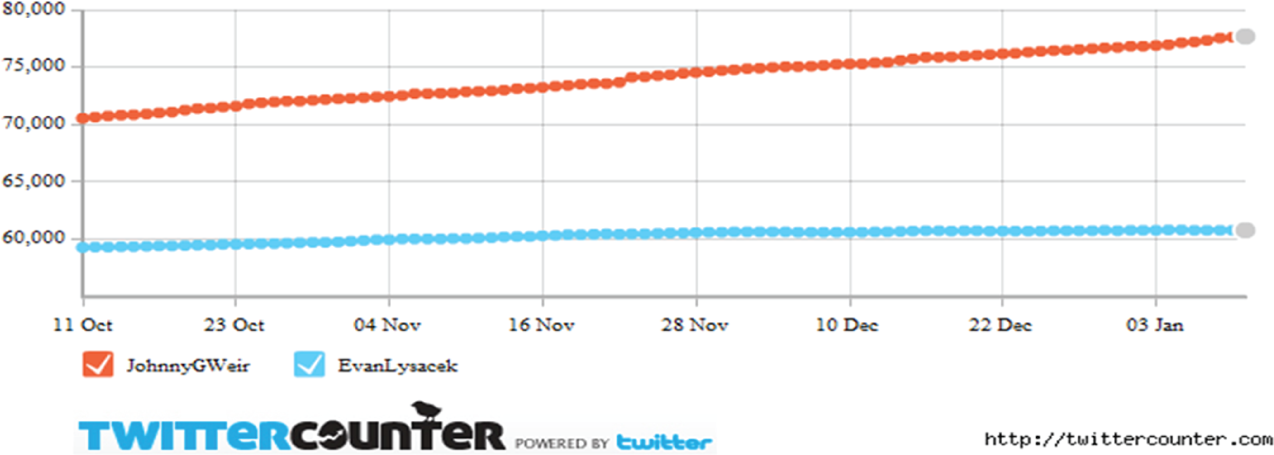
Lysacek vs Weir on Twitter, October 2010–January 2011.
Our analysis also shows that Lysacek and his team underestimated the fact that, in the new digital environment, stakeholders can use blogs and new media to connect with other stakeholders: they can share the latest information and form coalitions. Weick (1995) perfectly points out the main issue here: the problem is not in the crisis itself but in how the actor involved responds and makes sense of information he or she receives.
Our article shows that new technologies have increased the opportunities for both the scandal subject and the scandal audience to receive information and present information themselves: social media is both an explosive opportunity and a disruptive change to the fundamental parameters of crisis management. In a social media setting, persistence, replicability, scalability and searchability shape people’s participation and reputation management (Boyd, 2011). Previous empirical studies deal with the impact on a brand of negative information related to the brand’s endorser (see Fisher and Wakefield, 1998; Louie and Obermiller, 2002), but they do not look at scandals erupting in social networks and connected to the representation of self. Through the Goffmanian framework we link this kind of scandal to disruptions in the representation of self portrayed by celebrities through social networks. As the impact of different media types on the effects of different crisis-response strategies is still insufficiently studied, even though our investigation focused on only one event, it contributes to new media research. Indeed, it could be useful to detect what to do and what to avoid in order to create a perfect coherence and harmony though one’s presence online. Other cases can be analysed using the research framework of this study to identify commonalities and differences in the management of an online communication crisis.
Footnotes
Funding
This research received no specific grant from any funding agency in the public, commercial, or not-for-profit sectors.