



Abstract
Drawing from a growing body of research that focuses on emotions as social and cultural phenomena, this article examines how publicly performed emotions can be employed in the exercise of power. The article uses William Reddy’s ideas on emotional regimes. A qualitative analysis of Finnish business magazine Talouselämä tracks how corporate leaders have performed publicly in Finland from 1940 to 2005. I suggest that corporate capitalism developed an emotional regime of enthusiastic individualism, which challenged the previous regime of paternal managerialism. The article demonstrates how business media such as Talouselämä provided an emotional refuge that became a public platform through which rising corporate sectors could formulate the new emotional regime. The mediated performances of corporate leaders became rituals that borrowed from the affect economy of social movements and fuelled the rise of the new capitalism.
A growing body of research views emotions as sociological, cultural or collective phenomenon (Greco and Stenner, 2008; Harding and Pribram, 2009). Emotions are not only a private issue that individual people feel or possess; rather, emotions can be understood as more general styles or regimes (Berezin, 2001, 2002; Fineman, 2000; Reddy, 2001; Stearns, 1994; 6, 2002). This view also retools our understandings of power. Emotionality, as a claim about a subject or collectivity, is dependent on the relations of power (Ahmed, 2004: 4). At the same time, those seeking power often attempt to influence the emotions of subjects and collectivities to achieve their desired objectives (Gould, 2010: 33). A range of emotions such as hate, fear or enthusiasm can be employed as social practices to put feelings towards particular uses (Harding and Pribram, 2009: 4). Emotions can be both organized and managed (Ahmed, 2004, 2009; Hochschild, 1983, 2002).
The media have an important role in the effective exercise of power. Emotions, in order to be utilized in the exercise of power, have to be performed publicly. Public rituals and symbols are collective means of emotional communication insofar as they formalize shared feelings (Barker, 2001; Berezin, 2001; 6, 2007). Consequently, the media often become important sites of emotion management where performances occur.
In this article, I am concerned with the way current capitalism has employed and managed emotions in the public performances of corporate power over recent decades. A qualitative analysis of the Finnish business magazine Talouselämä tracks how corporate leaders have performed publicly in Finland from 1940 to 2005 and how emotions have been communicated in the mediated performances.
A number of studies have paid attention to the role of emotions in political communication (Engelken-Jorge et al., 2011; Staiger et al., 2012; Thompson and Hoggert, 2012). Performance theory also has pointed out how political leaders need to develop public performances to gain legitimacy in society (Alexander, 2011; Hajer, 2009). However, there has been little interest in the public performativity of corporate power. Corporate leaders also need to develop public performances that legitimize their actions. The new capitalism, in particular, has developed a range of performative practices (Lee and LiPuma, 2002; Thrift, 2006: 3–4) as corporations address their employees, customers, shareholders and stake holders, as well as the society at large (Kantola, 2012).
I am particularly interested in the mobilizing power of emotional performances. Emotions are effective tools of power as they help motivate subjects and collectivities. Negative feelings such as anger, frustration, shame, guilt and hate can induce individuals to express discontent (Ahmed, 2009; Eyerman, 2005: 44; Lucas, 2012; Northcott, 2012; Pantti and Wahl-Jörgensen, 2011). However, positive feelings can also fuel action. Studies on social mobilization and social movements have shown how emotions can be encouraging and revitalizing, as well as mobilize affection for imagined communities (Berezin, 2001; Collins, 2004). Social movements create feelings of belonging: affective ties, bonds of solidarity and moral empathy (Barker, 2001; Maiz, 2011: 55). They also sustain feelings of hope (Civettini, 2011). I suggest that it is precisely these positive feelings that corporate leaders have employed in their public performances.
In recent decades, economic globalization, financialization and market orientation have fundamentally altered societies and given capitalism new power. The new flexible capitalism has also developed a range of new management techniques that focus on emotional effect. Social theorists have labelled these techniques as the rise of the ‘third spirit’ of capitalism (Boltanski and Chiapello, 2005), of ‘soft’ capitalism (Heelas, 2002; Thrift, 2006: 21), or of ‘cool’ capitalism (McGuigan, 2009). I address this shift by looking at how the mediated performances of corporate leaders have contributed to the rise of new forms of capitalism. To understand these dynamics, I suggest that the success of the new capitalism can be explained by its ability to address emotions that were suppressed in the previous regime of paternal managerialism. I also discuss this change in relation to politics, which have, on the contrary, become something we ‘hate’ (Hay, 2007).
My argument proceeds as follows: I first describe the rise of the new capitalism and Reddy’s theory of emotional regimes. Next, I show how Finnish corporate leaders can be understood in terms of two regimes. Finally, I discuss the implications of these dynamics with regard to larger societal dynamics.
The third spirit as emotional regime
Recent social theory has described a change in corporate management. Since the 1960s, the post-war Fordist-Keynesian system has been giving way to new logics of production. New information and satellite communication technologies as well as declining transport costs have increased the flow of goods and services (Harvey, 1990: 124, 147, 240). The investment–profit investment cycle has accelerated, and profit rates have declined (Giddens, 1991: 11). Many industries have torn down hierarchical pyramids and have evolved into flexible and dispersed network enterprises (Castells, 1996: 151–279). Post-Fordist production has also altered the affect economy of corporate management. As hierarchies and pyramids are not always available for management, management has turned towards soft management practices. Management involves narratives, discourses and practices that build identities and company cultures (Heelas, 2002: 81). Business management aims to activate emotions and impassion its subjects (Thrift, 2006: 130–152); it communicates a feeling of revolutionary change (Boltanski and Chiapello, 2005; Kantola, 2009, 2013) or cool rebellion (McGuigan, 2009).
The change in corporate management has been deciphered perhaps most extensively by Luc Boltanski and Eve Chiapello (2005: 16–20), for whom the history of capitalism can be seen as the development of three spirits: the paternal bourgeois family firm; the large and efficient industrial firm; and the flexible corporation. They suggest that, in the 1960s, capitalism was drawn into crisis. The 1968 generation condemned the bourgeois family, the firm and the state as ossified worlds attached to tradition, legalism, bureaucracy, calculation and planning. Capitalism, however, recuperated by developing new styles of management that favoured mobility, flexibility, flat hierarchies, flexibility and teamwork (Boltanski and Chiapello, 2005: 145). The study, based on a corpus of Francophone management texts from the 1960s and 1990s, is indicative of the ideals of management literature rather than the actual practices of management. Boltanski and Chiapello (2005: xxi) themselves point out that the model, if realized in practice, would itself make an interesting object of study. Thus, in this article, I analyse the rise of the third spirit of capitalism and the ways in which it has employed emotions in relation to the first and second spirits of capitalism.
As I am interested in the emotional appeal of corporate authorities, I draw from studies that have tracked emotional arenas (Fineman, 2000), communities of feeling (Berezin, 2001, 2002), affect styles (6, 2002), emotional standards and styles (Stearns, 1994), and regimes of emotion (Hochschild, 2002; Reddy, 2001). Of these, I apply William Reddy’s idea of emotional regimes.
For Reddy, the symbolic order of a given community or society entails a particular emotional element – an emotional regime that guides action and activities in society. He defines an emotional regime as: ‘The set of normative emotions and the official rituals, practices, and emotives that express and inculcate them; a necessary underpinning of any stable political regime’ (Reddy, 2001: 129). An emotional regime consists of (i) a coherent set of collectively shared emotional goals, (ii) a set of instructions on how to obtain mental and bodily control, and (iii) a set of ideals concerning the individual and collective meaning of specific goals and of emotional control (Reddy, 2001: 61). Similarly, Hochschild (2002: 118) points out that at the heart of the regime are (i) feeling rules about how we imagine we should feel and (ii) framing rules about the way we believe we should see and think.
Emotional regimes are linked with their time and place, with societal institutions and with social structures. They are also linked to power. Industrial societies contain many different emotional management styles: conforming majorities as well as marginalized minorities develop varying management strategies. Furthermore, gender-based and ethnic variations often prevail. Executives, rich and well-educated, develop their own particular emotional atmosphere, while labourers develop their own particular emotional regime (Reddy, 2001: 128).
Emotional regimes also give rise to emotional refuges. In particular, strict emotional regimes, which control the acceptable affectivity with firm rules, often create a need for a place where the emotions can be expressed more freely. Reddy (2001: 129) defines emotional refuge as a relationship, ritual or organization (whether formal or informal) that provides a safe release from prevailing emotional norms and may shore up or threaten the existing emotional regime. He asserts that the performing of emotions has two main types of consequences: first, the performed emotions may intensify the emotion in question. Thus, as emotions are performed, they tend to develop into more consistent forms of performative action. At the same time, however, the regime can give rise to alternative emotional styles if the people who are subjected to a particular regime do not feel that they conform to the performance. Thus, a new emotion, which contradicts the performed emotion, arises and develops into a style that captures the felt feeling in a better way (see also Gould, 2001: 139–41; Stearns, 1994: 281–2). Emotional regimes thus develop in dynamic relation to each other. A given emotional regime with specific emotional rules and conventions produces normative emotions that, when performed and repeated over time, can cause ambivalence in those whose emotions and experience do not confirm with the performed norms. Consequently, the new and suppressed feelings seek out a place where they can be expressed and develop into a new emotional regime.
But what does this have to do with the media? Most obviously, the media can be platforms upon which emotional regimes are acted out and through which emotional rules are employed by the performers or by the media itself (Pantti and Wahl-Jörgensen, 2012). The media can also become an emotional refuge. In Reddy’s account of the French Revolution, the strict normative regime of the king and his court gave rise to a societal opposition that created in its own salons and public styles a forum where forbidden emotions could be expressed. Reddy posits this interpretation as parallel to Habermas’s (1989) bourgeois public sphere. In Reddy’s (2001: 146) terms, the journals and reading societies of the bourgeois became an emotional refuge. The bourgeois could not identify with the existing emotional regime and thus developed their own public spaces that allowed new ways to express emotions. Similarly, one can compare emotional refuge to Goffman’s (1990: 114) backstage, a place where public codes of emotional expression can be questioned and contradicted. In a Reddyan reading, however, the backstage as emotional refuge is not necessarily a hidden place; the contradictory emotions can be expressed also in public.
In the following, I use the notion of ‘emotional regime’ to analyse the public performances of corporate authorities in Finland. I employ Reddy’s ideas and track down the emotional regimes by analysing how corporate leaders performed publicly in Finland after the Second World War. I analyse the public performances of corporate leaders in Talouselämä, the country’s main weekly business magazine (comparable to the Economist), and suggest that it evolved into an emotional refuge that provided an outlet for a new capitalist emotional regime.
The research material and method
The research material consists of stories published in Talouselämä from 1940 to 2005. To obtain a representative sample of business leaders and their public style, I selected all pieces that were centred on one business leader as the main topic of the story and that contained a visual presentation – normally a photograph – of the leader. The pieces were mostly interviews or columns written by the subject. The sample represents the range of public styles that were published by the magazine, and as the magazine has traditionally covered Finnish business life extensively, the sample is a relatively good representation of public business leadership styles in Finland. I also wanted the sample to reflect the long-term changes in the post-war decades. Thus, the stories were gathered from publications every five years between 1940 and 2005.
All together there were 296 stories. In the 1940s and 1950s, the yearly number of stories was low, ranging from 0 to 8, as the magazine did not have many items on individuals. In the 1970s the number of personal stories again was relatively low as the individual interviews were replaced by collective interviews, which posed a similar question to a range of people representing all relevant interests groups. After that, however, the stories started to change, and the number of personal interviews with multiple photos increased. The magazine was glossier, the number and size of photographs increased, and the story formats changed. From 1980 onwards the yearly number of interviews varied from 28 to 63 pieces.
In order to analyse the performance styles of the leaders, I applied textual analysis, which focused on emotional expression in texts and photographs, and combined quantitative and qualitative elements (Davis, 2008: 57–8; Deacon et al., 2007: 139). As Reddy (2001: 129) and Hochschild (2002: 118) suggest, emotional regimes build on rules on how emotions should be expressed publicly. Thus, in the analysis I focused on the emotional expression and control in the text as well as in the photographs. How did the business leaders express emotions: how did they feel about their work, about their company, about their role in society and about their own life? What were the most characteristic modes of emotional performance? What types of emotions were expressed – were these positive or negative? How did the business leaders control and restrict their emotions?
I read the stories and listed forms of emotional expression and control. I analysed the photographs in a similar way, analysing the types of emotional states communicated through visual representations. Gradually it became clear that over the seven decades the performances changed considerably. From the 1940s to the 1960s, the stories were mostly serious, self-written columns or interviews with small and formal photographs. Since the late 1970s especially, the dominating style of solemn performance gave way to more lively and informal modes of address.
Subsequently I classified these two styles as paternal managerialism and enthusiastic individualism. The paternal managers, altogether 146 stories in the sample, expressed their emotions in solemn and restricted ways. Paternalism was most clearly seen in authoritative phrases that pertained to ‘us’ and ‘we’ as a nation. Managerial style was linked with phrases that emphasized reason, rational planning and numbers. No one talked about his or her own personality. In photographs, paternal managerialists were solemn and serious. In contrast, individual enthusiasts clearly differed from paternal managers. Enthusiastic individuals, altogether 150 stories in the sample, liked to bring their own personality to the forefront and expressed their personal views and feelings. They often displayed personal enthusiasm, joy, zeal or even passion for their work. Moreover, they liked to talk affectionately about their employees, families, hobbies and other personal interests.
Both styles could be easily separated – there were very few pieces that could not be classified as one of the styles. This suggests that both styles were based on relatively clear feeling rules for proper conduct during public performance. This allowed me to include a quantitative element in the analysis. I counted the number of pieces representing the two styles for each year. In this way, I had an indication of their mutual dynamics and was able to follow the increase in enthusiastic individualism over paternal bureaucrats (Figure 1). In the following section, I describe two emotional regimes and suggest that they exist in a dynamic relation to each other.
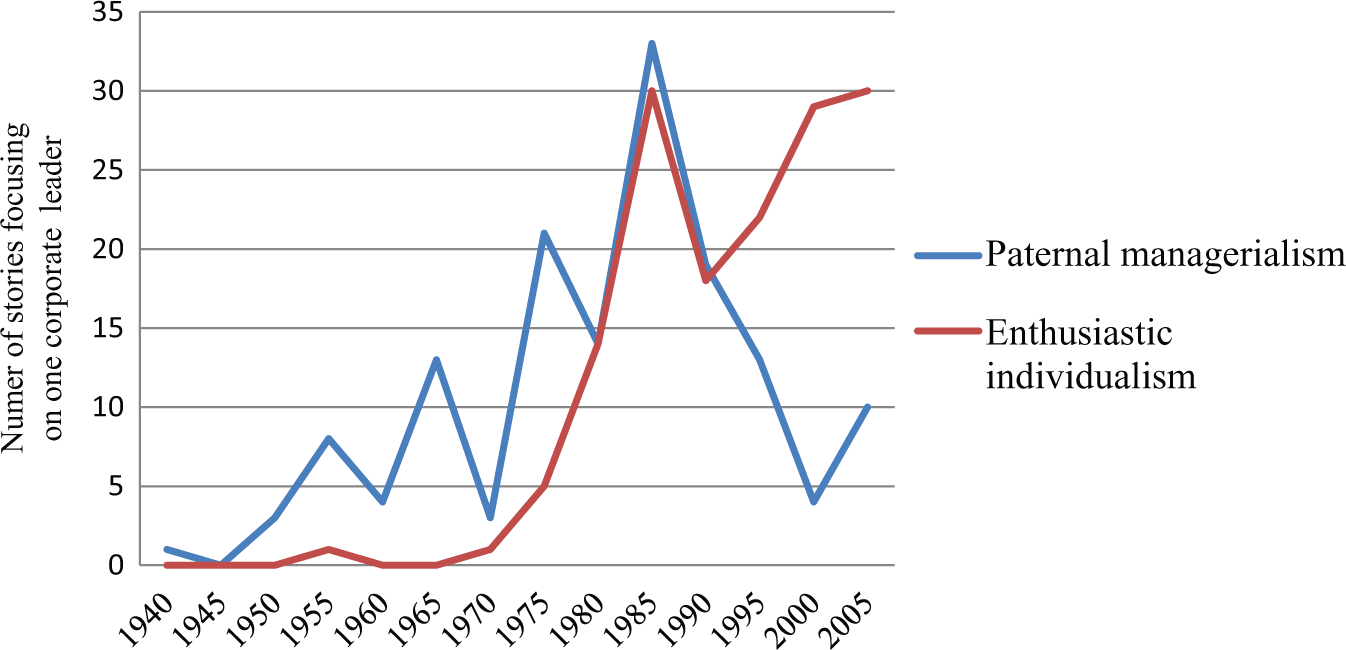
Emotional styles of Finnish corporate leaders in Talouselämä magazine, 1940–2005.
The style of paternal managerialism
In Finland, the Second World War united the nation, and the Winter War of 1939 against Soviet Union became an especially strong national unifying myth. Subsequently, the first decades after the war were times of robust nationalism and this extended into all areas of Finnish society. This national affect can be seen clearly in the pages of Talouselämä. As business and corporate leaders appear in the magazine they express their concerns predominantly as national concerns – as part of a larger ‘we’. The predominant emotion is one of solemn concern for the nation. The issues addressed deal most often with the concrete problems that face business life in the aftermath of the war. The stories are characterized by a serious worry over the nation’s destiny: industrial and business leaders consistently address ‘our’ problems, referring to the nation.
Still, at the same time, this national worry is linked to the idea of rational planning: the ideal of a rational business manager who believes and acts upon a set plan. The post-war era was a golden age of state-led social engineering and industrial planning (Sampson, 1995; Scott, 1998), and this can be seen clearly in the public performances of Finnish business leaders in Talouselämä (TE) since the 1950s. An overwhelming majority promote efficiency, competitiveness and planning. The leaders combine national worry with rational planning. For instance, a leader from the metal industry describes the sector’s future options and combines the national ‘us’ with concerns on efficiency. He refers to the metal industry as ‘our’ newest export industry and mainly ponders the difficulties of the ‘hard road’ ahead. His main objective is to increase efficiency, and he sums up this ethos:
The purpose of industry is of course to create better living conditions for those who work in its service. But this is possible only if the efficiency of production grows so that productivity per working day and per kilowatt-hour keeps growing on a continuous and adequate basis. (TE, 21.4.1950: 304)
As the national ‘us’ is linked with Tayloristic rational planning and scientific management, the emotional rule is one of disciplined worry over the nation. Many corporate leaders express their general worries regarding quality and price competitiveness. They also pose an imperative of structural change caused by fierce competition. There is also the imperative to keep wages low. Thus, one leader calls for ‘self-discipline, co-operation, vigilance and above all goal-directed diligence’ (TE, 21.4.1950: 304).
Emotionally, the style of address is top-down and authoritative. The stories are not interviews but narrative expositions of the featured person; alternatively, corporate leaders also write columns themselves and communicate their worries for the national economy in the ‘we’ voice. In both cases, the leaders speak from on high and they seriously consider the matters on which they write. They present sober advice to politicians and citizens and to ‘us’ as a nation.
There is often the sense that these leaders plainly present uncomfortable yet inevitable facts that require action. For example, ‘harsh competition will necessarily bring structural changes’ (TE, 39/1960: 924) or ‘marketing is an increasingly demanding activity’ that requires planning and expertise (TE 43/1969: 1056). The tone gains its educative authority through its harsh presentation facts and figures, which implicitly impugns other ‘optimistic’ predictions as ungrounded.
The combination of solemn nationalism with rational managerialism produces an emotional regime that builds on the authority of father, who guides ‘his’ family as the national ‘we’. Paternalism is a style of authority built on the idea of pater, a father, who takes care of his children (Karonen, 2002a). This idea has taken a variety of forms through various historical contexts (Karonen, 2002b; Shpayer-Makov, 2004: 87–8). It has been used to build religious, national and family authority, as well as corporate and business authority (Einonen and Karonen, 2002). Traditional patronage was the employer’s paternal protective attitude towards his workers in the workshops of the ancient régime (Burdy, 2004: 37). This tradition was moulded by 19th-century industrialization into industrial paternalism (Burdy, 2004). It then transformed into Victorian bureaucratic paternalism, which combined the disciplined life of the rising middle classes with the intense emotivism of motherhood and fatherhood (Stearns, 1994: 60–71). Victorian bureaucratic paternalism combined a need for rational efficiency with a civilizing overtone that sought to control the morality of workers both in and outside of the workplace (Shpayer-Makov, 2004: 75–77).
In the analysed material, Finnish corporate leaders clearly employ a version of bureaucratic paternalism in the aftermath of the war. The authorities present themselves as high authorities who show fatherly concern and worry for ‘us’ (see also Rainio-Niemi, 2008: 291–311). The prevailing public emotions are the deep and solemn feelings towards the fatherland as well as serious worry over ‘our’ destiny.
This paternal style is combined with the rational drive for efficiency, which imposes clear standards and rules. Finland was something of a latecomer into the industrialized world, and, due to the long period of agricultural production, the introduction of rational management was slow in comparison to many West European countries (Michelsen, 1999: 273–88; Seeck, 2008). Furthermore, business schooling only came to Finland in the 1950s and many business leaders had been educated in military schools (Michelsen, 2001: 182–3). The Second World War, however, prompted a strong belief in the value of efficiency as scientific management methods and research were employed effectively during wartime. Moreover, metal industries boomed after the war as Finland was forced to pay war debts to the Soviet Union (Michelsen, 1999: 273–88). All this meant that in the 1950s corporate leaders were still clearly dedicated to the national cause. At the same time, however, rational planning and management became popular and was combined with nationalism. A sales director of a sports clothing company, for example, describes the main aims of his field:
Work methods are of course developed in order to make them more efficient and expedient as well as time and money saving. One needs to examine the richness of each salesman’s work field and thus to find right kind of procedures. (TE, 43/1960: 1056)
He promotes careful planning and contends that ‘the rule of thumb’ employed widely in business, will be replaced by exact numbers and figures. Rational managers perform with a style that is characterized by a low personal profile, consensus seeking, rationality and planning optimism. Thus, a CEO of an advertising agency describes the future of marketing:
The role of creative work will be enhanced strongly and the people involved will gain more authority and creative independence. This however does not mean that ideas are invented only for the sake of inventiveness and play. Creativity will emerge as a force that is based on a thorough groundwork of analysis, research and justification. (TE, 43/1960: 1058–9)
The emotional style is very plain and impersonal. A similar style is also communicated through the photographs. The prevailing type of photograph is a standard portrait. The person looks straight at the camera and rarely shows any emotion. While there are some pictures where the subject smiles, such pictures are rare (TE, 43/1960: 1056). The subject’s clothing and entire appearance is formal, and a sense of personal styles is muted.
The style of paternal managerialism is also reflected in the story formats from the 1970s. In Talouselämä single stories on one person only are almost totally missing. Instead the magazine creates chains of interviews that address a group of important people using similar questions. The questions are usually posed for a group of people who represent the relevant political interests that, together, compose the nation. Such grouped interviews appear to signal the endurance of the patriotic style. Paternal nationalism here transforms into a rational style that addresses the nation by interviewing different actors to achieve a ‘balanced’ perspective comprised of every significant interest in the national regime.
The style of enthusiastic individualism
While paternal managerialism is clearly the dominant style of Talouselämä in the 1970s, by the end of the decade some business leaders begin to express optimism, joy and enthusiasm. They present themselves as lively and spontaneous, and they speak casually.
The story formats of the magazine also change. Serious posing is replaced by smiles and an informal photographic style. In the 1980s, the personal interview becomes the prominent story format as the number and length of the interviews rise sharply. The interviews represent their subjects in a more relaxed way; subjects smile and are in good humour, as if caught in the middle of unprompted speech. Photographs get bigger and portray their subjects ‘in action’: the interviewees smile and act in a lively manner as well as demonstrate their point by waving their hands energetically. In some cases, there are also several pictures of a single director, each showing him smiling and moving in different positions (TE, 4/1980: 27).
A tone of playful informality gradually appears in these interviews, which contrasts with the formality and seriousness of former decades. The new style emphasizes individualism and personality, and leaders are described as rule-breaking and outward-looking. The new leaders do not draw their authority from established positions; rather, they are passionate men of action. This new ethos is personified in the CEO who has already changed companies two times before his new job in the textile industry. He claims that any CEO can change. He is described as a man of action: ‘He likes problems and becalmed periods make him obviously paw the ground restless and ready to go. He reduces, simplifies and presents things in common sense way, and talks volubly and plentifully’ (TE, 9/1980: 88). The emotional style is built on individualism and passionate commitment, which at times turn into extravagance and eccentricity. There are many intriguing characterizations of such leaders: as ‘brisk boy, sorcerer, honest’ (TE, 21/1980, 108); as a ‘crooked old man’ (TE, 20/1980: 66); as ‘a good-time boy’ (TE, 32/1980: 80); as ‘turbo’ and ‘a fighter, who will never give up’ (TE, 2/1990: 13); as ‘shamelessly youngish and boyish’ (TE, 12/1990: 51); as ‘quick and nimble’ (TE, 36/1990: 16); or as ‘a strange bird’ (TE, 40/1990: 20).
Moreover, many leaders describe their personal and private interests. Family, spouses and children begin to be mentioned. A managing director in an insurance business relates that he tries to be home enough so that ‘the children still know their father’. He goes home to put the children to bed and returns to work around nine o’clock, this time in jeans (TE, 3/1990: 14).
Sport becomes an increasingly important hobby and background for business leaders who like to appear energetic and in good shape (TE, 6/1990: 14). Thus we are told that a director, who has a long-standing interest in ice-hockey, has a record of running 1100 km per year, which leads the journalist to wonder ‘whether the way he takes care of his health has become a sickness’ (TE, 2/1990: 13; see also TE, 8/1990: 12). Sports appear to help one become a better leader. Experience in sailing helps to organize teamwork (TE, 25/2000: 57–8), and golf reveals the true character of a person (TE, 22/2000: 57–8).
The new leaders are no longer grey company men in grey suits; rather, they emphasize their own individual personality, capability and courage. For instance, a woman who has made her way from secretary to bank director is described as light-hearted and joyful, ‘an antithesis of a militant feminist’ (TE, 13/1980: 71). She had not perceived her secretarial work as an end to her career, but instead built upon that experience a ‘fresh, logical action guided clearly by daring and courage to try new things’ (TE, 13/1980: 71). The new leadership position is not about gaining a formal position in the organization. In fact she describes her move as finding her true self: ‘As a secretary I was not me, but I was the secretary of the managing director. A secretary is the PR woman for her boss. Here I can create plans by myself and there is space to act’ (TE, 13/1980: 102).
If in previous phases the authority style was built on seriousness and credibility through the demonstration of a nationalist and rationalist ethos, there is a growing sense of doing things in alternative ways: a frank and honest questioning of the prevailing system. Many new leaders explicitly contrast their style with earlier styles of rational managerialism. Several business leaders worry about bureaucracy (TE, 33/1980: 70; TE, 34/1980: 84), or centralized organizations ‘stuck in the early 1970s’ (TE, 2/1990: 13), or old directors in middle management (TE, 3/1990, 27). Their worry is that business leaders may become as institutionalized and timorous as those in governmental institutions (TE, 24/1980: 72; TE, 13/1980: 102).
The new leaders typically side strongly with their people. Some interviews are built on a narrative where the interviewee has left an institution that he or she felt was too rigid and whose directors were too authoritarian. As a director of a shoe retail company recalls, he left his old career because he was fed up with the company’s strictness. He no longer has a supervisor who approaches him ‘banging his fist on the table’ (TE, 14/1980: 106). In the new style, there is a new emphasis on worker satisfaction and motivation as well as enthusiasm (TE, 6/1990: 14). The high and authoritative style is replaced by more colloquial style that sides with the employees. A Finnish director, moving to Volvo, Sweden, is represented as business director who explicitly is not a technocrat, and in line with the anti-technocratic ideas of the Swedish Volvo director Per Gyllenhammar, emphasizes openness as an important factor for employee motivation. Moreover, he claims that if a person enjoys his work, he also is more productive (TE, 11/1980: 32). Similarly, the director of Reader’s Digest Finland, Martti Immonen, is described having developed his own culture, which is exemplified by such phrases as ‘I like to be with people’, ‘a strong spirit of entrepreneurship’ and ‘enthusiasm often overcomes know-how’ (TE, 6/1990: 14).
Many leaders also demonstrate their anti-system and down-to-earth personality by being photographed on the shop floor or outside the office. One director is even photographed in the Linnanmäki amusement park, in the midst of twisting mirrors, making a call for ‘radical innovativeness’ based on chaos, spontaneity, weak signals and turbulence (TE, 24/2000, 30–1).
In enthusiastic individualism, enthusiasm and personal passion became the new normative emotions that business leaders express in public. This emotional style differs markedly from the paternal and rational managers who focus on the facts and figures of their work. The enthusiastic individualists rather reveal their individual ideas and passions that differentiate them from others. Thus, one business leader is vegetarian while another is a novelist who has just published his third book (TE, 28/2000: 72). The enthusiastic spirit is also evoked in the stories of self-made millionaires. The Uoti brothers, two high-profile millionaires and investors, are described as ‘hotheads’ and ‘Ewings’ from the television series Dallas (TE, 42/1990: 48). Artturi Tarjanne, a youngish and successful capital investor, described as ‘an innovator and promoter’ and ‘business angel’ in the information technology sector, claims that ‘I want to stir up fighting spirit in the troops. I rage so that I create a magical feeling of energy’ (TE, 21/2000: 73–4).
The dynamics of emotional styles and regimes
The studied material suggests a clear change in the emotional styles of corporate leaders in Finland since the Second World War. A quantitative analysis (Figure 1) also shows how the change from paternal managerialism to enthusiastic individualism has not occurred overnight. I have classified the stories according to the style the leader represents in the story. The style of enthusiastic individualism is first non-existent, but it becomes more prominent in the late 1970s. Since the 1990s, it has clearly been a more popular style compared to paternal managerialism. The style of passionate individualism spans industrial and business sectors, creating a new regime of emotion with specific performative conventions and rules. In the new regime, corporate leaders need to show enthusiasm, passion and individuality. This suggests the rise of the third spirit of capitalism. Still, local conditions do matter. In Boltanski’s and Chiapello’s terms, the paternal style represents the family entrepreneur spirit of capitalism, rational managerialism is the second industrial spirit, and passionate individualism is the third spirit of capitalism. However, this case study shows that in practice the spirits mix with each other.
In Finland, the paternal style was still strong in the decades after the Second World War, and it was combined with rational industrial managerialism, which was a latecomer in Finland. Also, Boltanski and Chiapello (2005: 539–40) point out that management texts are geographically anchored. Every nation has its own history and national passions that strongly influence the ways new ‘global’ ideas are adopted. In terms of Reddy’s theory, both of the regimes have clearly distinct emotional styles (Figure 2). The emotional regimes are based on positive feelings towards ‘we.’ Paternal managerialism builds on patriotism. At the same time, it is a solemn and serious love that is performed by the paternal authorities. This love is combined with managerial efficiency, which relies on reason and does not favour emotional expression. Enthusiastic individualism, for its part, builds on excitement, optimism and ambition. The authorities step down and speak at the same level as their employees, and their mode of address is casual and informal.
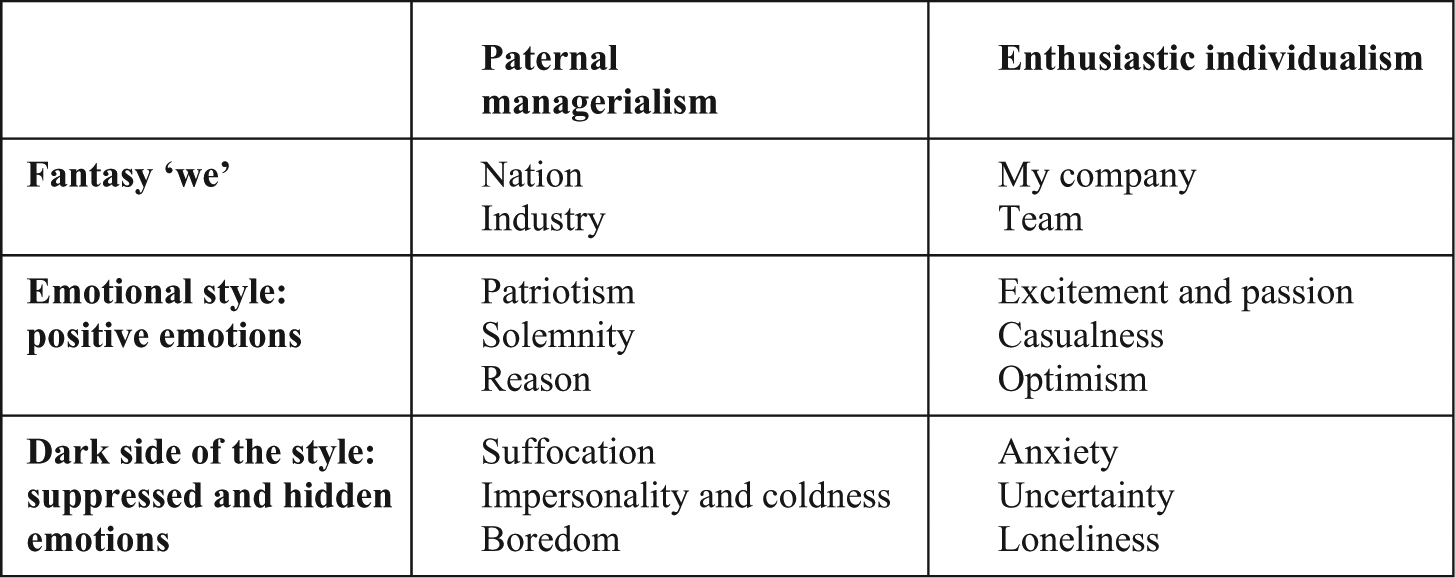
Styles of corporate power as emotional regimes in Finland.
The change of styles can be compared with similar results in other studies. Pantti and Wahl-Jörgensen (2011) suggest in their study on disaster coverage in Britain from the 1950s to the 1980s that an authoritative emotional regime designed to control anger and highlight rationality was dominant. They found, from the 1980s onward, indications of a more open regime allowing for individual emotional expressions. Also Janzen et al. (2012) posit that individualized self-actualization (with the purpose of becoming the person ‘that you really are’) can be seen at the core of a new emotional regime of a hedonistic consumption culture that developed after the 1960s. Similarly, Stearns (1994) suggests that the Victorian style of strict etiquette and family morality, which had dominated the earlier part of the 20th century, was replaced from the 1950s by a new, informal style of ‘cool’.
This study, however, also stresses how emotional regimes are linked with each other as the suppressed feelings of paternal managerialism are addressed by enthusiastic individualism (Figure 2). In paternal managerialism, the father loves his children, yet he can be dominating and suffocating in his authoritative pose. Rational authority can be cold and impersonal. The style of passionate individualism seems to address these problems. It escapes the suffocating high figure of the father, liberates its subjects from the national ‘we’ and celebrates individuality. Passionate individualists implicitly challenge the model of unimpeachable authority by constructing public images and performances that communicate individualism and change. Often, they openly criticize the faceless bureaucracy and suggest that they would get bored in big bureaucracies. Passionate individualists attempt to create a new style that allows for expressive feelings.
The emotional dynamics between different regimes also open up an interesting point for further research. Is there also a dark side to the regime of enthusiastic individualism? As new capitalism builds on individuality, its shadow emotions may be insecurity and alienation. Alternatively, because enthusiasm often passes relatively quickly, this regime may suffer from a lack of long-term consistency and concrete horizons. The continuing insecurity and alienation within individualism’s backstage might therefore give rise to the next emotional regime. This hypothesis, however, needs to be researched at another time.
The dynamics of emotional regimes can also be compared between societal sectors. The shift in public performances may indicate larger social dynamics, whereby business sectors have gained a prominent and dynamic role when compared to the political and public sectors. The 1980s was a decade of post-Fordism and economic liberalization as national regulation of finance capital was gradually loosened and markets gained the upper hand over the state-guided national economy. The third spirit of capitalism arose in conjunction to these developments (Kantola, 2009). Interestingly, some suggest that politics have simultaneously become something we ‘hate’ (Hay, 2007). Arguably, politics was the most powerful sector in state-controlled societies from the 1950s to 1970s, and at that time, as I also suggest, business life was subservient to the state-led national emotional regime. It may be that since the 1980s, this relation has changed as markets and finance have been increasingly liberated from national constraints, and the business sector has become the dynamic force in society in comparison with the state and politics. This hypothesis, however, needs to be investigated through multiple media that represent the emotional regime of politics more consistently.
Mediated performances of power
The study shows how media play a central role in the emotional dynamics of society. In this case study, the media provided a forum for emotionally tuned public performances. Talouselämä, a magazine for engineers and business professionals, became a forum where they could openly perform their new styles. As such, the magazine can be likened to the earlier journals and salons of the 18th-century bourgeois public sphere (Habermas, 1989; Reddy, 2001: 146–52). At the end of the 20th century, the magazine expressed the corporate sector’s new emotional regime, which challenged the existing state-led regime of patriotic paternalism and rational planning.
The management of emotions was partly transformed by the journalists and media that adopted new story formats. Paper became glossier and the forms of writing became more informal. Columns were replaced by interviews and small passport-sized pictures by colourful photographs representing dynamic and outspoken ‘real’ people. At the same time, corporate managers changed their performance styles. Gradually, they gave up the solemn style and became more informal, individual and enthusiastic. These public performances became ritualized forms of communication that helped to change the dominant emotional regime. Talouselämä also served as an arena of identity, a bounded space where new collective feelings of belonging were enacted (Berezin, 2001: 93). As Finnish journalism slowly became more critical of business and political elites (Kantola and Vesa, 2013), Talouselämä created a space where corporate elites could perform relatively freely.
The case study also points out that the performative rituals of power do not need to be grand ceremonials or spectacular media events. Everyday public performances such as interviews, public discussions and confrontations are an important part of the ritual order of political and social life. They are repeated practices that mobilize emotion and attention among participants or observers. They elevate certain symbols and invest authority in those emotions that either sustain or challenge institutions and social relations (6, 2007: 40–2). The mediated performances of the business leaders can be regarded as small, everyday rituals that set the emotional tenor of corporate life and its meaning in society. These corporate leaders step out into the public and perform not only facts but also emotions upon the page. When traced over a longer period of time, these routine interviews and columns are good indicators of wider societal changes. Public performances show how societies change as performers make small yet significant revisions of familiar scripts that, in the long run, accumulate into more profound and dramatic social shifts (Alexander and Mast, 2006: 15).
One might also ask why the mediated performances were effective. Collins (2004: 363) pays attention to the importance of emotions in societal change, be it evolutionary, progressive, developmental or revolutionary change. Collins (2004: 132) contends that the creation of emotional energy is crucial for change: power is fomented when the energy of the leader is transformed into a collective emotional energy. He also points out that ‘their energy is not their own’. Thus instead of seeing leaders’ energizing impact as a result of their individual qualities, Collins proposes that they should be seen as part of interaction rituals in which it is important that they appear as energetic and dynamic. Thus, the media play a central role as they provide sites where emotional energy can be performed and transferred. The higher strata of society develop forms of mediated interaction, which employ emotions. These mediated performances can become emotionally effective if they enhance solidarity and have a binding quality that embodies a promise to align with others (Barker, 2001: 188). Mediated performances can also fuel societal dynamics (Eyerman, 2006) as they permit new or forbidden emotions to emerge (Eyerman, 2005: 46).
In Finland, as with other countries, the corporate sector has been successful in creating and devising such performances since the 1970s. As Eyerman (2006: 204) suggests, social movements affect the boundaries of feeling as they speak for the unseen, deserving other. Similarly, since the 1970s, business leaders performed publicly emotions that had been unseen previously, and at the same time the business sector challenged the existing state-led rational collectivity. New capitalism became an emotional regime that challenged existing institutions and created feelings of mutual action, community and empowerment. This also points to the fact that it is not only anger that can be employed to motivate action (Pantti and Wahl-Jörgensen, 2011) – positive feelings can also activate subjects. This study suggests that, in order to gain power, one needs to develop a range of public performances that build on positive feelings. This study suggests that at the heart of an emotional regime is a fantasy of ‘me’ or ‘we’, an ideal identity, community or issue that arouses enthusiasm and energy. To maintain power, the regime must devise public performances that reiterate and reinforce this ideal. Clearly, one should not overemphasize the role of emotions in societal dynamics. Emotions are by no means the sole cause of societal change, and they should not be considered distinct from other structural factors of change. However, the emotional perspective does argue that feelings must count in the ways we measure societal dynamics. In order to understand the workings of power, one needs to look into the emotional dynamics as they can provide a clue to the societal dynamics of power.
Footnotes
Funding
This research received a grant from the Academy of Finland and from Helsingin Sanomat Foundation.