



Abstract
While humanitarian communication has been scrutinized by practitioners and academics, the role and meanings of intimacy at a distance in this communication have been largely overlooked. Based on analysis of 17 in-depth interviews with professionals in 10 UK-based international NGOs engaged in planning, designing and producing humanitarian communications, this article explores how intimacy figures in NGOs’ thinking about and practice of humanitarian communication. Drawing on discussions of ‘intimacy at a distance’ and the ‘intimization’ of the mediated public sphere, the analysis explores three metaphors of intimacy used by interviewees to articulate the relationships they seek to develop with and between their beneficiaries and UK audiences: (1) sitting together underneath a tree; (2) being there; and (3) going on a journey. The article situates the governance of intimacy of practitioners’ thinking and practice as NGOs’ attempt to respond to criticisms from the humanitarian and international development sector, policymakers and scholars. It concludes by calling for a revisiting of the centrality of intimacy in humanitarian communication and the logic of emotional capitalism within which it is embedded, outlining its implications for both academic scholarship and practice.
Keywords
Media coverage and non-governmental organization (NGO) communications related to humanitarian disasters and international development call on western spectators to care for and act in solidarity with distant others. They frequently construct distant others as intimates: the suffering child whom we are invited to regard as a daughter; the mother whose testimony is posed as from a friend or neighbour. Viewers are asked to develop ‘intimacy at a distance’ (Horton and Wohl, 1956; Thompson, 1995), a mediated, intimate, mostly non-reciprocal bonding with far-away others. While humanitarian communications – mediated messages about humanitarian crises, international development and human rights violations have been scrutinized by practitioners (e.g. Darnton and Kirk, 2011; Progressive Development Forum, 2013) and academics (e.g. Benthall, 1993; Boltanski, 1999; Chouliaraki, 2006, 2013; Cohen, 2001; Cottle and Nolan, 2007; Dogra, 2012; Littler, 2008; Moeller, 1999; Nash, 2008; Pantti et al., 2012; Richey and Ponte; 2011; Tester 2001; Vestergaard, 2008), the role and meaning of intimacy at a distance in such communications have been largely overlooked by both sides in the debate.
This article is based on an analysis of interviews with NGO professionals engaged in planning and producing humanitarian communication (fundraisers, communications, branding, campaigns and advocacy managers) and explores how intimacy figures in their thinking and practice. It seeks to situate humanitarian NGOs’ employment of mediated intimacy within their broader struggles and criticisms from the humanitarian and international development sector itself, and from policymakers and scholars, regarding the effectiveness, legitimacy and ethics of humanitarian communications, and issues at the core of NGOs’ work (e.g. Howell, 2013; Progressive Development Forum, 2013; Tran, 2012). The study links two mostly separate literatures: on humanitarian communication and ‘intimacy at a distance’. It complements critique of humanitarian and development communication that relies mostly on philosophical accounts and visual and textual analysis (Orgad and Seu, 2014) with an analysis of producers’ accounts, and seeks to connect academic critique more closely to NGO practitioner debate.
The first section presents the theoretical framework for the analysis, reviewing key issues and arguments related to ‘intimacy at a distance’ and linking them to the study of humanitarian communication. The second section presents an analysis of the interviews with NGO professionals, showing how practitioners draw on images of intimacy to articulate the relationships they seek to develop with and between their beneficiaries and UK audiences. The analysis is organized around three metaphors of intimacy used by interviewees. They encapsulate how interviewees mostly accounted for the relationships they seek to create with and between audiences and beneficiaries in their humanitarian communication practice. The third section discusses some implications of what appears to be the ‘tyranny of intimacy’ (Sennett, 1974) in current humanitarian communications, concluding by highlighting three ways in which the discussion is relevant to theory and practice.
Intimacy at a distance and the ‘intimization’ of humanitarian communication
In a pioneering essay examining ‘show business’ programmes in the early days of American television, Horton and Wohl (1956) proposed the concept of ‘intimacy at a distance’. It described a new type of non-reciprocal relationship – para-social interaction – that viewers were asked to develop with media personae, such as news presenters and talk-show hosts. The authors showed how these media performers used devices, formulas and strategies to ‘coach audience attitudes’ (Horton and Wohl, 1956: 6) and create the ‘illusion of intimacy’ (Horton and Wohl, 1956: 3), of bonding, albeit one-sided and non-reciprocal, with ‘crowds of strangers’ (Horton and Wohl, 1956: 2). Audiences were invited to know and relate to these personae on a regular, continuing basis, as ‘friends’, and to feel involved in casual, informal, face-to-face exchanges that emphasized intimacy rather than engagement in formal and/or passive observation.
While Horton and Wohl’s (1956) essay is largely descriptive, more recent debate on the ‘intimization’ of the mediated public sphere (Van Zoonen, 1991) is critical and normative. Inspired by critiques of the ‘tyranny of intimacy’ (Sennett, 1974: 5) and the prevalence of the western therapeutic model of intimacy in contemporary public life (Illouz, 2007), studies of various media forms and genres (e.g. lifestyle magazines – Gill, 2009; news – Kress, 1986; Van Zoonen, 1991; media events – Myers, 2000), and media personalities (e.g. celebrities – Rojek, 2012; Schickel, 2000; Turner, 2004; politicians – Stayner, 2012) highlight increased incorporation into the mediated public sphere of intimate styles of presentation and modes of address previously considered to belong to the private sphere. Van Zoonen (1991: 228) underscores the gendered character of intimacy and challenges the view that incorporation of ‘private’ topics, genres, values and actions in the mediated public arena is eroding ‘the adequacy of the public sphere’ and endangering ‘effective public discourse [and life]’. Others (e.g. Dahlgren, 1981; Matthews, 2007; Orgad, 2005; Peck, 1996) demonstrate the potential value of intimate modes of address/language, and personalization and privatization of issues, for example to foster identification, but warn they may deflect attention from broader societal structures by transmuting political to psychological categories, thereby diffusing the responsibility of larger societal institutions and forces.
Although the literature on humanitarian communication mostly does not explicitly address the issue of intimacy at a distance (exceptions include Koffman and Gill, 2013; McAlister, 2012; Orgad, 2012), many observe that the individual – particularly women and children – constitutes the ‘face’ of distant suffering. Studies show how constructions focusing on sufferers’ personal intimate lives (e.g. Cohen, 2001; Chouliaraki, 2006; Dogra, 2012) are employed, in Horton and Wohl’s (1956: 6) words, to ‘coach audience attitudes’, to encourage spectators’ identification with and care for distant sufferers. For example, McAlister (2012) shows how the moral imperative for responsibility and action in response to distant suffering is couched in intimate terms and uses of idioms of western romantic love in order to resonate with western givers’ private suffering over damaged romantic relationships. However, as Thompson (1995: 225) warns, there is a danger that in fostering a symbolic ‘bond of intimacy’ ‘the narrative of the self becomes interwoven with a narrative of the other in such a way that one can no longer prise them apart’. In asking viewers to become symbolic intimates of distant sufferers, current media representations often call on them to embody the sufferers, and relate to the other through ‘the elision of the different to the same’ (Silverstone, 2007: 47). 1
Situating humanitarian communication within the broader ‘intimization’ of public communication and public life, and combining insights from the two literatures – ‘intimacy at a distance’ and humanitarian communication – provide a basis for examination and critique of the logic and practice of NGO communications.
The study: intimacy at a distance in NGO professionals’ thinking and practice
Methodology
The following analysis is based on 17 in-depth interviews with NGO professionals engaged in planning, designing and producing humanitarian and development communications. Open-ended interviews (1.5–2 hours) were conducted by the first author in 10 UK-based NGOs representing the two main ‘branches’ of humanitarianism (Barnett, 2011): humanitarian emergency and international development.
Interviewees were selected from ‘outward-facing’ professionals who address the UK public and are active in aspects of the production and dissemination of humanitarian communications. We aimed at a mix of sizes and longevity of NGOs, positions/roles, seniority of individuals, and departments – communications and campaigns (6), fundraising (3), marketing and branding (4), media relations (2), and advocacy and policy (2).
Interviews were audiotaped and transcribed and aimed at exploring practitioners’ thinking about goals, practices and experience of communication planning, design, production and dissemination. They were open-ended to allow practitioners to describe what they saw as most central, important and/or challenging and difficult in their practice. Interviewees were given a broad description of the study’s purpose – to investigate how NGO practitioners and the UK public perceive and experience humanitarian communications. Interviewees were asked to describe their role; subsequently, interviewer interventions were minimal.
This deliberate open-ended, flexible interview design was chosen to encourage practitioner-led narratives whose content and structure were organized by the interviewees. Substantively, it aimed to expand and complement the focus of research on humanitarian communication on critique of audiences’ and media producers’ (including NGOs) ‘violations of philosophical norms’ (Ong, 2011: 20), that is, top-down examination of the meanings and consequences of humanitarian communication on the basis of specific ethical normative values. The present study focuses on the meanings that NGO producers give to their practice; their accounts of their role and practice and its implications in their particular work context.
Preliminary thematic analysis of the interview transcripts identified broad topics and issues prioritized in practitioners’ accounts. These themes were not prompted by specific questions; they were discussed idiosyncratically by individual participants. Further thematic analysis was guided by the following questions: In relation to whom and what do practitioners position their practice and role? How do practitioners perceive current and desired relationships with these reference points? While current humanitarian communication research focuses on how NGOs (and media) can bridge the gap and cultivate mediated connections between spectators in the global North and ‘beneficiaries’ in the global South, we are interested in whether and how practitioners account for this relationship, and whether they consider other relationships as significantly shaping their practice. Ultimately, we are seeking a contextualized understanding of the priorities, arenas, interests and struggles driving the thinking and practice of NGO practitioners involved in the production of humanitarian communications.
Details that might identify speakers and/or NGOs have been removed to ensure confidentiality and anonymity. Thus, inevitably, some observations are general. While constraining specific comments about differences between types of NGOs and their professional roles, it enables reflection on NGO practices and patterns of thinking beyond individual affiliations and specific remits.
The analysis identified three types of relationships practitioners considered central to humanitarian communication: (1) NGO and its beneficiaries; (2) UK audiences and beneficiaries; and (3) NGO and UK audiences. Other relationships, for example between and within NGOs, and between NGOs and stakeholders such as private donors, were discussed but were mentioned less frequently and/or indirectly. The analysis shows that these other relationships are sometimes implicated in and associated with one or more of the three listed (for a detailed discussion of NGO inter- and intra-organizational relationships see Orgad, 2013). Interviewees often used figurative language to describe these relationships, and especially types of relations they sought to cultivate through humanitarian communications. Each relationship had some distinct characteristics, but all involved images of intimacy, which were used unprompted in accounts of the NGO’s desired relationship with its beneficiaries, with UK audiences, and between UK audiences and beneficiaries. Interviewees used three main images of intimacy: (1) ‘sitting together underneath a tree’ – to describe the NGO–beneficiaries relationship; (2) ‘being there’ referring to relations between UK audiences and beneficiaries; and (3) ‘going on a journey’ describing the NGO–audience relationship. Figure 1 presents the three types of relationships and the images that map onto them.
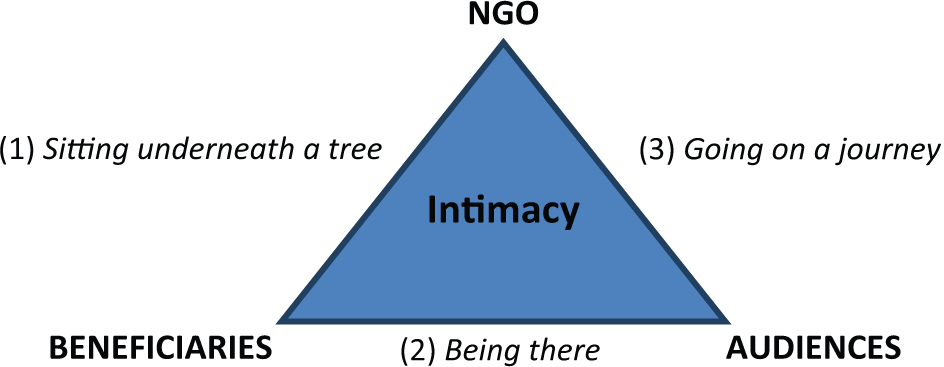
Three types of relationships and metaphors of intimacy.
The three images operate as metaphors that evoke specific ideas, values, claims, and knowledge and belief systems on which NGO professionals draw and which structure their thinking and practice in important ways (based on Fairclough, 1992: 195). They also work affectively, conveying attitudes, feelings and evaluations (Cameron, 2003). Specifically, as the discussion will show, the first two metaphors – sitting together underneath a tree and being there – were used by interviewees in direct relation to their or other NGO workers’ concrete experiences. Unlike the third metaphor of a journey, which many civil servants have embraced, the force of these two first images seems to derive largely from an imagined and/or embodied real situation to which interviewees refer. The analysis is organized around these images and seeks to show how intimacy recurs as the ‘thing’ that practitioners said they sought to cultivate in their communications, and as a discourse that structures how practitioners think and act, and which constructs their terms of debate and worldviews in significant ways.
Analysis: metaphors of intimacy
Sitting together underneath a tree: NGO–beneficiaries relationship
The phrase ‘sitting together underneath a tree’ was used by only one interviewee, but others used variations of it to describe the relationship between their NGO and its beneficiaries. When discussing their approach to representing ‘beneficiaries’ in NGO communications, many described the NGO worker and the beneficiary sitting side-by-side outdoors, surrounded by nature, on the beneficiary’s (imagined) turf (e.g. village, mountain, field). The communications and campaigns manager who used the words ‘sitting together underneath a tree’, was describing a real scene:
[our staff] will literally sit with families, you know, underneath the tree, and identify the obstacles which are keeping those families in poverty, and agree ways in which [our NGO] can work together with those families to help them move from opportunity to opportunity. (int. 1, emphasis added)
Following this literal description of an encounter between NGO workers and beneficiaries, the manager then explained that this image ‘informs the culture, the approach, the philosophical, raison d’être for the way we work … the locus for our public communications work’ (int. 1). In other words, he referred to the image of NGO and beneficiary sitting beneath a tree as a metaphor embodying an ideal encounter. Similarly, a communications manager in another NGO (int. 11) described how her NGO workers would climb a mountain to record the experiences of beneficiaries who were illiterate. She used this image to convey the broader ‘spirit’ of her NGO, of engaging with beneficiaries (‘a word I hate’, she said) as partners, on their own turf and their own terms.
We suggest that the significance of these images is their powerful symbolism of NGOs’ relationships with their beneficiaries, grounded in real or imagined images of NGO workers and beneficiaries together in this type of embodied situations. (Interestingly, several of the NGOs’ UK offices displayed posters showing NGO workers and beneficiaries, sitting together, outdoors in villages or fields.) These mental images evoke a personal, one-to-one and, significantly, egalitarian relationship. Rather than western white ‘saviours’ rescuing ‘beneficiaries’ or ‘victims’ in the global South, these images depict NGOs and beneficiaries as ‘partners’ engaged in an equal and fair relation. According to Illouz (2007) the western model of intimate romantic relationship promised a departure from the long shadow of asymmetric power relations between men and women. Similarly, the intimate image of sitting under a tree and its emphasis on egalitarianism between ‘us’ (embodied by the NGO in the global North) and ‘them’ (the ‘beneficiaries’ in the global South) promise abandonment of the narrative of ‘the powerful North [that] wants to know and possess the submissive South’ (Cohen, 2001: 178), whose employment by NGOs has been harshly criticized.
The modern western model of intimacy that NGOs seem to adopt to account for their relationships with beneficiaries stipulates, that ‘partners ought to relate to each other in an egalitarian fashion’ (Illouz, 2007: 28). This model, which couples intimacy and equality, is embedded in and constitutive of emotional capitalism, a culture that fuses the economic sphere and its market repertoires and the language of psychology and emotions (Illouz, 2007). Appropriating the logic of emotional capitalism and its image and discourse of intimate partnership allows NGOs to establish themselves as ethical and progressive, and to mark rejection of their colonial baggage. For example, a campaigns manager in one of the largest UK NGOs (int. 2) praised his organization’s campaign for being ‘about partnership and all that’ adding that ‘it’s lovely’, in contrast to ‘plenty of other NGOs’, which he criticized for failing to embrace the intimacy-partnership model and for perpetuating the image of NGOs as saviours of helpless victims, ‘the noble savage sorts of … colonial thing’. Intimacy is equated with fair and equitable exchange, signalling abandonment of unequal relations between NGO and beneficiaries, and, by implication, between global North and global South.
NGOs’ intimization of their relationship with beneficiaries serves also to counteract the impersonal nature of their work, which is public, replicated, transactional and uses standardized formulas and strategies in mass-mediated forms (e.g. campaigns, appeals) to address the masses. Rather than delivering supplies through a faceless supply chain of anonymous people whom these practitioners will never see, ‘sitting together under the tree’ connotes a sense of personal relation and identification, in an interaction constructed as private, personal and unique. When discussing beneficiaries, several interviewees referred to people’s names, ages, locations and personal ‘life stories’. Rather than a brief and fleeting transaction – an NGO communications framework that has attracted fierce criticism (Chouliaraki, 2013; Darnton and Kirk, 2011), sitting together under a tree invests the NGO–beneficiary relationship with some durability – a sense of humans ‘being in nature’ together for a time. And rather than around a table, on chairs, in the NGO practitioners’ offices, they sit on the ground outside, implying authenticity and proximity. The image of ‘partners’ sitting together on the ground, constructs the encounter and relationship with the beneficiary as mutual and dialogic. A communications and campaigns manager said: ‘it’s not that we’re doing things to them [beneficiaries] … it’s about working with them to effect change’ (int. 1).
In response to criticisms of offensive, patronizing, ethnocentric, dehumanizing representations of beneficiaries that perpetuate the unequal power relations between ‘us’ in the global North and ‘them’ in the global South (Chouliaraki, 2013; Cohen, 2001), NGOs seem to be exploiting intimacy in an attempt to reconstruct and correct their relationship with beneficiaries. Intimacy enables them to construct an ‘adequate’ encounter with the distant other, as unique, personal and embodied. Yet, in adopting the cultural model of intimacy, its key motives of equality and fairness (Illouz, 2007: 29) and its orientation towards the ‘here and now’, as in ‘sitting together underneath a tree’, to articulate NGO–beneficiaries relations, NGOs fail to acknowledge past and present asymmetries. The image of individuals forging an intimate bond in nature masks the fact that NGO–beneficiaries’ relations are entirely institutionalized and structured within large-scale complex logistic operations in increasingly professionalized work fields (Calhoun, 2008b). This model of intimacy supresses history and inequality, described by a campaigns manager as that ‘colonial thing’ (int. 2) (which he and many other interviewees insisted they no longer ‘do’ in their communications). The image of NGO and beneficiaries sitting ‘here and now’, on the ground, on a par, obscures the radically unequal ground that shapes socio-economic and political relations between global North and global South.
Being there: audiences–beneficiary relationship
Related to the emphasis on embodied proximity to the beneficiary, ‘being there’ in the beneficiaries’ territory was a recurring image in interviewees’ descriptions of the symbolic relationship they seek to create between their UK audiences and beneficiaries. The idea of being there – the leitmotif of humanitarian organizations (Fassin, 2012) – and the promise it embodies of intimacy, was presented by most interviewees as the pivotal feeling that communication must generate in audiences. Most interviewees were clear that for their communications to successfully engage and mobilize audiences to act (primarily by donating money) the beneficiaries must be seen as intimates in a shared space; audiences need to experience ‘being there’, in the scene, together with the distant other. A senior communications manager summarized this saying that were he able to achieve just one thing it would be to ‘take all the people in the UK and show them real poverty’ in the global South, to overcome his audiences’ alienation from the far-away strangers in developing countries (int. 10) – alienation that NGOs are partly culpable for cultivating, as some interviewees acknowledged. As one campaigns manager reflected: ‘fifty years of just churning out the same message about gravity of need, need, need, need, need; and the way to respond to that is give, give, give, give money’ (int. 12).
Intimacy carries a corrective promise, it presents a ‘fix’ for this ‘depressing message’ (int. 12) and the disconnection it fosters between audiences in the global North and beneficiaries in the global South. Education programmes involving UK supporters visiting remote places where NGOs work with beneficiaries were described by various interviewees as offering the closest (idealized) realization of ‘being there’. However, such programmes are expensive, and NGOs focus on simulating embodied proximity to their beneficiaries, using mediated forms. This is the premise of Oxfam’s ‘See for Yourself’ campaign, comprising two television advertisements showing two ‘typical UK donors’ (as described by one of Oxfam’s fundraising team) – Abbie and Jodie – being flown to Zimbabwe and Malawi to see poverty ‘for themselves’ and to see where Oxfam is working. The characters assert that ‘being there’ and seeing ‘with their own eyes’ enabled them to truly identify with and thus care for these distant others: ‘seeing it for themselves’ was a crucial, transformative experience. Similar to the television personae that Horton and Wohl (1956) studied, the Oxfam campaign’s Abbie and Jodie exemplify ‘to the home audience an enthusiastic and “correct response”’ (Horton and Wohl, 1956: 7). To understand and care for the distant other requires one to ‘get closer’, to become an intimate.
NGO practitioners regard mediation as a barrier to embodied intimacy and they look for ways symbolically to de-mediate the relationship between UK audiences and distant beneficiaries by simulating physical proximity. New media technologies are utilized to support the project of de-mediation. For example:
we made a film in 3D last year for the first time because we really wanted people to, sort of, feel that they were in the village … really try to, you know, make [them] feel that they were in there and, you know, in the hut. (int. 3, emphases added)
Just like the technical devices exploited by television producers in the 1950s to ‘create the illusion of intimacy’ (Horton and Wohl, 1956: 5), NGOs in 2013 are employing devices such as 3D immersive films ‘to lure the attention of the audience, and to create the easy impression that there is a kind of participation open to them’ (1956: 5); that they are ‘in the hut’. The ease with which spectators are invited to symbolically ‘move in’ to the same space with beneficiaries and ‘be there’ is instrumental to the model of intimacy that NGOs adopt and the logic of emotional capitalism that informs it. It is geared to supporting a ‘smooth operation’, based on meeting audiences ‘where they are’ (a phrase repeated in most of the interviews) and offering them a seamless and relatively effortless ‘way in’ to the suffering of far-away others. We return to this point later.
The significance professionals attribute to simulations of the experience of ‘being there’ among their UK audience often was closely intertwined with and regarded as dependent upon their own experience of physical visits to sites of NGO operations, and meeting beneficiaries ‘first-hand’. For example, in the following statement from a communications manager, note the move from (a) talking about approaching her audiences in the UK as a communicator, to (b) her personal experience of visiting Ethiopia, back to (c) her addressing of her UK audience:
(a) you can demonstrate it quite straightforwardly, if you’re talking to a general sort of public, if you’re talking to potential new supporters … people you want financial support from, by using strong case studies, which we do have a lot of. You know, because you go out to anywhere and you will be introduced to somebody who’s been assisted with something, and then, you know, they’ve gone from poverty to growing.
(b) I mean I’m thinking of a particular lady I met in Ethiopia. We were experimenting with new, to them, crops, and she was given some potato seeds and within two years she’d grown hectares of potatoes, was selling them! She was the poorest woman in the community and that’s why she was part of this test and had gone from being the poorest woman in the community, unable to send her children to school, to having kids at school, she had people working in her fields, she was selling surplus at market, she had cows, she had goats, she was on the committee in her village, and her life was just sort of transformed, completely transformed.
(c) And, that was fairly simple but it’s very, very tangible, and there are lots of stories like that.… So, that kind of messaging … this is what happened, she can tell you about her life now, and it’s very obvious that this is a change for the better, and if you can replicate that. (int. 3, division of the text added)
The endeavour, according to this manager, is to replicate the (imagined and idealized) one-to-one intimacy experienced by the professional through her embodied encounter of the ‘other’, in mediated form, for mass (one-to-many) audiences – intimacy at a distance. Such intimate knowledge of others and their situations is seen by practitioners as guaranteeing understanding. Practitioners based in ‘their great big isolated headquarters’ (int. 14) who fail to forge the desired intimate bond with the people they represent cannot ‘really’ understand their beneficiaries and communicate their needs to western audiences, explained a fundraising manager (int. 14). A former news correspondent in Africa, now a media manager in one of the UK’s largest NGOs, establishes this notion of ‘being there’ as guaranteeing capacity to imagine and understand the far-away other:
I’ve got a good understanding of the issues, I’ve got a very good understanding of the political and policy issues, both about how Africa is seen back here and the situation on the ground in developing countries. Yes, I can also visualize the children that I’m thinking about or talking about … so when I’m thinking of a child that’s hungry … I know what that means, or thinking of a child who’s been a child soldier, I know what that means. (int. 7, emphases added)
Thus, ‘being there’ provides the stamp of authenticity: intimate knowledge of the other based on an embodied ‘bond’ with the beneficiary grants the NGO speaker legitimacy and authority to claim things on the other’s behalf and represent him/her ‘truthfully’. Paradoxically, those professionals whose job it is to mediate the experience of far-away others, believe that it is the intimate unmediated encounter with the other that is required in order to both understand (cognitively) and care (emotionally) for distant others.
The notion that understanding and caring for the other is conditioned upon becoming her intimate, is closely connected to a broader, commercially driven emphasis in the contemporary mediated environment on ‘getting closer’. Contemporary media compete over who will get spectators (symbolically) closest to the far-away events and people they report; their impetus is defeat of distance, making it seem as if the spectator were ‘on the spot’ (Orgad, 2012: 1). However, this excludes other forms and ways of knowing, and modes of relations with distant others, which potentially would allow spectators to know the Other in more diverse, complex and less standardized ways (Orgad, 2012: 191). Intimacy, which appears to ‘tyrannize’ NGOs’ thinking about the relations they want to create between UK audiences and beneficiaries in the global South, may block out alternative (perhaps more effective and ethical) modes of relations through which spectators can relate to and act for far-away others.
Going on a journey: NGO–audiences relationship
The metaphor of a journey was used by almost all the interviewees. While some used it to describe the relationship between NGO and beneficiaries, it was most often used to depict the desired relationship between NGO and its UK audiences. NGOs seek to ‘begin a journey’ on which they can take their audiences over time. A fundraising manager explained:
essentially you are usually bringing people in quite cold, and what you’re doing is you’re taking them on a journey, where what you hope to do is get them more engaged with your cause. (int. 5, emphasis added)
The journey metaphor casts the NGO–audiences relationship as one that grows, matures and endures. It suggests a corrective alternative to fundraising-driven approaches and ‘transactional’ engagement activities that are oriented towards arm’s length relationships that end quickly – approaches that NGOs have been criticized for and faced demands to abandon (Cohen, 2001; Darnton and Kirk, 2011).
The image of a journey constructs the relationship between the NGO and its audiences primarily as educational: campaigns and advocacy practitioners in particular, described the public as in need of education, and the NGO as the educator/coach providing it. The discourse of education is part of the broader official institutional rhetoric NGOs use to frame and position their work with audiences (many have dedicated education programmes, teams and departments).
The journey is simultaneously instrumental: communications and especially fundraising and branding practitioners explained that it serves to convert ‘one-off’ donors to long-term regular NGO supporters and donors, for example:
You sort of hope to take them along [on] the journey … we’re looking at how you move people from being supporters to being campaigners, and campaigners to being supporters. So, it’s all part of that supporter journey, giving people entry points and then other ways of getting involved and bringing them along with you. (int. 3)
Interviewees described the strategies and techniques they employ to create and sustain the ‘journey’ with their audiences in similar terms to those used by Horton and Wohl (1956: 3) to describe television personae seeking to create ‘a continuing relationship’ with ‘crowds of strangers’. Practitioners referred to establishing their NGO’s image or brand as a regular, recognizable feature integrated into people’s daily lives. They described techniques that echo the discursive manufacture of celebrity by the media (Turner, 2004), which they employ in their public communications to create a sense in their supporters of ‘living with’ the NGO, such as sharing with supporters small episodes of NGO workers’ private lives. For example, one communications manager (int. 11) reflected on her inclusion in a supporters’ newsletter of a piece by an aid worker in the field who talked about missing Marmite. She felt that such trivia in an NGO worker’s daily experience in the field resonates with UK audiences, thus enabling ‘much greater connection’ (int. 11) between audience and NGO. Thus, the ‘journey’ which NGOs invite their audiences to undertake harnesses intimacy to monetary transaction. This is the logic of emotional capitalism: the economic self – here, in the figure of the potential donor – is made emotional through feelings of intimacy with the NGO, and the audiences’ emotions are bound to the instrumental action of money donation.
The journey metaphor draws on and evokes another, less explicit, discourse – romantic love:
it’s about them [audiences] believing in us and what we give them by way of a communications experience that will bring them back to us … that will make them love us I suppose in hippy terms.… We need people to give us money. We need our business to work. It’s what we add on top of that that will make us memorable, that will create this love in our audiences, that will bring them back to us, and that will actually potentially change them as well. (int. 4, emphases added)
What this NGO brand manager describes (corroborated by other interviewees in various roles) is NGOs’ attempts to win back their audiences’ loyalty. Resonating with McAlister’s (2012) analysis of the evocation of suffering over damaged love in a telethon Haiti earthquake communication, interviewees positioned their NGOs as the betrayed lover, seeking to re-engage the partner who has left, by showing that they have changed their ways. Underlying this is an implicit recognition of audiences’ perceived disillusionment and loss of trust in NGOs and/or humanitarian aid. The journey metaphor and the romantic language of intimacy supporting it, help NGO practitioners to establish their endeavour as a corrective, conciliatory effort 2 tuned to audiences’ needs and wants.
Taking audiences on a ‘lovers’ journey’, and creating intimate relations with them, imply avoidance of challenge or discomfiture – at least initially. Underlying these journey constructions is the idea that, as the relationship with the audience develops, it can survive difficult feelings and information, but these should be avoided in the opening, ‘dating’ phase. Similar to the media personae described by Horton and Wohl (1956), the discourse of a romantic journey establishes the NGO as the romantic hero who reassures and comforts, endowing supporters with a good feeling, not challenging or disturbing them. The following account of a branding manager captures this in advocating elimination of conflict rather than enabling audiences some experience of discomfort from the encounter with others’ vulnerability:
we’d love to help them [audiences] see that they can be political without it threatening them; that takes time. So yes, we would, and we do that so we don’t whip people [up] against money, in other words, softly introduce the notion that they can actually make change politically, but lots of people don’t feel that comfortable with it. (int. 4, emphases added)
The emphasis in this and some other accounts is on making audiences care about the suffering and need of others, but comfortably. Even those interviewees who admitted the intimate journey with their audiences included some disruptive moments when the NGO whips rather than comforts and reassures its audience, were keen not explicitly to engender feelings such as guilt, anger or indignation, and favoured the ‘cosier’ and more positive allure of intimacy with their supporters:
[We want to] appeal to the feeling, to the emotion; but not […] to the emotion that is about guilt or shame: it is a shame that these people are poor; or guilt that my country is … I’ve got so much and you’ve got so nothing; or pity, which is some of what these feelings throw out – you don’t want them to have that feeling; you want to touch on the positive feeling. (Campaigns manager int. 12, emphases added) But not in a judgemental way, it’s saying to [our audience] … you have the agency to help do something about that. So I don’t know that it would be layered with guilt actually and that’s certainly not how we’re trying to position it. (Communications and campaigns manager, int. 1, emphasis added)
The model of intimacy that the above interviewees and other NGO practitioners admitted to employing echoes the model of ‘emotional capitalism’: it ‘aims at neutralizing the emotional dynamic as that of guilt, anger, resentment, shame, or frustration’ (Illouz, 2007: 39) and instead seeks to make us feel validated and good. The intimacy promoted in this NGO–audiences relationship is self-oriented rather than other-focused: it is geared to the audience deriving pleasure, satisfaction and, in some cases, also understanding. This notion, which resonates clearly with consumerist discourses, not surprisingly was emphasized particularly by fundraising and branding practitioners. For example, a branding manager explained:
The [brand] proposition … it’s what I want you […] to do to achieve my cause and the experience I will give you.… It might just be feeling good. It might be some peer status.… The brand proposition is: we have a cause, you can be part of it and you’ll get an amazing experience. (int. 4, emphasis added)
One fundraising manager (int. 10) even compared the feeling promoted by charitable giving with how one feels after having sex. While this comparison could be considered somewhat eccentric, the emphasis on pleasure and satisfaction as key outcomes of the supporters’ ‘journey’ was widely shared by interviewees. Ultimately, the implicit promise of the romantic love relationship is of a fundamental transformation of the self rather than the other, as one campaigns manager put it, it is about ‘challenging the norms in our self’ (int. 2).
Conclusion: revisiting the ‘tyranny of intimacy’ in humanitarian communication
Our analysis reveals that intimacy at a distance is intimately embedded in humanitarian communication; it governs and infiltrates practitioners’ thinking and practice. On the one hand, NGO practitioners’ embrace of the communicative model of intimacy is an ethical response. Relating to beneficiaries as partners symbolically sitting with NGOs under a tree, and offering western audiences a simulated experience of ‘being there’, on a par with and symbolically proximate to the distant other, seeks to frame the partners – NGOs and beneficiaries and UK audiences and beneficiaries – as equals. This construction of an intimate egalitarian exchange is an attempt to address and redress the inadequacies of earlier NGO communications paradigms that perpetuated views of the developing world as a theatre of tragedy and disaster (Cohen, 2001), reinforcing the unequal relations between the West and the developing world, and patronizing and dehumanizing distant others. In times when NGOs are subject to considerable scrutiny and criticism, intimacy at a distance serves as a technique and a discourse to achieve credibility, authenticity and ethical authority, so as to correct past failures of humanitarian representations and NGO practice.
At the same time, NGOs are appropriating intimacy at a distance as a fundraising technique; the creation of mediated intimacy between audiences and distant others and, especially, between audiences and the NGO, is intended to achieve what one fundraising manager called ‘a win-win situation, where they [audiences] are getting some personal benefit out of it and they are also helping us at the same time’ (int. 5). This win-win situation is not about egalitarian intimacy; it is an intimate ‘journey’ that centres on the giver and the pleasure s/he derives from it (for a similar argument, see Chouliaraki, 2013). In centring on creating intimate relations with their UK audiences, which will give these audiences an ‘amazing experience’ (as a fundraising manager cited earlier put it, int. 4), the experience of potential beneficiaries may become obscured. Indeed, one campaigns manager said that he would like the communications he produces ‘to be as much about who we are in this country … as [about] their suffering’ (int. 2, emphases added). While the prime motivation of NGOs is to elicit recognition of distant others’ vulnerabilities and need, and mobilize charitable responses to their plight, the model of intimacy on which they draw, particularly in its application to the NGO–audience relationship, may have the opposite effect.
As the analysis demonstrates, combining ethical insights from the literature on humanitarian communication and intimacy at a distance can be instructive for critiquing NGO communications logic and practice. The problem of managing and reducing distance is at the core of humanitarian communications, that is, how to bridge the geographical, cultural and moral gaps between spectators in the global North and distant others in the global South whose suffering they seek to mitigate. The cultural model of intimacy, embedded in the communicative logic of emotional capitalism, provides humanitarian communication professionals with a framework, a language and a set of tools to re-imagine how they can bridge these gaps.
Intimacy at a distance seems to have successfully penetrated and shaped NGO professionals’ thinking and practice because it is compatible with and supportive of a series of broader transformations that humanitarian communications has undergone – increased professionalization, and adoption of market logic and corporate techniques and styles, particularly branding models and social media (Chouliaraki, 2013; Dogra, 2012; Nash, 2008; Richey and Ponte, 2011; Vestergaard, 2008). It furnishes NGOs with a communicative approach that enables them to establish their work as a corrective for past failures and mistakes, and as reconciling their beneficiaries and western audiences by tuning in to their needs and treating them as equals.
One might lament the ‘intimization’ of humanitarian communications as corrupting and distorting the ‘core values’ and ‘purity’ of humanitarianism – a sentiment that can be found in contemporary debate on humanitarian communication and humanitarianism more generally. However, bearing in mind the important intervention of feminist scholars that effectively critique such grief (see Van Zoonen, 1991) in writing about mediated intimacy, we avoid such lamenting. Rather, we highlight three tensions that emerge from the analysis of the centrality of intimacy in the thinking of humanitarian communication practitioners, and suggest that they are relevant to academic enquiry and practice related to humanitarian communication.
First, NGOs’ investment in developing mediated intimacy with and between their audiences and beneficiaries, paradoxically, is an attempt to de-mediate and ‘naturalize’ these constructed relations at a distance, to overcome the distance created by the act of mediation. It is also an attempt to overcome the non-reciprocal character of this one-to-many mediated relation by drawing on images of mutual, reciprocal, unique and authentic interactions: the UK supporter and the beneficiary ‘being there’ together, the NGO worker and the beneficiary ‘sitting underneath a tree’ together, and the NGO and its audience ‘going on a journey’ together. However, there is an important limit to the ‘bond of intimacy’ between media personae and audiences (Thompson, 1995): the accumulation of knowledge and intensification of loyalty offered by intimacy at a distance ‘appears to be a kind of growth without development, for the one-sided nature of this connection precludes a progressive and mutual reformulation of its values and aims’ (Horton and Wohl, 1956: 3).
Indeed, the three types of ‘intimate’ relations which NGOs seek to develop are fundamentally – albeit to different degrees – non-reciprocal. With the exception of programmes such as child sponsorships, which hold the promise of more direct, intimate relations with beneficiaries through communications originating from sponsored children (e.g. letters, drawings, photographs), most humanitarian communication is one-sided. Working in a mass, impersonalized way is a central and inevitable aspect of NGOs’ work, and their limited financial resources constrain their capacity to provide feedback to audiences donating money. Thus, cultivating an ‘illusion of intimacy’ (to use Horton and Wohl’s [1956: 3] term again) between benefactors in the global North and beneficiaries in the global South, between NGOs and beneficiaries, and between NGOs and their audiences, is limited, misleading and potentially risky. As some audience research suggests (e.g. Seu, 2013), most often the illusion of intimacy dissipates; today’s audiences – well-versed in the language of emotional capitalism – are sensitized to and recognize the limits to the bond of mediated intimacy. Ultimately, intimacy at a distance may highlight and accentuate the distance that humanitarian communication seeks to reduce.
Second, the model of intimate communication that many interviewees described employing in their practice is highly standardized. 3 Studies confirm that formats and types of representations of humanitarian communication are similar and highly predictable, and that the distant others in NGO communications are depicted in standardized and formulaic ways (e.g. Cohen, 2001; Dogra, 2012). Illouz (2007: 112) warns that the standardization of intimate relations, which is deeply connected to the culture of emotional capitalism, ‘weakens our capacity for nearness, the congruence between subject and object’. Though Illouz refers to interpersonal relationships, her observation is suggestive for our context: NGOs’ appropriation of intimacy in their communications has become so standardized, familiar and predictable, that it may weaken rather than strengthen, the capacity of audiences to imagine themselves as close to far-away others; it also may weaken their capacity to think about beneficiaries as citizens (Calhoun, 2008a), thus broadening rather than reducing the gulf between ‘us’ ‘here’ and ‘them’ ‘there’.
This model of intimacy on which NGOs seem to draw also poses no discomforting challenges to the spectator. As our analysis shows, practitioners admit to using various techniques and devices to create pleasurable, comfortable and non-threatening intimate ‘cosiness’ between audiences and beneficiaries, and between the NGO and its audiences and its beneficiaries. Most practitioners imagine the moment when difficult emotions and information are conveyed, as vague, remote and distant in the ‘journey’ with audiences.
There are many reasons why NGOs have come to favour this model and style of communications – a model that is influential and successful in consumer and popular culture. Most clear, perhaps, is the fact that their use of ‘intimacy at a distance’ and their ‘coaching of audience attitudes’ are aimed at raising funds. NGOs have learnt from the consumer market that, in marketing their product (which one practitioner compared to food) they should not challenge or discomfit audiences. Intimacy has purchase (Zelizer, 2005): it triggers and sustains the public’s money donations, and audiences’ monetary transactions, in turn, sustain and complement their emotional relations to distant others and the NGO – or so many practitioners (especially but not exclusively fundraisers) believe. In the culture of ‘emotional capitalism’, to follow Illouz (2007) and Zelizer (2005), intimacy and the transactional act of donating money to the far-away, are not antithetical, but are mutually supporting. The danger is that this intermingling of affect and the economic sphere is geared towards containment and even erasure of negative emotions, such as rage, indignation, shame and guilt, emotions that propelled past successful humanitarian campaigning, advocacy and communication (as well as fundraising) and remain pivotal for future humanitarian communication. Humanitarian communication, which essentially confronts spectators with the misfortune, and unjust and unequal conditions of the other – an uncomfortable and potentially even disturbing encounter aimed at eliciting compassion and assistance – appears to stand for something rather different in the imagination of some current NGO professionals. It is a cautious attempt to engage spectators in caring about and for distant sufferers by eliciting positive emotions and emphasizing equality, comfort, pleasure and ease.
Third, the temporality of intimacy is ongoing and long term; intimate relations are based on mutual emotional commitment that develops over time. In its mediated form, intimacy at a distance offers a continuing relationship, consistent with ‘the flow logic’ (Miège, 1987) in cultural production, which provides a continuous flow of product geared to gaining audiences’ loyalty over time. However, in the NGO–audience relationship, this temporal orientation, reflected in the metaphor of an ongoing journey on which NGOs seek to take their supporters, is in tension with the imaginary that propels their work, namely the humanitarian emergency (Calhoun, 2008a). Humanitarian communication is rooted in the idea of emergency that underpins the humanitarian project (Calhoun, 2008a): the urgent unexpected disaster here and now, not the long term.
Though there are significant differences between the ‘emergency’ branch of humanitarian intervention, whose temporal orientation is the urgent, and the ‘alchemical’ humanitarianism whose orientation is both ‘development’ and ‘emergency’ (Barnett, 2011), most interviewees from both branches referred to humanitarian disaster as underpinning and structuring their practice. A campaigns and communications manager in a development NGO admitted that NGOs, including his, ‘have such a conditioned approach and vested interest in crisis communication [of] the humanitarian disaster’ (int. 1). A communications manager of and NGO from the ‘emergency’ branch admitted that:
we’re not very good at long-term project management. We’re not, in fact we’re pretty crap at it. We’re just not set up for it and we get pulled, knocked off kilter, pulled into dealing with emergencies. (int. 11)
Thus, practitioners from both branches seem to struggle over reconciling the promise of intimacy at a distance as a way to establish long-term ongoing relationships (with and between their audiences and beneficiaries), and the short-term, fleeting and often disconnected structures and forms of emergency communication, which audiences do not encounter on a repeated, regular basis, as in the case of television series or fandom. 4 ‘I wonder whether there’s ever going to be a connection between that moment in time [of the urgent, immediate disaster] and the longer-term story of change in a development sense’ concluded one interviewee (int.1).
Scholarly critique needs to attend to the implications of the temporality of humanitarian communication, so centrally nourished by the imaginary of the humanitarian emergency (Calhoun, 2008a; Fassin, 2012). If one of the failures of contemporary humanitarian communication is that it privileges short-term, low-intensity relations with the suffering other (exemplified in the trend towards ‘clicktivism’), over engagement in a deep, long-term relation grounded in ethical commitment to distant strangers (Chouliaraki, 2013; Narine, 2010; Orgad, 2012), then researchers and practitioners alike ought critically to consider the contribution of the temporal orientation of existing genres and forms of this communication to sustaining this failure. For example, are appeals – one of the most important genres of humanitarian communication that support and reinforce the emergency imaginary – suited to the ‘burden’ of cultivating a long-term ‘journey’ with audiences, sustaining their engagement with and commitment to the humanitarian cause? Also, if, as Calhoun (2008a) and Cottle (2011) argue, humanitarian disasters need to be rethought as ‘the dark side of globalization’, and if it is their underlying human-made conditions and consequences rather than ‘natural’ unexpected features that need to be better communicated, then the current model of ‘fleeting intimacy at a distance’ (Orgad, 2012) that governs NGO practice seems ill-equipped to deliver this change. Indeed, some within the humanitarian sector (e.g. Darnton and Kirk, 2011; Progressive Development Forum, 2013) are urging NGOs to rethink their communications in this direction. Our discussion of the prominence of ‘intimacy at a distance’ in NGO practitioners’ thinking seeks to contribute to this debate. We believe that attending to how NGO practitioners think and talk about their practice provides a good basis for such reflection and, we hope, may result in change.
Footnotes
Acknowledgements
We would like to thank the anonymous reviewers, Simon Cottle, Frances Flanagan, Sonia Livingstone and Andreas Schwarz for their helpful feedback on earlier versions of this article.
Funding
This research is based on a three-year research project supported by the Leverhulme Trust (grant no. F/ O7 112/Y).