




Abstract
In both eBook and print versions, EL James’ Fifty Shades trilogy has made a substantial impact on bestseller lists across the world. But what does it mean to be a bestseller? Is the eBook bestseller different from its print counterpart? Taking the case of the Fifty Shades trilogy as a starting point, this article looks into the overall topic of bestsellers and digital publishing with specific attention paid to the Norwegian book market and the publishing history of the trilogy in Norway. The article examines these issues in line with an understanding of the bestseller as the product of a cultural logic rather than a reflection of popular taste. The article argues that since a bestseller is identified through its position on a bestseller list, the status is dependent on a general cultural recognition and the inclusion in a particular market information regime. The case of Fifty Shades highlights new trends in publishing and new elements to the construction of the bestseller, but also how the construction of the bestseller was dependent on its integration into the traditional channels of publishing.
Introduction
EL James’ Fifty Shades trilogy 1 about Anastasia Steele and her relationship with industrial magnate Christian Grey has made a substantial impact on bestseller lists since its introduction into the mainstream international book markets in April 2012, according to various sources: The three volumes occupied the three top spots of the 2012 US eBook bestseller lists (Greenfield, 2012), with the first instalment Fifty Shades of Grey topping the New York Times bestseller list for a total of 28 weeks over the year (Wikipedia, 2012: ‘The New York Times Fiction Best Sellers of 2012’). In the UK, it became the novel to overtake Harry Potter as the fastest selling paperback ever (Bentley, 2012). In Norway, publisher Gyldendal launched the first volume, Fifty Shades – Fanget, as an eBook in August 2012. It was the first time the publisher opted for an eBook release prior to the print version. Within four days, it became the eBook bestseller of the year for the publisher (Nipen, 2012b). Starting in January 2013, when the first Norwegian eBook bestseller list was launched, the three Fifty Shades books occupied the top three spots of the eBook bestseller lists four weeks in a row.
Reporting these ratings does point towards the sales and popularity of this particular cultural item, but does not reveal what actually goes into the making of a bestseller, or a bestselling eBook novel. Taking the case of the Fifty Shades trilogy in Norway as a starting point, we shall examine these issues in line with an understanding of a bestseller as the product of a cultural logic rather than as a mere reflection of popular taste.
This article thus looks into the overall topic of bestsellers and digital publishing, internationally and in the Norwegian eBook market. Although departing from a national case study, the article provides a wider international contextualization and makes the argument that the Norwegian situation is indicative of how book markets are structured by both national arrangements and influential international trends. Finally, it situates the Fifty Shades phenomenon within a theoretical framework of cultural production, that is, the processes by which cultural products and services are created, manufactured, marketed, categorized, distributed and evaluated in the constitution of consumer culture (cf. Peterson, 1976; Venkatesh and Meamber, 2006).
The following research questions are central:
How is a bestseller defined and identified?
How does the eBook bestseller relate to the traditional bestseller?
What went into the making of the Fifty Shades trilogy as a Norwegian eBook bestseller, from the perspective of publisher Gyldendal?
The methodological underpinnings of the analysis are two interviews with editorial and sales staff with Norwegian publisher Gyldendal, undertaken to get an inside view of how publishers work in practice with potential bestsellers and how they work with eBooks in an emerging market. The publisher also granted me access to sales statistics, market data and promotional material aimed at booksellers. The extensive media coverage of the Fifty Shades phenomenon also provided important background information.
The article is divided in two main sections: Section 1 deals primarily with the first two research questions and places the phenomenon of Fifty Shades in a context of theories of cultural production. Section 2 explores the specific dynamics behind the introduction of the Fifty Shades eBook into the Norwegian market in 2012, and thus addresses the final research question.
Section 1: bestsellers and market information regimes
We might be lead to believe that bestseller lists somehow reflect the books that people read. (We should note immediately that bestseller lists never say anything about book reading, only book buying.) This is the view of bestseller lists as pure market information. In the following, we shall go into some detail describing how the bestseller and bestseller lists are cultural constructs at least as much as they are variables in the book economy.
What makes a bestseller?
Evidently, a bestseller is a book which sells well, if not the most, over a given period of time (typically, a week, month or year). However, there are multiple complicating factors in defining and identifying bestsellers. Historical (diachronic as well as comparative) analysis is to a large extent hindered by lack of, or incomplete sources and background data. It is only in the last 40 years or so that we have been able to establish with some degree of certainty which books sell the most (Bloom, 2002: 7). However, even today it is difficult to pronounce anything certain about the sales of so-called bestsellers, unless you are fortunate enough to have access to the closely guarded sales numbers from all sellers.
While sales statistics form the backbone of most bestseller lists, actual sales numbers are seldom included in the lists made public by newspapers, book trade journals and book industry analysts. Bestsellers are not primarily reported as stand-alone entities, but identified through their relative positions on bestseller. In other words, we only get a partial view of how popular a certain book may be in relation to other books. Moreover, the various lists are represented in different manners and in accordance with different methodologies, the precise workings of which are seldom revealed in their entirety and sometimes kept completely secret: A staff editor in the New York Times Book Review has stated that even the Book Review editors have no knowledge on the precise methods of the news survey department, who create the list: ‘(The formula) is a secret both to protect our product and to make sure people can’t try to rig the system’ (Pierleoni, 2012). Hughes quotes a former book review editor in the Los Angeles Times describing bestseller lists as ‘deeply unscientific’, ‘whimsical’, but with ‘a veneer of a certain kind of science’ (Hughes, 2005: 19).
When Norwegian newspaper VG published their ‘Bokbarometeret’ first time in 1982, the list entrants from 1 to 10 were scored on a scale from 0 to 400, representing their relative standings as reported by book sellers across the nation (VG, 1982). Today, the authoritative lists in Norway are compiled by the Booksellers Association, based on market data from the Book Database, a cross-industrial platform providing metadata and database services. The lists, published in a number of newspapers and trade journals, run from 1 to 15. Indeed, the actual number of books on a bestseller list is a highly visible, but perhaps overlooked feature. The New York Times’ lists run from 1 to 25, recognizing titles from 25 through 35 as ‘Also selling’. What this means, given that the label of ‘bestseller’ is not bestowed by any official agency, is that a book in spot 25 in the New York Times is a ‘NYT bestseller’, whereas a book in spot 26 is merely ‘also selling’. A book in spot 16 on the Norwegian list is not even recognized, however. Needless to say, sales numbers required to enter the US and Norwegian lists, respectively, are miles apart. In other words, whether or not a title is included in the bestseller lists depends in part on arbitrary mechanisms.
Moreover, bestseller lists are commonly separated according to genre and target group (e.g. fiction, non-fiction, children’s books). New list sections come and go: according to some, The New York Times in 2001 created the Children’s Books category in order to push JK Rowling’s Harry Potter books out of the top spots on the fiction chart, where they had remained for over a year (Sutherland, 2007: loc1151). Further, the lists distinguish between price ranges (hardback, pocket/discount books), and in the US between trade books and mass market books. Romance fiction and erotica is often sold through other channels (supermarkets, gas stations, newsstands, kiosks, and even vending machines) than the culturally recognized channels (book stores and book clubs). In the US, the lists published by The New York Times and USA Today differ in that the latter also include sales from Walmart. In some markets, genre fiction is excluded from the information systems of list compilers, as is the case in Norway.
The Norwegian book industry is to a large extent dominated by three large actors – the publishing houses Gyldendal, Aschehoug and Cappelen Damm – who also have stakes in retail, distribution and book clubs, as well as the aforementioned Norwegian Book Database. These houses have limited experience with romance and erotica publishing. In Norway, romance fiction tends not be reviewed by national newspapers and is de facto excluded from bestseller lists. The Norwegian Booksellers Association’s bestseller lists are based on sales statistics from a number of book store chains, but excluding sales from newsstands, kiosks and supermarkets, characteristically the domains of mass market fiction (especially romance). Tellingly, the Norwegian Authors’ Union refuses ‘serial novelists’ as members.
The Norwegian lists also exclude older titles, so that the recent lists for January 2013 now only feature books issued in 2012–2013. The temporal dimension of bestseller logic means ‘fast-seller’ may be a preferable term, since the bestseller list logic de facto excludes ‘steady-sellers’, books which sell extraordinarily well only over a longer period of time (Escarpit, 1966: 116; Sutherland, 2007: loc402). With digital distribution, the importance of newness is increasingly obvious. Since there are fewer restraints on delivery time than with print-based logistics, a bestselling eBook can be read minutes after you first heard of it. Accordingly, Amazon.com’s Kindle bestseller list is updated hourly.
Market information regimes
For all their diverging displays and methodologies the bestseller lists do provide a service of some value, both for industry professionals and for the general reader: for publishers, book sellers and other book industry actors, the bestseller market information provides knowledge about which books sell well across a wider section of the industry than they are able to gather information on singlehandedly; for consumers, the lists are guidelines that they can use to make choices on what books to read or simply to be informed about general trends in cultural consumption. Studies have questioned the extent to which bestseller lists influence book-buying, suggesting that the lists are in fact more interesting to sellers than buyers (cf. Towse, 2010: 499). Sorensen (2007), in his analysis of NYT bestseller lists, finds a modest effect on sales and primarily an informational effect of appearing on the list.
In cultural production terms the bestseller lists can be conceptualized as (parts of) ‘market information regimes’. Anand and Peterson (2000), in their analysis of the SoundScan music sales measurement technology, operate with the following definition: A market information regime comprises regularly updated information about market activity provided by an independent supplier, presented in a predictable format with consistent frequency, and available to all interested parties at a nominal cost. (Anand and Peterson, 2000: 271)
Like the SoundScan service in the music industry, the Nielsen BookScan service introduced in 2001, collecting actual point of sale data, ushered in a new market information regime in the book industry (Andrews and Napoli, 2006; Childress, 2012). Sometimes, but not always, compiled from point-of-sales data, the bestseller list is an important way of acknowledging a segment of cultural life. As Anand and Peterson noted, ‘The methodology used for framing market information is vital to the social construction of a market’ (2000: 272). The increased importance of market information in the cultural industries, as evidenced by the use of market analysis, audience measurement, focus groups and ratings, is widely discussed in the literature (cf. Hesmondhalgh, 2006). In On Television Bourdieu observed a general fixation on ratings, adding that, You can see this in another recent institution, the best-seller list. Just this morning on the radio I heard an announcer, obviously very sure of himself, run through the latest best-seller list and decree that ‘philosophy is hot this year, since Le Monde de Sophie sold eight hundred thousand copies’. For him this verdict was absolute, like a final decree, provable by the number of copies sold. Audience ratings impose the sales model on cultural products. (Bourdieu, 1998: 27)
Digital book talk
Other, non-official mechanisms also help to frame market information, and are crucial to the construction of a bestseller. Hype, buzz and word-of-mouth are mechanisms of book talk and often intertwined with the ratings logic of bestseller list, as indicated by Bourdieu’s radio announcer. The mechanisms are also related to the concept of the ‘big book’ (Coser et al., 1982; Thompson, 2010). Thompson reminds us that the big book, as a ‘hoped-for bestseller’ (2010: 193), is a creation of the logics of the publishing industry: Big books do not exist in and by themselves: they have to be created. They are the social constructions that emerge out of the talk, the chatter, the constant exchange of speech among players in the field [. . .]. (Thompson, 2010: 194, emphasis in original)
Thompson’s emphasis is on the players internal to the field of publishing – authors, publishers, agents, booksellers – but we may also add the bloggers, the critics and the fans to the list of players who talk up big books. Increasingly, this book talk takes place on internet platforms such as Facebook and Twitter or on more specialized sites like Goodreads, Bookish and various fan sites. Digital products such as eBooks – distributed, purchased and read on internet-connected devices – are already embedded in webs of digitized book talk and commercial tie-ins (cf. Collins, 2010 for a discussion). For instance, when finished reading an eBook on Amazon’s Kindle device, you are soon invited to share your review and rating of the book, and to purchase more books similar to the one you just read.
Jenkins (2006) has described the present media culture as a ‘convergence culture’, whose characteristics are adaptations and remixes of works of art, storytelling across media platforms (so-called transmedia storytelling; Jenkins, 2003) and new relationships between producers and users (e.g. fan fiction). Fifty Shades is itself perhaps the very best example: The story of a fan fiction created on the basis of characters from Stephenie Meyer’s Twilight series (a book and film series), it was first posted on various fan fiction web sites, later published on the author’s own web page with alterations so as to diverge from the fan fiction genre. The publication then received a lot of media attention – especially in social networks – and a small Australian publisher called The Writers’ Coffee Shop published the books in eBook and print-on-demand format. After even more book talk, the trilogy was picked up by US publisher Vintage Books to be republished in April 2012. International success followed, and, as is to be expected, a film adaptation is on the way, with Universal Pictures and Focus Features securing the rights to the trilogy in March 2012. Long before the movie will hit the screens, fans have uploaded several unofficial trailers to the forthcoming movies, mash-ups with shots of characters that the fans want to see as Anastasia and Christian. Also, an album of songs called Fifty Shades of Grey: The Classical Album has been issued by EMI. Although the bestseller in this case is a book, it is hard to separate it from its mediated and digitized context.
The eBook bestseller list
The eBook bestseller list is a relatively recent addition. The New York Times started their eBook bestseller list in 2011. The Norwegian Booksellers Association’s eBook bestseller list, starting only in January 2013, is the first ‘official’ attempt at recognizing digital bestsellers in the slight Norwegian eBook market.
Unlike the lists from US book industry analysts Digital Book World (DBW), the NYT eBook lists are not separated (at least not visibly) in price ranges, and as a consequence, the list typically features a high number of very cheap self-published titles and discounted older titles. In March 2013, a self-published book, Jennifer Armentrout’s Wait for You, entered the top spot in the DBW eBook list for the first time. (The book was only #25 in the NYT eBook list for 17 March 2013.) While discount titles are a common feature also in Norwegian bestseller lists, self-published books have yet to make a mark on Norway’s literary establishment. The different market information regimes may provide clues to the national and transnational differences in this respect, indicating how the regime serves to define a market by inclusion and exclusion.
Recognition is essential in the cultural industries. The eBook bestseller list is not only a representation of (actual) sales, but the manifestation of the existence of a market for eBooks. It exists as much to create sales as to record them (Sutherland, 2007: loc571). For the book industry actor, lists and other market information mechanisms confirm decisions made on a strategic level to engage in digital publishing; for the book reader, they make visible a new sub-market of books. The construction of a market for eBooks thus relies upon methodologies for collecting eBook sales and compiling eBook bestseller lists. This is crucial in an emerging market, such as the Norwegian eBook market.
Fifty Shades as a crossover
As we have seen in the previous, the construction of a bestseller depends upon the recognition of the work in question within a certain cultural framework. For ‘erotic fiction’ or ‘erotic romance’ to become general bestsellers, this requires the ability to transcend the cultural boundaries of the overall cultural category of ‘romance fiction’. The ability to go beyond a designated cultural category or target group is what media professionals like to call a crossover (cf. Clark and Philips, 2010; Squires, 2009) and similar to Escarpit’s concept of the ‘blockade runner’, that is, an item that ‘demolish[es] the barriers between popular and cultured circuits’ (1971: 69). Escarpit’s (1971) distinction between two more or less separate circuits of distribution, the cultured circuit and the popular circuit, essentially corresponds with that of High culture and Low (or Popular) culture, or Highbrow and Lowbrow.
Fifty Shades’ first crossover was from online fan-fiction to self-publishing. Herein lays the specific ‘born digital’ nature of the book. Rather than a print original converted into digital, which is still the general rule in publishing, these books went the other way. When the trilogy crossed over from self-publishing to traditional publishing, it also made the transition into some of the renowned publishing circuits. The first big publisher to sign on the book series was the highly esteemed Vintage Books, an imprint of Knopf Doubleday. Vintage – established as a paperback publisher by Alfred Knopf in 1954 and currently a subsidiary of Penguin Random House, the world’s largest trade publisher – is the home of numerous Noble Prize winners and firmly placed within the cultured circuit. Random House has also published the trilogy in other book markets through its collaborators, subsidiaries and imprints in Spain, the UK and Germany. Indeed, it seems that EL James’ agency made conscious decisions to publish with distinguished publishing houses: Gyldendal in Norway, Norstedts in Sweden, Gyldendal-owned Rosinante in Denmark, Otava in Finland, Mondadori in Italy.
Moreover, looking at the actual circuits of distribution for James’ books in Norway, we find that the trilogy is sold through all conceivable outlets, both from newsstands and quality book stores. The hardcover version of Fifty Shades of Grey published by Gyldendal in Norway, managed to top the bestseller charts in the country’s largest newsstand chain Narvesen, an anomaly in a largely pocket format dominated market (Skylstad, 2012). In this, it reminds us of a true blockade buster.
However, in operating with a two-tier model of cultural circuits we run the risk of overestimating or misinterpreting the cultural crossover of Fifty Shades. It seems more reasonable to consider this a temporary transgression, rather than a demolishment of the cultural barrier. In order to gain a more complete picture of the dynamics at work, we need to include a third category, between highbrow and lowbrow, typically called middle brow. While middle brow is a disputed term often used condescendingly, it is nonetheless widely employed to describe mainstream literary culture (see for instance Radway, 1997; Rubin, 1992). A three-part model of book culture allows us to separate between distinctly recognized titles (award winners) and distinctly unrecognized titles (trivial literature) and a (large) middle category of commercially successful, but critically under praised titles (bestsellers).
The Fifty Shades crossover indicates how the success of a blockade buster hinges on the ability of a cultural item to break into the middle circuit. Fifty Shades is far from the only example of such a crossover. Several of the international fiction bestsellers of past years are characterized by similar aspects of crossover movements: Think of Harry Potter transgressing age target groups, as did The Hunger Games and Twilight, or the crime fictions of Stieg Larsson and Jo Nesbø breaking out of small language markets.
Section 2: Fifty Shades in Norway
In Norway, EL James’s trilogy was published by Gyldendal, an esteemed literary publisher established in 1925 and one of the leading publishing houses in Norway. This second part of the article examines how Gyldendal handled the books in terms of acquiring rights, translating, marketing, pricing and distributing. This section also provides comparisons and references to the publishing history of Fifty Shades internationally.
Two interviews were conducted with employees at Gyldendal for this part. The first interview in December 2012 was with a publishing director, a digital editor, and a sales executive. The second took place in April 2013 with two editors working specifically with the Fifty Shades titles. In addition, this part of the analysis makes use of the press coverage related to the publication. Quotes without citation references are from the interviews. All quotes have been translated from Norwegian by the author.
Acquisition
When receiving a pitch from EL James’ agency via email in March 2012, editor for literary translations, Cathrine Bakke Bolin, first declined to take on the novel series, on the grounds that it did not quite fit the publisher’s editorial profile and traditions. Also: ‘We were aware, naturally, that we were not dealing with a potential Nobel laureate’ (Nipen, 2012b). Gyldendal’s own chief information officer was cited in the press saying that ‘there is a fine line between erotica and porn’; and that the traditional publishing houses would likely leave this part of the market for others to pursue (Rostad, 2012). Though entertainment genres are by no means alien to the publisher, Gyldendal does not have a special imprint for romance and erotica. This is unlike for instance the Danish publisher of Fifty Shades, Rosinante, who published the books with its imprint Pretty Ink.
According to Gyldendal’s publishing director, there were doubts in publishing companies across Europe whether the success of Fifty Shades would be transferable from an American to a European context. As he stated: ‘Erotica travels poorly’. The cultural differences are seldom as pronounced as for this type of books, since they need to walk the line of moral boundaries: ‘What seems shocking in Italy can seem rather trivial in Scandinavia and different again from the USA’.
Fifty Shades was at this point up for bidding auctions in the large publishing markets in Europe. While Gyldendal’s editor first declined to take on the trilogy, at least a couple of other offers had been made by other Norwegian publishers. In what seemed to be a sudden change of mind – of the kind that publishers like to make into book business folklore – Bolin decided to give the books a chance after all. The publicized story is that after discussing the books with fellow train commuters on her way to work, Bolin called EL James’s agent and gave a resounding ‘yes’ (Nipen, 2012a). Unlike in most cases, the book was not up for auction to the highest bidder, indicating that James’ agency was pursuing a specific type of publisher.
This was not a matter of deeming a book publishable or unpublishable, in line with the traditional gatekeeper role of publishers (cf. Coser et al., 1982). Gyldendal’s editors simply reasoned that if they did not acquire the rights, someone else would. So, it was more a matter of taking part of what might potentially be a bestseller. The decision was made in late March, and it was increasingly evident that Fifty Shades had a special appeal to readers; the books were much talked about in the social networks; and media outlets in general were debating the phenomenon. It is worth noting that even before Fifty Shades was taken up by Vintage, the first volume (in the Writers’ Coffee Shop edition) topped NYT’s combined eBook and print list (The New York Times, 2012). Gyldendal consulted with its network of scouts and international publishing contacts and discussed the publication in-house. Without the bidding war, they considered it a balanced risk: The Norwegian rights were ‘relatively cheap, practically nothing in advances, compared to the later success of the titles’.
Publishing and marketing
When the decision was made, Gyldendal were adamant to get the first book published as soon as possible. The editors arranged weekly meetings dedicated solely to Fifty Shades to coordinate and plan marketing activities, sales strategies, PR and media contact, involving Gyldendal personnel from editorial, sales and information staff. A website, fiftyshades.no, was set up to serve as information hub.
The original plan was to launch the three books in September 2012, November 2012, and January 2013. However, things were starting to happen very fast. As the books gained extensive media coverage in Norway, the publishers feared that potential book buyers were migrating to English-language versions of Fifty Shades of Grey. Having noticed the success of the digital versions internationally, they decided for the first time to publish an eBook version prior to the paper book. The decision was not principally anchored in a digital strategy: ‘There was no intention to “break” the eBook market; we just wanted to reduce the sales of English editions, that’s how unglamorous the decision is. It turned out to be a very good idea’.
Another motivation for speeding up the process was related to the press coverage, which was substantial in Norway, even prior to the Norwegian language editions. For the publisher, every item of news is a capital of sorts; and press coverage that cannot be related to an item for sale is lost capital: ‘We lose press coverage’.
In the entire production process, including translating, proofreading, copy-editing, printing and distributing, measures were taken to minimize the ‘leakage’ to English language versions. In order to speed up the publishing process, Gyldendal hired different translators for the three volumes. The translators – Inge Ulrik Gundersen for Fifty Shades of Grey, Vibeke Saugestad for Darker, and Inge Ulrik Gundersen/Hilde Rød-Larsen for Freed – worked in parallel to save time. In order to maintain an even tone of voice and a similar vocabulary within the three books, the publisher needed translators who could cooperate, so Gundersen, Saugestad and Rød-Larsen set up a temporary working group for this purpose.
The new publishing ‘rig’ for Fifty Shades meant a considerable alteration to the original plan. The eBook version of Fifty Shades – Fanget was published on 17August, followed by the hardback version at the end of August. Then, on 14 September and 19 October, the two sequels – Bundet and Fri – were published as eBooks, with hardback versions following shortly after.
The sense of urgency at the Gyldendal offices was not unique. Publishers in the Netherlands, Italy and Germany also rushed to publish these books as soon as possible. However, there is little evidence that the slightly slower publishing process in for instance Sweden and France did much to damage sales. Table 1 indicates when the three volumes were published in various book markets.
Publishing timeline for the Fifty Shades trilogy, select countries.
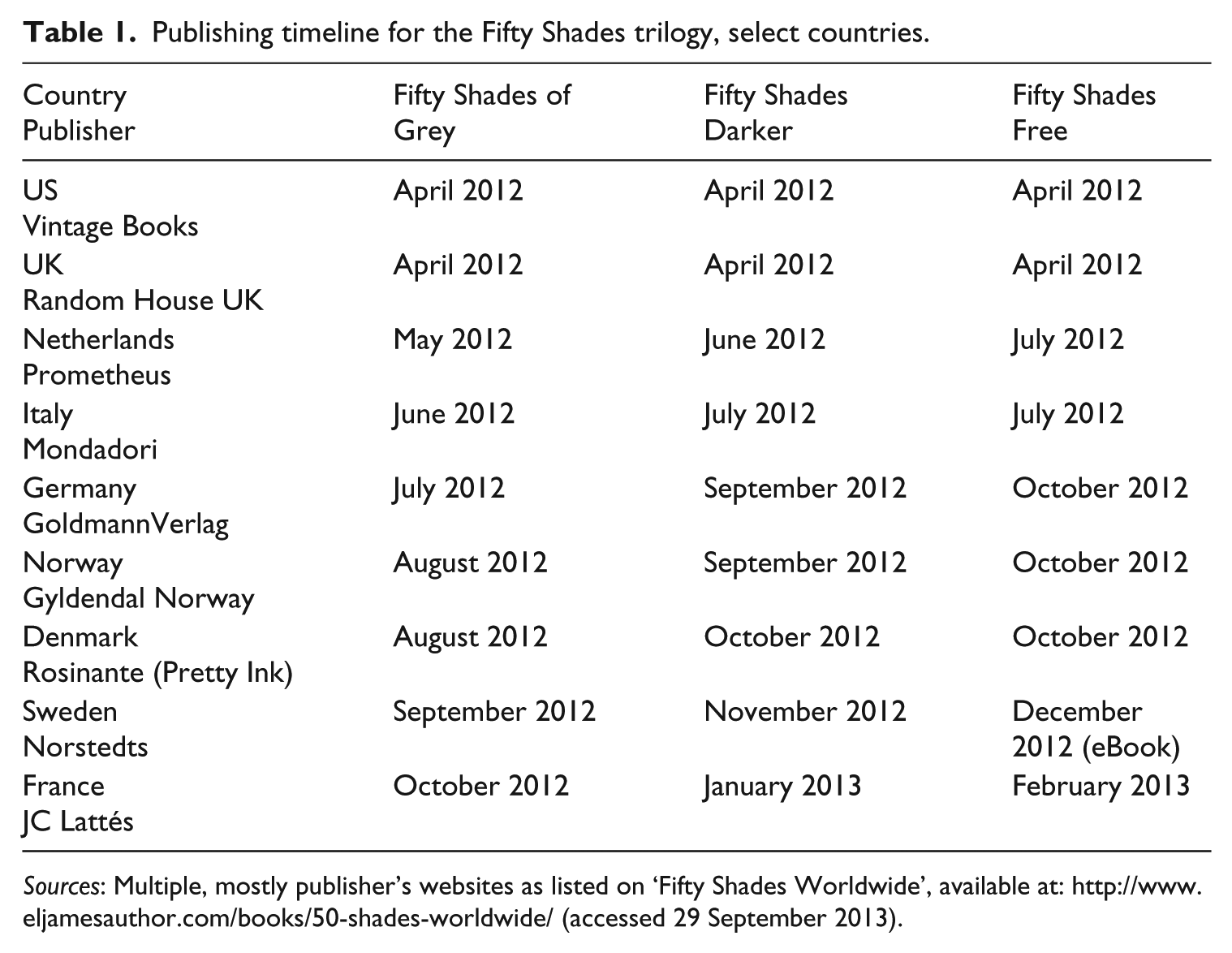
Sources: Multiple, mostly publisher’s websites as listed on ‘Fifty Shades Worldwide’, available at: http://www.eljamesauthor.com/books/50-shades-worldwide/ (accessed 29 September 2013).
In Norway, as in many other countries, the trilogy then seemed to take on a life of its own, according to the publisher: ‘There was no getting away from it [. . .] you have to read the book, or at the very least form an opinion about it. It’s always great fun to publish these kinds of books’.
Fun indeed: in 2012, Fifty Shades contributed NOK 25.5 million to the publisher’s revenue, a stunning 3.8% of the house’s combined revenues (Oftestad, 2013). As exceptional as these numbers may seem, the importance of bestsellers in the book economy is not specific to Fifty Shades or to Gyldendal. Publishers’ earnings in most markets are ever more dependent on extreme bestsellers such as Fifty Shades, the Harry Potter books, The Da Vinci Code and so on (Rønning and Slaatta, 2011).
Distribution and marketing
Gyldendal has since the mid-1980s acquired numerous imprints and book-related activities and is today a fully integrated publishing house with stakes in distribution, retail and book clubs. Most of these activities, however, belong to the traditional print-based value chain. The Gyldendal Corporation owns the retailer Ark, with a 13% share of the total book market in Norway (cf. Oslo Economics, 2012: 15). Ark’s online store (ark.no) has also established itself with a strong position in the market for eBooks. Gyldendal’s eBooks tend to have a substantial share of Ark’s sales, much due to the close relationship and dialogue between the publisher and the retailer.
In the small, but emergent, Norwegian eBook market, Ark decided to put resources into developing an e-reading application and into marketing. The application was launched in June 2012, and seemed to have an immediate impact on the market, according to Gyldendal’s publishing director. Also important in establishing Ark.no as an eBook sales channel was the use of its newsletter to market specific deals and new titles, such as Fifty Shades of Grey. The newsletter has some 200,000 recipients, and contributed widely to the sales success of Fifty Shades. Ark.no reportedly took half the market for eBook versions of the Fifty Shades trilogy (see Table 2).
Online retailers market share of Fifty Shades trilogy sales (2012) in eBook format.

Source: Gyldendal (2012).
What Ark did was basically to use its existing retail capabilities to build a digital market. Rather than going the way of launching an e-reading device under its own name in the manner of Barnes & Noble and their Nook business, the Norwegian book seller relied on the app ecosystems already in place. Although exact sales figures are hard to get hold of, estimates indicate that there are more than one million tablet computers in Norway and even more smartphones. This existing hardware situation convinced Ark to go the way of a reading application.
Sales
What the above market shares do not show is that the Norwegian eBook market is comparatively small, as of January 2013, a mere 1.3% of the combined trade book market (Einarsson, 2013). As Gyldendal’s marketing director reported, Fifty Shades of Grey took only four days to become the publisher’s bestselling eBook (Nipen, 2012b). The status of bestseller was achieved on the basis of fast sales, and not the least because topping the eBook bestseller list requires less than the general hardback list. Fifty Shades – Fanget had only to sell 3,000 eBooks to top the charts, compared with the more than 80,000 copies sold in print. In fact, sales statistics for 2012 reveal that for all three volumes, only 4% of total sales were digital (see Table 3).
Sales of Fifty Shades trilogy in Norway 2012, market share for print and eBooks.
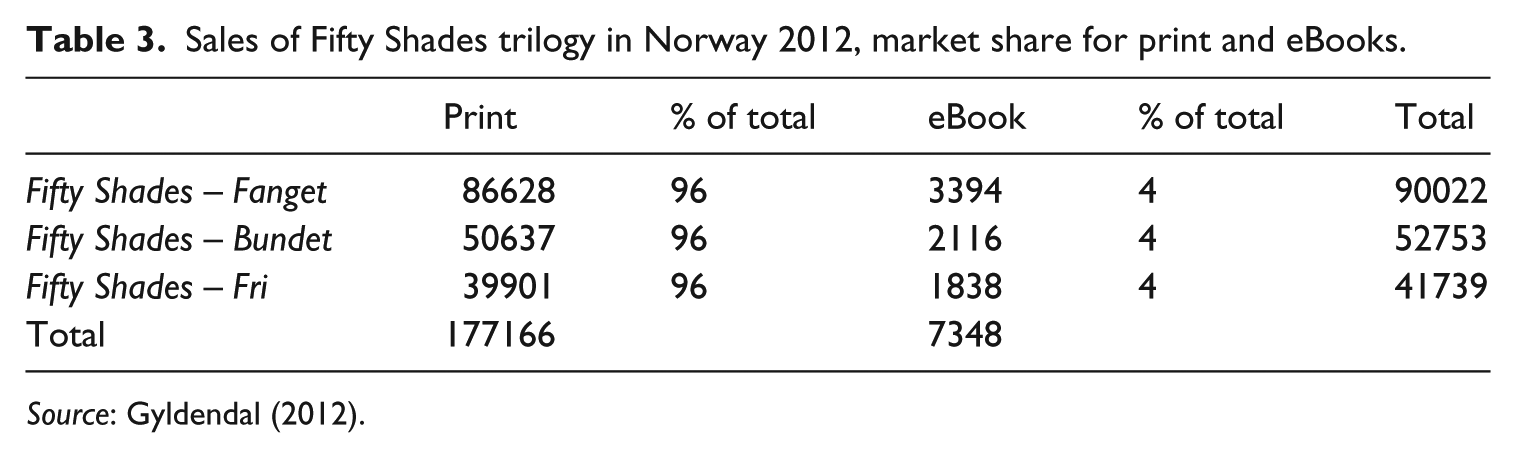
Source: Gyldendal (2012).
Formats and prices
While the eBook version of Fifty Shades – Fanget was launched two weeks prior to the hardcover version, the paperback was not released until June 2013. The publishing strategy of releasing hardcover versions prior to paperbacks is common in Norway, but quite unique in the international context of Fifty Shades, according to Gyldendal. In the US and the UK, the publishing cycle has been almost the other way around, with exclusive hardcover versions following the initial paperbacks and eBooks. Not only did the Norwegian publisher issue the books in hardcover before paperback, they also priced them at perhaps as much as twice the initial price in most other countries (NOK 249).
Setting the price tag at NOK 249 means the books are comparatively expensive in an international context, but still far more reasonable than the common price for new hardcover releases in Norway (approximately NOK 350). Gyldendal had discussions both in-house and in meetings with the book store chains to find a suitable pricing strategy for this kind of title. The price tag signals that the trilogy occupies a position the between distinctly recognized and the distinctly unrecognized forms of literature. Similarly, while issuing ‘low-status’ formats (paperbacks, eBooks) first may be uncommon in the Norwegian general fiction market, it seems to reflect the somewhat ambiguous status of Fifty Shades between genre fiction and ‘serious’ literature. There was no clear distinction between print and digital in this sense, the eBook versions were priced at the same level.
Due to the Norwegian fixed-price agreement between publishers and retailers, the price is maintained throughout the year of publishing and until 30 April the next year. Consequentially, Ark.no discounted the Fifty Shades eBooks to NOK 99 as of 1 May 2013. The price maintenance policy means that the Norwegian eBook market has not seen anything like the drop in prices witnessed in the US market. Average prices of US eBook bestsellers have been in decline from a level of about US$12 to almost half that price, according to statistics from Digital Book World (see Figure 1).

Average price of US eBook bestsellers, August 2012–August 2013.
The differences (and fluctuations) in pricing-and format strategies clearly indicate how bestseller logics are not universal, but shaped by national frameworks of culture, policy and economy, as they are a part of larger national, regional, transnational) ‘culture-producing milieux’ that are socially structured and linked with society at large in diverse ways (Peterson, 1976: 11).
Conclusion: constructing the bestseller
How did Fifty Shades become a bestseller? This article has argued that we need to look at how book markets are structured as well as more specific aspects pertaining to the book in question. In the concluding remarks, we revisit the three research questions posed in the beginning of our argument.
How is a bestseller defined and identified?
It follows from the above discussions of bestseller list logics, market information regimes and crossover trajectories that the bestseller is not just the bestselling book, but rather a book which is allowed to feature as a bestseller. A more elaborate definition would need to include that the bestseller is a book in a recognizable format, preferably newly published, which sells comparatively well through certain recognized outlets over a short period of time, within what is determined by publishers and list makers to be a given genre or target group. The variations between different kinds of bestseller lists are striking when you go into detail, but at a casual glance they seem to reflect popular taste, neatly displayed and categorized with a ‘a veneer of a certain kind of science’ (Hughes, 2005: 19).
In order to be recognized as a noteworthy cultural item, a book needs to be acknowledged by someone with that authority. Although national peculiarities and differences persist, all bestsellers typically need some form of approval. While the importance of the gatekeeping function of publishers may be diminishing in the age of the Internet and digitized distribution, traditional publishers still have an aesthetic and literary authority. For Fifty Shades of Grey, Vintage provided a stamp of approval in the US market, as did Random House in the UK and Norstedts in Sweden. In the Norwegian market Gyldendal did the same thing when they decided to take on Fifty Shades in March 2012.
Acknowledgement and approval is also what inclusion into bestseller lists imply. A simple fact remains: A bestseller is only identified as such if it is included in one of the authoritative bestseller lists. Depending on national specifics pertaining to national book markets, a romance fiction book which sells millions of copies through newsstands and supermarkets may only be recognized as a bestseller by insiders to that specific market. Similarly, an online fan fiction published for free to a global audience of dedicated fans will not be identified as a bestseller. Hence, the first prerequisite for the construction of Fifty Shades as a bestseller is its integration into the traditional channels of publishing. The crossover from fan fiction and genre fiction to multi-format publication with renowned publishers brought Fifty Shades into the commercial circuit of the middle brow, where the bestseller sticker is applied.
Despite its apparent subordination to market forces (the best seller), the bestseller status is thus more of a symbolic ‘consecration’ in Bourdieu’s sense, that is, a literary or artistic prestige bestowed upon a work of art by the dominant factions in the field (Bourdieu, 1993: 38). As Fifty Shades of Grey was named, in 2012, popular fiction book of the year at the National Book Awards in London, and James was named Publishing person of the year by American book trade publication Publisher’s Weekly, the consecration was completed. This process of recognition is carefully enabled by professional producers and ‘cultural intermediaries’ (Bourdieu, 1984; Negus, 2010) in a complex book economy. Publishers, book sellers and agents are obviously actors in this process, but technological components and information systems also play crucial parts. In fact, it may be fruitful to consider the compilation algorithms behind bestseller lists (or other kinds of lists) as semi-autonomous intermediaries in themselves, operating by principles known to only a few and negotiating between markets and culture in intricate ways.
With regards to Anand and Peterson’s (2000) definition of a market information regime, the phrasings ‘independent supplier’ and ‘available to all interested parties’ are of particular interest in the digital context. Rather than providing market information available to all, digital retailers such as Apple and Amazon closely guard their own sales data, portioning out only that which reflects well on them. ‘Amazon’s quarterly earnings calls with analysts and journalists are festivals of vagueness’, as a recent profile on Amazon CEO Jeff Bezos stated (Streitfeld and Haughney, 2013). The informational asymmetries vis-à-vis publishers and consumers give digital retailers a competitive advantage both as distributors and as content providers.
The above does not imply that the bestseller is a mere marketing ploy; rather, it is the outcome of diverse processes involving both professional and non-professional actors, as well as algorithms and information systems designed to collect sales data and compile lists. Even the sophistication of BookScan technologies and the extended usage of market information techniques does not do away with the ‘nobody knows’ property of cultural production (Caves, 2000). The cultural industries remain a ‘risky business’ (Hesmondhalgh, 2007: 18), and the construction of the bestseller relies upon, and is guided by, a management of uncertainty. The case of Fifty Shades provides ample confirmation of this balancing act of innovation and control.
How does the eBook bestseller relate to the traditional bestseller?
Does the eBook bestseller differ from its print counterpart? In many ways there seems to be little difference between the logics that creates bestsellers within the digital or the print regimes. Some aspects regarding hype and buzz may be ‘digitally supercharged’, as Sutherland suggests (2007: loc1570). In the era of plenty, there are different ways of getting to know about books. That may benefit the so-called ‘long tail’ (Anderson, 2006), but it seems also to mean more attention paid to the extreme bestsellers, the ‘big books’. The digitized content of eBooks allows for more interconnections between different media (traditional and social, amateur and professional) and opens for efficient marketing and super fast distribution. The fast-seller dimension of bestsellers is evident in this case: EL James went from nothing to a household name with multiple millions of readers worldwide within the space of a year. How long she will stay in the limelight remains to be seen.
Fifty Shades provides an extreme, but enlightening, case of how fan fictions born online find new ways to readers via blogs and social networks, via POD presses and small publishing houses to a global audience. Online retail and the fluency of eBook distribution certainly played a critical part in this process. But it remains noteworthy that in order to reach this audience, the trilogy also had to go by traditional publishing houses and retail outlets. In this case at least, the digital bestseller was tightly integrated with the traditional distribution circuits and market information regimes.While the Norwegian publisher could in part rely on the proven success in the US and UK markets, the initial publishing phase of James’ books indicate how self-publishing success and online buzz can provide a basis for a publisher’s decision to aquire a title or not, thus serving as a risk-reducing factor.
Fifty Shades could only be conceived of as a Norwegian eBook bestseller because a new subdivision within the market information regime was being established, the eBook bestseller. There is no doubt that the Fifty Shades titles sold comparatively superior to other eBooks (within a given time frame), but in order to be recognized as an eBook bestseller, a new category was needed. In Norway, that category was formally established when the Bookseller’s Association introduced the eBook bestseller list in January 2013. A year earlier, the NYT eBook bestseller list recognized the US market for eBooks in the same way.
What went into the making of the Fifty Shades trilogy as a Norwegian eBook bestseller?
Besides the general points discussed above, there are more specific aspects to this publishing history, some of which involve the digital dimension. In the Norwegian market, the introduction of a reading application and the intensive marketing of the book, in addition to massive media coverage and a constant social media buzz, helped bring the eBooks to the top of the list. Gyldendal’s priorities in bringing the digital versions to market first, helped the Fifty Shades eBooks and enabled the first eBook bestseller in Norway. The close cooperation with retailer Ark.no also made a difference. Fifty Shades as the ‘book of the moment’ was the perfect match with Ark positioning themselves within the eBook market with a reading application for mobile devices.
Digital did matter for Fifty Shades. Importantly, however, the trilogy was a massive success also in print, and the status of eBook bestseller in many ways came easy, in the sense that it required far fewer sales. The simple answer to how Fifty Shades became an eBook bestseller in Norway is ‘less than 8000 copies combined for three books’; as the argument of this article goes to show, however, the bestseller is a far more complex construction than that.
Footnotes
Funding
This study is part of a PhD thesis project funded by the Faculty of Humanities, University of Oslo.