



Abstract
Recent scholarship has offered a modification to audience labour theory in the context of social media, suggesting that rather than merely working by watching advertisements, social media users also produce data, which is commodified by social media companies. This article offers a further analysis of audience labour in social media using Facebook’s Sponsored Stories as a case study. Sponsored Stories are ads rendered from naturally occurring users’ communication on Facebook. I argue that the value generated by users is based on two additional types of labour: the ‘self’ of users, who are mobilized as ‘celebrity’ avatars to advertise a brand, and the construction and maintenance of networks, or media channels through which ads are disseminated. Such analysis suggests that the audience is involved in three moments along the value chain of social media: consumption, production, and marketing. Put differently, valorization on social media takes place also through the work of the audience as marketers, entailing the construction and maintenance of targeted channels of communication, and the mobilization of ‘selves’ for the promotion of brands. The article suggests a comparison between the mass media and social media, along the coordinates of audience labour and advertisements as theoretical and empirical constants, respectively.
We used to talk of Traditional Media, and then began talking of New Media. We now talk of You Media – you are our media.
Recent scholarship has offered a modification to audience labour theory in the context of social media, suggesting that rather than merely working by watching advertisements, social media users also produce data, which is commodified by social media companies. This article offers a further analysis of audience labour in social media using Facebook’s Sponsored Stories as a case study. Sponsored Stories are ads rendered from naturally occurring users’ communication on Facebook. I argue that the value generated by users is based on two additional types of labour: the ‘self’ of users, who are mobilized as ‘celebrity’ avatars to advertise a brand, and the construction and maintenance of networks, or media channels through which ads are disseminated. Such analysis suggests that the audience is involved in three moments along the value chain of social media: consumption, production, and marketing. Put differently, valorization on social media takes place also through the work of the audience as marketers, entailing the construction and maintenance of targeted channels of communication, and the mobilization of ‘selves’ to the promotion of brands. The article suggests a comparison between the mass media and social media, along the coordinates of audience labour and advertisements as theoretical and empirical constants, respectively.
One of the defining features of social media is the central role that the audience plays in it. The audience in social media is characterized as engaged, expressive and collaborative. This is precisely why the audience is commonly referred to as ‘users’. This marks a shift from the conception of the audience in the mass media as passive and atomized. The theorization of media audience was crystallized during the golden age of the mass media; The new environment of social media calls for its revisiting. Research into the changing role of the audience in new media has critical bearings on communication theory in general. And, indeed, audience transformations have been given attention in recent work on the internet around concepts such as participatory culture, user-generated content, user participation, co-creation, mass collaboration, prosumption, produsage, social production, commons-based peer production, mass customization, crowdsourcing and open source. All these concepts refer, in one way or another, to a new – more active – role of the audience in the contemporary media environment.
This changing nature of the audience in social media has been taken up by an emerging body of scholarship that has recently revisited the notion of audience labour in the context of social media and the internet. The basic thrust of this body of work is that the networked architecture and interactive nature of the internet gives social media corporations, from Google to Facebook, unprecedented access to mobilize ‘free’ audience labour for capital accumulation (Terranova, 2004: ch. 3). Compared with the mass media, the internet – particularly social media – allows new, more intense forms of exploitation (Andrejevic, 2011a, 2011b; Cohen, 2008; Fisher, 2012; Fuchs, 2011a, 2011b; Lee, 2011; Peterson, 2008; Scholz, 2013).
These theoretical engagements focus on data as a new ‘raw material’, commodified by media corporations, and dependent on the work of social media users. The types of data are varied: public data, private (or semi-public) data, and meta-data. Public data refers to direct and conscious contribution of the audience to media content, such as user-generated content in newspaper sites or user-uploaded videos to YouTube. This is usually thought of as a form of prosumption (Fuchs, 2011b), or co-creation (Humphreys and Grayson, 2008). Private data refers to content generated by users interacting with computers (such as a Google query), or between users in private communication channels (such as emails) or semi-public networks (such as social networking sites). It is comprised of texts and images, Likes, posts, shares and so forth (Cohen, 2008; Lee, 2011). Meta-data refers to the digital footprint generated by merely using the internet, indicating when and where an action has taken place, frequency of a specific action (e.g. how many photos are posted), number of friends on the SNS, which articles are read on a newspaper, for how long, and so forth (see Andrejevic, 2011b for a similar distinction). Ultimately then, such analysis focuses on audience labour in social media as producing data, rendering the internet a ‘factory’ of information (Scholz, 2013). Commodifying audience labour on social media requires highly sophisticated techniques of collecting, analysing and manipulating these kinds of data (Beer, 2009; Kang and McAllister, 2011; McStay, 2011), but the audience plays a key role in producing them. Indeed, audience work of this kind cannot be performed by ‘regular’ media workers since it involves real, lived-experienced events and interactions.
This body of work has been tremendously important in bringing audience labour theory up to date, by emphasizing the production of data. This article wishes to further modify audience labour theory to the new media environment by fine-tuning the nature of audience labour on social media, by analysing Sponsored Stories, Facebook’s advertising programme which renders naturally occurring users’ communication on Facebook into ads disseminated to these users’ friends. I argue that the value generated by users is based on two further types of labour: the ‘self’ of users, who are mobilized as ‘celebrity’ avatars to advertise a brand, and the construction and maintenance of networks or media channels through which ads are disseminated. Such analysis suggests that the audience is involved in three moments along the value chain of social media: consumption, production and marketing. Rather than merely acting as a commodity sold to advertisers, or as labour power watching ads and marketing to themselves (as was the case in the mass media), the audience in social media acts also as media, constructing and maintaining communication channels through which messages are delivered. In addition, the marketing value created by the audience relies not merely on labour of communication and sociability but also draws on users’ social capital.
The notion of audience labour is a theoretical one but has emerged in the context of advertising in the mass media. It revolves around advertising for ontological reasons (as advertising was seen as the locus of audience production in commercial media) but it also demarcates an empirical field. This ontological and methodological nexus inspires the current article’s focus on Facebook’s Sponsored Stories advertising programme. Maintaining the real-world reference of audience labour theory – advertisements – constant would help us uncover transformations in the political economy of audiencing as we move to a new media environment.
I will proceed as follows: the first section offers a short exposition of the assumptions and assertions of audience labour as sketched by the foundational works of Smythe and Jhally. The second section describes Sponsored Stories as an exemplar of the current advertising business model of social media. The third section highlights the novelty of Sponsored Stories in terms of audience labour theory, and discusses the theoretical modifications needed in order to account for audience labour on social media.
Audience labour in the mass media
Communication theory has a diverse and dynamic theorization of the audience with three basic conceptions standing out: the audience as passive receivers of media texts, the audience as an active agent interpreting media texts, and the audience as active agent in the political economy of the media. The three conceptions cut through theoretical and paradigmatic lines, and are at least partially temporally sequential. The notion of the passive audience underlies many of the founding theories of communication, most notably the Columbia School and the Frankfurt School. Lazarsfeld’s inaugural work on radio audience (1940) and notions of the two-step flow of communication (Katz and Lazarsfeld, 2005 [1955]) and the narcotizing dysfunction of the mass media (Lazarsfeld and Merton, 2004 [1948]) essentially positioned the audience at the receiving end of messages propagated through the mass media. A popular articulation of these ideas comes in Lippmann’s (1997 [1922]) view of the audience as susceptible to propaganda, even in democratic societies. Coming from a diametrically opposing theoretical perspective is the work of the Frankfurt School, which views the audience as a helpless herd, duped by a culture industry which forces ideological messages down their throats (Adorno, 2001; Horkheimer and Adorno, 1976). Such a view has spurred research on how ideology is coded into media messages, including an investigation of the ideological content of books (Radway, 1984), journals (Lutz and Collins, 1993; Stevenson et al., 2001) advertisements (du Gay et al., 1997: section 1), movies (Wasko, 2001), and news (Said, 1981) (see Akass and McCabe, 2007). In sum, whether conceptualized as media framing or agenda setting, these theories saw the audience as an object of media effects.
A second conception of the audience arises very much as a critique of the media effects approach, and sees the audience as a thinking, creative and critical subject. This underlies approaches as diverse as cultural studies and uses and gratifications theory. Notably, the Birmingham School attributes to the audience an active capacity to decode, or ‘read’ ideological messages in the media and resist them (Hall, 1980, 1995; Mathijs, 2002), leading to a theorization of the audience as a participant in the construction of multiple meanings of media texts (Ang, 1985; Morley, 1992). Multiple interpretations also imply multiple audiences; thus, for example, different audiences of a single television show read the media text in diverse and even conflicting ways (Liebes and Katz, 1994).
A third conceptualization of the audience emerges from Marxist political economy of the media, and in fact integrates an important insight from the active audience approach; here, too, the audience is seen as active, not only in the process of meaning-making, but also in the process of money-making. Traditionally, the political economy of the media ignored the question of the audience altogether. It focused on the effects of capitalism on media institutions, investigating issues concerning media ownership, state regulation, commercial mergers, consolidations and monopolies, links between government and the media, and employment arrangements of media workers, focusing mainly on its capacity to advance or hamper a democratic society (Herman and Chomsky, 1988; McChesney, 2008; Mosco, 2009; Mosco and McKercher, 2009; Schiller H, 1991; Schiller D, 2010). The audience was conceptualized as the passive consumer of media products, and thus as external to the accumulation process.
But the political economy of the media was greatly revised in the 1970s and 1980s by analysing media as a site of production in and of itself, thus highlighting the productivist role of the audience in the valorization of the media, both as a commodity and as labour power. This approach was pioneered by Dallas Smythe’s (1981) ground-breaking work on the audience commodity.
Smythe’s approach was a critique of what he termed the ‘blindspot’ of Marxist analysis of the media (à la Frankfurt School), which tended to focus exclusively on the ideological content of media products. Rather than viewing the media merely as an ideological, superstructural apparatus that supports relations of production in the economic base – presumably located elsewhere (e.g. in the factory) – Smythe positioned the media as a vital component in the chain of capital accumulation. Smythe suggested that what goes on in the mass media was not primarily audience consumption of media content but the selling of audience attention to advertisers.
In return for the bait of programming, the audience remains glued to the television screen, thus watching advertisements, which become an ever more important driving motor for consumption. He suggested that ‘audience-power’ is put to work by advertisers by ‘getting audiences to market commodities to themselves’ (Jhally and Livant, 1986: 129). The audience performs cognitive and emotional work: learning to desire and consume commodities. Smythe, then, assigned to the audience an active and central role in the political economy of the media and of advanced capitalism.
In terms of political economy, Smythe thought about the audience as commodities sold to advertisers. But, more radically, he laid down the foundations for thinking about them as performing an active role: marketing to themselves. Further developments in this strand followed suit. Most notable was the work of Jhally and Livant, who argued that Smythe’s focus on the contribution of audience labour for manufacturers of branded commodities ‘deflect[s] the specificity of the analysis away from communications to the ensuing consumption behavior of the audience’ (1986: 129). That is, Smythe linked audiencing to consumption rather than (media) production. ‘Ultimately’ they say, ‘Smythe was concerned with drawing attention to the place of communications in the wider system of social reproduction of capital’ (1986: 129), thus pointing to the use-value of advertisements (as motivating consumption). In contrast, Jhally and Livant explore the blindspot that is ‘located more firmly within the media industries’ (1986: 129, original emphasis). They do that by defining the audience not as a commodity sold to advertisers in order to encourage consumption, but rather as workers engaged in production within the framework of media corporations. Jhally and Livant, then, analyse watching television as a form of working: it harnesses human ‘capacities of perception’ (1986: 126) to the creation of surplus-value. The creation of surplus-value in the media is based on ‘extra watching’ – or ‘surplus watching time’ (1986: 127) – of advertisements, that is, on the audience watching more ads than is necessary to pay for programming.
Thinking about audiencing as working opens up new and interesting theoretical horizons for the political economy of the media. Such analysis constructs the media as a dynamic site of struggle between the audience and media corporations, a struggle that revolves around time and value. Jhally and Livant (1986) describe the dynamic process of this struggle by employing Marx’s distinction between extensive and intensive exploitation. Marx insisted that surplus-value can only arise from workers working more time than is needed to reproduce their lives; hence capitalist struggles ultimately revolve around time. This extra working time creates surplus-value which, rather than being exchanged for its market equivalent, is appropriated by capitalists and introduced into the accumulation process (for example, by investing in new technology). Since this entails the creation of value by one class of people (workers) and its uncompensated appropriation by another class (capitalists), Marx refers to it as exploitation. The problem, inherent in capitalist accumulation, is that the rate of surplus-value tends to diminish over time, so the source for capital accumulation dwindles (Marx, 1993: ch. 13). To expand, capital must find ways to intensify the level of exploitation, that is, expand the scope of surplus-value created by labour. This can be achieved in two ways: extensive exploitation and intensive exploitation. Extensive exploitation refers to techniques and arrangements by which more time is dedicated to work, for example, by elongating the working day or by cutting down on lunch breaks and vacation time. Intensive exploitation is achieved by having workers produce more in less time, for example, by accelerating the rhythm of work or making the work process more efficient.
Jhally and Livant (1986) argue that both these processes of exploitation have been occurring in the mass media: the audience has been asked to work more and harder over the course of media history. The extension of exploitation was achieved by introducing the audience to more advertisements, thus making them watch over a longer period of time. The intensification of exploitation was achieved in two ways: ‘reorganizing the watching population, and … reorganizing the watching process’ (Jhally and Livant, 1986: 133). The first involves all sorts of techniques – from media segmentation research to the rating system – aimed at helping media corporations target a specific audience with a specific ad, relevant to its consumption behaviour; such market segmentation leads to an increase in the value of advertisements. As Jhally and Livant put it: ‘Specification and fractionation of the audience leads to a form of “concentrated viewing” by the audience in which there is … little wasted watching’ (1986: 133). Since highly targeted advertising costs more, ‘we can say that the audience organized in this manner watches “harder” and with more intensity and efficiency’ (1986: 133–4). The second way to intensify exploitation is through the division of time, accomplished mainly by shorter commercials.
Sponsored Stories: a case study for audience labour on social media
In order to evaluate the applicability of audience labour theory to social media I will analyse Facebook’s Sponsored Stories advertising programme, a centrepiece in the political economy of social media. The analysis of the political economy of advertising allows an important link between the mass media and new media. While these media forms are regarded as radically different, they both rely predominantly on advertisement revenues as their business model. Different media have different kinds of advertisements; this is not incidental – the forms of advertising, as well as the methods of their production, dissemination and consumption, are closely linked with media forms. (Think, for example, of the differences between billboards, television spots, and product placements in movies).
Likewise, advertising on the mass media and on social media is quite different. This was not the case in the early days of the internet. At its inception, the internet was dominated by banner ads and mass email messages (‘spam’), representing the imposition of older media forms on new media. Increasingly, however, advertising on social media differentiated itself from mass media advertising, and became attuned to the unique characteristics of digital technology. Sponsored Stories epitomize this latter phase: a much more sophisticated advertising scheme, designed along the technological and sociological coordinates of social media, and taking advantage of them by – among other thing –further exploiting audience labour.
Sponsored Stories are by no means the only exemplar; all major social media sites feature advertising programmes that are founded, to a greater or lesser extent, on audience labour. But Sponsored Stories seem to provide the most comprehensive exemplar of the kinds of audience labour that could be mobilized to the whole chain of value creation. The Sponsored Stories advertising programme was conceived by Facebook as its most innovative and promising method of monetizing the social networking site. If Facebook’s market value (estimated in the last 12 months variably at $50–100 billion) is the riddle, Sponsored Stories is the solution, conceived by Facebook as the key to monetization. A centrepiece of Facebook’s business model, Sponsored Stories serves as an especially fitting vignette to uncover the political economy of social media, highlighting particularly the role of the audience in the creation of social media value.
Sponsored Stories, introduced by Facebook in January 2011, are ads based on regular users’ posts; businesses and organizations pay Facebook to render these regular post into ads. According to Facebook, by rendering posts into ads, they are ‘highlighted’ and there’s a better chance for other users to notice them (Facebook, 2012). A Sponsored Story then is an ad, based on a post by user X that would have appeared anyway on the news feed of user Y. By rendering posts into Sponsored Stories Facebook changes both the position of the original post on the page and its graphic formatting; Sponsored Stories appear higher in news feeds or on the right-hand side of the page, and they usually feature the logo of the brand.
A Sponsored Story can be created when a user does either of several actions: Likes a page, Likes or comments on a page’s post, RSVPs to a page’s event, votes on a page’s question, check-ins to a place, uses an application or plays a game, or Likes or shares a website (Facebook, 2012). Once a post has been converted into a Sponsored Story all further communication acts associated with it are then taking place within the context of the Sponsored Story. So that any comment or Like on the Sponsored Stories will ‘reactivate’ the ad and will be disseminated to the network of friends of the user clicking the Like. That means that the dissemination of a Sponsored Stories is exponential (or viral). It also means that the movement of the ad in the social network is not arbitrary: ads move organically in channels of communication which have been constructed bottom-up and spontaneously by users.
Figures 1a and 1b illustrate the visual appearance of Sponsored Stories. 1 Figure 1a features a regular Facebook post. In this example, a Facebook user named Jessica is using a location-based application on her mobile phone. She checks into a Starbucks café for the second time that day with Philip, a Facebook friend. This would automatically create a post reading ‘Jessica: Second time today – at Starbucks with Philip’. Figure 1b features this post rendered into a Sponsored Story, after it has been bought by Starbucks. Graphically, the text is a little more compact, eliminating technical information, and compressing comments and Likes of friends to the post. The bluish background of the comments box is also eliminated. The text is organized in a box-like format, and a logo of Starbucks is added.

A regular post, based on a user check-in location.
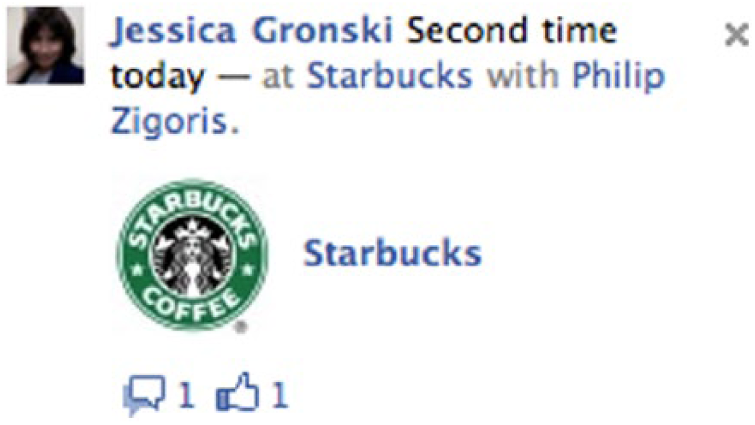
The above regular post rendered into a Sponsored Story.
We can begin to unravel the role of audience labour in Sponsored Stories by examining the discourse of Facebook on the programme. Such discourse is aimed at two kinds of audiences: advertisers and Facebook users. Facebook’s CEO Mark Zuckerberg described Sponsored Stories as a premium form of advertising since it is founded on personal connections, saying ‘[n]othing influences people more than a recommendation from a trusted friend. A trusted referral influences people more than the best broadcast message. A trusted referral is the Holy Grail of advertising’ (Farley vs. Facebook, 2011). Facebook’s Chief Operating Officer Sheryl Sandberg follows-suit:
Marketers have always known that the best recommendation comes from a friend … This, in many ways, is the Holy Grail of marketing.… When a customer has a good experience … on Facebook, the average action is shared with the average number of friends, which is 130 people. This is the elusive goal we’ve been searching for, for a long time; [m]aking your customers your marketers. (Farley vs. Facebook, 2011)
Both statements point to a kind of audience labour that is not present in the mass media and is not readily accounted for in early theorizations: marketing.
Smythe did conceptualize watching television ads as being about the audience marketing to itself. But in the case of Facebook, audience members do not merely market to themselves, but to other audience members as well. This is a qualitatively different kind of audience labour, entailing three distinctive features. It involves communicating (which underlies the dissemination of massages), sociability (which underlies the construction and maintenance of social networks), and the persona of users – their human capital, or their self as brand. These features are interrelated of course: communication requires media, and persuasion requires familiarity and trust.
Sandberg further substantiates the power of user-supported ads by comparing Sponsored Stories with regular Facebook ads:
On average, if you compare an ad without a friend’s endorsement, and you compare an ad with a friend’s ‘Like,’ these are the differences: on average, 68% more people are likely to remember seeing the ad with their friend’s name. A hundred percent – so two times – more likely to remember the ad’s message; and 300% more likely to purchase. (Farley vs. Facebook, 2011)
Sandberg offers a political economy analysis of social media, valorizing, in fact, audience labour. Sponsored Stories allow advertisers to reach a much more targeted audience, and accompany the message with the human capital value of users. Audience labour here involves constructing segmented channels and targeted audience, and mobilizing human capital to promote a brand or product.
The nature of audience involvement in the production and dissemination of Sponsored Stories emerges also from Facebook’s promotional video for the programme (Facebook, 2011). The video, entitled ‘Introducing Sponsored Stories’, appears on various locations around the internet, most prominently on YouTube (where it accumulated close to 50,000 views by the end of 2013), and Facebook marketing pages (where it received 2750 comments in the same period). The video is directed mainly at advertisers, pitching the new service, but it is also directed at Facebook users, primarily meant to assuage concerns regarding privacy infringement.
The video can be read as a promise to advertisers regarding the unique contribution that the audience can make for their ads. The video features images of Facebook users in various social/consumerist activities: shopping for sports shoes and cameras, sitting in a café, and dinning at a restaurant. In between and in voice-over are snippets of three Facebook employees explaining Sponsored Stories. In the video, Kent, the product manager, adopts the perspective of consumers to explain the advantage of Sponsored Stories:
When we [consumers] make decisions about the products we want to buy, the places we want to go, we’re basically looking for cues from our friends about what those things should be. And all of us aren’t out there to market ourselves or try to influence people to go somewhere or do something. But the reality is when we make a decision we’re looking for information, and we want this information to come from people we trust. (Facebook, 2011)
Kent applauds the advantages of interpersonal persuasion as a successful marketing technique. But he also hints to the limited reach of such type of persuasion, a limit that Facebook helps overcome: the perfect medium to render interpersonal persuasion massively accessible. Facebook facilitates a kind of ‘mass interpersonal persuasion’, which ‘brings together the power of interpersonal persuasion with the reach of mass media’ (Fogg, 2008).
The assumption that underlies Facebook’s discourse is that behaviour (particularly consumerist behaviour) is driven by information, and that the most valued information (i.e. that which can be commodified) comes from acquaintances we trust. Another assumption is that this type of information is scattered, unorganized and uncatalogued – thus it is not always communicated and disseminated effectively. Either people possess the information but refrain from sharing it (for example, attending Starbuck regularly but not making this information public) or they do share the information, but it goes unnoticed by others. From the perspective of ‘interpersonal mass persuasion’, these are deficiencies, either at the end of the sender or at the end of the receiver.
Phil, Facebook’s engineer, frames the deficiency at the end of the receiver in terms of information overload, or clutter. He explains in the video:
my friend Joe goes and he checks in to Starbucks. That would appear on my news feed, and I may or may not see it. And what we’ve seen is that a lot of impressions do get lost, because there’s so much content coming through. (Facebook, 2011)
Too much information is coming through social media; too many friends communicating too much with each other. In such a media ecology users run the risk of losing important information, which would possibly be critical in driving them to beneficial behaviour. Sponsored Stories are presented as a solution to the problem of information overload, a ‘device’ for highlighting particular bits of information over others.
The formula determining which information is filtered through and brought to the attention of users juxtaposes commercial and communicative coordinates: commercial interests intervene to amplify specific pieces of information, generated in the context of regular, mundane communication acts between users. The commercial coordinate accounts for which information is singled out. At the same time, this commercial filter is presented as a device which improves interpersonal communication because it highlights information pertinent to users as well. As Phil the engineer puts it in the video:
Starbucks can come in and say ‘I want to promote check-in Star locations’. So when I come to the site I see the story that my friend checked into Starbuck. Now, I can click through, I can Like the Starbucks page from that story, and when I Like this page it creates more organic content. (Facebook, 2011)
This brings up another facet of audience labour on social media: the production of data. Sponsored Stories allow companies to mine mundane, everyday fragments of information, created by users, and render them into advertisements. Note how users’ recommendations are explained in this context: ‘Sponsored Stories … let advertisers … take these word-of-mouth recommendations and promote them’ (Facebook, 2011). Ning, another engineer, further elaborates in the promotional video: ‘These word-of-mouth recommendations embody many different stories on Facebook. So, for example, for a restaurant, they can be check-ins, or if they have an application, it can be user-published application stories’ (Facebook, 2011). A visit to a restaurant, then, is a piece of mundane information which gets articulated and rendered into commodified social communication through Sponsored Stories. A visit to a restaurant does not, in and of itself, constitute a recommendation, but in the context of Sponsored Stories it literally becomes an endorsement (see Peyton, 2014 for her analysis of the ontology of the ‘Like’ button).
But it is not just this kind of users’ data which is mobilized to produce Sponsored Stories; audience labour is also involved in constructing the infrastructure which facilitates their circulation. Kent, Sponsored Stories’ product manager, highlights in the video the advantages that come from (automatically) user-generated ads:
Anything that one of your friends is seeing as a Sponsored Story which features some of your content is actually something they would have already seen in the news feed. A Sponsored Story never goes to somebody who’s not one of your friends. (Facebook, 2011)
At the immediate level, this statement addresses what is arguably the primary concern for Facebook users: privacy. But this statement can also be read as directed at advertisers, highlighting the power of Sponsored Stories as an organic and highly targeted advertising vehicle. Ads are based on naturally occurring, mediated communication. Moreover, the dissemination of Sponsored Stories is based on ‘webs of affective relations’, as Arvidsson and Colleoni (2012) call them; the ad is watched by a particular and identifiable type of audience – a particular user’s (Facebook) friends – comprising those individuals most likely be affected by the message: people who trust their friend and are eager to get information pertinent to his consumerist behaviour.
The benefits of organic marketing in social media are reiterated in the promotional video by Phil, who describes a Sponsored Story thus: ‘it’s not this message that’s saying “you should buy this thing”, or “you should come to this website”. It’s your friend saying “look, I did this, and I want to tell you about it”’ (Facebook, 2011). Sponsored Stories are described as unobtrusively giving more thrust to regular communication. What distinguishes these messages from regular ads is their dissociation from marketing, persuasion and propaganda. In contrast to ads in the mass media, Sponsored Stories are casual, representing naturally occurring events and communication acts.
The language of Phil obscures the commodification process of regular human communication taking place through Sponsored Stories, and how that transforms the meaning of communication. He equates a Sponsored Story to ‘your friend saying “look, I did this, and I want to tell you about it”’ (Facebook, 2011). In reality, the rationale behind Sponsored Stories and the reason advertisers are ready to pay for such instance of communication, is an assumption that such a benevolent occurrence does not in fact take place. When your friend checks into a business, or ‘Likes’ its page, this friend does not in fact tell you anything. Even assuming he does implicitly tell you something, the rationale of Sponsored Stories is to amplify and highlight this event and turn it in fact into a message, that is, a piece of information directed to other people and carrying an implicit call for action.
Facebook describes Sponsored Stories as organic to the media experience of users in terms both of the production of communication upon which ads are based, and of the consumption of these ads. Phil describes Sponsored Stories as a way for advertisers ‘to be able to promote their content that’s as core user experience as news feed’ (Facebook, 2011, emphasis added). In traditional media, such as newspapers or television, advertisements are often experienced by the audience as alien to the core experience or reading news stories or watching programmes; they are easily distinguishable featuring a different rhetoric and visual style, a different author, and a different content. Indeed, the history of advertising in the mass media has seen a perpetual attempt to fuse together content and ads by making the ads adhere more fully to the core user experience. (Think, for example, of product placement or infomercials). According to Facebook, Sponsored Stories achieve that goal, assimilating into the core user experience of reading posts by friends on the news feed.
A story in Mashable, a leading online journal on social media, upholds the advantage of mobilizing user-generated communication to create ads, summarizing the contribution of audience labour to the value of Sponsored Stories. Unlike regular Facebook ads, Sponsored Stories ‘incorporate social endorsement prominently into ads’. They are ‘more relevant to the average user’, hence ‘more likely to be clicked’ (Lawson, 2012, emphasis added). It also upholds the advantage of using the channels of communication that Facebook users construct to deliver efficient and highly targeted ads (Lawson, 2012). The article explains: ‘A visitor comes to your site while logged into Facebook and Likes your site. This action generates a story into News Feed, such as “Jane likes X site”’ (Lawson, 2012). The advantage lies in the ability of companies to ‘acquire leads from the social network’: ‘Odds are Jane’s friends belong to the same target market as Jane, and ideally find Jane credible. Consequently, [Sponsored Stories] offer advertisers a great way to generate new leads and revenues through word-of-mouth marketing’ (Lawson, 2012, emphasis mine). This statement then ties together the two types of work that users do: producing data, and constructing communication channels. In the former, users’ unique contribution lies in producing mundane, organic communication; in the latter, it lies in creating targeted audience.
Sponsored Stories are described as emerging from regular communication acts and entwined with social life. They act and are distributed organically: ‘because the ad unit is well integrated into the News Feed, your brand’s image occupies a valuable space in the social activity’ (Lawson, 2012, emphasis added). The unique value of the ad lies in being seamlessly integrated into the regular social life of users, being woven into their regular social communication. As the Mashable article neatly sums up: ‘Sponsored Stories allow advertisers to participate in and influence the social context of Facebook’ (Lawson, 2012).
You Media: mediating as working
The analysis of Sponsored Stories uncovers the old and new ways by which audience labour is mobilized for the production of media value. These can be boiled down into three categories:
In the case of Sponsored Stories the audience participates in the production of value in two ways. First, it produces the ‘mundane’, everyday, personal information that serves as basis for the ad, for example, by downloading an application. Second, the audience also (unwittingly) engage their very ‘selves’ in the production of Sponsored Stories: their names, likeness and personas. In the first instance Sponsored Stories can be thought of as ‘reality advertisements’, where real-life events, and phatic communication are mediatized in a commercial/entertainment context. In the second instance, the social capital of audience members is mobilized for the endorsement of brands in social media, much like ‘celebrity’ avatars in the mass media.
The epigraph of this article – heralding an age of You Media – is taken from an interview I conducted with Yinon Landberger, chief executive of E-dologic, an Israeli social media advertising agency and a subsidiary of the Publicis Group, one of the world’s three largest advertising holding companies. It represents an attempt by social media professionals to grapple with advertising in a new media environment, highlighting the novelty of audience labour on social media. What the trade concept ‘You Media’ suggests is an amalgamation of networking and self, the two elements of audience labour pointed to throughout the article: commercial messages are transmitted through the ‘Media’ that users create by networking with others, but they are also given the thrust of ‘You’, the persona of users who inadvertently become spokespersons for the message.
‘You Media’, then, is ‘you, acting as media’. The social media audience constructs and maintains targeted communication networks. Unlike with the mass media, the audience does not simply tune into the media, consuming one among a limited set of content choices. When one first joins Facebook as a member, this audience member has no content to consume; audiencing begins when one connects with other audience members, becoming, in fact, their audience. Audiencing on social media, then, is entwined with creating networks among members. The links that one creates to other social media members determine the kind of media one will be consuming. They also determine the audience that one will have for the content that one provides.
Analytically, such a network is comparable with a television channel. But in social media each and every member of the audience creates his or her own unique, personalized media network; 1 billion Facebook users have constructed 1 billion unique media networks. Each media network is more homogeneous than an arbitrary sampling from the general population (of that particular social medium as a whole); members of each unique network tend to be more similar to each other in one or more factors, such as interests, socio-economic status, occupation, residence area, consumerist behaviour, political affiliation and cultural leanings.
The audience does not merely work in constructing its medium but constantly maintains it. One aspect of that is that the audience continuously add and remove friends and pages. This allows users to fine-tune their medium, making it more suitable to their changing habits and tastes. But maintenance pertains also to a more delicate work of sustaining the existence of the network. Users need to invest emotional, communicational and social work to sustain their network, making it a meaningful and vital medium with which to engage. This is manifested in the implicit dictate to share personal details with others and to react to the sharing of others with yet more communication acts (Agger, 2012; John, 2013). Much communication on SNSs is indeed phatic and is intended to lubricate the network and reassure users of its vitality, and indeed, its very existence (Miller, 2008). Furthermore, each media network is constructed and preserved by particular users, and in this sense, the self of each member of the network is important in valorizing it and, in turn, in valorizing the communication which travels through it. This is precisely the kind of value added to Sponsored Stories by having a particular user mobilized to sponsor an ad.
We can further account for the construction and maintenance of media channels on social media in terms of audience labour theory by using the notion of intensive exploitation (Jhally and Livant, 1986: 133–4). As already mentioned, the intensification of exploitation in the media is achieved primarily by reorganizing the audience so that it watches more ‘efficiently’: by segmenting it and delivering it more targeted ads. In social media, the audience creates its own segmentation. The political economy of social media, then, is premised not only on user-generated content but also on user-generated communication channels, through which content flows. The construction and maintenance of these channels – leading to an increase in the value of advertisements by allowing more accurate targeting – is a form of labour that was absent in the mass media and represents a form of intensive exploitation.
Like most other advertising programmes on social media, the Sponsored Stories pricing model is based on actual performance, measured either by impressions (how many users are exposed to the ad), or clicks. Advertisers pay Facebook only when there is a successful encounter between an ad and a member of the audience, that is, only when the audience is actually put to work. The ability of social media companies to offer such a model is based on three factors that facilitate a successful encounter: the construction of Big Data and targeted networks (both based on audience labour), and sophisticated algorithmic technologies (Beer, 2009). Ideally, these should allow Facebook to present each audience member with precision ads. Indeed, such degree of accuracy has been sought since the beginning of advertising in the mass media: to have an ad reach only that part of the audience for which the ad is relevant. This, in the language of Jhally and Livant (1986) allows the intensification of exploitation since the audience watches ads more efficiently (i.e. less audience watching time is wasted on irrelevant ads). By mobilizing the audience as media, Sponsored Stories mark a quantum leap in achieving that goal. To understand why we need to compare again the mass media with social media in terms of audience labour theory. In the mass media, the intensification of exploitation of audience labour is limited by two parameters. First, the monitoring, rating and segmentation techniques of the audience in the mass media are expensive. For example, the revenues of Nielsen, the largest global media rating company, reached more than $5.5 billion in 2011 (Nielsen, 2012). Not only are such techniques expensive, they are also mired in a paradox. More accurate information about the audience allows the making of more targeted ads. These, in turn, allow the intensification of audience labour (since the audience watch ‘harder’) and results in an increase in the surplus-value derived from watching (Jhally and Livant, 1986). But collecting information about the mass media audience requires expensive techniques; in fact, the price of collecting such information rises the more accurate and full this information is. This inevitably undermines (at least partially) the benefit reaped from the resulting intensification of watching. Furthermore, audience monitoring techniques rely on statistical analysis, which is probabilistic by definition.
The second limit to the intensification of exploitation in the mass media concerns content production. The intensification of exploitation requires media corporations to invest much energy in segmenting the audience (creating in fact multiple audiences) according to advertisers’ demands. Segmentation is done mostly by diversifying media contents and genres, based on the assumption that specific demographic groups are more likely to consume specific types of content and/or genres. In the language of Smythe, mass media corporations provide different ‘baits’ for different audiences. To adapt the language of social media, what mass media corporations do is construct different communication networks, each corresponding to a specific content/genre and a specific consumerist universe. Contrary to popular myth, media corporations are not interested merely in attracting as much of the audience as possible, but in attracting as much as possible of that part of the audience most fitted to be lured by the specific products advertised. In other words, knowing your audience is as important as making sure you have many of them. The drawback of such a technique is that media corporations might fail miserably: they might not attract a large enough audience, or they might not attract the desired segment of the audience.
As the case of Sponsored Stories shows, advertising on social media overcomes these limitations – partly or wholly – by making the audience construct its own communication channels. Rather than mass media corporations allocating resources to segment their audience, Facebook’s audience segments itself, with an accuracy that can hardly be achieved in the mass media. Segmentation on social media is much cheaper as it is, in effect, ‘outsourced’ to the audience. And it is more accurate since it is done bottom-up by the audience, based on personal acquaintance or shared interests. Where once mass media corporations strove to know their audience as much as possible in order to target it more precisely, social media companies now rely on two characteristics of digital media which allow them to know their audience without recourse to any top-down method: the capacity of networks to self-organize and the panoptic view they allow on personal information – both heavily reliant on audience labour.
With that, we also need to be aware that audience work on SNSs is done voluntarily and profusely precisely because users get something in exchange which is of great value for them: an ability to be active and gain greater control over the medium. SNSs are the epitome of what Castells dubs ‘mass self-communication’, the appeal of which lies in it being ‘self-generated in content, self-directed in emission, and self-selected in reception’ (2011: 9). And Fisher (2012) has argued that the exacerbation of exploitation of audience labour on SNSs has been coupled – and in fact, legitimated – by the de-alienating promise they encapsulate.
In sum, the audience on social media is a commodity sold to advertisers, labour power that produces attention to ads as well as data which feeds into the production of ads, and a medium through which targeted messages are propagated. Sponsored Stories contain the whole chain of value production by audience labour on social media: it not only watched by the audience-cum-consumers, but it is also produced and distributed by them.
Footnotes
Funding
This research received no specific grant from any funding agency in the public, commercial, or not-for-profit sectors.