



Abstract
Digital labor and its role in the profitability of digital media companies have received increasing attention from scholars. However, digital audience labor has not been analyzed or recognized as the most important to digital media companies’ profit-making ability. Digital audience labor is here conceptualized as the use of digital media to consume culture and make meaning. Most digital media companies must control the activities of their users as cultural consumers in order to generate revenue, just as most ‘old media’ companies have long done. Google is an exemplary case: ‘The Googlization of Everything’ is primarily a process of trying to gain control over numerous activities of digital cultural consumption. Those activities can be understood as digital audience labor, and Google uses its control to extract value, that is, to exploit digital audience labor. Google Search, Google Books, and YouTube are examples of this effort to exploit digital audience labor.
Keywords
Scholars have increasingly pointed to the role of the ‘digital labor’ of digital media users in the profit-generating strategies employed by digital media companies. Users have been described as providing a kind of ‘free labor’ (Terranova, 2000) for companies like MySpace (Coté and Pybus, 2007) and Facebook (Cohen, 2008). Users’ activity has been described as a commodity that is exchanged between digital media companies and advertisers (Fuchs, 2010). Users have also been described as doing the work of creating the profiles of their online activities that advertisers use to target their advertisements by virtue of the fact that those activities are tracked and generate data (Andrejevic, 2007).I argue there is another kind of digital labor that has not been analyzed but is actually the most important to digital media companies’ profit-making ability. I refer to this as digital audience labor, by which I mean the work of consuming culture and making meaning (see Nixon, 2014). In other words, I argue that most digital media companies must control the activities of their users as audience members, or cultural consumers, just as most ‘old media’ companies have long done. I analyze Google as an exemplary case because its attempts to profit from many different kinds of digital communicative activities are unified by a dependence on digital audience labor.
In The Googlization of Everything (and Why We Should Worry), Vaidhyanathan (2012) demonstrates that ‘Google dominates the World Wide Web’, having ‘Googlized’ a wide range of digital communicative activities, including web search, email, online video posting and viewing, and numerous other activities (p. 13).In this article, I argue that ‘the Googlization of Everything’ is fundamentally an extension of centuries-old media business practices into new realms. I attempt to demonstrate that an understanding of how Google’s considerable profits are based on its ability to extract value from the digital audience labor of its users makes it possible to see the basic continuity in the political economy of communication, or the old media business in the new. The process I describe as the exploitation of digital audience labor remains the core means by which companies turn communicative activities into sources of profit. Google’s efforts ‘to organize the world’s information and make it universally accessible and useful’ (the company’s stated mission) through platforms, sites, and apps owned by Google are fundamentally efforts to gain control over digital audience labor activities and use that control to extract value, that is, to exploit digital audience labor. The political economy of Google can then be understood as a matter of accumulating capital by extracting value from digital audience labor.
In the first section, I briefly review the existing theories of Google’s capital accumulation in order to show the lack of attention to digital audience labor. I argue that failing to grasp the specific role of digital audience labor results in a misunderstanding of how Google operates as a digital media company. In the second section, I consider three specific aspects of Google’s capital accumulation strategies and the place of digital audience labor exploitation in each. In doing so, I attempt to demonstrate the new insights into Google that can be gained from a focus on digital audience labor.
Theories of the political economy of Google
Google is currently one of the dominant companies that profits by treating digital communication as capital – by treating processes of digital communication as processes of capital accumulation – making it what I refer to as a communicative capitalist. The scholarship that specifically addresses the political economy of Google does not seem to have recognized the centrality of digital audience labor to Google or accurately theorized how Google exploits the communicative activities of its users. I review some of that scholarship here and make some preliminary comments to indicate my alternative theory in order to help establish why there is something new to learn about Google by analyzing its relationship to the audience activities, or cultural consumption and signification, of its users.
Kang and McAllister (2011) describe the process by which Google ‘commodifies and sells audiences to advertisers’ (p. 142) as a digital version of Meehan’s (1984) audience ratings commodity: Google gathers data through surveillance of its users and then sells those data to advertisers. That argument also follows Andrejevic’s (2002) theory of the exploitation of ‘the work of being watched’, since it is the monitored activity of users that supposedly produces the data that are commodified and sold. Kang and McAllister also follow Smythe’s (1977) concept of an audience commodity, to some extent, in insisting that ‘Google sells its users’ cognition, including attention’ and ‘its users Internet activities’ (Kang and McAllister, 2011: 146, 150). Lee (2011) similarly argues that the way Google commodifies its users is by selling information about them.
Fuchs (2011) argues Google accumulates capital through the commodification and sale of its ‘prosumers’ to advertisers, focusing on Google’s first attempt to create a social network with Google Buzz (which lasted less than 2 years before being replaced by Google+ (Greene, 2011)). Like Kang and McAllister and Lee, Fuchs (2011) says it is the information about users collected through surveillance that is purchased as a commodity by advertisers in order to facilitate targeted advertising (p. 291). Fuchs claims that all digital labor performed using Google sites and applications is exploited by Google through surveillance to create data commodities that Google can sell.
Pasquinelli (2009) has put forward the political-economic category of rent as a way to understand Google’s capital accumulation through its search engine. He focuses on Google’s PageRank algorithm, which is the patented software code of a mathematical procedure that produces results on Google’s search engine. In a theory derived from the Autonomist Marxism tradition, Pasquinelli describes Google as ‘the first systemic global rentier of the common intellect’ (p. 2) because the company uses its ‘hegemonic’ power to determine the value of websites it does not produce – a power created by its algorithm – and create ‘a monopolistic position for Google advertisement channels’ (p. 5) in order to extract ‘cognitive rent’ (p. 8).
Andrejevic (2009: 418) describes the specific political economy of YouTube, the online video site owned by Google, as one in which digital labor is exploited because users are compelled to produce data about themselves as a condition of using YouTube, while Google owns those data and uses them to target advertisements at those same users. Andrejevic claims that, by alienating those data from the YouTube users who produce them, Google exploits the labor of those users by appropriating value they produce, and the data are ‘returned to its producers in the form of an external influence’: targeted advertisements (p. 421). Wasko and Erickson (2009) describe the political economy of YouTube as involving the selling of audiences to advertisers to generate advertising revenue. Postigo (2014) points to the importance of the architecture of YouTube in the company’s ability to capture digital media use as digital labor. He claims that architecture is ‘an effective system for harnessing the productivity of “YouTubers”’ (p. 6), and he highlights the centrality of views and viewers to the advertising revenue generated by the site: more views equal more revenue.
I argue, as Comor (2014) has, that more precision is needed in theorizing the exploitation of digital labor in order to gain the analytical clarity necessary to produce insights into the capitalization of communication in the digital era. We need to specify how companies extract value from communication processes and how that value extraction defines the relationships between those companies and digital media users. From the perspective of political economy, most users of Google platforms should be seen as digital audience laborers, as they are primarily of value to Google as consumers. Here I attempt to take up Schiller’s (1996) call for a theory of communication as labor and build on the work of Smythe (1977, 1978), Jhally and Livant (1986), and Williams (1977, 1980a, 1980b, 1981). Smythe and Jhally and Livant argued specifically for a concept of audience activities as audience labor and conceptualized it as the work of producing consciousness (Jhally and Livant, 1986: 143; Smythe, 1978: 121, 125) by paying attention (Smythe, 1977: 4) or using ‘capacities of perception’ that are ‘guided by our attention’ (Jhally and Livant, 1986: 126). It is that process I also refer to as audience labor and conceptualize as the work of signification through cultural consumption – producing meaning by consuming meaning or signifying by working on signified objects.
Williams’ (1980b) theorizing of means of communication as means of production is also useful here. A digital audience labor process requires digital culture as its object of labor and a digital medium as its instrument of labor. The object and instrument of labor are means of communicative production and signification. 1 The audience labor process is the activity of signifying through the consumption of signified digital cultural objects. Those objects are worked on through the use of digital media instruments, the most basic being computers, tablet computers, and smartphones.
In 2013, advertising revenue accounted for 91% of Google’s US$55.5 billion total (Google, 2014). I argue that the political economy of Google should be understood primarily as a process in which Google lends digital space to advertisers in return for a money payment that, in the terms of political economy, is similar to an interest payment. Google does not relinquish ownership of the digital space it controls – space in which Web search results, ebooks, and YouTube videos appear. Rather, Google lends part of that space to advertisers and receives in return both that original space and extra value as advertising revenue. Google is then free to lend that space to another advertiser. In that way, Google is like a capitalist who accumulates capital by lending money and receiving in return that money back plus interest. Google’s version of that process is one I describe as appropriating surplus-value through the indirect exploitation of digital audience labor: the money Google receives comes from advertisers, but it is Google’s control over digital audience labor activities that is the basis for that payment. Google’s control over digital audience labor is based on its control of means of communication that are, for its users, means of cultural consumption and signification.
The political-economic theories of Kang and McAllister, Lee, and Fuchs do not explain Google’s advertising revenue directly; they only help explain why advertisers might find Google’s websites and applications a relatively more attractive place to advertise, which is that Google can facilitate targeted advertising because it has a lot of information about all of its users. The actual advertising revenue Google generates does not come from selling information. Google’s advertising revenue should be understood as interest paid by advertisers in return for the ability to borrow some of the digital space controlled by Google in order to place text or audio-visual advertisements in that space.
The specific political economy of Google’s search engine should be understood as a process of lending part of the digital space containing search results to advertisers in return for a payment that is essentially interest on that loan. By first focusing on the relationship between Google Search and digital audience labor and determining the processes by which the use of Google Search enables Google to appropriate value and accumulate capital, what Pasquinelli calls ‘cognitive rent’ can be understood as what I describe as a kind of interest payment.
The theories of Andrejevic, Postigo, and Wasko and Erickson do not explain the process of capital accumulation by Google in relation to YouTube because they do not explain the processes by which Google appropriates value and capitalizes on digital communication. Andrejevic is certainly correct about the importance to Google of collecting data about YouTube users, but he does not explain what advertisers actually pay for and what Google actually gives them in return for that money. Postigo is certainly correct about the importance of the control enabled by the technological affordances of YouTube’s design, but he offers no explanation of the process by which value is extracted from digital labor. Despite claiming to present ‘a political economic analysis of YouTube, including […] the ongoing efforts to capitalize on the site’, Wasko and Erickson (2009: 384) also do not actually explain the advertising revenue generated by YouTube because they do not explain the processes by which value is appropriated and digital communication is capitalized. None of these scholars explains YouTube’s advertising revenue because they do not examine the relationship of YouTube to its viewers in terms of how their viewing constitutes a form of digital labor that is exploited. I argue it is necessary to see YouTube in terms of the company’s control of the means of cultural consumption and signification. That control enables Google to appropriate surplus-value through YouTube by the indirect exploitation of digital audience labor, in which Google lends to advertisers part of the digital space it controls on the YouTube site in return for money that constitutes interest on the loan and advertising revenue for Google.
Google’s exploitation of digital audience labor
In this section, I analyze three of Google’s strategies for capital accumulation as they involve the exploitation of digital audience labor: advertising revenue from Google Search, advertising and sales revenue from Google Books, and advertising revenue from YouTube. The analysis demonstrates the fundamental importance to Google’s business model of creating ‘platforms’ that enable the company to control the consumption activities of its users and extract value from those activities.
Google Search
Google Inc. began in 1998 as a web search engine, and web search is still at the core of the company, which claims its mission is ‘to organize the world’s information and make it universally accessible and useful’. Google ‘rules the web’ through ‘its power to determine which sites get noticed, and thus trafficked’ (Vaidhyanathan, 2012: 14). An understanding of the role of digital audience labor exploitation in Google’s capital accumulation through its search engine, however, makes it clear that the company’s mission can more accurately be described as cataloging global digital culture on the web and making it accessible specifically through Google. It is in that way that the company profits by providing free access to information, websites, and other kinds of digital culture that it does not own or even produce.
The basis for Google’s search engine is the copies it makes of digital culture on the web. Google ‘crawls’ the web and creates an index of every individual page – Google (2013b) says there are more than 30 trillion pages on the web and that its index is more than 100 million gigabytes of information. When an individual searches the web through www.google.com or one of the other ways to access Google’s search engine, the company’s patented search algorithm produces results that are pulled from that index and ranked based on more than 200 factors coded into the mathematical procedure performed in a fraction of a second by its algorithm (Google, 2013b). Google provides free access to those search results. The web page on which search results are displayed generally contains advertisements on the top and along the right side. Through Google’s AdWords program, advertisers place bids on words that might be entered into a search, telling Google how much they will pay to have their ads appear next to search results for those words. When an actual search is conducted, AdWords runs an instant auction to determine which ads appear next to the search results. Ads are placed on the page, and Google is paid by those advertisers if and when users click on an ad.
Search results are personalized (Google, 2013a) using either a ‘cookie’ (a file sent to a computer from a website that has been visited, allowing the website to recognize the specific identity of the computer and containing information about previous web activities) to track the previous web searches of users not signed in to a Google account or a more personalized ‘Google Web History’ linked to a Google account for users signed in to such an account. Advertisements that appear next to search results are also personalized through the use of cookies and other means of identifying users and targeting them based on data previously gathered through online tracking (Google, n.d.-a). In 2007, Google (Google, 2007, n.d.-c) acquired the online advertising company DoubleClick, and since then it has been able to use the DoubleClick cookie to monitor users and serve them targeted advertisements. Since 2007, Google’s annual revenue has more than tripled, from US$16.6 billion to US$55.5 billion in 2013. That is in large part due to the fact that Google has also continued to expand its rule over the web beyond its dominance of search. However, search-based advertising remains a key strategy of capital accumulation for Google.
Figures 1 and 2 provide an image of what someone using Google’s search engine (through https://www.google.com/) might see on their computer screen (although the results would be different for every person, based on what Google knows about previous activity on the device being used and the identity of the searcher, if signed in to a Google Account). The search terms ‘kill the messenger’ and ‘orange is the new black’ were used to compare search results for terms connected to books, a movie in US theaters (in the first case), and a program available on Netflix (in the second case). The same terms will be used in the discussion of Google Books and YouTube in later sections of this article.
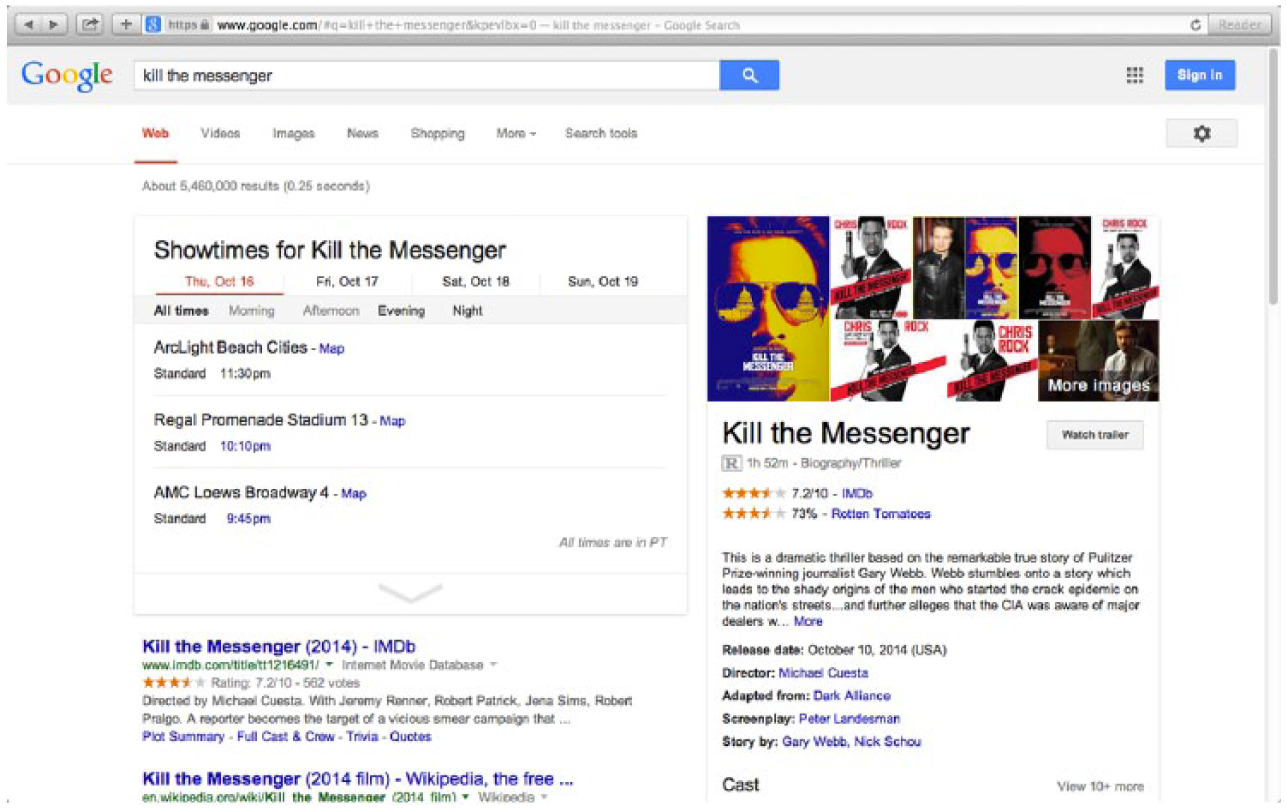
Screenshot of search results for ‘kill the messenger’.
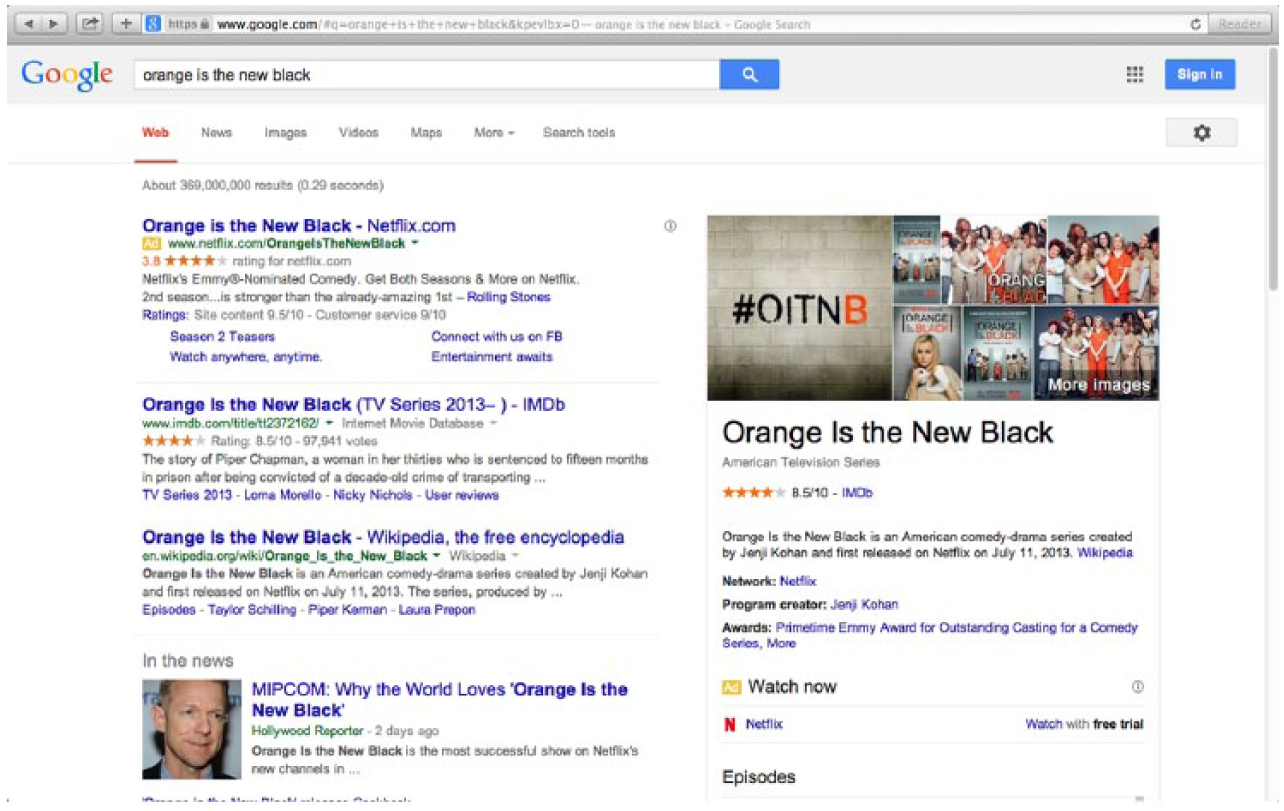
Screenshot of search results for ‘orange is the new black’.
Through its search engine and patented algorithm, Google controls an object of digital audience labor – web search results – that is also a means of signification. Those search results are for Google a means to appropriate value from the activity of accessing them because Google controls that access. That relationship to digital audience labor is what defines Google as a communicative capitalist. Google is dependent on having power over consumers of culture. But Google does not produce or pay for most of the digital content it controls in order to attract consumers as digital audience laborers.
Google does not use its control over search results to extract payment from those who conduct searches. Rent is the payment landlords receive in return for the use of their land (including resources and buildings) (Harvey, 2006: 330). Culture can be seen to operate similarly, in that a person or company that controls access to culture (e.g. a copyright holder) can demand a payment for access and use (Harvey, 2002). The history of media industries demonstrates that power can also be wielded by those who control access without the legal power of copyright (e.g. booksellers and cable television providers). I argue Google has that power, although it generally chooses not to demand payment for access and use, preferring to lend some of its control over digital culture to advertisers. It predominantly generates revenue from what, in political-economic terms, amounts to interest payments. Rent and interest are two of the categories of the distribution of surplus-value, the others being profit and wages. My claim is that Google does not generate profit in this technical sense, as it does not sell a commodity. Google generates revenue primarily through something akin to interest payments and also through rent payments.
A search for ‘kill the messenger’ when the movie by the same name was in US theaters, produced results that did not seem to generate any revenue for Google (see Figure 1). Instead Google’s Knowledge Graph accounted for most of the results. Knowledge Graph is meant to present answers to questions rather than links to relevant web pages (Google, n.d.-b). A search for ‘orange is the new black’, the name of a popular program available on Netflix, did produce advertisements along with a Knowledge Graph and links to relevant web pages (see Figure 2). There were two advertisements for Netflix on the top of the first page of results. In this case, Google lent some of digital space next to its search results to Netflix. However, Google only would have received money from Netflix if the ads had been clicked.
In producing the search results examined above, Google provides free access to objects of consumption: the digital audience labor of using those objects of consumption as objects of labor and means of signification is not directly exploited since no value is extracted from the digital audience laborers themselves. Google extracts surplus-value in the form of interest from advertisers and thereby indirectly exploits the digital audience labor of web searching. The audience labor process of signification through the consumption of search results is still directly affected, however. It is only because Google has power over that labor that it can induce advertisers to pay to borrow space next to search results. The object of labor in this case is a signified object whose meaning is worked on in one of the many processes by which individuals make meaning. Google’s search results are an example of one of the many ways in which an object of digital audience labor actually sought by people – in this case, information about where on the web a person might find something they are specifically seeking – is partially transformed by advertising into an object signified to be worked on to produce a ‘consumer consciousness’ (Smythe, 1977: 1), which is something other than what was sought in searching the web.
Google Books
Google’s rule over the web has long since expanded beyond its search engine. The ‘Googlization’ of books through the Google Books project is one such expansion. Google began scanning and indexing millions of books in 2004, with the help of university libraries (Vaidhyanathan, 2012: 152). Google had ‘declared that it could offer something close to universal access [to digital books] for no cost to the public. The catch, of course, was that it would have to be done on Google’s terms’ (p. 155). Considering Google as a communicative capitalist that specifically profits from the cultural consumption of its users, the issue with allowing it to set the terms for access to digital books is clear: ‘Hanging over the promise of access to knowledge offered by Google Books is the specter of its opposite – restrictions on open access to books, their contents, and the power that such access might help provide’ (p. 156). But public criticism along those lines does not seem to have had a significant effect on Google’s efforts. Rather, it was the complaints – and lawsuits – from those who felt their ability to profit from books was threatened that forced Google to scale back its ambitions without abandoning the Books project.
In 2005, the Association of American Publishers and the Authors Guild sued Google, alleging its Books initiative (then named Google Print) involved massive copyright infringement (Miller, 2012; Tibken, 2013). Google defended its actions as a fair use of copyrighted material before it reached a proposed settlement with the publishers and the authors in 2008 (Vaidhyanathan, 2012: 152). Google offered to pay the publishers US$125 million to settle the case, and it also offered to create a rights registry and to make out-of-print books available for sale as digital books (p. 161). Anti-trust objections from the US Department of Justice forced the parties to revise the settlement, but even the revised settlement created a system that ‘would effectively make Google the sole vendor of most of the books published in the twentieth century’ (p. 154). The revised settlement was rejected by a federal judge in 2011 (Kravets, 2011; Vaidhyanathan, 2012: 154).
The revised settlement certainly would have created a system through which millions of books could be made available in digital form, but all those still under copyright protection would have been offered for sale by Google. ‘American libraries would be commercialized, essentially hosting Google vending machines’, and ‘Google would have asserted itself as the mediator of the accessibility and affordability for this vast collection’ of digital books (Vaidhyanathan, 2012: 154). As a prominent critic of Google Books described how the project had changed from its beginnings to the judicial rejection of the revised settlement, ‘[w]hat began as a project for online searching metamorphosed […] into an attempt to create the largest library and book business ever imagined’ (Darnton, 2011). But I argue that the same critic misunderstood how even Google’s initial project challenged the power of publishers as book capitalists when he claimed: ‘The early version of Google Book Search did not amount to commercial competition with publishers, because Google provided its search service free of charge, although it linked its displays to advertisements’ (Darnton, 2011).
An understanding of the role of digital audience labor exploitation in both publishers’ ability to use copyright to profit from book sales and Google’s ability to use control of access to even partial digital books to profit from advertising revenue makes it possible to see that Google was attempting to appropriate the power of book publishers from the beginning although it was not trying to sell books. Google’s provision of access to parts of digital books through its search engine in order to profit by lending advertising space next to search results is at least potentially in competition with book publishers. But the competition must be seen as a struggle to control access to an object of digital audience labor in order to be able to appropriate value from audience activities, whether that appropriation occurs through the direct exploitation of audience labor, as with the sale of books, or through the indirect exploitation of audience labor, as with the lending of space to advertisers. In 2012, the publishers decided to settle with Google. The communicative capitalists involved agreed to work together to exploit digital audience labor and leave alone the copyright issues (including fair use) rather than risk a court decision that would have radically undermined the power of either the book publishers or Google. The publishers settled with Google after gaining the power to choose whether Google can scan their books, and the two sides agreed to split the revenue from the sale of digital books through the Google Play store (Kravets, 2012; Miller, 2012).
That seems to have been a wise decision on the part of the publishers, as the Authors Guild continued its lawsuit against Google, and in 2013 Google won when a judge decided its project of making available portions of digitized copies of books was a fair use of copyright protected material (Miller and Bosman, 2013; Roberts, 2013). The Authors Guild has appealed the decision to the US Court of Appeals for the Second Circuit (The Authors Guild, 2014). Google directed attention away from the commercial purposes of Google Books in claiming that it ‘acts like a card catalog for the digital age’. The judge in the case based his ruling on the ‘important educational purposes’ of Google Books and how ‘all society benefits’, and he pointed out that that Google ‘does not engage in the direct commercialization of copyrighted works’ (Miller and Bosman, 2013; Roberts, 2013).
The Authors Guild, however, noted that Google does profit from the display of copyrighted works (Roberts, 2013). As I have argued, the basic political-economic issue is one of communication as capital and control over cultural consumption. The ability to profit from books is dependent on the use of control over access to content as a means to control and exploit the digital audience labor of consumption. Google’s ability to indirectly commercialize its collection of digitized books is based on its ability to appropriate the power of book publishers (or booksellers) over book readers. Even if Google does not attempt to directly commercialize digitized books by selling them (which is really always a matter of renting access and use, not selling a product, as I argued above) and instead provides free access while generating advertising revenue, the company is in fact assuming the role of communicative capitalist in place of (and without the permission of) the actual copyright holder. Google is still exploiting the digital audience labor of readers, although indirectly.
Google Books has now expanded from a sort of digital catalog of searchable digital books (with limited access to their content) into a growing catalog and library of digital books as well as a digital bookstore with its connection to the Google Play store. The publishers clearly saw Google as a competitive threat because it was set to appropriate the control over cultural property that enables publishers to extract rents from readers. With its Google Play store, on top of its use of digital book content to generate advertising revenue from web searches, Google was attempting to appropriate the benefits of cultural ownership without the legal right of copyright; it was attempting to assume a de facto copyright over the digital versions of the print books it copied. As Vaidhyanathan (2012) explains, even before the development of the Play store, ‘publishers were most offended by the prospect of a wealthy corporation free riding on their content to offer a commercial and potentially lucrative service. […] The publishers wanted a piece of the revenue’ (p. 159) That is what the publishers received in the 2012 settlement, in which they share revenue from digital book sales through the Play store.
In the case of Google Books, with the addition of the Play store, Google can be seen as having extended its power to exploit digital audience labor to the direct extraction of rent through the sale of digital (or, ‘e’) books. The Google Books homepage, books.google.com (Figure 3), provides a visual representation of the company’s two strategies for exploiting digital audience labor by controlling access to digital books.
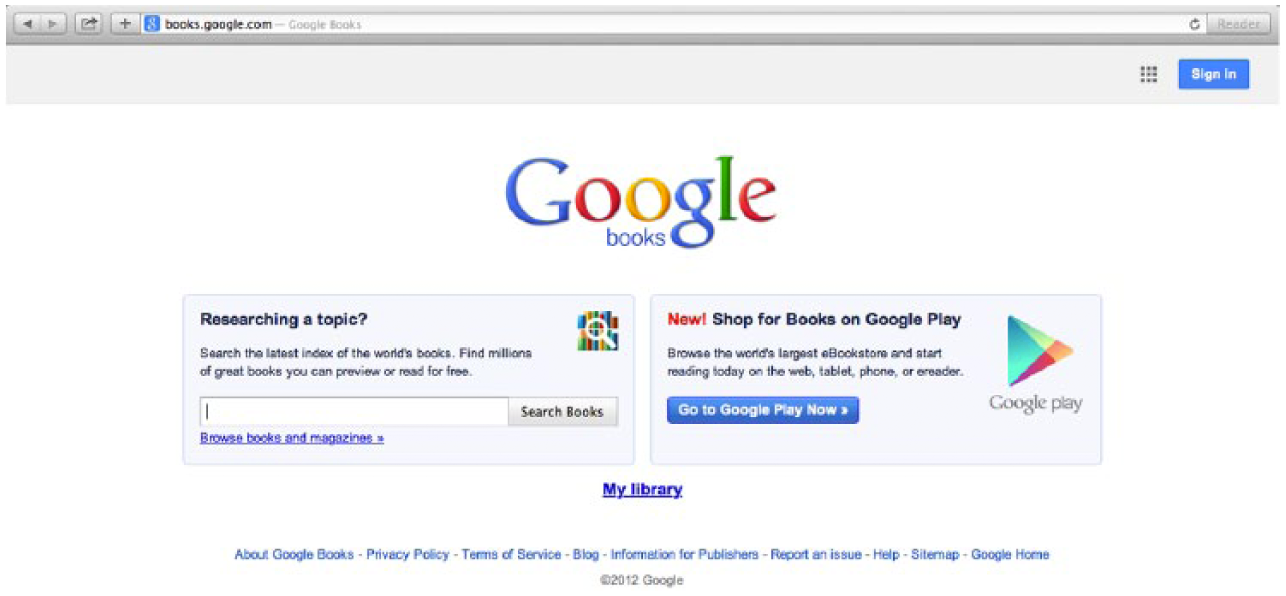
Screenshot of Google Books homepage (https://books.google.com/).
On the left, Google Book Search, a book-specific version of Google’s search engine, enables the company to indirectly exploit the digital audience labor of consuming book search results to generate advertising revenue. A search for ‘kill the messenger’ produced results for a number of books with that phrase in the title (Figure 4). The second link was to the book by Nick Schou on which the movie Kill the Messenger was based (the move was in US theaters at the time). At the bottom of the first page of search results were two ads (Figure 5).
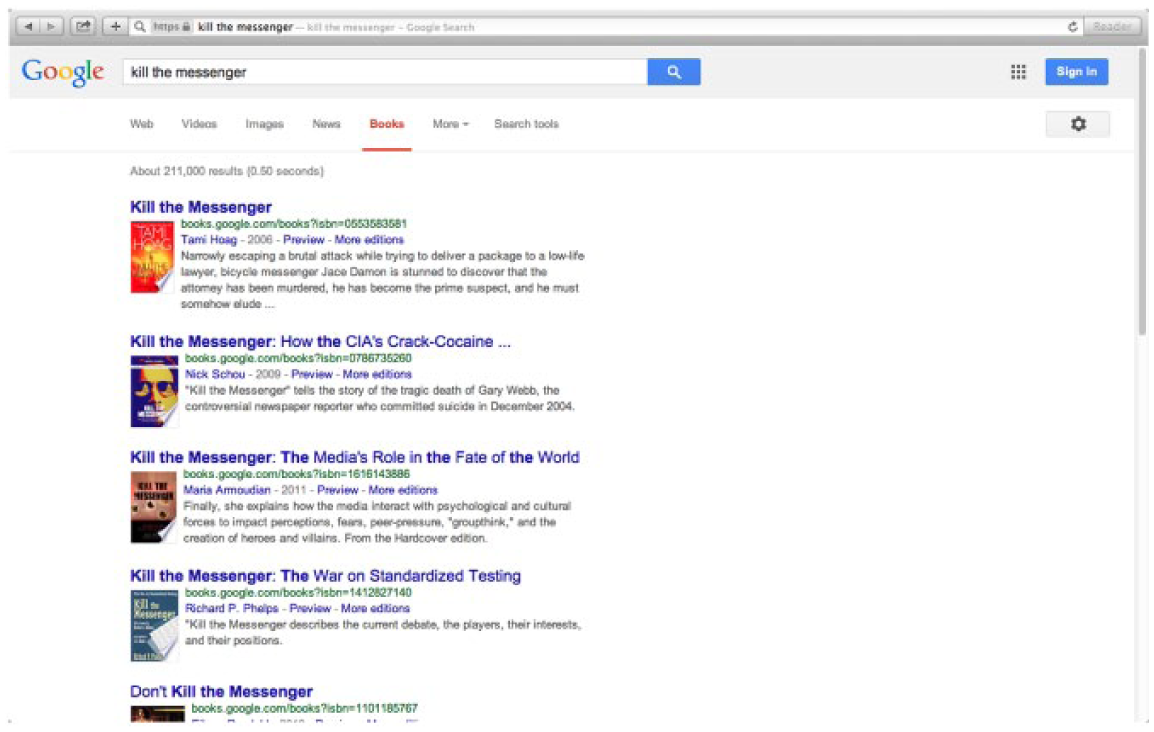
Screenshot of Google Books search results for ‘kill the messenger’.

Partial screenshot of Google Books search results for ‘kill the messenger’.
A search for ‘orange is the new black’ produced results that included an ebook version of the book by Piper Kerman on which the Netflix program of the same name is based. On the top of the results was an advertisement for that program on Netflix (Figure 6).
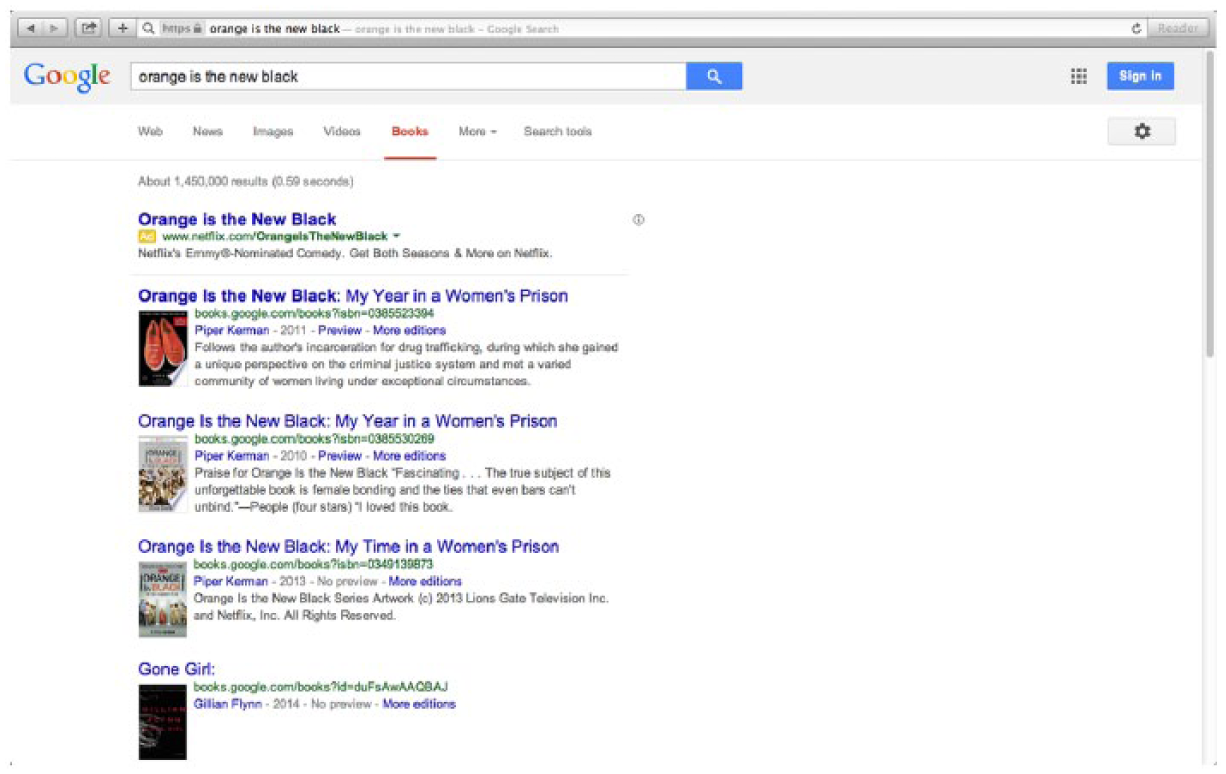
Screenshot of Google Books search results for ‘orange is the new black’.
The option on the right side of the Google Books homepage is a link to the Google Play Store, which enables the company to directly exploit digital audience labor. Google rents access to digital books, either scanned versions of print books or versions produced specifically to be read on digital media. A search for ‘kill the messenger’ produced results that included a number of books with that phrase in the title. First on the list was the book by Nick Schou on which the movie Kill the Messenger was based (the move was in US theaters at the time), available for US$9.99 (Figure 7).
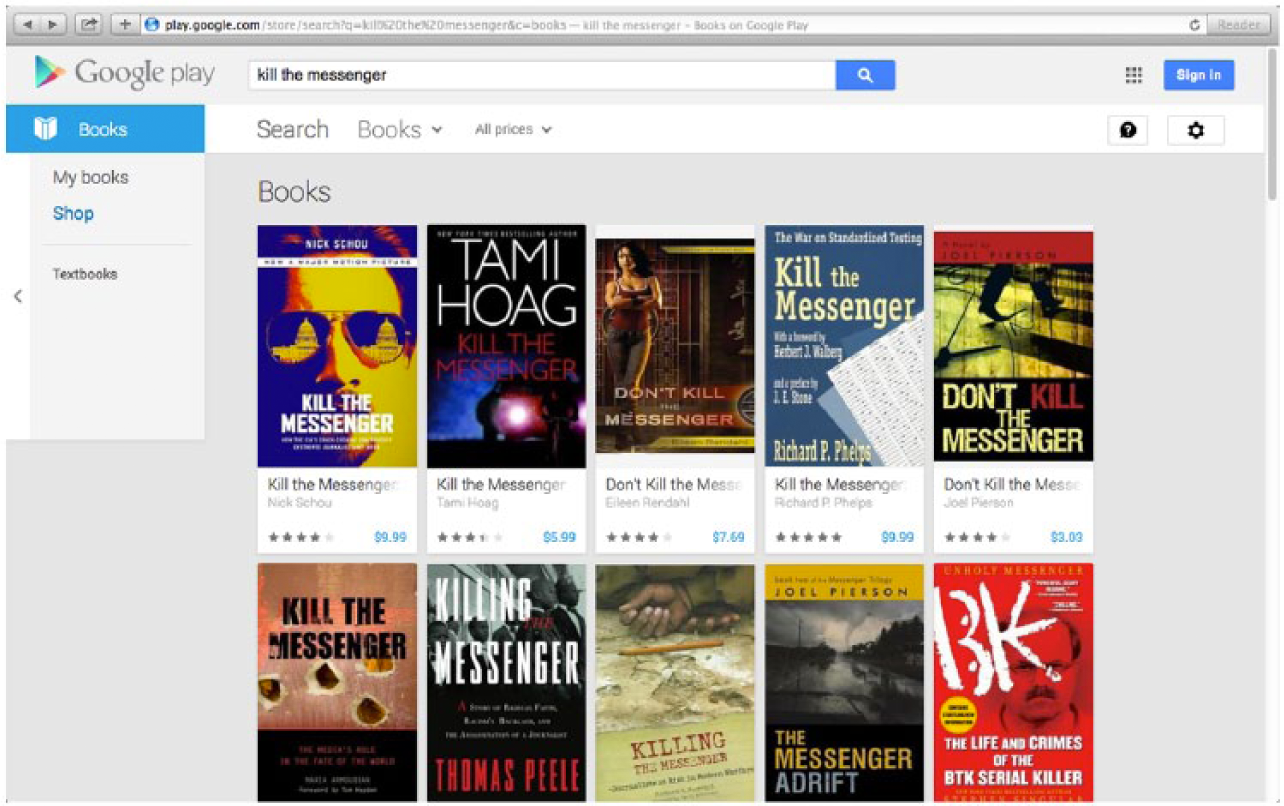
Screenshot of Google Play search results for ‘kill the messenger’.
A search for ‘orange is the new black’ produced results that included an ebook version of Orange is the New Black by Piper Kerman, available for US$9.99 (Figure 8).

Screenshot of Google Play search results for ‘orange is the new black’
Google accumulates capital through Google Books by exploiting digital audience labor, either through Google Book Search or the Google Play Store. Google controls the Book Search results as an object of digital audience labor because of its patented search algorithm as well as its extensive scanning and digitizing of print books. Google controls the digital books in its Play Store as an object of digital audience labor because it has either scanned print books not protected by copyright or copyright-holding publishers have agreed to let Google sell their digital books in exchange for a share of the profits. After the agreement with the book publishers reached in 2012, Google has a relationship to publishers that is similar to that of a bookstore: Google shares the profits from digital book sales with the publishers. Readers rent access to the digital content of the books through the Play store, while the actual copy of a purchased digital book remains in ‘the cloud’, that is, on Google’s servers rather than on the computer hard drive of the purchaser. That ‘cloud’ storage enables reading across digital devices, but it also means the person who has purchased access to a digital book through the Play store ultimately has limited control over the content.
YouTube
In October 2006, Google acquired YouTube, then a year-old website for uploading, circulating, and viewing user-generated content, although much of that content is not produced by those users but rather consists of clips from movies, television programs, music videos, sporting events, and other audio-visual content that YouTube users have copied and uploaded to the site. Because of that, copyright is a significant issue for YouTube. The site now claims to have more than 1 billion unique users each month (YouTube, n.d.). YouTube reportedly generated US$3.5 billion of Google’s US$50.6 billion in advertising revenue in 2013 (Abbruzzese, 2014). I argue that YouTube should be understood as one more of Google’s strategies to exploit digital audience labor and one more strategy to do so that has not been understood as such. Viacom’s copyright infringement lawsuit against YouTube is an illustrative example of Google’s fundamental concern with gaining power to exploit digital audience labor.
In March 2007, Viacom sued Google for US$1 billion in damages for copyright infringement. Google claimed it was protected by the ‘safe harbor’ provisions of the 1998 Digital Millennium Copyright Act (DMCA) (17 USC §512), which exempt online service providers from liability for the copyright infringements of their users as long as the service provider does not know the material is infringing and removes any such material once it is notified. Lower courts repeatedly ruled in Google’s favor, and in March 2014 the two companies reached a settlement (Silver, 2014). As with the fight between Google and book publishers over the Google Books project, the fight between Google and Viacom in relation to YouTube demonstrates how Google’s ability to accumulate capital is based on its ability to appropriate surplus-value in a process that undermines the source of other communicative capitalists’ ability to accumulate capital. Like the book publishers, Viacom finally agreed to settle rather than risk a ruling in Google’s favor.
YouTube already automatically checks uploaded videos against a database of files submitted by major copyright owners, a system called Content ID (YouTube, 2013), and it removes videos when it receives a notice that they are infringing (as required by the DMCA). But communicative capitalists like Viacom consider the presence of even just portions of their copyrighted cultural products on YouTube to be a case of Google free riding on the content produced by others (Vaidhyanathan, 2012: 30–36). The political economy of YouTube as an exploiter of digital audience labor shows the truth in that claim. That is not to say that Viacom is in the right; rather, it is a recognition of Google as a communicative capitalist looking to exploit digital audience labor just as do most other digital communicative capitalists. The political economy of YouTube I describe here is specifically a means to understand the power relation between Google and its YouTube users as a relationship of exploitation.
Google generates revenue from YouTube through advertising: it generally provides free access to the digital content on the site in order to attract viewers while lending space on the site to advertisers. Google lends advertising space on the YouTube homepage as well as space next to YouTube search results, space next to videos being watched on the site, and space before, during, or after the videos being watched on the site. YouTube also has a Partner Program that allows users to share in the advertising revenue generated from the videos they post. While YouTube partners can only receive a share of the advertising revenue if their content does not infringe copyrights, Google profits by lending ad space next to or within even potentially infringing videos.
The advertising revenue generated is the product of indirect audience labor exploitation. Advertisers are interested in access to cultural consumers who will also consume ads, so Google profits from the cultural consumption of its YouTube users. That cultural consumption is an audience labor process, which on YouTube is specifically a process of viewing videos on the site. That audience labor process is also a process of signification. It is that productive process of signification that interests advertisers, and Google’s control over that process is what enables it to appropriate surplus-value from advertisers. Google controls one of the means of signification in this case: the videos on the site, which are objects of audience labor.
Google does not produce the videos on YouTube; they are either produced and uploaded by users or simply copied and uploaded by users – and many of those users are now commercial entities like Viacom (Figure 9). Google takes control of the videos posted on YouTube as its cultural property although it does not own the legal copyright to those videos. If the videos are produced by a company like Viacom, Google has capitalized the products of the cultural labor of Viacom employees without payment to Viacom. Whether or not Google infringes Viacom’s copyrights in the process, it is certainly appropriating some of the power Viacom holds over audience activities by assuming the power to control access to the content to which Viacom holds the copyright. YouTube’s terms of service give it a contractual power equal to a de facto copyright: ‘a worldwide, non-exclusive, royalty-free, sublicenseable and transferable license to use, reproduce, distribute, prepare derivative works of, display, and perform’ the content uploaded by its users (YouTube, 2010). By virtue of that de facto copyright, Google has the power to control audience activities and appropriate value from those activities.
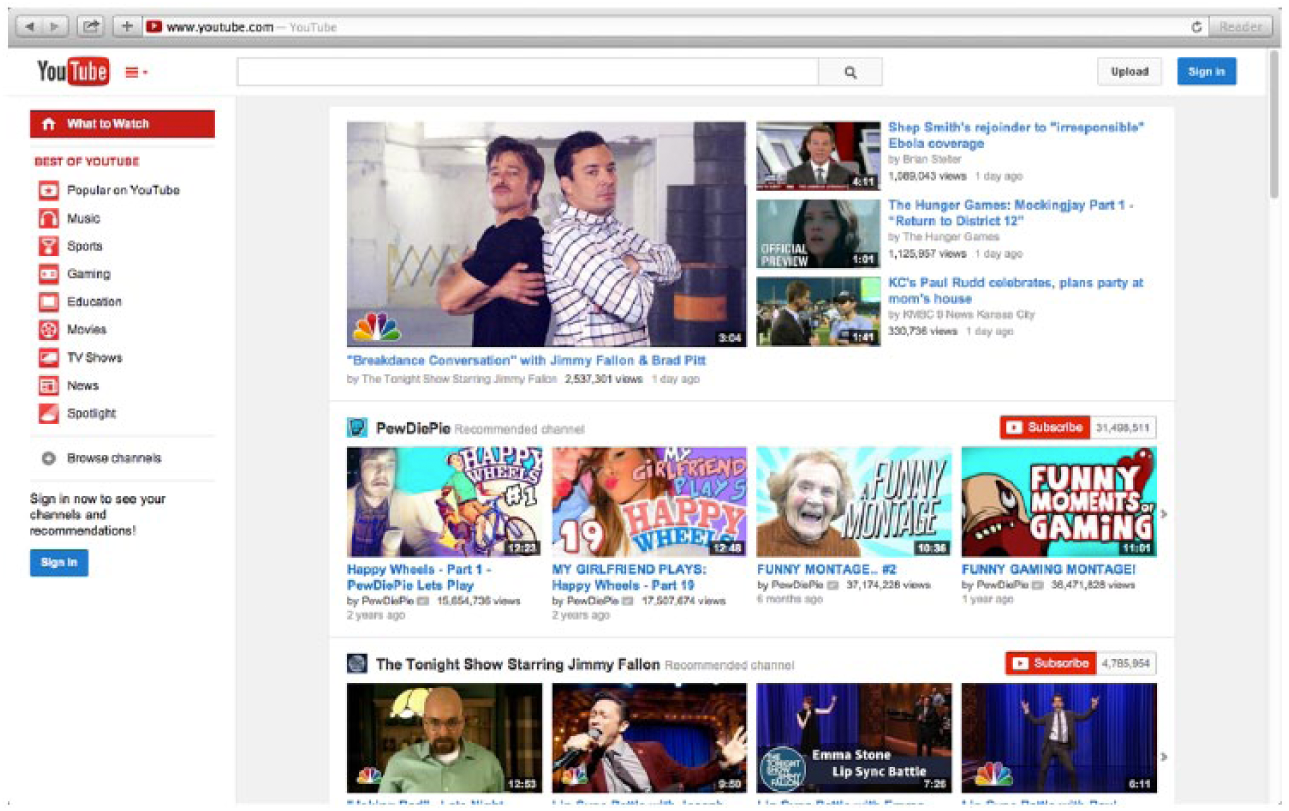
Screenshot of the YouTube homepage (https://www.youtube.com/).
A search for ‘kill the messenger’ produced results that included trailers for the movie Kill the Messenger, which was in US theaters at the time. On the top of the results were two video advertisements. There was also an advertisement on the right-hand side (Figure 10). A search for ‘orange is the new black’ produced results that included video clips of the Netflix program. At the top of the results were two video advertisements. There was also an advertisement on the right-hand side (Figure 11).

Screenshot of YouTube search results for ‘kill the messenger’.

Screenshot of YouTube search results for ‘orange is the new black’
Google does not directly exploit digital audience labor on YouTube because it provides free access to the videos on the site, although the company plans to require paid subscriptions to access some content (Dougherty, 2014; Stetler, 2013) and recently launched a paid subscription streaming music service called YouTube Music Key (Sisario, 2014). Instead, Google indirectly exploits the digital audience labor of its YouTube users. By controlling access to the videos through its ownership of the YouTube site, Google can lend part of the space next to the videos to advertisers in return for interest. Through that process, Google extracts surplus-value from advertisers and thereby indirectly exploits the digital audience labor of YouTube users. The audience labor process of signification through the consumption of videos is directly affected, however, as an object of digital audience labor actually sought by people is partially transformed by advertising into an object signified to ‘effect’ the signifying activities of its consumption in specific ways, transforming cultural consumption into a means to produce ‘consumer consciousness’ (Smythe, 1977: 1) – something other than what the consumers sought in viewing certain videos.
Conclusion
I have analyzed several strategies by which Google attempts to accumulate capital through the exploitation of digital audience labor. Google does so primarily through the indirect exploitation of digital audience labor since most of the company’s revenue comes from advertising. Google’s search engine, Google Books, and YouTube are three key aspects of ‘the Googlization of everything’, and each is designed as a means to exploit digital audience labor and capitalize on digital consumption. My analysis demonstrates the extent to which Google depends on control over digital culture, as the object of digital audience labor, in order to gain power over activities of cultural consumption. My analysis also demonstrates the extent to which the company is a communicative capitalist dependent on its ability to indirectly exploit digital audience labor. Finally, my analysis demonstrates that Google’s relative advantage over pre-digital era communicative capitalists is that, like many digital communicative capitalists – specifically, those that provide ‘platforms’ for users to circulate the digital culture produced by others – it produces almost none of the digital culture over which it assumes control, while that control is what enables it to capitalize on the consumption of that digital culture, that is, to exploit digital audience labor.
While Google’s self-proclaimed mission is ‘to organize the world’s information and make it universally accessible and useful’, its mission as a communicative capitalist in the digital era is to control means of cultural consumption and signification – specifically, various kinds of digital cultural content – so that it can appropriate value as rent or interest payments. Hence, there is a class struggle between Google and its users in their role as digital audience laborers or consumers of digital culture. And Google’s relationship to its users is, in an important way, fundamentally similar to the relationship media companies have had with audiences for centuries.
While Google’s users are relatively empowered as digital cultural laborers, since they have free use of the means of cultural production necessary to create user-generated content, as digital audience laborers they are no more empowered, or any less exploited, than any other audience laborers in other eras in which communication has been treated as capital. Even in the digital era, processes of communication are also processes of capital accumulation specifically because communicative capitalists control audience activities of cultural consumption and exploit audience laborers (either directly or indirectly). In the digital era, communication is still capital.
Footnotes
Funding
This research received no specific grant from any funding agency in the public, commercial, or not-for-profit sectors.