



Abstract
The use of social media platforms, such as Facebook and Twitter, by politicians and entertainers to engage young citizens can be seen as a further example of the emergence of celebrity politics. While regarded by some commentators as further evidence of the trivialization of political life, this article adopts the alternative approach of those scholars who foreground the potential for popular culture and media entertainment to be more socially inclusive, democratizing and influential in public policy making. To-date analysis of celebrity politics has tended to be focused upon the media performances of politicians and political celebrities, based upon a single country and lacking empirical evidence. This article explores what young citizens drawn from three late-modern democratic societies (Australia, United Kingdom and the US) think about the use of social media by politicians and political celebrities and whether it influenced their own outlook on politics? Our conclusions are that young citizens are generally cautiously positive about both politicians and celebrities using social media but felt that they should learn to use it appropriately if they are to rebuild trust and credibility.
Social media, such as Facebook and Twitter, have increasingly become seen as the communications medium of choice for any politician intent upon capturing the votes of young citizens. Often regarded as reluctant participants in politics, or even apathetic, young people have nonetheless been typically early adopters of social media and enthusiastically engage in social networking. These online platforms thereby provide politicians with new (and disruptive) circumstances in which to modify their political communication in ways that demonstrate a closer affinity to the lived experience of contemporary young people. Whether in the form of selfies, tweets, Facebook profiles or the selective posting of Instagram images, the use of social media by politicians can thereby be seen as further evidence for the adoption of celebrity style performances as a means of actively constructing important constituencies of young citizen support (Van Zoonen, 2005). Indeed, politicians themselves already face online competition for the attention of young citizens from entertainment celebrities intent on campaigning and expressing their own political views to their hosts of young online followers and networked friendships. The infusion of politicians and political celebrities into this emergent social media ecology could thereby mark a further sign of the public domain being opened up to a more personalized genre of politics, blending with the online popular culture of young citizens.
Of course for some commentators the very notion that politicians should be using social media to attract young citizens is itself an indication both of the trivial nature of celebrity politics and the continuing decline of democracy (Crouch, 2004). It further encourages the spectacle of politics being simplified, sensationalized and dumbed-down for an apathetic, ignorant citizenry with a poor attention span. From this perspective, social media simply continues the damage done to representative democracy by previous media platforms such as television (Putnam, 2000). These pessimistic accounts have, however, been countered during the last decade by a number of scholars who have argued that celebrity politics itself needs to be taken ‘seriously’. A growing literature provides important insights into both the limitations of traditional practices of democracy, that are being rejected by young citizens (Bennett, 1998; Loader, 2007), but also the potential for popular culture and media entertainment to be more socially inclusive, democratizing and influential in public policy making (Marsh et al., 2010; Street, 2004; 2012; Van Zoonen, 2005).
In this article, we draw upon the work of those scholars who argue that popular culture, manifested through a variety of media, genres, celebrity and performances, can play an important role in strengthening democratic politics. In particular, our focus here is upon how the use of social media by politicians and ‘political’ celebrities could influence the engagement of young citizens with politics. While there has been some interest in exploring how politicians and entertainers are using new media to advertise themselves and market their message, there has been a paucity of studies examining what the intended recipients actually make of these campaigns. One of the most influential scholars in this field, John Street (2012), has suggested that a more in-depth understanding of celebrity politics should first ‘involve a greater emphasis upon comparative study; [and] second requires greater emphasis on citizen/audience reception’ (p. 352). We therefore seek to take up Street’s recommendation and attempt to develop this approach further by analysing qualitative data arising from a large-scale comparative project exploring the influence of social media upon the political engagement of young citizens. More specifically, a sample of young citizens drawn from three late-modern democratic societies (Australia, United Kingdom and the US) were asked what their attitudes were to the use of social media by politicians and political celebrities and whether it influenced their own outlook on politics? Only by gaining a clearer understanding of the expectations of young citizens, and what they regard as acceptable uses of social media by politicians and celebrities, can we discern how social media technologies in the hands of a youth constituency might act to influence the performative repertoires of politicians and political celebrities and judge its potential for democratic politics.
The role of communication in democracy
To consider the role of social media platforms for mediating the relationship between politicians and young citizens is first of all to foreground the place of communication in democratic politics. Yet the appropriate form and strength of democratic politics remains essentially contested (Barber, 2003). For those with a sceptical view of the potential of citizens to actively engage in the issues and decision-making of political communities, communication is merely the channel to translate the expert views of elites to the electorate. Those with a more optimistic view of the capabilities of citizens, on the other hand, believe that strong democratic governance is made possible by the media ‘educating’ the citizen to facilitate discussion, deliberation and informed political choices. This binary framework was, of course, famously laid forth in the respective positions adopted by John Dewey and Walter Lippman in 1920s America (Dewey, 1927; Lippmann, 1921). We recall it here, not only to make the point that this dichotomy is not new, but also as a proxy for the dual criticism, which we can term ‘incapable-unworthy’ citizens, that is often made of young people today.
While Dewey maintained that democratic politics was predicated upon a public sphere of citizens, experts and journalists in communication with each other, Lippman believed most citizens to be incapable of serious political thought and that complex social issues should instead be left to those who represented them. If Lippman’s one-way transmission model of communication left little room for citizens to engage in democratic politics much beyond the occasional vote, Dewey’s version places an excessive amount of responsibility upon citizens, journalists and experts to even make democracy a possibility at all. Thus, while the often stated disengagement of young citizens with democratic politics might seem to reflect Lippman’s formulation, Dewey’s unmet demands by dutiful young citizens lead to a corresponding despondency for many advocates of strong democracy. This dualism is still played out in contemporary anxieties expressed about the poor health of the democratic body politic and the sometimes concomitant dismal prognoses about its future. Blame for this sorry state of affairs is often placed upon the slothful figure of the young citizen. Typically portrayed as the wilful miscreant intent upon undermining democratic practices through her apathetic non-committal and disrespect for previous democratic battles fought by earlier generations of citizens, young people are thereby recognized as either Lippman’s ‘incapable’ citizen, or as ‘unworthy’ to join Dewey’s political community.
This ‘incapable-unworthy’ citizen labelling can also be seen to inform concerns over the influence of the Internet upon young citizen’s engagement. From this perspective, social media, far from being an enabling communications technology for strengthening democratic engagement, only acts to further undermine the political ‘education’ of young citizens by giving them the opportunity to exit the public sphere. With the capability to construct their own communication networks outwith broadcast media and newsprint, young people can more easily avoid politics and public affairs. Furthermore, its use as a channel for sharing gossip, playing online gaming and ‘liking’ embarrassing video clips is seen as more likely to further the political attention deficit of young citizens than foster political deliberation (Bovard, 2005). Even when young people do use social media to support a campaign, or sign an online petition, this is regarded by critics as ‘slacktivism’ rather than genuine citizenship engagement (Morozov, 2011).
These concerns about the detrimental effects of social media upon young citizen engagement have a commonplace appeal and certainly add to the worries of the political classes as well as many political scientists. But are they grounds for a council of despair? The literature is surprisingly divided on this question. For sure the incapable–unworthy lines of argument have typically dominated political science. In contrast, however, it is possible to discern at least two refutations arising from media/communications scholars and political sociologists that suggest a more cautionary interpretation is possible. The first challenges the very models of modern democracy so beloved of many political scientists and that form the basis for negative accounts of young citizen disaffection. In this case, writers (Dryzek, 2000; Young, 2000) have pointed to how the particular cultural requirements of democratic participation (against which young citizens are frequently measured and found wanting) are themselves socially discriminating. Rather than being ‘incapable’ or ‘unworthy’ of engaging, many young citizens are instead systematically excluded from the political system. Access to the public sphere for the young citizen has often been denied because they are not deemed capable of meeting the appropriate entry requirements necessary for rational political deliberation – usually equated with age and/or the ability to reason by expressing oneself in an orally articulate manner based upon a sound knowledge of the matter under discussion. In reality, this formulation of democracy has been difficult to find in practice, and has been regarded as a justification for the domination of white, male, middle-class communication styles to the exclusion of those associated with other social groups such as women, ethnic minorities, Lesbian, Gay, Bisexual, Transgender and Queer (LGBTQ), working class and many young people.
The second refutation arises from a growing body of literature that contends that the citizenship practices of many young people in late-modern societies have significantly changed from a prescribed manner to one which is more personalized and self-determining (Bang, 2004; Beck, 1994; Bennett, 2012; Giddens, 1991; Norris, 1999). It is one where the political self is a cultural expression that is embodied, performed and negotiated through relational networks of power. We have attempted to capture this ideal type in our portrayal of the ‘networked young citizen’ (Loader et al., 2014). Here, in contrast to the good young citizen of conventional political theory who is obliged to participate in elections and join political and civic organizations, the contemporary young citizen is more likely to engage through informal non-hierarchical social networks that are mediated by digital communications technologies. The respectful deference to their political elders is replaced in the deportment of the networking young citizen by reflexive considerations of how public issues relate to their lived experience, and influence their life project (Giddens, 1991).
Both these counter arguments suggest that a reinterpretation of the disengagement of young citizens thesis is possible, and, we would argue, desirable. In the first, such disenchantment needs to be set against a political system that is increasingly regarded by young citizens as ‘not fit for purpose’. While the second opens up the possibility of seeing young citizen engagement expressing itself through a broader participatory culture facilitated by an emerging communications ecology (Jenkins, 2006). It is important to emphasize that these alternative perspectives neither displace completely previous models of democracy or valourize the role of young citizens in what may follow. But it does allow us to consider that the culture of democratic politics may be changing without denying the possibility of its existence.
Celebrity politics
The adoption by politicians of communication styles usually associated with popular culture, such as marketing and entertainment, in order to connect with young citizens is generally described as celebrity politics. Often this expression is used in a derogatory manner to refer to what are seen as the desperate ways politicians today seek support from the ‘incapable and unworthy’ young citizen. However, a growing body of scholars in recent years have attempted to provide greater definition and explanatory value to celebrity politics as a conceptual framework to explore contemporary political culture (Corner and Pels, 2003; Street, 2004, 2012; Van Zoonen, 2005). They have been responsible for emphasizing the academic value of exploring celebrity politics as an almost pre-modern formation (Hartley, 2010) where democratic politics is a cultural activity that has communication between actors at its core. Furthermore, in contrast to the rational liberal model of democratic engagement, emotions are seen as an important and legitimate factor shaping the participation of citizens. Passion and feelings are once again not only allowed to be regarded as sources of political enquiry, affinity, identification or critical evaluation, but they are indeed to be found underpinning the actual lived experience of democratic engagement. In relation to our interest here, young citizens may therefore be as likely to gain their political knowledge and moral attitudes from celebrity entertainers, comedy shows (Xenos and Becker, 2009) and their social media networks, as from formal instruction. Politicians wishing to connect with and build a constituency of young citizens, and thereby move beyond a mind-set of blaming young people for being sceptical of conventional political practices, need to understand contemporary youth culture and the central role social media plays within it.
Celebrity politics thereby returns our attention to the communicative spaces where citizens live their lives and political representatives actively seek their support and attention. No longer the market places of ancient Greece or the coffee houses of 18th century Europe, these interactions are played out through the entertainment media of national and local newspapers, radio, television and, increasing for young citizens, through digital media (Dahlgren, 2009). As in the past so today politicians have looked to adapt their styles using the media of the day. Often tentatively, and not without casualties, they have honed their performances and expanded their repertoires from soapboxes and stumps to fireside chats and televised debates. What is distinctive about the latest variants of digital communication, and is a defining aspect of celebrity politics, is the assertion that it is producing a more individualized and personalized style of politics.
This trend towards personalization has often been discussed against the backcloth of different communication spaces in which politicians are required to perform. John Corner, for example, makes the distinction between three distinct spheres: political sphere, 1 public and popular sphere and the private sphere. The political sphere he argues does not tend to be a mediated sphere with the performance being confined, often behind closed doors, to interactions with fellow politicos. 2 In contrast, the public and popular sphere is fully mediated with the politician performing as a public figure. Corner suggests the first sphere can be seen as a ‘workplace’ and the second as a ‘shop’ by way of separating the production and consumption of politics. Like others, he also argues that the third private sphere has become of greater significance with the rise of the political persona. In terms of our own focus of investigation here, the introduction of social media raises further questions about the impermeability of these three spheres. Can, for example, the delineation between the production and consumption of politics be maintained in an era of ‘prosumption’ where self-determining citizens can create their own political agendas and policy makers use user-generated content to inform their decisions? Moreover, the rise of political celebrities begs the question of what spheres they perform in? In their case, we see a greater emphasis upon the private and public but not the political sphere.
Looking at celebrity politics from the perspective of citizens, there has been growing agreement among scholars that a significant shift in political communication has occurred in late-modern democracies from a focus primarily upon political institutions (parties, government, cabinet) and policies (ideologies, manifestoes) towards individual politicians (leaders) (Karvonen, 2010; McAllister, 2007; Rahat and Sheafer, 2007; Van Aelst et al., 2011). The priority given to the profiles and performance of individual politicians, and in particular party leaders, in political campaigning and through the news media, has been offered as evidence of this trend towards personalized politics. Thus, the support of young citizens and their engagement in campaigns is seen as increasingly shaped by how they feel about the political candidates and party leaders (Coleman, 2013). It also leads to a shift in focus from the public face of politicians to their private lives. Despite their protestations, politicians have increasingly introduced aspects of their private lives into their political personas (Stanyer, 2012) and this has become more prevalent in their use of social media for tweeting and posting ‘selfies’.
Despite the growing prevalence of celebrity politics and the concomitant personalization of political communication, the literature has almost nothing to tell about what young people themselves think about these developments. Or how young citizens respond to the use of social media by celebrity politicians and political celebrities to engage their attention and mobilize their support? Inthorn and Street, in one of the few studies to explore young people’s attitudes to celebrity politics, considered how a range of popular cultures, including music and video-gaming entertainment, might ‘provide a source of knowledge about, and responses to, the public world of politics’ (Inthorn et al., 2012: 348). They utilized political marketing concepts as a means to understand how responses to celebrity could be mediated by perceptions of credibility, attractiveness and trust. Such readings are, of course, complicated by the variety of celebrity figures and political personas, and their persuasiveness may also be influenced by the diverse levels of political interests of young citizens themselves. Nonetheless, adapting Inthorn and Street, the use of social media can be interpreted within a celebrity politics context by three distinct although related dimensions aimed to build relationships between citizens and those who claim to represent them. First, social media can be used to politically inform (knowledge) young citizens of policies, arguments and values. Second, it can facilitate a sense of affinity (identity) with the politician or political celebrity; are they like one of us? Third, it also enables an emotional appraisal (evaluation); are they trustworthy, credible and dependable? The first dimension manifests itself through online performances associated with the political and public spheres. The other two responses, however, are more likely to be derived at least as much from presentations of the private sphere. Those who claim political representation may therefore need to develop their digital literacy in order to perform effectively online across the political, public and private spheres.
What then do young citizens make of politicians and political celebrities using social media to gain their support? What influences the judgement of young citizens when making these evaluations? After first outlining the methods we adopted to address these questions we will then go on to examine what the young citizens from our three late-modern democracies revealed.
Method
Our findings are derived from a larger project we have undertaken investigating the use of social media by young citizens for political engagement. This provided two data sources: a survey of 3691 young people aged 16–29 undertaken by IPSOS-Mori in April–May 2013 using their online panels in Australia (1222), the United Kingdom (1241) and the USA (1228); and, 12 online discussion groups (4 per country) that were subsets of the main survey sample. For our analysis in this article, we use the responses of the young people who participated in the online discussion group using IPSOS-Mori’s online discussion boards. These took place over three days in September 2013 comprising online asynchronous group responses. Thus, the data are similar to responses to open-ended questions, with occasional interaction between group members. The moderator and researchers were all able to follow and interact with follow-up questions with the group respondents but this was fairly minimal. In total, 107 young people participated (approx. 9 per group) with 56% female members. By using the survey results, we were able to recruit participants into four kinds of groups, according to both their reported levels of political participation (0–3 acts vs 7–13 acts), and their socioeconomic status (SES), using their parents’ educational attainment as a proxy (both vs neither parents had higher education). The groups are thereby labelled as follows:
High participation/High SES (HP-HSES);
Low participation/Low SES (LP-LSES);
High participation/Low SES (HP-LSES);
Low participation/High SES (LP-HSES).
These groupings enabled us to explore whether we could detect differences in attitudes to politicians and celebrities using social media that might be influenced by existing propensities to political engagement and/or SES. Three particular questions related to celebrity politics and these form the basis for our enquiry here. Transcripts of the responses to the questions from each of the 107 participants were later thematically coded using NVivo. These online discussion groups provide, we believe, a valuable source of data with which to gain a deeper insight into the attitudes of young people towards politicians and political celebrities performing in their social networking domains. The methods used mirror those of political marketing and enabled the groups to be drawn from the commercial panel to produce a representative social sample in all three countries. Nonetheless, we acknowledge that online discussion groups do not allow the kinds of intensive, in-depth enquiry that can be enabled by one-to-one interviews over an extended period in their own environment. Indeed, we would suggest that just such an approach would be an ideal way to further test the findings and conclusions set out in what follows.
Politicians using social media
Perhaps somewhat unexpectedly, when asked the question what do you think about politicians using facebook and twitter? our online discussion groups were generally favourable in their responses (Table 1). There was little surprise that politicians were adopting social media and many respondents considered it essential for them to use such communication channels as a means of keeping up-to-date. As one discussant remarked, ‘if politicians do not connect through social media then they don’t connect at all’ (male, Australia, HP-LSES). This was especially evident where they believed that it helped politicians to ‘connect’ with young people. Of course such a rich source of data from a diverse set of young citizens provides a more nuanced and complex range of answers than it is possible to describe in detail here. For some participants, for example, especially those with a deep-seated antipathy towards politicians, social media should be a space free from the incursions of politics. As one commented, ‘social media to me is a time of relaxation and leisure. Not political propaganda’ (male, Australia, HP-HSES). Such outright negative views were very much in the minority, however, with most being characterized by the kind of critical and reflexive dispositions consistent with the literature discussed above.
Emerging themes on politicians using social media.
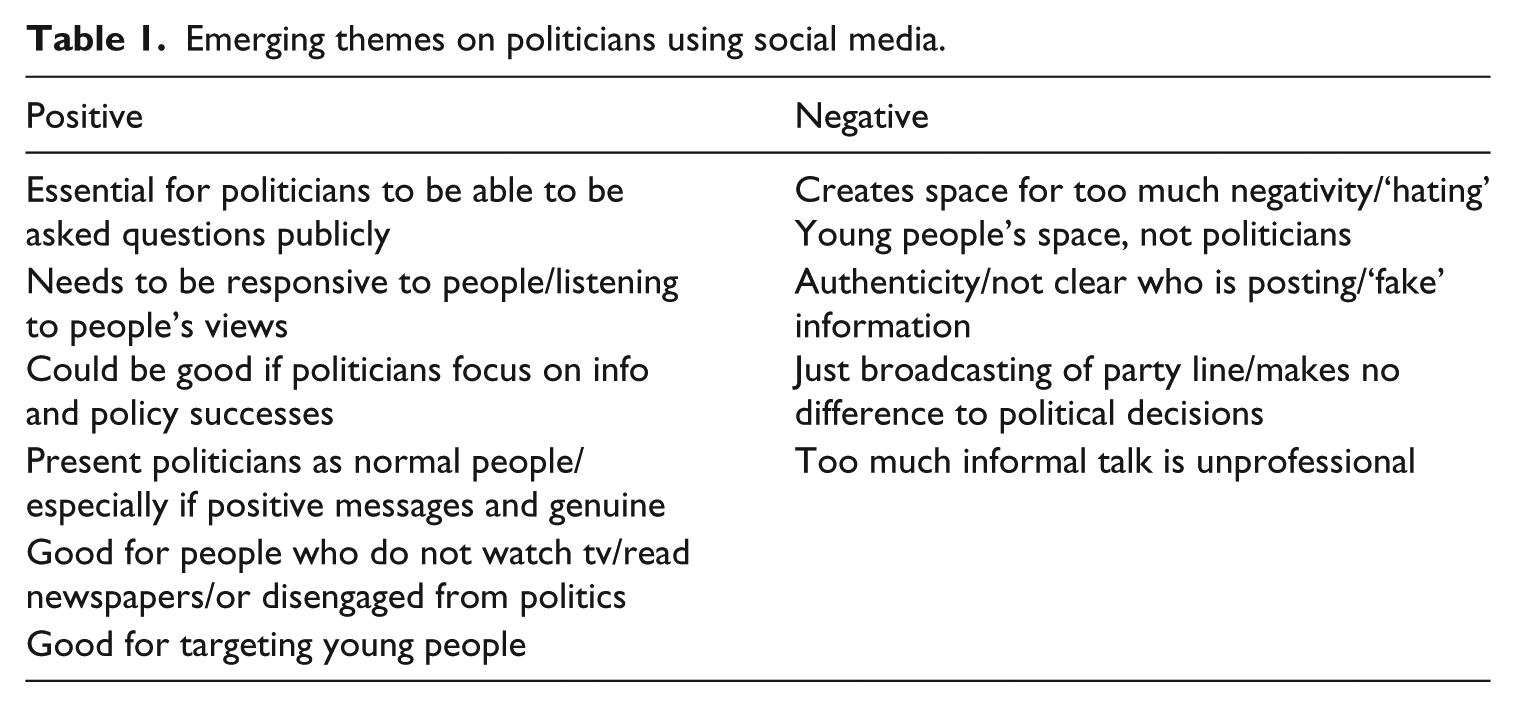
In particular, we contend that the opinions proffered can reasonably be seen to be expressed within a personalized frame. One that both acknowledges contemporary youth communication practices as well as their preference for focussing upon the individual qualities of politicians. Cognizant that young people were less likely to read newspapers or watch television news, for example, several respondents believed social media to be a good alternative channel for young citizens to obtain information about the views of politicians. Frequently referring to such attempts to ‘reach out’ to them as politicians marketing themselves and their message, they nonetheless tended to regard this as an acceptable basis upon which to make a critical judgement. A typical example would be the comment that ‘the politicians are essentially trying to sell themselves, and the young people can assess what is being put in front of them. It may not be the whole truth, but still …’ (male, Australia, LP-HSES).
But it is their familiarity with the participatory capacity of social media platforms that primarily shaped the expectations of our young networked citizens when appraising the use of social media by politicians. The two-way interactive nature of social media communication raised the contention that politicians should also listen to young citizens and be respondent to their views. One discussant suggested, ‘It is … a good platform for voters to tell politicians their views, so that when it comes to Parliament voting, the constituents are represented fairly, with the MP voting how the majority of people wanted him to’ (female, UK, HP-HSES). Their familiarity with the new media also enabled young networked citizens to be aware of its capability for sharing comment about politicians’ posts with their online friends and peers as well as providing critical feedback. Sharing, ‘liking’ and retweeting postings and comments with their friends and family are becoming important ways in which young people can actively engage with the political discussion (Manning, 2012). The idea of an active engagement with online politicians is captured by the following:
[Social media] does, in fact, have the potential for getting the ‘audience’ to give feedback and have discussions, even if it is just among themselves. They can reply to posts and then to each others replies to get a good discussion going that way. (Female, USA, HP-LSES)
There was thus a strong sense that the use of Facebook and Twitter by politicians was to be expected in an emergent digital society, with the concomitant possibilities for a more mutually informed two-way interactive engagement. Such participative sentiments were nonetheless tempered by a concern about the capability of politicians to use social media appropriately. The respondents were, for example, aware that politicians rarely answered online queries personally, posted content themselves, or realistically expected them to do so. What they tended to object to was that they received no replies, that politicians never engaged in discussions in person or that they appeared unaware of the participative capabilities of the media. Interestingly, for many respondents, their concern over the digital illiteracy of many politicians led them to fear for the safety of their reputations. Conscious of how social media postings and images can go viral and become a focus for public ridicule, many group participants suspected that inappropriate use of social media would lead to a further lack of respect for politicians. 3
What begins to become foregrounded in these different responses towards politicians using social media as a means to engage young citizens is a complex set of communication cues upon which to form the basis for judgements. On the face of it, respondents often seem to desire conflicting requirements. They want their representatives to be ‘serious’ political actors, knowledgeable and competent in their field. Yet, they also express a desire for them to be ‘one of us’. Such mixed attitudes can be seen as consistent with the need for politicians to perform and communicate across the different political, public and private spheres outlined earlier. Thus, the effectiveness of politicians traversing these domains enabled many young citizens to make judgements about their authenticity, trustworthiness and credibility. This aspect of personalization and its appeal to young citizens is explored further in the next question we asked them.
Mixing with celebrities
As politicians have turned to social media and popular culture to engage young citizens, they have also frequently included entertainment celebrities to endorse their campaigns or improve their personal image. We therefore also used example images of politicians’ Twitter messages and selfies and asked our young participants what they thought about politicians posting this sort of thing? in order to gauge their response and to prompt broader discussion. The three politicians are all active Twitter users and generally popular with young people, and two of the three images (Boris Johnson and Barack Obama) featured the politician with politically engaged celebrities. While it is not possible to separate the evaluation of the images from individual partisanship, a pattern emerged where most of our respondents were positive (or neutral) about the selfie itself; the UK groups were the most positive and the US groups the least so. Again a small minority were critical and the two examples (on Kevin Rudd in Australia and Boris Johnson in the United Kingdom) below (Images 1 and 2) demonstrate concern that social media selfies are seen as just a populist strategy and a distraction from policy debate:
Gosh this annoys me so much! It is so fake. He is trying too hard to seem young and relevant. For politicians they need to try less to fake these things. It puts me off politics. He is wanting people to like him, but I vote based on polices, not gross pictures! (Female, Australia, HP-HSES) He is using pop culture maybe in a way to target young people. Which i think there is nothing wrong with that if both parties share the same idea. As long it is to that, i would agree with it however if it just to promote their popularity then it is morally wrong. (Female, UK, HP-HSES)

Rudd selfie.
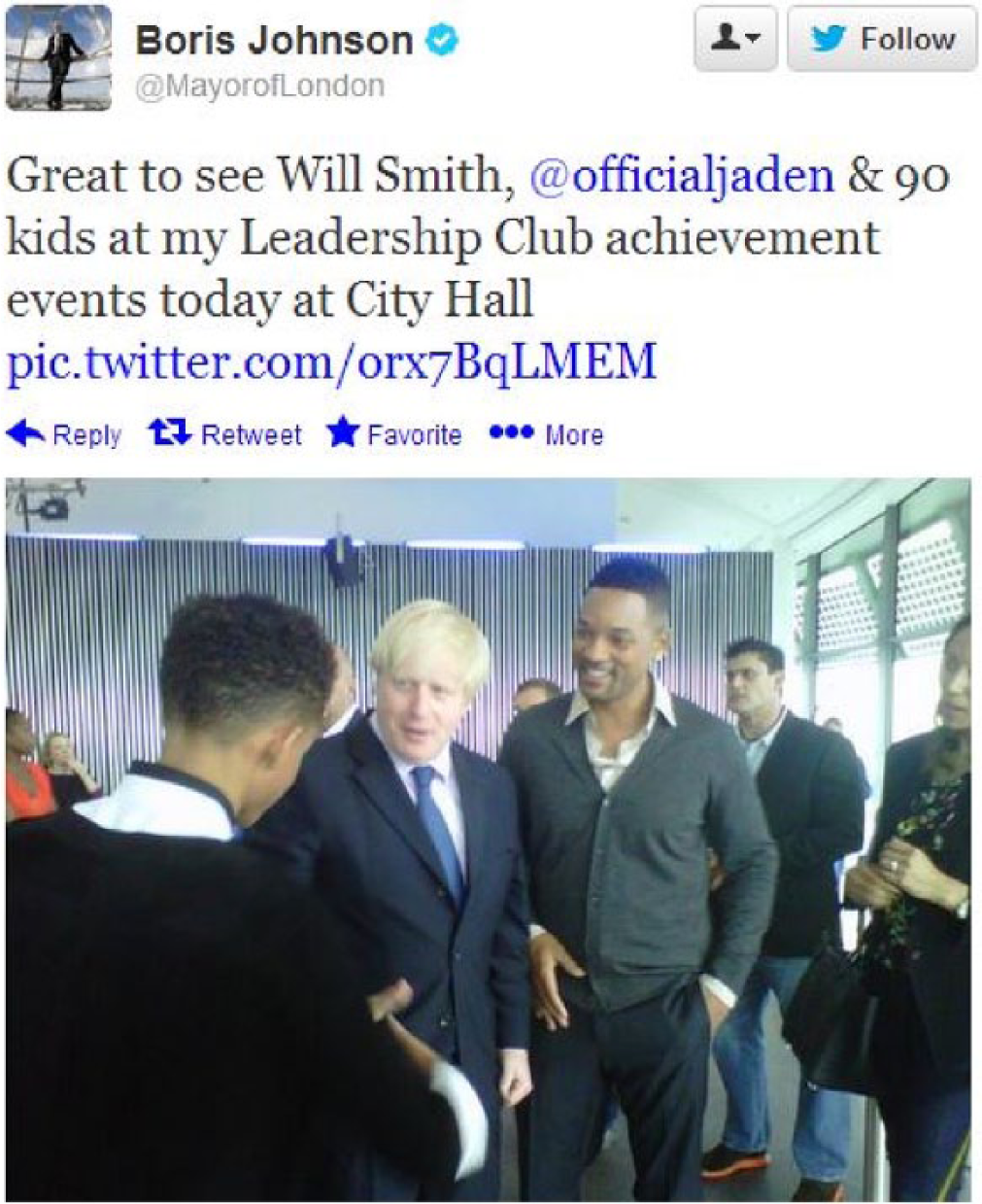
Boris meets Will Smith.
Some politically engaged young people were though more positive: ‘Brilliant! It shows Boris is modern and approachable – something I find most people in politics aren’t!’ (female, UK, HP-LSES). Notably, many of those not actively engaged in politics were positive about the selfie images. This suggests that both the personalization of politicians and the celebrity politics effect enabled by social media could help in engaging the disengaged. As with the responses to politicians using social media more generally above, some liked that the images made politicians appear more human, relaxed with a sense of humour, and capable of having a beyond-politics life (Images 1 and 3):
I think it does make them seem more human. Showing their sense of humour, and it seemed to get people’s attention. (Male, Australia, LP-LSES) I guess they want Obama to look cool and chill. He’s still the president and works hard, but he can hang out with friends too during his free time. Some might think this is a bad idea and may make Obama seem too relaxed, as in he’s not doing his job, but everyone needs time away from work. (Female, USA, LP-LSES)
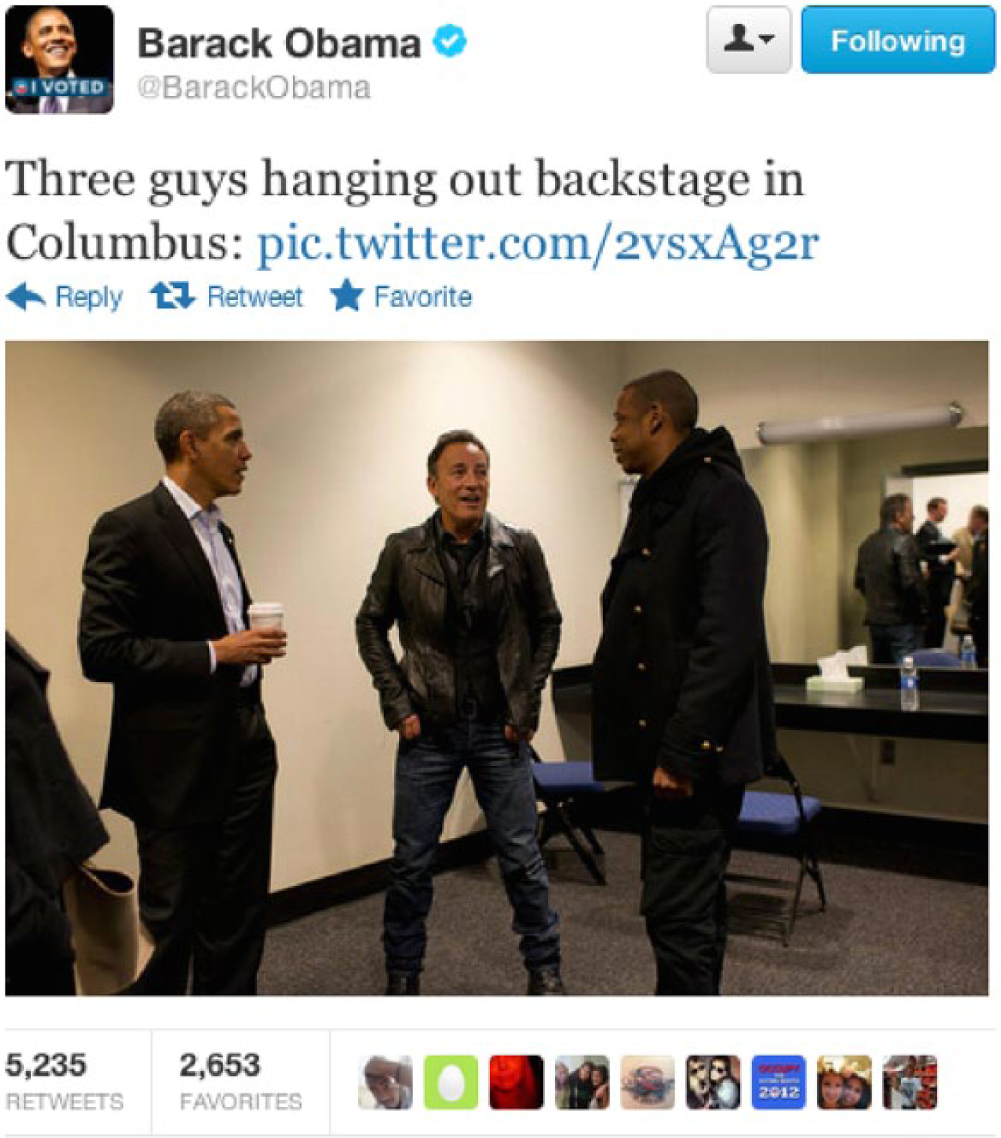
Hanging out with Obama.
Others note, in a reflective and critical way that the association with celebrities can focus attention on incidental exposure to politics, such as in this quote:
this is quite good because I’m a Will Smith fan I would stop and look at this, if Will wasn’t in the picture I’d probably skip over it so it got my attention. (Male, UK, LP-LSES)
This last excerpt from an interchange between two males in the USA LP-HSES group on the Obama selfie again shows that young people recognize the tension between authenticity and connecting with people with the real business of governing and doing politics. They see public and private spheres as intrinsically interconnected (Papacharissi, 2010):
… I think it’s awesome to see this and we should celebrate this more and pictures like this help me see the president in a new light. (Male 1) … Personally, I would hope his actions would speak for themselves, and he wouldn’t try to pander for votes by hanging out with celebrities. (Male 2) … It’s refreshing to see them more as actual people than seeing every single moment as a politician. I do agree ultimately that his actions would be the best indicator of him as a man and as a politician. (Male 1)
Political celebrities
Young citizens are, of course, far more likely to encounter celebrities on their favourite social media platforms rather than politicians. As fans of pop music, sports stars and entertainers, young people are able to use social media to follow the activities and opinions of their favourite celebrities. Moreover, they are able to share celebrity news feeds and postings as a basis for discussion within their own social networks of friends. Celebrities and their assistants, aware of the importance of social media for connecting with their fans, consequently invest a significant amount of attention to providing publicity content and actively interacting with their fans through Facebook and Twitter. Their effectiveness in using social media to build and maintain audiences is, as we have noted above, the very reason that politicians and their advisers associate with and seek endorsement from popular celebrities having a large young fan base. However, what is of interest to us here is the prevalence of politically minded celebrities such as Russell Brand, Bono or Angelina Jolie. These have sought to challenge politicians and voice their own opinions on public issues, by talking directly to their fans and users of social media. At a time when mainstream politicians may no longer be the primary source of representative authority in many late-modern democracies, the status of these political celebrities needs to be assessed. Our final focus, therefore, is to gauge what our discussion groups of young citizens thought about celebrities who use social media to talk about social issues?
Once again the responses were generally positive if critically cautious. They are summarized in Table 2 for ease of reference. Like other commentators, some of our young respondents also expressed concerns over the legitimacy of celebrities voicing their opinions on political issues. This is nicely captured by the following quote:
I think that it is a bit scary that someone who can sing or act can have so much influence over a big number of people. Being famous is not really a qualification for anything and so there is the danger that people might not be able to distinguish the credibility of what the celebrity is saying or if their message has an ulterior motive. (Male, Australia, HP-HSES)
Perceptions of celebrities using social media to raise public issues.
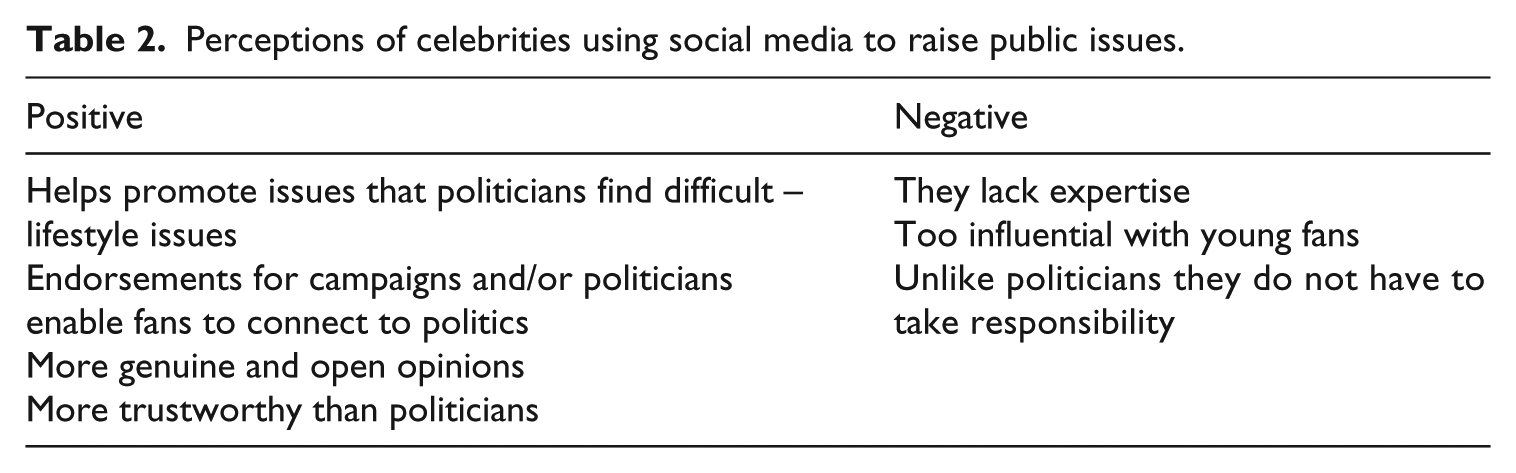
In some instances, this apprehension about the gullibility of other citizens was particularly acute in relation to the perceived undue persuasiveness celebrities might exert over impressionable very young fans. Such influence, moreover, could be seen as irresponsible since celebrities were unelected and unaccountable for their views:
Celebrities using social media is completely different than politicians using social media because celebrities are not the ones making national decisions and attempting to pass and reform laws. Celebrities do have a large influence over people, but they are not the ones actually creating laws. (Female, USA, HP-HSES)
Despite these familiar and important reservations, however, the overwhelming majority of our respondents considered it perfectly acceptable for celebrities to express their personal opinions on social media along with other citizens. One of our Australian participants enthusiastically said that he was
a big fan of a celebrity using social media to express their views. It’s interesting to see how your favourite actor or comedian feels. My favourite example of this is Ricky Gervais. He shares a lot of his thoughts and feelings on twitter and he doesn’t hold back. He makes a lot of jokes and actually replies to people who get in contact with him. (Male, Australia, LP-LSES)
Political comment by celebrities can, of course, take different forms from a full-blown campaign designed to raise public awareness of a particular social issue to a more casual posting or tweet. What was notable in many of the responses from our discussion groups was the feeling that such interventions were good for opening up discussions on topics that politicians were less likely to address. As one of the American participants observed, ‘I think celebrities have more say in their social media accounts than politicians do, and sometimes the celebrities really do have some interesting things to say’ (female, USA, HP-LSES). Processes of managing which social issues should be addressed by politicians and subject to legislative debates have long been a focus of democratic theorists. As we noted earlier, traditional models of deliberative democracy have often acted to exclude the voices and issues of concern to many young citizens. Yet celebrities, for many of our respondents, were able to use their social media platforms to open up discussions on topics that mainstream politicians were reluctant to address. Moreover, minority concern over the gullibility of the very young not withstanding, the participants in our study believed celebrities were more likely to engage young people in political issues of concern to them. As one young group member remarked,
I have ‘liked’ a few celebrities on Facebook and every so often they write a status about social issues/politics. I think it’s really important they express their views and also this can reach so many more people than if the ‘average Joe’ writes something. (Female, UK, HP-LSES)
When specifically invited to compare celebrities using social media with that of politicians, a great many respondents believed celebrities to be more authentic in their postings. This was sometimes due to a lack of trust in politicians but more often because celebrities were regarded as free from the need to secure electoral support or party discipline and therefore able to say what they felt to be true: ‘I believe they are more genuine because they are just voicing out their opinion but a politician will say just about anything to get your vote whether or not it is completely genuine’ (female, USA, HP-LSES). Politicians, many believed, have to be more careful what they say online and guarded about their personal views:
Celebrities are able to have their own opinions, and are not so much conflicted by legislative and party policy constraints. Politicians talk about issues because they want to pass a certain law or policy, celebrities are more likely to truly care. (Female, Australia, HP-LSES)
Again these responses taken together are interesting for foregrounding the complex expectations of young citizens. They tend to believe celebrities are at greater liberty to raise controversial, emotional or moral issues which politicians are unable or unwilling to address (lumpy issues). Crucially, however, this did not mean they agreed with the views proffered by celebrities. They were thus not naive followers but rather young citizens who welcomed the role played by celebrities in facilitating political discussion on lifestyle issues that they cared about. A sense of this is gained from the following short exchange between two of our American participants:
I know that many celebrities use social media to talk about socials and politics. I know that Lady Gaga does. I feel like it’s different when she talks about politics because she isn’t in charge of making any policies, she does influence them though. It’s more genuine because I know how she feels and she probably isn’t faking it. (Female 1, USA, HP-LSES) Lady Gaga is a great example! She is always posting something political! She has so many followers so I think it’s great that she can share her opinion with them and talk about something other then promoting her music. (Female 2, USA, HP-LSES) I also like how she speaks her mind whenever she wants to. There isn’t a time when she will hold back. I find that exciting. (Female 1, USA, HP-LSES)
Conclusion
We have set out in this article to discover what a sample of young citizens, drawn from three late-modern democracies, think about politicians and entertainment celebrities using social media as a way of engaging them with politics and garnering their support. Given young people’s immersion into a digitally mediated world of entertainment and social networking, it is perhaps little surprise that politicians from these countries should seek to connect with them through these communication channels. For most entertainment celebrities, the use of social media to communicate with their fans is generally more commonplace and therefore a ready means to raise public issues with their followers, if they are so minded. It is clear from our findings, however, that the effectiveness of social media use in mobilizing support is likely to depend upon the receptiveness of politicians and political celebrities to the expectations and performative demands of young networking citizens. Most of the existing literature focuses upon the study of politicians and celebrities using the media rather than on young citizens as active social agents in shaping the political communication and practices of political representatives. Our analysis of social media provides, we believe, strong evidence that for politicians and celebrities to engage with young citizens they must develop more participatory communication styles. There are clear suggestions here of the potential for some convergence between the online participatory culture of political celebrities and the personalization of politics.
For politicians this will clearly be no easy task. As we have seen earlier, the pre-valence of political marketing and the professionalization of politics have helped to produce young citizens who are sceptical, if not mistrustful, of the entreaties of political representatives. In some cases, this led to a strong reaction from a few of our respondents who thought that politicians should have no place in their experience of social media. More significantly, however, the overwhelming majority of our young citizens were cautiously open to the prospect of politicians and political discussion being an aspect of their social networking, provided that politicians used social media appropriately. The clear implication being that social media could indeed be an effective channel for politicians to connect with young citizens, but that in order to do so they would have to develop more authentic digital personas.
Across our three countries, online authenticity for our young respondents was judged by reference to how well politicians navigated between the political, public and private spheres in their social networking. Young citizens do not expect their politicians to be anything less than expert in their respective political field, and for this to be demonstrated in their strategic pronouncements. Here leadership and representation are manifested as professionalism. This form of communication was generally regarded as a good way for politicians to ‘get their message out’ or ‘market their ideas’, which many young citizens could then critically assess. However, while informative, such communication was not usually considered sufficient for gaining allegiance. Electoral support required a deeper emotional insight into the personal lives and qualities of those who claimed to represent them. It involved a more active evaluation by young citizens of how they feel about politicians. Such emotional support is only acquired by reference to what political representatives do and how they act. Are they the kind of people that they can trust? Are they like themselves? Do they understand our lived experience? Can they interact with us?
Social media platforms do seem to provide for young citizens just such opportunities for personal assessments of politicians to be made. But it raises questions for politicians about how they can be effective users of these media. They may need, at least at a local level for example, to be far more interactive in person and not always rely upon official responses from their staff. More controversially, it may require politicians to reveal a little more of their personal lives, not in crass imitation of younger social networkers or celebrities, but in ways that connect with the everyday lived experiences of those they claim to represent. Such a development requires us to acknowledge both that the boundary between the public and private spheres is far more permeable and that the personalization of politics is a legitimate basis for political judgement by young citizens (Manning, 2013; Papacharissi, 2010).
The value of online access to politician’s private life, as a means to gauge affinity and evaluate authenticity, is perhaps best understood by comparison with our young respondents’ attitude to the use of social media by celebrities. In contrast to politicians, young citizens were far more trusting of the political opinions of celebrities precisely because of what they regarded as their openness and honesty arising from their everyday lived experiences. Something similar was also found by Inthorn and Street (2011) in one of their studies. Our young citizens, in all three of the late-democratic societies, were just as sceptical in their responses to celebrities but they did appreciate that they could raise issues they cared about and tackle public problems that politicians preferred to ignore or suppress. While we are not arguing that celebrities should replace politicians, our findings do point to the potential benefits for politicians to learn to share the digitally mediated public domain with celebrities and other groups competing for the attention of young citizens. We suggest that far from weakening public deliberation it could strengthen its democratic quality by enabling issues of personal concern to the lived experience of young citizens to be tabled and expressed in multiple formats (video, text, voice, image) and styles (humour, reason, emotion) that reflect more socially diverse political communities.
Such inclusiveness certainly challenges the dominant and orthodox political discourses which have too often excluded access to the public domain by certain social groups and restricted the kinds of public issues to be discussed.
It also requires a more nuanced use of social media by politicians. Used appropriately by politicians, however, social media can ‘show their human side’ and enable young citizens to feel more emotional affinity with politicians. Earlier failures by politicians to use social media appropriately should not, and indeed is unlikely to, stop their adoption as an effective means of political communication. Nor should mistakes and errors be regarded as necessarily catastrophic for a political career. If to err is human, then to forgive politicians, if not divine, may at least be an expression of affinity. Our young citizens are generally not easily convinced by professionally scripted promotion styles, are repelled by negative campaigning styles, and are dismissive of attempts to be ‘cool’. But they do tend to be receptive to what they perceive to be more open, truthful and personal expressions of political values, commitments and their concomitant challenges to realization.
Contrary to our original assumptions, we could find no significant national differences in the findings outlined in this article. All three late-modern societies produced very similar responses to our questions. Of more interest, however, was the suggestion that it might be possible to detect distinctions on the basis of our participation–SES group categorizations. The three HP-LSES groups, for example, did appear to be more open to the use of social media by politicians and political celebrities as a means to engage young citizens in politics. While the HP-HSES respondents tended to exhibit attitudes more critical of celebrity politics usually associated with the orthodox mainstream. If such findings are found to be robust in future analyses they could have important implications for the use of social media to facilitate more socially inclusive democratic politics. It certainly points to the need for politicians and political celebrities to recognize the varied potential of different social media platforms to engage in an effective way with a socially diverse constituency of young citizens. Shaping their postings to encourage sharing and re-posting, for example, are effective ways by which politicians could facilitate discussion with young citizens, and avoid talking down to them.
As others have remarked, and we concur, there is little new about the personalization of politics. It has a long and rich history with politicians honing their styles to suite the medium of the day. Those whose preference is for a serious political disposition should not be fooled into thinking that such a contrived gravitas is any more a sign of political competence or representational quality than the adoption of other styles. A cursory glance at the wreckage of recent political decisions should bear testimony to that (King and Crewe, 2014). What are new, however, are the digital platforms upon which contemporary political personas are performed. In this respect, at least, many of our young networked citizens may be in the vanguard in shaping the nature of contemporary democratic politics. Whether this process will lead to improvement is too early to say, but we see no evidence in our data to be pessimistic. Our young respondents seem neither ‘incapable’ of engaging with contemporary political issues nor ‘unworthy’ of participating as citizens but in ways more suited to a reflexive political self. The disillusionment with political representatives is neither a product of social media nor the province of young citizens alone. Its amelioration, however, may have a lot to do with how politicians and political celebrities use social media to connect with the fluid and multiple lifestyle selves of networked young citizens.
Footnotes
Funding
The author(s) would like to thank the Spencer Foundation for their generous financial support for The Civic Network Project (Grant 201300029).