




Abstract
Research on civil society, social movements, and civil rights protests through the media in Latin America – and, in general, in new democracies beyond the West – has shown the way in which populism deepens polarization, making civil society and its media outlets an arena of ideological divides and opposing interests. By bringing Jeffrey Alexander’s civil sphere theory to the analysis of #NotOneLess movement in Argentina, this study examines the performative power of the media in creating and spreading a unified civil discourse even in the context of a highly polarized society. The article explores the media discourse on the femicide crisis in Argentina in June 2015 constructed in international and national news outlets and analyses interviews with journalists and activists. In the years prior to the emergence of the #NotOneLess movement, discourse on human rights in Argentina had become polarized owing to Kirchnerism’s monopolization and instrumentalization of it, which caused it to disappear from many sectors of Argentine society. The article aims to demonstrate how the media discourse crystallized in the general context of the massive demonstration of 3 June 2015 and did so in a way that set aside particular ideological agendas in the middle of the election period.
Keywords
On 3 June 2015, a spectacular shockwave of civil solidarity swept across Argentina. Rallying around the slogan #NiUnaMenos (‘#NotOneLess’), hundreds of thousands of people protested against gender violence and demanded institutional commitments to stopping the murder of women in the country. The #NotOneLess movement was initiated on 11 May, just 3 weeks before the march took place, by Marcela Ojeda, a female radio journalist who let out a cry of despair via Twitter. A new case of shocking gender violence had just been committed in Argentina. Chiara Páez, a pregnant 14-year-old, had been brutally killed and buried in the backyard of her boyfriend’s family home in the town of Rufino, northeast of Buenos Aires. ‘They’re killing us’, reads Marcela Ojeda’s tweet that, echoed promptly by a small group of women journalists and other intellectuals and writers, sparked off a national and international debate in the media. Media reports framed the murder as one more ‘femicide’ in the context of the significant number of recent killings of women in Argentina because of their gender. By framing the killing as ‘femicide’, the media were willing to relate the brutal isolated killings to violence of a structural nature and with a global reach, as well as to make political demands. In this fashion, #NotOneLess journalists and activists associated the word ‘femicide’ with human (women’s) rights. By doing so, they channeled the human rights discourse that has been an essential part of Argentina’s recent democratic history. The media-cum-activist movement against femicide succeeded to a great extent because of its connection with civil discourse.
A ‘human rights’ resignification of gender crimes occurred in the specific context of new democratic Argentina, namely, the phenomenon of discourse on human rights in the country having become polarized in recent years owing to Kirchnerism’s monopolization and instrumentalization of it, which caused it to disappear from many sectors of Argentine society. The media managed to a certain degree to reverse this trend. They created a unified discourse on the civil rights of women that cut through opposing discourses on human rights in the country at a time when the third term of Kirchner’s populist left-wing government was coming to an end and the victory of Mauricio Macri and his center-right Republican Proposal in the November 2015 presidential elections was imminent. In the previous decade, President Néstor Kirchner had established close links with human rights organizations. Through powerful symbolic acts, Kirchner brought together many social organizations under the banner of populist ideals. Kirchnerism’s human rights credentials were contested by its critics, who accused the president of populist policies that served to sustain his authoritarian power and corporate enrichment.
Research on civil society, social movements, and civil rights protests through the media in Latin America – and, in general, new democracies beyond the West – has recently showed the way in which populism deepens polarization, making civil society and its media outlets and arena of ideological divides and opposing interests (Arteaga and Arzuaga, 2016; Baiocchi, 2006; Elizalde et al., 2011; Silva et al., 2015; Waisbord, 2011). In line with several authors, Waisbord (2011: 110–111) alerts from applying accepted visions of civil society to new democratic Latin America, ranging from Habermasian views of civil society – in which civil society represents an autonomous sphere for democratic deliberation at arms’ length from states and markets – to a Gramscian civil society of power domination and resistance. Departing from and criticizing these views, Waisbord argues that ‘civil society in the region […] evolved largely as a result of mobilization from above to pursue specific political, state-linked projects’. Because this authoritative incursion, Waisbord concludes, ‘multiples experiences of citizens’ activism in support or opposition to populism suggest that civil society is hardly the expression of unified interests’.
This article takes a different theoretical perspective to illuminate how the media can help create and spread a unified civil discourse even in a context of highly polarized society. By bringing civil sphere theory (Alexander, 2006a; Jacobs, 2000) and cultural pragmatic (Alexander, 2006b) to the analysis of the Argentine case, the study will examine the performative power of the media for sharing civil society’s ‘vital center’. The term identifies an overlapping network of democratically inclined actors and institutions that believe in the existence of a civil consensus and share the view that their society, while far from being fully democratic, does nevertheless represent something worth maintaining (Schesinger, 1949 (cited in Alexander, 2016)). How can the media in transitional democracies help prevent polarization? To what extent media’s collective representations and journalists’ performance are crucial to gain wider democratic consensus, avoiding confrontation and partisan interests, particularly when they reported on the #NotOneLess movement in Argentina? What kinds of rhetoric – symbols, images, narratives, and so forth – did the media deploy to successfully perform civil solidarity across the whole of Argentina’s public space? By exploring the media discourse on the femicide crisis in Argentina constructed in international and national news outlets and by analyzing interviews with journalists, I will demonstrate empirically how the media discourse crystallized in the general context of the massive demonstration of 3 June 2015, doing so in a way that set aside particular ideological agendas in the middle of the election period.
Media, crisis creation, and civil sphere in a polarized society
For the case of Brazil’s civil society, Baiocchi (2006) has studied the coexistence of two ‘opposing’ codes, one ‘corporate’ and one ‘liberal’, that are locked in a continuous struggle to symbolically exert their dominance in a society in which democracy is less strongly established. Other studies highlight the nature of other Latin American countries such as that of Mexico (Arteaga and Arzuaga, 2016) by looking at dominant authoritarian and hierarchical political systems that prevent democratic codes from being operative. Similarly, Tognato (2011) has explored competition among opposing political discourses in Colombia’s public sphere. The culture of confrontation in contemporary Argentina has been widely documented, particularly with regard to the period of intensifying ideological opposition to the Kirchners’ ‘authoritarian’ legitimizing discourse, in which opposition parties, media corporations, and other social opponents were stigmatized as ‘they’, ‘individualistic’, ‘ruling class’, ‘business-driven interests’, ‘sections’, and ‘enemies of the people’ (Elizalde et al., 2011; Romero, 2013).
The theoretical framework of the civil sphere envisions this opposing coding within a domain of discourse and institutions that mobilize civil and anti-civil values, combining them with institutional resources (of both a communicative and regulatory nature), to repair what are claimed to be external and internal threats to democracy (Alexander, 2006a). Civil sphere’s discourse entails a broader, common narrative of struggle for civil solidarity and justice wherein antagonist, democratic, and counterdemocratic codes, relations, and institutions are embedded and achieve their full meaning within particular civil societies.
News media have the crucial role of conveying these more universalizing values (Forde, 2015), particularly in process leading to the creation of crisis within the civil sphere (Alexander, 2006a; Alexander and Jacobs, 1998). An instance of outrage whose impetus comes from the civil sphere constitutes a process that involves a chain of actors. Discussing on the changing ways of expressing public protest in today’s media ecology, Cottle (2008) highlights the still crucial involvement of mainstream media for social movements and activists to get their claims across wider audiences. The #NotOneLess movement entailed an impressive forging of civil solidarity preceded by a phase of crisis creation. It was the product of journalists-cum-activists’ planning, and its momentum and ongoing presence were sustained by legacy news organizations. The success of such mediated process rests on the media and social movements’ strategy to create transversal bonds between groups who hold divergent beliefs and are ideologically divided on other social or political issues to produce consensus between them (Alexander, 1984). The creation of the crisis over femicide depended on otherwise-opposed actors, groups, and journalists’ capacity to take the view that their stance on women’s rights – and in particular their right to not be subjected to gender violence – was consistent with a vision of a society unified by a shared antimacho understanding of civil life. To put the point in broader terms, in spite of the existence of significant ideological and/or social antagonism within a society, a civil sphere can exist if citizens feel that they form a cohesive collective created out of a broad front of solidarity that is defined substantively and based on a shared acceptance of a civil code rather than on more visceral factors such as nationalism, race, religion, or sex. This collective belief entails a ‘mass audience watching and reading the media coverage at home, and sometimes elites and authorities watching and coordinating responses’ (Cottle, 2008: 854). Social movement activists’ claims and demands cannot be hold as belonging to such collectivity unless the media represent them in a manner that they become part of/related to their community’s core civil values. In this sense, the crisis creation must involve an issue that goes from being one that affects only part of society (in this case abused women) to one that concerns the whole, and it must also make the transition from a noncivil sphere (in this case, domesticity, gender, and sex) into the civil sphere.
After describing the method, the following sections will show how the media and social movement against femicide brought human rights into a new narrative frame in the context of social and political fragmentation that would be accentuated by the November 2015 presidential elections. Journalists successfully performed the role of ‘civil translators’ (Alexander, 2006a). They managed to transfer crimes and perpetrators into the public space in a large scale and impressive fashion that feminist associations had until that point failed to achieve, and they framed these individuals and their violent acts as destructive intrusions into the Argentine civil sphere.
Method
I used semiotic and narrative analysis to identify the main coding, plots, settings, and characters through which the message against gender violence was conceptualized by the media. I collected around 150 media articles from the Dow Jones Factiva database. These texts encompassed the news stories, features, and editorials published during June 2015 by a variety of national and international news media outlets, a month that coincided with the peak of media reporting on the march of 3 June. The articles contained the term Ni Una Menos and other key words. 1
To explore the Argentine news outlets in greater depth, I consulted the digital archives of the daily newspapers Clarín and La Nación, whose editorials (particularly those of Clarín) were strongly critical of the Kirchner administration and for whose target audience the very term human rights has negative connotations. Although Buenos Aires’ newspapers cover a broad political and ideological spectrum, they hold two main stances on Kirchnerism, the governments of which existed in a state of public conflict with the largest private media groups but at the same time were closely aligned with smaller media organizations (Becerra et al., 2012). I selected all the news stories, features, and editorials on the demonstration published in June (around 100 pieces from La Nación and 30 pieces from Clarín), and I did the same for two newspapers that sympathized with the Kirchner government’s policy, namely, Tiempo Argentino and Página/12.
In a less systematic way, I also examined the general national discourse on human rights in relation to recent controversial events, such as the first visit of President Mauricio Macri to the former Higher School of Mechanics of the Navy, which has become the Space for Memory and Human Rights; the publication of and response to a provocative editorial on human rights by the newspaper La Nación on 23 November 2015 (that is, one day after Macri’s victory); and the presence of Barack Obama in Argentina on 24 March 2016, when the 40th anniversary of the country’s 1976 coup took place.
My exploration of media articles is complemented by an analysis of interviews with the 22 journalists, women’s rights advocates, and intellectuals who organized the march in Buenos Aires. The interviews were conducted between July and September 2015. Whereas the material from media outlets described above allows a broad, objective approach to the general discourse on #NotOneLess, the interviews offer insights into the more subjective and personal perspectives of key individuals involved in organizing the movement. One might think that these data could be skewed on the basis that its sources are parties involved in the movement. The 22 interviewees supported the march, as did the majority of the public and the political and media elites. Nevertheless, the respondents represent a wide section of the Argentine political, ideological, and media spectrum and hold strongly divergent political views. They include journalists working at the pro-Kirchnerist Página/12 and the anti-Kirchnerist La Nación and Clarín, as well as Kirchnerist activists and opponents.
Reporting human rights in Argentina: #NotOneLess
The impact and implications of the media discourse against femicide cannot be apprehended without taking into account the broader national human rights narrative that developed in the country after the 1976–1983 dictatorship. What allowed the outraged unity against femicide was the unusual power of human rights discourse in Argentina. Human rights discourse – one concrete version of the discourse of civil society (Alexander, 2006) – was the central discourse in the emergence of democracy in postdictatorship Argentina. It allowed the Mothers of Plaza de Mayo movement to develop a nonpartisan critique of the military government that could not be easily challenged. The claim that they made was that all human lives are valuable and deserving of respect, regardless of the individual’s particular ideological or political affiliation. As the Argentine historian Luis Alberto Romero (2012) puts it, human rights associations that precipitated the fall of the military dictatorship in 1983 ‘imposed an ethical dimension on all political practice, as well as a sense of commitment to and a valuing of society’s basic agreements above partisan affiliations in the context of previous experiences – something truly original’ (p. 269). According to Romero (2012), human rights discourse in Argentina began to become more radicalized from the early years of the new democratic government, when the most extreme voices within human rights organizations objected to judgments of military officials and guerrillas on an equal basis. They called for more severe punishments for military officials and became progressively more sympathetic to members of the guerrilla organizations.
A radicalization of human rights discourse was accompanied, in turn, by Argentine democracy’s turn toward an authoritarian nature, in particular under the Kirchners’ administrations from 2003, when Néstor Kirchner took office. By the end of the third term of the Kirchners’ administration in 2015, the civil discourse narrative had progressively fragmented, and human rights advocates and organizations had been tainted by anticivil codes in terms of how they were – and still are – perceived by a section of Argentine public opinion. Their critics accused them of sectarianism and radicalization, and also of being dependent on political power. A closer analysis to the relationship between Kirchnerism and Argentine media reporting on human rights organizations will allow the immediate context of political confrontation and polarization in which #NotOneLess movement emerged to be revealed.
The polarization of human rights discourse
Under the Kirchner administration (2003–2015), the term human rights maintained its main original signifiers: the symbols, images, and stories of state terrorism and its traumatic aftermath. However, it began to acquire a particular and narrow sense that confined the cause of human rights and its advocates to a particular set of signifieds. President Néstor Kirchner started to establish close ties with the Mothers and Grandmothers of Plaza de Mayo as well as with organizations that had their origins in the unemployed movement. He progressively included the defense of human rights within his political agenda through symbolic ceremonies and gestures such as the withdrawal of paintings of former military leaders from the Military School in 2004. The linking of human rights to Kirchnerist ideology led to a rejection of emblematic human rights organizations such as the Mothers and Grandmothers of Plaza de Mayo by some liberal antigovernment sections.
Recently, President Mauricio Macri’s first visit to the former Higher School of Mechanics of the Navy, which took place in February 2016, triggered harsh criticism among human rights activists and representatives of the Left and Kirchnerism. The controversy surrounding Macri’s visit to Esma represents just one of the recent events that have provided the basis for discursive battles over the cause of human rights in the country. On 23 November 2015, one day after Mauricio Macri won the elections, La Nación published a controversial editorial entitled ‘No More Revenge’, which stated that ‘the election of a new government is an opportune moment to put an end to the lies about the 1970s and the ongoing human rights violations’ (La Nación, 23 November 2015: 32). The article outraged a large section of politicians and human rights advocates. Journalists at La Nación rejected the editorial and published a statement of their own on the same day, repudiating the text’s call for the release of repressors tried for crimes against humanity. The journalists characterized the statements made by the newspaper as antidemocratic and linked a continuation of the trials to democracy and justice.
The present ideological struggle for human rights continues. In March 2016, the Kirchnerist newspaper Página/12 reported on the criticism from human rights organizations that was sparked by the presence of Barack Obama in Argentina on 24 March 2016, 40 years after the 1976 coup. The report echoed criticism leveled by Estela de Carlotto, president of Grandmothers of Plaza de Mayo, and Nora Cortiñas, representative of Mothers of the Plaza de Mayo. ‘It [the Obama visit] is a mistake that is also offensive’, Cortiñas commented in an article on 20 February. The anti-Kirchnerist media outlets celebrated Obama’s presence as a historical ‘180-degree turn’ on the human rights policies of Néstor and Cristina Kirchner (Clarín, 23 March 2016). Clarín applauded Obama’s tentative visit to Esma in its opinion pieces and disapproved of the negative reactions of human rights representatives, which, it suggested, were the product of ‘numb stories that draw from a fictional past’ (Clarín, 10 March 2016).
In a Clarín opinion article (26 March 2016), the journalist Alfredo Leuco stated that there is an urgent need for ‘honored’, ‘prestigious’ leaders and benchmarks in ‘shaping new human rights bodies for new times in Argentina’. His comments on the 40th anniversary of the 1976 coup and on Obama’s visit to Cuba and Argentina can be seen as reflecting the displacement of human rights organizations to the side of antidemocratic codes from the perspective of anti-Kirchnerist and anti-Left parties and ideologies. The article referred to the ‘extraordinary and courageous’ role played by the Mothers and Grandmothers of Plaza de Mayo for speaking out in favor of ‘freedom in the broadest sense of the word’ and against ‘authoritarianism’. Furthermore, it emphasized the ideological plurality of associations such as the Center for Legal and Social Studies (known as CELS in Spanish). However, Leuco also argued that ‘time went by and twelve years of the Kirchnerist state’s bullying gave them a partisan dimension, emptying them of plural and ecumenical content and, in some cases, sinking them into the foul swamp of corruption’. Through making serious accusations of partisanship, membership in a privileged minority, and corruption, Leuco attached a complete different meaning to the traditional symbols and emblematic leaders of human rights organizations.
Against femicide: the media resignification of human rights
The polarization that had split discourse on human rights in Argentina was something that activists and journalists planning and reporting on #NotOneLess movement were very conscious about avoiding. Interviews with main organizers of the march in Buenos Aires reveal that the journalistic discourse moved from a Kirchnerism-induced fragmentation of human rights narrative to a regeneralization of it, such that human rights could function, once again, as an overarching consensual discursive frame.
The #NiUnaMenos movement unfolded over 3 weeks, starting with the murder of 14-year-old Chiara Páez and the immediate denunciation by journalist Marcela Ojeda via Twitter on 11 May 2015 and culminating in 3 June mass march in Buenos Aires and many other cities in Argentina. The post on Twitter followed a movement that had taken shape from March that year. Under the slogan #NotOneLess, a reading marathon organized by feminist activists at the National Library in Buenos Aires aimed to raise awareness of killings of women and involved several victims’ relatives. The event was held on the 10th anniversary of the disappearance of a young woman named Florencia Penacchi, and it coincided with the killing of 19-year-old Daiana Garcia that same week. In May, the journalists’ call through the media was intended to take a different direction in making femicide publicly visible and denouncing it. In what follows, I will focus my analysis on the media coverage on the 3 March demonstration to explore the ways in which public outrage was framed. I will then examine the content of 22 interviews with the organizers of the march. The interviews record opinions and personal experiences of the weeks before and during the march.
In Basics of Qualitative Research, Anselm Strauss and Juliet Corbin (1990) propose the interpretative level of paradigm or model to relate ‘in vivo’ codes (categories used in texts to present and evaluate events) to one another and to bring them face to face with the conditions that gave rise to such coding, the context in which it appeared, the strategies (actions/interactions) through which it occurred, and its consequences. Alexander’s ‘cultural performance’ model for social action (see Figure 1) enabled me to delineate and interpret the main codes, narratives, and facts for this case study from a civil-sphere and cultural-sociological perspective. I follow the basic elements of this cultural performance model of deep codes and foreground scripts, actors, and audiences to present my findings.
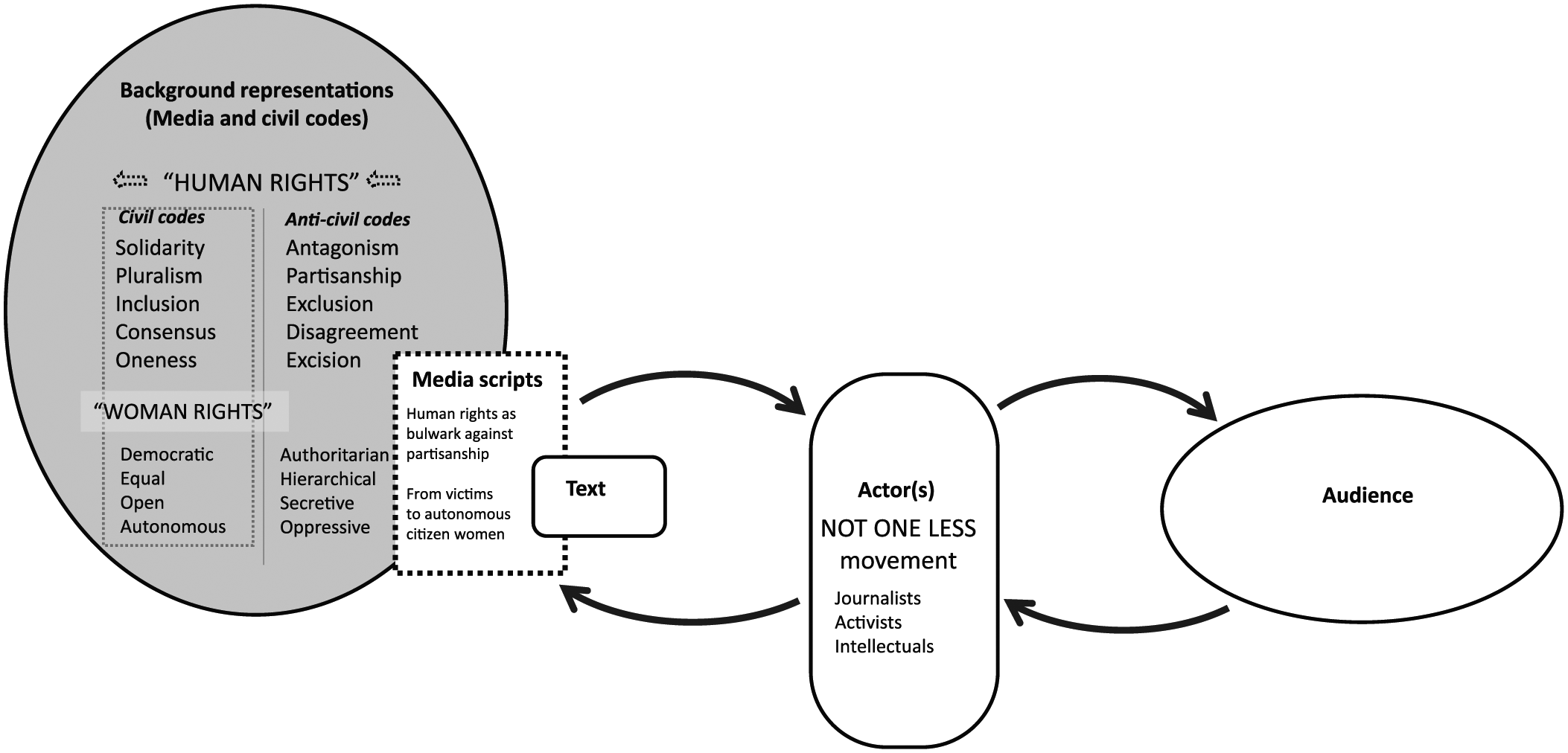
Elements of cultural performance (Alexander, 2006) applied to the #NotOneLess movement.
Putting human rights into civil codes: solidarity, inclusion, pluralism
In most of the international and national news reporting on the demonstration, Argentine society as a whole appears as the main character in the headlines, performing the role of safeguarding human rights: ‘Not One Less: The Unanimous Outcry of Thousands of Argentines’, read El Cronista (4 June 2015). El País reported that ‘Argentina Campaigns’ (4 June 2015). The Guardian (8 June 2015) told its readers that ‘it is a noble cause. It’s something much more basic. It is a human right’. Associated Press produced a press release (Associated Press, 4 June 2015) that read, In an Argentina polarized by the October general elections, the call brought together … politicians from all sides, artists, intellectuals, social activists, and, above all, ordinary women, overwhelmed by the daily headlines about women who had been murdered, in most cases by their partners.
El País reported on the march in the same manner: ‘Argentina is experiencing a time of great political turmoil and division in the middle of the electoral campaign. However, the mobilization of #NotOneLess has been so great that all candidates have backed this group’s demands’. The Argentine daily La Nación (4 June 2015) described how ‘the demonstration managed to unite clashing flags under one slogan: shouting down femicide and changing a culture of violence. [It was] an encounter where people from all social classes, creeds, and ideologies visualized #NotOneLess’. And BBC Mundo (3 June 2015) reported on ‘the Argentine outrage that has transcended borders’.
News outlets from both anti- and pro-Kirchnerist wings of the media reported on the 3 June march by framing it in broad terms of solidarity and collective action performed by the whole Argentine population. The anti-Kirchnerist newspaper Clarín (7 June 2015) embraced this coding, which encompassed government institutions such as the Secretariat for Human Rights of the Ministry of Justice and the National Counsel for Women, to report on the achievements and positive repercussions of the march. Clarín journalist Mariana Iglesias, who covered the event, described her perception of the facts, attributing a leading role to Argentina’s civil society, activists, journalists, and citizens while relegating politicians to the background: There were no politicians involved in it. Or rather, there were, but they were unable to get into the foreground because they were not allowed to do so. Only relatives of the victims – and no one else – were allowed to be at the front.
In contrast to the oppositional discourse on human rights that had characterized the editorial line of La Nación, most of its articles on the #NotOneLess movement reflected on ‘citizen action’ and the ‘vitality of civil society’ (La Nación 4 June 2015). The following quotation from an opinion piece by Carolina Arenes considers the facts based on a civil concern of inclusiveness and plurality: Yesterday there were flags of all colors, from the Left, the Frente para la Victoria, Pro, the UCR, and the unions. Few recent demonstrations have allowed such a convergence, and we should take note. Because it does us good, and because it is true.
The media coding of private gender violence: macho perpetrators as anticivil actors
The eruption of criticism of femicide increased moral concerns about unpunished crimes and psychological identification with victims of gender-based violence. Recent singular cases of brutal murders of women were framed as having been the result of the uncivilized, threatening forces characteristic of ‘macho’ perpetrators. As one of the women’s rights activists behind the demonstration pointed out in a New York Times article (15 June 2015), ‘The cause is our country’s macho culture’.
In an interview with Radio Nacional (3 June 2015), Dora Barrancos, a historian and sociologist who is the director of social sciences at the National Council of Scientific and Technological Research (CONICET), stated, ‘The triumph of patriarchy is best viewed from the fact that women themselves accept that patriarchy. Violent action legitimizes even more violent actions’. Barrancos linked the fight against domestic violence to the Argentine women’s movement and women’s self-awareness within democracy. For Barrancos, the powerful contribution of the Mothers of Plaza de Mayo to the democratic restoration of 1983 produced a renewed Argentine feminist consciousness after the dictatorial regime. In the new democratic society, sexual hierarchy and authoritarian male–female relations should be excluded from the rule of law.
According to TV presenter Florencia Etcheves (interview 7), ‘This march was not only a consequence of increasing violence against women but the result of a struggle that women began long ago’. Private violence, together with public and political recognition of women, became a central issue of the new feminist agenda that the #NiUnaMenos movement projected in masse to the public as a goal.
Media discourses on the events symbolically reflect the shift from individual, private, and marginal scenarios to the collective, open, central scenarios of public life by emphasizing the way in which the same harrowing murders of women that previously had been committed in intimate spheres were now taking place in the public sphere. One of the women journalists who organized the rally wrote in the British newspaper the Guardian (8 June 2015) that where once these gender crimes … were likely to be committed in domestic settings, in many recent cases they have made a leap into the public sphere – into coffee shops and classrooms. ‘Macho’ gender violence has taken on perverse new forms and entered new spaces in Argentina.
Opinion pieces commenting on the meaning of the 3 June demonstration transfer democratic demands for equality, autonomy, and openness to the fight against gender violence, and they juxtapose these qualities with the counterdemocratic codes of the macho perpetrators, whose actions are portrayed as hierarchical, authoritarian, and secretive (as most instances of these crimes are committed in private and intimate scenarios). In this vein, a Página/12 article (2 June 2015) reads, ‘as young people and teenagers gain their independence, these men intend to send an exemplary and chastening message: they will keep control and will not give it up so easily’. In an interview with the Mexican feminist Marcela Lagarde (Página/12, 21 June 2015), the newspaper highlighted the detrimental effects of male–female relations based on ‘love mythologies’ that imply being ‘held captive’ and ‘women’s repression’.
Aggressors are coded in the discourse produced as ‘selfish’ individuals who seek to control and ‘isolate’ women. And women are accused of complying with relations in which macho males invade women’s spaces and humiliate and degrade them and constrain their independence. In discussing the traumatic experience of the killing of his mother, journalist Luis Bremer criticized the macho culture behind the killing of women and highlighted the anticivil forces that characterize the killers: What a shame it is, for you as a son, about your old lady being killed, and not having had strength within a cultural framework where what is given priority or is applauded is physical strength and not intelligence, and bravado and not negotiation. This is the cultural framework that we are in: one in which the man who has the most muscle, who imposes his power, who empowers himself over the rights of others, has the most approval.
Media scripts: human rights as a bulwark against partisan intrusions
Reflecting on how the warning bells against femicide were sounding with increasing loudness across different sectors of society, Hinde Pomeraniec, a journalist, editor, and columnist at La Nación and a member of the #NotOneLess movement observed, If I am proud of one thing, it is to have cooperated in setting up such a powerful and diverse team. … There was a need to express an opinion on the subject, which in my view combined with another need, namely uniting once more over a single cause of human rights, in which you can have many differences with the person by your side, but not over this issue. I think that there are many people who have been used in the past to getting out and demonstrating but who haven’t done it for a long time: people who had always felt like answering the call over human rights issues and who at some point began to feel that this had become the property of one political sector. (Interview 11)
In her general introductory account of the events, journalist Paula Rodríguez relates the #NotOneLess movement to human rights in the same nonfactional way when she states that ‘#NiUnaMenos is not someone’s property, attribute, or creation, but an a posteriori synthesis of what was a unique social moment’ (Rodríguez, 2015). Radio Nacional journalist and #NotOneLess member Florencia Alcaraz (interview 6) frames gender violence within this broad sense of ‘human rights’: I think that human rights – that is, explaining that the violation of the rights of women is a violation of human rights – are a wise approach to the issue. This approach is also good for getting more people to join it and not only people who have already been persuaded.
Similarly, journalist Marcela Ojeda (interview 13) expresses the motives that led her to begin the movement. She differentiates these from hard-line activism and partisanship-based motives: I think it was like … I do not know whether to say magic may seem naïve. … Because ours is not a feminist cause either. Mine is not a feminist militancy or a neomilitancy. It is a particular fact that touched me and encouraged me to say: ‘Let’s take the street’. How? In a political, nonpartisan way.
Mercedes Funes, a #NotOneLess member who is a journalist and the editor of Gente magazine (interview 17), gives an account of the divergent ideologies within the core of the movement that shows that plural views converged in a single cause: At a time of political division that was so great that it was referred to as a ‘rift’, there were people from TN, Barcelona magazine, Página/12, Perfil, and Editorial Atlántica working together. Beyond the fact that this diversity did not necessarily correspond to the editorial line of the media outlet that each person worked in, it contributed a great deal for us. The broadness of this base with regard to the media outlets that we worked for, the diversity of thought that this showed – and that was moreover shown on Twitter – enriched us. And I think that value, our social capital and careers, and everyone’s contacts, greatly influenced and gave more power to the call.
The organizers’ accounts of the protest reveal that opposing political groups that were competing in the election race attempted to instrumentalize the cause of women’s rights and the protest’s popularity. ‘Why did the politicians come to find us before we went looking for them? Because they saw that something was going on and that people were beginning to take pictures of it’, observes Marina Abiuso, a journalist at El Trece TV (interview 15).
Communication consultant Ana Correa (interview 2) expresses the organizers’ desire to prevent the campaign’s becoming colored by the ideologies of official or opposition sectors: In recent years, almost all marches had been tinged in this way. To me it seemed like a really interesting challenge to see what we could do so that it did not fall into the hands of an extreme sector that would appropriate it and destroy it, deepening the rift, which is what can happen with these things. For those of us who are concerned as citizens, the subject of rifts is a permanent and unwanted one.
Correa explains that the government joined the campaign 6 days before the march. In keeping with the discourse of other organizers, she recounts the internal debate on whether government officials should be asked to cooperate or not. When questioned about the accusation of being a Kirchnerist protest, she observes that Kirchnerism waited until the last minute to join the protest: ‘They took a reserved stance, monitoring what others were doing and what we were doing, and we took advantage of the situation’.
Text: the media effectiveness of narrating the civil demands
The text that was read in public and reported in the media achieved a high level of dramatic effectiveness. Through it, the media presented the deaths of individual women as part of a collective story of femicide, the cause of which was machismo. The cases of murdered women were framed as being a human rights problem that affected all of society: ‘In many femicides children were also killed as part of the punishment projected on the women and their own ability to give life’, reads one of the statements. The rights of ‘some people’ are the rights of ‘all society’, and preserving the life and the decisions of women expands freedom to all. The declaration encourages a forging of new forms of collective strategies to ‘spin the fabric of “common life” more and more’. The text refers to a ‘social and cultural violence’ legitimized by ‘public discourses’ that have to be reversed into discourses of civil solidarity and commitment. Women victims are not ‘alone’ but embedded into webs of affection and mutual support; and ‘private violence’ has to be discussed within the sphere of politics.
This narrative included an affirmation of saying no to ‘social mandates’ of repression as a ‘response from the whole of civil society’. The request featured legal demands such as the implementation of the Law of Complete Protection for Women of 2009, as well as severe criticism of the judicial system’s contributing to the impunity of aggressors and the vulnerability of victims, and its failure to guarantee effective measures to combat gender violence. It also appealed to the media to reshape the public discourse of victims’ culpability, inequality, and domination.
Twitter, mass images, and the role of celebrities
The interviewees present Twitter not just as a means of civil mobilization – ‘There I wrote that tweet and quickly an exchange began’, says journalist Marcela Ojeda – but as an expression of plural, open, and trustful communication. Ojeda describes how ‘it was transparent and spontaneous. It is all written and clear for all to see on Twitter’. As journalist Mercedes Funes states, Ten of us have in common that we use Twitter quite a lot and know how to interact on it. We hadn’t ever seen each other, except two or three who worked together. I did not personally know any of them. They were Twitter friendships that quickly became something else. Those of us who reacted to Marcela’s tweet were a very heterogeneous group in some respects and very similar in others, and we started to work on this almost en masse. We were able to reach an agreement, and once we had divided up the tasks we were able to have confidence in what the others were doing.
Through Twitter, journalists caused the feminist activists’ message to go viral and spread the #NotOneLess campaign to newspapers, TV and radio channels, blogs, news sites, and so forth. A sensationalized story type of gender violence that had been exploited by mass media on many occasions – namely, the case of 14-year-old Chiara Paez, who was found buried in the garden of her 16-year-old boyfriend’s house and who was a few weeks pregnant at the time of her death – became via new media the campaign slogan for mobilization against a machismo culture. Writer Florencia Minici (interview 8) observes that ‘in this area, the work that my colleagues have been doing on Twitter is great, because they are always showing how to communicate effectively. There are some very interesting gaps to be bridged in terms of how to communicate’. A new media form, Twitter, therefore emerged as an effective alternative to traditional mass media and the form in which the latter usually covers gender violence resulting from similar ‘macho’ cultural patterns.
Nevertheless, at some point during the campaign, the mass media were also courted and enlisted as an ally by activists and journalists. In their interviews, the organizers interpret the presence of celebrities in terms of wider civil engagement and plurality. #NotOneLess member Ximena Espeche explains that the presence of Tinelli ‘caused a stir’ because the way in which he has acted on TV was not consistent with the message of #NotOneLess. However, as Espeche argues, Out in the public square, you are disputing the public voice. Tinelli has a lot of power within that public voice, so whatever he does will have an influence in one sense. If you are going to dispute that sense, you may win or lose. In this case, I think that it went well for us. It went well because there was lots of content and there were many grassroots people saying things about it that no one had a monopoly over. For me, that was what was interesting. But for many analysts, it is very difficult to understand the noises that the crowd is making.
Mise-en-scène: the symbolic center of the Plaza
Only 3 weeks after the news of Chiara Paez’s murder and the tweet sent out by Marcela Ojeda in response to it, the physical scenario for #NiUnaMenos was set for June 3 at Congress Square, the location of Argentina’s National Congress. Interviewees link this scenario to the power of ‘a common action’ that managed to integrate ‘the most heterogeneous elements of Argentine political life’ (interview with María Pía López). María Pía López links the public arena for debate to the cohesion and unity of ‘the plaza’ and distinguishes it from other historical physical spaces that would not allow such an alignment of viewpoints: ‘In my view, if we had just been people who are closer to Kirchnerism, everything would have just happened in the Plaza de Tribunales’.
Journalists link this symbolic center to other plazas around Argentina. Congress Square represents the center at which the public outcry emanating from plazas in different cities and villages, and particularly those located in the interior of the country, converged. In her interview, radio journalist Marcela Ojeda asks, ‘When did I start to attach a bit more importance to what was happening? When we started to see what was happening inside the country. For me, #NotOneLess was an implosion. It came from inside’.
At Congress Square, the text was read by celebrities rather than by feminist activists. Gente magazine journalist Mercedes Funes points out that ‘we talked a lot about who were going to be the spokespeople. … What needed to be accomplished was to transcend [feminism] and to connect with people’s discourse. There’s a much more subtle power in that’. Before the event started, TV Todo Noticias journalist Florencia Etcheves explains, the organizers had to clear the main stage of political slogans mixed with #NotOneLess signs: The stage was for the five points, the information on the 144 phone line, and #NiUnaMenos. Beyond the stage, there was the whole square for whatever you like. No one can say that we had let people put up the flags of this or that party.
Near the stage was an area where families of victims of gender violence stood during the performance.
Conclusion
Shortly after the unprecedented and massive participation in the march, the National Council of Women reported that the national phone line for reporting cases of gender violence had experienced a ninefold increase in the average daily volume of calls that it received. A process of civil repair was set in motion. Argentina’s Supreme Court announced the creation of a national registry of femicides – no official statistics of such crimes had existed up until that point – and the local legislature of the city of Buenos Aires unanimously passed a law against gender violence. The mass protest in Argentina was replicated one year after, on 3 June 2016, in Brazil, and then again 2 months later, on 13 August 2016, in Peru. Further research on the connections between the three cases, as well as on public outrages in other Latin American countries, will allow a consideration of the extent to which the success of the media discourse on #NotOneLess has helped to initiate social change based on a shift in the core civil and anticivil codes of male-female relations that are deeply established in Latin American culture.
The media succeeded in bringing about a process that Alexander, (2006a: 231) has described as translating ‘a problem in a particular sphere [the domestic, intimate sphere in this case]’ into ‘a problem in society as such’. Journalists, activists, and other organizers of the 3 June march were able to trigger a reaction from an audience – which comprised officials, political parties, legal representatives, civil actors, citizens, and so forth – by reframing femicide and perpetrators in a newer and broader sense of human rights. From a broader discourse of solidarity, pluralism, and inclusion, violent acts against women were assessed not just as isolated women’s rights violations but as uncivil forces against Argentina’s civil society at large. These violent acts amount to threats to the democratic values of equality, openness, and independence. Their perpetrators embody counterdemocratic codes that stand in opposition to these values. Their brutal actions were decoded as being the last link in a chain of an oppressive, authoritarian, and hidden ‘macho’ culture.
Armed with these civil ideals, the media quickly and widely spread a unifying civil discourse, forestalling coexisting opposing narratives on human rights in a virulent atmosphere of political confrontation between pro- and anti-Kirchnerist currents that was created by the electoral campaigning. Most of the #NotOneLess supporters interviewed describe how widespread protest came about through a framing of their fight against femicide in terms of a common defense of human rights, of a unanimous common agreement within society as a whole that cut across different political ideologies, and of a demand for women’s rights without exclusions. This cultural grid was used as one of the media scripts for journalists and activists who supported the movement and the actual performance in the symbolic center of Congress Square, where demonstrations against femicide and in civil defense of human rights were protected from manipulation for partisan ends.
Taking the protection of women’s rights (under the label ‘femicide’) as a master frame (Benford, 2013; Benford and Snow, 2000; Cannata, 2016), the media discourse had the ability to encompass a broad spectrum of institutions, political parties, and social movements, integrating different political ideologies in a larger frame unit of the public discourse. The #NotOneLess media discourse could have become a question of being for or against the government of Cristina Kirchner. But in the event, no such division manifested itself. The march was neither governmental nor oppositional. The femicide outrage overcame such political barriers and become a cause for everybody. In their discussion of and varying perspectives on the feminist claims contained within the #NotOneLess movement’s demands, the organizers of the movement show how, to some degree, women made the transition from ‘women’ to ‘human’ over the course of the summer of 2015 in Argentina. According to the feminist activists interviewed, this civil reconstruction of gender and the rise of feminism began decades earlier as a critical element of the postdictatorship context. It was a women’s movement – The Mothers of Plaza de Mayo – that championed the cause of human rights within a democratic state. The interviewees also clearly asserted that #NotOneLess’ identifying traits of feminism and a critique of machismo were to be liberated from the political ties of Kirchnerism and left-wing ideologies.
In November 2015, Argentina’s government shifted toward the center-right after 12 years of Kirchnerism. The change would have been unthinkable a few months earlier at the time when the #NotOneLess march took place and polls predicted victory for the Left’s candidate. On 25 November, the Day for the Elimination of Violence against Women was marked through new #NotOneLess rallies, and the Ministry of Social Development of the city of Buenos Aires published statistics on psychological, physical, and sexual violence in the capital for the first time. The immutability of the #NotOneLess movement during a period of political change might emphasize that it was a manifestation of solidarity and civil demands for women’s rights led by Argentina’s civil society.
The reaction to Obama’s visit less than a year after the march against sexual violence thus shows that the pro-Kirchner/Macri axis of polarization over human rights still continues. The recent movement against femicide might be viewed as an exception within the general context of the ongoing controversy about human rights in Argentina. However, it also offers important insights into the power of civil discourse and the way in which it manages to gain ground against established competing political forces. The femicide outrage itself was the necessary key in producing an underlying consensus. The case examined here suggests that left-right polarization can be challenged or at least bracketed by explosions in the civil sphere that highlight what people on both sides of the divide agree to be anticivil crimes.
Footnotes
Funding
The author(s) received no financial support for the research, authorship, and/or publication of this article.