



Abstract
Women experience positive engagements with documentary as an enclave that values their gendered contribution, but also suffer negative encounters with it as a genre that restricts their full involvement, by promoting masculinist practices as normative. This gendered dynamic means that women occupy a liminal space with regard to documentary. Women’s liminal status is experienced negatively in a number of ways: first, during commissioning, where their approach to narrative, budgets and directing are questioned; second, in terms of work relationships where they are required to be relentlessly ‘likeable’; and third, when credits for work performed are withheld. Women’s subjective identities are constructed around this negative liminal positioning but it can become a position or form of positive adaptation to gendered and neoliberal subjectivity in their working lives. Resistance occurs when women conduct practices such as, first, enhancing the status of affective labour; second, when they undo or reject working through normative hierarchies; and third, when they collaborate in documentary production to negate neoliberal logics of individualization. Liminality, thus, constitutes both a way of understanding women’s negative experiences of gender inequality in documentary production but also a potentially positive form of resistance to the gendered precarity that characterizes creative labour.
Introduction
Women in Irish documentary production acknowledge a gendered and liminal subjectivity and positioning within the genre, which concurrently retains but at the same time also rejects them. Women experience positive engagements with the genre as an enclave that values their gendered contribution, but also suffer negative encounters with it that restricts their full involvement, by promoting masculinist routines and culture as both generic and normative. This push and pull of gendered costs and benefits means that women ultimately sit in a constant ongoing liminal space with regard to documentary, neither fully in it, nor exactly excluded from the genre either. For women in documentary, much subjective identity is constructed around liminality as a status but also, more radically, as a potential adaptation to increased neoliberal precarity in creative industries generally and media industries specifically. Gill and Pratt (2008: 19) contend that subjectivity is always mediated by the meanings that people give to their experience and that this mediation does not exist outside of culture. It is in the mediated meanings that women documentary makers give to their work practices, their gendered experiences and their liminal status that the accounts of refusal of and resistance to precarity, through subjectivities, are to be located. In the analysis that follows below, I argue that women use liminal status within documentary production, to undo hierarchy, to emphasize the value of affective labour and to use collaboration to acknowledge shared precarity, which amounts to a practice of resisting the normative, masculine and neoliberal order of contemporary screen production.
Precarity and liminality
A number of authors have noted that media production is not gender neutral (Mayer et al., 2009; Mayer, 2011; Ross and Carter, 2011). Feminist writers propose that media work is characterized by a number of patterns of gender inequality that relate to informality, autonomy and flexibility (Banks and Milestone, 2011; Gill, 2002). Gill (2002: 82), for instance, argues that gender impacts through differentiations in educational advantages, varied access to entry routes and contracts, a gender pay gap and trends towards casual status for women. O’ Brien (2015) looks at how processes of gendering operate by channelling women and men into different types of production roles, where they receive differential rewards and opportunities from their work. Gender impacts in complex ways on the routines of production, where it shapes the perspective applied to media content and expectations regarding the behaviour of staff (O’ Brien, 2015). The informality of recruitment and the gendered challenges of networking, self-promotion and parenting while working in the field all further act to compound inequality (Conor et al., 2015: 62). Critical accounts of contemporary media work recognize the pleasure of creative work for women, but also its costs. These writers map the ‘pleasure-pain axis’ as McRobbie (2006) puts it.
In addition to gender inequality in media work, a key outcome of recent transformations in advanced capitalism has been a shift towards neoliberal employment patterns within the sector. In this context, workers in all sectors of Western society are increasingly insecure, casualized and in intermittent employment (Gill, 2011: 251). Neoliberal transformations occur across a spectrum of settings in terms of the degree of exposure that various types of workers experience with regard to those trends and with different implications for their labour conditions and their modes of resistance to inequality. However, many media workers, men and women, have in the last couple of decades witnessed the normalization of practices including lower pay, longer hours, contract insecurity, the individualization of risk, increased self-government and the transference of responsibility for work onto individual workers, the iconic members of the ‘precarious generation’ (Gill, 2002; Gill and Pratt 2008; Neff, 2012; Perrons, 2003). Neoliberalism ‘creates policies and practices that embody the enterprising and constantly strategizing entrepreneur’ as the ideal citizen where power operates through technologies of the self in the form of worker subjectivity (Apple, 2006: 227). These workers see themselves and are expected by the ‘community’ of media workers to be flexible, adaptable, sociable, self-directing and able to work day and night without restrictions and be marketable as perpetually attractive, uncomplaining commodities – so that eventually, as Gill (2011) puts it, all of life becomes a ‘pitch’ for work (p. 249).
While some women, mainly those employed in public service broadcasters, do not experience the more extreme versions of neoliberal precarity that their freelance colleagues in the independent production sector experience more forcefully, nonetheless all women media workers experience the ‘precarity’ that attaches to gender identity in media production. Women are under-represented in media work, there is horizontal and vertical segregation on the basis of gender, a gender pay gap and women are much less likely than men to be appointed to senior decision making or leadership roles in media work (European Institute for Gender Equality (EIGE), 2013; O’ Brien, 2017). Gender thus generates precarity in terms of women’s position in media industries relative to men. Women are precarious by virtue of gender, irrespective of how well ‘tenured’ they might be in terms of their status, position or employment contract. But oftentimes women also experience the sharp end of neoliberalizing tendencies, in addition to the gender inequality they experience, and these processes are enmeshed in their experiences of working life. While a number of writers have explored the gendered dimensions of neoliberal precarity in media work, few of these analyses examine the modes of adaptation or potential resistances to neoliberalization or to gender precarity that may exist among media workers.
This article argues that liminality constitutes one such mode of adaptation and a potential space of resistance within creative labour. In discussing neoliberal, precarious workers, Lorey (2015) notes,
Techniques of self-conduct comprise active modes of self-exploitation … (but) At the same time, inherent in these are also new modes of subjectivation, which are able to elude neoliberal forms of domination and enable new practices of resistive composition and constituent power. (p. 106)
Just as Lorey argues that modes of subjectivity can evade neoliberal domination, I argue in parallel that a mode of adaptation or resistance to gendered precarity is operationalized by women who adopt a liminal subjectivity. This status allows women to simultaneously participate in media industries, but to retain a distance from an industry that is biased against them. They become permanently in but not of the industry. Through liminality, women are able to ‘breach existing relations of domination, a breach that signifies a certain affirmation in which something new can emerge’ (Lorey, 2015: 107). Liminal modes of subjectivity are not always subsumed into normative practices of flexibility, informalization and network dependency that characterize the neoliberal creative labour force. ‘In uncertain, flexibilized and discontinuous working and living conditions, subjectivations arise that do not entirely correspond to the neoliberal logic of valorization, and which may resist and refute it’ (Lorey, 2015: 103). One such mode of resistance is liminality as a work status.
The concept of liminality describes various threshold situations (Van Gennep, 1960) or ‘betwixt and between’ positions (Turner, 1982) that are usually part of a rite of passage to a more fixed or incorporated position among small cultural groups. As Garsten (1999) notes, liminal workers are constantly betwixt and between, they lack the ‘structural bond created by a regular employment position, yet (are)drawn into extended circles of loyalty’ (p. 603). Liminality has been used in organizational studies to describe employees in organizational threshold situations (Sturdy et al., 2009) where there is an absence of a long-term ongoing relationship with the organization for which they work (Borg and Söderlund, 2014). As Beech (2011) puts it, liminality ‘can be thought of as a more longitudinal experience of ambiguity and in-between-ness within a changeful context’ (p. 288). In this sense, liminality can be a permanent form of identity that offers a ‘special sense of community with others in the limbo … a shared sense of alterity, as it were … liminality is much more than a personal state … it is an objective condition, a working arrangement …’ (Czarniawska and Mazza, 2003: 273). Liminality denotes a time and space where subjects are ‘neither “in” nor “out”’ but are ‘separated from familiar space, routine temporal order or hegemonic social structures’ (Sweeney, 2009). While space and time are critical in the conceptual development of liminality, there are certain aspects of liminality that are more relevant in the context of this analysis than others and primarily it is used here as a metaphor, not to describe a particular time or space, but rather to understand women’s gendered condition in media work as one of being in ‘a position of ambiguity and uncertainty’ (Chreim, 2002). That position of ambiguity can, and often does, serve as a manifestation of gender inequalities that alienates them from creative labour, but it can also serve as a status from which women can reflexively critique or even resist their full incorporation or assimilation into neoliberal and gendered work practices in creative industries.
Method
Ireland shares the typical structures of the European screen-production industry, albeit on a smaller scale. Currently, the Irish broadcasting sector has two dual-funded, public service broadcasters, RTÉ and the Irish language station TG4, and one commercial broadcaster TV3. Over 150 small to medium-sized independent screen-production companies are active in the film and television industry in Ireland. In terms of gender balance in media employment, Ireland lags behind the European average of 44% female employment in programming and broadcasting with a rate of 30% participation (European Institute for Gender Equality (EIGE), 2013: 16). Moreover, international comparative studies have shown that Ireland suffers from ‘persistent patterns of inequality in terms of under-representation, glass-ceiling barriers to advancement and low pay (in relation to men)’, all of which remain firmly embedded within the Irish media sector (EIGE, 2013: 14). A key concern of the majority of the respondents was that the data would be anonymized, this related to their anxieties about possible reputational damage that might accrue to identifying gender inequality in the context of a small nation state with a highly networked industry.
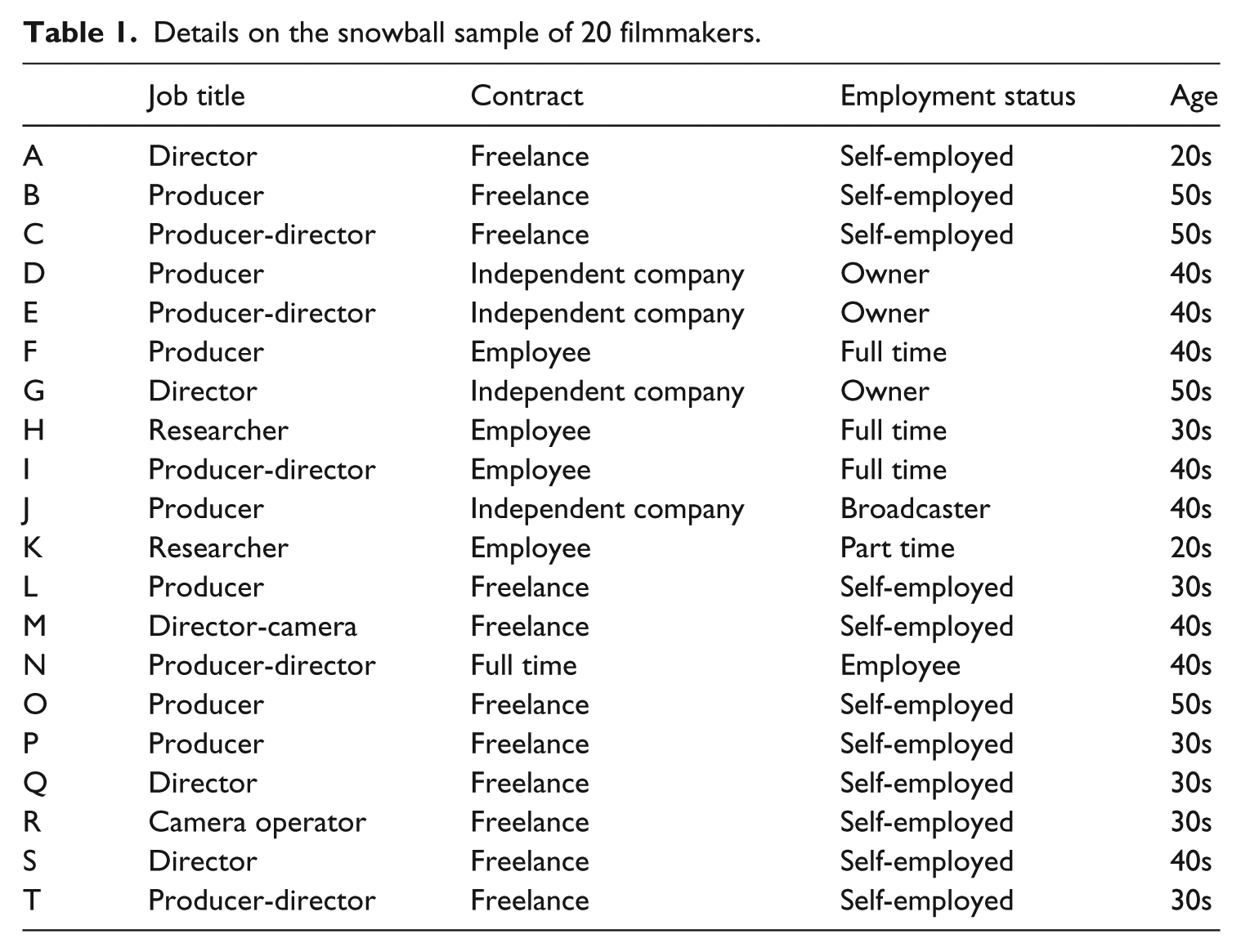
In terms of documentary production, the Broadcasting Authority of Ireland finances approximately 13.5 hours of production per biannual funding round, with other work commissioned from the independent sector mainly by the public service stations. The data used here do not include women working in broadcasters’ in-house documentary units; instead, it prioritizes the views of freelance workers and the independent sector, this is in order to isolate women who are more exposed to contemporary dynamics of neoliberalization in creative industries. The data in this study were gathered through semi-structured interviews with a snowball sample of 20 film-makers, described in more detail in Table 1. ‘Gendering’ is defined throughout the paper as a combination of ‘practices, that are perceived, interpreted and/or intended as about gender’ and which contribute to the social institutionalization of gender (Martin, 2003: 362). Findings from a relatively small snowball sample that focuses on subjective and qualitative experiences of work, within a specific screen genre and in a single nation state, are not generalizable beyond those terms. Nonetheless, the study offers a detailed and nuanced account of the ways in which the experiences of liminality are operationalized for women in documentary production.
Details on the snowball sample of 20 filmmakers.
Liminality and inequality
While liminality describes a borderland region between insider and outsider statuses, in some work situations, it has been associated with a number of negative consequences for workers including ‘stress (Garsten, 1999), lack of affiliation (Zabusky & Barley 1997), and weakening of power (Tempest & Starkey 2004)’ (Borg and Söderlund, 2014: 3). Women’s position within documentary production is often experienced as liminal in these negative senses. They experience more stress, are more questioned, treated as if they have a deficit in respect to the core of male workers, treated as if they are ‘transitional, incomplete, ambiguous and incoherent’ (Mansaray, 2006: 175) simply by being female in a male-dominated industry and genre. This understanding of liminality in negative terms was articulated by many of the women interviewed, who noted that they were excluded from the masculine norms of media production in three main ways: first, during the commissioning process where their approach to narrative, directing and budgets was questioned; second, in terms of work relationships or how reputation functioned during production; and third, in post-production, in terms of the extent to which they were not accurately credited with the work they had done.
During the commissioning process, women’s views on narrative, their perspective on directing and their trustworthiness with budgets and funding were all questioned. Funder’s responses to women’s ideas of what was a valid narrative were negatively received in ways that they argued prioritized masculine normativity and rendered women liminal. As one director observed with regard to how commissioning editors and film funders viewed her proposed stories,
You apply to all of them and they just say no. They say it lacks ‘narrative coherence’, but that’s gendered, because the idea of narrative is gendered. Mainstream funding bodies say that my stuff isn’t ‘narrative’ enough and I say it’s just a different kind of narrative. But that’s seen as not ‘correct’. The ‘correct’ way is coming from a very gendered way of working and thinking about what narrative is … the three-act structure with the ‘orgasm’ at the end of the film – is very gendered. (T)
Women’s status with regard to narrative was that they were free to participate in storytelling but the stories that were most privileged were ones that fitted a normative and invisibly masculine norm. If women were to work outside the norm, they would accentuate their liminal status within the commissioning process.
On the issue of funding and women’s trustworthiness with budgets, another director observed a similar dynamic. ‘As a woman, you deal much more with the idea of intrinsic bias and that question of trust’ (Q). In her experience, men were perceived to be much less of a risky option with budgets, purely on the basis of a societal gender bias. As she put it, ‘… it’s not conscious, financiers and commissioners are making qualitative decisions. There’s no way of assessing the criteria on which decisions are made, it’s a personal judgement’ (Q).
Another director commented that at the outset of her career,
very young men come into the office and were given opportunities. It did feel like they were trusted because they were male, I knew for a fact they weren’t as experienced as me … (but) it was presumed they could do it. (E)
Women’s social identities were positioned outside of the ‘safe space’ of trustworthy masculinity. This liminal positioning played out with regard to women defining themselves as directors.
One director described a production manager on the way to a shoot asking impertinently ‘How did you get this job anyway?’ (E). The director observed ‘there was a total lack of faith in my ability to do the job from the very beginning’ (E). Her approach to directing was not accepted as ‘normal’ by the crew. As she puts it, ‘I didn’t have questions going to an interview, that’s just my style, its conversational, but they’d ask why don’t you do it this way or another way, it was really undermining, and that was coming from other women …’ (E). This director further outlined how while working with a male presenter her directorial authority was largely ignored and she was bypassed in favour of a male cameraman’s directions. She was clear about the gendered nature of much of this liminal placement. ‘I’ve never seen it happen to male directors that they’re questioned …’ (E).
Another director concurred that women do direct differently because of their social experience of gender identity, but any difference was interpreted by crew and funders not as a ‘creative’ asset but rather as suspect, or not adequately normative/masculine. ‘I do direct differently to your average patriarchal white man … because I’m hyper aware of female visualisation on screen and of women’s stories, and women’s participation, and collaboration what kinds of women are in the film’ (T). This gender consciousness was core to her directing style but different to the masculine norm, which doesn’t often (ever?) put gender at the centre of questions of directing and representation.
Women adapted to the negative repercussions of a liminal status with regard to narrative, directing and funding. They were resilient in dealing with negative positioning but this was at a huge cost to them as individuals in terms of their health, mental well-being and perception of their potential longevity in the industry. However, the ‘solution’ to women’s liminal status was often seen to lie with amending the nature of the women themselves, their approach to stories, their aptitude for finance and their ‘confidence’ with directing. The solutions were never understood to lie with the industry needing to adopt a different approach to creative ‘merit’ or alternative ways of working that might value norms that did not fit with the established masculinist practices. As one director put it,
There was a big focus recently about how women need to be more empowered and how they need to do workshops on building women’s confidence. It makes it women’s fault that they’re not being funded because they’re not empowered and they’re not confident. (T)
That director went on to argue that interventions were needed, not around women’s incoherence as entities, but rather
[t]he workshops should be for the people making the decisions in any of the institutions and they should be trained to think when they’re looking at a piece of work is their perspective gendered? It’s not up to me to be empowered it’s up to them to empower their own staff. (T)
Liminality and likeability
A second way in which women were excluded or pushed out from full affiliation in documentary production was by the compromised nature of work relationships in the industry within which there was a presumption that women’s participation was conditional on them being compliant and ‘likeable’ rather than them having an unconditional affiliation within the genre. Women experienced a significant and pervasive stress to be ‘likeable’, to not be seen as ‘difficult’, in order to underpin informal networks of recruitment and to secure future employment and career prospects. One of the respondents described this experience as a form of ‘reputational terrorism’ where women have to negotiate liminal status around likeability in ways that their male peers simply did not.
Positioning themselves as being ‘likeable’ and not being ‘difficult’ was operationalized in a myriad of ways. Some of these were minor, ‘I will sometimes word and reword emails and I’ll write it firmly, think that’s too strong, reword it, find words to soften it and make it sound more conversational, more friendly …’ (E). Some practices of likeability were connected to the presentation of self at work ‘If you are very confident that’s a classic one of ‘oh she’s a bitch’ so you worry you’re not likable’ (R). Other concerns with ‘likeability’ and difficulty came up with regard to getting basic entitlements, like the same rates of pay as men:
Just at the minute I’m in the middle of a shooting week and some new people are coming on board, and they’re charging higher rates and I’m going to have to have a fight about it … I’m not good at asserting myself that way and the likability thing. (M)
There was a similar issue with statutory entitlements, even around maternity benefits:
I remember one day I was still breast-feeding and expressing milk during the day. I drove from my home for 5 hours, worked all day, and left to drive home again the same day. But you dare not complain, to suggest you couldn’t do it meant that someone else would … (O)
The question of being likable or difficult was very closely connected to concerns about getting the next job (Gill, 2011). ‘You can’t even ask for things that you might be legally entitled to, like holiday pay … you’re afraid to ask for it in case you’re seen as difficult and won’t get the next job’ (E).
Respondents were clear that men seemed to have no issue with likeability nor did they suffer from the stress of reputational terrorism that women endured. On the question of softening communications so that they were ‘friendly’ or acceptable, one director commented, ‘I’ve heard my male colleagues on the phone to producers and if I spoke to them like that then I’d worry that I’d never get a job again’ (E). With regard to their rates being questioned, it was clear to the respondents that this was not an issue for male peers:
When it came to invoicing I got a call complaining about my rate saying ‘I’ve never paid this rate before’ and it was lower than my male counterparts, I knew one of the male directors … and he got no phone calls about the same rate. (E)
Entitlements around parenthood seemed to affect men less:
The nature of the freelance world is that you are constantly proving yourself. This means giving 110% all the time, not taking any time off for childcare. It is my experience that this is easier for men as they tend to carry a lighter childcare burden. (L)
Women were clear that these liminality dynamics of reputational terrorism and negotiating their right to be accepted fully as workers in the genre were not ones that their male peers had to negotiate. For men in documentary, this borderland of gendered peer recognition and highly conditional acceptability of the subject simply did not exist to be negotiated on an ongoing basis.
Not getting the credit
Film industry literature observes that women often experience a bias in terms of the acknowledgement of their places and roles in production (Morfoot, 2016). These become very explicitly and literally named by respondents at the post-production phase. A third negative experience of liminality in terms of women being positioned as ambiguous, weakening their power and compromising their affiliation to the industry occurred around credit allocation in film titles. This situation was very familiar to the respondents, as one director explained:
… When it came to signing off there was a battle to get the credit I had understood I was getting. There were two meetings there were two phone calls there was an email, in the end I almost felt maybe I don’t deserve this credit? … but it matters so much it, matters more than the money when you go for the next job … (E)
The fight for credits was clearly gendered; it was a liminality that was experienced by women but not by their male peers:
It does seem to happen to my female colleagues more, it’s never happened to my male colleagues or I’ve never gotten a call saying ‘what should I do?’ or ‘what should I say?’ But from female colleagues in the last year – 3 of those calls. (E)
The reason for this privileging of men in credits was understood by the women to pertain to an understanding that if the programme was produced by men, it was somehow more worthy or valuable:
I found it very difficult to get a producer credit on a programme that I was producing and directing. The executive would only give me a director credit and gave the producer credit to an absent man. I fully believe this was because he wanted a man to be seen to produce the series. (L)
The need to advocate for their earned credits, to negotiate their right to belong in the programme they had worked on, was an experience that the women observed occurred more to female peers than male colleagues in production. This contradictory positioning with regard to willing collaboration but highly policed accreditation for that contribution creates a further negative liminality for women within documentary. Women have to constantly negotiate how they can both offer creative insights and engagements in the context of a team, while at the same time have their individual place in the collaborative work acknowledged and explicitly named and recorded on screen. While women occupy that ongoing liminal space of doing the work and being acknowledged for doing it, that negotiation was a non-issue for men. Another invisible male privilege in post-production was simply having the work they did unproblematically recorded or even over-stated, while the women had to fight at the end to simply have their individual contribution recorded accurately or fairly.
These experiences of inequality meant that at all phases of production, women had a battle on their hands that was stressful, which was premised on a gender-conditional affiliation with production, which weakened their power in the context of informal networks of recruitment and that framed them constantly as incomplete, ambiguous or incoherent, as liminal documentary makers. In this way, women experienced a double burden in production settings, of being both precarious and never quite ‘normal’. They were present but not normative, in but not of the industry. This situation is best described as a liminal one that is experienced in negative ways, which also has the potential for various refusals of incorporation into neoliberal work practices.
Women resisting inequality
While women’s liminal status is problematic for them in terms of the inequalities they face within documentary production, nonetheless it does result in them adapting to this ongoing negotiation of status. They do this by developing skills in dealing with liminality and by co-opting their liminal position to the benefit of their working lives. As Borg and Söderlund (2014) note, sometimes liminality operates with positive consequences, such as through the development of liminal competencies:
Such competence is important so individuals can avoid the negative consequences of liminality at work but also so that they can utilize the potentially positive benefits of liminality for ‘achieving greater job satisfaction, for benefitting from long term professional development, and possibly for greater opportunities to transfer lessons learned and knowledge across organizational contexts. (p. 3)
Women documentary makers show key and important liminal competencies in their documentary production work by using their ambiguous and transitional liminal status to occupy an alternative, creative and connected space in media production. In so doing, they use their liminal status to acknowledge shared precarity, which upsets the norms of neoliberal creative industry practices that promote individualistic approaches to careers, achievement and progression, as will be outlined in detail below.
Lorey (2015) and Butler (2004) argue that acknowledging precarity, not just as threatening and hierarchized in terms of protected differences, but as a shared, existential vulnerability, opens it up as an affirmative basis for a new politics of precarity. Lorey (2015) notes that forms of individualization through neoliberal employment mean that there is less scope for labour to organize through traditional institutions of representation (p. 7). She questions how a perspective on social and political conditions can be developed ‘that does not reject relationships, connections and dependencies among individuals … one that imagines and practices forms of self-reliance that start from connection with others’ (Lorey, 2015: 7). Such resistance means undoing practices of government through neoliberal conduct. It means moving away from subjects participating in neoliberal practices of governmentality. This means moving away from tending to what is one’s own, away from the dissolution of ties to others and refusing to segment relational difference.
Liminal status within documentary making is used by the women in practice, if not ideologically, as a way of breaking through the isolation and individualization of post-Fordist, neoliberal working conditions. The women use their liminal status as documentary makers to implicitly, if not explicitly, acknowledge and foreground their fundamental social relationality, their dependencies, relationships and connections, a position that opposes, resists and refuses neoliberal individualization. They do this in three ways: first, by undoing industry hierarchy; second, by putting value on care and connection in their working lives; and third, by emphasizing collaboration in documentary production and resisting the logic of individualism or the male-genius-director/auteur tradition within the genre. Enhancing the status of care, undoing hierarchies and collaborating within their liminal production spaces in documentary enable alternative ways of being and different responses to the structural inequalities and the neoliberal logics of threat, insecurity or precarity that are so prevalent in creative industries.
Resisting hierarchy
First, respondents noted that one of the main capacities women derived from liminal status was that they had the skills required to work outside of the usual industry production hierarchy. The normative hierarchical approach to screen production often did not work well for women, as one camera operator noted: ‘You were never led to believe that you could move sideways or upwards, I couldn’t get a director credit for work I had shot but also actually directed’ (R). An alternative more flat-structure approach to documentary production was therefore adopted by some of the women who did not want to have to negotiate the typical hierarchies of screen production and the pecking order of ‘male egos that dominate the film industry’ (O’Falt, 2016).
One of the skills required to work outside of industry hierarchy was the willingness to initiate projects on their own terms rather than looking for other people to ‘give’ them work. Women frequently had the capacity to do this as they were often left on the sidelines and not ‘chosen’ by men for production teams; therefore, they were socialized into accepting that they would often have to make their own work. One producer-director named this position and her response to it very clearly:
Nobody has ever given me work, I have always had to create my own work and that is a big difference – that I’ve seen other men be picked up by the agents – it has never ever happened to me. I have always had to forge ahead and create my own work. (C)
As another producer-director succinctly put it rather than wait to be employed in industry, ‘It can be easier to just get going yourself on a documentary’ (T).
As well as the capacity to generate their own commissions and work, another key skill the women had, which again came from their liminal status in industry, was the requirement to resolve contradictory demands on them. Women constantly had to juggle competing demands on their time and attention. Flexibility was something that the women made work for them in the context of documentary production, in an inversion of the usual mantra of neoliberal workplaces’ demands for constant availability. In particular, this was something that women directors who were mothers were both concerned about but had also managed to resolve satisfactorily in some cases. As one woman observed, ‘I was nervous about how to do both motherhood and work well, juggle the demands of working and reality’ (E). Another director had skilfully made both career and childcare work together to meet her desires to do both: ‘What’s good about my freelance work is … I’m able to be my own boss on long terms things, arrange my own hours, see the kids a bit and do the job a bit’ (M). The key skills that women brought to bear from their liminal status in industry that facilitated them in working outside of industry hierarchies included the capacity to juggle conflicting demands, while maintaining perspective that all of life was not simply a ‘pitch’ for work (Gill, 2011). ‘It’s important to have a life beyond work, otherwise what are we making programs about?’ (F). This perspective is directly in contrast with neoliberalism’s demands for fully devoted, compliant and ever-available workers. In short, the women were ‘making their own deal’ (G) within industry, using their ‘strong negotiation skills’ and ‘rock hard determination’ (C) to work in patterns that suited them as much as industry. Operating in this anti-hierarchical way was often premised on women having both the business and creative skills needed to start their own companies. As one director commented, ‘If I had my own company and didn’t have to answer to anyone, not having someone looking over your shoulder would make it so much more possible to do the job, to make documentaries’ (E). Another director admitted this was a daunting but nonetheless attractive option: ‘I did set up a company … having the confidence to make that leap it’s hard … but you don’t have to fight for your rate, argue for your credit and all that stuff’ (E).
Retaining connection
Second, respondents were clear that they were key to delivery of the emotional work and social connection labour, both within the production team and with programme participants, which are fundamental and necessary elements of production work. This labour was often seen as peripheral within industry, as a dimension of a lower status, but crucially, it was also a dimension of the work that women particularly valued and sought out and which they argued added to the creative impact of their documentaries. As one director described, emotional connection was important to documentary production and she was clear that it was something women specifically did and did very well. ‘That’s the biggest thing, emotional work, managing relationships, with sensitive topics, you’ll find more female directors working in those areas’ (E). Another director concurred that emotional connection was central. ‘In documentary, there’s a smaller production going on and there’s a relationship and an empathy that builds … there’s a big relationship of trust and that’s gendered’ (T). Another respondent concurred, ‘Women tend to be more polite and tuned into the relationships in the team. They also get more involved in the team. Men can compartmentalise well and avoid getting too involved with others’ (L). Another director commented, ‘people and trust is the most important thing, managing relationships with people who let you into their lives, or programmes like these can’t be made any more, the whole industry relies on it’ (E).
The value that women put on emotional labour and connection with their co-workers in the production team context became clear in how they described what I label here as ‘work intimacy’ or an intensely shared experience of working life, which in the context of the documentary makers interviewed was also very female-centric. One director was clear that she valued the work intimacy of shooting documentary, as she observed,
… It’s pretty much two women going around in a car with a camera … and you really get to know the person, and they’re like a friend for life because you spend hours and hours and days and days with another person and you’re both really invested in the process, which is really nice. You really feel like you’re shaping it together … for that actual shooting period … I find it very female. (M)
Another director described the partnership that built over time between her and a camera operator also in very gendered terms as a form of valued work intimacy, which contrasted explicitly with her experiences with male camera operators:
My camerawoman and I have a shorthand because we’ve worked together a lot, she listens to me and to the participants and she watches what’s going on and she responds. Over the years, I found male cameramen will have switched off in the middle of something … it happens, we’re not all on 100% of the time … but the reason I hire female camera ops is that I feel safe … you want to work with people who trust that you know what you’re doing. (E)
By working in female teams, the women were proactively creating long-term relations of trust in a homosocial fashion, as men have always done in industry. But the women were also explicitly bypassing the processes described above, whereby women are questioned about the nature of their narrative, their right to direct, their trustworthiness, by a community of film-makers that did not accept their approach or gendered presence as normative within the industry. One director described a situation in which she was heavily questioned about her ability, by an all-female team; she stated that it ‘really rocked me to my core, really made me doubt myself’ (E). However, her network of peers and the connections and trust they shared was a bulwark against this questioning, as she put it: ‘a female producer who has done and seen it all gave me good advice and (the next job) was really great, complete respect and listening, the best working experience I had’ (E). The work intimacy among women was something that they proactively sought out and enjoyed but it was also a defence against the constant negotiation of liminality in documentary, where even after decades of sometimes award-winning work their right to be on a shoot could be fundamentally questioned, and purely on gendered grounds. A key outcome of the women’s valuing of work intimacy was that it offered a form of resistance to neoliberal individualization, which puts no value on care work or emotional labour or connections among workers. By offering an alternative, or liminal, way of being, the women possess a mode of working, in the form of work intimacy, which mitigates against neoliberal prioritizations of competitive individual workers over the collective.
Collaboration and resistance
A third aspect of documentary making valued by the respondents, which offered a form of resistance to neoliberalizing tendencies towards self-reliance, segmentation of relationships and dissolution of social ties, was the process of collaboration that underpinned productions. As one producer put it, women ‘have a different perspective and a different way of working I think that we can collaborate properly, I don’t want to generalise but with many men there’s an inherent ego thing and it’s hard to overcome’ (J). One producer-director described both the financial unsustainability of her situation, but also the trade-off for an alternative benefit of collaborative practice:
I’m not getting paid a lot of the time for the work that I’m making so I tend to try to do it my way, with the resources that I have, so I try to work with other great people and so on, I’m not someone who is being paid and being forced to work with people in bad situations. (T)
Collaboration involved relationships of trust across complimentary but distinct roles in the creative process, but this collaborative practice resists the individualization and atomization that is typical for neoliberal workers and replaces that emphasis with one that acknowledged the interdependency of workers in production networks.
Many of the women interviewed were interested in what other people brought to their project at all stages. As one producer-director outlined with regard to editing,
Usually in observational doc you work with good editors who are good to work on their own, that’s a big thing … the editor has to view the stuff and come to an idea of what they want. They tell the story as well and they’re much more involved in documentary than in more structured programming … it is more collaborative. (C)
Another director expressed the desire to collaborate in terms of a willingness to share credit for productions with peers because the determination of credit for roles in production often became a site of conflict, one which the women experienced in ways that were different for their male peers. As one director described it, ‘if you’re working closely with someone it’s fair to credit them as a co-director because you wouldn’t have done it without them’ (S). The women were generally open to and interested in acknowledging the fact of various participant’s roles and contributions to that collaborative process and were happy to move away from a system of individual credits to one of shared credits. ‘We share credits because it’s a genuine collaboration?’ (J). Respondents used liminal competencies to create alternative approaches to production that emphasized shared precarity and social connection in media production, which inverts normative practices that promote individualistic approaches to documentary production. The result was a refusal of neoliberal normativity among liminal workers.
Conclusion
Liminality ‘offers both risks and opportunities, for individuals and organizations alike’ (Tempest and Starkey, 2004: 301). For women documentary makers in Ireland, liminal status has ambivalent offerings, of inequality but also of potential refusal of the gendered neoliberalization of creative work. Women exist on the borders of the normative within the industry, which remains at core dominated by a masculinist work culture. But women also continue to participate successfully within documentary production, in so far as they can address the simultaneous belongings and exclusions and co-existent loyalties and disloyalties to them from the sector. Crucially, women are liminal, not in the periphery, but also not quite in the core, but in some in-between state of presence and absence within the genre. In short, they can participate in the sector but they do so from a liminal place with radical potentials. As Lorey (2015) notes, ‘In the new post-Fordist conditions of precarious production, new forms of living and new social relationships are continually being developed and invented. In this sense, processes of precarization are also productive’ (p. 104). By being liminal and not getting coopted into the masculinist norms of the neoliberal industry, the women are able to breach existing relations of domination and affirm something new, forge a new way of being – within creative labour that resists neoliberalism, albeit not explicitly but implicitly, not ideologically but through practice.
This potential connection between liminality and gendered inequalities in work situations has not been explored to date in work, gender or creative labour literatures on women’s labour and offers scope for further understandings of creative working lives. Although the findings relate to the specifics of the documentary genre and the Irish case specifically, they also offer insights into the nature of work in media production more broadly, as experienced by women employed in the sector. In addition, the findings shed light on the manner in which media and creative work is gendered, but may have insights for the ways in which women experience other types of work through the prism of gendering processes and practices. Moreover, the Irish findings may be relevant to other European Union states, where women media workers are similarly under-represented. Irish women’s media work is, thus, a specific case of persistent patterns of inequality in terms of under-representation of women but one that may also offer the traces of potential resistances to the neoliberal order through practices of collaboration, relational connection and a move away from individualistic hierarchies.
Footnotes
Funding
The author(s) received no financial support for the research, authorship and/or publication of this article.