



Abstract
Conflicting accounts exist regarding the influence of online-based communication platforms on the development of cross-border migrants’ networks. It has been reported that such platforms can either promote migrants’ participation in the host society or support secluded ethnic networks at the expense of developing ties with the local population. This article examines this issue through the analysis of the accumulation of online-based social capital among first-generation Latvian migrants. The study is based on interviews with 20 Latvians living in other countries who are frequent users of social networking sites and a survey of Latvian migrants (N = 14,068). Migrants use social networking sites to maintain ties with friends and relatives in Latvia and also to broaden their networks and enable access to relevant information and contacts. Rather than interpreting social networking site-mediated communication among migrants as the accumulation of either bridging or bonding social capital, this article highlights the limitations of construing this pair of concepts as a binary opposition. In their online connections, Latvian migrants develop ‘dispersed ties’ – a bonding connection with fellow Latvians as a group and simultaneously bridging connections with individual members of the group, which increase heterogeneity of their networks and serve instrumental functions.
Keywords
Introduction
Today, people who migrate to other countries have a variety of media at their disposal. Among the most popular are social networking sites (SNSs), which are a type of social media and the focus of this study. SNSs are widely used to maintain migrants’ contacts with their home countries, find other compatriots, and join communities on these sites based on shared home countries, identities, interests, and needs (Schrooten, 2012). Like any other technology, SNS provides its users with a particular set of affordances that influence communication opportunities and practices and consequently may change the dynamics of relationships and participation (boyd, 2011).
Recent years have seen a growing body of research on SNS use (Zhang and Leung, 2014). As communication platforms employed for interpersonal communication and exchange of information and other resources, SNSs have also been studied in the context of individuals’ access to social capital (Ellison et al., 2011, 2014; Ellison and Vitak, 2015; Johnston et al., 2013; Valenzuela et al., 2009, to name a few), which refers to a resource that facilitates co-operation between individuals through trust and expectations of reciprocity (Coleman, 1988; Lin, 2001). Two types of social capital are being distinguished: bridging social capital and bonding social capital (Putnam, 2000), which refer to closed, homogeneous and overlapping, heterogeneous networks, respectively, and frequently have been interpreted as binary opposition. Through the example of SNS-use among Latvian migrants, this study contributes to the development of the concept by re-examining the properties of bridging and bonding types of this capital. I use the term ‘dispersed ties’ to describe how migrants through their online activities simultaneously maintain a stable connection with fellow Latvians as a group, while their ties with individual members of the group are situational and may be maintained only as long as necessary for any practical transactions. Thus, the general sense of belonging to the Latvian community contributes to bonding social capital, while specific contacts with other compatriots are likely to provide access to bridging connections outside the individual’s immediate social network.
In this study, I examine the dual use of SNSs by migrants: (1) person-to-person interaction facilitated through these sites and (2) participation in ‘groups’ (Facebook, n.d.-a) operated by SNS users for compatriots and allowing them to find others living nearby, and to exchange information and other forms of support. Although this article specifically analyzes the Latvian case, the use of SNS groups for similar purposes is popular among migrants of other ethnicities or social groups, too (see, for example, Christensen, 2012; Oiarzabal, 2012 such a feature is also referenced in Dekker and Engbersen, 2014; Schrooten, 2012).
Since the beginning of the 21st century, more than 9% of the Latvian population has left the country (Hazans, 2013). This process particularly intensified after Latvia joined the European Union (EU) and after the onset of the global economic crisis of 2008. Other new EU member states have also seen waves of economic emigration under similar circumstances (Kahanec et al., 2010), thus the Latvian case may illustrate a more general communication practice among migrants – specifically, the process of development of their networks as they establish connections with people in the host society and simultaneously maintain ties with their home country.
Social capital and migrants’ ties
Migration is a networked phenomenon (Tilly, 1991). Experiences and opportunities as well as other kinds of support are passed among networks that consist of people who have already settled in the host country or recently moved, or remain in the home countries (Samers, 2010). Participation in such relationship networks thus allows people to exchange resources that are crucial in the migration process. The link between interpersonal ties and access to such resources is explained by the concept of social capital, which itself has been described as ‘resources embedded in one’s social networks, resources that can be accessed or mobilized through ties in the networks’ (Lin, 2001: 29). Social capital facilitates interaction among people through development of trust, social networks, and norms (Putnam, 1993), such as reciprocity (Coleman, 1988).
This concept has commonly been employed in the study of cross-border migrants’ ties, too (Aguilera and Massey, 2003; Nannestad et al., 2008; Ryan, 2011; Ryan et al., 2008). In the discussion of migrant networks, the distinction between bonding and bridging social capital (Putnam, 2000: 22–24) is important. Bonding social capital refers to relationships within strong-tie networks, which usually encompass close friends and relatives. These are homogeneous groups, which typically exhibit high levels of in-group solidarity and trust. Participation in such a group provides a source of support, but, at the same time, bonding social capital is directed toward the internal autonomy of the group and disassociation from other groups. Bridging social capital, on the contrary, is formed in inter-group relationships. Ties in bridging social capital are weaker: usually, these connect acquaintances. Weak ties enable an exchange of information and ideas between groups (Granovetter, 1973). Thus, both bridging and bonding social capital play an important role in facilitating interaction and information flow and providing access to other kinds of resources migrants need.
A particular source of social capital in relationships among migrants is solidarity based on their shared origin and belonging. Such migrants are more likely to trust each other, help out, and willingly establish and maintain mutual ties. As stated by Nee and Sanders (2001), ethnicity-based social capital is ‘often more important than human and financial capital in shaping the trajectory of adaptation for many immigrants’ (p. 374). At the same time, bonding social capital, which enables in-group solidarity through the development of tightly knit and ethnic affiliation-based networks, can encourage segregation. Portes (1998) describes dense ethnic, racial, or kin networks as ‘truncated’ – participants in them are isolated from exposure to information from the outside world. Through the strengthening of in-group ties, the potential contacts with those not included in the community are less likely.
However, the empirical research does not fully support the interpretation of bridging and bonding social capital as a binary opposition. Patulny and Haase Svendsen (2007) stress that these concepts should not be interpreted as mutually exclusive and with rigidly defined outcomes. Evidence also exists that weak ties per se are not necessarily the only route to new relevant information, of which a typical example discussed in many studies is acquiring information about job opportunities. In China and Singapore, strong ties can be more important than weak ones in the labor market (Bian and Ang, 1997). Moreover, Smith (2010) has shown that people take a number of considerations into account when deciding with whom to share information about a job opening. Among the reasons why current jobholders are more likely to refer acquaintances rather than friends is that they are able to assess people they know more critically and make decisions whether these individuals are fit for the job or how the referral might affect their own reputation (Smith, 2010). Such observations invite further scrutiny of the nature of interpersonal ties with respect to bridging and bonding social capital.
Social capital, SNSs, and migrants’ online connections
Communication on SNSs has been extensively studied in the context of social capital and the development of interpersonal connections. Access to social capital is associated with particular online communication practices, including the intensity of use of the site (Ellison et al., 2007; Steinfield et al., 2012), level of engagement (Ellison et al., 2014; Hargittai and Hsieh, 2011), values and norms of the users’ cultures and countries (Choi et al., 2011), and the combination of online and offline social activities (Junghee and Hyunjoo, 2010). At the same time, few studies of online communication have attempted to re-examine the juxtaposition of bridging and bonding social capital. One such report observed that the number of acquaintance (typically weak-tie) relationships with other participants in an SNS-based online community is linked to providing and receiving emotional support on the site (Bucholtz, 2015), which, in turn, is commonly associated with bonding social capital. The evidence of ambiguity of the characteristics of bridging and bonding social capital in online environments is limited, but worthy of further inquiry.
Migrants also benefit from social capital accumulated through online interactions. The use of online communication platforms helps them to maintain the existing relationships and initiate new ones, as well as to access information that helps them establish their lives in their new host country (Dekker and Engbersen, 2014; Hiller and Franz, 2004; Schrooten, 2012). However, the effect such communication opportunities have on the composition of their interpersonal ties is open to discussion.
Brinkerhoff (2009) states that participation in online communities provides members of a diaspora with a wider range of options to experiment with their identities and adapt ‘hybrid identities’ – a combination of elements of their homeland identity with those of their host society. This increased flexibility, in turn, aids the integration process in the host country through gradual or at least partial acceptance of the customs and norms prevalent in the host country. Leurs (2015) has documented similar experiments with cultural codes and acceptable practices among migrant youth. Parker and Song (2006) describe online civic activity within the British Chinese community, which otherwise is not well represented in the public discourse.
Conversely, other researchers point out that the ability to keep their existing ties influences how migrants establish ties with locals. Komito and Bates (2009) report that Polish migrants in Ireland, through their widespread use of SNSs, establish ‘resilient’ social groups, members of which interact mostly with their compatriots rather than the Irish people. Komito (2011) further stresses that the availability of information and the ease of following others facilitates awareness among migrants of the presence of compatriots and promotes their sense of belonging to a dispersed community. Together with maintenance of migrants’ ties with friends and relatives, these features facilitate the accumulation of bonding social capital among migrants and consequently discourage their participation in the host society (Komito, 2011).
Based on these differing observations, the aim of this study is to explore how Latvian migrants use SNSs in the development and maintenance of both strong and weak ties and how the use of such sites relates to the establishing of migrants’ connections with local people. To achieve this aim, I pose the following research questions:
Q1. What social ties do Latvian migrants develop and maintain through SNSs?
Q2. How does the use of SNSs relate to establishing links of Latvian migrants with people from the host country?
By primarily exploring the use of discrete media platforms, one cannot fully examine migrants’ social networks, but that is not the intent of this study. Rather, I interpret SNS use as one element that shapes migrant communication practices and is instrumental in the interpersonal ties they develop and maintain in both ethnic and heterogeneous networks.
Method
This study is based on 20 semi-structured interviews with Latvians who have emigrated since the beginning of this century and are active users of SNSs and results from an online survey of 14,068 Latvian emigrants in 118 countries.
The interviews were conducted in the summer of 2014 with first-generation migrants who have lived in their host countries for less than 15 years or so, and by their own accounts, have personal experience of establishing their lives there. Topics covered in the interviews included media use, relationships with people in Latvia and fellow Latvians in their host country, and their experience with participation in online groups for migrants on SNSs.
With 467,000 daily users, Facebook is the dominant SNS in Latvia. However, it has a strong local competitor, Draugiem.lv, which in 2015 had about 443,000 daily users (TNS Latvia, 2015). According to information provided by the Draugiem.lv helpdesk upon the request of the author, the site has around 715,000 monthly users, roughly half of all Internet users in Latvia. (The popularity of Facebook has been steadily growing in Latvia, while the audience of Draugiem.lv is falling (TNS Latvia, 2017)). Since Draugiem.lv is used almost exclusively by ethnic Latvians, it is not well suited for the establishment or maintenance of contacts with people of other ethnic or language backgrounds. This aspect allows exploration of how the use of online services by members of only one ethnic group is linked to the development of their social networks.
Most of the interviewees were recruited through ‘groups’ for Latvian migrants on Facebook and Draugiem.lv that are organized around countries, cities, or regions where Latvian migrants live. Such groups on SNSs are an important feature that migrants employ to exchange information and establish new connections. These groups serve as forums in which users ask for or exchange largely practical information, locate other compatriots who live nearby, and discuss current issues. Ordinarily, participants in such groups are not personally acquainted.
On Facebook and Draugiem.lv, many such groups and also pages, which are similar in many respects to groups (Facebook, n.d.-b), for Latvian migrants exist; over 430 of them have at least 100 members or followers. The list of countries to which such groups are most often dedicated roughly corresponds to those with the largest Latvian populations: the United Kingdom, Ireland, Norway, Denmark, and Germany (Hazans, 2013). The most popular groups on Draugiem.lv are ‘Anglija • England’ (32,961 members as of March 2016), ‘Latvieši Anglijā un Īrijā’ (Latvians in England and Ireland; 11,365 members), and ‘Latvieši Norvēģijā :)’ (Latvians in Norway; 10,716 members). Among the largest groups on Facebook are ‘Latvians Worldwide – Latvieši pasaulē: The Embassy of Latvians on Facebook’ (9702 members), ‘Latvieši UK’ (Latvians in the United Kingdom; 7516 members), and ‘Latvieši Anglijā’ (Latvians in England; 4893 members).
By recruiting interviewees from these groups, it was ensured that the participants had first-hand experience with the inner workings of these social formations. All of the interviewees used SNSs for interpersonal communication with their friends and relatives, too. The interview candidates were selected from the most popular groups on Facebook and Draugiem.lv with the aim of recruiting not only the most active participants but also those who follow such groups on a regular basis but with less engagement. The diversity of activity was expected to provide different perspectives on these groups. Less than one-third of those invited to participate in the research project were willing to do so. Women were much more forthcoming than men; thus, the sample’s gender proportion was 15 female and 5 male respondents. The average age of the participants was 30 years – the youngest was 22 and the oldest 57. To preserve anonymity, pseudonyms are substituted for the names of the participants quoted in this study.
Results from the online questionnaire were the other source of data. The dataset from the 2014 survey provides the most comprehensive information on Latvian migrant communities to date (Mieriņa and Koroļeva, 2015). Based on migration data from various Latvian and foreign sources, the data were weighted by the country of residence, age, gender, language spoken, and level of education. Although it is not possible to guarantee that the sample is indeed perfectly representative, it is reasonable to claim that the results can be generalized (Mieriņa and Koroļeva, 2015). In this article, the survey data are used to describe friendship networks of Latvian migrants and their SNS use. As with the interviews, the survey results demonstrate gender disparity: 33.1% of the respondents were male and 66.9% female. Although this disparity, if not as large a gap, might be considered a limitation, other sources also suggest a higher female proportion among Latvian migrants (Hazans, 2013: 83).
The next sections outline the results of the analysis.
Migrants’ ethnic ties on SNSs
This section outlines the dual use of SNSs – for maintenance of connections with relatives, friends, and acquaintances and for participation in online groups.
Apart from active exchanges of written messages, SNSs are used to maintain links between familiar people by following each other’s posts and pictures that require little or no actual interaction. It is the low intensity but continuous connection that Komito (2011) described as the mechanism that strengthens migrants’ sense of belonging to their ethnic community through weak ties. Elga, 27, who resides in Denmark, stressed that picture galleries are one of the most convenient elements that ease the preservation of her interpersonal transnational ties: I can see other people’s pics and post pics of my own. It’s unlike email, which requires active engagement. With email, if you don’t write, no-one writes you. But [on SNSs], if you don’t have the energy, you can just quietly follow how others are doing.
Thus, users make use of the characteristics of SNSs that allow maintaining a wider network of weak ties, especially through lowered transaction costs (Ellison et al., 2011). The ease of establishing a connection promotes development of ties with other compatriots. It is common for such contacts to be initiated through – though not restricted to – SNS groups for Latvians, as illustrated by the experience of Rebeka, 28, living in Norway: On Draugiem.lv, there is that section where you can see how many people are currently online [for example] in Norway. Then you just explore if a person lives in Bergen or somewhere closer, and then you start clicking till you both click away. [And then] you start exchanging messages. I have planned [to meet them in person], but the distances are too far. I think, if we would meet, that would happen in Latvia. Not here.
The participation in online groups for migrants brings a different dynamic to the maintenance of ethnic ties. According to the survey results, 26% of the Latvian migrants follow online groups, blogs, or mailing lists. Such activities are considerably more widespread among ethnic Latvians (34%) than Russians (14%). Given the previously discussed popularity of groups for migrants on SNSs and the low prevalence of blogging in Latvia (Juzefovičs, 2011: 38), it is likely that most of the respondents who said they take part in such online activities referred to groups on SNSs, rather than blogs or mailing lists. This result affirms the consideration described in the ‘Method’ section of this article that the largest and most active emigrant groups on SNSs are maintained by ethnic Latvians, and Latvian Russians are less likely to join them.
Some Draugiem.lv and Facebook groups attract users who are interested in parties for Latvians, book clubs, cultural organizations, or recreation activities. However, even more SNSs have an equally important role in the exchange of practical information. In addition, these groups provide infrastructure for the informal economy of migrant communities. Mutual trust among compatriots and facilitated online communication make groups on SNSs popular spaces where they seek and present details about various goods and services.
In groups, connections to particular users in many cases are ad hoc – these can be easily established and easily abandoned – while connection to the group itself is much more stable. Membership in the group, even without active interaction with participants, can be experienced as a connection with the Latvian community or an identity statement. Elīza, 28, who emigrated in 2005 and lives in Ireland, explained that she joined the group Latvians in Ireland because ‘I wanted to note that I am a Latvian in Ireland, that I am somewhere’. Other interviewees said that they have joined Latvian groups to ‘follow the topicalities’ or ‘be informed’.
This form of participation illustrates connections that may be called ‘dispersed ties’, which denotes following a social group or community without necessarily maintaining a connection to particular individuals in this group or community. As mentioned previously, a number of interviewees have made acquaintanceships with other Latvians through SNSs; however, these contacts are later maintained separately from membership in the particular group. Although the participants tend to express at least some interest in online- and offline-based activities of the local Latvian community, the main function of groups of SNSs is still to establish temporary connections through exchanging information and advice that remain active only until the particular transaction is completed.
Another aspect to consider is the characteristics of ethnicity-based ties on SNSs. Far from being unambiguously homogeneous, the analyzed groups comprise people who may differ greatly from each other in terms of education, profession, interests, views of the local Latvian community, and other traits. Heterogenety can be observed in the interviewed sample of users, too. Among them were the manager of a cemetery, programmer, entrepreneur, chemical engineer, manual laborer, and homemaker, as well as other occupations. Some of them are married to local citizens or interact with the locals on a daily basis, while others seek out other Latvians. The diversity of backgrounds has a strong influence on the dynamics of the group. Anna, 44, living in England, described her discomfort about the behavior of some of the participants in the group: Here are people with very diverse levels of education and conceptions about ethics and other things […]. Let’s be honest, the vocabulary some of them take the liberty to use … I don’t know, my ears are bleeding. Some people have no respect, or something.
However, the members generally believe that the benefits from participation – usually in the form of access to information and practical resources – in these groups outweigh the annoyances. These experiences also can be seen as a manifestation of how taking part in an online group connects people from different backgrounds and outside their immediate circles of friends and relatives, thus creating opportunities to establish weak ties based on shared ethnicity.
However, interviewees of different backgrounds vary in their takeaways from online activities. For example, Daumants, 51, who lives in Ireland and used to work in construction but currently is unemployed, said that usually many local Latvians only have time to check SNSs in the evenings after work just to keep in touch with friends and relatives. Although Daumants himself has more time to spare and occasionally posts entries on a Draugiem.lv group for Latvians in Ireland, he also says he is not keen to use SNSs to get to know new people. ‘What’s the point in talking to a stranger?’ he asked. ‘I will only speak if they offer something that I am interested in’.
Conversely, Olga, 27, a chemical engineer living in the Netherlands, states, ‘I purposefully invest my time here. I go out to meet people and do things with people’. Although she claims to only read posts published in the group for Latvians in the Netherlands, participation in the group is one of the ways in which she gets information about cultural and social events of the local Latvian community. Gunta, 57, who lives and works as a caterer in Ireland, says that ‘following discussions [in the group], several people have sent me friend requests on Draugiem.lv, which I have accepted. We have even – not exactly gone for a visit, but have met those friends from Draugiem.lv’.
The data used in this study do not allow for generalizations regarding definite links between a person’s professions, education, interests, political views, and the outcomes of SNSs use. However, the interview results show that participation in the same group may or may not provide access to homogeneous and/or heterogeneous networks, depending on migrants’ online activities. Participation in an online group for migrants facilitates association with others of the same ethnicity and can connect previously unacquainted people.
The development of ties outside the ethnic group on SNSs
Overall, SNSs are not used to initiate connections with people outside the migrant’s ethnic group if the migrant has not been able to develop social connections to locals through other means. Ilona, 30, living in Norway, was one of the respondents who pointed out that, in principle, relying mostly on ethnic ties can encourage a person to avoid contact with people outside his or her ethnic community. However, she also noted that borders between different social groups in their offline ties are not always rigid: If you only have contact with Latvians, of course it doesn’t promote your personal development, learning the Norwegian language and things like that. [However,] my gang is mixed – I have many Latvian friends and many Norwegian friends. […] I think that the groups a person belongs to in many cases are conflated to some degree. It is quite often that at parties or other events we Latvians end up speaking English [so that the locals can understand us].
Since offline and online connections tend to overlap, migrants’ online activities also tend to embrace people outside their ethnic group. If connections have been established elsewhere, SNSs are also seen as an instrument that directly helps migrants to cement these links. Especially Facebook is regarded as useful for blending in socially, as explained by Aigars, 31, residing in Norway: Well, if you are on Facebook, it serves as an additional option to fit in better, to infiltrate – you can see what your colleagues write there, what the local Norwegians are fans of, and what is topical here.
This is a major difference from the way Latvian migrants are able to establish connections with other Latvians on these sites. Shared national or ethnic backgrounds act as latent ties, which are defined as ‘technically possible but not yet activated socially’ (Haythornthwaite, 2005: 137). Without similar latent or previous online or offline ties, the emergence of online acquaintanceships between a migrant and a local person on SNS is much less likely.
Hence, we need to analyze how well Latvian migrants have been able to develop ties with other people who live in their host societies. The next section examines such connections and the migrants’ use of SNS to develop them further.
Migrants’ strong ties and the use of SNSs
To get an insight into Latvian migrants’ social networks, I consulted the survey variable measuring the number of close friends among Latvian migrants. According to the data, 46.6% of respondents said they have three or more close friends among the local people in the host country (Table 1).
Percentages of respondents who have close friends in three different locations.
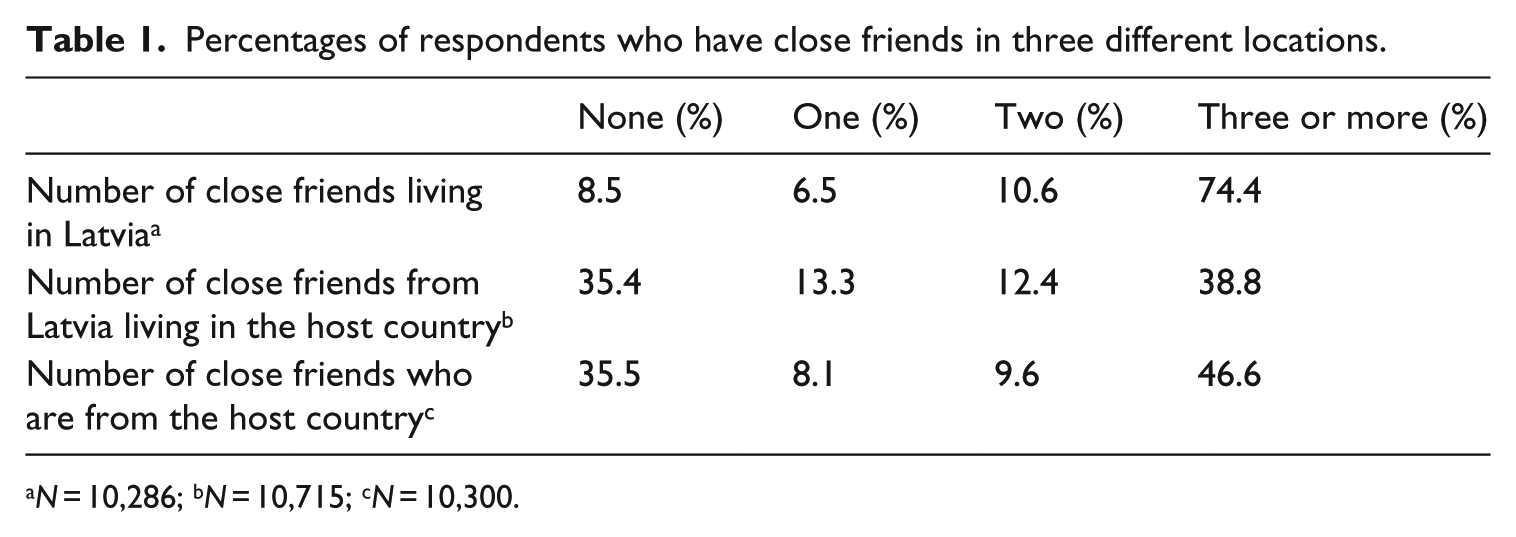
N = 10,286; bN = 10,715; cN = 10,300.
That is not a low indicator per se; yet, 35.5% of respondents said they have no close friends in the host country at all. Interestingly, the number of migrants who have more than three close local Latvian friends (38.8%) is even lower than the number of strong-tie friendships with local people. Together with the fact that 74.4% of the respondents have more than three close friends in Latvia, this means that for most of them, ties with people in Latvia are much stronger than with the native population – or even with members of the local Latvian community. At the same time, this can be interpreted as evidence that most Latvian migrants are not part of large, closely knit ethnic networks in the host country and actually have been a bit more successful in forging strong ties with the locals.
This suggests that friends and relatives in Latvia are the most prominent source of Latvian migrants’ bonding social capital – rather than those in the host country. At the same time, Latvian migrants are a little more successful at building strong ties with the native population of the host country than with local Latvians. This, in turn, indicates that those Latvian migrants who have established functional ties with the local people also can use SNSs to cement these ties. Unfortunately, the survey did not measure the number of Latvian migrants’ acquaintances; thus, it is not possible to find out which is the most important source of weak ties – local Latvians or non-Latvian locals.
Next, I looked at how the differences between the use of Facebook and Draugiem.lv are associated with the kinds of social networks their users maintain. To evaluate such links, I correlated data from the survey on the number of close friends a respondent has and the frequency of his or her SNS use. Since the survey employed ranked variables for these questions, I used Spearman’s rank correlation coefficient to calculate these relationships.
As shown in Table 2, regular use of Draugiem.lv is negatively associated with the number of close friends a migrant has in the host country. It means that regular users of the SNS employed mainly by the Latvian-speaking population do have narrower strong-tie networks with people outside their ethnic group. In addition, regular use of Draugiem.lv is positively associated with the number of close Latvian friends a migrant has in Latvia or their host country. Facebook use is associated with the number of close friendships in the host country as well as in Latvia. The result asserts that the user base of an SNS (international vs ethnic) illustrates the kinds of ties a migrant maintains and develops online.
Correlations of the number of close friends a respondent has and regularity of SNS use.
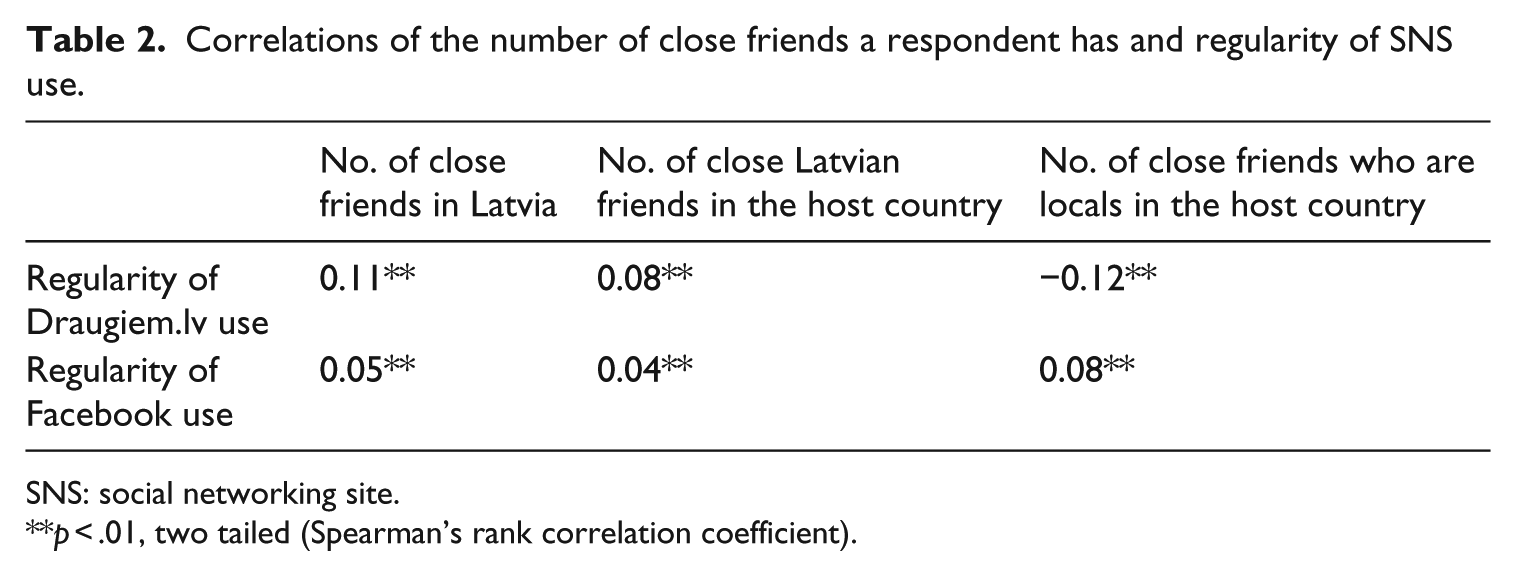
SNS: social networking site.
p < .01, two tailed (Spearman’s rank correlation coefficient).
These results alone do not fully explain the relationship between SNS use and the formation of migrants’ social networks though. The correlation coefficients presented in Table 2 are weak, suggesting that the choice of a particular SNS depends on other considerations. According to the survey results, it is common for Latvian migrants to use more than one SNS: 69% of regular Draugiem.lv users also regularly use Facebook, while less than half (48%) say they regularly use just one such site, and 18% say they do not use any.
Ultimately, the choice of a communication platform itself is unlikely to influence decisively a person’s social network – interpersonal connections are established by individuals, not communication platforms.
Discussion and conclusion
This research article has explored the use of SNSs by Latvian migrants in the development and maintenance of their ties. On SNSs, migrants initiate connections among their compatriots, but these sites generally are not used in the same way to establish ties with people outside a migrant’s ethnic group. At the same time, SNSs are used to maintain and cement connections with the local people established through other means. This is possible for users on Facebook but not those on Draugiem.lv, who tend to have fewer friends among the local population. However, while the choice of one SNS over another reflects the composition of a migrant’s social network, in itself it is unlikely that the use of a particular SNS can be a decisive factor that encourages ethnic isolation.
In accordance with the media multiplexity principle (Haythornthwaite, 2005), people who are connected through strong ties use various communication channels to maintain these ties. Thus, among people who maintain regular and intimate relationships, SNSs are unlikely to be the only means of communication they use – even though together with other communication channels they are indeed a medium widely employed to maintain such connections.
SNSs have a major role regarding the migrants’ weaker ties. This can be observed in maintenance of more peripheral connections of one’s network to follow content shared by other people with or without actual interaction. In addition, a source of weak ties is the participation in the groups for Latvian migrants that operate on both Facebook and Draugiem.lv. Although the most common use of migrant groups on SNSs is instrumental, which refers to access to practical information, the element of ethnic belonging is evident in the interviewees’ explanations that they have joined groups on SNSs to be informed about the local Latvian community or as an identity statement. While strengthening in-group ties signals the presence of bonding social capital, evidence exists that the actual contribution of such communication practices to the development and maintenance of the migrants’ ties is more nuanced.
Bridging social capital is commonly being linked to weak-tie relationships, while bonding social capital is associated with strong-tie relationships. Bridging implies heterogeneity of connections, and bonding, homogeneity (Putnam, 2000). However, homogeneity and heterogeneity as binary opposites is problematic when applied to such complex social formations as ethnic groups. So is the exact distinction between bridging and bonding social capital (Patulny and Haase Svendsen, 2007).
Ethnic groups at times have been interpreted as essentially homogeneous, without considering the enormous possible differences in status, education, income, and other characterizations that group members might exhibit. For example, Uslander and Conley (2003) declare that ethnic groups ‘by definition are not diverse’ (p. 355). Under certain conditions, ethnic affiliation can indeed form the basis of tightly knit and exclusivity-based communities (Portes, 1998). However, as stressed by Ryan (2011), the mere fact that a group is ethnicity-based does not imply homogeneity. The ties they develop among themselves and resources that flow through them may vary, as do outcomes of their interactions.
The problematic perception of ethnic (or diaspora) groups as homogeneous is also evident in previous accounts that explore the outcomes of the use of online communication platforms among such groups. In the literature review, I pointed to two seemingly opposing interpretations. On one hand, Brinkerhoff (2009) claims that participation in online communities can help minorities to integrate into the host society. On the other hand, Komito (2011) states that the near constant following of the compatriots’ activities among migrants result in the strengthened sense of belonging to a dispersed community and thus encourage seclusion. It should be noted that the background of ethnic minority groups studied by the mentioned researchers differs greatly.
However, the results of this article remind that online communication platforms, including those based on similar design principles, are not identical in their user-base, in the activities of their users, and subsequently, the outcomes of their use. Hence, the interpretation that online platforms help ethnic minorities to participate in the host society better (Brinkerhoff, 2009; Leurs, 2015; Parker and Song, 2006) is not necessarily at odds with the explanation that through the use of such platforms, migrants rely on their ethnic networks and are unsuccessful in establishing links with members of the host society (Komito, 2011; Komito and Bates, 2009). Depending on the actual composition of a particular online- and offline-based social network, both scenarios are possible. Latvian migrants do maintain strong ties with their friends and relatives in Latvia and show interest in the activities of the local Latvian communities, but the most important factor that influences the diversity of their ties is their offline-based social life in the host country. Migrants whose general social networks are dominated by other Latvians do use SNSs to strengthen their ties with the group, while those who have also developed functional ties with the local people employ SNSs to maintain this diversity.
People can bond along one dimension and bridge among others. One example Putnam (2000) uses to illustrate this principle is Internet chat groups, which ‘may bridge across geography, gender, age, and religion, while being tightly homogeneous in education and ideology’ (p. 21). Similarly, interviews with Latvian migrants reveal that participation in SNS groups allows them to bond with others of their ethnicity, but at the same time bridge across professional, educational, or social differences. The emotional value of participation in such a group and participants’ trust in each other strengthens their ties and facilitates interaction with their ethnic group, while the instrumental value of their participation through access to information and other practical resources means participants are also establishing bridges to those outside their immediate network of ties. Thus, another variable should be added to Komito’s (2011) observation that the use of SNSs maintains migrants’ sense of participation in their community and is the source of bonding social capital: namely, the weak-tie associations in SNS groups, which add a certain level of heterogeneity to their ties.
This combination of bridging and bonding is manifested in what I call ‘dispersed ties’ – ad hoc and temporal connections with particular members of the group, while association with the group remains much more stable. Participation in the group mostly benefits members in locating people who can help with practical tasks – for example, providing a service or giving advice. When the particular need has been satisfied, the tie with the helpful person can be dissolved; if it is maintained, this usually happens through direct, person-to-person interaction, rather than through participation in the group. At the same time, many participants not needing practical favors from others are still interested in continued group membership as a way of maintaining some connection with the local Latvian community as well as being involved with the local population.
According to Wellman (2002), in contemporary societies people switch between networks, roles, and identities, rather than relationships. Rather than perceiving migrants’ use of SNS as promoting either ethnically homogeneous or heterogeneous ties, we should view it in the context of the diversity of social networks in which migrants operate. Participation in Latvian groups on SNSs does not preclude a person from developing functional ties with people of other ethnicities or nationalities. Although the Latvian migrants’ online groups possess some level of ethnic homogeneity, they are not the only social groups someone can participate in. Ethnicity-based social capital is not the only resource influencing migrants’ ability to participate in the host society. Education, cultural capital, and language skills are other important resources that influence migrants to access new networks (Ryan, 2011). Hence, migrants capable of establishing offline ties through professional or social activities are also using SNSs in ways that allow them to maintain or strengthen their networks.
Footnotes
Funding
This work was supported by the European Social Fund within the project ‘The Emigrant Communities of Latvia: National Identity, Transnational Relations, and Diaspora Politics’, which was carried out by the Institute of Philosophy and Sociology, University of Latvia. Grant number 2013/0055/1DP/1.1.1.2.0/13/APIA/VIAA/040. I am grateful to Dr Ilona Kunda and Barbara S. Plakans for their invaluable help with the draft.
