




Abstract
Against the backdrop of the new populism, this article takes a closer look at the role of anger in media coverage of Trump’s inauguration. The article suggests that Trump’s rise heralds a shift in prevailing ‘emotional regime’ towards what I will refer to as ‘angry populism’. Angry populism – embodied by Trump – is based on a rhetoric which seeks broad appeal through the deliberate expression of anger. Adopted as an interpretive framework in media coverage, it suggests that the anger of Trump, his supporters and his opponents is both salient and relevant to political life.
A wave of populism has swept across the world in recent years. This new populism cuts across the political spectrum, representing both the left and the right, from the victories of Podemos in Spain and Syriza in Greece on the left, to the rise of Donald Trump in the United States, Brexit in the United Kingdom and Marine Le Pen in France on the right. What these movements share, despite their diversity, is the mobilisation of disenchanted electorates, fed up with the political establishment.
Against the backdrop of the new populism, this article takes a closer look at the role of anger in media coverage of Trump’s inauguration. The article suggests that Trump’s rise heralds a shift in prevailing ‘emotional regime’ (Reddy, 2001) towards what I will refer to as ‘angry populism’. Angry populism – embodied by Trump – is based on a rhetoric which seeks broad appeal through the deliberate expression of anger. Adopted as an interpretive framework in media coverage, it suggests that the anger of Trump, his supporters and his opponents is both salient and relevant to political life.
Theorising populism and political anger
The changes in the emotional regime charted here should be understood in the context of contemporary forms of populism. As a political project, populism tends to be premised on the mobilisation of the people around an opposition to shared enemies (Laclau, 2005, see also Gerbaudo, this issue). Contemporary populisms are based on discursively generating collective identities based on oppositions between ‘the pure people’ and ‘the corrupt elite’ and usually involve affective allegiances to a charismatic leader (Mudde, 2007: 23; Mudde and Kaltwasser, 2012: 7). Because of the structuring role of such oppositions, populist identities are often exclusionary (Laclau, 2005: 195).
For the purposes of this piece, I focus on the right-wing forms of populism that Trump exemplifies, which frequently draw on such exclusionary solidarities to target resentment at the most vulnerable members of society, including immigrants and ethnic minorities (see Ost, 2006). As such, Trump’s appeal is organised around a particular negative affective constellation representing coalescence of long-standing practices and trends. Yet it also appears to be distinctive – and distinctively angry, premised on the discursive construction of shared grievances. First, Trump’s electoral victory has been widely connected to broader patterns of economic anger. The prominent economist Ann Pettifor (2017) is one of many observers to link the election result to the economic consequences of globalisation. She has argued that it should be understood as part of a global pattern of response: In a ‘counter-movement’ to globalisation and recognising the failure of democratic governments to protect societies from the depredations of self-regulating markets, [these societies] have reacted by electing ‘strong men’ (and women) that do offer protection. Donald Trump posed as a strong protector, and won the support of those Americans ‘left behind’ by globalisation. (Pettifor, 2017: 53)
Second, Inglehart and Norris (2016), in their analysis of cross-national survey data, argue that support for Trump is the result of a ‘cultural backlash’: It is a reaction ‘by once-predominant sectors of the population to progressive value change’ – particularly salient among older, White male, religious, and less educated parts of the population (Inglehart and Norris, 2016: 3). This ‘cultural backlash’ thesis also sees votes for Trump as arising out of anger, if for slightly different reasons. What these theories share is the idea that the decision to vote for Trump is underpinned by forms of reactionary anger, borne out of long-standing exclusion from privilege, whether economic or cultural.
This suggests that theorising anger is vital to understanding Trump’s distinctive brand of populism. In focusing on anger, this article is part of a larger project of taking seriously the role of emotion in mediated politics. This goes against the grain of much scholarship in political communication and media studies (Wahl-Jorgensen, 2013). The liberal democratic approach which prevails in Western democracies has tended to view emotion as anathema to good citizenship (Pantti, 2010). The ideal citizen, according to this view, should be rational, impartial and dispassionate (Wahl-Jorgensen, 2013). As a result, scholarship on mediated politics has tended to neglect the role of emotion in shaping political life.
Anger has been a particular target of this dismissal. Philosophers since the Stoics have viewed the ‘civilized life as one that avoids anger’ (Holmes, 2004: 127). For Lyman (2004), the ‘claim that “reason should be in control of the emotions” should be treated as an ideology designed to silence angry speech’ (p. 134). Anger has been seen as a dangerous emotion that, because of its intensity and the challenge of controlling it, jeopardises the social order and leads to violence (Lyman, 2004: 133). This view of anger has made it difficult to open up a nuanced debate about its role in political life – one which takes seriously its mobilising power and its consequences for public debate. Here, I want to make the case that understanding the circulation of anger in public discourse around the rise of Trump is, in fact, vital to understanding the phenomenon.
Anger is interesting in part because it is a potentially political emotion (Lyman, 1981: 61, 2004). It has been recognised in social theory as a reaction to injustice and is therefore inherently relational (Holmes, 2004). Aristotle (1968), in his Rhetoric, defined anger as ‘an impulse, accompanied by pain, to a conspicuous revenge for a conspicuous slight directed without justification towards what concerns oneself or towards what concerns one’s friends’ (pp. 1382–1383). Similarly, for the pragmatist philosopher John Dewey, we ‘only think we are angry because an outside observer describes our conduct in that way, in an attempt to assign responsibility for an action’ (Dewey, 1983; cited in Ross, 2013: 19). Although anger is in the first instance an individual emotion, it comes to matter politically when it is articulated by collectives, usually towards a shared objective of addressing an injustice.
The role of anger in social movements has become a matter of interest in recent years, as scholars studying oppositional and marginalised groups have begun to recognise anger as an important resource of collective mobilisation and empowerment. Deborah Gould (2010, 2012) has studied the role of anger in queer and feminist movements. For her, the very act of labelling emotions forms the basis for political empowerment – as when lesbians ‘feeling bad’ collectively relabelled their emotion as anger (Gould, 2012). By naming and articulating the negative affect of ‘feeling bad’ about the consequences of patriarchy as ‘anger’, it becomes a shared and public emotion which empowers the angry group to take action. This work recognises that anger can be a particularly useful resource for oppositional political life (see also Holmes, 2004) and that it is readily recognised as an expression of collective injustice. At the same time – and precisely because of the association of the expression of anger with the collective activities of disempowered groups, often organised against dominant power formations – anger has also always been understood as a dangerous emotion that requires management and control (Nussbaum, 2016).
However, political anger is not reserved for the actions of marginalised groups or social movements. Instead, grievances and disaffection should rightly be understood as permanent features of political life (Oberschall, 1973: 298). Anger, therefore, must not only be seen as a destructive emotion in political life. Instead, it also serves a productive role, insofar as it generates bonds of emotional solidarity and forms the basis for collective action. As Ost (2006) puts it in the opening of his book, The Defeat of Solidarity: Anger and Politics in Postcommunist Europe, Anger, solidarity and democracy have traditionally gone together. Democracy has usually been advanced when people angry about their exclusion from wealth and power join together in solidarity. This does not mean just mass demonstrations or disruptive action. From New Deal America to Keynesian Western Europe, liberal and socialist parties resuscitated democracy in the West by organising the anger of those long deprived of social protection. (p. 1)
Anger has always been central to the strategic appeals of mainstream political parties and should be recognised as a key ideological resource: Politics does not become angry only when non-elites shout. Anger is built into politics through the everyday activities of political parties, which continually both stoke and mobilize anger in order to gain and maintain support. (Ost, 2004: 229)
There are two key reasons why anger is so important to the appeals of mainstream politics, according to Ost (2004). First, there is widespread anger because of economic inequalities, and capturing ‘economic anger’ is central to popular appeal, particularly successfully harnessed by illiberal populist political actors (Ost, 2006: 9). Second, political parties need to cultivate solidarity to maintain their base: ‘This requires creating an emotional connection with supporters, the establishment of an “us” against the “them” of other parties, an emotional bond that can best be maintained when the other is cast negatively as an object of aversion’ (Ost, 2004: 229). For political parties and the politicians who represent them, anger must be organised, channelled and harnessed in particular ways, and the organisation of anger is vital to the construction of political narrative.
The context for angry populism
However, the current mobilisation of anger merits analysis as a distinctive formation. This theme has been picked up by journalistic and scholarly observers to explain both the anger of Trump voters and of Trump himself. It was a prominent refrain in journalists’ attempts at making sense of Trump’s appeal to voters disenchanted with the political process. Cilizza (2017) explained Trump’s rise in the Washington Post with reference to polling data. He argued that it should be understood as the result of a confluence of circumstances, including the hollowing out of the economy, the loss of faith in institutions, unrest within the Republican Party and anger with the federal government. Similarly, an Atlantic article linked Trump’s ascent to divisions in the Republican Party, powerfully embodied in the Tea Party movement: Was it any wonder, then, that a candidate came along whose anger was even more consuming and less constructive, whose disregard for political norms was even more flamboyant, whose appeals to racial resentment were even more overt, whose disregard for fact and fondness for conspiracy was even more pronounced? (Ball, 2016)
These observations reflect the broader resonance of anger as a political resource for the projects of populist politicians. Writing in the New Yorker about Trump’s first 100 days in office, David Remnick (2017) described Trump’s ascent as part of a broader global trend of a rebellion against liberal democracy, linking it to anger: The Trump presidency represents a rebellion against liberalism itself – an angry assault on the advances of groups of people who have experienced profound, if fitful, empowerment over the past half century. There is nothing about Trump’s public pronouncements that indicates that he has welcomed these moral advances; his language, his tone, his personal behavior, and his policies all suggest, and foster, a politics of resentment. It is the Other – the ethnic minority, the immigrant – who has closed your factory, taken your job, threatened your safety. (p. 20)
Such observations highlight not only the prominence of an emotional politics of anger in contemporary politics but also Trump’s ability to tap into that anger (see Hochschild, 2016).
Angry populism and a changing emotional regime
Even if much of the analysis of the rise of Trump has been based on observations about distinctive cultural, historical and economic circumstances in the United States, there is reason to think that these trends may reflect broader developments. The post-colonial writer Pankaj Mishra (2017) has suggested that we may be seeing the rise of a global ‘age of anger’, fuelled by disenchantment with the ability of political institutions to effect social change. The argument around the emergence of an ‘age of anger’ suggests a change in the ways we perform our emotions in public, centrally tied to political practices inside and outside – as well as against – institutions of governance. For the historian William Reddy (2001), we need to see practices of governance as driven in part by the way we speak about emotions in public. The expression of emotion or ‘emotives’ constitute ‘a type of speech act … which both describes … and changes … the world, because emotional expression has an exploratory and a self-altering effect on the activated thought material of emotion’ (Reddy, 2001: 128). He introduces the term ‘emotional regime’ to refer to the ‘set of normative emotions and the official rituals, practices, and “emotives” that express and inculcate them; a necessary underpinning of any stable political regime’ (Reddy, 2001: 129).
If emotional regimes coalesce through the public expression of emotives, the media play a key role in facilitating their emergence and their change (see also Pantti and Wahl-Jorgensen, 2011). By studying changes in the use of emotional language in media coverage of a comparable event over time (and presidential administrations), we can, therefore, trace changes in the emotional regime. In this case, I am studying shifting emotional regimes by looking at expressions of anger in post-election and inauguration coverage of Obama’s first election and inauguration in 2009, as well as Trump’s election and inauguration in 2017. In taking this approach, I am following the lead of journalism historians who have looked at changes in coverage of, for example, the President’s State of the Union address (Schudson, 1982) and Thanksgiving (Brennen, 2008) to understand transformations in journalistic practice. The purpose of my analysis, however, is not to offer a detailed historical exploration of emotional regimes but rather to provide a snapshot of a particular critical moment of change, represented by the election of Trump. Such an analysis cannot establish whether Trump’s rise represents a unique emotional regime. But it can point to shifts in the relative prominence of particular emotions and highlight what this tells us about horizons for public discourse and political change. In this context, it is worthwhile noting that the populist anger of Donald Trump cannot be simply understood as constructed through the discourses of mainstream media but rather as emerging within a hybrid media system (Chadwick, 2013). Trump, like other populist politicians, has been highly successful at mobilising support through his use of Twitter (Engesser et al., 2017), and his tweets have, in turn, attracted extensive media coverage. The increasing prominence of social media shapes not just the content of mainstream media but also their affective style. According to a number of observers, the affordances of Twitter facilitate a discursive climate which is more extreme, divisive and polarised (Shepherd et al., 2015). Trump appears to be a beneficiary of this affective shift by crafting his charged messages on Twitter in a way that spills over into mainstream media (Karpf, 2017).
Here, I will suggest that the ascent of Trump is an indication of a shift towards an emotional regime of ‘angry populism’ – a rhetoric which seeks broad appeal through the deliberate expression of anger and which feeds a journalistic narrative that understands anger as central to political life. My findings indicate that this anger is sometimes directed at specific targets, including the political establishment and other cultural and economic elites, women, migrants, ethnic minorities and anyone perceived as a threat to American interests (see also Newmyer, 2017). At other times, however, the anger does not have a target, but instead seems to be more diffuse and ill-defined – a form of anger which is politically consequential in its own right.
Studying the rise of angry populism
To illustrate this emerging emotional regime, I have studied the occurrence of the phrases ‘anger’ and ‘angry’ in the period between Trump’s election in November 2016 and the day following his inauguration in January 2017, contrasting it with the period between Obama’s first election victory in November 2008 and his first inauguration in January 2009. I have then taken a closer look, through a qualitative textual analysis, at the more manageable sample of the day following the inauguration for each of the two presidents.
I have chosen to examine this particular period to avoid tapping into anger surrounding conflicts associated with the campaign, instead of focusing on the language of anger surrounding the election and inauguration. This period is critical in both establishing and contesting the reputation, vision and public image of a new president (Mansch, 2005). Inaugurations seek to cement the dominant narrative around the president. They are mediated public rituals building consensus around the spectacle of affirming the new president and the shared values he or she represents (Bajc, 2007; Bormann, 1982; Kertzer, 1989). They represent moments when the nation is often represented as coming together, and divisions set aside. This makes the study of anger in inauguration coverage all the more interesting: If anger is viewed as an uncontrollable and dangerous emotion, it is anathema to the ideological consensus of the inauguration ritual where we might expect it to be largely suppressed or invisible (Beasley, 2001). At the same time, the inauguration coverage also frames the presidency by providing an interpretive context for understanding key debates surrounding the new president and therefore provides a sense of the ‘emotional regime’ (Reddy, 2001) he or she embodies.
Using Nexis UK, I selected US newspapers and newswires and searched for major mentions of Trump (6 November 2016 to 21 January 2017) and Obama (4 November 2008 to 21 January 2009) and mentions of ‘anger’ or ‘angry’ anywhere in the text. This basic quantitative examination does not tell us anything about the substance of the coverage of anger, but merely detects the presence of this particular emotion word, or its correlate, angry. This, however, provides a useful indication of the relative salience of anger in mediated debates over the two candidates. I should note that the analysis deliberately steers clear of examining similar or related emotion words such as ‘indignation’, ‘fury’ or ‘frustration’. The reason for this decision is to maintain a clear focus on what are explicitly identified as public articulations of anger as a central political emotion.
A clear pattern emerges from this analysis: Following his election and up until the day after Trump’s inauguration, there were 3828 stories using the terms ‘anger’ or ‘angry’, which contrasted with 1449 for Obama. This gives an indication that anger was much more salient in post-election coverage of Trump than following Obama’s first presidential victory. If we, then, look at the shorter time period of the inauguration and the day after in each of the two cases, we get a smaller and more manageable sample of the role of anger at this critical moment of establishing the interpretive framework through which the presidency is understood. To locate such a sample, I repeated the search detailed above, adding ‘inauguration’ as a search term anywhere in the text, looking only at the period of 20–21 January 2009 for Obama and 20–21 January 2017 for Trump. For Obama, the search yielded a total of 47 relevant stories, whereas for Trump, there were almost twice as many – 90. 1
To better understand how this smaller sample constructed anger, I looked, first, at the target of anger across all the stories: That is to say, at what or whom is the anger directed? This provides us with a sense of how the anger is explained – and, in some cases, legitimated. If anger is a way of addressing a shared sense of injustice, the nature of injustice matters hugely to the framing and interpretation of the anger. Table 1 shows the targets of the anger in the respective inauguration stories. I have included all instances accounting for more than 7% of references to the targets of anger.
Targets of anger in coverage of Obama’s first inauguration (2009) and Trump’s inauguration (2017).

When anger was referenced in coverage of Obama’s inauguration, this was almost never directed at Obama. Instead, the most frequent mention of anger was as a response to the historical experience of racism among African Americans, who were celebrating the Obama victory as an opportunity for overcoming racist discrimination. Coverage of anger in the context of Obama’s inauguration tells the story of a journey from anger to happiness and hope, represented by the historic rise of the first African American US president.
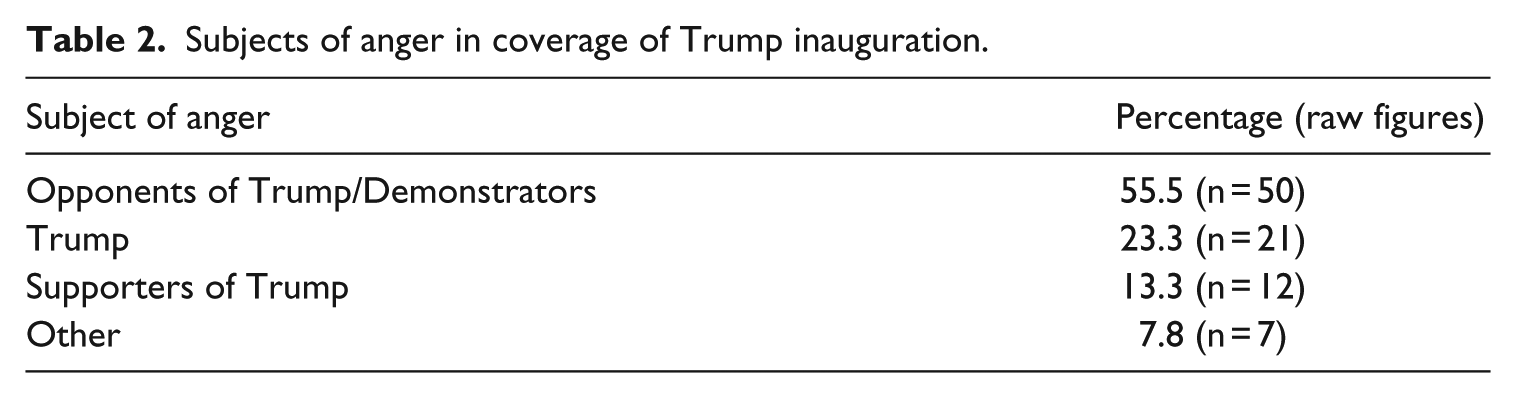
By contrast, the anger expressed in coverage of Trump’s inauguration overwhelmingly targeted Trump himself. This was true for more than half of all references to anger in the sample and was based on extensive coverage of protesters gathering for the inauguration itself, as well as the Women’s March on the day following the inauguration. Trump’s opponents represented the majority (55.5%) of the subjects of anger – those represented as angry in stories. If we look more closely at these subjects of anger in the case of the Trump inauguration, what is particularly interesting is the relatively small number of different types of actors accounting for the vast majority: Trump, his opponents and his supporters account for more than 90% of angry actors (Table 2).
Subjects of anger in coverage of Trump inauguration.
This is in sharp contrast to the Obama inauguration coverage, where the subjects of anger are identified as representing a wide variety of actor types – to mention just a few, they include Kenyan citizens, Gaza activists, African American community leaders, domestic politicians and Bush supporters. This also reflects the wide variety of targets of anger in the case of the Obama inauguration. It suggests that discord and conflict have an inevitable place in narratives of political events and that Obama’s inauguration provided the opportunity for reflection on a wide variety of long-standing political grievances.
In many of the stories on the Trump inauguration, the anger of the protesters was described as energising a new social movement and was frequently legitimised with reference to the substance of their grievances. A widely syndicated Associated Press article observed that ‘Trump’s call for restrictive immigration measures, religious screening of immigrants and his caustic campaign rhetoric about women and minorities angered millions’.
Trump’s supporters, however, were also described as angry, accounting for 13.3% of the subjects of anger. The anger of Trump supporters – usually directed at the Washington establishment and a decline in economic opportunities – was used to explain their voting decisions, as in this Associated Press news story: Trump’s victory underscored that for many Americans, the recovery from the Great Recession has come slowly or not at all. His campaign tapped into seething anger in working class communities, particularly in the Midwest, that have watched factories shuttered and the certainty of a middle class life wiped away.
Expressions of anger at the Washington establishment was another common target, accounting for 7.8% of references – consistent with understandings of populism as oriented around an opposition between ‘the pure people’ and ‘the corrupt elite’ (Mudde, 2007). It was most prominent in coverage of Trump’s inaugural speech, as in this report from the Los Angeles Times: His 16-minute speech – the shortest since President Carter’s inaugural in 1977 – lacked specific policy. In its place was a sense of anger at what he defined as a ruling political class that had raided America for its own benefit.
However, what is perhaps most striking about the construction of anger in stories about Trump’s inauguration is that a very high number of references to anger – 20% – did not identify a target. As the literature on anger suggests, it is highly unusual for anger, as expressed in political coverage, not to have a target. Rather, anger normally requires a target for it to matter politically (Pantti and Wahl-Jorgensen, 2011). By contrast, in stories about Trump’s inauguration, anger appeared to become newsworthy in its own right. And in the vast majority of cases, this unspecified anger was that of Trump himself: The 16-minute inaugural address that President Trump delivered was Trumpism distilled to its raw essence: angry, blunt-spoken and deeply aggrieved. (Los Angeles Times, editorial) Donald John Trump intends to govern as the same fiercely angry man who inspired the discontented but aroused the worries and fears of so many other Americans. (E. J. Dionne, syndicated column)
Describing anger as having a particular target both explains the anger and contributes to legitimising it. By contrast, the unspecified anger of Trump and his supporters suggests that they are angry for no particular reason or cause. Instead, the image that emerges from the media coverage is that anger is essential to their identity and their world view. This essentialising of anger is central to understanding the place of angry populism as the emotional regime of the Trump Era: It suggests that the particular brand of exclusionary populism cultivated by Trump depends on the performance of anger as a way of dramatising grievances. Analysts suggested that Trump appealed to voters in large part because he saw the utility of a new and angrier form of political discourse. As CNN noted in an inauguration update, Donald J Trump identified, long before anyone else did, the anger and desire for change that millions of Americans craved. He addressed that in frank, blunt terms that deeply resonated with millions who were fed up with Washington’s political class and felt left behind in the globalizing economy.
Through his astute reading of the Zeitgeist, Trump became an emotional performer, acting as the advocate of the people and the impersonator of their anger. His anger mattered because it became a political force in its own right. As Michael Wolff wrote in a Hollywood Reporter column, Even if it is a teleprompter speech – an unfortunate concession to liberal manners – the determination or, if you will, truculence, or golf face, angry and pissed off, is written in, or cemented, as he practices it. […] Trump, shoulders hunched, arms swinging, brow furled, lips pursed, is the medium of his message.
The widespread emphasis on Trump’s performative anger – and his appeal to an aggrieved public through this anger – alongside the interest in the anger of protesters and opponents – has had significant consequences in shaping public debate over the presidency. It suggests the salience of angry populism, implying that anger is a viable interpretive framework for understanding political discourse and its performance, along with the motivations of political actors. More than that, Trump’s populism works because of the anger it expresses: Anger is foundational to his appeal and his political project. But it also appears to be what we might call an umbrella emotion – one which covers a wide variety of grievances and disaffections.
What is also important to note is that not all anger is created equal: The media coverage appears to construct the anger of Trump’s supporters and opponents alike as caused by legitimate grievances. It is an emotion which might give rise to new forms of solidarity – embodied, for example, by the positivity of protesters. By contrast, the anger of Trump himself is largely viewed as opportunistic, illiberal and dangerous. As the Massachusetts Telegram and Gazette reported, Carol Sarafconn, a member of Agudat Achim, said the past year frightened her as she believed anger and hate took center stage and bigotry and intolerance became the norm. ‘It frightens me that the intuitions I treasure are criticized and scrapped’, Ms. Sarafconn said. ‘… When social contracts are weakened, anti-Semitism isn’t that far behind. When hate and anger become acceptable, anti-Semitism does, too’.
What this implies is that Trump’s populist anger is not dangerous, as political theorists might have it, but rather that it is incontrollable or violent because it fosters other negative feelings (bigotry, intolerance, hate) which are incommensurate with democracy (see also Cilizza, 2017; Ott, 2017). This, indeed, might be another reason why Trump’s anger is newsworthy in and of itself: It is seen to be one which closes down constructive debate and invites in fascism through the back door.
Conclusion
In this article, I have made the case for the importance of considering emotion as a factor in mediated politics. I have proposed that we need to have a careful look at the role of anger as a mobilising emotion in explaining the rise of Trump. I have demonstrated a shift in the ‘emotional regime’, represented by media discourses following Trump’s inauguration, comparing them to coverage of Obama’s first swearing in. In particular, I have argued that media coverage suggests a shift towards an emotional regime of angry populism. This emotional regime renders anger a viable framework for interpreting political life and suggests that its performance is essential to the brand of populism represented by Trump. Given the prominence of anger in contemporary politics, then, I have sought to sketch out some of the complexities of expressions of anger: I have suggested that it is not just a tool of political opportunists like Trump. The anger of Trump supporters as well as protesters against him is given voice and represented as legitimate and pertinent.
Even if anger has long been denounced as a negative and dangerous emotion, it is also important to consider the ways in which protesters against Trump are seen to view it as positive and mobilising. But this alone does not offer a way out of angry populism. It may be helpful to look at examples of contexts where related emotional regimes – like those of Geert Wilders in the Netherlands and Marine Le Pen in France – have been defeated by appeals to more inclusive solidarities. Such examples remind us that collective and political emotions are dynamic and ever-changing, perhaps none more so than anger.
Footnotes
Funding
The author(s) received no financial support for the research, authorship and/or publication of this article.