




Abstract
This study explores how the act of witnessing takes distinctive discursive shape in social media in the context of large-scale disasters or crisis events. Drawing upon a set of microblogs posted on China’s most widely used social media platform, Weibo, immediately after one of China’s most serious industrial accidents, this study shows how witnessing manifests itself through individual eyewitness accounts foregrounding personal experience but constrained within Weibo’s standard protocol of 140 Chinese characters. Often blending word and image, these accounts are examined using methodologies drawn from discourse analysis. On this basis, we argue that witnessing in social media in China not only demonstrates strong participatory, connective, and self-reflexive characteristics. It also opens up new possibilities for various patterns of meaning, which, when appropriated by other social media users, constitute a public testimony that can challenge official discourses of crisis in China.
Introduction
Witnessing is a complex practice that raises in Peters’ terms questions of ‘truth and experience, presence and absence, death and pain, seeing and saying, and the trustworthiness of perception’ (Peters, 2001: 707). The traditional understanding of ‘witnessing’ by Peters has been on providing retrospective accounts of events in a way that emphasized how the practice of witnessing was not performed until the closure of an event when witnesses were called upon by a (media) institution to shed light on matters of relevance to the public. This was a special kind of communicative entitlement (Myers, 2000) and not everyone was entitled to this role. However, with the rise of Internet technologies and various social media platforms, the nature of the communicative entitlement to witnessing has changed radically. Today, it occurs on a much wider scale as anyone with a mobile device giving access to the Internet can take up the role of witness, testimony-producer, and (citizen-)journalist on their own initiative should a (crisis) event of sufficient scale takes place near them (Andén-Papadopoulos, 2014; Mortensen, 2015). Nonetheless, despite a growing interest in the role played by social media in documenting crisis events (e.g. Doan et al., 2011; Murthy, 2011; Wu, 2012), and particularly in microblogging services like Twitter and Weibo, there has as yet been fairly little academic discussion of bearing witness in social media in crisis contexts specifically as a distinctive discourse practice: existing research is restricted mostly to the study of eyewitness images in the news coverage (e.g. Allan, 2014; Andén-Papadopoulos, 2013; Caple, 2013; Mortensen, 2014) and takes little account of word as well as image or possible multimodal interactions between the two.
A key challenge in the study of the use of social media in crisis contexts is to make sense of the ways in which individuals mobilize social media to establish a collective response or what might be called a ‘community of engagement’ with the event. This requires us to look closely at the discursive practices deployed by social media users in such contexts.
In what follows, we draw upon some key notions and analytical tools from discourse analysis to examine witnessing in social media. The data under scrutiny are a sample of microblogs retrieved from Weibo, a popular Chinese microblogging service launched in 2009, in the immediate aftermath of a series of cataclysmic blasts that rocked the port of Tianjin in Northern China, 150 km from Beijing. The Tianjin explosions constituted one of the most serious industrial accidents since the founding of the People’s Republic of China. Much of the Weibo data consist of immediate reactions to the explosions by users directly affected by them, and these reactions typically take the form of elliptical proto-narratives. The analysis focuses on these proto-narratives of personal experience, but seeks to show that they go beyond simple reactions to the event but act as a form of witnessing in which the witness-survivors’ narratives ultimately prove crucial in breaking the news of the crisis event. As such, the Weibo users provided a baseline for challenging the official discourse of the accident offered by local authorities and the official media. Weibo witnessing in this context, effectively, lays the foundations of a counter-official discourse.
Literature review
Social media and witnessing
Witnessing in its classic forms may typically take place at one remove from the event (Mortensen, 2015; Peters, 2001) but, with the rise of mobile technologies and social media platforms, witnessing has the potential to become a participatory and semi-instantaneous self-reflexive practice that takes place on a massive scale in various forms across a wide range of media platforms even while events are still in process. Social media and mobile technologies have provided their users with a powerful means for bearing witness in a crisis event, in which ‘ordinary’ individuals can assume the role of witness and testimony-producer through a repertoire of discursive practices which include documenting, telling stories about, and commenting on the event, as well as sharing personal experiences online. The active participation in documenting and sharing crisis events in an increasingly networked, interactive, and participatory media ecology subtly alters the nature of ‘witnessing’ and gives rise to terms like ‘citizen witnessing’ (Allan, 2013), ‘citizen camera-witnessing’ (Andén-Papadopoulos, 2014), ‘mobile witnessing’ (Reading, 2009), and ‘connective witnessing’ (Mortensen, 2015). These terms more or less capture the ethos of ‘ordinary’ individuals’ capacity to bear witness in situ by raising their mobile-cameras to record at the scene of a newsworthy event and sharing with a wider audience online.
Although these terms all suggest a meaningful engagement with an event and a self-conscious commitment to perform an active role of witness, they do not seem adequate to theorize the practice of witnessing in crisis events in the Chinese context, where a different kind of relationship between the public and the state is at play. While ‘mobile witnessing’ and ‘connective witnessing’ may highlight the affordances and support of mobile and Internet technologies, ‘citizen witnessing’ and ‘citizen camera-witnessing’ carry a political connotation of ‘citizen’, which does not apply straightforwardly in the Chinese context. While it has been argued that ‘citizen’ (as in citizen witnessing, or citizen journalism) in Western contexts is a flexible notion that resonates with a sense of social obligation but need not correlate exactly with a formal sense of citizenship or public service in democratic cultures (Allan, 2013; Allan and Peters, 2015), it nonetheless carries connotations of acting as a supplement to, or in parallel, with existing institutional arrangements for witnessing. As such, it is based upon a distinctively Western understanding of civic engagement and public participation in the sphere of politics and public affairs typically associated with democratic cultures based on individual rights. In the Chinese context, however, the notion of ‘citizen’ confers as much generalized obligations as rights. Indeed, in China, where information flow and opinion expression are under strict surveillance and control, witnessing is not so much the act of a citizen, free under the law, but may offer testimonies and visual records which can be used to disrupt the surveillance of the state, monitor the conduct of the authorities, and mobilize strategic actions (Andén-Papadopoulos, 2014; Rentschler, 2004; Montgomery, Shen and Chen, 2015). At the very least, ‘netizens’ may offer details or perspectives on matters that were unknown or uncertain to the public during crisis situations. The real-time nature and networked character of social media, therefore, enable Weibo users to bypass established editorial filters and censorship by transforming personal experience of injuries and suffering into public testimony that may work to counter official scripts carefully prepared and provided to the mainstream media. This networked practice of distributing personal accounts of an event facilitates the creation of online communities for sharing experiences, sociopolitical stances, and collective goals; this, in turn, establishes a foundation for further actions capable of effecting sociopolitical change. In this sense, therefore, to apply the notion of citizenship in relation to witnessing may, in the Chinese context, obscure some of the oppositional character of the digital public sphere as it has emerged in China over the last two decades. At the same time, we hope to show that witnessing itself is an important dimension of the firsthand narratives that came to the fore in the immediate aftermath of the 2015 Tianjin blasts, even to the extent of establishing an experiential baseline as a counter discourse to official accounts.
Narratives of personal experience as a mode of witnessing
The discursive power of personal narratives derives, as Andén-Papadopoulos (2014: 14) remarks, from their ‘unassailable status as testimony not to “fact”, but to an intensely subjective experience’. Narratives of personal experience potentially bring their audience closer to the lived realities of crisis events through their detailed description of subjective reactions. Inasmuch as they offer a truth based on personal experience rather than objective fact, their claim to validity is basically incontrovertible. But, they provide more than proof of the simple actuality of being present at the scene of the event. Appearing on social media in the immediate aftermath of the event, these subjective reactions in the form of proto-narratives build their personal stories into a publicly mediated testimony that circulates and is reproduced online (Reading, 2009).
A significant component of witnessing in the 2015 Tianjin blasts took precisely the form of witness-survivors’ narratives operating in both visual and verbal modalities on social media, particularly on Weibo, which provided firsthand materials that helped the world make sense of the event while it was still unfolding and ‘facts’ were not available. Those multimodal stories created by social media users and shared to a larger scale of audience become the ‘materials’ through which mass audiences bear witness and participate in collective mourning and helping to hold the responsible accountable.
A discourse analytic approach and Labov’s model of narratives of personal experience
As Peters (2001) notes, direct and private sensory experience easily vanishes and remains inaccessible to others unless it is put into words capable of shaping a shared experience. This, then, is precisely the focus of our study: how individual experience is articulated in word and image, and in turn builds into a public discourse of a crisis event. To examine such transformation, we adopt methods drawn from sociolinguistics and multimodal critical discourse analysis, with particular relevance to the study of narrative. Multimodal critical discourse analysis looks at the ways social and contextual meanings are created and power relations are fostered and negotiated in discourse through close analysis of different kinds of semiotic resources (Machin, 2013). A multimodal critical discourse analysis of witnessing inevitably touches upon many of the fundamental issues that arise in crisis contexts, especially, for instance, on how the raw and private ‘materials’ such as the memoirs of the survivors, the fear of death, and the pains of the victims are communicated through words, pictures, and videos. But, it also sheds light on how witness accounts fulfil the functions of breaking news, representing and constructing realities, as well as building solidarity between the witnesses, victims, and a wider audience.
Most discourse-analytic approaches to narrative are inspired by the seminal work of the sociolinguist William Labov (and his colleague, Joshua Waletsky). The initial impetus for their model came from Labov’s field work on urban vernacular speech when he searched for ways of eliciting natural, spontaneous, unselfconscious speech data and hit upon the device of asking if subjects had ever been in a fight or feared for their lives. This led to the creation of a large database of over 600 natural narratives, dubbed by Labov and Waletsky as ‘narratives of personal experience’, from which they were able to isolate a basic recurring pattern or structure (Labov, 1972; Labov and Waletsky, 1967). The model comprises six core elements: the abstract, the orientation, the complication, the evaluation, the resolution, and the coda (Labov, 1972, 2013; Labov and Waletsky, 1967). The abstract is a brief description of the central action and main point of the narrative. It informs the recipient or audience what the story is about though it does not give information about the sequence of events that led to the most reportable event. The orientation sets the scene of the story by introducing and identifying the time, place, participants, and backdrop of the event. The complication or the disrupting event is the most reportable part of the narrative that answers the question of ‘what happened?’. The evaluation addresses the question of ‘why does this event matter?’. Since narratives do not simply report what happened, but convey a point or purpose. The evaluation, therefore, consists of the narrator’s attempt to address the value of the story. The resolution is the result of a narrative, and in the narrative of near-death experience, the resolution often involves rescue/escape. Finally, the coda is a functional device to return the telling from the past to the present.
Although the stories told by Weibo users in the Tianjin case take written form, they are forged under the immediate pressure of the event – sometimes, indeed, as the event unfolds. It is hardly surprising, therefore, that these witness-survivors’ accounts of escaping from the brink of death conform in many ways to the Labovian model of narratives of personal experience. Where there are differences, they stem not so much from the nature of the experience itself, but from the temporal distances involved and the contrasting notions of audience. In Labov’s data, the event is invariably finished and the narratives work to project a kind of closure before returning via the coda to the immediate context of interaction, typically involving a small number of co-present interlocutors. By contrast, our Tianjian data are characterized by the irruption of the unexpected into everyday life and the detail of witness-survivors’ sensory experiences, physical presence, and engagement with the particularities of the event. Added to this is a strong sense of sharing these details in word and image on social media in a self-conscious practice of bearing witness to the scale and awfulness of the event.
Data
Late on 12 August 2015, a fire broke out at the port in Tianjin, the maritime gateway to China, followed by a series of massive blasts at a chemical warehouse, devastating a large area – including residential areas – killing 173 people and injuring close to 800 others. According to China’s Fire Department of the Ministry of Public Security, it is documented as the worst accident affecting the Chinese front-line responders since the creation of the People’s Republic of China in 1949. However, little information from official sources was available to the public in the immediate aftermath of the event, so that Chinese social media, especially Weibo, took the lead in filling in the immediate information void. Subsequently, it became the driving force which challenged the unsatisfactory official discourse of the accident that would emerge later. Indeed, to a large extent, it was the powerful collective voice provided by Chinese social media that forced both Chinese central government and local government to investigate the truth behind the tragedy, eventually holding 49 people from governmental sectors and the warehouse company criminally responsible for the accident.
The 2015 Tianjin blasts provide important data for the study because it shows Chinese social media acting in a crisis context not just as spontaneous record and reaction but as form of self-conscious witnessing. Chinese social media users assumed the role of active witnesses and surrogate journalists by breaking the news, collecting and disseminating information and knowledge, and setting the media and political agenda. While the mainstream/official media struggled to fill in the ‘liminal zone’ (Fitzgerald and Evans, 2018), the stretch of time between an event happening and knowing the facts, Weibo users went a step ahead in breaking news of the accident through a collective discursive act of creating and sharing online their personal experiences in forms of videos, pictures, and words. Those firsthand materials constituted a crucial part of crisis news reporting, public witnessing of crisis events, and the baseline of a public testimony that would disrupt and challenge the discourse provided by local authorities and mainstream media when they later tried to downplay the scale and details of the accident (Wu, 2018).
This study is based on a qualitative analysis of microblogs posted on Weibo immediately after the accident. In the moments after the blasts, many residents nearby who witnessed and/or experienced the accident raised their mobile phones to document and share it online. Firsthand pictures and video clips, together with witnesses’ personal accounts of the massive blasts, provided the immediate coverage of the tragic event and data for this study. We used a Chinese-developed data mining software named ‘八爪鱼采集器’ (Octopus data collection tool; pinyin: bazhuayu caijiqi) to collect microblogs from Weibo. This software was set up to automatically capture threads of microblogs containing the keyword of ‘天津爆炸’ (Tianjin blasts) between 23:00 on 12 August and 5:00 on 13 August 2015. The software captured the microblogs posted within the first 6 hours after the blasts broke out because, first, they demonstrate how social media users respond to crisis events before news crews get involved in reporting the events. Second, they constitute a relatively manageable data set for in-depth discourse analysis. Eventually, we had a data set of 1378 microblogs, after ruling out irrelevant posts. The microblogs were originally in Chinese, but have been translated into English for the purpose of this article. Due to ethical concerns, pixilation is used to blur out the features of people in the pictures of selected examples.
Data analysis: narratives of near-death experiences as a mode of witnessing
A significant component of the Weibo response to the 2015 Tianjin blasts takes the form of witnessing expressed in narratives of personal experience where ‘ordinary’ people not only were recording their immediate reactions to the event but also translating this into a collective response circulating in the digital public sphere on the Internet. At the core of those stories are survivors’ accounts of near-death experience which conform to Labov’s structural template of narratives of personal experience. Indeed, a striking aspect of the life stories told by Weibo users is their sheer similarity: the awfulness of individuals’ experiences in a harrowing circumstance, and the forms through which this was communicated to a wide audience in the social media community were highly uniform. The similarity can be illustrated by the Labovian scheme of oral narratives of personal experience within an overall discourse approach for examining the social and contextual meanings constructed and negotiated through language and visual resources. To better present the analysis, the microblogs were coded according to the narrative template with different semiotic resources marked in a bracket, shown as (verbal message) or (visual message).
As noted above, Labov identifies six core elements in everyday narratives: the abstract, the orientation, the complication, the evaluation, the resolution, and the coda. However, except for the complication and the resolution, the other four elements are optional to a narrative. For instance, the abstract is rarely seen among the witness-survivors’ accounts in the data. The orientation in Labov’s term sets the scene: who, when, where, and the backdrop of the event. The orientation in the Tianjin blasts established the normality before the interrupting event – the blasts – took place. The witness-survivors were just getting back home (Ex. 1), or doing routines before bedtime like taking a shower (Ex. 2) when the first blast occurred at around 11:20 p.m.
Ex. 1 [Orientation] (Verbal Message) 1. 刚回到家 (We just got home) [Complication] (Verbal Message) 2. 突然看到整个天都红了 (when the sky suddenly turned red) Ex. 2 [Orientation] (Verbal Message) 1. 当时刚洗澡出来 (I just finished a shower) [Complication] (Verbal Message) 2. 门很响了一下 (when I heard the banging of the door)
Generally speaking, the orientation in the eyewitnesses’ accounts sets the scene in a way that underscores the normality of the pre-event stage and the sudden transition from the ordinary to the extraordinary. Equally noteworthy is the way in which the witnesses’ accounts emphasize the immediacy of the event using expressions such as ‘刚’ (just, about to) and ‘快’ (about to) to emphasize the unremarkable nature of the routine and their unawareness and unpreparedness of the coming event.
The complication or the disrupting event in this case is the most reportable part of the narrative, which answers the question of ‘what happened’? The complications in the Weibo narratives have one thing in common: they are not explicitly referred to as blasts or explosions. Instead, witnesses relive the sensory experience of the event in an effort to re-capture its personal impact and its scale and intensity. In other words, in recalling the event, the witness-survivors remain true to the fact that they lacked objective knowledge of what was exactly happening back at the time. For instance, the blast is implied by the sky suddenly turning red (e.g. Ex. 1), the banging of the door (Ex. 2), and the shaking of the floor or house and a loud boom (Ex. 3).
The complication not only takes the form of verbal description, it is also visualized by pictures. In Ex. 3, pictures 1, 2, 4, 5, 6, and 8 allow us to trace the chronological sequence and see the unfolding of the accident almost in real time. The huge bright light-ball in pictures 1, 5, and 8 probably came before pictures 2, 4, and 5 where mushroom clouds appeared. Compared with the verbal description of the witness-survivor’s sensory experience, the photographs show in immediate visual terms the complication itself. The use of the mobile device for the simple act of taking pictures marks the presence of the eyewitnesses and their proximity to the event, as well as the scale of the event itself, while simultaneously through Weibo making the connection with the larger social media community.
Pictures in Ex. 3

Despite its essential role in any narrative, the complication takes up limited space within these pro-narratives – sometimes requiring only one or two sentences to capture the event. Much more space is devoted to the evaluation. According to Labov (2013), the evaluation constitutes the narrator’s attempt to express the value or point of the story. In the case of the Weibo narratives, the evaluation often expresses the thoughts, senses, and feelings of the witnesses, realized by sensory and cognitive verbs like ‘felt’, ‘saw’, ‘heard’, ‘thought’, and ‘expected’, capturing the survivors’ mental processes in trying to make sense of the accident. For instance, survivors evoke frames such as a thunder-storm (Ex. 4) or earthquake (Ex. 3) to make sense of the violent shaking, the big bangs and the uncomfortable feelings of their ears. Witnesses in this case, not only rely on senses like sight, hearing, and touch, but also try and integrate their impressions within some kind of explanatory framework involving an extraordinary event within the natural world.
Ex. 3 [Complication] (Verbal Message) 1. 就听见轰的一声 (when my husband and I heard a loud boom) [Evaluation] (Verbal Message) 2. 老公就推我问是不是地震 (My husband asked me whether it was earthquake) 3. 他感觉晃 (because he felt the shake) Ex. 4 [Evaluation] (Verbal Message) 1. 第一声冲击时以为是暴雨前的大风 (When I heard the first blast, I thought it was a big wind before a storm) 2. 没想到第二次大波动接踵而来 (I didn’t expect the second blast following)
Crucial to the evaluations in witness-survivors’ accounts are questions of feeling and emotion. Survivors described the moments as near-death experiences, as shown in comments like ‘close to death’ in Ex. 5 and 6. The evaluations are also filled with emotions like fear and horror, reflected in traumatic reactions such as ‘bursting into tears’ and calling families (in Ex. 5), or being ‘scared silly’ (in Ex. 6). Such evaluations of personal experience communicate not only the witness-survivors’ reactions to the events but also their orientation to and engagement with the wider public. In effect, they have a double-orientation, inwards to the personal experience and outwards to communicate the experience to the wider public.
Ex. 5 [Evaluation] (Verbal Message) 1. 我感觉和死神擦肩而过 (I felt so close to death) 2. 给家人打电话 (I called my family) 3. 然后嚎啕大哭 (then I burst into tears) Ex. 6 [Evaluation] (Verbal Message) 11. 刚刚爆炸的时候吓傻了 (I was scared silly when the blast happened) 10. 感觉经历了一次生死 (I felt like being close to death)
Another common element of the evaluation is devoted to the personal impact of the explosions, both verbally and visually. Some survivors show their injuries on Weibo. @小寶最爱旻旻, who uploaded the first video footage of the Tianjin blasts on Weibo, attracted wide attention from the Weibo community. She updated the community by posting pictures of her injuries and explaining in words the diagnosis and medical treatment she received. The pictures were juxtaposed in a reverse chronological order: after and before the treatment. The last three pictures were probably taken after she was saved by her husband but before getting any treatment, while the first picture was taken after her medical treatment. The last two pictures complement her verbal diagnosis of cuts and bruises, while the first picture complements her verbal description of the medical treatment she received. The indisputable pain and suffering conveyed in the words and visuals serve, in Peters’ words, as a resource to persuade others of one’s words of witness’ (Peters, 2001: 714).
Ex. 7
Translation: Thanks for all the kind regards. I survived though I was hurt. Not very severe luckily. It was so horrible. I had some cuts and bruises that required over 20 stitches. I was knocked into a coma by the blast wave. My husband carried me downstairs from the 23rd floor! We were close to the explosion scene. Thank God, I am still alive! Thank you all for asking!

Equally noticeable as part of the evaluation are descriptions of the physical aftermath of the blasts. Descriptions of broken glass, windows, and doors are common, as well as accounts of the sudden suspension of electricity or water supply, and damage to buildings after the blasts. Among these descriptions, there is a tendency to overstatement in the form of hyperbole or maximizing generalization (Montgomery, 2010). References to ‘all’ or ‘everything’ such as ‘全’, ‘都’, and ‘所有’ are used to maximize the impact of the accident which even in these extreme circumstances are unlikely to be literally true. Instead, they serve to underscore the strength of their accounts. As such, they are figuratively true to experience, helping to convey what witness-survivors saw and how they felt at that moment in the strongest fashion. For instance, descriptions of blood (‘everywhere’), doors (all broken), and windows (all smashed) are prominent within survivors’ accounts. It does not mean necessarily that all the doors and windows were broken, or the corridor was actually filled with blood. In fact, those accounts can be better understood as illustrating the horrible impact of the blasts. It seemed like all windows were broken because there was a lot of shattered glass in the field of view. It felt like quite a number of people were hurt because of a blood-stained corridor. Such rhetoric does not undermine, but rather enforces the veracity of the witness’s accounts because it effectively communicates to the larger audiences what the catastrophe felt like in the witness-survivors’ immediate experience.
Ex. 6 [Evaluation] (Verbal Message) 3. 楼上所有门窗被炸碎 (All doors and windows were broken) 4. 二楼楼道全是血 (Blood was all over the corridor on the second floor) Ex. 8 [Evaluation] (Visual Message in the screenshots of WeChat conversations) 20. 纱窗全坏了 (The window screens were all broken) 24. 康庭三楼玻璃全震碎了 (All windows on the third floor at Kangting residential compound shattered)
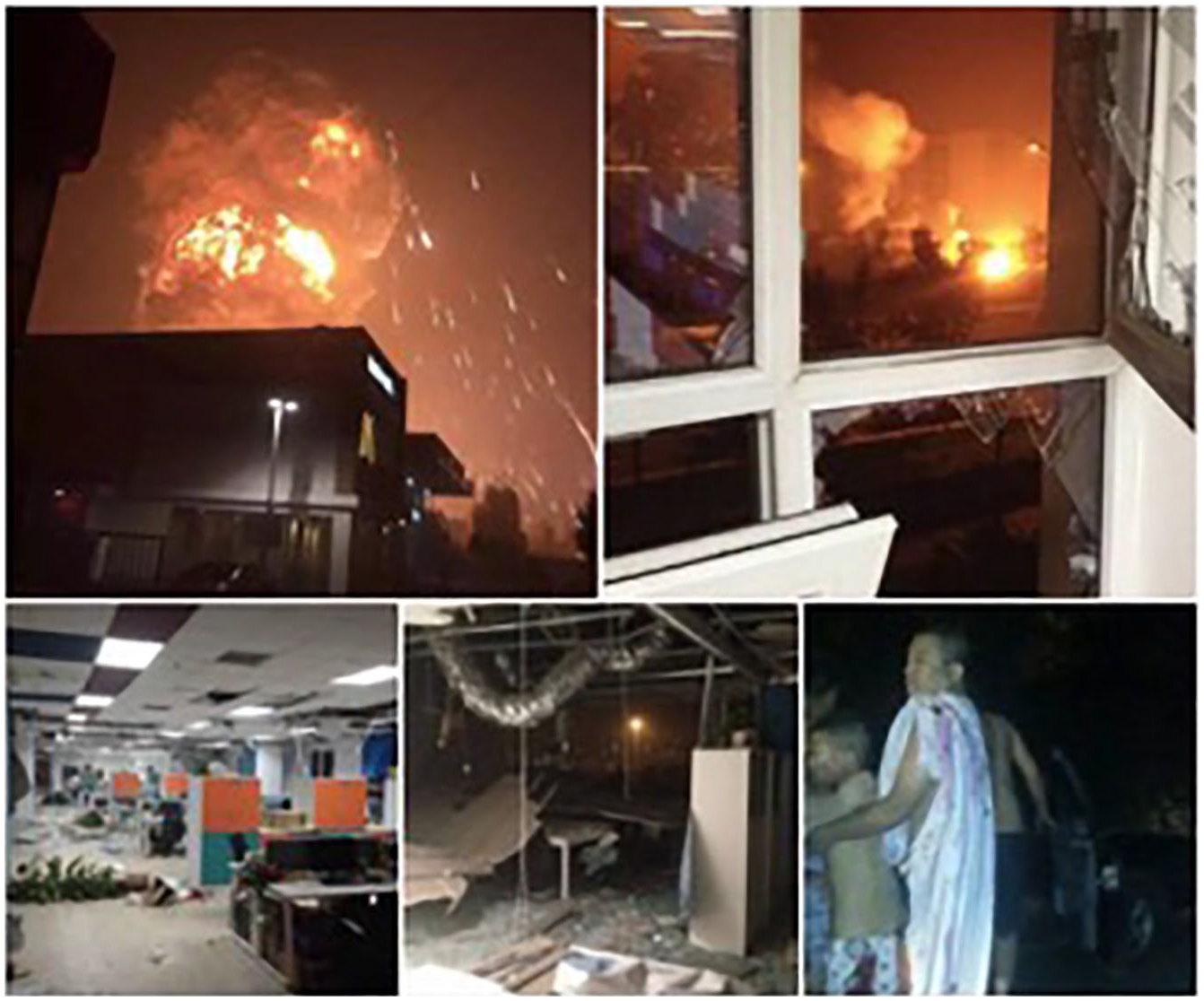
The veracity of the witness’s evaluation is further underpinned by the photographs which they posted of the injured victims, broken windows, shattered glass, fallen ceilings, and damaged furniture and decorations (see the pictures in Ex. 5). These in themselves serve as acts of visual testimony – signs of ‘being there’ in close proximity to the event – but they also position Weibo users and the social media community as witnesses in themselves, now almost in real time, to distant suffering. For instance, the pictures in Ex. 5 enable audiences to apprehend the scale and the impact of the distant disaster, and empathize with the victims, by displaying the blasts and their immediate aftermaths in an unfolding sequence.
Pictures in Ex. 5
The resolution in this case involves a process of ‘rescue/escape’. Survivors depict their survival in an elliptical fashion in a series of images, but in such a way to enable the social media community to reconstruct the manner of their escape. The adventitious nature of their escape in the resolution is accentuated by the sense, as shown in Ex. 7, of close proximity to the accident scene and the distance to relative safety on the ground, as well as the lack of time to react or prepare, as shown in Ex. 6.
Ex. 7 [Result] (Verbal Message) 9. 我老公把我从23楼背下去的!(My husband carried me downstairs from the 23rd floor!) [Evaluation] (Verbal Message) 10. 离爆炸点很近 (We were close to the explosion scene.) Ex. 6 [Result] (Verbal Message) 1. 光着脚被我妈拽着往外跑 (I was pulled by my mom bare-footed to get out)
Narratives of personal experience typically end with a coda, which according to Labov (2013), returns us from past events of the narrative to the present situation. The microblogger in Ex. 11 ends her story with a reference to her current state, one in which she has survived. One particularly striking feature of these microblogged codas is the use of verbal and visual prayers and blessings to express forms of solidarity. Often realized by optative verbs such as ‘希望’ (hope), ‘望’ (hope), and ‘愿’ (wish); expressions such as ‘加油’ (fighting), ‘祈祷’ (pray for), ‘平安’ (safe), ‘祈福’ (prayer), ‘天佑’ (God bless), and ‘保佑’ (bless); and emoticons like praying hands ( ) and (
 ), candle (
 ), and flexed biceps (
 ) convey sentiments of an almost religious kind in the face of disaster and suffering.
Ex. 7 [Coda] (Verbal Message) 10. 庆幸活着!(Thank God, I am still alive!) 11. 谢谢大家关心!(Thank you all for asking) Ex. 1 [Coda] (Verbal Message) 5. 现在只愿天佑天津 (I could only pray for Tianjin) 6. 加油 (Fighting)
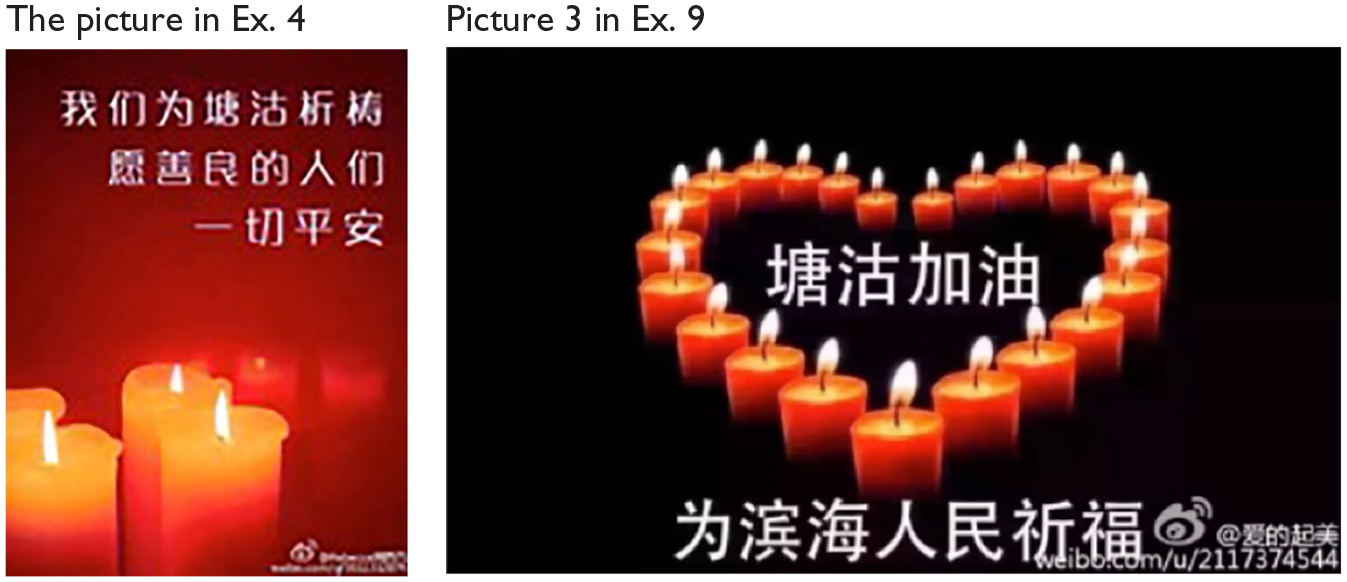
In addition, pictures are also used to express support that echoes the verbal prayers in these codas. Candles are the most commonly used image to construct the message of prayers and blessings. There is, of course, a paradox here, since China is not avowedly a religious country. On the face of it, these kinds of religious symbolism and practice seem to represent some kind of borrowing from the West, lighted candles as an accompaniment to prayer being one of them. The prevalence of religious sentiments on social media in the context of suffering seems to provide a way accentuating or elevating expressions of solidarity.
The sentiment can be projected both visually and verbally. Noticeably, the Weibo witness-survivors of Tianjian inserted verbal prayers into the pictures of lighted candles. For example, four lighted candles are placed at the bottom of the picture of Ex. 4 while the verbal text in Chinese is placed above the candles which says ‘我们为塘沽祈祷 愿善良的人们一切平安’ (We pray for Tanggu. Wish good people are safe and sound). In a similar fashion, picture 3 in Ex. 9 positioned the verbal element ‘塘沽加油’ (Fighting, Tanggu) in the heart-shaped candles and ‘为滨海人民祈福’ (Pray for people in Binhai) in front of the candles. Such prayers and blessings by the witness-survivors operate in at least two ways. On one hand, they consolidate the emotional bond and project a form of solidarity between the witness-survivors and other sufferers/victims of the catastrophe. On the other hand, those prayers and blessings appeal to the wider audience-spectators as potential benefactors for moral support and future disaster relief or development aid initiatives.
Discussion
A striking feature that emerges in our analysis is the common threads that run through the data. This may be due to several factors. First, the witness-survivors’ similar approach to documenting the accident may partly be influenced by a common sense of news values imbued with ‘perpetual crisis awareness’ (Frosh and Pinchevski, 2009: 300). This provides them with an inchoate template – a proto-journalistic frame – for documenting a disaster event that erupts in front of them. Thus, in the Tianjin case, witnessing takes place partly in terms of establishing in terms of precise particulars that ‘I was there’ to witness and experience an event of sufficient scale and intensity to warrant their accounts. Second, the individual witness-survivors’ act of sharing their near-death experiences takes similar form because they also draw upon an existing vernacular frame for narratives of personal experience, especially for life in extremis. Third, the practice of witnessing invokes a sense of social obligation for the benefit of an audience that was not present at the site and yet were entitled to know what happened to Tianjin. Those personal narratives and photographs each communicate a fragment of reality from a different angle to the audience. In this sense, the witness-survivors serve as ‘the surrogate sense-organ of the absent’ (Peters, 2001: 709) and their firsthand materials – photos, video clips, and their personal stories of the horrible experience – serve as a medium that passes the experience, perception, and judgment of the event to a wider audience. Fourth, the technological affordances of Weibo may partly explain the multi-semiotic combination of words and pictures. Weibo, as the most popular microblogging service in China, allows its users to post up to 140 Chinese characters (although Weibo is said to lift its word limit, its users still conform to the 140-word length) and nine pictures at maximum. Such a constrained and multimodal discursive environment is reflected in the short and fragmentary narratives of witness-survivors’ experience alongside the juxtaposition of multiple pictures in the Weibo posts.
Witnessing serves the purpose of documenting the course of the accident, breaking news to the distant audience, communicating private experiences, and expressing personal emotions and judgments. However, what makes the performance of witnessing distinct in the Tianjin case is that it demonstrates how social media technologies have endowed individuals with a new form of capital in transforming private sensory experiences into a public testimony that has the potential of challenging the disaster discourse constructed by local authorities and mainstream media and providing a counter-official discourse on social media platforms. The witness-survivors’ stories of near death experience became the subsequent ground and foundation of an alternative discourse of the 2015 Tianjin blasts constructed by social media users (see Wu, 2018) in the face of limited official accounts. According to the study, while the official/mainstream media coverage attempted to downplay the scale and aftermath of the accident, Chinese social media users resisted the official discourse by incorporating witnesses’ accounts as the documentary evidence (Wu, 2018). It was the very sense of irrefutable authenticity that imbued these multimodal narratives of near-death experience created by Chinese social media users that provided a powerful alternative to the official discourse of the accident. Indeed, these immediate firsthand materials, including verbal accounts and pictures of the suffering, the accident, the aftermaths, and the associated emotions, provided the baseline for critique of the official discourse.
Conclusion
This study has examined an emerging type of witnessing that has been facilitated by the combined affordances of social media and digital mobile technologies such as the smart phone by drawing upon the case of the 2015 Tianjin blasts in China. The reactions of Weibo users to the Tianjin accident suggest a significant transformation in the act of media-witnessing.
In Seeing Things: Television in an age of uncertainty, John Ellis (2000: 6ff.) argues that developments in mechanical media in the 20th century – photography, cinema, radio, and especially television – were deeply implicated in the development of witness as a new form of experience – ‘a new way of experiencing the world’. Indeed, for him, the 20th century was ‘a century of witness’. But, only in the second half of the century, he writes, ‘did commentators begin to explore its specific nature which allows us to experience events at a distance, safe but also powerless, able to over-look but under-act’ (Ellis, 2000: 15). The transition from the second half of the 20th century to the first half of 21st century has corresponded loosely to a transition from ‘mechanical’ (or analogue) media to digital media. Our analysis demonstrates that in this transition, witnessing has been radically transformed. In the digital age, we no longer experience events simply at a distance, ‘safe but also powerless, able to over-look but under-act’ (Ellis, 2000: 15). When people find themselves caught up in events, their capacity to register them by digital means goes far beyond passive spectatorship. Rather, it can be a near instantaneous active and reflexive discursive act of documenting, stating, and sharing one’s personal experience of the event on social media platforms. Thus, in the case of the 2015 Tianjin blasts, witness-survivors’ involvement in and engagement with the event allow them to become ‘a kind of editor, and thus an active shaper of the story of what happened and less merely a victim’ (Seaton, 2005, cited from Andén-Papadopoulos, 2014: 761).
The widespread diffusion of social media enhanced by the affordances of mobile smartphone technologies allow for the dissemination of media content via social media networks, communicating one’s personal experience and emotions to a virtually connected community, and mobilizing the multimodal testimonies produced by individuals partly as evidence but also as semiotic resources to establish solidarity and propel political engagement. This study reveals a new kind of witnessing as a participatory and self-reflexive act on the part of social media users in which they assume the role partly of witness, partly of a testimony-producer, and partly of a journalist.
A discourse analysis of these acts of witnessing in the social media age, not only captures the ongoing changes to the practice of witnessing but also underscores the distinctiveness of witnessing in political contexts like China where a different kind of public–state relationship may constrain and shape the discursive practices of witnessing. In the case of the Tianjin blasts, witnessing in the mode of narratives of personal experience by survivors constituted a significant part of the earliest coverage of the accident and shaped the public perception of the accident. Witness-survivors’ firsthand verbal accounts and visual materials helped the world outside Tianjin to make sense of the accident when details were not yet available. More importantly, the creation and sharing of sensory personalized eyewitness accounts provided an experiential baseline for a counter-official discourse that disrupted and questioned the accounts belatedly offered by local officialdom. Witnessing occurring on a large scale and across different social media platforms can mobilize social and political change as it ‘opens up a multitude of singular, subjective perspectives and various patterns of meaning, which, when combined, make a statement about the engagement and inspiration across different contexts’ (Mortensen, 2015: 1404).
The study of witnessing has attracted an increasing scholarly attention in past years. Despite a growing interest in the changing performances of witnessing facilitated by new media technologies in crisis contexts, research from the perspectives of discourse analysis and narrative analysis remains an important yet underexplored area. Based on a close analysis of Weibo users’ stories of life and death in the 2015 Tianjin blasts, this study not only examines the discursive practices of witnessing on social media platforms in disaster contexts but also raises issues around the complex relationship between private narratives and public discourses, witnessing and political engagement, crisis reporting, and communication through mainstream/official media and social media.
