



Abstract
Magic: The Gathering is a household name among analog games. Its publisher, Wizards of the Coast, has experimented with digital adaptations since the late 1990s, however, it was only in 2018–2019 when the company announced a more radical push for the video game market, including a strategy for streaming and esports. By analyzing streaming content, paratextual elements, and online discussions leading up to the first major digital tournament, I explore the attempted and heavily promoted transition of Magic: The Gathering from a primarily analog card game toward a transmedia esports property. Beside conflicting reactions from players and fans to particular aspects of this transformation, this change brings along deepened mediatization of the game as a way to improve the spectator experience by following the media logics of streaming and esports. Professional players in the newly formed esports league along with other sponsored content creators were recruited to serve as advocates for this transition.
Keywords
Introduction
Magic: The Gathering (Garfield, 1993) has established the genre of trading card games (Brougère, 2004; Martin, 2004) and inspired modern in-app monetization practices such as loot boxes (Nielsen and Grabarczyk, 2018). Despite its sustained economic success over more than 25 years, the game received less mainstream exposure than, for example, Dungeons & Dragons (Gygax and Arneson, 1974), which has recently captured broad attention due to references in hit television shows and popular streaming series such as Critical Role (Trammell, 2019). The company Wizards of the Coast (further abbreviated as WotC), which publishes both Magic: The Gathering and Dungeons & Dragons, now aims to increase the mainstream appeal of the card game by turning it into esports. This new strategy was first unveiled during 2018’s ‘The Game Awards’, a show that primarily focuses on video games, further implying a deliberate effort to reach new markets and audiences. In an attempt to better fit the increasingly popular and influential streaming (Taylor, 2018) and esports culture (Scholz, 2019) and provide a more accessible viewing experience, WotC is partially moving away from the original tabletop version of the game (further referred to as MTG) toward its new digital adaptation Magic: The Gathering Arena (Wizards Digital Games Studio, 2019; further abbreviated as Arena).
This article explores the transition of a card game into a more spectator-oriented entertainment product in the context of mediatization (see Hepp, 2013; Hjarvard, 2013; Schulz, 2004). Stig Hjarvard (2013: 20) previously argued that chess underwent a transformation ‘from physical chessboard to computer game’ . According to him, this process of direct mediatization has unlocked new possibilities for the game due to its newly acquired mediated form, for example, playing online or against a computer-controlled opponent. Andreas Hepp (2013: 43) suggested that in the case of another originally analog game – poker – this direct mediatization took two main forms: ‘TV and online poker’. Similarly, WotC gradually deepened MTG’s mediatization first with Magic: The Gathering Online (Leaping Lizard Software and Wizards of the Coast, 2002; further abbreviated as MTGO) and more recently with Arena. 1 As a result, audiences can engage with the game online both as players and spectators. In this process, the card game evolved into a complex transmedia cultural object, which at very least transcends the binary of analog and digital games.
Despite the recent criticisms aimed at the assumption of this binary (Aarseth, 2017; Torner, 2018), it is still influential in the study of competitive gaming, which, save for a few exceptions (Karhulahti, 2017), exhibits a bias toward the digital. Scholars often highlight the similarities between esports and traditional sports, suggesting a process of sportification (see Borowy and Jin, 2013; Turtiainen et al., 2018) instead of mediatization (c.f. Wimmer, 2012). However, I would argue that sportification as a concept, at least when applied to games, presupposes a modern media landscape that allows sports to become widely circulated spectator entertainment in the first place. Thus, sportification and mediatization thematize different aspects of an overarching process during which a gaming pastime becomes both a competitive sport-like activity and a media product designed for audience consumption.
As mentioned, chess (Fine, 2012; Hjarvard, 2013) and poker (Albarrán-Torres and Apperley, 2019; Hepp, 2013) have been affected by the same processes. The crucial distinction between these games and Magic: The Gathering is that the latter is fully owned by one company – WotC, itself a subsidiary of the toy giant Hasbro. This corporate oversight influences the mediatization of the game and brings it closer to esports, which is characterized by this particular ownership structure (Burk, 2013; Hollist, 2015; Karhulahti, 2017), and somewhat resembles the mediatization of toys, for example Lego’s extensive transmedia and licensing strategy (Hjarvard, 2013). Beyond the obvious technological adjustments, mediatization in the case of Magic: The Gathering also involves changes to rules, competitive play, and monetization. This case highlights the appeal of mediatization and sportification for game publishers as an alternative venue to both promote and commodify their intellectual property, even if it was originally conceived as an analog card game, by turning it into a widely accessible spectator entertainment, which can be experienced without actually playing it.
How to play?
In MTG, two (or more) players battle against each other in a fantasy setting by casting spells and summoning creatures from their decks of cards. Matches are usually played as a best-of-three series. After the first game, players can, in most cases, adjust their decks using the so-called sideboard. This feature helps to improve game balance and leverages the fact that some cards are designed to have narrow but powerful effects that only matter in certain matchups (Garfield, 2014).
A major aspect of MTG is its relatively large offer of play variants, called formats in the game’s lingo. While the basic premise of the game usually remains the same, special rules and different deck-building approaches can alter the gameplay experience. For example, players can either prepare their decks at home – Constructed – or build them on spot – Limited (Elias et al., 2012). Among Constructed formats, a further variety can be introduced by limiting the card pool to specific sets. While formats were initially introduced by WotC, grassroots initiatives soon followed and spawned even more ways to play MTG (Boon et al., 2016; Švelch, 2019). For example, the community-created Elder Dragon Highlander (EDH), whose first iterations can be traced back to the early 2000s, had become so popular that it was co-opted by WotC, renamed to Commander, and turned into an official product line in 2011. However, its special rules are to this day overseen by an independent committee.
In 2019, there is a large number of both official and unofficial formats (see Table 1). This multiplicity is further compounded by the three main versions of the game: MTG, MTGO, and Arena. For example, Arena has introduced an exclusive variation on the Standard format. Unlike most other two-player formats in which matches are played as a best-of-three series, the so-called Arena Standard follows a best-of-one structure. This approach arguably mimics the fast-paced style of digital card titles like Hearthstone (Blizzard Entertainment, 2014).
An overview of selected Magic: The Gathering formats.
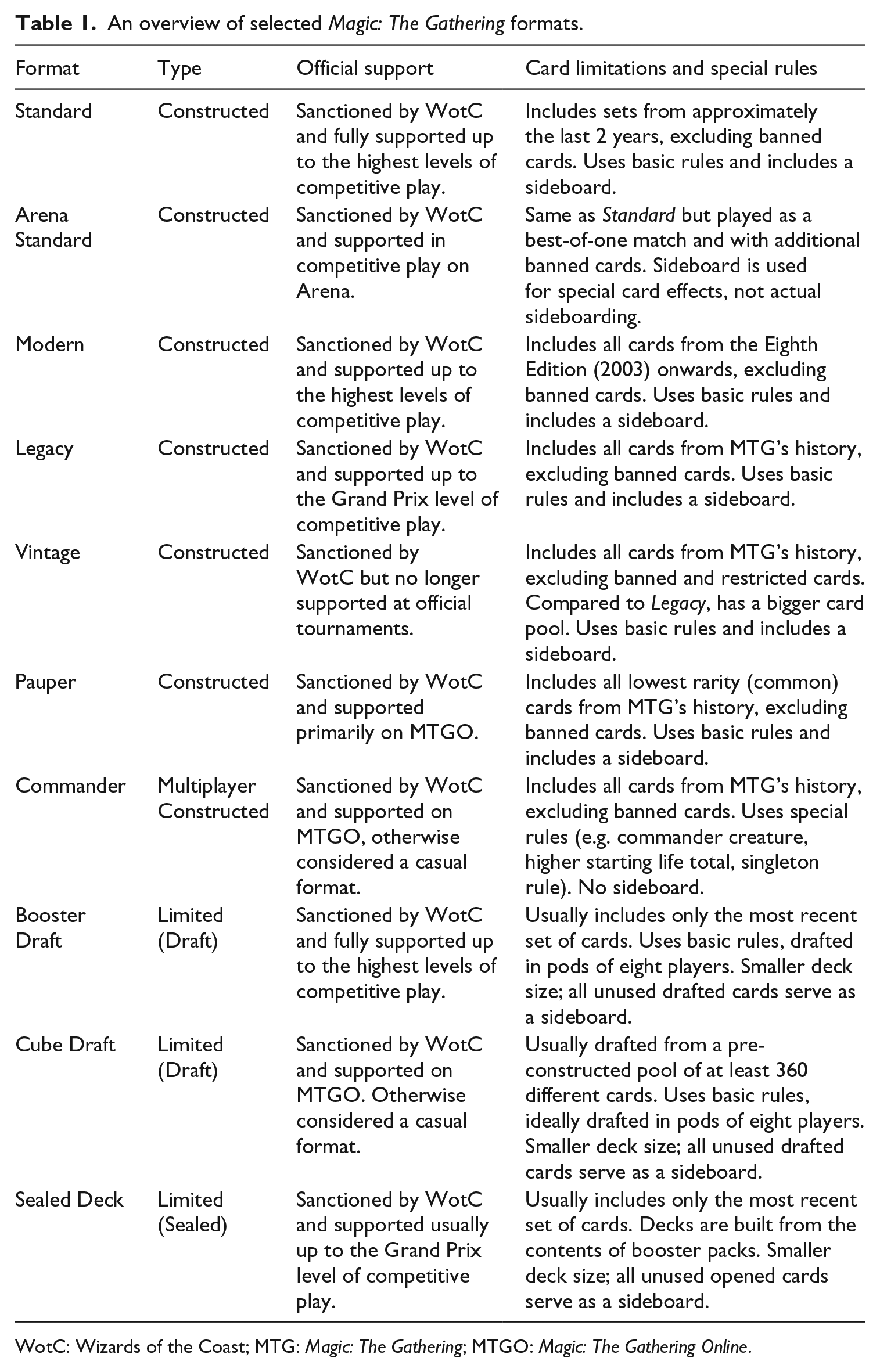
WotC: Wizards of the Coast; MTG: Magic: The Gathering; MTGO: Magic: The Gathering Online.
Monetization
Formats were intended to ensure economic longevity of Magic: The Gathering as its designers, including the creator Richard Garfield, were afraid that expansions would otherwise be perceived as less impactful and thus would end up being less popular: The solution we found was to promote different formats of gameplay, many of which involved only more recent sets of cards. Today [in 2003] there are popular formats of play that involve only the most recently published cards, cards published in the last two years [Standard], and cards published in the last five years, in addition to many others. (Garfield, 2014: 223)
MTG’s most supported format Standard, which serves as the backbone of the official competitive scene (Maisenhölder, 2018) and dates back to 1995, embodies this logic. While it is one of the cheaper variants of the game, according to industry commentators (SaffronOlive, 2017), it requires a continuous financial investment into new cards as older expansions leave Standard after approximately 2 years. Expansions, which are released every few months, fuel the need to upgrade existing decks or build new ones. In essence, MTG, MTGO, and Arena all utilize the oft-criticized pay-to-win model (Paul, 2018). However, this monetization model has been paradoxically accepted by many players, even to such an extent that its obvious structural bias, which advantages rich consumers, is largely ignored in favor of a meritocratic ethos. Reportedly, WotC has in the past taken legal action against completely free-to-play digital versions such as Cockatrice (Boon et al., 2016), which subvert the official pay-to-win model.
The primary form of distribution is a booster pack (see Table 2), which contains randomly selected cards of predefined rarities. As mentioned, this monetization model has inspired video game microtransactions, namely the controversial loot boxes, which were compared to gambling due to their random contents (Griffiths, 2018; Nielsen and Grabarczyk, 2018). What distinguishes trading card games, including MTG and MTGO, from most video games with loot boxes is that players have other options how to acquire cards than by buying randomized packs directly from the publisher.
An overview of the three main official Magic: The Gathering games and their monetization models.
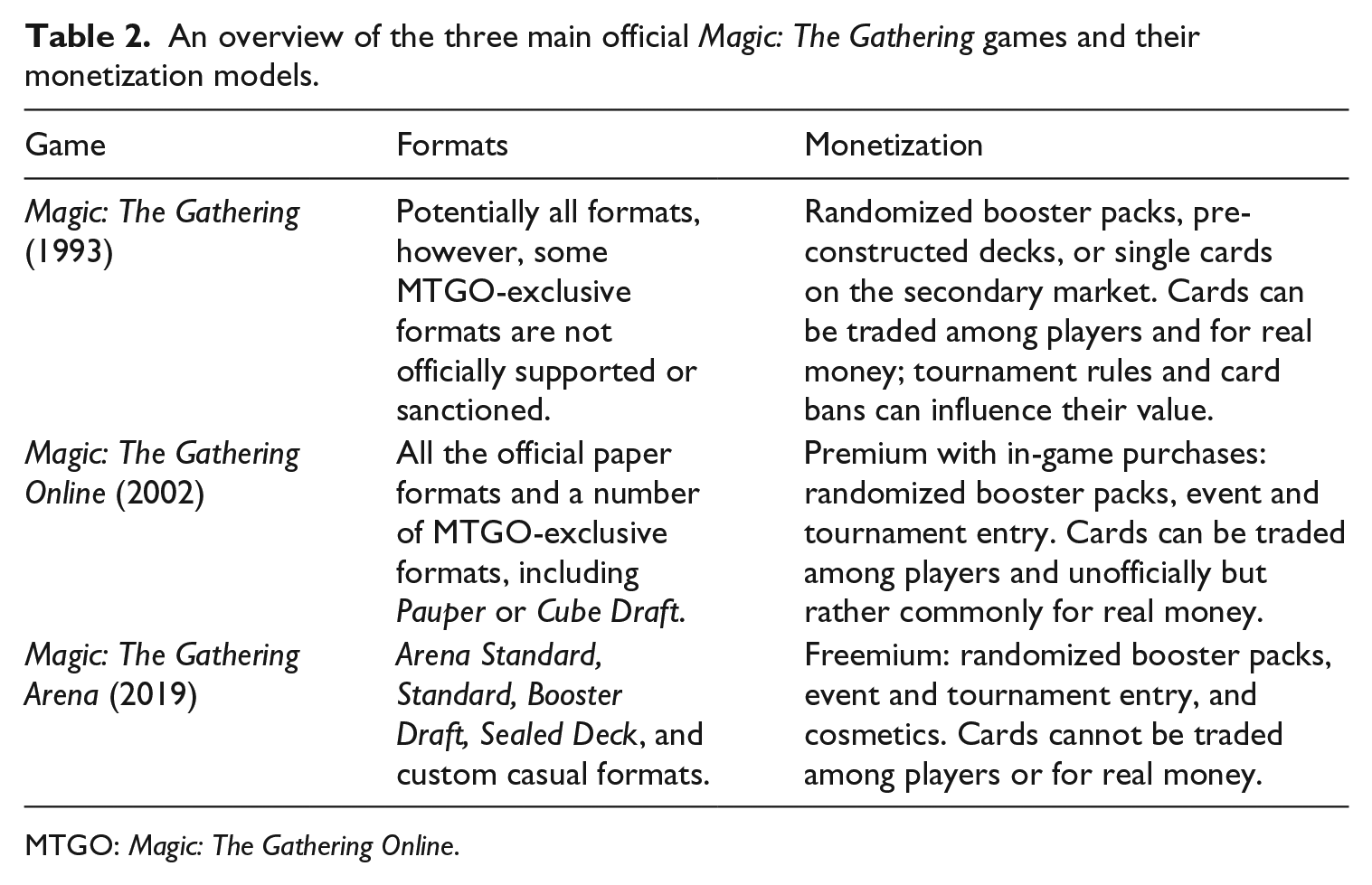
MTGO: Magic: The Gathering Online.
Arena, on the other hand, does not allow any direct trading or exchange between users. While it is technically possible to sell (or buy) a whole Arena account, including cards and virtual currencies, any such sale would breach the end user license agreement. This means that only WotC can legally benefit from players’ spending in Arena. This type of freemium monetization can be lucrative (Nieborg, 2016), but it operates on a different scale than both MTG and MTGO, making the game potentially cheaper (or even free if users invest enough time) to play than the other official alternatives. This is a markedly different approach compared to MTGO whose economy had been intentionally designed not to threaten the tabletop version (Garfield, 2014), although it still ended up being more affordable in the long run (SaffronOlive, 2017). Arguably, Arena’s pricing aims to compete with other digital card games such as Hearthstone.
The business side of Magic: The Gathering extends beyond the cards to various side products and peripherals. Similar to the video gaming sector (Taylor, 2012), analog games have also spawned ancillary industries focusing on accessories. In the case of MTG, these are primarily protective materials for cards, such as sleeves, deck boxes, or playmats. Arena, and to a lesser degree MTGO, limit the existence and viability of many of these third-party commercial activities both by being digital (thus not having any material objects to protect or modify) and due to their nature as closed proprietary services (Zittrain, 2008). The latter aspect gives WotC more authorial and economic control regarding monetization and preferred formats. Despite this step toward centralized oversight, some third-party practices are still possible even within these highly regulated environments, such as independent tournaments or various forms of content creation, including streaming, strategy guides, or coaching.
Competitive play
A crucial term for understanding of MTG’s competitive play and its connection to monetization is metagame, which was introduced by the game’s creator (Garfield, 1995) and quickly adopted by players. In its original meaning (c.f. Boluk and LeMieux, 2017), metagame addressed the fact that any match can be considered a part of a series and thus should be approached with the information about previous matches in mind. In a tournament setting, this means that a player is not building the best deck in absolute terms (as this should be impossible if the game is supposed to be properly balanced), but a deck that is favored against the other popular decks, which constitute the current metagame. This contingent quality of competitive play then results in continuously changing metagames (see Karhulahti, 2017). If a specific metagame would ever become too stagnant, WotC can release powerful cards, ban the existing ones, or introduce a new variant with its own metagame. Standard, in particular, is a fast-evolving format due to its relatively small card pool and regularly scheduled rotation of older sets. Thus, any new expansion has generally a bigger impact on Standard’s metagame compared to more stable formats such as Modern or Legacy. This format structure has clear economic implications, as the viability of cards across various formats influences their value on the secondary market. 2
The major tournaments, which in 2019 usually feature Standard but also Modern and Booster Draft, promote the game as a whole, but more importantly they showcase the newly released sets (Maisenhölder, 2018). Arguably, the official organized play is structured to drive sales of new products by focusing on the formats that are heavily influenced by expansions, such as Standard. Tournaments thus function as promotional media events (Borowy and Jin, 2013). This particular mindset stood behind the origins of WotC-sponsored competitions; inspired by traditional sports Garfield (2014) believed that professional play would help to popularize MTG. This approach was also applied in video game industries (Borowy and Jin, 2013) and can be considered a form of sportification.
The organized play has undergone significant changes regarding the supported formats, tournament structure, and reward programs for professional players since the first major tournament, Magic: The Gathering Pro Tour, which took place in New York in 1996. As part of the esports strategy, the main tournaments, which have been rebranded from Pro Tour to Mythic Championship, are no longer held exclusively as tabletop events, but now also use Arena (Chase, 2018, 2019).
The esports announcement directly affected professional players. Previously, the so-called Pro Player Club, which was established in 2005 and discontinued in 2019, offered travel and accommodation reimbursement for major events and appearance fees to the top ranked players. Still, professional players had to often rely on prize money and non-WotC affiliated sources of income to cover their living costs, resulting in arguably unsustainable careers. Starting in January 2019, the new Magic Pro League (further abbreviated as MPL) introduced an annual salary for its 32 participants (Chase, 2018) akin to esports industry standards (Taylor, 2012, 2018). The new system de-emphasizes the importance of weekly mid-level tabletop tournaments (Grand Prix), which previously awarded points for the Pro Player Club, in favor of Arena and its new qualifier events. This change decreases the amount of travel necessary for members of the MPL and other aspiring competitors, as participation in Grand Prix no longer yields points for the annual ranking system. At the same time, the switch from relatively open seasonal rankings to an annual league limits access to the higher tiers of the competitive scene.
Beside the official WotC competitive events, other parties can also legally organize tournaments in MTG, MTGO, and Arena (see Boon et al., 2016; Trammell, 2010, 2013). However, these unaffiliated competitions rarely have any direct impact on the official organized play and thus can be considered autonomous entities with their own standings, prize money, and sponsors. For example, SCG Tour is an established series of tournaments located in the Eastern United States and run by the card reseller company Star City Games. Smaller sanctioned events take place on a daily basis in local game stores that distribute WotC products (Kinkade and Katovich, 2009; Trammell, 2013).
Methodology
The empirical part of this article utilizes a combination of mostly qualitative methods, including online ethnography (Eisewicht and Kirschner, 2015; Markham, 2013), paratextual analysis (Švelch, 2016), and discourse analysis (Fairclough, 2003) in order to explore the implications of MTG’s transition toward esports and streaming. The chosen ethnographic approach is rooted in reflexive participant observation combining both descriptive and critical stances (see Eisewicht and Kirschner, 2015) and focusing on the embodied performance (Taylor, 2016) of MTG streamers and commentators and the discourses surrounding MTG, Arena, and esports, including interactions with the Twitch chat and the chat itself. As a long-time casual player, who has been playing the game on and off since around 1997, I had a sufficient degree of field experience, which I further developed by following the changing competitive metagames via tournament results and strategy articles and by playing both MTG and Arena. The fieldwork consisted of 300 hours of participant observation of 52 personal Twitch channels and four tournament broadcasters on Twitch (Magic, Channel Fireball, SCGTour, and Twitch Rivals) carried out from September 2018 to March 2019. I observed each of the personal channels for at least 1 hour (for the combined amount of 150 hours for this part of the fieldwork), prioritizing live broadcast. Due to time zone differences and infrequent streaming schedules, I had to rely on recorded videos in three cases. The observations are presented anonymously out of respect for the original context and privacy of the streamers and chat members.
Twitch was selected both due to its role in WotC’s esports strategy and its dominant position in streaming culture (Taylor, 2018). The personal channels had to meet all of the three following criteria: (1) the stream features MTG, MTGO, or Arena, (2) at least part of the streaming is done in English, and (3) the channel either belongs to one of the 56 players invited by WotC to the Mythic Invitational – a tournament with the highest prize pool in the history of the game, which took place at PAX East in Boston between 28 and 31 March 2019 – or ranks among the top 20 most watched MTG channels on Twitch (according to Twitch Metrics statistics from 12 February 2019).
From the 52 personal channels, 41 (79%) streamers identified in their social media profiles as cis male, nine (17%) as cis female, one (2%) as transgender, and one (2%) as non-binary. These demographics align with previous research on streaming (Uszkoreit, 2018) and the perceived gender composition of the MTG community (Orsini, 2016; Wolff, 2015). In contrast, WotC’s market research data suggest that 38% of all players identify as female (Rosewater, 2015). However, their representation among tournament participants has been estimated at 1%–5% (Wolff, 2015). This distribution can be partly attributed to structural causes, such as hegemonic and toxic masculinities within game and geek cultures (Paul, 2018; Salter and Blodgett, 2017). The majority (87%) of the observed streamers could be considered white (including Hispanics and Lusitanics residing in Europe or South America, who could be labeled as Latinx in the US context), again echoing previous findings (Gray, 2017).
I further collected official articles, promotional videos, podcasts, social media posts, and forum posts by WotC and its employees that were connected to the esports announcement, changes to organized play, updates to Arena, and the Mythic Invitational. As the last step of data triangulation, I explored online discussions, journalistic articles, and blog posts related to the aforementioned topics.
Spectatorship and streaming
Historically, the mediated spectatorship of MTG was closely related to its professional scene. WotC has been recording and broadcasting video footage of major tournaments since the first Pro Tour in 1996 (Rosewater, 2013). Briefly from 1997 to 2000, this coverage was featured on ESPN2, a US general sports cable and satellite television network – an earlier attempt at sportification of MTG by association in order to boost its mainstream appeal. The broadcasting efforts later shifted toward online live-streaming. In 2016, WotC signed a contract with Twitch, making it an exclusive platform for official coverage of MTG tournaments, which were primarily tabletop events at that time. During 2016–2018, WotC was live-streaming most European and American Grand Prix and all high-profile tournaments such as Pro Tour. However, the 2019 transition to esports resulted in cuts in official coverage of Grand Prix (Chase, 2019). Immediately, WotC was criticized for seemingly abandoning the tabletop MTG scene by the player community at large and also by many of the observed streamers. Fans and streamers alike complained about the perceived ad hoc decision to discontinue video coverage and the lack of communication from WotC. Due to popular demand, Channel Fireball Events, a business partner of WotC, which organizes the on-site Grand Prix events, took over text coverage for all Grand Prix in 2019 (Chase, 2019). In addition, the same company now provides live-streamed video coverage on its Twitch channel for a few select Grand Prix, starting with Magic Fest Los Angeles (1–3 March 2019).
WotC’s decision to step away from video coverage of tabletop tournaments has to be analyzed in the context of streaming contracts (see Taylor, 2018), which were reportedly offered to all 32 original MPL members. Out of the 32 players, only four (13%) streamed on Twitch regularly and two occasionally (6%) prior to the foundation of the MPL. Thus, WotC’s esports strategy resulted in creating approximately 25 new active Twitch channels, which focused specifically on Arena. Along with the increase in prize money for organized play in 2019, it is possible that the funds that were previously used for coverage were moved to esports contracts and Arena’s development and promotion. According to WotC, the cuts to Grand Prix coverage were also motivated by low viewership (Chase, 2019). On a purely quantitative level, there is now more sponsored Magic: The Gathering content on Twitch despite the decrease in official video coverage of tabletop tournaments. However, the amount of official competitive play has decreased in favor of Arena gameplay, which includes informal sparring and also highlights from the weekly MPL competition.
On a formal level, Arena is better suited for spectatorship as it has been developed with streaming platforms in mind as opposed to the original tabletop version of the game. For example, MTG does not fully represent all of its game mechanics and states using game pieces (i.e. cards, tokens, and dice). Therefore, it relies on players to keep each other verbally informed about their in-game actions. In addition, players can skip ahead through gameplay phases during which no relevant actions are taken, significantly speeding up the pace of the game. This ‘flexible simplicity’ (Murnane and Howard, 2018: 85) allows for relatively fast gameplay despite the otherwise complex rules. At the same time, this aspect of MTG makes it harder for spectators to follow the progression of a match (see Figure 1). Coupled with the relatively small-sized cards, the above listed qualities turn MTG into a poor spectator experience, especially for audiences that do not have expert understanding of the rules and a given metagame. These formal obstacles for spectatorship can be bypassed in pre-recorded videos, in which editing and post-production can make the viewing experience both more accessible by showing extra information and also more streamlined by skipping unimportant parts of play, such as shuffling. Spellslingers (2013–2018) is an early example of a YouTube video series, which succeeded in turning MTG into media entertainment as evidenced by viewer numbers above 1 million for its most popular episodes. However, shows like these require relatively high budgets and long production times and thus they do not solve the problem how to broadcast live gameplay.
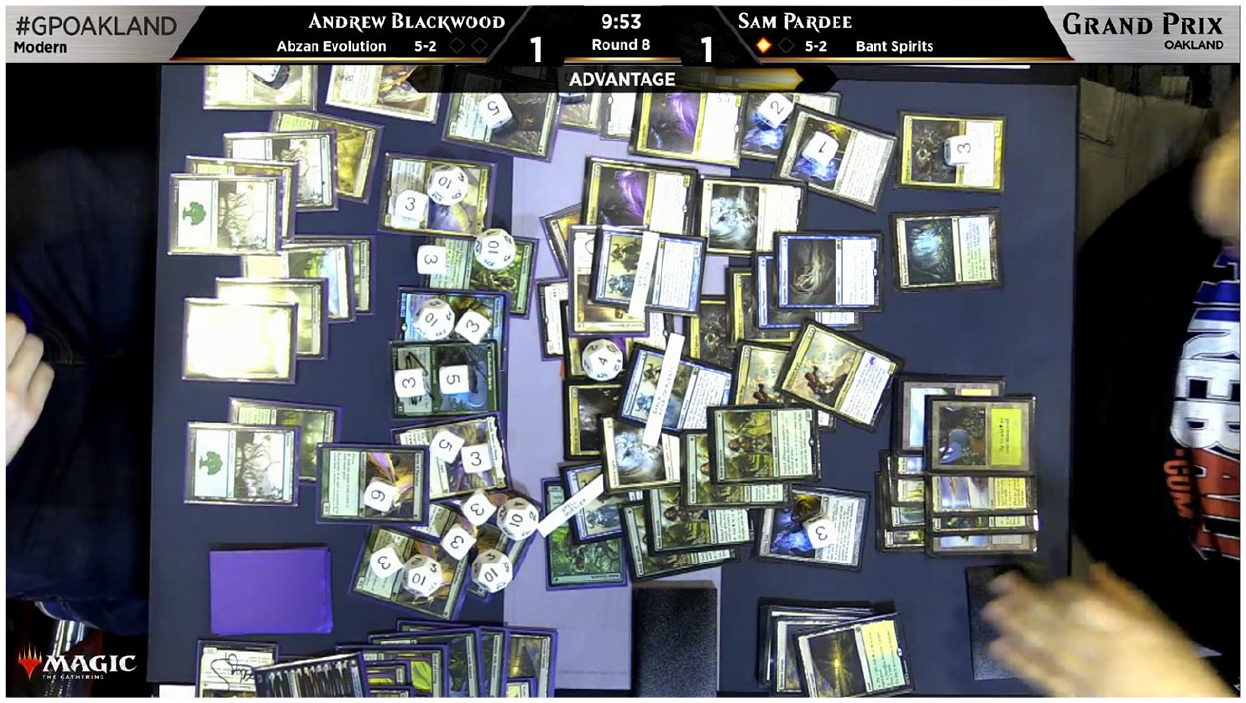
A complex board state during a Modern tabletop match at Grand Prix Oakland (January 2019) from the official Twitch channel of Magic: The Gathering. While this is an extreme example of how many game pieces can be in play at the same time, even regular gameplay situations can be hard to follow.
Arena and MTGO make some of the implied information about game mechanics and states, such as the turn phases or the so-called stack (see Murnane and Howard, 2018), visible on the screen (see Figure 2). Out of these digital versions, the newer Arena has a modern-looking user interface, although it tends to simplify certain aspects of the game, at least in its visual representation. However, similar complaints were previously aimed at MTGO (Trammell, 2010). The emphasis on viewer experience is symptomatic of WotC’s recent actions and complements the push for esports as mediated entertainment. Beside the MPL streaming contracts, WotC also offers a so-called Creator’s Program as a form of basic technical and promotional support for content creators on Twitch and YouTube. In addition, two card bans issued in the first quarter of 2019 noted spectatorship as one of the rationales for removing certain cards from competitive play. In both cases, the banned cards were believed to lead to ‘unenjoyable games and [. . .] viewer experiences’ (Duke, 2019; Wizards of the Coast, 2019a).
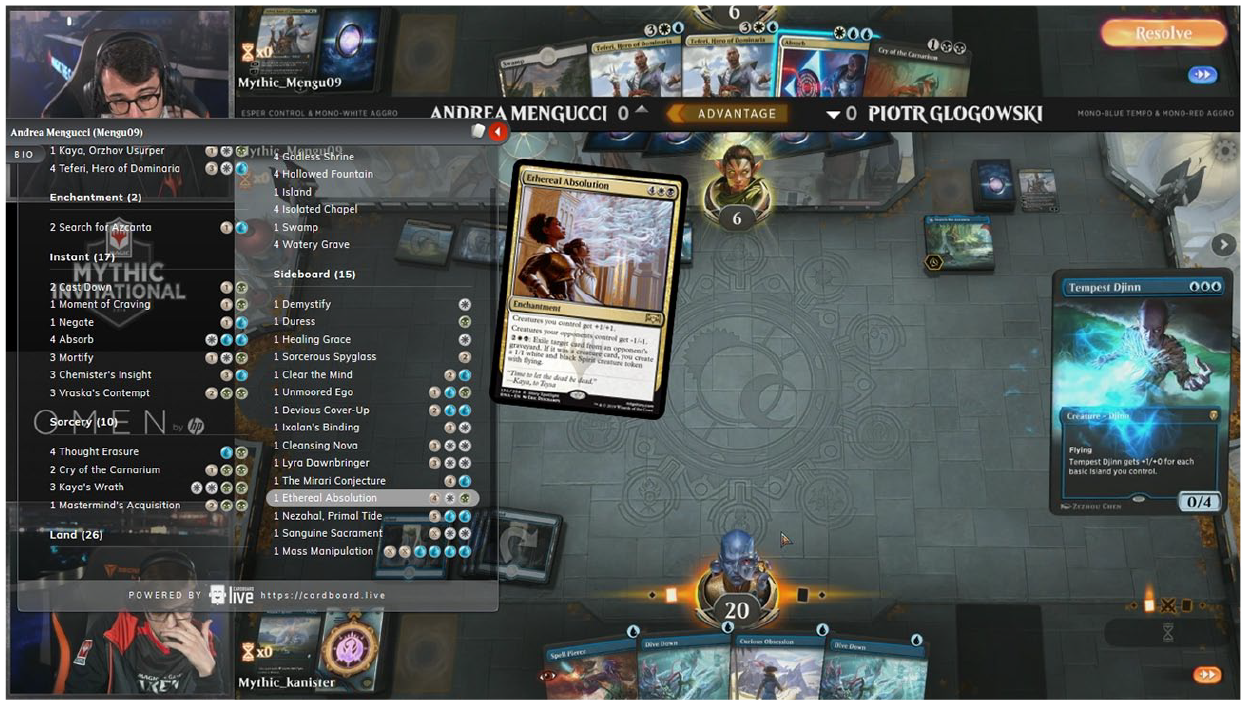
The official coverage of the Mythic Invitational (March 2019) conveyed additional information compared to the tabletop footage using visual cues of Arena (e.g. turn phases) and the Twitch extension CardBoard Live (player bios and deck lists).
WotC’s tabletop tournament coverage attempted to compensate for the aforementioned issues by providing commentary and various additional visual indicators (e.g. health, remaining time, or advantage). More recently, Star City Games and Channel Fireball have started using the CardBoard Live Twitch extension to give viewers access to additional details, such as deck lists, player biographies, or continuously updated tournament standings. This augmentation of live-streams has been positively received by the community. Comparable extensions also exist for Arena. For example, Deckmaster allows for zooming in on any card on the board or in the player’s hand and was used by approximately 90% of the observed streamers.
Arena’s first major tournament: the Mythic Invitational
The inaugural official Arena tournament, the Mythic Invitational, caused controversy upon the announcement of its participants in January 2019. Among the invited contenders, there were spots reserved for 30 MPL members (two less than the full number due to prior disqualification for cheating and allegations of sexual misconduct) and top eight players on Arena’s ranked ladder at the end of February 2019. The remaining 26 participants were handpicked by WotC as ‘some of the biggest names in Magic gaming and streaming’ (Wizards of the Coast, 2019b). This arguably vague selection criterion was criticized partly for favoritism due to the fact that the final roster did not include some of the most popular content creators, at least based on Twitch viewer rankings. The uproar channeled toxic meritocracy (Paul, 2018) of MTG’s online communities as it primarily targeted female players and questioned their skill. Some influential members of the community, including a number of observed streamers, objected to these criticisms and defended WotC’s decision to promote inclusivity by inviting cis female, transgender, and non-binary players. As mentioned, MTG’s tournament scene is dominated by white cis male players, which is often the case in esports (Taylor, 2012; Witkowski, 2018). The MPL’s original 2019 roster, which was decided based on the Pro Player Club rankings at the end of the 2017–2018 season, only included men, out of which 22 (69%) came from North America or Europe. 3 For the Mythic Invitational, cis women, transgender, and non-binary persons constituted 19% of the field largely due to the curatorial efforts from WotC. This gender distribution was still below the estimated number of women among all MTG players (approx. 38%; Rosewater, 2015).
In the months leading to the Mythic Invitational, some of the observed streamers publicly shared the feeling that they should prove their skill by reaching higher ranks in Arena despite the fact that they had already qualified for this event. The announcement of the tournament format Duo Standard had a noticeable impact on the content of the observed streams as many competitors prioritized the best-of-one matches (Arena Standard) as training for the tournament. Still, some others stuck to their favorite game modes, whether it was best-of-three Standard, various Limited formats, or even MTGO. On a general level, the deck testing in streams of MPL members and other competitive players was deemed to prevent unexpected decks from having any significant impact on tournament play, as was also evidenced by the metagame distribution at the Mythic Championship I in February 2019. Players have argued that previously it was easier to do secret testing within the professional teams but the fact that the top competitors were broadcasting their tournament preparation as part of their esports contract limited these possibilities. While metagames continually evolved over the observed time period and the relative strength of decks changed on a weekly basis, this high-level play now occurred publicly, effectively discouraging any alternative, untested strategies. However, the Mythic Invitational was an exception to this trend due to its new Duo Standard format and the small number of participants, which encouraged both secrecy and scouting among the invited players.
The tournament itself managed to attract a record number of viewers for a Magic: The Gathering event on Twitch, reaching 125,000 concurrent viewers on the final day on the main channel according to official Twitch metrics; 157,000 according to WotC’s numbers (Schmiedicker, 2019). The coverage team for the Mythic Invitational differed from the previous major tournaments. Among the hosts were popular Twitch streamers who do not exclusively focus on Magic: The Gathering, but nonetheless have experience with the game. Some of these online personalities and a portion of the invited players stream competing titles such as Hearthstone. This decision, which arguably distanced the event from the regular tabletop tournaments and aimed at a more mainstream esports audience, was generally praised by viewers. Especially, the perceived higher production values were appreciated in the Twitch chat, online comments, and on Twitter. However, the Twitch chat settings had to be quickly switched to a subscriber-only mode after a wave of harassment against cis female, transgender, and non-binary competitors. For the first time, WotC employed a Twitch extension to augment the spectator experience – viewers could inspect decks and player bios using CardBoard Live.
While the coverage itself was considered a success by both the audiences and organizers (Schmiedicker, 2019), the Duo Standard format was criticized for trivializing the matches and increasing the role of luck (at the expense of skill) due to a random deck selection during the first two games of a best-of-three series. Duo Standard is effectively a hybrid of the best-of-one and best-of-three models: it does not allow proper sideboarding similarly to Arena Standard, but it is played as a best-of-three match with two unique decks. Arguably, this new format attempted to limit downtime in live coverage, which normally occurs during the sideboarding phase, and resembled tournament structure from digital card games such as Hearthstone or Gwent: The Witcher Card Game (CD Projekt RED, 2018). Duo Standard prioritized spectator enjoyment over other more traditional aspects of the game (e.g. balance, complexity, the role of chance).
The complaints about the format foregrounded the meritocratic ethos of some parts of the MTG community. These believers in meritocracy also belittled the achievement of certain players, especially the non-MPL competitors, who made their way into the later stages of the tournament also by defeating MPL members. Arguably, this narrative was enabled by WotC’s own distinction between the two groups of competitors: (1) MPL members, who were often referred to as professionals by the coverage team, and the so-called (2) challengers, who included both the invited content creators and the eight players who qualified by placing in the top ranks of Arena. The four finalists, while all white males, represented different countries (Italy, Poland, Finland, and the Czech Republic; in a descending order based on their final placement) and groups of competitors: two MPL members, one streamer, and one player who qualified via Arena. Three women (all of them invitees) progressed to the top 16.
Discussion: mediatization of Magic: The Gathering
Many of the observed changes highlight the complex processes of micro-level mediatization that Magic: The Gathering was and is still undergoing. Regarding the shift in technology, MTGO and Arena represent an instance of direct mediatization (Hjarvard, 2013) resulting in substitution (Hepp, 2013; Schulz, 2004) of a non-mediated activity – the original tabletop play – for its mediated form. However, this shift is in no respect total (or final) and needs to be considered within the context of WotC’s official publishing strategy and audience negotiations about the preferred ways of play. For example, MTGO was initially targeted at lapsed players (Garfield, 2014) and was thus meant to complement MTG, not replace it. Still, it later became a practice environment for active professional players (Trammell, 2010) and it effectively substituted MTG for this particular style of play. Arena represents a more significant step toward direct mediatization as it was from the outset marketed as a full-fledged game for both casual and competitive audiences. Still, all three main versions co-exist together as relatively autonomous entities, each providing something unique, partly due to their different technological infrastructures. MTG facilitates face-to-face social contact and contributes to creation of places where players can meet and play on a regular basis (Kinkade and Katovich, 2009). MTGO and Arena both enable online and arguably streamlined play (Trammell, 2010) but they differ regarding playable formats and monetization and are planned to co-exist in this way in the future.
The increasing emphasis on Arena as a major way to engage with Magic: The Gathering leads to other developments that can be understood within the framework of mediatization. Changes are not limited to the technological aspects of the game but extend to card design and foundation of new formats that are developed to suit Arena and which resemble other digital card games. This indirect mediatization (Hjarvard, 2013), or accommodation (Hepp, 2013; Schulz, 2004), results in adjustments to Magic: The Gathering as a whole that are motivated by the new digital mediated forms and follow specific media logics, in this case streaming and esports. As I have shown, tabletop MTG faces difficulties as spectator entertainment due to small-sized cards and reliance on verbal communication between players. One of these obstacles is also the length of a match, which previously also problematized broadcasts of chess competitions (Fine, 2012). The Duo Standard and Arena Standard formats attempted to address these issues by eliminating the time otherwise spent sideboarding. However, the lack of sideboards does not only impact the actual play by speeding it up and encouraging new strategies but it also affects game design, which tries to account for these shifts. WotC’s designers admitted that Arena Standard in particular influenced the design of cards from the recent expansion Ravnica Allegiance (Rosewater, 2019). These new cards (see Table 3) in turn shape even the non-mediated forms of play as they can also be used in other formats.
Examples of the so-called split cards from Ravnica Allegiance, which were designed to provide additional utility for formats without sideboards.
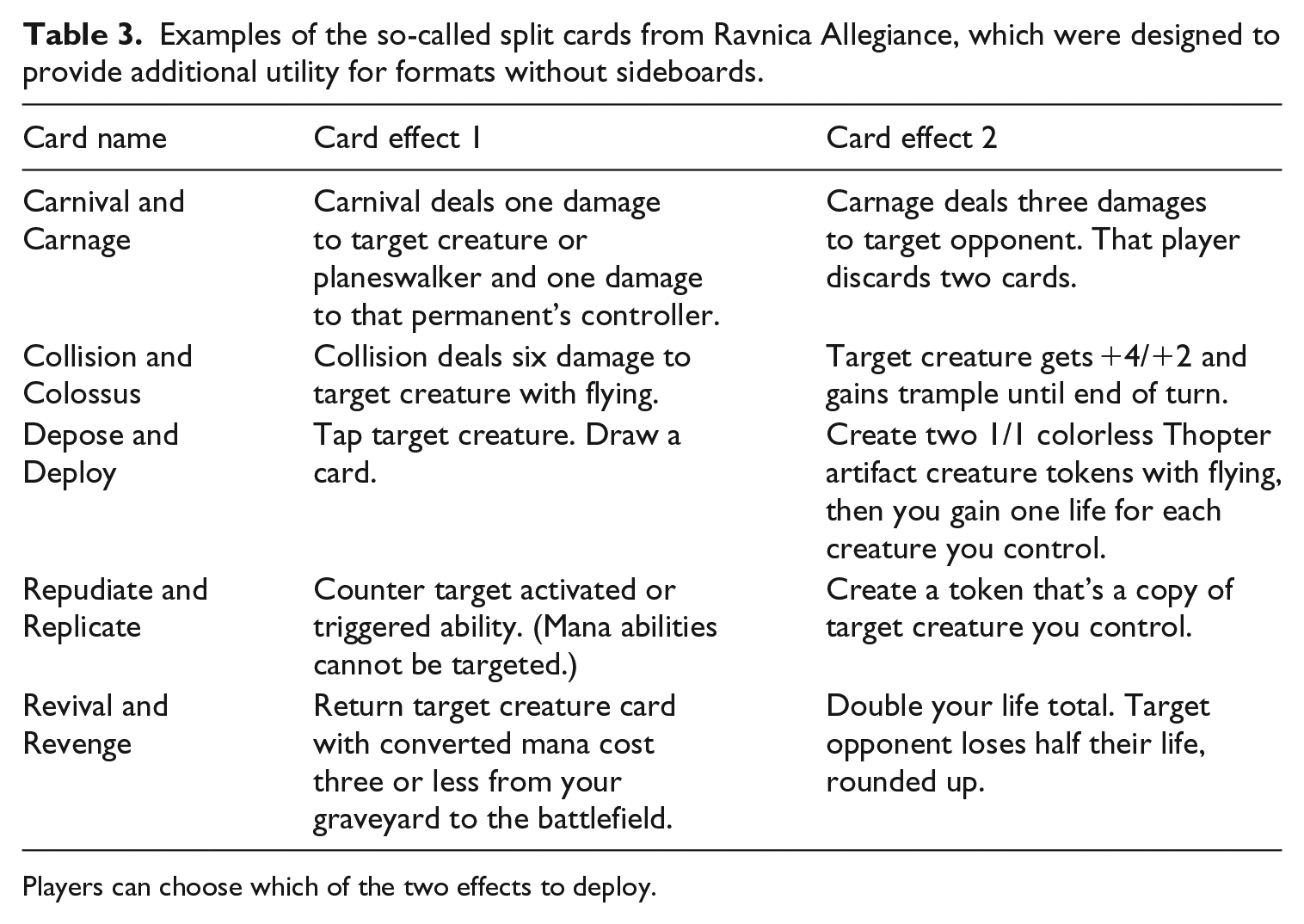
Players can choose which of the two effects to deploy.
The intention to speed up the game by introducing new formats, rules, and cards is supported by digital technology. MTGO and Arena automate shuffling, which in tabletop settings is time consuming, laborious, and can be exploited for cheating. Furthermore, Arena also utilizes a so-called hand-smoothing algorithm in all best-of-one matches (including Arena Standard), which improves the chances of a playable opening hand (WOTC_ChrisClay, 2018).
Magic: The Gathering proves that the process of mediatization is complex and cannot be neatly classified into the direct and indirect categories (Hepp, 2013; Hjarvard, 2013). Considering that mediatization of Magic: The Gathering is arguably WotC’s corporate strategy, other stakeholders, such as professional players, regular consumers, and also proprietors of secondary markets, all might have reasons to oppose such a top-down change. Due to the fact that WotC is not enforcing a total substitution of tabletop MTG in favor of Arena, the resistance from external parties is relatively mild and focused primarily on the competitive scene, which is more directly overseen by the company compared to casual forms of play. For example, the overwhelmingly negative reception of Duo Standard led to its discontinuation in favor of the established Standard. Expectedly, the inclusion of Arena in high-level tournaments was criticized by conservative members of player communities. However, the foundation of the MPL turned many professional competitors, who might have had otherwise sided with conservative members of the community, into advocates and pioneers (Hepp, 2016) of this transition as they arguably benefited from this process. One player quit the MPL in May 2019 to protest perceived mishandling of the esports league by WotC. As in the early days of Magic: The Gathering (Garfield, 2014), sportification was used as a tool to promote the game, this time utilizing the trend of esports, which itself leverages the formal similarities between video game competition coverage and mediation of traditional sports (Borowy and Jin, 2013; Turtiainen et al., 2018).
From a viewpoint of political economy, the mediatization of Magic: The Gathering strengthens WotC’s corporate oversight of how the game is played and commodified. While MTG has already exhibited certain platform-like qualities due to its multiple formats, which are held together by the shared basic ruleset and cards, Arena’s always online software has established a more dominant position for WotC in the multisited market as it is at the same time a video game product, a distribution channel, and a framework for competitive play. Older avenues of tabletop MTG and MTGO are upheld partly to honor players’ earlier financial investment and to encourage further spending. Although all three major versions of Magic: The Gathering use the booster pack as the primary channel for card distribution, Arena’s proprietary nature makes it also the only available option, effectively sidestepping secondary markets, which have emerged in MTG and MTGO to provide alternative means to obtain cards. At the same time, WotC is technically selling the same content in three incompatible forms. One of the few exceptions is that a paid participation in a physical MTG pre-release tournament serves as a free entry to one Limited event on Arena.
Conclusion
At the moment, Magic: The Gathering resists being classified as either analog, or digital game, instead occupying a liminal position between the two in order to capitalize both on the recent board game renaissance (Trammell, 2019) and the steady growth of esports (Scholz, 2019) and streaming culture (Taylor, 2018). Nonetheless, both sectors and the respective sides of Magic: The Gathering embrace mediatization as a way to reach and expand their audiences, as also evidenced by the role of Twitch and the various types of augmented viewer experiences in tabletop and digital versions of the game. As shown, the mediatization process is not straightforward even when enacted by an exclusive publisher and a copyright owner of a game. Generally, the top-down changes, such as the new playable formats and cards, the increasingly important role of Arena, and the new competitive scene modeled after esports, all bring it closer to the fast-paced natively digital card games such as Hearthstone. At the same time, the legacy ways of playing – for example, at a local game store or at a kitchen table – still remain valid and supported by WotC’s product lines although they now have to co-exist with the more streamlined options of digital gaming. Magic: The Gathering’s 2019 esports strategy has succeeded in putting it among the top 25 titles on Twitch based on average viewership hours, in part due to the MPL streams, the Mythic Invitational tournament, and the overall success of Arena. However, the increased media presence has exposed some of Magic: The Gathering’s long-standing issues, such as the underrepresentation of cis female, transgender, and non-binary players in tournament play, which might now be perceived as more threatening to the game’s success when competing with other esports titles. Overall, the analysis of the current developments in Magic: The Gathering underscores the fact that mediatization is not a linear effect but a complex process with both driving and opposing forces and various discontinuities (Ekström et al., 2016; Hepp et al., 2015).
Footnotes
Acknowledgements
The author would like to thank Jaroslav Švelch and his colleagues from Tampere University for their comments and suggestions.
Declaration of conflicting interests
The author(s) declared no potential conflicts of interest with respect to the research, authorship, and/or publication of this article.
Funding
The author(s) disclosed receipt of the following financial support for the research, authorship, and/or publication of this article: This research was supported by the Academy of Finland project Center of Excellence in Game Culture Studies (CoE-GameCult, 312395).
