




Abstract
The copper mining city of of Alto Hospicio, Chile and GoodPath town, a factory city in China both seem to be archetypal neoliberal cities. They epitomize the circulation of goods, people, and ideas through their export-based economies, large migrant populations, and high penetration of Internet and social media use. Yet, we find that in migrants’ social media use, there are stark contrasts in the significance they place on their movement and the identities they form around these migrations. In China, factory workers take to the ‘online world’ to escape harsh realities and engage in identity formations that privilege cosmopolitan aspirations. In Chile, mining workers express the harshness of their lived reality, using social media to build identities around a sense of pride in their abrasive conditions. This comparative essay reveals how processes associated with neoliberal capitalism – including migrations of people, goods, and information, and the commodification of identities – is preconditioned by local contexts. We find that the processes of neoliberal capitalism sometimes yield starkly different consequences, even when local circumstances seem to be similar. This demonstrates that even as media (and particularly social media) connect people more closely, their effects are anything but homogenizing.
A tale of two cities
It is 8:15 pm and Rodrigo ends his daily 12-hour shift at the copper mine in northern Chile where he is a heavy machine specialist. He goes back to his dormitory room that he shares with a colleague to shower and change clothing before eating his evening meal in the mine’s cafeteria. But he pauses first to check his WhatsApp and Facebook. Rodrigo’s round at the mine lasts 7 days, followed by an alternative week off. Rodrigo often says he feels like he is in something of an asylum at the mine, and social media is his only connection to the outside world. The mine is located 4 hours from the nearest port town on the Pacific, where Rodrigo lives with his wife, their two children, and his in-laws. Rodrigo has also left behind his own parents and siblings in the southern Chilean town of Temuco. He migrated 2500 km north 10 years ago because of the economic opportunities associated with mining and shipping copper, which makes up about 20% of the country’s gross domestic product (GDP) and 60% of its exports (The Economist, 2013). There is seldom cellular service in the work sites of the mine, located high in the Andes at an altitude of 4500 m above sea level. But once back at the dormitory, Rodrigo takes time to post pictures from the workday on Instagram, shares funny memes on Facebook, and sends messages to his friends and family members via WhatsApp.
At the same moment, it is 7:15 am across the Pacific in GoodPath town, China, where Yingying is walking to the factory where she will work for 10 hours on the assembly line. Yingying slows down at the traffic junctures where smoking breakfast carts, honking vans, motorbikes, bicycles, and pedestrians all intersect. A 19-year-old Yingying is not bothered by the scene, as her mind is occupied by a vast expanse of purple lavender field in Provence. She is busy posting to her QQ page, uploading photos of a honeymoon in France, which she collected online. While waiting in line at the factory’s 1 fingerprint check-in, Yingying takes her last chance to reply to comments from QQ friends before she is required to put away her smartphone. She is one of the young rural migrants who make up the majority of the factory labor in GoodPath. Located in the middle of Zhejiang, the coastal Pacific province which boasts China’s most dynamic private economy, GoodPath is now home to more than 60 massive factories and over 40,000 migrant workers from inland rural China.
Both of these migrants have traveled thousands of miles to work in booming export industries closely tied to their proximity to the Pacific Ocean. In many ways, they are both examples of a certain kind of neoliberal subject – a life defined by their own movement, the movement of the goods they produce, and the movement of ideas shared through their social media use. The circumstances of their lives are conditioned by their own movement and that of goods sold in the global marketplace. But their use of social media and the sharing of experiences through these media allow both to construct distinct identities that mediate their position between the local context and the global reach of their ideas.
This essay uses a comparative approach to understand the ways that these three kinds of movement within neoliberal economies deeply influence individuals’ lives. Comparative analysis in anthropology has been long recognized as an important tool for moving beyond specificity inherent in ethnography, allowing for descriptive generalizations either confirming or contesting an assumption of causation or patterning. We use comparison here as a means to point out that assumptions about the homogenizing power of social media and the predictability of neoliberal ideological formations’ impact on daily and intimate lives might not be as certain as many perceive. We concentrate on Chile and China in part because they are connected through the Pacific Ocean – indeed Chile was the first country to sign a free trade agreement with China, outside of Hong Kong and Macau, and China is Chile’s chief importer of goods. But more importantly, the two are similar in terms of their economic dependence on exports, and these two cities in particularly are closely involved in these processes. They are both, in essence, key parts in the production of products of export which keep their countries financially sound. Yet, through our comparison we are able to point out the limits of these similarities, thus making clear the ways in which histories and social continuities exert influence in individuals’ daily lives, even as they are increasingly structured by neoliberal economies tied to the Pacific.
Migrations in a neoliberal world
Although human culture has always involved migrations, these have taken on different characteristics under the economic and cultural conditions often known as neoliberalism. Neoliberalism is at its most basic a theory of political economic practices that privilege individual entrepreneurial freedoms as the best basis from which to advance human well-being. Strong private property rights, free markets, and free trade are the hallmarks of this ideology, with states providing institutional frameworks that support these practices. States guarantee the integrity of money, military, defense, police, and legal structures required to secure private property rights and the proper functioning of markets. Yet, beyond these tasks, the state rarely intervenes (Harvey, 2005: 2).
This ‘freeing of the market’ means that goods, and indeed workers, are expected to travel more freely from place to place. As trade is globalized, outsourcing moves low and mid-wage jobs from North Atlantic countries to places where labor is less expensive – places such as Chile and China. As labor shifts, so do labor practices, social relations, and daily life by incorporating a wide range of experiences within the domain of the market.
Under neoliberal social conditions, citizenship is often redefined so that in order to be a ‘good citizen’, one must both be an economically productive member of society, and aspire to ‘possessions, property and wealth’ (Aizura, 2006: 295; Ong, 2006). Sharon Zukin (1993) connects this productivity with consumption noting that workers are important to the economic system not for what they produce, but what they consume (p. 4). Because market competition is central to neoliberal economic models, producers differentiate products from competitors by enhancing the social status of design, urging consumers to perform identity through consumption of particular products (Mort, 1995: 585).
Many scholars have pointed to the commodification of identity as a key feature of neoliberalism (Adkins and Lury, 1999; Cameron, 2000; Di Leonardo, 2008: 4), but with the rise of social media in the early 2000s, users gained access to different sorts of resources for performing identity. Individuals who are connected to the Internet and social media are now able to use their original photographs (taken with now ubiquitous camera phones) as well as draw from a wide range of other visual materials circulating on the Internet. Erin Taylor (2014) calls the ability to appropriate such images and bestow them with one’s own meaning ‘the curation of the self’. Drawing on Erving Goffman’s (1959) notion of the ‘performance of the self’, she suggests that when individuals appropriate aesthetic forms, and in combination with their original visual materials, they are ‘constructing a story’ about themselves.
With similar access to this seemingly endless supply of images, we might expect migrant workers on both sides of the Pacific to ‘curate’ their online selves in similar ways. Instead, through our comparison, we find that local context drastically inflects the ways in which social media becomes of site of identification processes for migrants directly involved in neoliberal circulations.
The context of industrial China
In GoodPath town, there was a remarkable discrepancy between offline life and the images factory workers posted on social media. When workers were not toiling on assembly lines, they would spend hours viewing and sharing images representing luxury lifestyles or conspicuous consumption. Rather than depicting their offline lives, these images reflected individuals’ aspirations toward modernity and the consumption they saw as connected to modern lifestyles (see Figure 1). For this young generation, the rural-to-urban movement was no longer only pushed by economic pressure, but also significantly pulled by individuals’ desires to see new places and to participate in the cosmopolitan world as modern citizens. In China, the industrial and consumer revolutions were so collapsed into a single decade that some scholars argue it is even difficult to tell which came first (Croll, 2006). These migrants see themselves as transforming from ‘peasants’ to ‘factory workers’, and simultaneously from ‘peasants’ to ‘consumers’. They aspire to be ‘consumers’ because they perceive consumption to symbolize new freedom and equality after years of controlled scarcity and severe rural-urban divides.

Examples of Chinese migrant workers’ ‘fantasy’ images.
The current rural-to-urban trend in China is said to be the largest migration in human history. In 2015, the number of Chinese rural-to-urban migrants was over 250 million (National Bureau of Statistics of China, 2016). Such massive labor movement has only been possible during economic reform with heavy demand for cheap labor and with the relaxing of control on domestic migration through the household registration system (hukou). However, even though rural people are now allowed to work in urban areas, they are still registered as rural residents under the hukou system, which means that compared with their urban counterparts, rural migrants have limited access to medicine, education, and other social welfare supports (Yan, 2008). Moreover, researchers note that rural migrants are regarded as scapegoats for all kinds of social problems in cities, and they suffer various forms of social discrimination and exclusion (Jacka, 2006; Pun, 2005).
Chinese workers feel deep frustration about their offline living situations and inability to improve their material conditions. At the same time, they feel strong aspirations for inhabiting identities aligned with the neoliberal market. This seeming contradiction is bound up with the ways the Chinese party-state has selectively followed neoliberal logics, emphasizing individual entrepreneurship and free market competition, but not adhering to the ideal of minimal state intervention (Ong, 2006). In order to secure social stability and justify economic success, for decades the party-state has promoted the term suzhi, meaning ‘human quality’. The Suzhi discourse marks a sense of self-value in the market economy (Yan, 2008), and calls on ‘people to take responsibility for their own welfare in a competitive world’ (Murphy, 2004: 5). In this way, the party-state actually places the responsibility for improving life squarely on rural migrants’ own shoulders, and individual responsibility, rather emphasizing individual rights (Murphy and Fong, 2006).
But workers incorporate suzhi ideals into their social media practices, finding a human element online, even when they do not experience it offline. One young factory worker remarked to Wang, ‘Life outside the smartphone is unbearable’. She sat in her simple dormitory, suffering a stifling heat indoors, but felt she could escape the dreadful environment by immersing herself in the fantasy world of her smartphone. These migrants traveled all the way from inland villages to costal urban areas in order to transform themselves into cosmopolitan worker/consumers, but they were able to achieve this transformation far more efficiently in their migration from offline to online (Wang, 2016). Chinese migrant workers’ fantasy photographs on social media are not only the embodiment of collective desires of neoliberal subjects, but they are also the visualized local form of local neoliberal ideologies.
The context of Chile’s mining region
The ways in which neoliberal ideals become shaped through local practices is all the more evident when viewed through a comparative ethnographic lens. In the northern copper-mining region of Chile, people tended to express a sense of daily normalcy on their social media accounts. Northerners’ Instagram photos depicted mundane items like new gym shoes, lunch sandwiches, or their well-worn cars. They often took selfies at work, in a friend’s home, or during a brief outing to downtown areas of the city. These photos rarely portrayed a sense of glamor. In fact, the ‘footie’ (Figure 2(a)) was likely the most popular and telling form of social media photography. In these pictures, northerners depicted their feet, almost always while lounging around at home, watching television or playing a video game. The photographs gave viewers a sense of mundane life, and photographers usually did not attempt to hide or edit their often messy, ill constructed, or unfinished homes in the background. The footie was so casual that the photographer did not even have to move from their resting position to pose.
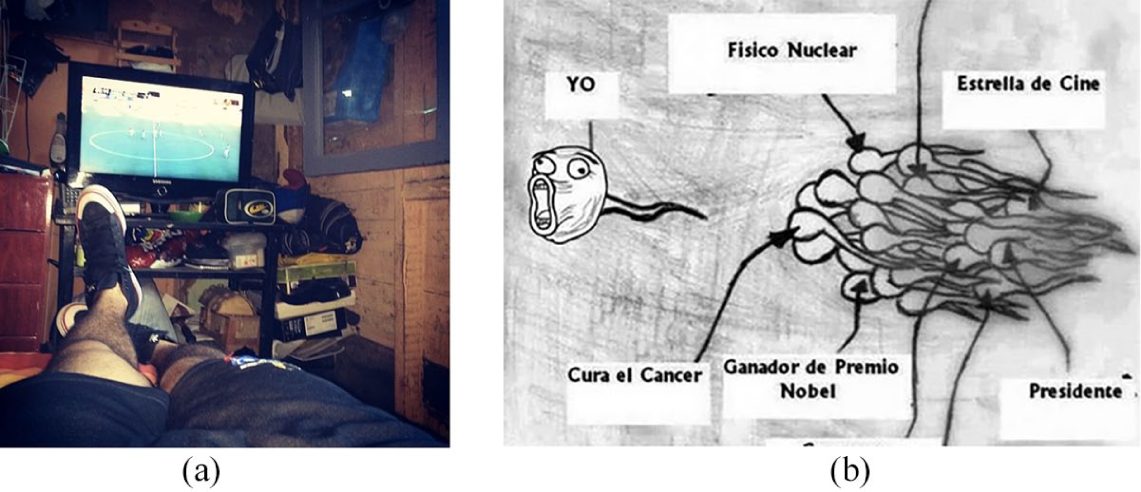
A northern man’s ‘footie’ while watching football; Meme depicting sperm racing for an egg. (Clockwise from top left) Me, Nuclear Physicist, Movie Star, President, Nobel Prize Winner, Cancer Curer.
But by far the most popular kinds of images posted on social media were memes. Most often, these images overlaid with formulaic language dealt with subjects related to economic instability, the inability to purchase luxury goods, and self-deprecation related to physical attractiveness, body size, or intellect. One meme (Figure 2(b)), a pencil drawing, depicted several sperm swimming toward an egg. Simply drawn individual sperm shapes were labeled as nuclear physicist, movie star, Nobel Prize winner, and president. Notably, the sperm labeled ‘me’ was drawn with a goofy face often used in memes to represent an unintelligent or irreverent character. In contrast to greatness, this meme framed the sharer as mediocre, and in solidarity with the other 2 ‘normal’ residents of the mining region. Similarly, a series of memes featuring Kermit the Frog (Figure 3) expressed desire for something – a better physique, nicer material goods, a better family, or love life – but Kermit always concluded that it was unlikely to happen, and that he would ‘get over it’. Kermit was a particularly apt ‘everyman’ to portray such sentiments because he is well known as a frog that faces hardships in life, as evidenced by his famous rendition of the song, ‘It’s not Easy Being Green’.

Kermit the Frog meme: ‘Sometimes I’d like to quit working. Then I remember that I don’t have anyone to take care of me and I get over it’.
These visual social media posts can be understood as closely reflecting the ways in which social solidarity, particularly in terms of social class, was important to community cohesion in northern Chile (see Haynes 2016). Northerners often suggested that one fits into the community through their status as a worker rather than as a consumer. As in China, particular historical, political, and social formations make such local ideologies legible. Northern Chile has been an important mining region since the late 1800s. While mining has brought great wealth to the nation as a whole, manual laborers in these projects have historically worked under harsh conditions, low pay, and coercive employment strategies. In the first decade of the 1900s, when nitrate was the primary mining resource, these workers fomented the Chilean labor movement, a point of pride in the region, even today. The vast inequalities of the nitrate era have persisted and were particularly re-entrenched during the US embargos preceding the brutal Pinochet dictatorship and the neoliberal economic shocks that followed it. Chile remains the most unequal highly developed country in the world. The northern mining region remains the least economically advanced area in the country, and communities tend to rally around notions of marginalization while valuing identities associated with hard work over consumption. In fact, many northerners are deeply suspicious of individuals with aspirations to join the growing upwardly mobile middle class of South America, a sentiment popular in other areas of the continent. Instead, the region’s connections to resource extraction and exportation through the Pacific structure normativities. When northerners occasionally posted the types of images popular in GoodPath town, their neighbors interpreted them as a bid for upward mobility, and they were met with judgment and gossip. Instead, northern Chileans used social media to distance themselves from consumption and presentation of elite consumer goods. For them, highlighting their ‘normal’ daily life on social media was an ideal way to portray their particular positioning within the inequalities of neoliberal economics and cultural formations.
Conclusion
Globalizing forces associated with neoliberal economics have indeed fostered cultural exchanges that at times lead to homogenization. Individuals internalize new social norms as they meet people from other places, use goods that have traveled from afar, and engage with media that moves across the world at half the speed of light (Singla et al., 2014). Yet at times we might underestimate the impact of local economies, histories, laws, regulations, and social structures in the ways that these globalizing forces are taken up. This comparison between a Chinese factory town and a Chilean mining region, indeed confirm the ways in which neoliberal processes may be globally connected but their impacts are always locally specific.
This phenomenon of ‘glocalization’ (Robertson, 1995) has been well documented in terms of consumer products, but media use as a site of simultaneously universalizing and particularizing tendencies has only recently become subject to academic attention (e.g. see Straubhaar, 2014). Media is a particularly important field of inquiry, because of the ways it allows us to understand the impacts of neoliberal processes outside of the economic. Looking at individual’s identity-making practices on social media allows us to understand them beyond their roles as migrants, as laborers, and even as consumers of globally circulating goods. As Emily Martin and other scholars contend, analysis of laborers’ lives outside the workplace, and their senses of personhood are of vital importance to understanding the reorganization of the labor processes within neoliberalism (Dunn, 2005; Martin, 1997; Yanagisako, 2002). Indeed, art historian Richard J. Powell, paraphrasing Amiri Baraka, argues that ‘an analysis of a particular political, economic, and social class of people includes an analysis of their outward expressive, aesthetic selves’ (quoted in Frederick, 2016: 36). Although people around the world are using similar platforms and this may seem to implicate social media as an instrument of global homogenization, the degree to which users are able to transform these platforms into specifically local phenomena demonstrates the ways that social media may equally be understood as instruments of global heterogeneity (Miller et al., 2016). Understanding the landscapes of social media use within neoliberal spaces, and particularly understanding the variations between different contexts is vital then, to nuancing our understandings of neoliberal globalization, mediascapes, and even the ways we conceptualize the region of the Pacific Rim. By looking at the diversity of experience in different localities around the Pacific, we find that the region is not just defined by its geographic commonalities, trade connections enabled by this geography, or even the cultural consequences of geography and exchange. Rather, local histories within the Pacific Rim are always tied to other world regions, inflecting the types of cultural phenomena we see within the rim. This makes the Pacific an important locus for inquiry relevant far beyond the what might narrowly be defined within the region, extending to the entire world system.
Footnotes
Funding
The author(s) disclosed receipt of the following financial support for the research, authorship, and/or publication of this article: This article was made possible by support from the Center for Intercultural and Indigenous Research at Pontificia Universidad Católica de Chile, the Centre for Digital Anthropology at University College London, the European Research Council, Chile’s National Commission for Scientific and Technological Research, and the Wenner Gren Foundation.
