



Abstract
Social media are increasingly entrenched in politicians’ campaigning. Yet even as they become more ubiquitous, evidence suggests widely used platforms normalize rather than equalize the existing power dynamics of the political landscape. Our study of New Zealand’s 2017 general election uses a mixed-method approach including analysis of five Party Leaders’ (PLs) public Facebook wall posts, campaign coverage in four newspapers and interviews with Party workers and MPs. Our findings show PLs seldom interact with citizens and mostly use posts to promote campaign information. Citizens are more likely to ‘like’ a PL’s post than share or comment and there are important divergences between Party and media agendas. These findings demonstrate not only the importance of social media for Parties’ attempts to control messaging and disrupt journalistic interference, but also highlight that neither Parties nor citizens seem much invested in dialogue. However, understanding which posts excite citizen engagement may help all Parties more effectively promote participatory democracy globally.
Keywords
Politicians who have adopted Facebook cite the desire to appear modern, to bypass media gatekeepers and to interact with voters as motivations to join the platform (Keller and Kleinen von-Konigslow, 2018; Magin et al., 2017; Skovsgaard and Van Dalen, 2013; Sorensen, 2016). As Facebook usage increases among the general population of most contemporary democracies, it has also become an important social media platform in the political sphere (Bossetta, 2018; Magin et al., 2017; Yarchi and Samuel-Azran, 2018), though individual politicians’ adoption rates vary markedly within and across countries. For example, just 26% of Swiss politicians were on Facebook in 2015 (Keller and Kleinen von-Konigslow, 2018), whereas 97% of Danish politicians were using Facebook in 2014, likely impacted by resourcing levels and the extent of parties’ cross-sectional appeal (Quinlan et al., 2018). It is surprising that uptake is not more widespread given the equalization rhetoric of social media and at least some evidence that politicians adopting social media receive increased public attention (Van Aelst et al., 2017). However, given the time lag between the publication of research and the reality on the ground, it is very likely that uptake levels are now moving towards saturation.
Once politicians are signed up to Facebook, their activity levels also diverge (e.g. Keller and Kleinen von-Konigslow, 2018; Magin et al., 2017; Sorensen, 2016) but some general trends emerge. Politicians’ Facebook posts tend to focus on a combination of information, mobilization and to a lesser extent, interaction (e.g. Magin et al., 2017) – or marketing, mobilization and dialogue (cited in Sorensen) – with the information-sharing ability of Facebook especially appealing to politicians, parties and campaign teams. This informational content is mostly heavy on visuals and not overly political in language or style (Magin et al., 2017). Studies of politicians seeking the top job in politics show similar trends, for example, a considerable proportion of Facebook posts made by US presidential candidates comprise links, mostly to campaign websites and media items (Bossetta, 2018). Larsson’s (2015) study of Norwegian leaders’ Facebook posts captured high levels of campaign reports and information, with little critique. The importance of social media research distinguishing between different platforms’ content (Bossetta, 2018; Stier et al., 2018) is emphasized in multi-platform studies showing, for instance, that campaigning topics comprise nearly half of Facebook posts and are much more common in politicians’ Facebook posts than on Twitter (Bossetta, 2018; Stier et al., 2018), and video content more common on Facebook than other platforms (Bossetta, 2018). The presence of mobilization content on Facebook likely reflects the nature of the platform where most followers are already supporters, thus logical targets for increased involvement, though some studies also note politicians’ unwillingness to be too direct with mobilization requests for fear of alienating voters.
Despite its networked architecture and some suggestion that voters respond favourably to politicians’ interventions in online conversational threads (Meeks, 2019; Utz, 2009), few politicians proactively engage in sustained, genuine dialogue on Facebook (Magin et al., 2017; Ross et al., 2015). This may reflect resource limitations and perceived risks or be a corollary of passive engagement by citizens online, where modest levels of follower engagement are the rule. A negative discussion culture may also inhibit interactivity (Magin et al., 2017). As with activity levels, politicians’ Facebook interactivity or engagement varies by individual, party, country and context, with some support for the notion that female politicians and those from smaller parties interact more (Sorensen, 2016; Yarchi and Samuel-Azran, 2018). Sorensen found most politicians engaged in some form of dialogue with followers in 2014, possibly reflecting the highly engaged electorate and the non-campaign context of his study, or because of ‘a general evolution in the use of Facebook’ (p. 680). Kok-Michalska et al.’s (2016) findings are also consistent with an evolution in digital usage: all parties in the four countries they studied, significantly increased ‘web 2.0’ components of their websites between 2009 and 2014, although ‘1.0’ features still prevailed, and there was a shift from a mobilization to an interactive strategy in Germany, Poland and the United Kingdom. In one of the few longitudinal studies, albeit of Twitter, Meeks (2019) captured an increase in two candidates’ interactivity between 2012 and 2014, with her definition of interactivity including photos of politicians interacting with others. This idea that an evolution in Facebook use will necessarily result in more interaction is, however, contradicted in another non-campaign study, in Austria in 2015, showing that ‘the more publicity and public attention a profile receives, the less political actors are willing to react to user comments’ (Heiss et al., 2019: 1510). Evolution may in fact be a less apt metaphor than the ebb and flow thesis advanced by Kok-Michalska et al. (2016) or the cyclical dimensions noted by Quinlan et al. (2018).
Politicians’ communicative activity is only part of the equation if we are to understand the role of new technologies in equalizing or normalizing political power. In terms of visibility, we need to examine not only who speaks (i.e. their presence on the platform and the number of posts) but also who gets heard, through considering the reach of messaging on social media. For various reasons (such as algorithms), politicians’ activity per se is not clearly associated with impact. Keller and Kleinen von-Konigslow (2018) concluded that intensive activity on Facebook does not lead directly to more digital reactions (likes, comments, shares) but there are indirect effects such as more activity leading to more followers leading to more reactions. ‘Likes’ are the most popular form of feedback, followed by comments and shares: ‘lower or less demanding forms of engagements appear as most common’ (Keller and Kleinen von-Konigslow, 2018: 469; see also Larsson, 2015). The extent of likes and shares is influenced by the use of humour and expressions of enthusiasm and fear in messages (Metz et al., 2019); similarly, comments are stimulated by issue polarization, humour and positive emotions (Heiss et al., 2019; Larsson, 2015). There is also some evidence that high levels of audience engagement are linked to messages which include private or intimate self-personalization (Metz et al., 2019), the least frequent forms of personalization used by politicians. In their work on Israeli politicians, Yarchi and Samuel-Azran (2018) found that women politicians achieved higher levels of engagement on Facebook than male colleagues which they argued was a result of their greater propensity to share personal information and make attacking comments. Larsson (2015) showed acknowledging support and making critical commentary (the least present topics) also resulted in the most engagement with Norwegian leaders’ Facebook posts and noted the tension between what politicians talk about and what topics activate and animate the Facebook audience.
While the ability of social media to circumvent media gatekeepers is widely identified as an attractive equalizing opportunity, particularly for small parties (Magin et al., 2017) and women, relatively few studies have looked closely at the relationship between political content on social media (specifically Facebook) and mainstream political news content. The limited number of studies which do, suggest that the agendas of traditional news media (produced by journalists) and ‘political’ social media (mostly produced by journalists and political actors) are related and work together to influence the overall visibility of politicians. Stier et al. (2018) suggest there are ‘persistent – although probably diffuse and mediated – agenda-setting effects between mass media and social media . . . as well as within social media’ (p. 67). Studies of Twitter and news media suggest a connection, not around activity level but popularity. Van Aelst et al. (2017) found that activity level on Twitter was not correlated to media attention but that popularity was connected, and ‘a small political elite of predominantly party leaders and ministers is successful on both platforms’ (p. 728). In this way, ‘social media replicate existing imbalanced representations in traditional media’ (Kruikemeier et al., 2018: 224). In other words, key political actors continue to gain high visibility while everyone else struggles for attention. Keller and Kleinen von-Konigslow (2018) also found ‘the structural advantages of high levels of media coverage best predicts social media success’ although the impact was less clear-cut on Facebook than Twitter (p. 8). Our study thus contributes to both the extensive global literature around politicians’ social media usage and the lesser studied dynamic between social media and mainstream media agendas.
The NZ context and the 2017 election campaign
NZ’s electoral system is mixed member proportional (MMP), a form of proportional representation where voters cast two votes: one for their representative in a geographic district (electorate vote) and one for their preferred party (party vote). Although most parties seek ‘two ticks’ from voters, tactical vote-splitting is common and some smaller parties prioritize campaigning for the party vote which, if over the 5% threshold, determines their share of seats in the 120-member Parliament.
Mainstream coverage of the 2017 election campaign was dominated by the Party Leaders (PLs), particularly of the two main parties, National and Labour (Levine, 2018; Mills et al., 2018). While this is not unusual, in this election, it was particularly acute because Labour had elected a new (young, female) leader – Jacinda Ardern – just weeks before election day. Under her leadership, Labour quickly became a credible opposition party for the high-polling National-led government which had hitherto been predicted as the obvious election winner. The final election result would see Ardern become Prime Minister, leading a three-party coalition government, although the National Party won nearly half the party vote (44% compared to Labour 37%, NZ First 7% and the Green Party 6%).
Given the importance of Facebook in contemporary political communication and the ongoing celebrification of politicians (Street, 2003; Wheeler, 2012), we were interested to see how PLs presented themselves on Facebook. The specificities of the political context of the 2017 election offered a useful opportunity to consider the importance of the PL as figurehead and proxy for the all-important party vote, given that three were incumbents and two (including the only woman) were very recently in post. While we acknowledge that politicians, especially PLs, do not always write their own social media (see also Adams and McCorkindale, 2013; Zamora Medina and Zurutuza-Muñoz, 2014), what is posted under their names nonetheless says something important about how they (or their campaign teams) wish to present themselves and we are interested in this conscious aspect of presenting the ‘self’. We also wanted to determine if the issue-based content of PLs’ posts aligned with the mainstream news media’s agenda. Much of the research about politicians’ motivations to use social media platforms suggests that a primary reason is precisely to circumvent the gatekeeping and ventriloquising tendencies of journalists (Hong et al., 2019; Larsson and Kalsnes, 2014; Ross et al., 2015). Finally, we wanted to explore first-level public reaction to the PLs’ posts, given social media’s ability to extend the reach of messages through sharing, and facilitating interactions through likes and comments.
Method
We chose to focus on Facebook since it is the most widely used social media platform in NZ (Gervai, 2017). We collected every Facebook post published across the full campaign period (23 August–22 September 2017) from the public pages of the five main PLs: Bill English (National), Jacinda Ardern (Labour), James Shaw (Green), Winston Peters (NZ First) and Te Ururoa Flavell (Maori), totalling 606 posts. The posts were captured manually as screenshots after each original post had been up for 48 hours. The Parties selected for analysis had all achieved a minimum of two MPs in the 2014–2017 term. While that term saw seven parties represented in Parliament (centre-right National forming a minority government with support of the Maori Party, ACT and United Future), both the latter Parties had just one MP, as a result of winning an electorate seat with the tactical support of National. The Maori and Green Parties traditionally have two co-leaders, but we decided to follow just one (co) Leader for each party to enable a direct comparison, not least because Green co-Leader Metiria Turei resigned (and was not replaced) just weeks before the campaign. For the Maori Party, Flavell was the logical choice because of his higher profile and because it was his electorate win in 2014 that brought his female co-Leader Marama Fox into Parliament as a list MP.
We also undertook a quantitative content analysis of all election-related stories and columns published during the official campaign period in NZ’s two highest-circulating daily newspapers (Dominion Post and NZ Herald), and the two main Sunday publications (Sunday Star Times and Herald on Sunday). These newspapers also represent the country’s two major ownership chains. We coded 527 newspaper items, from 23 August to 22 September inclusive, for topic, sources, tone, visuals and personal comment.
We contacted all five PLs seeking an interview about their Facebook activities but only Te Ururoa Flavell agreed to an interview. However, we also interviewed Tory Whanau (Chief of Staff for the Green Party), Neale Jones (ex-Chief of Staff for Labour) and Paula Bennett (Deputy Leader, National).
Findings
We start by providing basic data about the volume and content of the 606 posts. The first aspect to note is the considerable difference in the volume of posts sent from the five PLs’ accounts, with Flavell sending the most (173) and Shaw the least (41). Peters was the third most prolific (138) behind National’s English, who made nearly twice as many posts (169) as Labour’s Ardern (85). The low volume of Green Party posts is surprising, as in previous elections, in NZ and elsewhere, Green MPs have tended to be very active on social media. However, Whanau (2018, personal communication) explained they were under-staffed and under-resourced this time round.
Nearly three-quarters (72%) of posts included photos or moving image content, with only 7% being text-only, although this figure conceals significant Party differences (e.g. Peters made 67% of text-only posts). The most frequently used images were photos of the PL with at least one other person, but more often a group of people (29% of all posts included this kind of content), followed by photos of events (10%), other people only (9%) and the PL with family members (4%). Interactive photos showing MPs with citizens were the most frequent type of accompanying image for English (39%), Ardern (36%) and Peters (31%). Photos with children and young people were included in 9% of all posts, including in nearly a fifth of all photos posted by Ardern and 11% of those posted by English. Ardern’s more frequent use of photos of herself with young people was part of Labour’s campaign strategy to attract younger voters and leverage Ardern’s popularity and dynamism. Labour’s Chief of Staff explained, We printed a load of white T-shirts with ‘Let’s do this’ on them and our standard backdrop was a load of people wearing those T-shirts, standing behind her looking excited and happy and having fun. It shows that she’s popular, that she’s engaging people. (Jones, 2018, personal communication)
Just over 25% of Shaw’s posts contained images of himself only, whereas the most popular type of image included in Flavell’s posts was photos of other people (16%). Arguably, Shaw’s strategy was intended to boost face recognition of himself as Green PL, given he was the least well-known of the five. Of the small proportion of photos which did not feature people at all, 67% were posted by Flavell and his posts also accounted for more than half of those which only included photos of other people (58%). The propensity of Flavell’s (2018, personal communication) posts to feature other people may reflect his having to do much of his social media himself with very few resources. Although Flavell (2018, personal communication) was the least likely to include photos of himself with young people (only 4% of all his posts), he was strategic in leveraging his daughter’s social media presence to reach out to younger voters, since she (Miria) had a significant following in her own right: It was her post which I shared. She’s younger and has a large following so the post reached that younger generation. It had some humor, it had some realism with a daughter talking to her dad.
Of particular interest, in terms of images, is the extent to which PLs’ families were included in their posts. While photos of PLs with family members were relatively infrequent (4% overall), the majority were posted by English (77%), followed by Flavell (14%) and Ardern (9%). In the case of English, his wife and his children featured more or less equally alongside him on the election trail at formal events, with a few showing him and his family at home but still in campaign mode. Flavell’s family photos were all of him and his daughter. Ardern posted only two photos of herself and her partner, one at a campaign event and one at a recreational event. Neither Peters’ nor Shaw’s posts included any family photos. Interestingly, this pattern of including or excluding family members was mostly replicated in mainstream media coverage, with 26 stories featuring English’s family compared with 18 mentioning Ardern’s family (mostly her parents) and even fewer for Peters (five mentions of his partner) and Shaw (one mention of his mother). But there were no mentions of Flavell’s family and, indeed, there was barely any mention of him at all in mainstream media election coverage.
Given the importance of visual material for social media, we were also interested in moving images, especially live video which was then a relatively new but increasingly popular Facebook feature. Just over a quarter (27%) of all posts contained some kind of moving image including around a third of posts from English, Ardern and Flavell, with Peters’ posts including the least amount of such imagery (15%). The majority (48%) of video content from all PLs comprised Party Election Broadcasts (PEBs) or other kinds of direct-to-camera party messaging. Other types of video content were favoured by particular PLs, for example, English, Ardern and Flavell used Facebook live video but only English and Flavell uploaded video content which included family members. Only Peters posted video content from Parliamentary debates, only Ardern posted video selfies and only Flavell posted video content produced by non-political organizations.
As well as noting visuals and moving image content, we also captured the extent to which PLs activated other elements of Facebook’s architecture including embedding links to external content: 20% of all PLs’ posts included weblinks, the majority to their own Party websites (43%) or mainstream news sites/other media outlets (48%). These results are very similar to Bossetta’s (2018) study of US presidential candidates.
Posting political content
As well as form and format, we were obviously also interested in content. First, we considered the broad topic of posts and, unsurprisingly, the predominant focus was on PLs’ own campaigns (45%), with promoting their Party’s campaign being the next most frequent topic (19%). Altogether, campaigning-related posts comprised nearly two-third of all posts, reflecting the findings of other studies of PLs’ posts (Larsson, 2015), although there were some interesting differences between the candidates. For example, 77% of English’s posts were campaign-focused, compared with 55% of those produced by Flavell. Peters’ and Shaw’s campaign posts constituted 69% of their total posts, and Ardern’s was 68%, although Shaw was the only politician who made more campaign posts about his Party than himself. Again, this is perhaps unsurprising because of all the Leaders, Shaw was the least well-known. Greens’ Chief of Staff explained, We started off quite light because in a way we were rebuilding our brand . . . we had lost a lot of trust from the public and the polls showed that . . . so we wanted to spend the last few weeks building up James as a really likable leader and non-controversial. (Whanau, 2018, personal communication)
Whanau’s analysis was borne out by the newspaper coverage of the PLs where we found that Ardern, English and Peters were much more likely to be the topic of a news article than their respective parties, but the opposite was true for Shaw.
Policy matters
Around a quarter (24%) of all posts mentioned a policy topic although the frequency of mentions varied significantly between the five PLs, from 61% of Shaw’s posts, down to 7% of those made by Flavell: policy topics were mentioned in 40% of posts made by English, 26% of those made by Ardern and 15% by Peters. Some aspect of policy was also mentioned in 37% of the mainstream election coverage. When asked about his low volume of policy-oriented posts, Flavell (2018, personal communication) said that policy-focused social media content was disliked by supporters, and he made a conscious effort to play politics ‘lite’: Someone took a photo of me dancing with our children in our house and it got thousands of hits and comments about my style but you put up a policy item and you get no response whatsoever . . . Sometimes people don’t really know what the issues are about so laying them out in a fun way . . . seemed to work as people were tuning in regularly and enjoying the engagement.
While there is little published evidence to support the view that humour generated by politicians themselves is appreciated or prompts positive voting action, some politicians nonetheless give humour the benefit of the doubt. Paula Bennett (2018, personal communication) also mentioned including humour to convey a sense of the ‘ordinariness’ of the political persona. This more playful approach to political communication was most clearly seen in posts made by Flavell where the humour was largely self-deprecating and directed at himself and/or his co-Leader, Marama Fox.
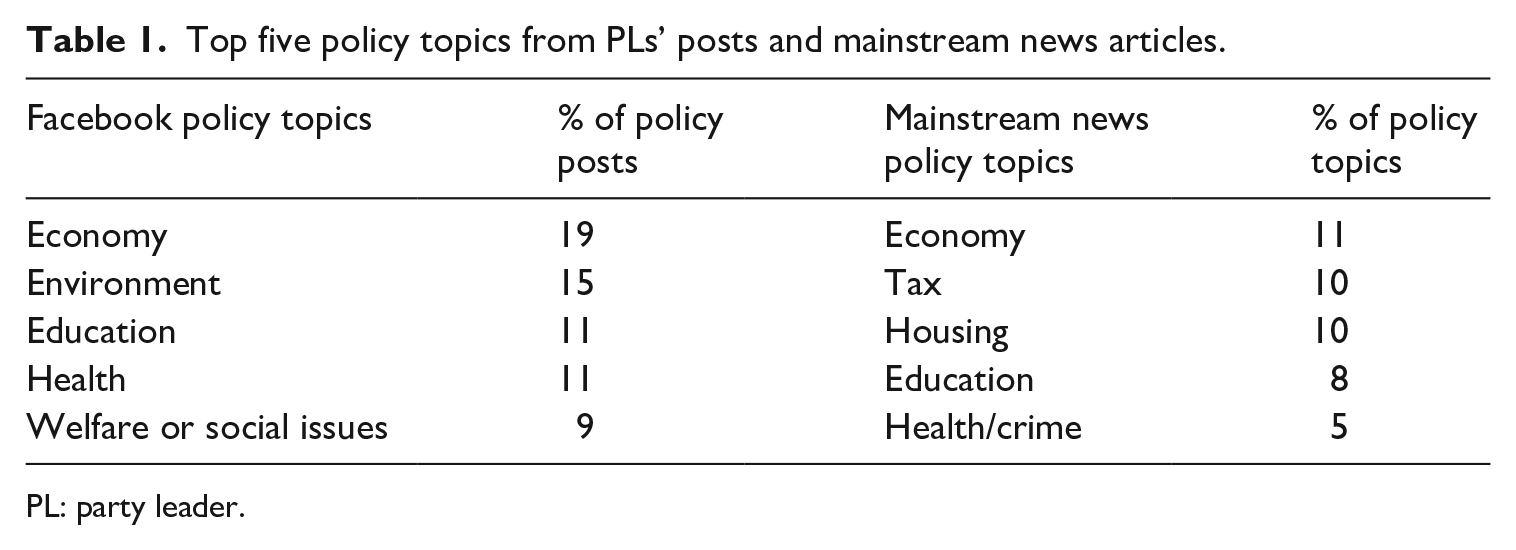
As far as policy topics were concerned, a large number of different ones were mentioned but the top five, across Facebook and mainstream news, are captured in Table 1.
Top five policy topics from PLs’ posts and mainstream news articles.
PL: party leader.
Again, composited categories listed in Table 1 conceal significant differences between Parties. For example, the top topic for English was the economy (26% of his policy posts), followed by general support for National’s policy agenda (18%) and then education (15%). For Ardern, the top three policy topics were health (32%) and then education, housing and the environment on 14% each. However, Peters’ priorities were the economy (38%), followed by the environment and welfare reform both on 19%. Flavell’s top three policies were equality/Maori language (50%), welfare reform (25%) and the environment (17%). Finally, Shaw was mostly interested in the environment (40%), health (16%) and education (12%). No PL’s agenda had a clear overlap with the mainstream media agenda, although the economy was the top topic across both formats. PLs were more likely to post about the environment and health rather than tax or crime, but Flavell’s policy concerns, particularly around Maori, were the most notably out of sync with the mainstream news agenda. Interestingly, across all the election news articles, Ardern was mentioned in relation to tax more than twice as often (54%) as English (23%) and was the PL most mentioned in any policy-focused news item (48%) compared with English (31%). Flavell received no traction in the mainstream media with any of his messages about equality for the Maori community or language, and although these were occasional topics of opinion pieces, he was never directly referenced.
Given our focus on the PLs’ public Facebook pages, perhaps it is not surprising that so few posts were non-political (6%), of which 33% mentioned family members. The vast majority of these posts were made by Flavell (40%) and English (31%) – the traditional ‘father figures’ in the sample – with the other PLs much more reticent about exposing aspects of their personal lives.
Similarly, news articles included very few (3%) mentions of PLs’ personal lives, although slightly more mentions of their family members (9%). Across both types of personalized commentary, the primary focus was Ardern (66% of personal mentions and 37% of family-focused comments) and English (53% of family-focused comments and 22% of personalized comments). The focus on English’s family members, mostly mentions of his wife, reflects other studies suggesting that the wives of PLs receive more visibility than women political candidates during elections (Harmer, 2015).
These differences between message content sent by politicians/parties and news content about those politicians/parties provide further support for the suggestion that Facebook is used by political actors to control content and frame preferred meaning, removing the interpretive lens of the journalist. Another major difference identified between the two forms of communication, at least in our study, is orientation, with posts being almost entirely devoid of negative content, including attack campaigning. This contrasts with most mainstream news outlets where journalists are routinely critical of politicians of all colours, almost as a default setting.
Ask the audience
The aspect of social media most promoted as potentially shifting the rules of political engagement is the dialogic communication between politicians and citizens enabled through mechanisms such as commenting, liking and sharing. However, most research on politicians’ use of social media, especially Facebook and Twitter, suggests that despite this potential for interactivity and direct communication, politicians and Parties are much more likely to simply replicate the kinds of monologic flow found in other forms of digital communication such as websites and email (Magin et al., 2017; Stromer-Galley, 2000).
Interactivity though comments
We found that all PLs engaged in some degree of interactivity during the campaign, with Flavell being particularly interactive, making 103 responses to comments made on 58 of his posts. Aside from Flavell, we noted 26 responses to 18 posts made by the other PLs, 17 by English, 4 by Peters, 3 by Shaw and 2 by Ardern. Flavell stands out as something of an outlier, perhaps because he used Facebook as a more explicit tool for constituency engagement. However, it is also interesting that he was the least interactive visually in terms of uploading photos of himself with others. Our findings broadly reflect those of others which report low levels of interactivity: one of the primary reasons given for politicians’ reluctance to engage with citizens through direct response is the potential for losing control of the message (Heiss et al., 2019; Stromer-Galley, 2000). That concern is likely to be a contributory factor in our study too.
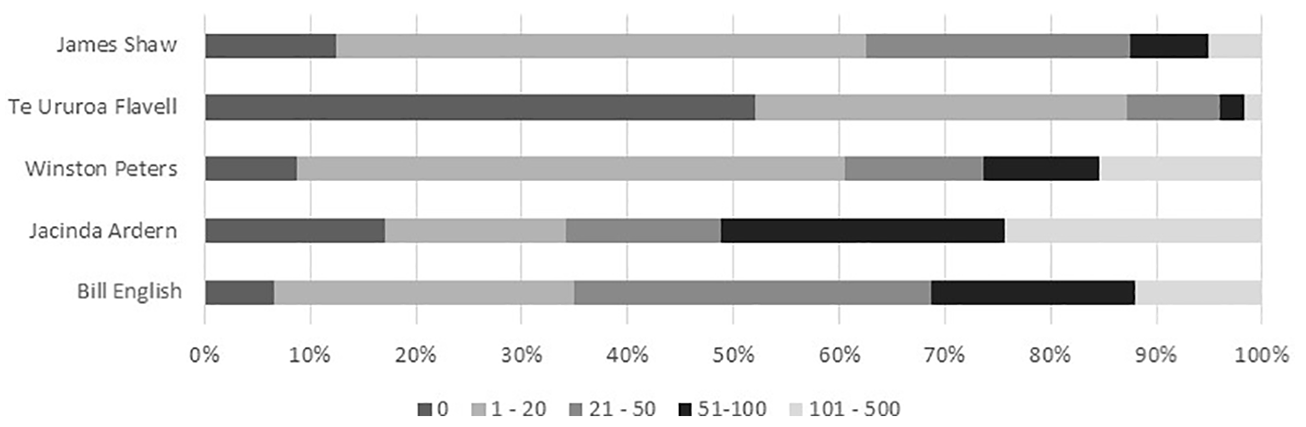
In terms of interactivity on the citizen’s side, we looked at the volume of comments, shares and emoticons which posts provoked and Figure 1 shows the average number of shares achieved by each PL.
Patterns in audience shares, by PL.
Shares
Across the corpus of 606 posts, a majority (78%) were shared at least once, although the poor response to many of Flavell’s posts (52% had no shares at all) considerably skews the average since without these very poorly performing posts, only 10% of the posts of the other four PLs received no shares. While not all her posts were shared extensively, overall Ardern’s followers performed the best in terms of sharing, with 50% of her posts being shared at least 50 times, including 24% being shared between 100 and 500 times. She was nearly twice as successful as English and Peters in this respect, where 31% and 26% of their posts respectively were shared at least 50 times. A further eight posts were shared more than 500 times, three each from English and Ardern and one each from Peters and Shaw. While most people would likely be pleased if even one of their posts received 10 shares, let alone 50 or 500, this level of positive endorsement is rather less impressive for PLs whose follower base, at least for English and Ardern, runs into hundreds of thousands of people. This low level of arguably the most important kind of interactivity, where posts are shared and thus extend the reach of the original message, is rather underwhelming. However, it is absolutely consonant with other literature including Larsson’s (2015) study of Facebook posts of nine PLs (including co-Leaders) in the 2013 Norwegian elections. It is also likely to be one of the primary reasons why political parties do not allocate more resources to their Facebook pages, since evidence indicates an ambivalent public response.
Likes
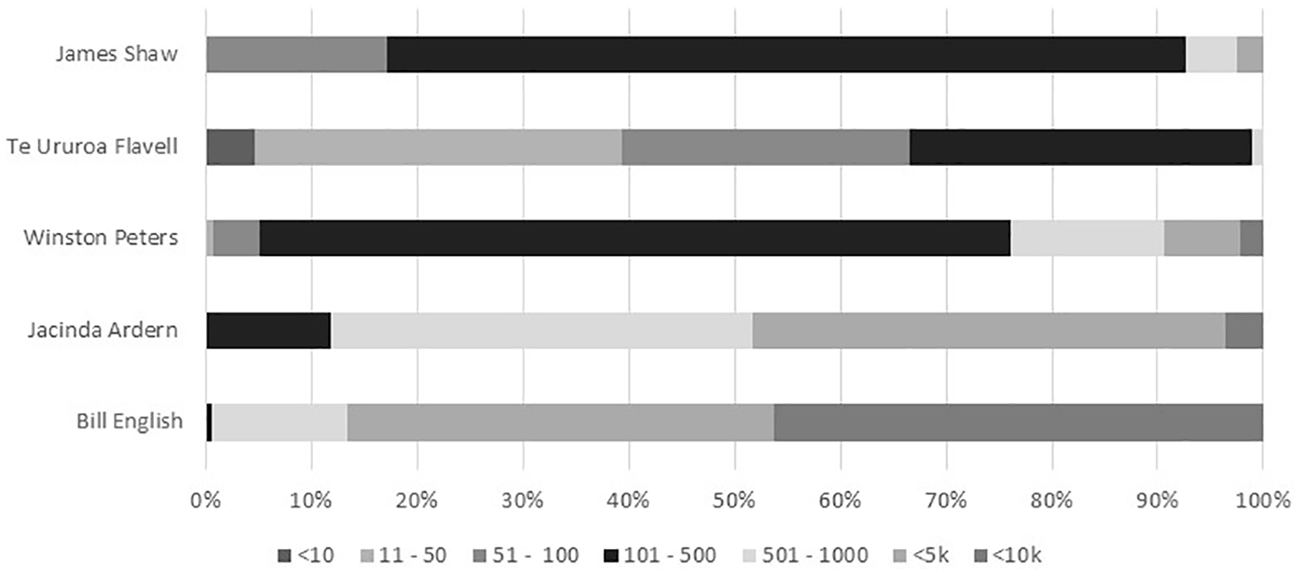
Figure 2 reveals that the majority of posts made by the then PM English (84%) attracted more than 5000 likes, including 45% prompting more than 10,000. A further five of his posts received between 10,000 and 20,000 likes. By contrast, just under half of Ardern’s posts prompted more than 5000 likes as did 9% of those made by Peters and 2% of those made by Shaw. As with shares, Flavell’s posts received fewest reactions, with 62% receiving less than 100 likes and a further 5% receiving no response at all.
Patterns in audience likes, by PL.
We also explored the use of emoticon responses and with very few exceptions, they were overwhelmingly positive (e.g. love, ha-ha, wow). We found only 15 posts (2%) where the volume of negative emoticons (angry) was more than 10% of the combined number of positive emoticons and likes, six of which were posts made by Peters, followed by three from English, two from Ardern and one each from Flavell and Shaw. Six of those posts, two from each of English, Ardern and Peters, were posts which also scored in the top three for each PL in terms of numbers of shares and comments.
Follower comments
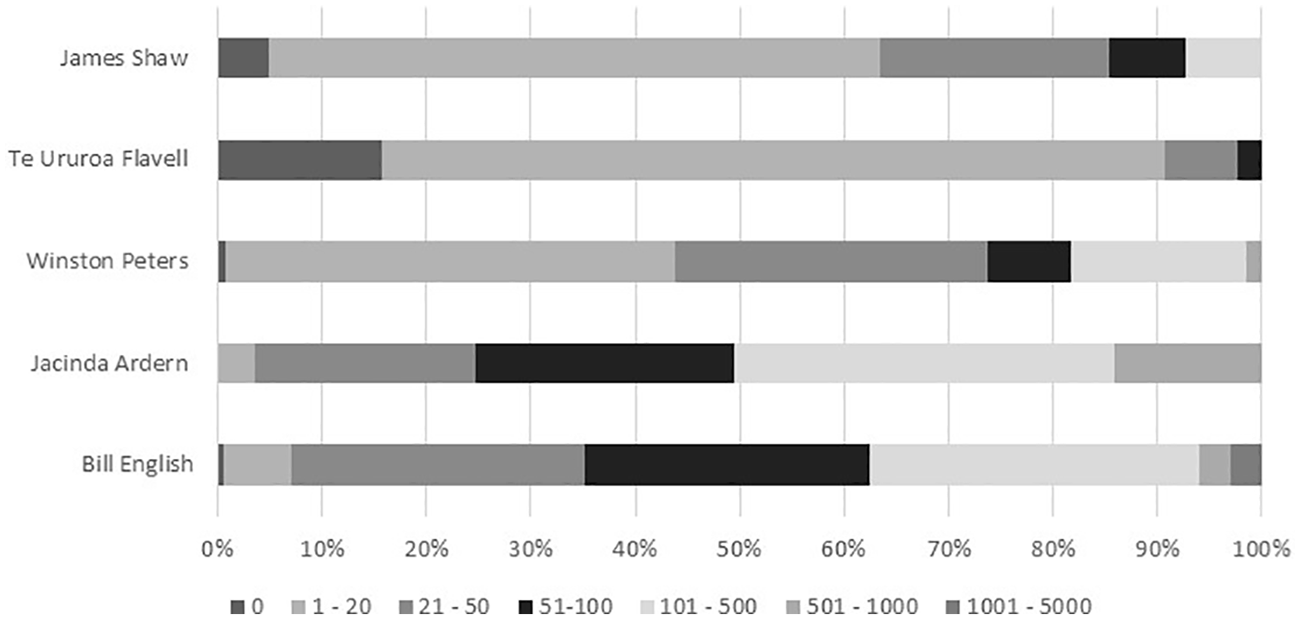
When we look at comments (Figure 3), we see a similar pattern to shares in terms of which PLs’ posts attracted the most public reaction: Ardern and English provoked significantly more commentary than the other three. Again, Flavell’s posts were the least likely to attract comment, with 16% receiving no comments and 75% receiving fewer than 20, although 59% of Peters’ and 43% of Shaw’s posts also received fewer than 20 comments.
Patterns in follower comments, by PL.
Interpreting leaders’ interactivity
What, if anything, can NZ PLs’ most provocative posts tell us about social mediated politics more broadly, and about what kinds of message move citizens to respond in both positive and negative ways? For Ardern, the post which had the most shares (1937), the most comments (871), the most likes (7100) and the second highest number of angry emoticons (52) was one of two PEBs she made on the topic of tax: that post also attracted 196,000 views. Ardern’s post which had the most (75) angry emoticons was another PEB, also about tax. It is interesting that these high levels of engagement were in response to a topic that she spent little time engaging with on Facebook in terms of original posts, but to which she was clearly linked by mainstream media. We argue that this is a good example of the media’s priming effect, and one which has implications for politicians across various mediated campaign settings.
For English, different posts provoked different responses: the post with the most shares (1753) was a PEB criticizing Labour but the one prompting the most comments (2075) was a Live Facebook Q&A he did with one of his sons, which also attracted the second highest number of views (154,000). The post which provoked the highest number of angry emoticons (153) was a single photograph of English holding a ‘thumbs up’ placard with the message, ‘thumbs up if you’re party voting National’: however, it also prompted the second highest number of likes (6600). Although there were very few negative posts overall, their ability to attract significant audience reaction has been documented in other studies (Heiss et al., 2019; Larsson, 2015), and was also observed by Neale Jones (2018, personal communication) explaining Labour’s hesitancy to introduce such topics online: Every time we posted something about refugees on Facebook we got swamped with awful racist troll comments . . . there was so much hate, and that made us think twice about posting on such topics, not because it was unpopular or was damaging us but because there was so much vitriol, it was very difficult to deal with, to monitor and moderate.
For Flavell, Peters and Shaw, the posts provoking the highest number of angry emoticons (84, 439 and 43, respectively) were posts critical of others, but where the public anger expressed was actually supportive of the poster’s position, not against it, constituting a form of empathic rage. In Flavell’s case, there was some explicit encouragement to provoke a particular response from his followers since he reported his mood before writing the post, by saying he was ‘feeling annoyed’, giving permission to his supporters to follow his emotional lead. This post was about a journalist giving misleading information about who could vote for the Maori Party which, for a small party, is potentially disastrous. That post also had the most shares (295) and the most comments (99). The post with the most views was one of his PEBs (11,100) and one of Peters’ PEBs also attracted the most views for any of his posts (81,000). In Shaw’s case, his post commenting on the media’s exposure of the Government withholding a report on climate change had the most shares (140). In contrast, the post attracting the most likes (1100) showed him sitting crossed-legged on a mat holding several puppies with the single word caption, ‘puppies!’ It was a charming image, nothing to do with politics, but confirming the views expressed by Flavell and Bennett that the public are as interested in the politician-as-human as they are in the human-as-politician.
Discussion and conclusion
All the PLs favoured Facebook content promoting their own campaigns and those of their Parties which is entirely predictable although there were interesting differences across other aspects of their posting behaviour in terms of their use of visuals and humour, the proportion of personal content and their inclusion of family members. These differences could be the consequence of both personal and party preferences, including the particular character of the PLs themselves, their confidence and interest in using Facebook, the approach adopted by their campaign teams and the willingness of family members to get involved. Volume differences could reflect the extent of party resources available or personal preferences about spending time on social media or spending time on the doorstep. For example, after the election, English (2018) said he enjoyed being on social media, especially working with his sons, and this came through clearly in a number of his posts. However, Flavell also made several appearances with his daughter, hoping to leverage her large social media following but this was not effective in saving him or his Party at the ballot box.
Comparing what our PLs chose to post about and the mainstream news agenda, there were some similarities in terms of the top topics (specifically the economy, with health and education also appearing in the top five topics across both, albeit in different positions), suggesting that for the most part, politicians and their parties use Facebook (and indeed other social media platforms) as a vehicle through which to engage the public with the messages they want to promote. This was particularly noticeable in their policy-related posts where, although we discerned some differences in policy focus among the PLs, there were very few posts about crime or tax, both favourite topics of mainstream news. Both Ardern (2018) and English (2018) have mentioned elsewhere their use of social media to bypass mainstream news.
The ways in which social media can contribute to a more engaged polity has often been promoted as an enhancer of democracy but our findings suggest this hope remains largely aspirational. Although there were clear differences in the extent to which our five PLs interacted with their followers, and while at least one of the leaders (English) increased his interactivity since 2011 (Ross et al., 2015), overall levels of interactivity were low and echo findings from other studies (e.g. Gibson et al., 2014; Lilleker et al., 2011; Stromer-Galley, 2000). We found no evidence that our only woman leader was more interactive than her male counterparts, although she was the second biggest poster of interactive photos and the most likely to share photos of her interacting with young people. Flavell was by far the most interactive in terms of responding to comments, but his use of humour and a light touch with policy did not give him any traction on social media in terms of likes and shares, and did not raise his visibility in the mainstream media.
In terms of public engagement, the most frequent reaction was to ‘like’ a post rather than share or comment on it, liking being the easiest and quickest way to show support, sometimes seen as symptomatic of a ‘clicktivist’ mentality (Larsson, 2015). These likes undoubtedly display the kind of support which appears to endorse post content and could have a mobilizing effect on others. However, followers who took the time to comment on posts were less frequent. While this article is not primarily focused on followers, we suggest that what motivates citizens to follow politicians on social media is likely to determine what they do when they get there. Notwithstanding that a proportion will be there to attack, those who are friends on Facebook are also friends with other people, and some studies suggest the propensity to make opinions known through commenting and sharing is related to self-confidence (Liu et al., 2017; Marder et al., 2016). It is therefore safer to show (almost) faceless solidarity with thousands of others in ‘liking’ rather than to offer a comment or share and thus be (at least potentially) exposed to attack or opprobrium. However, one reason Ardern’s posts were shared much more than any of the other PLs could lie in the more youthful profile of her Facebook support base, digital natives being very used to sharing everything online, or perhaps because she was seen as an agent of change, a sentiment with which individuals were willing to align. Some studies suggest that citizens follow politicians on social media partly because of their dissatisfaction with mainstream media (Fisher et al., 2019), so they may be seeking information but not necessarily be supporters. Others suggest that most politicians have little or no traction with the public and those who do, arguably high profile politicians such as PLs, should be considered outliers rather than the norm (Nielsen and Vaccari, 2013), suggesting that Facebook is not an effective form of political communication for the rank and file politician.
Our findings make a useful contribution to the literature on social media and political communication, not least because so much of the extant work has focused on the United States or Europe and we show that smaller nations exhibit very similar trends. Two of the clearest messages are that high levels of social media activity by politicians do not necessarily provoke high levels of follower response, nor predict electoral success. Ardern made the second fewest posts and scarcely ever responded to commenters, but attracted more shares than any other PL and significantly boosted Labour’s party vote. On the other hand, Flavell made the second highest number of posts, employed family connections, humour and a light touch with policy, but attracted the smallest number of responses and lost his seat, although he increased his personal and party vote in his electorate (Flavell, 2018, personal communication). The election ‘winner’ – at least in terms of party vote – was English, who did not achieve the same level of shares as Ardern but was the second most likely to respond to comments and had significantly more likes, combining a fairly robust policy focus with the softer appeal of including family members. Notwithstanding the third-party campaign hands involved in the actual posts themselves, these findings demonstrate not only the complexity of the politician-citizen relationship on social media, but also prompt a consideration of the role of social media in the campaign tool-box. They also suggest that some Parties are more successful than others in both attracting followers and encouraging engagement across social media platforms, reflecting their popularity in the offline environment. What Facebook does not appear to be enabling is a genuine forum for two-way communication and instead, what we mostly see is what Stromer-Galley (2019) calls ‘controlled interaction’, carefully managed messages designed to explain rather than debate.
Importantly, we found significant differences between the content of policy-focused posts and the mainstream news agenda, which suggests that the priming proclivities of the latter are subverted by political parties’ social media use. At the same time, and working in the opposite direction, efforts by politicians to prime the public and/or the media were not successful either: much of Flavell and Shaw’s post content concerned issues with which their parties are especially associated (e.g. Maori culture and rights, and the environment), which were more or less invisible in mainstream media coverage. The only exception to this was citizen reaction to the sole written post Ardern made on the topic of tax, which prompted the highest level of engagement including the most angry emoticons, suggesting that, despite politicians’ attempts to claim the agenda, some topics are still too hot to handle.
Ultimately, our study of NZ PLs provides little support for the equalizing potential of Facebook. The two most visible leaders in mainstream media were also the two leaders who attracted the most public attention online, in comments, shares and likes, whereas the most prolific Facebook user was the only PL who lost his seat. There are clear limitations in studying social media in isolation from other influences on voter behaviour and election outcomes, including mainstream media, political advertising, track record in government and electoral systems. However, by focusing on a smaller nation with a proportional representation system of government, our study is a reminder of the importance of context and culture when interpreting the role of social media in contemporary election campaigns. It is also worth commenting that researching social media use is an ever-moving target, with platforms moving in and out of favour. Evidence of Parties’ fortunes being positively affected by the extent to which they post or tweet is entirely contradictory. But it seems likely that social media will continue to play an important role in providing mechanisms through which citizens can learn about politics and policies which are not refracted through the prism of mainstream journalism.
