



Abstract
The global data center industry relies on what this article defines as ‘climate extraction’. Through this peculiar but critical infrastructure for global Internet operations, a focus on Ireland reveals the entanglements of state, corporate, and environmental actors within the extractive calculations of transnational companies. Ireland has been advertised to and by data center developers because of its ‘cool’ climate while downplaying the importance of its low corporate tax rate and the government and planning system’s favorable treatment of big tech companies. Public discourses around big tech ‘greenwash’ power and contribute to a material climate (both atmospheric and infrastructural) from which value can be extracted. This is achieved by extracting for and from data circulation through the built and ‘natural’ environment. This article articulates the ways in which the spatial development of data centers as ‘strategic infrastructure’ contributes to the ongoing naturalization of capital and state power’s entanglements with the so-called natural world through technological systems.
The Republic of Ireland has seen a recent influx of data center development by some of the largest data colocation providers and tech companies in the world. Home to many of the largest companies in the world, and frequently listed as a prime location for data center, a distinction that the Irish government strives to maintain, this ‘boom’ will likely continue into the near future. Ireland’s ‘creative economy’ has been centered around the tech and financial services sectors since the rapid growth of the Celtic Tiger, and data centers would appear on the surface to be a continuation of these development strategies, which have arguably only intensified since the financial crisis (Lawton et al., 2014). Industry website Data Center Dynamics recognizes the fact that the attraction of data centers to Irish shores has been a recovery strategy following years of austerity and downturn. The yoking of weather, workforce, location, and tech/media infrastructure coalesce when Ireland begins to recover its ‘economic sovereignty’ (Jones, 2014). Leo Varadkar’s Fine Gael government has put forward an amendment to the Planning and Development Act of 2000 (particularly the 2006 addition on Strategic Infrastructure) to ‘allow data centres and other key IT infrastructure to be included in the criteria for access to the Strategic Development planning procedure’ (Government of Ireland, 2017), meaning that these private infrastructure projects are treated like other ‘strategic infrastructure’ are thus not required to seek planning permission with local authorities (O’Halloran, 2017). This comes on the back of messy planning disputes with the likes of Apple and Amazon, along with various reports on the role of data centers and other communications infrastructures in Ireland’s economic future (Government of Ireland, 2018; IDA Ireland, 2018). In spite of, and sometimes because of, these public debates, including around the potential effects of Brexit, Dublin is now reported to be the largest data-hosting cluster in Europe (Reddan, 2019).
The following article is not a history of this Irish ‘data center phenomenon’ specifically (for that, see McLaughlin, 2015). Using information collected from discourse and policy analysis, walking tours and site visits, and conversations with data center owners, entrepreneurs, and engineers, what this article will offer is a critical analysis of the politics of cloud infrastructure and finance capital as they are bundled and naturalized in a given territorial context using an array of governmental and discursive strategies, theorizing what I call the ‘climate extraction’ of data centers. This process occurs through local business and ‘natural’ environments as well as across networks of trade, finance, and infrastructure built between nations and in negotiation with trans- and supranational formations. Even describing the proliferation of data centers in Ireland as a ‘phenomenon’ detaches it from material contexts, assuming a phenomenological existence that paints over any frictions underneath. But this view also grants access, on a topological level, to the surfaces, visual culture, and discourse of the ‘data center industry’ in complex relation to geopolitics, civil society, and the natural environment. The approach in this article is thus speculative and transdisciplinary, drawing from thinkers across anthropology, geography, and media studies, putting these frameworks in conversation with histories of capital and industry in Ireland. Taking theoretical and practical tools from the subfield of ‘media infrastructure studies’ (see Larkin, 2008; Parks, 2015), the method I have adopted weaves together views of the industry between top-down promotional and infrastructural strategies and these operations as they take place ‘on the ground’ in Ireland. In doing so, we can see that rather than taking the path of least resistance, the strategies of the data center industry are often made more robust by what may initially appear to be spatial and cultural challenges to their smooth world imaginary, opening apertures to the cultural stakes of these big tech developments. As bordering mechanisms multiply across geopolitical contexts as well as across everyday life in the age of finance capital (Mezzadra and Neilson, 2013), tech companies plan spatial infrastructures in negotiation with states and cultures across avenues of friction and resistance, strengthening their functional operation and expanding their extractive power.
Discourses of ‘climate’ are crucial to understanding how data centers are established and function. As is by now well-known, data centers require enormous amounts of electricity to operate, much of which is directed toward cooling. These highly controlled microclimates utilize local climate conditions while affecting these same climate conditions in collateral ways, particularly via increased energy use and the resultant emissions (McLaughlin, 2015). Many have noted Greenpeace’s statistic that ‘if the cloud were a country it would be the fifth largest energy consumer in the world’ (Maxwell, 2014). In Ireland alone, energy projections suggest that by 2026, 15% of the country’s energy use will go toward data centers (Bodkin, 2017), a number that balloons to 20% on world scale projections (Climate Home News, 2017). However, just as this article is not a historical overview, neither is its aim to parrot these urgent statistics and arguments about data centers and climate change. The environmental implications of such technologies become more apparent as state regulation recedes, and companies vie for position in a market increasingly geared toward ‘green’ alternatives. As others have shown in studies of ‘greenwashing’ and ‘green capitalism’, governments (state and supranational) incentivize green industry to mitigate damage while encouraging growth in strategic sectors like tech and media, and companies go through great lengths to avail of these benefits (see Carruth, 2014; Klein, 2014; Maxwell and Miller, 2012; Miller, 2017).
But ‘climate’ also has a more expansive definition as a material and immaterial assemblage of conditions, whether natural, cultural, social, or political, which create a friendly environment for certain types of life and enterprise to thrive. This more expansive conception of ‘climate’ and its relation to the extractive operations of data centers forms the basis of this article’s concept of ‘climate extraction’ within the diverse supply chains of global data. By taking an industry-led approach to media infrastructures, I will home in on the implications of these broader issues in order to determine the ways in which data centers, as key loci of interaction between public infrastructure, private capital, and the so-called ‘natural environment’, become sites of entangled sovereignties and powers. Data and its infrastructures are produced to become environmental circulations, vaporous and invisible, as their operational conduits spring up like mushrooms in the increasingly rotten landscapes of capital.
‘Media infrastructure’, the public, and the private
Data centers are a peculiar kind of infrastructure. They are mostly privately owned, but contain the information of the world’s ‘data citizens’, as defined by European Union (EU) regulations like General Data Protection Regulation (GDPR). Data sovereignty is growing in importance and contention. Increasingly, subjects are able to request to know where their data are being held. Rights to individual privacy and transparency necessarily implicate data centers, but what about public knowledge of where they are, what public resources they use, and what they actually do?
Jennifer Holt and Patrick Vonderau (2015: 74) propose treating popular visualizations and corporate propaganda around data centers, along with the physical spaces, policies, and agreements, as part of their infrastructural operation. Transparency around these infrastructures remains a major point of contention, as the idea of the cloud fundamentally occludes where our personal data are actually stored and what power governs it (p. 75). In discussing how these things become public knowledge, scholars have addressed a ‘politics of infrastructure invisibility’ and the methods by which ‘concealment strategies keep citizens naïve and uninformed about the network technologies they subsidize and use each day’ (Parks qtd. Holt and Vonderau, 2015: 76).
1
The question of public knowledge, and public visibility, is fraught when it comes to media and telecommunications infrastructures, which are (and have been for some time) highly privatized administrators of ‘public good’: It is difficult to identify boundaries between public and private interests in media infrastructures, let alone in between the various business providing us with access to media content; nor can we assume that ‘the industry’ follows only one-dimensional strategic goals such as profit maximization . . . While traditional issues such as the concentration of ownership, subsidies and tax breaks, operating efficiencies, and industry resources may remain useful categories for political economic analysis akin to what they were during the first wave of media mergers, today’s structural convergence (and functional heterogeneity) of media in a global market demands a more case-based rather than one-size-fits-all approach. (p. 78)
This methodological elucidation is particularly pertinent to the similar but specific disruptions and issues faced by data center development at different points in the world by large tech companies. While a stalled Apple data center project in Athenry in 2017 (Brodie, in press) is different from the construction of Facebook data centers in Oregon in 2010 (Hogan, 2015b) or in northern Sweden in 2014 (Vonderau, 2019), there are nonetheless a series of familiar arguments, standardizations, and spin tactics employed by corporate public relations and their partners in the state. The visibility of these things – either as physical infrastructures, sets of promotional strategies, or policies – is a highly political point of contestation, generating a business ‘climate’ within which companies can operate and extract value with little public intervention. 2 Only by controlling where and how the public (or investors) become aware of data centers can the cloud truly recede into the ambience of global life.
Part of this infrastructural focus is to better articulate the relationship between media and the surrounding environment (‘natural’ or built), through which scholars such as Lisa Parks (2015) have developed ‘a critical methodology for analyzing the significance of specific infrastructural sites and objects in relation to surrounding environmental, socio-economic, and geopolitical conditions’ (p. 355). As will be developed below, these ‘climatic’ conditions are intertwined in the object of the data center, in terms of how value is extracted from elements already present in Ireland apparently a priori to data centers. This is true at present and historically, especially in terms of the ‘layered infrastructural ‘footprints’ (whether carbon or territorial) that emerge as a result’ of the distribution of media (p. 356; see also Boyd and McLaughlin, 2015). As these and other critical studies of data centers and other media infrastructure have demonstrated (see Hogan, 2015a, 2015b; Johnson, 2019; Larkin, 2008; Parks and Starosielski, 2015; Starosielski, 2015), lifting the lid on how infrastructural systems work, and the diverse social and cultural politics around them, can help to better articulate the ‘operations of capital’ (Mezzadra and Neilson, 2017) in contemporary global networks of trade. While it is easy to bemoan the placelessness of the global data landscape, we need to pay attention to how locations, contexts, and communities are unique, advertised as such, and what companies do to instrumentalize, optimize, and extract value from these specificities within given environments. Ireland offers a case study into the ways in which modernity, liberalization, and postcolonial development actually feed into the logics of data center development, in an apparently paradoxical situation through which cultural phenomena are mobilized by both the state and local communities to support ongoing projects of private infrastructural development, even in the face of dissent and clear environmental violations (Brodie, in press).
An overarching problematic of the field of infrastructure studies (see Graham and Marvin, 2001; Larkin, 2013; Star, 1999) – and media infrastructure studies in particular – is studying this relationship between public use and private ownership. Public aspirations of the ‘promise of infrastructure’ (Anand et al., 2018) run aground on its private administration. Beyond that, private infrastructure (i.e. private roads or developments) requires public funds and bundling with official state infrastructures (pipes, wires, roads) themselves run by private or semi-state corporations. Just as ‘the State came through the pipes’ with modern infrastructural systems (Trentmann, 2009: 303), so too does the corporation. This is particularly true in Ireland, where public/private partnerships have been the primary machine of development since the Celtic Tiger (see Hearne, 2014). Funding, zoning ordinances, taxation, and use all seem to operate as themselves ‘bundles’ of public and private interests and finance. As is increasingly the case, these infrastructural environments are treated as naturally occurring places from which value can be extracted from increasing aggregations, and agglomerations, of infrastructure, resources, information, and energy, climatic and thus abundantly available. In what follows, I will draw out the implications of Ireland’s strategic placement and promotional development within global data supply chains, detailing a theory of ‘climate extraction’.
Supply chains, data, and governance
The apparently smooth infrastructures of data centers are in actuality messy agglomerations of public interests, private capital, and state power, but this does not mean their extraction of value is any less efficient. Studies of logistics and the multiplication of borders, zoning mechanisms, and pipelines of power, capital, and sovereignty stress the importance of structural diversity for the machinations of global capital (Cowen, 2014; Mezzadra and Neilson, 2013; Ong, 2006; Tsing, 2009). The blurring of geopolitics and transnational trade are the basis for what Deborah Cowen calls ‘geo-economics’ (2014), within which the public and the private lose distinction in terms of regulatory mechanisms and structural violence. These flexible, elastic rhythms of the global economy are operational to what anthropologist Anna Tsing (2009) has called ‘supply chain capitalism’, the contemporary transnational arrangement of trade and power by which diverse life and labor enrich the supply chain while ensuring structural subjugation to extractive capital. Ned Rossiter (2016) recognizes in data centers this paradoxically increasing centralization which as a result of global diversity: no matter that institutions potted across the world are indeed different, the computational architecture of their operations is increasingly the same . . . This is a defining feature of logistical media: Low-level demands prompted by minimal parametric variation are what make the world of supply chain capitalism turn around. (p. 138)
But this is not merely in the everyday operation of trade and the intimacies of human subjects with logistical media and its infrastructures – rather, it deeply concerns the production of territory as sovereignty spreads across communications infrastructure (p. 140).
However, the variegated landscape of data management, storage, and facilitation goes beyond mere territorial projects for frictionless production and circulation. Particular formations of consent and dissent follow their territorial instantiations, whether in terms of popular local support for data centers (see Brodie, in press; Mayer, 2019; Vonderau, 2019) or more broadly geopolitical concerns over data sovereignty and privacy (particularly post-Brexit). The materiality of data centers and the ways in which these logistical infrastructures operate in specific places, in relation to local environments and industries, testify to the very spatio-political diversity, and what Mezzadra and Neilson (2013) refer to as the ‘fog and dirt, violence and magic’ of borders (p. vii), the environmental and cultural factors (and metaphors) that supply chain capitalism both courses through and runs aground on. As Harvey Molotch (1976) contends, ‘we need to see each geographical map . . . not merely as a demarcation of legal, political, or topographical features, but as a mosaic of competing land interests capable of strategic coalition and action’ (p. 311). Along with the planning and spatial development of data clusters, pipelines, and enclaves which require different permits, procedures, and environmental and geopolitical consideration, private companies must constantly respond to changing regulatory and industrial conditions, despite the fact that a view from afar – for example, a map of cable lines and data centers in Ireland (see Figure 1) – appears to demonstrate an increasingly smooth and standardized industry. Rossiter (2016) argues that, ‘A media theory of data centers would . . . need to accommodate the apparently paradoxical situation of both differentiation (by technical operation, geography, and political economy) and standardization’ (p. 147). Data centers, like other logistical infrastructures across the globe, strategically negotiate with the ‘fog and dirt’ of planning, zoning, and the communities they circulate through and intersect on the ground.
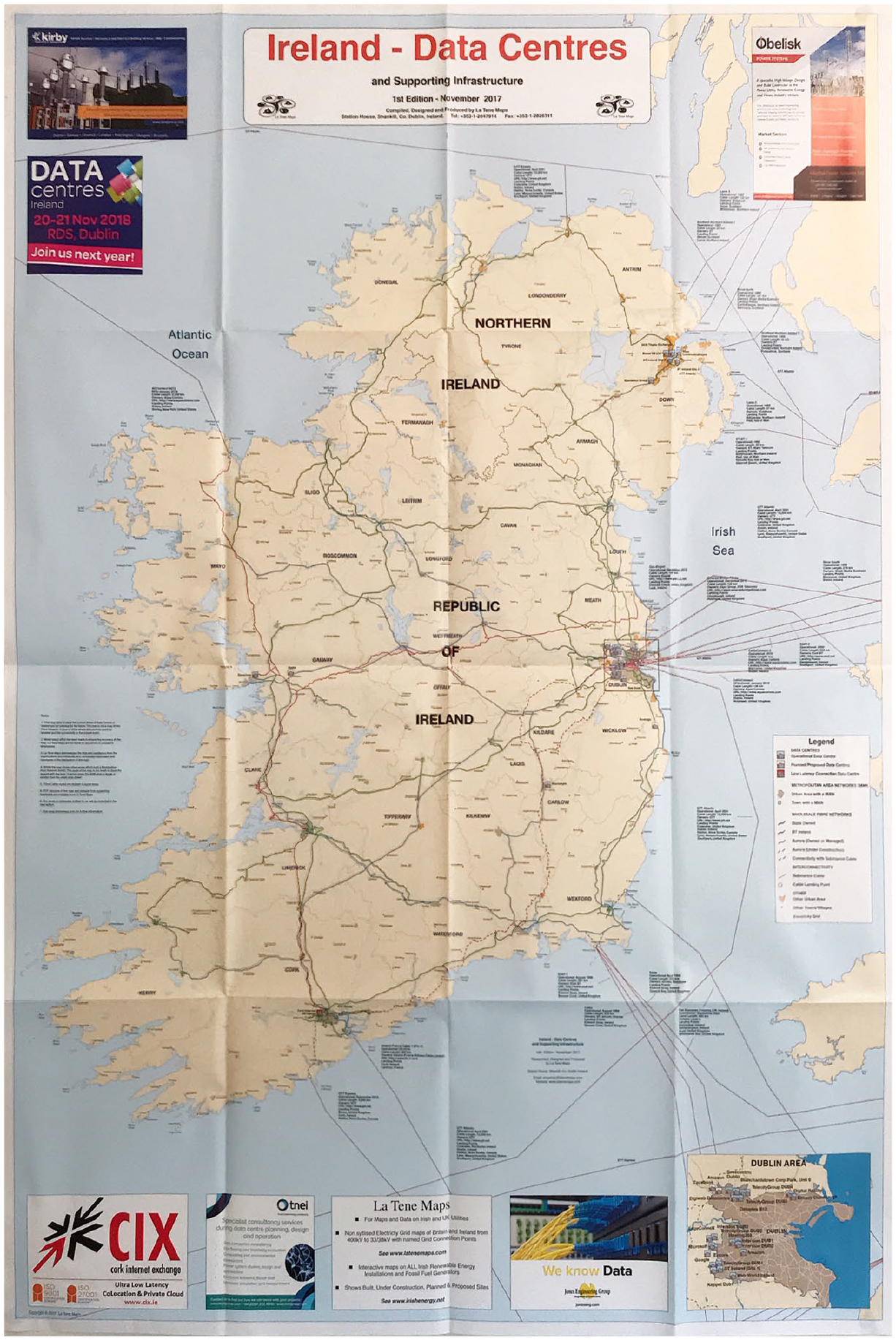
Industry map of data centers and fiber optic cable routes in Ireland.
The imbrication of media infrastructures with the built and natural environment becomes a geo-economic process by which the landscape of a given territory is produced – often transnationally – as a space through which value can be extracted from already-existing elements. This second-level extraction, which intensifies existing processes of resource extraction, is allowed by socially produced conditions stemming from privatized relationships with once common or public goods (i.e. water – see Bresnihan, 2016). These elements can be directly environmental and climatic (i.e. cool climate) or, as advertised by industry website Host in Ireland, cultural and infrastructural: whether ‘policy, power, people, pedigree, pipes’. 3 Such descriptions do not readily distinguish between public goods and private enterprise. However, as much work on telecommunications infrastructure in Ireland and elsewhere has demonstrated (McLaughlin, 2015; Rossiter, 2016; Starosielski, 2015), the construction of such networks has always been a transnational and historical process of public and private negotiation, as well as national and supranational security. For example, data centers can act as both private hosting facilities as well as contractors for governments, whether providing space for telecoms transmitters on top of them or proprietary server stacks hosting police and other secure governmental data.
Beyond data centers, regimes of geopolitical security are increasingly tied into systems of finance, technology, and environmental management at a global (and usually extractive) level (see Bigger and Neimark, 2017; Cooper, 2010). Many have written on historical and human-driven legacies of colonialism and the climate (see Chakrabarty, 2009; Hulme, 2017; Povinelli, 2016), and how material conditions of capitalism and imperialism are embedded within transnational histories of climate and the everyday experiences of its turbulences. Others have taken ‘atmospheric’ approaches to the felt environments of capitalism and control (Furuhata, 2018; McCormack, 2018). In conversation with these bodies of work, I define a climate as an array of material – historical, natural, and economic – conditions that make up an environment, within which various circulations occur and can be valorized for profit. However, we have to recognize that this array of factors apparently fixed within given ‘climates’ are co-constituted by structural forces such as technology and finance as much as everyday cultures. Power and capital courses through the lived space of the contemporary built and natural environment, and understanding this set of relations is crucial to understanding how the existent conditions and those created (and data generated) become sources of value extraction for capital.
Climate extraction
There are thus an array of conditions that create a particular ‘climate’, the seemingly natural assemblage of elements that makes somewhere a good place to do business, or not. Climates are both affective and representable, relational and fixed in places. Geographer Mike Hulme (2017) describes ‘cultures of climate’, ‘develop[ing] a case for understanding climate as an enduring, yet malleable, idea which humans use to stabilize cultural relationships with their weather’ (p. xiii). These cultural relationships are negotiated and mediated both popularly, as in the Irish media’s fascination with the use of Ireland’s ‘cool climate’ for data center investment (see McDonald, 2012), as well as by state and business interests navigating these changing social conditions (especially in relation to climate change). But it is telling the degree to which atmospheric climate is concretized and put directly in relation to business, regulatory, and infrastructural environments. On an Ireland-specific page on their site, Zayo extol the virtues of hosting your data-driven company in Ireland, calling Dublin ‘the world’s data center’, claiming geopolitical proximity, partnerships, and stability; a robust and decentralized start-up and entrepreneurial culture; a pro-business environment; a ‘burgeoning cloud ecosystem’; a ‘fibre motorway’ around the city; and finally ‘a natural climate that helps with the cooling of data centres and little threat of natural disasters, Dublin’s natural economy supports this pro-business system that has been put in place’; all within the same description (Zayo, 2017, emphasis mine). Such descriptions, familiar across the data center landscape, pair organic and ecological metaphors with economic, political, and infrastructural conditions as though all flow through Dublin like the River Liffey. As we can see, these types of materials and advertisements, which circulate among a privileged class of investors, entrepreneurs, and policy-makers, erase spatial contingencies that do not already strengthen the case for spatial and economic development. As evidenced by the title ‘the world’s data center’ itself, Ireland – and Dublin in particular – are seen as mere generators of profit for the world-making enterprises of finance, tech, and other corporate interests.
This branded generation of a ‘business climate’ – on top of the more literal discussions of climate in relation to cooling – illustrates the conditions required for what this article refers to as ‘climate extraction’. In discussing the divergences between ‘extraction’ and ‘extractivism’, Mezzadra and Neilson (2017) distinguish that [extractivism] provides a means of identifying the wider characteristics of economic, political, and social formations that are predicated upon an expansion and dominance of extractive activities. [Extraction] describes historical and contemporary processes of forced removal of raw materials and life forms from the earth’s surface, depths, and biosphere. (p. 185)
Their argument, however, is that far from representing a new paradigm, the current financial and logistical dimensions of the global economy make it possible to ‘locate extractive dimensions in operations of capital that are seemingly remote from these domains [mines, plantations, etc.]’ (p. 186). Thus, as capital intensifies, and first natures (the ‘natural’ environment) come to be produced and determined by the second (societal relations) (Smith, 1984), the environment ceases to be the primary resource of extraction, entering a circulatory dynamic through which capital can produce its own circumstances for growth through the market (see Lee and LiPuma, 2002). Rather, the already-existing infrastructures of state and capital in a given location take precedent. In addition, the raw data of consumer activity circulating through data infrastructures becomes a crucial site of extraction, as many (Gago and Mezzadra, 2017; Mezzadra and Neilson, 2017; Rossiter, 2016; Srnicek, 2016) have begun to understand. This follows Jennifer Gabrys’ (2016) idea of computation ‘becoming environmental’, which describes the ways in which sensing technologies, biometric controls, and what Rossiter describes as ‘logistical media’ are articulated through the infrastructures as well as the users of contemporary digital technology. This logic is extractive in the sense that the ‘environment’ and its natural resources are increasingly used in the production of more efficient circulation, following the idea that contemporary value extraction turns its focus to this ‘noisy sphere’ (Marx, 1992: 279). The noise of communication in informational capitalism is as much a place for extraction – via optimization – as is the smooth transmission of people, goods, and data.
Thus, through technological and financial systems, what would have once been thought of as the ‘natural environment’ of the climate is seen as not only a site of extraction but also a site of instrumentation, of circulation, at the same time that dominant discourses produce this same environment as something under threat, to be cared for by green market initiatives, and as ‘precious’ as ever before. As Hulme (2017) argues, The discursive phenomenon of climate-change should therefore be understood as a ubiquitous trope through which the material, psychological and cultural agency of climate is exercised in today’s world . . . Climate-change should rather be seen as the latest stage in the cultural evolution of the idea of climate, an idea which enables humans to live with their weather through a widening and changing range of cultural and material artefacts, practices, rituals and symbols. (p. xiii)
These cultural and material artifacts manifest in the form of technologies designed to ‘mitigate’ climate change, which data centers and their green energy discourses contribute to in observable and material ways. The ‘practices, rituals and symbols’ are thus as observable within the social practices of state and corporate development, and the forms that their cooperation takes in relation to a dynamic set of relations to the natural climate within the artificial generation of a particular business climate and set of circulatory (financial and trade) circumstances.
A vast array of interests, conditions, policies, cultural histories, and ecologies present in post-crisis Ireland – which has seen the country not only increasingly dependent on foreign direct investment (FDI) but largely defined by it on a geopolitical level – has generated a climate from which companies are able to extract value, whether in terms of the discursive/literal heralding of the natural climate as a source of cooling, fiber optic cables to use information, or the use of policy mechanisms to optimize value generation. The financial crisis and austerity imposed by the troika compelled the government to cut public services and introduced increasingly privatized forms of infrastructure and resource management. Correspondingly, in Ireland and elsewhere, financial and environmental crises are capitalized upon as opportunities for profit-making enterprises, through mechanisms like climate finance and ‘weather futures’ (Cooper, 2010). As the atmosphere is increasingly circulated with the speculative fictions of technological and financial systems, this intensification of extractive practice is felt in lived climates of industry and their built environments. This entangled political ecology has consequences far beyond branding and spatial development. Political theorist William Connolly (2017) argues we must ‘renegotiate persistent tensions between freedom and belonging’ (p. 19) during an era when environmental catastrophe and its social consequences are realized at a planetary level. Just as the choppy waves of global finance and oceanic circuits of trade, information, and energy re-organize and re-distribute violence and instability across all forms of work, a literal ‘tsunami of data’ threatens to flood the world with the unmitigated growth of media infrastructures (Climate Home News, 2017), as energy consumption rises and the climate is irreversibly affected by continued emissions.
‘Ireland “cool” for data centers’: climate, site placement, and location
In this turbulent planetary environment, site selection appears small-scale. However, it provides a revealing aperture into the material operation of these ongoing extractive processes. Newspapers, magazines, and corporate literature all echo the same dogma: Ireland’s climate reduces the immense cost of cooling data centers. In a particularly revealing article from the early days of the data center boom, a Guardian (McDonald, 2012) writer formulates the appeal in popular terms: ‘It’s not often that Irish weather is a cause for praise, but the temperate climate was very significant in choosing Ireland as a location for this data centre’, says Dan Costello, Google’s global data centre operations officer. The group has managed to reduce the amount of energy it uses worldwide to cool down its data systems to just 12% of its energy bill. ‘It’s not quite as simple as just opening the windows, but it’s pretty close’.
The tying of weather to culture – in the form of national pride and praise – here echoes essentialisms of the Irish landscape in the service of transnational capital, while also reiterating familiar refrains of economic development in Ireland. The industry website Data Center Dynamics (Jones, 2014) tells a similar story of the attractiveness of Ireland’s (relatively new) indigenous technical, transport, and labor infrastructure as well as its ‘cold and damp’ weather. However, although climate here is posed as a commendable feature of Irish space to be extracted for profit, which takes shape in popular discourses, the determining factor seems to be the business and tax climates, and the accompanying infrastructure from which to draw from. Ireland’s generous corporation tax rate and a government happy to facilitate private infrastructure investment in service of greater cash flows and global visibility through the country, especially as a post-crisis state at once eager to dispel concerns around economic instability and rebuild an image of robust growth potential, means that companies often have free-reign of the spatial and regulatory environment. This naturalizes the liberties taken with the climate, and the failure to provide believable environmental credentials to back up the greenwashing. As an Irish Times (O’Dwyer, 2015) writer found out, ‘To be honest, the line on the weather is a bit of spin’, says Jason O’Conaill, international partner with Infinity Data Centres in London and formerly data centre lead with Eircom. ‘The weather here is the same as most of northern Europe when it comes to computer cooling, and from an engineering point of view, well Norway, Denmark or Amsterdam would be the same really, so it’s not really a strategic advantage’. (O’Dwyer, 2015)
This is echoed by industry reports (SEAI, 2017) and practitioners. Jerry Sweeney, CEO of Cork Internet Exchange (CIX) (2018, personal interview), testified that the cost savings of Ireland’s cooler climate were so negligible as to not be a factor in his company’s data center operations.
CIX is an example of how the bundling and layering of infrastructural footprints, in vital relation to the surrounding social and natural environments, determine the particular instantiations of data center spaces. The data center is built on a hill, in the Hollyhill Industrial Estate, overlooking Cork city and the surrounding countryside (see Figure 2). Upon approaching the center for a tour and interview with local entrepreneur Sweeney, I wondered if I had the wrong address. Situated in a non-descript industrial park in the middle of sprawling residential estates, CIX and the surrounding area reflects the suburbanization of urban spatial technologies, which find cities surrounded by sprawling industrial and logistical parks seemingly far removed from an urban core (Cowen, 2014; Keil, 2018). As Sweeney told me, the choice of location was in part determined by the proximity to Apple’s nearby office campus, just a bit farther up the hill. The concentration of fiber optic cables and other Internet infrastructure was already piped up the hill, and so CIX was able to plug into this existing bundle of infrastructures (Sweeney, 2018, personal interview).

Cork Internet Xchange (CIX) in 2017. The data center building is on the left.
Private data infrastructure clusters around the projects and infrastructural resources provided by the state or other corporate presences. Irish architecture scholar John McLaughlin (2015: 198) describes the ‘data center ring’ around Dublin, which represents both the attractiveness of the country’s tax climate – its 12.5% corporate tax rate is the lowest in the ‘industrialized’ world – but also the clustering of data centers around other critical infrastructures, most notably the M50 ring-road and its surrounding energy and data wiring (the T50 telecom network, which also runs around most of the perimeter of Dublin). This infrastructural ‘bundling’ is key to identifying the strategic routes through which these public/private partnerships operate – just as logistics companies require public roads and railways as much as natural and man-made waterways to operate, private high-tech companies require and instrumentalize the energy and fiber optic resources of a given territory as much as its labor resources and, in this case, climate conditions. Equinix, a large colocation provider, advertises that colocation in Ireland allows ‘interconnections’ between ‘business partners and customers across their digital supply chains’ at their four data center locations. They boast both Ireland’s robust Internet infrastructure as well as the presence of digital content, entertainment, social media, online retail, and other companies, with Dublin offering a ‘vibrant digital ecosystem featuring world’s leading technology providers and enterprises’. 4
Logistics centers and management of these pipelines often take place on the same campuses as the centers themselves. Data center colocation provider Interxion advertises their Dublin locations as ‘strategically positioned on the data and trading highways between Europe and the USA’. 5 Mél Hogan (2015b: 4) notes that this occurs because ‘large corporations also pay for various infrastructures that are intended to help other server-based companies “set up shop” nearby. So while communications technologies have long been privatized, these internet infrastructures are increasingly entangled in market logics that are making internet flows a utility to manage, like electricity and water’. In Ireland, these are often on semi-state Industrial Development Authority (IDA) sites and surrounded by other industrial campuses, like the Google data center in Dublin’s Grange Castle Business Park South (see Figure 3), representing blurred boundaries between public and private facilities, funds, resources, and infrastructures. Visiting this site, I had a similar experience of disorientation, as the center itself was surrounded by largely rural land, appearing as a digital intrusion on the landscape. The area was home to Equinix, Interxion, a highly secure Microsoft data center site, and a Pfizer plant. Smaller homes and businesses appeared besieged by this development. The clustering effect has seen both private and public developers, like neighboring (also IDA-partnered) Profile Park, with available sites pre-conditioned for data centers. 6 But with these larger companies ‘setting up shop’ comes increased blackboxing, security, and bordering, to the point that surveillance occurs on ostensibly public lands and roads. Encounters with security were frequent during my data center site visits, despite never knowingly entering private premises without proper authorization.
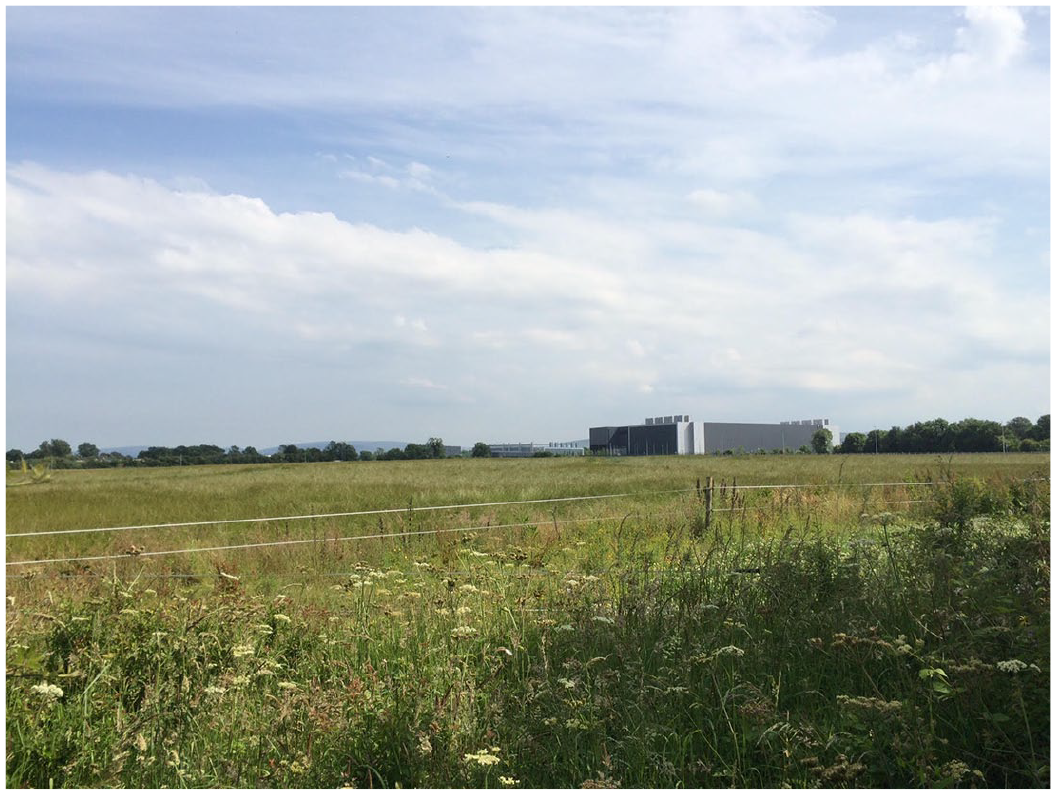
The Google data center in the Grange Castle Business Park, an IDA site (photo from 2017).
For CIX, the largely empty industrial area that the data center occupied offered area for expansion, as the former warehouse unit next door was being gutted for a structural addition to their server stacks. But when I asked Sweeney why he chose Cork, his answer was more personal: he is from there (2018, personal interview). This is a familiar refrain from developers, but there is some truth in such admissions, however calculated, in terms of cultural familiarity, ties, and existing social networks. While strategically situated nearby another massive tech organization as well as cable landings from North America and Europe, CIX is in some ways the product of an entrepreneur’s desire to develop in his hometown, with other factors lining up. But data centers themselves are territorial technologies of much wider flows of data and capital, plugging into existing environments and infrastructures (for example, Apple’s campus and cable landings off the coast of Cork). Thus, despite the apparent non-placeness of the data landscape, location is key in other ways, as Molotch (1976) discusses in terms of the ‘urban growth machine’ and the competing and cooperating local interests in any given place that interact to drive growth and development. This takes on a particular weight in (sub)urban Ireland, where space is at a premium (Gavin, 2018), and echoes aforementioned discussions of the logistical parks and industrial campuses circling and managing the flows of contemporary cities.
But these borderline rural spaces also exist at the fulcrum of various types of politics and power relations, as high-profile cases like the failed Apple data center on forest land outside of Athenry, County Galway illustrate (see Brodie, in press). Here, locals took to the streets to demonstrate in support of the project, one of whose claims was that Athenry offers a frontier for development of overcrowded Galway city. At the cusp of corporate visions of planetary urbanization (see O’Callaghan, 2017) and national images of landscape and heritage, the edges of Irish cities offer attractive and natural ‘greenfield’ spaces for urban-centered growth. While CIX is non-descript, the vista upon leaving its bunker-like industrial estate is far from it, and one would imagine that Apple’s headquarters has an even better view of the surrounding area. The rolling hills of County Cork surround, and Cork City Center is just down the hill, with its church spires and winding roads. Google’s data center outside of Dublin used to be similarly picturesque, surrounded by fields and small estates as recently as 2017, just on the edge of Dublin’s expensive suburban sprawl. Now this sprawl has caught up, and farmland in the area has been claimed for development. Other data centers, like Amazon Web Services’, exist clustered within gigantic industrial parks also housing pharmaceutical, tech, and other manufacturing companies, or those like Facebook, which are tucked away at the edge of smaller suburbs and suburban R&D parks. The scale of these projects is important in relation to the surrounding environment and the presence of local communities. While some companies, like AWS, prefer to keep completely discrete about their data center locations and operations, other companies, like Facebook, Google, and (ill-fatedly in Athenry) Apple, have made public engagement a priority. Facebook gave publicized tours of their Clonee data center for RTÉ, and Google commissioned a large-scale mural on the side of one of their Grange Castle buildings (see Figure 4). Visualizations of data centers, through corporate promotional material and press releases shown to the general public on industry and journalistic websites, are very green-focused, often focusing on the ‘expanse of sky and land surrounding the buildings. In effect, the data centers are visible but rendered practically inconsequential by the surrounding spectacle of natural vistas and wide-open spaces’ (Holt and Vonderau, 2015, 76; see also Carruth, 2014). The buildings are part of a larger, usually pristine, natural landscape, devoid of people. 7
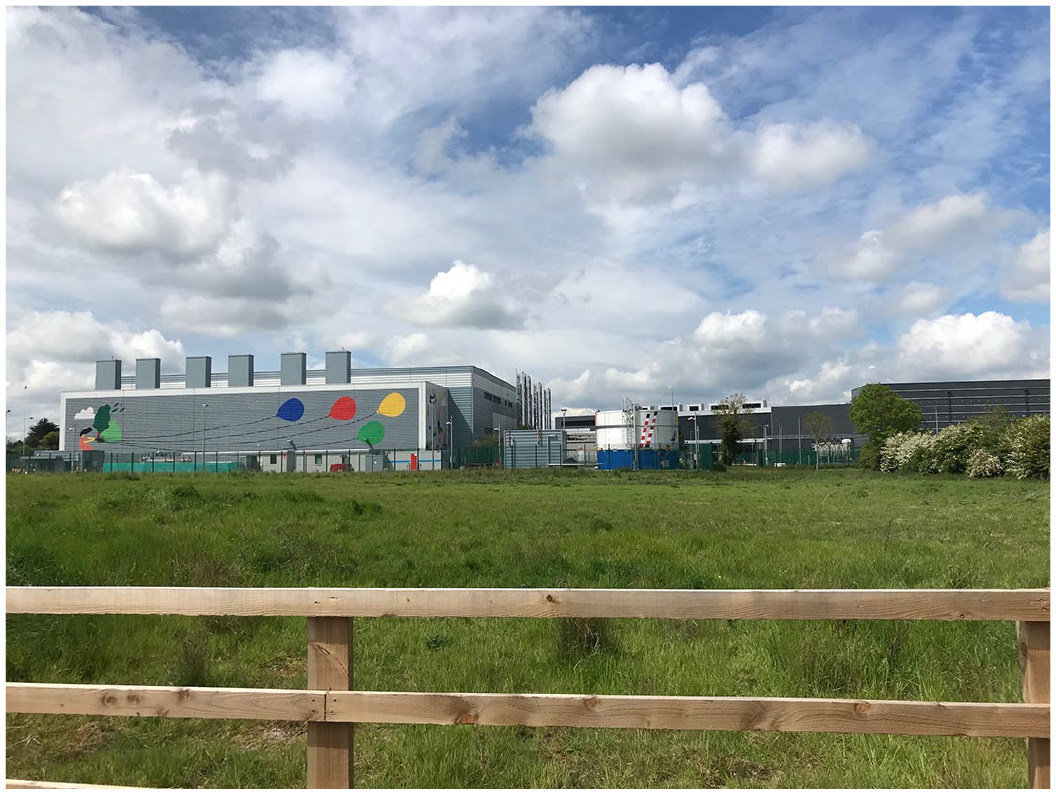
Google’s Grange Castle mural in 2019, all clouds and wind.
This type of imagery is familiar to those studying the liberalization of the Irish economy through the 1970s and 1980s. The IDA (along with tourism body Bord Fáilte) explicitly tied together the natural environment – particularly its ‘pristine’ beauty – and the business climate as a strategy for attracting FDI. The intersection of finance, industry, and culture has been an economic development strategy in Ireland since at least the 1970s, emphasizing a duality of investment opportunity and pristine beauty unhindered by labor: ‘it’s almost as if they’re advertising a country nobody lives in’ (Ballagh qtd. in Gibbons, 1996: 86). The Irish state prepared an ideological space through which capital could flow unchecked, over unspoiled nature, with no human life to get in the way, or what could be described as ‘industrialization without urbanization’ in order to stay away from strong urban labor movements (Gibbons, 1996: 88). During this process of centralized liberalization, through aggressive zoning, deregulation, and social partnership, labor was systematically disempowered, disaggregated, and mobilized for maximum profit within emergent systems of production as wealth and wage inequality skyrocketed between the 1980s and the current period (MacLaran and Kelly, 2014: 26), although the country ostensibly saw unprecedented prosperity through the 1990s and early-2000s. Public/private partnerships and organisms as dictated by Irish government agencies, EU mandates, and supranational organizations form a template for this type of development. While again, these interrelations are often accidental, modular, and disorganized, they nonetheless serve a common goal – to further the vision of Ireland as a space ripe for capital, a project which comes from both Irish governmental and semi-state organizations as much as from private interest groups and corporate propaganda. Data centers, as largely unmanned infrastructures after initial construction (the largest often employing a mere few dozen workers), and even whose maintenance and optimization is increasingly mechanized and automated (Enterprise Ireland, 2017: 24), may be seen as a dream conduit for labor-averse capital still seeking to establish territorial grounding in a tax-friendly locale. The conditions produced by Ireland’s ‘natural’ environment and business climate, dually promoted by the state and its corporate partners, provide fertile ground for the extractive processes of data hosting, circulation, and management via the territorial technology of data centers.
Conclusion: industry, adaptation, and obsolescence
The global data center industry manages the movement of financial and data circulations like supply chain managers, adapting to spatial and cultural dynamics while navigating the messy contingencies of politics on-the-ground. Discourses of ‘climate’ and the naturalization of business interests are key to these strategies of modular management. In this article, I have argued that data centers act as physical, discursive, and managerial technologies. In doing so, they naturalize the place of big tech and emergent modes of value extraction in an increasingly unstable global business and natural environment.
Just as governments are adapting to Brexit and climate change, we also need to think about how small countries like Ireland will adjust to more harmonized tax and data security regimes. Between high-profile tax avoidance scandals and regulations like GDPR, the writing may be on the wall as the EU begins to crack down on what are seen as unfair tax advantages in countries like Ireland, as well as irresponsible data use, storage, and management practices. What, then, will happen to these companies’ data center buildings once they become redundant or obsolete? Employing very few people already, the vast physical emptiness of these corporate infrastructures, even as they are loaded with significance, make workers redundant, data distribution cleaner and faster, and the extraction of value from data (and the ‘natural’ environment) more efficient. CIX, a comparatively small data center, employed less than 10 permanent employees, although its expansion required peripheral workers from the construction industry. Interxion, a multinational data center company based in Amsterdam, in three sites across Dublin totaling 5,820 square meters of built data center space, employed around 30 workers, and the contractors – peripheral or ripple hires – are largely brought in by companies renting server space. But even though the servers and computing stacks within a data center are under near-constant renewal, with technologies only expected to last for a few years at a time, the buildings of the digital economy are subject to their own decay, repair, and obsolescence. With typical corporate animism (see Povinelli, 2016: 20), industry speakers describe them as ‘living’ entities in themselves (Judge, 2017; Riccio, 2016). However, these short life spans lead to the potential for vast swathes of largely toxic (Gabrys, 2011; Parikka, 2015) built computational space, and an unsustainable level of employment even at the very limited base. A recent report from industry analyst Gartner predicts, ‘By 2025, 80% of enterprises will have shut down their traditional data center, versus 10% today’ (Cappuccio, 2018). Thus, with the rate of change of digital media infrastructure, and a shifting regulatory landscape, these data centers will need to be updated, razed, or replaced for an eventual decentralized data landscape. Thus, most importantly for recovery-era Ireland, and those working in/for the industry or gambling on the future social and environmental care offered by tech companies and their private infrastructure, what will happen when this bubble also bursts?
Footnotes
Acknowledgements
The author thanks Kay Dickinson, Philip Lawton, and Patrick Bresnihan for their generous feedback on early drafts of this article.
Funding
The author(s) disclosed receipt of the following financial support for the research, authorship, and/or publication of this article: This research was supported by a doctoral award from the FRQSC (Fonds de Recherche Québec Societé et Culture). Fieldwork was partially conducted with the help of a Mitacs Globalink Research Award.
