



Abstract
Based on findings from a production study, this article explores and discusses the impact of streaming on television scheduling. Especially within public service television companies, scheduling for traditional linear television is currently transforming into what this article terms trans-programming. This development makes the work of the schedulers more important as well as more difficult than ever. The article argues that this development is a result of the integration of linear channels and non-linear services within the companies’ portfolios, which is leading to a merger between linear and non-linear promotion and distribution strategies for the content. A trans-programme is being produced, and this is becoming the key competitive tool in the current transformation of the television industry. The focus on the trans-programme involve organisational changes, but in train with this it actualises new and familiar issues and dilemmas in the production culture involving commissioning. These issues call for further research.
Introduction
In the year 2000, Ellis (2000b) posed the question whether scheduling had become the ‘last creative act’ in television. His analysis pointed to the importance of the work of the schedulers in securing the relationship between broadcasters and viewers in a deregulated competitive European television landscape. Ellis’s work contributed to a second small wave of academic interest in the schedule as a televisual genre and in scheduling as a professional craft (e.g. Ellis, 2000a; Søndergaard, 1994, 2003; Ytreberg, 2002). The first wave of academic interest in the schedule and in scheduling had appeared when television was still the ‘new medium’ in need of theoretical conceptualisations. Seminal work by Williams (1974) and Ellis (1982) contributed to this fundamental understanding of the medium as a communication technology and a cultural form with a huge impact on society. However, in comparison to other aspects of television, the scholarly interest in scheduling has been very sparse, and this is a bit of a paradox because media scholars all agree that the schedule and scheduling are key aspects of the television medium compared to other media and cultural forms. Currently, there is nevertheless what might be called a third (small) wave of scholarly interest (Bruun, 2016, 2018, 2019; Ihlebæk et al., 2014; Johnson, 2012, 2013, 2017; Lassen, 2018; Van Den Bulck and Enli, 2014b), to which this article aims to contribute. This article argues that fundamental changes to traditional linear television scheduling as a craft actualise old and familiar as well as new issues, challenges and dilemmas in the production culture. Especially within public service television companies, scheduling is presently transforming into what this article suggests we term trans-programming. As argued in Bruun (2020), the new practices that are emerging produce a television paradigm in which the distinction between the linear channels and the non-linear platforms within the company no longer really applies (Bruun, 2020: 109). Elaborating and reflecting on these findings, this article highlights and discusses two features of what trans-programming entails. First and foremost, organisational changes are taking place that are strengthening the desktop organisational structure in television companies that are already demand-led (Ellis, 2000a). In such an organisation the television company produces none or very little content in-house. Instead the vast majority of the content consists either of commissions from external production companies or acquisitions. The company is therefore a relatively small company dominated by a managial, editorial and scheduling staff and has none or very little creative staff imployed. Most television companies, whether they have public service obligations or not, share different versions of this basic form of organisation. Understanding the impact on cultural production of these changes is therefore of general value to television studies. The trans-programme is becoming a key competitive tool in the production culture. As a consequence, the schedulers are put in an increasingly powerful position in the editorial process within the company. Second, trans-programming entails a broadcastification of the non-linear services as well as a reworking of the programming and commissioning practices of traditional scheduling for the linear channels. This development involves a focus on the need for specific genres in order to hold onto profitable and politically important target groups. However, trans-programming is causing familiar issues concerning creativity, innovation and commercial pressures in the TV ecology to resurface alongside the emerging new challenges to public service core values. These issues and challenges will be discussed in the article, and on that basis I argue for a future research trajectory with a focus on the commissioning of content for public service television.
Scheduling studies and digital television
As mentioned above, during the last decade, a third wave of scholarly interest in the schedule and in scheduling has emerged in television studies in light of the changes to television in the digital era. Important contributions to this area of research have questioned the theoretical understanding of television as a time-structured and flow-organised textual phenomenon. Johnson’s (2012) study compares the channel branding strategies and campaigns of the BBC, ITV1 and Channel 4 with those of the American television networks ABC, NBC, CBS and Fox over a 30-year period. As Johnson’s findings suggest, it has become increasingly difficult to predict linear viewing patterns. Nevertheless, efforts to attract and hold viewers’ attention across channels are still paramount, and they have become more important than ever. In line with Johnson’s interest in how the American and British television industries are trying to adapt, Ihlebæk et al. (2014) compare how schedulers and promoters of public service and commercial channels in the Norwegian television industry are revising and renewing their ‘toolkit’ (p. 14) to face these scheduling challenges. Special attention is given to building so-called ‘junctions’ (Ihlebæk et al., 2014: 9), whereby the multi-platform provider uses various different forms of cross-promotion to herd the viewers to stay tuned within its own portfolio.
New textual features in the on-air schedule available to the audience are also highlighted in Bruun (2016) on how ‘continuity’: the interstitials between the actual programmes, is changing in multi-channel and multi-platform public service television. Author Removed argues that traditional business models have a conservative effect on how ‘continuity’ is used. In comparison, licence-fee funding makes the television company far more agile and adaptable to a non-linear television paradigm than commercially funded public service television can be. This trend towards widening differences between the communicative strategies of public service television and commercial television companies is supported by the findings in Bruun (2019). The findings show that the commercial television companies have a far more conservative way of using ‘continuity’. All in all, licence-fee-funded public service television seems to be a huge advantage in the current competition. This is underpinned by Lassen’s (2018) analysis of how scheduling and cross-channel promotion developed at the Danish public service broadcaster DR from 2005 to 2015. In her comparison of schedules from 2005, 2010 and 2015, Lassen’s analysis shows how the number of ‘junctions’ where and alternative choice of programme is promoted to the viewers has grown in step with the proliferation of digital channels since 2009, indicating that the public service company is eager to make many different kinds of content available to the audience in the portfolio (Lassen, 2018: 118–123). Furthermore, Lassen argues that, to the schedulers, ‘counter programming’ based on genres has become increasingly possible and important within the portfolio, not just as a strategy used in the competition with other companies (Lassen, 2018: 129). This approach is being used to secure extended choice and to meet the public service obligation of diversity in the overall portfolio even if the single channel becomes less diverse in terms of genres or subject matter. Lassen’s analysis also points out a strong emphasis on the main channel’s promotion of immediate or future content available on the niche channels in the portfolio. In other words, Lassen’s analysis shows that the main channel is still the mothership in the portfolio, addressing a large mainstream audience. This scheduling practice could be viewed as part of DR’s endeavour to meet its public service obligation to serve as a virtual gathering place for the Danes across small and large communities. This is still an important part of the broadcaster’s political legitimacy in the digital era. Similar trajectories seem to guide the use of on-air announcers and channel voices, still in place in European public service television as part of identity-building and communicating a personalised relationship between the provider and the viewers (Van Den Bulck and Enli, 2014b).
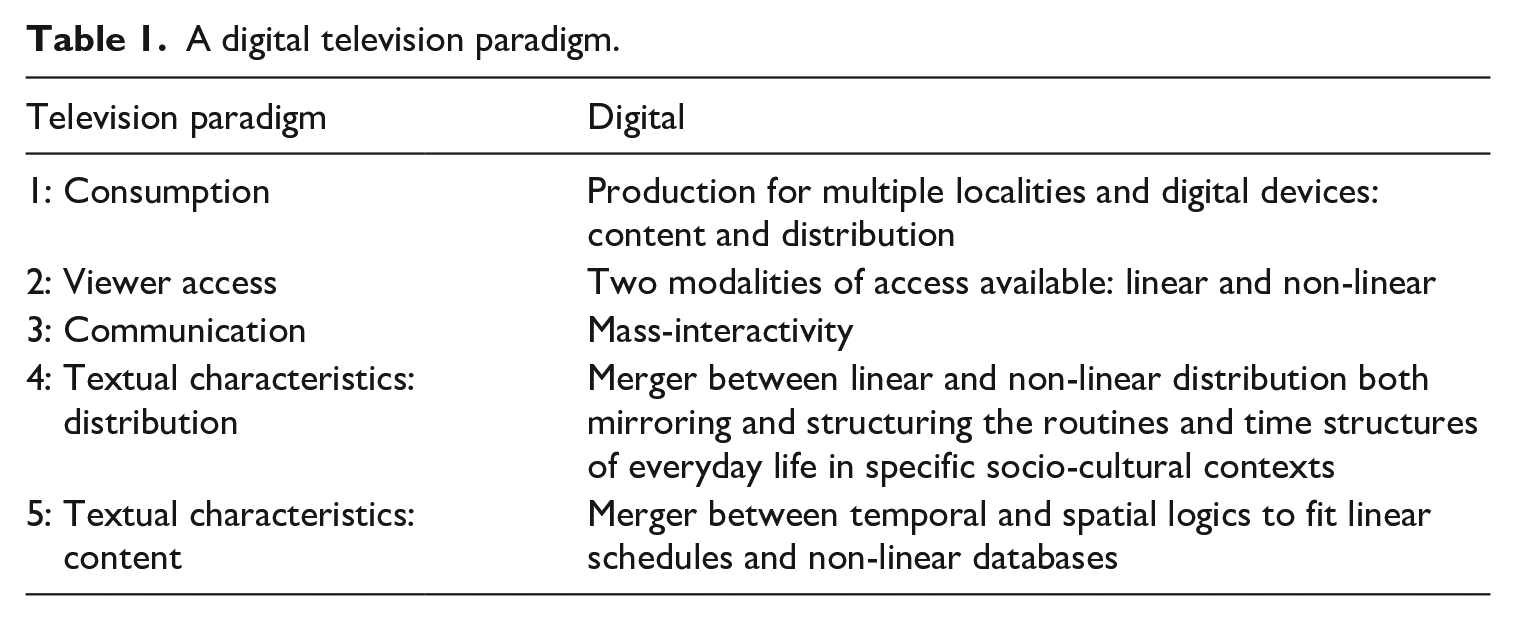
These third wave contributions all underline how scheduling as a professional task and as a skill set is changing. It is still extremely important in producing audience ratings, and it draws on professional knowledge and practices from linear television. However, at the same time it is adapting to an increasingly non-linear use of television content (Van Den Bulck and Enli, 2014a). As pointed out by Johnson (2019), television and the internet as the meta-medium for distribution are becoming ‘indelibly intertwined’ (Johnson, 2019: 1). From the point of view of television companies, this merger entails a collision between a traditional linear and an emerging and disruptive, non-linear television paradigm. The ‘TV natives’ (Johnson, 2019) are currently navigating the tensions between these two paradigms in order to remain relevant to the audience. The goal is to attract and hold onto the attention of an increasingly fragmented audience in the competition with Over-The-Top-companies (OTTs) such as Netflix, Amazon Prime and to a degree, HBO. To meet these new competitors, the TV natives have included streaming services in their portfolios. The tensions between the two paradigms are therefore located within the companies themselves. As argued by Bruun (2020: 109–115), the schedulers’ new practices, deployed in order to adapt to the emerging non-linear paradigm, make the contours of a new television paradigm visible: a digital television paradigm which entails a tentative merger of linear and non-linear characteristics (Table 1):
First, the consumption of television is not limited by a single device, the television set – a device typically placed in the audience home. Even if the home is still a major arena for the consumption of television content, the content is accessible on multiple and mobile digital devices and often movable between them. This has and will have an impact on the production of content and the trans-programme.
Second, television is not only to be understood as a time-structured medium. It is also defined by non-linear space, in the shape of a database that contains a catalogue of content accessible through an interface. This means that two modes of access to the content are available to the audience, and these two modalities of television have and will have an impact on the production of the content and the trans-programme.
Third, the traditional communicative characteristics of mass communication dominating the linear television paradigm are becoming combined with interactivity, producing new feedback structures and data-driven possibilities for implementing personalisation of the content distribution.
The fourth characteristic is that across non-linear and linear distribution, television is struggling to cultivate its ability to mirror and structure the everyday life routines and time structures of its target audience in specific contexts. It is of paramount importance to the schedulers to flesh out how the non-linear use of television connects to linear use, and as a consequence to the conceptualisation of the audience that is part of the professional production culture.
Finally, the fifth characteristic of great impact on the production of the trans-programme is that the content produced not only needs to fit the time slots of the linear schedule during the year, but also the spatial needs and time logics of the non-linear databases – the streaming service.
A digital television paradigm.
In the following section key implications of this emerging digital television paradigm are presented and discussed. The aim is to further examine the issues connected with the organisational position and functions of the schedulers in cultural production. This elaboration is based on my study at the public service television company TV 2 in Denmark. This took place over a 3-year period from the summer of 2016 to the spring of 2019, and the findings are based on 25 interviews and 2 weeks of field observations. TV 2 in Denmark is the commercially funded public service company, and it is the company with the highest share of viewing in Denmark (40.4% in 2019). TV 2’s position is, however, undermined in terms of audience ratings and reach in the population by dwindling viewing time for the measured kind of television viewing in which the use of OTTs is not included: in 2010 the viewing time was 3 hours and 20 minutes, but in 2019 this was down to 2 hours and 17 minutes. Like most television companies in the world, TV 2 is affected by the decline because it is funded by commercials and subscriptions. The portfolio consists of seven linear channels, a website and an in-house streaming service, TV 2 Play. The streaming service is a Subscription-Video-On-Demand service (SVOD) and it is the third most used in Denmark, with 600,000 subscribers, equal to around 1.5 million users according to TV 2 (TV 2 Annual Report 2019, 2020: 12). TV 2 is a limited company owned by the Danish state, and it is divided into two divisions: first, a division including the main channel and the windows for regional news, all with public service obligations, and second, a commercial section including the six niche channels, the website and the SVOD service. This structure means that trans-programming needs to cross this divide. Finally, it is important to stress, as mentioned above, that TV 2 is a desktop company. The majority of content it provides is commissioned from external television production companies.
The trans-programme as a competitive tool
The digital television paradigm elaborated above has an impact on organisational structures of the television company because the trans-programme is becoming a key competitive tool in the relationship with the audience. This development means that at TV 2 the focus is on strengthening the interplay between the main channel, with a 25.5% share of the viewership, and the streaming service, TV 2 Play. The goal is to cater to the two modalities of television. In order to achieve this goal, the main channel is becoming more important than ever. It is serving as a cross-promotional hub that is however still able to attract a large mainstream audience for the portfolio at large and TV 2 Play in particular. In line with Lassen’s analysis of DR (2018), the main channel is still the mothership of the portfolio. The linear main channel is in fact of growing importance to the economy at a time when large audiences are becoming increasingly difficult to attract. Together with the six linear niche channels, the main channel covers around 80% of the revenue (Head of scheduling Mette Rysø Johansen 23.4. 2019, personal interview). At the same time, the economic growth of the SVOD is considered very important to the company in order to cater to new habits among the audience and to secure revenue in a situation where subscriptions are becoming more important to TV 2’s economy than the traditional commercial breaks in the on-air schedules. In 2019, 54% of the revenue came from subscriptions (TV 2 Annual report 2019, 2020: 14). The focus at TV 2 is therefore also on strengthening the synergy between the youth channel, TV 2 Zulu, and the streaming service in order to cater to 15 to 39 year olds, which is the target group for the streaming service. In general this age group is spearheading non-linear use of audiovisual content (Agency for Culture and Palaces, 2018: 10).
These efforts to future-proof TV 2 mean that scheduling for the linear channels and the streaming service needs to be coordinated much more closely in order to produce a trans-programme with competitive power. Recent organisational changes at TV 2 seem to speak to this trajectory. In order to secure the managerial backing of the new focus on the trans-programme, the former head of scheduling for the linear main channel, Mette Rysø Johansen, became the head of scheduling for the streaming service as well as the linear channels in early 2019. According to Rysø Johansen, this managerial integration is a sign that the role of the streaming service in the portfolio is changing rapidly in the company: TV 2 Play becomes the main access point for TV 2 content whether it is used in a linear manner or streamed when you feel like it. The scheduling and curation of TV 2 Play is now a natural part of the programming work from the very early stages of commissioning process. And in relation to Zulu, Play comes first because Zulu’s content performs really well on the streaming service. (Head of scheduling Mette Rysø Johansen 24. 4. 2019, personal interview)
The former role of the SVOD was to offer the same content as the linear channels after it had been broadcasted. This mirror and a catch-up service is presently changing into a kind of ‘front door’ to the entire universe of content at TV 2 for the subscribers, as stated by the CEO of TV 2 Anne Engdal Stig Christensen (Madsen, 2019). Examples of this new role is that new content is available before it is broadcasted on the linear channels and original content is produced for the service to a larger extend. This ‘front-door’-argument is also forming part of the managerial discourse at the BBC, as pointed out by Grainge and Johnson (2018: 35). The focus on the trans-programme as a competitive tool gives scheduling a more powerful position within the organisation. An example of this enhanced editorial power is that in January 2019 the head of scheduling was able to implement a reduction of super primetime for the main linear channel by moving the late newscast from 10 to 9:30 pm. The news is at the very top of the genre hierarchy in television production, and it is a core genre in what defines what public service television is expected and obligated to produce. Furthermore, the news and current affairs programming produced by the public service media is highly appreciated by Danish citizens and is the preferred news source for 69% of the population (+12) (Agency for Culture and Palaces, 2020: 5). Moving the newscast is therefore no small matter in the production culture of a public service television company. However, this was implemented in order to allocate more resources to super primetime programming, that is capable of performing well on streaming as well as on the linear channels. The move meant that instead of the usual three shows in super primetime, the schedule would only need two. Furthermore, the need to optimise the number of time slots for commercial breaks between the programmes during super primetime also had to yield. All in all, the focus on the competitive power of the trans-programme means that the professional knowledge, creativity and skill of the schedulers are becoming increasingly important to the company. There is a great need for new tools to improve the synergies between linear and non-linear use of television. The ability to flesh out these logics of trans-programming as a way of innovating within the schedulers’ toolbox is appreciated
The schedulers’ enhanced editorial power in turn is impacting on the relationship between production of the trans-programme and production of content, and this seems to entail an acceleration of the trends identified by the second wave of scheduling research studies published in the late 1990s and early 2000s and referred to above. Especially the results of a research project on changes to scheduling in the old public service television monopolies and licence-fee funded companies in Denmark, Norway, Sweden and Finland of the late 1990s (Søndergaard, 2003) are important to pay renewed attention. In this period the growing competition for audiences meant that the schedule became an important competitive tool. This led to a number of organisational and managerial changes within the public service companies, DR, NRK, SVT and YLE. All of these were (and still are) in-house production companies, which means that they have production divisions and facilities as well as imploy huge amounts of creative staff. The focus on producing a competitive schedule therefore trended towards the following characteristics. First, these old companies changed by implementing desktop-like organisational structures within the companies themselves. This was a big change for these companies from a form of organisation based on a structure of largely economic and editorially autonomous production divisions. Second, the focus on the schedule as the competitive tool introduced a sharp division between production and editorial power within these organisations. This included an organisational power transfer from the production divisions to an editorial board of commissioning editors, channel managers and schedulers. Third, the reorganisation introduced a demand-led commissioning circle for new content initiated by the editorial board. This circle stimulated in-house competition for programme slots in the schedule and budget allocation, as well as introducing outsourcing of programme production to external production companies. In DR this organisational change, introduced in 1998, was implemented more radically than in the other Nordic public service companies (Søndergaard, 2003: 10). In the 1990s audience ratings and shares plummeted at DR, and the change was a political survival strategy very much inspired by the BBC’s producer’s-choice model, introduced in 1991 (Harris and Wegg-Prosser, 1998: 152). The purpose was to introduce a new paradigm of managerial and editorial control that would simultaneously cut costs and produce more content in order to fill a second channel within existing resources (DR2 1996), as well as to become more in alignment with the audience. In short, the idea was to present the notion of public service television ‘as a united editorial product instead of a number of single programmes of a certain standard’ (Søndergaard, 2003: 20).
Findings from the above mentioned production study can in several respects be seen as an enhancement of this development, trending towards the following characteristics. Scheduling a trans-programme enhances the desktop organisational identity of the company in order to secure content for all platforms following different scheduling needs, which will be elaborated below. This enhancement of the desktop organisation includes a whole new dimension to the television company that needs to be built: the actual distribution of content to the end user downstream, and the handling of feedback data from this distribution back upstream to the knowledge base of organisation. The problem is that this is an expensive task to graft onto the organisation, and it is not an area of professional expertise already in place at TV 2. Currently this part of the organisation is slowly developing as work-based learning, growing out of knowledge already embedded in the professional scheduling practices and fusing with usability studies from the field of computer science. Furthermore, trans-programming has shifted the managerial focus towards scheduling content as individual programmes rather than channels. As a trend, genres in place of channels has taken over as the organisational principle behind the structures for commissioning content. An example of this development at TV 2 is that the number of channel heads in the managerial team has been reduced to one, and the streaming service and the youth channel TV 2 Zulu has been merged into one division with its own head, focusing on content for their overlapping target audience. Furthermore, the former commissioning editors for the seven linear channels and TV Play are re-organised in so-called genre teams for content across the portfolio (Jöhncke, 2019; Reseke, 2018). Finally, the growing focus on producing fiction across the portfolio is supported by a new autonomous unit (Madsen, 2020). Mette Rysø Johansen, the head of scheduling, points to ongoing serious discussions within the company around this shift, given the risk that the value of the individual channel brands might be eroded: What about the channel brands and TV 2 Play? Is it important at all to know whether a programme is associated with the main channel, TV 2 Charlie or TV 2 Zulu? Or is this way of curating television completely unimportant? Some argue that the channel brand informs about the target group which is important to the viewer relationship. (23 April 2019, personal interview)
Adding to this dilemma, it is important to point out that this potential erosion of the channel brands is not fruitful for the intended production of synergy between the two modes of television, nor consequently for the commercial value of the traditional sources of revenue from the seven linear channels, on which TV 2 still heavily depends. As mentioned above, the ratio is 80% to 20%.
Trans-programming means that the genres over channels-principle at TV 2 is giving more editorial power to schedulers in the commissioning circle. They are increasingly focused on demanding specific genres and new kinds of formats to support synergies of linear and non-linear television use instead of supporting the individual channels. This means that certain genres become more important than others for the purpose of holding onto the audience. The kind of content that does well on both linear and non-linear outlets is fairly stable: it is Danish-language fiction, reality shows/competitions, and human interest documentaries, such as true crime and series with a focus on likeable humans dealing with difficult life circumstances. The concrete series doing well are termed: Bull’s eye-programming [. . .] and as schedulers for both ways of watching television we need programmes that has a long life on streaming. Low intensive programmes or lean back programmes have a hard time at the moment because they tend to only perform well on linear television (Head of TV 2 Play scheduling Kurt Holm Jensen 9.4. 2019, personal interview):
The challenge for the schedulers as well as the commissioning editors is to flesh out the logics behind why certain series, often within the same genre, do not perform the same. This is complicated to understand, and the focus on themes, casting and, not least, aesthetics is growing as part of the explanation in order to reduce the risks of failure. All in all, diversity in terms of content is narrowing in order to feed the synergy between the linear and the non-linear outlets.
The strong focus on supporting revenue from the streaming service involves fighting growing churn rates, which means that new subscribers are just replacing former subscribers instead of making the number of subscribers grow. Even if the focus on trans-programming entails what can be termed a broadcastification of the streaming service there is a growing need to work against linear scheduling practices. Traditionally, scheduling follows a four-seasons plan, A to D. It is part of the industry lore that Danes do not watch much television from June until September, and thus the B-plan is full of reruns of Danish content as well as foreign acquisitions, and apart from the news it contains very little new content. During the rest of the year – plans A, C and D – content anticipated or proven to be popular is piled up to feed the linear schedules with a competitive lineup. However, the streaming service need to hold onto subscribers all year round in order to fight growing churn rates, and during the B-plan, growth is a huge problem because there is nothing new to be found on the service. Furthermore, it is very easy to stop a subscription to TV 2 Play, and the customers stream out. The way to fight this is to spread out known attractive content with a little overlap in order to have new content on offer every day, all year round. At TV 2 this strategy is called Play365, and it comes with a lot of economic problems. It erodes the scheduling of TV 2 Zulu, which is extremely dependent on shuffling reruns of the same content around in the schedule during a long period and on stacking multiple episodes of reruns in the schedule all in order to fill the 24/7 schedules within the limited resources available to the niche channel. Play365 is therefore a very expensive strategy to accommodate a very small segment of the audience even if it is a commercially important one. Sune Roland, head of TV 2 Zulu and TV 2 Play content, points to the core problem that the collision between these practices is entailing in this way: Zulu is a power brand and that is worth a lot of money [. . . ] but the new scheduling strategy means that instead of scheduling flagship content on Mondays as we have done before it has to be spread out on every day of the week. But at the moment it is not in the budget to produce more content (9 April 2019, personal interview)
Finally, trans-programming means that demand-led commissioning processes are increasingly based on user data from TV 2 Play using Adobe Analytics. This new source of knowledge is intertwined with the use of data from traditional audience measurements. Since 2017, the ratings provided by Kantar Gallup have been more valuable than ever. The data includes 7 days of non-linear viewing and the improvement in this source of knowledge has made a huge difference to scheduling practices and has supported the Play365 strategy. Personalisation as Netflix uses it is not implemented at TV 2 Play because the catalogue of content is far too small to make it truly meaningful and the technical solutions are not in place either.
Across the portfolio, editorial scheduling is therefore still far more important than atificial intelligence-supported scheduling, and the content curation of TV 2 Play’s interface is very much marked by the adaption of traditional scheduling tools. The curation adapts tent poling, which places content considered important close together, hammocking which places weak content in between already popular content, and shuffling, mentioned above, is used to a large degree in order to give the impression of new content available. All is done in order to support the synergy between the two modes of television. As pointed out by Kurt Holm Jensen, head of scheduling for TV 2 Play, the schedulers therefore need to be included in the very early stages of the commissioning process: The focus on the Play356 strategy involves walking on three legs at the same time. First, scheduling, second, commissioning and third, marketing. If we look at commissioning I have been increasingly involved in this process. (9 April 2019, personal interview)
New bottles, old wine?
The trans-programme as the key competitive tool means that a lot of managerial challenges are emerging in the relationship between scheduling a trans-programme and the actual content production. Both are dependent on a production process that involves a collaboration with the external production companies in order to deliver the content needed for a successful trans-programme. In this situation, familiar questions are re-surfacing, especially for desktop-organised public service television like TV 2. The basic question is whether the enhancement of the desktop organisational form is turning the demand-led relationship between production and scheduling into a creative problem for public service television by fear of losing the audience? Or does it improve the ability to adapt by distributed creativity that includes the schedulers as part of the staff? It could be argued that the changes to public service braodcasting in Europe in the 1990s described above secured the popularity of public service television and at the same time made programme production more efficient at accommodating the growing portfolios. Søndergaard (2003) addresses these questions, and based on his research he proposed the following three ideal type models to illustrate the relationship between the schedule and production in order to discuss differences between them (Figure 1):
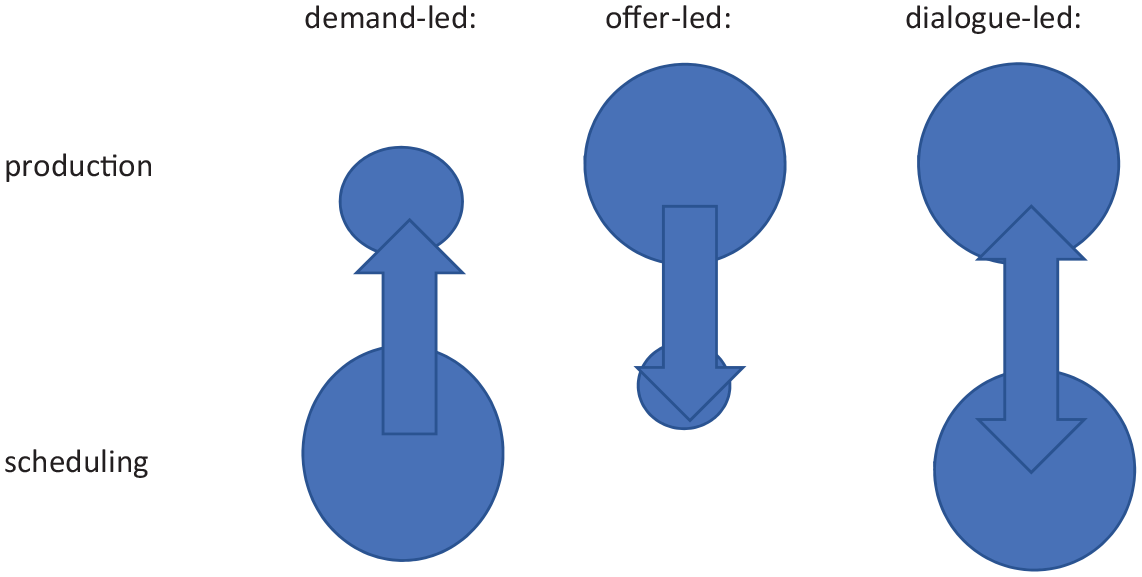
The three ideal type models (inspired by Søndergaard, 2013: 11).
The first model is a demand-led model, in which economic resources and editorial power are placed in the editorial board of managers, commissioning editors and schedulers. The commissioning circle is initiated by a call process or brief announced within the company, and perhaps to external production companies in order to pitch ideas for programmes. Accepted pitches for programmes get the resources, and internal marketisation is introduced in public service companies based on in-house production of content (Harris and Wegg-Prosser, 1998: 153). The second model is offer-led, in which economic resources and editorial power are mostly placed in divisions and/or production companies. The programmes they have decided to produce are ‘offered’ to the schedulers for distribution to the audience. The third model is dialogue-led, which is a combination of the first and the second. During the late 1990s DR mostly fitted the dialogue model, according to Søndergaard’s analysis. As Andersen’s (2019) analysis of the ideas development process in DR shows, this model is very much still in place (Andersen, 2019: 11).
Søndergaard did not describe or discuss the specific challenges for public service content production in a desktop organisation based on a radical demand-led model in which almost all content production is commissioned from external production companies, like TV 2. The demand-led model is also found in other companies with public service obligations, such as TV 2 Norge, Channel 4, TV 4 Sverige. Based on my findings, this organisational ideal type model seems to be becoming more and more important to use as a heuristic theory for empirical studies of cultural production. This is because the focus on trans-programming makes the demand-led model, with its embedded advantages and challenges, even more dominant. The relationship between trans-programming and the production of content – or to put it more in business terms, the purchasers and the providers – can be illustrated like this (Figure 2):
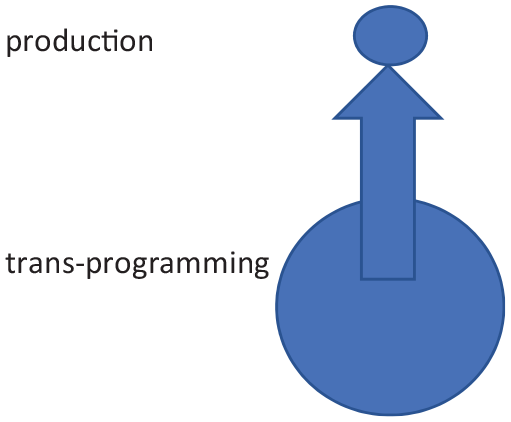
A fourth ideal model: trans-programme-led.
This model is, in several respects, the offer-led model turned upside down. The commissioning process in this model is dominated by the schedulers, who are becoming the actual commissioning editors who control the economic resources for productions. Because the vast majority of the production of content is outsourced in a trans-programme-led desktop organisation, the organisation is small in terms of permanently employed staff. Such an organisation is also connected to a network of production companies that co-build the creative base from which content is supposed to emerge. This is a flexible model, which makes it relatively easy to downsize or upsize the volume of productions as well as change the supplier. Securing a dialogue and an openness to input from outside the company in this kind of network-dependent organisation is however essential. The challenge is to secure a relationship between content production and trans-programming that is fruitful for creative processes as well as supportive of innovation in content production in order to meet audience interests and tastes (Andersen, 2019). The risk is a disconnection between trans-programming and the external production companies, because in this model the commissioning editors are less powerful. Their many roles as intermediaries and as a ‘sounding board’ for a close dialogue with the production companies in the production process therefore becomes less influential than in the demand-led model (Fink and Sørensen, 2007: 101). Furthermore, the trans-programming-led desktop organisation is part of an industry that is marked by growing international competition for talent and ideas, as well as a dynamic workforce shifting between competing production companies that produce for different companies. This makes it even harder for a trans-programming-led desktop organisation to build cultural capital, to hold onto investments in content development, and to capitalise these investments and possible successes (Reseke, 2019). However, for more than 25 years TV 2 has been the biggest customer for the many production companies in the Danish television industry, and this power relationship has not changed yet even if the production companies under their own names are part of transnational and powerful parent companies such as the Banijay Group. This relationship is linked to the strong focus in the Danish public service obligation on supporting Danish language and culture. In practice, Danish-language content in all genres is expected by the audience, and Danes prefer television in Danish and with a focus on the national context and issues. At present, 70% of content on the main channel at TV 2 is in Danish for a population of 5.6 million. Danish-language original content is, with a few exceptions, not exportable to the transnational television market, and investment by OTTs in the Danish audiovisual production sector is very limited. The situation is not at all comparable with that in the UK, where co-productions between BBC and the OTTs are becoming more frequent owing to the exportability of English-language content and, perhaps, British culture (Select Committee on Communications and Digital, 2019: 36). All in all, the dominating position of TV 2 is still in place. But securing the creative dialogue in the relationship with the production companies is an issue that has yet to be addressed in a situation in which producing a trans-programme is becoming ever more important.
The second challenge to the trans-programming-led model is for a desktop organisation to secure innovative processes with the external production companies, yet implement decision-making processes that support the ability to meet core public service obligations and values that attract an increasingly fragmented audience. Core values like universality in terms of viewer access and content are at stake owing to the importance of following and supporting changing viewing patterns among especially the younger segments of the audience. The study indicates that the need to hold onto subscribers for the commercial streaming service at TV 2 is playing a key role in the trend towards the commissioning of certain genres. The findings indicate that diversity in terms of the content commissioned is at stake because specific genres and subject areas are performing better than others, possibly leading to the narrowing of diversity in terms of content. Diversity as an ideal regarding the television genre menu for the individual viewer is also at stake in the trans-programme-led model. In the long run, this narrower range of genres may harm the ability to cater to a mainstream audience, and viewing patterns are changing fast across audience segments. In other words, it seems that not including the streaming service as part of the public service obligation is not a future-proof trajectory for a public service television company, because commercial aims can too easily take the lead.
Suggestions for further research
In order to shed some light on the issues embedded in the trans-programming-led model for a desktop organisation, as presented above, suggests a research effort for television studies that highlights what is happening to the strategic planning, implementation and outcome of the commissioning circle in the digital television paradigm. Currently at TV 2 the commissioning circle can be outlined as follows. A call for new content is initiated by a written brief to the external production companies, and presented at physical meetings at TV 2’s headquarters between the broadcaster and a large number of production companies. This is followed by an evaluation of the submitted suggestions to meet the brief. The selected suggestions are invited to pitch programme suggestions in closed and confidential meetings. Finally, decisions are made on which suggestions will be put into production, terms are negotiated, and the production process then begins. Alongside this formal commissioning circle, the production companies also contact the broadcaster in more informal ways. The broadcaster does also ask for content outside of this process as and when urgent needs for new material turn up. This run-down shows a commissioning circle that is also found in other desktop television companies. However, the emerging trans-programming-led model does not necessarily imply a split between the two worlds of a non-creative top management team of schedulers and executives, driven by a commercial agenda, and the creatives driven by an artistic agenda. As Roberts (2010) has pointed out, such a conflict-based approach to the relationship between creative and commercial agendas, very widespread in the field of media production studies, is a problem. It is a basic tenet that maps easily onto organisational structures, but though convenient, this categorisation, Roberts argues, does not address the complexity in the production processes: ‘Rather than a clash, the research reveals the subtle interplay of a wide variety of factors that do not fall neatly into either category, or, if they do, are not considered solely by the relevant functional specialist’ (Roberts, 2010: 777). Andersen’s findings from his recent work on ideas development and the impact on creativity in television production also points to these complex, socio-cultural aspects of industry lore (Andersen, 2019: 15). In order to avoid falling into a antithetical ‘trap’, it might be fruitful to follow the commissioning circle from the point of view both of the television company and of the external production companies.
Furthermore, it is important that the products commissioned to be trans-programmed are included in the analysis in order to follow the question of how the core values of public service are met in practice. It could be argued that the current focus on certain genres and target groups in the trans-programming-led organisation model works against universality and diversity. However, in the present competition with the OTTs, emphasising the public service obligation seems to be gaining in importance. At TV 2, the broadcaster’s identity as a public service media provider is being argued in a far more proactive way than in the past. As stated by Anne Engdal Stig Christensen, CEO of TV 2, the company is in a ‘public service transformation in which we are taking our obligations and role in society into the streaming world and we are making TV 2 Play into the Danes’ “front door” to our content’ (Jöhncke, 2019). In order to follow the impact of such a trajectory and similar cultural-political discourses on the commissioning circle I public service television, it would be important to focus the research effort on genres that are coming under challenge, yet regarded as important to the alleged public service identity of a company. As the findings presented above show, socio-cultural proximity and national language play a crucial role in combinations with specific genres: fiction, reality programmes/shows and human interest documentaries are performing well across the two modes of television viewing. However, focusing on only these genres in order to produce a successful trans-programme could potentially stifle the diversity of content on offer as documented by Hendrickx et al. (2019) in their seven-country comparison of public service broadcasting. Especially news, current affairs and documentaries not fitting into the human-interest category are, from a cultural-political point of view, also regarded as important content for a public service television company to offer. However, these genres are in a more difficult position because of the current focus on the trans-programme as a competitive tool. First, the journalistic genres mentioned often have a very short shelf life, if any. To make the synergy between the two modes of television viewing profitable, content needs to have a very long shelf life and a serialised format. Second, the competition for audience attention in a media landscape of on-demand media seems to favour emotionally appealing, high-quality content and innovative aesthetics. Both issues place a demand on developing productions that can adapt to these new communicative conditions in the television industry as well as to the public service obligation in different media systemic contexts. As this article has argued, securing creativity in the commissioning circle in desktop-organised public service companies in which the trans-programme is the main competitive tool seems to be at the heart of the challenges to maintaining the vitality, adaptability and survivability of public service as a united editorial product in the digital era.
