



Abstract
The contemporary outbreak of right-wing populism in combination with increasing migratory flows toward Europe raises concerns about the social construction of migrations and migrants and the policy orientations toward them. Research indicated worrying tendencies to perceive migrations negatively and criminalize migrants. However, this paper focuses on a different tactic adopted by a number of populist forces: the criminalization of sea-rescue NGOs. In particular, it presents the case-study of Sea-Watch 3, an NGO sea-rescue vessel which docked in Italy with several migrants on board in June 2019, after a long struggle with Minister of Internal Affairs Matteo Salvini, the leader of the League (a right-wing, anti-migrants populist party). By means of content analysis, the paper discusses Salvini’s Facebook communication strategy about the event. The aim of this study is to cast new light on how the criminalization of NGOs can be exploited to reinforce other aspects of right-wing populism, such as anti-elitism, nationalism, exclusionary politics, personalization, and polarization. In this respect, the implications of criminalizing sea-rescue NGOs for policy orientations and policymaking are also highlighted.
Introduction
On 14 June 2019, the Italian government introduced a security decree that included, among other measures, severe sanctions for sea-rescue NGOs whose ships entered Italian waters without permission. It included up to 50,000 euros fines, the arrest of crew members, and the requisition of vessels. 1 The decree was drafted by Minister of Internal Affairs Matteo Salvini, leader of the League, a far-right populist party (Rooduijn et al., 2019), and member of the populist government in charge in Italy between June 2018 and September 2019 (Garzia, 2019). The decree followed a long struggle between Salvini and the NGOs involved in sea-rescue operations in the Mediterranean, with several vessels stranded at sea in the previous months owing to Salvini’s decision to forbid their docking in Italian ports. A few days before its introduction, the United Nations Refugee Agency (UNHCR) demanded that Italy revised the decree by letting humanitarian considerations prevail over securitization arguments. However, the Chamber of Deputies and the Senate approved the decree respectively on 24 July 2019 and 5 August 2019, turning it into an Italian law. 2
Between the first introduction of the decree in June and its final approval in August, a relevant event happened. On 12 June, the sea-rescue vessel Sea-Watch 3 (owned by German NGO Sea-Watch) approached Italian territorial waters with 53 migrants on board. The ship captain, German citizen Carola Rackete, asked permission to dock at the Lampedusa harbor, which Salvini denied. After several days waiting outside the Italian waters, on 26 June, Rackete decided to dock without permission, claiming that the situation on board was becoming too dangerous for the migrants and the crew. While approaching the harbor, the Sea-Watch 3 collided with a military vessel that was attempting to prevent the docking. Rackete was subsequently arrested by the Italian police, only to be freed by ruling of an Italian judge on 2 July. 3
The case fuelled a heated debate in Italy and, most importantly, was exploited by Salvini to promote the anti-immigration orientation driving his latest governmental decree. While Salvini was by no means the only political actor feeding into the discussion on this event, his communications were particularly relevant for at least two reasons: first, given his role of Minister of Internal Affairs, he was directly involved in the management of the case and had the power to influence the development of events; second, his communication strategy was particularly aggressive. It was based on the criminalization of Rackete, her crew, and the NGO she belonged to, and on the delegitimization of sea-rescue NGOs in general. The co-occurrence of a new decree, marked by a strongly punitive approach toward NGOs conducting sea-rescue operations in the Mediterranean, and the Sea-Watch 3 case made crystal clear that the criminalization of pro-migrants NGOs is a defining feature of Salvini’s (and League’s) populism. This is evident both in his communication strategy and in his policy orientation. Though it was not the first time Salvini attacked and attempted to criminalize NGOs, the Sea-Watch 3 episode marked a critical moment for the emergence of this issue in the public debate.
The criminalization of NGOs is by no means an exclusively Italian issue, and rather represents a defining feature of other far-right populist forces. The most famous contemporary case is perhaps that of Hungarian politician Viktor Orbán, who repeatedly attacked pro-migrants NGOs and, as Prime Minister, drafted laws against them (Nagy, 2020). Orbán, moreover, openly expressed his will to create an illiberal democracy in Hungary (Buzogány, 2017), while a set of reforms promoted by his government brought the European Union to trigger Article 7 of the Treaty on European Union against Hungary for alleged breaches of the rule of law. 4 In Orbán’s typically populist view, European institutions, the judiciary, and NGOs are all part of a corrupt elite working against the interest of the people (Mudde, 2004; Mudde and Kaltwasser, 2017).
There are several similarities between Orbán’s and Salvini’s populist perspectives: both political leaders (and their respective parties) hold far-right, Eurosceptic, and nationalist ideas, and have a strong anti-immigration policy orientation. Moreover, both appear to consider pro-migrants NGOs as part of the elites that populists typically attack in their narratives of pure people versus corrupt elites (Mudde and Kaltwasser, 2017).
However, while Euroscepticism and anti-immigration (including its sub-topic of criminalization of migrants) have been thoroughly investigated by academics in its relationship with populism (e.g. Barker, 2012; De Wilde et al., 2013; Lazaridis and Skleparis, 2015; Lutz, 2019; Michailidou, 2015; Ruzza and Pejovic, 2019), there is a knowledge gap in how the criminalization of pro-migrants NGOs plays a role in the political strategy of right-wing populists. Thus, the aim of this paper is to conceptualize the logics and objectives of the criminalization of sea-rescue NGOs, and to discuss the potential implications and impact of this tactic. As made clear by such policies as Salvini’s decree and Orbán’s laws and by their respective public statements about NGOs, it is argued that the criminalization of NGOs is an important feature of some right-wing populists and plays a central role in generating populist narratives. By criminalizing NGOs, populists can reinforce other fundamental aspects of their narrative, including anti-elitism, exclusionary politics toward migrants, polarization, personalization, and nationalism. This study contributes to disentangle the relationship of these typical aspects of right-wing populism with the specific tactic of criminalizing pro-migrants NGOs.
To reach these objectives, the paper focuses on the analysis of the Sea-Watch 3 case and on populist leader Matteo Salvini’s exploitation of the event to pursue his politics. Rather than policy-making, the paper investigates the discursive construction of a populist narrative based on the criminalization of NGOs. To accomplish this, it explores populist communication strategies by looking at the use of social media platforms (i.e. Facebook).
Right-wing populism and migrations
In the debate about populism and its definitions, the ideational approach has gained a certain popularity. It defines populism as ‘a thin-centered ideology that considers society to be ultimately separated into two homogeneous and antagonistic camps, “the pure people” versus “the corrupt elite”’ (Mudde and Kaltwasser, 2017: 6). Thus, at its core, populism is anti-elitist and attributes to politics the purpose of pursuing the general will of the people (Mudde, 2004).
As a thin-centered ideology, populism can be (and often is) linked to other ideologies (Mudde and Kaltwasser, 2017). Right-wing populism can be tied with such ideological elements as nationalism and nativism, patriarchy, and anti-immigration sentiments (Wodak, 2015). In addition, in the European context, the nationalist character of far-right populism is often expressed through Euroscepticism (Arzheimer, 2015; Krouwel and Abts, 2007; Ruzza and Pejovic, 2019) and the association of the EU with migration-related issues (Balch and Balabanova, 2017). The vast array of far-right populist parties in Europe (for a list, see Rooduijn et al., 2019) tends to use a mix of Euroscepticism and anti-migrants stances in their communication strategies in order to mutually reinforce both the anti-elitist and the exclusionary elements of their ideology (Jagers and Walgrave, 2007). This exacerbates the politicization of migration (Krzyżanowski, 2018; Krzyżanowski et al., 2018) and, in turn, makes migration a highly mediatized issue (Colombo, 2013), particularly relevant in the public debate and for moving political consent.
The most common expression of far-right populists’ anti-migration sentiments is xenophobia (Ruzza, 2018), which, in terms of policy orientations, tends to be exclusionary, thus demanding border protection, a full halt of migration flows toward Europe, and a general tightening of security measures (Wodak, 2015).
Xenophobia and the consequent exclusionary politics toward migrants often rely on arguments based on the criminalization of migration and migrants. Migrants are generally criminalized in two different ways: on one hand, by being defined as ‘illegal’, meaning that the act of migrating toward Europe is considered an illegal act in itself (Barker, 2012; Dauvergne, 2008); on the other hand, by claiming that migrants tend to commit more crimes than the native population, thus suggesting that an increase in their number leads to an increase in the number of committed crimes (Cacho, 2012). The consequences of these two different types of criminalization of migrants in terms of policy orientations are exclusion (for instance, by reinforcing border controls and increasing the expulsions of ‘illegal’ migrants) and securitization (often resulting in tightened security measures and laws concerning migrants). This process of ‘crimmigration’ (Stumpf, 2006) has consequences in terms of policies directed at the securitization of migration (Lazaridis and Skleparis, 2015) and at the criminalization of the act of migrating (Barker, 2012), but also in terms of social representations of migrants (Innes, 2010; Leudar et al., 2008). In particular, recent research shows that negative media representations of migrants seem to follow politics and policies (Brouwer et al., 2017), thus suggesting that right-wing populist anti-migration stances might play a central role in how migrants are represented and treated in Europe.
The criminalization of migration, moreover, is in line with a particular form of populism called penal populism (Pratt, 2007), which is the tendency to devise criminal laws mainly aimed at answering to people’s perceived fears and requests, that is, the ‘general will’ conceptualized by the ideational approach to populism (Mudde, 2004).
The criminalization of migration, therefore, is a useful tool in the hands of right-wing populists. In particular, it answers their need to attack elites (by associating migration flows with EU institutions and policies), fuels nationalism/nativism and exclusionary politics, and facilitates the proposal and potential implementation of populist policies.
The example described in the introductory section demonstrates the interconnection between representations and policy-making, showing how Salvini’s populist stance, largely based on nationalism and Euroscepticism, led him to design national laws grounded upon the criminalization of migration and, at the same time, to attack publicly those who helped migrants.
However, there is an element of novelty in Salvini’s decree and his reactions to the Sea-Watch 3 case: the focus on the criminalization of sea rescue NGOs, rather than migrants. The reiteration of this position in Salvini’s decree as well as in his actions and communications about the Sea-Watch 3 suggest that it is central to his populist strategy. The aim of this paper, thus, is to explore and understand Salvini’s choice of attacking pro-migrants NGOs, and the role that this tactic has in his overall populist politics. In investigating the case study of Salvini’s social construction and exploitation of the criminalization of NGOs, I try to answer the following research questions:
RQ1: What are the elements and logics of the criminalization of pro-migrants NGOs in right-wing populist communication?
RQ2: Why do some right-wing populists decide to attack and criminalize NGOs, and how is this tactic integrated in an overall populist strategy?
The answers to these questions might shed new light on the debate about the reasons and methods of populists’ attacks to NGOs (in particular those engaged in pro-migrants activities) and contribute to the academic literature concerning the criminalization of migration by delving into one of its underexplored aspects.
Methodology
While the ideational approach defines populism as a thin-centered ideology (Mudde and Kaltwasser, 2017), a central aspect of populism is political communication, especially as for the logics and strategies that populists exploit to socially construct their ideology. Communication plays such a central role in populism that much research is focused on the populist communication style(s), exploring such features as anti-elitism, racism, and populist leadership (e.g. Bracciale and Martella, 2017; Jagers and Walgrave, 2007; Mazzoleni and Bracciale, 2018). Wodak (2015) thoroughly investigated right-wing populist discourses, to identify and disentangle its different traits (in particular nationalism, exclusionary politics and racism, charismatic leadership, patriarchy, identity, and provocation). Other researchers investigated the political communication of right-wing populists by looking at their exploitation of traditional and social media. Their studies highlighted, in particular, that populists’ communication heavily relies on personalization (Alvares and Dahlgren, 2016; Krämer, 2014), and uses social media to spread their ideology, circumventing traditional media, and reinforcing their identitarian element (Krämer, 2017).
Following this line of research, this paper focuses on the discursive aspect of right-wing populism, exploring how the criminalization of pro-migrants NGOs contributes to the social construction of the populist ideology (Billig, 1991), rather than how such ideology is turned into actual policies.
To investigate this discursive aspect of populism, a content analysis of Facebook posts related to the Sea-Watch 3 case was conducted: first by coding a dataset of 98 posts from Salvini’s personal profile, then by carrying out an in-depth, qualitative analysis of a selection of posts. The choice to analyse social media content is rooted in a growing body of research that demonstrates the increasingly relevant role of social media in populist communication. The affinity between populism and social media has been theorized and demonstrated in manifold ways (see Gerbaudo, 2018; Jacobs and Spierings, 2019). Social media allow for fast communication with the potential to become viral and strongly influence the public debate and traditional media (Jacobs and Spierings, 2019); they favor emotional communication (Stieglitz and Dang-Xuan, 2013), and this suits the highly emotionalized style of many populists (Cossarini and Vallespín, 2019) who rely on generating (often negative) sentiments such as fear and anger (Wahl-Jorgensen, 2018; Wodak, 2015). Most importantly, social media constitute a form of disintermediated communication, allowing populist actors to directly reach their audience, bypassing journalistic gatekeepers (Engesser et al., 2017). This is a key aspect of populists’ communication on social media, as it enables them to use particularly aggressive and polarizing messages, including ‘cybermobbing’, ‘shitstorms’, and manipulated information (Vallespín and Bascuñán, 2019: 171). Through social media, populists can exasperate the polarization between the people and other groups, such as elites or foreigners. Moreover, they can exploit social media messages to influence traditional media and agenda-setting (Mazzoleni and Bracciale, 2018; Waisbord and Amado, 2017), or even to accuse traditional media of being part of the corrupt elite (Fawzi, 2019; Schulz et al., 2020).
Thus, it is on social media platforms that one can find populist communication in its purest form, unfiltered by gatekeepers and constantly updated to cover the most important topics of the day and offer a populist point of view about them. Moreover, social media are multimodal (Kress and van Leeuwen, 1996), as they allow to use mixes of texts, images, and audio-visual content.
To analyse how Matteo Salvini strategically exploited the Sea-Watch 3 case to pursue his populist strategy on social media, I focus on his Facebook posts. Most research about political communication on social media focuses either on Twitter or Facebook, or on both platforms (e.g. Enli and Skogerbø, 2013; Stier et al., 2018). In this case, Facebook was chosen because it poses no limits to the length of texts, and Salvini is more popular on this platform than on Twitter (Bobba, 2019).
All the elements in the Facebook posts (texts, images, videos) were included in the analysis. Whenever links to other media content (e.g. newspaper articles) were included, only the elements appearing directly in the post were considered, excluding the full content of the link. This choice was made to focus only on the elements directly used by Salvini in his communications, rather than on external features that might be irrelevant or misleading.
The analysis was centered on a 1-month period following the first approach of the Sea-Watch 3 to Italian territorial waters (12 June–12 July 2019). All posts including references to the Sea-Watch 3, Rackete, and NGOs in the Mediterranean were selected, leading to a dataset of 98 posts. The coding was conducted following a partially deductive and partially inductive approach (Elo and Kyngäs, 2008; Van Gorp, 2010). Some categories were extrapolated directly from literature on right-wing populism, such as the presence of appeals to people, personalization, attacks to elites, and nationalist references. Other categories (such as specific kinds of attacks, invoking arrest or prison, and the criminalization of NGOs and migrants) were generated through open coding (Van Gorp, 2010). Each post was also coded according to the type of content it included, namely text, text and images, text and video, or text and link. Once the coding scheme was complete, all posts were coded, and intercoder reliability was calculated on a subsample of 10% of posts (percent agreements between 0.89 and 1).
The results of coding were used to unpack and interpret the use of criminalization of NGOs in Salvini’s communication and the role this tactic played in pursuing a more general populist communication strategy based on elements of personalization, political delegitimization, criminalization of migration, and nationalism. To explain and exemplify this strategy and its features, a qualitative analysis of texts was conducted, by using excerpts of texts, videos, and images.
Results
General overview
Table 1 summarizes the results of the coding of the dataset. The large majority of posts are formed by a text accompanied by some other form of visual (images) or audio-visual (video) communication, or by a link to other websites (usually traditional media, such as the online versions of newspapers). Salvini’s Facebook communication, therefore, can be described as an integration of textual, visual, and audio-visual features. In particular, as pinpointed in the following pages, Salvini heavily relies on videos of his own interviews (which can be seen as a form of personalization of politics) and on constructed images which often integrate visuals and texts. These are used at times to strengthen his figure (personalization), at times to attack and provoke political opponents and enemies. Images and videos, therefore, are not simply used to attract more attention, but also play a pivotal role in Salvini’s integrated strategy of online political communication.
Coding of the Facebook dataset.

Table 1 shows that Salvini’s general strategy focuses on a few recurring features. First, the criminalization of NGOs, which is present in over three quarters of his posts. Secondly, a strong personalization of his communication (elements of personalization are present in over 57% of his posts), accompanied by a series of appeals to people (26.5%). Salvini’s posts are also characterized by a widespread presence of nationalist references, typical of right-wing populists (Wodak, 2015). Finally, there is a tendency to attack different ‘enemies’ in the posts: over three quarters of the dataset contain at least one attack to some political, institutional, or cultural actor, while over one third of the posts contains multiple attacks. Interestingly, most of these attacks are directed either toward other countries or toward Italian politicians and political parties.
These results suggest that Salvini’s strategy in his social media coverage of the Sea-Watch 3 case is based on three main elements: the criminalization of NGOs and its representatives (in particular, in this case, the Captain of the Sea-Watch 3, Carola Rackete); a strong personalization of political communication; anti-elitism, based on the delegitimization of political actors, institutions, the media, and cultural elites. A fourth element, nationalism, rather than a feature of communication, constitutes the ideological background of Salvini’s arguments, the strong ideological element attached to the ‘thin’ ideology of populism (Mudde and Kaltwasser, 2017; Wodak, 2015).
As clear from Table 1, the criminalization of NGOs is the most prominent features of Salvini’s communication about the case. In the following paragraphs, it will be shown how this tactic is used to integrate different elements of populism into a unified communication strategy.
Anti-migration populism: shifting from the criminalization of migrants to the criminalization of NGOs
Exclusionary politics toward outgroups and the practice of attacking the ‘other’ are typical features of right-wing populism (Jagers and Walgrave, 2007; Wodak, 2015). Migrants are often targeted by exclusionary rhetoric, for instance, on the base of ethnic, religious, and cultural discrimination. Salvini and his party often use this exclusionary rhetoric toward migrants. Surprisingly, however, Salvini chose not to apply this strategy in the construction of the Sea-Watch 3 case. Only in few cases (12) within the whole sample migrants are characterized as illegal, and thus criminalized. Conversely, there is a marked tendency to criminalize the Sea-Watch 3, its captain Rackete, and the sea-rescue NGOs in general. Migrants, instead, are strategically inserted into this narrative as victims of both human traffickers and NGOs.
In his attempt to frame the Sea-Watch 3 (and implicitly all NGOs rescuing migrants in the Mediterranean) as criminals, Salvini constructs a narrative in which migrants are victims of a ‘slave trade’ conducted by smugglers who then re-invest their money into drug dealing and arms smuggling. NGOs rescuing migrants at sea are framed as accomplices of these smugglers, and thus criminals. For instance, in a post (S3 5 ) Salvini writes that ‘Italian ports are and will be closed for human traffickers and their accomplices’, while in another (S9), even more directly, he shares an article by Italian newspaper Il Giornale quoting it: ‘The Sea-Watch is ignoring the rules, and is smuggling people’. The Sea-Watch 3 is repeatedly called a ‘pirate ship’ and an ‘outlaw ship’.
Moreover, the Sea-Watch 3 and Rackete are accused of exploiting migrants for political gain. For instance, in a video posted on 26 June (S22), Salvini talks directly to the viewers and declares that the Sea-Watch 3 is playing ‘a disgusting, sleazy political game’, and that ‘this are the ones who play with the life of human beings’. On 13 June, Salvini frames the case stating that ‘the act of the NGO looks like a real abduction for political reasons’. In another post (S28), Salvini expresses the hope that ‘a judge will declare that inside that ship there are outlaws, and first among all the captain’. On 27 June, Salvini shares a video of journalist Nicola Porro, in which Porro addresses Rackete with these words:
This lady should spend 10 years in jail, just as a rapist does, a corrupt person does, an assassin does, just as anyone who favours illegal immigration does. (S38)
In several posts, Salvini underlines that the Sea-Watch 3 has broken Italian laws, and invokes the arrest of its crew. The situation degenerates after Rackete decides to ignore the orders of the Italian Navy and docks at Lampedusa, colliding with an Italian Financial Police’s boat during the manoeuvre. On 29 June, Salvini posts two videos of the arrest, with accompanying tests claiming: ‘Captain arrested. Pirate ship confiscated’ (S55) and ‘Mission accomplished’ (S60); similarly, he posts an image of Rackete with the word ‘ARRESTED’ in capital red letters (see Figure 1).
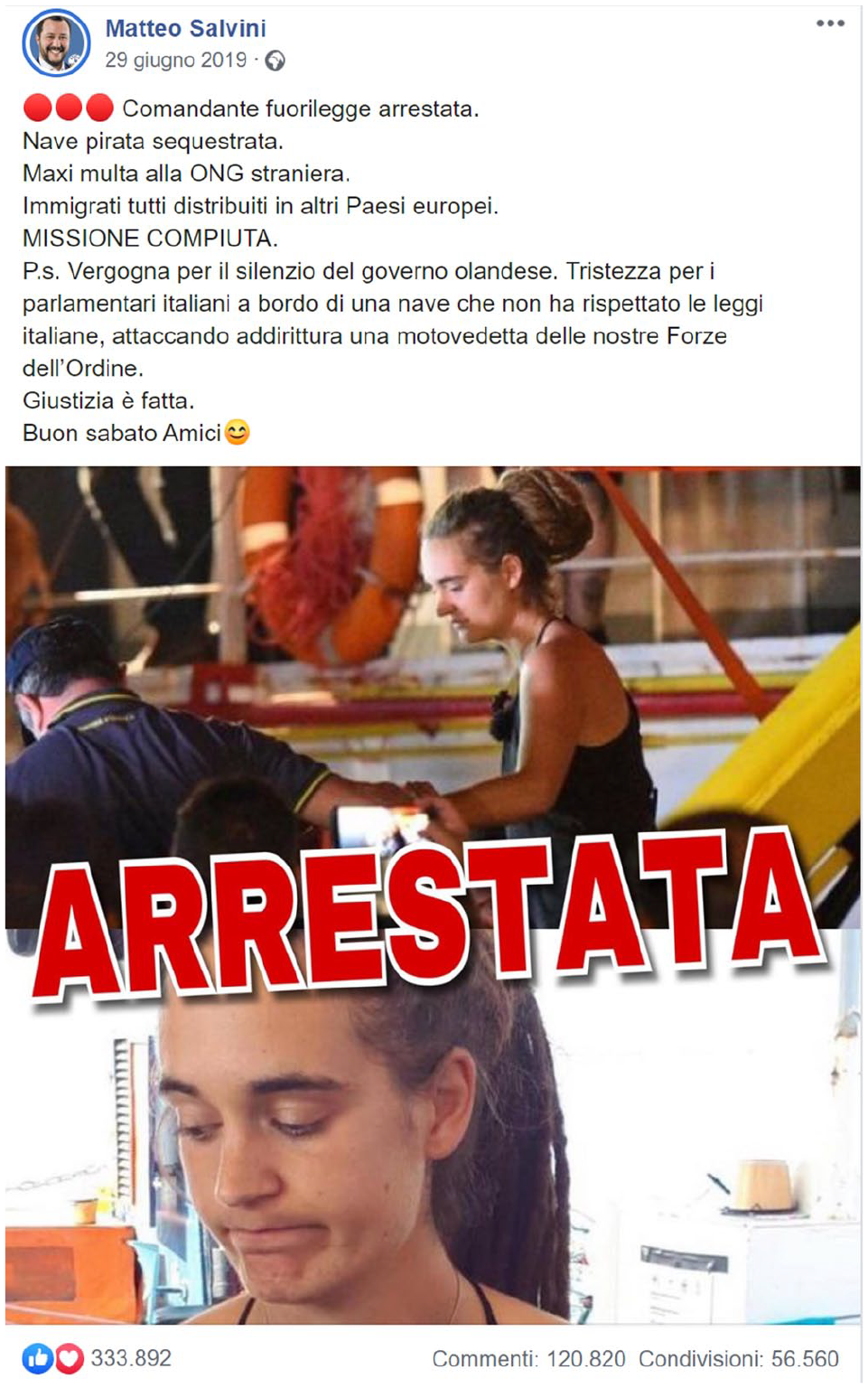
Matteo Salvini’s Facebook post on 29 June, after the arrest of Carola Rackete.
Despite the judiciary eventually decided to free Rackete without prosecuting her, Salvini opted for an aggressive communication strategy, framing the event as an ‘act of war’ (S57).
It is quite interesting to follow the evolution of Salvini’s communication on the figure of Rackete. While at the beginning his attacks are mostly directed toward the Sea-Watch, he starts to focus on Rackete on 26 of June, when in a video (S22) he defines her a ‘little braggart’ (sbruffoncella) who exploits migrants for political reasons. On the same day, he posts a photo of Rackete, claiming that she should not ‘come to bust balls (venire a rompere le palle) in Italy’ (S26). This form of character assassination proceeds after Rackete decides to dock at Lampedusa and is subsequently arrested. From that moment on, Salvini repeatedly defines her ‘outlaw’ and ‘criminal’, even after the judiciary’s decision not to charge her. Moreover, Salvini creates a typically populist Manichean division between good and evil (Wodak, 2015), juxtaposing the ‘outlaw’ Rackete to the ‘good’ police forces and insisting that Rackete willingly put at risk the lives of agents and soldiers. On 4 July, Salvini posts a photo of himself among a group of policewomen, and under it a photo of Rackete by herself, accompanying this image with the text ‘I stand with those women who defend the law, and not with criminals!’ (S85). Moreover, Salvini uses provocation to attack Rackete, for instance by calling her ‘a rich and spoiled German communist’ (S90).
As shown in the next sections, the criminalization of Rackete and Sea-Watch becomes the ground for attacking and delegitimizing Salvini’s political and institutional opponents as well as other countries and the EU. Conversely, Salvini depicts himself as a hero who opposes the ‘villain’ Rackete, together with the Italian people and the police forces.
Anti-elitism: exploiting the criminalization of NGOs to attack the ‘enemies of the people’
Table 1 shows that Salvini’s posts generally include some form of attack to others, and in many cases (over one third of the sample) multiple attacks. The majority of these attacks are directed toward other countries (49% of the posts) and national politicians and political forces (36.8%), though a relevant portion of attacks is also directed toward the EU, the media, cultural elites, the judiciary, and even the Catholic Church.
Looking at the single posts, it can be noticed that these attacks are not casual, but rather linked to particular moments and events. Salvini tends to pick on actors who supported (or are accused of supporting) the Sea-Watch 3 and Rackete. For example, from the very beginning, Salvini repeatedly highlights that the Sea-Watch 3 is a Dutch ship with a crew from a German NGO, thus taking the chance to attack these two countries and the EU. On 23 June, he writes:
I personally wrote to my Dutch colleague and Minister: I am in disbelief, because they are ignoring a ship with their flag, used by a German NGO, that has been floating for eleven days in the middle of the sea. We will consider the Dutch government and the European Union, as usual absent and distant, responsible for anything that will happen to the women and men on board of Sea-Watch. (S11)
These attacks continue for the whole period under analysis, with Salvini claiming that the migrants on board of the Sea-Watch 3 should be equally distributed between Germany and the Netherlands. Moreover, Salvini directly picks on several foreign institutions and politicians, such as German President Frank-Walter Steinmeier and French President Emmanuel Macron (e.g. S75).
However, foreign countries are not the only targets of Salvini’s attacks. These include, for instance, the Catholic Church, picked on with two posts (both on 24 June) simply because the Turin diocese offered to host the migrants on the Sea-Watch 3, and a Lampedusa priest started a protest to ask for the migrants to be disembarked immediately.
After some politicians from the Democratic Party (a center-left, non-populist party) decide to embark on the Sea-Watch 3 in support of its crew and the migrants, Salvini begins a series of attacks against his national political opponents. As part of this strategy, Salvini repeatedly defines them ‘anti-Italian’ (S27) and ‘the anti-Italian left’ (S39), claiming that these politicians support illegal immigration (S24) and ‘pirate ships’ (S30).
It is evident how the previously described tactic of criminalizing sea-rescue NGOs serves the purpose of associating to criminal activities other countries (in particular, the Netherlands and Germany), and Italian political forces who openly disagree with Salvini’s position on the issue. Likewise, Salvini directly responds on Facebook to the attacks of several intellectuals and journalists who openly contest his position, such as Roberto Saviano, Gad Lerner, Adriano Sofri. A particularly interesting example is Salvini’s attack against David Sassoli, responsible of openly supporting NGOs in his new role of President of the European Parliament. In his post against Sassoli (S83), Salvini defines him ‘new President of the European Parliament, Member of the European Parliament of the Democratic Party, and former Rai journalist’, thus attacking at the same time the European institutions, his Italian opponents, and the media.
Finally, once Rackete is set free from jail by the judiciary, Salvini begins a series of attacks directed at the latter. Significantly, in a video posted on 2 July (S78), Salvini accuses the judge responsible for the decision of perhaps having drunk a glass of wine with Rackete: while this accusation is obviously a provocation, it helps creating a narrative of a judiciary colluded with who has previously been defined (by Salvini himself) a criminal and a pirate. The same video perfectly exemplifies how Salvini manages to merge different attacks to create the narrative of a conspiration of evil elites working against him and the people. First, referring to the judge’s decision to free Rackete, he ironically argues:
I knew that there would be someone attempting to deny the evidence, someone who would do what the big professors, some foreign politician like Macron or Merkel, or some Italian Solon, were expecting: freeing that poor woman, who only tried to kill five Italian soldiers.
Then, he randomly targets Italian intellectuals and journalists (Roberto Saviano, Fabio Fazio, Lilli Gruber, Gino Strada, Oliviero Toscani, Daria Bignardi), and claims ‘I believe I have on my side millions and millions of Italians and respectable immigrants’. He ultimately concludes by proposing a reform of the judiciary and appealing to people by claiming ‘If you’re up for it, I’m up for it’. This speech makes explicit how Salvini uses communication and the social construction of issues to design and propose policy ideas (in this case, a reform of the judiciary). The final slogan of this video also exemplifies a third element of Salvini’s communication linked to the criminalization of NGOs, namely its (highly polarized) personalization.
Personalizing politics: ‘hero of the people’ versus criminal NGOs
Table 1 shows that the personalization of Salvini’s social media communication is pervasive. This is not surprising, as personalization is a typical feature of mediatized populism (Krämer, 2014), and particularly of populist social media communication (Casero-Ripollés, 2017; Grill, 2016; Krämer, 2017). This is, at least partially, a consequence of the specific nature of social media, which allow politicians to have personal pages and to communicate in a disintermediated way. For instance, Salvini does not communicates only through texts, links, and TV interviews, but also through self-made videos in which he directly addresses his audience. This strengthens his personalized politics. Moreover, by greeting his audience, and by calling them ‘friends’, personalization and appeals to people are merged to strengthen the idea of a direct connection between the leader and his people.
The personalization of Salvini’s communication, moreover, has a strong visual element. Several posts include photos of the leader himself, accompanied by statements and brief sentences expressing his positions. In communicating about the Sea-Watch 3 case, Salvini exploits the criminalization of NGOs to construct a self-image of a strong defender of the law. While polarization between people and elites/outgroups and the construction of a charismatic leadership are typical traits of populism (Mudde and Kaltwasser, 2017; Wodak, 2015), in this case Salvini strengthens the polarization by using legality (rather than, for instance, popular consensus) as the feature that separates him and the people from their enemies.
In Figure 2, for instance, Salvini uses an image of himself accompanied by the words: ‘Pirate ship. Closed ports’. The leader’s image is continuously re-presented in the posts, often in opposition to images of ‘enemies’, such as the Sea-Watch 3 (S7), journalist Gad Lerner (S36), Palermo’s left-wing mayor Leoluca Orlando (S71), Carola Rackete (S77). The personalization of communication and the focus on the leader are also evident in a post (S42), where Salvini is photographed surrounded by flowers, accompanied by a text appealing to his people:
Good morning friends! Today too I am working to defend the honour, the dignity, the borders, the safety, the jobs, the future of our country. Kisses to outlaws and NGOs.
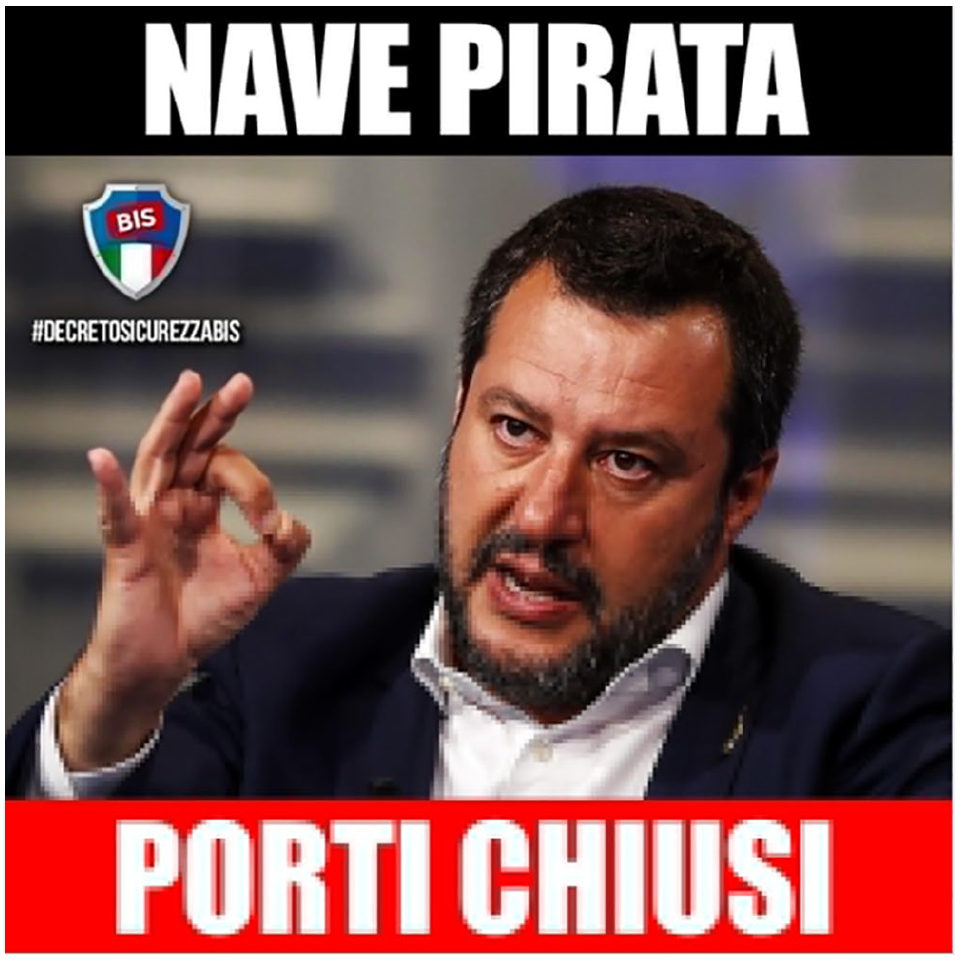
Facebook post of 12 June, stating ‘Pirate ship. Closed ports’.
This post shows how different features of right-wing populist communication (personalization, appeals to the people, nationalism) are successfully integrated with the criminalization of NGOs.
Another post (S98, 12 July) clearly shows how Salvini frames himself as the true representative of all the Italians: after the news that Rackete would sue him and ask for his social media pages to be closed, Salvini posts an image with his and Rackete’s photos juxtaposed, accompanied by these words:
Ultimate folly! ‘Seize Salvini’s social media!’. The little spoiled German wants to shut up Italians!
The underlying argument of this post is that suing Salvini for the potential misuse of social media is the equivalent of forbidding Italians to publicly express their ideas on social media, thus implying that Salvini’s opinion is the opinion of the entire Italian people.
The role of nationalism
The previous sections described how Salvini’s communications on Facebook about the Sea-Watch 3 case were characterized by the criminalization of NGOs, a broad anti-elitism targeting different groups, and a strongly polarized personalization. The fourth constant of Salvini’s strategy is nationalism (as evident from Table 1): it is an ideological element that, attached to populism, constitutes the primordial soup of his communication.
If we consider the criminalization of the Sea-Watch 3 and Rackete as the backbone of Salvini’s narrative, we notice that it is built on two main arguments:
The NGO and its crew are considered complicit of human traffickers, and their action is framed as kidnapping and exploitation of migrants (e.g. ‘[. . .]they say they are good, but they are kidnapping women and kids in the middle of the sea’, S5).
The NGO and its crew are considered criminals for breaking laws, particularly Italian laws, and for attempting to illegally enter Italian territorial waters.
Therefore, the criminalization of the enemy goes through the nationalist element of border defence (Wodak, 2015). Furthermore, nationalism is reinforced by continuously underlining that the Sea-Watch 3 is a Dutch ship used by a German NGO. These two elements allow Salvini to integrate in his strategy the delegitimization of institutional and political forces and the personalization of politics. An example of how Salvini targets foreign governments and institutions is a video posted on 26 June (S22):
I am sick of Italy being treated by some international organizations and by some other European countries as a B series country. Stop it!
In the same video he picks on the Catholic Church and intellectual elites. Salvini therefore can construct himself as surrounded by internal and external enemies whose aim is to attack Italy and Italian citizens. He turns himself into a heroic figure who appeals to his people to explain them that he is fighting a war in defence of his nation:
I am tired, and I believe I am talking in the name of 60 million Italians. [. . .] A Dutch ship of a German NGO is ignoring Italian laws, voted by the Italian government and by the Italian Parliament, representing the Italian people. Are we joking? [. . .] Dignity and respect, this we want, we demand, as Italy. [. . .] A State’s borders are sacred. [. . .] And as a Minister, I believe that you are paying me a salary to defend the security and the borders of my Country.
This narrative is further reinforced once the Sea-Watch 3 docks at Lampedusa and collides with the military vessel. At this point, the criminalization of Rackete is strengthened by accusing her of willingly attempting to defence forces’ lives, and the judge who sets her free is defined the complicit of a criminal. Within this narrative, internal opposition can be easily constructed as ‘anti-Italian’ simply for criticizing Salvini’s opinions and actions or supporting the Sea-Watch 3 or Rackete. This is a typically populist Manichean division of society (Mudde, 2004), based on a strong nationalist element. With this strategy, Salvini manages to appoint himself as the true representative and heroic figure of a homogeneous people, while at the same time he creates a frame (based on the idea that some criminals are exploiting migrants to illegally enter Italian borders) in which everyone who disagrees with him, regardless of their reasons and arguments, can be constructed as an enemy of Italy and a supporter of outlaws.
Discussion and conclusion
Engesser et al. (2017) noted that populism is often expressed on social media as a fragmented ideology, with single elements appearing separately in different contents. This is explained in part by the characteristics of social media (e.g. word limits), in part by the populists’ need to address different audiences with targeted messages.
However, while single social media messages may actually include ‘fragments of ideology’, the case study analysed in this paper shows that populist communication strategies can be highly integrated, with different elements merging together and relying on each other to form a complex (if at times contradictory) narrative.
By analysing Salvini’s tactic of criminalizing sea-rescue NGOs, it seems evident that he manages to construct a right-wing populist narrative that includes strong elements of anti-elitism, anti-migration and exclusionary politics, personalization, polarization, and nationalism. Rather than directly attacking migrants and foreigners, in this case he chooses to victimize them, in favor of harsh attacks directed at actors (NGOs) that can more easily be constructed as elites. In so doing, he does not need to reject the anti-migration stances of his party and his supporters, rather re-framing the issue in order to attack the powerful (NGOs, but also political opponents, other countries, the EU, the media, the judiciary, . . .) and not the weak (migrants). Nationalism is strengthened by the possibility of exploiting Euroscepticism and attacking countries involved in the Sea-Watch 3 case (particularly Germany and the Netherlands). Polarization is also enhanced by implying that every institutional and political actor, national or international, that supports Rackete or Sea-Watch, is part of that homogeneous, corrupt elite that works against the people. The corrupt nature of this elite is demonstrated by the ‘criminal’ behavior of the sea-rescue vessel and its captain. Finally, personalization is reinforced by exploiting the role of Salvini as Minister of Internal Affairs to turn him into a heroic figure facing multiple attacks from different elites, all characterized by their will to weaken Italy.
This narrative tends to be reflected and amplified across social media, especially among Salvini’s audience, as demonstrated by waves of negative and offensive comments under Salvini’s posts on Rackete. Moreover, the provocative and polarizing content is very effective in setting the agenda and influencing the public debate, as shown by a plethora of legacy media discussions over the conflict between Salvini and Rackete, and by Rackete’s decision to press charges against Salvini for defamation (Rackete publicly motivated this decision by claiming that Salvini used social media to spread hate speech, threats, and insults 6 ). In general, the mediatized attacks to sea-rescue NGOs pursued by Salvini on social media have been quite successful in increasing the support for anti-migration policies (Baldini and Giglioli, 2020) and media attention toward the politicization of migration (Bailo, 2019).
The criminalization of NGOs, moreover, can be exploited by right-wing populists to develop and implement policies and laws against them. This is clearly the case of Salvini, whose ideas against pro-migrants NGOs were not new, and whose attacks directed at the Sea-Watch 3 came during the process of approving a decree that actually criminalized the actions of sea-rescue vessels. Such policies can have potentially negative implications from a legal, humanitarian, and political point of view (Cusumano and Gombeer, 2020; Geddes and Pettrachin, 2020), and can be a cause of further concern for development NGOs (see Galasso et al., 2017).
However, the implications of criminalizing NGOs may be even more concerning. The analysis of Salvini’s narrative shows that by criminalizing the Sea-Watch 3 and Rackete, he was subsequently able to attack several other actors, many of which play a central role in liberal democracies. Salvini targeted political opponents by calling them ‘anti-Italian’; he attacked the media, journalists, intellectuals; he picked on judges, even advocating a reform of the judiciary simply because a tribunal took the decision of setting Rackete free from jail. This suggests that the criminalization of NGOs may not only be the basis of laws against the NGOs themselves, but also against actors who play a vital role in the maintenance of a liberal democratic environment.
In this respect, the criminalization of NGOs should be further investigated in its potential developments and impact. While this paper focuses on a single case study in one country, future research may include other national and transnational contexts, and perhaps explore attacks to organized civil society in a broader sense, by focusing not just on pro-migrants organizations, but also on groups dealing with other relevant issues (e.g. religion, gender).
Supplemental Material
Appendix_-_FB_posts – Supplemental material for Right-wing populism and the criminalization of sea-rescue NGOs: the ‘Sea-Watch 3’ case in Italy, and Matteo Salvini’s communication on Facebook
Supplemental material, Appendix_-_FB_posts for Right-wing populism and the criminalization of sea-rescue NGOs: the ‘Sea-Watch 3’ case in Italy, and Matteo Salvini’s communication on Facebook by Carlo Berti in Media, Culture & Society
Footnotes
Funding
The author disclosed receipt of the following financial support for the research, authorship and/or publication of this article: The author received financial support from the PRIN 2017 project “The transformation of democracy: Actors, strategies and outcomes in opposing populism in political, juridical and social arenas” (CUP E64I19003110005), funded by the Italian Ministry of Education, University and Research.

Supplemental material
Supplemental material for this article is available online.
Notes
References
Supplementary Material
Please find the following supplemental material available below.
For Open Access articles published under a Creative Commons License, all supplemental material carries the same license as the article it is associated with.
For non-Open Access articles published, all supplemental material carries a non-exclusive license, and permission requests for re-use of supplemental material or any part of supplemental material shall be sent directly to the copyright owner as specified in the copyright notice associated with the article.
