



Abstract
This project analyzed print news articles on cannabis legalization that were published in 2015 (N = 295) from newspapers across the United States. The following year, 2016, saw more states legalize cannabis for adult use and medical use than before. Therefore, one goal of this research was to investigate the relationship between reports on cannabis legalization and subsequent legal changes that occurred in states that reformed their cannabis laws. Findings reveal that cannabis legalization issues are reported in the media with tones that favor, oppose, or are neutral toward cannabis legalization. Overall, cannabis legalization stories were reported with a neutral tone. Additionally, arguments about whether cannabis should be legalized are framed using criminological, economic, medical, and political themes. The political theme emerged most frequently in all reports. Findings indicate that there is an association between the tone of positive reporting and subsequent cannabis legalization in states where those reports originated. These findings have implications for allowing policymakers and healthcare professionals to build on their existing knowledge of the relationship between media, public opinion, and emerging cannabis policy. Finally, this study provides some context for the connection between a story’s theme, tone, and how they can shed light on cannabis legalization outcomes.
Keywords
Introduction
Public perception of cannabis legalization has shifted dramatically over the last several decades. Attitudes supporting legalization of cannabis have steadily risen from about 20% in 1975 to above 60% in recent years (Jones, 2015; Stringer and Maggard, 2016). Further, the perceived risk of using cannabis once or twice per week decreased from 50% in 2002 to 33% in 2016 (Compton et al., 2016). One of the factors that accounts for the lower risk perception of cannabis use is the way media coverage of the substance has changed over time (Lancaster et al., 2011).
As of December 2019, 34 states have legalized the sale of medical cannabis. Of those, 13 states and Washington D.C. have legalized the sale of adult-use cannabis (NORML, 2019). State cannabis laws began shifting in 1996, when Californians voted to legalize the substance for medical use. Since then, most states in the US have undergone some type of cannabis law reform, be it for medical or adult-use purposes. 2016 brought the largest volume of cannabis law reform to date, with 10 states passing legislation to modify their laws in favor of some form of legalization (Trumble, 2017). One of the components playing a causal role in these policy shifts is the impact of media reports on public perception of cannabis use. Kim and Kim (2018) found that media coverage of medical and adult-use cannabis legalization in the United States varied in tone according to presidential periods and that the framing of cannabis as positive or negative differed according to the political affiliation of media outlets.
The manner of news coverage can have considerable implications for how media consumers understand it. Particularly, media consumers formulate a great deal of their political knowledge from media reports (McCombs and Shaw, 1972). Increased media attention to certain issues also sets the stage for national policy, as the salience of media reports about certain drugs has been linked to the precedence of their anti-drug legislation (Miller et al., 2014). The media engages in framing by prompting their consumers on how certain issues can be analyzed and interpreted (Entman, 1993). The process of framing involves focusing attention on what is deemed relevant, conveying a particular set of meanings in a given narrative, and functioning to reshape the way a phenomenon is understood (Goffman, 1974). When examining the history of media coverage of various drugs, each drug appears to have a window of time during which it is the primary focus of sensationalistic reporting (Alexandrescu, 2013; Cobbina, 2008; Miller et al., 2014).
Social researchers have long been studying the relationship between media reports, public perception, and policy. Media discourse is full of organizing themes that allow media consumers to make sense of relevant issues and events. Gamson and Modigliani (1989) suggested organizing themes in media discourse enable media consumers to make sense of issues by developing a pro, con, or ambivalent stance toward them. Coleman et al. (2009) suggest that media reports can take on an affective tone that can be positive, negative, or neutral and “attributes and tone that the media use in their descriptions are the attributes and tone foremost in the public mind.” (p.149).
No region of the United States is untouched by some form of recent cannabis law reform. Entire regions like the Northeastern United States, which includes New England and the Middle Atlantic states, have enacted some form of cannabis legalization, either for adult-use or medical purposes. Every state in the Western Pacific region has legalized cannabis for adult-use, aside from Hawaii, where medical cannabis is legal. The largest clusters of states that have not undergone any cannabis law reform are predominantly in the South and Midwest regions of the United States. As each year passes, however, more and more states are joining the trend to engage in cannabis law reform.
In 2016, more states shifted their laws toward cannabis legalization than the country had previously seen. A total of 10 states modified their laws to include provisions for the use of medical or adult-use cannabis. Research on depictions of cannabis presented in the media is still in its emergent phases. Therefore, this research aims to close the gap in understanding the relationship between media reporting on cannabis and subsequent changes in cannabis policy. To do so, it is critical to examine the frequency of organizing themes and the tone used in media reports about cannabis. Kim and Kim (2018) examined reporting trends between 1995 and 2014. Their research produced a wealth of new knowledge about the media framing of cannabis but excluded reports from 2015, which preceded the year the US saw the highest number of states engage in cannabis law reform. Subsequently, this research will examine media reports on cannabis from nine states, one from each regional division, during 2015 and will ask the following research questions:
Additionally, the tone of each of the articles in the sample will be examined. To analyze the tone of each story, Coleman et al.’s (2009) themes of tonal analysis, which indicate a story’s positive, neutral, or negative emphasis, will be used to understand the angle of articles’ depictions of cannabis. Therefore, understanding the tone of each story’s portrayal of cannabis is essential when exploring how and why states achieve cannabis law reform. Based on the importance of tone in each story, the following research questions are asked:
Methods
Study sample
To obtain a comprehensive sample of newspapers throughout the United States, one major newspaper from each of the nine regional divisions was selected. The US Census Bureau Regions and Divisions were used, which separate the United States into nine divisions within their four regions. The regions and their divisions are depicted in Figure 1.
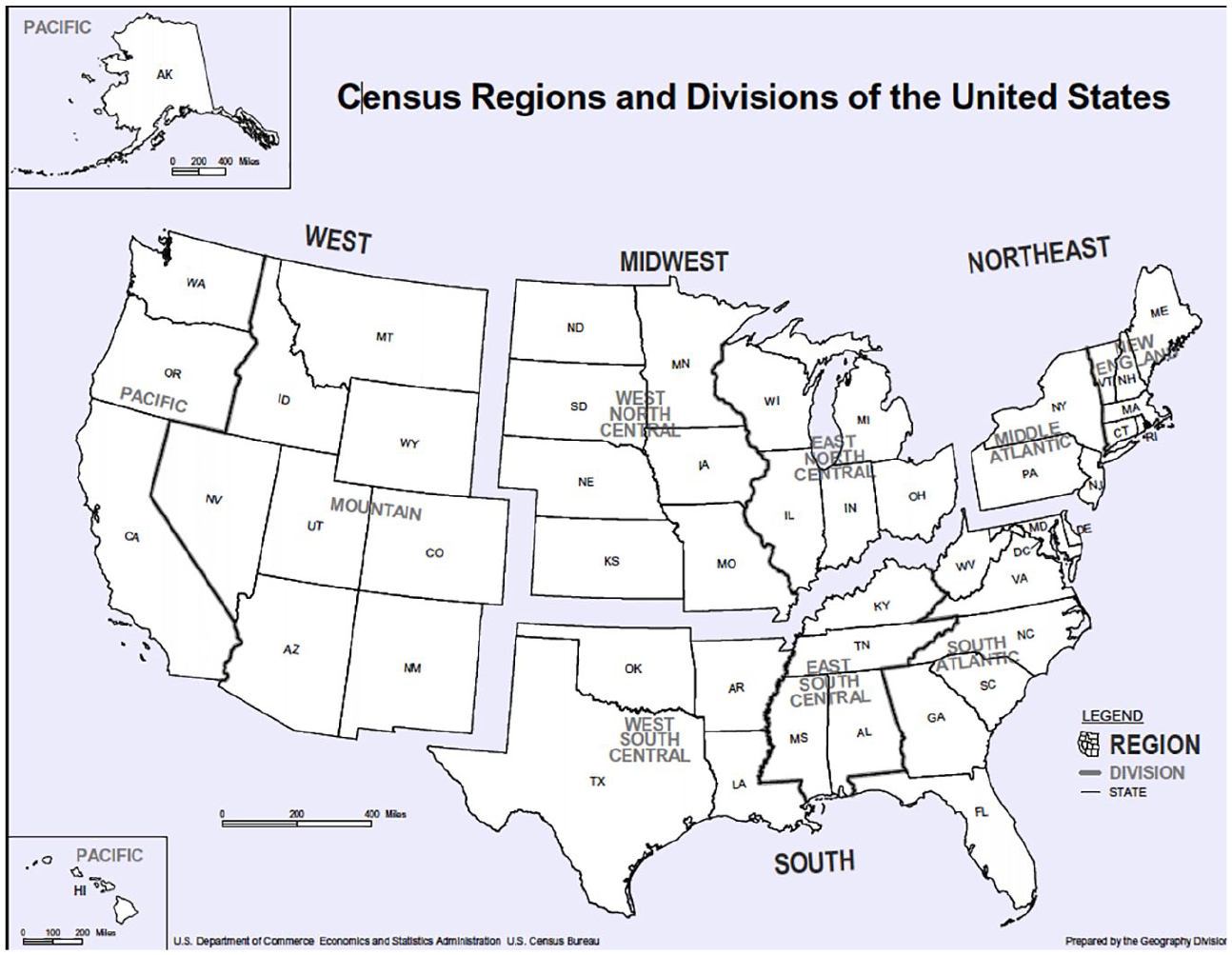
Census regions and divisions of the United States (US Census Bureau, 2019).
In order to select newspapers from states where cannabis use is permitted and states where it is not, one state from each of the nine divisions was selected and their most widely-circulated newspaper was analyzed. States that legalized cannabis in 2016 that were excluded from the study are Ohio, Nevada, Maine, Massachusetts, and North Dakota. These states were excluded in order to achieve geographic representation, get a balanced view of states with varying laws (adult-use, medical, illegal), and to maintain a manageable sample size of newspaper articles. Papers were selected from states in three categories: states where adult-use cannabis is legal (California and Vermont); states where cannabis is medically legal (Arkansas, Florida, and Pennsylvania); and states where cannabis remains completely illegal (Indiana, Idaho, Mississippi, and South Dakota). The states included in the study where cannabis remains illegal each had grassroots efforts in 2015 aiming to legalize cannabis in 2016, but were ultimately unsuccessful at shifting cannabis legislation.
Once the state sample was selected, the largest newspaper circulated in each state was included for analysis. News articles were searched using key words in the following search engines: News Bank and Newspapers.com . Articles were retrieved from these databases using the following keyword search terms: “marijuana,” “legal marijuana,” and “medical marijuana.” Articles were included if their headlines mentioned “marijuana” or marijuana-related terms, such as: “Pot,” “Weed,” and/or “Cannabis.” Articles were only included if they appeared in news story or feature story format. Therefore, editorials, reviews, stories in sports sections, columns, press releases, and letters to the editor were excluded. News stories and feature stories explored the issue of cannabis legalization in greater depth than the other formats, thereby allowing for a higher quality of analysis on their organizational themes and tones. Narrowing the sample in this manner produced a total of 295 articles (N = 295) to be analyzed.
Coding procedure
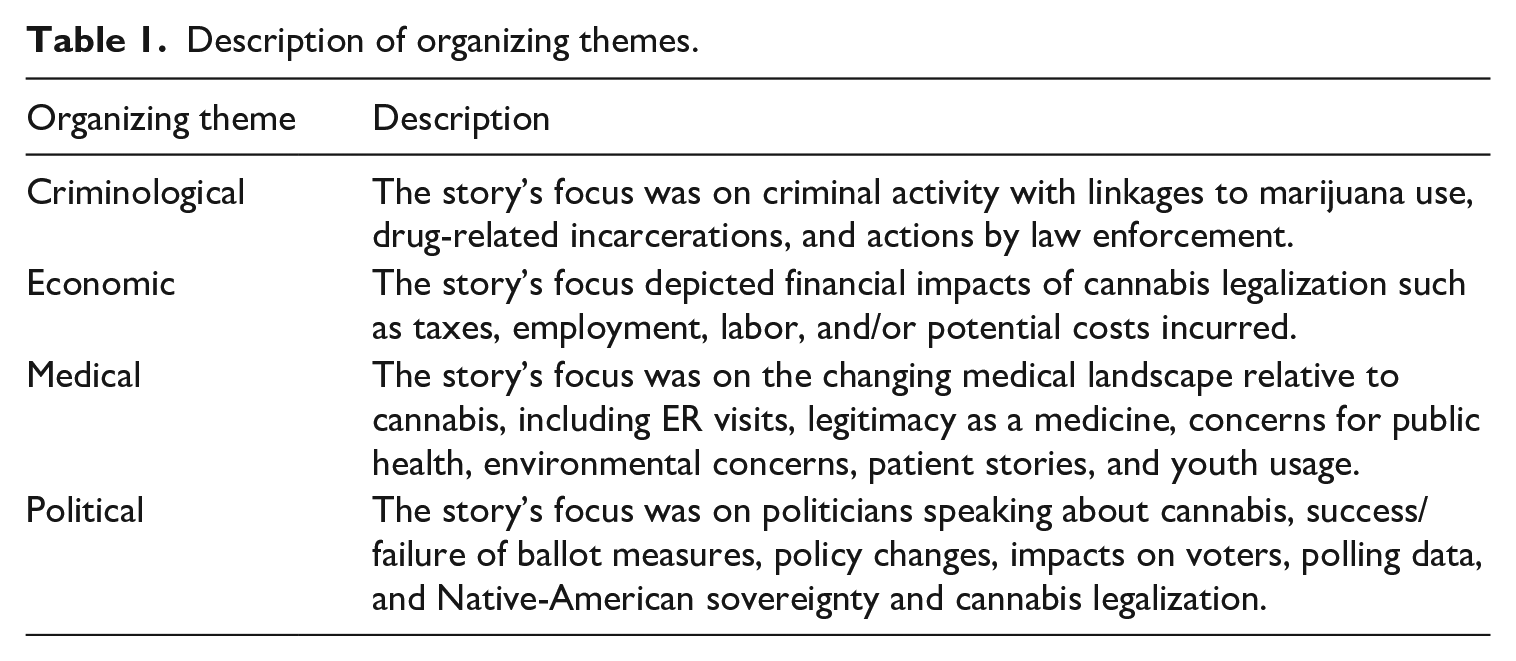
The author, along with another academic professional, conducted the coding procedure for this project. Coders read each story, recorded its organizing theme(s), and analyzed the tone of each article. Themes were categorized by identifying the topics most frequently discussed in the reports when referencing cannabis legalization. The emergent themes are: criminological, economic, medical, and political. If more than one theme was included in an article, coders placed the article into two or more thematic categories. A description of each theme is presented in Table 1. Afterward, the coders coded each of the articles for their overall tone and determined whether the articles used language in favor of (pro), opposed to (against), or neutral on the subject of cannabis legalization. To arrive at this decision, coders examined the discursive emphasis in the article headlines, depictions of pros and cons of cannabis legalization within the stories, and the conflation of cannabis use with positive or negative social norms within the reports. Inter-coder reliability of the first 100 articles coded averaged .91.
Description of organizing themes.
Results
Organizing themes
As shown in Figure 2, news reports from states that legalized and from states that did not legalize were positively skewed according to their themes. The criminological and economic themes were coded 5–10% of the time in both legal categories. The medical theme differed the most between the two categories of legalization. The medical theme appeared in reports from legalized states approximately 19% of the time compared to about 9% in non-legalized states. The political theme represented the majority of both legalized and non-legalized states, with approximately 24% compared to about 17% respectively. To examine if there was any association between occurrences of reporting themes and changes to state law during the following year (H1), a chi-square test was conducted. The results of chi-square test indicated that there was no statistical association between the appearance of the themes and a state’s legalization status during the following year (Χ2 = 7.6, p < 0.05).

Proportion of reporting themes in states that legalized and states that did not.
Story tone
As shown in Table 2, among 295 articles, 63% (n = 186) were written with a neutral tone about cannabis legalization. Articles that reported a favorable tone toward cannabis legalization made up 24 % (n = 71) of the sample. Lastly, articles written with a tone opposing cannabis legalization made up 13% (n = 38) of the sample.
Number and proportion of story tone in cannabis legalization articles.

As shown in Figure 3, reports from states that legalized cannabis in 2016 were more frequently written in a positive tone compared to states that did not legalize in 2016. Additionally, reports from states that did not pass cannabis legislation in 2016 were more frequently written with a neutral tone. A chi-square test was conducted to examine any association between tone of news reports and state legalization patterns the following year (H2). The results of the chi-square test indicated that the difference in the tone of reporting was significant relative to the states’ subsequent legalization statuses (Χ2 = 58.45, p < 0.05). As shown in Figure 3, reporting in Tampa Bay Times and in Seven Days, of Florida and Vermont, respectively, revealed no articles written in a negative tone. Additionally, reporting in Idaho Statesman revealed no articles written in a positive tone.
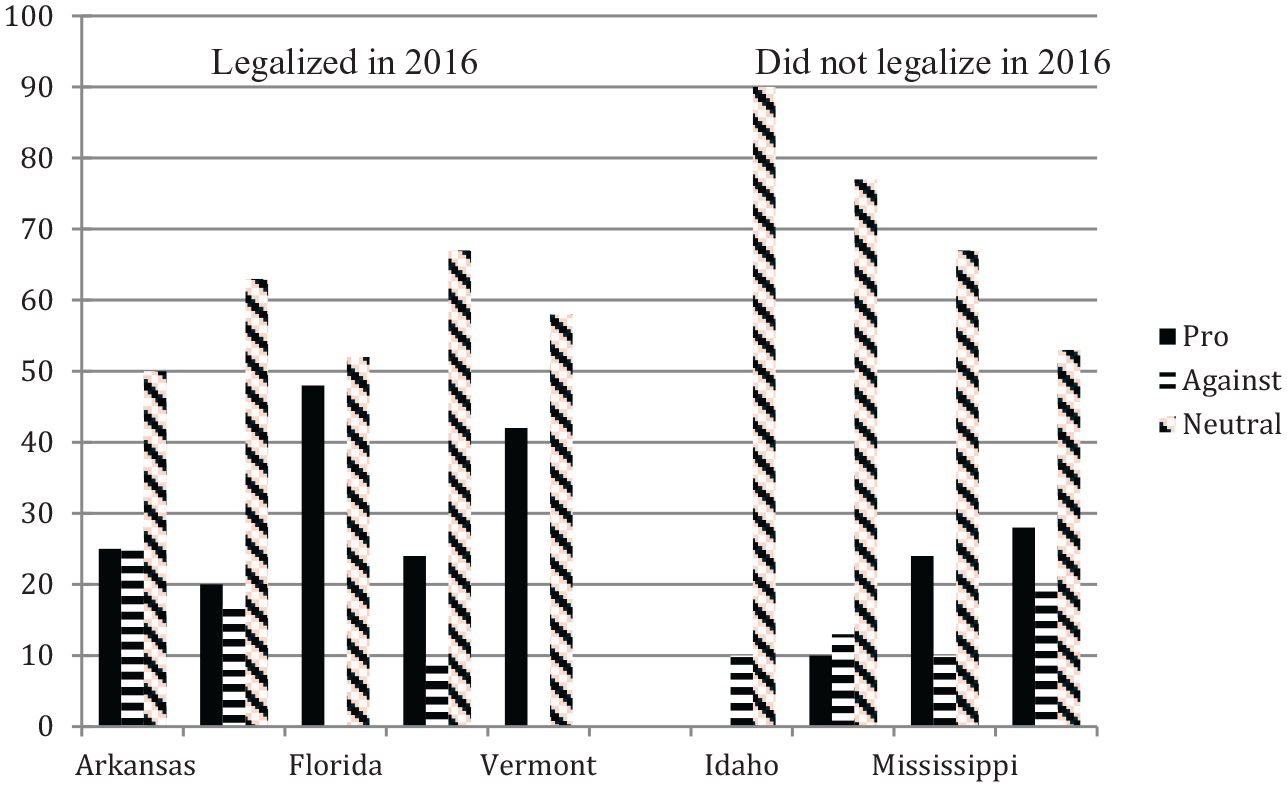
Percentage of story tones by state.
Discussion
The goal of this study was to uncover the manner in which newspapers covered cannabis legalization stories in 2015, since the following year brought the largest official legalization movement to date. Newspapers used political theming most frequently when describing issues surrounding cannabis legalization. This held true whether the state subsequently voted in favor of or opposition to cannabis legalization. These findings are in alignment with extant literature revealing cannabis legalization issues are most frequently framed using a political theme (Golan, 2010; Kim and Kim, 2018; Lewis et al., 2015; McGinty et al., 2016). So long as the reports continue to emerge under a political scope, American news consumers will continue to understand the issue of cannabis legalization as a political one, rather than as an issue of public health (Kim and Kim, 2018), crime, or economics.
These findings have several key implications. The political theme represented in this reports encapsulates legalization efforts that occurred in 2015. The reports in the political theme often highlighted aspects of the incongruence of federal and state cannabis law, since cannabis remains federally illegal. Of all states in the sample, states that legalized in 2016 incorporated a higher prevalence of all four themes into their news reports along with a greater presence of a tone favoring cannabis legalization. Themes used by reporters affect the way media consumers tolerate issues by impacting their perceived importance (Nelson et al., 1997). Therefore, the prevalence of the political theming mentioned above may help contextualize the subsequent shift toward legalization observed in those states.
The medical theme incorporates references to patients, medical costs and benefits of use, youth usage, and other aspects of public health. The data reveal this theme occurred less frequently than the political theme although three of the five states in this report that legalized did so for medical purposes (Arkansas, Florida, and Pennsylvania). This shows issues of cannabis legalization are discussed more frequently with a political perspective even in states that are attempting to pass medical legislation. This further bolsters the notion that cannabis legalization issues discussed in news reports are most frequently themed as political.
In states where cannabis is legal for adult-use, also known as recreational cannabis, news reports frequently mentioned economic themes, depicting the benefits of tax revenues, profit margins, and improvements to state infrastructures. Papers from two states that legalized adult-use in 2016, California and Vermont, were included in the sample. The economic theme represented 21% of the observed themes in LA Times and 57% of the observed themes in 7 days. Although there are few reports that examine the relationship between cannabis legalization and its media framing, Block (2017) noted the prevalence of economic framing in news reports following Colorado’s adult-use legalization in 2014. Therefore, there is a noticeably greater tendency for news reports to focus on economic benefits of cannabis in states that legalize it for adult-use.
The largest concentration of criminological themes occurred in Indianapolis Star, with a readership based primarily in Indianapolis, Indiana. Cannabis law reform has not yet occurred in Indiana, which may explain the preoccupation with framing the cannabis issue through a criminological lens. Criminological themes represented 47% of the total themes coded from Indianapolis Star. Of those articles, 15% used a tone that was opposed to cannabis legalization. In newspapers from the other eight regional divisions, the criminological theme was not as prominently represented.
As shown by Figure 2, reports featuring criminological themes were less prominent than medical and political themes. There are several possible explanations for this, including increasing public skepticism relative to the amount of crime that results from cannabis legalization. Research reports have empirically demonstrated that medical cannabis legalization, particularly when it is legalized for medical use, may produce decreases in violent and property crime (Morris et al., 2014). Further, Kepple and Freisthler (2012) found that the geographic density of medical cannabis dispensaries is not associated with violent or property crime rates. Further, recent evidence suggests medical cannabis legalization can also decrease the volume of illegal drug trafficking in states with international borders (Gavrilova et al., 2017).
State cannabis law has preempted federal cannabis law. Since the early 2000’s, there have been multiple administrative, judicial, and congressional calls for cannabis law reform. Some examples of federal attempts at reform include: a 2002 petition to the Drug Enforcement Agency filed to reschedule marijuana’s status as a schedule 1 narcotic; the 2009 Ogden Memorandum, which deprioritized federal prosecution for marijuana offenses; the 2013 Cole Memorandum, which reinforced the Ogden Memorandum; and the 2016 Rohrbacher-Blumenauer Amendment, which prohibited the use of federal funds to prosecute marijuana offenses (Haffajee et al., 2018). These efforts point to diminishing federal interest in coopting cannabis law in states where cannabis legislation has been passed. Since the majority of the states in the US have incorporated some kind of cannabis law reform, be it adult-use, medical-use, or decriminalization, the criminological implications may be deprioritized from the forefront of public consciousness.
Indiana was not the only state in the sample where no cannabis law reform occurred. In total, four newspapers from states where cannabis is still illegal were represented in this study. Those other states are Idaho, Mississippi, and South Dakota. Each of those states had strong grassroots movements aimed at legalizing cannabis, and their efforts persist. Idaho, for example, came close to legalizing CBD in 2016, in the form of non-THC cannabis oil used for medical purposes. This movement was successful with the passing of SB-1146a, however Governor Butch Otter vetoed it (Russell, 2015). Mississippians aimed to pass the Mississippi Marijuana Legalization Amendment Initiative, Initiative 48, in 2016 but fell short of collecting the necessary 107,000 signatures to qualify for the November ballot (Saltor, 2015). Similarly, South Dakotans led a grassroots effort in 2015 to legalize cannabis and collected more than the required amount of signatures needed for their petition. However, over half of the signatures were deemed to be invalid by the office of Secretary of State, Shantel Krebs, and the petition did not make it onto the 2016 ballot (Roper, 2015).
Approximately 63% of the articles framed the issue of cannabis legalization as neutral. Stories with postivie tones (24%) occurred more frequently than stories with negative tones (13%). This pattern of neutrality may be partly explained by the decreasing negative emphasis on cannabis-related activity in popular media over the last three decades, which has produced attitudinal changes toward the risk of cannabis use (Stringer and Maggard, 2016). Another factor that could explain the volume of neutral reports may be the increasing perception of cannabis use as a medically acceptable substance (Chan et al., 2017). Kim and Kim (2018) attribute the pattern of higher relative volumes of reports with neutral tones to stories using two-sided framing strategies. Two-sided framing is more likely to position stories from a neutral perspective in order to cover both sides of the issue. This may also explain the higher volume of reports with a neutral tone.
In media analysis, neutral categories periodically become necessary since many articles do not place emphasis on risks or benefits of policy change (Feucht and Zander, 2017). Neutral articles may also highlight the strengths and weaknesses of public policy (Bullock et al., 2001; Williams, 2017). The format of articles in this project were news and feature stories and included quotes from relevant officials on both sides of the cannabis legalization issue. The majority of the neutral articles relayed facts or addressed the conditions of state or federal cannabis policy. This seemingly unbiased style may have been ineffective at shifting media consumers’ perspectives about cannabis legalization, as evidenced by the lack of policy change seen in states with higher volumes of neutral reporting.
This research had several limitations. First, only print news stories were examined. Print media were selected in order to keep the sample size manageable with a readership whose location was bound within certain areas of the country. Future reports that examine related phenomena may include newspaper analysis bolstered by analysis of audio-visual reports and online reports. Additionally, newspaper search engines are not all-inclusive, so the results of the searches were limited to the accessibility of the available databases. Future research might incorporate searches done in more expansive databases like ProQuest Historical Newspapers in addition to those used in this study. Geographic representation of the sample was one of the goals of this research and, while the newspapers may be geographically representative, they were not all encompassing of the views of individuals, organizations, and politicians within those regions. Third, the categories of themes were determined inductively because extant research on this topic is limited. Codes from other studies were used, where available. At times, codes used in other studies were collapsed into broader schemas to allow more robust thematic representation in this report. Finally, identifying a causal relationship between public opinion, media, and policy was nearly impossible given the context of the research design. Therefore, future studies may aim to address the causal linkages between media, public opinion, and cannabis policy reform.
Conclusion
Cannabis legalization, as a social, legal, and medical phenomenon, is expanding. Subsequently, the research on this phenomenon is in its emergent stages. Few studies exist that examine the relationship between media themes and tones of cannabis legalization across the United States. This study can provide insight on how this relationship is understood and contextualized, and thus has real-world implications. The media has an incredible influence on public opinion (Schudson, 2011). Public opinion and perceived risk play a key role in voter behavior (Cass and Pecotich, 2005). Therefore, attitudes about cannabis might impact cannabis policy decisions, thus changing cannabis politics. These findings also have implications for allowing policymakers and healthcare workers to build on their understanding of the connection between media, public opinion, and cannabis policy. Lastly, this study provides some explanation for the connection between a story’s theme and tone and how they can shed light on subsequent cannabis legalization outcomes.
