



Abstract
This article presents how the rise of Justice and Development Party (AKP) to political power in Turkey transformed journalists’ professional practices as to lead to a decline in the plurality of opinions presented in the media. After AKP’s second electoral victory in 2007, political trials, property transfers, and dismissals wrapped in a discourse of punishment and purge of the “nation’s enemies” destabilized long established power hierarchies of secularists, religious-conservatives, Kurds, and leftists in Turkey. The destabilization was caused by the state’s changing attitude toward these identity groups, and in the media it lead to shifts in journalists’ status positions and emotions. Varying professional responses triggered by these shifts explain the convergence to a dominant singular political narrative in the media. This argument builds on narrative evidence collected between 2012 and 2014 via in-depth interviews, newspaper articles, and journalists’ memoires. With a from-below account, the article presents the effects of destabilized hierarchies on journalistic practice. In the example of media, it invites scholars to rethink contemporary democratic backsliding in terms of the links between state actors and non-state actors, on the one hand, and social actors’ power positions, political identities, and professional practices, on the other.
Keywords
In the last decade, victories in the ballot box reversed trends of democratization, and curtailed political rights and civil liberties in countries such as Venezuela, Turkey, Hungary, Poland, India, and Brazil. Scholars defined this process in a variety of ways ranging from retrogression (Huq and Ginsburg, 2018) to democratic backsliding (Levitsky and Ziblatt, 2018), from de-democratization (Agh, 2015) to democratic deconsolidation (Brusis, 2016). Despite diverging on the term, they agreed on the incremental but substantial nature of the erosion in the quality of democratic institutions. To explain how such incremental breakdown happened scholars stressed the role of state actors, in particular of those active in legal channels, and governments’ legitimation of their acts by reference to electoral success (Bermeo, 2016; Scheppele, 2017). This article contributes to this burgeoning group of studies on democratic backsliding. As different from existing scholarship that focuses on the acts of state actors, it explores how non-state actors contribute to processes of democratic backsliding.
Turkey is a forerunner among its contemporaries with its authoritarian turn. Since the rise of Justice and Development Party (AKP) to power in 2002, the structure of political institutions in Turkey changed drastically losing their existing – albeit in defective form – democratic functions. The media was the first institution to surrender its power over politics as indicated by the decline of media plurality in the country and Turkey’s deteriorating placement in the World Press Freedom Index. Since the early 2000s when Turkey occupied a mediocre 99th position in the Index (RSF, 2002), the country has dropped to a 157th position among 180 countries (RSF, 2018). Deterioration in the rankings of press freedom corresponded to a complete subjugation of existing channels of media freedom to the rule of AKP. Content-wise, silence on corruption scandals involving AKP, fake news stigmatizing party opponents as enemies of the nation, and verbatim overlaps between front pages of newspapers became the new normal. This article conceptualizes the Turkish media’s loss of power over politics as retrogression in a defectively functioning democratic institution. To explore the role of non-state actors, in this case journalists, in democratic backsliding processes it asks how media outlets’ news-narratives converged into a dominant singular narrative.
The article finds the answer in the destabilization of power hierarchies between religious-conservatives, secularists, Kurds and leftists after AKP’s second electoral victory in 2007. It demonstrates that the decline in the plurality of opinions was a consequence of the destabilization’s effect on journalists’ news-making practices. In contemporary media scholarship there is increased interest in contextualizing journalistic practice in realities of new authoritarianism and democratic backsliding (Schimpfössl and Yablokov, 2019; Sükösd, 2018). Most of these studies focus on Russia and Eastern Europe, and explore the impact of party capturing, media oligarchs, and journalists’ meaning-making processes on journalistic’ practice and thus on media transformation (Bajomi-Lazar, 2013; Roudakova, 2017; Zeveleva, 2020). Yet, none of these studies explore journalistic practice and retrogression in the media in the context of changing power hierarchies.
This article focuses on the changes in the Turkish media landscape before 2014. Relying on 62 semi-structured in-depth interviews conducted with journalists from mainstream, secularist, religious-conservatives, Kurdish, and leftist outlets between 2012 and 2014 and published sources of memoires, columns and news, it lays out the Turkish government’s destabilizing measures directed at various identity groups, and how these measures played out on the ground level of news-making. In doing this, the article also goes beyond studies of journalistic practice and invites scholars to rethink contemporary backsliding in democratic institutions in terms of the links between state and non-state actors, on the one hand, and social actors’ power positions, political identities, and professional practices, on the other.
Hierarchies, emotions, and democratic backsliding
In democracies, the media is expected to serve several roles including informing people, interpreting processes with societal and political relevance, and controlling those in power (Benson, 2008; Graber, 2003; Schudson, 2002). It serves these roles predominantly through news-coverage of politics and society (Esser et al., 2012), and fails to fulfill its democratic function when content of news-stories no longer guarantee flow of diverse information, public discussion, and oversight of political decisions (Esser et al., 2012; Strömback, 2005). In Turkey, journalists always worked within the bounds of “tutelary democracy” (Esen and Gümüşçü, 2016). State institutions that considered political Islam, foregrounding of ethnic identity, and communism as threats to the regime intervened in the political process, where they thought publications propagated on these topics, and pressured journalists to adopt the state position. This was most clearly manifested during the armed conflict between PKK (the Kurdish militant organization) and the state over the 1990s, when censorship, incarcerations, and killings targeted the media that addressed the issue from a non-state-controlled perspective.
However, the Turkish media system with its commercial nature based on private ownership and free market competition also resembled its counterparts in Southern Europe, Latin America, and Asia (Yeşil, 2016). Aside from concentration, conglomeration, and clientelism, in a fragmented political system, where there were ten different governments between 1991 and 2002, this meant that the competition among businessmen owners of media conglomerations to engage in political alliances in return for profitable deals endowed them with power over political parties. In fact, the media fulfilled much of its “democratic function” as businessmen sought to reveal corrupt affairs of their competitors in business and politics, and critical journalists resisted the state at the expense of suffering the consequences.
In explaining how the media in Turkey lost its power over political parties as media-outlets’ news-narratives converged into a dominant singular narrative, this article expands on power-status theories of emotions. States use a variety of methods such as public rituals, rallies or events to create communities of feeling (Berezin 2002). In many cases, these methods come into effect by destabilizing existing identity hierarchies in the society (Berezin 1997). In Turkey, the AKP government used political trials, property seizures, and dismissals to disturb existing power hierarchies among political identity groups. Wacquant (2008) has shown that destabilization in ethno-racial power hierarchies may result in increased feelings of insecurity and thus lead to changes in institutional structures. Along the lines of this thought, I argue that the destabilization in Turkey transformed the landscape of emotions and professional practice in the media. The shifts in journalists’ emotions and news-making practices explain the retrogression in the defectively democratic institution of the media.
Scholarship has established that institutions are “bounded sets of iterational practices” and that even established, institutionalized political practices include an emotional dimension (Emirbayer and Goldberg, 2005; Glaeser, 2011). Any institution, including the media, is therefore in part structured by emotions. Changes in emotions are reflected in the structure of institutions through emotions’ impact on individuals’ practices. In linking retrogression of democratic institutions to destabilization of identity hierarchies, power-status theories of emotions are therefore helpful. According to power-status theories of emotions, actors possess relative power and status within social situations. The existing hierarchy of power and status between these actors sets up expectations for interactions. When actors gain or lose power or status in changing social relationships, and expectations for interactions are not met, emotions emerge from these changing relationships (Kemper, 1978, 1990). For instance, fear and anxiety result from an insufficiency or reduction in one’s power. These emerging emotions are then reflected in people’s actions that form institutions. In this context, to the extent that disturbed power hierarchies among identity groups transform individuals’ emotions and practices, the disturbance of power hierarchies is consequential for the structure of institutions.
In what follows, I present a relational analysis of the emotional shift experienced by journalist members of different political identity groups in effect of AKP’s destabilizing measures. In the example of the convergence of the news-narratives in Turkey I then show how changes in journalists’ emotions affected their news-making practices leading to retrogression in existing democratic functions of the media.
AKP, “enemies of the nation” and the media
In Turkey, AKP, a party with roots in political Islam, rose to power in 2002 with 34% of the votes (see Table 1). At its foundation the party claimed to be a conservative-democrat party that embraced not only Islamist but also center-right fractions in politics. Secularist state actors, particularly the president, the military and the judiciary, as well as the mainstream media nevertheless opposed AKP’s entrenchment in the state apparatus 1 (Ciddi, 2011).
Election results 2002–2015.
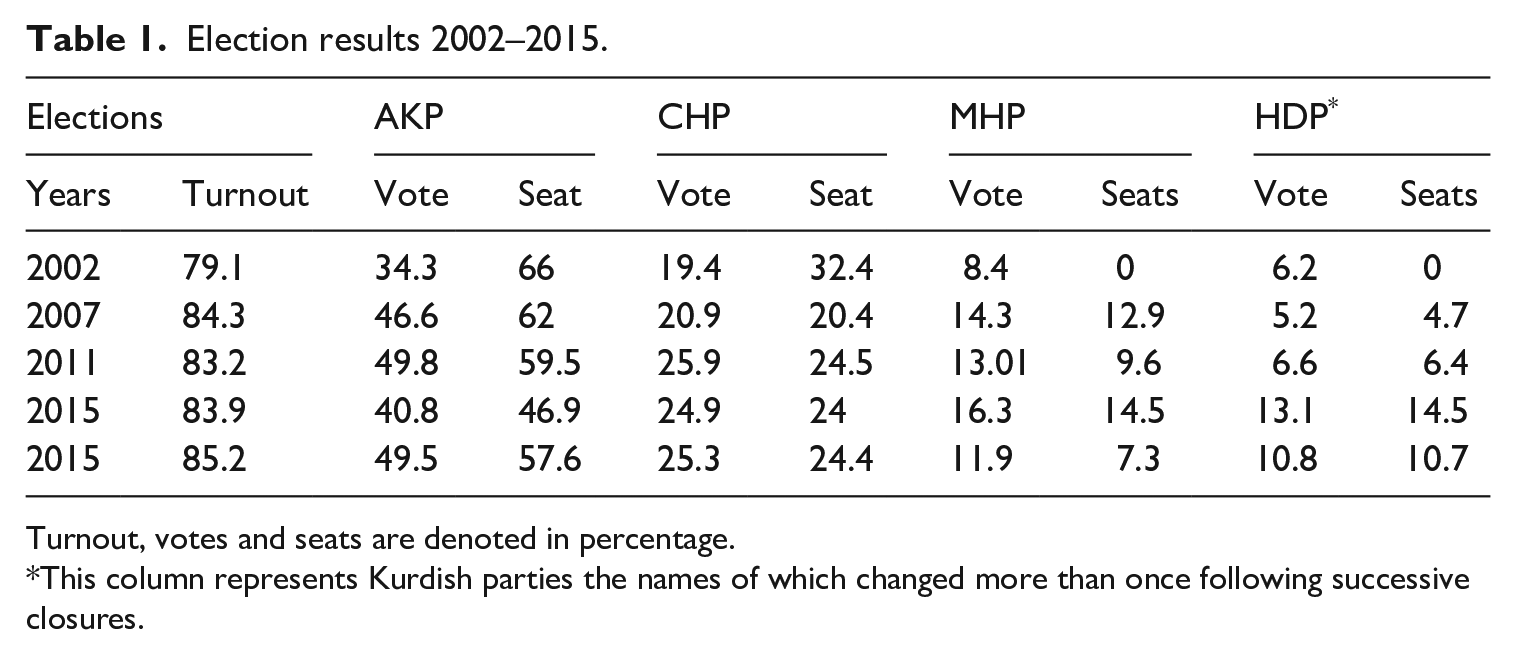
Turnout, votes and seats are denoted in percentage.
This column represents Kurdish parties the names of which changed more than once following successive closures.
During its time in office, and especially after its second electoral victory in 2007, AKP responded to this resistance by channeling rewards to its supporters and punishing its opponents. It instrumentalized a discourse of “the nation’s enemies” to demonize its secularist, Kurdish, leftist critics and legitimize its strategies of punishment. In this discourse, in addition to the Kurdish political movement and the leftists, which the state before the AKP also recognized as enemies, the regime was to be protected from the secularists. In multiple speeches, AKP politicians claimed the secularists to have oppressed the will of the nation throughout republican history (Yılmaz 2017). Terror trials, property seizures, and dismissals wrapped in this discourse of punishment and purge of “the nation’s enemies” were then presented as democratic means of correcting existing oppression and corruption (T24, 2014), and used to oust critics from their positions. In addition to these measures of punishment, AKP also endorsed religious-conservatives by depicting them as the core of “the nation” and endowing them with credits, resources, and positions in bureaucracy and business (Buğra and Savaşkan, 2014). In combination, these measures led to destabilization in power hierarchies among identity groups, and the professional field of journalism constituted no exception.
In the media, AKP labeled secularist, leftist and Kurdish journalists and outlets as “the nation’s enemies”. In one instance, Erdoğan targeted the daily Hürriyet, which was then seen as the “flagship” of the secularist mainstream media. After stating that AKP “came [to power] with the prayers of the nation” he positioned the newspaper against “the nation” by noting that AKP “grew up fighting against the frontlines. . . [and] despite the mentality that said ‘he cannot even be a village headman’ [Hürriyet’s headline from 1998]”. “Enemy” journalists were at times also presented as outsiders of the Muslim community that AKP depicted as the core of “the nation”. For instance, in 2009, Prime Minister Erdoğan despised columnist Bekir Coşkun for sleeping by his dog, when he said “these people have dear dogs. They sleep and breathe by them.” According to many interpreters of Sunni Islam having a dog at home is forbidden by religion.
The same discourse of “enemy journalists” was instrumentalized in political trials where court action was called upon changing the power distribution in the media. Before 2014, journalists were accused of membership to and propaganda on behalf of terrorist organizations in Ergenekon, and KCK trials, and were not only persecuted but also stigmatized. In KCK trials, which targeted Kurdish organizations including news outlets, for instance, suspects were stigmatized as working at illegal media outlets and distributing publications of illegal outlets even though publications by these outlets were legally sold in the market. When in 2011, Ahmet Şık, a leftist journalist who wrote a book on Gülen movement’s sneaking in the police force, was arrested in the context of the Ergenekon trial, Prime Minister Erdoğan responded to criticisms at the Parliamentary Assembly of the Council of Europe by comparing Şık’s book to a bomb and normalizing his arrest (Bianet, 2011). It is in such a context that Turkey became the country with the highest number of jailed journalists in the world successively in 2012, 2013, 2016, 2017, and 2018 (see Figure 1).

Number of incarcerated journalists.
Another means of punishing and purging the “enemy” was property transfers. Media outlets critical of AKP were subjected to property seizures or tax fines that forced owners to sell their outlets. The earliest example was the seizure of the ATV/Sabah network, the second largest media group, shortly before the 2007 general elections. In 2009, a tax fine imposed on the Doğan group, the largest media group, followed. Aydın Doğan, the owner of Doğan group sold two of its prominent newspapers, Milliyet and Vatan, to a pro-AKP businessman to deal with the fine. When pressure increased in the following decade he eventually also sold the group’s flagship newspaper Hürriyet along with its TV outlets CNNTürk and KanalD. AKP legitimized seizures or fines through the discourse of purging politics from corrupt relationships, even calling for a boycott “against the media that makes erroneous news” and asking AKP supporters “not [to] let these newspapers through the doors of [their] home” (Önderoğlu, 2008).
As media networks owned by “enemies” were subjugated, state banks provided easy credit to pro-AKP businessmen and facilitated transformation of these organizations into proponent outlets. By 2011, approximately 30% of the newspaper circulation had already changed hands (Çarkoğlu et al., 2014). Table 2 presents transfer of newspaper ownerships to pro-AKP businessmen between 2002 and 2016. Meanwhile, TV stations of smaller leftist or Kurdish outlets that operated outside the mainstream were threatened with cutting their access to satellite broadcasting, while their newspapers’ distribution was hindered through threats to sale offices or manipulation of demand records.
Transfer of newspaper ownerships.
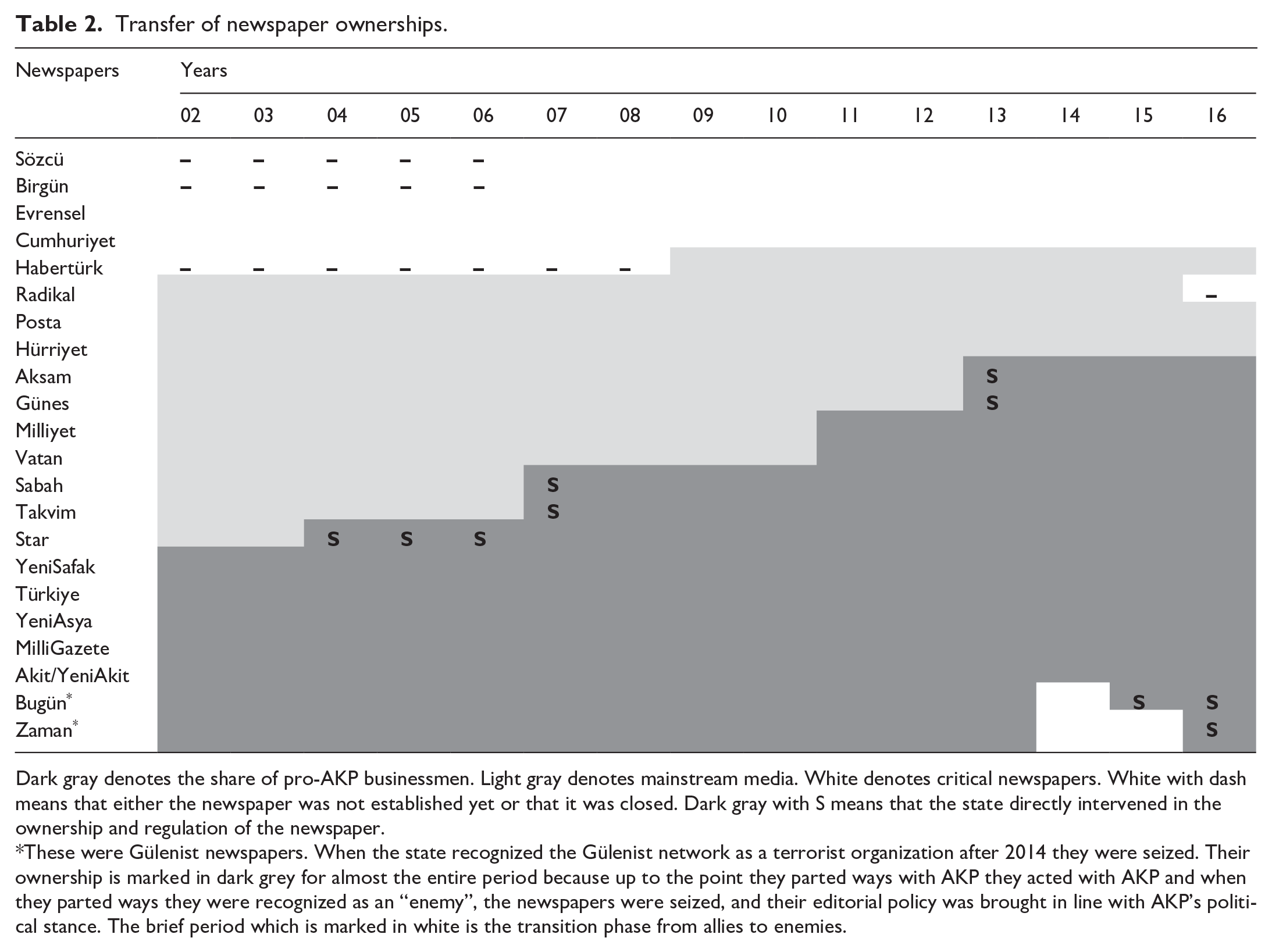
Dark gray denotes the share of pro-AKP businessmen. Light gray denotes mainstream media. White denotes critical newspapers. White with dash means that either the newspaper was not established yet or that it was closed. Dark gray with S means that the state directly intervened in the ownership and regulation of the newspaper.
These were Gülenist newspapers. When the state recognized the Gülenist network as a terrorist organization after 2014 they were seized. Their ownership is marked in dark grey for almost the entire period because up to the point they parted ways with AKP they acted with AKP and when they parted ways they were recognized as an “enemy”, the newspapers were seized, and their editorial policy was brought in line with AKP’s political stance. The brief period which is marked in white is the transition phase from allies to enemies.
Positions of power in the media were also changed through dismissals and appointments of journalists within news organizations. According to CHP’s report, between 2002 and 2014 at least 1863 journalists had been fired or forced to resign for political reasons (Ağbaba et al., 2014). These dismissals were often ordered by phone calls to owners of media outlets. Instant interventions by politicians to TV programs through phone calls also became common practice. One of the interviewees explained that in one example, Prime Minister Erdoğan called the host of a program on Kanal 24 telling him not to let strong oppositional commentators show up in his program because they make pro-AKP commentators look weak on TV. Dismissals were also ordered through lists of journalists passed to media owners or made part of trade deal negotiations between media owners and AKP politicians (Coşkun, 2011). At other times, politicians publicly asked media owners to dismiss columnists. For instance, in February 2010, Erdoğan claimed: “columnists cannot write whatever they want; when necessary, the boss should say ‘Sorry, we don’t have room for you’.” (Milliyet, 2010)
Finally, supporters of AKP were appointed into managerial positions to oversee everyday news production. The chief editor of Habertürk between 2009 and 2014 notes that in the face of increased pressures the owner of the news outlet had found a middle way by appointing a party proponent as a manager at the channel in 2011 (Altaylı, 2015). These appointees were usually chosen from circles personally close to Erdoğan. In this case, the appointee was the son of a Sheikh of the Naqshbandi order of Sunni Islam, who was known to be a mentor to Prime Minister in his youth (Diken, 2014). In other cases, party affiliates paid regular visits to news organizations.
Destabilizing measures and journalists
In presenting the effects of government’s destabilizing measures, journalist interviewees highlighted their changing status positions and emotions. These narratives of status and emotion varied with interviewees’ political identities 2 :
The new enemy
Irrespective of their differences in the left-right spectrum, secularist journalists working in mainstream media outlets commonly highlighted status loss as a consequence of government’s attacks. A prominent journalist who was in close circles with politicians over the 1990s noted that back then they felt like “little kings”. “Prime ministers would stand up” when they saw them and “would respond to [their] phone-calls when [they] wanted to get in touch.” According to this journalist, everything was different now. Another secularist prominent columnist similarly emphasized status loss, when he noted that AKP politicians and others, who are trying to maintain good relations with the party, avoided them “as if they have the plague.” Secularist journalists from news outlets, where ownership was transferred to pro-AKP businessmen, also highlighted status loss. A leftist and secularist journalist underscored the changing attitudes within the news organization when he explained the effect of new managers’ appointment: “This creates an invisible mobbing effect . . . nobody tells you to leave . . . but the kind of work you do is not made part of the newspaper”. A Kemalist journalist in his eighties similarly stressed changing professional manners: Not publishing a column [as it is] is ordinary . . . but the chief editor would not say ‘I don’t want this column’. . . He would not let another person talk on his behalf. . . These are all done within the bounds of rules and kindness. (Pulur, 2013)
Liberal journalists who supported AKP during its first decade in rule noted that once they pulled back their support they also experienced status loss. One described his position in the newspaper as “a decadent vizier that could be beheaded any moment.” For all these journalists their political identity as secularists, leftists, Kemalists, liberals and more broadly as opponents of the government underlay the treatment they received. They also noted in resentment that their positions were taken over by religious party proponents:
At Sabah the ones that came were certainly more religious. . . To create their own cadres in the media they brought in lots of such people with cemaat [Gülenist] background or other religious background…. We were told, ‘Teach them the job’. They didn’t tell us, ‘we’ll fire and replace you with these guys’. But over the process, we, the oldies left, and they dominated the organization.
According to these journalists, markers of religiosity and proximity to party members had become a means of finding jobs, and identity-based decisions of dismissal and appointment were leading to dissolution of merit in the profession:
Some of the new managers would not be able to manage me. . . . One of them was an intern with us working at the weekend supplement . . . We taught him how to make news, and he is now a manager. Why? Because he is a friend of the prime minister’s son. . .
Understanding organizational decisions as a matter of identity and thinking merit to become increasingly irrelevant added on journalists’ feelings of exclusion, letting their experiences of status loss result in emotions of fear and anxiety. Many felt more open to threats of unemployment because going against the interests of the government in their news-stories meant going against the interests of owners and risked getting fired. Others explained that until Gülenists split ways with AKP, criticizing Gülen inhered the same risks and would immediately bring in a call asking for content change. In news outlets, where government appointed its own men to oversee everyday practices, these fears were more pronounced. A journalist, who noted that either the front page of their newspaper would be sent to AKP headquarters or politicians would pay regular visits to the newspaper, explained that personal encounters with party officials such as the key advisor of the Prime Minister significantly transformed the atmosphere into one of fear.
Secularist journalists also underlined fear of incarceration. A prominent columnist who worked in the mainstream media noted that he became afraid of getting included in the Ergenekon trial when he saw his name being discussed on a TV show in the context of the trial (Coşkun, 2011). They added that people’s imprisonment based on fabricated evidence as well as government’s attitude in existing political trials was an indication of what could happen them in the future. They also expressed that they were sure their phone calls were wiretapped and feared their expressions would be framed in ways other then they intended, and used as an evidence of crime. These fears often went hand in hand with the fear of being personally targeted and “treated as traitor”.
No longer an enemy
Unlike secularists, for much of the period under consideration, religious-conservative 3 and liberal 4 journalists spoke of an empowerment in the profession that was made possible through AKP’s rise to power. Religious-conservatives described the previous hierarchy of power as the “unjust old”, the transformed system as the “democratic new”, and the government’s measures undermining secularist actors as “democratization of the old system” (Karaalioğlu, 2012). Two of my female interviewees, who wore headscarf, noted that they would have never found a job in the mainstream news outlets in the “old order”, therefore “never thought about applying to any of those media outlets.” What secularists described as identity-driven decisions and dissolution of merit was democratic inclusion of the religious into the system for many of these journalists. The style of new politics and pro-government newspapers was thus defined as “democratic, multi-vocal, and creative” (Karaalioğlu, 2012).
One of my interviewees expressed, that following its rise to power, AKP had engaged in war with “white Turks who were members of an elite group”, “had an obsession with laicite” and “long turned their back to the religious.” Measures directed at them were therefore nothing other than the removal of privileges: “They [secularists] cannot accept that the Islamic community that they had been oppressing for years is now obtaining its rights.” (Köse, 2014). Both religious-conservative and liberal journalists claimed to embrace AKP’s policies for disempowering the oppressors and empowering the oppressed. An editor who identified as “a libertarian, an anti-Kemalist, who since the late 1990s had serious problems with staunch Atatürkism” expressed pride when he talked of how they reported on the presidential crisis of April 2007 at the daily Sabah:
At night the military had posted the memorandum on its web site . . . In the morning, I saw Sabah’s headline: No to Coup! I was impressed. I said holy mother of God . . . I am standing on the accurate side [of history]!
The cherished feeling of empowerment vis-a-vis the “old order” often prevented religious-conservative journalists from openly criticizing the government, the Gülen movement, or the pro-government media. Even when they addressed problems they normalized them as problems of the entire media. Liberal journalists similarly emphasized that problems associated with the pro-government media were primarily caused by earlier wrongdoings of the mainstream media owners. Even when they spoke of a power hierarchy between liberals and the conservative-religious journalists, where the former could work at pro-government outlets so long they were in “good relationship with Islamist owners”, and acknowledged the thick relationships between owners of these outlets and the government, they nevertheless refrained from framing these as abuses of power.
Always an enemy
Journalists, who identified as leftists, socialists, and/or supporters of the Kurdish political movement and worked outside the mainstream media, noted that because of their open criticism of the state, mainstream media never wanted to employ them. The dominant narrative was that their status vis-à-vis the state has not changed much:
[over the 1990s] they launched operations to kill people who they categorized as terrorist . . . When we [journalists] tried to write about these . . . they beat me, they detained me, and they threatened to kill me. They called me a terrorist . . . In the 2000s the regime changed, the leaders of the regime changed, the leaders of the police force changed but being defined as a terrorist remained unchanged.
Journalists from the Kurdish press added that even fellow journalists working in the mainstream media thought of them as “terrorists”.In this context, critical journalists emphasized the pride they take in representing the interests of the oppressed against the will of the oppressor. Comparing their conditions to journalists working in the mainstream they expressed content for not facing the public in shame:
At the funeral of Berkin Elvan [a child killed by a tear-gas canister during the Gezi protests], a reporter had to take off the logo of the channel from the microphone. They cannot face the public . . . I am happy that I don’t have to experience that.
While these journalists acknowledged that property transfers and political trials, in particular KCK trials, signaled a war waged against the opposition and said that they are severely affected by these pressures, they did not think of them as a new phenomenon and therefore as a source of status loss. They rather complained about the dual standards applied in political trials:
[In KCK] they accused me for the news I made. . . . There were reporters from those news outlets [Radikal, Doğan News Agency] standing next to me when I was making these news stories . . . If there is a crime there, why isn’t he on trial?
These journalists described the pressures as sources of risk rather than of fear and stressed their normative attachment to journalism as a force in democracy: “We do rights-based journalism . . . We are aware of the pressures . . . This is a fight for democracy. If you want to do this, then you take the risk.”
“Mr. Erdoğan would be angry” journalism
Changes in journalists’ status positions and emotions affected their news-making practices and translated into dominance of a singular political narrative in the news, namely the one propagated by Tayyip Erdoğan and AKP. The convergence was made possible by willing and unwilling forms of submission. For journalists, who experienced status loss, self-censorship, a form of unwilling submission, was the differentiating feature of journalism in the mainstream media, and this was a given consequence of the atmosphere of anxiety and fear. A journalist explained that the widely used expression of “the boss has changed, now we have to be more careful” presented evidence for how the fear of unemployment boosted self-censorship. Another journalist stressed that many thought of the trials as a “menace for all” and added, “when this perception is normalized, it brings about severe self-censorship”. A third journalist highlighted the fear of being stigmatized as a trigger for self-censorship when she explained how efforts to avoid being labeled as a “coup supporter” and a supporter of the “old order” affected the level of criticism in the news. Older generation of journalists, especially in the news outlets where ownership was transferred to pro-AKP businessmen, added that being isolated in the workplace because of one’s identity killed the atmosphere that made proper journalistic conduct possible:
Journalism. . . is a job that you do with words and ideas. You constantly discuss, you say your views . . . When you start feeling isolated you cannot do your job.
Others explained that this atmosphere normalized self-censorship and made the pursuit of professional ideals impossible:
We can’t do anything against this system. You obviously have to make your living and go on living. . . What is going to change when I leave? . . . They are going to hire another person and he will do the same job . . .
Self-censorship has historically been prevalant in the mainstream media. 5 In the new media, however, it reached a degree that journalists found a name for it: “Mr. Erdoğan would be angry journalism”. In “Mr. Erdoğan would be angry journalism” what Erdoğan endorsed could be written about and all else is avoided. A journalist explained that they could “no longer make news about the government or those in close circles with the government”. The founding chief editor of the daily Radikal confirmed this when he noted that Radikal failed to do good journalism during Ergenekon and Balyoz trials and protect its readership because of fear of Prime Minister’s rage (Yılmaz, 2014).
“Mr. Erdoğan would be angry journalism” made its first major appearance in the mainstream media in 2011 when Turkish jets bombed civilian smugglers at the Iraq-Turkey border. Turkish government’s official statement framed the bombing as an “accident” where smugglers had been mistaken for PKK militants (Eralp, 2015). A broadcast ban was imposed on related news. A journalist from the news-channel NTV noted that the ban was imposed long after the news arrived in their department. Journalists working in the nightshift had delayed the news, waiting for a public declaration by the government. Later, in 2013 during the Gezi Protests self-censorship became even more obvious. During the protests, banners were hanged on the walls of the Atatürk Cultural Center to protest the Prime Minister. In the TV presentation of the cultural center first name of the Prime Minister was removed from the banner that said, “Shut up Tayyip”, and the interviews revealed that this decision was taken without any commendation from authorities.
Journalists working at proponent outlets also pointed “Mr. Erdoğan would be angry journalism” as the dominant form of journalistic practice. A journalist noted that whether stories made into the news in proponent outlets was decided on the basis of Prime Minister’s attitude and his anticipated reactions toward the issues reported on. He then added: “Bülent Ersoy [a famous transgender singer] would not make into news in Sabah until she appeared in the same photograph with the Prime Minister” (Ertuğrul, 2014).
The difference between submitting to “Mr. Erdoğan would be angry journalism” willingly and unwillingly corresponded to a variation in the tone of support for the government. Eagerness to match Erdoğan’s ways of thinking made fake news a common practice in pro-government outlets. During the 2013 Gezi protests, a news story blamed protesters of publicly peeing on a veiled woman and her child. Accordingly, protestors, who were assumed to be disrespectful of Islam and violent, had thought of the veiled woman as an AKP supporter. Pro-government columnists claimed to have watched camera recordings of the incident and corroborated the story. Daily Sabah went so far as to publish a picture, which was allegedly a screen shot from the video records of the incident. Later, it was proved that the allegation was unfounded and the published image was photo-shopped. A journalist explained that at the daily Star, which had joined the choir vilifying protestors, feelings of empowerment vis-à-vis AKP opponents and eagerness to match Erdoğan’s stance on the issue gave direction to journalists’ practice: [In the editorial discussion] They even said that there would be no legitimate ground for Gezi protests if we publish this headline. . . ‘We believe in that woman’, ‘These Gezi protestors would do anything’. These kinds of prejudices dominated any objection and counter argument. The newspaper administration foresaw that the government was going to turn this story into a big campaign. . . When the actual video recordings were made public, we discussed writing an editorial apology. But when Prime Minister’s attitude became clear it was impossible to publish it. (Ertuğrul, 2014)
Overall, journalists’ willing or unwilling submission to “Mr. Erdoğan would be angry journalism” led to convergence in news-content and hence a decline in the plurality of opinions presented in the media. This became especially apparent when more than handful newspapers started appearing with exact same frontlines 2013 onwards. The first example was during the 2013 Gezi Protests, on June 7, 2013. Zaman, Star, Yeni Şafak, Sabah, HaberTürk, Bugün and Türkiye all had the frontline “Democratic Demands are Welcome”. It was a quote by Prime Minister Erdoğan and used to picture him as an understanding politician vis-à-vis “violent” protesters.
Critical journalists working in independent outlets worked to break this univocality. However, their efforts did not suffice. In addition to incarcerations, property transfers, and hindrances on distribution, broader social effects of these measures obstructed production and circulation of critical news. Many journalists highlighted the uneasiness of news sources and commentators in speaking to their outlets or providing comments. This was mostly grounded in the fear of being associated with terror trials in a possible police raid to the outlet. A journalist from DIHA explained in the example of a non-political news story how her news source begged for the removal of his name from the journalist’s computer.
Overall, while practices of journalists working at mainstream and pro-government outlets led to convergence toward a singular dominant narrative, broader social effects of destabilizing measures stalled critical journalists’ efforts to break the singularity. Nevertheless, it was these efforts that occasionally broke the univocality in the press. In such cases, critical journalists would make the news stories and reach broader audiences through the social media.
Conclusion
This article has shown that after its second electoral victory in 2007, AKP instrumentalized political trials, property transfers, and dismissals to disturb existing power hierarchies between secularists, religious-conservatives, Kurds, and leftists while presenting these measures as parts of a broader project of punishment and purge of “the nation’s enemies.” In the media, these measures changed journalists’ status positions and emotions. While they caused status loss, anxiety, and fear for secularist journalists, they led to status gain and increased feelings of empowerment for conservative-religious journalists. The variation in journalists’ emotions was then reflected in news-making practice: anxiety and fear triggered self-censorship while empowerment triggered the making of fake news. Altogether, changing practices of news-making resulted in the convergence to a singular dominant narrative in the media: “Mr. Erdoğan would be angry journalism”.
Contributions of this study are twofold. First, the article presents the effects of destabilization in power hierarchies on media transformation. Specifically, it builds on power-status theories of emotions and demonstrates how political identity, emotion, and practice mediate the effect of destabilization on the structure of a political institution, the media. Second, the study shows that non-state actors such as journalists have a crucial role to play in democratic backsliding processes. While state actors initiate processes of retrogression, its spread to fundamental institutions of democracy such as the media or the academia cannot be understood without an exploration of the actions of non-state actors who constitute these institutions with their mundane concrete actions. This emphasis on professional practices of non-state actors provides us with a new lens to understand democratic backsliding processes taking place in other parts of the world such as Hungary, Poland, Brazil, or India.
Footnotes
Acknowledgements
I thank Mabel Berezin, Richard Swedberg, Matthew Evangelista, Fatma Müge Göçek, Matthias Koenig, and my colleagues at the Lichtenberg Kolleg of Göttingen University for their comments at various stages of preparing this article. I also thank participants of SSRC’s “Interasian Conversations: Media and Politics in India and Turkey” Meeting in 2018, ASA Media Sociology Conference in 2018, and Liberalism and Its Critics Workshop at the Lichtenberg Kolleg of Göttingen University in 2019 for their comments.
Funding
The author(s) disclosed receipt of the following financial support for the research, authorship, and/or publication of this article: The project was financially supported by Cornell University Institute of European Studies’ Luigi Einaudi Fellowship for Dissertation Research and the Lichtenberg Kolleg of Göttingen University.
