




Abstract
On February 5th, 2019 Facebook labeled four Ethnic Armed Organizations (EAOs) in Myanmar as “Dangerous Organizations” thereby formally banning them from using the company’s platform. At the time of the company’s announcement, all four of these groups were in open conflict with the Myanmar military (Tatmadaw) who were themselves in the process of being prosecuted for genocide in the International Court of Justice. As a principle vector for communication in Myanmar, Facebook’s decision directly impacted the ability of these groups to connect with national and international stakeholders during their conflicts with the Tatmadaw. This study looks to examine this decision and other content moderation decisions involving ethnic speech within Myanmar to document Facebook’s evolution from a tool for democratic liberalization to international political authority. While outwardly projecting a stance of neutrality in foreign affairs, this work seeks to demarcate how Facebook’s content moderation practices have transformed the company into a new governmental apparatus freely adjudicating political speech claims around the globe with virtual impunity. Building on scholarly discussions around content moderation and digital governance in media studies, I look to interrogate how Facebook’s positionality affects ethnic visibility in nations beholden to the company for national and worldwide recognition.
Keywords
Introduction
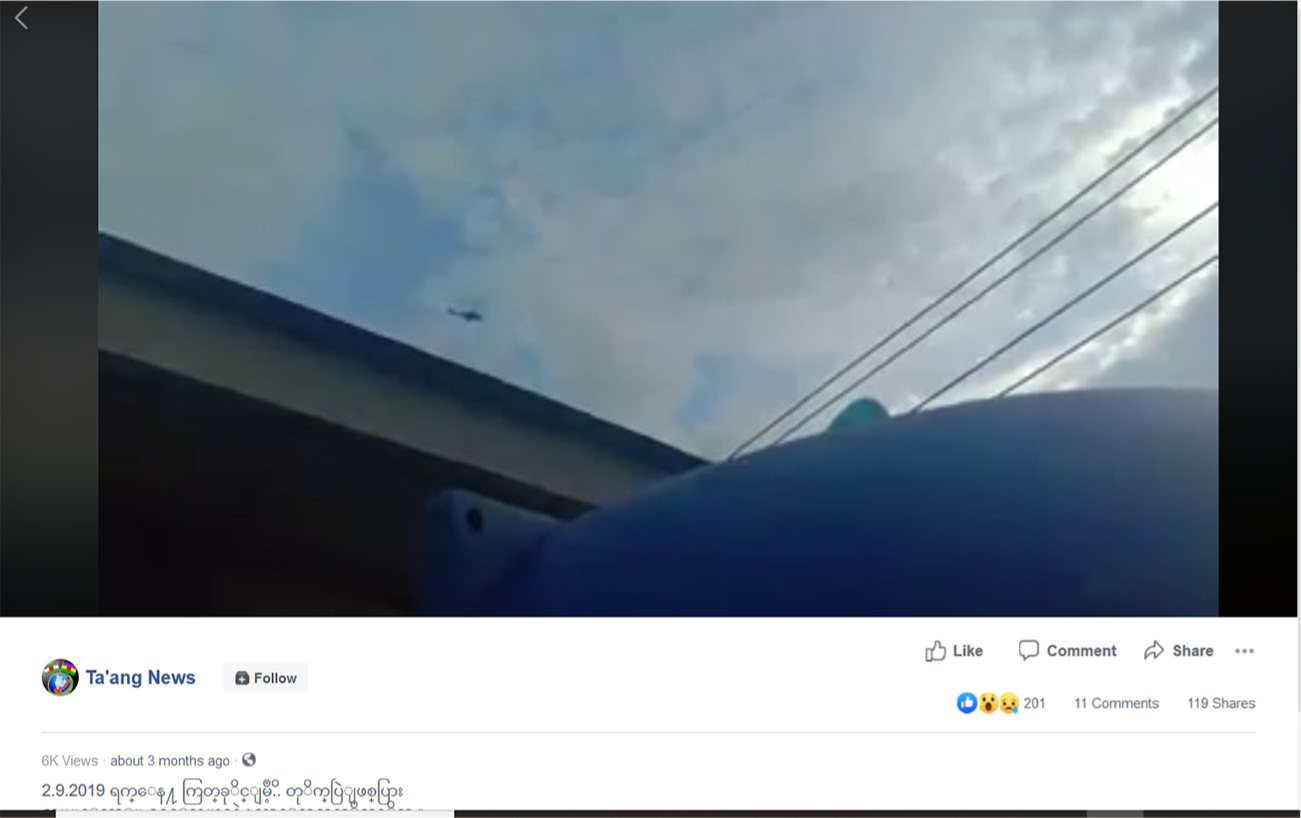
An attack helicopter swerves around an isolated township in Myanmar’s northern Shan State. On the ground, a hazy video posted to the Ta’ang News Facebook page captures the sound of bullets pinging around the village. A caption claims the aerial assault is an attack undertaken by the Myanmar military (Tatmadaw) against civilians accused of harboring the Northern Alliance separatist group (see Figure 1).
A woman’s body lays limp on the ground. Her face, obscured by a crème-colored circle, hangs slack. According to Ta’ang News, she is a victim of Tatmadaw brutality (see Figure 2).

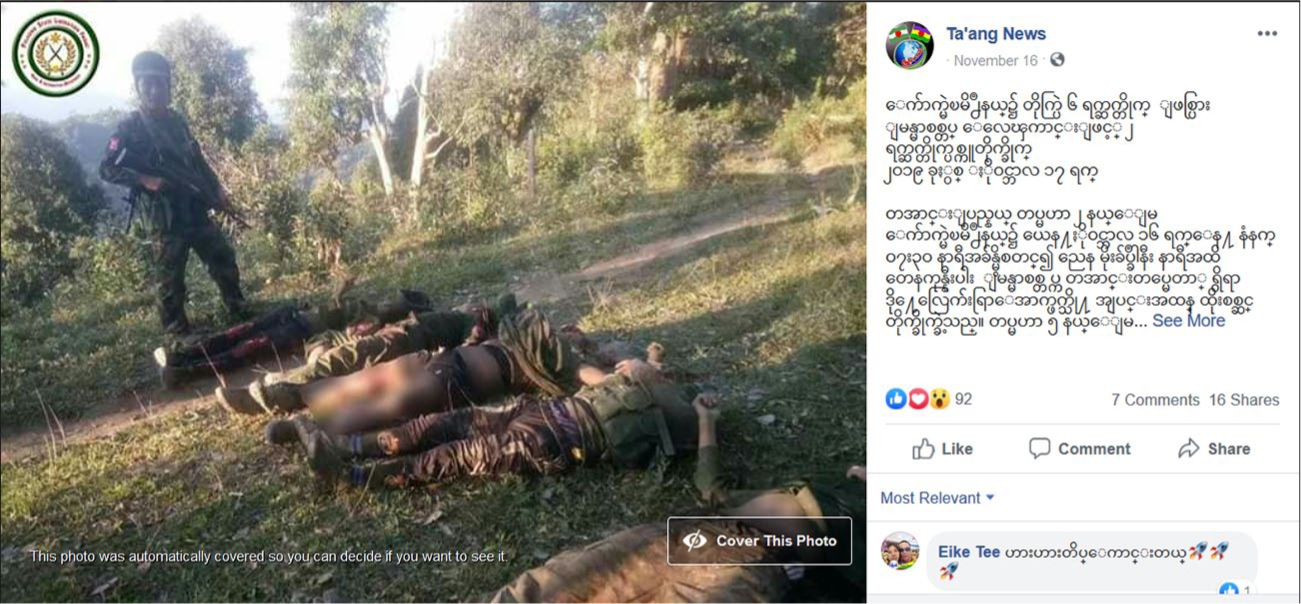
A Ta’ang National Liberation Army (TNLA) soldier stands beside the bodies of his fallen comrades. The seal of the Palaung State Liberation Front, the political affiliate of the TNLA, rests above his head. The caption states he is a survivor of a Tatmadaw artillery barrage leveled against civilian and militia targets (see Figure 3).
On the Golden Arakan Land (Rakhine) Facebook page, a photo of a bloody dying Arakanese boy testifies to the brutality of the Tatmadaw’s campaign against the Arakanese people (see Figure 4).

Not long after, the page posts a speech glorifying the leader of the secessionist Arakan Army (see Figure 5).

Drawn from two Ethnic Armed Organization (EAO) affiliated pages, these images are small windows into the ecosystem of EAO related pages on Facebook. Many, as shown, document alleged atrocities committed by the Tatmadaw against ethnic populations for domestic and international audiences. Others serve as outlets to announce the policy positions of these EAO’s, the community matters pertaining to the groups they support, and miscellaneous political functions. Conversely, others serve as digital propaganda organs to recruit new members and recontextualize fact and fiction in Myanmar’s nascent digital media environment.
However, according to Facebook, they should not exist. These pictures and pages violate a company decision announced on February 5th, 2019 labeling the Arakan Army (AA), the Ta’ang National Liberation Army (TNLA), the Myanmar National Democratic Alliance (MNDA), and the Kachin Independence Army (KIA) as “Dangerous Organizations” banned from using the service (Facebook Newsroom, 2019a, 2019b). Nevertheless, these pages continued to host, “all related praise, support and representation” for these “dangerous organizations” long after the ban was announced (Facebook Newsroom, 2019a, 2019b).
According to Facebook, the move to ban these select EAO’s was meant “to prevent them from using our services to further inflame tensions on the ground” (Facebook Newsroom, 2019a, 2019b). In the wake of Facebooks use as a vector for senior Tatmadaw and government officials to coordinate the Rohingya genocide, Facebook’s decision implied an attempt to rectify its previous inaction by forcibly injecting itself into the country’s discourse in the hopes of stymieing a number of emerging ethnic clashes. In taking a proactive measure against militant communication on its platform, Facebook attempted to project a stance of consideration for a region they so seriously disrupted (Wong, 2019).
Conversely, in this attempt to smother further hateful coordination, Facebook announced a powerful political position in a nation dependent on the company’s infrastructure for nearly all its digital communication (Kyaw, 2019). From their position in Menlo Park California, Facebook’s decision cemented a formidable stance aligning it, inadvertently, with the Myanmar Tatmadaw. By making a political judgement regarding the legitimacy of specific EAOs while allowing others to thrive, Facebook helped codify the Tatmadaw policy of supplanting Burmese supremacy as the true cultural identity in Myanmar by rendering these groups and their ethnic concerns invisible to national and international audiences (Long, 2019)
While the Tatmadaw possesses a number of media outlets capable of buttressing their stance in the nation and beyond, many EAOs representing Myanmar’s many ethnic groups use Facebook as a primary outlet to communicate with stakeholders abroad (Buchanon, 2016). Removed from Facebook, these groups are left isolated, alone, and susceptible to Tatmadaw propaganda drowning out their counter-narratives.
As one of the earliest adopters of Facebook as digital infrastructure and a site of one of the most deleterious examples of failed digital governance, Myanmar serves as an integral space to study the political ramifications latent in Facebook’s content moderation policy. With over a hundred different ethnic groups and as many EAOs, Myanmar is an important space to examine the interconnection of local politics with Facebook’s international infrastructure. With its ambitions for a pluralistic republic hanging in the balance, how Facebook moderates Myanmar’s ethnic strife acts as a harbinger for how the company will contend with international concerns going forward.
In this work, I examine the intersection of Facebook’s content moderation decisions regulating ethnic speech and the reassertion of oppressive governance in Myanmar. Through an analysis of popular press reports and literature around the economic and political growth of Myanmar’s digital state, I show how control over Myanmar’s online communications was ceded to foreign actors in the name of economic and democratic modernization. This movement opened the door for Facebook to rapidly advance into Myanmar’s burgeoning market in the mid-2010s under great international plaudits even as the company never sought assistance in understanding the political and social orientation of the market they sought to capture.
Following this analysis of Facebook’s emergence in Myanmar, I analyze how in their attempt to stay “objective” and “neutral” with regard to the political movements erupting across the country, Facebook allowed government aligned content dedicated to fanning ethnic strife to thrive while suppressing content showcasing minority concerns. Mired in a non-aligned stance, Facebook failed to respond to the Tatmadaw’s encroachments against freedom of expression and in turn helped retrench authoritarianism in a country long seen as a blooming republic.
The horrors in Myanmar point to the limits of the company’s corporate neutrality in foreign policy. Facebooks authority over speech claims within its massive digital architecture binds it to a new role as an extraterritorial political authority beset with radical new normative powers. This work investigates the breadth of that power and unearths the consequences of Facebooks attempt to obscure its political impact behind the veneer of corporate impartiality. By documenting the company’s haphazard attempts to moderate ethnic behavior in Myanmar, I show how Facebook’s ambiguity and impenetrable decision making has inadvertently furthered authoritarianism.
The politics of social media companies
In the wake of the 2016 U.S. election and Brexit, media theorists have turned their attention to demarcating the relationship between social media governance and the encroachment of totalitarianism. Suzor (2019) situates this interconnection as a byproduct of the lack of universally recognized legal regulations governing social media behavior (p. 5). Unbeholden to defined borders or unified international legal constraints, social media companies are left to develop their own internal regulations without democratic supervision. Thereby, companies find themselves operating within a “lawless” space without supervision and absolute freedom to decide their own regulations without fear of state reprisal.
As social media spaces have grown in ubiquity and importance around the globe, the enforcement or moderation of these regulations has become, according to Gillespie (2018), the principal role of these platforms (p. 207). To Gillespie, “Moderation, far from being occasional or ancillary, is in fact an essential, constant, and definitional part of what platforms do. I mean this literally: moderation is the essence of platforms; it is the commodity they offer.” All social media spaces moderate. This moderation is a form of curation and the need to curate content which keeps their audiences both engaged and wanting to come back is the preeminent task these companies face.
With the rapid transformation of spaces like Facebook into national communicative infrastructures, the task of keeping users engaged has found itself in opposition to these systems role as forums for open sustained discourse. As Kaye (2019) finds, engaging content can be divisive content and companies now find themselves adjudicating speech claims once solely under the purview of national governments or international governing bodies to maintain order in their massive online ecologies (p. 45). As these companies have transformed into essential digital architecture, this conflict between continued engagement and moderation has reached a breaking point.
To respond to the myriad conflicts proliferating across their networks around the globe, many Silicon Valley companies have begun to rely on an opaque international network of contractors and in-house moderators dedicated to ensuring user safety and that discourse within these spaces adheres to in-house ideological predispositions (Roberts, 2019). While many of these companies publicly refrain from taking political stances on issues around the world, their content moderation positions point to the ideological preferences structuring these increasingly impactful centers of political power (Roberts, 2019: 100).
This lack of transparency and inability to reconcile inherent biases with infrastructural necessities has blossomed into an environment ripe for shameless opportunists, white supremacists, racists, authoritarian actors, and other malicious riders to manipulate for their own political or personal ends (Crain et al., 2018; Daniels, 2018; Donovan et al., 2018; Lewis and Marwick 2017; Pomerantsev, 2019; Philips, 2016). However, academic research on the consequences of corporate protocols in nascent sovereign communicative ecologies has only begun to emerge.
Within this analytical space, Nothias (2020) establishes the impact of Facebook’s balancing act of capturing Africa’s rapidly expanding digital marketplace while also navigating each countries unique intransigent ethnic and political strife. Within their push to establish hegemony over the continent’s social media market, Facebook has found itself in a duplicitous dance as it develops partnerships with actors predisposed toward sustaining intransigent political inequities while also, as an outgrowth of Facebook’s corporate ethos, tries to expand digital rights and privileges among their expanding userbase. Additionally, Prasad’s (2017) work documents the upheaval created by the Indian government’s decision to ban Facebook’s Free Basic program as an outgrowth of India’s desire to assert digital sovereignty. In India’s push to free itself from dependency on Western internet frameworks, Prasad (2017) showcases how the country was able to both combat this new form of digitized colonialism while also suppressing their citizens freedom of expression under the guise of protecting national values.
This work will expand on this evolving discourse by crafting a timeline documenting Facebook’s transformation from an apparent tool for democratic revitalization into a political architecture used for the furtherance of ethnic division in one of the world’s fastest growing communicative markets, Myanmar. To do so, I will rely on a textual analysis of popular press works, scholarly examinations, and Facebook content compiled from political figures to document the changes in the company’s position in Myanmar. From there, I juxtapose examples of EAO and political content featured on Facebook with the company’s external policy to showcase gaps between the company’s explicit stance and compliance on the ground. Finally, I document how Facebook’s policy toward ethnic speech provided a platform for the Tatmadaw to further their long-established policy of suppressing ethnic speech in a country where military officials have for decades tied ethnic visibility with national instability.
Infrastructural reformation
“Having spent the past half a century under military rule and engaged in civil wars at the same time, Myanmar remains one of the poorest countries in the world and certainly the poorest in Southeast Asia. However, this once self-imposed isolated country is now undergoing a series of political, social and economic reforms that promises boundless opportunities for international trade and investment” (Deloitte, 2013).
Taken from a report titled, “Myanmar: The Next Asian Telecommunications Greenfield,” crafted by Deloitte these sentences encapsulate the economic and sociopolitical hopes numerous actors in the global arena held for Myanmar as it became the newest entrant in the world of international development. By the mid-2010s Myanmar was moving headlong toward a radical reconstruction and business leaders around the world sought to capitalize on the near feudal conditions underpinning Myanmar’s economic reality. This moment of transformation and optimism came to serve as the foundation for Facebook’s assumption as the de-facto online communication system in the country.
In this section, I provide a brief overview of the transformations which took place in Myanmar’s communications industry; transformations that converted one of the most isolated nations in the world into one of the fastest growing telecommunications markets. In doing so, I highlight the ways governmental and financial adjustments to Myanmar’s historically confined media ecosystem conferred control of Myanmar’s digital life into the hands of foreign actors. Specifically, Facebooks.
When the report was released in 2013, Myanmar’s telecommunications industry was considered the least developed in Asia. While much of the continent was focused on building digital tools for the rest of the world, Myanmar was languishing without telephone lines. In many ways this communicative poverty was a byproduct of Myanmar’s literal poverty. At the onset of the 2010s, the World Bank Group highlighted the stark economic conditions underpinning life in Myanmar: With a population of 51.4 million, the country has a per capita GDP of $1,105, and the poverty rate is 37.5 percent, one of the highest in the region. Among ASEAN countries, Myanmar has the lowest life expectancy and the second-highest rate of infant and child mortality. Less than one-third of the population has access to the electricity grid, road density remains low, at 219.8 kilometers per 1,000 square kilometers of land area, and ICT connections are scarce, with mobile phone and internet penetration rates at 1.1 percent and 0.3 percent, respectively. Myanmar’s level of development used to be on a par with countries such as Thailand and Malaysia only a few decades ago; today it is much lower, comparable with Lao PDR and Cambodia. (World Bank Group, 2014)
Nonetheless, it would be naïve to postulate Myanmar’s telecommunications bankruptcy as mere byproduct of its economic poverty. While other nations beset by similar levels of economic stratification moved to modernize their telecommunications systems, the political apparatus which long depressed the nation’s economic trajectory deliberately kept digital technologies in the hands of a select few. Surveying the trajectory of digital media in Myanmar, we see a clear line between media availability and autocratic central planning.
At a foundational level, access to media technology in Myanmar was constrained in large part by designed prohibitive pricing. When formally introduced by the government-controlled Myanmar Post and Telephone in 2000, SIM cards and mobile phones were offered at a staggering 5000-dollar price tag. Even as the country entered the second decade of the 21st century cell phones still cost upwards of 200 dollars (Heijmans, 2013). Likewise, broadband internet instillation fees cost upwards of 2,000 dollars and an hour online at one of the countries few internet cafes would set a customer back 1.50 U.S. dollars (Song, 2015). With the average daily income hovering around a dollar a day, the ability to get online was priced purposefully out of reach of anyone but the ruling Junta’s privileged inner circle. More so, access to digital communication was further stunted by stringent legal statutes designed to prevent open expression.
From the introduction of the first email service in 1997 to the incorporation of the country’s first internet service provider Bagan Cybertech in 2002, the Junta ensured access to these tools was encased behind a web of draconian prohibitions. One of the most prominent examples of these early roadblocks was the Myanmar Computer Science Development Law which designated any unlicensed or unregistered access to internet networks outside approved government pipelines to be a criminal offence carrying a maximum sentence of 15 years in prison (Wong, 2013). Drafted during the roll out of Myanmar’s early digital infrastructure, the Myanmar Computer Science Development Law complemented earlier restrictive laws to make online life stuck squarely beneath the purview of the central government (Moe, 2016). Nevertheless, as the new millennium rolled along and internet connectivity became understood as a conduit for financial gain, attitudes toward digital technologies would come to radically change (Stokke et al., 2018: 8).
Newly recognized as a pathway toward democratization and economic prosperity, the push to radically vitalize Myanmar’s floundering telecommunications infrastructure was embraced as a revolutionary reform by parties as disparate as the World Bank and Human Rights Watch. In a Human Rights Watch report on the prospects of transforming Myanmar’s communications industry, the organization trumpeted restructuring the nation’s nearly non-existent network as a means to “enhance economic growth and civic participation in a country that has been closed for decades” (Wong, 2013). Likewise, the World Bank concluded that telecommunication privatization presented a “tremendous opportunity for Myanmar to leverage modern information and communication technology (ICT) as a platform for socioeconomic development” (Norbu, 2015). Even the U.S. government, under the guidance of Secretary of State Hillary Clinton, viewed President Thein Sein’s movements to open the telecommunications ecosystem as a positive foundation for the U.S. to confidently reengage with Myanmar after over fifty years of disconnection (Eckert, 2012). The outside world, responding in large part to real need, liberal idealism, and potential financial gain, laid the groundwork for digital liberalization to become a means of survival for the Junta in the 21st century.
With reengagement quickly becoming linked to liberalization, the government-initiated a near complete reversal on its historic communicative estrangement. In 2008 the constitution was officially reconstructed to provide allowances for self-expression, freedom of assembly, and the relaxation of media censorship. The ratification of the constitution was followed by a 2012 proclamation issued by Tint Swe, the head of the Press Scrutiny and Registration Department, ending the formal review of all journalistic pieces by the state censorship board (Pidd, 2012). Nevertheless, the most consequential reforms came in 2013 and 2014 with the passage of the Printing and Publishing Enterprise Law, the Telecommunications Law, and the News Media law. Together these three laws abolished the colonial Burma Wireless Telegram Act, the Printers and Publishers Registration Act, the Myanmar Computer Science and Development Law, and other formal statutes which had stunted the proliferation of Myanmar’s telecommunication industry for nearly a hundred years.
These three laws became the foundation of Myanmar’s contemporary digital life. Following the passage of the Telecommunications Law in 2013, the Myanmar government held a massive competition for the right to design and shepherd Myanmar’s new mobile and digital network. The two winners, the Qatari company Ooredoo and the Norwegian firm Telenor, pledged billions of dollars of investments to construct a massive 4g network across the country capable of reaching 97% of the population in five years (Heijmins, 2013). Thanks in part to these investments, by 2018 Myanmar had, “56.8 million mobile phone users in 2017–2018 against a total population of 54 million, implying a penetration rate of more than 100%” (Nanda, 2018). Broadband connectivity rates saw a similar jump from .3% of the country in 2010 to 26.7% by 2018.
Due to both the News Media Law, which denoted the rights and capabilities of press workers and the Printing and Publishing Law, which expanded the licensure and definitions for valid publishing sites, the number of print, television, and digital news organizations increased dramatically. In 2013 alone there were 59 new licenses granted to new digital, print, and broadcast news agencies (Long, 2019). Thanks to the cohabitation between foreign assistance and governmental acquiescence, Myanmar was finally seeing the transformations prophesized by so many by the late 2010s.
Yet, the greatest beneficiary of Myanmar’s digital expansion was Facebook. Thanks to an ever-increasing list of mobile phone providers offering cheap social media data packages with Facebook pre-installed, Facebook use in the nation has ballooned to over 18 million daily among a total population of sixty million people (Dowling, 2019). In time, these users would grow to become more than just fans of the service. According to a Reuters report on hate speech in Myanmar: Many saw it as an all-in-one solution – offering a messaging system, news, and videos and other entertainment. It also became a status symbol, said Chris Tun, a former Deloitte consultant who advised the government. “If you don’t use Facebook, you’re behind,” he said. “Even grandmas, everyone was on Facebook”
In time many observers came to see Facebook as the internet in Myanmar (Wong, 2019). Yet, the rapid vitalization of the nation’s telecommunications apparatus and the blanketing of mobile based digital communications across the country did not end up begeting the rise of democratic normalization many envisioned. In fact, rather than becoming a vehicle for liberalism, Facebook became a conduit for genocide and the collapse of pluralistic governance in the young republic.
Facebook and political speech
On June 1st, 2012, the official spokesman for President Thein Sein of Myanmar, Zaw Htay, posted this diatribe on his personal Facebook page: Rohingya terrorists as members of the RSO are crossing the border into Myanmar with weapons . . . Our troops have received the news in advance so they will completely destroy [the Rohingya]. It can be assumed that the troops are already destroying [the Rohingya]. We don’t want to hear any humanitarian or human rights excuses. We don’t want to hear your moral superiority, or so-called peace and loving kindness. Go and look at Buthidaung, Maungdaw areas in Rakhine State. Our ethnic people are in constant fear in their own land. I feel very bitter about this. This is our country. This is our land. I’m talking to you, national parties, MPs, civil societies, who are always opposing the President and the Government. (Report on the detailed findings of the independent Fact-Finding Mission in Myanmar 2029; 167)
Seven years after Zaw Htay’s comments and many more were featured in the UN Human Rights Council’s Report on the detailed findings of the independent Fact-Finding Mission in Myanmar, Zaw Htay’s presence on Facebook continues to grow. As of April 2020, his follower count numbers 340,000 unique individuals. This sizable online presence is commensurate with his role as Director General of State Counsellor and Nobel Prize Laureate Aung San Suu Kyi’s office. His continued celebrity on Facebook stands in stark contrast to his political contemporary, Commander and Chief of the Myanmar Armed Forces Ming Aung Hlaing who was taken off the platform over similar comments such as a Facebook post declaring, “we [the government] so openly declare that absolutely our country has no Rohingya race” (Fact finding mission of Myanmar, 2019; 334).
Since being identified as an integral vector for the creation and furtherance of the Rohingya genocide, Facebook has tried to enact a public stance against the proliferation of Fake News stories they claim contributed to the explosion of ethnic violence in Myanmar. (Facebook Newsroom, 2018a, 2018b, 2019). While Facebook has positioned their complicity in the genocide as a failure to police Fake News or misleading content, an examination of political leaders’ Facebook use point to a more systemic concern.
The issue I wish to explicate, is that while Fake News exists and is a considerable issue, the greater problem is that real political figures like Zaw Htay use Facebook within the company’s parameters to further contentious paradigms. Zaw Htay and other actors who manipulated Facebook for the furtherance of ethnic terror did so and continue to use the platform exactly as Facebook allows and in accordance with their political parties desired intent and national laws.
When Facebook has acted, such as when they removed Min Aung Hlaing, they tried to obscure these politically consequential decisions as the simple removal of fallacious information (Facebook Newsroom, 2018a, 2018b). Ming Aung Hlaing, as the Commander and Chief of the Myanmar Armed Forces, commands a four hundred thousand strong military hardened by decades of inter-ethnic conflicts. Because of their decision, arguably the most powerful political leader in Myanmar cannot use Facebook in his own country. Facebook addressed this move with a one paragraph description (Facebook Newsroom, 2018a, 2018b). When asked to comment further on their decision, Facebook spokesman Clare Wareng said, “This is part of our effort to identify and disable networks of accounts that mislead others about who they are. We ban this kind of behavior because we want people to be able to trust the connections they make on Facebook,” (Slodkowski, 2018).
In their insistence to tie their involvement in the genocide as an outgrowth of their failure to police Fake News, Facebook demonstrates an insistence on maintaining a non-interventionist political stance built around withholding judgement against powerful actors’ behavior even as these actors use their space for hellacious purposes (Facebook, 2019). Min Aung Hlaing and other military officials did not merrily traffic falsehood, they coordinated genocide and ethnic cleansing. They did so as prominent officials connected to the Myanmar government. And while some of their individual forums have been taken down, pages continue to arise trumpeting the military and figures like Min Aung Hlaing (see Figures 6 and 7).
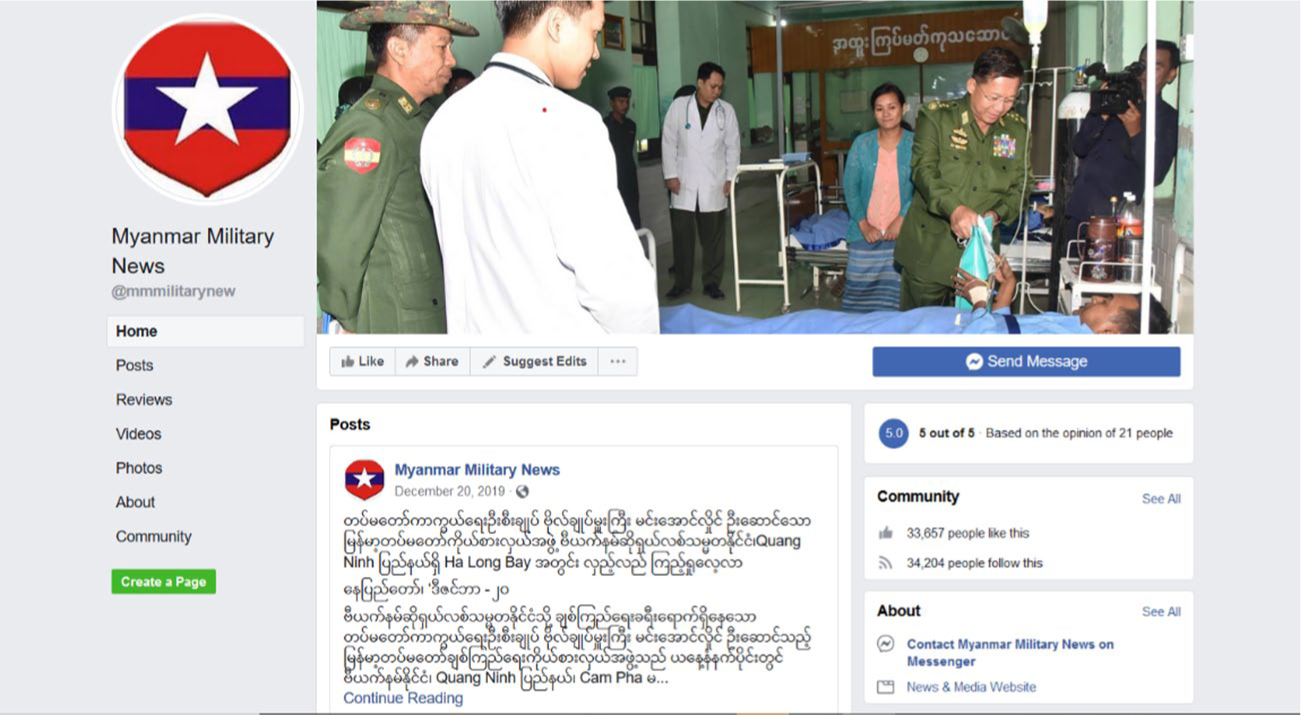
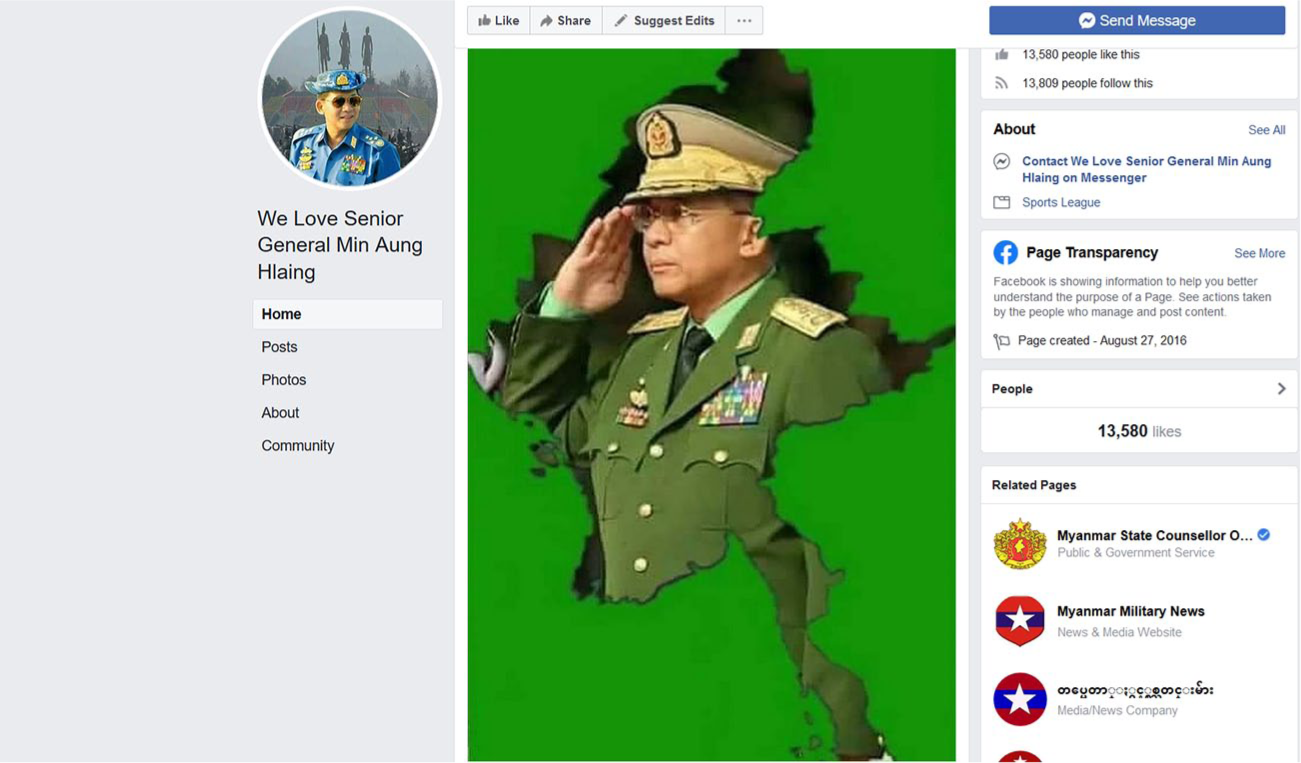
Even when Facebook has chosen to engineer the platform to suit a Myanmar audience or have decided to moderate their platform to prevent further virulent outcomes, their actions have in truth homogenized ethnic differences to the Tatmadaw’s advantage. The company’s current tribulations in Myanmar point to a corporate culture willing to reconfigure nations’ communicative infrastructures on its terms but unwilling to take responsibility when these systems lead to horrific ends.
Facebook and national laws
On July 13th, 2013, Time magazine ran a cover featuring a stoic Buddhist Monk with the title, The Face of Buddhist Terror, descending down his neck (see Figure 8).
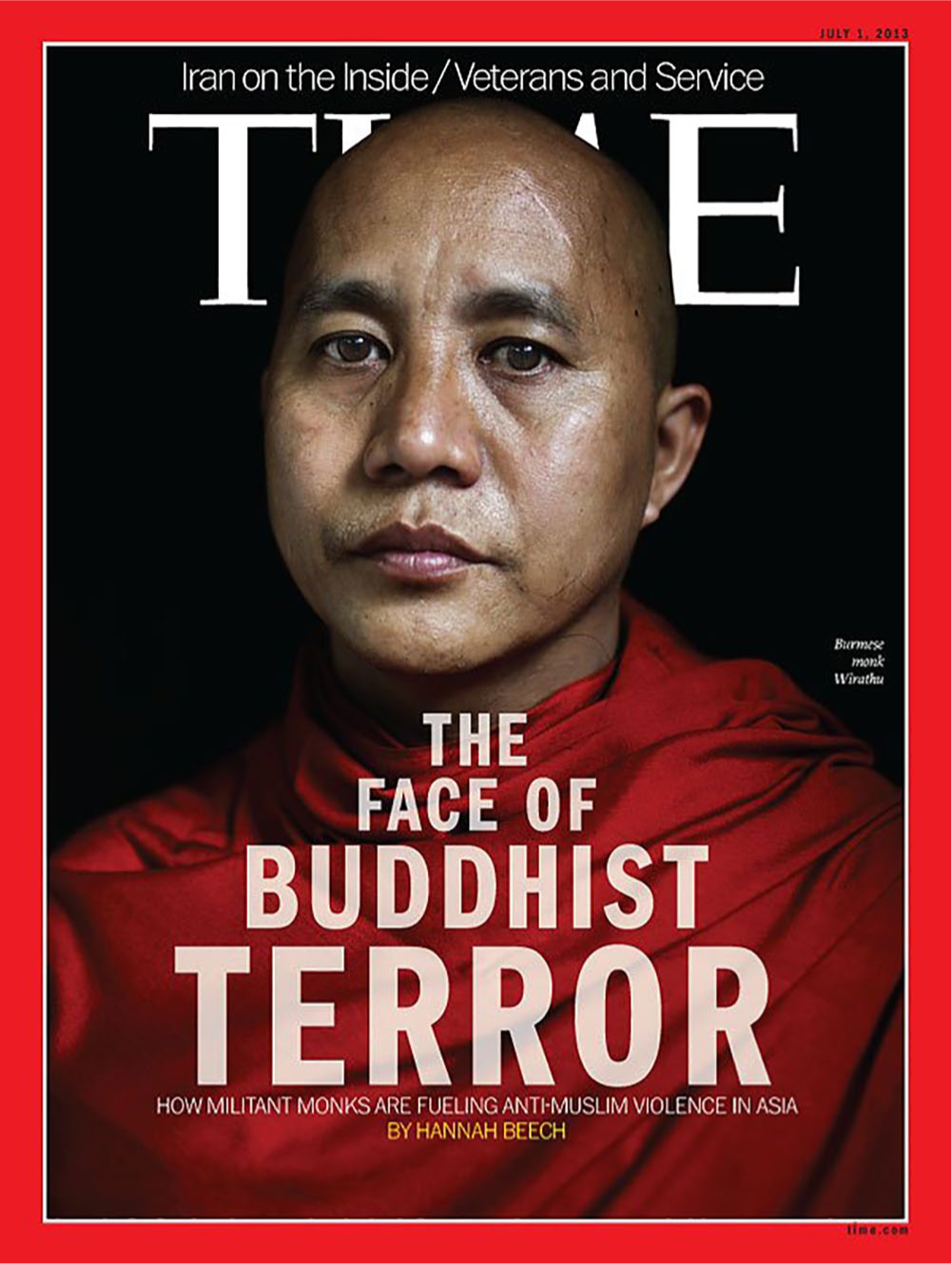
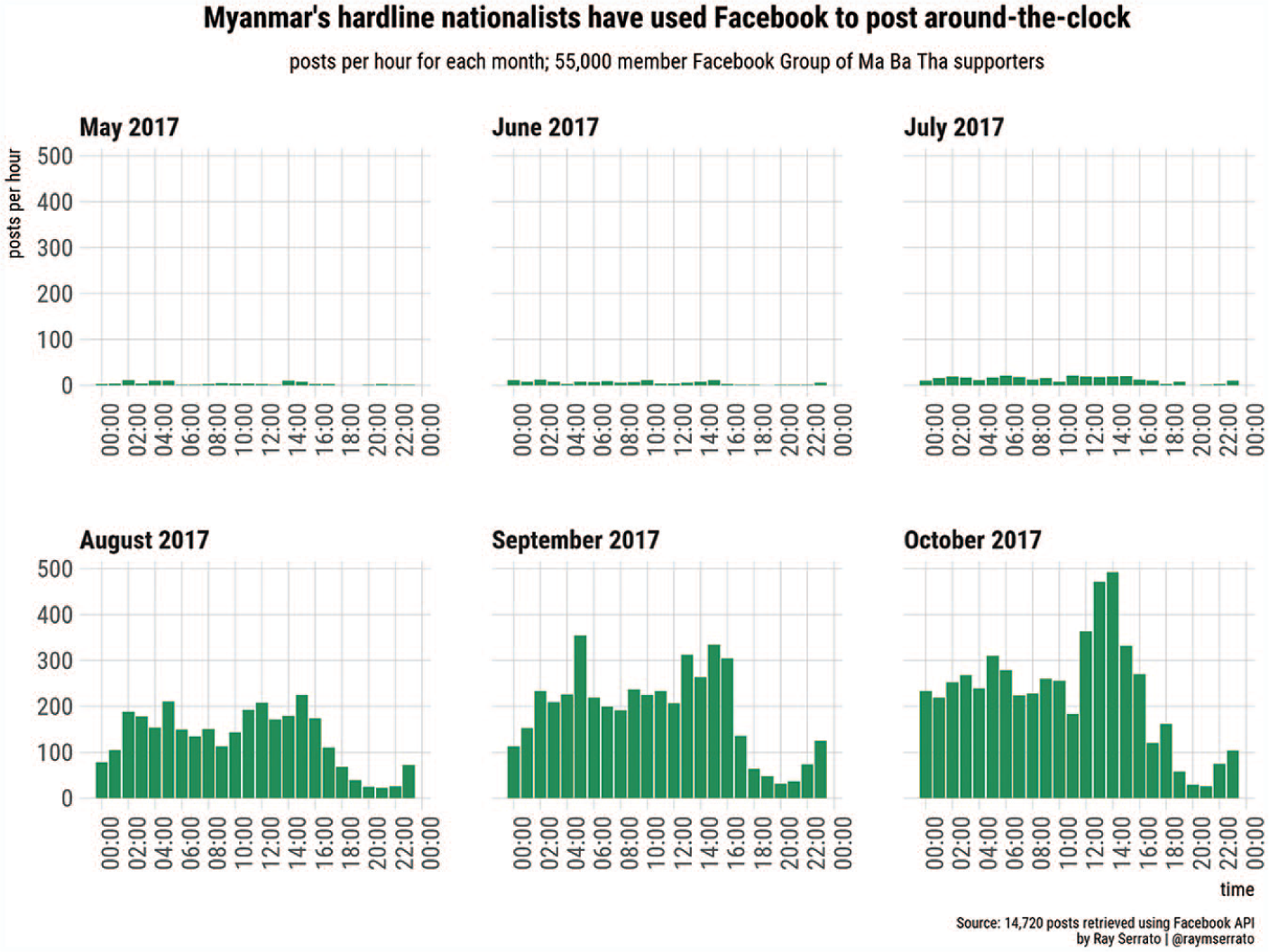
The monk on the cover was the infamous, “Burmese Bin Laden” Ashin Wirathu. Following his release from a decades long stint in jail for anti-government sermons, Wirathu quickly amassed a massive Facebook and YouTube presence built on furthering anti-Islamic hate against the Rohingya. According to outside reports, during the height of the Rohingya genocide the political organization he helped found, The Patriotic Association of Myanmar or Ma Ba Tha, called on 55,000 unique Facebook group members to post hundreds of unique posts per hour in support of the clearance operation (see Figure 9).
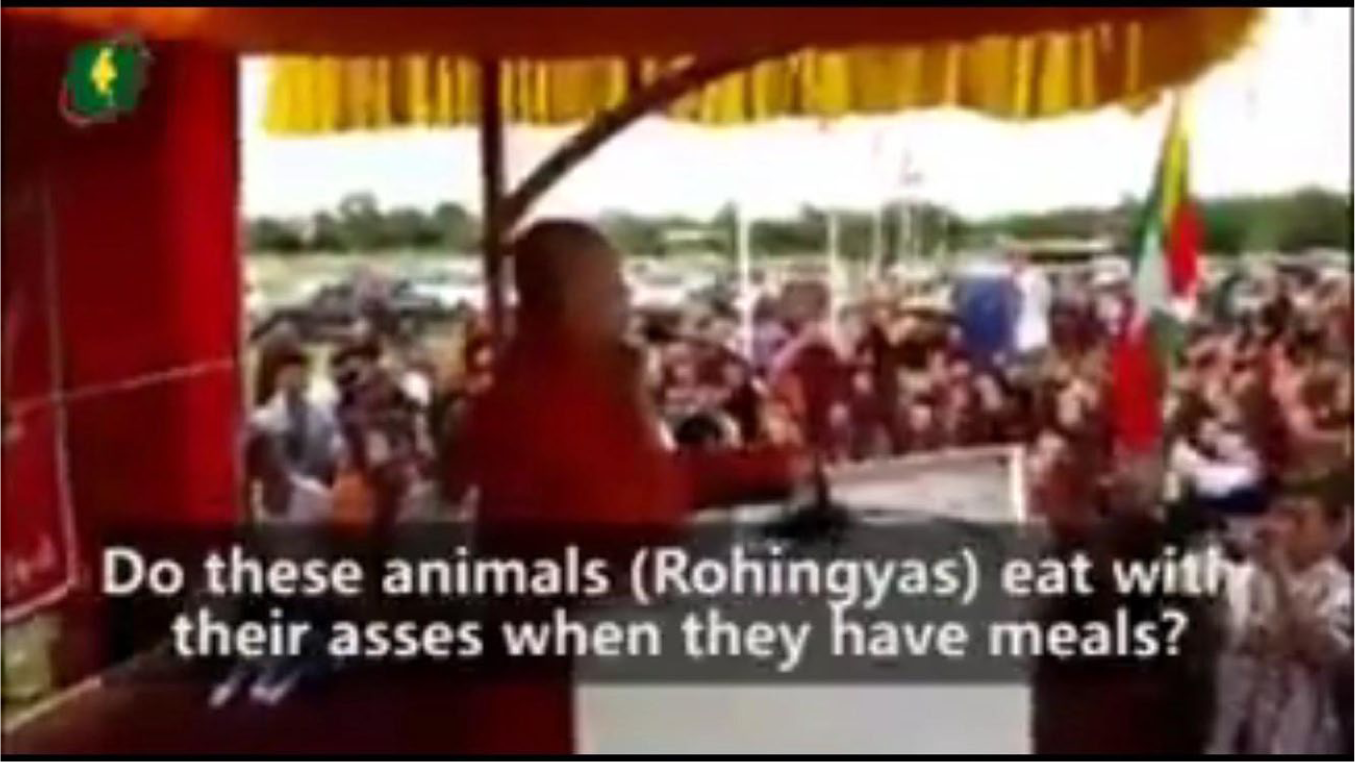
Much of the content they posted was false and dehumanizing. Like this video footage of Wirathu speaking disparagingly of the Rohingya to a large crowd at a Ma Ba Tha rally (see Figure 10):
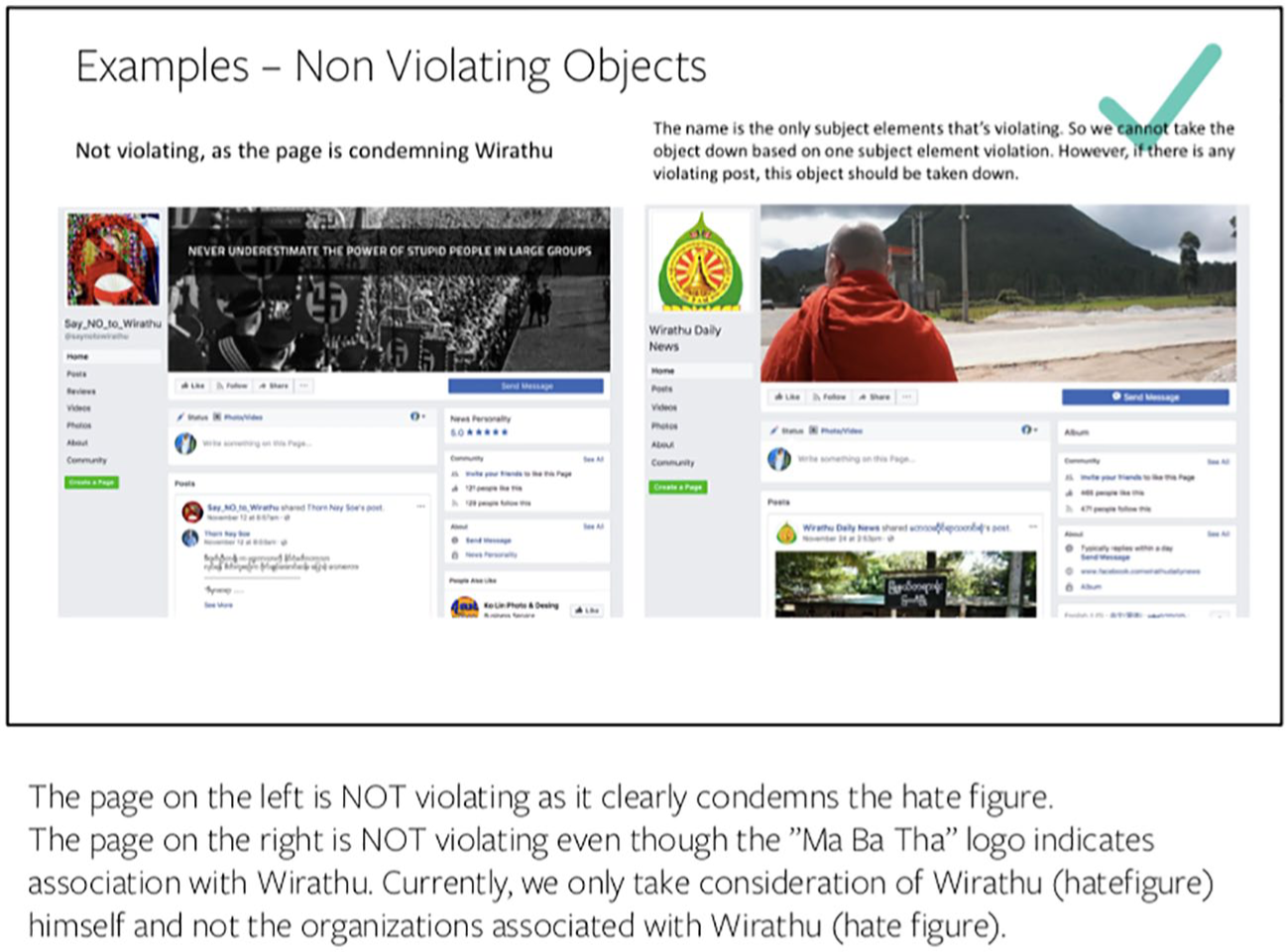
Facebook, of course, was very aware of Wirathu and Ma Ba Tha throughout the crisis. In a leaked copy of Facebook’s internal content guidelines during the height of the conflict, Ma Ba Tha related media was considered allowable according to internal considerations. However, Wirathu, who had been banned for several months at the time of the leak, was disallowed (see Figure 11).
Stepping back, the reluctance to punish Wirathu by Facebook and the government, and as I will show, the lengths the government went to protect him following his release, point to the ways the Tatmadaw has successfully contorted liberal digital spaces into tools for authoritarian retrenchment.
Since the formal drafting of its democratic constitution in 2008, Myanmar’s legislative frameworks have been found to harbor restrictive legal statutes capable of suppressing free expression within the telecommunications ecosystem. The most widely used of these repressive codes is Section 66(d) of the Telecommunications law. Section 66(d) codifies that: Anyone found guilty of extorting, coercing, restraining wrongfully, defaming, disturbing, causing undue influence or threatening any person by using any telecommunications network shall be punished with a maximum three years in prison, a fine or both (The Pyidaungsu Hluttaw, 2013).
Despite being based on universal outlines for recognizing and addressing improper speech on telecommunications pathways like Facebook, Section 66(d) rulings have almost exclusively been issued against critics of the government, the military, and even Wirathu himself. In one example, the activist Ko Yar Pyae was sentenced to 6 months in prison under a section 66(d) complaint for allegedly posting photoshopped images of Aung San Suu Kyi, Min Aung Hlaing, and Wirathu on Facebook. On closer inspection, the account cited was a fake page created using his name and a picture taken from his real account. Despite the evidence demonstrating he was framed, Yar Pyae was arrested on May 22, 2016 and held without bail (Lakhdir, 2019). Though just one example, this case draws a clear distinction between the way the law was written and the way it is practiced. Min Aung Hlaing and Wirathu used their Facebook platforms to incite hate and defamation. Yet, because one is the leader of the armed forces and the other’s behavior suited the military’s purpose, both were not only protected from prosecution, but gained the privilege of using these statutes for their own ends. Wirathu himself was only penalized for defamation after the government realized he was no longer needed to further their aims (Beech and Nang, 2019).
Facebook has never addressed whether it can or will do anything to prevent their site from continuing to be used as a cudgel against free expression. Outside analysts have found that Facebook almost always defers to local law in freedom of expression disputes (Khoi, 2018). Even when the local laws in question are used to harangue their user’s speech, Facebook prefers to avoid conflict with governments whose support they need to stay in operation. Therefore, Facebook’s professed impartiality provides an open lane for oppressive governments to abuse its citizens and further power inequities.
Ethnic visibility on Facebook
Nonetheless, even Facebook’s attempt to suppress communicative conflict in Myanmar have proven to be inadequate at best and destructive at worst. Though much has been said about Facebook role as the principal pipeline connecting Myanmar to the rest of the international community, comparatively little has been written about how the company was unable to moderate the written Burmese content shared on their platform. This problem was due in part to Myanmar’s considerable period trapped in digital isolation. As such, the dominant language in Myanmar, Burmese, entered the Unicode script incredibly late. In the meantime, early digital natives in Myanmar developed a homegrown alternative called Zawgyi. Without knowledge of Zawgyi, Facebook created a Burmese to English translation tool for its content moderators to use based on the Burmese Unicode script. Only after the Rohingya crisis boiled over did they find that their algorithm was spitting out gibberish.
Famously, the phrase: Kill all the Kalars that you see in Myanmar; none of them should be left alive.
Became: I shouldn’t have a rainbow in Myanmar.
Similarly, Facebook’s own language pulled from it’s community guidelines contorted into nonsense.Phrases like: We take our role in keeping abuse off our service seriously.
Morphed into: We take our role seriously by abusing our services (Stecklow, 2018).
This problem was exacerbated by the fact that Facebook employed a single Burmese speaking content moderator (Stecklow, 2018). Thereby, the means for Facebook to deal with hate speech was rendered inoperable; moderators could not remove what they could not read.
The scope of this problem came into view when Facebook banned the use of the most hateful ethnic slur for a Rohingya, Kalar. Kalar is a term which denotes that the Rohingya are foreigners from India or Bangladesh. This belief aligns with the Tatmadaw’s claim that the Rohingya are foreign interlopers undeserving of citizenship or rights. Unfortunately, Facebook quickly discovered after removing Kalar that the word literally means from the west and is used in several Burmese words like Kalar pae (chickpea) and Kalarkaar (curtains). As such, a whole swath of Burmese was suddenly banned from Facebook overnight (Stecklow, 2018). Facebook since reversed its decision. Even still, the haphazard approach to banning keywords like Kalar exemplifies Facebook’s inability to center the socio-cultural complexity of Myanmar in their decision making.
Furthermore, the act of coding Burmese as the sole Myanmar dialect on Facebook at launch served as an implicit cultural stance taken by the company regarding which language signified Myanmar’s move to digital modernity. While many indigenous languages in Myanmar use Burmese as the dominant written form, some, like Shan (or Tai with 3.2 million users) use a completely different written style. Furthermore, even though some ethnic languages may share the same alphabet, these dialects harbor a number of unique word choices. Facebook’s decision to solely support Burmese aligned with a decades long protocol advocated by the Tatmadaw (Mackerras, 2003: 189). For generations, the Tatmadaw imposed strict laws preventing the use of indigenous languages so that Burmese, the language of the majority Burman, became the lingua franca for the country. The adoption of Burmese for Facebook’s entire site assigned the dominant language of the military and Burmese nationalists as the language of modernity and brushed aside native languages as bygone marks of difference incompatible with modern digitality.
From here, we can see Facebook’s decision to ban several ethnic militias as a strategy of either deliberate appeasement of the military’s aims or a reflection of the company’s ignorance toward its role as an international policy apparatus. The groups Facebook decided to ban all used the platform to circumvent government controls as their respective conflicts with the Tatmadaw intensified. The Tatmadaw has a multitude of popular press outlets at its disposal to shape the flow of information for its benefit. These groups do not and by losing Facebook they lost their ability to shape their communicative identity within and without their regional borders (Wong, 2019). For example, on August 2018 the TNLA released evidence on Facebook documenting a Tatmadaw barrage on an aid convoy killing six innocent medics. The Tatmadaw tried to cover up the story. But thanks to the TNLA’s access to Facebook, the story was able to see the light of day (Hammond et al., 2018). Facebook’s decision curtails this form of agenda setting and makes reporting on Tatmadaw brutality more difficult.
Meanwhile, despite this decision, Facebook continues to maintain a blind eye to the multitudes of other EAO’s who use Facebook in the vein these banned groups did (see Figures 12,13,14,15,16.):

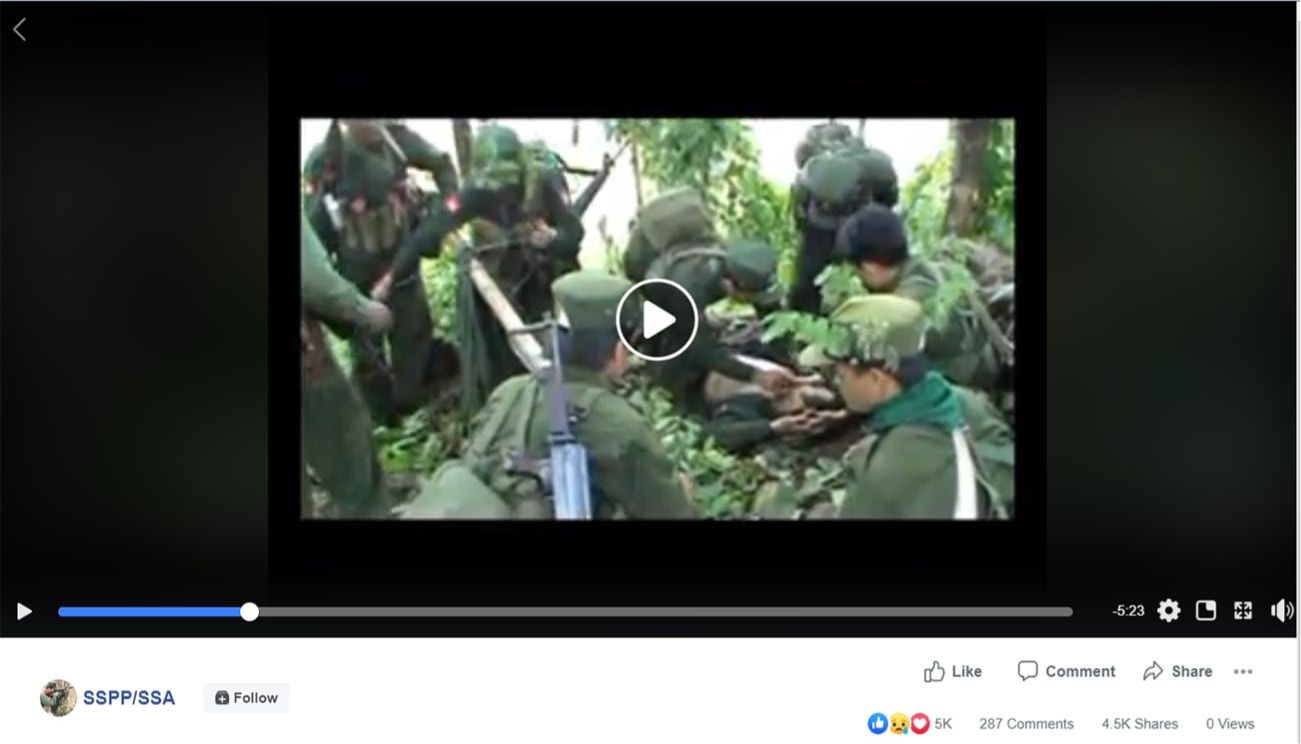


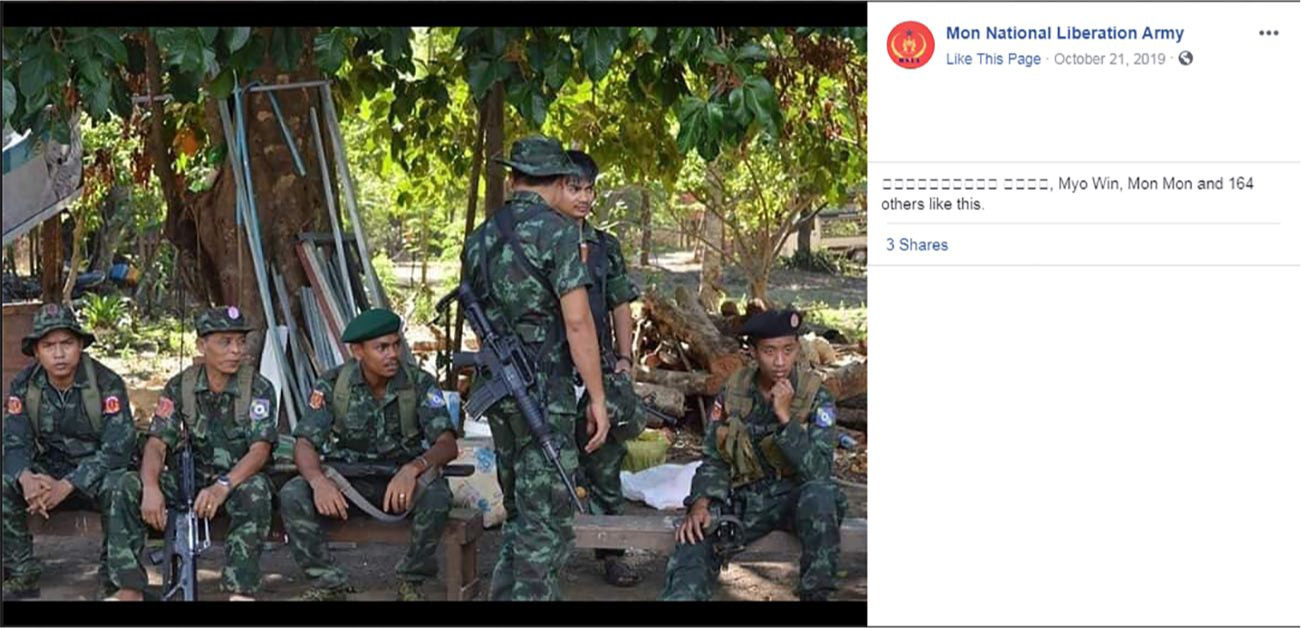
By pushing a select group out and preserving others, Facebook has developed a stratified opaque landscape of proper use where some groups become extremist organizations while others, who do the exact same thing, continue to grow. Facebook’s strategy promotes a similar divide and conquer ethos to the military’s wherein these groups are left adrift with no ability to counter the military’s narrative of events and without recourse to challenge their removal. This act of erasure inserts Facebook directly into an ongoing political conflict even as it hides behind neutrality
Despite their proclaimed detachment and support for global expression, Facebook’s action in Myanmar attest to the outsized impact its decisions have on international matters. Though the company has attempted to shift the narrative around the harms wrought on its site as a matter of Fake News, the actual kindling which stoked ethnic tensions in Myanmar came from political figures using the site as intended to fulfill the military and the government’s designs of forcibly removing the Rohingya. Facebook’s current position precludes ethnic minorities from pushing back against this type of hateful propagation and as such signals to authoritarian actors that awful behavior is allowed as long as it does not raise western reproach. If Facebook does not evaluate its deep political position in nations far removed from its headquarters in Menlo Park, the horrors in Myanmar are sure to continue unabated.
Conclusion
Since his formal ban, Min Aung Hlaing’s standing within Myanmar has only grown. Rather than a death sentence, his ban has become a rallying point for the Burmese majority who see his forceful removal as an act of colonial domination (Moe, 2019). His loss of an official space on Facebook has pushed him to employ numerous proxy’s and official government gatekeepers to leverage his agenda (Soe, 2020). Meanwhile, the EAOs banned by Facebook continue to wage war against the Tatmadaw in relative international obscurity without the ability to document Tatmadaw brutality on Facebook. Compounded by the government’s decision to cloud Rakhine state under the longest digital blackout in history, the inability to communicate through Facebook has further eroded international stakeholders’ ability to discern the current reality in one of the world’s most contentious areas (Htoon, 2019). Nevertheless, Facebook’s position as a neutral platform has insulated the company from culpability even as the country lurches forward into 2021.
In the coming year Facebook plans to formally institute its Content Advisory board dedicated toward adjudicating international content concerns raised by users on its platform (Facebook, 2019). This platform is designed to address the concerns raised by Facebook’s content moderation decisions across the globe. Composed of over 40 different experts drawn from an eclectic array of fields, the board is ostensibly separate from Facebook’s formal governance structure but is reliant on a 130-million-dollar trust provided by the company (Culliford, 2019). Designed to provide a conduit to ameliorate the inadvertent consequences of the company’s unilateral content moderation decisions, in reality the board may further the platforms consolidation of geopolitical speech claims within its purview.
The decisions and indecisions the company has made in Myanmar reveal that any choice made in house by the company or even connected to the company is a lackluster ameliorant for an escalating problem. By locating the advisory board in Menlo Park California disconnected both physically and metaphorically from the global conflicts the board will decide, the policies they create will prove inadequate to properly wrestle with the localized fallout of their decisions. More so, by folding deliberation for these issues in house, it incentivizes the views of a select number of a privileged few capable of working within this process (Roberts, 2019; 194). This movement continues to center Facebook’s positionality and the ideological structure it embodies over the sovereignty of individual countries. It is a formalization of a new colonial political structure masquerading as a new lever for the furtherance of digital constitutionalism.
With its long history of geo-political isolation and past scarred by ethnic conflict, the decisions regarding the political future of Myanmar are excruciatingly complex for any foreign interloper to properly examine. As the bungling of their decision to regulate EAOs in the country demonstrates, if Facebook continues to operate with few if any formal employees in the region, they will remain ill-equipped to intervene in political matters within the country and others like it.
In order to reconcile the issues brought about from its centralized corporate infrastructure, Facebook will have to relinquish its lean start up mentality in favor of a traditional international corporate modality. Companies like Exxon or Shell, out of political and financial necessity, have developed international political connections which enable them to respond rapidly to the problems their work creates. Facebook contends having in country representatives would place their employees at considerable risk and hiring more international moderators would put an undue burden on the company’s flexibility. In response, Kaye (2019) advocates developing regional counsels with national representatives who can advocate locally but convene outside of any direct harm (p. 118).
To tackle the broader issue of how to hold these companies accountable, Suzor (2019) argues for the creation of an international constitutional institution dedicated toward adjudicating global content moderation conflicts (p. 161). Bodies like the UN and the International Criminal Court were devised to combat concerns brought about by the close of WWII and the rise of the Cold War. These bodies developed new lexicons and structures around promoting human rights with mechanisms capable of holding governments accountable. In the contemporary moment, as companies like Facebook have constructed apparatuses to surveil and control communication unparalleled by any governmental system before it, a new international representative body will have to arise capable of supplanting digital governance under constitutional understanding (Suzor, 2019: 165). Perhaps even new formulations of digital human rights will have to be developed. What is certain is we must never let companies like Facebook, who seek to orchestrate our digital selves forget what happened in Myanmar. To do so will ensure more strife there and elsewhere.
