



Abstract
This article investigates algorithms and their construction of cultural taste through a socio-technical analysis of the Netflix Recommender System. I examined the key algorithmic processes in the intersection of its technological infrastructure, cultural processes, and social relations by employing Taina Bucher’s three methodological tactics for ‘unknowing’ algorithms. Drawing from media logic and computational logic, I propose the concept of ‘algorithmic logics’ to define the assumptions, processes, and mechanisms that govern the construction of taste within the Netflix platform. I identified these four logics of taste – datafication, reconfiguration, interpellation, and reproduction – and argue that they reappropriate old apparatuses of social control and generate new capacities in engineering cultural processes. Together, these logics transform algorithms from procedural to self-generative machines in the guise of algorithmic objectivity, user agency, and post-demographic experiences. Algorithmic logics function as an ‘interpretative schema’ in making sense algorithms in their entanglement with social actors, institutions, and infrastructures.
Keywords
Introduction
From a DVD-by-mail service to a global streaming media business of 200 million users in 2020, Netflix has transformed the way we watch content. Core to its success is the Netflix Recommender System (NRS), a set of algorithms that suggests programs and films based on individuals’ taste preferences. Netflix has evolved and optimized its algorithms through the years by introducing mechanisms that challenge cultural and industry conventions. Broad generic categories are reassembled into thousands of hyper-specific ‘altgenres’ (Madrigal, 2014) and audiences are purportedly targeted based entirely on their viewing behavior and not their demographic backgrounds (Rodriguez, 2017). Through the power of its algorithms, Netflix CEO Reed Hastings claims the platform to be ‘so good at suggestions that we’re able to show you the exact film or TV show for your mood when you turn on Netflix’ (The Economist, 2017).
The Netflix Recommender System exemplifies algorithms as contemporary intermediaries. Intermediaries bridge the production and consumption of goods and services by creating and manipulating the meanings and values attached to them (Bourdieu, 1984; Negus, 2002). They are tastemakers who, through their cultural capital, legitimize particular forms of cultures and translate them into everyday cultural encounters. Algorithms as intermediaries derive their influence not from cultural expertise but from their computational capabilities (Morris, 2015). They transform cultural information into data and generate cultural experiences through and within their algorithmic infrastructures. Apart from this, their inner workings remain unknown because of algorithms’ inherent complexity and deliberate obscurity as proprietary ‘black boxes’ (Pasquale, 2015). The pervasiveness of algorithmic culture (Striphas, 2015) in contemporary society makes it imperative to understand how algorithms construct taste and its implications to our cultural experiences and cultural processes, more broadly.
This article investigates algorithms and its construction of cultural taste through a socio-technical analysis of the Netflix Recommender System. The study focuses on the key algorithmic processes of extraction, appraisal, and prediction that I identified in the analysis as marking the critical stages of constructing taste. While these processes are purportedly concealed in the unknown ‘black box’ of the algorithms, I employ Bucher’s (2018) three methodological tactics for ‘unknowing’ algorithms to trace the relational and multiple logics emanating from the consistencies, discrepancies, and contradictions in NRS’ socio-technical intersections. While investigations on algorithms are always partial and conditional given their dynamic character, I direct my attention to the functioning of the NRS beyond those programed in code.
Drawing from media logic (Altheide and Snow, 1979) and computational logic (Kowalski, 1979), I propose the concept of ‘algorithmic logics’ to define the assumptions, processes, and mechanisms that govern the construction of taste within the Netflix platform. I identify these four logics of taste – datafication, reconfiguration, interpellation, and reproduction – and argue that they reappropriate old apparatuses of social control and generate new capacities in engineering cultural processes. Together, these logics transform algorithms from procedural to self-generative machines, in the guise of algorithmic objectivity, user agency, and post-demographic experiences (Cohn, 2019).
The article contributes to debates in critical algorithm studies by articulating the complex intersections of algorithms’ materiality (Bucher, 2018; Finn, 2017; Morris, 2015), cultures (Bucher, 2018; Hallinan and Striphas, 2016; Natale, 2019), and sociality (Colbjørnsen, 2018; Lomborg and Kapsch, 2020; Seaver, 2021). Algorithmic logics provides a conceptual framework that undergirds the inextricable relations among human agency, cultural processes, and technological infrastructures in constituting algorithmic cultures in everyday life. While not exhaustive and particular to Netflix’s algorithms, the logics discussed here serve as an analytical tool to draw analogies and distinctions on how algorithms, software, and media technologies, more broadly, shape cultural realities.
Theorizing algorithmic logics
Algorithmic power
Striphas (2015: 405) defines an algorithm as a ‘set of mathematical procedures whose purpose is to expose some truth or tendency about the world’. Through data manipulation and computational rationality, algorithms produce a rendition of the social that appears straightforward and almost self-evident (Finn, 2017). This professed unambiguity is despite algorithms being ‘black boxes’ whose assumptions and values are concealed and virtually unknown (Pasquale, 2015). Their automated processes also obscure the interplay between human intervention and programmatic decision-making and the extent to which they shape algorithmic outcomes (Seaver, 2021). When and where they begin and end is impossible to locate as they recursively feed and fold back to themselves (Beer, 2013). Kitchin and Dodge (2011: 30) regard algorithms as both the producers and products of social processes as ‘models analyze the world and the world responds to the models’.
This regime of power that works from within and not over culture is defined by Lash (2007) as post-hegemonic power. Beer (2013) argues that algorithms enact power not through visible ideological work but through ‘invisible infrastructural force’. It begins with algorithms’ quantification of cultural artifacts and practices into ‘computable abstractions’, which are then repurposed into new categories and structures in understanding the world (Finn, 2017). Through its governance mechanisms, algorithms ascribe meaningfulness and value through the ways they grant visibility (Bucher, 2018), regulate circulation (Beer, 2013), and render relevance (Gillespie, 2014) to cultures and identities. They also demarcate the possibilities and boundaries of user agency by predefining choices and prescribing action (Cohn, 2019). Our algorithmic interactions are reified in our ‘algorithmic identity’, which Cheney-Lippold (2017) argues is based on arbitrary and proprietary assumptions about social identities. These algorithmic representations collectively constitute what Gillespie (2014) refers to as ‘calculated publics’ and it functions to codify how we see ourselves and others.
The power of algorithms is fortified by the secrecy of the ‘black box’. Pasquale (2015) argues that algorithms are regarded as ‘trade secrets’, hidden from the public, if not obfuscated through their technical incomprehensibility. Bucher (2018) assert that the black box rhetoric also serves as a ‘red herring’ to restrict any attempts at knowledge, except through deciphering the code. The preoccupation in the technicalities of the algorithms overlooks the social processes embedded in their operations – from the encoding of the vernacular social frameworks of their designers (Seaver, 2021), their discursive construction by the public that inform their material trajectories (Natale, 2019) and the recursive relationship of users with algorithmic output (Lomborg and Kapsch, 2020). Andersen (2020: 1480) argues that humans are constantly ‘implied by, interpellated by, or domesticating algorithms’ in order to make sense of them and how they fit into our everyday lives. This underscores the critical role of human agency not only in constituting algorithms but also in understanding their workings beyond the black box.
Media logic and computational logic
The difficulty of defining the operation of algorithms is in part being both a medium that facilitate communication and a machine that operate technical protocols. It is this duality where I reappropriate the concept of ‘logic’ as a shared terminology to capture the algorithms’ mechanical complexity, as well as their relational character emerging from their social interactions. I first draw from the concept of ‘computational logic’ in computer science. Kowalski (1979) defines algorithms as consisting of two components: ‘logic’ defines the knowledge used to solve problems, and ‘control’ employs the strategies to operationalize problem-solving. When one optimizes the control component of the algorithm, it makes it more efficient but it is the logical component that decides the ‘meaning of the algorithm’ and ultimately, ‘what the program does’ (Kowalski, 1979: 429–431). Computational logic takes the form of procedures or rules that animate the processes operating the algorithm, emanating from its manipulation of databases. Algorithms today have evolved from using computational logic to neural networks, which recognize relationships in the data (‘learning’) rather than rely on logical imperatives (‘reasoning’) to arrive at decisions (Gurney, 1997). Neural networks, however, are not devoid of rules, such that nodes in the network have assigned ‘weights’ that signal the relative importance of data attributes and ‘biases’ that set the threshold of permitted action (Gurney, 1997). Similar to logic, neural networks set the orientation of decision-making based on particular sets of principles and parameters.
This notion of rules determining how technology functions resembles that of ‘media logic’, conceptualized by Altheide and Snow (1979). Media logic is a set of ‘rules or codes for defining, selecting, organizing, presenting and recognizing information’ that govern communication (Altheide, 2015: 1). It emerges from an interactive process between technology, media institutions, and audiences, familiarized, and normalized as ‘formats’ adopted in industry and everyday practices. Altheide and Snow (1979: 15) characterize media logic as a ‘form’ but not a ‘structure’ and it defines but not dictates how media is organized and how audiences should interact and interpret content. The concept of media logic has been developed to adapt to the dynamics of new media technologies, theorized as social media logic (Van Dijck and Poell, 2013), network media logic (Klinger and Svensson, 2018), and media logics (Thimm et al., 2018) to emphasize the multiple logics at play in contemporary media environments. It is also engaged in the scholarly discourse on ‘mediatization’ to characterize the centrality of media logic in various social formations and cultural institutions (Couldry and Hepp, 2013).
Algorithms sit in the middle of these concepts. On one hand, algorithms are predicated on computational models, albeit obscured from view; on the other hand, they are shaped by their relationships with social actors (e.g. developers, proprietors, users). Moreover, theories of media logic fail to problematize algorithms as a distinct medium and relegates it only as another technological affordance (see Klinger and Svensson, 2018; Van Dijck and Poell, 2013). In this article, I theorize ‘algorithmic logics’ as a conceptual framework to characterize the nuances of algorithms’ intermediation of cultural processes. Algorithmic logics serve to translate socio-technical procedures into ‘legible’ forms of cultural decision-making (Hallinan and Striphas, 2016). I focus on the algorithmic construction of cultural taste as an empirical starting point to illustrate the concept through my interrogation of the NRS.
Netflix culture machine
Netflix and the streaming lore
The Netflix Recommender System is the operating system of the Netflix platform. It employs collaborative filtering by using large user dataset to infer taste preferences and content-based filtering that draws from the users’ historical interactions with content attributes to produce recommendations (Mello, 2020). In 2007, Netflix launched the ‘Netflix Prize’, a project worked on by top-notch developers to improve the then algorithmic system Cinematch, but the winning algorithm was never implemented. Beyond these broad strokes of technical explanations, the supposed unequivocal power of the NRS is conveyed in the form of ‘steaming lore’. Burroughs (2019) characterizes streaming lore as the conventional knowledge and assumptions around streaming platforms, built from industry-led cultural discourses and enacted through cultural practices. Natale (2019) identifies lore as embodying ‘narrative patterns’ that shape our cultural expectations of streaming, structure our social experiences with algorithms, and influence the material developments of software.
One of these narratives is the centrality of algorithms in the production of streaming content, audiences, and experiences that ‘guarantee’ quality viewing. Netflix’s self-commissioned programs, Netflix Originals, beginning with the breakthrough series House of Cards, were purportedly informed by algorithmic data to be definite successes (Finn, 2017). This may, in part, be because of Originals allegedly being algorithmically favored, though Netflix denies algorithmically prioritizing its own programing (Jenner, 2018). Netflix also prides itself on its creation of new consumer categories using ‘post-demographic’ profiling (Cohn, 2019), rejecting traditional markers of identity as basis for recommendations. How these audiences are algorithmically conceived feeds into the delivery of hyper-personalized cultural experiences that are designed to keep them watching.
Despite the rosy depictions of the NRS, it is not devoid of criticisms, the most recent of which are investigated in this article. A common complaint is the mismatch between the recommendations and the users’ taste preferences. Cohn (2019: 108) speculates that this is because of the uncertainty over which attributes accurately predict users’ preferences, as ‘prioritizing certain details over others can result in very different conception of taste’. There is also anxiety over the NRS identifying sexual identity, with concerns about the system either ‘outing’ users or falsely implying their sexual orientation (Hallinan and Striphas, 2016).
Theories of taste
Taste is both the capital and the product of cultural processes (Bourdieu, 1984) and algorithms’ entanglement with these processes begets rethinking our understanding of cultural taste. In his influential book Distinction, Bourdieu (1984) regards taste as a disposition, cultivated through the accumulation of ‘cultural capital’ or the privileges derived from social class and is embodied through the ‘habitus’ that governs social practices within the ‘regulated liberties’ of social divisions (Bourdieu, 1992). The ‘cultural field’ is where intermediaries produce and manipulate meanings attached to social practices and goods and compete for dominant positions in the market.
Scholars have developed and criticized Bourdieu’s work by underlining that intersectional social positions of gender, ethnicity, and age are equally influential in taste cultivation (Bennett et al., 2009). Peterson (1992: 254) contests that individuals can be ‘culturally omnivorous’ by engaging in diverse practices that occupy ‘more or less taste values’ outside the boundaries of class divisions. Lahire (2005) also disputes Bourdieu’s concept of the unified habitus and argues that individuals exhibit dissonant and contradictory taste practices, while McNay (2000) emphasizes the ambiguities in taste based on the performative and reflexive nature of social practices. Bennett et al. (2009) also identify neoliberal, capitalist systems as privileging cultures that sustain consumerist practices. Latour (2005) contends that taste cultivation also involves non-human socio-technical actors playing in the cultural fields, but how they mediate taste practices remain vague. From these theoretical developments, what is consistent is how taste is and has been an instrument to define and classify individuals and groups in society according to dominant social hierarchies (Bennett et al., 2009; Bourdieu, 1984).
The NRS is redefining our cultural experiences with its vast global influence, yet its algorithmic processes remain ambiguous and concealed in calculated narratives. With cultural taste historically being used to reproduce social order, it is worth investigating if algorithmic logics further entrench social hierarchies or create new paths to negotiate or even undermine the importance of social position to cultural identity. This question requires us to situate the NRS in the intersection of its technological architecture and social contexts of use.
Methodology
Disputing the dominant ‘black box’ analogy, Bucher (2018: 48) argues that algorithms are ‘neither black nor box but eventful’. This locates algorithms not as singular, stable unknowns but as multiple, relational ‘known unknowns’ that emerge as they interact with heterogeneous social actors and elements (Bucher, 2018: 43–47). It is in these gray ‘events’ that oscillate between transparency and opacity when their logics are constituted, actualized, and materialized. In this research, I employ Bucher’s (2018) three methodological tactics for ‘unknowing’ algorithms to trace their relational logics. First is through reverse engineering, which is the technique of extracting the ‘blueprint’ from which the algorithm was built. I redrew the NRS’ blueprint by mapping the ‘semiotic systems that cluster around technical artefacts and ensembles’ (Mackenzie quoted in Bucher, 2018: 61), inscribed in Netflix’s web resources, press releases, academic publications and so forth. As discussed earlier, Netflix not only uses the NRS as an operating system but also as a marketing strategy, and these documents contain both technical and layman explanations as to how the algorithm ‘should’ work as intended by its engineers. I analyzed 60 documents primarily from the Netflix Tech Blog that houses their engineering works and innovations, as well as from its media and consumer websites, journal articles and social media posts since the NRS was first introduced in 2007 until 2019. Much of the public knowledge about the NRS, however, are in the form of media reports that cover a more diverse set of social actors (e.g. producers, critics, viewers) and include controversies and issues around the NRS. I collected 100 media reports from news, tech, and entertainment articles from their earliest publication in 2013 until 2019, particularly those that exhibit instances when the NRS produces results that are not designed nor anticipated by its developers.
The second tactic is through a phenomenological approach of ‘excavating the meaning-making capacities that emerge as people have “strange encounters” with algorithms’ (Bucher, 2018: 63). When algorithms are brought to the fore during breakdowns, accidents, and controversies (Latour, 2005), users recognize and make sense of these encounters in public spaces like social media to expose how they expect algorithms to work and how they ‘really’ work (Bucher, 2018: 100). I capture these interactions as they materialize as social media posts on Twitter, which is where users were observed to publicly share their algorithmic encounters. 1 Using a commercial tool subscribed to the Twitter API, I collected 6676 tweets containing the keywords that are directly related to the algorithms (‘Netflix’ with ‘algorithm’, ‘recommendation’, or ‘recommendation system’) from February to April 2019 during the period of my graduate research, geo-located from all parts of the world to capture the transnational audience of Netflix. While all collected tweets were deemed to be in the public domain, metadata that could identify users were removed and the tweets were generalized in the findings so they cannot be traced back to their authors. After filtering data to exclude promotional posts and repetitive retweets, 990 tweets were coded and juxtaposed to the emergent themes in the first tactic to identify recurring patterns.
The third tactic is concerned with interrogating the configurations of algorithms, particularly those that ‘hold together “contradictions that do not resolve into larger wholes” because each idea, although conflicting, might be “necessary and true”’ (Haraway quoted in Bucher, 2018: 63). Here, I identified the elements and processes (e.g. taste communities, A/B testing, artwork personalization) from the semantic and social data collected through the first two tactics to explicate the ways the NRS facilitate cultural processes. Notable in the data are the tensions, inconsistencies and contradictions among the accounts of the algorithms as built by its engineers, as imagined in media and as experienced by users. Bucher (2018: 63) argues that these disparities might not be in the technical design of the algorithms but out of their emergent operations in ‘situated practices’. This tactic allowed me to bridge the knowable aspects of the known unknowns, reconcile their differences, and articulate the NRS’ logics as they emanate in these gray events.
Reassembling the Netflix Recommender System
The socio-technical investigation of the NRS primarily illustrates the ‘control’ components of the algorithms that I identified in the key processes of extraction, appraisal, and prediction. While these processes are closely intertwined, they exhibit the distinct ‘logic’ components from the way they identify, classify, and generate cultural concepts, objects, and people. Interrogating these processes as they manifest in the gray ‘events’ of the NRS demonstrates both coherence and dissonance in the workings of the NRS, particularly on alleged demographic profiling, controversial customization, and recommendation mismatch.
Algorithmic processes
Extraction is the identification and collection of signals and actions of users that pertain to their taste preferences and are classified into explicit and implicit taste preferences. Explicit taste preferences are user actions that directly inform the algorithms on viewers’ individual preferences. Answering a profile survey, adding titles to ‘my List’ or the playlist of queued shows, and rating content are some of the ways users overtly indicate their interests to the NRS. Ratings used to follow a five-star system similar to review platforms like Metacritic, but it was changed to a thumbs-up and thumbs-down system. Netflix executives explained that the binary rating system was purportedly to let viewers ‘embrace their guilty pleasures rather than build out a collection of works they’d consider “important” or “critically acclaimed”’ (Sims, 2017). This was in line with Netflix’s removal of external reviews and box office results in its platform.
On the other hand, implicit taste preferences refer to user activities that signal the consumption behavior of users: plays, watch time, searches and navigation, among others. An earlier design of the NRS took into account the viewing habits of users’ Facebook friends in determining taste preferences, but it was discontinued after 2012. Consistent in Netflix documents and media reports is the primacy of implicit over explicit taste preferences as the stronger predictor of consumption. Explicit taste preferences are said to be aspirational and performative, with Netflix VP Carlos Uribe pointing to the case of users indicating interest in watching foreign films and documentaries, but ‘in practice, that doesn’t happen very much’ (Vanderbuilt, 2016).
Appraisal involves the transformation, categorization, and evaluation of data that serve as the basis for recommendations. First of these processes is the development of altgenres, which are thousands of new genre categories constructed by segmenting films and TV programs into inexhaustible, granular components. These ‘microtags’ include things like the moral stance of the characters, the degree of romance, and level of gore of the content, all of which are graded into a scale. The NRS weighs these attributes and assigns the titles into hyper-specific altgenres, such as ‘Mind-bending Cult Horror Movies from the 1980s’ or ‘Visually-striking Cerebral Fight-the-System Movies’. Netflix intended altgenres to establish new connections among seemingly unrelated programs and repel the so-called ‘genre bias’.
Another schema of categorization in the NRS are taste communities. They were introduced in 2016 to collapse national audiences into a singular entity as Netflix transitions to become a global streaming service. Taste communities are clusters of viewers with similar tastes, agnostic of their demographic backgrounds. According to Netflix VP of product Todd Yellin, members of the same communities are considered ‘taste dopplegangers’ and their preferences inform the NRS of what to recommend to the rest of the group, regardless if they live in different sides of the world (Rodriguez, 2017). The categories, sizes, and compositions of these groups of users were not specified in documents or reports, but it is revealed that users can belong to three to four taste communities at a time.
Which altgenres and titles are served to individual users are assessed by the NRS following a set of criteria. The two key criteria at play are relevance, which pertains to the compatibility of the recommendations to users’ taste preferences, and popularity, which indicate the in-demand content within taste communities across geographic locations and time periods. Netflix engineers divulged that their algorithms also assess their recommendations against the criterion of diversity to provide individuals and households ‘a page full of slight variations of their interests’ (Alvino and Basilico, 2015). The NRS also uses A/B testing to determine to which content are users most receptive. The algorithms test dozens of recommendation variants (e.g. titles, artwork, row arrangement) to different control and experiential ‘cells’ of users and measure which recommendation generates the most clicks and views. A 2016 Netflix Tech Blog indicates that the cells are randomly assigned homogenous groups, but it did not explain which variables are used to generate the cells.
The last stage is prediction, which is the presentation of the recommendations to users through various formats and arrangements. Everything is a recommendation on Netflix, from the individual title suggestion, row distribution, to the personalized interface. The homepage is where all recommendations are housed, with the titles and their respective altgenres arranged in each row to correspond to the users’ taste preferences and viewing inclination at that particular time of usage. Apart from the aggregate of rows matching users’ interests, there are also special rows that are generated to offer particular themes of recommendations, such as the ‘trending’ row to show popular titles in the platform, and the similarity row, which identifies titles related to your most recently viewed content.
In 2016, NRS has further personalized recommendation by customizing the artwork representing title recommendations. Much like A/B testing, artwork personalization experiments on which among the algorithmically captured images would appeal the most to users (Image 1). The ‘winning images’ assumed to have the most visceral appeal are rolled out to most users. The NRS is also personalizing evidence, by highlighting specific information about the title over others, such as its synopsis, cast members, or awards won. It also displays the match score or the degree of compatibility of the title to the users’ taste preferences. According to a 2017 news article, titles with match scores lower than 50% are removed from the recommendation list altogether.
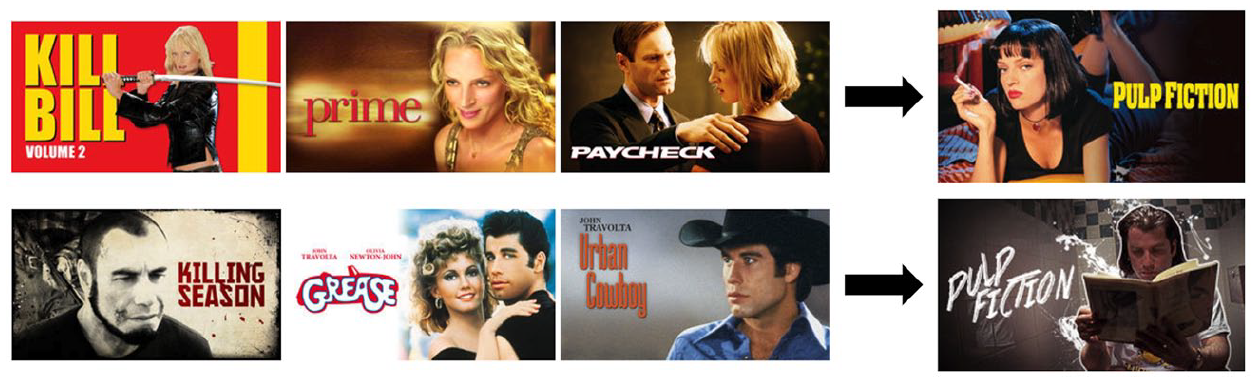
Illustration of how artwork personalization works for the movie Pulp Fiction based on the two users’ viewing histories (Chandrashekar et al., 2017).
Criticisms, controversies, and contradictions
The sophistication of these algorithmic processes holds the promise of producing recommendations that are true to the users’ taste preferences, but the investigation of media reports and Twitter posts about the NRS indicate contradictions to this idealized narrative. The first major case illustrating this is the alleged racial targeting of African Americans through artwork personalization. Reports indicate that a number of Black users were presented with artwork featuring minor Black characters in titles with a predominantly White cast (See Image 2). Users expressed that they feel ‘manipulated’ by Netflix and criticizes its algorithms for reducing their taste to their racial background and manufacturing diversity that is otherwise lacking in these titles (Berkowitz, 2018). The second case is the purported episode sequencing based on users’ sexual orientation for the animated anthology Love, Sex, and Robots. Queer viewers have observed that the sexually explicit lesbian episode was first served to them (See Image 3), while their straight friends had the heteronormative episode queued on top (Ha, 2019). These tendencies for the algorithms to make assumptions about users’ identities based on race, gender, and sexual orientation were echoed in the Twitter data. Some users believe that the NRS ‘thinks [they’re] white’ and so they are not served or promoted with Black content ‘no matter how popular’ those shows are. Gay users claim to have been ‘queerbaited’ and have been shown thumbnails of dating shows with two men, while male users are being presented with female supporting-characters for ‘male-led movies’. In both controversies, Netflix executives insist that they ‘don’t ask members for their race, gender or ethnicity’ (Berkowitz, 2018) and maintain that recommendations were generated through randomized A/B testing and machine learning.

Screenshot of tweet from Brown (2018) about her experience of alleged racial targeting through artwork personalization (also published in Berkowitz, 2018).

Screenshot of tweet from Thoms (2019) comparing the arrangement of the episodes of an animated anthology from two profiles that were supposedly based on the users’ sexual orientation (also published in Ha, 2019).
Apart from demographic targeting, the NRS was also criticized for misrepresenting titles through personalized artwork. Netflix engineers advised to pull out images of lead actress Jane Fonda in the show Grace and Frankie because it was performing poorly in the A/B testing. Why the artwork attracted less clicks is unclear, but reports speculate that it might be due to the polarizing persona of Fonda for her activism. NRS was also allegedly whitewashing the artwork for the program Nailed It! by serving images of two white men, who are only supporting cast members, instead of its host Nicole Byers, a Black woman. In a now-deleted series of tweets, Byers expressed disappointment in Netflix for reinforcing the erasure of Black women in culture only to attract particular audiences.
While a small number of tweets in the Twitter data attest to the accuracy of the algorithms, most are recurring complaints about low-quality and problematic recommendations by the NRS. Users point out that even if they have been consistent with their consumption, there were recommended titles that were at odds with their tastes and ‘something [they’d] never watch’. If they are served with content that aligns with their tastes, users complain about the limited range of recommendations despite their diverse interests. There were also instances of users finding the recommendations peculiar or unrelated to the programs they watched, such as being recommended to see the true-crime documentary The Ted Bundy Tapes after finishing the children’s show Peppa Pig or the ‘80s classic The Breakfast Club’. Connected to this is the purported bias of the algorithms for Netflix Originals. This has led users to believe that some programs have been ‘buried by the algorithm’, not only because titles that aligns with their interests were rarely recommended, but also because they find it difficult searching for them.
The tweets also indicate users’ frustration with the algorithms misreading or misattributing their behavior by assigning low match scores with content they have high affinity with and ‘have watched over and over’. They assume that this misinterpretation might be because the NRS deliberately disregards their actions and choices, with down-rated content still appearing in the recommendations. Users, however, said that they are willing to help the algorithms generate better recommendations by ‘gaming the algorithms’ to read their taste accurately and suggesting new actions they can perform such as editing their viewing history.
Algorithmic logics of taste
The ‘logic’ of the Netflix Recommender System emerges not from an organized ‘control’ structure but from the consistencies, discrepancies, and contradictions of algorithmic processes situated in the intersection of technology, culture, and sociality. This intricacy renders computational logic unable to rationalize unforeseen issues emanating from cultural expectations and social interactions with algorithms and media logic inadequate to account for the unseen and often overdetermined ways the algorithm imposes its computational rationality. I conceptualize ‘algorithmic logics’ to characterize the algorithm’s predetermined but generative structures and their configuration of the social relations that constitute cultural processes. I illustrate this with my interrogation of the NRS and its four logics of taste – datafication, reconfiguration, interpellation, and reproduction – to define the assumptions, processes, and mechanisms that govern its construction of cultural taste.
Datafication
Sadowski (2019) argues that all digital infrastructures are built with the capability for datafication not only to perform their computational function, but also to produce value for the digital economy. While datafication can be as straightforward as a click of the ‘buy’ button to indicate purchase intent, translating ‘taste’ into data necessitates the developers of the algorithms to define what ‘taste’ consists of. The underlying assumption for quantification of taste is that taste is a divisible concept, constituted by parts of a whole rather than by the whole itself. By splicing users and contents into granular attributes, the NRS is designed to assume that specific characteristics of a title or user, such as a morally deviant plot or a liking of certain actors, drive our preferences more than the others. However, as Cohn (2019) has pointed out, this premise heightens the probability of the algorithms miscalculating taste and it seems to be the case with users receiving incompatible or unrelated recommendations. Cultural concepts, works, and identities are also perceived not in absolute but relative terms, disembodied, and disassociated from their coherent wholes (Hallinan and Striphas, 2016).
Despite the risks of misinterpreting or altering taste, datafication serves to render algorithms the control over people’s cultural identities by reducing individuals to ‘dividuals’ (Deleuze, 1992). Once detached from the self, ‘dividual’ units of taste are relieved from their existing relations and are infinitely reevaluated and reorganized based on the algorithms’ parameters of valuating datafied taste. By prioritizing implicit taste preferences and dismissing explicit ones as ‘aspirational’, the NRS is formulated to deliberately undermine the value of reflexive and performative articulations of our tastes. It also isolates taste in a ‘social’ vacuum from other forms of cultural capital that influence one’s disposition. Social and cultural capital, in particular, has been separated from taste with the omission of the ‘friends’ network recommendations, the five-star rating system, and industry benchmarks. What datafication does is deflate our subjective performances into mere acts of consumption, which is where Netflix derives commercial value. This abstraction of the self into metrics not only rejects expressions of user agency but also depoliticizes the consequences of particular representations of class, racial, and gender being codified in the data (Cohn, 2019).
Reconfiguration
Born out of datafication is the capability of creating new models to identify and classify tastes, individuals, and objects. I call this as the reconfiguration of taste, wherein new compositions and categorizations transform these algorithmic models from sets of quantified relationships to ontological structures (Finn, 2017) that define the rules in the construction of taste within the algorithmic infrastructure. Categories like altgenres, taste communities, and other algorithmic schemas like ‘criteria’ become a priori frameworks in all the decisions of the NRS. Critical algorithmic research has extensively illustrated that these algorithmic configurations, designed by Silicon Valley developers and trained by historical data, tend to be biased to the dominant social order (Eubanks, 2018; Noble, 2018). The controversy on demographic targeting manifests this, surfacing the built-in associations between behavior and social identities despite Netflix purportedly not collecting demographic data. The downplaying of the demographics is also by design, with engineers ‘generally reluctant to recognize demographic categories as technically salient’ (Seaver, 2021: 3). The criteria of popularity also implies that there is an invisible majority that directs which cultural experiences are privileged by the algorithms. Minority cultures might be limited in their influence over popularity metrics as Netflix’s global audiences are primarily comprised of western nations (Jenner, 2018). Moreover, there is a historic lack of economic interests in them that further marginalize them in influencing popular culture (Cohn, 2019).
Other reconfigurations present opportunities for alternative cultural representations. The diversity metric is more promising, as it guarantees to serve a diverse spectrum of interests in the recommendations (Jenner, 2018). However, closer reading suggests that diversity only means having distinct genres in each row of the homepage and does not ensure catering to niche or underrepresented tastes. This means that mainstream content may pass as ‘diverse’ if it appears different from the rest of the selection. A/B testing, in theory, allows for experimentation on different artworks to represent titles, unlike the conventional practice of a singular promotional poster. However, it ends up prioritizing several images with the most clicks, regardless of it misrepresenting what the film is about or if the stars of the show are removed from the artwork.
In favor of the logical and efficient models of the algorithms, reconfiguration dismisses or overrules the ambiguities (McNay, 2000), multiplicity (Peterson, 1992), or dissonance (Lahire, 2005) of taste. Because it governs the generation of new rules with the inflow of new data, the system itself becomes self-generative. This means it decides which titles are recommended and are rendered more prominent, and which ones fall short of the threshold and are ‘buried by the algorithm’.
Interpellation
Personalization is at the core of the NRS, and each element in the Netflix interface is said to be algorithmically generated to suit the interests of each user. In theory, personal customization conflicts with the universal application of the NRS’ ontological structures. In practice, however, personalization works through what Althusser (2011) calls as interpellation by ‘hailing’ users to identify with social identities using semantic codes embedded in its recommendations. In the controversies, artwork personalization was purportedly employed to call users into recognizing visual codes corresponding to particular racial, gender, and sexual identities, despite claims of demographic neutrality. Beyond linguistic and visual cues, the NRS also makes use of space and order to perform interpellation through homepage personalization and episode sequencing. Once users respond to the interpellation, they become social subjects (Althusser, 2011) and are prescribed with the altgenres that supposedly represent their taste and the taste communities to which they belong.
This subjectification is willingly accommodated by users because they expect that the algorithmic output is meant for them and not for anyone else. They regard recommendations as ‘categorized images of the self’ (Prey, 2018) as they recognize aspects of their taste and their identities in them, a kind of ‘pseudo-intimacy’ with oneself through the algorithms (Colbjørnsen, 2018). There is hyper-awareness on what the algorithms might ‘think’ of them, and they would wish to settle their frustrations and anxieties by assuming a ‘sense of ownership, agency and presence’ (Cohn, 2019: 89) over their algorithmic identities. They are reasserting agency by trying to work on the dissonance between their algorithmic identity and self-identity through various strategies. Alternatively, the personalization narrative may also prompt users to internalize the algorithmic depiction of their selves, subscribing to a dominant reading of algorithms as knowing us better than ourselves (Lomborg and Kapsch, 2020). Algorithmic interpellation, rationalized by the lore of personalization and users’ ownership of algorithmic identity, is the logic that draws users to the ‘taste’ that the NRS prescribes for them.
Reproduction
I refer to the logic to reproduction to characterize the capacity of algorithms to constantly generate compelling cultural experiences through computational processes. By dissecting content into infinite attributes and reconfiguring them into new categories and classifications, the NRS transforms these titles into ‘new’ cultural forms. Programs and films are ‘repackaged’ through personalized artwork, evidence, and match score to appeal to individuals’ taste preferences. They are ‘reframed’ by positioning them in a particular row in the homepage or beside specific titles to emphasize their relative relevance to one’s taste. Content in the form of recommendations are contoured to the shape imposed by the algorithms a hundred times over to tailor-fit them to the interests of Netflix’s millions of subscribers. The show Stranger Things can be classified as a sci-fi thriller, a period drama or a teen romance all at the same time to different sets of viewers. While not changing the material itself, reassembling content consequently affects how it is perceived and valued. Secondary Black characters as stand-ins for a film of predominantly White actors would give you a different impression of the movie than what its producers intended. Netflix Originals may appear to be ‘popular’ if assigned in the ‘trending’ row in the homepage. These subtle changes not only influence the show’s odds of attracting viewers today but also its future prospects in the algorithmic calculus of visibility and relevance (Bucher, 2018; Cohn, 2019; Gillespie, 2014). The NRS engineers our cultural experiences by manufacturing new norms of ‘quality’ and ‘popularity’ while at the same time underlining the primacy of recommendations matching your ‘taste’ (Hallinan and Striphas, 2016; Morris, 2015).
These mechanisms and processes reproduce the very same algorithmic logics that run them, and they remain undisputed because the algorithms restrict and often supersede user agency. Despite their multifaceted interests, users are often boxed into certain taste communities and allocated to a narrow array of altgenres, and this turns choices into constraints (Cohn, 2019). This set of regulated liberties (Bourdieu, 1992) permitted by the NRS makes algorithmic taste neither deterministic nor emancipatory but inhibits users from deviating from the formula it prescribes. This means that users who might have more expansive taste preferences or those more ambiguous or contradictory in their taste practice might be considered ‘unrecommendables’ (Cohn, 2019) by the algorithms. Even if users assert agency, there is a lack of mechanism to demand from the ‘court of algorithmic appeals’ (Hallinan and Striphas, 2016). The inability to edit one’s viewing history, absence of social recommendations, and the limitations of the binary rating systems impose rigidity in our taste practice within the Netflix infrastructure. Historically, while cultural taste functions to relegate individuals to their social positions, it is also a means to negotiate your cultural identity as resisting or non-conforming to the ‘structuring structure’ of the habitus (Bourdieu, 1984). However, the NRS provides limited to no recourse for users to negotiate their tastes with the algorithms. While users find creative ways to signal their preferences to the NRS, it would only be a tacit negotiation (Gillespie, 2014). The restrictions on agency exists in the same paradigm where users are supposedly empowered by free choice and self-determination of their cultural experiences.
These algorithmic logics of datafication, reconfiguration, interpellation, and reproduction reappropriate old apparatuses of social control, such as subjectification (Althusser, 2011) and restraints in user agency (Bourdieu, 1992), while introducing new capacities in engineering cultural processes through automation and computational manipulation. It can be argued that algorithmic logics resembles some aspects of mass media logic (see Altheide and Snow, 1979) by employing ‘formats’ like altgenres and building legitimacy through the ‘grammar’ of recommendations (Cohn, 2019), as well as those of social media logic (see Van Dijck and Poell, 2013) of the primacy of ‘popularity’ and the ‘programmability’ of social encounters. However, there are clear power asymmetries between the algorithms and users, and to a certain extent between the algorithms and its proprietors and media producers for being blindsided by the former’s unilateral decision-making and unforeseen outputs and outcomes. This makes algorithmic logics distinct in its intermediation of culture by transforming algorithms from procedural to self-generative machines, in the guise of algorithmic objectivity, user agency and post-demographic experiences (Cohn, 2019).
Conclusion
Algorithmic logics encapsulate the completeness of algorithms as a machine, their contingency as media, and the emergent contradictions from the multiple social contexts where they operate. Where there is conflict, however, the algorithms appear to veto in favor of logics that correspond, correlate, and concur to the categories, models, and structures deeply entrenched in their operations. Through the algorithms’ self-governing, self-generative structure, these logics become universal, definite, and enduring and they manufacture cultural experiences under the pretense of choice and control. Devoid of transparency and enveloped in romanticized narratives, algorithms are exempted for scrutiny as they operate behind their invisible yet ubiquitous infrastructure (Pasquale, 2015).
Despite these power asymmetries, algorithmic logics function as an ‘interpretative schema’ (Altheide, 2015) in making sense algorithms in their entanglement with social actors, institutions, and infrastructures. Datafication, for instance, exhibit the reliance of algorithms on social interactions as data to fuel their computational functions, while also acknowledging the human decisions that determine which data matters and which are negligible. Interpellation accentuates the power of narratives in impressing on users that they could identify (parts of) themselves in algorithmic output and take ownership of their algorithmic identity. Logics being prescriptive and not deterministic also direct scholars to probe practices of resistance and subversion of algorithms (Cohn, 2019) in an attempt to reclaim the agency restricted or nullified by the algorithms.
Algorithms are part and parcel of larger digital infrastructures and they operate within the logics of these systems (Klinger and Svensson, 2018; Van Dijck and Poell, 2013). The algorithmic logics presented in this article undergirds the workings of platforms where output derives primarily from the algorithmic manipulation of existing databases (e.g. Netflix and Spotify) than from user-generated content and actions (e.g. Facebook and YouTube). This means that the logics of ‘social’ algorithms may manifest differently as they coincide and potentially conflict with the platforms’ encompassing social media logics (Van Dijck and Poell, 2013). The same thinking applies for algorithmic systems of ‘service’ infrastructures, from commercial platforms, albeit becoming public utilities, (e.g. Google and Amazon) to public services and governance (Eubanks, 2018). A critical examination of the intersection and interdependence of these media and social structures is necessary to problematize how their logics coincide and how they influence contemporary cultural experiences.
Footnotes
Acknowledgements
I would like to acknowledge the guidance of Dr Justine Humphry from the University of Sydney as supervisor for my master’s dissertation from which the research article derives its most critical components.
Funding
The author received no financial support for the research, authorship, and/or publication of this article.
