



Abstract
The article proposes to consider the COVID-19 global pandemic as new major development for cultural industries and policies and to highlight timely and crucial trends due to the lockdown measures. Thus, it attempts to stimulate the scholarship debate regarding the consequences of the pandemic to the action of global online platforms, as well as to policy and economic aspects of cultural sectors. Taking as case study the audio-visual sector, the article explores whether the US global streaming platforms are the winning players of the lockdown measures and emphasizes the multifaceted strategies developed by US-based platforms in order to strengthen their soft power. Focusing on China and the European Union, the article also argues that the overwhelming action of US-based online platforms triggers the potential emergence of media platform regionalization in the context of COVID-19 pandemic. Finally, it highlights the regulatory challenges and how the new empirical trends are expected to shape the current audio-visual policy framework. The analysis focuses on the period between the beginning of global pandemic in Asia-Pacific in January 2020 and the progressive easing of lockdown measures in North America, Europe and Asia-Pacific in July 2020.
Keywords
The lockdown measures due to the COVID-19 global pandemic are expected to have a key impact on the functioning of cultural markets and the global flows of digital cultural content. Taking as case study the audio-visual sector, the present article proposes to consider the COVID-19 pandemic as new major development for cultural industries and policies and it seeks to stimulate the scholarship debate regarding its effects on the action of global online platforms. In this respect, the analysis aims to explore whether the global streaming platforms are the winning players of the lockdown measures and to highlight the possible consequences of the global pandemic to economic and policy aspects of cultural sectors.
The arrival of global online platforms represents an unprecedented change in production, dissemination and consumption of audio-visual content (Albornoz and Leiva, 2019; Nieborg and Poell, 2018; Vlassis et al., 2020). “The presence of these intermediaries in the everyday lives of citizens and consumers is raising major policy issues” (Mansell, 2015: 21). Thus innovative subscription video on demand (SVOD) platforms, such as Netflix, Amazon Prime Video, Disney Plus, Apple TV Plus, or HBO Max, have major impact on the balance of power in the global audio-visual economy (Lobato, 2018; Vlassis, 2020), insofar as platformization drives changes in how people watch TV programs and movies and it entails the rise of the platform as dominant infrastructural and economic model in the industry (Evens and Donders, 2018: 4). In this context, the rise of global streaming platforms leads different stakeholders to rethink the key norms in the functioning of audio-visual industries (Lotz, 2019) and triggers various regulatory and governance challenges for policymakers (Poell, 2020; Vlassis et al., 2020).
Even though the universe of new global platforms displays certain major opportunities, such as more abundant and affordable range of cultural goods and wider accessibility of cultural content, the current context of the COVID-19 pandemic could favor concentration dynamics in the audio-visual market due to the action of global streaming platforms. The article focuses on the period between the beginning of global pandemic in Asia-Pacific in January 2020 and the progressive easing of lockdown measures in North America, Europe and Asia-Pacific in July 2020. The analysis is based on collected data coming from companies such as Netflix, Amazon, Disney, Apple, HBO, Tencent, Alibaba, Baidu, as well as from specialized magazines – Variety, the Hollywood Reporter, Screen International, and Cine Europa.
The article consists of four main parts. Firstly, it highlights how the lockdown measures consolidate the economic advantage of US-based online platforms. Secondly, it provides an analysis regarding the multifaceted strategies developed by global platforms in order to strengthen their soft power and to become irreplaceable actors for culture professionals, public authorities, and experts. Thirdly, focusing on China and the European Union (EU), the article analyzes the action of national and regional platforms facing the overwhelming presence of US-based online platforms. Finally, it explores the regulatory challenges and how the new empirical trends due to the lockdown measures are expected to influence the current audio-visual policy framework.
Globalizing US online platforms
US-based transnational online platforms have powerful capacities to produce and disseminate audio-visual content on a global scale and exercise strong influence over how audio-visual content can be accessed, even though these SVOD services are expected to have “differentiated effects on the markets” they have entered (Lobato, 2018: 184). Today the only worldwide VOD services are two US-based companies – Netflix and Amazon Prime Video – and by 2021 we should include in this list HBO Max, Hulu, Disney Plus, and Apple TV Plus. As of July 2020, Netflix, the world’s largest SVOD service, is available worldwide except mainland China, Syria, and North Korea. In addition, Netflix spent around 12, 15 and 17 billion USD on original content in 2018, 2019 and 2020 respectively. For its part, Amazon Prime Video launched worldwide in December 2016 except for mainland China, Cuba, Iran, North Korea, and Syria. As stressed by McDonald and Smith-Rowsey (2016: 1–2), Netflix, followed by other US SVOD services, had “a transformative effect in the relationship between consumers and content providers,” becoming “synonymous with the growing, pervasive impact of technology.”
Netflix is one of the US-based platforms benefiting from the lockdown measures due to the COVID-19 global pandemic. According to its quarterly reports (Netflix, 2020a), in the first 6 months of 2020, Netflix added 26 million new subscribers worldwide, which is almost the same as the number of subscriptions throughout 2019 (28 millions). As of July 2020, the Californian platform has around 193 million subscribers compared to 167 million at the end of January (Table 1).
Global and regional SVOD platforms.
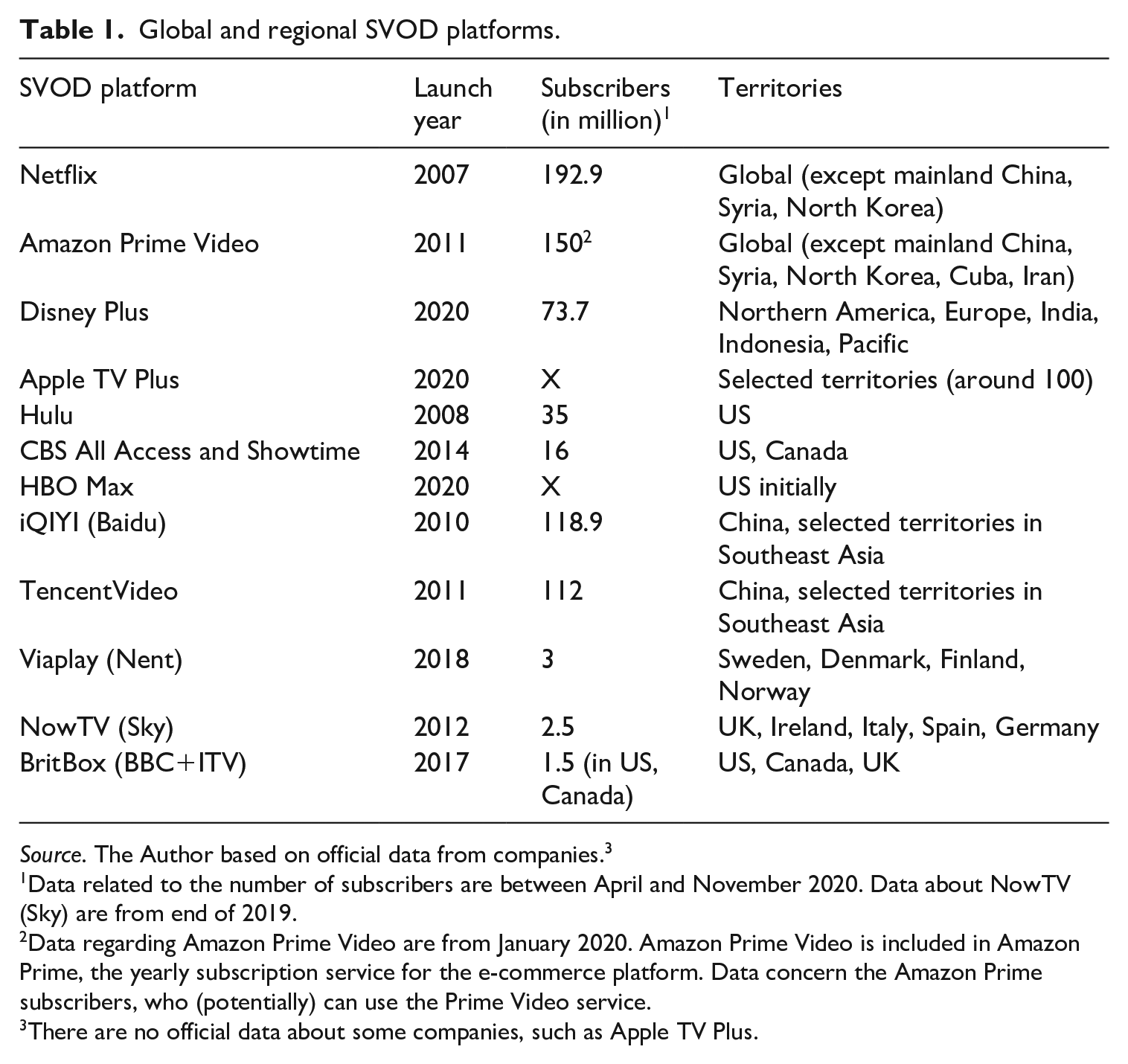
Source. The Author based on official data from companies. 3
Data related to the number of subscribers are between April and November 2020. Data about NowTV (Sky) are from end of 2019.
Data regarding Amazon Prime Video are from January 2020. Amazon Prime Video is included in Amazon Prime, the yearly subscription service for the e-commerce platform. Data concern the Amazon Prime subscribers, who (potentially) can use the Prime Video service.
There are no official data about some companies, such as Apple TV Plus.
It’s worth noting that before the COVID-19 pandemic, Netflix’s growth in the United States had started to drop, while the international market started to occupy a key place in the company’s strategy: between 2018 and 2019, Netflix saw a 55% decrease in net adds in the United States, only bringing in 2.6 million new subscribers. Last quarter of 2019, Netflix added 0.42 million subscribers domestically, whereas it saw an additional 8.33 million subscribers internationally (Netflix, 2020b). Moreover, during the lockdown measures, more than 80% of the new subscribers came from outside the North America. From January to July 2020, the California-based company signed up 5.2 million subscribers in the United States and Canada, as well as 9.7 million new paid subscribers in the region Europe, Middle East and Africa, followed by a major increase in Asia-Pacific with more than 6.3 million new membership additions. Regarding the high jump in Asia-Pacific, it is revealing that by end 2019, this region accounted only for 8% of the company’s total revenue.
Besides, unlike Hollywood studios such as Disney, Universal, Paramount, Sony and Warner Bros, Netflix does not release its films into cinema theaters and its business model has not been impacted by the fact that movie theater screens fade to black in several countries during the COVID-19 pandemic. Instead, for commercial and symbolic reasons, Hollywood studios decided to not skip theatrical releases and to not head directly movies to streaming online platforms. The majority of Hollywood movies have pushed to early or mid-2021 with six notable exceptions: Trolls World Tour and Scoob distributed by Universal Pictures and Warner Bros respectively and released for digital rental; Artemis Fowl and Mulan released on Disney Plus, as well as Greyhound released on Apple TV Plus.
In addition, Netflix’s dominance is largely challenged by Disney Plus, Disney’s new video streaming service, launched in November 2019 in the US, Canada and the Netherlands. In July 2020, Disney Plus reached more than 60 million subscribers (The Walt Disney Company, 2020), compared to 28.6 million Disney Plus paid subscribers as of February 2020. It means Disney Plus added around 32 million new subscribers in 5 months, while Disney Plus originally set a target of 60–90 million subscribers by the end of 2024. Clearly, Disney Plus is a key beneficiary of cultural consumption changes and growing in-home streaming practices due to the COVID-19 outbreak and the lockdown measures.
The new Disney SVOD service got a major boost in late March and early April, when it launched in eight Western European countries – the United Kingdom (UK), Ireland, Germany, Italy, Spain, Austria, France, and Switzerland. Moreover, Disney Plus subscription figures were also boosted by its launch in India and Indonesia, where Disney Plus is offered in conjunction with the existing streaming service Hotstar. Besides, the overwhelming presence of Netflix and Disney Plus in SVOD services is being challenged by the launch of HBO Max in the US in May 2020, the launch of NBC Universal’s Peacock on July 15 and the rebrand of CBS All Access to Paramount Plus early 2021. Finally, Hulu, Disney’s other streaming service, which only operates in the US, reaches today 35 million subscribers and in 2021, Disney is looking to launch a new entertainment streaming platform overseas under the name Star.
US online platforms, soft power, and multifaceted strategy
It’s worth understanding the global expansion of US-based SVOD services as a coherent political, economic and industrial process, even though it is expected to produce distinct, national and regional context-dependent outcomes (Wayne and Castro, 2020). Firstly, global US SVOD services establish themselves through multiplication of economic deals with regional and national pay-TV operators, widening the addressable market and their penetration into households. Netflix has access to more than 300 million pay-TV households worldwide, outside of China. In 2019, as an additional instrument of extending its global reach, Netflix signed more than 15 economic deals with major pay-TV operators (Roxborough, 2019). For its part, Disney Plus is not expected to launch in the Middle-East region in the near future, but will license its original content exclusively to regional pay-TV and streaming company OSN (Orbit Showtime Network) (Dams, 2020). Regional entertainment network OSN broadcasts into 24 countries across the Middle East and North Africa, including Egypt, Saudi Arabia, Morocco and Algeria. Following the same strategy as Netflix, as of July 2020, Disney Plus also established multi-year distribution deals with several pay-TV operators: Vivendi’s Canal Plus Group in France, Sky’s Sky Q and NowTV in the UK and Ireland, Italian telecom TIM, and Spain-based telecom Telefonica.
Secondly, the public diplomacy strategy is a key component in the overall practices of these digital players in the context of COVID-19 global pandemic. It is revealing that recently, self-regulation in Internet governance has come under increasing pressure; in several countries, calls to implement local content policies and ambitious tax measures are multiplying. In this view, public diplomacy strategy (Gilboa, 2008) seeks to promote both respectful attitude and good reputation of the global online platforms, creating positive opinion to public regulators, screen industry bodies, and culture professionals in order to support policies, which do not affect core priorities of the US-based platforms.
In March 2020, Netflix established a 100 million USD fund to help with hardship in the cultural industries, starting with the crews on Netflix’s productions. In Netflix’s efforts to consolidate its legitimacy as a leading player in cultural sectors, this fund includes donations of 1 million USD each to the SAG-AFTRA Foundation COVID-19 Disaster Fund, the Motion Picture and Television Fund and the Actors Fund Emergency Assistance in the United States and 1 million USD between the AFC and Fondation des Artistes in Canada. In addition, Netflix also provided each 1 million USD to major public and private audio-visual agencies, such as British Film Institute, the Italian Film Commission, the Brazilian Institute of Audio-visual Content, the Argentine and Mexican Academy of Film Arts and Sciences, the Instituto de la Cinematografía y de las Artes Audio-visuales and the Film Academy in Spain, as well as the Netherlands Film Fund. In a similar vein, Amazon Studios provided 1 million USD for the catering team of Jon&;Vinny’s restaurant group to prepare and deliver meals to associations, including the Motion Picture & Television Fund and it also set up a 6 million USD fund to support the recovery of the European audio-visual production community.
Thirdly, even though several US SVOD platforms focus on strong investment in original content, they also seek to develop film heritage strategy, undermining criticism with respect to global platforms’ overwhelming influence or to commodification and standardization of cultural content. In April 2020, Netflix established a new partnership with MK2 Films (Netflix, 2020c), the Paris-based film sales and distribution company, in order to strengthen and diversify the array of content that the platform makes available to audiences across the globe. A selection of French and international films from the MK2 catalog is available on Netflix throughout 2020, covering a catalog of 50 films directed by François Truffaut, David Lynch, Michael Haneke, Xavier Dolan, Charlie Chaplin, etc.
Following its film heritage strategy, in January 2020, Netflix acquired exclusive streaming rights to the full film catalog of the Japanese animation house Studio Ghibli – including Hayao Miyazaki’s animation films among others – for all territories in the world outside North America and Japan. HBO Max – US SVOD service from WarnerMedia Entertainment – already picked up US streaming rights to Ghibli’s works, whereas the agreement with Netflix represents a key step for its international growth goals. Moreover, since January 2020, five Netflix films, The Irishman, Marriage Story, American Factory, Atlantics, and Roma, have added to the Criterion Collection, the US home video distribution company focusing on licensing important classic and contemporary films.
Unsurprisingly, this multifaceted strategy aims to show to policymakers and culture professionals that strict regulation for SVOD platforms risk to suffocate a benevolent business model, which – when operating within an unfettered digital market – is expected to accomplish economic and socio-cultural goals. It is revealing that in the framework of the EU Audio-visual Media Services Directive (AVMSD)’s review (Vlassis, 2017), Netflix argued that the introduction of quotas will endanger “a sustaining business model, which allows European consumers to access a wide variety of European and international content” (Netflix International, 2016: 16). As such, the business model of global SVOD platforms can be perceived as necessary tool dealing with the persisting policy and economic problem of international visibility of local and national content that “conventional audio-visual support measures struggle to achieve” (Kostovska et al., 2020: 16).
Global US platforms facing regional actors
Inspired by the world system theory of the French historian Fernand Braudel, the economist Charles-Albert Michalet pointed out that since 1980s, Hollywood has developed the “world-cinema” (cinema-monde) strategy based on three key mechanisms: (i) the development of world movie, both an event and a global film; (ii) the development of a worldwide approach on the market; and (iii) the establishment of a horizontal cooperation among companies centered on entertainment activities. “The world cinema reflects the economic forces that showed up the global capitalism, namely an economic system that can only be operating in a global dimension” (Michalet, 1987: 112). The launch of disruptive US SVOD services – such as Netflix, Amazon Prime Video, HBO Max, Apple TV Plus, or Disney Plus – and the targeted export strategies of these platforms to global markets (Jin Dal, 2017; Lobato, 2018) follow the mechanics of ‘world-cinema’ (Vlassis, 2020). Here, the Chinese and European audio-visual markets and the action of regional VOD platforms are indicative of how the US-based platforms are the dominant players worldwide on one side, and on the other of how their global practices could initiate a new wave of media regionalization “with a renewed regional media geography” (Steinberg and Li, 2017: 181).
Firstly, as of July 2020, Netflix, Amazon Prime Video, and other foreign VOD services are blocked for operating in mainland China under strong restrictions of China’s foreign digital content distribution, leaving plenty of room for encouraging national private investment and strengthening Chinese VOD services. Insofar as in China, “the audience has shifted from traditional television viewing to Internet television consumption” similar to audiences in many countries (Fung, 2019: 998), the three Chinese Internet giants Baidu, Alibaba, and Tencent (collectively known as BAT) have been expanding in the entertainment sector, setting up VOD platforms (Meng, 2018: 95).
In this view, evolved rapidly from a DVD-based and piracy dominated market to a fast-growing VOD one, Chinese audio-visual market is currently dominated by three platforms operated by BAT – Baidu’s iQIYI, Alibaba’s Youku, and Tencent’s Tencent Video. Their business model is quite different to US VOD platforms; the three Chinese VOD services operate a mixed business model with both advertising and individual subscriptions. In March 2020, iQIYI and TencentVideo subscribers reached 118.9 and 112 million respectively, up 23% and 26% year over year (Baidu, 2020; Tencent, 2020). For its part, revenue from Youku in the first quarter 2020 was 0.84 billion USD, an increase of 5% compared to same quarter of 2019 (Alibaba Group, 2020: 15). 1 Indeed, the dominance of BAT in the Chinese market is based on rigid regulation imposed by Chinese authorities, which explicitly prevent “foreign platforms from managing their own distribution in China” (Kokas, 2020: 409), protecting national private investment and imposing the presence of Chinese content in VOD catalogs (Vlassis, 2016). As stressed by Li (2019: 1–2), before 2014, online video was subject to different regulation than television and cinema industries were. Television and cinema were “the province of the state,” whereas “market relations dominated the development of online video, from its financial structure to its content development.” In December 2014, the State Administration of Press, Publication, Radio, Film, and Television – the main regulator of Chinese cultural life – announced that “content forbidden to be broadcast on traditional media would also be forbidden on new media” (Li, 2019: 1).
Given strict State measures, since 2013, all the three Chinese VOD services have established multiple content agreements with US companies, revealing the strong attractiveness of entertainment content produced and distributed by US-based firms. The Table 2 outlines the key distribution deals carried out between US entertainment companies and Chinese online platforms:
Distribution deals between US-based entertainment companies and Chinese online platforms.
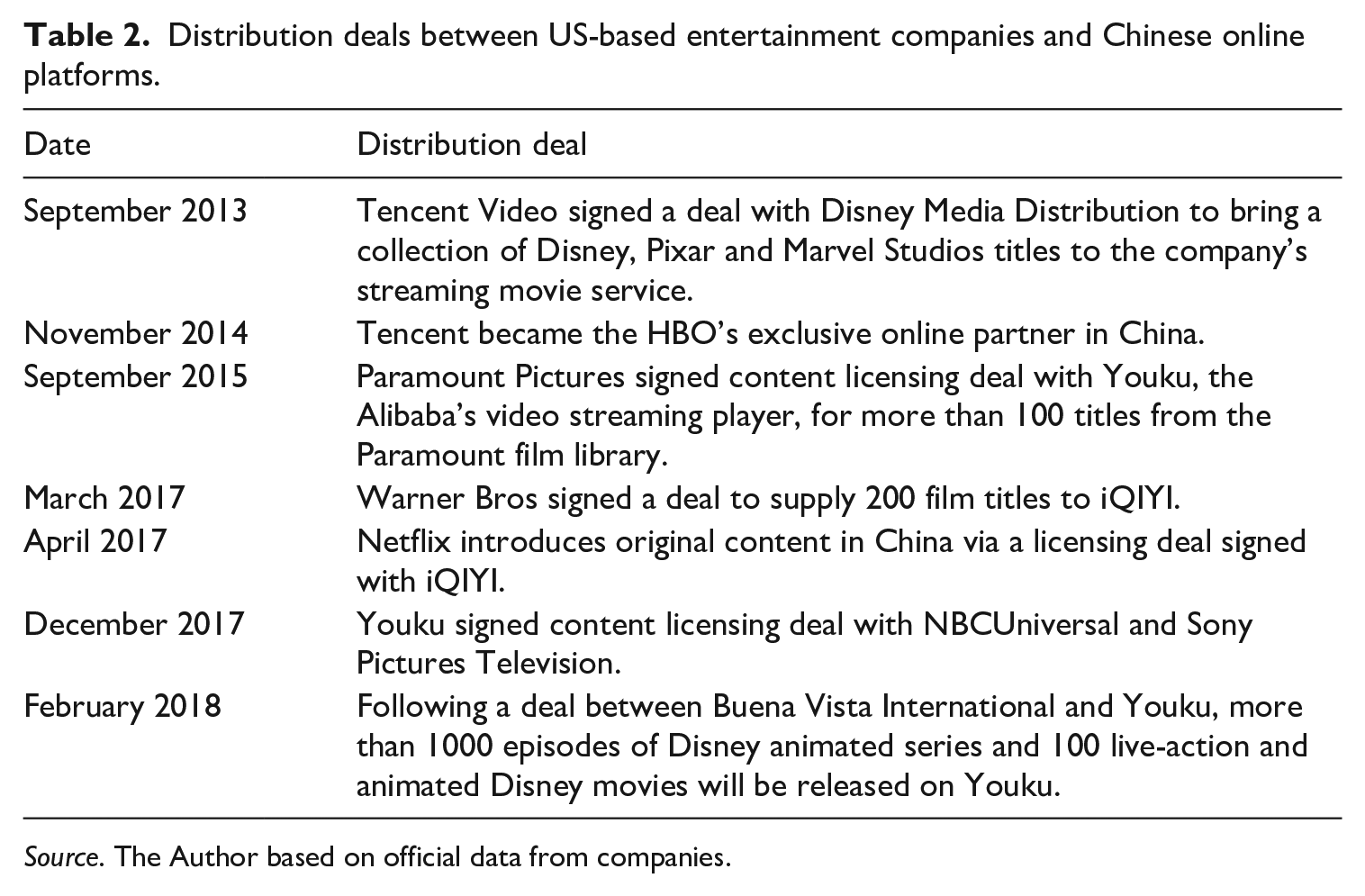
Source. The Author based on official data from companies.
In addition, even though “technology allows Chinese TV to go global” (Keane, 2016: 5437), the activities of the three Chinese VOD platforms – benefited from rigid regulation – are notably national, while expanding abroad is extremely poor. Far from being considered as global players, the key priority of the three VOD services is to target especially significant Chinese diaspora populations and to penetrate the Southeast Asian audio-visual market, as activities from global US-based platforms have so far remained weak. In 2016, for the first-time iQIYI launched its business activities outside China – in Taiwan, the second largest Chinese-speaking market after the People’s Republic of China. In January 2020, iQIYI also established a strategic partnership with Malaysian television operator Astro and it is looking to expand its service across 10 countries in the Southeast Asian region. For its part, moving in the same direction, in November 2018 Tencent Video launched a VOD service in Thailand under the name WeTV, with a mix of Chinese, Thai, Korean, and US content. However, the Chinese diaspora is also a key priority for US online platforms. In 2019, Netflix produced its own Mandarin-language original TV series – Nowhere Man, Triad Princess, and the Ghost Bride – for targeting the Mandarin speakers outside China. In a similar vein, in March 2019, Netflix licensed rights to Chinese series I Hear You from Chinese streaming platform Youku for playing out in 190 countries.
Secondly, in Europe, the only pan-European SVOD platforms are US companies, showing once again that the European audio-visual market is still an integrated component of the US entertainment economy (Vlassis, 2020). In 2018, Netflix and Amazon Prime Video are the leading players, operating in each EU country. They represent 78% of the total SVOD subscribers in the EU, whereas the VOD Sky Online/NowTV, acquired by US telecommunication group Comcast, represents 3% and it operates in four EU countries – Ireland, Spain, Italy, and Germany, and in the UK (European Audiovisual Observatory, 2020: 55). In this view, based on existing cooperative arrangements and common language strategies, public and private national and regional broadcasters in Europe aim to adapt their practices to the dominant trend of platformization and to deal with the competition from US streaming platforms.
First, in October 2020, the French public broadcaster France Télévisions and commercial networks TF1 and M6 launched the streaming service Salto in order to develop an offer “for a French audience” (Keslassy, 2020). Instead of using algorithms, its business model will be based on film and TV personalities making their own recommendations. Second, in 2020, based on the cooperation between ZDF and France Télévisions – the German and French public broadcasters respectively – the Franco-German television network ARTE (Association Relative à la Télévision Européenne) seeks to launch a European VOD platform in various languages. Note too that the ARTE started broadcasting in 1992 and is perceived as a European culture channel, producing programs for various national audiences, or even for a European audience. Third, in 2017, following a joint venture and relying on a common language strategy, BBC and the network ITV launched the VOD service Britbox, which operates in the US, Canada, UK, and by late 2020, in Australia. At the end of 2019, it reported more than 1 million subscribers. Finally, in September 2020, French language international public broadcaster TV5 Monde launched TV5MONDEplus, a French-speaking VOD platform, including the contribution by French-speaking public broadcasters, such as France Télévisions, France Medias Monde, ARTE, RTBF Belgium, Swiss SSR, Radio-Canada, and Télé Québec.
Clearly, the global practices of US-based platforms produce different kinds of distribution forces, which can in turn generate various media collaborations or diverse media geographies in regional terms. In this respect, the worldwide action of US online platforms has initiated a new wave of strategic alliances between public and private national broadcasters – the France-based VOD platform Salto or the UK-based Britbox. On the flip side, it could also trigger the emergence of a platform regionalization based either on common cultural or language imaginaries, such as the Scandinavian Viaplay, TV5MONDEplus and ARTE VOD platform or on regional powerful players, such as the action of Chinese online platforms or Hong-Kong’s Viu in Southeast Asia.
Regulate or not regulate in the age of COVID-19 global pandemic?
US-based online platforms have become major enablers of global flow of cultural content, with unparalleled gatekeeping powers. The era of globally available, on-demand media content represents a considerable challenge both for policies expected to protect national or local cultures (Debrett, 2009: 822) and for media governance related to production, distribution and consumption of cultural contents (Albornoz and Leiva, 2019). In addition, global streaming platforms have traditionally favored self-regulation for digital technologies, underpinned by fear of inappropriate State intervention or suspicion of untimely public policies (Simpson et al., 2016; Vlassis et al., 2020). Therefore, their discourse has been built on a deep skepticism towards the intervention of the State for economic, social and cultural purposes.
In this context, EU agenda on audio-visual services has been recently dominated by the review of the 2007 AVMSD (Vlassis, 2017). Here, the issue was twofold: to prevent the adoption of formerly local and national standards in digital markets ensuring open audio-visual markets to transnational digital content and/or to establish governance arrangements in the digital economy in order to involve global online platforms in the financing, prominence, and visibility of European audio-visual content. The new AVMSD was adopted by the European Parliament in October 2018 and it is also going to apply to VOD platforms. More specifically, the new text (Regulation (EU), 2018/1808) includes obligations for providers of on-demand audio-visual services to respect a quota of 30% for European works on their catalogs. The revised AVMSD also incorporates exceptions to the country-of-origin principle in order to tax non-domestic VOD players targeting a given Member State.
Indeed, the EU measures indicate a level of path-dependence from the analogue-broadcast era to the digital one and the new text is based on a logic à la carte, which historically dominates EU intervention in audio-visual industries (Vlassis, 2020). In this view, as of July 2020, France, Germany, Italy, Poland, Denmark and the Flemish Community of Belgium have developed obligations for non-domestic providers of on-demand audio-visual media services (Donders et al., 2018). Among them, the introduction of a compulsory contribution from VOD platforms to the Polish Film Institute is a policy measure based on economic motives against the effects of the COVID-19 global pandemic. Besides, in May 2018, regarding the German case, the European Court of Justice (ECJ) has rejected the lawsuit from Netflix following a complaint about the payment of a fee to the Federal Film Board. According to the ECJ, due to the fact that the Californian VOD platform’s content is available in Germany, Netflix is obliged to contribute to the national film fund (Albornoz and Leiva, 2020).
It’s worth mentioning that beyond these obligations analyzed above, since 2015, all the EU Member States have imposed to global streaming platforms selling to European consumers to apply, collect and remit Value Added Tax (VAT). In Europe, Switzerland and Norway are the first countries introducing tax rules on the digital platforms in 2010 and 2011 respectively. In a similar vein, several countries or provinces in the Americas, Asia-Pacific or Africa have proposed legislation to ensure that the sales tax is imposed on all foreign companies offering products and services online, notably in the cultural sectors. Since February 2020, seven national governments have considered to charge foreign SVOD platforms with an additional digital services tax: Brazil, Paraguay, Indonesia, New Zealand, Philippines, Kenya, and South Africa. Clearly, in the context of COVID-19 global pandemic and of economic downturn, there is strong possibility for new mechanisms applied to global SVOD services and implemented for financing and level playing field motives. As such, end October 2020, in the framework of the AVMSD’s transposition, French government announced that non-national SVOD platforms, such as Netflix, Disney Plus, or Apple TV Plus, will have to invest in French and European audio-visual works based upon a rate of at least 20% of their net turnover in France; 85% of this investment would be spent on French-language content. As such, the new public measures could be the sign of a confrontation between strengthened State intervention and triomphal digital capitalism in the context of COVID-19 pandemic. However, this type of public mechanisms is also likely to be a source of political and economic clash between national governments and the US administration. The latter considers these obligations to be designed to unfairly target US companies and to discriminate against US digital players.
Concluding remarks
The article has offered a multi-dimensional investigation in order to stimulate the debate with respect to the consequences of the lockdown measures to the action of global SVOD platforms. Despite major technological developments disrupting audio-visual industries, the article highlights a strong continuity in terms of balance of power in the global audio-visual politics and economy. The lockdown measures could thus have crucial effects: consolidating the dominant place of US-based VOD platforms in the global cultural market; giving the economic and technological advantage to these players for establishing their leading position in the global trade of digital cultural content; developing oligopolistic conditions of strong competition among few US multinational firms in the digital audio-visual market; strengthening the soft power of these US-based platforms in order to become irreplaceable global actors for culture professionals, experts and public authorities.
In addition, despite their competition with each other, US online platforms are connected by strong strategic interdependence, benefiting from technological advantages, large base of consumers, public diplomacy strategies, economies of scale, strong market capitalization, as well as from a normative framework largely based on self-regulation. In this respect, the ubiquitous action of US VOD platforms establishes platformization as the dominant structure in audio-visual economy, within which national and regional media operators seek to develop their strategies. Their worldwide action also represents a strong contrast with the US foreign policy pursued by Trump administration, which is strongly unilateralist and nationalist. Instead, in the light of COVID-19 global pandemic, US-based online platforms increasingly contribute both to the progressive economic integration of national audio-visual markets and to the potential development of media platform regionalization.
Finally, even though the COVID-19 global pandemic sees the emergence of a possible confrontation between strengthened State intervention and triomphal digital capitalism, it makes also necessary to develop policy measures, which go beyond a path-dependence logic from the analogue-broadcast era to the digital one, attempting to explicitly boost discoverability and visibility (McKelvey and Hunt, 2019) of local and national content in the VOD platforms’ catalogs. Consequently, the overwhelming presence of global SVOD platforms is also expected to exacerbate the data asymmetries among different stakeholders in the cultural and media sectors. Today, US-based streaming platforms handle vast amount of data, being beyond the scope of institutes for cultural statistics, civil society organizations, researchers, and policymakers. The restricted access to supply and consumption data raises major issues in terms of transparency and accountability, of establishing a level playing field in the digital media economy, as well as of defining new appropriate policy measures to deal with social and economic conditions of creators and to promote diversity of cultural expressions in an after COVID-19 context.
