



Abstract
The rise of user-generated content (UGC), such as internet memes and amateur videos, enables new possibilities for mediatization of the past. However, these possibilities can facilitate not only more diverse and less top-down engagements with memory, but also lead to its trivialization and distortion of historical facts. The latter concerns are particularly pronounced in the case of memories about mass atrocities (e.g. the Holocaust), where online media are often used to promote denialism and attack the victims’ dignity. To better understand the relationship between UGC and memory mediatization, we examine a selection of internet memes dealing with Anne Frank, an iconic Holocaust victim. Using a combination of inductive content analysis and close reading, we identify four classes of Anne Frank memes: (1) ad hominems; (2) deniers; (3) trivializers; and (4) thought provokers. Our findings demonstrate the multi-faceted functionality of memes, which are used not only to trivialize Holocaust memory, but also to reinforce canonical narratives about Anne Frank, and highlight the dependency of memes on other forms of memory mediatization, thus raising questions about the interrelations between UGC and institutionalized forms of remembrance.
Introduction
The distribution of digital technologies has led to the increased presence of online media in different areas of life. Known as ‘mediatization’ (Hjarvard, 2017), this phenomenon transformed many social and cultural processes, including the ways individuals and societies remember and forget. Important part of this transformation – sometimes referred to as the digital (Garde-Hansen et al., 2009) or connective (Hoskins, 2011) memory turn – is the growing role of user-generated content (UGC) that provides individuals with the new means of formulating, reinforcing and challenging interpretations of the past. Examples of how UGC can be used for these purposes vary from animated E-cards challenging memory hegemonies (Makhortykh and Sydorova, 2019) to Reddit threads debating celebrities’ biographies (Esteve Del Valle and Smit, 2021) to YouTube videos commemorating armed conflicts (Drinot, 2011).
The rise of memory-related UGC plays an important role in the ongoing shift from individuals serving as recipients of mediatized narratives of the past (collective memory paradigm; Misztal, 2010) to them being actively involved in the production and contestation of memories in the hyperconnected media environments (memory of the multitude paradigm; Hoskins, 2017). The effects of such a shift are often discussed in the context of remembering contemporary events (see, for instance, Ferron and Massa, 2011; Liebermann, 2021), but the fading of the distinction between individual and collective remembrance as well as memory consumption and production, which are the key components of the memory of the multitude, also has implications for remembering events that happened decades ago (Benzaquen, 2014; Lohmeier and Pentzold, 2014).
The need to better understand the role of UGC in the context of memory mediatization is particularly urgent in relation to remembrance of mass atrocities. Such an urgency is attributed to the new possibilities, but also challenges that the connective turn creates for remembering atrocities’ victims and preventing reiteration of historical injustices (Pinchevski, 2019). Being less subjected to censorship and societal hierarchies, UGC can enable more diverse practices of remembrance (Gibson and Jones, 2012) that facilitate negotiations between the past and the present (Walden, 2019) and enable new modes of media witnessing (Henig and Ebbrecht-Hartmann, 2022). By doing so, it can give voice to the suppressed narratives (Ikhwan et al., 2019) that is important when acknowledging past violence is required to counter present discrimination (Messer, 2021).
The promising aspects of the connective turn, however, are contrasted by disturbing evidence of it amplifying the distribution of misleading information that distorts historical facts (e.g. Holocaust denial; Whine, 2020) and promoting communication practices which cultivate disengaged or cynical attitudes toward the past suffering (Hoskins, 2020). Such trivialization – or ‘banalization’ (Misztal, 2008) – of painful memories not only challenges the canonical narratives of mass atrocities, but also can potentially reinforce existing discriminatory practices by stimulating stigmatization of the Other (Droumpouki, 2013). These concerns become particularly pronounced considering the acceleration of translation of the analog commemoration models into the digital ones following the COVID pandemic (Ebbrecht-Hartmann, 2021) that leads to the past being increasingly interacted with in environments, which are less controlled by the memory institutions.
To investigate this complex dynamics of mediatization, we focus on how one particular form of UGC, which is internet memes, interacts with memory about Anne Frank, an iconic Holocaust victim and a universal symbol of suffering caused by the mass atrocities (Sion, 2012). Because of this unique status, Frank’s memory is a common target of Holocaust deniers in online environments (Whine, 2020) and is often appropriated for humoristic purposes (Steir-Livny, 2020). Under these circumstances, memes, which serve as a potent form of memory mediatization because of their viral nature (Smit et al., 2018), but are also increasingly used to propagate extremist views (Askanius, 2021), can play a rather ambiguous role. The need to understand this ambiguity and its potential consequences for remembering mass atrocities prompts our main research question: How do internet memes mediatize Anne Frank memory and how it can inform our understanding of the relationship between UGC and memories about mass atrocities?
Case study: Anne Frank and Holocaust memory
Anne Frank is one of the most well-known Holocaust victims, whose story occupies a unique place in the framework of Holocaust remembrance. Originally from Frankfurt, Frank moved with her family to Amsterdam in 1933 and stayed there after the German occupation of the Netherlands. In 1944, the place she was hiding together with her family was invaded by the German police, and the Franks were arrested. A few weeks later, they were deported to Auschwitz, from where Anne and her sister, Margot, were sent to Bergen-Belsen, where they died from typhus in early 1945. The only member of the family who survived the war was the father of Anne, Otto Frank.
Unlike many other similar stories, the story of Frank became widely known to the world. The reason for it was the publication of the diary she wrote while in hiding. First published in Dutch in 1947, the diary became a bestseller and was subsequently translated to German and French (1950), then English (1952) and then many other languages. The international acclaim of the diary posthumously made Frank a celebrity whose story evokes emotions ranging ‘from veneration to sacrilege’ (Kirshenblatt-Gimblett and Shandler, 2012: 1). It also keeps influencing both popular culture and Holocaust remembrance (Pollock, 2007) despite some criticism of treating the story of Frank as the one of an archetypical Holocaust victim (e.g. Cole, 2017; Sagan, 1995).
The iconic status of the Frank’s story can be attributed to multiple reasons ranging from the tragically enticing subject of the writing and the circumstances at which it was created (Kirshenblatt-Gimblett and Shandler, 2012) to it being a prominent work of adolescence literature examining one’s approachment to womanhood (Dalsimer, 1986) to the potential for universalizing Frank’s image (Sion, 2012). However, a key factor in the process of Frank’s ‘canonization’ (Sagan, 1995) is the intense mediatization of the story behind the diary via different formats, such as theater plays (Nahshon, 2012) or animated series (Portnoy, 2012).
With the rise of digital media, the mediatization of Frank’s story took new forms. While the diary remains a core element in this process, memory institutions, such as Anne Frank House, adopt new online formats, including, for instance, the YouTube vlog series (for more information, see Henig and Ebbrecht-Hartmann, 2022). These new formats also include a number of user-generated tributes, such as Facebook pages made in Frank’s name and YouTube tributes to her family members (Kirshenblatt-Gimblett and Shandler, 2012). Often, these UGC items utilize artifacts other than the diary, such as photos of Anne made by her father. Similar to other Holocaust-related digitized images (Makhortykh, 2019; Lundrigan, 2020), these photos stopped being an exclusive property of memory institutions and became widely spread across the Web.
The accessibility of Anne’s digitized photos contribute to memefication of memory about her which can be viewed as a distinct form of digital mediatization. Because of their viral nature and strong affective potential, which we will discuss in more detail later, internet memes play an important role in memory mediatization. So far, however, there is little in-depth discussion of how memes interact with memory about Frank with a few existing studies focusing either on the relationship between humor and Frank’s story on a more general level (Portnoy, 2012; Steir-Livny, 2020) or looking at a single meme (e.g. Farah Baker’s Twitter campaign using Anne’s image to advocate for Palestinian rights; Wolf, 2015).
Theoretical background
Digital memory turn and Holocaust remembrance
The case of Frank is just one of many examples of the profound impact of mediatization on Holocaust remembrance. From video and photo evidence of Nazi crimes produced in the liberated camps (Hicks, 2012) to fictional movies starting to appear en masse in the 1970s and 1980s (Baron, 2005), different forms of media played a key role in making the public aware about the Holocaust. By exposing the audience to information about mass extermination, media prompted the growing interest toward different modes of dealing with the traumatic past that has led to the so-called ‘memory boom’ (Winter, 2001).
The rise of digital media with their new communicative formats had substantial impact on mediatization of Holocaust memory. The new possibilities were quickly recognized by many museums and archives, where digital technology was utilized to restructure the ways in which historical evidence is stored and accessed (Shandler, 2020) and to enhance traditional ways of presenting content (Reading, 2003). Besides affecting the internal functionality of these memory institutions, the digital turn also led to the active use of online platforms by the institutions for the purposes ranging from self-promotion to countering Holocaust denialism (Manca, 2021).
In contrast to the rather extensive examination of the digital turn’s impact on Holocaust memory in the context of institutionalized remembrance, its consequences for more grassroot practices remain less studied. The limited assessment of the effects of the shift toward ‘memory of the multitude’ (Hoskins, 2017), including the rise of memory-related UGC, can be attributed to the concerns about this turn undermining existing memory practices as well as the authority of memory institutions (Kansteiner, 2017). Similar to the idea of laughing about the Holocaust, which remained taboo for several decades after the end of the Second World War (Steir-Livny, 2017), the increasing role of UGC is viewed as a potential breach of the sacred status of the Holocaust, in particular considering that UGC is often produced by non-specialists who sometimes lack skills and knowledge to deal with sensitive topics.
The actual assessments of the impact of UGC on Holocaust remembrance provide a rather mixed picture. In some cases, such as in the case of ‘Dancing Auswitz’ YouTube tribute (Gibson and Jones, 2012) or Holocaust-related articles on Wikipedia (Pfanzelter, 2015), UGC can positively transform remembrance experience by creating new possibilities for re-negotiating identities and evoking empathy. In others, however, it facilitates the appropriation of Holocaust memory as, for instance, in the case it being mobilized to stigmatize political opponents in Eastern Europe (Makhortykh, 2019), or the promotion of Holocaust denialism (Whine, 2020).
Internet memes as a form of memory mediatization
Initially defined by Dawkins (1976) as a cultural unit that disseminates in a viral way, the concept of a meme is intensively applied in mediatization research. Usually understood as digital content units sharing features of content and form (Shifman, 2014), internet memes play an important role in mediatizing phenomena ranging from political protests (Milner, 2013) to climate change (Zhang and Pinto, 2021). The prominence of memes as a form of mediatization can be attributed to their intertextuality and high affective potential (Makhortykh and González Aguilar, 2020). The effects of their use, however, are rather ambiguous and range from normalizing social polarization (Paz et al., 2021) and spreading ‘murder fantasies’ (Askanius, 2021: 161) to amplifying empathy and civic engagement (Zhang and Pinto, 2021).
A growing body of research examines the role of memes as a form of memory mediatization, including the ways memes contextualize the current events by relating them to the past and how they use memories’ affective potential to facilitate public mobilization (see, for instance, Makhortykh, 2015; Boudana et al., 2017; Smit et al., 2018; Khoruzhenko, 2020). Often, this meme-based mediatization involves the reinterpretation of existing mnemonic narratives and the promotion of new interpretations of the past, as in the case of memes exposing the history of systematic injustice in the US (Smit et al., 2018) or downplaying the scale of the state-sponsored violence in the Soviet Union (Makhortykh, 2015).
Despite the importance of memes for mediatizing the past, their use in the case of memory about mass atrocities remains controversial. The frequent reliance of memes on humor for generating affect (Shifman, 2014) poses an ethical dilemma when using memes to mediatize the past suffering. Even if it is done for a societally relevant purpose (e.g. to challenge the instrumentalization of victims’ memories; Steir-Livny, 2020) and not just for the entertainment purposes, the humor-driven mediatization of the traumatic past can insult the dignity of the victims. Similarly, the reliance of memes on selective remixing (Shifman, 2014) can create simplified or inappropriate interpretations of the past and in extreme cases even devoid memories which are being memefied of their meaning (Boudana et al., 2017).
Methodology
Data collection
To collect Anne Frank memes, we searched for them on seven search engines: Google, DuckDuckGo, Bing, Yahoo, Yandex, Ecosia and Baidu. Our decision was based on the assumption that search engines prioritize content which is more popular among internet users (Germano et al., 2019). Consequently, while memes commonly appear on social media platforms (Lemish and Elias, 2020) and messengers (Sebba-Elran, 2021), we assume that search engines perform the role of content aggregators with the memes appearing in the top of search results likely being the ones which are more frequently engaged with across different platforms. Furthermore, considering that search engines serve as information gatekeepers in today’s digital ecologies (Urman et al., 2021), they can also be used by the users searching for memes (see, e.g. Wang and Wood, 2011). At the same time, we acknowledge that looking at the distribution of Frank memes across other platforms (e.g. Facebook or WhatsApp) is an important direction for future research.
We used multiple search engines because of the profound differences in content selection algorithms of individual search engines (Urman et al., 2021). Hence, to prevent potential bias in data selection we used five Western engines which are the most commonly used in Europe, in particular Spain (Statcounter, 2021b) and Switzerland (Statcounter, 2021a) where the authors are located, and two world’s largest non-Western engines (Yandex and Baidu). To control for the effect of location and time, we searched for memes at the same time of the day in the two countries using the Chrome browser without an earlier history of use. For consistency reasons, we used the ‘.com’ version of all search engines.
After testing several queries, we eventually decided on the two of them: ‘Anne Frank meme’ and ‘Anne Frank holocaust meme’. Then, we entered these queries one by one on the image search page of each engine and manually extracted the top 20 outputs, thus resulting in 140 images per query (20 outputs × 7 search engines). Our explicit interest in the top outputs is attributed to the earlier research noting the tendency of search engine users to rely on the top few outputs (Urman and Makhortykh, 2021). Each of the two authors ran two queries in their respective region that resulted in 560 outputs per data collection round (140 outputs × 2 queries in Spain and 2 in Switzerland). To control for possible variation in the outputs, we conducted two rounds of data collection (February 26 and March 5 2021) that resulted in the final dataset of 1115 images.
Two points are worth noting in relation to the data collection. First, the size of the final dataset (i.e. 1115 instead of 1120 memes) is related to the data collection errors due to which for Baidu for Switzerland (the ‘Anne Frank Holocaust meme’ query) and Google (the ‘Anne Frank Holocaust meme’ query) for Spain on February 26, and Baidu, Bing, Yandex (the ‘Anne Frank meme’ query) and Yahoo (the ‘Anne Frank Holocaust meme’ query) for Spain on March 5 only 19 instead of 20 outputs were collected. Second, we did not filter out duplicate memes appearing across different search engines. The latter decision is motivated by the two reasons: first, the notion of a duplicate can be rather ambiguous in the context of memes, which rely on content remixing. It can be debated whether memes sharing the same message, but using different visuals are duplicates, or how separate elements of the same meme (e.g. the very top frame of image 1b) shall be treated. Second, keeping duplicates is important for examining the distribution of memes’ features across search engines: here we assume that it is less important how many unique memes appear on a specific engine than how many of them deny or trivialize the Holocaust.
Data analysis
To analyze collected data, we combined inductive content analysis and close reading. First, we qualitatively examined data and identified several features which were of particular relevance for the study. These features included (1) whether the image is actually a meme; (2) whether the image is related to the Holocaust; (3) whether the image makes antisemitic statements (e.g. derogatory comments about Jews); (4) whether the image makes misogynistic statements (e.g. derogatory comments about women); (5) whether the image makes statements denying that the Holocaust happened; (6) whether the image makes statements trivializing the Holocaust (e.g. by joking about it); and (7) whether the image makes a humanistic statements (e.g. by emphasizing the importance of human rights).
Then, the two authors distributed 1115 images between them and coded the presence of these seven features for each image. The coding categories were binary (i.e. 0 if feature is absent, 1 if present) and not exclusive, so the same image could be coded as the one making, for example, both antisemitic and misogynistic statements. To measure the intercoder reliability, 554 images (~50% of the dataset) were coded by both authors. Based on the coding, we calculated Brennan and Prediger’s Kappa (B&P Kappa) for each feature (see Table A1 in the Appendix). Our decision to use B&P Kappa is attributed to the skewed data, where the majority of images belonged to a single class within a particular feature (e.g. almost all images being related to the Holocaust).
Overall, our calculations showed acceptable levels of reliability except for features concerning whether the image is related to the Holocaust and whether it makes trivializing statements. The lower reliability here is related to the different backgrounds of the authors with one of them having more experience in Holocaust-related research and another one having no specialized historical knowledge as well as the often blurry line between memes making offensive statements for the sake of such statements and the ones using these statements as a humoristic device. To address these and other disagreements the two authors re-coded the whole dataset and consensus-coded the disagreements.
After completing the coding, we used its results to identify the prevalent classes of Anne Frank memes. To do so, we selected unique memes with distinct features 3–7 and then used close reading to examine in more detail how they engage with memory about Anne Frank. Based on this examination, we identified four classes of memes which we discuss in more detail in the findings: (1) ad hominems: memes using references to Frank to attack the notions of Jewishness or femininity; (2) deniers: memes using references to Frank to deny the Holocaust; (3) trivializers: memes using references to Frank primarily for humoristic purposes; and (4) thought provokers: memes using references to Anne Frank to stimulate humanistic thinking about abstract or current issues.
It is important to note that the difference between specific classes of memes is not always clear-cut. In particular, ad hominems and trivializers often include content that can be offensive, whereas some thought provokers can trivialize memory about the Holocaust by appropriating it to comment on the issues which are not necessarily comparable to it (e.g. COVID; Steir-Livny, 2021). Thus, the attribution of memes to the specific classes was based on the authors’ interpretation of their prevalent function. If the meme contained a denialist statement or a direct attack against Frank, then it was treated as a denier or an ad hominem, respectively, because we assumed that these features undermine functions of trivializers and thought provokers. If no direct attack or denialism were present, and the meme referred to Frank’s memory in a sarcastic manner without making a societally relevant comment, then it was treated as a trivializer. Finally, memes making societal commentaries and not including potentially offensive features (e.g. sarcastic statements about suffering) were treated as thought provokers.
Findings
Distribution of memes by their features
We started our analysis by examining features of the collected search outputs. Table 1 shows that most of them are actually memes which deal with Anne Frank and the Holocaust. The only prominent exception is a Chinese search engine, Baidu, where among the top 20 outputs only a few memes are present, in particular for the query ‘Anne Frank meme’. There is also some fluctuation in the number of memes among the outputs for other engines, in particular Yandex and Ecosia. Instead of memes, these engine often retrieve images dealing with commemoration of Frank (e.g. images of Anne Frank House) or historical evidence of the Holocaust (e.g. photos of dead bodies from the camps).
Number of search outputs which are memes [first number] and related to the Holocaust [second number] per search engine per query/date/region.
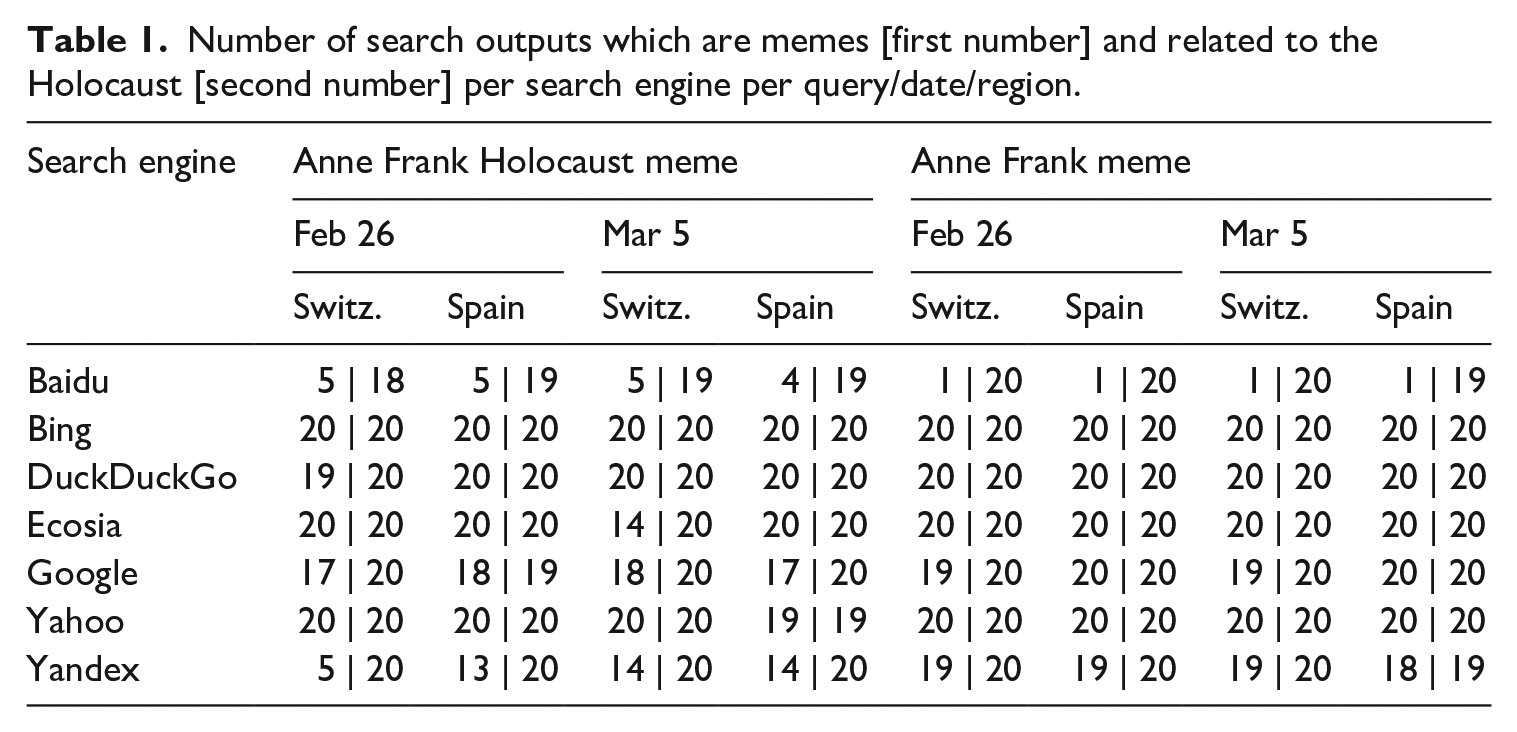
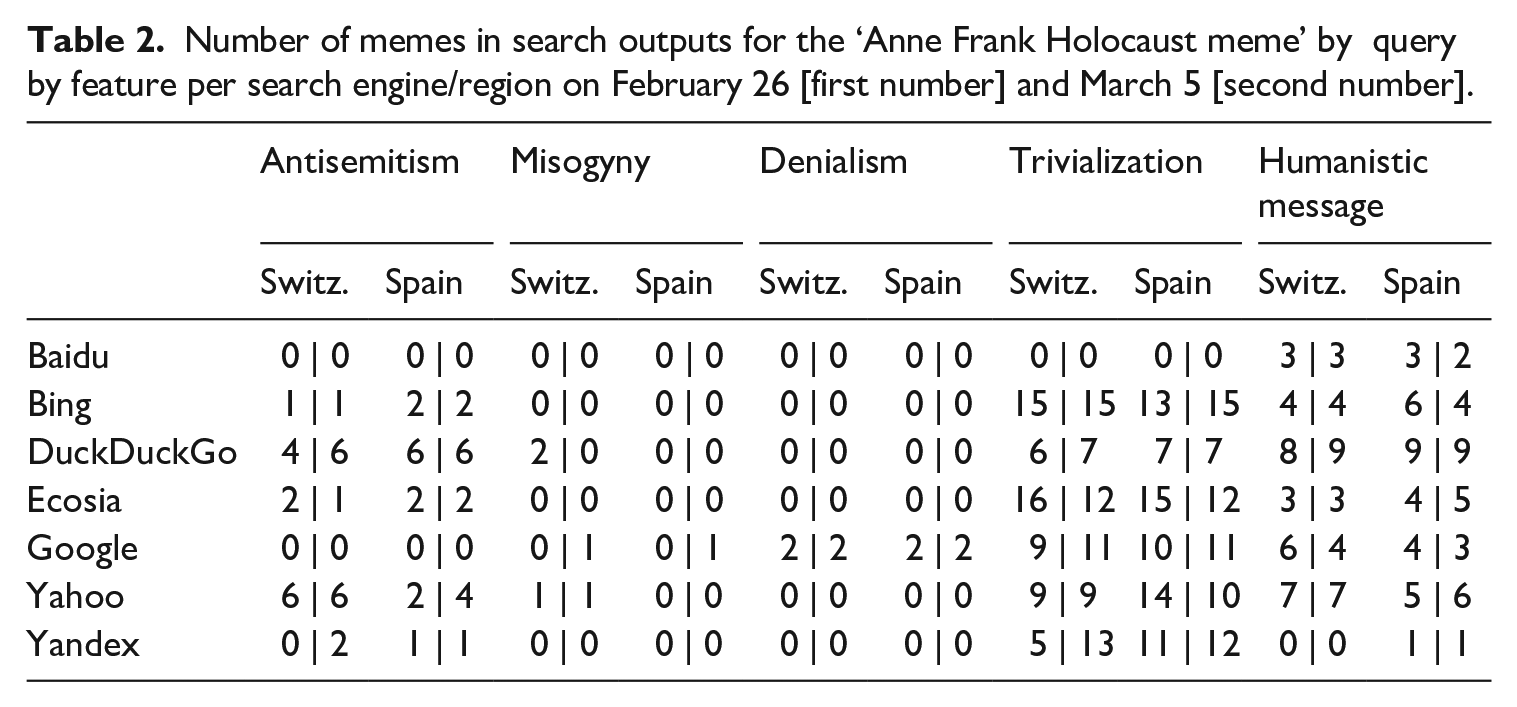
The examination of the other features (Tables 2 and 3) indicates the prevalence of memes which trivialize the Holocaust and the presence of antisemitic and misogynic memes in the top search outputs. This observation is not unexpected considering existing concerns about memes promoting cynical attitudes toward the past (Askanius, 2021), but is worrisome considering their high visibility in search outputs. Interestingly, the second most common feature is the presence of humanistic statements that can facilitate more constructive engagement with Holocaust remembrance through memes. We also observed limited presence of memes denying the Holocaust, which can be attributed both to search engines putting effort in filtering them out and difficulties of constructing a denialist argument in the meme format.
Number of memes in search outputs for the ‘Anne Frank Holocaust meme’ by query by feature per search engine/region on February 26 [first number] and March 5 [second number].
Number of memes in search outputs for the ‘Anne Frank meme’ query by feature per search engine/region on February 26 [first number] and March 5 [second number].
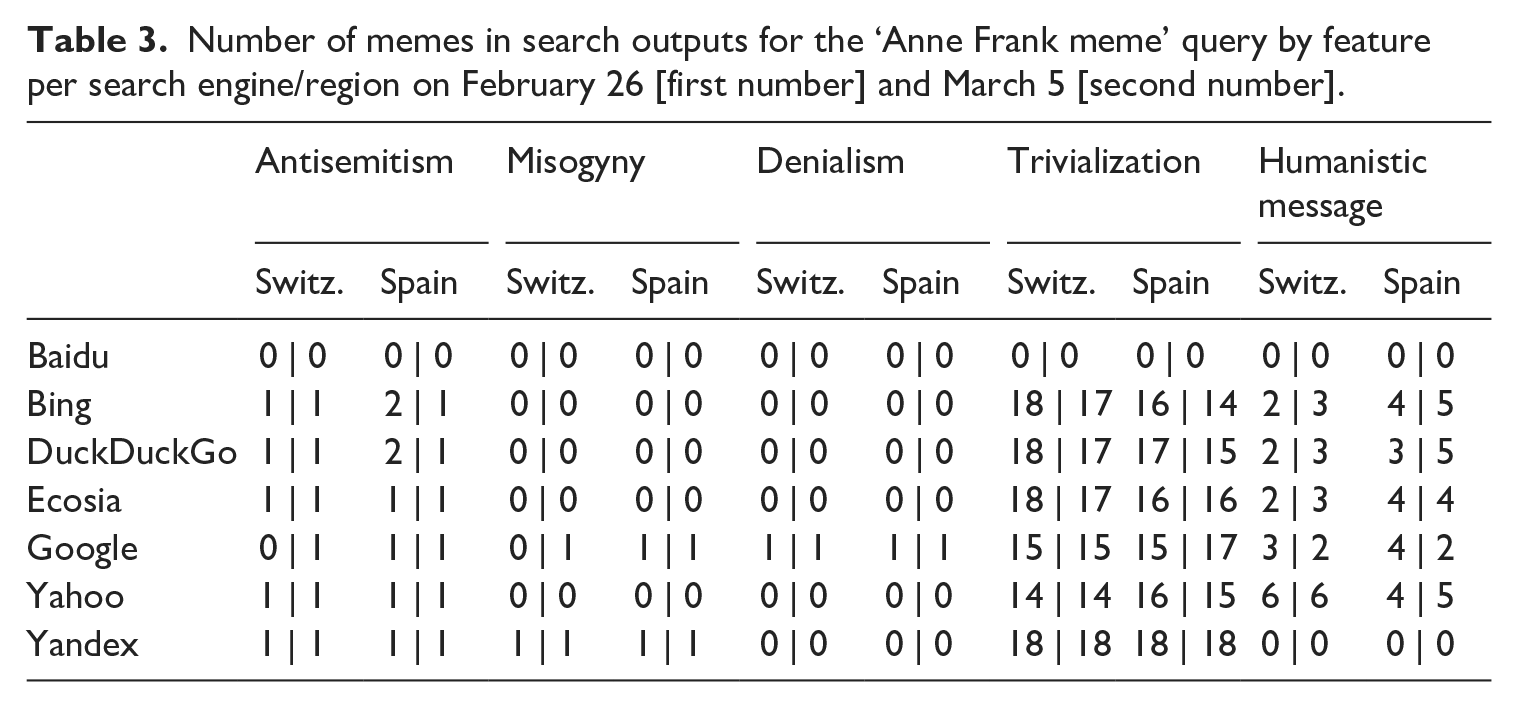
While the general patterns of features’ distribution remain consistent, we observe substantive variation in the content retrieved for the two queries and by different search engines. The memes retrieved in response to the query with the word ‘Holocaust’ more often make antisemitic and misogynic (in particular, for smaller Western engines) and denialist statements (for Google), but also more commonly include humanistic messages (especially for DuckDuckGo). This observation can indicate the larger degree of contestation of the content directly related to the Holocaust, which is targeted by extremists aiming to promote denialism and antisemitism, but also by individuals interested in using UGC for the constructive engagement with memories about atrocities. While the comprehensive comparison of differences in the treatment of Anne Frank memes by different engines is beyond the scope of this paper, it can be an interesting direction for future research.
Ad hominem memes
Relatively infrequent in our dataset, ad hominems are distinguished by explicitly offensive statements targeting the personality of Frank. Specifically, ad hominems tend to target two aspects of Frank’s identity – Jewishness and womanhood – both of which are treated in a derogatory way. In both cases, ad hominems have less to do with specific interpretations of the past and more with propagating discriminatory attitudes toward specific groups associated with Anne Frank (e.g. Jews and women).
Figure 1 shows two examples of ad hominems attacking Frank’s Jewish identity. Both memes are constructed along the lines of the Nazi-like antisemitic statements presenting Jews as mentally incapable or dehumanizing them by treating them as animals. The first meme (Figure 1b) appropriates the ‘SpongeBob Pickles’ meme that is based on the series’ episode, where its protagonist, SpongeBob (portrayed as Hitler) catches an antagonist, Bubble Bass (portrayed as a Jew), who is trying to avoid paying for the meal. It presents Hitler as a protagonist and dehumanizes Frank by associating her with an animal committing a crime. Another ad hominem (Figure 1a) also brings Hitler and Frank together, but this time it focuses on Frank’s inability to concentrate in order to get the homework done which Hitler attributes to her being Jewish.

Antisemitic ad hominems. (a) Example of an ad hominem. (b) Example of an ad hominem.
In the case of misogynistic ad hominems, the discursive attacks are focused on Frank’s womanhood and usually take the form of extreme sexualization. By deliberately omitting other aspects of Frank’s personality and emphasizing that the main function of her image is to satisfy sexual desires of the viewer (e.g. by serving as a fetish), these memes treat Frank as a sex toy. In some cases, it is done explicitly by showing a pornified image of Anne Frank (Figure 2a), whereas in other cases (Figure 2b) the Frank herself is absent from the image, but the focus on sexualization remains.
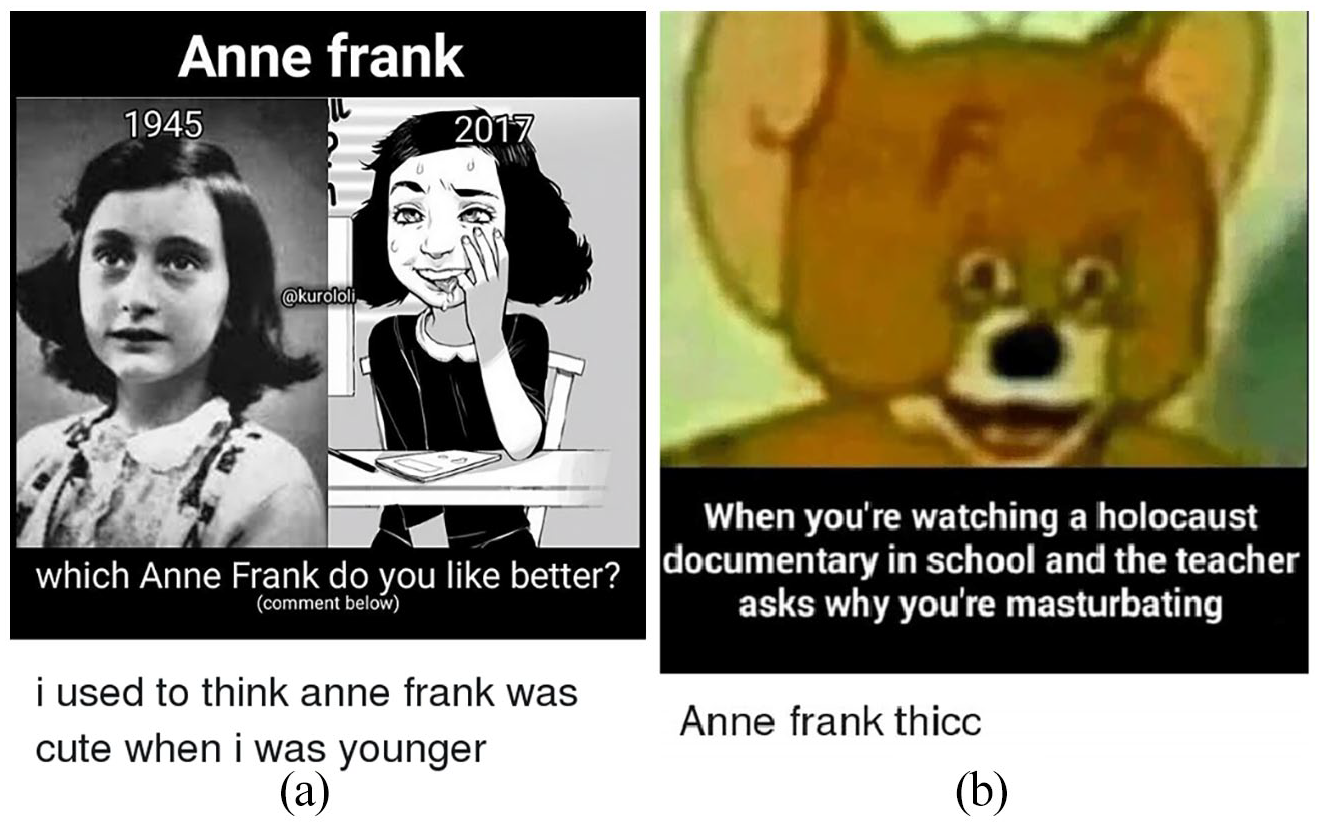
Misogynistic ad hominems. (a) Example of an ad hominem. (b) Example of an ad hominem.
In theory, some ad hominems can be viewed as a radical form of critique of the canonical narrative about Anne Frank, which is a function performed by other forms of Holocaust-related humor (Portnoy, 2012). However, considering the aggressive objectification (and, at times, dehumanization) of Frank’s image, and, through it, other victims of the Holocaust, we suggest that ad hominems are a form of hate speech, which aims to conceal itself as a form of humor to normalize antisemitic and misogynistic attitudes (Askanius, 2021). While not numerous, such memes are still concerning, in particular considering their presence in the top search outputs for the respective queries.
Denier memes
Similar to ad hominems, deniers constitute a rare class among the memes we collected. The distinct feature of deniers is their rejection of the conventional narrative of the Holocaust that usually involves questioning whether it has actually happened. While the use of Frank’s images for denialist purposes can seem counterintuitive, it actually follows the long-term trend of denialists targeting Frank’s story as an example of the Holocaust ‘myth’ (Sion, 2012) that allegedly demonstrates the fake nature of the Holocaust.
Similar to the pre-digital instances of Frank-related denialism (Sion, 2012), memes primarily focus on questioning Frank’s story. However, instead of targeting the diary and its authenticity, deniers usually focus on Frank’s photos by claiming, for instance, that one photo shows a pen that was invented only in 1949. Other memes make even more explicit claims by arguing that Frank’s images are ‘a whitewashed fake’ (Figure 3b), whereas the real Frank was black and lived in Africa. While the latter meme does not claim that Frank did not experience the Holocaust, it effectively discards her story using the racial justice claim.
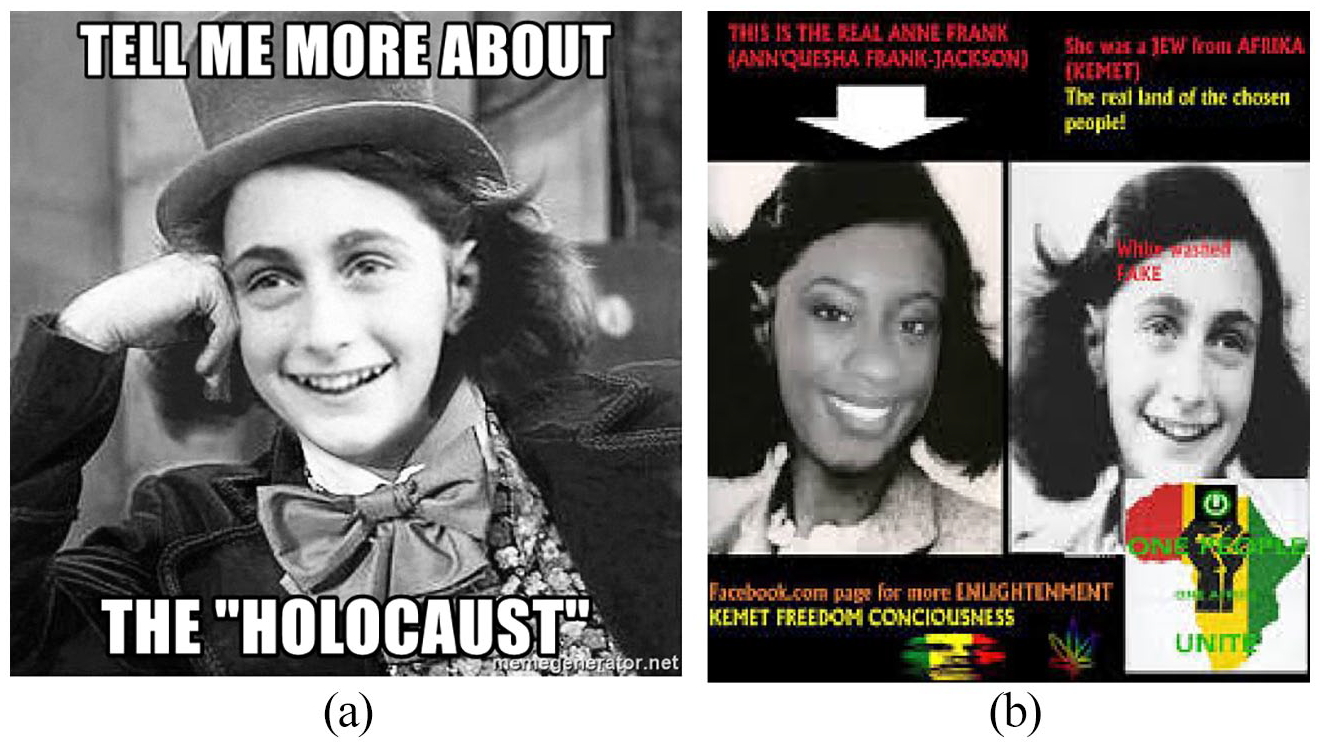
Deniers. (a) Example of a denier. (b) Example of a denier.
Another denier appropriates the popular Condescending Wonka meme (Oliveira et al., 2016) by replacing Wonka with Frank (Figure 3a). The nuanced composition of this meme makes its potentially ambiguous, because it can also be interpreted as a way of satirizing Holocaust denialism using Frank’s patronizing figure as a means of debunking doubts that it has happened. However, considering that the original Wonka meme is usually utilized for conveying sarcasm in relation to something unreliable, we interpret its Frank version as the one sarcastically engaging with the so-called ‘Holocaust’ to challenge its authenticity.
The creative use of memes for mediatizing Holocaust denialism is concerning for several reasons. By utilizing potentially ambiguous statements and hijacking cultural reactions to the latest societal developments (e.g. calls for racial justice), deniers might be able to reach new audiences and make their messages more emotionally engaging (e.g. by claiming that they fight against historical whitewashing). Furthermore, it makes such memes harder to detect both for humans and automated filtering mechanisms, thus potentially facilitating their dissemination in online environments.
Trivializer memes
Trivializers constitute the largest category among the memes we collected. These memes sarcastically comment on the memories about Frank and the Holocaust, often appropriating them in the ways which can be viewed as offensive. Unlike ad hominems, trivializers do not aim to directly attack Frank’s personality, but instead make fun of the past suffering for entertainment purposes. By doing so, they undermine the unique status of Frank’s story in the framework of Holocaust remembrance as well as canonical narratives of the Holocaust. Depending on the specific form which such memory trivialization takes, we identified two subclasses of trivializers: cynical and wordplaying ones.
Cynical trivializers achieve their effect by expressing extreme cynicism toward the past which often crosses the line between the dark humor and the offensive claims. Two major aspects of Frank’s life that such trivializers focus on are her death (death-focused trivializers) and her being forced to stay in hiding (hiding-focused trivializers).
In many cases, death-focused trivializers contrast the image of Frank with an image of ashes using the alleged cremation of her body as a humoristic device. Figure 4a shows one example of such use, where the cremation is sarcastically characterized as a ‘celebrity weight loss’. Other trivializers combine Frank images with cynical verbal expressions making fun of the deaths of Frank’s relatives (Figure 4b) or appropriating other memes (e.g. ‘Cash me outside’ meme which is transformed into ‘Gas me outside’).
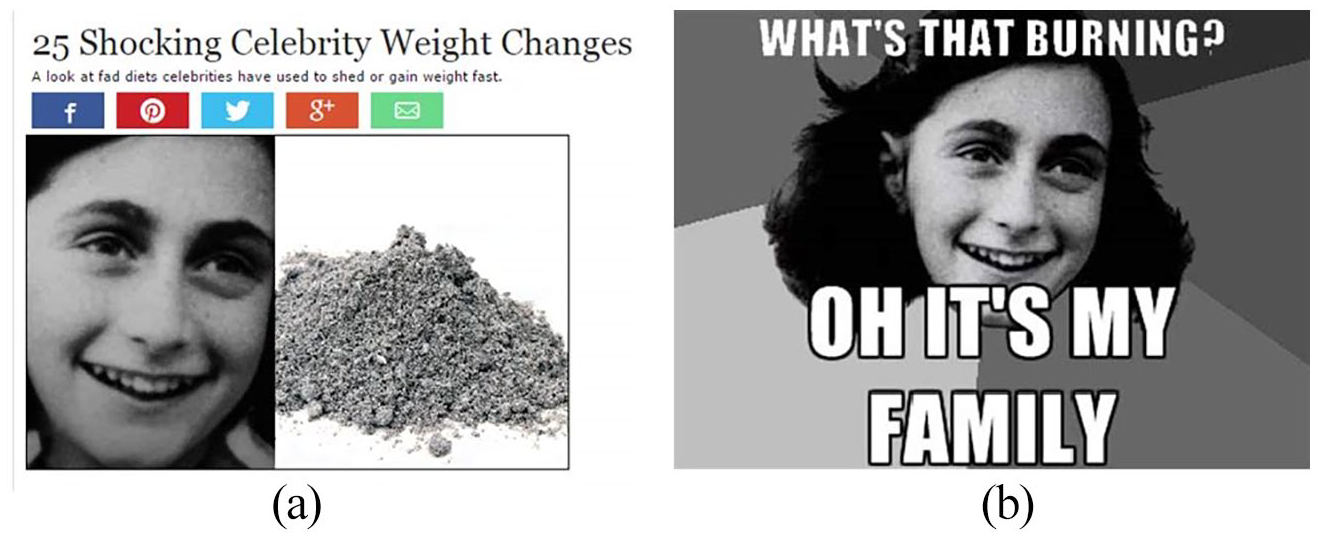
Death-focused trivializers. (a) Example of a trivializer. (b) Example of a trivializer.
Hiding-focused trivializers usually follow the same principle as the death-focused ones, but instead downplay the suffering of Frank caused by the need to hide from Nazi. Often, it involves re-appropriating the image of Frank not as a victim, but as a ‘hide-and-seek champion’ (Figure 5a). In other cases, the fact that Frank was found in the attic is attributed to her being careless and willing to embrace her life in a YOLO (you-only-live-once) manner (Figure 5b); the latter memes at times get close to ad hominems by presenting Frank’s story as an example of irresponsibility, albeit not directly attributing it to her being a woman or a Jew.

Hiding-focused trivializers. (a) Example of a trivializer. (b) Example of a trivializer.
Another subclass of trivializers – wordplaying ones – is less dependent on shocking the audience and instead relies on a play of words. To achieve the humoristic effect, plays of words commonly pick up on the name of Frank and transform it to ‘Anne Frankly’. In other cases, wordplaying trivializers rely on the ambiguity or slang meanings of words such as ‘gas’ (denoting both digestive gas and cyanide), ‘baked’ (being under the influence of drugs and exterminated by burning) or ‘burned’ (having a bad deal and exterminated by burning).
Figure 6 shows two examples of wordplaying trivializers. One of them (Figure 6b) utilizes the ambiguity of the word ‘baked’ to draw parallels between being drugged in the summer camp and being murdered in the death camp. Another one (Figure 6a) uses the name of Anne Frank to amplify the humoristic effect of the situation labeled as ‘derping with Hitler’ by sarcastically subverting the presumed unwillingness to listen to the Holocaust-related jokes.

Wordplaying trivializers. (a) Example of a trivializer. (b) Example of a trivializer.
Trivializers can be viewed as the class of memes which is the closest to other forms of humor-based mediatization of Holocaust memory. By making fun of specific aspects of Frank’s story, trivializers can serve as a form of protest against presenting Frank as a universal symbol of Holocaust suffering. Such protest can aim to counter both common instrumentalization of Holocaust memory by the politicians (Steir-Livny, 2020) and formalization of memory practices that can be counter-productive in the long term (Kansteiner, 2014). Similarly, trivialization of the traumatic past can be treated as a form of coping with it via more frivolous engagements with painful memories (Steir-Livny, 2017).
However, to what degree trivializers we analyzed can fulfill the above-mentioned purposes remains an open question. Unlike some other forms of Holocaust humor (e.g. Hitler rants; Steir-Livny, 2017), trivializers achieve their humoristic effect by making claims which are rather offensive, in particular in the case of cynical trivializers. While downgrading the importance of the past suffering can be viewed as a way of challenging canonical narratives about the past, it is also quite questionable from the ethical point of view, in particular as the line between using sarcasm as a form of mnemonic protest and using it to attack the dignity of victims often gets blurry. Consequently, even if we assume that challenging the canonical Holocaust narratives can be justified when the aim is to counter their instrumentalization (see, for instance, David, 2017; Steir-Livny, 2021), the nihilistic approach of trivializers might not necessarily be the most productive one.
Thought provoker memes
The last class of memes is thought provokers which use memory about Frank to stimulate reflection about specific issues. For this aim, thought provokers make humanistic statements on a broad range of issues from Holocaust remembrance to COVID-19 regulation. We treat the notion of ‘humanistic statements’ rather broadly and apply it to all reflective statements about individual and societal matters. Through our analysis, we identified two subclasses of thought provokers: conventional and non-conventional ones.
The conventional thought provokers reiterate messages associated with the ‘canonic’ (Sagan, 1995) role of Frank in the framework of Holocaust remembrance. Such messages focus on optimism and hope, which are present in the diary, and often use quotes from it together with images of Frank or burning candles symbolizing resilience. This subclass also includes memes commenting on the importance of Holocaust remembrance and emphasizing the status of Frank as a universal Holocaust victim.
Figure 7 shows two examples of conventional thought provokers. The first meme (Figure 7a) includes a quote from the diary: ‘Look at how a single candle can both defy and define the darkness’ and an image of a candle. Such visual composition is common for other memes of this subclass, even if the quotes can be different (e.g. ‘A quiet conscience makes one strong!’ or ‘How wonderful it is that nobody needs to wait a single moment before starting to improve the world’). The second meme (Figure 7b) use a photo of Frank to stress the importance of Holocaust remembrance by claiming ‘Every day is Holocaust Remembrance Day! Every day. . .’.
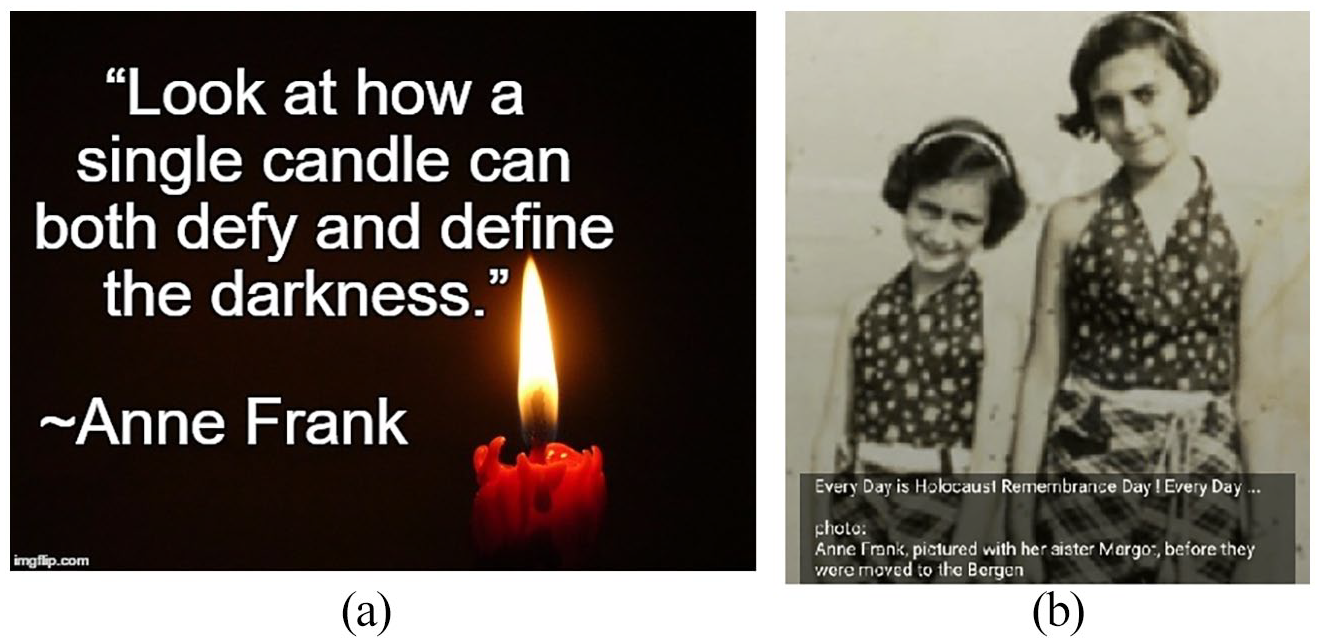
Conventional thought provokers. (a) Example of a thought provoker. (b) Example of a thought provoker.
By contrast, the unconventional thought provokers go beyond reiterating the memory canon. Instead, these memes use references to Frank’s story to comment on the current issues ranging from the general discrepancies between ethics and law to the more concrete matters such as the state-sponsored xenophobia or the COVID-19 pandemic. While doing so, these memes appropriate Holocaust memory to draw parallels between the Holocaust and the contemporary matters that in many cases can be viewed as a form of trivialization (see a similar discussion on the use of references to the Holocaust in the context of COVID; Steir-Livny, 2021). However, the absence of directly offensive claims together with the presence of societal commentaries differentiates these memes from exclusively trivializing content and relates them to the memes used as reflective statements (e.g. ‘Hitler rants’ memes used to comment on the Israeli society; Steir-Livny, 2021).
One recurring example of a more abstract unconventional thought provoker is the meme criticizing the notion of law as a moral compass (Figure 8b). While doing so, it refers to Frank’s story to argue that her death was caused by individuals following Germany’s legal system, whereas breaking it would be more ethical. Another meme (Figure 8a) relies even less on the iconic status of Frank and, instead, uses her image as a generic ‘diary talk’ visual to comment on the relationship between libertarianism and right-wing attitudes.

Unconventional thought provokers (abstract). (a) Example of a thought provoker. (b) Example of a thought provoker.
More concrete thought provokers often use Frank’s image to comment on the two issues: the dissatisfaction with COVID-19 regulations and the anti-migrant policies of the Trump administration. While doing so, they evoke the status of Frank as a universal victim in the way similar to the conventional thought provokers, but appropriate it to discuss broader societal matters.
One of such memes (Figure 9a) refers to the presumed willingness of Frank’s family to migrate to the US that turned out impossible because of being denied the entry visa. By doing so, the meme draws comparisons between the suffering during the Second World War and hardships of today’s migrants who can also be deprived the right to live by anti-immigration legislation. Another meme (Figure 9b) uses Frank as a symbol of suffering and contrasts her with complaints about the COVID-enforced lockdowns to emphasize their shallowness.
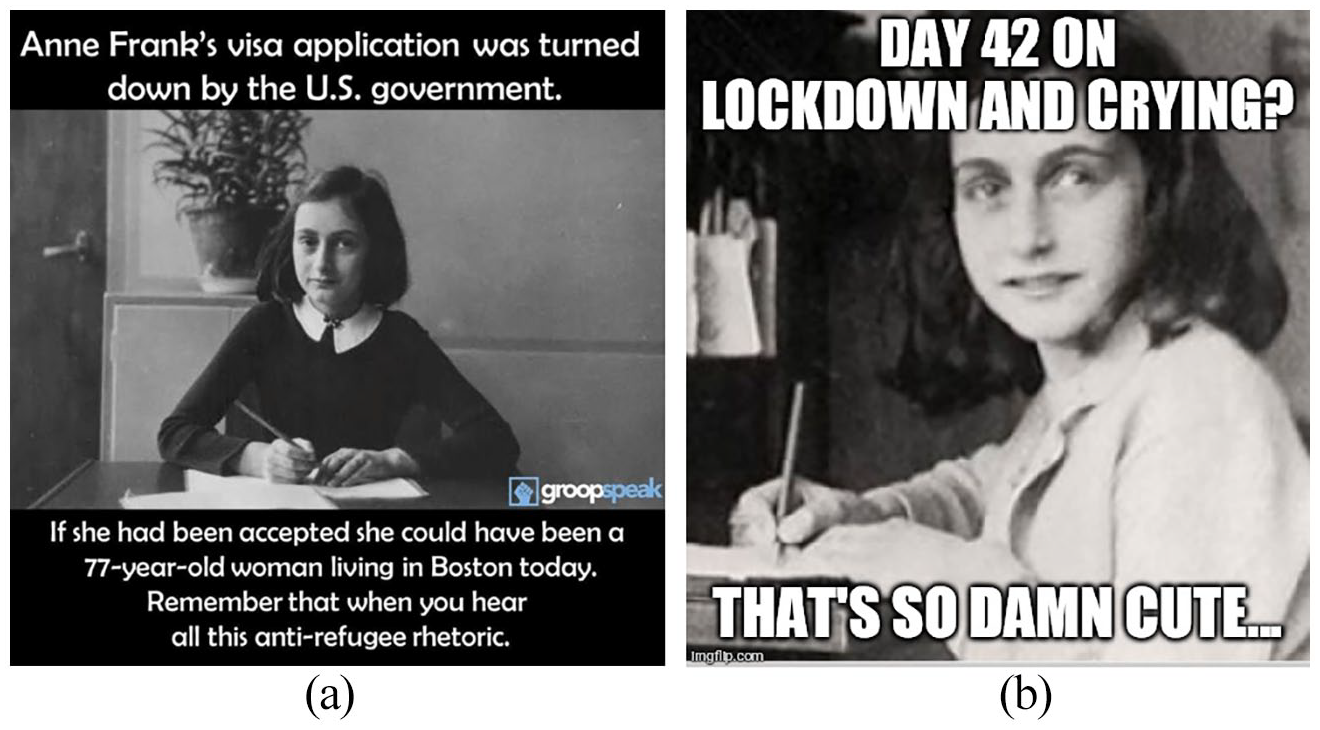
Unconventional thought provokers (concrete). (a) Example of a thought provoker. (b) Example of a thought provoker.
These examples highlight an important distinction between thought provokers and other classes of Anne Frank memes. Instead of challenging Frank’s canonical status, thought provokers reinforce it by mediatizing prevalent Holocaust narratives via UGC. In many cases, such mediatization takes the form of reiterating feelings of optimism and hope associated with the diary, but sometimes memes take a step forward and appropriate Frank’s memory to comment on different societal matters.
Discussion
In this article we examined how internet memes mediatize memory about the iconic Holocaust victim, Anne Frank, and identified four classes of Frank memes: ad hominems, deniers, trivializers and thought provokers. Our observations highlight several points which can advance the current understanding of the relationship between memory and UGC, in particular the role of memes as a form of mediatization of memory about mass atrocities.
The first of these observations concerns the multi-faceted functionality of memes as a form of memory mediatization. The strong presence of trivializers aligns with the existing arguments about UGC often serving as a means of challenging canonical narratives (Kansteiner, 2014) and conventional modes of remembrance (Hoskins, 2017). However, the often cynical and offensive nature of trivializers raises questions whether their primary role is to counter instrumentalization of the Holocaust canon (Steir-Livny, 2017) or to downgrade the importance of the Holocaust. Besides trivialization of Holocaust memory, a number of memes propagate denialism and promote antisemitic/misogynistic messages, thus reiterating concerns about UGC being used to normalize hate speech (Askanius, 2021; Paz et al., 2021). However, a number of memes also reinforce the canonical narrative about Frank by reiterating its main premises or appropriating it for commenting on the current societal matters.
This diverse functionality stresses the difficulties of adopting a one-size-fits-all approach to conceptualizing the relationship between UGC and different modes of remembrance. At the same time, it also raises questions about the interdependency between different classes of memes (e.g. deniers or thought provokers). To achieve their purposes, deniers and trivializers require the audience to be familiar with the canonical narrative of Frank (e.g. to know what exactly is denied) that is a purpose served by thought provokers, which often reiterate this narrative. However, the ability of thought provokers to spread their humanistic messages also benefits from other classes of memes: while the latter cannibalize memory about Frank, they at the same time make it more visible, albeit in a distorted form.
Our second observation concerns the reliance of memes on other forms of media to make the audience familiar with the narrative that is memefied. Without such familiarity that presumes awareness about the Holocaust and the story of Frank, the effectiveness of many memes’ messages, including paradoxically the deniers, would be severely undermined. To a large degree, this dependency is attributed to the hyperselective logic that determines how memes engage with the past: instead of communicating the larger narrative, memes usually focus on a single aspect of a story, which can be the womanhood of Anne Frank, the need for her to hide, or the optimism of her diary.
This hyperselective logic has implications for the ongoing discussion of the effects of UGC on how individuals and societies remember the past. It is hardly disputable that memes are capable of reinforcing or challenging certain interpretations of the past, thus facilitating the formation of less top-down and more distributed modes of remembrance (e.g. memory of the multitude; Hoskins, 2017). However, our observations suggest that memes are not necessarily able to do it independently from conventional forms of collective remembrance associated with pre-digital memory institutions (e.g. museums or legacy media). While some other forms of UGC (e.g. amateur memorials) can offer a more comprehensive alternative to institutionalized forms of remembrance, the case of memes raises questions of how sustainable are many forms of memory-related UGC.
Together, these two observations raise questions about what is the future role of internet memes as well as UGC in mediatization of memories about mass atrocities. One crucial question here is what exactly memes add to atrocities’ remembrance compared with other non-UGC modes of remembering. Similar to other novel forms of memory transmission (e.g. video games; Kansteiner, 2017), memes challenge existing approaches to commemoration and enable new possibilities for reaching the audiences which might be harder to reach otherwise. However, the hyperselective logic of memes that translates into highly fragmented representation of the past together with memes’ tendency (at least in the case of Frank) to trivialize past suffering pose a question of whether the use of memes for mediatizing sensitive and complex subjects brings more disadvantages than advantages.
The answer to the above-mentioned question also has implications for the preferred treatment of memes from the point of view of audience engagement by memory institutions and the need to filter out potentially inappropriate content by commercial platforms. Shall, for instance, memory institutions start using memes to mediatize memory about mass atrocities considering how popular this form of UGC is? If yes, then what shall be the good balance between humor and appropriateness to engage the broad audience, but at the same time prevent trivialization of suffering? Or is it more desirable to look for ways to decrease the presence of memes dealing with mass atrocities online by putting pressure on the platforms to remove them and, if yes, then how much of loss it will be considering that memes can not only undermine, but also reinforce canonical versions of the past? Answering these questions is not an easy task, but it is important for determining how remembrance of mass atrocities will look like in the future.
It is also important to note some limitations of the current study. It relies just on a single case, which is memes about Anne Frank, and it is possible that the analysis of UGC dealing with other episodes of the Holocaust can lend different results. Furthermore, even in the case of Anne Frank, the study relies on the content acquired from search engines using a small set of queries in a single language that mayresult in some bias. In particular, in the case of deniers and ad hominems it is likely that search engines might filter them out, thus resulting in their limited visibility in our dataset and stressing the importance of looking at other platforms where memes are commonly used (e.g. messengers or imageboards). Finally, we relied on the subjective reading of memes’ functionality for attributing them to a specific class and it has implications for the robustness of the procedure which in the future can potentially be more formalized.
Finally, our study also highlights a number of potential directions for further research besides the possibilities of examining the presence of Frank memes on other online platforms. Future studies can look at Frank memes in languages other than English to examine how similar or different are the cross-language interactions betweee.n memes and Holocaust memory. Another interesting direction is the more in-depth analysis of the impact of mechanisms of algorithmic curation on the dissemination of memes related to mass atrocities. Additionally, it is important to take into consideration not only how internet memes represent the Holocaust, but also how actual web users perceive these representations that can be achieved using a different methodological approach (e.g. interviews).
Footnotes
Appendix
Intercoder reliability measurement.
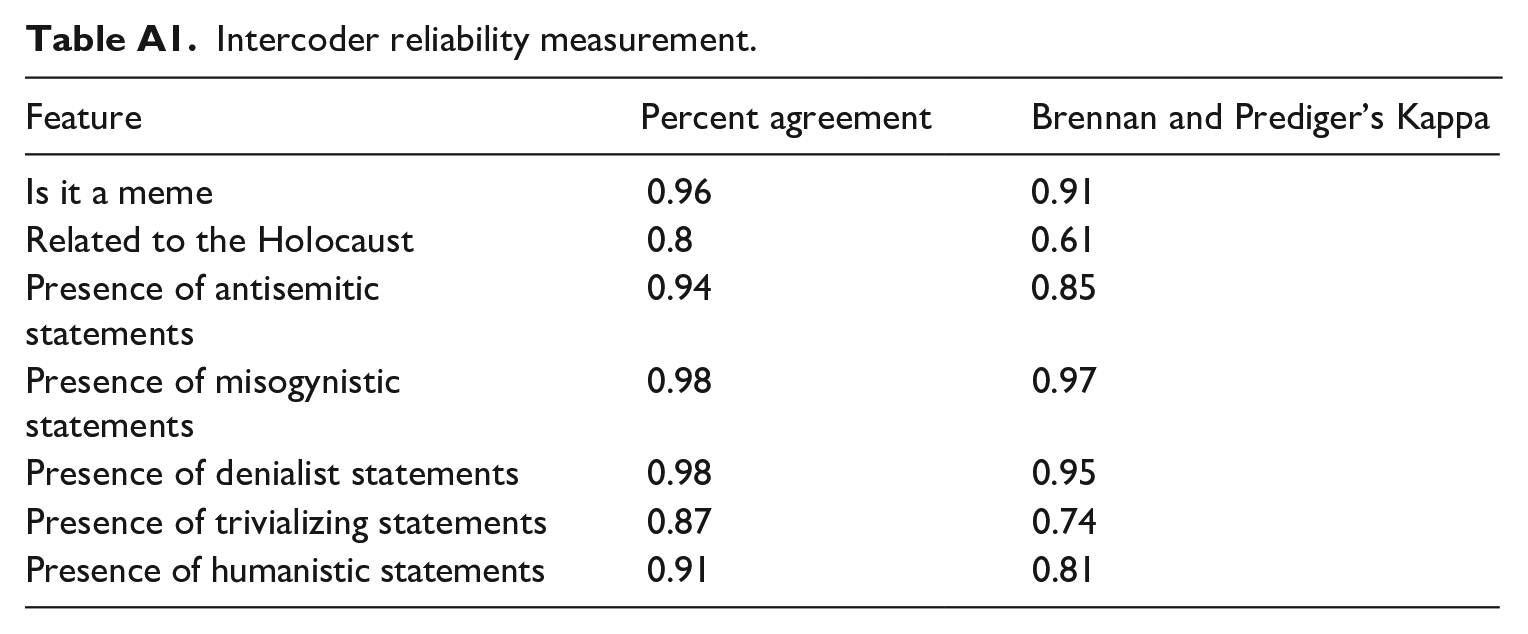
| Feature | Percent agreement | Brennan and Prediger’s Kappa |
|---|---|---|
| Is it a meme | 0.96 | 0.91 |
| Related to the Holocaust | 0.8 | 0.61 |
| Presence of antisemitic statements | 0.94 | 0.85 |
| Presence of misogynistic statements | 0.98 | 0.97 |
| Presence of denialist statements | 0.98 | 0.95 |
| Presence of trivializing statements | 0.87 | 0.74 |
| Presence of humanistic statements | 0.91 | 0.81 |
Funding
The author(s) received no financial support for the research, authorship, and/or publication of this article.

References
Supplementary Material
Please find the following supplemental material available below.
For Open Access articles published under a Creative Commons License, all supplemental material carries the same license as the article it is associated with.
For non-Open Access articles published, all supplemental material carries a non-exclusive license, and permission requests for re-use of supplemental material or any part of supplemental material shall be sent directly to the copyright owner as specified in the copyright notice associated with the article.
