




Abstract
The incorporation of new media technology into journalistic practices led to online harassment, particularly of female journalists. The researchers investigated the tweets of four prominent Pakistani female journalists through the lens of post-colonial feminism and symbolic violence. The qualitative analysis of 239 tweets revealed themes that corroborated the dominance of sociocultural and political grounds in undermining the status of women and making them susceptible to online harassment. In culturally traditional communities, the position of women is “gender specific,” and socioeconomic status cannot guarantee women’s safety from cultural behaviors. The harassment themes included “you called for it,” adhering to the limits of a male-dominated society, women’s card, threats, “lifafa,” shamelessness, religious policing, moral policing, and pseudo-intellectual labeling. The study recommends expanding research in sociopolitical, religious, and cultural contexts to comprehend symbolic violence, particularly in relation to women.
Introduction
Social media visibility is seen as a double-edged sword for female journalists. There is ever-increasing pressure from media organizations to increase social media outreach. At the same time, this outreach becomes a potential source of social media harassment for female journalists. Trolling, one of the most common forms of social media harassment, is a disruptive and sensational act that draws unfavorable attention to specific social media posts (Herring et al., 2002). As a type of harassment, trolling achieves visibility, inclusion, and, occasionally, projection into the mainstream.
Digital harassment is “the new front line for journalists,” according to the International Center for Journalists (ICJ). Hence, gender-based trolling is increasing, especially among female journalists (International Center for Journalists, 2020). Seventy-three percent of female journalists surveyed by the ICJ admitted to being victims of online harassment and abuse, while 20% of those who were harassed and abused also confirmed suffering offline attacks related to online abuse (International Center for Journalists, 2020). Scholars foresee an increase in the proportion of female journalists subjected to online abuse, which is three times that of men (Watson and Hagen, 2015). The fact that female journalists face daily internet threats of sexual assault and rape is a big cause for concern (Dutchak, 2018). Although harassment of female journalists is not new (Sanders and Pritchett, 1971), online media has become a simple and accessible channel for their online harassment and sexual threats (Blumell, 2020). On a broader scale, surveys and interviews have demonstrated the detrimental impacts of online abuse, and female journalists endure emotional and mental health concerns (Rego, 2018). However, in the Pakistani context, the literature related to online harassment is scarce and there is a need to expand academic research and analyze the growing online harassment of female journalists.
The Pakistani context is quite interesting in understanding the online harassment of female journalists, as the culture and organizations offer a callous environment, and women remain underrepresented in journalism. “Less than five percent of journalists in Pakistan are women, and those in the profession face substantial risks, hurdles, and discrimination.” This raises serious concerns about addressing women’s representation in the profession and the associated risk and anti-social behavior toward them. Moreover, this hatred was not limited to the online sphere; female journalists also faced the consequences in real life, as a few of them were murdered.
Therefore, analyzing the online harassment of female journalists becomes more critical and complex at the same time when religious, organizational, political, economic, and sociocultural forces define the status of women regardless of their profession. As a result, women’s identity varies in the cultural, political, and religious arenas, and women are undermined across the country (Gong et al., 2022). Additionally, women’s stereotypical notions and defined behaviors are culturally grounded, and any behavior against this hegemonic power of culture is not tolerated. Therefore, by combining qualitative content analysis with postcolonial feminist theory, the study provides insights into female journalists’ online experiences as well as cultural behaviors toward their professional tasks.
This study’s research question is: What are the primary recurring themes in the Twitter harassment of Pakistani female journalists?
Online trolling, gender issues in Pakistani context
Gender trolling, also referred to as “virtual sexism,” is a relatively new form of purposely provocative online activity (Fichman and Sanfilippo, 2015). Similarities have also been discovered between social media trolling and agnostic and mischievous mindsets (Edwards et al., 2020). According to Philips, trolling includes hate crimes such as doxing, threats of murder, and threats of rape. It has also been noted in the literature that fewer safeguards are available online as it becomes simpler to assemble an online mob, while the popularity of anonymity umbrellas makes it increasingly impossible to identify even a single troll (Adams, 2017). In one study focusing on India, Chaturvedi (2016) notes that the use of pseudonyms and VPNs (virtual private networks) are major features of Twitter trolling. Due to social media, viewers also have the ability to “publicly correct gender performance and maintain the status quo” (Finneman et al., 2019: 490).
In Pakistan, widespread systemic and cultural barriers expose journalists to mistreatment, verbal abuse, and exploitation. The percentage of women in newsrooms and in executive and managerial positions is disturbingly low. Women who are bullied at work typically do not receive justice despite legal protections. Legal action against violent abusers exacerbates women’s maltreatment, exposing them to defamation claims and legal proceedings. At the administrative, law enforcement, and judicial levels, the difficulties of delivering justice remain unaltered, as social media harassment allegations are regularly ignored or dismissed as overly feminist (Naseer and Ashraf, 2022). Nine out of 10 female journalists were more likely to encounter online aggression if they did not self-censor their expression, according to research (Media Matters for Democracy, 2021).
Around 24 Pakistani female journalists testified before Pakistan’s parliamentary committee on human rights on August 18th, 2020, that they “have encountered coordinated vicious social media campaigns to harass, discredit, and intimidate them for their work.” Journalists allege that the online harassers were patronized by some elements within the ruling party, Pakistan Tehreek-e-Insaf (PTI). During their testimony, the majority of witnesses detailed the graphic nature of the sexual abuse they endured. These include social media trolling, being called prostitutes or whores, and receiving death threats (Gul, 2020). In a second joint statement, the female journalists detailed the various forms of online abuse they suffer, including the publication of personal information, morphed videos and images, threats of physical and sexual assaults, gender-based slurs, and account hacking attempts (Arab News, 2021).
Unraveling harassment, symbolic violence from post-colonial feminism
The feminist movement focused on women regardless of economic and political circumstances, region, or race. Thus, academics raised issues regarding the first and second waves of feminism, arguing that they had a limited and restricted reach and were primarily centered on Western societies. In addition, both waves disregarded women from diverse cultural, economic, and political contexts. The third wave of feminism in the late 1980s, known as “post-colonial feminism,” diverted attention toward women according to their socioeconomic, cultural, and racial statuses. As opposed to the homogenization of women’s needs, issues, and experiences, the emphasis was given to socio-political and economic contexts and the complex layers of oppression that influence women’s lives (Mohanty, 2004).
Likewise, women’s conditions in third-world countries emerged as a nexus of debate among scholars, as the “underdeveloped” world has an abundance of religious, economic, cultural, and political disparities toward women. Furthermore, these disparities exist despite their social conditions, education, and financial freedom. Since women across the world face harassment, regardless of their region, post-colonial feminism is used to relate the sociocultural and political context of the study with online harassment against women. Legal protection is very limited because online harassment laws are not strictly enforced and culture-based behavior dominates online communities. The women are known as “women” rather than by their profession. They are easily victimized and susceptible to symbolic and systemic violence due to their gender. Symbolic violence often manifests itself through language and verbal and nonverbal communication. However, political and economic institutions are widely blamed for systemic violence. Some historians consider symbolic violence within the realm of historical artifacts since it is rooted in the desire to dominate, which helps to advance economic, political, and hegemonic ideas (Recuero and Soares, 2013). According to Samuel (2013), Bourdieu views systematic violence as the result of symbolic power and believes that symbolic violence is carried out through the imposition of meaning. Both Bourdieu and Zizek concurred that symbolic violence is created and legitimized by discourse (Recuero and Soares, 2013).
To analyze the numerous structural levels of oppression, Pierre Bourdieu has interchangeably employed the concepts of symbolic power and symbolic violence (Samuel, 2013). He stated that symbolic violence should be seen as a process in which certain groups are systematically denied the opportunity for proper acknowledgment. As a consequence, they are stigmatized and devalued relative to others. Symbolic violence also aids in comprehending how undervalued groups of society feel robbed of the most fundamental degree of recognition from the rest of society (Crossley, 2001).
Methodology
Using qualitative thematic analysis, the study examined frequent patterns and themes in the online harassment of Pakistani female journalists on Twitter. Trolling behaviors were analyzed in the tweets of four female journalists, namely Asma Shirazi, Amber Shamsi, Benazir Shah, and Ghareeda Farooqi. The followings are brief dossier of the selected journalists:
As she questioned the veracity of government data pertaining to COVID-19,
When a fabricated video of Muhammad Zubair, the former governor of Pakistan’s Sindh Province, went viral, it was used to harass a well-known journalist named
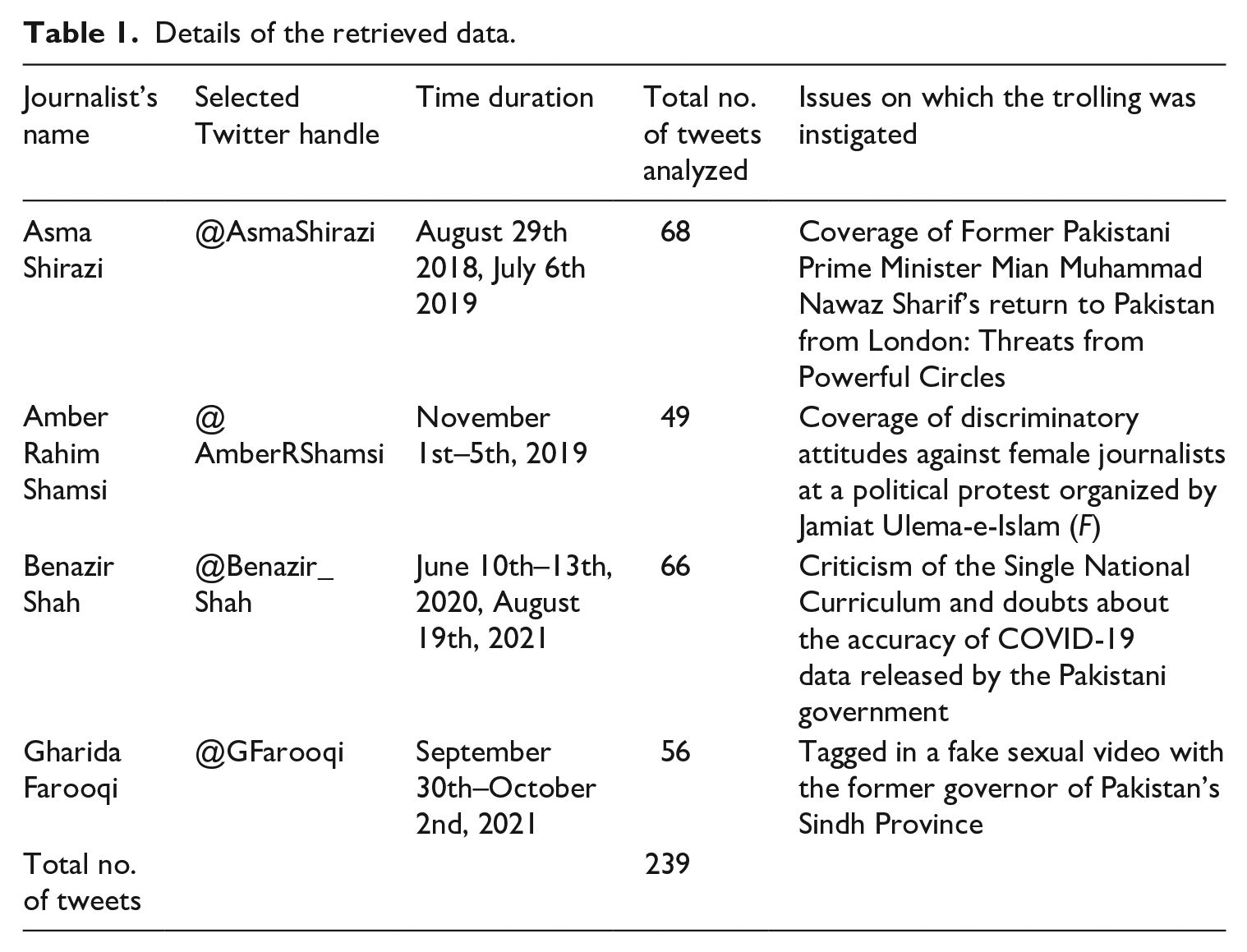
The data based on the tweets of the aforementioned journalists was collected and analyzed (see Table 1)
Details of the retrieved data.
Findings
Asma Shirazi tweeted in reaction to the condemnation of the online harassment of female journalists.
Tweet:
“Thanks, united we stand, divided we fall.”
Trolls “The nation will also be united against your yellow journalism practices.” “United we do misreport without evidence and earn more as never.”
She was constantly accused of being a “lifafa” journalist, a phrase commonly used in Pakistan and India to allude to bribe-taking journalists. In another tweet, she was accused to behave like a mafia member, “Every person in this country has freedom of expression. If you can break stories without proof, then we can also express our opinion about it. Journalists can’t act like the mafia.”
Asma Shirazi disclosed in one of her tweets the threats she received from influential individuals for exercising her right to freedom of expression.
Tweet “Official sources have revealed that I am being specially investigated. At the same time, I have received similar messages from different sources. The only reason is that we should shut up. On social networking sites, I am being told that the next number is yours.” Trolls “Total yellow journalism, shame of you” “How much money you get?”
As a result, she was constantly accused of accepting bribes from the Pakistan Muslim League (one of Pakistan’s major political parties) and of engaging in yellow journalism. Most of the trolling utilized the following themes: “lifafa” journalist; shamelessness; threat; linking current trolls to prior trolls; and pseudo-intellectual label.
Amber Rahim Shamsi denounced Pakistan’s religious and political parties in a series of six tweets for their intolerance of female journalists.
Tweet “Rallies, mob crowds, and jalsas (protests) are always challenging for women. I’ve been harassed, pushed, and touched at a rally of a mainstream political party. But my worst experiences were at the Sunni Tehreek dharna in 2016 and the Tehreek-e-Labbaik Pakistan protest in 2018” (Shamsi, 2019). “It helps to be trained in how to handle oneself in a male-dominated crowd. Local media organizations do not invest in hostile environment training.” Trolls “If JUI guards told her to leave because there were no other women there, then whose fault is this? It’s very logical. And after that warning, if she wishes to go there, then it’s her will. Why use melodrama and the women’s card in every hyped event?” “When these women face any sexual abuse in the field crowded with men, they start to make issues that this is against women’s rights. The point is, why they enter a field crowded with men in the 1st place. That’s why JUI don’t allow. Have you ever seen a hen in the field crowded by cock?”
Shamsi was asked frequently to adhere to the constraints of being a woman in a society controlled by men. Most trolls used the phrases “you asked for it,” “adhere to the boundaries of a male-dominated society,” and the “women’s card.”
Benazir Shah’s criticism of the administration and the veracity of COVID-19 data was met with trolling that included both professional and sexual harassment.
Tweet “we have left China and Italy behind in confirmed coronavirus cases. . .”
The tweet was branded as part of an anti-government campaign, and she was accused of being a pawn of the opposition, and that the opposition was “pulling her strings.” In the subsequent trolling, she was frequently labeled as “fake,” “biased,” and a “pseudo-intellectual.” Some responses ridiculed her for bringing the gender perspective into every situation and for aggressively taking a feminist stance. She was deemed “dumb” for her inability to comprehend even the most elementary events. Most of the trolling themes involved threats, moral policing, and the label of “pseudo-intellectual journalists.”
Gharida Farooqi was referred to as a “behaya” (Urdu for shameless) by trolls. She was told to control her sexual cravings and be modest; religious policing was also apparent in the trolling. Some tweets referred to her as the “rakhel” (Urdu for mistress) of political leaders. Some Pakistani digital activists aggressively expressed their support for her: “women make up 11.8% of the Twitter users in Pakistan but seem to receive 99% of the Twitter hate, especially if they are outspoken” (Kirmani, 2021). “You asked for it,” “the women’s card,” shamelessness, threats, and religious policing dominated most of the trolling themes.
To present the findings more concisely, the researchers have summarized the above-discussed themes in Table 2, along with their brief descriptions.
Recurrent social media trolling themes (against female journalists).

Harassments targeting journalists in patriarchal culture
Culture is also defined as “managerial force,” which controls and defines “shared values, beliefs, and ideas” (Chapin, 2010). The patriarchal culture does not allow women to maintain an online free expression.
The analysis of the previously mentioned themes demonstrates that, despite being well-educated and professionally renowned, female journalists face harassment and threats due to their gender. Although some common themes emerged like “shameless,” “mistress,” “women’s card,” etc., referring to symbolic violence. These themes actually reflect the uniqueness of societal attributes. For example, themes of “You called for it” and “women’s card” are the reflection of a judgmental society, where women are portrayed as stereotypical representation”, judged women according to “social norms” (Bailey et al., 2013), criticized and labeled as “slut” (Megarry, 2014) . It is especially apparent among journalists because this occupation oftentimes speaks publicly. This also breeds the occupation hazard in Pakistan.
The themes of “Religious Policing,” “Moral Policing” with expressions of “male-dominated and crowded places,” “avoidance of entering male-dominated protests,” and “adherence to rules” in the tweets demonstrate the impact of culture and men’s domination on the status of women. The comments and reactions illustrate the entrenched hatred for women and the culturally grounded stance, which concludes that misogynistic sentiments are profoundly ingrained in Asian nations such as Pakistan. This refers to the gender positioning that women endure and experience due to the fact that they are perceived as women and not as journalists; their socioeconomic level cannot ensure their safety from cultural pressures. Despite the fact that technology has eliminated geographical barriers and established virtual communities and cultures, regional political and religious realities continue to impact conventional approaches to behavior.
Discussion and conclusion
The analysis of selected tweets revealed that cultural, political, and religious forces in Pakistan influence the trolling of female journalists on social media. This is in consistent with the previous literature. For example, Chen et al. (2020) discovered that online harassment limits female journalists’ ability to maintain positive contacts with audience members without fear of harassment or intimidation. Also, Pain and Masullo Chen (2019) characterized trolling women as abusive and focused on their physical qualities, whereas Gardiner (2018) corroborated the claim that social media content made by women has the potential to draw a “disproportionate amount of abusive and dismissive comments online.” Overall, explicit and implicit forms of online hostility are activated globally through affectively charged memetic figures, texts, and speech to maintain gendered myths of feminine illogicity through an online, globally shared culture of misogyny (Khosravi Ooryad, 2023; Razack and Joseph, 2021). By analyzing Twitter trolling in patriarchal society, this study unravels the continuous struggles of targeted minority groups (i.e. female journalists) and feminist discourses in the social media era, where echo chambers are becoming breeding grounds for polarization and radicalization (Kilvington, 2021).
Online hostility is growing and adapting, highlighting the significance and relevance of this work. McRobbie (2004) argued that female journalists are subject to a greater degree of symbolic violence. The trolling of female journalists is also considered symbolic violence since it demands they conform to cultural and political-religious norms and incites hostility against them if they disobey. Similarly, (Recuero, 2015) stated that symbolic violence can be carried out significantly more effectively via social media due to its verbal and visual platform. Internet trolls disparage female journalists with vulgar language and imagery, as well as by posting remarks and inappropriate images directed at women. Because manifestations of hostility can now be disseminated in numerous forms via easily accessible platforms such as Twitter, this profession is more likely to face hostile incidents or acts in a variety of forms.
The analysis of social media harassment in the context of Pakistani journalists is a crucial contribution to the worldwide social media scene, where every 30 seconds, on average, a problematic tweet is sent to a woman (Amnesty International UK, 2018). Although the study did not examine the relationship between online and offline hate speech, Williams et al. (2019) found that there is a strong link between “hateful Twitter posts and offline racially and religiously aggravated crimes,” as 1000 hate tweets can cause a 4% increase in racial or religious harassment. In Pakistan’s unstable media climate, where journalists are viewed as one of the most vulnerable groups in society due to the impunity of journalist homicides and kidnappings, it is vital to examine the trends of social media harassment directed against Pakistani female journalists.
The study, in addition to dissecting the trolling of the selected case studies (which concluded that trolling consists of a deep-seated hatred for women and their culturally rooted position), demonstrates how social networking sites like Twitter can provide a platform for trolls to advance patriarchy and misogyny, as social networking sites are becoming virtual stages of resentment (Kilvington, 2021). Liao (2023) also supported the platformization of misogyny and concluded that platforms ultimately produce a type of control that is inextricably intertwined with the commercialization of online opinions. With its examination of themes, the study also contributes to the literature on how trolling can function as a technique to recreate the traditional patriarchal framework, especially for powerful and empowered women such as journalists (Vochocová, 2018). In addition, the study explicates how anonymity or the illusion of anonymity might inspire trolls to influence online expressions, since they view social networking sites as places where social standards no longer apply.
Although the Prevention of Electronic Crimes Act (PECA) provides the legal framework for combating hate speech and offenses against the dignity of a person in Pakistan, it is only through a broader interpretation and effective implementation of these laws that female journalists will be able to practice journalism in a safe social media environment. The manner in which modern audiences connect and express themselves has been transformed by Web 2.0 and social media platforms, fostering online hostility, trolling, and even misogyny in a male-dominated domain. The data revealed that the behavior of female journalists is seen as a source of social discomfort and disruption. Female journalists are continually compelled to conform to societal and religious norms. The examination of the selected trolls shows that regardless of how alluring and beautiful the social media outreach may appear, the repercussions for female journalists in the South are enormous and far from resolved.
