




Abstract
Visual messaging is a cornerstone of campaign strategies of political parties and candidates that can complement and amplify the effects of the written/spoken word. Through a thematic analysis of the Facebook ads of the two main political parties during the 2021 West Bengal assembly elections in India, this paper shows the interplay of identity, ideology, and gender in the visual communication strategies of political parties on Facebook as they tried to mobilize voters in an intensely polarized context. Both the incumbent and the opposition parties framed issues in their visual campaigns that were culturally situated; these issues centered around identity and ideology while simultaneously emphasizing strong leadership with gendered rhetoric. Our findings contribute to the advancement of theoretical understanding of political personalization, highlighting the intricate interplay between gender, ideological inclinations, and cultural identity, all of which profoundly influence the personalization process in the context of an intensely polarized election campaign.
Visuals are a powerful mode of communication that can complement and amplify the effects of written or spoken word. As such, visual messaging often forms a central part of the campaign strategies of political parties. Other than image-based visuals, videos have also acquired greater significance in political campaigns and have been integrated into electoral strategies (Ingram, 2020). Studies have begun to pay more attention to visual-centric political campaigns on social media such as Instagram, Facebook (Lalancette and Raynauld, 2019; Russmann et al., 2019; Turnbull-Dugarte, 2019), and YouTube (Ingram, 2020; Litvinenko, 2021). The interactive nature of social media not only facilitates engagement with campaign visuals but also enables the micro-targeting of diverse voter segments, leading to the development of new strategies in visual political communication.
The visuals – both images and videos – enable political actors to relay carefully crafted messages and project a specific persona to the audience; visuals are instrumental in creating a political identity for the self and define the other (Doerr, 2021). The construction of this political identity is informed by the ideology of political actors, which is then presented to the electorate in a reified form through visuals during campaigns (Gbadegesin and Onanuga, 2019). By deploying visuals, campaigns enable political actors to assert their identities and express their ideologies, encouraging leader-centric campaigns, also known as the personalization of politics (McAllister, 2007; Steffan, 2020). Despite the widespread occurrence of personalization, it is crucial to acknowledge the heterogeneous nature of personalization as it varies based on political and cultural contexts (See Metz et al., 2020; Van Aelst et al., 2012). Research suggests that visuals are constructed with gendered notions of masculinity and femininity (McGregor et al., 2017; Meeks, 2016; Sandberg and Öhberg, 2017). While these studies have advanced our understanding of the deployment of visuals in political campaigns, we know little about how visuals are used by political actors on social media to convey identity and ideology by infusing cultural and gendered idioms in leader-centric campaigns.
This paper shows the interplay of identity, ideology, and gender in the visual communication strategies of political parties on Facebook as they sought to mobilize voters in the polarized context of the 2021 West Bengal assembly elections. It must be noted that India, since 2017, has become the largest user base of Facebook outside the US, with an estimated over 400 million users (NDTV, 2023, February 2). Specifically, the paper conducts thematic analyses of the political ads on Facebook of the two main political parties, All India Trinamool Congress – popularly known as the TMC and led by the current chief minister of West Bengal, Mamata Banerjee – and the Bharatiya Janata Party (BJP) – a right-wing political party that has been ruling at the center (national level) and was the other main contender in West Bengal’s assembly election of 2021. Both the incumbent and the opposition parties used and framed issues in their visual campaigns that were culturally situated; these issues centered around identity and ideology while simultaneously emphasizing strong leadership and gendered motives. Our findings contribute to the advancement of theoretical understanding of political personalization, as they demonstrate the intricate interplay between gender, ideological inclinations, and cultural identity, all of which profoundly influence the personalization process in the context of an intensely polarized election campaign. Importantly, India has complex linguistic, cultural, and political diversities. In addition to a national media system, there exist several regional and local media systems in the vernacular (Neyazi, 2018). These complexities underscore the importance of understanding regional dynamics. Relying solely on a national perspective can lead to oversimplifications, potentially overlooking nuanced regional variations. Such omissions can keep us from gaining vital insights into the interplay between media and politics at regional levels, which often have a significant influence on national politics.
This study’s regional focus on the West Bengal elections provides a unique lens to examine these dynamics, offering insights that challenge and enrich our understanding of political communication in diverse and multifaceted societies. By analyzing the localized use of visuals and their impact, this research contributes significantly to the broader discourse on media, politics, and identity, emphasizing the need to consider regional and cultural specificities in political communication studies. These insights are invaluable for scholars and practitioners alike, seeking to navigate and understand the complex landscape of media and politics in countries with vast regional diversities.
Identity and ideology in visual campaigns
The prominent exhibition of the identities of candidates and the promotion of their political ideologies in visuals are ways in which visuals can supplement campaign efforts. According to Grabe and Bucy (2009), visual imagery can have a substantial impact on political campaign communication, as it enables candidates to convey their message more effectively and persuasively, evoking emotional responses and enhancing the relatability of candidates. The prime minister of Canada, Justin Trudeau, for instance, typifies how image-making can be applied to political campaigning (Lalancette and Raynauld, 2019). Trudeau has been successful in building a strong personal brand, partly due to his strategic use of visuals on his Instagram account that picture him at national, international, formal, and informal events, and project the persona of a “youthful, well-groomed, and positive person at ease in every personal or public situation” (Lalancette and Raynauld, 2019: 916). Trudeau’s postings are calculated and personalized to focus on his professional life, successfully conveying desirable traits like authenticity and trustworthiness – traits appreciated by voters – that earn support for Trudeau. By emphasizing a political identity that resonates with voters, politicians can bridge the gap between themselves and the voters, thereby building trust and earning support.
Entrenched within political identities are prevailing ideologies they represent. To visually represent the central ideology of progressivism, a candidate from the People’s Democratic Party (PDP) in Nigeria was seen shaking hands with the former president of the US, Barrack Obama (Gbadegesin and Onanuga, 2019). In doing so, voters were given the impression that Nigeria will progress and prosper under the PDP’s leadership with the help of the US. Thus, it can be observed that visuals are not only a means to display carefully constructed political identities, they are also an avenue to showcase political ideology. For instance, the far-right German political party Alternative for Germany used anti-Muslim provocative visuals that reinforced the feelings of “Germanness” and “others” as a “mobilization strategy to create public visibility” (Doerr, 2021: 3). This strategy of using notions of self and “others” is becoming more pronounced in developing democracies such as India too. Right-wing political parties like the BJP often present Muslims as “others” in their campaigns to attract Hindu majoritarian votes. This approach, where visual campaigns are imbued with ideological messages, effectively appeals to specific voter groups and underscores the significant role of visuals in shaping political narratives and influencing voter perceptions.
Personalization of politics through visuals
The personalization of politics is marked by a focus on individual attributes of political actors, focusing on their personality and image rather than on the political party (Garzia, 2019; McAllister, 2007). Visuals facilitate the personalization of politics because the pictorial representation of a politician is more efficacious in transmitting information and promoting policies compared to a faceless political party (McAllister, 2007). Furthermore, the richness of visual experiences renders images and videos the best option for political actors to communicate a carefully constructed persona to voters, since most voters would not have interacted firsthand with candidates (Schill, 2012). The personalization of politics is multi-faceted and can take the form of professional, emotional, or private self-personalization (Metz et al., 2020). Despite variations across countries and contexts, the personalization of politics is consistently detected across polities. Obama is often regarded as the first successful politician to create a Facebook persona. Vučković and Črnič (2020) studied his Facebook posts between 2008 and 2016 to show how he “familiarized” voters by placing himself as an “ordinary man.” Carefully crafted messaging with elements of “humanization” and “emotionalization” were used to attract viewers. Further, research by Metz et al. (2020) showed that German parliamentarians too frequently used emotional and private self-personalization to positively affect viewer engagement. These examples underscore the pivotal role of visual strategies in the personalization of politics, demonstrating their effectiveness in building relatable and engaging political personas.
Quantitative content analysis of visual posts on Facebook, Instagram, and Twitter offers important insights. A study that focused on seven countries showed that western democracies were more likely to use the “ideal candidate frame” than the “populist candidate frame” (Steffan, 2020). Interestingly, former US president Donald Trump utilized the ideal candidate frame more than his opponent, Hillary Clinton. Although this belied the widespread notion of Trump as a populist leader, this depiction was intended to present him as a qualified statesman who could deliver on his promises. Contrarily, Canadian Prime Minister Justin Trudeau employed the “populist candidate frame” more frequently to project himself as a leader close to his people (Steffan, 2020). German and American political actors most frequently employed professional self-personalization, such as being pictured in formal attire at formal events (Steffan, 2020). Russmann et al. (2019) found a trend toward private personalization in visuals used by political actors in Sweden and Norway; visuals of candidates in both countries increasingly depict them during personal activities. These studies suggest the prevalence of cultural differences in how political actors present themselves visually with some political actors favoring professional self-personalization, while others are increasingly incorporating private personalization into their visual messaging.
Gender and personalization
Personalization is increasingly coupled with gendered tropes that familiarize the leader with established social roles while incorporating cultural context into their political messaging. Sandberg and Öhberg (2017) show how Swedish women leaders used social media during the 2014 European Parliamentary Elections generating differentiated responses from their male peers. Similar threads were found in the 2012 US Senators election where women employed “feminized” modes to elicit activity (Meeks, 2016). However, gendered roles are not fixed and are always determined by ideological positions. The conservative women political leaders of Hungary and Romania suspended their views of “domesticity” while reinforcing their political interests (Norocel, 2018).
In Canada, female candidates attracted more news coverage that focused on their personal lives and physical appearance than their male peers (Trimble et al., 2013). This suggests that gender-based differences can be observed within the realm of private personalization. Female candidates in the US emphasized their gender in personalization tactics, whereas male candidates made more references to their family using family photos (Meeks, 2016). Lawrence et al. (2016) in their study of the 2014 US gubernatorial election argue that female candidates are doubly burdened as they must demonstrate their competence as leaders while simultaneously emphasizing their roles as mothers. This additional pressure originates from prevailing gender norms that dictate the characteristics associated with traditional gender roles. Despite these gender expectations, female candidates have been successful in counteracting gendered stereotypes, which typically attribute agentic traits, such as assertiveness and independence, to men rather than women (Lawrence et al., 2016).
Moreover, gendered stereotypes play a significant role in shaping perceptions of leadership. Male leaders are often associated with qualities of aggressiveness, toughness, objectivity, and these perceptions are reinforced through prolonged media coverage, leading to different outcomes for male and female leaders (Aaldering and Van Der Pas, 2020; Hayes, 2011). In India, the representation of Prime Minister Narendra Modi as a masculine Hindu leader epitomizes the trend towards masculinization in Indian politics (Kinnvall, 2019). Modi has instrumentalized the symbolisms of masculinity and Hinduness for oneself while calling out other male leaders as effeminate in a bid to mobilize voters (Srivastava, 2015). In contrast, female leaders have to often redraw the boundaries of politics in hegemonized masculine spaces, a phenomenon observed not only in India but in other countries as well (Kittilson and Fridkin, 2008; Meeks, 2012). Based on the above discussion, we pose the following research questions
RQ1. How do political actors on Facebook utilize visuals, incorporating cultural and gendered idioms, to convey their political identity and ideology in leader-centric campaigns?
RQ2. How do the visual communication strategies of incumbent and opposition parties differ in framing of their campaign on Facebook during election campaigns?
Empirical context
The 2021 elections for the 294-member state assembly in West Bengal were among the most intensely contested in recent history. Polling was held in seven phases from 27 March to 29 April 2021. The prolonged and multi-stage campaigns turned out to be highly polarizing and acrimonious (Palshikar et al., 2021). The election primarily saw a direct contest between the incumbent TMC led by Chief Minister Mamata Banerjee and the BJP which prominently featured Prime Minister Narendra Modi in its campaign rather than any state leaders. This is because the other two parties in the fray – the Indian National Congress (INC) and the Communist Party of India Marxist (CPI-M), although they contested the election in alliance – were not viewed as strong contenders. Ultimately, the TMC was able to retain power in the state winning 213 seats with the BJP securing only 77 seats.
Method
We collected Facebook ads of the TMC and the BJP during the official campaign period (1 January–29 April 2021) to understand their mobilization strategies. TMC ads were collected from two Facebook pages: All India Trinamool Congress and Banglar Gorbo Mamata (Mamata is the pride of Bengal). The former is the official page of the party and was created in 2011. The latter was created in 2019 and, as its name suggests, is centered around Mamata Banerjee. The TMC spent most of its resources on its Banglar Gorbo Mamata page with a total spend of INR 34,540,727 or USD 444,585 (Supplemental Appendix A1).
BJP ads were culled from the Facebook pages BJP West Bengal, Amar Poribar BJP Poribar (My family is BJP family), and Aar Noi Annay (No more injustice). Created in 2011, BJP West Bengal is the official page of the party on which the maximum was spent totaling INR 19,896,352 or USD 256,092 (Supplemental Appendix A1). The latter two pages were created in 2020. These two pages, along with another page named ModiPara (Modi Street), had content mainly focusing on Prime Minister Modi.
We collected all the ads using Facebook API. In total, there were 3802 ads issued by the BJP and 360 by the TMC. However, in terms of money spent, the TMC outspent (INR 34,620,265.5 or USD 445,609) the BJP (INR 21,231,187 or USD 273,273). From all the ads, we selected the top 10 percent from the BJP and the TMC in terms of money spent and number of impressions. This gave us a total of 635 ads (533 from BJP and 102 from TMC). From this corpus of 635 ads, we randomly selected every 10th ad from the BJP page (51 ads) and every 5th ad from the TMC page (21 ads) for our analysis (See Riffe et al., 1996). Given the disbalance in the number of ads released by BJP and TMC, different intervals were chosen to maintain a balance in our corpus.
Thematic analysis
This study deploys thematic analysis, which helps in identifying “patterned responses or meanings within a data set” (Braun and Clarke, 2006: 82), to answer our research questions. Thematic analysis uses both a deductive method – a top-down approach informed by theories, or an inductive method – a bottom-up approach that seeks patterns within the data (Fereday and Muir-Cochrane, 2006). The current study employed a bottom-up approach, prioritizing an understanding of the local cultural and political contexts from which the discourse originated. Crucially, the present study drew upon the contributions of Braun and Clarke (2006, 2012; Clarke V and Braun, 2013), who devised a methodical procedure for thematic analysis, encompassing six distinct stages. These stages include: (1) acquainting oneself with the data, (2) formulating codes, (3) exploring themes, (4) evaluating themes, (5) defining and designating themes, and (6) generating the report.
By following the above procedures in their sequence, we unpacked the visual communication strategies of both the incumbent and the opposition political parties to attract voters. The first stage involved a close reading of the selected political ads that were collected from the Facebook ads library. Such close reading in this context required deep familiarity with the political and cultural context in which these ads were situated. Three steps were followed, each of which focused on a specific aspect of the visual communication strategy, which also helped in the second step of formulating codes (see Supplemental Appendix A2 for further details on formulating codes).
The next step involved coding the data, where we systematically organized the information extracted from the ads into distinct categories based on their content and visual elements. Specifically, we focused on the messages conveyed in the ads by analyzing their topics, slogans, as well as catchphrases or taglines used to convey key messages. We also focused on background images, the emotions showed, the campaign attributes used, their gestures, dressing, ways of greeting, and forms of salutation, and whether any hashtags or mentions were present in the posts. Our thematic analysis resulted in the emergence of nine broad main themes: (1) national development, (2) emphasizing local identity, culture and symbols, (3) highlighting the destruction of local society by outsiders, (4) emphasizing on Hindu symbols and communal fault lines by covering issues such as: infiltration and demographic change (5) emphasizing Hindu-Muslim unity and local syncretic culture, (6) women specific development plans, (7) corruption and attacks on women, (8) emphasizing on strong leadership, and (9) emphasizing on benevolent leadership. These broad categories were then reduced to four overarching themes to organize our analysis theoretically. These four themes include (1) nationalism and sub-nationalism, (2) communalism and secularism, (3) women empowerment, and (4) personalization.
Results and analysis
Nationalism and sub-nationalism
Nationalism has become an important mobilizing force in Indian electoral politics particularly since the 1980s after the rise of BJP. The BJP uses an ideology of Hindu nationalism which is exclusionary in nature and is built upon anti-Muslim rhetoric (Corbridge and Harriss, 2013; Rajagopal, 2001). It is the creative use of Hindu nationalism or Hindutva in addition to economic nationalism that has allowed the BJP to emerge as a formidable force in Indian politics (Jaffrelot, 2021). Unsurprisingly, nationalism was a recurrent feature in BJP’s digital campaigns in the West Bengal assembly elections. In Figure 1a, Modi is seen khadi-clad with a shawl draped over his shoulders in the foreground, and the Indian national flag in the background, coalescing the concept of the nation and national leadership vias-a-vis Modi – the strong leader. The careful projection of Modi’s face with two significant elements – a flowing grey beard reminiscent of saints and the firm grimace of a father-leader is telling of the admixture of both tradition and modernity: tradition in the revival of “Hinduness” and modernity in the form of the national flag. Saintliness has historical resonance in Indian politics and has long been associated with the father of the nation, Mahatma Gandhi. These elements are further vindicated in Figure 1b: the ad adheres to a similar visualization strategy of Modi in the foreground. However, what is most significant in this image is the pronounced intersection between Hindutva and nationalism as both the images of the Ram Mandir (sacred Hindu temple) and the national flag are merged to form the background.

(a) PM Modi with the caption “Last chance for you to obtain BJP membership card and become part of the family.”
The use of nationalism to mobilize the majority also involved simultaneous attempts at demonizing the Muslim minorities. Frequent references to contentious issues of the National Register of Citizens (NRC) to drive out “infiltrators” and “Rohingyas” while retaining “uprooted” Hindus through the Citizenship Amendment Act (CAA) in the BJP campaign projected the larger issues at play – that is introducing graded claims to Indian nationality on a religious basis (see Supplemental Appendix A3).
In addition to highlighting these exclusionary policies as a path forward toward national development, the BJP has projected itself constantly using nationalist symbols and figures from the local society and history. Particular attention was paid to Netaji Subhash Chandra Bose, the founding leader of the Indian National Army and a prominent freedom fighter against the colonial British (see Supplemental Appendix B1 and B2). However, the BJP’s attempted appropriation of Bose was subject to criticism since he was known for his secularism and virulent opposition to the Hindu Mahasabha (BJP’s antecedent organization).
In the TMC campaign ads, the theme of Bengali sub-nationalism and secularism was the dominant feature as embodied in its central slogan “Bangla Nijer Meyekei Chai” (Bengal wants her own daughter) which emphasizes a notion of autonomy. In Figure 2a, Mamata Banerjee is seen with folded hands seeking votes alongside the geographical map of West Bengal. However, it is interesting to note that the map also consists a superimposed image of Royal Bengal Tiger. In designing this iconography, the Bengali sub-nationalist identity is foregrounded within the reproduction of the leader’s image. The notions of femininity and strength are sewn together to present Mamata Banerjee as the protector of West Bengal, and also the custodian of communal harmony and its secular and syncretic traditions (see Supplemental Appendix B3).

(a) Mamata Banerjee with the caption “To keep the development of South 24 Pargana unhindered, vote for this symbol!”
The presence of quintessentially Bengali symbols as seen in Figure 2b, such as roshogolla (popular Bengali sweet), Mamata’s white cotton saree (symbolic representation of the Bengali weaving tradition) or frequent references to Nobel laureate Rabindranath Tagore (widely accepted as a fount of secularism) in the other ads emphasize the close-knitted autonomy of Bengal as a nation within a nation (see also Supplemental Appendix B4). Sub-nationalism was used by the TMC to counter BJP’s strong pan-Indian Hindu nationalism. The slogan “Joy Bangla” (Long Live Bengal), famously used as a rallying cry for Bangladesh’s independence, was also deployed extensively to explicitly buttress this position. This infuriated the BJP, but helped the TMC to forge a pan-Bengali secular solidarity. The TMC’s aggressive rebuttal of the BJP by continuously referring to it as an outsider party or calling its members “Borgi” (referring to medieval Maratha raiders in Bengal) reflected the strong sub-nationalist rhetoric presented in its ads; the BJP’s national leaders were often lampooned for their lack of knowledge of Bengal’s history and their inability to speak the Bengali language; both inadequacies are presented as reminders of their “outsider” status.
Communalism versus Secularism
If the use of religion for political purposes is referred to as communalism, the underlying theme of the BJP’s Bengal campaign ads was communalism. The issues of Bangladeshi infiltration (or the immigration of Muslims from Bangladesh), smuggling of goods from Bangladesh, Rohingya migration, and Muslim appeasement through vote-bank politics, were prominently covered by the BJP. In some of the ads (See Appendices B5 & B6), the fear of West Bengal’s conversion into Bangladesh (or a Muslim majority state) was subtly hinted at, to polarize voters along religious lines. West Bengal was projected as the “rightful” place of Hindu Bengalis by pitting Bangladesh as the Muslim “other.” Therefore, the presentation of West Bengal as a “Hindu state” both culturally and politically was strongly conveyed in the BJP’s ads.
The relatively higher ratio of Muslims in Bengal (30% of the state’s population) in comparison to other states was used as a campaign tool to instill fears amongst Hindus. The attempt to evoke emotions such as anger and disgust in viewers was quite explicit in the BJP campaign. The vitriolic statements by Suvendu Adhikari (former TMC strongman who later joined the BJP and contested against Mamata Banerjee in Nandigram) that certain block divisions where Muslims were in greater numbers constituted “mini-Pakistan” (a reference to India’s Muslim majority neighbor) reflected this explicit communalization of the political campaign (Ghosh, 2021).
To counter the BJP’s campaign which centered around communalism, the TMC ads emphasized secularism and communal harmony. For example, images of Durga Puja (the most important Hindu festival in Bengal), Eid prayers (Muslim festival), and other religious symbols (see Supplemental Appendix B3) were showcased to project the equal weightage arrogated to different religious denominations. A series of ads released by TMC captures the yearning to protect this harmony. In Figure 3a and b one can see images of the Delhi riots in which 53 people were killed in February 2020. The faces of Modi and Shah are placed in the foreground with a click option to “mark yourself safe from BJP” – the clear indication being that the BJP is a menacing force that intends to disturb peace and social stability in the state. Similarly, Hindu-Muslim unity and the ordinary citizens desire to live in peaceful co-existence with other villagers were the themes projected throughout the campaign (see Supplemental Appendix B7).

(a) PM Modi with the caption “Mark yourself safe from BJP.”
Thus, the TMC’s campaign had two elements that were apparent from the beginning. First, to draw upon the secular traditions and co-existence of communities in Bengal. Second, to project the threat of BJP’s potential capture of power in the state as inimical for the Muslim minority and the overall social fabric. But, at the same time, the TMC was careful not to project itself as overtly pro-Muslim. The BJP’s constant projection of the TMC as indulging in Muslim appeasement and anti-Hindu activities found resonance among many voters. So, the TMC was careful in framing its message since it could affect the Hindu majority votes. In a bid to connect with Hindus, Mamata was projected as a devout Hindu woman as against the purported image of “Begum Mamata” (derogatory term used to project Mamata as Muslim appeaser) referred to by BJP leaders such as Adhikari during public rallies (Chatterjee, 2021).
Women empowerment
The violence against women and their lack of safety was highlighted in great detail in the BJP’s ads. This was used not only to critique the TMC’s rule but also to showcase the BJP as the savior of women. Figure 4a shows a woman who seems to be a victim of violence. The woman’s hands and legs are tied up, and the text in the image uses the word “frustrated,” alleging the lack of safety for women in Bengal. In another ad, an acid attack victim is shown announcing that to get justice and restore law and order in society she is going to vote for the BJP (see Supplemental Appendix B8). In most of these ads, Hindu women are represented at the receiving end of violence and suffering and used to evoke anger in the viewer. The portrayal of Hindu women as victims of Muslim men has been a recurring trope in the Hindu nationalist narrative. Sehgal (2007) argues that this is intended to create a “feminized siege mentality” among Hindu women (p. 1), wherein they feel the urgency to be protected from such threats. Figure 4b marks a break from the previous women’s safety campaign by heralding constructive promises such as free education, free health services, and free public transport services that would facilitate women’s empowerment in the future. But positive ads were far less than the number of ads reflecting violence inflicted on women. Throughout the campaign, it was the honor of Hindu women that was sought to be safeguarded.

(a) Image of a woman who seems to be a victim of violence with the caption “For how long will the women of Bengal have to wait to have safety?”
Apart from the BJP’s clustered “Women Empowerment” ads, there was a relative absence of women, or their presence relegated to purported identities of wives and daughters. Thus, construing to the tendency of imparting controlled agency to women; only within the male-dominated imagination of Hindu community and nation (Sarkar, 2001). In the TMC campaign ads, on the other hand, women empowerment featured strongly. In Figure 5a, Mamata is shown to be blessing young girls. These ads were regularly released on the local Facebook pages of the TMC. During the campaign, frequent references were made to past schemes such as Kanyashree and Ruposhree (social security schemes to support girls from marginalized backgrounds) that had proved extraordinarily popular in rural Bengal. Kanyashree in particular had won a UN award in 2017 for aiding the development of girls’ education. Figure 5b represents the success of the Ruposhree scheme with Mamata in the foreground (see also Supplemental Appendix B9). These images all emphasize Mamata’s benevolence in empowering women and also suggestive of the fact that women form the primary constituency of Mamata; conscious of this, Mamata frequently uses the term “Maa-Bonera” (Mothers and Sisters) in her speeches in a bid to cement her rapport and closeness with women voters.
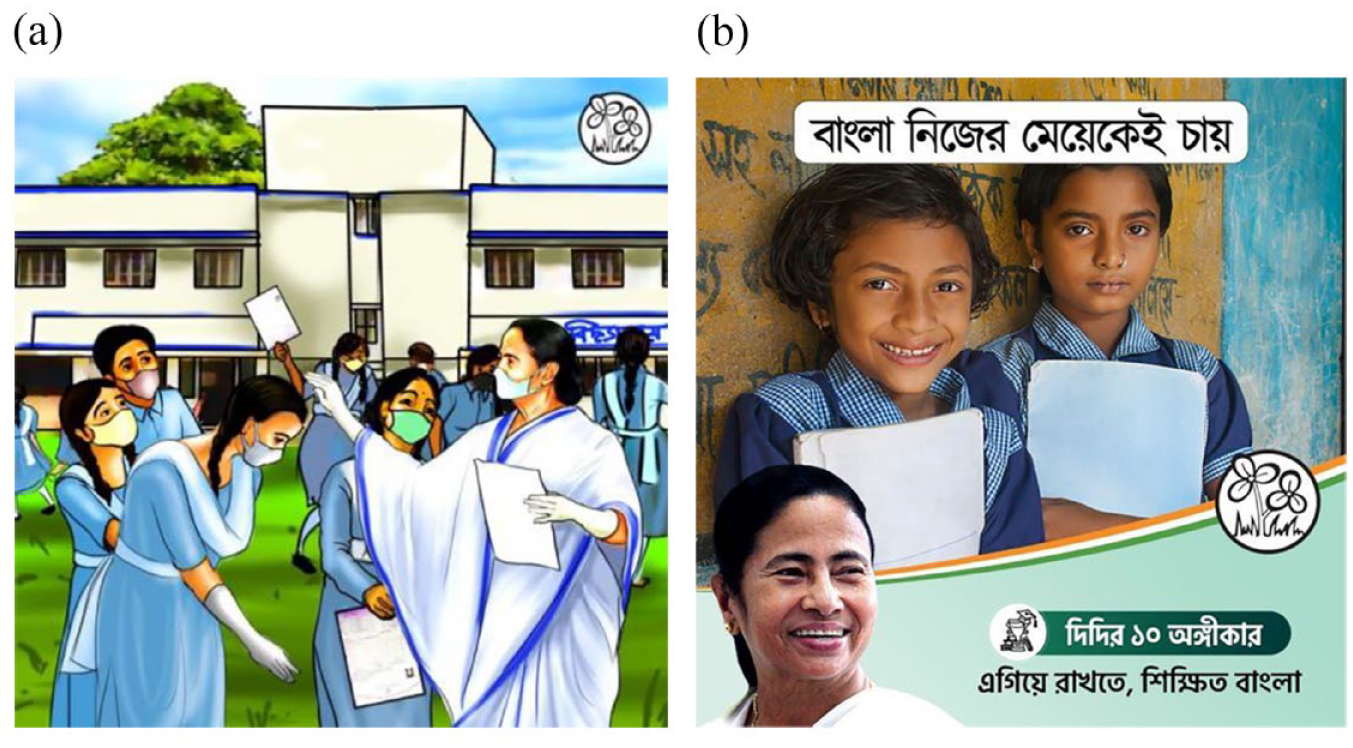
(a) Mamata blessing young girls.
Apart from these constructive women empowerment ads, negative ads portraying violence against women in BJP-ruled states also played a part in the TMC campaign. The rape of a Dalit girl at Hathras in Uttar Pradesh, a BJP-ruled state, and the subsequent violence were weaponized to portray Uttar Pradesh as a dangerous place for women (see Supplemental Appendix B10). The implicit message was carried that BJP-ruled states were unsafe for women; hence, the women of Bengal must reject the BJP. The Bengali print media also played a significant role in whipping up emotions against the violence in Uttar Pradesh and in helping to project Bengal as a relatively safer state (Bhattacharya, 2021).
Personalization of the campaign
Strong leader BJP
Personalization of politics to foreground the focus on personal characteristics of leaders and the communication of political messages via leaders, featured prominently in the BJP’s ads. Modi’s “strong leader” personality was increasingly used to highlight issues such as corruption, unemployment, misgovernance, and so on. Modi had been projected as a “56 inches leader” in the past with tropes of masculinist fervor embedded in the 2014 General elections (Srivastava, 2015). Similar notions of strength and virility were employed alongside efficiency and dynamism to represent him as a savior of Hindus population in Bengal. The image in Figure 6a asserts that unemployment must end: Modi is fashioned as a dynamic leader with faces of young men and women. In a marked change from his kurta-clad image, Modi is seen wearing a black suit representing the corporate aspirations of educated youth. Figure 6b is one of the most easily recognizable examples of the strong leader/masculinist leader theme. Modi is shown raising his fists while he grimaces with an air of resoluteness. The text of the image reads “Bangla e durniti bondho koro” (Stop Corruption in Bengal). Despite the different issues highlighted in the different visuals, Modi’s image is the one constant in all of them – the idea being to project Modi as a strong leader who will rally everyone around to uproot the state’s incumbent despotic chief minister. Emotive issues were treated in a personalized fashion to enhance the viewer’s association with them. This is evident in Figure 6c: the ad announces that anyone wishing to be a BJP member can easily get the membership card – Modi’s image in the ad clearly bolsters the attractiveness of attaining membership. It was evident the BJP wished to build its campaign around the persona of Modi and consciously used the trope of “strong/masculinist leader,” putting forth issues in a manner that would generate more resonance. Its strong leader theme helped to evoke a feeling that the “Hindu mythical past” in Bengal would be revived under his safe tutelage. The BJP adapted the slogan “Sonar Bangla” (Golden Bengal) in its election campaigns strategy and associated it with the “Hindu past” that would be achieved under its strong/masculinist leadership of Modi (see Supplemental Appendix B11).
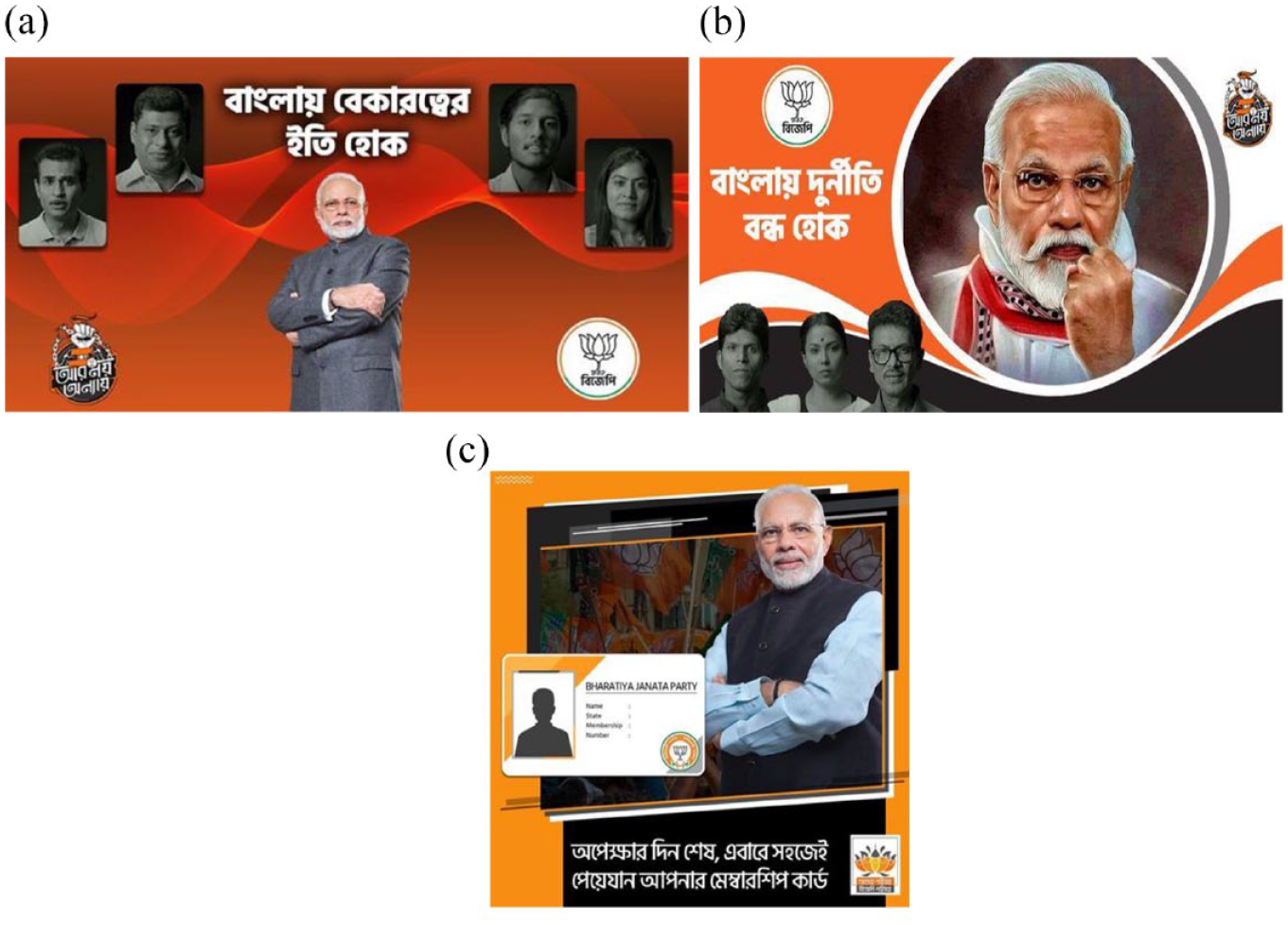
(a) PM Modi with the caption “End unemployment in Bengal.”
Strong and benevolent leader TMC
Personalization of Mamata mainly as a benevolent leader but also as a strong leader in ads was extensively instrumentalized by the TMC. Mamata Banerjee had successfully woven an image of herself as the “streetfighter” during the days of her as an opposition leader (Nielsen, 2016). However, her projection as strong leader is gendered within the boundaries of Bengali cultural identity. Hence, Mamata is represented as a Bengali woman who fights for the cause of the wretched and alleviates the people from their misery. Mamata is often shown amidst people addressing them, dancing with Adivasi (tribal) women, making tea, and so on; the message being carefully crafted that her connection to the soil is reciprocated with unflinching support from the people and the custodian of religious and cultural harmony.
The “benevolent leader” image is further emphasized by presenting the quintessential “mother” portrait. This is in sharp contrast with the “masculinist leader” as embodied in Modi. Figure 7a and b respectively show Mamata warmly engaged with children and protecting them from torrential rain– both these images are clearly intended to generate “warmth” in the viewer by portraying Mamata as the epitome of compassion and empathy. This “benevolent leader” image, however, is complemented by a different variant – that of a “strong woman leader.” In contradistinction to the earlier ads, Figure 8a shows a montage of Mamata in a wheelchair leading thousands of TMC supporters and, later in her speech, declaring that she is a “Royal Bengal Tiger,” a “Street Fighter.” The video ad is replete with multiple low-angle shots and stirring background music reinforces a sense of awe in the viewer. A brief reference is also made to Subhash Chandra Bose to portray her as the rightful inheritor of his heroic political lineage.

(a) Mamata engaging with children under a tree.
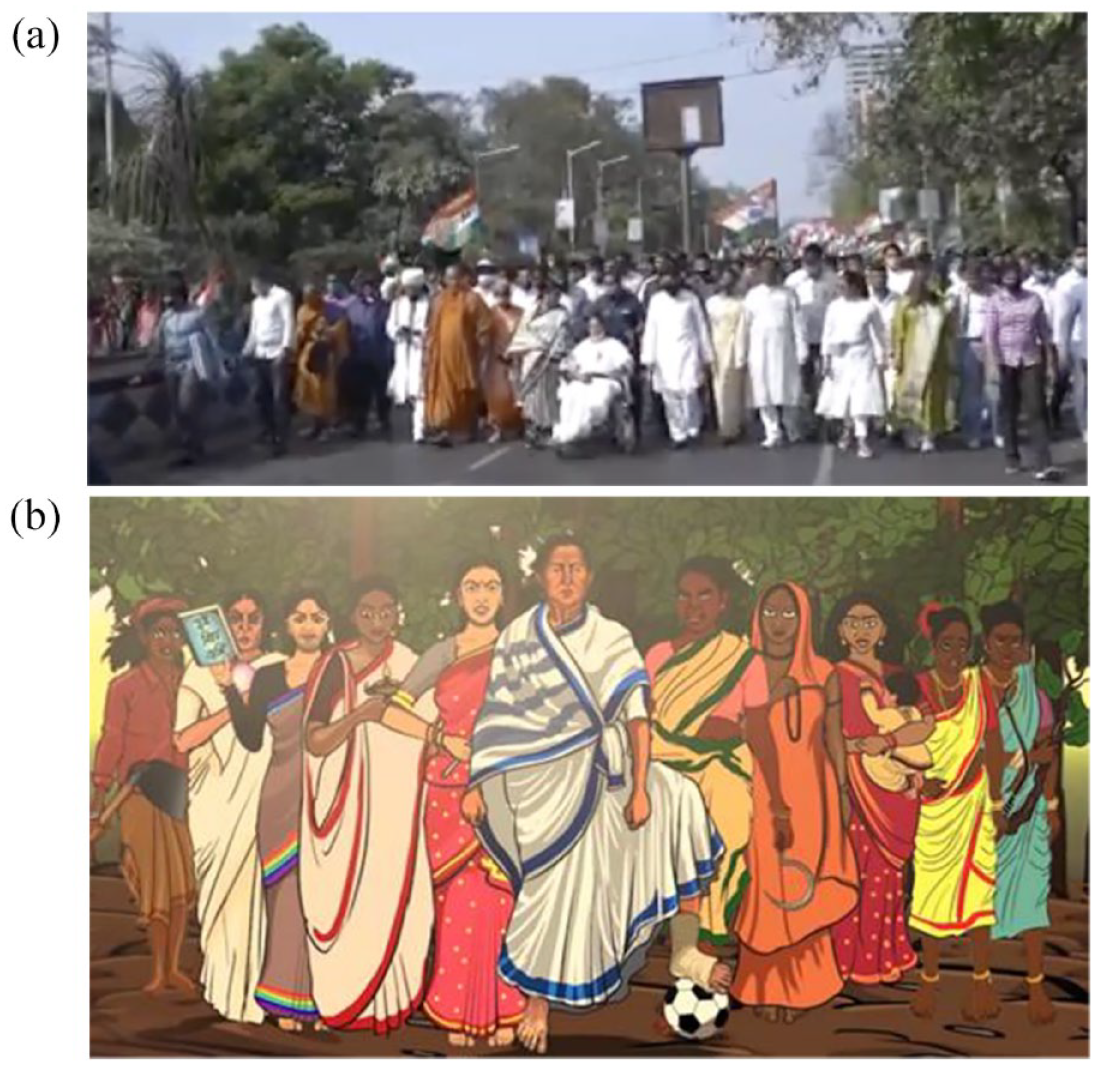
(a) Video ad by TMC of Mamata leading a march of thousands of TMC supporters in a wheelchair.
Such TMC ads were intended to reinforce the perception of Mamata as a gritty woman leader who is up to meeting the challenge of BJP’s “strongman” leaders. Moreover, the representation of the injured body carries the message of embodied resistance while simultaneously generating sympathy in the eyes of the viewer. In Figure 8b, Mamata is seen leading a team of women footballers all draped in saree. The women include representations from different Bengali and Adivasi communities. It is worthy to note that ideas of strength and dynamism are refashioned, from the tropes of the universalist masculine figure, to the orchestrated symbolism of the socially embedded woman leader.
Discussion
This paper sheds light how political parties leverage digital media in their campaign strategies to mobilize voters with particular focus on the Facebook political ads of the incumbent (TMC) and the opposition (BJP) during the 2021 West Bengal assembly elections. Our study demonstrates the manner in which the personalization of politics functions within a highly polarized environment; while emphasis is placed on leaders and their individual traits, numerous cultural aspects in addition to ideology are integrated into the portrayal of leaders to resonate with voters. For example, the theme of nationalism as enunciated by the BJP and the TMC represented two contesting positions in relation to the imagining of Bengal. The BJP focused on Hindu nationalism, in tandem with its larger project of building the “Hindu Rashtra”; its ads were imbued with the message of rediscovering Bengal and connecting it to its vision of “Hindi-Hindu-Hindustan.” The BJP’s 2021 West Bengal campaign can be compared with the global trend of identity-based mobilization. A study of the 2016 US presidential elections (Whitehead et al., 2018) shows how Christian nationalism was the key factor resulting in the Trump Presidency: the desire to preserve the past and the possibility of creating a “Christian future” were successful in winning support from white voters. The hashtag “Make America Great Again” was used to mobilize the white supremacist cohort through Twitter and effectively create a public campaign (Eddington, 2018).
In contrast, the TMC contested this paradigm with its view of secular Bengali sub-nationalism: Bengal’s autonomous cultural and historical journey was portrayed by integrating local traditions that were instrumental in the formation of Bengali identity. Hence, the symbolism and iconography key to this unique Bengali identity were instrumentalized to construct the idea of the state’s secular populace standing up against unwarranted intrusions of the “outsider.” In both the projections, a strong leader was portrayed as essential in embarking the development path.
However, the notion of a strong leader was strikingly different from each other as projected in the visual campaigns. By invoking local cultural insignia, Mamata Banerjee carefully projected her image as an amalgamation of a strong and benevolent leader, who also possess motherly traits and compassion, which contrasts with a masculinist leadership style as embodied by Narendra Modi. Studies have demonstrated that female leaders can effectively challenge gender stereotypes by portraying themselves as strong and assertive (Lawrence et al., 2016). Mamata Banerjee’s ability to counter the conventional perception of strong and powerful leadership as being inherently male-centric is an essential element of her public image. By adopting a leadership style that combines both traditionally feminine and assertive characteristics, Banerjee offers an alternative model of effective leadership that transcends gender norms.
Our study reveals an interesting aspect of private personalization in political campaigns; unlike in the United States, where candidates often showcase their family lives to shape public perception (Lawrence et al., 2016; Meeks, 2016), this approach was scarcely observed in the campaigns we analyzed. One possible reason for this discrepancy lies in the cultural expectations of Indian society, where political leaders are often viewed as making personal sacrifices, including distancing themselves from their families, to fully commit to national development (Rai, 2019). This finding adds a new dimension to the existing literature, highlighting how personalization in politics varies significantly depending on cultural and societal contexts (Metz et al., 2020; Van Aelst et al., 2012). Furthermore, in the domain of political communication research, there has been a discernible trend favoring Western and European-centric frameworks. However, turning our gaze to the Global South, particularly India with its complex socio-political landscape and media systems, not only offers fresh empirical data but also has the potential to question and redefine existing theoretical constructs. By venturing into these underexplored areas, the field stands to gain from unveiling distinctive modes of political communication, leading to a more comprehensive and globally inclusive understanding of political dynamics.
To conclude, the West Bengal state assembly election in 2021 highlighted the close dialectical interplay between identity and ideology, both of which form significant aspects in the mediation of politics. The present study affirms that ideological narratives are sewn through “positive-self and negative-other” identity portrayals to elicit political acceptance (Gbadegesin and Onanuga, 2019: 8). Moreover, such dissemination takes place within a personalized and emotionalized setting. Moreover, it is increasingly becoming a part of digital campaigns to stylize performances with notions of gender (see McGregor et al., 2017; Meeks, 2016). The construction of Modi”s image as a “strong/masculinist leader” along with the emotional appeal of Hindu nationalism and astute statesmanship conforms to this conceptual understanding. Mamata Banerjee’s image, on the other hand, is that of a “political ascetic combining elements of Hindu goddess imagery and nativistic rhetoric” (Chaudhury, 2022: 6) while simultaneously presenting herself as a strong leader who can confront the challenges posed to her authority. Additionally, her self-fashioning as the descendant of Bengal’s secular tradition combined with the powerful imaging of sub-nationalism attempted to raise her to the pedestal of a leader/custodian. However, in spite of the campaign weaving messages through Mamata’s womanhood, it is heavily guarded by already established patriarchal norms of the Bengali society. In fact, scholars have earlier argued that the employment of “feminine style” in elections does not necessarily disrupt hegemonic masculinist practices (Parry-Giles and Parry-Giles, 1996). The contrasting gendered styles of Modi and Mamata a in this election exemplify how gender interplays with identity and ideology in Indian politics, revealing the complex and multifaceted nature of political communication in this context.
This paper is not without limitations. First, the thematic discourse analysis used here does not gauge the political consequences of the ads we examined; viewers’ reactions might differ from the analytical categories we employed in this paper. Second, this paper did not track the evolution of the BJP’s and TMC’s ads over time. While this aspect was beyond the scope of the current paper, future studies can adopt a longitudinal perspective to observe how campaign strategies adapt to changing electoral trends Despite these limitations, our, paper makes significant contributions to the growing body of literature on visual political communication by showing the enduring appeal of personalized rhetoric centered on strong leadership and identity-based issues, a phenomenon increasingly observed in various parts of the world. These personalized appeals are often imbued with gendered interpretations of masculinity and femininity, positioning political leaders within socially familiar constructs of manhood and womanhood. This process further reinforces the potency of such rhetoric in resonating with the electorate. Our findings also have implications for future research, which should explore the intersectionality of identity markers and cultural symbols, as well as the impact of gendered rhetoric on electoral outcomes and voter behavior, underscoring the need for a nuanced understanding of these dynamics in the realm of political communication.
Supplemental Material
sj-docx-1-mcs-10.1177_01634437231214189 – Supplemental material for Personalization of politics through visuals: Interplay of identity, ideology, and gender in the 2021 West Bengal Assembly Election Campaign
Supplemental material, sj-docx-1-mcs-10.1177_01634437231214189 for Personalization of politics through visuals: Interplay of identity, ideology, and gender in the 2021 West Bengal Assembly Election Campaign by Debopriya Shome, Taberez Ahmed Neyazi and Sheryl Wei Ting Ng in Media, Culture & Society
Footnotes
Funding
The author(s) disclosed receipt of the following financial support for the research, authorship, and/or publication of this article: This research is supported by the Ministry of Education, Singapore under the Academic Research Fund Tier 1 (FY2020). This study is part of our Digital Campaigns and Propaganda Lab research.

Supplemental material
Supplemental material for this article is available online.
References
Supplementary Material
Please find the following supplemental material available below.
For Open Access articles published under a Creative Commons License, all supplemental material carries the same license as the article it is associated with.
For non-Open Access articles published, all supplemental material carries a non-exclusive license, and permission requests for re-use of supplemental material or any part of supplemental material shall be sent directly to the copyright owner as specified in the copyright notice associated with the article.
