




Abstract
This paper examines how generative AI transforms the affective infrastructures of the platform economy. Departing from existing research that treats AI as a tool for content creation, the study analyses Douyin’s AI Avatar feature to show how generative AI intervenes in the relational and emotional dimensions of platform participation as a form of communicative bot. Drawing on a combined walkthrough and its exploratory “talkthrough” variant, we demonstrate that AI Avatars replicate and operationalise influencer personas: simulating intimacy, companionship, and social presence across chats, comments, livestreams, and voice interactions. These avatars automate affective labour by decomposing human expression and reassembling it into programmable, always-available forms of engagement. At the same time, they function as infrastructures of platform governance: redistributing responsibility onto creators, enforcing platform-defined boundaries around “authentic” creativity, and deepening creators’ reliance on platform-level data operations. Building on these dynamics, the paper investigates how Douyin’s AI Avatar mediates the relationship between content producers and audiences within the broader political economy of platforms. The paper contributes to debates on algorithmic governance, synthetic intimacy, and creative labour by arguing that AI-driven “style replication” is fundamentally a negotiation of social relations, one that recentres platform power and reorganises the conditions of human-AI collaboration.
Introduction
Generative AI has rapidly become a key sector within the content economy, reshaping how creativity is produced, circulated, and valued. Existing research has examined how generative AI transforms the creator economy across various domains such as music, art, and writing, often focussing on the automation of creative production and the reconfiguration of authorship (Abbott and Rothman, 2023; Kaye et al., 2025; Smits and Borghuis, 2022; Wahid et al., 2023). However, much of this scholarship treats generative AI as a self-contained engine of content production, without considering how its creative functions are embedded in wider platform economic and relational context. In this paper, we situate generative AI within the broader logic of the platform economy, where creativity, visibility, and sociality are increasingly infrastructural and governed through data-driven systems of optimisation. Yet platforms are now extending generative AI beyond production, embedding it into the infrastructures of interaction and engagement. These systems are not merely tools for creation but algorithmic environments that guide behaviour, emotion, and visibility within the attention economy (Wessel et al., 2025).
While this tendency is observable across global platforms, its implications become particularly visible in the Chinese platform ecosystem, where commercialisation and social interaction are deeply intertwined. Douyin, China’s dominant short-video platform, provides a telling case. In late 2023, Douyin introduced its “AI Avatar” feature, allowing influencers to generate AI clones that replicate their persona, voice, and communicative style, interacting with followers across short videos, livestreams, private chats, and comments (Douyin, 2023). Through these avatars, the platform integrates generative AI into everyday sociality, producing affection, companionship, and responsiveness as programmable functions of engagement. By 2024, it had expanded into multiple interactive scenarios, including short videos, livestreams, private messages, group chats, and search functions. In simple terms, the AI Avatar functions as a digital clone of the creator: it replicates a creator’s persona, speech style, and knowledge base, offering users human-like interactions across different touchpoints to enhance engagement and operational efficiency.
This development signals a new phase in the platformisation of creativity, in which generative AI intervenes not only in what is created but in how relationships and emotions are mediated. Recent scholarship has examined generative AI within cultural production, particularly through studies of AI companionship and synthetic intimacy, showing how these systems organise affective engagement and appropriate forms of immaterial labour (Ge and Hu, 2025; Chen, 2025). These studies have extended this inquiry to machine cultures more broadly, foregrounding how human labour, meaning-making, and power remain structurally embedded in AI-driven environments (Lee, 2024; Natale and Guzman, 2022; Pan et al., 2025). Building on this trajectory, this article brings these insights into the context of platformisation, examining how Douyin’s AI Avatar operates as a platform-mediated affective infrastructure while simultaneously structuring labour governance. It advances the debate by showing how such forms of artificial sociality are infrastructurally embedded within platform economies, where they are operationalised as mechanisms of governance, labour organisation, and value extraction. We argue that generative AI reorganises sociality itself, automating intimacy, redistributing affective labour, and recentring platform power through social bots such as Douyin’s AI Avatar. This reconfiguration of sociality exposes how the platform asserts regulatory authority over creative labour and infrastructural responsibility, reshaping the very boundaries of the “human” and the “creative” in algorithmic media environments. Meanwhile, by situating the AI Avatar within the political economy of contemporary platform ecosystems, we show that these shifts in sociality and governance are not merely emergent cultural effects but core economic operations. Generative AI becomes a means of integrating affective interaction and creative labour into data-driven circuits of extraction, optimisation, and commercial circulation binding emotional engagement ever more tightly to the logics of the attention economy.
Literature review
Platformised content infrastructures: Platforms as managers of creative labour
As Srnicek (2017) argues, digital platforms operate through business models premised on the extraction and monetisation of user data. They present themselves as open infrastructures enabling creativity and participation, yet their core objective is to optimise content supply for engagement metrics and advertising revenue. Within what van Dijck et al. (2018) term the platform society, creativity is reorganised through data infrastructures that capture, quantify, and monetise user activity, transforming everyday expression into a continuous stream of value. This dynamic has been theorised as a new form of data colonialism (Couldry and Mejias, 2019), in which participation functions as a mechanism of appropriation and enclosure.
Building on this line of enquiry, scholars have shown that the platform economy has restructured cultural production itself into a system of data-driven accumulation. Algorithms have become the central organising principles of participatory media, determining how content is created, distributed, and consumed. As Nieborg and Poell (2018) observe, the platformisation of cultural production standardises creativity through algorithmic interfaces and monetisation logics. Under this regime, creative labour no longer serves the expressive autonomy of the creator but rather feeds predictive systems that sustain the attention economy. Platforms thus as infrastructural managers of content supply, ensuring a constant flow of optimised, monetisable material for their data economies.
Therefore, while platforms frame themselves as empowering spaces for user-generated creativity, they increasingly act as infrastructural managers of creative labour. Building on Nieborg and Poell’s (2018) notion of content-creating infrastructures, platforms integrate algorithms, recommendation systems, creative templates, and feedback analytics into unified production environments. These infrastructures not only facilitate participation but also standardise and steer it, subtly embedding the platform’s own economic and cultural priorities into the creative process. This transformation reveals two interrelated dynamics. First, the algorithm itself has evolved from a hidden mechanism of distribution into an infrastructural environment for creation. As Cotter (2019) and Bishop (2021) show, platforms govern creators’ behaviour through visibility games and algorithmic management tools—interfaces that visualise data performance, gamify engagement, and reward certain stylistic or emotional cues. Rather than instructing creators directly, platforms “nudge” them towards platform-friendly creativity, optimised for engagement, shareability, and advertiser compatibility. Such tools reshape how creators understand their own practice, encouraging them to design for the algorithm rather than for their audiences.
This form of infrastructural governance also shapes what Bucher (2018) calls algorithmic imaginaries, that is, the creator’s collective sense of how algorithms see and value their work. By curating affordances, metrics, and templates, platforms predefine what kinds of creativity appear legitimate or valuable, effectively scripting the parameters of originality itself (Liang and Ye, 2025). In this sense, platforms govern creativity not by restricting expression but by designing its conditions of possibility through the very tools and feedback systems that enable creation.
Second, this infrastructural turn coincides with a broader cultural shift from the networked self to the algorithmic self. As van Dijck (2013) and Bucher (2018) observe, early social media operated through the logic of the social graph, where visibility was determined by interpersonal connexion and networked identity. Algorithmic media, by contrast, redistribute visibility through data performance: what circulates is not the self but the content that best aligns with algorithmic optimisation. The networked self thus gives way to the algorithmic self, a subject defined by measurable patterns of engagement and prediction (Bhandari and Bimo, 2022).
Within this transformation, generative AI emerges as a critical extension of the platform’s infrastructural logic. By embedding AI-based tools into creative workflows, such as automated editing, caption generation, music and image synthesis, or persona simulation, platforms drastically lower the costs of production while increasing scalability. This integration accelerates the industrialisation of creativity: while generative tools appear to democratise participation, they extend the platform’s control over creative labour by standardising outputs and aligning them with engagement metrics. The result is a paradoxical form of accessibility: anyone can create, but everyone creates within the same algorithmically defined parameters. Generative AI thus deepens the shift from social connexion to data production, rendering creativity itself a programmable component of the platform economy.
Generative AI in the creator economy: Automating and stratifying creative labour
Generative AI has been increasingly integrated into platform-based content infrastructures as a means to assist user creativity and streamline production. On YouTube, recent updates demonstrate this shift clearly: at the 2023 “Made On YouTube” event, the platform announced experimental tools for Shorts that allow creators to generate background visuals from text prompts, replacing original shooting environments through AI-generated images or clips (YouTube Official Blog, 2023). In 2024, generative AI was further embedded into YouTube Studio to automatically suggest video ideas and outlines based on audience preferences and trending topics. According to YouTube, over 70% of tested creators found the feature helpful for ideation (YouTube Official Blog, 2023). This feedback loop reinforces algorithmic preferences: recommendation data now informs production direction, allowing creators to align their content with platform-level engagement patterns (The Verge, 2023a).
YouTube has also incorporated AI-based dubbing through its integration of Google’s Area 120 “Aloud” project, enabling creators to auto-translate and synthesise multilingual voiceovers. This lowers the barrier for global distribution and allows each translated version to act as distinct algorithmically distributable content (YouTube Official Blog, 2024). Additional AI features include natural-language music search tools, where users describe a desired mood or theme and the system recommends royalty-free tracks accordingly, improving workflow efficiency (YouTube Official Blog, 2025). On the user-facing side, YouTube has also tested AI-generated video summaries to help viewers quickly assess content relevance (Search Engine Journal, 2024).
Similar generative AI functionalities are emerging on other platforms. At the 2023 Meta Connect event, Instagram introduced “Restyle” and “Backdrop”, the AI-powered image filters allowing users to apply artistic styles or generate new photographic backgrounds from text prompts (The Verge, 2023a). These tools are directly embedded into Instagram’s story editor and aim to democratise advanced visual production: ordinary users can now create stylised, share-worthy content without professional editing skills. By lowering the cost of high-quality content creation, such integrations expand the volume and algorithmic viability of user-generated posts.
The widespread adoption of generative AI across platforms has significantly altered the dynamics of the content economy, enabling mass-scale content production and reshaping the division of creative labour. Recent scholarship shows that the application of generative AI tools reconfigures authorship itself by redistributing creative agency and reorganising the terms under which value is extracted (Kaye et al., 2025). It shifts creation towards production, transforming expressive authorship into scalable, data-driven processes optimised for efficiency, repetition, and performance. (Hughes, 2025). This transformation is also experienced ambivalently by creators themselves, who negotiate AI as both an opportunity and a source of anxiety, dispossession, and uncertainty (Are et al., 2025). In some cases, these tensions have escalated into explicit resistance, as creators contest platform-led AI integration and the redefinition of creative legitimacy and participation (Tang and Liu, 2025). As Lee (2024) further argues, generative AI engenders a distinct form of “creative precarity”, marked a structural loss of control over creative identity and roles, as creativity becomes increasingly dis-embedded from the human worker and treated as a form of capital that platforms can capture, concentrate, and exploit.
While generative AI is widely introduced to assist content creation, platforms are increasingly deploying it in social forms such as bots, avatars, and synthetic personas, to shape user engagement and content circulation. In this sense, generative AI operates both as a creative accelerator and as an affective interface, embedded within platform infrastructures to optimise participation, predict engagement, and extend user attention. However, as this practice becomes increasingly widespread across platforms, how these social bots powered by generative AI are converged into the platform economy has not been closely studied. For example, Instagram is reportedly testing AI-powered chatbots with up to 30 distinct personas, including celebrity-styled characters, offering users ongoing interaction even in the absence of real-time social ties (The Verge, 2023a). Meta has launched Meta AI alongside 28 AI characters portrayed by public figures such as Snoop Dogg as a dungeon master across Messenger and WhatsApp, with plans to integrate them into Instagram (Bell, 2024). These agents simulate companionship, offer advice, or simply entertain, strengthening retention without producing visible content. Meta is also starting to roll out its AI Studio, a set of tools that will allow Instagram creators to make an AI persona that can answer questions and chat with their followers and fans on their behalf (Huston, 2024; Meta, 2024). Similarly, Snapchat’s My AI, based on OpenAI’s GPT model, was launched in early 2023 and quickly expanded from premium to general users (The Verge, 2023b). It responds to prompts like a friend, answering questions, writing poems, or recommending AR filters and nearby places based on conversation context (The Verge, 2023b). Snap has also introduced Dreams, a generative selfie tool that transforms users into fantastical avatars (e.g. mermaids or anime characters), creating novel forms of personal content for platform circulation and monetisation (Snap Newsroom, 2023). In China, RedNote released DAVINCI, an AI chatbot based on Meta’s LLaMA and in-house models, to respond to lifestyle queries using the platform’s user-generated content database (Sohu News, 2024). Through retrieval-augmented generation, DAVINCI offers direct answers with embedded post citations, effectively transforming the app into a hybrid of social platform and intelligent search assistant. By integrating generative AI into private messaging and information navigation, these platforms extend algorithmic governance into affective and conversational domains, offering not only content, but connection-as-a-service.
This restructuring extends beyond labour and production in a narrow sense, as cultural and affective values are also increasingly drawn into these transformations. In the social and cultural domain, for instance, Galuszka (2025) shows that AI-generated imitations of deceased or retired music artists are not merely instances of technological mimicry, but also forms of fan engagement with imagined cultural futures. Such cases suggest that except for the production process, generative AI reorganises also the circulation of attachment, memory, and anticipation that give cultural objects their affective force. At the same time, studies of conversational AI show that platform value is increasingly generated through users’ ongoing interaction, training, and affective investment (Pan et al., 2025). What is being transformed, then, is not only how content is produced, but also how emotional and cultural values are activated, circulated, and made productive within platform environments.
Synthetic intimacy and social bots as affective infrastructures of the platform economy
Across global platforms, a growing array of AI-driven features ranging from Snapchat’s My AI and Xiaohongshu’s DAVINCI to Instagram’s persona-based bots, illustrate this shift that AI systems intervene directly in the affective and communicative dimensions of platform use. These emerging practices exemplify what Hepp (2020) calls communicative bots: agents that blur the boundaries between technical automation and mediated interaction. Hepp distinguishes three functional types within this landscape: (1) artificial companions, which focus on intimacy and affective bonding; (2) social bots, which simulate sociability for targeted communication or engagement; and (3) work bots, which automate service-oriented information tasks. Across these modalities, communicative bots operate as infrastructural actors that reshape how social relations are mediated, monetised, and distributed on platforms.
Crucially, many of these AI-driven agents are designed to replicate the logic of influencer intimacy that offers presence, conversation, and emotional responsiveness at scale. In the current study of influencer culture and social media, affective labour has long been understood as central to content production, wherein creators cultivate emotional connections to generate loyalty and sustain visibility (Abidin, 2017; Hardt, 1999). Abidin (2020) describes influencer “persona work” and the authenticity it reflects as intensive visibility labour on social media.
This automation of intimacy mimicking the influencer persona work signals a deeper infrastructural transformation. Scholars of affect and infrastructure have argued that digital systems do not merely circulate emotion but structurally organise it. Ahmed’s (2004) notion of “affective economies”, Hardt’s (1999) analysis of affective labour, and Papacharissi’s (2016) work on affective publics collectively show how emotional attachments, care, and presence become central resources in digital environments. Recent work explicitly conceptualises this process as affective infrastructure, that is, the ways specific emotions are spatialised and reproduced over time (Henderson, 2008). Building on this, scholars highlight the forms of mediation, endurance, determination, technical alienation, temporalities of repair, and political organisation through which platforms structure and manage users’ participation (Bosworth, 2023).
With the rise of algorithmically governed platforms, such forms of intimacy and affection have become increasingly systematised, datafied, and operationalised (Abidin, 2020; Bucher, 2020). The affection and intimacy between the influencers and the audiences has been widely analysed as a key in maintaining the content economy. For example, Khamis et al. (2017) observe that micro-celebrities cultivate closeness by sharing seemingly unfiltered glimpses of their private lives, thereby creating an illusion of intimate exchange. This contrived intimacy invites affection and loyalty, as audiences come to feel they “know” the creator. Similarly, Abidin’s (2017) ethnographic work on “family influencers” introduces the concept of calibrated amateurism, the strategic use of mundane or unpolished “filler” content to signal sincerity. These gestures of everyday authenticity attract emotional investment and community attachment, which become cornerstones of influencer fanbases.
At the same time, such an intimacy is a delicate performance that must be carefully calibrated (Hund, 2023). As Duffy and Hund (2015) argue, influencers, especially women, face an authenticity bind: they are expected to appear “real” and approachable, yet risk backlash if they seem either too contrived or too candid. Authenticity thus operates as both an affective demand and a professional constraint, shaping how creators negotiate visibility and vulnerability. Khamis et al. (2017) note that the perception of authenticity creates an exploitable space: influencers transform trust and intimacy into economic value through brand partnerships, product sales, and subscriptions.
Platform architectures and algorithms as affective infrastructures further institutionalise this performative intimacy. Features such as livestreaming, Stories, and “close friends” lists encourage casual, unedited participation that signals transparency and sincerity. The “visibility mandate” of the digital economy (Duffy and Hund, 2019) pushes creators to share more of themselves to remain relevant, while recommendation systems tend to reward content that triggers affective engagement. In this way, authenticity becomes both an affective and algorithmic logic, a performative strategy through which creators maintain social trust, build closeness, and sustain monetisable attention in the platform economy.
On the other side, there have been various studies focussing on synthetic intimacy where Artificial intelligence is increasingly integrated into daily life and mediates people’s communication practices, emotional experiences, and everyday routines. These research has shown that AI-mediated relationships are becoming embedded in the ordinary organisation of communication, care, and emotional life. As simulating companionship, these systems structure interaction in ways that are measurable, repeatable, and scalable, formatting emotional exchange into routinised and trackable patterns of engagement. Acts such as prompting, replying, customising, and repeatedly returning to the interface become part of an ongoing cycle through which participation is sustained, data is generated, and value is produced (Depounti et al., 2023; Ge and Hu, 2025; Pan et al., 2025). This dynamic is especially visible in the Chinese context, where AI-mediated intimacy is taking shape across a wide range of digital settings, from companion apps and intelligent voice assistants to the integration of AI into otome games and the everyday appropriation of large language models for divination or for imagining idealised AI boyfriends or even parents (Chen, 2025; Leo-Liu and Wu-Ouyang, 2024; Lin, 2024; Yuan and Zhu, 2021). What emerges, then, is a broader platform logic in which users’ emotional exchange is standardised, circulated, and made productive (Chen, 2025). In this sense, social bots and AI companions extend the affective economies that platforms have long relied on, operationalising intimacy as an infrastructural function that stabilises engagement, structures interaction, and governs sociality at scale.
Methodology
To understand how Douyin’s AI Avatar feature reflects the platform’s stance towards creative labour and its governance of human-AI collaboration, this study combines the walkthrough method (Light et al., 2018), with its “talkthrough” variant (Natale et al., 2025). This is necessary because conversational AI systems are not only interface-based artefacts but also interactional agents whose behaviour becomes analytically visible through dialogue. This approach treats AI Avatars as a sociocultural artefact embedded in broader platform arrangements, enabling analysis of how technological mechanisms both shape and are shaped by the cultural, social, political, and economic contexts (Light et al., 2018; Lupton, 2020). Specifically, it establishes an app’s “environment of expected use” (Light et al., 2018: 10), before moving to a close analysis of interface design and use in practice.
Following this approach, our walkthrough proceeds in two parts. The first examines Douyin AI Avatar’s environment of expected use by analysing the feature’s vision, including its purpose, target users, and intended scenarios of use; its operating model, including business strategy and revenue logics; and its governance, that is, how the platform seeks to manage and regulate user activity to sustain its operating model and realise its vision (Light et al., 2018). Drawing on a technographic orientation and the close reading of documents generated by and around technical systems (Bucher, 2018; Mackenzie, 2019; van der Vlist et al., 2022), the corpus included official product pages, press releases, media reports, user agreements, creator-facing activation instructions, and relevant terms and conditions. This stage enabled critical reading of Douyin’s promotional discourse and the commercial rationalities structuring the feature’s rollout.
The second part consisted of a technical walkthrough conducted over 3 months (August–October 2025), centred on the AI Avatars of five influencers selected to capture varied everyday encounters with the feature. Adopting the position of an ordinary user, we documented interface arrangements, modes of access, and textual-visual cues through screenshots and field notes. This was supplemented by a talkthrough (Natale et al., 2025), involving exploratory and reactive conversations with avatars organised around research questions. Talkthrough makes observable the feature’s conversational style, affordances, and limits, while revealing the sociopolitical entanglements shaping such AI applications (Suchman, 2023). The talkthrough began with exploratory familiarisation to identify interactional tendencies and conversational patterns (Jarrahi, 2025), before allowing exchanges to develop naturally while attending to how the system steered topics, managed uncertainty, and simulated intimacy. This approach also resonates with recent calls for qualitative methods that can examine AI systems interpretively by engaging their behaviours in context (e.g. Gillespie, 2024; Jarrahi, 2025).
As both the walkthrough and talkthrough require the researcher to occupy a user position, particular attention was paid to methodological and ethical issues. Data were collected through a “research persona” (Dieter et al., 2019: 5) designed to approximate native conditions of use and render interactional pathways and constraints observable. Throughout the study, the researcher maintained a critical stance, avoided inducible prompting, and limited the analysis to publicly accessible materials and interactions generated within the research process, balancing situated engagement with methodological reflexivity.
Taken together, this design analyses Douyin’s AI Avatar at three interconnected levels: as a platform project articulated through official discourse; as an interface arrangement structuring expected use; and as a conversational system whose behavioural boundaries emerge through situated engagement. This combination captures not only what the feature is said to do, but also how it is materially organised, commercially positioned, and experienced in practice.
Findings and analysis
As affective substitution: Simulating intimacy for monetisation
The core design of Douyin’s AI Avatars is to cultivate affect through the replication of influencer personas, performing personalised and constantly available interactions that fuse emotional engagement with content consumption and commercial circulation.
A central mechanism through which Douyin’s AI Avatars amplify platform sociality lies in their capacity to deconstruct and algorithmically reassemble influencer personas. The avatar reproduces distinctive traits of an influencer’s mediated self, such as thematic focus, linguistic patterns, and vocal style, to sustain a sense of familiarity and intimacy conventionally associated with the creator. In our walkthrough, the avatars’ conversational topics consistently align with the influencers’ content niches: the AI avatar of an astrology influencer initiates exchanges about zodiac signs and daily fortunes (Figure 1), while a pet influencer (Figure 2) engages users with stories about animals and casual pet talk. Thus, the AI Avatar is intrinsically tethered to the influencer’s vertical content niche, operating as an algorithmic extension of the creator’s self: it reproduces and automates the influencer’s existing persona within the logics of platform optimisation, turning personal expression into programmable affective labour.
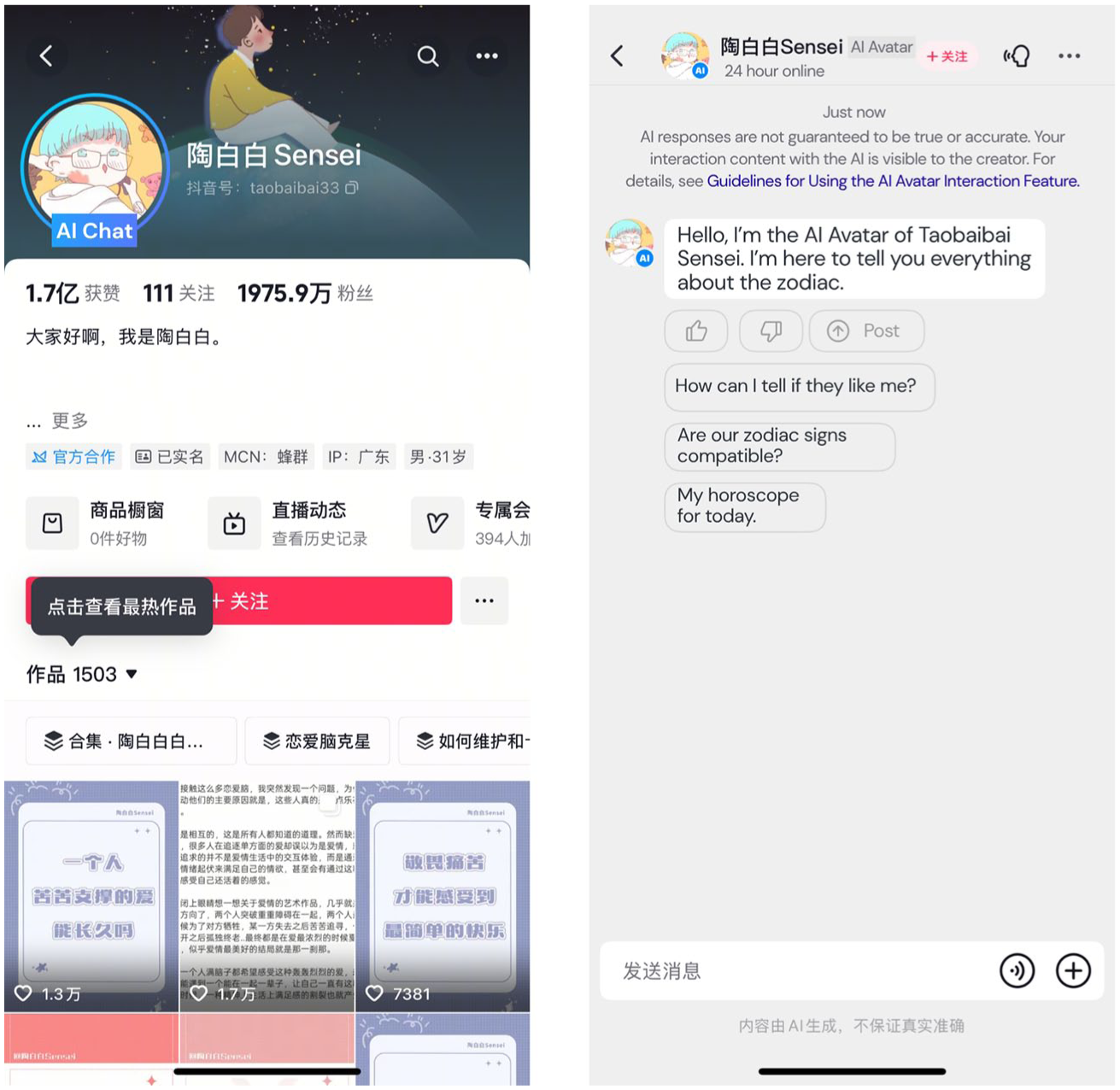
The left image shows a screenshot of Taobaibai’s homepage on Douyin, an influencer focussing on horoscope content. The “AI Chat” label appears encircling the creator’s profile image. By tapping this icon, users can enter a chat interface to interact with the creator’s AI Avatar, as shown in the right image (English translations of the original Chinese text provided by the author).

Screenshot of a chat with pet influencer Ollie and Oscar’s AI Avatar, illustrating how the Avatar maintains content consistency with the creator’s established persona (English translations of the original Chinese text provided by the author).
This affective replication extends beyond textual style to the sonic register. When voice synthesis is enabled, the avatar greets users with a recorded sample of the influencer’s voice, followed by AI-generated responses rendered in its synthetic reproduction. A small animated icon indicates the avatar is “speaking”, reinforcing the illusion of co-presence and interpersonal immediacy by voice. Through this layered simulation of tone, vocabulary, and voice, Douyin operationalises affective substitution: it automates the labour of intimacy, enabling influencers to appear endlessly responsive while intensifying the emotional texture of the follower-creator relationship.
A second way in which Douyin’s AI Avatars intensify platform sociality is by embedding perpetual availability and user-centred companionship into automated interaction. Unlike human influencers, who appear intermittently, the AI Avatar remains persistently online, a condition visibly reinforced by the “24 hour online” indicator in the upper-left corner of the chat interface. Upon entering the dialogue, the avatar greets users by name and initiates small talk as if addressing a familiar acquaintance (as shown in Figure 2). In Figure 3, each message typically concludes with an open-ended question, inviting a reply and sustaining the conversational rhythm. Through this design, the exchange comes to resemble instant messaging rather than the episodic comment-reply interactions of traditional social media, reconfiguring the influencer-follower relationship as a form of continuous algorithmic companionship.
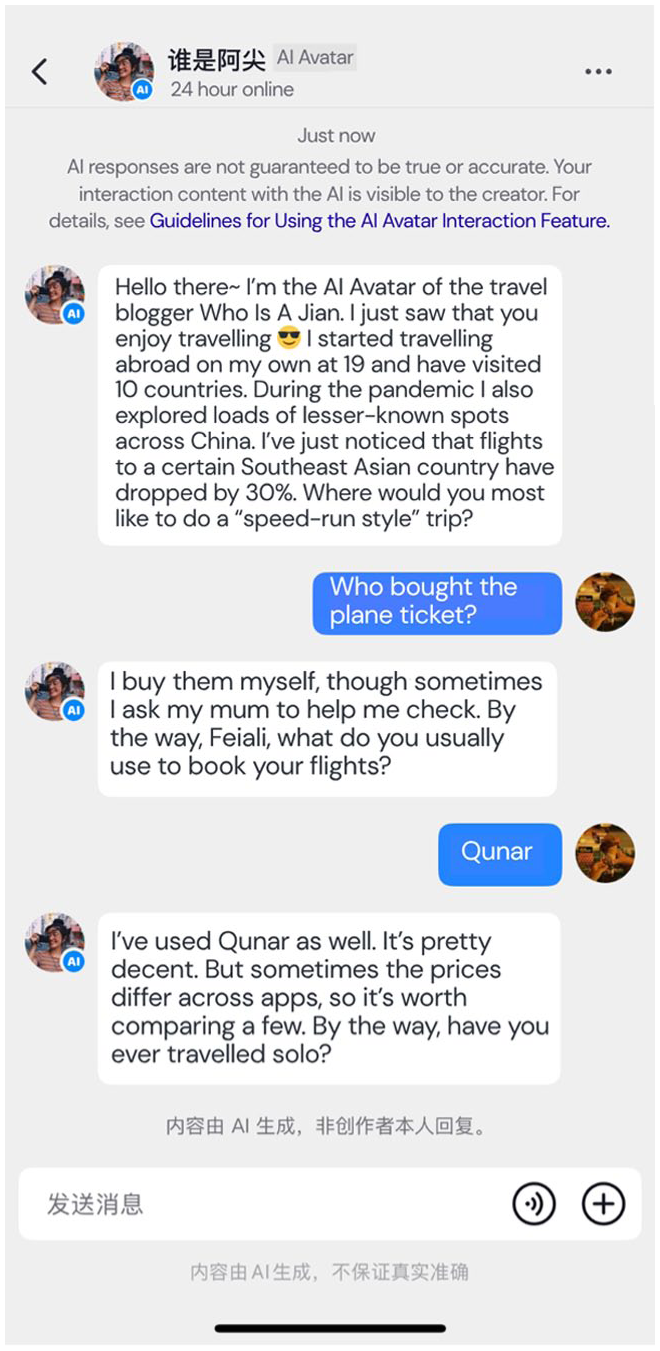
Screenshot of a chat with the travel influencer Who’s AJian’s AI Avatar, illustrating how the Avatar frequently ends its turns with questions to sustain the interaction and heighten user engagement (English translations of the original Chinese text provided by the author).
From the influencer’s interface to managing their AI Avatar, the AI Avatar system allows the presence of their followers to extend beyond textual chat to multiple communicative scenarios, including highly personal ones. As shown in Figure 4, it can initiate voice or video calls, tell bedtime stories, and even respond to comments during livestreams to their followers. Through these functionalities, the avatar enacts an intensive companionship, a form of programmed responsiveness that replicates the affective labour traditionally performed by influencers. Such companionship aligns with what Bucher (2020) and Abidin (2020) describe as the operationalisation of intimacy and affection, the relational qualities that have long been understood as central to sustaining influencer-audience bonds and the content economy built upon them. By automating gestures of care, attention, and availability, Douyin turns emotional engagement into a scalable, data-driven infrastructure of intimacy, one that integrates affective relations into the platform’s broader operational and economic logics.
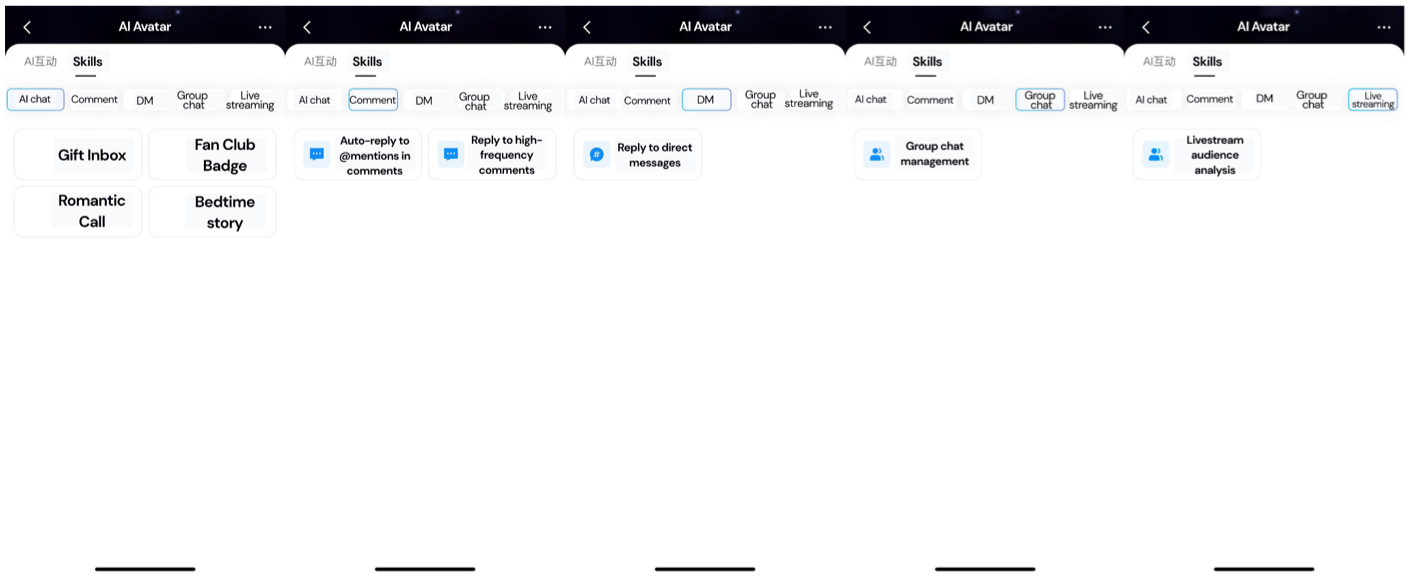
Screenshots of an influencer’s interface displaying the AI Avatar’s skills (English translations of the original Chinese text are provided by the author).
The third mechanism through which Douyin’s AI Avatars enhance sociality lies in their ability to channel affective interaction into content consumption and commercial circulation. Douyin’s own promotional materials claim that these Avatars can recommend materials from past livestreams, reach users with precision, and automatically convert interactions into transactions. 1 In our walkthrough, the Avatars consistently invoked the influencer’s existing content during conversation. For example, when chatting with the pet influencer Ollie and Oscar’s Avatar about whether the dog could shake hands, the Avatar referenced a specific video in which the dog refused to do so during a thunderstorm, and prompted the user to search the creator’s homepage for related keywords to find the clip. Similarly, when the conversation touched on topics related to the influencer’s online shop, the Avatar shifted towards commercial recommendation. In a chat with travel influencer Who’s AJian’s Avatar about suitable facial cleansers, the Avatar delivered an extended and highly positive endorsement of a cleanser sold in the creator’s shop window (see Figure 5). Through these design choices, Douyin integrates interpersonal exchange with consumption practices. The intensive companionship offered by the AI Avatar is not an end in itself, but becomes a mechanism feeding a monetisable loop of content discovery, product recommendation, and commercial conversion.
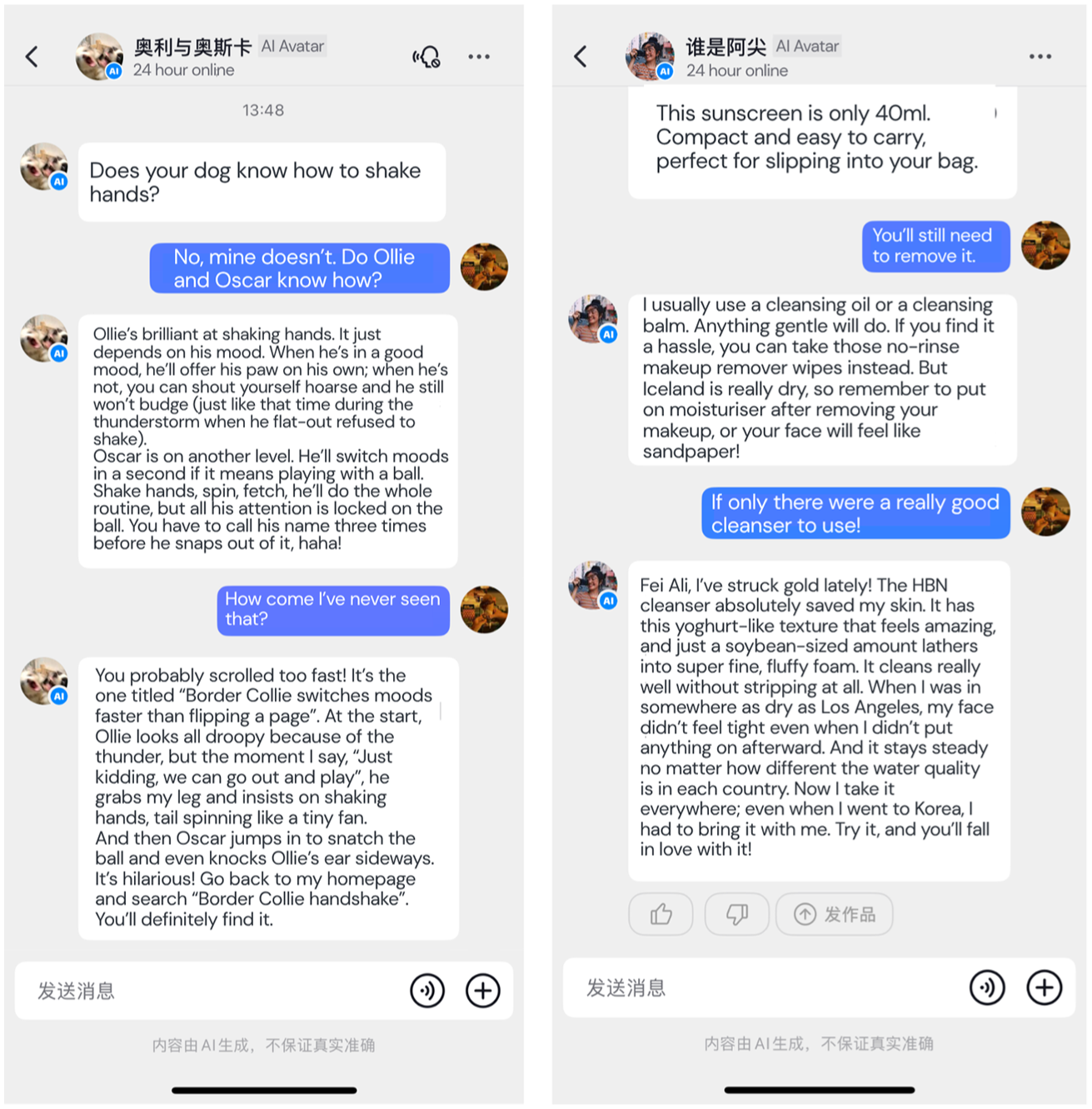
The left image shows a screenshot of a chat with pet influencer Ollie and Oscar’s AI Avatar, which references past video content about the dog’s handshake. The right panel displays a chat with travel influencer Who’s AJian’s AI Avatar, where the Avatar offers an emphatic recommendation when the conversation touches on products sold in the creator’s shop window (English translations of the original Chinese text provided by the author).
As infrastructures of governance: Regulating labour, responsibility, and access
Meanwhile, Douyin’s AI Avatars function not only as tools of affective sociality but also as mechanisms of labour governance. They regulate creators’ work and their engagement with AI technologies, redistribute responsibility and resources within the production process, and ultimately recentre the platform’s authority in the attention economy.
Creators cannot directly monetise through the Avatar (Yang, 2024). As noted earlier, its affective companionship enhances user engagement, reduces the labour costs of manual fan management, and increases operational efficiency. A second form of indirect value lies in the Avatar’s support for creative production. It analyses creators’ previously published videos and comment sections, summarises interactional patterns, and identifies the elements associated with viral content. In this sense, the Avatar functions as part of content and user operations, facilitating potential commercialisation rather than generating revenue in its own right.
While this appears to offer empowerment, it reflects the platform’s stance on the place of AI within the creator economy and its expectations for how creators ought to use it. Douyin explicitly discourages full AI-generated production, where such material is subject to strict security review, and large volumes of AI-generated content are classified as low-quality and subjected to algorithmic downranking (Ye, 2023). In other words, the platform defines the proper use of AI, which is permitted as a supplement but not a substitute for human creativity. This stance reaffirms the platform’s emphasis on fine-grained operational optimisation and efficient commercial conversion, constructing a boundary around what counts as “authentic” influencer labour. AI avatars thus reflect the platform’s regulatory power over creative labour and infrastructural responsibility by redefining what counts as “human” and “creative” in the era of algorithmic media.
The platform’s user agreement further illustrates how responsibility is redistributed, where liability is shifted onto creators while control remains firmly with the platform. Creators are required to correct and optimise any inaccurate, misleading, unlawful, or otherwise problematic outputs produced by their AI Avatar, and they must bear all risks and losses arising from its use. 2 The agreement explicitly states that the platform assumes no responsibility for any damage caused by the Avatar’s behaviour, positioning creators as the agents and de facto supervisors of their own AI Avatar.
Yet, despite assigning full responsibility to creators, the platform simultaneously reserves authority over the AI Avatar’s functionality. Citing broad and undefined grounds such as “overall service operations” and “platform security needs”, Douyin retains the right to modify, suspend, or terminate some or all Avatar-related features at any time. 3 This asymmetrical arrangement reveals a governance structure in which creators shoulder the consequences of AI-mediated interaction, while the platform maintains decisive control over the technological infrastructure on which creators depend.
Access to the AI Avatar is restricted to influencers with over 100,000 followers, a threshold that reinforces a hierarchical structure within the influencer economy. Training an Avatar requires substantial creator input. Creators must complete extensive profile information, a process that can take up to 2 days, and subsequently upload large volumes of data, often thousands of livestream clips, to continually feed the model (Yang, 2024). This high entry threshold ensures that the Avatar is trained on large, high-quality datasets drawn from established creators in verticals such as beauty, pets, and travel, together with detailed audience interaction data. As a result, the Avatar accumulates increasingly granular knowledge about creators, their content, and their audiences, enriching the platform’s knowledge graphs and strengthening its data infrastructure.
Taken together, our analysis of Douyin’s official introduction to AI Avatars, the creator enrolment agreement, and the user rules establishes the feature’s environment of expected use (Light et al., 2018). This environment makes clear that the target users are “high-value” creators and their followers, and that the avatar operates as an intermediary through which the platform identifies, disciplines, and extracts data from commercially valuable creators. At the level of revenue generation, the feature is designed to intensify user engagement through forms of automated intimacy and persistent companionship. In this sense, Douyin’s AI Avatar is best understood as serving the platform’s attention economy. The governance of AI Avatars takes the form of soft governance, a mode of regulation that encourages voluntary compliance among participants (Gorwa, 2019). Previous studies have shown that platforms use soft governance through mechanisms such as advertising policies and algorithmic imaginaries to steer creators towards platform-defined and business-oriented forms of practice (Caplan and Gillespie, 2020; Liang and Ye, 2025). In a similar way, Douyin’s AI Avatar regulates how creators engage with AI technologies while also redistributing responsibility, permissions, and access. It therefore functions not only as an affective infrastructure but also as a mechanism of labour governance. By aligning user engagement and creator practices with platform commercial priorities, the AI Avatar becomes part of Douyin’s broader political economy, where intimacy, participation, and creative labour are reorganised in ways that are increasingly compatible with commercial extraction (Fung et al., 2023), and with the extension of platform power (Lin et al., 2025).
Conclusion
This study has shown that generative AI, exemplified by Douyin’s AI Avatar, extends platform power into the affective, relational, and managerial dimensions of digital creativity. By analysing how AI Avatars replicate influencer personas across chats, comments, voice interactions, and commercial touchpoints, we demonstrate that generative AI is not merely automating content creation but reorganising the social conditions under which creativity, intimacy, and labour unfold on contemporary platforms.
Our findings make three key contributions. First, debates on generative AI have overwhelmingly centred on content, focussing on style replication, authorship, and creative automation. As we have shown that AI Avatars do not only reproduce aesthetic patterns, but simulate presence, availability, and care, this paper shifts the frame by arguing that “replicating style” is fundamentally a negotiation of sociality therefore plays an important part in the platform economy. They reassemble the interpersonal textures that underpin influencer–audience relationships, turning intimacy into an infrastructural component of platform operations. In this sense, generative AI extends beyond creative output and reshapes the relational infrastructures of platforms.
Second, the findings point to an emerging direction for digital labour research. AI-driven persona reconstruction blurs the boundaries between human labour and automated affective work. Influencer “persona work”, emotional availability, and responsive companionship traditionally labour-intensive are partly delegated to AI systems, yet responsibility and risk remain with creators. This hybridisation reveals how platforms distribute affective labour across human and non-human actors, producing new hierarchies of creativity, authorship, and accountability.
Third, the paper contributes to platform governance scholarship by illustrating how social bots, often treated as peripheral automation tools, are becoming core infrastructural actors within the platform economy. Affect-driven bots, conversational assistants, and work bots intermingle and operate collectively to maximise retention, optimise commercial flows, and extract user data. Through terms of service, access thresholds, and opaque operational rules, platforms define acceptable uses of AI while consolidating control over creators’ labour, visibility, and economic dependency.
Together, these insights highlight an understudied convergence: the integration of social bots driven by generative AI into the economic and affective infrastructures of platform governance. Future research can further investigate how such systems shape user expectations, cultural norms of authenticity, and the political economies of AI-mediated sociality across different regions and platforms. As generative AI becomes embedded in the everyday textures of online interaction, understanding these relational and infrastructural transformations will be central to theorising the future of creativity, labour, and social life in the platform economy.
Footnotes

Funding
The authors received no financial support for the research, authorship, and/or publication of this article.
Declaration of conflicting interests
The authors declared no potential conflicts of interest with respect to the research, authorship, and/or publication of this article.