




Abstract
This article traces the evolution of the rule changes to Ofcom’s Broadcasting Code in 2021, in response to a number of high-profile crises in reality TV in 2019, to regulate for better duty of care for participants. By analysing the rhetorical framework around Ofcom complaints, conducting a discourse analysis of Ofcom’s consultation on duty of care and interviews with senior broadcasting executives, it demonstrates how the statutory framework evolves through compliance negotiations around ‘audience expectations’ and ‘freedom of expression’. Analysing the ‘silence and noise’ of the Parliamentary Inquiry and Ofcom’s consultation, shows whose voices were most prominent (broadcasters and production companies) and whose were marginalised from the debate (participants and production crew). The framing of the policy is analysed through the lens of the relationship between the broadcasters and Ofcom in a modern regulatory system that relies on governance mechanisms and models of ‘risk management’. This begins to raise questions about the regulation of care where compliance becomes about protecting the broadcaster from negligence, rather than the participant from harm, calling for a broader approach to an ethics of care which accounts for the interdependencies between all parties involved in reality television production.
Introduction
This article traces the evolution of the rule changes written into the Broadcasting Code of Ofcom, the British media regulator, in 2021 around duty of care towards people who appear on unscripted (reality) television programmes and interrogates the role of broadcast regulation. It analyses the developments in relation to media policy debates about Ofcom’s neoliberal governance structures in terms of the ‘new regulatory state’ (Braithwaite, 2000) and how that has shaped the developments of duty of care in the television industry in the UK. Ofcom is the regulatory body established in 2003 under the UK government’s Communications Act to oversee and set standards for the content of UK television and radio programmes via its Broadcasting Code. In the wake of a spate of high-profile suicides of ex-reality television participants, from 2019 to 2020 Ofcom ran a public consultation on proposed new rules for inclusion into the Broadcasting Code around ‘due care’ to protect the welfare of participants in broadcasting, which came into force in 2021.
Here, we analyse the evolution of Ofcom’s regulatory remit in relation to the nature of care for participants in unscripted television and consider the way in which policy is made through the relationship between the broadcaster and the regulator. We use Freedman’s (2008) approach to media policy analysis which focuses on ‘the interaction between different actors, the institutional structures within which they work and the objectives that they pursue’ (2008: 13). We consider how policy-making ‘is both political and marked by conflict’ in that it is ‘circumscribed by institutional, economic, technological and governmental dynamics – and actor-driven in the pursuit of different norms and goals’ (Freedman, 2008: 4). We take three approaches. First, we discuss the ground prepared for the consultation through Ofcom’s complaints procedure, secondly, we discuss the scale and range of voices that fed into the Ofcom consultation and their discursive frameworks and finally we draw from interview data with broadcast executives.
When reality television began to boom in the UK in the early 2000s, researchers were already raising ethical concerns around the way that content was made. Hibberd et al.’s (2002) report for the UK Broadcasting Standards Commission into issues around informed consent in reality television found that participants were not always given adequate information or were not made fully aware of how they might be portrayed (2000: 8), while Varney (2009) pointed out that the increase in reality television programming created the need for enhanced content regulation, particularly around offensive content. These issues were still unresolved by the time of Ofcom’s 2019 consultation.
In following Freedman’s (2010) direction to pay attention to the ‘silence’ as well as the ‘noise’ of policy making, we argue that despite the earlier warnings, there has been an absence of voices that are key to the experience of care in production, whilst the dominance of the views of broadcasters can be seen to have shaped regulatory outcomes through models of compliance. Through our discourse analysis we outline a rhetorical framework and a set of operational definitions around ‘audience expectations’ and ‘public interest’ which influence the potential range of policy outcomes. We suggest that this results in a regulatory focus on care which leans towards protections against negligence in the interests of the broadcaster, rather than an ethical framework that can address care as a condition of mutual dependency and fully protect those most directly affected by a lack of care in unscripted TV production.
Ofcom, governance and reality TV in the UK
Established by the New Labour government in 2003 as a response to the evolving nature of broadcasting, telecommunications and computing in the digital age, Ofcom replaced five separate broadcasting and telecommunications regulatory bodies, representing a shift in focus ‘towards the control of market power to facilitate free market competition’ (Smith, 2006: 929). Ofcom’s development is part of a wider acceptance in advanced capitalist economies of the ‘universalism of the market’ (Beck and Ritter, 1992: 104) whereby it becomes the superior resource-allocating mechanism. Analysts saw this as part of a transformation – or a ‘hollowing out’ (Rhodes, 1994) – of the state. The state was seen as ‘overloaded’ with responsibilities, failing to intervene in key social challenges or handling of emerging globalised agendas and bodies, such that its responsibilities were best transferred to a series of semi-autonomous agencies to replace government centres (Pierre, 2000). Here ‘arenas of governance’ emerge, which Shearing (1997) refers to as a type of ‘neo-feudalism’ where the language of expectations (‘rights’) and responsibilities (‘duties’) emerge in new communities of governance. As Braithwaite (2000: 233) argues, in this ‘new regulatory state’, with privatisation and increased self-regulation, ‘risk-management’ becomes central whereby, ‘responsive regulation also flows into strategies for regulating already private institutions through compliance systems, codes of practice and other self-regulatory practices’.
It is through this lens that we can understand Ofcom’s oversight in the regulation of UK broadcasting as it evolves from its sole public-service model to its hybrid marketised model, with the development of a robust independent commercial sector. Here Ofcom is responsible for enabling (and thus potentially revoking) the licences of the main public service broadcasters: BBC, ITV, Channel 4 and Channel 5, 1 whilst at the same time it can hold them to account for their compliance with the Broadcasting Code of Standards and is able to impose operational and financial sanctions on any breach.
In the development of Ofcom we can see some of the struggles inherent in this regulatory shift, whereby the UK has also tried to hold on to a more patrician public service model of broadcasting with the preservation of the licence fee. Liberalisation and de-regulation were certainly at the centre of The Communications Act of 2003 which paved the way for opening up the UK media market, but Hesmondhalgh (2005) outlines the way in which New Labour’s approach to media and cultural policy emerged from its own particular brand of neoliberal politics. Thus, as outlined in the 2003 Communications Act Clause 3.1, Ofcom’s duties are:-
(a) to further the interests of citizens in relation to communication matters;
(b) to further the interests of consumers in relevant markets, where appropriate by promoting competition.
These seemingly distinct imperatives set in motion a discursive struggle, trying to balance citizen and consumer interests and their related values. In this period, Ofcom established the notion of the ‘citizen-consumer’ with a mission statement that claimed, ‘Ofcom exists to further the interests of citizen-consumers through a regulatory regime which, where appropriate, encourages competition’ (cited in Livingstone and Lunt, 2012: 43). But the reconciliation of the ‘citizen-consumer’ is not easily achieved and so to clarify regulatory oversight there was a separation into a Consumer Panel to deal with consumer interests and a Content Board to ensure citizen interests in relation to broadcast content. This distinction, as we go on to show, makes it difficult to regulate for the protection of participants in reality television.
Whilst Ofcom was established with Labour’s emphasis upon a stakeholder society, it subsequently also presided over the exponential growth of the independent production sector and of market competition and exports. Reality television was a central ingredient to the UK TV success story. The independent production sector, established in 1982 with Channel 4’s remit to commission rather than make diverse programmes, birthed the rise of multiple independent production companies, stimulated by the trade agreements of the 2003 Communications Act. This generated hundreds of companies and large profits, driving horizontal and vertical integration into the establishment of the ‘Super Indies’, which by the mid-2000s ‘had become a lynchpin in the promotion of the United Kingdom’s creative industries as a major source of economic growth for the country’ (Bennett, 2015: 84). This commercial environment was key to the rise of big-budget formats like Big Brother (Channel 4 2000–2010, Channel 5 2011–2018, ITV 2023-) and British unscripted content became a leading force in the global franchise TV market. By 2014 PACT (trade body for independent production) reports that the sector was worth more than £2bn (cited in Bennett, 2015) although it is important to note that the once booming industry is currently experiencing a considerable contraction, with a fall in UK revenue by £392m to a total of £3.61bn (Pact, 2024).
Globally, reality television has been seen as a solution to television market pressures, reductions in advertising revenue and greater competition from the internet, platforms, and streaming services (Raphael, 2004). In the US this was particularly the case in the wake of the 2008 Sag-AFTRA writers’ strike, leading to Ross’ (2014) description of reality television as a ‘scab genre’. In the UK for some, this much more aggressively competitive production sector was hampering public service aims, rather than delivering the original remit for Channel 4 to generate freedom and creativity (Ellis, 2013). The ‘Super Indies’ were chasing lucrative formats with a largely de-unionised, freelance and precarious workforce which meant that the ‘moral core of television production’ was put ‘under increasingly significant pressure’ (Lee, 2011: 491). Back in 2011 David Lee was discussing the poor working conditions for crew which must impact upon ethical decision-making and public service, conditions which have only intensified over the last decade (Van Raalte et al., 2021).
It is no surprise that Celebrity Big Brother (Channel 4 2001-10, Channel 5 2011-18, ITV 2023–) was one of the first shows that generated controversy for the ways in which participants were being treated on set, hitting the headlines for the ‘Shilpa Shetty race row’ (BBC, 2007) in 2007. After more than 45,000 complaints to Ofcom over the bullying of the Bollywood star, Channel 4 was sanctioned by the regulator for ‘serious editorial misjudgements’ and a ‘serious failure within Channel 4’s compliance procedures’ (Ofcom, 2007: 5). Yet reality television continued to thrive over the next decade. In particular, the re-launch of Love Island (2005–6 & 2015–) by ITV in 2015 saw a new era for reality television, one which had a symbiotic relationship with social media tie-ins. Reality television again breathed life into linear broadcasting, bringing back a younger demographic. However, now reality TV participants were not only subject to tabloid scrutiny but were also subject to the online trolling that now typifies much of the misogynistic social media environment (Jane, 2020). Over the 2000s, explosive moments on set, such as arguments on Big Brother, bullying in ITV’s Celebrity jungle or toxic relationships in Love Island, dominated social media and tabloid press headlines. 2 This volatile environment seemed to hit its peak in 2019 and was understood as a contributing factor to the deaths by suicide of a number of reality television participants, leading to a Parliamentary Inquiry in 2019.
Audiences were also becoming more concerned. We have counted the number of complaints Ofcom assessed in 2019 in relation to reality television at 31,835. This number includes another high-profile explosive confrontation: 25,322 complaints about an incident between two participants of Celebrity Big Brother (Channel 5) in August 2018, which became known in the media as ‘punch-gate’. 3 The number of complaints to Ofcom about the treatment of participants, coupled with a number of high-profile suicides triggered two processes: a Parliamentary Inquiry and an Ofcom Consultation which led to a policy change in the Broadcasting Code in 2021.
Public outcry and regulatory intervention
The public outcry around reality television in 2019 seemed to reflect wider societal conversations about mental health, found in newspaper headlines following the tragic deaths of reality television participants from two ITV shows: The Jeremy Kyle Show (ITV 2005–2019) (a conflict-resolution talk show) and Love Island (ITV 2015–) (an immersive dating show). As a result, the UK government’s Department of Digital, Culture, Media and Sports (DCMS) select committee launched a public inquiry to ‘consider production companies’ duty of care to participants and ask whether enough support is offered both during and after filming, and whether there is a need for further regulatory oversight in this area’. (UK Parliament, 2019).
In June and September 2019, the committee took oral evidence from broadcasting executives and ex-participants. Written evidence was supplied by participants, industry and academic experts, advisory bodies and audiences. A committee press release after viewing ‘whistle-blower’ footage of The Jeremy Kyle Show – drawn from experts’ analysis of that footage – suggested that a ‘bullying methodology’ operated on the show (Dare and Wood, 2019). However, the inquiry shut down in 2020 due to a general election, before any firm conclusions were established.
In 2019 Ofcom also launched its consultation into the protection of participants in television and radio, in response to the steady rise in complaints, to provide ‘a clear and consistent approach based on best practice, so that broadcasters and programme makers are applying a generally accepted standard of care to those who take part in their programmes’ (Ofcom, 2019:5). Ofcom launched the consultation in July 2019, with a second round of consultation in March 2020, proposing two new rules to be added to Section 2 (Harm and Offence) of the code. In December 2020 Ofcom announced new rules to be added to Section 7 of the Code (Fairness), instead of Section 2: Where a person is invited to make a contribution to a programme (except where the subject matter is trivial or their participation is minor) they should normally, along with the other measures as already set out in Practice 7.3, at the appropriate stage: . . . be informed about potential risks arising from their participation in the programme which may affect their welfare (insofar as these can be reasonably anticipated at the time) and any steps the broadcaster and/or programme maker intends to take to mitigate these. Broadcasters should take due care over the welfare of a contributor who might be at risk of significant harm as a result of taking part in a programme, except where the subject matter is trivial or their participation minor.(Ofcom, 2020b: 2)
Changes came into force in April 2021 with an accompanying set of guidelines and a risk matrix for productions. Ofcom’s published complaints adjudications at the time of writing show that of the 10 complaints made by participants of reality television under section 7 (Fairness) and 8 (Privacy) since the implementation of the code changes in 2021, only two have been partially upheld and none have been fully upheld. 4 An analysis of the discursive background to the consultation and the way in which the regulatory landscape operates around broadcast content, begins to tell us why.
Methodology
As part of the wider research project, ‘ReCARETV:Reality television, working practices and duties of care’, which also involves interviews with television executives, crew and reality television participants, we analysed the publicly available materials leading up to the changes to the Broadcasting Code in 2021. This involved looking at the nature and investigation of complaints to Ofcom in relation to reality television, as well as mapping the public evidence given to the DCMS public inquiry and to the Ofcom consultations on duty of care.
We also counted the number of complaints dealt with by the regulator in relation to reality television in the years 2007 (the year of the Shilpa Shetty row) and 2019 (the year of the consultation). We did this by analysing the content of Ofcom’s ‘Broadcast and On Demand Bulletins’, published fortnightly on its website. These bulletins give details of the complaints adjudicated over a 2-week period. We looked at the outcomes and discussion of those complaints upheld, as well as those that were not investigated, to get a sense of the existing framework within which reality television complaints were being assessed. It must be noted that deciding what constitutes a reality television programme is not a precise method given its blurred generic boundaries. The process was also complicated by the changes to the way Ofcom presented its data and decision-making over the years.
We also analysed the 49 pieces of publicly available written evidence submitted to the Parliamentary Inquiry in 2019, published on the DCMS select committee website (UK Parliament, 2019) as well as the 45 written responses to Ofcom’s first and second rounds of public consultation on its proposed changes to the Broadcast Code in 2019, published on Ofcom’s website (Ofcom, 2019). We grouped the types of respondents and quantified the number of responses to gain a picture of the range and volume of the voices and competing interests that were contributing to the policy-making process. We then broadly applied a critical policy analysis framework (Taylor, 1997) looking for themes and positions, in relation to institutional structures, particular actors and the competing values and pressure for outcomes at work.
We recognise there is a methodological problem analysing the development of policy via what is made available as a matter of public record, since, as Ofcom makes clear: ‘Ofcom met with a range of experts, major broadcasters, and people who had first-hand experience of taking part in TV programmes as part of the consultation process’ (Ofcom, 2020a: 5). This paper also draws on data taken from 22 interviews (undertaken in 2024–2025) with senior broadcaster executives from the major UK broadcasters (BBC, ITV, C4, Channel 5/Paramount and Sky). These interviews were carried out in a combination of in-person and online contexts and form part of a wider set of interview data with crew and reality television participants across the project. It is important to note that all research participants across the project had the opportunity to review and redact data before agreeing the final transcript available for analysis. The interviews were secured via a key gatekeeper at each of the broadcasters, either in compliance, senior welfare roles or commissioning. In these interviews we discussed working practices in relation to duty of care and understandings of the code change which we use here to contextualise the discursive contributions to this regulatory shift.
The complaints process as a rhetorical frame: Audience expectations and ‘the public interest’
The development of the code change does not come from one given period during the consultation process. Rather, the discursive landscape emerges through the interactive relationship between the broadcasters and Ofcom over time through the compliance process. Braman (2004) notes that even the identification of a policy issue is political ‘because it determines who participates in decision-making, the rhetorical frames and operational definitions used, and the resources – and goals – considered pertinent’ (2004: 154). Given the high volume of complaints about reality television, the 12-year gap between the Shilpa Shetty case and Ofcom’s consultation on changes to the Broadcasting Code might seem surprising, especially since the previous regulatory body published a report on the problems in 2002. Analysis of the regulator’s complaints procedure indicates that one reason for this delay might be in the way in which Ofcom’s regulatory remit is set out in relation to ‘Content’.
Ofcom is a post-broadcast regulator which protects its citizenship values via the audience complaints process and ultimately the Content Board (currently made up of 1 academic and 10 experienced media professionals), regulating around standards of decency, offence, harm, fairness and privacy. When participants of reality programmes have complained about their treatment in terms of unfair portrayal or invasion of their privacy during the production, we can see from the Bulletins that these complaints are rarely upheld, with the context of the programme as broadcast used as a determining factor in Ofcom’s adjudication.
The primary framework before the code change is to protect the audience from offence and not the participant from harm. We see this in the language used in adjudicating complaints made about ‘punch-gate’ under Rules 2. 1 and 2.3 (General Standards) of the code in 2019, which deal with issues such as offensive and discriminatory behaviour and are the section of the code most audience complaints fall under. Ofcom makes it clear that under these rules ‘
Broadcasters maintained that offensive scenes in reality television could be justified in the context of the nature of the show, and that audiences would expect to see such content in a long-running format they have grown to know well. For example, in response to audience complaints about ‘punch-gate’ in Celebrity Big Brother 2018, Channel 5 said that it was ‘a well-known reality television programme with a reputation for an honest and faithful depiction of the activities of the Housemates’ and highlighted that, ‘Indeed, the audience would be disappointed if such situations did not arise [. . .] viewers were entitled to see the incident, how it had affected Roxanne and how Big Brother had dealt with the situation’ (Ofcom Broadcast and On Demand Bulletin 373, 2019: 81-83). Ofcom ruled that the broadcasting of ‘punch-gate’ was therefore actually not in breach of the broadcasting code, largely because audiences can expect confrontation. This becomes an important rhetorical frame from the complaints framework which impacts how duty of care is discussed in the consultation.
The second important frame is how Ofcom’s statutory framework emphasises the right that broadcasters have to freedom of expression: Ofcom takes account of the audience’s and the broadcaster’s right to freedom of expression set out in Article 10 of the European Convention on Human Rights. In carrying out its duties, Ofcom must seek to balance the broadcaster’s freedom to broadcast potentially offensive content and the requirement in the Code to ensure that material which may cause offence is justified by the context. (Ofcom Broadcast and On Demand Bulletin 373, 2019: 85–86)
Article 10 plays an important role in the adjudication of Fairness (Section 7) and Privacy (Section 8) complaints cases: the sections of the Broadcast Code under which a participant/contributor might complain about how they have been treated in the making of television. In Section 8 of the code, the regulator conducts a balancing exercise between the rights of the broadcaster to freedom of expression and the rights of participants to privacy (article 8 of the Human Rights Convention). This highlights a power imbalance, with broadcasters regularly arguing that their right to freedom of expression and the public interest nature of the story is more important than an individual’s expectation of privacy – a principle which is understood as an important value for journalistic investigation in a functioning democracy. However, we might want to question the use of freedom of expression for shows that are ostensibly about entertainment rather than news – whilst the distinctions between those shows are not always clear. For example, in response to a complaint of unwarranted infringement of privacy in the docu-reality show about the work of bailiffs, Can’t Pay? We’ll Take it Away! (Channel 5 2014–18), where the complainant claimed they had not given permission for filming or for entry to their home, Channel 5 argued that: [when] the subject matter of a broadcast contains information which is of public interest, and the broadcast of the material is capable of contributing to a debate of general interest, then this should be accorded significant weight when conducting the balancing exercise. (Ofcom Broadcast and On Demand Bulletin 375, 2019: 77)
In this case Ofcom’s decision was that the public interest outweighed expectations of privacy and did not uphold the complaint. 5
Out of the 6 Fairness and Privacy cases adjudicated in 2007, only one was upheld and by 2019, none of the 6 cases presented were upheld. In Fairness and Privacy cases which involved complaints about participants’ lack of consent and unfair editing, broadcasters often argued that participants would have been aware of the nature of the shows because they had previously watched them, and therefore by appearing on them they were giving tacit consent to the broadcasters’ editorial decisions. For example, in 2009, Ofcom did not uphold a complaint by a participant on The Trisha Goddard Show (ITV & C5, 1998–2010) that she had not given informed consent because of ‘the well-established nature and format of previous editions [of the show]’ (Ofcom Broadcast Bulletin 133, 2009: 26). The problematic assumption here is that the ‘likely expectation of the audience’ gets transferred to the participant; by having watched the broadcast transmission of a show as a member of the audience, participants are assumed to understand the nature of taking part. This blatantly ignores the very complex processes of staging, direction, production and editing that any show moves through before transmission – processes about which lay participants will mostly know very little.
Between 2007 and 2019 it is possible to see a pattern for dealing with complaints emerging. Over time broadcasters successfully argued that context, public interest and editorial judgement were reasons not to uphold complaints. As a template for adjudication formed, many cases were investigated internally by the Ofcom Executive without gathering evidence from the broadcasters, and in July 2011 Ofcom introduced a new table of ‘Complaints Assessed but not Further Investigated’, stating that ‘after careful assessment, Ofcom has decided not to pursue [these complaints] because they did not raise issues warranting investigation’ (Ofcom Broadcast Bulletin 186, 2011: 103). In 2019, 6210 general standard complaints made about reality programmes in relation to racial, gender, sexual orientation and disability discrimination, along with offensive language and harmful behaviour were assessed but not pursued. Similarly, in most of the Fairness and Privacy cases pursued by participants in programmes across this period, Ofcom agreed with the broadcasters’ arguments about content being ‘in the public interest’ and/or the fact that participants expectations would mean they were fully aware of what to expect on a show. In assessing the nature of the ‘Content’ in this way, the experience of the ‘ordinary participant’ and any protections that might be afforded to them, fall through Ofcom’s regulatory purview.
Ofcom as a post-broadcast regulator is therefore both part of a deregulatory model which saw market principles support the exponential growth of reality television in the UK, and at the same time establishes a complaints framework which in prioritising ‘the public interest’ historically failed to protect the participants on whom reality television relied. Since they are not actors (or those who had the required minimum ‘professional experience’ to be considered for union membership to Equity), or ‘employees’ with labour contracts and worker rights, reality television participants were (and still are) a largely unprotected and ‘free’ resource vital to the production of reality television (Wood et al., 2023). Without any regulatory or protective oversight of this group, it is hardly surprising that crises began to emerge and in 2019 in the UK both Parliament and Ofcom sought to intervene.
Silence and noise in the Parliamentary Inquiry and the Ofcom Consultation
In this section, we conduct a comparison of the different voices in the Parliamentary Inquiry and Ofcom Consultation focusing on ‘the contrasting sets of ideas that are either normalised or marginalized in the clashes that take place’ (Freedman, 2008: 13). Freedman argues that we must look not only at the public exercise of policy practice, but also the non-policy making (what is not discussed, whose voices are not heard), considering ‘the means by which alternative options are marginalized, conflicting values delegitimized, and rival interests derecognized’ (Freedman, 2010: 347) since decision-making is an ideological process structured by unequal access to power.
In the following charts (Figures 1 and 2) we compare the quantity and types of voices that contributed to both the Parliamentary Inquiry and the Ofcom Consultation.
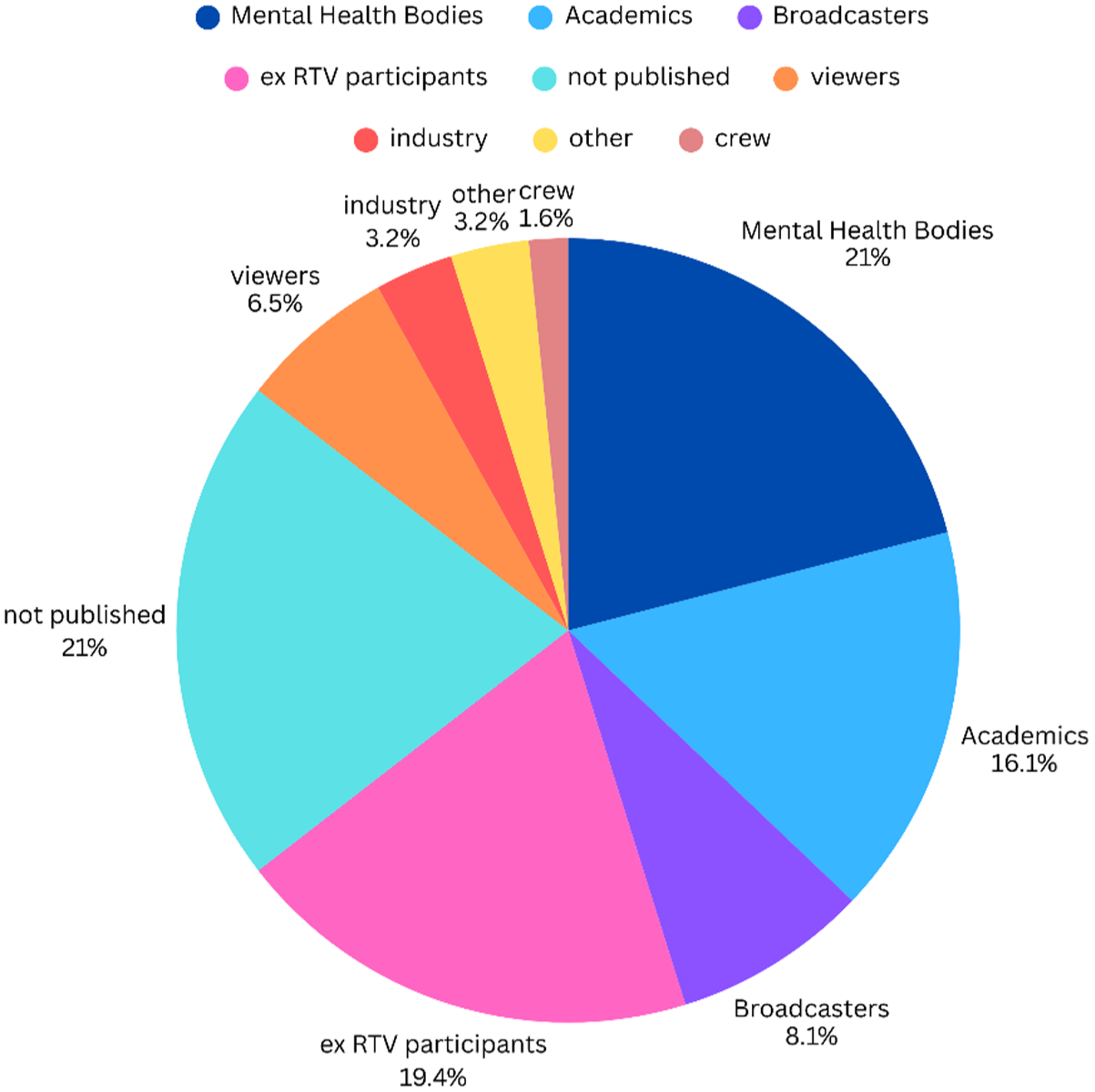
Written responses to the Parliamentary Inquiry. (Total responses 63, 49 publicly available).
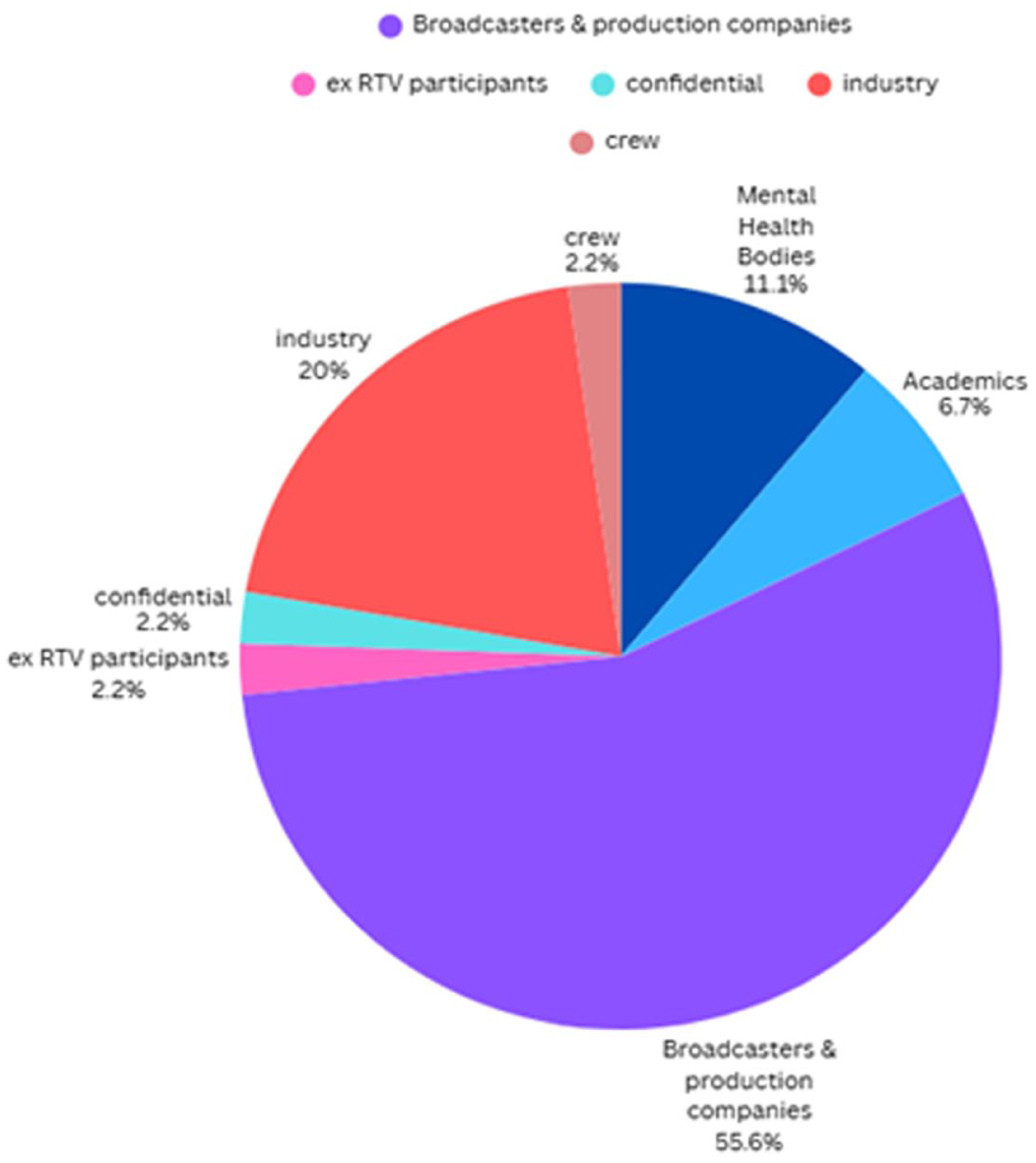
Written Responses to Ofcom’s first and second round of consultation. Total responses: 45 (30 responses to first round and 15 responses to supplementary questions in second round).
‘Silence’ in the consultation
21% of written contributions to the Parliamentary Inquiry were unpublished (in our email communication with the select committee this was suggested to be those who asked for their contributions not to be made publicly available). Published responses to the Inquiry involved a much broader range of contributions from different stakeholders, including advisory bodies, charities and a considerable number of reality television participants (19.4%) while broadcasters and producers made up only 8.1% of the submissions. Here, a range of ex-participants, advisory bodies and academics were primarily concerned with the kinds of issues that seemed beyond Ofcom’s framework as construed through ‘Content’ as described above, such as questions of informed consent, psychological mistreatment, unethical editing and misrepresentation. By contrast, in the Ofcom consultation the broadcasters and producers make up 55.6% of submissions, with industry bodies the next largest group. The broadcasters, producers and industry bodies were mainly concerned with the mechanics of the proposed regulation in terms of language, context, and implementation, while mental health groups, academics, and charities still voiced concerns around consent, mistreatment and psychological harm.
Ofcom prides itself on being a consultative regulatory body and commissions consultations on various aspects of its operational mandates, but as Livingstone and Lunt (2012) point out there are problems in terms of which stakeholders have the ability to respond from within their uneven resources. One of the first things to note in Ofcom’s consultation process is the glaring absence of the voices of viewers, participants and crew. While 6.5% of the Parliamentary Inquiry responses came from those who identify themselves as viewers, there are no responses in this category for the Ofcom consultation.
The Parliamentary Inquiry drew on the oral and written testimony of participants, with four oral testimonies heard and 10 written testimonies submitted. This included oral and written testimony from Dwayne Davison about his experiences of unfair portrayal, bullying and lack of consent on The Jeremy Kyle Show and oral testimony from two participants of Love Island who had recently appeared on the show. However, participant voices are almost absent from Ofcom’s written consultation, with only one response on behalf of a participant. It is also worth noting that previous participants of Love Island who had documented their poor experience in the press around the same time did not give oral evidence to the Parliamentary Inquiry. 6
Voices of crew are also largely missing from both the Parliamentary Inquiry and Ofcom’s consultation process, receiving only one response each which were concerned with crew safety and wellbeing. A clue to the lack of representation of crew can be found in the response to the consultation submitted by Directors UK (a professional association for screen directors) suggesting that those involved in production might be too afraid to speak at all: One of the key issues we have heard from our members is regarding the ability of production teams to raise concerns and have them recognised and addressed by other senior or more permanent members of the production. Often directors, who are almost always freelance, feel unable to flag their concerns for fear of being seen as a troublemaker which can impact on finding future work, some have found that their concerns are dismissed by other members of the production team. (Directors UK, 2019: 1)
Television production involves a complex set of relations between commissioners, heads of production, directors and crew, as well as reality television participants and these relationships are central to any understanding of care in production (Coleman, 2025). However, Directors UK claimed that the concerns they raised in the first round of consultation on behalf of crew about how new regulation would impact on them in terms of budget, a safe space to raise concerns, and monitoring the enforcement of the code, including their suggestion of an independent method of scrutiny, ‘have not been adequately addressed in these updated proposals and guidance’ (Directors UK, 2020:3).
The noise of the broadcaster: Protecting freedom of expression
In its 2019 consultation document Ofcom sets out a ‘proportionate and flexible approach’ to balancing different needs, taking a relatively cautious position and stating ‘Our proposal for new rules and guidance in this area is not a
The consultation document sets out a civic rhetorical framework around questions of ‘freedom of expression’ that are rehearsed in the complaints process whereby content is justified as ‘in the public interest’. Broadcasters and larger production companies with the resources with which to respond robustly from within their legal and compliance departments make use of the established operational definition of ‘freedom of expression’ and repeat Ofcom’s cautious approach. So, in their consultation responses we see the BBC argue that rules must not have ‘
Indeed, this argument is also extended to suggest that more hard-line legislation might impede the freedom of expression of participants themselves appearing in shows and thus this position is used for the protection of participants and audiences alike. For instance, Channel 4 argues, To unduly restrict the involvement of certain people–for example those who have previously suffered from a mental health condition–from taking part in a TV programme would not only be discriminatory, but by limiting the range of stories and experience shown on television, and the empathy, understanding and conversation those stories have the power to generate, it would be detrimental to both viewers and society as a whole (Channel 4, 2019: 28)
What is curious is that this is not an issue brought up by any of the very few participants that we hear from in either the inquiry or the consultation, (or for that matter across our wider research data) rather it is only spoken about by the broadcasters on behalf of potential participants. Whilst broadcasters do demonstrate a resounding commitment to duty of care in the interviews for this project, there is also an occasional concern that legislation is making it harder to speak to some groups. For instance, one commissioner says, But for the people who are the hardest to reach and who’s in society, we need to quite be able to explain their stories. Why it’s important. They are the ones who have just got harder and harder and harder to reach, which means that we don’t go near it, which means that as a society, we aren’t talking about the really important things we’re talking about the things that are cleaner and easier. (Commissioner, major broadcaster)
The main fear expressed by the broadcasters – that the rules will have a ‘chilling effect’ on journalistic enquiry – draws on a firmly civic issue to push back against further regulation. This dominating frame draws on the rights of the ‘citizen’ – privileging the public’s ‘right to know’ (public interest) and the citizen’s ‘right to speak’ – but curiously the ‘citizen’ and the reality television participant do not occupy the same discursive space. Does the right to be cared for in production necessarily have to come at the expense of the right to speak for vulnerable groups?
In this way the civic values of creative freedom are being mobilised through a discursive frame which protects the position of the broadcasters via the rights of ‘the public’ as a more important constituency than participants. The use of ‘in the public interest’ is pitched as competing with the participants’ needs for protection through which there seems a higher moral disposition towards a principle of ‘the greater good’. The echoing of the word ‘proportionate’ across the documentation reinforces an agreed approach which immediately resists suggestions for any radical alternatives or intervention and supports the position of Ofcom as a ‘light touch regulator’ (Livingstone and Lunt, 2012).
The broadcaster and the regulator: An embedded affair
In Gibbons’ older critique of Ofcom’s consultation processes, where he is critical of the dominance of commercial thinking over their responsibilities to citizenship, he suggests that ‘there is a tendency to use the aggregation of preferences and opinions as a means of legitimating its views’ (Gibbons, 2005: 47). He criticises Ofcom’s reliance on surveys, ‘rather than making a substantive case for the significance of the values at stake’ (ibid: 48). On this issue in 2019, it is hard to see here where Ofcom’s views end and where the broadcasters’ begin. Rather, what we see are established rhetorical frames and agreed operational definitions which make intervention into an entirely new area – difficult to conceive via any alternative framework.
Levi-Faur describes how regulation expands the state through an approach which is ‘more steering than rowing’ (Levi-Faur 2014: 599) and shows how financial regulation is embedded within the welfare state and in turn produces policy, ‘through enforced self-regulation, compliance systems, codes of practice and the other responsive techniques that substitute for direct command and control’. (ibid: 602). We can see a similar model at work here where the regulatory mechanisms of Ofcom are thoroughly embedded within the broadcasters’ robust compliance departments and exercised and reinforced in the complaints process. Thus, although Ofcom has the power to impose sanctions on broadcasters who it judges to have breached its codes, broadcasters ultimately help to define the regulatory practices upon which they are financially dependent for their licences to operate and function
In our interviews with senior broadcasting executives, they were keen to express their commitment to duties of care, pointing out how much involvement they had in the changes to the Broadcast Code – in effect doing some of the ‘rowing’ of the policy work ‘steered’ by Ofcom.
[when asked about duty of care] ‘we introduced that phrase and that’s what we talked to Ofcom about when we met them, when they were revising their guidelines, [. . .] we had several meetings with Ofcom and then you know, trying to put our point of view. And then we sent our responses, I think to the draft and to the- and to the final submission or their near final submission’ (Senior policy advisor) ‘We fed into the work that Ofcom was doing and that DCMS were doing and a lot of the work that [major broadcaster] had done was encapsulated in the Ofcom code, so it’s not something that’s been imposed on us’. (Senior policy advisor) ‘You probably know that the Ofcom rules as they are now, were largely based on what we had already put into practice [. . .] In practical terms, they [rule changes] haven’t made any difference to us because they were our rules effectively’. (Legal director)
Since the introduction of the code change, care for participants on reality television seems to have significantly improved, with evolving guidelines and much more psychological support in place. The apparently low rate of complaints from participants might itself be evidence that the code change is effective, although it is difficult to see how many participant complaints are not entertained by the regulator because they do not fit Ofcom’s established rubric. However, what this does suggest is that more interrogation is needed into how the complaints process works and whether participants complaints can really be heard. The rhetorical framework for the code change, built through the compliance process, seems to confirm agreed operational definitions that are the product of Ofcom’s embedded relationship with the broadcasters. This sustains a very complex complaints process as well as robust broadcaster legal compliance departments.
Conclusion
Of all the evidence given to the consultation on the changes to the code, the voices of two important constituents – crew and participants – are either entirely or mostly absent. This is curious, but we can see this as a product of a number of factors: firstly, Ofcom’s reluctance to intervene in production rather than ‘Content’ as a post-broadcast regulator; secondly, the discursive framework of Ofcom which takes its public values as related to the citizen-consumer dialectic and the moral hierarchy of the right to ‘freedom of expression’; and finally the embedding of the discursive framework of the compliance process within the consultation which mostly aggregates the views of broadcasters and production companies rather than take any stronger independent direction.
Braithwaite (2000) tells us that the new regulatory state, as a response to ‘market mentality’, means the rise of risk-management principally to protect market interests. By introducing care as a regulatory process, with accompanying guidelines like a ‘risk matrix’ for production, Ofcom arguably sets ‘due care’ (a term the broadcasters suggest they introduced) at the heart of a compliance process to protect the broadcaster from cases of negligence, rather to insist on better care for participants. ‘Due care’ in tort action is what ‘a reasonable person would exercise in the same situation or under similar circumstances’ (Legal Dictionary, 2017) and is used to determine the absence of care.
Ofcom as a broadcast regulator cannot offer any reparation for any participant who it deems has received poor care, therefore there is still a remaining issue as to who can truly represent or protect this constituency (Wood et al., 2023). The senior executives in our interviews raise concerns about the use of a risk matrix as a ‘tick-box exercise’ and suggest that they are committed to avoiding that approach. But regulating for care is different to thinking about an ‘ethics of care’ where ‘there is much to be said for recognizing how the ethics of care values interrelatedness and responsiveness to the needs of particular others, how the ethics of justice values fairness and rights, and how these are different emphases’. (Held, 2006: 16). A question therefore remains as to whether the code changes and the balancing act of ‘rights’ as they emerge from frameworks of market governance can fully protect participants within the interconnected set of relationships at the heart of television production.
Footnotes
Acknowledgements
We would like to thank all the members of the ReCARETV team, our advisory board and in particular Jilly Kay and Nina Willment for their comments on earlier versions of this article. Many thanks to Hayley James for feedback on a presentation at Aston University that helped the development of the paper and to the anonymous reviewers for their comments which strengthened the piece.

Ethical considerations
The Business and Social Science Ethics Committee at Aston University approved our use of publicly available data and our interview process. Approval ID BSS21147, on 25th March 2024.
Consent to participate
All interviewees gave written and verbal informed consent to recorded interviews and the use of their data for publication.
Funding
The authors disclosed receipt of the following financial support for the research, authorship, and/or publication of this article: This work was supported by the Arts and Humanities Research Council [AH/00676X/1 ‘ReCARETV: Reality television, working practices and duties of care’].
Declaration of conflicting interests
The authors declared no potential conflicts of interest with respect to the research, authorship, and/or publication of this article.
Data availability statement
The data used in the document analysis for this piece is publicly available. Data taken from interviews will be made available via Aston University on request within 3 years of the project completion scheduled to complete in September 2026.