




Abstract
This study investigates how mobile-first journalism is reconfiguring participatory news production and gatekeeping in informal economies, with a focus on urban South Africa. Addressing the problem of whose voices gain visibility and legitimacy in the digital age, the research integrates digital ethnography and semi-structured interviews with journalists, citizen reporters, and platform users in Johannesburg and Durban. In this study, voice refers to who can speak, contribute, and be recognised as a legitimate news participant, while visibility refers to whose contributions become searchable, shareable, and publicly legible within mobile-first news flows. The study is grounded in a theoretical framework combining digital public sphere theory, networked gatekeeping, and participatory culture, and introduces the concept of “mobile-mediated gatekeeping” to capture novel forms of editorial power and community agency. Results show that mobile-first platforms foster inclusive practices and amplify vernacular knowledge but also produce new exclusions through algorithmic bias and shifting infrastructural constraints. The findings contribute original theoretical insights by advancing “mobile-mediated gatekeeping” as a distinct analytic tool, showing how practice-based innovation within informal economies challenges conventional models of media power. Implications include recommendations for platform design, media policy, and scholarly approaches to digital voice and participation in the global South.
Keywords
Introduction
The transformation of journalism in the digital age is increasingly shaped by the dynamics of platform infrastructures, algorithmic gatekeeping, and shifting modalities of participatory practice (Couldry and Mejias, 2019; Helberger, 2019). While prominent theoretical work underscores the democratising promise of digital journalism, there remains a substantial gap in understanding how the methodological, technological, and normative underpinnings of mobile-first news practices impact voice and visibility in non-Western contexts, particularly within informal urban economies (Chambers, 2023; Gadjanova, 2021). Existing scholarship still too often centres legacy institutions and established actors, leaving unresolved the question of who gets to speak, whose stories circulate, and how digital inclusion and epistemic justice are realised beyond metropolitan core settings (Beyes, 2022; Matassi et al., 2019).
In South Africa, rapid advances in mobile connectivity and platform adoption have precipitated an unprecedented reorganisation of journalistic labour, audience engagement, and community legitimacy (openUCT, 2023; Statistics South Africa (StatsSA), 2025). Here, community legitimacy refers to the collectively negotiated trust and recognition that actors and groups earn within informal economies, based on their track record of accurate reporting, responsiveness, and embeddedness in local networks, especially within WhatsApp and Facebook news groups.
With over 90% mobile phone penetration and persistent digital divides in data affordability and device access, mobile-first platforms WhatsApp, Facebook, and increasingly TikTok now dominate the information ecosystem for millions, particularly in informal settlements and townships (Charman et al., 2017; Kemp, 2022; Malik, 2022). Yet the affordances and constraints of these mobile-first spaces shaped by technical architectures, platform governance, and evolving social norms raise new questions about the boundaries, ethics, and implications of participatory journalism (Evans-Cowley and Hollande, 2010; Mabweazara and Mare, 2021).
Against global debates on algorithmic bias, the “platformisation” of news, and declining investment in public interest journalism (Couldry and Mejias, 2019; Singh, 2022), South Africa’s informal economies reveal both acute vulnerabilities and fertile ground for innovation (Human Sciences Research Council (HSRC), 2025; South African Local Government Association (SALGA), 2023). Operating largely outside formal regulatory frameworks, these economies employ a diverse workforce and constitute more than a third of the country’s employed population (StatsSA, 2025). Within these environments, mobile-first journalism blurs the lines between newsroom and street, professional and citizen, amplifying both the disruptive potential and limitations of digital voice in the Global South (Gadjanova, 2021; Smrdelj, 2025).
This study begins from the theoretical problem of methodological bias: the tendency of both research designs and platform infrastructures to structure who is seen and heard in the digital public sphere (Barzilai-Nahon, 2008; Mutongoza, 2025). Here, methodological bias refers to how research tools and platformed journalistic practices, for example, survey modes, audience metrics, and moderation protocols, systematically shape whose participation is recorded and legitimised.
Building on traditions of critical media theory and participatory communication, the project contends that empirical research tools such as survey modes, content moderation protocols, or platform algorithms are not neutral vectors but constitutive elements that shape communicative inclusion and exclusion. Methodological voice bias is thus not simply a technical artefact but a structuring force, entangled with platform logics, social hierarchies, and policy regimes (Chambers, 2023). I use methodological voice bias to describe how these methodological and infrastructural choices privilege certain voices, languages, and participation styles over others, going beyond general sampling bias to focus specifically on how voice is structured, recognised, and counted in digital public sphere research and practice.
The empirical and conceptual objectives of this manuscript are threefold. First, it seeks to map the practices and dilemmas of mobile-first journalism among news producers and citizen contributors in Johannesburg and Durban, interrogating how participatory news-making is enacted, constrained, and contested in informal economies (HSRC, 2025; openUCT, 2023). Second, the study aims to theorise “mobile-mediated gatekeeping” as a process by which both technological affordances and community routines produce new forms of editorial power and cultural boundary work (Barzilai-Nahon, 2008; Welbers et al., 2018). Third, the research seeks to contribute to global debates on media inclusivity and digital citizenship by offering a contextually grounded yet conceptually transferable account of how methodological bias, infrastructural innovation, and situated agency intersect to shape the new gatekeepers of participatory journalism (Couldry and Mejias, 2019; Evans-Cowley and Hollande, 2010).
Methodologically, the project deploys digital ethnography and semi-structured interviews, foregrounding participant reflexivity and researcher positionality in engaging with often vulnerable actors. Special attention is paid to the need for ethical anonymity and the co-production of knowledge, in line with best practices in research on marginalised populations and contested digital spaces (Olmos-Vega et al., 2023; Pink, 2015). The context of South African informal economies is neither exceptional nor peripheral; rather, it provides an analytically generative vantage point from which to test, extend, and critique dominant models of digital journalism, public sphere theory, and epistemic justice (Nygren, 2019; SALGA, 2023).
By linking local empirical realities such as vernacular translation, digitally mediated reputation, or routine group verification with transnational debates on algorithmic power, voice bias, and the politics of media design, this article articulates the need for conceptual vocabularies and analytic strategies that are both rigorous and contextually grounded (Gadjanova, 2021; Mabweazara and Mare, 2021). It is precisely by situating the dynamism and contestation unfolding in South Africa’s mobile-first, participatory journalism that the paper aims to advance both theoretical and practical horizons in media, culture, and society scholarship. In the sections that follow, I first set out the research questions and qualitative design and then turn to the empirical case. The article then presents findings from digital ethnography and semi-structured interviews before returning to the theoretical implications of mobile-mediated gatekeeping in informal economies. The analysis that follows shows how mobile news hubs, informal reputation systems, peer-to-peer verification, and infrastructural constraints shape mobile-mediated gatekeeping in Johannesburg and Durban, highlighting both new possibilities for inclusive participation and the emergence of fresh exclusions in informal economies.
Literature review
Mobile-first journalism, informal economies, and media power
The rise of mobile-first journalism has transformed traditional news production and distribution, particularly in contexts where digital divides and socio-economic precarity shape information access (Gadjanova, 2021; Mabweazara and Mare, 2021). South Africa’s informal sector, comprising over a third of the country’s working population, is marked by innovations in digital practice amidst enduring barriers to cost, infrastructure, digital skill, and policy exclusion (Charman et al., 2017; openUCT, 2023; StatsSA, 2025). Empirical studies show that, in the absence of formal news institutions, mobile devices (especially smartphones) become the central infrastructure for participatory and vernacular journalism, enabling new actors to engage in collective sense-making, local translation, and civic storytelling (HSRC, 2025; Malik, 2022; Smrdelj, 2025). This absence reflects the broader decline of many traditional news institutions in South Africa, driven by shrinking advertising revenue, consolidation of legacy media, and reduced investment in public-interest and local reporting. These pressures have been especially acute for outlets serving townships and informal settlements, creating space for mobile-first news practices to become the primary infrastructure for everyday information and civic storytelling.
This shift has prompted critique of dominant theoretical paradigms, which often privilege legacy institutions, overlooking the growing complexity of civic voice and media power in marginalised digital contexts (Chambers, 2023; Couldry and Mejias, 2019). New research documents the interplay of entrepreneurial news-making, informal reputation systems – community-based mechanisms of trust-building and evaluation, such as repeated accurate posting in groups, endorsements from respected admins, and word-of-mouth validation in local markets and taxi ranks, and digitally enabled peer-to-peer verification, foregrounding the importance of situated knowledge and adaptive workarounds within everyday practice (Mabweazara and Mare, 2021; Welbers et al., 2018). These forms of agency, however, exist alongside enduring limits: algorithmic bias, systemic underrepresentation of vernacular language content, and exploitative platform economies, each entrenching new exclusions even as they open new doors (Malik, 2022; Singh, 2022; Smrdelj, 2025).
Theoretical evolution: Gatekeeping and participatory news
Gatekeeping theory provides the central conceptual anchor for this study because it focuses directly on how information is selected, filtered, and legitimised as news. In the context of mobile-first journalism, these gatekeeping functions are no longer confined to editors in institutional newsrooms but are distributed across journalists, group admins, platform algorithms, and participating audiences.
Today, mobile-first journalism complicates this model, as news flows through an ecosystem of distributed, dynamic actors: journalists, citizens, group admins (members with formal administrative privileges on WhatsApp and Facebook, such as approving members, moderating posts, and pinning messages, often acting as de facto editors or coordinators of news flow e.g. market group admins or taxi-rank news admins), influencers, and platforms each negotiating what becomes visible, trusted, or legitimate (Barzilai-Nahon, 2008; Ernste, 2014). Networked gatekeeping theory (NGT) recognises that both formal and informal filters shape news within the same digital system, foregrounding relational power, algorithmic filtering, and community validation (Mwanga, 2023; Welbers et al., 2018). Building on networked gatekeeping, I use the notion of mobile-mediated gatekeeping to capture how these human and technical actors in mobile-first environments jointly shape which stories emerge, gain visibility, and acquire authority in informal economies.
Emergent research on participatory journalism in Africa highlights the fluidity of boundary work – the process through which actors negotiate, draw, and contest distinctions between what counts as legitimate journalism versus gossip, activism, advertising, or spam as city reporters blend professional and community roles, gatekeeping is distributed across collective chat groups, and supervisor roles migrate from editors to influential group admins or tech-savvy contributors (Gadjanova, 2021; Mabweazara and Mare, 2021). In South Africa, vernacular content and street-level news function as key resources for local information resilience but are persistently downranked or sidelined by platform logics that prioritise English or foreign sources (Competition Commission, 2025; Smrdelj, 2025; South African National Editors Forum (SANEF), 2025).
Digital inclusion, exclusion, and algorithmic bias
Recent scholarship in media and technology studies critiques the promise of digital inclusion, arguing that platform infrastructures and data-driven design often reinforce historic inequities (Couldry and Mejias, 2019; Press Council, 2023; Singh, 2022). South Africa’s digital news ecosystem demonstrates these tensions acutely: while mobile devices broaden access, the actual visibility of local news is constrained by high data costs, infrastructural breakdowns, and opaque algorithmic regimes (Charman et al., 2017; HSRC, 2025; Malik, 2022).
Government and civil society investigations have found Google’s and Meta’s algorithms consistently underrepresent local and vernacular news in “Top Stories,” intensifying monetisation and traffic inequalities for grassroots outlets (BRICS Competition Report, 2025; Competition Commission, 2025; Silicon, 2025). These findings converge with critical calls for algorithmic transparency, public value design, and platform policy reform that centre African publishers, languages, and community newsrooms (Press Council, 2023; SANEF, 2025).
Methodological voice biases the way research methods or platform features shape who is counted as a news participant or survey respondent has become a salient analytical concept for revealing persistent blind spots in both digital media research and journalism practice (Couldry and Mejias, 2019; Mutongoza, 2025). In this sense, methodological voice bias highlights how seemingly neutral decisions about sampling, language, platform choice, or analytics systematically elevate some participants while leaving others effectively invisible in the data. In this study, methodological voice bias refers to how seemingly neutral methodological and infrastructural choices, for example, English-only surveys, platform analytics that ignore voice notes, or sign-up procedures that exclude undocumented migrants, systematically privilege certain voices and participation styles over others. I draw on recent digital media research that uses this concept to expose such blind spots and extend it here to analyse both scholarly research designs and platform architectures.
Empirical and conceptual gaps
While studies on mobile journalism, gatekeeping, and digital inclusion in the global South have flourished, several gaps persist. Most literature continues to focus on either elite, urban newsrooms or the politics of audience disconnection, too rarely mapping the creative dynamics of participatory news production in informal economies or peri-urban margins (HSRC, 2025; openUCT, 2023; Smrdelj, 2025). In this article, the politics of audience disconnection refers to deliberate and structural processes through which audiences disengage from, or are pushed away from, mainstream news, for example, because of distrust, fatigue, or structural exclusion; it overlaps with, but is not identical to, individual news avoidance.
Critical gaps remain in the cross-analysis of algorithmic influence and grassroots verification routines, especially regarding the negotiation of legitimacy and trust in non-English, community-based news spaces (SANEF, 2025; Singh, 2022).
Secondly, current research often under-theorises the role of infrastructural power, how data costs, uneven connectivity, and device limitations shape journalistic innovation, participation, or exclusion in informal economies (Charman et al., 2017; Malik, 2022). More work is needed on how local actors strategise around such systemic constraints by recalibrating collaboration, resource-sharing, and news curation in ways unique to their context (HSRC, 2025; SANEF, 2025).
Finally, theorisation of mobile-first journalism as a process in which survey instruments, group admins, platform design, and audience norms all function as gatekeeping actors remains nascent. This study responds by advancing “mobile-mediated gatekeeping” and “methodological voice bias” as central analytic tools arguing for their relevance in both research and practice, and for their capacity to reposition the study of informal economies in international debates over media power, digital voice, and public sphere formation (Chambers, 2023; Couldry and Mejias, 2019; Mutongoza, 2025).
Research questions
Guided by these debates and gaps, the study addresses three questions:
(1) How is mobile-first journalism enacted and negotiated by journalists, admins, and citizen contributors in Johannesburg and Durban’s informal economies?
(2) How does mobile-mediated gatekeeping operate across people, platforms, and infrastructures in these settings?
(3) In what ways does methodological voice bias shape participation and visibility in these mobile-first news spaces?
Theoretical framework
This theoretical framework centres on three interconnected pillars: digital public sphere theory, networked gatekeeping, and participatory culture. This intersectional theoretical approach enables an account of news production that is grounded, critical, and attentive to the power-laden dynamics of technological mediation, informal social norms, and situated agency (Chambers, 2023; Couldry and Mejias, 2019).
Rethinking the digital public sphere
The digital public sphere, following foundational work by Habermas and its subsequent global extensions, is increasingly theorised as a space constituted by both the affordances of digital technologies and the situated practices of diverse actors (Beyes, 2022; Chambers, 2023). In African contexts, the public sphere is neither singular nor static, but “negotiated” through language, power, and infrastructural constraint (Gadjanova, 2021; Nyamnjoh, 2021). Mobile journalism, in this frame, is inseparable from the everyday conditions, material limitations, and local aspirations that mark informal economies (Mabweazara and Mare, 2021). Indeed, digital platforms often reproduce or even exacerbate voice hierarchies and marginalities, making it essential to interrogate how news “publicness” and legitimacy emerge in such contexts (Couldry and Mejias, 2019).
Networked gatekeeping and infrastructural power
Rather than revisiting the general history of gatekeeping, this section builds directly on the literature review by focusing on how networked gatekeeping, infrastructural power, and mobile-mediated gatekeeping intersect in South Africa’s informal economies. Drawing on work that links algorithmic and relational forms of gatekeeping (Tandoc, 2014; Welbers et al., 2018), I use mobile-mediated gatekeeping to describe how group admins, journalists, and platform architectures together structure which stories circulate, how quickly they travel, and whose accounts are treated as authoritative in everyday mobile news hubs.
Classic gatekeeping theory (Shoemaker and Vos, 2009; White, 1950) viewed editors and journalists as principal selectors of what counted as news. Yet, with the rise of digital media, gatekeeping is enacted across a distributed ecosystem of actors, including platform algorithms, group admins, and participatory audiences (Barzilai-Nahon, 2008; Welbers et al., 2018). Networked gatekeeping theory (NGT) foregrounds how newsworthiness, legitimacy, and circulation are the product of on-the-ground trust-building, the curation of user-generated content, and ongoing technological mediation (Ernste, 2014; Mwanga, 2023). In South Africa’s informal economies, mobile-first journalism is particularly shaped by “mobile-mediated gatekeeping”: editors blend into group admins, digital influencers, or skilled users who translate and circulate stories via WhatsApp, Facebook, or TikTok (Gadjanova, 2021; Mabweazara and Mare, 2021).
The role of platform infrastructures, ranging from data costs and encryption to interface design and algorithmic ranking, remains central here (Couldry and Mejias, 2019; Singh, 2022). These infrastructural factors both enable new patterns of participatory newsmaking and introduce biases that can exclude vernacular or hyperlocal voices. Platform governance decisions, interplay with networked gatekeeping, shape the “participatory architectures” upon which group legitimacy and collective verification are premised (SANEF, 2025; Welbers et al., 2018).
Participatory culture and situated agency
The concept of participatory culture, as articulated by Jenkins and others, is essential for understanding the creativity, negotiation, and collaborative meaning-making at the heart of mobile-first journalism in resource-constrained settings (Jenkins et al., 2016; Mabweazara and Mare, 2021). In informal South African economies, community members, citizen reporters, and hyperlocal influencers assume hybrid roles in information production, circulation, and validation. Their agency is structured both by constraints (algorithmic filters, group hierarchies, language barriers) and by inventive tactics (peer verification, translanguaging, meme tactics, workarounds for high data costs; Malik, 2022; Smrdelj, 2025).
Recognition of “situated agency” that agency is always contextually constructed foregrounds power, reflexivity, and vulnerability, challenging idealised notions of open participation (Mutongoza, 2025; Pink, 2015). Methodological voice bias is thus theorised as not merely a research artefact but a constitutive mechanism through which participation, visibility, and exclusion are enacted in both scholarly and everyday digital practice (Mutongoza, 2025).
Conceptual innovation: Mobile-mediated gatekeeping and methodological voice bias
The primary conceptual innovation advanced here is “mobile-mediated gatekeeping”: the process by which technical affordances, admin routines, and participatory practices in mobile-first environments collectively shape the emergence, legitimacy, and authoritativeness of news in informal economies. Unlike earlier models tied to institutionalised editorial roles, this approach spotlights the blend of technical infrastructure and social negotiation unique to mobile-enabled, everyday newswork (Barzilai-Nahon, 2008; Gadjanova, 2021).
Additionally, the concept of “methodological voice bias” is developed as a lens for studying how both research and platform design decisions structure visibility, whose voices are counted, who is surveyed or included, and who is filtered out. This bridges empirical, theoretical, and methodological agendas by making reflexive critique of positionality and inclusion an analytic priority (Couldry and Mejias, 2019; Mutongoza, 2025).
By integrating digital public sphere theory, networked gatekeeping, and participatory culture with empirical insights from South Africa’s evolving mobile media landscape, this study provides a rigorous and contextually grounded framework for theorising the new gatekeepers and logic of news participation in the global South. The framework is explicitly designed to be transferable and useful for comparative research and policy, while remaining grounded in the realities of informal, vernacular media production.
Methodology
This section explains how the research questions were investigated through a qualitative design combining digital ethnography and semi-structured interviews in Johannesburg and Durban.
Research approach and theoretical justification
This study employs a qualitative methodological design to investigate the complexities of mobile-first journalism and emergent gatekeeping practices in South Africa’s informal economies. The approach is justified by the need to access lived experiences, situated routines, and digitally mediated forms of communicative agency that large-scale quantitative surveys or content analyses would likely overlook (Braun and Clarke, 2019; Pink, 2015). Methodologically, this dual framework operationalises the concepts of methodological voice bias, infrastructural inclusion, and everyday power in mobile news publics (Mutongoza, 2025). The qualitative design is therefore interpreted through the lenses of the digital public sphere, networked gatekeeping, and participatory culture, rather than a wider set of loosely connected theories. Johannesburg and Durban were selected as primary sites because they combine dense informal economies, highly active mobile-first news ecosystems, and diverse linguistic and socio-economic profiles, making them analytically rich settings for studying mobile-first journalism.
Field context and sampling
The research was conducted in two major metropolitan areas, Johannesburg and Durban, where informal economies, mobile penetration, and participatory media practices converge. Sampling was purposive and intersectional, targeting mobile-first journalists (freelancers, community reporters, fixers), group admins, hyperlocal influencers, and citizen contributors across diverse informal settlements. Recruitment balanced gender, age, linguistic identity, and self-reported levels of digital skill (Charman et al., 2017; Gadjanova, 2021). Invitations to participate were circulated through WhatsApp and Facebook groups, local market associations, and community media organisations. This ensured robust access to both highly networked actors and less visible but crucial news participants (Mabweazara and Mare, 2021). In total, the study engaged 39 participants, ranging in age from 19 to 58, with a roughly even gender distribution. Roles included freelance and community journalists, group admins, hyperlocal influencers, informal traders, and everyday platform users in Johannesburg and Durban. Participants reflected diverse linguistic identities (including isiZulu, isiXhosa, Sesotho, and English) and a mix of long-term residents and more recent migrants, capturing a cross-section of informal-economy news actors.
Data collection: Digital ethnography and semi-structured interviews
Data gathering was conducted over 8 months, combining multi-sited digital ethnography and 39 in-depth, semi-structured interviews (Cohen, 2023; Pink, 2015). Ethnography entailed immersion in local WhatsApp and Facebook groups, with the researcher passively observing message flows, verification routines, admin interventions, and moments of group contestation. WhatsApp and Facebook were selected because they are the dominant, low-data-cost platforms for everyday communication and trade in Johannesburg and Durban’s informal economies, and they host the majority of mobile-first news hubs identified during preliminary mapping. Fieldnotes were systematically kept using anonymised participant IDs. Interviews took place in the language of participants’ choice, primarily isiZulu, isiXhosa, Sesotho, and English, and focused on: participatory reporting strategies, perceptions of gatekeeping, experiences of inclusion/exclusion, and adaptations to platform constraints. Example interview prompts included questions such as “Can you describe how news usually starts and spreads in your groups?” “Whose posts do people trust most, and why?,” and “Can you recall a time when a post was challenged, corrected, or removed?”
Interview protocols were designed to surface tacit knowledge and hidden power structures, in line with theoretical requirements to centre situated agency and procedural parity (Olmos-Vega et al., 2023). Participants provided written or recorded informed consent, with explicit assurance of anonymisation, right to withdraw, and control over the use of direct quotes.
Analytical strategy
All audio and text transcripts were professionally translated and analysed inductively using NVivo. Analytical coding followed Braun and Clarke’s (2019) guidelines for reflexive thematic analysis, initially identifying open codes for routine, agency, exclusion, algorithmic mediation, and deliberative conflict. These were then mapped to theoretical categories: group boundary work and voice bias (SIT), moments of collective validation and dissent (Deliberative Democracy), and infrastructural adaptation (Participatory Culture). Coding was peer-checked and, where possible, validated by returning to participants for clarification or confirmation of interpretation (Cohen, 2023). To strengthen validity, I triangulated across three main data sources: digital ethnography (group observation and archived message flows), semi-structured interviews, and secondary policy and industry documents. Observations of verification exchanges and admin interventions in WhatsApp and Facebook groups were compared with interview accounts of how trust and exclusion operate in practice, as well as with public reports on South Africa’s digital news ecosystem. Where patterns converged, for example, around whose posts were routinely challenged or amplified, I treated them as robust findings; where they diverged, I revisited fieldnotes and transcripts to refine the analysis.
The analytical process was explicitly iterative, and dialogic insights from fieldwork shaped ongoing literature engagement and theoretical framing, ensuring that the analytical lens remained open to participant-defined experience and did not simply mirror pre-existing theory.
Reflexivity and ethical considerations
Reflexivity and ethical rigour were continuously foregrounded (Olmos-Vega et al., 2023; Pink, 2015). The researcher maintained an audit trail of positionality statements, field reflections, and analytic memos to identify the potential influence of personal, linguistic, or class position on participant rapport and data interpretation.
To ensure the safety and anonymity of all participants, many of whom operate in informal or precarious sectors, no identifiable digital traces, screenshots, or names were retained. Findings were triangulated with public reports and secondary datasets to mitigate the risk that internal group dynamics or researcher authority would unduly shape conclusions.
Methodological limitations
This qualitative design privileges depth and situated knowledge over statistical generalisability. While digital ethnography and interviews are well-suited to accessing tacit routines and marginal voices, they may be susceptible to selective participation, technological barriers, or periodic disruption in digital group access. Further, deliberate focus on WhatsApp and Facebook groups means findings may not be directly transferable to all digital contexts, especially formal newsrooms or regulatory domains (Mutongoza, 2025; Smrdelj, 2025). Nevertheless, these trade-offs are justified given the project’s theoretical objectives and the imperative to critically surface routine power, exclusion, and innovation within South Africa’s evolving media landscape.
Findings
The findings are organised around four themes: (1) the emergence of mobile-first news hubs and group admins as new gatekeepers, (2) informal reputation systems and peer reporting, (3) verification routines and infrastructural constraints, and (4) reflexive tactics and contestation in mobile-first news spaces. These themes are developed through case material from mobile-first news hubs in Johannesburg and Durban, illustrating both shared patterns and city-specific dynamics.
Emergence of mobile-first news hubs in informal economies
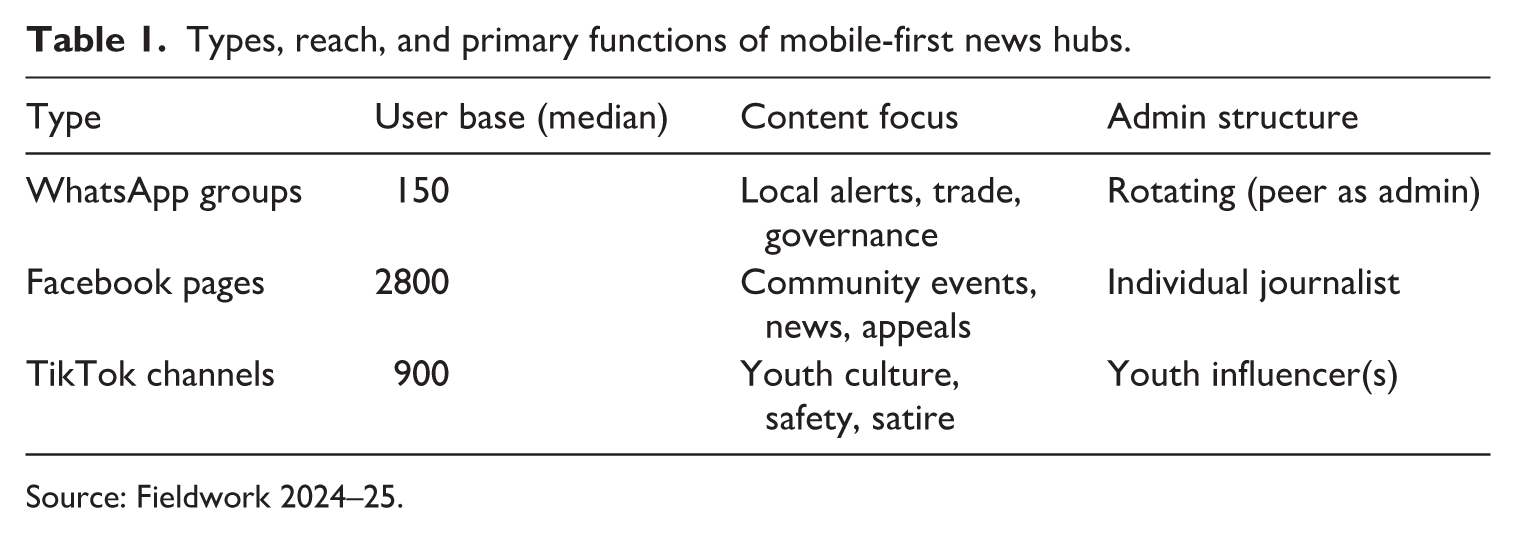
The analysis found that participatory news production in Johannesburg and Durban’s informal economies revolves around pockets of mobile-first “news hubs” WhatsApp groups, Facebook pages, and TikTok channels moderated by a hybrid of freelance journalists, group admins, and hyperlocal influencers (Gadjanova, 2021; Mabweazara and Mare, 2021). These spaces blend information curation, peer reporting instances where community members and group participants report events directly to each other or to admins via mobile platforms, bypassing institutional newsrooms, and user verification. For example, shopkeepers and commuters regularly post incident alerts and service updates to the group, which admins and other members then cross-check and either endorse, query, or discard.
Our group is where the real news breaks first, not on TV. People trust it more if it comes from someone who lives here. (Interview, Johannesburg trader, male, age 31).
This comment illustrates how group-level proximity and shared locality underpin informal reputation systems and shift perceived authority away from institutional newsrooms towards peer gatekeepers in mobile-first environments.
Table 1 summarises the main types of mobile-first news hubs observed in Johannesburg and Durban, indicating their typical user base, content focus, and admin structures in relation to the first research question on how mobile-first journalism is enacted.
Types, reach, and primary functions of mobile-first news hubs.
Source: Fieldwork 2024–25.
These hybrid spaces serve as gatekeeping interfaces: news is discussed, verified, challenged, and curated before wider release, illustrating the “networked gatekeeping” model and extending its applicability beyond legacy media (Barzilai-Nahon, 2008; Welbers et al., 2018).
Gatekeeping routines and algorithmic mediation
Mobile-first journalism in informal economies is shaped by overlapping human and algorithmic gatekeeping. Human admins employ local knowledge and group norms to filter, translate, and contextualise news, often prioritising stories relevant to daily survival or local safety (Charman et al., 2017; Mabweazara and Mare, 2021).
Algorithmic routines, such as WhatsApp message forwarding limits or Facebook’s trending post algorithms, create systemic biases, complicating the flow and visibility of vernacular/localised news.
Participants also described how algorithmic mediation shapes what is seen and by whom. One Durban participant observed, Sometimes our posts just disappear, or hardly anyone sees them. We don’t always know why. (Focus group participant, Durban, female, age 25).
This sense of opacity shows how platform logics can silently curtail the reach of vernacular or hyperlocal content, reinforcing methodological voice bias even when human gatekeepers are willing to share it. It also underscores that users experience algorithmic gatekeeping as unpredictable, which complicates their efforts to build stable reputations and audiences in informal economies.
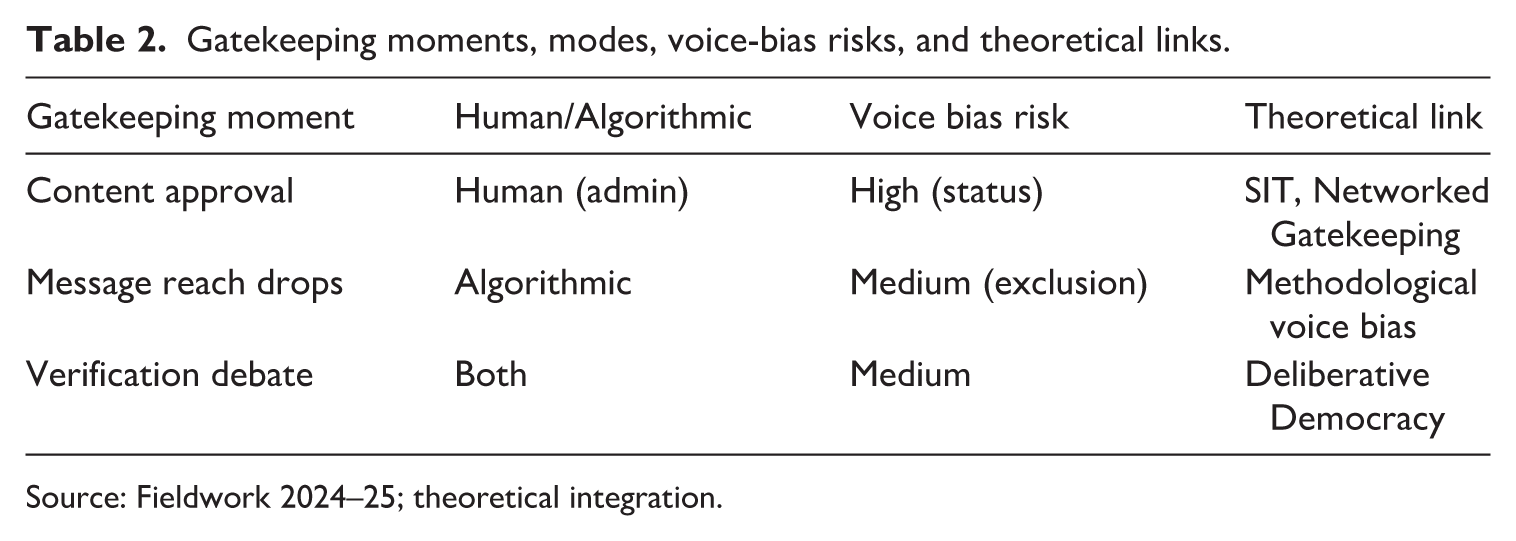
Analysis revealed systematic voice bias, where technically adept or higher-status users dominated the discussion, while newer members or migrants were less likely to have their news and perspectives amplified. This aligns with theoretical expectations about methodological (and infrastructural) voice bias (Mutongoza, 2025).
Table 2 illustrates typical gatekeeping moments in the groups, distinguishing human and algorithmic interventions, associated risks of voice bias, and how these relate to the study’s gatekeeping and methodological voice bias framework.
Gatekeeping moments, modes, voice-bias risks, and theoretical links.
Source: Fieldwork 2024–25; theoretical integration.
News verification, group dynamics, and deliberative practice
Verification routines are a distinctive feature of these mobile-first spaces. News items are frequently subject to collective discussion, demand for “proof,” and referential linking to regional or national outlets (Gadjanova, 2021; Smrdelj, 2025).
Verification routines are central to everyday gatekeeping in these groups. As an admin in a Durban WhatsApp group put it, No one just takes a message for truth; we always ask, ‘Where did you hear that? Show us a video!’ (Admin, Durban WhatsApp group, male, age 36).
This practice shows how participants collectively demand evidence before accepting information, using local norms of proof to filter rumours and unverified claims. It also illustrates how mobile-mediated gatekeeping relies on both social trust and access to digital resources, since those who can quickly provide screenshots or videos are more likely to have their accounts treated as credible.
This practice of demanding sources and visual evidence functions as a grassroots verification norm that partly compensates for the absence of formal editorial checks. At the same time, it can privilege those with better connectivity or devices who are able to supply “proof,” thereby reproducing inequalities in whose accounts are accepted as credible.
These processes function as participatory, situated checks and balances, but can also exclude dissenters and reinforce consensus-based hierarchies, especially during moments of tension or crisis (Olmos-Vega et al., 2023).
Periods of protest, service delivery breakdown, or violence saw WhatsApp news hubs decisively outperform traditional journalists in speed and perceived authenticity. Yet, the same periods amplified admin authority, with admins locking groups, screening posts, or temporarily muting dissent to “keep peace.”
Participatory innovation and resilience
Informal news actors demonstrate significant adaptiveness, deploying voice notes, short video bursts, memes, and infographics to bypass data and attention barriers and to foster rapid engagement, especially from youth and less-literate users (Charman et al., 2017; Malik, 2022). Reflexive tactics included repurposing language, circulating critical satire, or staging “newswatch” events for group accountability.
We use voice notes so even the old ladies and foreigners can hear quickly. Not everyone likes to read. (Volunteer reporter, Johannesburg, female, age 28)
Such innovations extend “participatory culture” theory and document new, contextually specific methods for asserting communicative agency (Jenkins et al., 2016).
Tensions, hierarchies, and structural limits
In these mobile-first news hubs, participants also deploy reflexive tactics to question, reshape, or push back against dominant narratives. By reflexive tactics, I refer to strategies such as repurposing language (e.g. reclaiming pejorative labels used for informal traders), circulating satire and memes that mock corrupt officials or unreliable mainstream coverage, and staging “newswatch” events where group members collectively monitor how legacy media frame incidents they have already reported in the group. Field observations and interviews showed, for instance, admins renaming a group with a previously insulting term to signal pride, users sharing humorous meme-videos to criticise municipal failures, and members live-commenting on TV bulletins to correct omissions or misrepresentations based on their own footage and experiences.
Participants were often explicitly aware of their shifting roles as informal news producers, moderators, or auditors. As one Johannesburg admin reflected, We are not just gossiping here; we decide what counts as real news for the area and what must be stopped before it causes trouble. (Admin, Johannesburg WhatsApp group, female, age 34).
This comment shows how group members understand themselves as gatekeepers who both amplify and block information, underscoring the reflexive dimension of mobile-mediated gatekeeping. It also illustrates methodological voice bias in practice, since those who occupy admin or high-status positions have greater power to define whose versions of events become visible and whose contributions remain marginal.
Algorithmic filtering, connectivity constraints, and moderation risks (group bans, shadowbanning) can erase emergent or dissenting news on contentious issues, especially relating to community-police conflicts or xenophobic events (SANEF, 2025; Singh, 2022).
Deliberative moments are episodic and often fleeting, with calls for open debate receding under pressure to restore order, protect reputation, or prevent panic.
Testing theoretical claims and global comparisons
Empirical findings affirm the “mobile-mediated gatekeeping” framework:
Local news production is both decentralised and re-centralised via digital group governance and technical/infrastructural affordances.
“Methodological voice bias” manifests as a function of digital skill, network centrality, admin status, and platform design, jointly filtering which forms of knowledge and identity achieve visibility (Couldry and Mejias, 2019; Mutongoza, 2025).
Comparatively, the resilience, innovation, and agency on view mirror findings from recent Kenyan, Nigerian, and Indian studies (Gadjanova, 2021; Mwanga, 2023), while the subtleties of exclusion, patronage, and algorithmic governance appear especially heightened in South Africa’s highly stratified informal sector.
Discussion
This study demonstrates that mobile-first journalism in South Africa’s informal economies is both a site of opportunity and a terrain of contestation where new forms of participatory news production, collective gatekeeping, and vernacular expression contend with persistent structural barriers, methodological voice bias, and algorithmic power. Synthesising empirical evidence and theory, the findings challenge static, institutionally anchored models of the public sphere and foreground the situated, relational, and often precarious negotiation of digital voice in the Global South (Chambers, 2023; Couldry and Mejias, 2019; Gadjanova, 2021).
Mobile-mediated gatekeeping and the fluidity of news authority
The data confirm that mobile-first platforms function as hybrid news hubs, blending individual agency, peer gatekeeping, and platform-driven technical constraint (Barzilai-Nahon, 2008; Welbers et al., 2018). Their structure enables highly localised, rapid production and curation of news, sidestepping the procedural and infrastructural inertia of legacy journalism (Mabweazara and Mare, 2021). These findings both echo and extend prior studies on participatory journalism, which have noted the rise of “networked publics” and reconfigured boundaries between producers and audiences (Gadjanova, 2021; Jenkins et al., 2016).
What becomes clear, however, is the paradoxical nature of gatekeeping in these spaces. While digital and social infrastructures allow for broader inclusion, especially along lines of age, linguistic diversity, and local expertise (Malik, 2022), they also foster new exclusions. Algorithmic moderation and group admin hierarchies were shown to routinely marginalise certain voices: “peripheral” users, migrants, or those lacking digital capital were often filtered out or ignored, confirming the impact of infrastructural bias (Mutongoza, 2025; Singh, 2022). Even as innovation flourishes in peer verification and news sharing (e.g. voice notes, memes, short videos), entrenched dynamics of status, technical skill, and legacy authority remain powerful determinants of who can speak and be heard (Charman et al., 2017).
Revisiting methodological voice bias and situated knowledge
The empirical demonstration of “methodological voice bias” advances the theoretical field by showing that both platform architecture and research design systematically filter not only who participates, but which types of knowledge become visible as news (Couldry and Mejias, 2019; Mutongoza, 2025). This study operationalises methodological voice bias not only in participant selection, but in the interplay between technical affordances, admin interventions, and the wider sociopolitical context of informality and marginality. This nuance responds to calls for reflexive, participant-centred research methods attuned to positionality, language, and digital literacies (Braun and Clarke, 2019; Olmos-Vega et al., 2023; Pink, 2015).
In the South African case, digital group histories, migration, and local trust networks significantly shaped who gained influence in news curation and whose perspectives were subject to scrutiny or exclusion. This aligns with and complicates Social Identity Theory (Tajfel and Turner, 1986), demanding that media and communication scholars see voice bias as both an individual and structural phenomenon, produced through collective digital practice, resource constraints, and informal hierarchies.
Deliberative democracy in precarious digital spaces
Moments of deep participatory deliberation open group debate, collective challenge to news claims, and consensus-building were episodic and dynamic. The study shows that deliberative democracy is not a default of digital participation in resource-constrained settings, but a fragile outcome, vulnerable to admin authority, threat of misinformation, and collective risk aversion (Dryzek, 2000; Olmos-Vega et al., 2023).
The evidence reinforces recent theoretical work (Chambers, 2023; Mabweazara and Mare, 2021) insisting that digital platforms do not inherently guarantee democratic practice. In fact, the same infrastructures can enable deliberation while also facilitating rapid shutdowns of dissent, muting of sensitive debates, or the viral spread of rumour in contexts of crisis. Group admins, as emergent “new gatekeepers,” are at once critical facilitators and potential bottlenecks for participatory democracy, highlighting the need for reflexive leadership and community accountability within digital publics (Mutongoza, 2025; SANEF, 2025).
Comparative and global implications
Findings from Johannesburg and Durban resonate with recent international literature on participatory media and gatekeeping from Kenya, Nigeria, and India (Gadjanova, 2021; Mwanga, 2023; Smrdelj, 2025). The South African context, however, illustrates heightened contestation along axes of race, migration, and informal status, and sharper policy-technical fault lines particularly visible in moments of protest, local crisis, or national news disruption (Charman et al., 2017; SANEF, 2025). This enriches global theoretical debates by providing a contextually specific, empirically grounded account of how global media structures and local meaning-making practices are intertwined.
Strengths, limitations, and reflexivity
A core strength of this study is its use of digital ethnography and participant-driven interviews to surface tacit, situated forms of agency and exclusion in digital news spaces (Cohen, 2023; Pink, 2015). Multi-lingual and intersectional sampling enabled inclusion of less-visible actors and built trust relationships necessary to access everyday routines. Triangulation with group records, fieldnotes, and peer coding further strengthened analytic validity.
Nonetheless, several limitations anchor interpretation. The temporality and volatility of digital group life mean findings may be sensitive to platform changes, admin turnover, or episodic shocks (new regulation, election, violence). Selective participation, especially among more precarious, migrant, or digitally marginal actors, remains a challenge, even with deliberate inclusive recruitment and consent practices (Mutongoza, 2025). Moreover, the focus on WhatsApp, Facebook, and TikTok (by design) leaves the role of other platforms or formal media less explored, though these findings offer a robust baseline for comparative work.
Methodologically, remaining voice bias cannot be eliminated; the study advocates for deeper, continuous reflexivity and partnership with local actors in both research design and dissemination.
Policy, practice, and future research directions
Directly from the findings, several recommendations and research priorities emerge:
For platform designers and regulators: Cultivate greater algorithmic transparency, local language and context recognition, and fairness in group moderation tools. Building admin resources, user feedback, and embedded digital literacy programming can directly counteract structural voice bias (SANEF, 2025; Singh, 2022).
For journalists, educators, and NGOs: Recognise mobile-first news spaces as key sites of civic voice, and invest in co-produced news literacy, translanguaging, and collaborative verification strategies. Develop training and support models for group admins and citizen contributors as emerging “gatekeepers,” widening their awareness of inclusion and exclusion risks (Charman et al., 2017; Mabweazara and Mare, 2021).
For scholars: Advance critical, participatory, and comparative research on digital voice, gatekeeping, and informality not only in Africa but in other contexts where formal journalism is fragmented or underresourced.
For policy makers: Foster dialogue between operators, community journalists, and platform policymakers to develop regulation that protects vernacular expression, prevents algorithmic marginalisation, and supports capacity in local, informal news ecosystems.
Theoretical and conceptual synthesis
This research contributes a novel framework, “mobile-mediated gatekeeping,” for analysing the hybrid, dynamic, and negotiated authority systems characteristic of participatory news production in informal economies. It extends “methodological voice bias” from method critique to a central analytic of both technological design and lived experience. In so doing, it builds a bridge between micro-level empirical realities and broader theories of the digital public sphere, infrastructural power, and participatory democracy (Barzilai-Nahon, 2008; Couldry and Mejias, 2019).
Returning to the central argument: digital platforms and group structures are not neutral facilitators of voice, but recursive social and technical filters. Agency, legitimacy, and publicness are always being renegotiated. Future research should pursue comparative, longitudinal, and interventionist designs probing how group status, digital capital, and platform shifts interact to continually remake the boundaries of who speaks, who listens, and who counts in the emerging publics of the digital South.
Conclusion
Mobile-first journalism in South Africa’s informal economies emerges from this study as a generative but contested space in which mobile-mediated news hubs redistribute gatekeeping, enabling hyperlocal voice, rapid verification, and new forms of civic agency while also reproducing voice bias, infrastructural inequality, and hierarchical admin power. By advancing mobile-mediated gatekeeping and methodological voice bias as core analytical tools grounded in digital ethnography and interviews, the article shows how platform architectures, group routines, and research decisions together shape whose knowledge becomes visible as news and whose contributions remain marginal. The findings point to the need for policy, platform design, and journalistic practice that foreground local languages, transparent moderation, and support for group admins and citizen contributors, while future comparative research across the digital South should further trace how infrastructure, agency, and everyday negotiation continually remake participatory news publics and the boundaries of digital power.
Footnotes
Acknowledgements
The author would like to express their gratitude to all research participants, stakeholders, and supporting staff who contributed their time and expertise. Special thanks to the Turf Research Ethics Committee for oversight, and to institutional colleagues for their ongoing encouragement and discussion.

Ethical considerations
Ethical clearance for this study was obtained from the Turf Research Ethics Committee.
Consent to participate
Appropriate informed consent procedures were followed.
Participation was strictly voluntary. Participants were explicitly informed that they could withdraw from the study at any stage without penalty or loss of benefits. Consent forms included an explanation of the study’s purpose, procedures, potential risks and benefits, and steps taken to ensure confidentiality and anonymity.
Consent for publication
All participants consented for anonymised excerpts of their contributions including interview responses, story circle participation, and illustrative quotations to be included in research publications, reports, and presentations. Care was taken to ensure that no personally identifying information would appear in any published material. For audio or story-based data, explicit, written consent was obtained to reproduce, paraphrase, or translate content for academic publication, with the right of participants to review such representations where feasible and reasonable (Braun and Clarke, 2021; du Plessis, 2024; Naidu, 2024).
Author contributions
The author contributed substantially to the conception, design, drafting, and critical revision of the manuscript in accordance with the journal’s authorship and contribution statement policy. The author has read and approved the final manuscript.
Funding
The author received no financial support for the research, authorship, and/or publication of this article.
Declaration of conflicting interests
The author declared no potential conflicts of interest with respect to the research, authorship, and/or publication of this article.
Data availability statement
All data supporting the findings of this article are available from the corresponding author upon reasonable request.*
Disclaimer
The views and opinions expressed in this article are those of the author and do not necessarily reflect the official policy or position of any affiliated institution or funder.