




Abstract
Gerontological studies note research noncompliance as a limitation of their results; however, few investigations focus on ways to minimize noncompliance. Additionally, older adults’ research participation is often controlled by other individuals such as the managers of retirement residences or community centers, where recruitment often occurs. These individuals are, in essence, the Gatekeepers of research participation among older adults. This pilot study explored ‘research participation’ through semistructured interviews with four managers. Analysis of the transcript data identified several important differences between managers of retirement residences and community center managers. Gerontologists interested in obtaining more representative samples may want to consider the contextual factors of the managerial systems and experiences that can facilitate or obstruct research participation of older adults.
Research that focuses on older adults is receiving more attention due to age-related changes in population demographics; however, research noncompliance is a challenge for accessing representative samples for gerontological studies. Gatekeepers, such as managers, can determine researchers’ access to study participants as they can withhold or grant access to important segments of community-dwelling older adults. As a result, these managerial decisions can significantly influence the generalizability of research findings. There is limited research investigating the influence that managers have on gerontological research compliance (i.e., participating in or facilitating research) in different organizational settings such as the management systems within community centers and retirement residences. A community center is a public facility that allows older adults to participate within their community via organized programs (e.g., aerobic classes) while a retirement residence is a private facility in which older adults live with the option of independent living or assisted care. The main objective of this pilot study was to explore research compliance through managerial Gatekeepers of community centers and retirement residences.
Method
Four individuals employed as management staff of community centers (n = 2) and retirement residences (n = 2) from the Greater Toronto Area took part in an in-depth, semistructured interview. They were asked a number of predetermined questions in a systematic and consistent order; however, the interviewer exercised the liberty to deviate from these questions with relevant and specific probing questions, allowing a more detailed exploration of the emergent issues being discussed (Berg, 2007). Questions predominately focused on the Gatekeeper’s perception of why older adults participate in research as well as their own personal experiences. The interviews began by focusing on the manager’s background such as education and job experience and later focused more on the manager’s experience with gerontological research, researchers, and their beliefs and attitudes about older adults being involved in research. Informants provided written informed consent and the research procedure adhered to institutional ethics regulations and policies.
Data Analysis
Each informant was given a pseudonym for anonymity and confidentiality purposes. Interviews were digitally recorded and transcribed verbatim. Our qualitative analysis followed the comparative analysis methodologies of the Grounded Theory approach (Glaser & Strauss, 1967). First, each transcript was read multiple times without the intention of coding in order to achieve familiarity with the raw transcript data (Esterberg, 2002). Transcripts were then coded and analyzed with a three-stage sequential coding process. Open coding involves marking key phrases, terms, and sentences within each transcript. A “code” is an identifying anchor that allows collections of codes (i.e., categories and themes) to emerge from these data (Denscombe, 2004). Categories represent concepts that emerge from code groupings. Axial coding developed categories via a combination of inductive and deductive thinking that established a preliminary framework to understand the relationships within and among categories (Strauss & Corbin, 1998). Once focal categories were established, selective coding began (Patton, 1990), which involved the rescanning of these data and established codes in relation to the focal categories.
Findings and Discussion
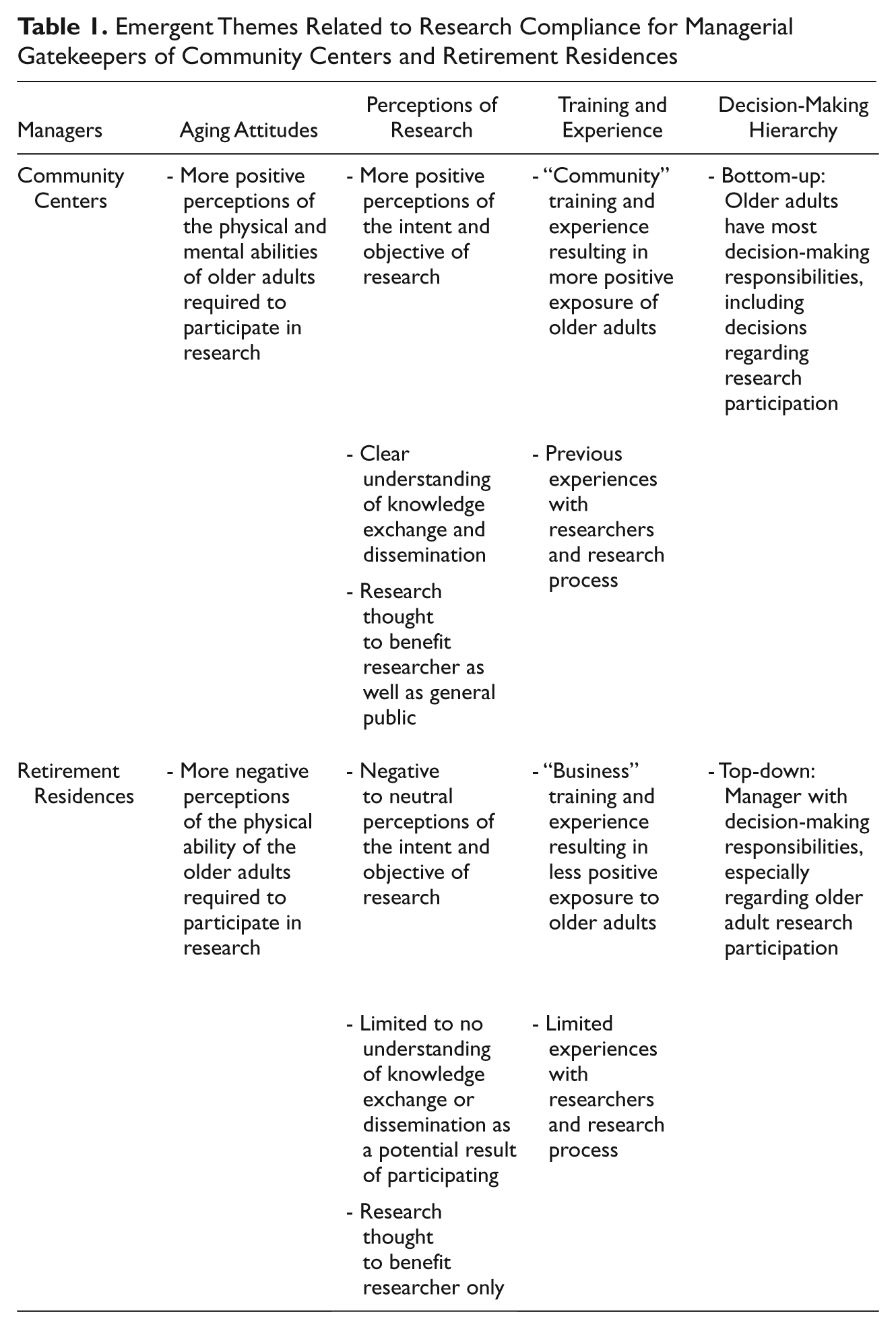
From these data emerged four important themes discussed among the managers (i.e., “Joyce,” “Penny,” “Bruce,” and “Matt”). The overall findings demonstrated notable differences between the managers of retirement residences and the managers of community centers. These observed differences related to (a) aging attitudes, (b) perceptions of research, (c) training and experience, and (d) decision-making hierarchy. These themes are summarized in Table 1.
Emergent Themes Related to Research Compliance for Managerial Gatekeepers of Community Centers and Retirement Residences
Aging Attitudes
Perceptions of the abilities of older adults were reflected by managers’ interactions with older adults within their respective settings. These perceptions, negative or positive, influenced decisions regarding the older individuals’ participation in research. Joyce and Penny, managers from retirement residences, expressed negative perceptions of older adults’ abilities to participate. Penny may have recognized that research participation may be of interest to this population, but she did not suggest any alternative strategies for older adults to engage in research and viewed participation as unfeasible. Penny explained that limited physical conditions may hinder the older adults’ ability to participate. Conversely, neither community center manager expressed negative perceptions of the abilities of the older adults to participate in research. Both noted older adults, in their experiences, are more than capable of participating in research.
Perceptions of Research
Managers’ perceptions of research emerged as another important factor relating to research compliance. Penny’s perception of research was that it was “a waste of time,” while Bruce, a manager of a community center, had a positive perception of research, believing it contributes to the body of knowledge and to society. Moreover, he felt it was important for older adults to know the results of research being conducted. Bruce felt that older adults understand and are genuinely interested in the results of research and believed that a fair and equal exchange of knowledge increases future participation. Bruce believed that research results not only benefit the researcher and the academic community but also the general public, such that if dissemination of knowledge is not undertaken and new information is not made accessible, then research cannot be effectively utilized by the community. This is an interesting finding as the transfer of knowledge from an academic setting to the general public is one of the primary objectives of community-based research. Matt, manager at the other community center, echoed these sentiments. Alternatively, Joyce did not support this notion as she believed research to be beneficial to the researcher only. She saw research as a disruption to older adults’ schedules with little benefit to them. These perceptions were also shared by Penny, the other retirement residence manager.
Training and Experience
Perceptions and values are strongly related to one’s lived experiences (Oswald & Chapleau, 2010). As a result, it is not surprising that the type of training as well as personal and occupational experiences with research emerged as important factors in understanding research compliance. In general, findings reflected two clear distinctions regarding training and experience among the four managers: business-oriented and community-oriented. Joyce and Penny, the retirement residence managers, had business-oriented backgrounds, while Bruce and Matt had community-oriented backgrounds such as educational training and personal experiences working within the community. Although further research is necessary to determine the influence that business-oriented and community-oriented perspectives have on compliance issues in research participation, it is plausible that community-oriented managers would be more receptive to research than business- oriented managers on projects that address important social needs, perhaps due to more positive experiences with, and exposure to, older adults.
Decision-Making Hierarchy
Hierarchies that reflect decision-making processes within these two settings were also revealed as a notable factor relating to research compliance. Generally, the hierarchy in retirement residences is organized in such a way that the manager is able to make most of the decisions, while the older adults make the fewest (i.e., top-down hierarchy). Consequently, older adults may not be given opportunities to participate in research because they are not aware of them. Joyce suggested that an important objective of the retirement residence was to respect the personal lives of the residents. Penny described a similar system. On the other hand, community centers in this study did not exhibit this top-down dynamic. The establishment where Bruce worked had a council of older adults, with members elected by other older adults in the community. The function of this council was to discuss and vote upon decisions that influenced the center (i.e., bottom-up hierarchy). Matt explained a similar bottom-up dynamic at his establishment where their council comprised of elected presidents from each ethnic group with additional executive positions of vice president, secretary, and treasurer. Regarding the participation in research, Matt noted that each president considers whether the members they represent would like the opportunity to participate. Not only does this shift the Gatekeeper responsibilities from the manager onto the older adult presidents, but it also shifts the decision-making process from an “outside person” onto a person with relevant and invested interest in research and its findings.
Conclusion and Implications
This pilot study explored some of the qualities and characteristics of research compliance among community center and retirement residence managers. Overall, the results suggested that different settings (i.e., community centers and retirement residences) have important and different influences on research participation among older adults via managerial staff acting as Gatekeepers. Joyce and Penny, managers of the retirement residences, had more negative perceptions of their residents’ and their capabilities and willingness to participate in research, which may relate to their greater exposure to older adults with lower levels of functioning, perhaps due to illness or dependence. Conversely, Bruce and Matt, managers of the community centers, were likely exposed to healthier, more active older adults, which may result in more positive perceptions of aging and older adults. Joyce and Penny seemed more “business-oriented” in their education and previous work experience and operated within a top-down hierarchy that limited the input of older adults. Although these preliminary findings may reflect industry-related differences between these two settings, their unique influence on research compliance would likely benefit from a deeper exploration. Importantly, a larger, more representative, sample study is needed to further investigate differences between these types of settings.
In summary, access to older participants is a key factor for gerontological research success. When access is limited by a Gatekeeper’s perceptions or experiences, generalizability suffers. These preliminary results offer some insight on factors that influence research compliance among these four manager participants. While further research in this area would, in theory, improve compliance in gerontological research, such initiatives could also provide Gatekeepers with knowledge and experiences around concepts of aging and practices of research. Continued attention to this issue will improve upon our understanding on the factors influencing the generalizability of research as well as our understanding of aging and older adults.
Footnotes
Declaration of Conflicting Interests
The author(s) declared no potential conflicts of interest with respect to the research, authorship, and/or publication of this article.
Funding
The author(s) received no financial support for the research, authorship, and/or publication of this article.
Bios
Natasha A. Spassiani is a doctoral student in the Department of Disability and Human Development at the University of Illinois at Chicago, USA. Her research interests relate to qualitative research methods, knowledge translation, and community-based action research among minority groups.