




Abstract
By combining stakeholder theory and activity theory, this study examines the dynamic relationships among wealth, volunteering, and self-esteem of older adults. This study uses latent growth curve modeling (LGCM) to capture the longitudinal patterns of self-esteem across four waves of data from the Americans’ Changing Lives (ACL) Study. As time-varying variables, the longitudinal trajectories of volunteering hours and self-esteem are analyzed. As time-invariant independent variables, the authors consider two types of wealth measurements: homeownership and the amount of total liquid assets at Wave 1. The authors find that the intercept of volunteering hours is positively associated with the intercept of self-esteem. This study also finds that volunteering hours partially mediates the relationship between wealth and self-esteem. This study sheds lights on dynamic mechanisms of wealth, volunteering, and self-esteem among older adults.
Volunteering among older adults is getting more popular in America. The number of volunteering older adults (65 years and over) has increased from 8.7 million in 2007 to 9.5 million in 2011 (U.S. Bureau of Labor Statistics, 2011). With baby boomers reaching retirement age over the next 20 years, it is likely that volunteering among older adults will continue to grow (Soo & Gong-Soon, 1998). According to the Bureau of Labor Statistics, 33.2% of all baby boomers (25.8 million) volunteered through formal organizations in 2005, which was the highest rate of any age group. Also, many studies have found that volunteering is associated with improved physical and psychological health and well-being of older adults (Caro & Bass, 1997; Fried et al., 2004; Hunter & Linn, 1980; Morrow-Howell, 2010; Van Willigen, 2000; Young & Glasgow, 1998).
Due to the extent of volunteering among seniors and its numerous perceived benefits, the emphasis in previous research has been to examine who volunteers and how volunteering influences older adults’ well-being (Morrow-Howell, 2010). For example, socioeconomic and demographic characteristics have been found to explain some variations in volunteering. Females (Gallagher, 1994), Whites (Hodgkinson & Weitzman, 1996), married couples (Szinovacz, 1992), those with better health (Fisher & Schaffer, 1993; Herzog & Morgan, 1992), those with more education (Brady, Verba, & Schlozman, 1995; McPherson & Rotolo, 1996; Wilson, 2000), and those with higher income (Menchik & Weisbrod, 1987) are more likely to have volunteered greater hours as older adults.
However, little research has simultaneously analyzed both predictors and outcomes of volunteering in a single model. In fact, past studies have tended to address the two issues separately: (1) What predicts older adults’ volunteering? and (2) How do the volunteering activities influence older adults’ well-being? As a result, existing studies suggest only fragmented implications for policy and practice. Using both stakeholder theory and activity theory, this study develops and tests a theoretical framework that combines predictors and impacts of volunteering. While stakeholder theory explains the impact of wealth ownership on productive activities as a predictor of engagement in volunteering, activity theory offers a theoretical understanding of the impacts of volunteering on older adults’ well-being. This study combines the dynamic processes embedded in predisposed conditions leading to volunteering hours and self-esteem as one of the outcomes influenced by this commitment. By combining stakeholder theory and activity theory, we examine how older adults’ wealth influences their volunteering hours and whether this engagement in volunteering is related to their self-esteem over time. Using four waves of nationally representative panel data from the Americans’ Changing Lives (ACL) study, this study investigates the relationships between wealth and the longitudinal trajectories of volunteer hours and self-esteem, as well as the longitudinal associations between initial status and changes in volunteering hours and self-esteem. Furthermore, we test the mediating effect of volunteering on the longitudinal relationship between wealth and self-esteem.
Literature Review
Stakeholder Theory
Several factors have been identified as influential for volunteering (McBride, 2003; McBride, Sherraden, & Pritzker, 2004; Wilson, 2000): contextual opportunity (Roy, Tubbs, & Burton, 2004), socialization (Clary & Snyder, 2002; Galston, 2003), life course (Burr, Caro, & Moorhead, 2002), and resources (Verba, Schlozman, & Brady, 1995). Among these factors, resource-based theory provides insight into older adults’ engagement in volunteering, indicating that those who have more resources including income and information are more likely to engage in volunteering (Verba et al., 1995).
Wealth is a resource that may influence volunteering and civic engagement. McBride’s (2003) stakeholder theory suggests that assets may increase stakeholders’ motivation to maximize their returns by participating in a variety of civic engagement activities such as volunteering and civic services (McBride et al., 2004). For example, homeownership may provide incentives for civic engagement to protect one’s home assets. In fact, homeowners are more likely to interact with neighbors and attend meetings related to community development (McBride, 2003). Homeowners may also be more willing to participate in political actions such as voting in an election. Furthermore, those who have financial savings show more interests in economic and political systems because their savings may be used for philanthropic contributions to social and political causes (McBride, 2003).
Activity Theory
Volunteering includes citizens’ participation in service delivery to others in formal or informal settings and civic actions for advocacy (Wilson, 2000). Many studies have documented various benefits from volunteering for older adults (Caro & Bass, 1997; Fried et al., 2004; Hunter & Linn, 1980; Morrow-Howell, 2010; Van Willigen, 2000; Young & Glasgow, 1998). Activities are presumed to be integrated with the social roles and context of an individual’s life course and to be closely related to the ongoing flow of life meanings, attachments, and commitments. According to activity theory, older adults who are actively engaged in productive pursuits are more likely to have better mental and physical health because volunteer work can facilitate the development of psychosocial resources through social integration and networking (Herzog & House, 1991; Van Willigen, 2000).
There is growing evidence suggesting a positive relationship between volunteering and physical health (Caro & Bass, 1997; Van Willigen, 2000; Young & Glasgow, 1998). Volunteering has also been found to influence psychological well-being. Hunter and Linn (1980) showed that volunteering is related to higher life satisfaction, a stronger will to live, and less mental disturbance. Fried et al. (2004) found that volunteers are more physically, cognitively, and socially active than similarly aged individuals who are not volunteers. A meta-analysis of 37 studies conducted between 1968 and 1994 found that 70% of older volunteers scored higher on quality of life measures than non-volunteers (Wheeler, Gorey, & Greenblatt, 1998). Morrow-Howell and colleagues (2003) found that older adults who volunteer more often report higher levels of psychological and physical well-being. Furthermore, volunteering was found to reduce the risk of mortality (Musick, Herzog, & House, 1999; Oman, Thoresen, & McMahon, 1999). Using a longitudinal national sample, Van Willigen (2000) revealed that more intensive commitment to volunteering leads to greater increases in life satisfaction and self-rated health. Moreover, he found that older adult volunteers (aged 60 and above) received more benefits than younger adult volunteers (aged under 60).
Volunteering and Self-esteem
Among numerous psychological benefits of volunteering such as greater life satisfaction, happiness, a sense of mastery, and lack of depression (Thoits & Hewitt, 2001), this study focuses on self-esteem as a psychological effect of volunteering. Considering the connection with various aspects of mental health, self-esteem is a critical outcome because low self-esteem may result in anxiety, stress, and loneliness, increasing the likelihood of depression and deterioration of relationships with family members (Counseling & Mental Health Center, 1999). Especially in later life, self-esteem has been considered an important buffer against the harmful impacts of negative life events such as chronic illness and numerous losses (i.e., financial loss, job loss, and bereavement) that helps older adults maintain well-being in later life (Collins & Smyer, 2005).
Nevertheless, there is considerable variation in older adults’ capacity to maintain self-esteem. As one way to maintain or increase self-esteem in later life, many studies have focused on productive activities such as volunteering. Graff (1991) found that volunteering contributes to self-esteem, health, vitality, and longevity of older volunteers. Herzog, Franks, Markus, and Holmberg (1998) consistently found positive effects of volunteering on self-esteem of older adults. In fact, it has been critical to understand the association between volunteering and self-esteem.
Purpose of the Present Study
Linking stakeholder theory with activity theory, this study aims to examine how wealth, volunteering hours, and self-esteem are interconnected. While stakeholder theory tests whether assets and home ownership are positively associated with volunteering hours and self-esteem, activity theory investigates the positive association between volunteering hours and self-esteem. Specifically, this study examines four research questions: (1) How do volunteering hours and self-esteem change over time among older volunteers? (2) To what extent does wealth affect the intercept and slope of volunteering hours controlling for covariates? (3) To what extent are the intercept and slope of volunteering hours related to the intercept and slope of self-esteem? and 4) Do volunteering hours mediate the relationship between wealth and self-esteem?
Methods
Data and Sample
This study analyzes four waves of data from the ACL study. The ACL utilized a multistage stratified probability sample of persons aged 24 years or older. This study used a subsample of 1,669 adults over 60 years old at the baseline (Wave 1) in 1986 to investigate predictors (assets) and outcome (self-esteem) of volunteering in later life. In 1989 (Wave 2), 1,279 older adults were reinterviewed. The sample size was again reduced to 948 older respondents in 1994 (Wave 3). Eventually, 463 older adults aged 60 and above were reinterviewed at Wave 4 between 2001 and 2003. At Wave 4, the minimum age of older adults was 76 or 78. It should be noted that only 27.74% of older adults at Wave 1 survived the study period. However, the ACL provides valuable data over an extensive period of time (16 to 18 years) to understand longitudinal changes in both predictors and outcomes of life events.
Measures
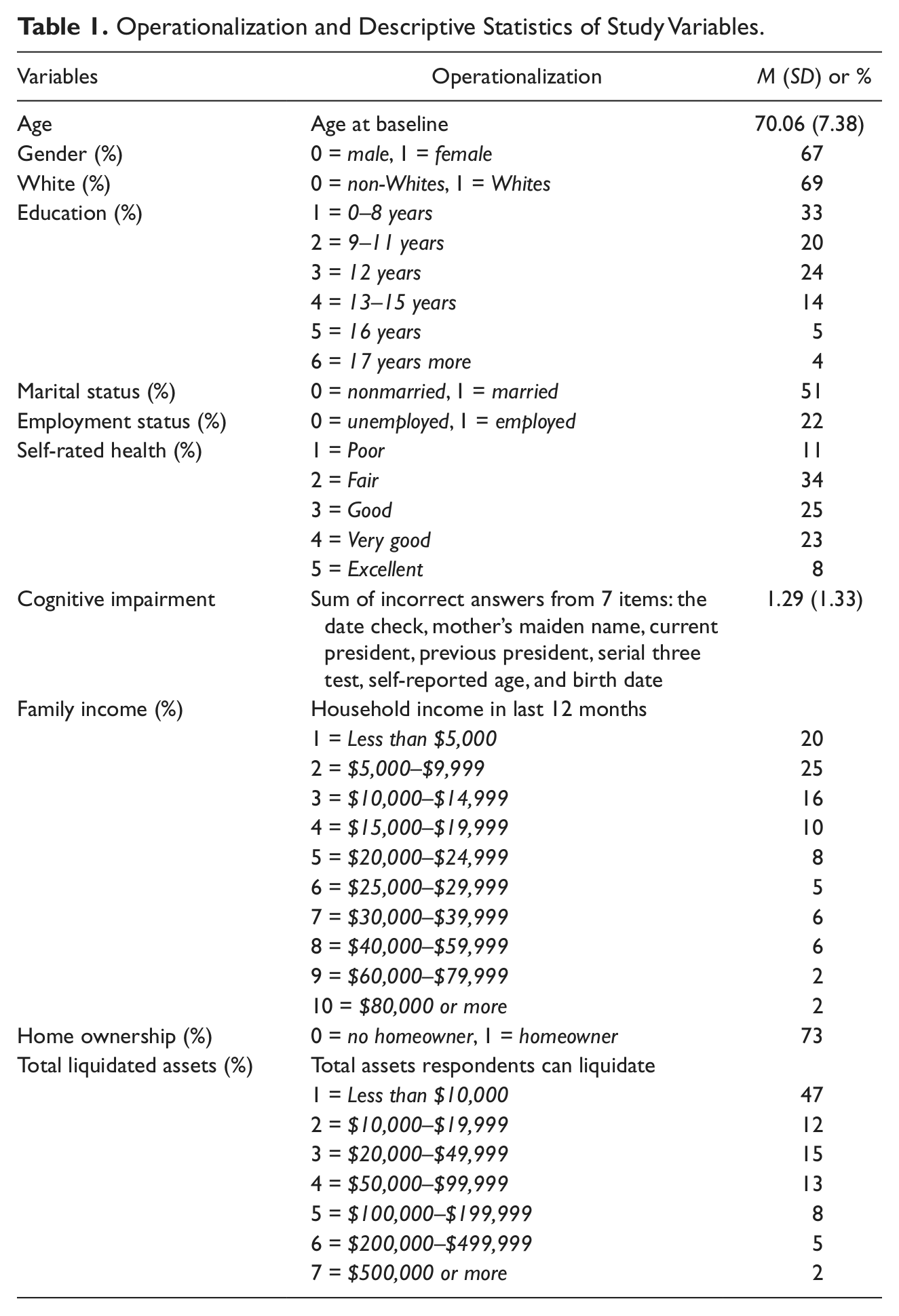
As shown in Table 1, this study included a variety of socioeconomic demographic factors (i.e., age, gender, race, education, employment status, marital status, and family income) as control variables. As significant covariates of self-esteem, self-rated health and cognitive impairment (a sum of 7 items) were also included in the analysis. The items measuring cognitive impairment included date check, mother’s maiden name, current president, previous president, a serial three test, self-reported age, and birth date. More than half of the sample was female (67%), White (69%), and married (51%). The age of the sample ranged from 60 to 90, with a mean of about 70. Twenty-three percent of the sample had over 12 years of education, and only 22% was employed at baseline. While 16% of the sample reported that their household income was more than $30,000, 45% had household income of less than $10,000. Eleven percent of the sample said that their self-rated health was poor, while 31% identified their health as excellent or very good. The ACL survey measured the level of cognitive impairment by asking seven questions. The mean score was very low (1.29), indicating that many older adults in the ACL survey had low cognitive impairment (See Table 2).
Operationalization and Descriptive Statistics of Study Variables.
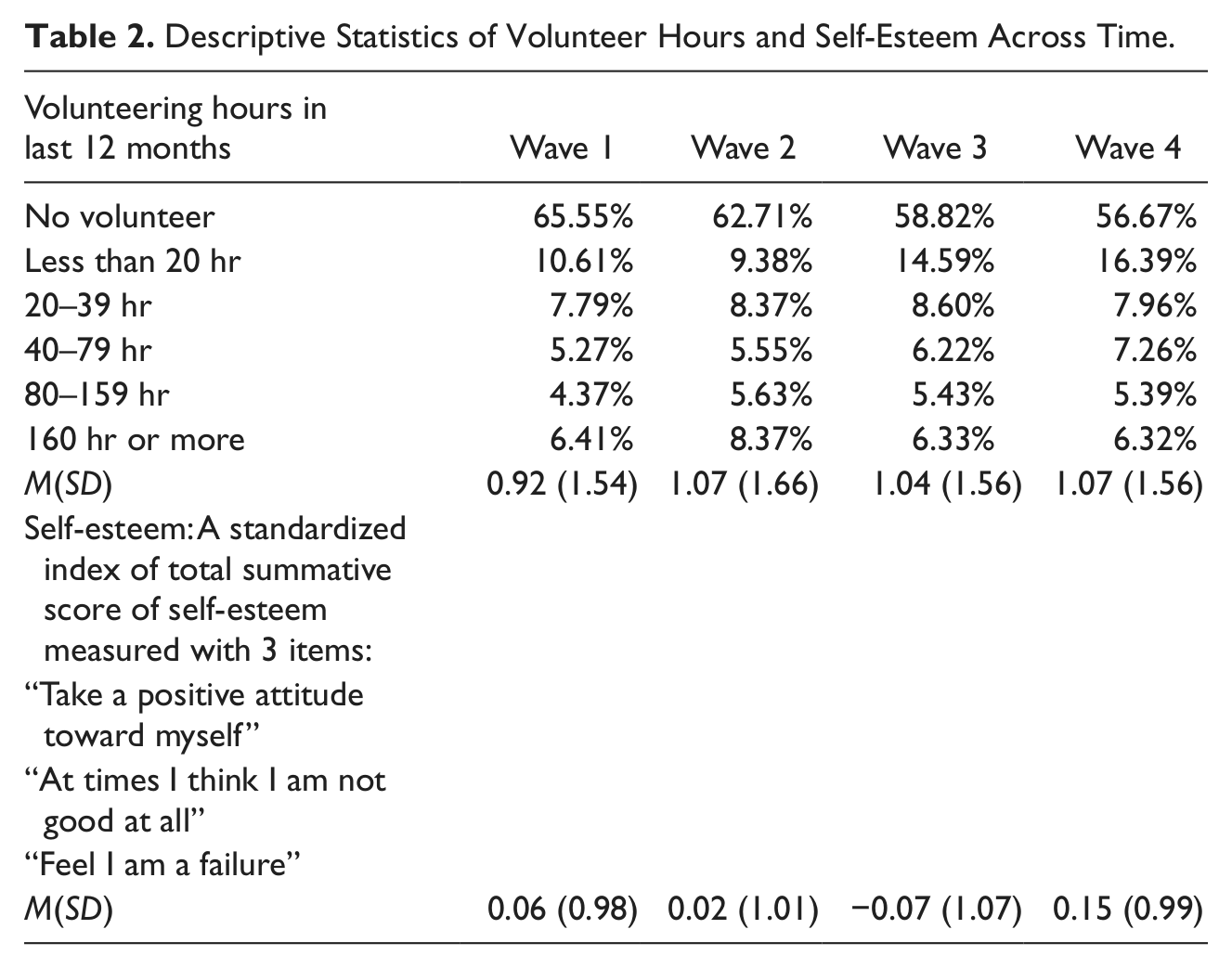
Descriptive Statistics of Volunteer Hours and Self-Esteem Across Time.
Two measures of assets (homeownership and liquidated assets) were key independent variables in this study. Homeownership was a dichotomous variable asking whether an older adult owned his or her own house at baseline. Total liquid assets captured the amount of participants’ assets that could be liquidated at baseline (e.g., stocks, bonds, certificates of deposits, etc.). A high portion of the sample (73%) owned their own home. However, we found that the majority of the sample had low levels of liquid assets. Forty-seven percent of the sample had liquid assets of less than $10,000. Only 15% of the sample was found to have liquid assets of $100,000 or more (See Table 2).
While there are many ways to measure volunteering, this study measured volunteering commitment by the total number of hours served by older volunteers in the previous 12 months. Volunteering hours is a mediating variable in this study. Between 57% and 66% of older adults volunteered through the four waves. On average, 6.9% of individuals in each wave did volunteer more than 160 hr. The ACL data measured self-esteem using 3 items selected from the Rosenberg Self-Esteem scale (Rosenberg, 1979): (1) “I take a positive attitude toward myself”; (2) “At times I think I am not good at all”; and (3) “All in all, I am inclined to think that I am a failure.” This study used self-esteem to measure the mental health of older adults. According to changes in the means, older volunteers’ self-esteem appeared to decrease slightly from 0.06 at Wave 1, to 0.02 at Wave 2, to −0.07 at Wave 3, but increased to 0.15 at Wave 4 (See Table 2).
All four wave measures of volunteering hours and self-esteem were analyzed using latent growth curve modeling. Before testing the measurement and theoretical model, this study tested multicollinearity with Pearson correlation and found no serious problem.
Statistical Procedure of Latent Growth Curve Model (LGCM)
To capture the longitudinal trajectories of volunteering and self-esteem, we constructed Latent Growth Curve Models (LGCM) using LISREL 8.52. As a type of structural equation modeling (SEM), LGCM determines case-specific baselines and longitudinal trajectories as latent variables. It refers to the random intercepts for the case-specific baselines and the random slopes for longitudinal trajectories (Bollen & Curran, 2006). Accordingly, LGCM in this study estimated the extent to which older adults had different intercepts (baselines) and slopes (longitudinal changes) of volunteering and self-esteem. While the group means cannot fully represent variations in individual growth curves of time-varying outcomes, LGCM provides statistical advantages specialized for estimating individual longitudinal trajectories in repeated measures (Bollen & Curran, 2006). Specifically, LGCM can examine the patterns of trajectories of repeated outcome measures, the impacts of intercepts and slopes of time-varying predictors, and the relationships between the intercepts and slopes of time-varying factors. Considering nonlinear growth curves of trajectories, we freed the third factor and fourth loadings to capture the nonlinear growth curve (Bollen & Curran, 2006).
To reduce bias from uncertainty of this missing information, this study used the full information maximum likelihood (FIML) estimation method. The FIML procedure in SEM has been developed to produce unbiased and efficient estimates in a wide variety of missing data contexts (Bollen & Curran, 2006). We examined whether the study sample meets the assumption of Missing at Random using bivariate statistics of independent sample t-tests and chi-square analyses. While respondents (n = 1,206) with missing values during the study period (longitudinal attrition) were coded as 1, those (n = 463) without missing values were coded as 0. The variables used in the study were examined to identify any difference between the two groups in the sample. The bivariate analyses found that females and Whites were more likely to drop out of the study. In addition, we found that those with missing values were likely to be older than their counterparts without missing values. However, we found that there were no significant differences in the other variables between the two groups of samples. In particular, there were no significant differences between the two groups in self-esteem and volunteering hours as outcome variables.
The LGCM strategy was carried out in the following manner. First, unconditional LGCM without predictors examined whether individual older adults had different intercepts and slopes of volunteering hours and self-esteem, respectively. Next, predictors were incorporated to produce the conditional LGCM, which includes variables predicting two sets of intercepts and slopes of volunteering hours and self-esteem. The conditional LGCM investigated what predictors explained the intercepts and slopes of volunteering hours and self-esteem, to what extent the intercept and slope of volunteering hours were associated with those of self-esteem, and how volunteering mediated the relationship between wealth and self-esteem of older adults. SEM has strengths to easily test mediation paths in a structural model (Cheong, MacKinnon, & Khoo, 2003). The mediation was modeled by relating wealth, the intercept and slope of volunteering hours, and the intercept and slope of self-esteem. Specifically, we assumed that wealth was related to the intercept and slope of volunteering hours and that the intercept of volunteering hours was related to the intercept and slope of self-esteem, while the slope of volunteering hours was only related to the slope of self-esteem. While two measures of wealth were key independent variables, this study also examined whether the relationships between the other socioeconomic variables and self-esteem were mediated by volunteering hours.
Overall model fits were interpreted prior to reporting the findings of LGCM. Specifically, nonsignificant chi-square, the critical value (e.g., greater than .90) of model fit indexes such as comparative fit index (CFI), incremental fit index (IFI), and adjusted goodness-of-fit index (AGFI) indicated acceptable model fits. The root mean square error of approximation (RMSEA) was lower than .05, which represents a good model fit (Hoyle, 1995).
Results
Unconditional LGCMs
For unconditional models of volunteering and self-esteem, this study estimated two-latent factor models using four indicators. The loadings of all four parameters of intercepts of the growth curve were fixed at 1.0, which represents no growth across four waves. While the second factor (slope) fixed the first loading to 0, which does not allow the indicator at Wave 1 to load on this factor, the second loading was fixed at 1.0, and the third and fourth factor loadings were freed (Chassin, Curran, Hussong, & Colder, 1996). The FIML estimation was used for analyses to estimate path coefficients unbiased by missing values.
Model fit statistics of the unconditional LGCM of volunteering hours were acceptable. While the chi-square was significant, indicating a poor model fit (χ2 = 14.34, df = 4, p = .006), other indices indicated good model fits (AGFI = .95; CFI = .94; and IFI = .95). The significance of the chi-square is sensitive to sample size (Bollen & Curran, 2006). RMSEA showed an adequate fit, indicating .03. LGCM of self-esteem showed better model fits. The chi-square was not significant (χ2 = 5.54, df = 4, p = .23). Furthermore, other model fit indices indicated good fit of the unconditional LGCM of self-esteem (RMSEA = .02, AGFI = 1.00, CFI = 1.00, IFI = .98).
Two factors of intercept and slope explained about 69%, 78%, 73%, and 60% of the variances in volunteering hours at Waves 1, 2, 3, and 4, respectively. The covariance matrix of the intercept and slope of volunteering hours indicated that older adults had different intercepts (M = 0.60, t = 2.27, p < .01) and slopes (M = .09, t = 2.69, p < .01) of volunteering hours. In addition, the intercept of volunteering was positively associated with its slope (M = .16, t = 3.46, p < .001). This means that older adults with higher intercepts of volunteering at baseline were more likely to volunteer over time. The mean slope was .09, indicating that there was an increase in volunteering hours over time. The factor loadings of the slopes on Wave 3 and on Wave 4 were 1.39 and 0.11, indicating nonlinear growth patterns of individual volunteering hours over time.
The unconditional model of self-esteem explained about 50%, 49%, 50%, and 35% of the variances in self-esteem at Waves 1, 2, 3, and 4, respectively. Older adults had different intercepts (M = 0.35, t = 11.13, p < .001) and slopes (M = −0.04, t = −3.53, p < .001) of self-esteem over time. The mean of slope indicated that older adults’ self-esteem decreased over time. A significant association between intercept and slope (t = 3.27, p < .001) means that older adults who had higher intercepts of self-esteem showed a lower decrease in longitudinal changes in self-esteem. The factor loadings of the growth rate on Waves 3 and 4 demonstrated nonlinear growth of self-esteem indicating nonproportional estimates between Waves 2, 3, and 4.
Conditional LGCM
The conditional model examined the relationships among assets, volunteering hours, and self-esteem controlling for socioeconomic demographic characteristics of older adults. Although the chi-square of the conditional LGCM was significant (χ2 = 153.10, df = 97, p < .001), other fit indices showed good model fits (RMSEA = .02; AGFI = .91; CFI = .99; IFI = .99). The model explained about 12%, 15%, 32%, and 53% of intercept and slope of volunteering hours and intercept and slope of self-esteem, respectively. Table 3 presents the path coefficients and t-values of predictors regressed on the intercepts and slopes of time-varying factors of volunteering hours and self-esteem.
Significant Relationships and Directions in the Conditional LGCM (n = 1,669).
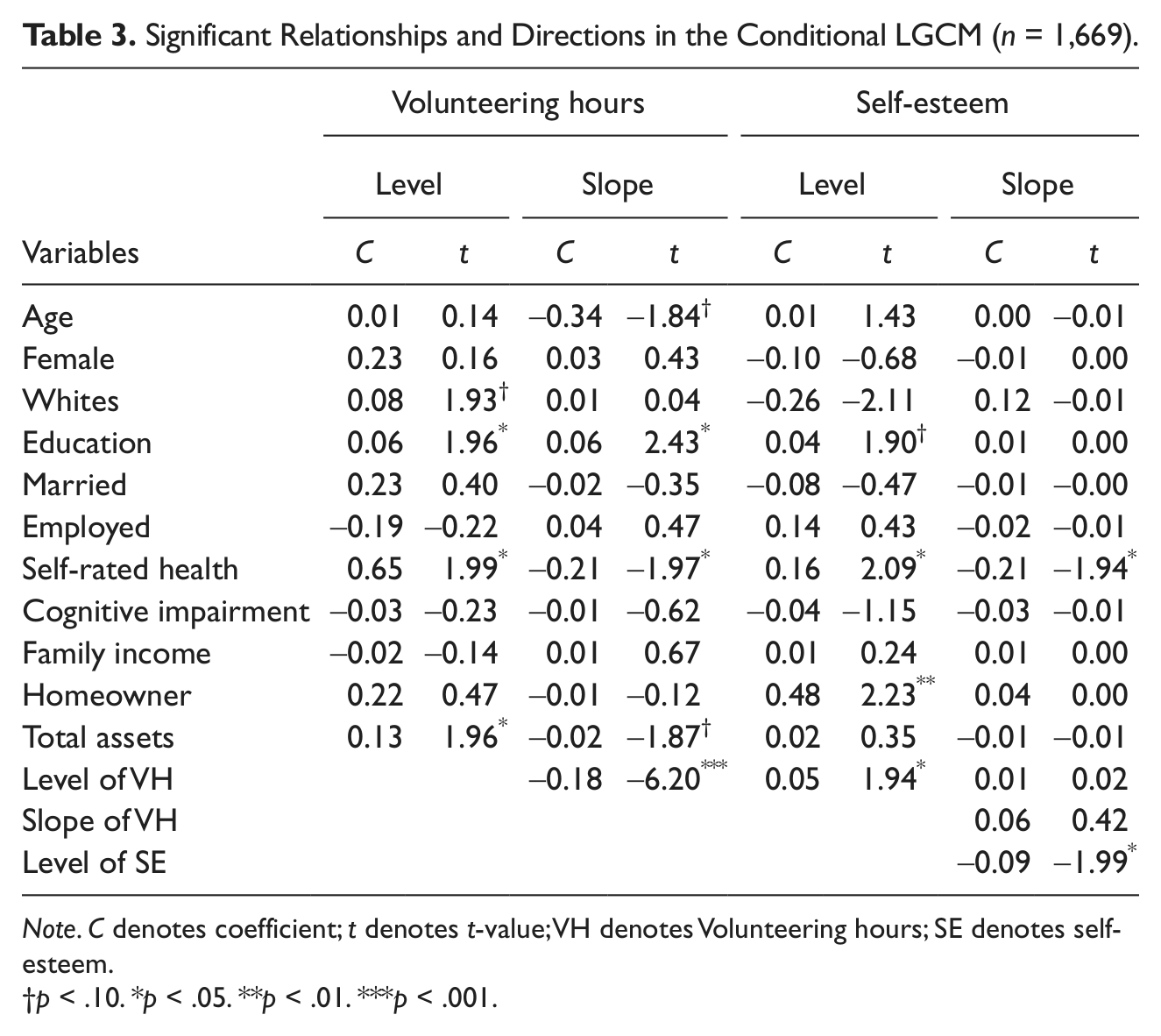
Note. C denotes coefficient; t denotes t-value; VH denotes Volunteering hours; SE denotes self-esteem.
p < .10. *p < .05. **p < .01. ***p < .001.
Findings on Volunteering Hours
Among demographic characteristics, age, race, and education were significantly associated with volunteering commitment. First, as the sample aged during the study period, older adults were involved in less volunteering (t = −1.84, p < .10). Second, Whites had more volunteering hours than non-Whites at the intercept (t = 1.93, p < .10) but had no significant differences in the slope of volunteering hours compared to non-Whites. Third, education status of older adults had positive and significant associations with the intercept (t = 1.96, p < .05) and slope (t = 2.43, p < .05) of volunteering hours. Fourth, the impact of self-rated health on older adults’ volunteering was significant in explaining both intercept and slope in volunteer commitment. Those with better health were more likely to have higher intercepts of volunteering (t = 1.99, p < .05) but less likely to maintain their higher engagement in volunteering over time (t = −1.97, p < .05). This finding suggests that healthy older adults who have committed to more volunteering at the intercept are likely to decrease their volunteering commitment over time. Fifth, we found that gender, marital status, employment status, cognitive impairment, and household income were not significantly associated with the intercept and slope of volunteering hours.
This study also found that wealth effects on older adults’ volunteering hours were inconsistent. First, homeownership had no significant relationship with the intercept or slope of volunteering hours. However, it was found that older adults with more liquid assets were likely to volunteer more hours at the intercept (t = 1.96, p < .05) and to decrease their volunteering hours during subsequent waves (t = −1.87, p < .10). Finally, we found a negative association between the intercept and the slope of volunteering hours. The negative relationship between the two suggests that the volunteering commitment of older adults was not sustained throughout the four waves.
Findings on Self-Esteem
The LGCM model explored how assets, volunteering hours, and self-esteem of older adults were interconnected, controlling for socioeconomic demographics. Key findings on socioeconomic demographics were summarized as follows: (1) Education status was positively associated with the intercept of self-esteem (t = 1.90, p < .10) but not with the slope of self-esteem; (2) Self-rated physical health was positively related to the intercept of self-esteem (t = 2.09, p < .05) and negatively linked to the slope of self-esteem (t = −1.94, p < .05), suggesting that older adults with good health and high self-esteem at the intercept may have experienced a decrease in self-esteem; (3) The other control variables including age, gender, race, marital status, employment status, cognitive impairment, and family income were not significant predictors of the intercept and slope of self-esteem.
Of the two measures of assets, homeownership was positively associated with the intercept of self-esteem (t = 2.23, p < .01), but we found no significant relationship between homeownership and the slope of self-esteem. We also found that liquid assets were not significantly related to either the intercept or the slope of self-esteem.
The intercept of volunteer hours was positively associated with the intercept of self-esteem (t = 1.94, p < .05), but had no significant impact on self-esteem over time. Also, we found that the intercept of self-esteem was significantly associated with the slope of self-esteem over time (t = −1.99, p < .05). The negative direction suggests that older adults with higher self-esteem at the beginning may have experienced a decrease in self-esteem over time.
We found that older adults’ volunteering commitment mediated the effects of education, self-rated health, and total liquidated assets on their self-esteem. Higher intercepts of education, self-rated health, and total assets increased more intensive volunteering and affected the slope of volunteering over time. Such positive effects of education, self-rated health, and total assets on volunteering hours influenced higher intercepts of self-esteem, but had no significant effect on changes in self-esteem over time. That is, the findings suggest that the mediation effect occurred only through the intercepts of volunteering hours and self-esteem.
Discussion
Building on numerous investigations of volunteering, this study examined how volunteering hours are influenced by demographics, health status, and wealth, and how these mediating effects of volunteering hours contribute to improved self-esteem in later life. To analyze longitudinal dynamics involved in volunteering hours, this study implemented an innovative theoretical approach to connect two sequential processes of volunteering, theorized by stakeholder theory (where volunteering is conceptualized as an outcome of wealth) and activity theory (where self-esteem is conceptualized as an outcome of volunteering). Another key feature of this study was the use of ACL panel data, which made it possible to understand how older Americans experienced changes in their lives over 16–18 years. This study used an advanced methodology of LGCM to examine the mediating effect of volunteering hours on self-esteem.
Several findings are noteworthy in this study. The growth patterns in volunteer hours and self-esteem were found to be nonlinear. These results suggest that the differences in mean values across four waves may be a limited indicator for understanding the dynamic mechanisms of individual growth patterns of time-varying factors.
Older adults with higher education significantly varied not only in the intercepts of volunteering hours and self-esteem but also in longitudinal changes in volunteering hours. This finding confirms the importance of education on volunteering demonstrated by other studies and suggests that more attention to less-educated older adults’ access to volunteering should been given when designing volunteer programs or providing opportunities to volunteer more.
Compared to income and home ownership, the effect of total liquid assets on older adults’ volunteering hours was important. Consistent with stakeholder theory (McBride, 2003; Sherraden, 1991), this study indicated that wealth provides incentives for volunteering more hours; that is, older adults with more liquid assets engaged in more volunteering hours at the intercept. However, the negative effect of assets on the growth curve of volunteering hours suggests that these older adults may experience difficulty in maintaining their volunteering commitment over time. Therefore, more attractive incentives beyond the wealth are needed to promote recruitment and retention of older volunteers. In addition, the findings may reflect ceiling effects in that those who have better health and more wealth may have higher volunteering hours at the intercept, but may be less likely to show any improvement in volunteering hours over time. It is also possible that, although we assume the linear growth of volunteering hours during the study period, the growth pattern is not linear. That is, wealth measured by total liquid assets may not predict the increase in older adults’ volunteering hours over time. In addition, home ownership was found to have a direct effect on self-esteem. The findings support asset effect theory where assets are hypothesized to have positive influences on psychological well-being such as self-efficacy or self-esteem (Sherraden, 1991).
By and large, this study reveals that volunteering partially mediates the relationships between self-rated health and self-esteem, along with the direct effects of self-rated health on self-esteem. As discussed before, the mediation effects appeared only through the intercept of volunteering hours. However, there were no mediating effects of the slope of volunteering hours on the relationships between self-rated health and self-esteem. In particular, self-rated health was found to have direct effects on the slope of self-esteem. However, we found negative relationships between self-rated health and slopes of volunteering hours and self-esteem. The findings support that self-rated health is beneficial for entering into a volunteer engagement, but not for maintaining slopes of volunteering hours and self-esteem over time. In addition, as explained above, this finding suggests that growth of volunteering hours and self-esteem are not linear, and the assumption of linear growth of the two factors does not fit the model. To examine more accurate longitudinal effects of self-rated health on volunteering hours and self-esteem, future research should measure self-rated health as a time-varying construct.
While Thoits and Hewitt (2001) found a marginal but significant effect of volunteering hours on self-esteem, this study revealed a strong association between volunteering hours and self-esteem. Despite this positive relationship between intercepts of volunteering hours and self-esteem, however, there was no significant association between longitudinal patterns of volunteering hours and self-esteem. The negative relationship between intercepts and slopes of volunteering hours and self-esteem may suggest that older adults with more volunteering hours and higher self-esteem at the intercept may not have experienced positive growth or may have experienced significant decreases in volunteering hours and self-esteem during the study period. Regarding these findings, we need to undertake a more comprehensive assessment of multiple activities in which volunteers are engaged. Other activities, roles, or events related to self-esteem should be simultaneously considered to examine the net effects of volunteering.
Limitations
Despite its contributions to knowledge of volunteering, this study has some limitations. First, different assets were assumed to have different effects on different types of volunteering (McBride, 2003; McBride et al., 2004). Future research needs to test how different types of assets are associated with different types of volunteering. Second, this study used volunteering hours as a measure of volunteering. However, respondents’ estimates of the number of volunteering hours are likely to be flawed due to inaccurate recall and/or social desirability effects (Thoits & Hewitt, 2001). Third, individuals had different combinations of formal and informal volunteering hours. In place of an aggregate measure of volunteering hours, using more specified measures of volunteering types and intensity (i.e., hours for paid work, formal or informal volunteering, and caregiving) will expand our knowledge about the dynamic process of volunteering. Fourth, the relationships among wealth, volunteering hours, and development of self-esteem are life long. Previous developments and experiences during younger adulthood are assumed to influence a continuum of productive engagement and well-being in later life. Future research should examine how wealth, volunteering, and well-being have developed throughout the life course. Fifth, this study did not examine interrelations among feedback processes. These interrelations should be examined in future research by setting feedback loops among wealth, volunteering, and self-esteem. Sixth, health status was measured with invariant constructs. Cognition and self-rated health should be developed as time-varying constructs. Seventh, this study used a very limited measure of psychological well-being, focusing on self-esteem. A wide range of psychological and physical well-being outcomes should be developed and tested to explain the influences of assets and volunteering on the well-being of older adults. Finally, the FIML method can provide unbiased estimate parameters when the missing patterns are missing completely at random and missing at random (MAR). While the tests of missing values in this study indicate that some variables have significant differences between those with and without missing values, no significant differences in the key outcome variables (e.g., self-esteem and volunteering hours) suggest that the data are partially MAR. The LGCM and measurement models were fitted to complete the longitudinal attritions and missing data in the study variables were completed using the FIML method. However, it should be noted that the missing values may have caused biased results in this study.
Conclusion
At least two findings of this study are noteworthy. First, we examined whether stakeholder theory and activity theory may be linked to explain relationships among older adults’ wealth, volunteering, and self-esteem. This approach can contribute to knowledge and theory building. Another significant finding is that wealth matters for civic engagement as well as mental health of older adults.
Based on our findings showing positive effects of volunteering hours on self-esteem, policy makers need to pay attentions to ways to increase volunteering opportunities for older adults across different socioeconomic groups. In particular, policy makers should reconsider expanding volunteering programs such as the Retired and Senior Volunteer Programs and Senior Companion Programs, which offer a modest stipend or other benefits for low-income older adults. These programs provide opportunities for less affluent older adults to volunteer in meaningful ways.
As this study suggests, assets and homeownership may help older adults to foster productive activities such as volunteering. Policy makers should advocate asset accumulation programs that motivate older adults to become active stakeholders in their communities, which, in turn, increase contributions to society through productive engagement in later life. Less affluent older adults who do not own their homes might be the focus of an asset accumulation program. Based on the finding that volunteering mediates the relationship of assets and well-being, policy makers and practitioners need to consider a single-entry point system that can provide more synthesized information on programs linking asset accumulation with productive engagement by older adults. These types of programs may be expected to increase opportunities for asset building and older adults’ empowerment through productive engagement.
Footnotes
Declaration of Conflicting Interests
The author(s) declared no potential conflicts of interest with respect to the research, authorship, and/or publication of this article.
Funding
The author(s) received no financial support for the research, authorship, and/or publication of this article.