




Abstract
Age discrimination is a common problem in organizations. In our pilot study, we want to explore the processes how the desired retirement age is influenced by age discrimination and see psychological empowerment as an important mediator for the relationship between these variables. Data stem from an online questionnaire completed by 130 employees from different organizations in Germany (all 50 years or older). Our results show that age discrimination is an antecedent for the desired retirement age. It has a direct as well as an indirect (via psychological empowerment) effect on the desired retirement age.
As a result of demographic changes, the European labor force is shrinking. Therefore, it is projected that for the next decade, more older workers are available for the job market (European Commission, 2011). At the same time, however, age discrimination, which is “a process of systematic stereotyping and discrimination against people because they are old” (Butler, 1969, p. 22), is a common problem in organizations (Furunes & Mykletun, 2010). There is growing evidence that age discrimination is associated with lower affective organizational commitment (Furunes & Mykletun, 2010) and a subsequent increase in intention to retire (Snape & Redman, 2003).
In this pilot study and research note, we explore the process of how the desired retirement age (DRA) is influenced by age discrimination. We see psychological empowerment as an important mediator for this relationship. Spreitzer (1995) conceptualizes psychological empowerment as a cognitive orientation toward the work role and operationalizes it with the following four dimensions: competence, meaning, self-determination, and impact. Spreitzer defines competence as employees’ belief to manage their work tasks successfully. Meaning refers to the coherence between the characteristics of the work role and employees’ beliefs and values. Self-determination is the perception of autonomy during work. Impact reflects the degree of influence employees experience in their work context (Spreitzer, 1995). These four dimensions are distinct but contribute to a uniform perception of empowerment (Seibert, Wang, & Courtright, 2011).
When using a mediation model, a relationship between the independent variable and the mediator, as well as between the mediator and the dependent variable, is necessary. We therefore will first explain why a higher level of age discrimination is associated with decreased empowerment and how empowerment is related to a higher DRA.
Age discrimination can decrease the perception of psychological empowerment in several ways. For example, older workers are discriminated in the hiring process (Büsch, Dahl, & Dittrich, 2009) and do not receive equal opportunity to participate in human development activities (Schermuly, Schröder, Nachtwei, Kauffeld, & Gläs, 2012). If their job competencies are trained less often they not only feel, but also become, more incompetent. As a result, older employees receive lower performance ratings from their supervisors (Saks & Waldman, 1998). Age discrimination can further evoke stereotype threat which is “a situational experience in which an individual feels vulnerable and pressured by the possibility of conforming or being judged by a stereotype” (Smith, 2004, p. 177). According to the process model of Schmader, Johns, and Forbes (2008), stereotype threat can reduce performance and subsequently decrease feelings of competence. Empirical research shows that age discrimination and feelings of competence are negatively related (Furunes & Mykletun, 2010). Additionally, age discrimination can also reduce the meaning dimension. If younger employees are preferred with respect to promotion or when new equipment or technologies are introduced (Furunes & Mykletun, 2010) not only feelings of competence, but the perception of the work’s meaningfulness, can be reduced. Less self-determination and sense of impact can result from age discrimination as well. Older employees can be excluded from decision or change processes because their supervisors expect that their remaining career will not be long enough to warrant participation. Participation is, however, highly associated with the perception of self-determination and impact (Schermuly, 2011).
After describing why age discrimination is negatively related to empowerment, we explain why high psychological empowerment should be associated with a higher DRA. Psychological empowerment leads to satisfaction of basic human needs. When such basic needs are fulfilled, employees’ well-being and functional capacity will increase and employees will be more inclined to maintain this status. According to self-determination theory (Deci & Ryan, 1985), self-determination and competence are very important basic needs. Those who experience an optimal challenge (coherence between competencies and the difficulty of a problem) while executing a task should as a result be intrinsically motivated (Csikszentmihalyi, 1975). Bandura (1977) has also shown that individuals with high levels of self-efficacy show more persistence to execute a task. Employees who believe that their job is meaningful should experience increased self-actualization (Maslow, 1954). Employees with a high perception of meaning in their occupation, experience, as a result, intrinsic reward and their work adds a sense of personal importance to their life. Furthermore, a meaningful job with coherence between work and personal values can stabilize employees’ psychological constitution and increase their DRA.
Results from other research fields also support this positive relationship between psychological empowerment and DRA. Early retirement can be interpreted as a specific form of turnover intention. Meta-analytic research shows that there is a negative correlation between psychological empowerment and turnover intentions, and a positive between the psychological empowerment and organizational commitment (Seibert et al., 2011). We therefore postulate:
Psychological empowerment mediates the negative relationship between age discrimination and the desired retirement age.
Method
Sample
Data stem from an online questionnaire completed by 130 employees from different organizations in Germany. Participants were recruited by students from an organizational sciences course. Because students came from all social classes and regions of Germany, an adequate sample distribution was anticipated.
Data was collected between June and August 2012 with a response rate of 37.1%. All participants were at least 50 years old (M = 54.5, SD = 3.75). While younger employees can be victims of age discrimination as well (Kunze, Boehm, & Bruch, 2011), the survey concentrated on employees aged 50+. We were specifically interested in the “baby boomer generation” (born between 1946 and approximately 1964). Because of their age, the decision to retire is a relevant question for this cohort. Furthermore, they are less effected by the new government policy to increase the retirement age in Germany. They have greater autonomy to prolong their working life and an array of public programs (e.g., perspective 50+) focus specifically on this cohort. Finally, as a result of their numbers, their retirement motivation is very relevant for the national economy.
Of the total participants, 49.2% were female. Participants worked in a variety of branches including public services (33.1%), manufacturing (20.8%), health care (10.0%), commerce (8.5%), transport and traffic (6.2%), banking and finance (4.6%), trade business (3.8), advisory services and consulting (2.3%), and others. Among the employees, 67.7% had at least a university entrance qualification (German Abitur) or a higher level of education. On average, employees had worked 18.4 yrs (SD = 11.6) at their position and had 23.7 yrs (SD = 9.8) of work experience in their current job; 33.1% of the participants had managerial responsibility.
Measures
Age Discrimination
We measured age discrimination using Furunes and Mykletun’s Nordic Age Discrimination scale (NADS, 2010). It measures age discrimination with 6 items such as “Elderly workers are passed over/left out in cases of promotion or internal recruitment” or “Elderly workers do not have equal opportunities for training during work time.” The other items were formulated for the aspects development, development appraisals, wage increase, and change processes. The items were introduced as follows: “Please refer the following statements regarding work conditions to the organization you are working for. Please rate how you agree with every statement. There are no right or wrong answers.” Cronbach’s α for this scale was .83.
Psychological Empowerment
Spreitzer’s (1995) 12-item scale was used for measuring psychological empowerment. It contains 3 items for each of the four dimensions of empowerment: Competence (e.g., “I am self-assured about my capabilities to perform my work activities,” α = .79), meaning (e.g., “My job activities are personally meaningful to me,” α = .89), self-determination (e.g., “I have significant autonomy in determining how I do my job,” α = .82), and impact (e.g., “I have a great deal of control over what happens at my department,” α = .84). A score for overall empowerment was formed by averaging the scores across all 12 items because Seibert, Wang, and Courtright (2011) could show that psychological empowerment forms a single, second-order latent construct. In our study, overall empowerment had high internal consistency (Cronbach’s α = .89).
DRA
The DRA was registered with the following question: In which age you would like to retire? In an empty field, the participants could enter the desired age. The current standard age of retirement in Germany is 65.
Control Variables
Different studies have shown that personality factors can have an influence on retirement behavior (e.g., Blekesaune & Skirbekk, 2012). That is why we controlled for the factor “generativity,” which is a general orientation of a person to pass on knowledge and skills to others. Generativity becomes strongest in midlife (Clark & Arnold, 2008). We believe that the need to pass knowledge on to another generation can be fulfilled especially during work. Therefore, those with a high orientation in generativity should have a subsequently higher DRA in order to satisfy this need. We used an adapted version of the 3-item scale from Zacher, Rosing, Henning, and Frese (2011) with items such as “I am more strongly concerned with establishing successful successors in my field than with working on my own success.” Cronbach’s α for this scale was .88. Furthermore, we controlled for employees tenure (see, e.g., the meta-analysis by Ng & Feldman, 2010). Because of the high percentage of employees working in public services and because other studies analyzing the effects of age discrimination controlled for organizations’ affiliation (e.g., Kunze et al., 2011), we also controlled for it. We used a dichotomous variable (employee working in public services or in other branches). As already mentioned, age discrimination and the actually age can be related (Kunze et al., 2011) and age has multifaceted effects on job attitudes (Ng & Feldman, 2010). Because the wish to retire can be seen as a job attitude and the preoccupation with retirement questions becomes stronger with age we controlled also for age.
Results
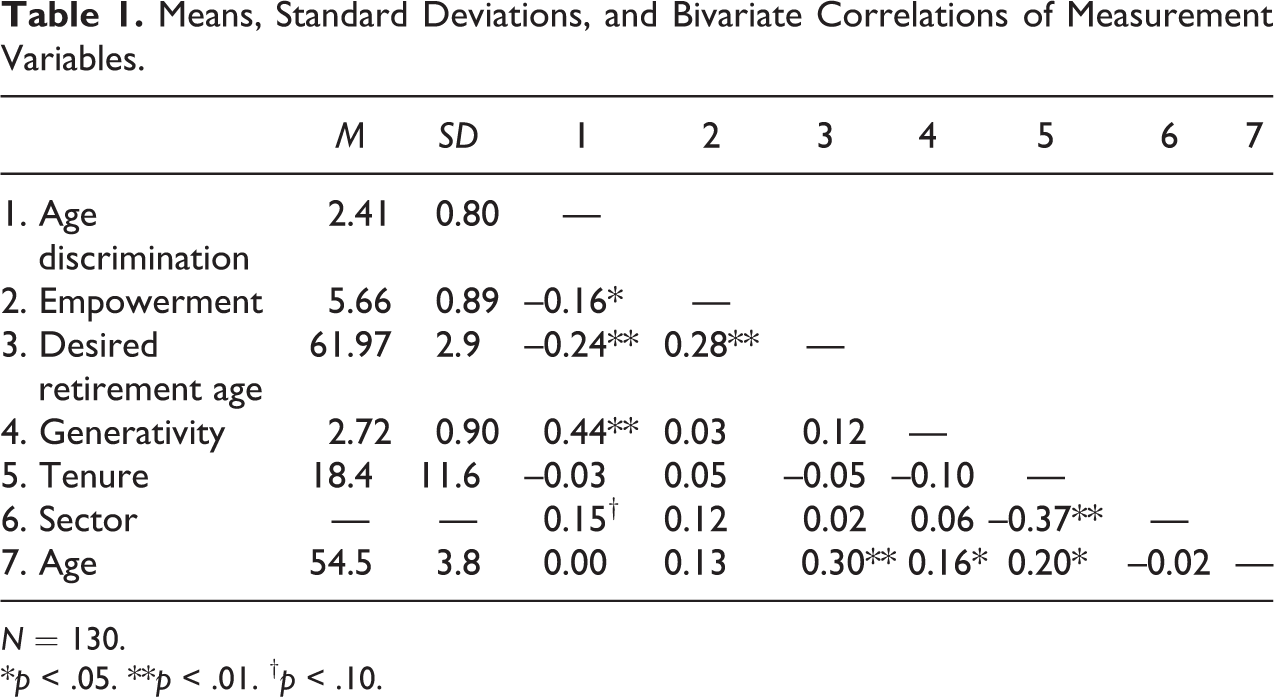
Means, standard deviations, and correlations are displayed in Table 1. It appears that the mean of psychological empowerment is quite high (M = 5.66, SD = 0.89) and that the participants would prefer to retire 3 years early than the current government standard (M = 61.97, SD = 2.88).
Means, Standard Deviations, and Bivariate Correlations of Measurement Variables.
N = 130.
*p < .05. **p < .01. † p < .10.
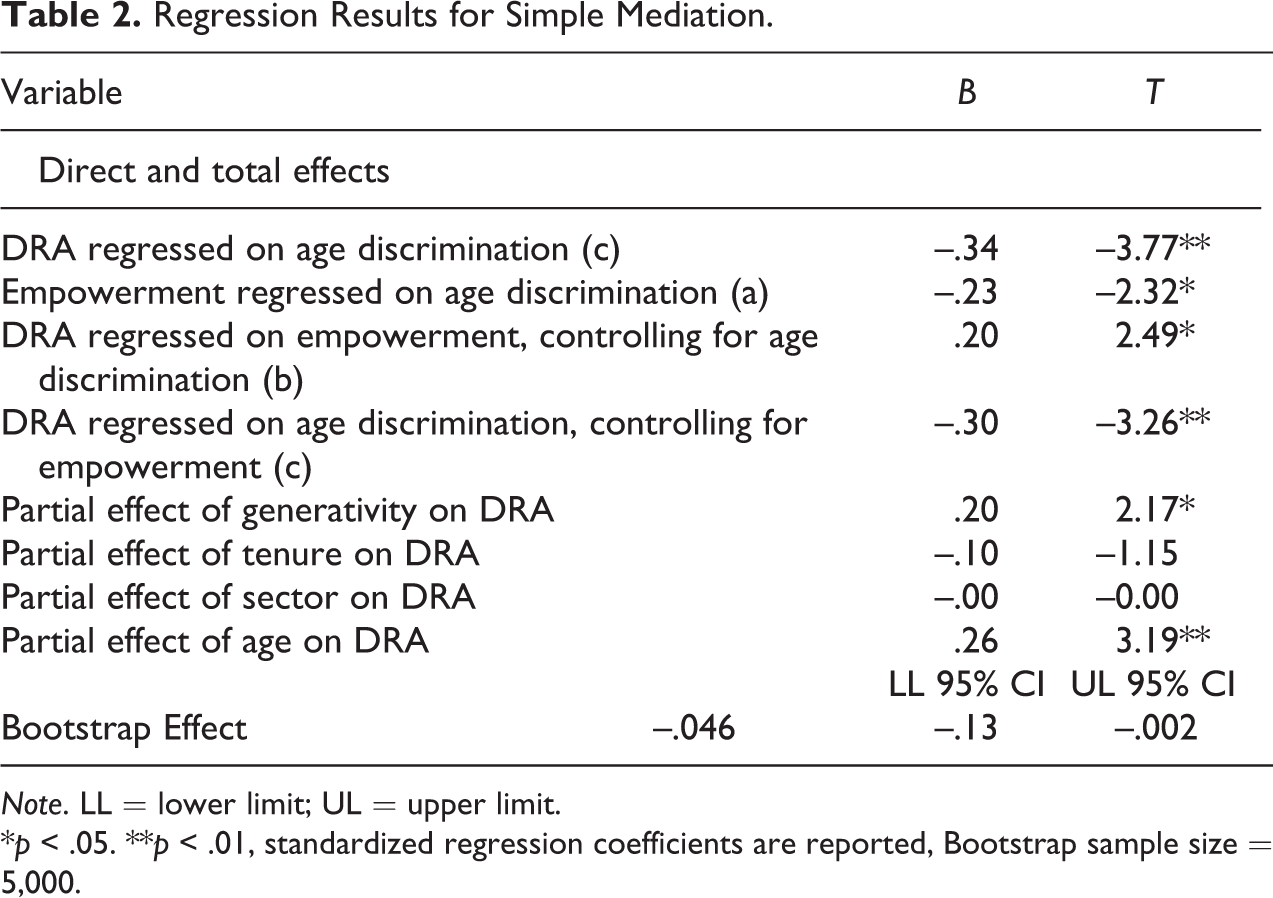
To test the mediation hypothesis, a simple mediation was conducted with the INDIRECT Macro from Preacher and Hayes (2008). This macro estimates indirect effects with a bootstrapped confidence interval. The method of bootstrapping was integrated in the Macro to overcome the restriction of the indirect effect being normally distributed, assumed by the Sobel test. The results for the mediation are displayed in Table 2 and Figure 1. Age discrimination is negatively related to the DRA (B = –0.34, p < .01). As hypothesized, this relationship is mediated by psychological empowerment. We tested the mediation effect with 5,000 bootstrap samples. The bootstrap confidence interval did not contain zero (–.13 < ab < –.002). The mediation hypothesis can therefore be accepted. Age discrimination is negatively related to psychological empowerment (B = –.23, p < .05) and psychological empowerment is positively related to DRA (B = .20, p < .01). The more that age discrimination was perceived, the less psychological empowerment was experienced. Employees with high psychological empowerment had a higher DRA. It is important to note that we found no full mediation. Age discrimination is still significantly related to the DRA (B = –.30, p < .01) after considering the path via psychological empowerment. The partial effect of the control variable generativity was positive and also significant. The model accounted for 24% of the variance of the DRA.
Regression Results for Simple Mediation.
Note. LL = lower limit; UL = upper limit.
*p < .05. **p < .01, standardized regression coefficients are reported, Bootstrap sample size = 5,000.
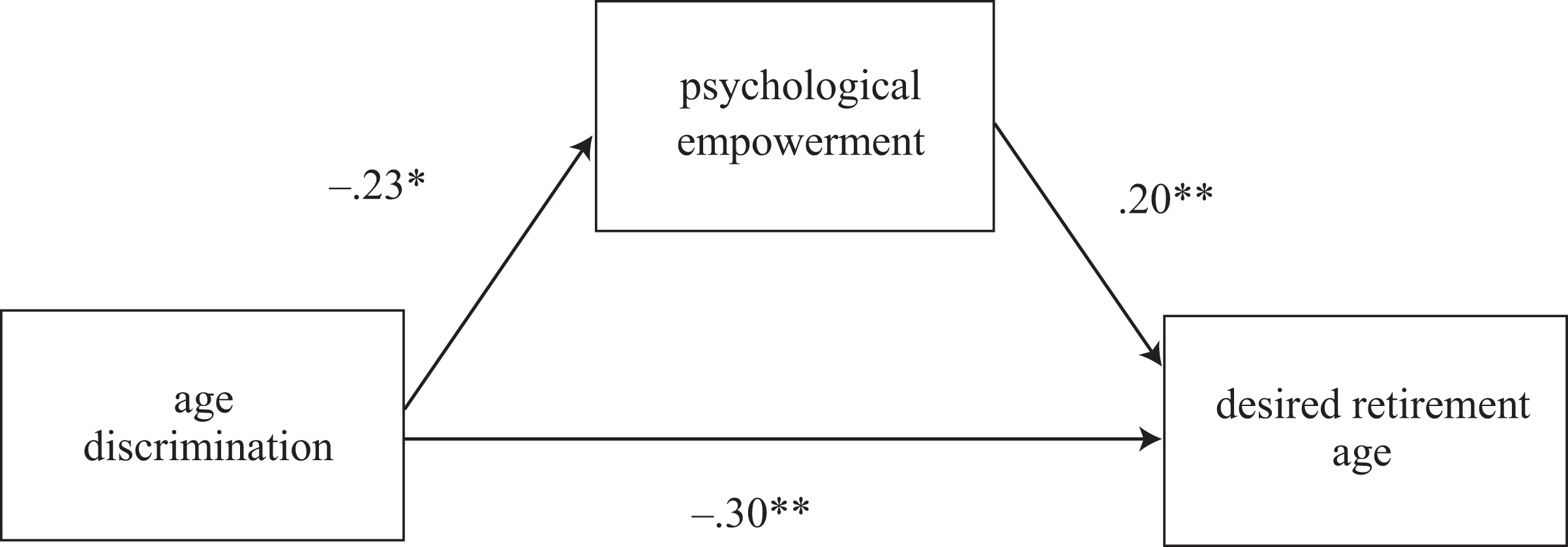
Results for the postulated mediation model.
Discussion
The hypothesis of this pilot study was partially confirmed. Psychological empowerment mediates, at least partially, the negative relationship between age discrimination and the desired age of retirement. According to the results, age discrimination may be regarded as an important factor for DRA. Age discrimination has both a direct and an indirect effect on DRA. Because the proportion of older employees is growing quickly (in 2020, 55–64-year-old employees will be the largest age segment in German companies) attention should be paid to age discrimination in research and organizations.
If our results can be replicated, they could be one starting point for influencing retirement motivations of employees. When age discrimination is reduced, employees potentially experience a greater sense of appreciation and, via psychological empowerment, experience greater fulfillment of basic needs in their jobs. If this leads to a higher DRA and employers agree that employees can work longer it could provide advantages for employees’ later retirement pensions. A higher DRA is also beneficial for organizations and the national economy. Organizations could thus reduce the skill shortage and knowledge loss provoked by demographic changes. Furthermore, age discrimination influences relational conflicts and decreases psychological well-being (Furunes & Mykletun, 2010), which can reduce employee productivity. For the national economy, both direct and indirect (e.g., lost taxes) costs could possibly be reduced if employees are willing to work longer. In Germany, every year €10.5 billion are spent on early retirement (Bundesverband BKK, 2008).
Organizational members should be sensitized for age discrimination. This sensitization should be broad, as age discrimination can occur in different situations (e.g., in promoting, human resource development, or change processes) and can come from a variety of players (e.g., supervisors, colleagues, or subordinates). Employee attitude surveys could be conducted to identify the level of age discrimination in different situations and in different groups. On the basis of such data, human resource development activities could be initiated to address any age discrimination in the workplace.
The present pilot study can help to broaden the research on psychological empowerment regarding antecedents and consequences. In their meta-analytic review, Seibert et al. found eight antecedents and seven consequences of psychological empowerment. According to our results, age discrimination could be an additional antecedent and DRA a new consequence of psychological empowerment.
The indirect effect also has practical implications. The organizational members should not only be sensitized for age discrimination but also for this mediating process. Structural hindrances that can threaten employees’ psychological empowerment should be reduced in organizations (e.g., poor sociopolitical support). Conditions that can increase psychological empowerment should be fostered. This includes offering challenging work tasks, high task and skill variety, participative leadership, and a positive leader-member-exchange quality (Seibert et al., 2011).
Limitations and Outlook
First, the sample size is small and should be composed more representative of the educational background and position of employees. This could increase the magnitude of the effects, as our sample consisted largely of employees who encounter less risk of age discrimination (the percentage of academics and supervisors was disproportionately high). Furthermore, all measures were self-reported and the relationships could be inflated by common method bias. The collection of several data points in time as well as of variables from different sources could attenuate this effect (Podsakoff, MacKenzie, & Podsakoff, 2012). A longitudinal design would also help clarify the effects’ directions. Higher levels of age discrimination can lead to more psychological empowerment; however, the opposite direction is also possible.
Future research should further identify additional mediators and moderators for the relationship between age discrimination and DRA. Important moderators could be sources of age discrimination (supervisors vs. peers), work setting (blue- vs. white-collar jobs), or different personality factors like neuroticism or assertiveness, which could increase or attenuate the relationship. Additionally, an important moderating factor could be different career periods of an employee. Different age brackets could be vulnerable in different ways to age discrimination. It is also plausible that younger employees react indifferent or positively to age discrimination because they stand to gain greater career opportunities if older colleagues are discriminated. Even today there are several generous options for early retirement in Germany. It is important to analyze how these options moderate the relationship between age discrimination and DRA. Employees with this option could be quicker to retire when they experience age discrimination.
Interesting mediators could be constructs such as job satisfaction or organizational identification. Also a distant mediation (age discrimination → psychological empowerment → job satisfaction → DRA) could be a worthwhile future research idea because we know that there is a high relationship between psychological empowerment and job satisfaction (Seibert et al., 2011). Furthermore, to explain more variance of DRA, additional antecedents should be integrated in a complex model. A very important variable could be health and especially psychological health variables. Currently, psychological health problems are the most frequently stated reason for early retirement in Germany. It is also important to look from both sides at retirement decisions and compare them. There may be different reasons for leaving earlier and for staying longer.
Footnotes
Declaration of Conflicting Interests
The author(s) declared no potential conflicts of interest with respect to the research, authorship, and/or publication of this article.
Funding
The author(s) received no financial support for the research, authorship, and/or publication of this article.