



Abstract
Despite increased interest in parent–adult child relations, there has been little attention to how these are influenced by changes in their lives, reflecting transitions and linked lives within a life-course perspective. Hybrid multilevel models are used to analyze the change in parent–adult child contact over two waves of the National Survey of Families and Households. Changes in parent–child proximity, parent and child marital status, and child parental status are associated with change in contact; continued coresidence with another adult child is related to contact with non-coresidential children; but change in parent health does not affect contact. Some patterns are stronger for daughters and biological children who tend to have stronger relationships with their parents. These analyses demonstrate how life-course transitions of parents and adult children can be examined in family context to understand how changes in the life of one family member may influence relations with another.
Family theorists have devoted a great deal of debate to how families have changed over time. Some have described both declines in extended family relations, with the emergence of the modern nuclear family, and declines in the nuclear family itself (e.g., Lasch, 1977; Popenoe, 1993; see discussion in Bengtson, 2001). Other family scholars, in contrast, have countered these positions with more optimistic conclusions, focusing on the resilience of both nuclear and intergenerational family bonds (e.g., Bengtson, 2001; Bengtson, Biblarz, & Roberts, 2002; Coontz, 1992; Logan & Spitze, 1996). These debates tend to revolve around demographic and social changes that are macro-level but that also play out at the level of individual members including parents and children. Researchers have also asked questions about how intergenerational relationships change over the life course, both with aging of each generation and with the transitions and life events that may be experienced by members of both parents and adult children (e.g., Kaufman & Uhlenberg, 1998; Szinovacz & Davey, 2007).
One approach to investigating the change in parent–adult child relations over the life course is to examine the age-related patterns. Although parents generally give more assistance to adult children than they receive, support from parents declines after children reach their young adulthood, and at more advanced ages parents tend to receive more than they give (Bengtson & Harrotyan, 1994; Cooney & Uhlenberg, 1992; Logan & Spitze, 1996). Such studies provide suggestive evidence as to how parent–adult child relations may change over time in response to life-course events and transitions in parents’ or adult children’s lives. However, there is only limited direct evidence about change in parent–adult child relations in individual families (Merrill, 2011; Shapiro, 2003; Szinovacz & Davey, 2007), in part because few data sets combine a longitudinal design with detailed information on these relationships. Much of that limited research has focused on changes in assistance or caregiving (e.g., Silverstein, 1995; Silverstein, Gans, & Yang, 2006; Silverstein, Parrot, & Bengtson, 1995).
We contribute to that literature by examining how in-person contact between parents and their individual adult children responds to changes in their statuses and characteristics. Visiting between parents and adult children, the predominant focus of previous research on parent–adult child contact, has been viewed as an important dimension of intergenerational solidarity (Rossi & Rossi, 1990; Silverstein & Bengtson, 1997). Further, Kalmijn (2006, p. 2) has suggested that face-to-face contact is a “good indirect measure of intergenerational support,” as it is related to other dimensions of parent–adult child relations such as exchange of expressive (e.g., Lawton, Silverstein, & Bengtson, 1994) and instrumental support (e.g., Rossi & Rossi, 1990). Some forms of instrumental support can only be provided in person.
Of course, contact between parents and (non-coresident) adult children may occur through other means, such as telephone, letters, or more recently various social media. But these alternate forms of contact have been shown to relate to each other. For example, frequency of visiting and phoning is positively correlated (Rossi & Rossi, 1990), exhibits very similar patterns of frequency (Kalmijn, 2006; see also Lye et al., 1995), and has similar predictors (Greenwell & Bengtson, 1997; Rossi & Rossi, 1990; Sarkisian & Gerstel, 2008). Treas and Gubernskaya (2012) indicate that although technological changes may make distance less of an impediment to parent–child contact, their analysis of patterns of maternal contact from 1986 to 2001 in seven countries found similar trends for face-to-face and “other” contact, with increases in “other” contact in only two of the countries.
Thus, our focus reflects the centrality of in-person contact in relation to other dimensions of parent–adult child relations, as arguably the most basic and significant form of contact. By examining changes in these contacts, we will contribute to a broader understanding of how other forms of contact and intergenerational support may vary in response to life events.
Further, while much past research has analyzed single parent–child dyads (e.g., Logan & Spitze, 1996; Rossi & Rossi, 1990) or parent reports of aggregated relations with adult children (e.g., Crimmins & Ingegneri, 1990; Shapiro, 2003), our recent work has examined contact and support within the context of all parent–child relations in a family (e.g., Deane, Spitze, Ward, & Zhou, 2009; Spitze, Ward, Deane, & Zhou, 2012). Here we extend such work to a longitudinal view of changes in parent–adult child relations. We use multilevel models to simultaneously examine contact between parents and each of their adult children, controlling for those adult children’s characteristics. We assess changes in parent–adult child contact between Waves 1 and 2 of the National Survey of Families and Households (NSFH), in response to changes in parents’ health, marital status, and coresidential status as well as children’s marital and parental status and their joint spatial proximity. We also examine whether any such effects vary by two unchanging characteristics of individual adult children, their gender, and their biological/step relationship to the parent respondent. In the following, we review the limited literature examining change in intergenerational relationships. We then review cross-sectional evidence on effects of our focal predictors of contact, and of other variables to be used as controls, and present the research questions that guide our analysis.
Review of Previous Literature
Changes in Intergenerational Relationships
Our modeling of the implications of change for parent–adult child relations is guided by two conceptual frameworks: intergenerational dimensions of solidarity and the life-course perspective. Silverstein and Bengtson (1997; also see Bengtson & Roberts, 1991; Bengtson et al., 2002) have described six dimensions of solidarity and their interrelations: structure, association, affection, consensus, functional, and normative. Their intent is partly to counter a “family decline hypothesis” that has asserted a weakening of family ties (see Bengtson, 2001), as their research indicates continued strength across the dimensions. (It should be noted that others have suggested this approach gives too little attention to conflict and ambivalence in parent–child relations; e.g., see Luescher & Pillemer, 1998; Ward, Spitze, & Deane, 2009.) We focus here on associational (contact) and structural (e.g., proximity) dimensions of parent–adult child relations, while also noting their implications for affectual and functional dimensions.
Our focus on change within families corresponds with two central dimensions of a life-course perspective: transitions and linked lives (Elder & Johnson, 2003). These concepts remind us that parents and children are interdependent throughout their increasingly long lives and relationships with each other and that individual lives and changes occur within a family context. Transitions experienced by one person will have influences on others, in part by altering their relationship (Connidis, 2010). For example, changes in a parent’s health or marital status, or in a child’s marital or parental status, may affect the other and their relations. This may be due to changing needs and assistance patterns or to changes in parent–adult child closeness (in distance or emotional ties); for example, parent–child closeness may be enhanced as children move into adult roles so that parents and children become more similar in their statuses and circumstances (Aquilino, 1997; Merrill, 2011; Pillemer & Suitor, 2002). Further, the implications of change for a particular parent or child may depend on the broader family context; for example, one child’s response to parent assistance needs will be shaped by the availability of siblings (e.g., Spitze et al., 2012).
Some recent studies have addressed patterns of change in helping and caregiving networks, conceptualized by Bengtson and colleagues as functional solidarity. They have found change in primary caregivers, in both initiating and ending adult children’s caregiving responsibilities, and in the size and composition of care networks over time (Dwyer, Henretta, Coward, & Barron, 1992; Jette, Tennstedt, & Branch, 1992; Szinovacz & Davey, 2007). Other studies have investigated change in more general patterns of support. Merz, Schuengel, and Schulze (2009) found that both emotional and instrumental support to parents increased over time in the Netherlands Kinship Panel Study. Studies by Silverstein and colleagues, using the Longitudinal Study of Aging (LSOG), have found that changes in support are affected by parent health and widowhood (Silverstein et al., 1995), that changes in adult child proximity (moving nearer to parents) are associated with worse parent health and widowhood (Silverstein, 1995), and that change in support to aging parents is predicted by change in parent functional impairment and by whether the mother stayed unmarried or became widowed (Silverstein et al., 2006). Thus, changes in parent health and marital status appear to elicit change in support from adult children, suggesting adjustment by children to changing parental need.
A few studies of longitudinal change have focused on quality of relations or contact. Kaufman and Uhlenberg (1998), using the NSFH, found that improved parent health yielded improved relations, whereas health declines led to lower quality of relations. Parental divorce also resulted in decline in parent–adult child relations, particularly with the father. If a parent was widowed, the relationship with an opposite-sex parent declined but that between daughters and widowed mothers improved. Merz et al. (2009), using the Netherlands Kinship Panel Study,
In sum, limited studies have analyzed change in parent–adult child relations within individual families. Most focus on functional solidarity (caregiving and other support) or affective quality of parent–child relations. A few examine changes in contact. The primary focus has been changes in parent health or marital status, though one study examined changes in adult children’s marital status and one looked at parents’ transition to retirement. We now turn to cross-sectional evidence on predictors of parent–adult child contact.
Past Cross-Sectional Evidence for Key Predictors
The key predictors of our analysis of change are parent–adult child proximity; parent health, marital status, and coresidential status with any adult child; and adult child’s marital and parental status. Although our analysis will examine effects of changes in parent and child circumstances between waves, here we review implications of cross-sectional literature for our predictors. We also discuss previous findings for children’s gender and biological/stepchild status, as background for our tests of interaction effects between these unchanging adult child characteristics and parent and child life-course transitions.
Parent–adult child spatial proximity, a key structural factor with implications for other dimensions of parent–adult child solidarity, is perhaps the strongest predictor of contact (e.g., Crimmins & Ingegneri, 1990; Deane et al., 2009; Hank, 2007; Greenwell & Bengtson, 1997), whether the focus is on adult children with living parents (e.g., Kalmijn, 2006; Lawton et al., 1994; Sarkisian & Gerstel, 2008; Waite & Harrison, 1992), parents and a particular child (e.g., Logan & Spitze, 1996; Rossi & Rossi, 1990), or parents and the most proximate child (Crimmins & Ingegneri, 1990; Hank, 2007). Although the role of proximity in determining contact might be presumed, we provide new evidence as to how varying degrees of proximity influence relationships. Within that context, we look at the implications of change in proximity along with other transitions in the lives of parents and adult children, and on how any effects of such changes may vary by characteristics of adult children.
Parental health has yielded mixed results. Longitudinal analyses suggest increasing support and proximity related to declining parent health, as noted above. Cross-sectional analyses have found quality of parent–adult child relations to be associated with better health (Kaufman & Uhlenberg, 1998; Uhlenberg & Cooney, 1990; Ward et al., 2009). Hank (2007), in a multinational European study, found that having chronic health conditions was associated with greater contact with the most-frequently seen child. However, other studies have found little or no association between parent health and visiting with adult children (Crimmins & Ingegneri, 1990; Greenwell & Bengtson, 1997; Logan & Spitze, 1996; Rossi & Rossi, 1990; Waite & Harrison, 1992).
Parental marital status has also been found to affect intergenerational relations in longitudinal studies (above) and in cross-sectional analyses but with complex patterns. Divorce is associated with lower quality and less contact, especially for fathers (Bulcroft & Bulcroft, 1991; Kaufman & Uhlenberg, 1998; Lawton et al., 1994; Logan & Spitze, 1996; Lye, 1996; Silverstein & Bengtson, 1997; Umberson, 1992). Ward et al. (2009) found that being married is associated with greater contact with adult children, especially for fathers. Waite and Harrison (1992) reported middle-aged women to have greater contact with their children (and with their own parents) if they were married. However, other research has found no relationship between contact with adult children and whether parents were married (Greenwell & Bengtson, 1997) or widowed (Crimmins & Ingegneri, 1990; Lye, 1996; Umberson, 1992).
Studies have found little association between coresidence by a parent with an adult child and contact or support patterns with non-coresident children (Deane et al., 2009; Spitze et al., 2012; Umberson, 1992). These have taken a cross-sectional view, however; the increased strain and parental dissatisfaction associated with coresidence, as noted by Umberson, may have an effect on parent–adult child contact over time. Studies have shown such coresidence to occur predominantly in parental households in response to the needs of adult children (see reviews in Ward & Spitze, 1992, 1996).
The marital and parental status of adult children may influence parent–adult child contact, perhaps by affecting quality of their relations. Studies suggest higher relationship quality when children have children (Lye, 1996) and lower quality with unmarried children (Kaufman & Uhlenberg, 1998), but evidence on their implications for contact is mixed. Married children have less contact with parents (Sarkisian & Gerstel, 2008), and divorced daughters who have custody of their own children see parents more (Spitze, Logan, Deane, & Zerger, 1994). However, Deane et al. (2009) found no association between child marital status and visiting with parents. In terms of children’s parental status, Merrill (2011) found that adult children may have less time for interaction with parents once grandchildren were born, though “shared motherhood” may bring mothers and daughters closer together. Logan and Spitze (1996) reported no association between having a grandchild and parent–adult child contact, but Deane et al. (2009) found that presence of a grandchild was associated with more visiting.
Research suggests that patterns of parent–adult child contact vary for sons and daughters and for biological and stepchildren. Logan and Spitze (1996) note that gender differences in parent–child relations are not necessarily straightforward, but women have been described as kin keepers who express stronger obligations, maintain family ties, and are most involved in assistance and caregiving (Bengtson, Rosenthal, & Burton, 1990; Logan & Spitze, 1996; Lye, 1996; Moen, 1996; Silverstein & Bengtson, 1997). There are also indications of more contact by daughters and mothers (Deane et al., 2009; Silverstein & Bengtson, 1997; Umberson, 1992). Further, implications of life-course changes may differ for sons and daughters. Merrill (2011), for example, has suggested that relations with daughters may improve after they marry, whereas relations with sons may worsen as their priorities change after marriage. Given these patterns of differences in cross-sectional research, we examine whether life-course transitions experienced by parents or adult children might vary in their effects on relations with sons versus daughters.
Research has also found variation in parent–child relations between biological and stepchildren. There tend to be more strained relations (Ganong & Coleman, 2006; Rossi & Rossi, 1990) and fewer normative obligations (Aquilino, 2005; Ganong & Coleman, 2006; Ward & Spitze, 2007) between adult stepchildren and stepparents; these may reflect family instability and disruption (Ganong & Coleman, 2004; Sweeney, 2007). These patterns contribute to weaker ties and less contact between stepparents and adult stepchildren than with biological/adopted children (Ganong & Coleman, 2006; Ward & Spitze, 2007; Ward et al., 2009). Again, we question whether life-course transitions of parents or adult children may have varied consequences depending upon whether the adult child is a biological/adopted child of the parent respondent or whether there is a stepchild relationship, perhaps of shorter duration.
Past Cross-Sectional Evidence for Control Variables
Our control variables include number of siblings in the family, and parent’s age, sex, race, and educational level. Number of adult child siblings is related to less contact with a particular adult child but to more contact with adult children overall (Crimmins & Ingegneri, 1990; Deane et al., 2009; Logan & Spitze, 1996; Treas & Gubernskaya, 2012). Ward et al. (2009; also Ward, 2008) found that having more adult children led to increased differentiation across children on both contact and reported quality of relations (also Shapiro, 2003). Adult children with more siblings experienced less frequent visits with parents (Sarkisian & Gerstel, 2008), although Logan and Spitze (1996) found this for adult daughters only.
Older parents may see children more often (Umberson, 1992), particularly daughters (Logan and Spitze, 1996). Black and Hispanic families have been assumed to have stronger intergenerational ties, but findings are mixed for contact (Lawton et al., 1994; Umberson, 1992); it remains unclear whether race affects family solidarity (e.g., Hogan, Eggebeen, & Clogg, 1993; Silverstein & Waite, 1993). Better educated parents visit with children less often (Crimmins & Ingegneri, 1990; Lawton et al., 1994; Spitze et al., 1994; but see Umberson, 1992).
Research Questions
Studies of parent–adult child relations have largely focused on aggregate measures, or on a single parent–adult child dyad per family, due to a lack of available data across adult children and/or of suitable analytic techniques. Our previous research has used innovative modeling techniques to analyze relationships between parents and each adult child in family context (Deane et al., 2009; Spitze et al., 2012). Here we extend that work in a longitudinal context, guided by research questions that address change in parent–adult child relations in the context of a family network. We pose questions about how changes in key characteristics of parents and adult children affect contact between parents and those particular adult children, controlling for earlier contact levels. We also examine whether any effects vary by the gender or biological/stepchild status of adult children, given the cross-sectional associations between those two unchanging characteristics and patterns of contact.
Specific research questions include the following. First, do changes in parent circumstances, including health, marital status, or coresidential status (with any adult child), affect contact between a parent and that child? How do changes in proximity between parents and adult children, or in an adult child’s marital or parental status, affect contact?
Second, do effects of changes in any of these parent or child characteristics vary by gender or stepchild status of adult children? We suggest that the effects of change in parent or child circumstances on their relationship may be more pronounced for relationships involving more frequent contact, as for daughters and biological children.
Data and Methods
Sample
Data are from the first two waves of the NSFH, collected from 1987 to 1988 and from 1992 to 1993 (Sweet and Bumpass 1996). The first wave was a national probability sample of 13,017 persons (primary respondents) aged 19 and over, representing the noninstitutionalized U.S. population, with oversampling of some groups (e.g., Blacks and Hispanics and certain household types); 77% of primary Rs were reinterviewed at Wave 2. For the analyses reported here, we selected parents who had at least one non-coresident adult child (aged 19+). This reduces the number of eligible parent respondents to 3,604 at Wave 1, with a total of 9,474 adult children; of these, 2,414 parent respondents (67% of Wave 1) with 6,045 adult children were followed up in Wave 2.
Unweighted data are used in our analyses. We account for NSFH’s complex survey design in our analyses via inclusion of the variables defining the sampling design (Korn & Graubard, 1991; Winship & Radbill, 1994; see also discussion of this approach in analyses of NSFH by Johnson & Elliott, 1998). The data file is organized with adult children as the units. The families we thus construct have from one to eight non-coresident adult children. Due to the small number of very large families and our estimation of unstructured within-family error covariances, children listed ninth and higher were excluded from our analyses. This does not eliminate any families and loses only 20 cases (i.e., adult children).
Dependent Variable
NSFH data include parent reports of relations with each of their children. We focus on change between waves in reported associational solidarity: frequency of visiting with each non-coresident adult child: parents reported “During the last 12 months, how often did you see (child)?” (1 = not at all, 2 = about once a year, 3 = several times a year, 4 = one to three times a month, 5 = about once a week, and 6 = several times a week). Approximately one fourth of parents live in the same household with an adult child, with the overwhelming majority of coresidence occurring in the parental household. The NSFH treats contact with coresident children as “not applicable”; however, we control for the presence of coresident adult children because of its potential impact on contact with non-coresident siblings. The NSFH also does not identify the motivator or location of contact (i.e., whether parent or child initiated the contact and where visits occurred).
Independent Variables
Independent variables include characteristics of the parent, the particular adult child, and the family. Parent characteristics include age, gender (1 = female), race (dummy variables identifying Black and Hispanic), marital status, education (number of years) as an indicator of social class, and health (self-reported: 1 = very poor to 5 = excellent). Characteristics of individual adult children include gender (1 = female), whether biological/adopted or stepchild (1 = biological/adopted), marital status, and parental status; parent respondents also reported “how many miles away from here” each child lived. Family characteristics include respondent’s number of children and whether an adult child coresides in the parent’s household (1 = yes).
Our research questions focus on the implications of change between waves in key parent and adult child characteristics and situations: parent marital status and health, adult child marital status and proximity, whether an adult child has a first child (grandchild) between waves, and whether there is a change in parent–adult child coresidence (an adult child or parent moving in or out of a household). We also investigate whether the effects of such changes vary by child gender and for biological versus stepchildren. Table 1 provides summary descriptive statistics for sample characteristics and variables, including the categorization of parent and adult child changes between waves.
Characteristics of Parents and Adult Children at Wave 1 and from Wave 1 to Wave 2.
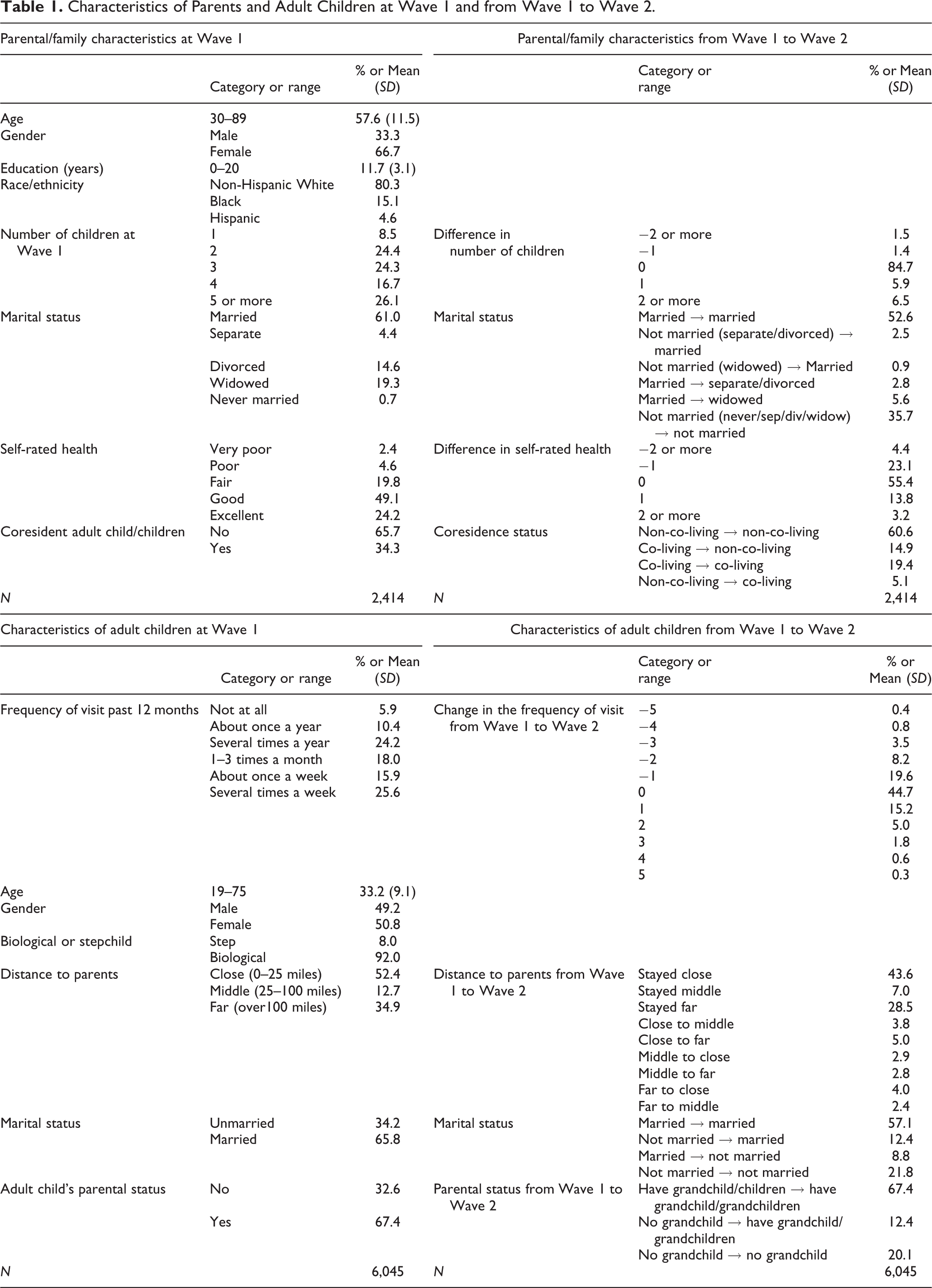
We subtract Wave 1 from Wave 2 frequency to measure change in contact; frequencies, ranging from −5 to +5, are reported in Table 1. Almost 45% of parents report no change in contact, while more report a decrease (32.5%) than an increase (22.9%); mean visiting declined from 4.07 to 3.90 (on scale from 1 = not at all to 6 = several times a week).
Parent/Family Characteristics
Parent/family characteristics are reported in Table 1. Those assumed not to change (or, for age, to change by a constant) include parent age (mean = 57.6 years in Wave 1; with a median of 57 years and 25th and 75th percentiles of 49 and 66, respectively); education (mean = 11.7 years); and gender (66.7% female). Parent race/ethnicity is coded as dummy variables for Black and Hispanic (non-Hispanic White the omitted category); 15.1% were Black and 4.6% were Hispanic. Parents also reported number of children in the family.
Parents’ marital status was coded in five categories (married, separated, divorced, widowed, and never married), but for simplicity we create a six-category measure of change. A majority (52.6%) were married in both waves or not married in both waves (35.7%). The most common change was married to widowed (5.6%). Parent health most often remained the same between waves (55.4%). It was more likely to worsen (27.5%) than to improve (17%). Most parents had no coresident adult child in either wave (60.6%) or had such a child in both waves (19.4%). They were more likely to move from coresidence to non-coresidence (14.9%) than the reverse (5.1%).
Adult Child Characteristics
Adult child characteristics include age (mean = 33.2 years in Wave 1); gender (50.8% female); and biological/adopted versus stepchild status (8% were stepchildren of the primary respondent). Children’s marital status is coded as unmarried or married for each wave. The majority were married (57.1%) or not married (21.8%) in both waves. Slightly more became married (12.4%) than unmarried (8.8%). The variable “presence of grandchildren” reflects whether each adult child had any children; 67.4% had a child in both waves, while 20.1% had no children in either wave. Some became parents between waves (12.4%), while a very small number were recorded as becoming nonparents; we code the latter in the “have a grandchild” category, not knowing whether these cases reflect children’s death or coding error.
Parents reported “how many miles away from here” each child lived. We analyzed a number of codings for our change variable, including a simple difference (which was unduly influenced by large values) and several cut points for categorical distance. We decided to code distance in three categories, reflecting likely travel time and residence in the same MSA: close (up to 25 miles apart), middle (26–100 miles apart), and far (over 100 miles). This yielded nine categories of change in distance. The large majority remained in the same category (51.3% close, 3.1% middle, and 28.5% far), while the most common change categories were “close to far” (6%) and “far to close” (4.9%).
Analytic Models
Our particular interest is whether changes in parent, family, or adult child attributes are associated with change in the frequency of parent–child contact. When two or more measurements on a dependent variable are available, and key independent variables are time varying, a fixed-effects method can get causal inference in observational studies much closer to inference in experimental designs than conventional methods for statistically controlling for characteristics of subjects—so long as the effects of unmeasured characteristics do not change over time. The essence of a fixed-effects method is in its exclusive focus on within-person variation; a characteristic that is shared by experimental designs. Although restricting attention to within-subject variation greatly improves our ability to get unbiased estimates, fixed-effect methods cannot estimate coefficients for attributes that have no (or little) within-subject variation. Random-effects methods, on the other hand, allow estimates for time-invariant variables while adjusting for the within-person correlation in repeated measures of the dependent variable that would inflate estimated standard errors and bias inference in conventional regression analysis. Although almost all of our independent variables are either time invariant or treated as time invariant due to categorical coding, we utilize, and extend, a hybrid random-effects model, derived by Allison (2005), which retains the strong causal inference properties of fixed-effect methods for time-varying variables with the ability of random-effect methods to estimate the between-subject effects of time-invariant variables and their conditioning effect on the change component of the dependent variable.
The general form of our three-level model decomposes within- and between-person variance by nesting time (indexed by t) within individuals (i.e., adult children indexed by i) within families (indexed by j):
where xit
, xjt
, zi
, and wj
are time-varying individual-level, time-varying family-level, time-invariant individual-level, and time-invariant family-level covariates, respectively;
A number of attractive and consequential features of the hybrid model can be matched to the terms in Equation 1. Most importantly in our application, the t subscripts on γ and η represent the flexibility to treat time-invariant variables from within the fixed-effects framework via time-varying coefficients. These coefficients (which result from interactions between time-invariant variables with time) allow the effect of time to vary with level of the time-invariant covariate.
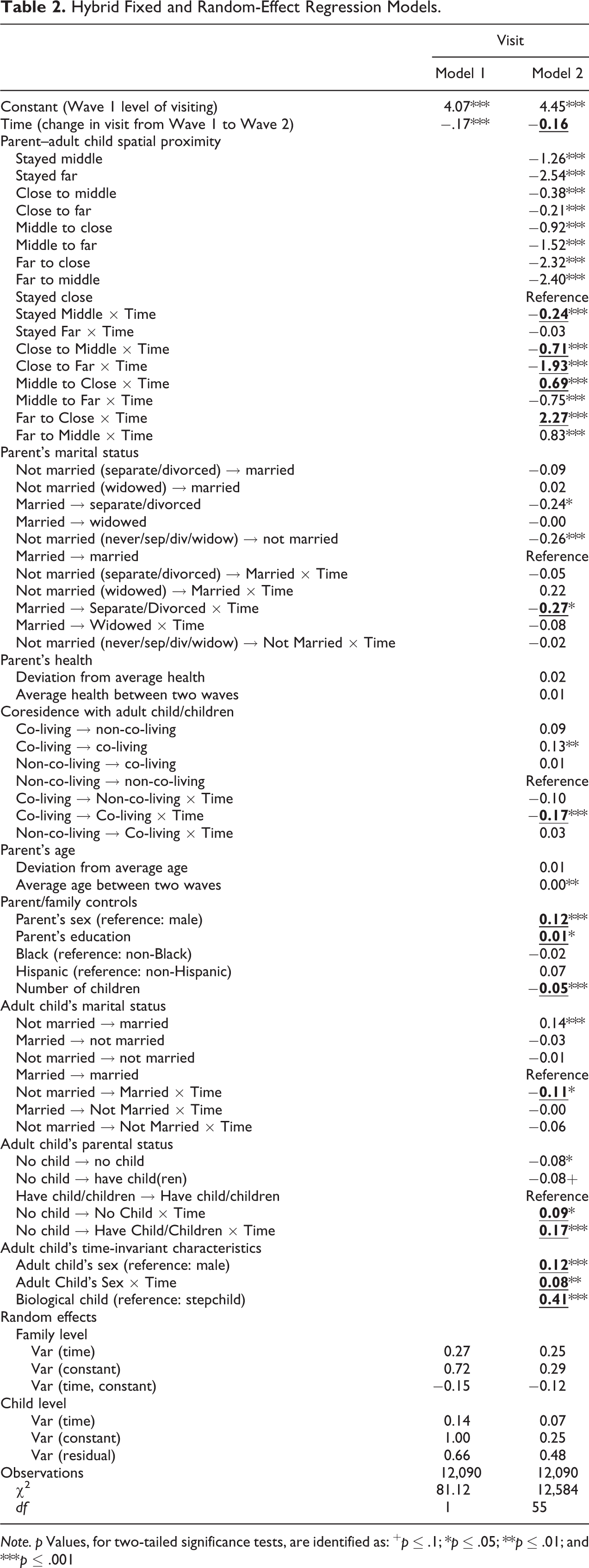
To illustrate our approach, we begin with a model in which the decomposition of y is based solely on person-specific and family-specific differencing plus the effect of time. The fixed effects in Model 1 of Table 2 show that the average level of visiting in Wave 1 was 4.07 (see “Constant”), declining to 3.90 in Wave 2 (see the “Time” coefficient estimate of −0.17 in Model 1 in Table 2).
Hybrid Fixed and Random-Effect Regression Models.
Note. p Values, for two-tailed significance tests, are identified as: + p ≤ .1; *p ≤ .05; **p ≤ .01; and ***p ≤ .001
Results
Model 2 in Table 2 presents results of our full model for the first research question: Do changes in proximity of parent and adult child, parent health, marital status, and coresidence status, and adult child marital and parental status affect changes in frequency of parent–adult child contact? We apply a hybrid method of fixed and random effects to incorporate both changing and time-invariant variables (such as gender, race/ethnicity, parents’ education, and biological relationship). For time-varying covariates, the coefficients labeled as “deviation from average” give the fixed-effect estimates. For time-invariant covariates and categorical coding of selected time-varying variables (parent and child marital status, presence of one or more coresident adult child, addition of a grandchild, and distance between parent and child), statistically significant interactions with time show the associations of these variables with change in contact from Wave 1 to Wave 2. Only statistically significant interactions with time are retained; variables without time interactions show the association with Wave 1 level of contact and indicate that they are unrelated to change in visiting.
The coefficient for time (−0.16) indicates that, net of other variables in the model, there was a small but not significant decline in the frequency of contact from Wave 1 to Wave 2 (here and in subsequent section we refer to coefficients; in Table 2 the coefficients are highlighted in boldface and by underlining).
We turn now to the implications of changing parent and adult child characteristics (see interaction with time coefficients; X × Time in Table 2). Consistent with prior cross-sectional research on spatial proximity and level of contact, distance between parent and adult child and changes in proximity have implications for changes in parent–adult child contact. Living nearer and moving nearer, especially moving from “far” to “close,” as we have defined these, are related to increased contact in comparison to parent–adult child dyads that were close at both waves (e.g., for far to close the increase is 2.27 vs. an increase of 0.69 for middle to close). Living further away, especially moving from “close” to “far,” is related to decreased contact (e.g., staying close decreases contact by −0.24, while the decrease for close to middle and close to far is −0.71 and −1.93, respectively). Remaining far and remaining close do not differ in patterns of contact change.
Other changes experienced by parents and adult children also have implications for their changing contact. For parent marital status, compared to those who were married at both waves, married parents who became separated or divorced had a greater decline in contact (−0.27), suggesting a weakening or disruption of parent–child relations; other marital status conditions were not related to changes in contact. Changes in parent health were not related to change in contact. Compared with parents not coresiding with an adult child at both waves, those who were coresident at both waves had decreased contact (−0.17); but transitions into and out of coresidence were not related to change in contact with non-coresident adult children. For child marital status, parents had less contact with children who became married compared with children who were married at both waves (−0.11), suggesting that marriage deflects children from involvement with parents. Parents had increased contact with adult children who became parents between waves (and to a lesser extent with children who were not parents at either wave) compared with those who were parents at both waves (0.17 and 0.09, respectively), suggesting that becoming a grandparent stimulates contact with adult children, but this may dissipate some over time.
Among control variables, parent age and race/ethnicity are not related to contact; contact was higher for mothers compared with fathers (0.12) and for parents with more education (0.01), and was lower (with a particular child) for parents with more children (−0.05). Contact was higher for biological versus stepchildren (0.41) and for daughters compared with sons (0.12), and contact increased for daughters after Wave 1 (0.08).
Our second set of research questions ask whether the associations between change in contact and selected parent or child characteristics vary by child gender or biological/stepchild status. We assessed this through three-way interactions of (1) child gender or biological/stepchild status with (2) parental and adult child marital status, parents’ health, coresidence, grandchildren, and parent–adult child distance and with (3) time. Table 3 summarizes the results of those analyses. We note interactions that modify the main effects reported above.
Change in Contact Modified by Child Gender or Biological/stepchild Status: Parent or Child Characteristics by Child Gender or Biological/stepchild Status by Time.
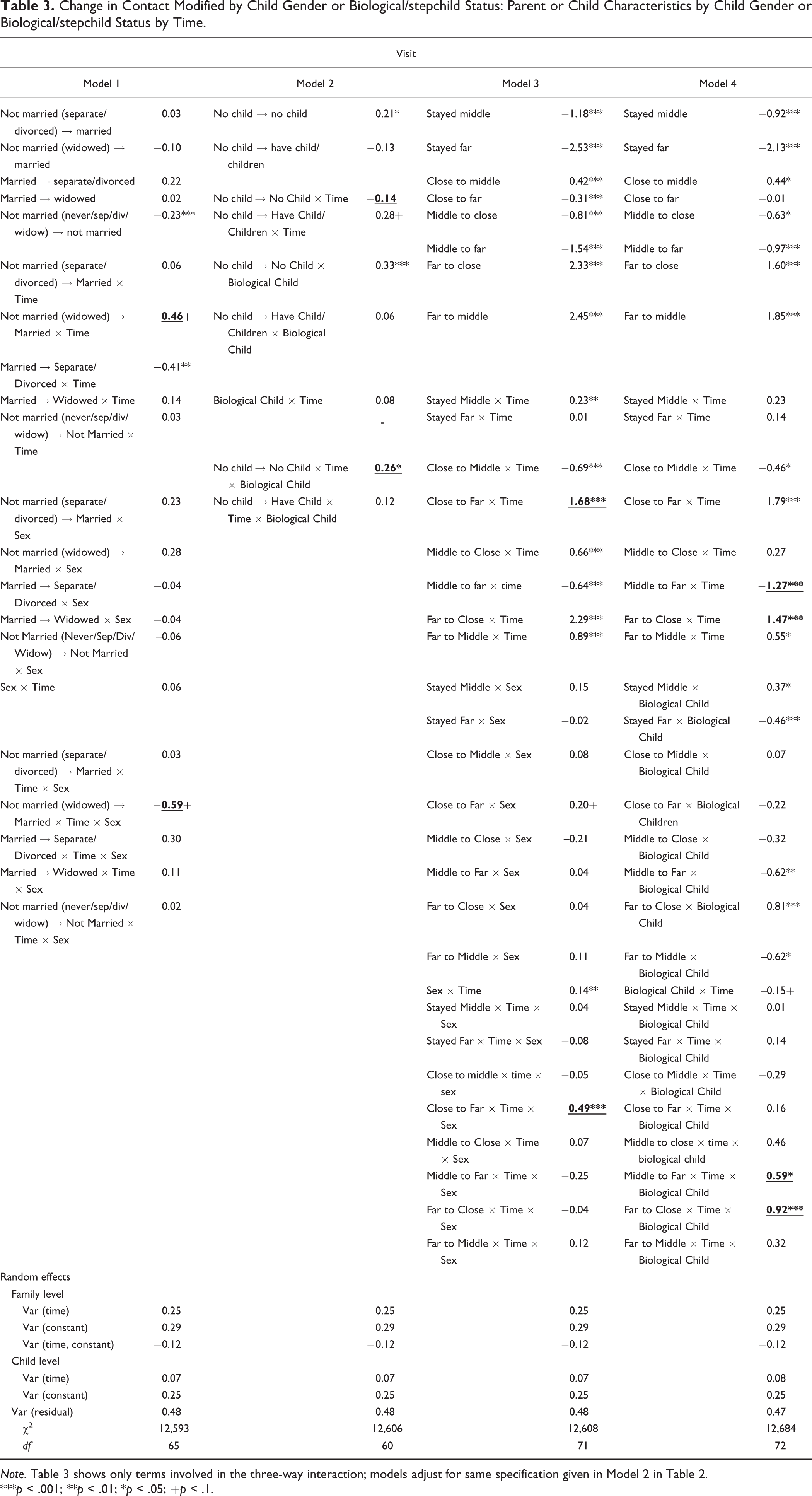
Note. Table 3 shows only terms involved in the three-way interaction; models adjust for same specification given in Model 2 in Table 2.
***p < .001; **p < .01; *p < .05; +p < .1.
Most of the three-way interactions were found to be not significant. This is itself of interest; for example, the implications of changes in parent health or in child marital status do not appear to be different for daughters and sons or for biological and stepchildren. There is variation in the implications for change in parents’ marital status from widowed to married by child gender. In the main model (Model 2 of Table 2), the interaction of time with Wave 1 widowed parents who marry between Waves 1 and 2 shows that the frequency of visits for these parents increases by about two tenths of a point (0.22) between Wave 1 and Wave 2; this is not significant controlling for other parent, family, and child characteristics included in our model specification. We can think of this as the average change for this parental marital status, but Model 1 of Table 3 allows this change to differ for sons and daughters. The result of this disaggregation reveals that parents report an increase in frequency of visits with sons of almost half of a point (0.46), controlling for other characteristics, while frequency of visits with daughters decreases by thirteen hundredths of a point (0.46–0.59 = −0.13) between Waves 1 and 2 for widowed parents who married. In other words, the nonsignificant change in frequency of visits given in Model 2 of Table 2 is the result of averaging a substantial positive increase with sons with a more modest but negative change with daughters.
A similar interpretation applies to other significant interactions in Table 3. There was a significant difference in the effect of not having a child (grandchild) at either wave (compared with those who had a child at both waves) by biological/stepchild status: this was related to increased contact with biological children (0.26–0.14 = 0.12), but to reduced contact with stepchildren (−0.14). There are also some significant interactions involving distance: daughters exhibited a greater decline in contact than sons when moving from “close” to “far”; for biological children, moving from “far” to “close” had a stronger positive association and moving from “middle” to “far” had a weaker negative association; but otherwise the effects of residential mobility do not differ by gender and biological/stepchild status. We highlight the relevant main effects and interaction effects (boldface and underlined) in the models of Table 3.
Discussion
In contrast to the predictions of “family decline” theorists, scholars who study intergenerational relationships have found significant ongoing solidarity between parents and their adult children (e.g., Bengtson et al., 2002; Logan and Spitze, 1996). However, relatively few studies have analyzed actual change in relations between parents and adult children within families, and most of those studies focus on functional (assistance or caregiving) or affectual solidarity. In particular, there has been little attention to how life-course changes of parents and adult children affect solidarity within families. We address these questions by examining how in-person visiting (associational solidarity) between parents and adult children responds to changes in their statuses and characteristics, using Waves 1 and 2 of the NSFH. Multilevel models are used to simultaneously examine changes in contact between parents and each of their adult children.
We find that overall contact declined modestly over 5–7 years but the decrease was not significant after controls. Thus, there is largely aggregate stability over that time span. Further, rather than cultural shifts in the significance of family ties, changes reflect aging and life-course experiences that were the focus of our research questions.
Our first research question asked how changes in the life-course circumstances of parents and adult children affect their in-person contact. We find that changes in proximity, in parent and child marital status, and in child parental status have implications for parent–adult child contact. Change in parent health does not affect contact in our analyses, and although continuing coresidence with another adult child is related to less contact with non-coresident children, changes in coresidence status do not appear to affect contact.
Our second research question examined whether effects of changes in parent or child characteristics vary by two unchanging characteristics of adult children, their gender and their biological/stepchild status. Patterns are mostly similar for daughters and sons, and for biological and stepchildren, but there are some indications that the effects of changes in parent and adult child circumstances are stronger for daughters and for biological children. Subsequently we discuss these patterns in more detail, placing them in the context of existing literature.
Our analysis captures two central concepts in the life-course perspective: transitions and linked lives. Two of the transitions we examine involve dimensions of structural solidarity in families, parent–adult child proximity, and parent–adult child coresidence. As in our previous cross-sectional work and much of the literature, we find proximity to be central and to produce the strongest effects. Parents and adult children see each other more often when the distance between them decreases and less when the distance increases. Interestingly, daughters exhibited a greater decline in contact when distance from parents increased. Merrill (2011) has suggested that although sons tend to live further from parents, greater distance may reflect poorer relations and greater ambivalence more for daughters than for sons. It may also be that nearby daughters have greater contact than nearby sons, so daughters’ moves may show a greater effect. We also find that moves leading to decreased distance promote more contact for biological than stepchildren, while increased distance is less disruptive of contact with biological children. As noted in the introductory discussion, relations with parents tend to be weaker with stepchildren than with biological children. Our findings reflect this, as biological children appear to be more motivated to maintain contact with parents such that moving closer facilitates contact and moving further is less disruptive of contact compared with stepchildren.
Of course, change in distance could occur due to residential mobility by the parent or the adult child or both. While we are able to measure changes in distance and changes in frequency of contact, we do not know which occurs first and through what mechanism. The implications of other life-course events discussed below, such as marriage, may partly operate through their effects on distance. Parents or children may also move closer due to a desire for more contact or a need to provide/receive types of support that require contact, or they may move for other reasons and subsequently find contact more or less convenient.
We find that continued coresidence by a parent with an adult child (compared to continued non-coresidence) decreases contact with other adult children. Cross-sectional studies have found no association between coresidence and contact with non-coresident children (Deane et al., 2009; Spitze et al., 2012; Umberson, 1992), but our longitudinal view may reflect strain and parental dissatisfaction noted by Umberson that becomes more evident when coresidence continues as a longer term arrangement. We do not find, however, that transitions into or out of coresidence affect contact with non-coresident adult children. Although coresidence predominantly involves children living in a parental household, implications of coresidence for contact with non-coresident children may depend on whose household it is; this might be addressed in future research focusing on coresidence patterns.
Of the other transitions examined, we find that parents who separate or divorce experience decreased contact with adult children. This is consistent with Shapiro’s (2003) findings for fathers, and Kaufman and Uhlenberg’s (1998) results for decline in quality of relations. However, we find no change in contact in response to parental widowhood. This is consistent with findings that contact is not related to parents’ current widowed status (Crimmins & Ingegeneri, 1990; Silverstein et al., 1995; Umberson, 1992). There is some evidence that parents’ widowhood may lead to increased assistance (Silverstein et al., 2006) or may affect quality of relations with children (Kaufman & Uhlenberg, 1998), but these studies did not investigate contact. Thus, consequences of changes in parents’ marital status may vary by the transition and the dimension of their relationship being examined. We also find that widowed parents who marry between waves experience an increase in contact with sons and a decrease with daughters. It is possible that daughters feel a decreased need to support remarried parents.
Our finding that parental health changes do not lead to changes in contact is also consistent with cross-sectional findings of little association between parent health and visiting (Crimmins & Ingegneri, 1990; Greenwell & Bengtson, 1997; Logan & Spitze, 1996; Rossi & Rossi, 1990; Waite & Harrison, 1992). Hank’s (2007) cross-sectional analysis found chronic conditions associated with greater contact with the most frequently seen child. Others have found increased support from children with parents’ increased functional impairment (Silverstein et al., 2006), and better quality of relations with children with parents’ improved health (Kaufman & Uhlenberg, 1998; Merz et al., 2009). These mixed results suggest countervailing consequences of parental health changes. Worse health may lead to more support and thus more contact, but worse health may also reduce the quality of relations and thereby lower contact. Thus, the net result could appear to represent no change.
We examine two life-course transitions among adult children that lead to changes in intergenerational relationships. An adult child’s change from unmarried to married yields less contact with parents (compared to those who are married in both waves), consistent with Musick and Bumpass’s (2012) findings for children’s entry into marriage/cohabitation. This also reflects Sarkisian and Gerstel’s (2008) view of marriage as a “greedy institution,” in which the emphasis on spousal relations deflects involvement in intergenerational relations with parents. Merrill (2011) has suggested that a son’s marriage may weaken relations with parents but that marriage may strengthen relations for daughters, but we do not find a significant gender difference in the implications of child marital change.
We also examine an adult child’s transition to parenthood, which leads to more contact with the grandparents. The comparison group is adult children who are parents in both waves, and we find that adult children who remain nonparents also have slightly more contact with their parents, particularly biological as compared to stepchildren. The birth of a grandchild may stimulate contact with the new grandparents, but the new-parent adult children may later reduce involvement with their own parents as they become more involved in their parental responsibilities. Merrill (2011) has suggested that grandchildren may weaken parent ties, though they may make mother–daughter ties closer; we do not find a gender difference.
There are limitations of our analysis, including those of time and place. Our “average” parent respondent (born in about 1930) had children during the 1946–1964 baby boom. Larger families in the sample (26% with 5 or more children) are reflective of higher fertility among baby boomers (Ahlberg & DeVita, 1992; Fingerman, Pillemer, Silverstein, & Suitor, 2012) as well as “blended” families of older remarried parents. However, the median number of children in the sample is three, and there is a range of cohorts, with parents born across five decades. Thus, the sample includes not only the baby boomers, but also cohorts before and after them which had lower fertility. However, we do use somewhat older survey data. Patterns of contact may differ in the most recent cohorts that are not represented, reflecting different choices in marriage and family that yield different life trajectories; for example, Treas and Gubernskaya (2012) suggest reduced fertility may lead to greater contact with older parents. It may also be that sibling contact has greater influence in smaller families, and patterns may differ in recent smaller cohorts. We did find greater contact with parents for adult children in smaller families; however, our analyses did not find evidence that number of children affects change in contact.
Another consideration regarding recent cohort patterns involves coresidence by parents and adult children. We found that coresidence was related to less contact with non-coresident children, though transitions into and out of coresidence were not related to change in contact. The prevalence of coresidence increased in the 1980s and 1990s (Goldscheider & Goldscheider, 1994) and that trend appears to have continued into the 2000s (Parker, 2012), reflecting economic difficulties. An increased prevalence of coresidence may have implications for more recent patterns of intergenerational relations.
From a family-stage perspective, it can also be noted that the “average” family (at Wave 1) entailed middle-aged parents and relatively young adult children (mean age of 57 for parents and 33 for children), though there is a substantial range in ages and the parents and children were 4–6 years older at Wave 2. We did not find that parent age was related to contact, but an older sample might exhibit greater instability in patterns of contact and some differences in the role of predictors as parents have greater needs and situations of children change with age.
The 5- to 7-year span between waves also limited the amount of change in contact and in key predictors such as change in parent or child marital status. A longer view, yielding greater change and variability, may yield stronger patterns of association.
Our data also represent the U.S. context. Patterns may differ in other countries, reflecting different filial norms or patterns of proximity and mobility. There may be more frequent contact in Europe (Hank, 2007; Kalmijn, 2006), for example, perhaps partly because U.S. families are likely to be spread over longer distances. But like the United State, studies have found little evidence of decline in parent–adult child solidarity in a variety of Western countries (Kalmijn & deVries, 2009; Treas & Gubernskaya, 2012).
In addition, we have focused on face-to-face visiting. Future research will be able to examine changes in other, newer forms of contact (from e-mail to social media), which have only very recently begun to be included in surveys (Treas & Gubernskaya, 2012). It is possible that these new technologies have led to increases in frequency of contact, although this is likely less true for in-person contact. It may require more qualitative forms of data collection to learn how, for example, brief text messages influence the quality of intergenerational intimacy in comparison to longer phone or in-person conversations.
Our analysis is based on parental reports. Logan and Spitze (1996) found slight differences in patterns of contact and help based on parents’ versus children’s reports, and parents may give somewhat more positive reports than their children (Aquilino, 1999). Parents may tend not only to report more contact, but more similar patterns of contact across children, not wanting to suggest favoritism. On the other hand, since we are examining patterns of change, any such bias might be less consequential for our findings here than in a cross-sectional analysis. In any case, it would be useful to conduct similar analyses with more recent data and with data based on children’s reports (such as that collected by Pillemer & Suitor, 2002).
One future step in this research will be to examine how changes in one adult child’s characteristics affect parents’ contact with other children. For example, if one child produces a new grandchild, perhaps the first in the family, is there less contact between parents and other adult children? It is also possible that such an event would create more visiting among all the members of an extended family. However, increased visits between parents and that adult child’s family might decrease time and energy available to see other adult children. A number of parallel questions could be asked, given sufficient detail about characteristics of all adult children and events in their lives.
These analyses have demonstrated how life-course transitions experienced by aging parents and their adult children can be examined in family context to determine how changes experienced by one family member may influence relations with others. The life-course perspective is central to our understanding of aging families, but the measurement and analysis of change in family relations continue to present challenges to family researchers. We hope that these results will encourage additional attention to these issues.
Footnotes
Acknowledgments
Data in this article are from the first two waves of the National Survey of Families and Households. The first wave of the NSFH was funded by a grant (HD21009) from the Center for Population Research of the National Institute of Child Health and Human Development; and the second wave was funded jointly by this grant and a grant (AG10266) from the National Institute on Aging. The survey was designed and carried out at the Center for Demography and Ecology at the University of Wisconsin–Madison under the direction of Larry Bumpass and James Sweet. The field work for the first two waves was done by the Institute for Survey Research at Temple University. Analyses in this article were supported by a grant (1 RO3 HD048451-01-A2) from the National Institute of Child Health and Human Development to the University at Albany, Glenna Spitze, Principal Investigator, and Glenn Deane and Russell Ward, Coinvestigators. Support was also provided by a grant to the Center for Social and Demographic Analysis from NICHD (R24 HD044943). Opinions, findings, and conclusions expressed here are those of the authors and do not necessarily reflect the views of the funding agencies. We thank our research assistant Lei Lei for her expert file management, statistical programming, and table construction.
Declaration of Conflicting Interests
The author(s) declared no potential conflicts of interest with respect to the research, authorship, and/or publication of this article.
Funding
The author(s) received no financial support for the research, authorship, and/or publication of this article.