




Abstract
While we know that living alone is often associated with greater risk of financial hardship, we have limited knowledge on the possible link between the availability of public support and independent living. We use data from the 2014 Health and Retirement Study and the 2011–2015 Survey of Health, Ageing and Retirement in Europe to compare income and wealth profiles of the population aged 60 and above who are living alone in the United States and 19 European countries. We find that the likelihood of living alone is higher in generous welfare states, with social support and spending both positively associated with living alone. The relationship between personal resources and living alone has a smaller positive gradient in countries with robust welfare systems. The lack of adequate public support in less generous welfare states may constrain the ability of many low-income older adults without a partner to continue living independently.
Population aging, coupled with a growing shift toward living independently, resulted in a sharp growth of older adults living alone over the past century (Stepler, 2016). There are over 12 million Americans aged 65 and older who live alone—about a trifold increase compared to the mid-20th century (Klinenberg et al., 2013; Stepler, 2016). This growth has been associated with higher rates of divorce and an increasing likelihood of remaining single following a divorce (Brown & Lin, 2012). A long-term decline in intergenerational households—a phenomenon caused by changing economic structures and increased opportunities for adult children outside of parental households—is also associated with this growth (Ruggles, 2007). As the result of higher marital instability and historically low fertility rates, an increasing number of older adults are aging not only alone but also without family (Margolis & Verdery, 2017).
The United States is far from unique in experiencing these trends. Many other developed countries have higher rates of older adults living alone (Iacovou & Skew, 2011) or having no children (Dykstra, 2009). Across the 28 member states of the European Union (EU), close to 27 million adults aged 65 and older lived alone as of 2013, of which about 20 million were women (Lodovici Samek et al., 2015). Although projections of future living arrangements in Europe (Gaymu et al., 2008) and recent trends in the United States (Stepler, 2016) suggest that a further increase in the percentage of older adults living alone is less likely (partly because of improved health of men and an associated decline in widowhood for women), it will likely remain high.
Beyond the population aging and related demographic shifts, the literature has identified changing preferences as the main driving force of increase in living alone. Klinenberg (2012) claims that social changes in recent decades including the entry of women into the labor force and their growing economic independence, as well as a revolution in communication, urbanization, and increased longevity, make living alone an important characteristic of developed societies. A large body of literature provides support for this notion (Burch & Matthews, 1987; Michael et al., 1980; Pezzin & Schone, 1999; Ruggles, 2007). Based on these theoretical and empirical insights about growing preference for independent living, researchers found that material resources—income in particular—are positively correlated with living alone (Gaymu et al., 2006; Iacovou, 2000; Michael et al., 1980; Mutchler & Burr, 1991).
The increase in solo living at older ages has sparked substantial scholarly and policy attention because, on average, those who live alone are at a higher risk of various adverse outcomes, in particular, related with health. For example, living alone may increase loneliness and social isolation among older adults (de Jong Gierveld et al., 2012; Yeh & Lo, 2004), and feelings of loneliness have been linked with physical and mental illness (Ong et al., 2016) and all-cause mortality (Steptoe et al., 2013). Living alone is also correlated with adverse health outcomes such as functional loss (Puts et al., 2005) and depression (Chou et al., 2006), though the relationship varies by gender, race, and ethnicity (Russell & Taylor, 2009). The main source of vulnerability for older adults who live alone may be a lack of someone who can provide various health-related supports (e.g., surveillance, care during illness, provision of meals). This can lead to faster health deterioration in the absence of other sources of support (Grundy, 2006). For example, individuals who live alone have an elevated risk of undiagnosed dementia (Lehmann et al., 2010). Beyond health, living alone is a risk factor for falling into poverty (Winqvist, 2002), and it appears to be associated with lower life satisfaction (Gaymu & Springer, 2010) and lower quality of life (Soares et al., 2010).
However, although available evidence suggests that living alone is on average an important risk factor for adverse health and socioeconomic outcomes, it is necessary to recognize various distal factors that impact the extent to which solo living is associated with greater vulnerability. One such factor is the extent and availability of social networks that can provide emotional and functional support to older adults. By this measure, Djundeva et al. (2018) show that only about a third of older adults living alone in Europe could be considered vulnerable. Another important factor is country-level context, including different policy regimes across countries. Although available empirical evidence suggests that growing preference for independent living can be observed across different societies (Palloni, 2001; Tomassini et al., 2004; United Nations, 2017), even in countries at a comparable level of economic development and with some broad cultural similarities, there is a noticeable difference in living arrangements. For example, while in Northern and Western Europe almost one third of older adults live alone, the same is true for only one fourth of older adults in Northern America (United Nations, 2017). Evidence from the United States supports the notion of importance of policy contexts, as it shows that choice in living arrangements was influenced by public home care programs (Pezzin et al., 1996) and social security benefits in the second half of the 20th century (McGarry & Schoeni, 2000). McGarry and Schoeni (2000) assess that about half of the total increase in independent living of older widows between 1940 and 1990 was attributable to their improved economic status, primarily as it relates to increases in social security coverage and benefits. Also, housing market conditions impact older adults’ living arrangements (Mutchler & Burr, 2003), and they may partly reflect different housing policies across countries.
In this study, we focus on contemporary trends in the living arrangements of older people in the United States and Europe. We are particularly interested in the way in which these countries differ in the propensity to live alone. Living alone is a highly relevant policy issue for older adults, especially given their increased risk of institutionalization (Thomeer et al., 2016), readmission following discharge from a formal care institution (Mudrazija et al., 2015), and the higher need for and use of health-related public support among a community-dwelling population (Grundy, 2006). As financial pressures escalate, the U.S. government will likely continue to expand policies that will enable older adults to age in place. In Europe, while the propensity to live alone varies across nations, it presents a similar challenge for future fiscal sustainability.
However, our knowledge regarding the relationship between public support and living arrangements, specifically in the context of available personal financial resources, remains limited. Although we know that economic resources are positively associated with living alone and we have some tentative evidence that this relationship may vary across countries (Iacovou, 2000), we lack deeper empirical insight regarding the role that public policies play in this relationship. This study addresses this research gap by exploring cross-national differences in the prevalence of living alone across income and wealth groups, proposing a theoretical framework for analyzing these differences, and estimating the impact of public policies on the likelihood of living alone.
Conceptual Model and Research Hypotheses
Figure 1 presents a conceptual model of the association between living alone and personal economic resources by welfare state generosity. Part A summarizes the relationships between the key variables of interest. We start by assuming a positive relationship of personal economic resources and living alone in old age, which was established in previous empirical studies. We then assume that welfare states impact the likelihood of living alone in two ways. Through their social spending and supports, welfare states increase the ability of older adults who prefer to live independently to do so, which is represented with a direct positive link with living alone. However, by alleviating resource constraints that less well-off adults face, and partially decommodifying the choice of living arrangements, welfare states also attenuate the positive relationship between personal economic resources and living alone. These assumptions about the links between individual behavior and public policies in the cross-national context are rooted in the theoretical and empirical insights from the prior literature that has examined the links between public policies and individual- and family-level decisions (e.g., Albertini & Kohli, 2013; Brandt et al., 2009; Leopold & Raab, 2011; Mudrazija, 2014, 2016). 1 Although not the focus of our analysis, we recognize that other personal characteristics also impact the choice of living arrangements.
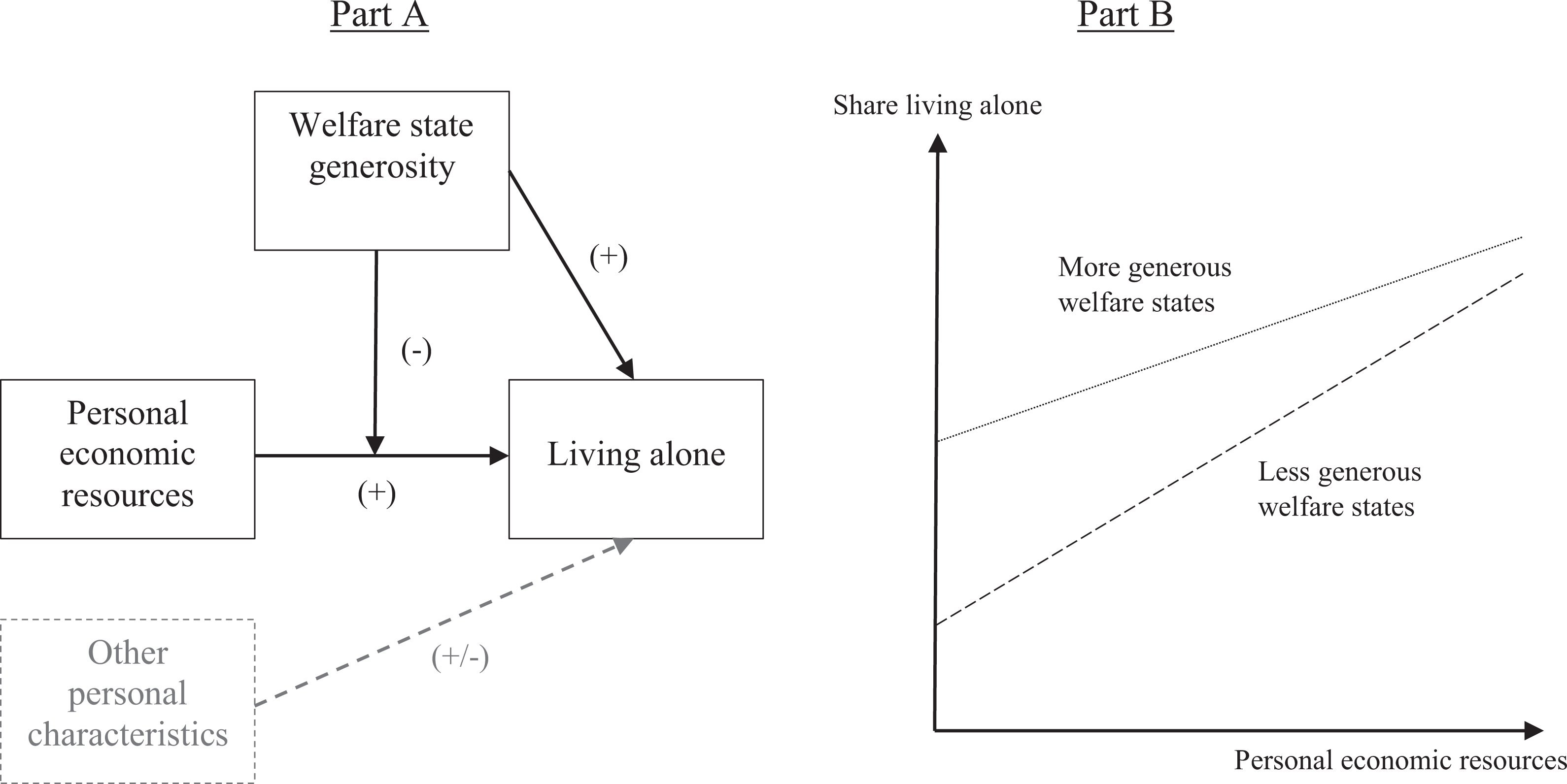
Conceptual model of the association of living alone and personal economic resources by welfare state generosity level.
In Part B, we depict how these basic assumptions about the impact of welfare state generosity on the relationship between personal economic resources and living alone translate into our research hypotheses. Because of higher social spending and supports, the prevalence of living alone is, all equal, higher in more generous welfare states (Hypothesis 1). This is reflected in the higher share of older adults living alone in more generous welfare states at any level of personal economic resources. Furthermore, consistent with the economic insights regarding decreasing marginal utility of income and wealth, we expect that redistributive policies have larger impact on residential choices of poorer than wealthier individuals. Therefore, we expect that more generous welfare states have a smaller gradient of association between economic resources and living alone (Hypothesis 2), as reflected in different slopes in Figure 1B.
An important caveat is that we are not making any assumption about the origins of welfare regimes and public policies, but assume they are exogenous from an older adult’s perspective. From a societal perspective, this reasoning is flawed given that public policies are, at least in mature democracies, both a product of voters’ collective preferences and a factor that shapes them. That is, they are inherently endogenous. Yet because any individual is essentially an infinitesimally small part of a country’s population and electorate, we assume that an older adult making a living-arrangement decision takes into consideration relevant public policies. This allows us to compare the impact of institutional and policy variation on individuals across countries.
In addition to examining the overall relationship of economic resources and living arrangements as depicted in Figure 1, we are interested in assessing possible gender and age differences. Due to their longer life expectancy, women are much more likely to be unpartnered and live alone in old age (Gaymu et al., 2006), yet conditional on being unpartnered, older men have higher odds of living alone than women (Yeh & Lo, 2004). Furthermore, research shows that the impact of increase in divorce and nontraditional family forms on family ties is less negative for women than men (Kalmijn, 2007; Kennedy & Bumpass, 2008). This suggests that both the selection into living alone and the role of support network may vary by gender. We expect a larger share of lower income women than men to form joint households with children, resulting in a steeper gradient of the relationship between economic resources and living arrangements for women (Hypothesis 3). Consistent with the expected impact of welfare state generosity previously described, the difference in the gender gradient of living alone by economic resources is larger across less generous welfare states (Hypothesis 4).
As far as the impact of age, Gaymu and colleagues (2006) establish that living alone has an age gradient, increasing through age 80, then declining as disability levels begin to increase. Among the key reasons is that health and long-term services and supports (LTSS) costs increase substantially with age, which may lead to older adults seeking alternatives to independent living, even if they otherwise would prefer to continue living on their own. Moreover, family support for unpartnered older adults may decline with age as their family support network declines in size (e.g., siblings passing away) or availability (e.g., adult children leaving parental home). Therefore, we expect the link between living alone and economic resources to exhibit a positive age gradient (Hypothesis 5). We also expect welfare state generosity to moderate the age gradient of the impact of economic resources on the likelihood of living alone (Hypothesis 6).
Data and Methods
Data
To analyze the links between living alone and the personal economic resources among older Americans and Europeans, we use individual-level data from the Health and Retirement Study (HRS) and the Survey of Health, Ageing and Retirement in Europe (SHARE). The HRS is a nationally representative biennial survey of Americans over the age of 50 conducted since 1992, while the SHARE is a nationally representative survey of people aged 50 and older from 19 European countries (Austria, Belgium, Croatia, Czech Republic, Denmark, Estonia, France, Germany, Greece, Hungary, Italy, Luxembourg, the Netherlands, Poland, Portugal, Slovenia, Spain, Sweden, and Switzerland) and Israel that began in 2004. 2 We use the HRS data from 2014, and the SHARE data for European countries from 2015, save for the Netherlands and Hungary, which did not collect data in 2015. We use the closest available data in its place (2013 and 2011, respectively). We primarily rely on the HRS-harmonized version of the SHARE data provided by the Gateway to Global Aging Data, which makes the SHARE data comparable with the RAND HRS data file. 3 Our data have records on 60,160 noninstitutionalized adults aged 60 and older who provided information on their living arrangements, household income, and wealth. Given that the extent to which older adults live with their partners is strongly linked with differences in life expectancy across countries that are shaped by various factors beyond welfare state generosity—such as lifestyle—we focus the analysis on the subsample of 19,745 unpartnered older adults. 4
We supplement the individual-level data with country-specific information on the share of social employment and social expenditures. Data on employment come from the International Labour Organization (2017) estimates of employment by sector. Data on the total social expenditures come from the Organisation for Economic Co-operation and Development’s (OECD, 2017) Social Expenditures Database. 5
Variables
The outcome of interest is whether the noninstitutionalized older adult lives alone, that is, whether there is only one resident living in a household as reported by the household respondent. The main predictors are older adults’ economic resources, defined as terciles of wealth and income in each country, and their interaction with the country indicators. To construct wealth and income terciles, we use the available household (i.e., couple) information on the nominal net total wealth and income, convert them to real 2015 U.S. dollars, correct for purchasing power parity across the countries, and calculate per-person amounts using equivalence elasticity of 0.5, consistent with the OECD (2015) methodology. We split the resulting per-person wealth and income in each country into three categories, representing low, medium, and high wealth and income, respectively.
In the models estimating the impact of public policies on living alone, the predictor of primary interest is the measure of social services employment and, alternatively, social expenditures. Because the decision regarding living arrangements can involve persons other than the older adults themselves (e.g., adult children, siblings, or friends) and reflects a complex optimization process that considers the needs and preferences of persons at various stages of the life cycle, we use the most inclusive measures of public support. Following the literature that examined the impact of public policies across countries on intergenerational transfers between older parents and adult children (Brandt & Deindl, 2013; Brandt et al., 2009), we operationalize social services employment as the total employment in human health and social work activities. This is equivalent to Sector Q in the fourth revision of the International Standard Industrial Classification (United Nations, 2008). This measure approximates each country’s level of commitment to public provision of intergenerational practical supports essential for independent living. 6 The measure of social expenditures is operationalized as the total per capita spending (in thousands of dollars) at purchasing power parity on social policy, which includes old age and survivors, disability and other incapacity-related benefits, health, family, unemployment, active labor-market programs, and housing. Public spending on social services approximates financial support provided to older adults and other individuals in need of support.
The models control for various individual sociodemographic characteristics that are statistically significant in at least some of the estimated model specifications. These characteristics include age (years), relationship status (divorced/separated, widowed, never married), education (years), indicator variables for gender, any living children, any living siblings, any caretaking of grandchildren, and any limitations in instrumental activities of daily living (IADL). The models also control for nativity as prior research suggests that even after accounting for resources, needs, and various demographic characteristics, older immigrants are more likely to live with family than their native-born peers (Wilmoth, 2001).
Analytic Approach
We first examine cross-national differences in wealth and income distributions of unpartnered adults aged 60 and older by living arrangements, focusing in particular on poorer older adults. This is followed by an overview of sample means including a test of difference in means by living arrangements.
We next fit a logistic regression model of living alone on wealth and income groups. The model includes a welfare state-type dummy variable and its interaction with wealth and income, allowing us to examine differences in the relationship of personal economic resources and living arrangements by welfare state generosity. Given insights from prior research, we include in the model an interaction of gender and relationship status. We also accommodate for possible nonlinear relationships between living alone and age, by specifying a piecewise linear spline with knots at ages 70 and 80. We repeat this analysis stratified by gender and age.
Finally, we estimate a multilevel logistic regression model of living alone that includes predictors for social services employment and social expenditures, respectively. The model has two levels—individual and country—with random intercepts by welfare state type, reflecting the hypothesized higher prevalence of living alone in more generous welfare states.
Results
Unpartnered older adults are likely to be at the lower end of the wealth and especially income distribution across all countries (Table 1). However, there is substantial variation by living arrangements as between 60% and 90% of those who live with others are in the bottom third of income distribution compared to between 19% and 56% of those who live alone. The relative difference by living arrangement is the largest in former socialist countries such as Hungary, Poland, and Estonia, and the smallest in Northern European countries such as Denmark and Sweden. For the wealth distribution, higher likelihood of being in the bottom third for those who live with others persists, although the magnitude of difference relative to those who live alone is smaller, and there is no clear geographic distinction in this difference.
Percentage of Unpartnered Adults Aged 60 and Older Who Are in the Bottom Third of Income and Wealth Distributions by Living Arrangements and Country. a
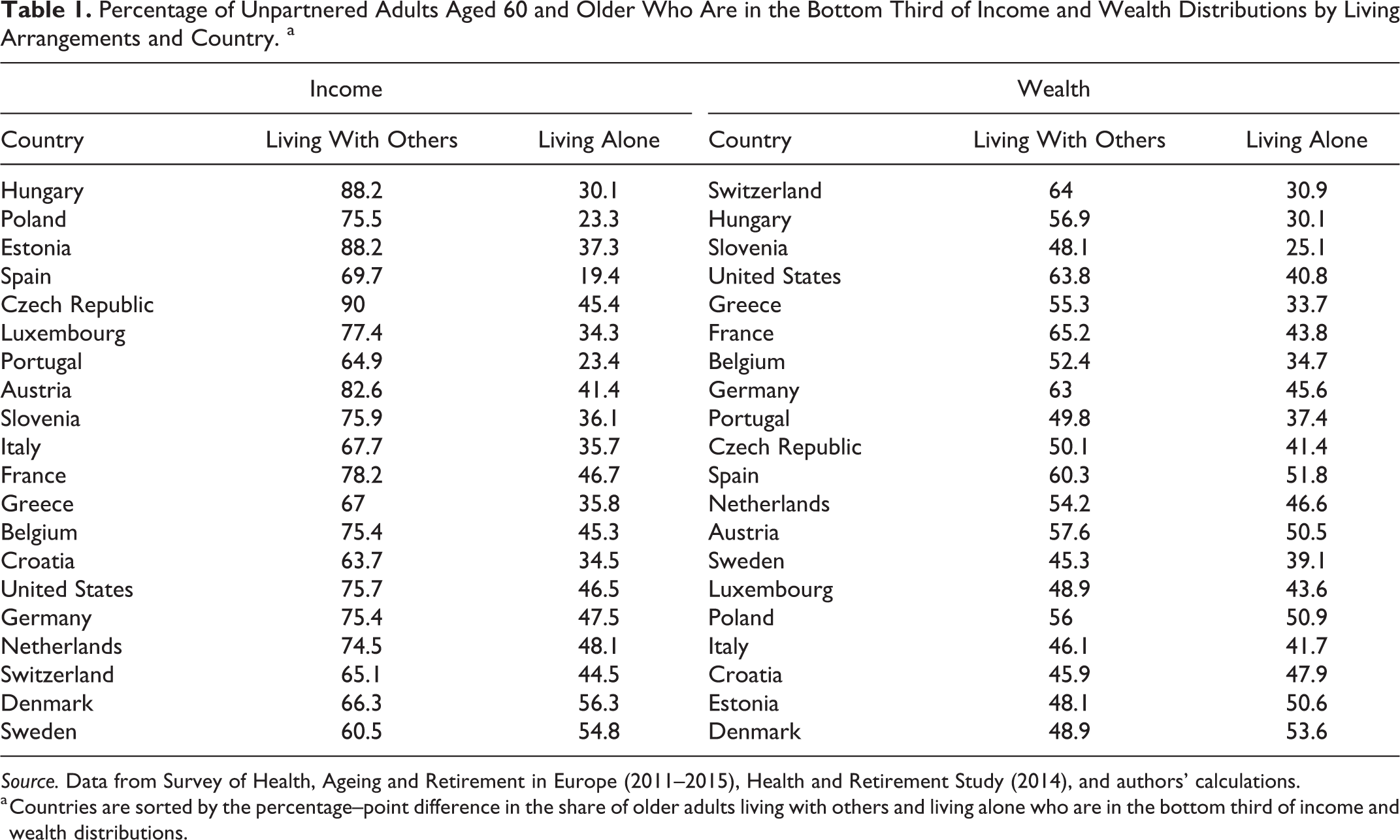
Source. Data from Survey of Health, Ageing and Retirement in Europe (2011–2015), Health and Retirement Study (2014), and authors’ calculations.
a Countries are sorted by the percentage–point difference in the share of older adults living with others and living alone who are in the bottom third of income and wealth distributions.
What remains unclear from these results is whether there is any noticeable difference between more and less generous welfare states with respect to the link between financial resources and living arrangements for unpartnered older adults. Figure 2 shows the difference in the share of adults aged 60 and older living alone or with others, by wealth and income levels and by country, alongside the average difference by welfare state generosity that is depicted with dashed lines. It reveals that although there is a fair degree of variation across countries, the differences are, on average, substantially smaller in countries with more generous welfare regimes. The magnitude of the difference is larger at the lower end of income and wealth distributions, which is consistent with higher resource constraints facing less well-off older adults.
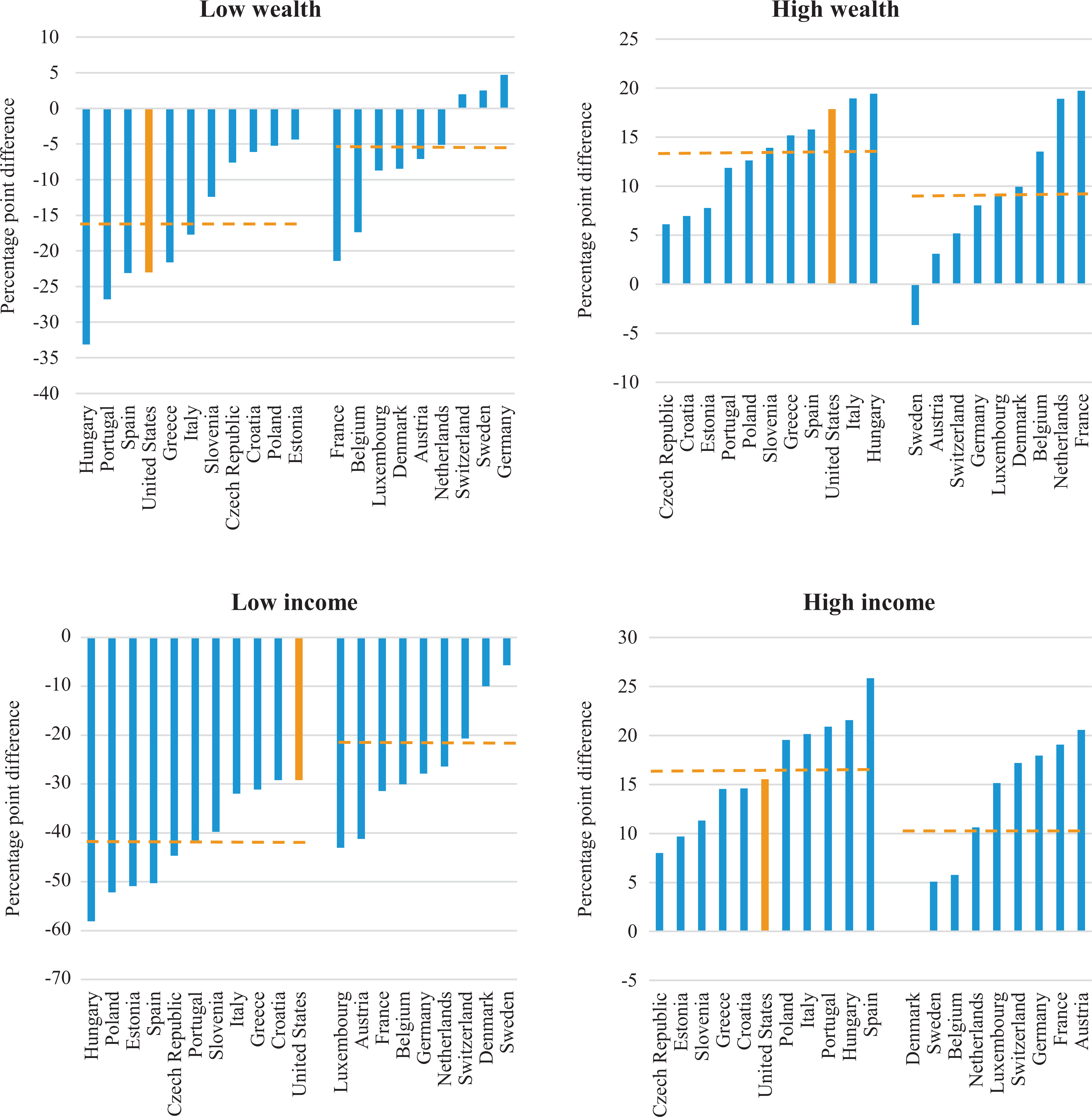
Difference in the percentage of adults aged 60 and older living alone and living with others by wealth and income levels, and country. Note. Dashed lines represent average difference by welfare state generosity. Source: Data from Survey of Health, Ageing and Retirement in Europe (2011–2015), Health and Retirement Study (2014), and authors’ calculations.
Table 2 presents sample characteristics. Three times as many unpartnered older adults live alone than live with others, and they are, on average, approximately a year older. Women are more likely to live with others than men are, as are widowed older adults. Conversely, divorced and never married individuals are more likely to live alone. Those who live with others are more likely to have living children and siblings—possibly indicating larger family network size—and are more likely to provide grandchild care. Foreign-born older adults are substantially less likely to live alone. Unpartnered older adults who live alone have fewer IADL limitations, are better educated, and have more financial resources.
Sample Means.
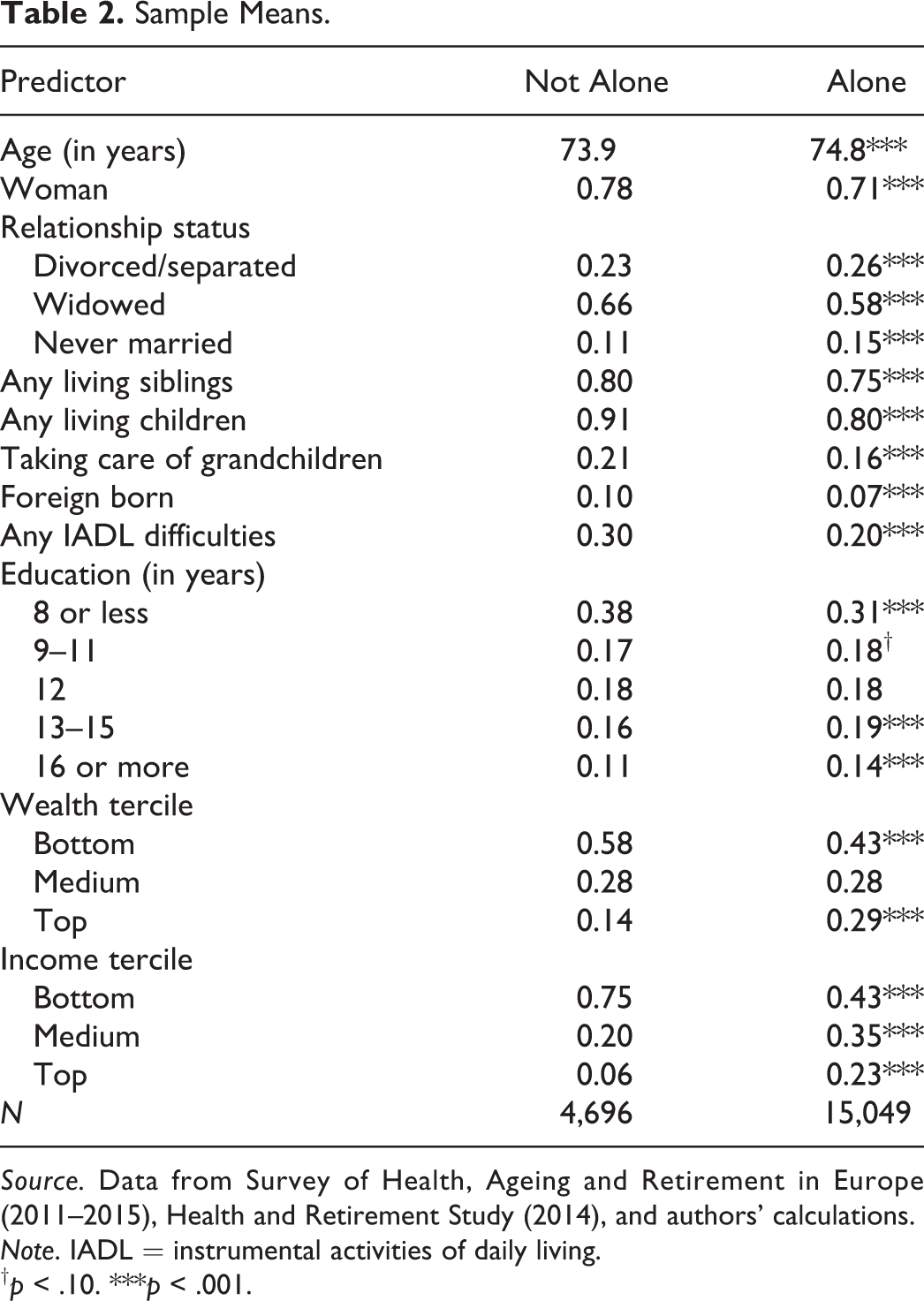
Source. Data from Survey of Health, Ageing and Retirement in Europe (2011–2015), Health and Retirement Study (2014), and authors’ calculations.
Note. IADL = instrumental activities of daily living.
† p < .10. ***p < .001.
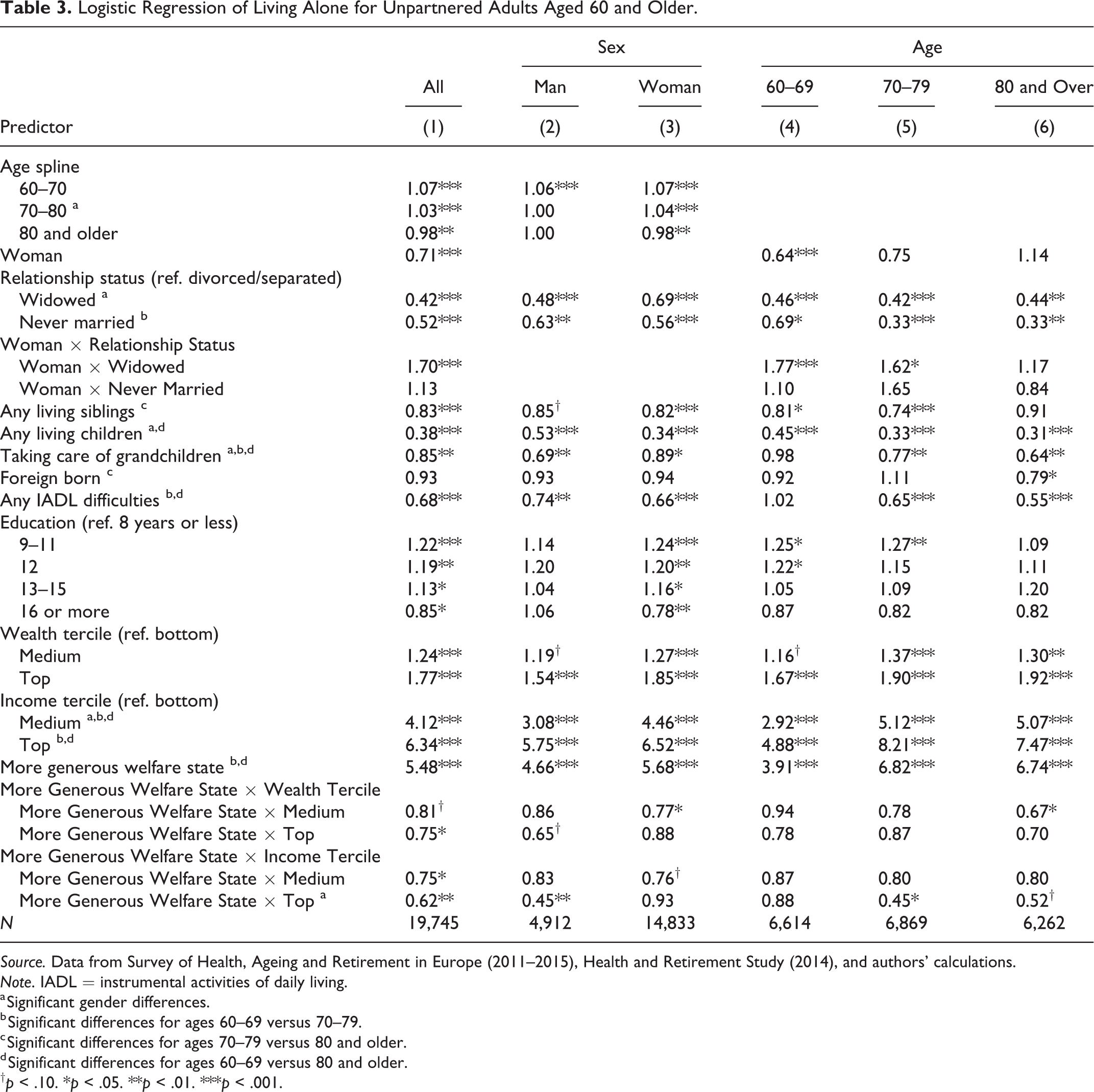
Model results presented in Table 3 allow us to examine the validity of our first two research hypotheses. We find that welfare state generosity is strongly positively associated with living alone (OR = 5.48, p < .001), and wealth and income gradients in countries that have generous welfare systems are less steep than in less-generous welfare states. For example, odds of living alone in more generous welfare states are 25% (p < .05) and 38% (p < .01) lower for those in middle and highest income terciles, respectively. Supplemental Figure A2 shows predictive margins of probability to live alone by wealth and income groups across welfare state types. These results provide support for our Research Hypotheses 1 and 2. 7
Logistic Regression of Living Alone for Unpartnered Adults Aged 60 and Older.
Source. Data from Survey of Health, Ageing and Retirement in Europe (2011–2015), Health and Retirement Study (2014), and authors’ calculations.
Note. IADL = instrumental activities of daily living.
a Significant gender differences.
b Significant differences for ages 60–69 versus 70–79.
c Significant differences for ages 70–79 versus 80 and older.
d Significant differences for ages 60–69 versus 80 and older.
† p < .10. *p < .05. **p < .01. ***p < .001.
The model results also confirm prior findings that economic resources are positively related to living alone. The magnitude of this relationship is substantially more pronounced for income than wealth. For example, being in the top tercile of the income distribution is associated with over 6 times higher odds of living alone than being in the bottom tercile (OR = 6.34, p < .001), whereas the odds are less than twice as high for high-wealth compared to low-wealth individuals (OR = 1.77, p < .001). Among other predictors of interest, we find that age is not linearly associated with the odds of living alone; the positive link is stronger before age 70 than after it, and it even reverses beyond age 80. Women are 29% less likely to live alone. Being widowed or never married is associated with lower odds of living alone compared to those who are divorced or separated, but the difference is significantly attenuated for widowed women. Having living siblings and children, taking care of grandchildren, and having functional limitations are all negatively associated with the odds of living alone. The level of education exhibits a more complex link with living alone, as those with 9–15 years of education are between 13% and 22% more likely to live alone than the least educated, but highly educated unpartnered older adults (16 or more years of education) are 15% less likely to live alone, all else equal.
Stratifying the analysis by gender allows us to test our Research Hypotheses 3 and 4. 8 Although women have steeper income and wealth gradients of living alone than men, this difference is not statistically significant for wealth thereby lending partial support to our third research hypothesis. The fourth research hypothesis finds no support in the results, as we find no evidence of smaller difference in gender gradients of income and wealth in more generous welfare states. There are several other findings of interest in the models stratified by gender. The age pattern of living alone diverges for women and men at age 70 and older as women’s odds first increase (OR = 1.04, p < .001) and then decrease (OR = 0.98, p < .01) while remaining flat for men. Having living children is more predictive of lower odds of living alone for women (OR = 0.34, p < .001) than men (OR = 0.53, p < .001), while grandchild care is a more important predictor of living arrangements for men (OR = 0.69, p < .01) than women (OR = 0.89, p < .05). Lower odds of living alone for highly educated older adults are observed for women only.
To test the two final research hypotheses, we stratify the analysis by age. The magnitude of the link between economic resources and living alone is larger for adults aged 70 and older than for their younger peers, although the difference is statistically significant for income only. Welfare state generosity is also more strongly associated with the odds of living alone beyond age 70 than at younger ages. Therefore, the results are broadly consistent with the fifth hypothesis. Conversely, although the estimated coefficients suggest that welfare state generosity is associated with moderating the age gradient of the link between economic resources and living alone, differences between coefficient estimates are not statistically significant. Hence, the final hypothesis finds no support in the results. Among other predictors, we find significant age-related differences in the odds of living alone by gender, relationship status, having living children and siblings, taking care of grandchildren, being foreign born, and having functional limitations, which suggests that determinants of living arrangements vary across older adulthood.
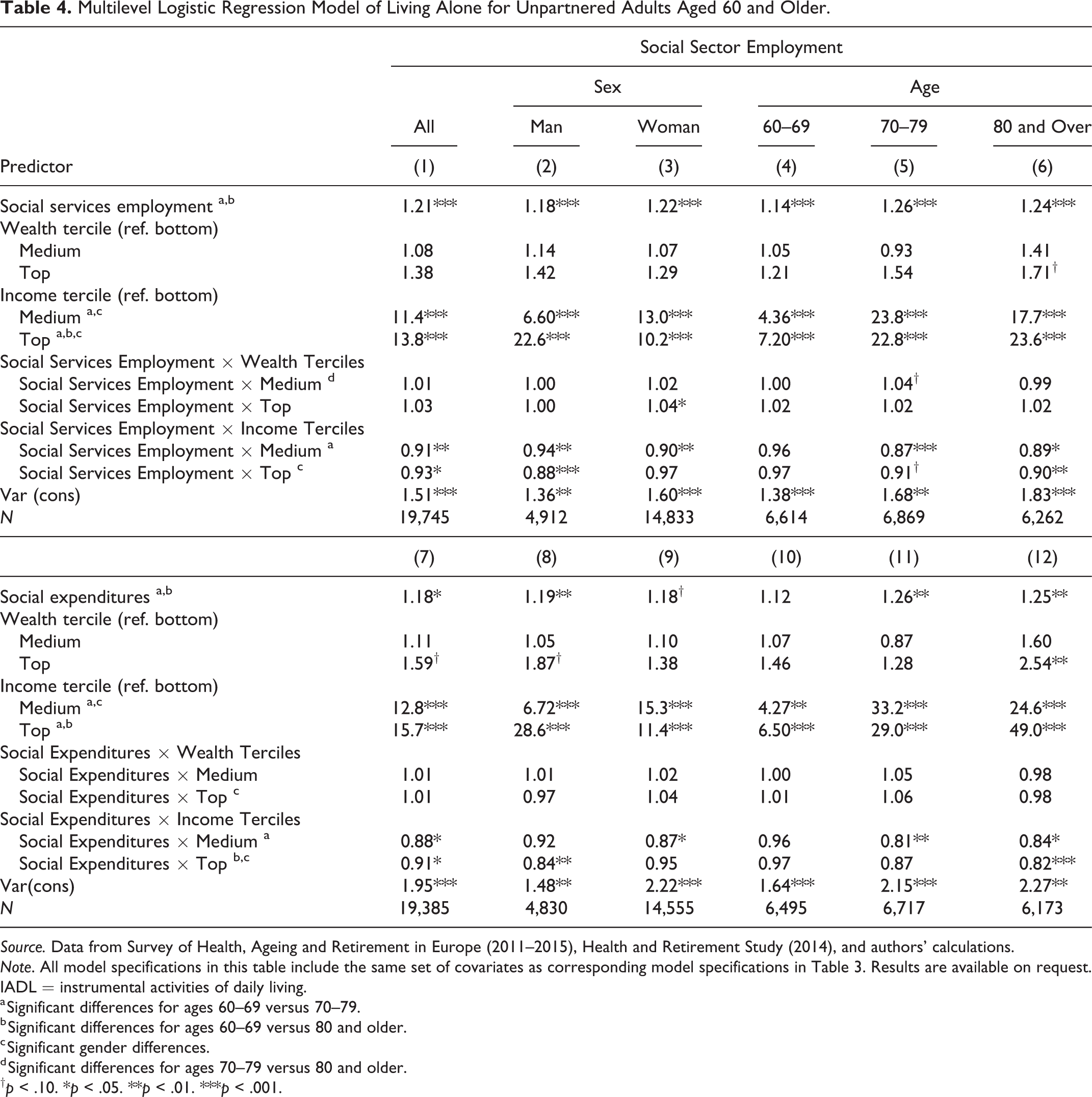
The final set of models extends the analysis to the multilevel framework and introduces measures of social policies to test more directly the hypothesized positive association between public support and living alone (Table 4). The results suggest that the odds of living alone are 21% higher for each additional percentage point of social services employment share in total employment (p < .001). Models stratified by gender and age 9 reveal that this effect is marginally smaller for men in comparison to women and for persons younger than 70 in comparison to those aged 70 and older. Social expenditures are also positively associated with the odds of living alone. On average, each additional $1,000 of per-capita social spending is associated with 18% higher odds of living alone (p < .05). The effect is somewhat larger for individuals aged 70 and older than for those who are younger than 70, but there is no statistically significant difference between women and men. Compared with regression results in Table 3, these models suggest an even stronger positive gradient of living alone by income level but no significant relationship between wealth and living arrangements. Higher social services employment and social spending are associated with moderating the impact of income on living alone. The results of multilevel logistic models, therefore, confirm the findings from the logistic regression models with respect to the hypothesized relationships of interest.
Multilevel Logistic Regression Model of Living Alone for Unpartnered Adults Aged 60 and Older.
Source. Data from Survey of Health, Ageing and Retirement in Europe (2011–2015), Health and Retirement Study (2014), and authors’ calculations.
Note. All model specifications in this table include the same set of covariates as corresponding model specifications in Table 3. Results are available on request. IADL = instrumental activities of daily living.
a Significant differences for ages 60–69 versus 70–79.
b Significant differences for ages 60–69 versus 80 and older.
c Significant gender differences.
d Significant differences for ages 70–79 versus 80 and older.
† p < .10. *p < .05. **p < .01. ***p < .001.
Discussion
This study set out to examine cross-national differences in the association of living alone and personal financial resources for older adults and the impact of public policies on the likelihood of living alone, overall, and by gender and age. We find strong support for our first two hypotheses. The results show that living alone is more common among older adults in generous welfare states and that social supports and spending are positively associated with living alone. Furthermore, the analysis finds that the positive link between financial resources and living alone has a steeper gradient in less generous welfare states, whereas the gradient is less steep in more generous welfare states. Although wealth and income gradients are steeper for women, only the latter is statistically significantly different by gender, lending partial support to the third research hypothesis. The fourth research hypothesis finds no support in the model results as income and wealth gradients do not exhibit consistently different gender patterns by welfare state generosity. Similarly, the analyses stratified by age suggest that economic resources are a more important determinant of living arrangements at age 70 and beyond than at younger ages, which is broadly consistent with the fifth research hypothesis. The final hypothesis finds no clear support as the observed differences in the moderating impacts of welfare state generosity on the age gradients of the link between economic resources and living alone are not significant.
These results extend prior research by providing evidence of the systematic variation in the association of personal financial resources and living arrangements across countries with different levels of welfare system generosity. They also directly link public policies—social supports and spending—with living alone, which is consistent with the conjecture that public policies affect individual and family behavior.
The results have important policy implications. Historically, one of the key distinguishing characteristics of welfare regimes has been an emphasis on the role of state and family as providers of support to individuals (e.g., Ogg, 2005). As a consequence, countries that emphasize stronger state’s role in the support of individuals have built policy structures that can facilitate independent living for citizens who prefer to do so or have limited alternatives. For example, Sweden has had policies and projects since the 1930s, such as collective housing, that allowed single women and mothers to live independently (Klinenberg, 2012). Lack of such social supports in familistic societies traditionally has had only a limited adverse impact on the population, as individuals could rely on robust family networks. However, in the era of shrinking families and socioeconomic developments conducive to independent living, a growing segment of the population may lack adequate public and family support, especially in old age. Family members of older adults with limited financial resources face much more substantial challenges regarding their dual role of working and providing care than their peers in generous welfare states. The results of this study are consistent with the notion that policies can alleviate such outcomes and allow older adults and their families to choose the living arrangement that they prefer—be it coresidence or independent living—and maximize their well-being.
This finding provides support for the harmonization of welfare policies across Europe, alongside convergence toward higher levels of social protection (European Council, 1992; Ogg, 2005). In recent years, policy reforms across European countries focused on active aging, especially relating to employment opportunities for older adults, ending age- and gender-based workplace discrimination, improving social inclusion for marginalized groups, and, to a lesser extent, other age-friendly policies in the areas such as transportation, urban development, and digital technologies (Lodovici Samek et al., 2015). Although Northern European countries like Sweden still have the most comprehensive approach toward active aging policies and social protections for older adults, new policy initiatives in other countries (e.g., adoption of active aging strategies in countries such as Romania and Slovenia) and the development of Active Aging Index tool (Karpinska & Dykstra, 2015) to monitor and compare active aging policies across the EU countries suggest a general increase in the awareness of the importance of this issue. While not targeting older adults who live alone exclusively, these policies may benefit these individuals in particular.
In the United States, focus has been primarily on policies to support aging-in-place and transitions from formal care into the community. While not specifically targeting older adults who live alone, programs such as Cash & Counseling, or Money Follows the Person, enable longer stays in the community for the population particularly susceptible to health deterioration and institutionalization. Furthermore, kinship bias, embedded in LTSS policies, is being increasingly supplanted by a more inclusive notion of the “caregiver” (Ivanova & Dykstra, 2015). Although the U.S. welfare system remains less generous than those of the Northern and Western Europe, these types of reforms increase options for the most vulnerable segments of older adults living alone.
The contributions of this study should be considered within the context of its limitations. The implicit assumption of this study is that, while they vary across countries, preferences for living alone are similarly distributed by income and wealth groups in different countries. If this assumption is violated, the results might partly reflect different cross-national distributions of living-arrangement preferences between poorer and richer older adults. Furthermore, due to data limitations, we could not explore various factors and relationships that would provide a more nuanced picture of the relationship between public support and living arrangements. For example, we do not know how many older adults could live with somebody else but chose not to do so, as opposed to not having such option. We also could not examine fully certain subgroups of older adults, such as those who are kinless and therefore more likely to have limited living-arrangement options and higher vulnerability levels. Finally, because of survey design and/or lack of suitable sampling frames across the two surveys, we limited the current analysis to noninstitutionalized individuals. Future research on living arrangements and public policies would benefit from examining institutionalization, as a competing risk, alongside other living arrangements.
Notwithstanding these limitations, this study provides new evidence that the observed differences in living arrangements across countries do not exclusively reflect the degree of familialism or individualism in different societies but are also likely related to resource constraints. This finding provides scope for government intervention, especially to support poor older adults who live alone and have no or limited family support available. Such intervention would foster individual freedom of choice as well as active aging and independence, thereby improving resiliency of this vulnerable population (Angel & Angel, 2017). More generally, a robust public support system would improve the social well-being by providing older adults and their families the opportunity to choose their optimal living arrangements. Furthermore, the analytic approach of this study is among the first to exploit the harmonized versions of the HRS and SHARE to model jointly the outcomes in the United States and Europe. Future research could explore cross-national differences in the adequacy of support for older adults, in particular the extent to which different policy regimes help remove barriers for frail older adults to live independently, and examine whether the current findings hold in the context of developing countries with different policy regimes and cultural and historical contexts. The latter may be especially interesting as solo living is increasing fast across developing countries, but sociodemographic profiles of persons living alone in developing countries differ from those in developed countries (Reher & Requena, 2018). Future research would also benefit from exploring the role of factors such as education that may moderate the relationship between personal resources and living alone.
Supplemental Material
Supplemental_Material - Living Alone in the United States and Europe: The Impact of Public Support on the Independence of Older Adults
Supplemental_Material for Living Alone in the United States and Europe: The Impact of Public Support on the Independence of Older Adults by Stipica Mudrazija, Jacqueline L. Angel, Ivan Cipin and Sime Smolic in Research on Aging
Footnotes
Acknowledgments
The authors are grateful to the editor and three anonymous reviewers for their helpful comments and suggestions on earlier drafts of this article.
Declaration of Conflicting Interests
The author(s) declared no potential conflicts of interest with respect to the research, authorship, and/or publication of this article.
Funding
The author(s) disclosed receipt of the following financial support for the research, authorship, and/or publication of this article: Harmonized Health and Retirement Study (HRS) and the Survey of Health, Ageing and Retirement in Europe (SHARE) data were obtained through the Gateway to Global Aging Data, produced by the Program on Global Aging, Health & Policy, University of Southern California with funding from the National Institute on Aging (NIA; R01 AG030153). The HRS is sponsored by the NIA (Grant NIA U01AG009740) and is conducted by the University of Michigan. The SHARE data collection has been funded by the European Commission through FP5 (QLK6-CT-2001-00360), FP6 (SHARE-I3: RII-CT-2006-062193, COMPARE: CIT5-CT-2005-028857, SHARELIFE: CIT4-CT-2006-028812), FP7 (SHARE-PREP: GA N°211909, SHARE-LEAP: GA N°227822, SHARE M4: GA N°261982), and Horizon 2020 (SHARE-DEV3: GA N°676536, SERISS: GA N°654221) and by DG Employment, Social Affairs & Inclusion. Additional funding from the German Ministry of Education and Research, the Max Planck Society for the Advancement of Science, the U.S. NIA (U01_AG09740-13S2, P01_AG005842, P01_AG08291, P30_AG12815, R21_AG025169, Y1-AG-4553-01, IAG_BSR06-11, OGHA_04-064, HHSN271201300071C), and from various national funding sources is gratefully acknowledged.

Supplemental Material
Supplemental material for this article is available online.
Notes
References
Supplementary Material
Please find the following supplemental material available below.
For Open Access articles published under a Creative Commons License, all supplemental material carries the same license as the article it is associated with.
For non-Open Access articles published, all supplemental material carries a non-exclusive license, and permission requests for re-use of supplemental material or any part of supplemental material shall be sent directly to the copyright owner as specified in the copyright notice associated with the article.
