



Abstract
A mixed method design was used to examine how caregiving and transitioning a family member into long-term care (LTC) influence planning. Participants, aged 50+ from the community, completed self-report questionnaires. Quantitative data evaluated differences between three groups (non-caregivers, caregivers, caregivers with experience in assisting with a LTC transition); and predictive effects of caregiving, care expectations and social support to planning. Interviews among a subsample of caregivers examined how experiences of caregiving, including assisting in a transition to LTC, and social support influenced planning. Results indicated that: (1) caregivers with LTC transition experience planned significantly more than non-caregivers, (2) caregiving, care expectations, and social support significantly predicted of planning, and (3) future care expectation was an important mechanism in the relationship between caregiving and planning. These findings underscore the impact of caregiving experiences on expectations of future care needs and preparation for future care needs, and the importance of social support.
Care needs among the aging population and family caregiving will increase as the aging population continues to grow. Currently, nearly one third of individuals over 85 in Canada reside in long-term, facilities-based care (LTC; Statistics Canada, 2017). LTC in Canada is a provincial/territorial responsibility and each province or territory provides differing levels of financial subsidies for care. Facilities can be private, for profit; private, non-profit (e.g. faith-based or charitable ownership); or public, non-profit.
Projections indicate that by the year 2026, more than 2.4 million Canadians aged 65 years and older will require care, from both family and formal placements such as LTC, which represents a 71% increase in care needs compared to 2011 (Hermus et al., 2015). Family caregiving is an increasingly normative experience. In 2012, there were 5.4 million family caregivers providing care to older adults in Canada (Turcotte & Sawaya, 2015); however, this number is likely greater, as many caregiving responsibilities are underreported (Hainstock et al., 2017). Previous research has indicated that proactive planning for future care needs is not currently the norm, particularly for the possibility that LTC may be needed (McGrew, 2000). Failure to plan has negative implications for the health outcomes of both care recipients and their family caregivers (Cooney, 2012; Hainstock et al., 2017). This research utilized a mixed methods approach to examine how experiences of providing care and of transitioning a family member into LTC influence caregivers’ own planning behaviors, taking into account the social context in which caregiving and planning occur. The diverse experiences of caregivers may account for differences in caregiver planning (Song et al., 2018); for example, different responsibilities between caregiving and caregiving in addition to transitioning a family member to LTC.
In addition to providing support to individuals in maintaining functional independence, family caregivers may be responsible for facilitating LTC relocations of their care recipient. Substantial stress has been linked to navigating a LTC transition, and this process is increasingly challenging when a-priori preparation has not taken place (Hainstock et al., 2017). The process of preparing for future care needs involves becoming aware of the potential need for care, gathering information, deciding preferences for care, and taking concrete planning actions (Sörensen & Pinquart, 2001). Failure to proactively plan has been linked to caregiver burden (Hainstock et al., 2017), is a risk factor for depression and anxiety in older adults (Sörensen et al., 2012), and may lead to inappropriate arrangements and/or other negative outcomes for the care recipient (e.g., difficulty adjusting, loneliness; Cooney, 2012; Sörensen et al., 2012).
Well-established predictors of planning include greater chronological age (Black et al., 2008), female gender (Black et al., 2008), and more years of education (Cramer et al., 2001). Importantly, differences in planning occur based on individual experiences (Goodnow, 1997). Caregivers learn from observing others’ experiences in late-life care (Gottlieb et al., 2009). Broyles and colleagues (2016) found that LTC planning was motivated by the desire to avoid negative outcomes that were observed through caregiving (i.e., family conflict, financial strain, dependence on children, unappealing LTC placements). Caregivers, compared to non-caregivers, had increased awareness of late-life care needs; however, this awareness did not translate into concrete planning (Finkelstein et al., 2012). To date, research addressing the influence of caregiving experiences on planning has utilized limited outcomes (e.g., purchase of LTC insurance, which is not relevant in all health care regions), and that caregiving has been evaluated dichotomously (caregiver/non-caregiver), which may not reflect account for differences in caregiving experience (e.g., tasks, extent of care recipient’s decline). There are greater challenges associated with caregiving for individuals with dementia compared to caring for an individual with physical disabilities alone (Ory et al., 1999; Vick et al., 2019), and caregivers to individuals with dementia experience mental health problems before and after their care recipients’ LTC transition, and many continue to provide care post-transition (Schulz et al., 2004). As noted, caregivers learn from observation; thus, engaging in different caregiving tasks (e.g., transitioning care recipient to LTC) may influence the impact providing care has on the caregivers and what actions a caregiver takes for their own future.
Perceptions of aging may contribute to a more comprehensive understanding of the association between caregiving and planning. For example, expectations of future care needs, greater anxiety about aging, and fear of filial burden have been associated with preparation for future care needs (Fowler & Fisher, 2009; Song et al., 2018). Caregiving may alter one’s perceptions of one’s own aging, yet little or no research has looked at the impact of differing caregiving experiences (caregiving only, compared to caregiving with experience transitioning a care recipient into LTC) on perceptions, such as care expectations, aging anxiety and filial burden. Existing research has begun to evaluate the link between caregiving and caregivers’ attitudes about planning. For example, compared to non-caregivers, caregivers have shown higher expectations of future use of home care and transportation services; though, caregivers were not more likely to have plans for future housing or care (Robison et al., 2014). These findings may be understood in the context of future care expectations indirectly promoting planning actions through increased awareness of emerging care needs and information gathering, which then predict planning decisions (Song et al., 2018). A comprehensive understanding of the association between caregiving and planning requires an examination of how expectations of future care needs may influence planning outcomes that encompass the phases of planning and broader planning actions.
Caregiving occurs within an intergenerational, social context. Social support broadly refers to emotional, instrumental, and informational assistance performed by others (i.e., family, friends; Thoits, 2011). In general, social relationships influence health behaviors, physical and psychological well-being, and mortality risk (Holt-Lunstad et al., 2015; Umberson & Montez, 2010). Theoretically, social support networks may provide a sense of assistance and guidance in navigating new situations (Prenda & Lachman, 2001) and may promote engagement in health behaviors through increased self-efficacy (Gallant, 2013). This implicates social support as a potentially important factor in both caregiving and planning. Among caregivers, life satisfaction and distress are influenced by social support (Clay et al., 2008). Research has shown that social support is positively related to future oriented planning (Prenda & Lachman, 2001) and preparation for future care needs (Sörensen & Pinquart, 2000). Importantly, the source of social support (Boerner et al., 2013; Carr et al., 2013), and relationship dynamics (Song et al., 2018), are key factors in the relationship between support and planning. Social support to caregivers has been shown to decrease over time (Clay et al., 2008). However, as of now, research has yet to examine for potential group differences in perceived social support between caregivers and caregivers with LTC transition experience. Further, the aforementioned research suggests that the extent social support may impact if and how caregivers engage in planning for their own aging; though, this is yet to be examined.
This study investigated the impact of caregiving experiences on planning, and, to the best of our knowledge, it is the first study to directly compare three groups (non-caregivers, caregivers only, and caregivers with experience assisting in an LTC transition) on various outcomes. To improve understandings of how one’s life experiences and social context influence preparation for aging, this study examined the direct influences of caregiving experience, expectations of care, and social support on broader planning outcomes (phases of preparation, multiple planning actions). Quantitative data were used to evaluate the following research questions: (1) Are there group differences between three groups (non-caregivers, caregivers, caregivers with experience assisting in transition to LTC) in planning for future care needs, perceptions of aging, expectations of future care needs, and/or perceived social support? (2) Do caregiving experience, expectations of care, and/or social support (from family, friends, or significant other) predict planning over and above well-established predictors of planning (age, gender, education)? Qualitative interviews sought to explore: (4) How did the overall experience of caregiving influence caregivers’ perception of their own aging and planning for potential future care needs? (5) How did social support influence caregiving experiences and planning? Qualitative interviews provided a richer understanding and clarification of quantitative findings. Following integration of the results, a post-hoc quantitative evaluation of the potential mediation of the relationship between caregiving and planning by expectations of care was conducted.
Method
Study Design
This study employed a sequential explanatory design, which allowed the quantitative results to inform the qualitative research questions (Hanson et al., 2005). Quantitative self-report data from a larger study on planning among adults aged 50 years and above were utilized for secondary analysis. A subsample of participants from the original quantitative dataset that indicated experience with caregiving only and caregiving with LTC transition experience were interviewed for this study. This study received ethics approval from the University Research Board. Integration of qualitative and quantitative data occurred during data interpretation (Hanson et al., 2005).
Participants
Participants for the quantitative component (N = 346), aged 50–92 years, were recruited from the community via public talks, posters, and pamphlets. Written informed consent was provided by all participants for the respective quantitative and qualitative components. Participants were categorized into three groups based on their responses to questions described in the measures section: non-caregivers (n = 180), caregiving experience only (n = 74), and caregiving and LTC transition assistance experience (n = 92).
A subsample of participants (n = 22) were recruited for interviews from 117 participants that had provided consent to be contacted for further research and had indicated current or previous caregiving experience or caregiving experience with LTC transition experience. Fifty-four of the 117 participants were contacted by phone (if not reached, a voicemail message was left; maximum of three attempts to contact were made), 14 contacted individuals were not interested, and the remaining, who did not participate, did not respond. Of the 22 interviews, two were excluded based on lack of relevant caregiving experience revealed in the interviews. The final qualitative subsample (n = 20), aged 52–81 years, had 10 participants with caregiving experience only, and 10 participants with experience in caregiving and relocating a family member to LTC.
Procedure
Quantitative procedure
All participants completed self-report questionnaires, either online, or in person with a trained student research assistant.
Qualitative procedure
The first author (a female master’s student, BA) conducted one-on-one, in-person, semi-structured interviews at the university, library, or participants’ homes. Aside from telephone communication, participants had no prior contact with the interviewer and no one, aside from interviewer and participant, was present during interviews. Interviews were audio-recorded for later transcription and ranged in duration from 20 minutes to 1.5 hours. All participants were assigned a participant number to ensure anonymity.
Quantitative Measures
Demographic variables
Questions assessing age, gender, education, ethnicity, and marital status were completed via self-report questionnaire.
Group membership
Mutually exclusive group membership was determined using self-report responses. The following yes/no question allowed participants to self-identify as a caregiver: “Are you now or have you ever provided unpaid care for an older adult (i.e., help with daily tasks such as meal preparation, dressing, medication, transportation, banking, etc.)?” Participants that indicated “yes” were asked to identify their relationship to the care recipient (“Who are you/were you providing care to?”) and list caregiving responsibilities (“What type of care did/do you provide?”). Participants that indicated caregiving to a close family relative (i.e., parent, step-parent, spouse) were considered caregivers. This definition is in line with previous studies’ definitions of caregivers and with the defining characteristics of family caregivers (i.e., provides unpaid assistance in daily activities; Roth et al., 2015). Experience assisting in a LTC transition was determined using the following questions: “Have you ever been involved in helping someone move to a residence that provides care? (e.g., assisted living, nursing home)”; “If yes, who was that person?” Participants that indicated providing care to and also assisting in an LTC transition of a close family member (i.e., parent, step-parent, spouse) were considered caregivers with LTC transition experience. Individuals that did not provide care to, nor transition a close family member were considered non-caregivers.
Preparation for future care needs and planning
Phases of preparation were measured using the 15-item Preparation for Future Care Needs scale (PFC-15; Sörensen et al., 2017). The PFC-15 was a total score (α = .84) of four subscales, awareness, decision making, gathering information, and concrete planning, measured on a Likert scale from 1 (not at all true of me) to 5 (completely true of me). Higher scores on PFC-15 indicate more preparation. Higher scores on the PFC avoidance subscale (α = .76) indicate less preparation. Planning actions were evaluated using a 12-item yes/no questionnaire (Supplementary Material, Appendix 1), adapted to Canadian-relevant planning actions (e.g., looking into the Canada Pension Plan) from a National Opinion Research Center (NORC) Study (Tompson et al., 2013). The NORC actions variable (extent of actions taken) was generated as a summed score (α = .70). The PFC-15 and NORC actions provide unique knowledge about planning. PFC-15 provides insight into phases of planning (e.g., awareness of need to plan), that are not measured by the NORC actions measure, while NORC actions provides an extensive measure of concrete actions taken (e.g., having personal directive, downsizing home).
Aging anxiety
A 10-item questionnaire evaluated extent of concern related to different outcomes of aging, measured on a Likert scale from 1 (no concern at all) to 5 (a great deal; Tompson et al., 2013). Aging anxiety was generated as a summed total score (α = .90).
Expectations of care
Expectations of individuals’ own potential future care needs were evaluated using a 5-item questionnaire (Sörensen & Pinquart, 2001). Responses were rated from 1 (strongly disagree) to 5 (strongly agree) and summed to create a total score (α = .87).
Fear of filial burden
The 4-item Fear of Filial Burden Scale (Fowler & Fisher, 2009) evaluated thoughts of the impact of potential care needs on family. Responses were rated on a Likert scale from 1 (strongly disagree) to 5 (strongly agree) and summed to create a total score (α = 86).
Perceived social support
The 12-item Multidimensional Scale of Perceived Social Support (MSPSS), a measure of the subjective quality of support from three sources: family, friends, and significant other (Zimet et al., 1988), produced a mean total score (α = 95) and subscale scores (friends, α = .94; family, α = .94; and significant other, α = .95). Responses were made on a Likert scale from 1 (very strongly disagree) to 7 (very strongly agree), higher scores indicate greater perceived support.
Statistical Procedure
Quantitative analysis
SPSS v.25.0 was employed for quantitative analysis. All statistical assumptions of analyses completed were evaluated. To evaluate the first research question, one-way univariate analyses of variance (ANOVAs) were conducted. Significant results were followed-up with post-hoc group mean comparisons, which were not adjusted for multiple comparisons, to avoid referencing an alpha value that was too stringent (Rothman, 1990). To examine the second research question, a hierarchical regression was completed, entering previously established predictors of planning in step 1 (age, gender, education), and predictors that were significantly correlated to the respective planning outcome measures (PFC-15, NORC actions) entered in step 2 (social support from friends, family and significant other, and expectations of care). In order for results of regression analysis to be interpreted meaningfully, independent variables included must be quantitative/continuous or dichotomous (Berry, 1993); thus, the two caregiving groups (caregivers, caregivers with transition experience) were collapsed to create a dichotomous variable (no experience = 0; caregiver experience = 1). Hayes PROCESS Macro was utilized to examine the post-hoc mediation (Hayes, 2017).
Qualitative analysis
Qualitative interview recordings were transcribed and entered into NVivo v.11.0 for thematic analysis as outlined by Braun and Clarke (2013). Initial codes were determined and agreed upon by two members of the research team. These codes were then used by the same researchers to independently code the transcripts. Coding was compared, discrepancies were resolved through discussion and consensus, and codes were analyzed to produce thematic accounts for each domain of inquiry.
Results
Statistical Assumptions
Data were evaluated for meeting the statistical assumptions related to ANOVA and regression. All statistical assumptions were met, with the following noted exceptions. The preparation for future care needs scale (PFC-15) met the assumption of normality for all groups; though, the assumption of normality of each group was violated for the remaining measures. Analyses were conducted despite these violations, as ANOVA is robust to violations of normality (Field, 2005). Adequate homogeneity of variance was met for all variables, with the exception of expectation of future care needs and perceived social support from significant other. Thus, non-parametric Kruskal-Wallis tests were used for these variables (Field, 2005).
Sample Characteristics
The quantitative sample (N = 346) had a mean age of 66 years (SD = 9.70) and was primarily female (74.6%; 25.4% male). Participants were White (79.4%), Chinese (4.6%), South Asian (2.3), Southeast Asian (1.7%), Latin American (0.9%), Black (.9%), Indigenous (.9%), or identified as “other” (9.3%). The majority of participants were married/common-law (47.1%), divorced/separated (25.1%), single (14.5%), or widowed (13.3%). Education level ranged from did not complete high school (4.9%), to completed high school (22.8%), trade school (23.7%), university (32.9%), or post-graduate training (15.6%).
In the qualitative sample (n = 20), the majority (90%) were female (10% male) and the sample was primarily White (95%), with one participant identifying as Chinese (5%). Mean age was 67 years (SD = 7.80) Participants identified as single/never married (10%), divorced (40%), widowed (20%), or married/common-law (30%). Approximately two-thirds completed trade school (30%) or university (30%), one-quarter completed high school (25%), while the remainder either did not complete high school (10%) or completed post-graduate training (5%).
Group Differences
Demographic variables
Results of one-way ANOVAs indicated that there were no significant differences (at p = .05) between the three groups (no experience, caregiving only, caregiving and transition experience) on measures of age, gender, nor education; thus, no variables were included as covariates in the one-way ANOVAs used to address the first research question.
Planning
Results of a univariate ANOVA indicated significant differences between groups in planning actions taken (NORC actions; F(2, 342) = 8.24, p < .001). Two separate univariate ANOVAs evaluated preparation outcome variables separately (PFC-15 and PFC avoidance); results indicated significant group differences on the PFC-15, F(2, 343) = 7.89, p < .001, and PFC avoidance, F(2, 343) = 9.56, p < .001.
Aging anxiety, fear of filial burden, expectations of care
Results from a univariate ANOVA indicated no significant differences between groups on aging anxiety, F(2, 325) = 1.82, p = .164, nor fear of filial burden, F(2, 337) = .29, p = .749. Results of a Kruskal-Wallis H test indicated statistically significant group differences in expectations of care needs, H(2) = 9.22, p = .010.
Social support
Results of univariate ANOVA indicated significant group differences in perceived social support from friends, F(2, 338) = 3.38, p = .035, but not from significant other, nor family. Results of all post-hoc group mean comparisons are presented in Table 1.
Group Means on Measures of Planning, Aging Anxiety, Expectations of Care, Fear of Filial Burden, and Social Support.
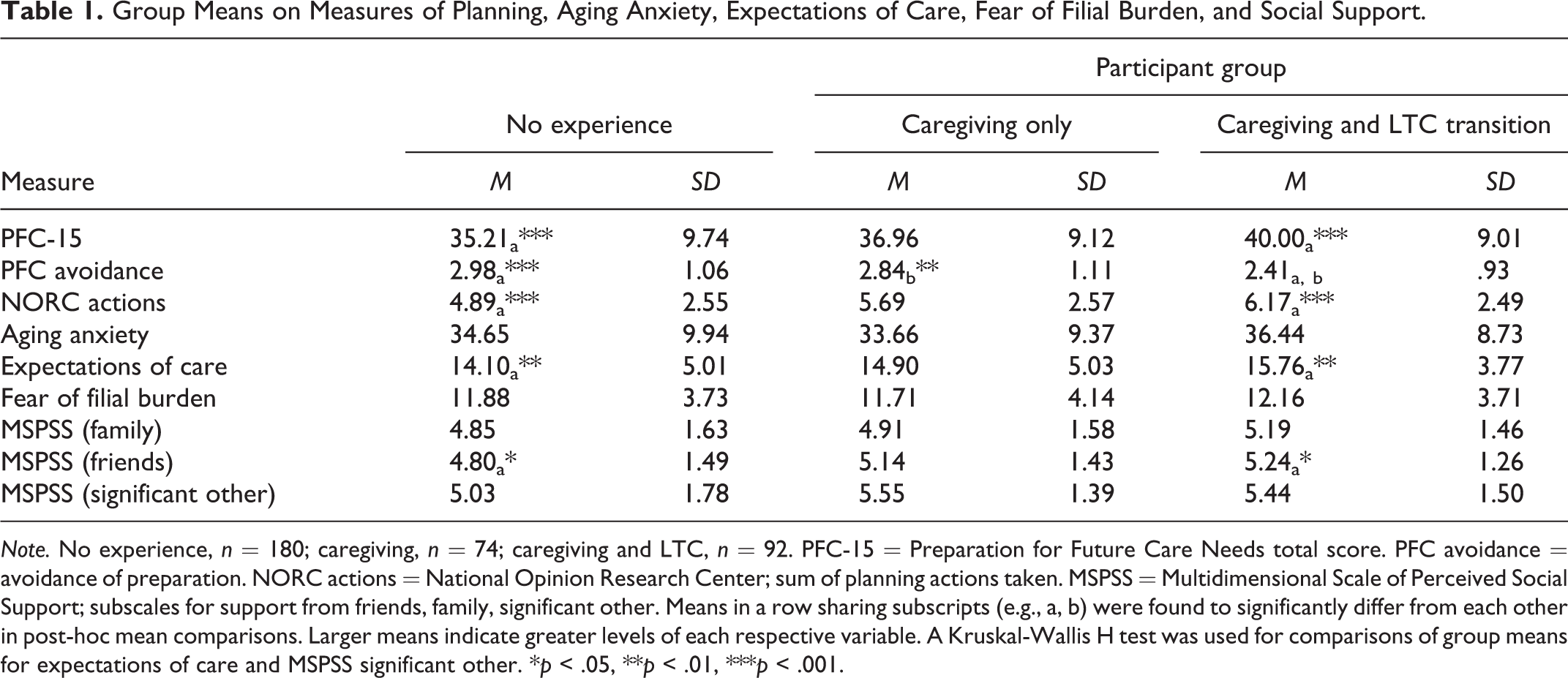
Note. No experience, n = 180; caregiving, n = 74; caregiving and LTC, n = 92. PFC-15 = Preparation for Future Care Needs total score. PFC avoidance = avoidance of preparation. NORC actions = National Opinion Research Center; sum of planning actions taken. MSPSS = Multidimensional Scale of Perceived Social Support; subscales for support from friends, family, significant other. Means in a row sharing subscripts (e.g., a, b) were found to significantly differ from each other in post-hoc mean comparisons. Larger means indicate greater levels of each respective variable. A Kruskal-Wallis H test was used for comparisons of group means for expectations of care and MSPSS significant other. *p < .05, **p < .01, ***p < .001.
Predictors of Planning
To evaluate the second research question, two separate hierarchical regression analyses evaluated the outcome variables of PFC-15 and NORC actions. Table 2 presents the results.
Results of Two Hierarchical Regression Analyses Predicting PFC-15 and NORC Actions.

Note. NORC actions = National Opinion Research Center; PFC-15 = Preparation for Future Care Needs total scale score; sum of concrete planning actions taken. MSPSS = Multidimensional Scale of Perceived Social Support; subscales for support from friends, family, significant other. Larger scores indicate greater levels of each respective variable. The dichotomous variable of gender was coded as male = 0, female = 1. Caregiving experience was coded as no experience = 0 (n = 180), caregiving experience = 1 (n = 166). *p < .05, **p < .01, ***p < .001
A hierarchical regression with PFC-15 entered as the outcome, age, education, and gender entered in step 1, and predictors that correlated significantly with PFC-15 in step 2. Step 1 accounted for approximately 8.1% of preparation for future care needs. When the remaining predictor variables were added in step 2, the explained variance increased to 25.4%, and the R 2 change was significant (F-change(6, 329) = 12.70, p < .001).
A second hierarchical regression was completed with NORC actions as the outcome, age, education, and gender entered into step 1, and predictors that correlated significantly with NORC actions entered in step 2. Step 1 accounted for approximately 20.6% of planning actions. When additional predictors were entered into step 2, approximately 32.7% of variance was explained, and the R2 change was significant (F-change(6, 328) = 9.82, p < .001).
Mediation Analysis
Regression analyses evaluated whether expectations of care mediated the relationship between caregiving and planning (PFC-15). Age, gender, and education were included as covariates. Figure 1 presents the unstandardized path coefficients of the mediational model. Approximately 19% of variance in planning was accounted for by the model, F(5, 324) = 15.93, p < .001. The indirect effect of caregiving on preparation through expectations was tested using a bootstrap estimation approach with 10,000 samples in Hayes PROCESS Macro v3.4 (Model 4; Hayes, 2017). Results indicated that the indirect effect of caregiving on planning through expectations was statistically significant (b = .76, SE = .35, 95% CI [.15, 1.47]).

Unstandardized regression coefficients for the relationship between caregiving experience and planning (PFC-15) as mediated by expectations of care needs. Caregiving significantly predicted expectations; expectations significantly predicted planning; and controlling for expectations, the direct effect of caregiving on planning was significant. The unstandardized coefficient for the total effect of caregiving on preparation (not controlling for expectations) is presented in parentheses. The dichotomous predictor variable of caregiving experience was coded as no caregiving experience = 0, caregiving experience = 1. Coefficients marked with an asterisk are associated with bootstrap confidence intervals that do not include zero and are statistically significant (*p < .05, **p < .01, ***p < .001).
Qualitative Results
Themes revealed from the interviews that addressed qualitative research questions are outlined in Table 3. There were no differences across groups in caregiving activities performed. Caregivers in this sample reported providing care to a family member (i.e., mother, father, husband, brother) for periods ranging from 3 months to 20 years (M = 6.67 years, SD = 5.14). Reasons for care were stated as being physical illness, mobility issues, cognitive decline or dementia, or a combination.
Research Objectives and Themes From Qualitative Interviews.

Influence of experiences on perceptions of aging
Increased awareness of aging and related care needs
Most participants indicated that their lived experiences of providing care increased their awareness of the realities of aging. Participant 4 stated: “I became aware of the fact that things can change rapidly and that we should be, as older people, not [taking] our health – any health that we have for granted.”
Increased awareness of burden placed on caregivers
There was an increased awareness of the responsibility and stress placed on caregivers, as well as desire not to put their families in such a position should they require care. Participant 16 stated: “you see how hard it is, right, yeah, I don’t want to put my daughter through that, or my family.” Participant 20 reflected: There comes a time when the victory laps of “I’m [living independently] in this place, aren’t I great?” is really only because of the burden it’s placing on family and friends behind the scenes that is allowing that to be so…What are you doing to those around you, your family and friends? That has been a big “aha” moment for me.
Hopeful perceptions about own aging
Many participants noted wanting to take better care of physical health to avoid/delay decline, and wanting to enjoy life (e.g., traveling, moving to a community with friends). Participant 15 stated: “The idea of, we’re not getting any healthier or any younger, so stop lamenting that you’ve got some aches and pains, and let’s go, let’s go.”
Influence of experiences on planning
Experiences primarily motivated planning actions
Caregiving experiences motivated actions, such as getting rid of belongings, downsizing their home or considering it, putting legal documents in place, information gathering, financial planning, and discussing care preferences with family. Many participants reported having made arrangements for after death (e.g., cremation, funeral). Care recipients’ a-priori preparation reportedly made caregiving easier, and motivated caregiver engagement in similar planning actions of their own. Among caregivers that had transitioned their care recipient to LTC, participants largely perceived inadequacies in the facilities (e.g., availability and quality of care provided; impersonal, institutionalized settings). Some noted their observations that care recipients were not treated with dignity in LTC. Nearly all caregivers reported not wanting to transition to LTC themselves in the future, and these results were consistent even if a caregiver noted a positive experience interacting with LTC. Participant 11 expressed: If they had places that were set up that were decent and people knew that they were being taken care of and it was a nice place, there would be more older people wanting to go into places like that, without it being a critical situation for the family.
Experiences were not primary influence on planning
Caregivers consistently reported that caregiving increased awareness of age-related care needs, but related motivation to take action was not entirely consistent. Two participants reported deciding on care preferences following caregiving, but that they had engaged in some planning prior to their caregiving experience (e.g., legal will, power of attorney). When asked what motivated earlier planning, participant 10 stated: “it’s just the right thing to do.” Three participants with caregiving experience only stated that caregiving inspired contemplation of actions (e.g., downsizing). However, deciding on future care preferences and putting this into action was still avoided. Reasons provided were feeling it is not yet necessary due to age (e.g., participant 15 stated “not that I’m in denial, but I think we still think we’re all too young…”), or uncertainty of how to prepare for an unforeseeable future (e.g., participant 14 stated “…I think there’s not a lot that I can do until I know what kind of disability I’m going to have, or how long it might be…”).
Social support in caregiving
Positive support from others
Helpful support reported included: emotional support from friends and family, informational support, instrumental support, and sharing the burden of caregiving. Participants reported that having others express genuine interest in their well-being during caregiving, and speaking to others with similar experiences, were notably valuable.
Lack of support from others
Some participants reported feeling alone, or lacking support throughout their time caregiving. Participant 4 stated: “For emotional support, hm. You know, I think you’re on your own. I do. You have to come to a place…where you accept where you are, which is a miserable place.”
Negative support from others
Some interactions were reported as being unhelpful, including participants family members providing unsolicited advice, family disagreements, and insensitive responses from friends. Participant 14 described: [My sister] was least supportive…She came in and said: “this is how it should be done,” and “let’s get on it” sort of thing, and she wasn’t the one that was dealing with the situation. So, that was not helpful. [People ask] how’s [your husband] doing? And I’d say well he has dementia and instead of saying anything, they say: “my mother had dementia” and so on, and that is the most devastating thing that they could say to you…They don’t say, you know, “how are you dealing with it?” or “do you want to talk about it?”
Social support in planning
Planning encouraged by others
Community organizations were frequently cited as being helpful resources for planning, as were discussions with friends. Some participants reported that seeing how friends planned and observing others’ care transitions as being helpful to their own planning.
Social barriers to planning
Within the family context, participants expressed difficulties having discussions with their family members regarding their aging and potential future care needs. Family members were reported as avoiding the subject due to discomfort, or due to dealing with personal struggles. Participant 6 described: My daughter gets quite upset. […] She has a lot to deal with, her health is deteriorating, she’s probably in worse shape than I am and she’s [younger]. But, yeah as soon as I mention something, I say: “you know, I’m not going to be around forever.” “Yes, mom I know” and then she starts to cry, so it’s hard to talk to her because she’s not feeling well in the first place. And my son he’s – they both have their emotional issues […] so I can’t really.
Discussion
The results of the quantitative and qualitative findings taken together indicate that: (1) the three groups are distinct in relation to their engagement in planning; (2) caregiving is significantly predictive of planning over and above established predictors; and (3) expectations of future care mediate the relationship between caregiving and planning.
Group Differences
In the group analyses, caregivers with experience assisting in a transition to LTC prepared and planned for future care needs significantly more than non-caregivers. In relation to a general model of planning (Friedman & Scholnick, 1997), these results support the importance of an individual’s prior experience with and knowledge of a task as a precursor to planning. In this study, caregivers with experience in transitioning care recipients avoided planning less than both the no experience and caregiving experience only groups. Avoidance may be desirable in the short-term (i.e., more positive well-being); however, the long-term implications of avoidance are not desirable, as reluctance to plan has been associated with greater depression severity in the future (Sörensen et al., 2012), worse outcomes for the care recipient following placement into LTC (Cooney, 2012), and caregiver burden (Hainstock et al., 2017). Moreover, quantitative results found that caregivers with experience in a transition to LTC were more likely than non-caregivers to expect the need for care in the future. These group differences may be accounted for by greater interaction with the care system among those who assisted with an LTC transition, as their care recipients likely had higher care needs. Finally, caregivers with transition experience had greater perceived social support from friends than non-caregivers. No group differences were found for social support from family or significant other, aging anxiety, nor fear of filial burden. These results indicate that friends are important sources of support for caregivers with LTC transition experience and future research should examine this in greater depth.
Caregiving Experience and Planning
Caregiving significantly predicted planning, above and beyond well-established predictors of planning (i.e., age, gender, education). Qualitative findings supported this, as caregivers reported that their planning was spurred by their observations of the realities of health declines, care facilities, and their caregiving experiences. Participants reported positive learning from their care recipient having been organized and having engaged in a-priori planning (e.g., having legal documents in place, downsizing). A motivation to plan among those with LTC transition experience was to avoid having to live in LTC in the future. Those that avoided planning reported optimism about their future quality of life and their efforts to promote that (i.e., traveling more, maintaining a healthy lifestyle). Baby boomers tend to be optimistic about a vibrant old age (Broyles et al., 2016); however, in some cases this may be counterproductive, as unrealistic optimism (i.e., the belief that one is invulnerable to negative outcomes) dissuades individuals from planning for future care needs (Sörensen et al., 2014). Further, interview data suggested that some caregivers believed they would age better than their care recipients had, and they engaged in temporal discounting, prioritizing present-oriented sources of enjoyment (e.g. travel) over planning for care needs (Hershfield, 2011). This is consistent with findings that individuals may not accurately estimate their risk of care needs nor dependency (Henning-Smith & Shippee, 2015).
A notable contribution to the literature is the partial mediation between caregiving experience and planning, suggesting that a mechanism through which experience is related to greater planning is through caregivers’ increased expectations of their own potential care needs. Interviews demonstrated that caregivers reported recognizing the possibility of and reality of rapid functional decline in older age as well as the care options available, and that planning was motivated by desire to improve potential outcomes in older age. Further, it could be speculated from interview data that caregivers’ expectations of their own potential care needs and understandings of demands and responsibilities placed on caregivers acquired from their first-hand experiences motivated caregivers to plan in order to reduce future potential burden on their family. In order to fully understand how caregiving influences planning, future research should seek to evaluate and identify additional mechanisms in the relationship between caregiving experience and planning.
Social Support in Caregiving and Planning
Social support from family predicted preparation for future care needs (PFC-15), while social support from friends predicted concrete planning actions (NORC actions). Thus, the social context of planning is highly relevant, and family and friends may serve different functions in the planning process. Friends may exchange important information about specific planning actions or influence planning through normative behaviors, while family may motivate planning by feelings of responsibility to them (e.g., desire not to burden family). These themes were reflected in the interviews. Discussions with friends and involvement with community organizations were instrumental for planning engagement (e.g., exchange of information, comparative evaluation of planning behaviors). Planning within the family context may be more complex. Some caregivers reported that discussing aging and care needs with family members was challenging or impossible, corroborating quantitative findings that decreased support from family hinders planning. Others have noted that reliance on family in planning for care needs may vary due to differences in familial relationships (Roberto & Bleiszner, 2015; Song et al., 2018). Individuals with problematic or unsupportive relationships with their family may be less likely to plan (Boerner et al., 2013). An important conclusion from this study is that family should not be solely relied on in order to promote planning, and that support from friends and community are highly important to planning, likely serving different but complementary functions.
Limitations
This study had several limitations. First, there was a lack of gender and cultural diversity in the sample. This is problematic because caregiving experiences may differ by gender (McDonnell & Ryan, 2013) and cross-cultural variation (e.g., filial expectation) may influence the experience of caregiving (Pharr et al., 2014). Second, the caregiving groups in the quantitative sample were defined using single-item measures of caregiving experience, which provided little contextual information (i.e., extent of caregiving, current versus past caregiving). Third, the quantitative data were cross-sectional, precluding the ability to derive causal relationships between caregiving and planning. The qualitative data did suggest that caregiving influenced subsequent planning; however, a more thorough analyses of the temporal relationship is clearly necessary. Fourth, the study relied largely on retrospective reports of caregiving which may have led to reporting bias. Finally, while the transcripts were checked for accuracy and coded by independent researchers, qualitative participants did not provide feedback on research findings.
Implications
The present findings point to six strategies to promote successful planning, at the individual, familial, community, and societal levels. First, among individuals that hold an unrealistically optimistic view of their aging, framing planning as a means to ensure one’s wishes are met, promote subjective well-being, and enhance satisfaction of care received in the future is important (Pinquart et al., 2005). Second, planning requires consideration of unpleasant future possibilities; thus, framing the discussion as promoting protection against certain threats (e.g., planning may promote autonomy) may be more effective than framing in terms of risks associated with aging (i.e., a negative focus; Löckenhoff & Carstensen, 2004). Third, behavioral change research has demonstrated that temporal discounting (a barrier to future oriented planning) may be mitigated by increasing perceived connection between the present-self to a future-self (e.g., by presenting individuals with photographs of themselves that have been edited to appear older; Hershfield, 2011). Fourth, to support families, future research should evaluate communication strategies that promote familial planning, for example, the use of politeness (Fowler et al., 2014). Fifth, at a community level, the development of navigational support programs for planning may be useful. Such programs have demonstrated success when implemented in other areas of healthcare (e.g., cancer care; Valaitis et al., 2017). Within navigational programs, volunteer caregivers (especially those with experience assisting in a transition to LTC) would share their gained knowledge with others, to guide successful planning. Additionally, this program may facilitate social support for caregivers and non-caregivers alike. Finally, at a societal level, efforts should first be made to increase understandings of what planning for future potential care needs is (i.e., not just preparation for retirement or death), followed by the promotion of planning as a normative process. Development of mass campaigns to achieve these goals will require evaluation of messaging for targeted audiences, and concurrent availability of resources to enable planning among the public (Wakefield et al., 2010).
Conclusion
This study was unique in its direct comparison of groups with varying caregiving experience on measures of preparation for future care needs, planning actions, expectations of care, and social support. The current findings underscore the value of caregiving experience, experience navigating a LTC transition, and social support in planning. Findings may inform future efforts to promote successful planning, which would ultimately improve outcomes for care recipients and family caregivers.
Supplemental Material
Supplemental Material, Appendix_1 - Does Caregiving Influence Planning for Future Aging?: A Mixed Methods Study Among Caregivers in Canada
Supplemental Material, Appendix_1 for Does Caregiving Influence Planning for Future Aging?: A Mixed Methods Study Among Caregivers in Canada by Julie A. Gorenko, Candace Konnert and Calandra Speirs in Research on Aging
Footnotes
Acknowledgments
The authors gratefully acknowledge the research participants that were generous in their time and in sharing their personal stories.
Declaration of Conflicting Interests
The author(s) declared no potential conflicts of interest with respect to the research, authorship, and/or publication of this article.
Funding
The author(s) disclosed receipt of the following financial support for the research, authorship, and/or publication of this article: This research was funded by a grant from Social Sciences and Humanities Research Council to Dr. Candace Konnert (SSHRC; 430-2015-00039); a Social Sciences and Humanities Research Council Canada Graduate Scholarship (Master’s) and a Scholarship from the Brenda Strafford Centre on Aging (Barrie I. Strafford Scholarship for Interdisciplinary Studies on Aging) to Julie Gorenko.

Supplemental Material
Supplemental material for this article is available online.
References
Supplementary Material
Please find the following supplemental material available below.
For Open Access articles published under a Creative Commons License, all supplemental material carries the same license as the article it is associated with.
For non-Open Access articles published, all supplemental material carries a non-exclusive license, and permission requests for re-use of supplemental material or any part of supplemental material shall be sent directly to the copyright owner as specified in the copyright notice associated with the article.
