




Abstract
Prototypical facial expressions of emotion, also known as universal facial expressions, are the underpinnings of most research concerning recognition of emotions in both adults and children. Data on natural occurrences of these prototypes in natural emotional contexts are rare and difficult to obtain in adults. By recording naturalistic observations targeted at emotional contexts in day-to-day kindergarten activities, we investigated the spontaneous facial behavior of 3-year-old children in order to explore associations between context and facial activity and verify the degree of matching between the well-known adult prototypes and facial configurations actually produced by children. When taken individually, most facial actions matched those that comprise the respective emotion prototypical face, but full facial configurations with all characteristic facial actions were scarce but for joy.
Keywords
The prototypical facial expressions of emotion
Most research on human facial behavior has focused a subset broadly defined as full face configurations of co-occurring visible muscle activity in the face and known as the facial expression of emotions. For example, a prototypical “happy” facial expression, in the open mouth version (Ekman & Friesen, 1975), results from the simultaneous display of various component individual action units (action units [AUs] in the facial expression descriptor system envisaged by Ekman and colleagues): + raised lip corners (AU12) + raised cheeks with eye corner wrinkles (AU6) lips parting (AU25) + jaw drop (AU26). Prototypical emotion expressions are thought to be universally produced and recognized and they have been described for seven basic emotions (e.g., Ekman, 1984, 1999).
The association between configurations of facial actions and a small set of basic emotions has been supported by two types of studies: (1) those showing differentiated patterns in the neural and physiological responses to distinct prototypical facial expressions (e.g., Davidson, Ekman, Saron, Senulis, & Friesen, 1990; Phillips et al., 1997; for a review see Cacioppo & Gardner, 1999) or revealing that voluntary facial activity mimicking prototypical facial expressions generates emotion-specific patterns of autonomic activity (Levenson, Ekman, & Friesen, 1990); (2) studies of the appraisal of posed facial configurations using forced choice questionnaires—the observers in each country who saw a picture of a facial expression named one emotion from a short list of 6–10 emotion terms translated into their own language. These cross-cultural studies were attempting to find consensual links between facial expressions and corresponding discrete emotions. With this cross-cultural, forced-choice questionnaire approach to the appraisal of facial expressions, Ekman and collaborators have found consistent cross-cultural links between the recognition of facial expressions and a small set of basic emotions (for a review see Ekman, 1999). With the same approach adapted to children, Izard (1971) reported the recognition of facial expressions of joy, sadness, anger, fear, and surprise in children as young as 2 years old.
An alternative approach—cross-cultural observation of spontaneous facial behavior—has also produced evidence of the universality of some consistent facial action associations with emotion (Eibl-Eibesfeldt, 1989; Grammer, Schiefenhoevel, Schleidt, Lorenz, & Eibl-Eibesfeldt, 1988). However, such studies are scarce and their findings are not directly comparable to the research discussed earlier as they describe movement patterns (such as approach/withdrawal in emotional ambivalent situations, or discrete single movements such as an eyebrow flash related to positive affect and social interaction), rather than identifying full face expressions. For example, the eyebrow raising is embedded in different behavior sequences with other facial and body elements in relation to distinct contexts: Eibl-Eibesfeldt (1989) describes a rapid eyebrow raising movement in mother–child interactions upon visual contact, accompanying a head lifting movement and a rapid smile, and followed by lowering the eyebrows and nodding; in other contexts, such as attention or surprise, the eyebrow raising movement is slower and is followed by other actions, such as mouth opening or fixed visual contact. This approach has produced detailed descriptions of universal movement patterns and their cultural variations, and the closest match it ever found to a prototypical facial expression (anger) was that of frown + upper lip raising + nose wrinkling in negatively toned situations, which was described by Eibl-Eibesfeldt (1989).
The emotional facial behavior of children
As with adults, more is currently known about children’s recognition of facial expression, and what children know of emotions, than of their spontaneous facial expressions. From an early age children begin to recognize the prototypical adult facial expressions (Charlesworth & Kreutzer, 1973; Herba, Landau, Russell, Ecker, & Phillips, 2006; Nelson & De Haan, 1997; Widen & Russell, 2003, 2004). Current views concerning their spontaneous facial expressions are split between two perspectives: One emphasizes findings, such as the early onset of smiling, supportive of a progressive onset of prototypical facial expressions of basic emotions (e.g., Izard, 1971). The other integrates findings into increasingly complex componential, functional, and dynamic views of emotional development in which expressions may vary in configuration and function and, depending upon numerous factors, may even not occur at all with emotion (for a review see Camras & Fatani, 2003).
Descriptive naturalistic studies with children (e.g., McGrew, 1969, 1972; Young & Décarie, 1977), including congenitally blind children, who were reported to display smiles identical to those of sighted children in pleasant and playful contexts, as well as frowns and pressed lips in anger (Eibl-Eibesfeldt, 1973; Freedman, 1964; Peleg et al., 2006), and experimental studies with babies (e.g., Bennett, Bendersky, & Lewis, 2002; Gosselin, Perron, Legault, & Campanella, 2002; Hiatt, Campos, & Emde, 1979; Oster, 2005; Rosenstein & Oster, 1997; Stenberg, Campos, & Emde, 1983) strongly support the proposition that children are biologically equipped with a repertoire of spontaneous facial actions that are, in many cases, informative of their emotional state, but which do not organize according to the adult prototypes. Facial actions that compose the “happy,” “angry,” and “disgusted” prototypes (but not necessarily the full face configuration) are among the earliest observed. Smiles in relation to physiological states and attention have been observed from the first day of life in Wolf’s seminal study (1966). Young and Décarie (1977) described nine configurational types of smiles in 9–12-month-old infants, eyebrow frowns, and other facial actions observed with adult “happy” or “angry” prototypical expressions. Neonates with just three days display nose wrinkling and upper lip lifting in response to aversive odors (these actions being part of the prototypical facial expression of disgust but are not the prototypical face itself) and with a smile to the smell of milk formula (Rosenstein & Oster, 1997; Soussignan, Schaal, Marlier, & Jiang, 1997). The underlying facial musculature seems to be functional from the 16th week of pregnancy (Oster, 2009) and in general there seem to be differences between spontaneous facial expressions of positive and negative affect but not discrete facial expressions for basic emotions (e.g., Camras, 1991, 1992; Oster, 2009; Russell, Bachowsky, & Fernández-Dols, 2003; Stroufe, 1996).
Notwithstanding the aforementioned evidence, studies reporting consistent facial activity in certain emotional situations reveal that extensive inter-individual variation occurs along with the predictable behaviors (Bennett et al., 2002; Rosenstein & Oster, 1997), feeding into dynamic models of emotion that state that these early expressive facial behaviors are not static configurations that co-occur with emotion, but a component of emotion subject to variations introduced by co-acting factors during development (see Camras & Fatani, 2003).
Measuring spontaneous emotional facial behavior in children against expected adult prototypes
A measurement of how often infants display the emotional prototypes in the expected emotional contexts has not yet to our knowledge been established for most of infancy and childhood (but see Benett et al., 2002). Oster (2005) reports exploratory attempts to inspect the existence of consistent cross-cultural facial activity in 11-month-old babies in anger-, fear-, and surprise-eliciting situations; in her experiments some facial action components in the children’s cry faces were those we see in negative adult prototypes, but the children’s facial expressions were not emotion-specific. In order to understand whether the prototypes develop later, develop only for some emotions, or do not develop at all and are just part of an observed array of possible facial configurations occurring with certain emotional states, as several researchers claim (Camras, Sullivan, & Michell, 1993; Grammer, Filova, & Fieder, 1997; Kaiser, 2002; Messinger & Fogel, 2007; Russell & Fernández- Dols, 1997), we believe it is necessary to determine at later stages how well facial activity in emotional contexts matches the adult prototypes. Such knowledge should also contribute to understanding the processes by which children develop their knowledge of emotional facial expression prototypes and provide a more realistic reference of emotion signals for adults interacting daily with children.
The current study set out to investigate spontaneous emotional facial behavior in children, exploring the extent of matches with adult facial expressions and gestaltic variation in naturalistic environments. We did not expect clear-cut facial expressions in all emotional contexts, but anticipated that matches would occur significantly more in given contexts: Departing from a behavioral ecology perspective (Fridlund, 1994), focused on function (consequences), a facial expression should occur concomitantly with emotion only if it is to the advantage of the actor (with no assumption of intentionality). The actions may bare non-communicative function but important physiological functions (e.g., closing nostrils in disgust protects from potentially toxic substances), or elicit typical responses from the receiver which are beneficial to the sender. We believe the latter to be the case of the happy and anger faces. Accordingly, it does not seem plausible that it is equally advantageous to the sender to communicate joy as compared to fear—because joy/playful emotions are often associated with social interaction (see Frijda, 1986; Panksepp, 2000), whereas fear is likely to be shown more rarely. This view has some support from studies on the interpretation of children’s facial expressions by adults. Adults are able to differentiate children’s positive from negative affect, but are not capable of effectively sorting sadness, distress or fear expressions (Camras et al., 1993). So we propose to call joy/playful and anger interactive visible emotions. Therefore, we intended to investigate: (1) whether some facial action units would associate significantly with given contexts—namely the components of the adult prototypical facial expression of happiness with the happy contexts, and the components of the adult prototypical facial expression of anger with the anger context—which would be predicted by their more interactive and consequently more visible nature; (2) whether the actual configuration of actions that composes the facial expression would only fully match the adult prototypical facial expressions of basic emotions in the case of the more interactive and (predicted as) more visible emotions joy/playful and anger.
We chose to study 3-year-old children as this age group gathers several ideal qualities for our purpose: (1) At this age infants begin to interpret facial expressions of emotion correctly (Charlesworth & Kreutzer, 1973; Widen & Russell, 2003, 2004), suggesting that, in addition to a maturation preparedness, they are being increasingly exposed to these expressions, as they also start to interact considerably with their peers and with adults outside their family. Play and joyful situations, conflicts and frustration, and other likely contexts in peer-interaction are a source of emotional experiences. (2) Albeit they have begun the acquisition of the rudiments of emotion and facial expression control (Gosselin et al., 2002), they are still young enough to have not been under very prolonged cultural exposure to norms of emotional display or “display rules,” as coined by Ekman, Sorenson, and Friesen (1969).
Methods
Participants
Seventeen 3-year-old children (M = 3.3, SD = 0.18) participated in this study (13 girls, 4 boys). They were observed at two kindergarten classes, with 20 children in each. Our N = 17 sample included only children for whom we had parental consent for videotaping and using footage for analysis, and who were not absent for more than 60% of recording sessions.
Measures and procedures
Emotional contexts
A list of eight emotional contexts (ECs), including a calm/neutral category, was established to identify spontaneous events. An additional category “other emotional contexts” was added for counting non-pre-defined emotional events that were observed. The ECs were defined as contributing to a group of presumed four basic emotion systems: joy/playful, anger, fear, and surprise. Although not considered an emotion, startle was included because of its possible common elicitors with fear and surprise and overlapping appraisals in studies of facial expressions. Emotional context definitions conformed to action tendencies and typical behaviors elected by Frijda (1986) and Panksepp (2005) as integral components of these very basic, homologous cross-species, action-oriented and with well-documented neuroethologic systems. Whenever a focalized child was having an interaction that could be coded as one of these contexts, the corresponding emotion was assumed. Following is the list of coded emotional contexts with the assumed underlying emotion within parentheses:
Invitation to social play (joy/playful): Whenever the child approaches another, extending the hand (or toy/other material) as if offering it, or with a motor action of play, enticing to chase, or other conspicuous playful movements while maintaining eye contact.
Calm social play (joy/playful): The child is engaged in a friendly, playful, non-ambiguous, non-agonistic activity with another, such as sharing a toy (or other material), exploring something together, regardless of the amount of physical activity involved (and so includes running together but not mock chasing).
Rough social play (joy/playful): The child is play-wrestling, mock fighting and chasing, or engaged in other form of boisterous quasi-agonistic play with another child.
Sudden attention shift (surprise): The child quickly redirects attention, turning head and/or eyes toward an eliciting stimulus (and not necessarily suspending all ongoing motor activity).
Withdrawal/avoidance (fear): The child performs an avoidance movement (or flees/hides) when someone else passes close by, seemingly intimidated or afraid; shivers after sudden noise/novelty with no other apparent cause but fearfulness, and may seek an adult for reassurance or protection.
Conflict threat (anger): Acts with any form of aggression (hit, kick, punch, throw toward) or threatens another with intentional movements or verbally.
Startle: The child suspends action in a sudden halt—much faster than in the sudden-attention-shift context.
Other: Other emotional situations not described in the former categories (e.g., apparent sadness, frustration, distress, disgust).
Neutral: No apparent emotion during observation. Mostly quiet.
Facial action measurements
Facial behavior was coded using the facial action coding system (FACS; Ekman, Friesen, & Hager, 2002), which allows an objective description of visually distinguishable individual facial movements (action units or AUs) so it is ideal for an exploratory study that is not based on identifying prototypes.
Behavior recording
Observations were made over a 4-hour period each day, including morning and afternoon, 3 days a week, for 6 weeks. Data were collected using an 800X zoom video-camera. Scan sampling took place at the beginning and end of each observation session (day) for 10 consecutive minutes to aid the clarification of contexts. Focal sampling from which data was later extracted (see Martin & Bateson, 1993, for these methods) was organized in randomized arrays that included all children in the class: Every child was recorded in an unpredictable sequence (both for the child and the researcher) four times per session. Each focal recording lasted 1 minute. Whenever a child missed school her focal recordings were compensated in another day of the same week, so that all children were sampled an equal number of times globally and within each week. The observers, after a period of habituation, and one at a time, did not interact with children, recording from a playground or activity room corner to prevent each child being aware that he/she was being focally-recorded. Recordings were converted into AVI files for analysis.
Analyzing context from video register
Context and facial behavior were analyzed separately by two research assistants. The assistant who coded context was not familiar with facial action coding, nor was he acquainted with the prototypical facial expressions or the full extent of the study goals; the facial action assistant coder was not aware of which contexts were being coded—she was only briefed on which parts of the video register to code. This was a precautionary measure to prevent awareness of the possible emotions we were looking for influencing coding.
Each 1-minute focal interval was coded into an emotional context category which included neutral (for when no emotional event took place), and the onset, offset, and intensity peak of the event were noted. The intensity peak’s time-code was taken as the reference for facial activity coding. Inter-observer reliability was determined by having the two assistant coders and a third coder independently coding 10% of all video records; after attaining an average 0.85 agreement, coding proceeded.
Analyzing facial behavior from video register
As explained earlier, as a precaution against bias in facial coding (since we all have been somewhat exposed to the prototypical facial expressions), facial behavior units were coded by a different assistant who was not aware that ECs were being sampled of the true purpose of the study.
Facial behavior was coded at the previously marked apex snapshots but used moving images to aid in coding (previous and subsequent seconds from the targeted time code were viewed in order to establish whether muscular action had taken place). Inter-observer reliability was calculated using the same method as in the EC analysis.
Statistical analyses
To explore associations between emotional context and facial actions a method based on table simulations was used. This method has been advocated before in the analysis of behavioral data in large contingency tables (e.g., Almada & Oliveira, 1997; Estabrook, Almada, Almada, & Robalo, 2002), and has the advantage of not losing accuracy when the expected count in some cells is less than five.
ACTUS 2
Analysis of contingency tables using simulation (ACTUS) 2 is a software-based simulation method, originally developed by Estabrook and Estabrook (1989), which does not use the chi-square distribution but instead simulates the significance of the value of χ2 calculated from the observed counts, going through the following procedures: (1) generation of a minimum of 1,000 (can run up to 10,000) random tables per test that have the R×C and grand total of the original observed values’ table, but generating independent values in rows and columns; (2) calculation of χ2 from each simulated table; (3) counting the fraction of simulated tables for which the value of χ2 is greater or equal to the value of χ2 from the observed counts. This fraction is the estimated p-value: ACTUS provides a report of significance for each cell in the table of observed counts with the fraction of simulated tables with counts in that cell that are greater than or equal to the count in the respective cell of the observed table. If for a cell very few of the simulated tables have counts equal to or greater than the observed count, then the observed count in that cell is atypically large and seen as significant at the p < = 0.05 level if the number of simulated tables is smaller than 50/1,000 simulations. One important detail is that these estimates are specific for each cell, so one can retrieve associations at the p < = 0.05 level or within a range of smaller p values. The authors of the test have demonstrated that, when thousands of tables are simulated, these estimated significances accurately reflect the predictions of the null hypothesis (for further details of the procedure see Estabrook, Almada, Almada, & Robalo, 2002; Estabrook & Estabrook, 1989).
Due to the large size of our contingency table (9 contexts × 9 AU configurations) we sought to base possible associations between the two variables on a conservative approach to controlling type I error: We ran ACTUS 2 using the option of 10,000 simulations and accepted only as associations those cells in which p < = 0.001 (the value of p corrected for 81 tests) corresponded to a proportion of 10 tables out of 10,000 in which the simulated tables had counts in that cell greater than or equal to the count in the respective cell of the observed table, an unusually low fraction.
To measure the proportion of times that observed AUs occurred in configurations of several AUs that matched the prototypical facial expressions described in the literature, we counted the actual proportion of times that a configuration corresponding to the prototypical facial expression occurred with its presumed corresponding emotional context. With Ekman (1979) and Ekman and Friesen (1975) as reference, we considered the following combinations of context/facial configuration matches with the prototypical facial expressions:
Sudden attention shift (surprise): AU1 + AU2 + AU 25 + AU26 (full eyebrow lifting, lips parting and jaw dropping).
All three play categories: invitation, calm and rough social play (joy/playful): AU6 + AU12 (cheeks raised and upper lip corners turned upwards) or AU6 + AU12 (the hallmark of the happy FE) + AU25 + AU26 (the same with lips parting and jaw dropping), respectively the closed and open mouth versions.
Withdrawal/avoidance (fear): AU1 + AU2 + AU4 (inner and outer corners of eyebrows lifted, with eyebrows drown together) and may include AU20 + AU25, lowered low lip, mouth stretched and lips parted).
Conflict/threat (anger): AU4 + AU10 and may include either AU23 or AU25 + AU27, with or without AU9.
Results
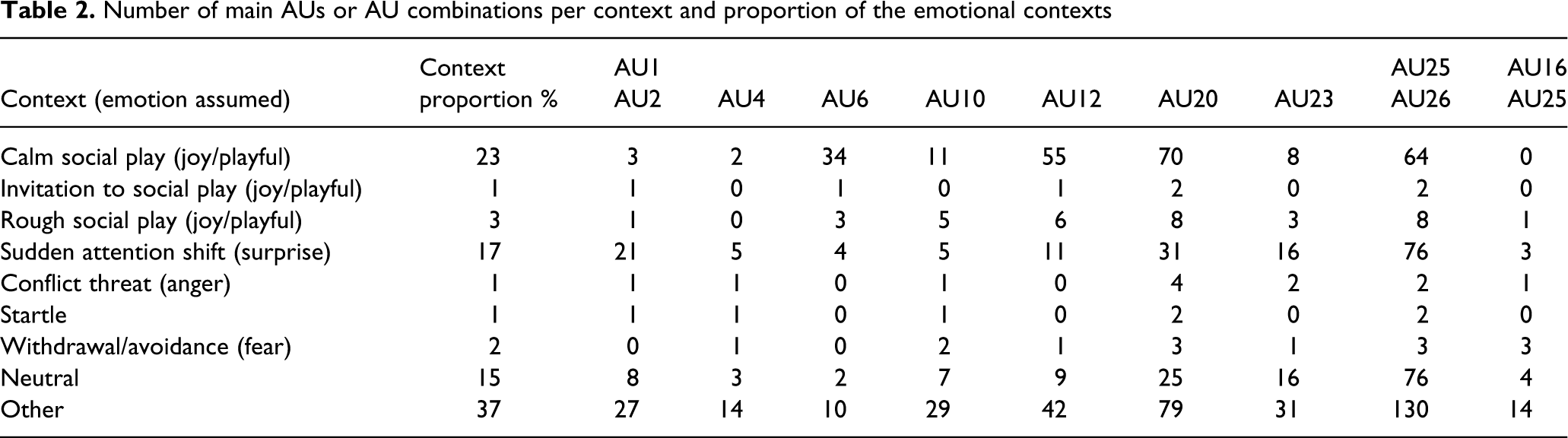
A total of 1,069 events within the scope of the emotional contexts list were registered. In Table 1 it is clear that the most frequent facial action is AU25, followed by AU26 (most times co-occurring as seen in Table 2). Table 2 presents the cross-tabulation of ECs and main AUs or AU combinations, and the proportion of each context. Figures 1A–H illustrate the relative proportions of observed AUs in each context. Table 2 and Figures 1A–H together show that the same AUs occur across a wide range of contexts but in quite different proportions, as one would expect across such different contexts.
Individual facial actions averages and standard deviations

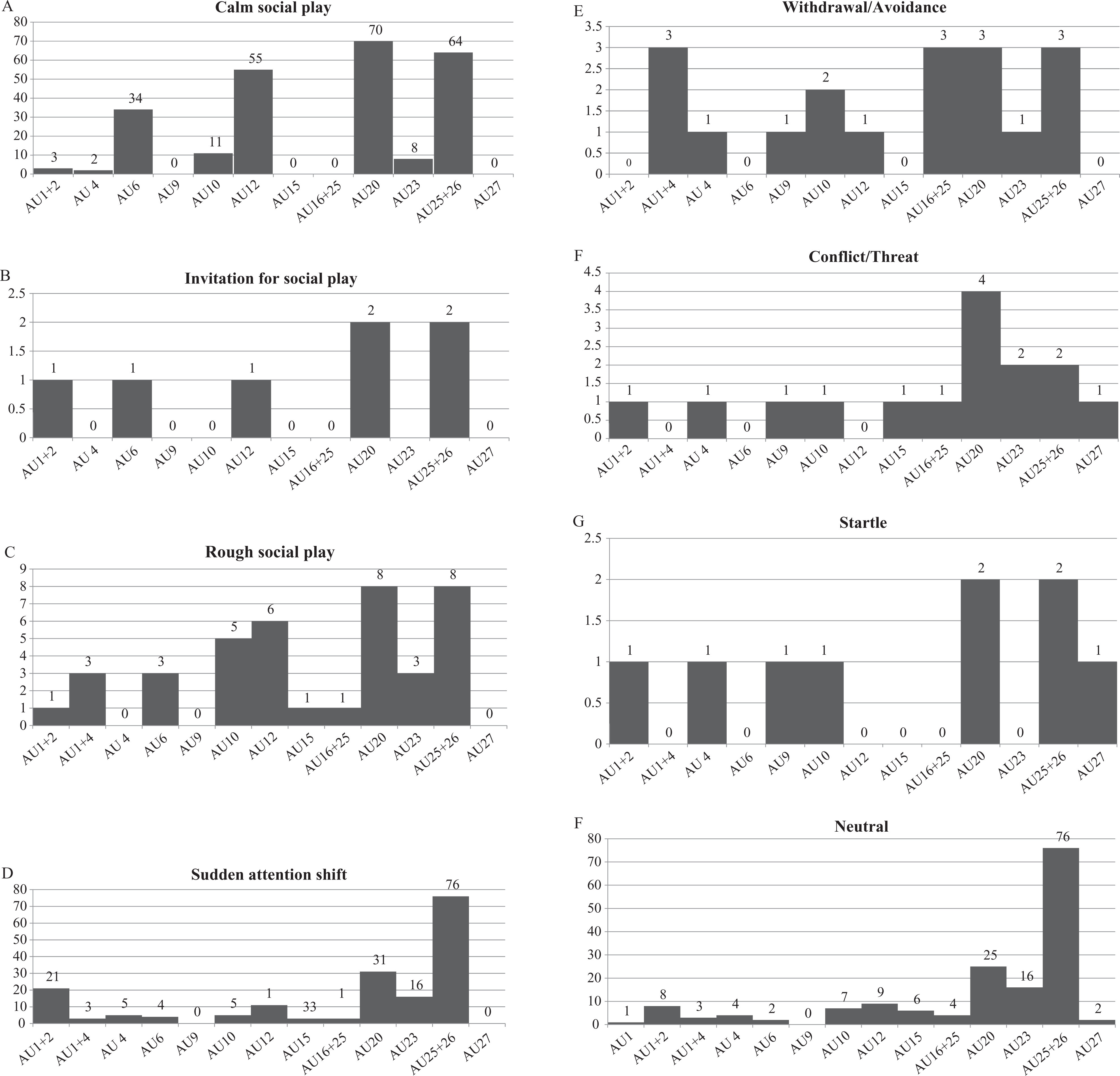
(A–H) AU proportions in the different ECs. A graph for the category other contexts is not included here as it would not provide the same kind of information as others, since many different (and even oppositely valenced emotional situations are included in it).
Number of main AUs or AU combinations per context and proportion of the emotional contexts
The association of emotional contexts and facial action units (AUs)
Before analyzing associations between contexts and facial behavior units, AU1, AU9, AU15, AU27 and AU1 + AU4 were removed from the original matrix due to their very low marginal totals (< = 18 across the nine contexts). The analysis of independence was computed for the remaining 1,020 event table of 9emotional contexts × 9Action Unit/comb (Table 2) and revealed a significant association between ECs and facial behavior: (χ 2 = 205.967; p < = 0.001; df = 64). Table 3 shows the estimated p-values per cell based on 10,000 runs of the simulation procedure described in the methods section (as proportions of the number of times in 10,000 in which the simulated χ 2 was above the χ 2 for the observed count).
Association analysis table of p values per cell. P values were estimated proportions of the number of times in 10,000 runs of ACTUS 2 in which the simulated χ 2 was above the χ 2 for the observed count

As seen in Figures 1A–H, there is considerable overlap of AUs between contexts, but with considerable differences in concentration per context. Some of these conspicuous concentrations emerged as major associations in the association test (Table 3, in bold): AU6, and AU12 associated with calm social play (joy/playful) and AU25 + 26 associated with the neutral context. Although sudden attention shift (surprise) had unusual high counts of AU1 + 2, and withdrawal/avoidance (fear) highly co-occurred with AU16 + 25, neither reached the significance level p < = 0.001. No associations were found for invitation to social play (joy/playful), conflict/threat (anger) or startle.
Proportion of matches between observed AU configurations and the prototypical emotion expressions
AU configurations matching the prototypical expression of joy/happiness are the highest, reaching 27% (Figure 2). The surprise matching proportion is 5%, anger, 0% and fear 11%. Different configurations other than the prototypical facial expressions observed in each corresponding emotion joy/playful, surprise, anger, and fear were, respectively, 5, 7, 8, and 8. So although three different contexts were looped into joy/playful for this comparison, joy/playful was the least dispersed context in terms of the facial configurations it generated.

Graphical representation of the proportion of observations in which the full facial action configuration matched that of the adult prototypical facial expression (dark color).
Discussion
We began this study with two primary goals: to describe spontaneous facial behavior in preschoolers from the ground up and throughout a range of pre-defined emotional contexts; and to compare their utterances to the prototypical facial expressions of adults. We expected facial behavior to be more stereotyped in some emotional contexts—joy/playful ones and anger, and thus we hypothesized that associations between these emotions and given facial actions would emerge; we also expected that the actual facial expressions in these emotional contexts would more often match the adult full facial expression prototypes by fitting in all its AU components. The results showed, however, that 3-year-old children use facial actions that comprise prototypical expressions, but they rarely display the full face adult prototype. The most interesting finding is that, “facial-behavior-wise,” the most “predictive” context is one assumed to relate to the joy/playful system—that is, calm social play—showing a characteristic lip corner raised smile with raised cheeks (AU6 + AU12; see Figure 3). We did not confirm our hypotheses in relation to anger, which we believe may be related to different adaptive timings in the development of the expression of different emotions, an idea we discuss later.
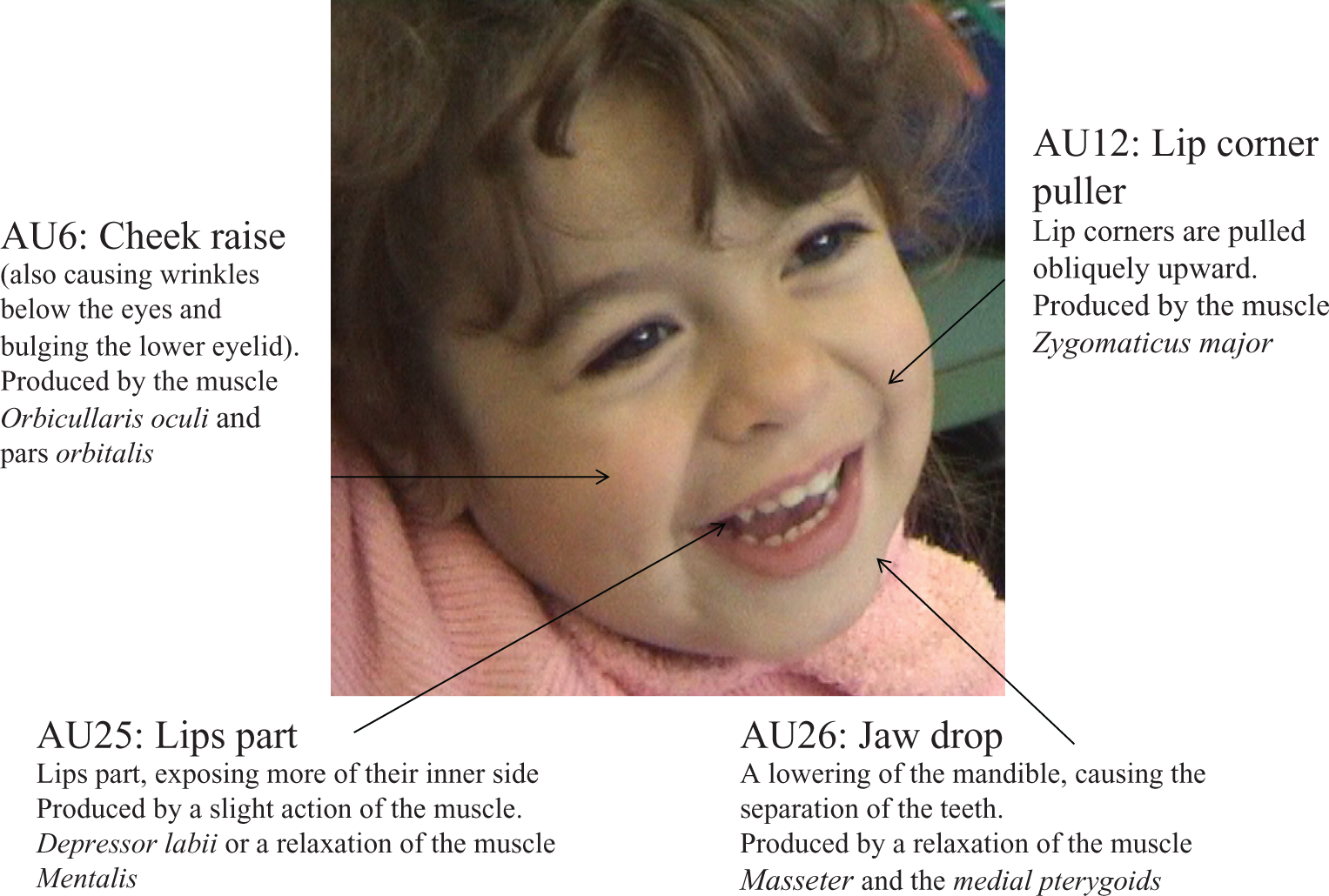
A facial configuration from the study, comprised of AU6 (cheek raiser, showing wrinkling around the eyes) and AU12 (lip corner puller) that are associated with calm social play, here combined with AU25 (lips part) and AU26 (jaw drop), in a gestalt that fits the adult prototypical facial expression of happiness.
Finding an association between calm social play and an AU6 + AU12 smile (as the one in Figure 3) is a largely expected result: This smile stands out among other types of smile (e.g., Ekman & Keltner, 1997) as the “Duchenne smile” (coined after the famous physiologist Duchenne De Boulogne, who was the first to propose that this was a true smile), for it is considered as a true sign of positive hedonic states. According to our hypothesis, it should be present in interactive contexts and in its full prototypical configuration, which was confirmed only in a fraction of observations, with the remaining observations being variations in configuration. Similar findings have been reported by other researchers who analyzed spontaneous facial behavior in emotional situations (e.g., Fernández-Dols & Ruiz-Belda, 1997). From a functional perspective, a highly predictable full face configuration in a given emotional context could be seen as evidence of emotional communication value. Given the component facial action associations with a joy/playful context and the nature of the joy/playful/happy emotion, there are ample reasons to expect an early display of the prototypical facial expression in a large scale. According to Panksepp (1998, 2005), joy/playful/happy is a core affect that promotes interaction and one of the most ancient affects in mammals, with infra-cortical attachment and reward systems in the brain. Signaling positive social attitudes and a proneness to interact friendly is crucial to socialization and to seeking positive interactions—little wonder that the prototypical expression of joy/playful has been reported as easiest to recognize by adults and children (e.g., Hager & Ekman, 1979; Soussignan & Schaal, 1996). These 3-year-olds have already in place a close match to actions recognized by older children and adults as signs of positive affect: cheek raising and lip corner upward pulling, which are also among the earliest signals used by human (Charlesworth & Kreutzer, 1973; Freedman, 1964) and great ape babies (e.g., Tomonaga et al., 2004) to interact with their caretakers.
Since most of the time in 3-year-olds only the lip corner pulling and the cheek raising occurred and not the full happy face (with the lips parting and the jaw drop—AU25 + 26), we speculate that experience may be playing a role throughout ontogeny, with one facial action triggering the receivers’ response and a correct appraisal, and the other AUs just commonly associating with it, a mechanism suggested by Carroll and Russell (1996). In addition, and in this particular emotional context, we cannot dismiss the possibility that there could be a higher match between what the face actually does in the joy/playful context and the prototypical happy face if we could measure hidden (or very subtle) activity of the muscle that produces the raising of lip corners, repeatedly shown to be active during positive affect (Dimberg, 1982; Dimberg & Thunberg, 1998; Lundquist, 1995; Surakka & Hietanen, 1998). It is also possible that, in many cases, context rated as neutral actually held a positive hedonic tone, that could not be inferred from behavior alone—this could also offer an explanation for the AU25 + 26 association that occurred with the neutral context.
If one departs from the assumption that a neutral emotional context will not involve much facial activity, unless one is speaking, the association between AU25 + 26 (relaxed open mouth) and the neutral context was indeed unexpected. This association may be fortuitous though, as most children for most of the days had stuffy noses and were breathing through their open mouths (with relaxed jaw), which became their baseline mouth. Another possibility is that the neutral context may be incorporating “hidden” positive emotion as proposed earlier. This relaxed open mouth configuration could be an autonomous part of the adult full facial expression prototype of happiness, occurring either alone or in combination with the Duchenne smile (AU6 + 12); it could be argued that this gestalt is homologous with the relaxed open mouth face displayed by chimpanzees and other great apes in relaxed affiliative and playful conditions, and also during excitement (Bard, Gaspar & Vick, 2011; Goodall, 1986), something that adults do not use as much. The ontogenetic perspective of facial expression (Oster, 2005) proposes that children do not develop their facial behavior toward that of adults, but rather display specific actions that have a better turn-over for them. For example, the suction reflex produces a pout face and the continued use of a pout through childhood either for soliciting things or during frustration is something that most adults do not use (Oster, 2005). These specificities of ontogeny seem, at least in some cases, to be phylogenetically ancient behaviors with homologues in other apes (Bard et al., 2011; Gaspar, 2006), which further supports the view that they have been programmed to play an early role in communication, which dissipates later in ontogeny.
We did not observe the prototypical fear facial expression, which probably occurs only in intense fear or panic. The withdrawal/fearsome context was rarely observed (fortunately, at the kindergarten) and it is probably difficult to witness in natural day-to-day naturalistic settings. Since there is no evidence that fear is an interaction-oriented emotion, in the sense we used earlier in this discussion, it is possible that unlike joy/playful or conflict/anger it has not as many associated interactive and conspicuous signals. In the fear context we observed nine distinct facial configurations, including AU16 + AU25, which is part of the prototypical fear expression.
Anger is thought to be an inter-personal core affect with an ancient neuroethologic system (Panksepp, 2005), resulting from prototypical contexts that have in common the actor’s appraisal that something wrong has to be corrected and a conflict of interest between actor and receiver, with threat and aggression being often, though not always, the outcome. It has been reported to be expressed as early as at 4 months of age (Lemerise & Dodge, 1993). In line with the communication theory, in order to be effective, facial components of the communication of anger/threat should be highly visible and the AUs in the prototypical expression certainly accommodate that requirement. Independent reports of anger-related non-verbal behavior corroborate the display of AU4 and AU27 in human adults (e.g., Shaver, Schwartz, Kirson, & O’Connor, 1987). In the present study we found a variety of possible actions and six combinations in this context that included the expected AU4, AU23, AU27, but also AU20, AU25 + AU26 and AU1 + AU2—but no consistent associations, so further sampling of this context may be a requirement in future studies in order to clarify whether the interactive value of this emotion is not yet in place in this age group (i.e., it is not yet adaptive to openly show anger towards peers), which is unlikely, or whether the expression of anger undergoes a slower development in the facial-visual channel—perhaps 3-year-old children’s other communication channels (vocal, gestural) are compensating and facilitating peer recognition of anger. It is also likely that experience (e.g., Pollak & Kistler, 2002) and individual traits are playing a role in the modulation of this facial expression (Bard et al., 2011), as these traits are also known to affect the perception of angry faces (e.g., Esteves, 2001; Öhman, Lundquist, & Esteves, 2001). Therefore, one would expect to see more inter-individual differences in angry expressions than in happy ones and, consequently, the likelihood of seeing a full face prototypical expression would fall.
The bottom line is that we expected children in both joy/playful and conflict/anger situations to use more often the prototypical adult facial expression, or at least a closer match using consistently some of the components of the adult full face prototype; because of the objective communicative function, we argue, that these expressions bear: promoting certain types of interactions, rather than conveying only information about what emotion they are experiencing. Indeed, smiling (characterized by lip corner raising) has been linked to social interaction more than to positive effect, and happiness itself may not even elicit a smile (Fridlund, 1991, 1994; Kraut & Johnston, 1979; Fernández-Dols & Ruiz-Belda, 1997), whereas laughter, which also involves lip corner raising and relaxed open mouth (the AU25 + AU26 combination), has been shown to be largely effective in the establishment of positive interaction among strangers (Grammer, 1990).
One may argue that we could have highlighted a few more matches between the emotional contexts and expected facial actions had we decided not to correct p-values for multiple comparisons. By using this correction we sought to avoid what could become an excessive number of associations based on small counts of contingent contexts and facial actions. As the first (to our knowledge) study of its kind with a limited sample of contingent observations for each category combination, it would be too premature to assume as significant those associations that are not really strong. For example, the association between the withdrawal/avoidance (fear) context and AU16 + 25 is one possible trend to be attentive to: partly because these facial actions are components of the adult prototypical facial expression of fear, and partly because its p-value of 0.005 fell short of the corrected p-value; nonetheless, inspecting Table 2, we realize this probability is based on three contingent observations. Another example of a trend, which is likely to be stronger in a future study with a larger number of contingent events, is sudden attention shift (surprise) with AU1 + 2 and AU25 + 26 (which are components of the full prototypical facial expression of surprise) and which would have been considered significant with uncorrected p-values, having, unlike fear, large counts of contingent observations. The latter can be seen as an example of the difficult balance between reducing error type I and error type II and of a limitation of this study.
An important constraint of this study is that virtually everyone in western societies has been exposed to consistent portrayals of the adult prototypical facial expressions in given expected situations—almost in a standardized manner across different media; for example, in commercials or movies, a big Duchenne smile is a standard display in happy situations, and a lip withdrawn grin (AU20 + AU25) is likewise predictable in thrillers. Although the coders were not aware of the purpose of the study and each coder was only assigned to code for one variable (either context or facial behavior, never both), the coder assigned to facial behavior was also observing little bits (seconds) of context and could perhaps have been biased to code more of some AUs based on these culturally assimilated prototypes.
Another limitation of the present study is that the coder assigned to context was also observing the ongoing facial behavior, which could have influenced his perception of the situation. A number of recent studies have highlighted the effect of contextual information in changing facial behavior interpretation (e.g., Aviezer et al., 2008; Carroll & Russell, 1996) but the reverse—that is, the effect of facial behavior in context coding—has not been a focus of attention. Still, we have to be aware of the fact that, when exposed to emotion cues, adults tend to reappraise context when in conflict with facial expression and do not rely preferentially on facial expression, whereas children tend to depart from relying mostly on facial expression toward integration of facial expression and context (Gnepp, 1983; Hoffner & Badzinsky, 1989). Although this limitation is mitigated by training and reliability testing procedures and by the fact that the context coder identified fear, anger, and surprise contexts even with very small or null proportion of observable prototypical facial expressions, we feel that the use of video editing tools that provide means to wipe out the background of the face, or the face itself, depending on whether one wants to code face or context, is required in future research to sort out additional information.
From a caretaker’s perspective the most relevant information this study provides is that a joy/playful affect can confidently be recognized by dynamic facial cues, with elevated probability that 3-year-old children will spontaneously display facial action configurations closest to those of adult prototypical happy faces. At the current stage of knowledge, we cannot make an identical proposition for the facial expression of other emotions in children of this age. Our results, framed within the behavioral ecology view, provide convincing evidence that the willingness to interact in proximity in a pleasurable, playful way seems to be the major message conveyed by 3-year-old children in peer interactions.
Footnotes
Acknowledgments
We wish to express our gratitude to CIS—IUL Centro de Investigação e Intervenção Social, the Department of Psychology of ISCTE—Instituto Universitário de Lisboa, for providing necessary human and laboratory resources that assured completion of this project; to Helena for providing always the best lab support; and to our coders Constança and Daniel for their laborious work. We are also grateful to Frederico Almada for providing useful input to our description of the statistical procedures and to two anonymous reviewers whose commentaries helped us improve on the previous version of the article.
Funding
The first author was sponsored by grant #SFRH/BPD/26387/2005 of the Portuguese Council for Science and Technology.