



Abstract
The present study examines two childhood markers of self-regulation, ego control and ego resiliency, as promotive factors for the development of global adjustment and as risk factors for the development of internalizing and externalizing behavior problems in a high-risk sample. Teachers and observers rated ego control and ego resiliency when participants (n = 136) were in preschool and elementary school. Ratings showed evidence for convergent and discriminant validity and stability over time. Ego resiliency, but not ego control, emerged as a powerful predictor of adaptive functioning at ages 19 and 26, as well as internalizing and externalizing problems at 16, 23, 26, and 32 years. We interpret these findings as evidence that flexibility and adaptability—measured with ego resiliency—may reduce risk and promote successful adaptation in low socioeconomic status (SES) environments.
Keywords
A robust body of evidence suggests that markers of childhood self-regulation—whether operationalized in terms of behavior patterns, temperament, or personality traits—predict health, financial, and criminal activity outcomes in adulthood (Moffitt et al., 2011), as well as later behavior problems (Caspi, Henry, McGee, Moffitt, & Silva, 1995; Chuang, Lamb, & Hwang, 2006; Denissen, Asendorpf, & van Aken, 2008). Variations in early self-regulatory patterns provide a foundation for later individual differences in self-regulation patterns (Carlson & Sroufe, 1995). In a pioneering longitudinal study, Jeanne and Jack Block showed that two important childhood markers of self-regulation, ego control and ego resiliency, have important implications for cognitive and socioemotional development (Block & Block, 1980). The present paper examines how ego control and ego resiliency in childhood relate to patterns of adaptation from adolescence through adulthood in a high-risk sample.
Ego control and ego resiliency are fundamental constructs for understanding the development of self-regulation, global adjustment, and the emergence of behavior problems (Letzring, Block, & Funder, 2005). Ego control refers to the capacity to regulate and express emotions and feelings. High levels of emotional expression characterize ego-undercontrolled individuals across different contexts and situations, even when it might be inappropriate. They are unable to control their impulses, tend toward instant gratification, and readily manifest emotional volatility (Block & Block, 1980). In contrast, ego-overcontrolled individuals typically contain emotions across situations, even when doing so may be unwarranted. They tend to be constrained and inhibited, to delay gratification excessively, and to minimize emotional expression (Block & Block, 1980). Ego resiliency refers to the capacity to adapt and be flexible in responding to situational demands. Individuals with low ego resiliency, characterized as ego-brittle, are more contained and restricted to the same level of emotional expression, independent of the context. They display low levels of adaptive flexibility, show little ability to respond to the dynamic requirements of situations, and a tendency to perseverate or fall apart when under stress or in novel circumstances (Block & Block, 1980). In contrast, a distinct characteristic of ego-resilient individuals is their capacity to adjust to situational demands (Letzring et al., 2005). They are resourceful in adapting to change, flexible in deploying their resources to solve problems, and are good at analyzing the goodness of fit between situational demands and behavioral possibilities (Block & Block, 1980).
Early patterns of ego control and ego resiliency can affect patterns of adaptation by increasing the probability of developing adaptive and maladaptive behavior, therefore, functioning as promotive and risk factors. Promotive factors are those that have the positive effect of enhancing the probability of developing adaptive behavior (Sameroff, 1999). This is a more precise term than protective factors because it highlights the positive contributions to healthy development, and not only the buffering effects from negative experiences. In contrast, risk factors are those that have the harmful effect of enhancing the probability of developing maladaptive behavior. Focusing on promotive and risk factors emphasizes the probabilistic, dynamic, complex, and open nature of development, in contrast to linear, simplistic, and deterministic models (Rutter & Sroufe, 2000).
Patterns of ego control and ego resiliency in childhood can be considered promotive factors since longitudinal evidence suggests that they increase the likelihood of competent adjustment later in development. By adolescence, children identified as resilient have been shown to develop more sophisticated social cognition and higher academic achievement than under- and overcontrollers. Individuals rated as overcontrolled exhibited low self-esteem and social withdrawal, while those rated as undercontrolled displayed more aggressive behavior (Hart, Hofmann, Edelstein, & Keller, 1997). Additionally, Robins, John, Caspi, Moffitt, and Stouthamer-Loeber (1996) showed that resilient individuals rarely develop antisocial behavior and psychopathology, and are more social and academically successful. Ego resiliency has been associated with individual and interpersonal competence (Klohnen, Vandewater, & Young, 1996). In a study of the transition to adulthood, Denissen and colleagues (2008) reported that individuals rated as resilient and undercontrolled took less time to find a romantic partner than those rated as overcontrolled. Moreover, self-reported adjustment in adult women (Klohnen et al., 1996) and adult secure attachment (Kobak & Sceery, 1988) have been predicted by ego resiliency.
While moderate levels of ego control and high levels ego resiliency promote adaptive functioning, high or low levels of ego control and low levels of ego resiliency are consistently associated with maladaptive functioning, specifically to internalizing and externalizing behavior problems (Chuang et al., 2006). Furthermore, associations among ego-undercontrol, ego-overcontrol, and ego-brittleness in early childhood and later behavior problems have been reported in longitudinal studies in Iceland (Hart et al., 1997), Germany (Denissen et al., 2008), the Netherlands (Juffer, Stams, & van IJzendoorn, 2004), Sweden (Chuang et al., 2006), and the United States (Robins et al., 1996).
Based on Block’s (1971) study, Robins et al. (1996) proposed three personality types: resilients, overcontrollers, and undercontrollers. In a sample of adolescents they found that resilients were more likely to be free of psychopathology, overcontrollers were prone to internalizing problems, and undercontrollers were prone to externalizing problems. Since then, others have replicated these findings (Asendorpf & van Aken, 1999; Asendorpf, Borkenau, Ostendorf, & van Aken, 2001). Evidence suggests that the effects of these personality types extend into emerging adulthood; for example, individuals rated as resilient in childhood were faster in getting a job by the end of adolescence than those rated as over or undercontrollers (Denissen et al., 2008).
Caspi and colleagues found that children classified as undercontrolled at age 3 were more likely to develop internalizing and externalizing problems in adolescence (Caspi et al., 1995); scored higher on impulsivity, and aggression in late adolescence (Caspi & Silva, 1995); scored higher on internalizing and externalizing behavior problems; had lower self-control, and poorer quality social relationships; and were more likely to drop out of school, commit crimes, and have difficulty finding a job (Caspi, 2000; Caspi et al., 2003). In contrast, individuals classified as inhibited at age 3 were more prone to develop internalizing symptoms in adolescence (Caspi et al., 1995); displayed low impulsivity, and aggression in late adolescence (Caspi & Silva, 1995); exhibited high self-control, low assertiveness, and social support; and were more likely to develop internalizing behavior problems in early adulthood (Caspi, 2000; Caspi et al., 2003; Caspi, Moffitt, Newman, & Silva, 1996).
Although this body of findings indicates that these markers of self-regulation predict global adjustment outcomes and behavior problems in theoretically meaningful ways, several gaps exist in the literature. First, many of the studies measure the outcome variables concurrently or use longitudinal designs that end in adolescence. Although some studies have shown the contribution of early ratings of ego control and/or ego resiliency to adult behavior problems (Asendorpf et al., 2001; Block & Block, 2006; Denissen et al., 2008; Klohnen et al., 1996), further validation of the constructs and replication of their effects is necessary, particularly in high-risk samples. Second, measures of ego control and ego resiliency, adjustment, and behavior problems are often derived from the same reporter, which may inflate relations across measures and over time, making studies with independent reporters crucial. Third, studies exploring both adaptive and maladaptive outcomes of ego control and ego resiliency remain scarce (for a recent exception, see Denissen et al., 2008).
Fourth, the majority of studies in this literature use low-risk, middle-class samples. The few studies that employ high-risk, low socioeconomic status (SES) samples rarely study poverty in itself, but in combination with maltreatment (e.g., Cicchetti & Rogosch, 1997), addictions (e.g., Laufer, Johnson, & Hogan, 1981), or criminal behavior (e.g., Robins et al., 1996). Unless more research with high-risk samples is conducted, findings regarding the longitudinal effects of ego control and ego resiliency could be questioned as having low external validity, thus having a limited generalizability to the population. The tendency among psychological scientists to pay more attention to internal than to external validity leaves questions about the meaningfulness of findings unresolved (Sue, 1999), and this study aims to fill this gap. In addition, using high-risk samples can yield statistically tractable distributions of behavior problems, in comparison to samples with low-risk samples with typically fewer reports of behavior problems.
Current study
The current study aims to fill these gaps. Our first goal was to investigate the convergent and discriminant validity of ego control and ego resiliency in a high-risk sample. This includes examining whether multiple raters (teachers and observers) of the same constructs within each time point are correlated, while at the same time examining whether measures of ego control and ego resiliency are uncorrelated at a statistically significant level and of low overall magnitude. Although the Blocks posited ego control and ego resiliency to be relatively independent dimensions (Block & Block, 1980), Chuang et al. (2006) found them at times to be correlated, albeit inconsistently, at one age positive and another age negative. Attempting to replicate previous findings in a high-risk sample is especially important for questions of generalizability. We hypothesize that teacher and observer ratings will be highly intercorrelated within constructs, but have low correlations across constructs (hypothesis 1).
Next, we examine the stability of ego control and ego resiliency over time. We address the issue of shared-reporter variance by obtaining measurements of ego control and ego resiliency from two independent sources (classroom teachers and trained observers) at two times (in preschool and elementary school). We hypothesize that teacher and observer ratings of ego control and ego resiliency will be stable across time (hypothesis 2).
We also investigate the predictive validity of ego control and ego resiliency and examine their relationship with global adjustment; that is, competent adjustment in the areas of work, social relationships, and consolidation of the self, at ages 19 and 26, as well as behavior problems from adolescence through adulthood (ages 16–32). Based on the pattern of findings in the literature reviewed earlier, we expect high levels of ego resiliency to forecast greater global adjustment and high ego control (undercontrol) and low ego control (overcontrol) to predict lower global adjustment (hypothesis 3). In addition, we hypothesize that high ego control (undercontrol) will predict higher levels of externalizing problems, low ego control (overcontrol) will predict higher levels of internalizing problems, and high ego resiliency will predict lower levels of internalizing and externalizing problems (hypothesis 4).
To test these hypotheses, we used longitudinal data on ego control, ego resiliency, global adjustment, and behavior problems from multiple reporters using multiple methods in adolescence and adulthood. When participants were in preschool (ages 4–5), they were observed on at least 2 days in a variety of structured tasks and play activities in their preschool or day-care setting (Troy, 1988). Observers and teachers then rated children’s ego control and ego resiliency using a Q-sort. When participants were in the second or third grade of elementary school (ages 7–9), the same Q-sort procedure was repeated, using different observers and teachers as reporters. Global adjustment was rated after extensive interviews at ages 19 and 26. Behavior problem data were collected from participant self-reports at ages 16, 23, 26, and 32.
The present study is unique in four ways. First, we use a sample at risk of developmental problems due to poverty. This is most critical since most studies on ego control and ego resiliency employ a normative, low-risk sample and thus questions of generalizability to low-SES populations remain unanswered. Second, this study is unique because its longitudinal span (early childhood to age 32) is longer than what is typical of developmental studies of ego control and ego resiliency and thus permits studying the long-term effects of these early individual differences. Third, it examines both adaptive and maladaptive behavior outcomes in relation to ego control and ego resiliency. Fourth, it is unique because it uses multiple assessments of the same measures, and employs a multiple independent informant approach that could yield more accurate estimates and avoid the same-reporter bias that often inflates associations.
Method
Participants
Participants came from an ongoing longitudinal study investigating developmental outcomes of at-risk urban children (Sroufe, Egeland, Carlson, & Collins, 2005). The sample comprised 187 first-time mothers (M = 20 years old, range = 12–34 years) and their infants. Mothers were recruited in a major city in the United States’ Midwest at a public health clinic during the third trimester of pregnancy. The families were identified as at-risk for parenting problems due to low income (100% at the time of the child’s birth), single parenthood (62%), and low maternal education (35.9% with less than a high school education). The sample used in the present analyses consists of 136 of children (75 male, 61 female) for whom global adjustment, behavior problems, and at least some ego control and ego resiliency data were available (73% of the original sample). 62% of the participants were White, 15% mixed ethnic background, 19% African-American, and 4% other/unknown.
Diminishing sample sizes do not correspond to patterns of selective attrition, but to specific reasons. For example, only 99 of the 180 children attended preschools and were therefore available for those analyses. During the elementary years, funds were available to do in-school ratings by observers on only 100 children at school and only 65 of these had been preschool participants. Moreover, we had funds to pay only 64 teachers, who were selected at random from the larger sample of teachers and students, to do ego control and ego resiliency ratings and between 26 and 28 of those were in preschool. These numbers apply to the stability analysis only for the subsequent growth curve analysis the available sample size was increased, and the resulting size of the sample in these analyses was between 92 and 97 participants. The subsample did not significantly differ from those not involved on any of the demographic or outcome variables, as indicated from a series of non-significant chi-square and t-tests (see Table 1).
Demographic characteristics between the subsample and those not involved in the study

Measures
Ego control and ego resiliency
Preschool and elementary school teachers and observers completed the California Child Q-Set (CCQ; Block & Block, 1969/1980) on each participant. At preschool and elementary school, one teacher completed assessments for each participant. In preschool, one observer rated 69 participants, and two rated 27. In elementary school, one observer rated 42 participants, and two rated 59. In preschool and elementary school, when two observers conducted ratings, the scores were averaged.
The CCQ consists of 100 diverse items described in individual cards about children’s behavioral, cognitive, emotional, and social characteristics. Items characteristic of ego-undercontrol include: “Is unable to delay gratification, cannot wait for satisfaction” and “Overreacts to minor frustrations; is easily irritated and/or angered.” Items characteristic of ego-overcontrol include: “Tends to brood and ruminate or worry” and “Is inhibited and constricted.” Items that are characteristic of ego resiliency include: “Can recoup or recover after stressful experiences” and “Is reflective; thinks and deliberates before speaking or acting.” Items uncharacteristic of ego resiliency include: “Tends to become rigidly repetitive or immobilized when under stress” and “Tends to withdraw and disengage when under stress.” The Q-sort methodology requires that raters sort the cards containing the individual items into piles with a fixed distribution. There are nine piles, each pile representing a category. The categories range from extremely uncharacteristic (category 1) to extremely characteristic (category 9). By placing each card into each pile, the rater provides each participant with a score for each item. Experts were asked to assign scores for each item based on an ideal ego-controlled child and for an ideal ego-resilient child, creating criterion scores. Participants’ scores were correlated with the criterion score, representing how much they approximated or diverged from the profile. These correlations became the scores used in analyses. For the ego control scale, high positive correlations indicate an ego-undercontrolled child and high negative correlations indicate ego-overcontrol. For the ego resiliency scale, high positive correlations reflect ego resiliency, while high negative correlations reflect ego-brittleness.
Global adjustment scale at ages 19 and 26
At ages 19 and 26, participants completed in-depth audio-taped interviews on work, social relationships, and romantic relationships. At each age, trained graduate students coded global functioning in the areas of work or school, social relationships, and consolidation of the self (including identity, goal directedness, reflectiveness, and self-awareness). Ratings were made on a five-point Likert-type scale. A score of 5 denoted that the participant was functioning well in all areas by being actively engaged in pursuing or participating in work or school; being close to family members, friends, and a romantic partner (if applicable); and displaying self-confidence, pursuing goals in life, being able to reflect on her or his own life, and recognizing personal limitations. A score of 1 signifies poor functioning in all major areas and experiencing pervasive and chronic problems in starting or maintaining intimate relationships with family, friends, and partners; lack of motivation or clear strategies to pursue academic or personal goals; and low awareness or understanding of her or his difficulties in these areas. The rating scale was the same at ages 19 and 26. However, there was a slight difference in coding methods across these two ages. At age 19, at least two graduate students coded audiotapes for each participant, obtaining an alpha of .93 (Carlson, Sroufe, & Egeland, 2004). At ages 26, a single graduate student (the interviewer) assigned a rating immediately following the interview.
Behavior problems in adolescence (age 16) and adulthood (ages 23, 26, and 32)
Internalizing and externalizing behavior problems were assessed using the developmentally-appropriate Achenbach self-report measure at each age. At age 16, behavior problems were assessed using the youth self-report (YSR; Achenbach, 1991). At ages 23 and 26, behavior problems in adulthood were assessed using the young adult self-report (YASR; Achenbach, 1997). At age 32, behavior problems were assessed by the adult self-report (ASR; Achenbach & Rescorla, 2003). These measures ask participants to describe their own behavior, feelings, thoughts, and competencies on a series of more than 100 checklist items. Participants are asked to indicate whether behavioral descriptions are (0) not true, (1) somewhat true or sometimes true, or (2) very true or often true. At each age these measures assess two global dimensions of behavior problem symptoms: internalizing and externalizing.
The YSR has 112 items in total; 32 items load on internalizing and 30 items load on externalizing. The YASR has 119 items in total; 24 items load on internalizing and 28 items load on externalizing. The ASR has 126 items in total; 39 items load on internalizing and 35 items load on externalizing. Since items included on the internalizing and externalizing subscales varied slightly across ages and measures, analyses were limited to those items that were identical and loaded on the same internalizing or externalizing subscale across time in order to facilitate mean growth curve analyses. For the internalizing subscale, 15 identical items were included. For the externalizing subscale 19 items were included, 13 were identical, and six were age-appropriate equivalents, but not identical. For example, item 39 in the YSR is “I hang out with kids who get in trouble,” in the YASR is “I hang around with others who get in trouble,” and in the ASR is “I hang around with people who get in trouble.” The items included are summarized in Table 2.
Consistent internalizing and externalizing items in the YSR, YASR, and ASR
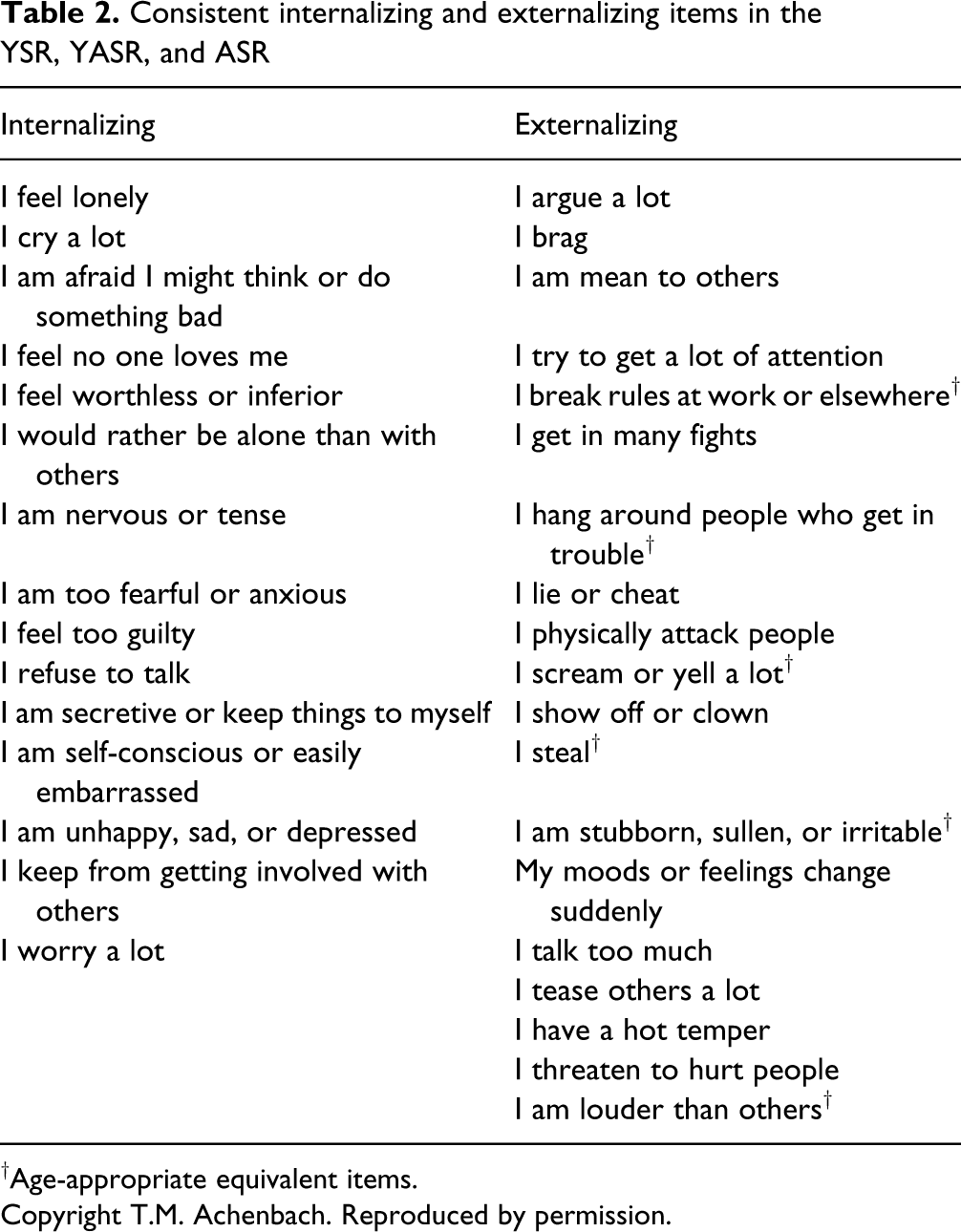
†Age-appropriate equivalent items. Copyright T.M. Achenbach. Reproduced by permission.
Alphas for the internalizing scale were .84, .85, .85, and .88 for ages 16, 23, 26, and 32 year measures, respectively. Alphas for the externalizing scale were .83, .86, .83, and .82 for ages 16, 23, 26, and 32 year measures, respectively.
Results
Descriptive statistics and zero-order correlations
Descriptive statistics for focal study variables are summarized in Table 3. Zero-order correlations are presented in Table 4. For the purposes of the zero-order correlations, ego control and ego resiliency ratings from each reporter were averaged for each age, thus creating preschool and elementary ego control and ego resiliency composites. Preschool and elementary ego control composites, as well as preschool and elementary ego resiliency composites, were significantly related. There were no significant associations between ego control and ego resiliency composites within and across time points. At the zero-order level, preschool ego control (where high scores indicated ego-undercontrol) was positively related to age 26 and 32 externalizing problems. Preschool ego resiliency was positively related to age 19 global adjustment, and negatively related to age 23, age 26 (marginal), and age 32 internalizing problems. Elementary ego control was positively related to age 23 and 26 externalizing problems. Elementary ego resiliency was positively related to ages 19 and 26 global adjustment, and inversely related to ages 16 and 26 externalizing problems. Table 4 shows that global adjustment at age 19 was significantly and negatively associated with internalizing and externalizing problems at ages 16, 23, 26 and 32.
Descriptive statistics for focal study variables

Intercorrelations among focal study variables
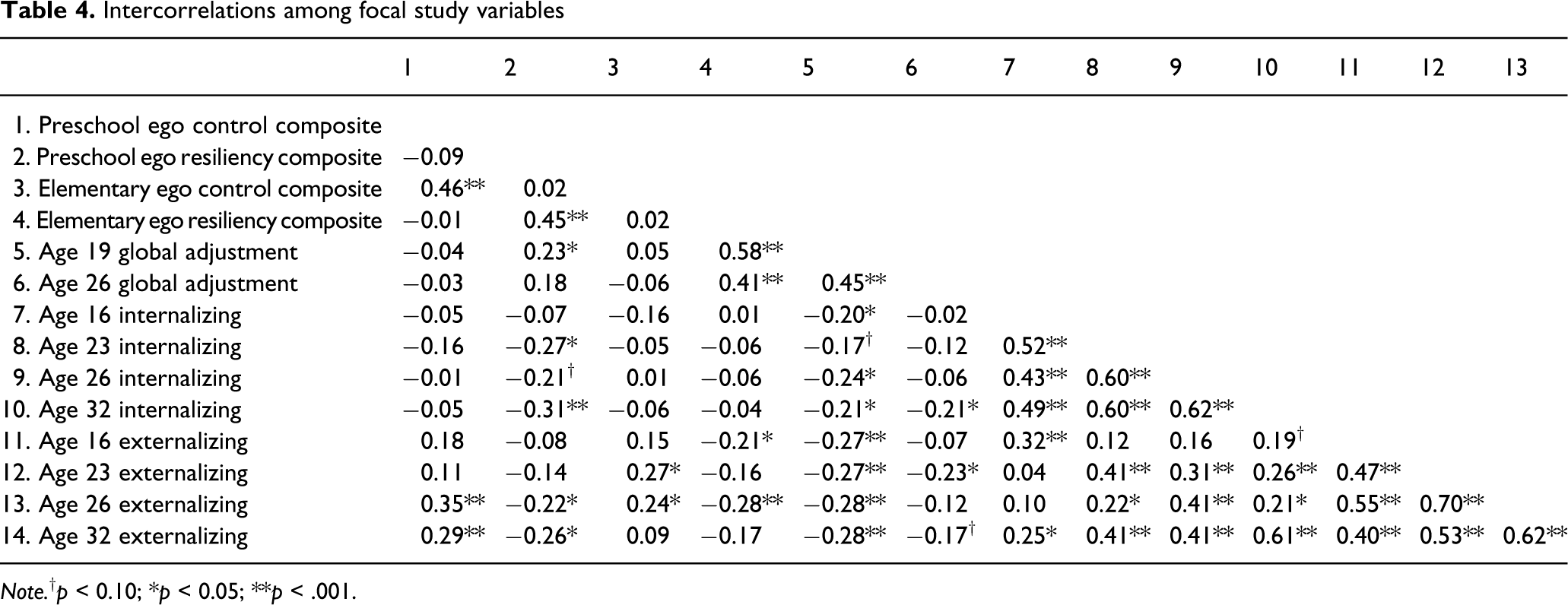
Note. † p < 0.10; *p < 0.05; **p < .001.
Convergent and discriminant validity
Examining concordance between reporters on measures within each age allowed us to assess convergent and discriminant validity. As shown in Table 5, within each age teachers and observers showed strong convergence on both ego control and ego resiliency, with correlation coefficients corresponding to large effect sizes under Cohen’s (1988) conventions. With one exception, within- and between-reporter ratings of ego control and ego resiliency showed non-significant associations with each other, providing evidence for discriminant validity. The single exception was that elementary school teacher ratings of ego control and ego resiliency were negatively and significantly correlated. Nevertheless, this effect was not replicated when examining the correlation between elementary teachers’ ratings of ego control with elementary observers’ ratings of ego resiliency or elementary teachers’ ratings of ego resiliency with elementary observers’ ratings of ego control.
Stability of ego-undercontrol and ego resiliency across time
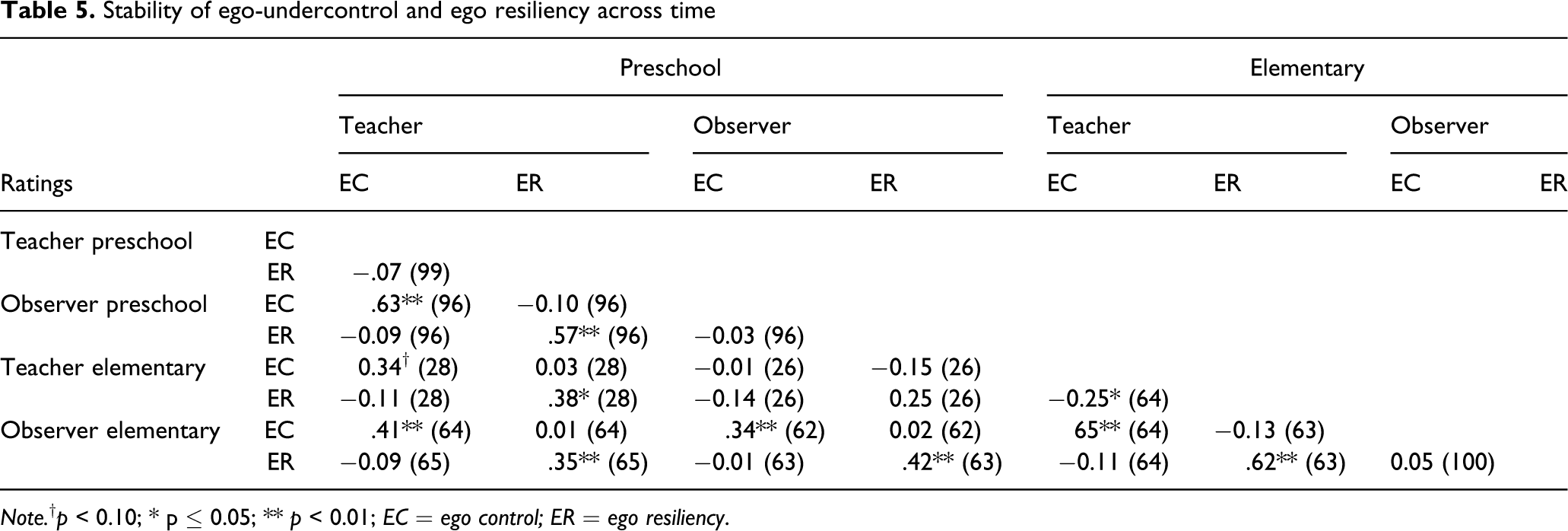
Note. † p < 0.10; * p ≤ 0.05; ** p < 0.01; EC = ego control; ER = ego resiliency.
Rank-order stability in ego control and ego resiliency between preschool and elementary school
As shown in Table 5, measures of ego control and ego resiliency showed rank-order stability between preschool and elementary school for both teachers and observers, with most correlations being significant, and others marginally significant.
Predictive validity: Global adjustment in late adolescence and adulthood
Multiple regression was used to assess whether preschool and elementary ego control and ego resiliency predicted global adjustment in late adolescence and adulthood. Given the convergence between teacher and observer ratings (see Table 5), and in order to reduce the number of statistical tests, available ratings from each reporter were averaged for each age, thus creating preschool and elementary ego control and ego resiliency composites. To aid in the interpretation of the ego control measure, where both high and low scores are less adaptive, at each age participants were classified into one of three groups. Participants in the bottom third of the distribution on the ego-undercontrol measure were classified as “ego-overcontrolled;” those in the middle third were classified as “ideal ego control;” those in the top third were classified as “ego-undercontrolled.” The ideal ego control group was set as the reference group in all analyses. As shown in Table 6, elementary ego resiliency predicted more adaptive functioning at ages 19 and 26. Unexpectedly, none of the anticipated effects for preschool or elementary ego control were significant.
Global adjustment as a function of preschool and elementary school ego resiliency and ego control

Note. † p < 0.10; *p < .001;**p < .0001; ER = ego resiliency; EOC = ego overcontrol; EUC = ego undercontrol.
Predictive validity: Behavior problem trajectories from adolescence through adulthood
Analytic approach
We adopted a linear mixed modeling (LMM) growth curve framework to examine mean-level trajectories of internalizing and externalizing behavior problems from adolescence through adulthood as a function of preschool and elementary school ego control and ego resiliency. Analyses were run using the lme4 package (Bates & Maechler, 2010) in R version 2.11.1 (R Development Core Team, 2010). The two main benefits of using this multilevel modeling statistical software for repeated-measures data is that it uses maximum likelihood methods to accommodate missing data on the dependent variables, as well as unequal lengths of time between assessments.
Our main analyses included four separate linear mixed models examining intercept differences in internalizing and externalizing behavior problems as a function of preschool ego control, preschool ego resiliency, elementary ego control, and elementary ego resiliency. As in the global adjustment analyses, the ego control and ego resiliency composites were used. The same ego control groups were used, and the ideal ego control group was again set as the reference group. In view of the reliable sex differences reported in the literature on internalizing and externalizing symptoms (Zahn-Waxler, Shirtcliff, & Marceau, 2008), sex was controlled in each model as a main effect.
Preschool and elementary school measures were run separately, and the same general model for each analysis was used. For example, the equation (expressed in hierarchical linear modeling [HLM] form) used to estimate the effects of preschool ego control and ego resiliency on the intercept of internalizing symptoms was:


where ß 1 is the intercept, which is the mean score on the internalizing subscale at age 16; ß 2 is the slope for the linear time term; ß 3 is the effect of sex on the intercept; ß 4 is the effect of preschool ego-overcontrol (EOC) on the intercept (compared to the ideal preschool ego control reference group); ß 5 is the effect of preschool ego-undercontrol (EUC) on the intercept (compared to the ideal preschool ego control reference group); ß 6 is the effect of preschool ego resiliency on the intercept; b1 is the random intercept allowing for individual variation around the mean (ß 1). Inferences for fixed effects were made using corresponding z-values because the N* (i.e., the total number of behavior problem observations) was large, ranging from 322 to 358. T-values obtained for parameters were compared to the critical values under the standard normal distribution.
Internalizing problems
Results from the linear mixed models (LMMs) examining trajectories of internalizing problems are summarized in the first column of Table 7. The results from the preschool model indicated that higher preschool ego resiliency predicted fewer internalizing symptoms at age 16. This effect is represented graphically in Figure 1. For illustrative purposes, predicted values were calculated at 1 SD above and below the mean of ego resiliency, as well as at the mean. There was also a negative effect for time, indicating that internalizing symptoms decreased over time on average, and a marginal effect indicating that females had more internalizing symptoms at age 16. There were no significant effects for the ego control categories. The results from the elementary model indicated a marginal effect whereby ego-undercontrol was associated with fewer internalizing symptoms, but no significant effect for ego resiliency. There was again a significant and negative effect for time in the elementary school model.
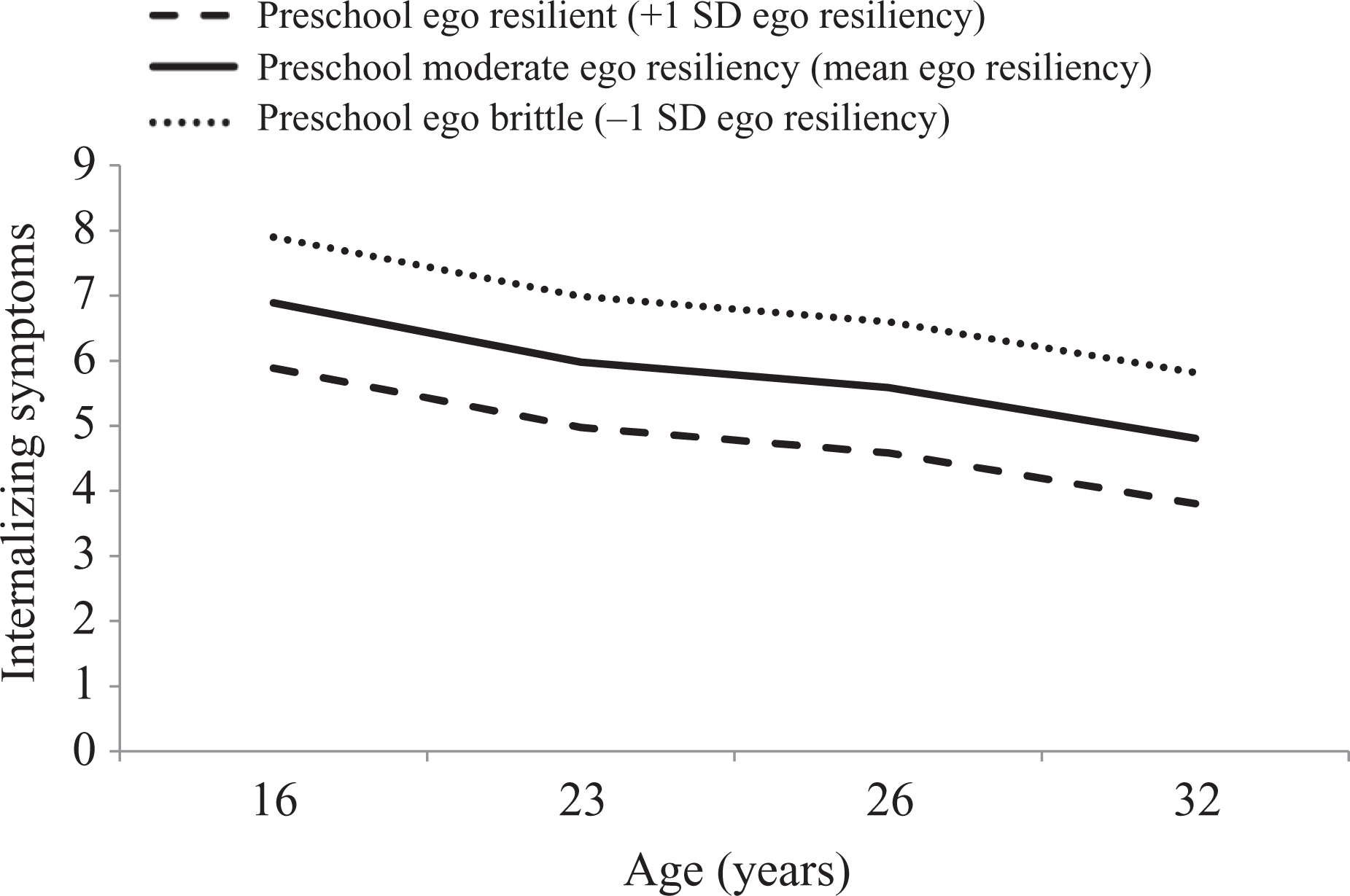
Trajectories of internalizing symptoms as a function of preschool ego-resiliency.
Linear mixed models examining internalizing and externalizing problems as a function of preschool and elementary school ego control and ego resiliency

† p < 0.10; *p < 0.05; **p < .001.
Externalizing problems
Results from the LMMs examining trajectories of externalizing problems are summarized in the second column of Table 7. The results from the preschool model indicated a trend whereby higher ego resiliency predicted lower externalizing symptoms at age 16. There was also a significant effect for time indicating that, on average, externalizing symptoms decreased over time. There were no significant effects for the ego control categories. The results from the elementary model indicated a negative effect for ego resiliency on age 16 externalizing symptoms. As shown in Figure 2, higher ego resiliency predicted lower externalizing symptoms. For illustrative purposes, predicted values were calculated at 1 SD above and below the mean of ego resiliency, as well as at the mean. The time term was also negative in the elementary model, suggesting that, on average, externalizing symptoms decreased over time. There were again no significant effects for the ego control categories.
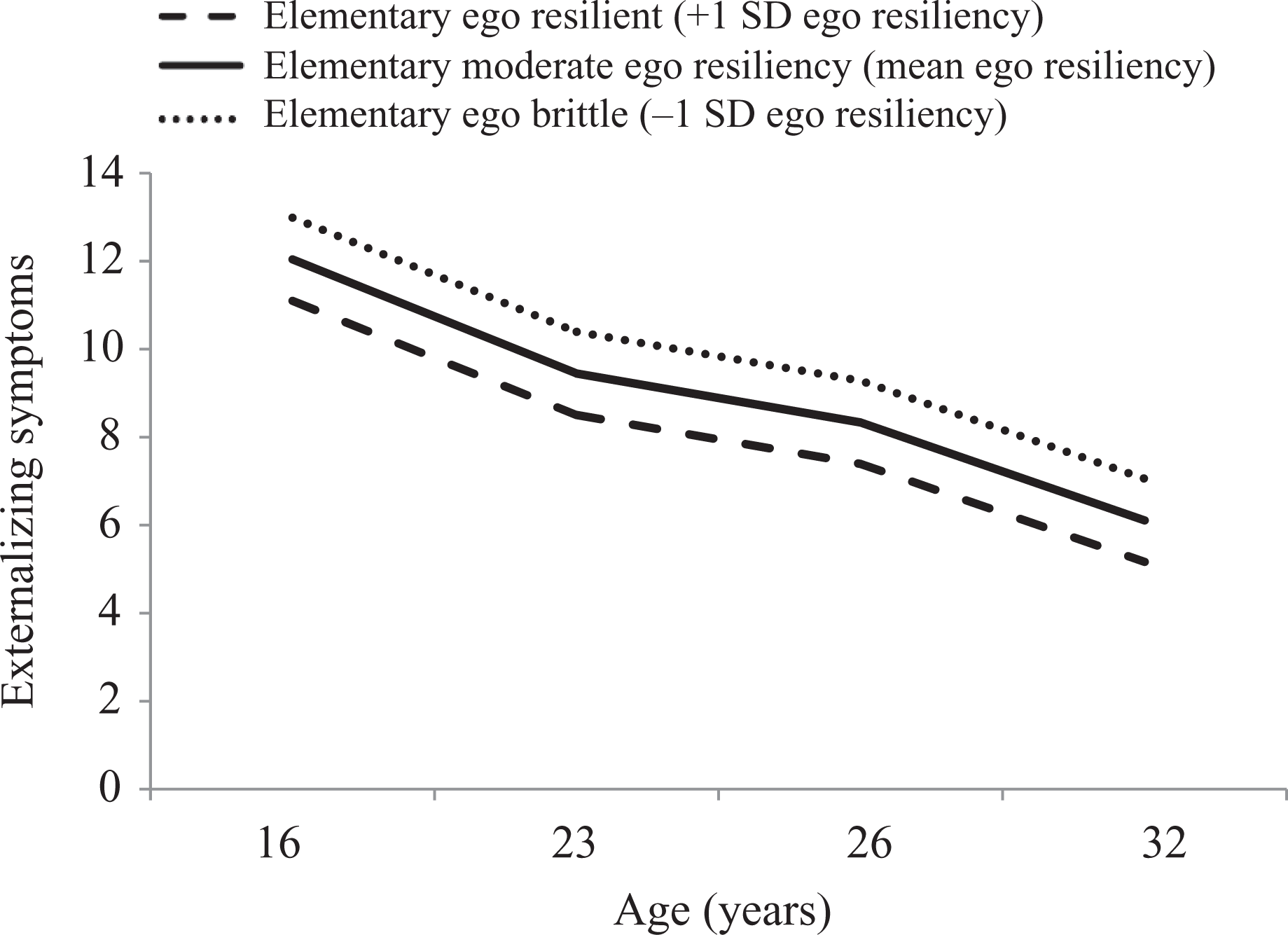
Trajectories of externalizing symptoms as a function of elementary ego-resiliency.
Discussion
In this prospective, longitudinal study we examined the convergent, discriminant, and predictive validity and rank-order stability of ego control and ego resiliency and their links to patterns of adaptation in a high-risk sample. As expected, we found evidence to support the convergent and discriminant validity of ego control and ego resiliency. Teachers and observers showed strong concordance on both ego control and ego resiliency within each age, with large effect sizes (hypothesis 1). Furthermore, our findings support the idea that ego control and ego resiliency are distinct constructs, as proposed by Block and Block (1980), since we found most associations to be non-significant and of negligible magnitude across constructs (hypothesis 1). The sole exception was the significant and negative correlation between elementary teachers’ ratings of ego control and ego resiliency. However, this effect was not replicated with the observers’ data. We replicated previous studies which showed that ego control and ego resiliency are stable across time (Block & Block, 1980; Chuang et al., 2006). Our data are quite compelling in that this stability was found for both teachers and observers and by the fact that different teachers and different observers were used at each age (hypothesis 2); thus obtained stability cannot be merely attributed to shared-reporter variance. It has been argued that multiple traits and methods must be employed in the validation process (Campbell & Fiske, 1959). By also including multiple informants, we are able to further extend the validation of the constructs of ego control and ego resiliency.
Perhaps the most significant contributions of this study are the evidence that ego resiliency in childhood is a promotive factor for the development of global adjustment in late adolescence and adulthood, as well as risk factors for the development of behavior problems from adolescence into adulthood (hypothesis 3), thus extending previous studies. Moreover, although internalizing and externalizing symptoms decreased over time for the sample as a whole, initial differences as a function of ego resiliency were maintained over time.
Unexpectedly, ego control did not exert the expected promotive and risk effects. Elementary ego resiliency—but not ego control—was significantly associated with more adaptive functioning at age 19 and age 26. These findings are consistent with the notion that individuals scoring high in ego resiliency are more likely to adapt to novel environmental demands (Block & Block, 1980). Ego resiliency in early elementary school also predicted differences in externalizing problems into adulthood (hypothesis 4). This lends support to the idea that resilient individuals are less likely to develop psychopathology (Robins et al., 1996). Ego resiliency might function as a self-regulation pattern that fosters positive adaptation and reduces the likelihood of developing behavior problems (Huey & Weisz, 1997). Ego-resilient individuals are more likely to receive positive social responses, express emotional stability, and thus achieve a better adaptation to the environment that translates into fewer behavior problems (Asendorpf & van Aken, 1991). Consistent with these notions, global adjustment at age 19 was significantly and negatively associated with internalizing and externalizing problems at ages 16, 23, 26, and 32.
It is worth noting that ego resiliency had more significant associations with global adjustment, internalizing, and externalizing problems than ego control. In contrast with previously reviewed studies on low-risk samples, our study suggests that ego resiliency may be more critical than ego control within a high-risk sample. A potential explanation for this finding is that, while ego resiliency and moderate levels of ego control may be adaptive in middle-class environments that are commonly more stable, ego resiliency may be more crucial for individuals born into poverty. Since most of our participants were born into low-income, single parent, and low maternal education households, it is possible that the ability to bring diverse psychological resources in order to address problems flexibly—ego resiliency—may be fundamental to cope with and successfully adapt to novel and demanding situations that characterize such high-risk environments. Ego resiliency is related to the development of internal locus of control and sophisticated social reasoning (Hart et al., 1997); it increases the likelihood to endure anxiety and to be less self-focused in the face of new challenges, remaining sufficiently organized and cognitively equipped to invoke alternative and flexible strategies (Block, Block, & Gjerde, 1986).
Taken together, these findings show that ego resiliency—and to a lesser extent, ego control—are valid and robust predictors of adaptive and maladaptive behavior. Additionally, these findings add evidence to the notion that early markers of self-regulation predict later behavior problems and are consistent with previous evidence (Caspi, 2000; Caspi et al., 1995, 2003). Our findings suggest that early patterns of self-regulation are important precursors for behavior problems reaching into adulthood (age 32). One possible explanation for these findings is that early self-regulation—especially ego resiliency—becomes the model for future strategies of coping with normative stress (Rutter & Sroufe, 2000). Early self-regulation patterns could become crystallized in the shape of personality (Block & Block, 2006; Caspi, 2000; Robins, Fraley, Roberts, & Trzesniewski, 2001), becoming an affect processing system (Block, 2002).
Our findings that ego control and ego resiliency are important factors in the development of adaptive and maladaptive functioning offer important translational opportunities. Thus prevention and intervention efforts aimed at promoting optimal levels of ego control and ego resiliency in young children may pay dividends in the future. There are a number of broadband intervention programs aimed at promoting self-regulation in children (for a review, see Eisenberg, Spinrad, & Eggum, 2010). Nevertheless, there is paucity in the development of treatment protocols tailored to promote appropriate levels of ego control and ego resiliency in children. For example, treatment for children identified as ego-undercontrollers could be developed to promote context-appropriate emotional expression, cognitive strategies to postpone gratification, and developing emotional control when upset. For children rated as ego-overcontrollers, the treatments could promote enhancing emotional expressivity and pursuit of goals. For children labeled as ego-brittle, treatments should focus on improving adaptive flexibility, ability to respond to the dynamic requirements of situations, and strategies to perseverate under stress or in novel circumstances. Taking into account socioeconomic status might be helpful for optimizing resources. Based on the findings of this study, it is more likely that children of families with low SES would benefit from interventions focused on enhancing ego resiliency.
Future studies should address how biological components interact, affect, and are affected by the development of ego control and ego resiliency. Although some studies have examined how they relate to hormonal functioning (Cicchetti & Rogosch, 2007), to our knowledge no study has looked at the interaction between genotype, ego control, and ego resiliency.
There are, of course, limitations in the present study. Most notable is the fact that we only measured ego control and ego resiliency at two time points. Carrying these measurements forward into adolescence and adulthood and examining factors correlated with continuity and change would have been an important advance. Second, although we obtained significant effects in the expected directions, it is important to replicate this work in more culturally and ethnically diverse samples to ensure the generalizability of these findings and to expand our knowledge of the development of patterns of self-regulation. Third, as the longitudinal study progressed, we experienced diminished sample size due to budgetary restrictions, among other reasons. This issue might have affected our ability to detect meaningful effects. Still, this study is testimony to the considerable power of early patterns of self-regulation and to their place in the field of developmental psychology. It extends previous studies—often focused on normative samples—to show that ego resiliency, and to a lesser degree ego control, predict adaptive and maladaptive behavior in late adolescence and adulthood in a high-risk sample.
Today, newer markers of self-regulation, such as behavioral inhibition, effortful control, and executive function, enjoy great popularity. Nevertheless, the classic self-regulation indexes of ego resiliency and ego control still offer enormous potential to predict adaptive and maladaptive behavior, and should be considered as complementary dimensions in future studies of self-regulation.
Footnotes
Funding
Preparation of this work and the research described therein were supported by a National Institute of Child Health and Human Development grant (HD054850-01) awarded to L. Alan Sroufe. This research was also supported by a pre-doctoral training grant to Jessica E. Salvatore (T32MH015755-32), and IFARHU-SENACYT pre-doctoral training grant (270-2009-168) awarded to José M. Causadias.