



Abstract
By integrating the life history theory of attachment with resource control theory, the current study examines the hypothesis that insecure attachment styles reorganized in middle childhood are alternative adaptive strategies used to prepare for upcoming competition with the peer group. A sample of 654 children in the second through seventh grades in Shanghai, China, participated in this study. The children reported attachment relationships with their mother and the use of resource control strategies in the peer group. Boys had higher avoidant attachment scores than girls, whereas girls had higher ambivalent attachment scores than boys. Moreover, avoidant attachment was positively associated with the use of coercive strategies to control resources. Ambivalent attachment was associated with the use of both coercive and prosocial strategies to control resources. A number of other gender and developmental differences were also observed. The implications for the adaptiveness of insecure attachment in middle childhood are discussed.
Child attachment researchers have long held that insecure attachment styles, which deviate from secure attachment, represent maladaptive social and emotional bonding. The negative relationships between insecure attachment and social adjustment and mental health have been widely documented in the literature (see Brumariu & Kerns, 2010; Fearon, Marian, Marinus, Anne-Marie, & Glenn, 2010 for more comprehensive reviews). Within the evolutionary frameworks, we reinterpret the existing psychology literature by integrating recent theoretical models from the life history (LH) theory of attachment and the resource control (RC) theory to support the argument that insecure attachment in middle childhood may be an alternative adaptive strategy for accessing resources in the broader social network. Gender differences in insecure attachment (that is, the adoption of avoidant attachment by boys and ambivalent attachment by girls) emerge in middle childhood as a means of adapting to the new social environment. Although the traditional psychological view holds that prosocial behavior is related to social acceptance and coercive behavior is related to social rejection, both prosocial and coercive behaviors are evolutionarily adaptive strategies that are used to control resources. Therefore resource-directed behavioral correlates have already been selected at this stage because they, together with attachment strategies, are coadaptive to evolutionarily relevant challenges. The present study therefore seeks to advance our understanding that the insecure attachment styles that reorganize in middle childhood develop in adaptive ways in modern human social contexts.
LH theory of attachment
The LH theory of attachment was first postulated by Belsky, Steinberg, and Draper (1991) and links childhood experience, attachment styles and reproductive strategies. Specifically, early social experiences (which in turn shape attachment styles) during the first 5 to 7 years of life have adaptively channeled children down different developmental pathways of divergent reproductive strategies in evolutionary history. Belsky (1997, 1999) distinguished two insecure attachment styles: avoidant/dismissing and anxious/ambivalent. Avoidant attachment evolved to promote opportunistic reproductive strategies in adulthood. In contrast, ambivalent attachment tends to lead to an indirect reproductive strategy and “helper-at-the-nest” behavior, which is designed to increase the inclusive fitness of the ambivalently attached individual by helping to rear siblings and other relatives (Belsky, 1997, 1999).
From the evolutionary developmental perspective based on the LH theory, adaptive phenotypic modification generally occurs with a developmental reorganization in response to environmental challenges (Ellis, Figueredo, Brumbach, & Schlomer, 2009; Flinn, 2006). Specifically, an important transition period in human ontogeny occurs during middle childhood, when behavioral strategies are reorganized to prepare for a new, stressful social environment (Del Giudice, 2009). During middle childhood, social networks expand significantly beyond the relationship between child and caregivers to more complex extrafamilial relationships. Because children are no longer completely dependent on caregivers for feeding and protection (Bogin, 1997), they may have greater opportunities to create and maintain peer connections than they do in early childhood (Collins, Madsen, & Susman-Stillman, 2002; Hardy, Bukowski, & Sippola, 2002; Kerns, Tomich, & Kim, 2006; Mayseless, 2005). Children in middle childhood will assess the extrafamilial ecological condition to make conscious or unconscious decisions about how to interact in future extrafamilial relationships to secure reproductive advantages in adulthood (Del Giudice, 2009; Mayseless, 2005). During this process, both secure and insecure children must begin to increase their active engagement in social activities within their peer group, and the attachment system at the beginning of middle childhood is reorganized to face these new challenges (Del Giudice, 2009; Del Giudice, Angeleri, & Manera, 2009). Because males and females will encounter different fitness-relevant challenges in adulthood (Bjorklund & Schackelford, 1999; Darwin, 1871; Trivers, 1972), gender-differentiated patterns of insecure attachment are expected to emerge in middle childhood. Specifically, insecure girls tend to develop and adopt an ambivalent attachment style, whereas insecure boys develop and adopt an avoidant attachment style when faced with new social demands driven by their peer group (Del Giudice, 2009). The reorganization may be a dynamic process during the middle childhood transition, and it may be driven by the hormonal mechanism of adrenarche, which depends on local environmental risks (Del Giudice, 2009; Del Giudice et al., 2009). Therefore the emergence of gender differences in insecure attachment styles may be a gradual process that begins in the early stage of middle childhood, but matures in the late stage of middle childhood.
RC theory
The RC theory formulated by Hawley (1999) reinterprets children’s social behavior in resource-directed terms with an evolutionary-function explanation (Hawley, 2007). Resources for survival and reproduction are limited. Those resources are not limited to materials, such as land, water, shelter and food; they may include social or informational forms that can contribute directly or indirectly to survival and reproduction (Foa, 1971; Hawley, 2007). Therefore competition for all types of resources is a major adaptation throughout the human lifespan. In humans, a wide range of social behaviors, including cooperation, relational and physical aggression, and deception, can be viewed from an evolutionary perspective as conditional strategies in the competition for resources (Charlesworth, 1996). Although the behaviors used to control resources can also be viewed on a continuum ranging from aggressive to prosocial strategies (MacDonald, 1996; McGrew, 1972), resource control theory proposes that the two broad, resource-directed competitive behaviors (coercive and prosocial) might be two separate dimensions (Hawley, 1999; Pellegrini, 2008). Individuals can access the resources in the social group by deceiving or exploiting (i.e., using an aggressive strategy) or by cooperating or reciprocating (i.e., using a prosocial strategy). Thus aggressive and prosocial strategies are two very different forms of behavior that can serve the same function of maximizing resource acquisition (Charlesworth, 1996; Hawley, 2011a, 2011b). The co-occurrence of these two strategies has been widely explained in relationships characterized by social dominance and resource acquisition (e.g., Charlesworth, 1996; B.-B. Chen & Chang, 2012; de Waal, 1986; Hawley, 2003; Hawley, Little, & Card, 2008; Pellegrini & Bartini, 2001; Pellegrini et al., 2007). Given the functional value of resource control strategy, RC theory emphasizes that children’s social competence within the social group depends on their ability to acquire resources using competitive tactics (Hawley, 1999). Empirical research in Western countries such as America (Roseth et al., 2011) and Germany (Hawley, 2003; Hawley et al., 2008) and in Eastern countries such as China (e.g., B.-B. Chen & Chang, 2012) has provided consistent support for this view.
Integrating LH and RC theoretical approaches into insecure attachment strategies in middle childhood
Bowlby (1969/1982, 1973), the founder of modern attachment theory, drew heavily from Darwin’s insights when he formulated his theory. He emphasized that an infant develops a close emotional tie to his or her primary caregiver to increase the likelihood of survival. Interaction and conflict between parent and child can itself be seen as resource competition (Godfray, 1995; Trivers, 1974). In fact, Chisholm (1996) has proposed that the development of two distinct adaptive insecure attachment styles in response to different safety threats seems to be a tactic for ensuring resource investment from caregivers. Specifically, in response to circumstances in which parents are willing but unable to consistently invest in their offspring, children can use ambivalent attachment (in the form of increasing need signals and behaving immaturely) to maximize the available investment. Children may respond to a parent’s unwillingness to invest with avoidant attachment behaviors, including seeking self-sufficiency and avoiding being abandoned or abused. Such behaviors as crying, smiling and immature reactions can represent different strategies to acquire benefits from caregivers and maintain access to resources (Bowlby, 1973; Hawley, 2007; Main, 1990; Soltis, 2005; Trivers, 1985).
If the attachment behavioral system serves to regulate competitive behaviors to control resources during infancy, then it should continue to serve this adaptive function. However, beginning in middle childhood, it contributes directly to reproduction-related outcomes, rather than promoting safety and survival as it does during infancy and early childhood. In the view of LH theory, the attachment styles that develop in response to risk and stressful conditions in childhood interact with other psychological/behavioral developments to collectively influence individuals’ subsequent reproductive and childcare strategies. Such theoretical linking of childhood attachment styles and associated behaviors invites the assumption that resource-directed behavior in middle childhood might be based on the reorganization of attachment styles that evolved as environmentally contingent mechanisms for promoting reproduction-related fitness later in life (i.e., adolescence and adulthood). Recent research based on a young adult sample (Hawley, Shorey, & Alderman, 2009) supports our assumption about the relationship between attachment and resource control. Adult attachment appears to play a unique role in behaviors that affect access to resources within peer groups, avoidant attachment predicts coercive resource control and anxious attachment predicts prosocial resource control (Hawley et al., 2009). Hawley (2011b) also suggested that parent–child attachment at an early age may calibrate resource control strategies in terms of whether an individual values a material or social orientation. Based on these studies’ findings, it seems reasonable to assume that, if the reorganization of insecure attachment styles in middle childhood is essential for coping with the competition outside the family, insecure attachments should be related to resource control strategies.
In his analysis, Del Giudice (2009) argues that children’s avoidant attachment and its behavioral correlates (i.e., high-risk resource acquisition) may be an optimal short-term reproductive strategy in an unfavorable family environment. In addition, Belsky (1997) hypothesized that some children (especially ambivalently attached females) reach a reproductive age without becoming autonomous from their parents, instead becoming “helpers-at-the-nest” to parents or other kin (see also Hrdy, 2005 for reviews). In this context, ambivalent attachment may be considered a useful strategy for extracting resource investment from kin and peers (Del Giudice, 2009). Such resource-acquisition behaviors driven by ambivalent attachment are not exclusively prosocial; they may also be coercive (Campbell, 2009; Del Giudice, 2009). Thus children who develop an ambivalent attachment style are more likely to adopt both prosocial and coercive strategies to control resources.
In addition, although peer competition reaches its peak in late adolescence and young adulthood (Archer, 2009; Kruger & Nesse, 2006; Weisfeld, 1999), different age groups in middle childhood may also experience different levels of peer-group competition during the reorganization process. For example, Pellegrini and Long (2002) found that coercive competition, as a function of social dominance-seeking, increased with the transition from primary to middle school and then declined across the next 2 years of middle school. Thus the patterns of associations between insecure attachment and resource control strategies may be amplified further during the specific stage of middle childhood when peer competition increases steeply.
The present study
Several researchers have examined the adaptiveness of insecure attachment in childhood (e.g., Belsky, 1997, 2008; Chisholm, 1996; Del Giudice, 2009; Main, 1990). These studies, however, were generally theory-based rather than empirical. To gain an increased understanding of the adaptiveness of insecure attachment during middle childhood, we randomly chose children who were in the second grade through the seventh grade to examine whether insecure attachment in childhood may represent alternative adaptive strategies for accessing the resources in their peer group. As the main aim of our present study, we hypothesized that avoidant attachment was associated with the use of coercive strategies to control resources, whereas ambivalent attachment was associated with both coercive and prosocial strategies to control resources. Based on the findings of Hawley et al. (2009), we did not expect that gender would moderate the associations between avoidant attachment and coercive resource control strategies; however, we did expect that these associations would be moderated by age, particularly in the late stage of middle childhood. As a secondary aim of the research, we also examined the main effects of gender and age on attachment. We predicted there would be gender differences in avoidant and ambivalent attachment. Extending previous research, we examined the developmental tendencies in attachment throughout middle childhood. We predicted that there would be grade-based differences in both avoidant and ambivalent attachment, with higher scores and greater gender differences occurring during the late stage of middle childhood.
Method
Participants
The participants were 654 children (327 boys and 327 girls) in the second through seventh grades in ordinary public schools in Shanghai, China. The children’s mean age was 10.87 years (SD = 1.78), with a range from 6.92 to 15.08 years. Approximately 47% of the participants’ mothers and 43% of fathers had completed high school only, 42% of mothers and 44% of fathers had a college or university degree, and 7% of mothers and 10% of fathers had also received some postgraduate education. The sample was representative of middle childhood-aged children in an urban area in China.
Measures
Insecure attachment in middle childhood
Self-reports of insecure attachment were obtained using a shorter version of the Coping Strategies Questionnaire (CSQ; Finnegan, Hodges, & Perry, 1996; Yunger, Corby, & Perry, 2005). The questionnaire’s 20 items measure two dimensions of middle childhood-aged children’s insecurity in relation to their attachment figure: preoccupied (or ambivalent) coping and avoidant coping. Perry and colleagues suggest that the preoccupied and avoidant coping styles assessed with the CSQ reflect two styles of attachment insecurity that are believed to be central to attachment security in preadolescence (Yunger et al., 2005). In the present study, the children were asked to choose which statement was more like him or her and indicate the degree of the item’s applicability. To minimize the influence of social desirability response biases, each item contains two opposing statements addressing the hypothetical situation, using a “Some kids . . . BUT other kids . . .” format. One sample item from the scale used to assess avoidant attachment describes the following situation: “Your mother takes you to the doctor’s office for a checkup. While you are sitting in the waiting room, she says she is going to run an errand and will be back to pick you up later.” The two opposing responses for this item read as follows: “Some kids would be glad their mother left them alone to wait BUT other kids would prefer that their mother wait with them.” The children were asked which statement is true about himself or herself, and whether it is “really true” or “sort of true.”
Following Finnegan et al.’s (1996) procedure, the items on the avoidant scale were scored as follows: (a) the non-avoidant coping response was “very true” (score: 0); (b) the non-avoidant coping response was “sort of true” (score: 0); (c) the avoidant coping response was “sort of true” (score: 1); and (d) the avoidant coping response was “very true” (score: 2). A value of 0 was assigned to both of the non-avoidant coping options (i.e., “sort of true” and “very true”) because neither indicated any degree of insecure avoidance. The items on the preoccupied scale were scored analogously (i.e., with a value of 0 assigned to both nonpreoccupied options and values of 1 and 2 assigned to the responses that indicated lesser and greater degrees of preoccupation, respectively). As Finnegan et al. suggest (1996), the item scores were averaged for each scale so that every participant received two scores on the continuous dimensions of preoccupied (ambivalent) and avoidant insecure attachment. Finnegan et al. (1996) reported that the two-week test–retest correlations for the preoccupied and avoidant subscales were .83 and .76, respectively, and the two subscales were moderately correlated (r = − .47), suggesting satisfactory divergent validity. Furthermore, the existing literature has shown that the subscales were significantly correlated with caregiving and parental styles (Karavasilis, Doyle, & Markiewicz, 2003; Yunger et al., 2005), social anxiety subtypes (Brumariu & Kerns, 2008), social competence (Booth-LaForce, Oh, Kim, & Rubin, 2006) and several indices of school adjustment (Kerns, Tomich, Aspelmeier, & Contreras, 2000). In addition, the two subscales were internally consistent across several samples of Chinese middle childhood-aged children (e.g., B.-B. Chen, in press; Z.-Y. Chen, 2008; Ma, 2010), with alpha coefficients ranging from .67 to .74 for ambivalent attachment and .65 to .85 for avoidant attachment. The internal consistency reliability estimates were .72 for avoidant attachment with mother and .72 for ambivalent attachment with mother in the current sample.
Resource control strategy
The Resource Control Strategy Inventory (RCSI; Hawley, 2006) was used to measure the participants’ behaviors related to accessing resources (material, social, informational) within their peer context. The RCSI consists of six items, each of which assesses two broad, resource-directed strategies: coercive resource control (e.g., “I access resources by dominating others” and “I access resources by bullying others”) and prosocial resource control (e.g., “I offer myself for friendship to access resources” and “I access resources by promising something in return”). The participants were asked to rate how true each item was for them on a seven-point scale ranging from 1 = “not at all true” to 7 = “completely true.” The self-report measure had acceptable alpha reliabilities, ranging from .76 to .78 for coercive resource control and .79 to .80 for prosocial resource control (Hawley, 2003; Hawley et al., 2008), and it was validated by peer nomination (Hawley, 2003; Hawley, Little, & Card, 2007). The literature has shown that self-reported prosocial resource control is positively associated with positive characteristics (social skills), whereas self-reported coercive resource control was positively associated with hostility and aggression (e.g., Hawley, 2003). Previous research (B.-B. Chen & Chang, 2012) based on a sample of Chinese children indicated that the two-factor confirmatory model for the RCSC yielded an acceptable fit on the basis of a number of goodness-of-fit indices, including comparative fit index (CFI) = 0.90, goodness of fit index (GFI) = 0.96, root mean square error of approximation (RMSEA) = 0.07, and standardized root mean square residual (SRMR) = 0.07. It also reported that both coercive and prosocial strategies were correlated with resource control as an indicator of the individual’s ability to obtain desired roles, possessions, or attention and his or her effectiveness at doing so (Hawley et al., 2008; Hawley, Little, & Pasupathi, 2002), indicating that the RCSI has satisfactory criterion-related validity in a Chinese sample. The internal consistency reliability estimates for these two composites were α = .81 for coercive resource control strategies and α = .61 for prosocial resource control strategies.
Data analysis strategy
Two sets of analyses were performed in the present study. First, a multivariate analysis of variance (MANOVA) and univariate analyses of variance (ANOVAs) were used to examine gender and grade main effects and their interaction effects on insecure avoidant and ambivalent attachment and coercive and prosocial resource control strategies. Here, grade level was examined with a recoded variable representing low (grades 2–3), middle (grades 4–5) and high (grades 6–7) grade levels. Second, multiple regression analyses involving the simultaneous direct entry of insecure attachment styles examined the unique association between each attachment style and resource control strategies. Differences in the strength of these associations as a function of gender and grade level were examined using interaction terms computed from each moderator and the children’s attachment (Aiken & West, 1991). Grade level was translated into two dummy-coded variables, with the middle graders as the comparison group. Three-way interaction terms, which evaluate developmental patterns in the association between the children’s insecure attachment and their resource control strategies, varied significantly as a function of gender and grade level. Continuous attachment scores were centered prior to the computation of interaction terms and their entry into each model. Analyses were repeated for each of the two resource control strategies.
Results
Gender and grade differences in variables
A MANOVA based on the whole sample was conducted to examine the overall effects of child gender and grade and their interactions on the variables. The analysis revealed significant main effects of gender, Wilks’ λ = .93, F(4, 645) = 11.95, p < .001, and grade, Wilks’ λ = .81, F(8, 645) = 18.32, p < .001. Nonsignificant interactions between gender and grade were found, Wilks’ λ = .81, F(8, 645) =.91, p = .51. The means and standard deviations of the variables for grade levels according to gender are presented in Table 1.
Means and standard deviations of the variables

A series of further univariate analyses was conducted to examine the study’s specific hypotheses. First, we predicted that there would be gender differences in avoidant and ambivalent attachment. Univariate analyses indicated significant gender differences in avoidant attachment, F(1, 648) = 30.62, p < .001, and ambivalent attachment, F(1, 648) = 19.47, p < .001. Specifically, the boys had significantly higher scores on avoidant attachment than did the girls, whereas the girls had significantly higher ambivalent attachment scores than did the boys.
Second, we predicted that gender differences in attachment would vary as a function of grade level. For avoidant attachment, there was a marginally significant interaction effect between gender and grade, F(2, 648) = 2.60, p = .075. Specifically, there was no gender difference in avoidant attachment for low graders, F(1, 205) = 2.55, p = .11, but there were significant gender differences in avoidant attachment both for middle, F(1, 208) = 13.45, p < .001, and high graders, F(1, 235) = 13.92, p < .001. However, for ambivalent attachment, no interaction effect between gender and grade was found, F(2, 648) = 1.38, p = .25. The univariate analyses indicated significant grade differences for ambivalent attachment, F(2, 651) = 41.36, p < .001. Inconsistent with our prediction, ambivalent attachment in low graders was higher than in both middle and high graders, and middle graders presented higher incidences of ambivalent attachment than high graders (M = .86, .64, .52, SD = .42, .41, .37, for low, middle and high graders, respectively).
Although we did not provide a specific hypothesis about resource control, the main results are reported here for the readers’ reference. The results indicated that boys had significantly higher scores in the use of both coercive and prosocial strategies to control resources than girls did: coercive strategies, F(1, 652) = 10.60, p < .01: M = 1.74, 1.50, SD = 1.02, .82, for boys and girls, respectively; prosocial strategies, F(1, 652) = 5.14, p < .05: M = 3.46, 3.26, SD = 1.20, 1.05, for boys and girls, respectively. Univariate analyses indicated significant grade differences for prosocial strategies, F(2, 651) = 31.75, p < .001, but not for coercive strategies, F(2, 651) = .19, p = .83. Tukey’s post-hoc comparisons between grade levels were used for follow-up with prosocial strategies. Low graders exhibited more prosocial strategy use than both middle and high graders, and middle graders exhibited greater use of prosocial strategies than high graders, (M = 3.82, 3.28, 3.02, SD = 1.07, 1.12, 1.05, for low, middle, and high graders, respectively).
The associations between attachment strategy and resource control behaviors
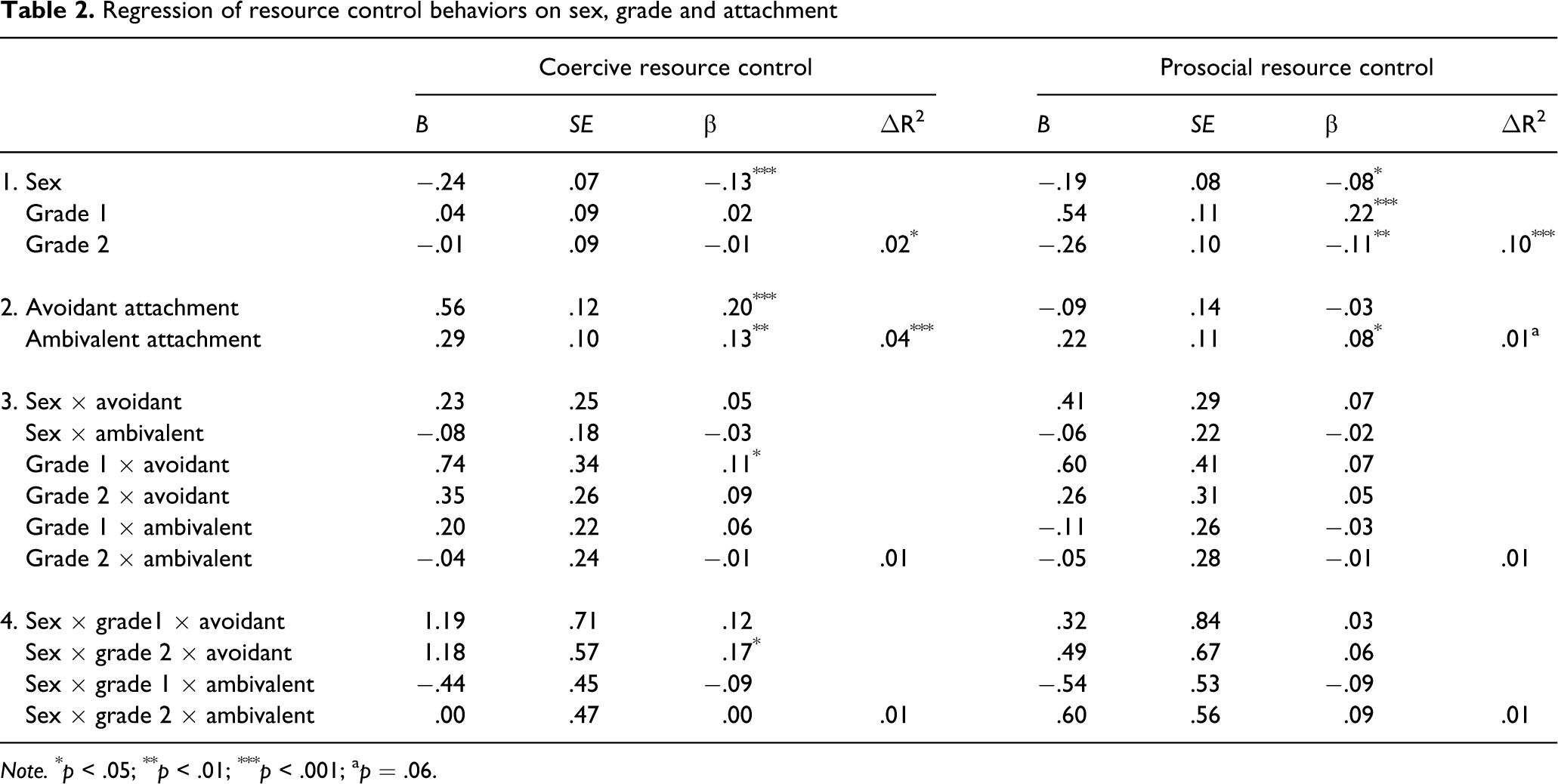
We predicted that avoidant attachment strategy was associated with coercive resource control, especially in the late stage of middle childhood. Table 2 shows that avoidant attachment was significantly associated with coercive strategies (β = .20, p < .001), but not with prosocial strategies (β = –.03, p > .05). Furthermore, the interaction between grade level (low grade vs. middle grade) and avoidant attachment was a significant predictor of coercive resource control (β = .11, p < .05). Simple effects were estimated using separate regression equations predicting coercive resource control from avoidant attachment for low and middle graders. Unexpectedly, avoidant attachment was more strongly associated with coercive resource control for low graders (β = .18, p < .05) than for middle graders (β = .08, p > .05; Figure 1a). In addition, a significant three-way interaction between child gender, grade 2 (middle grade vs. high grade) and avoidant attachment was found to account for additional variance in coercive resource control (β = .17, p < .05). Separate regression models for boys and girls revealed a significant interaction between grade 2 and avoidant attachment for girls (β = .28, p < .01), but not for boys (β = .01, p > .05). Regression equations within each grade level found that avoidant attachment was more strongly associated with coercive resource control for girls in the higher grades (β = .16, p < .01) than in the middle grades (β = –.10, p > .05; see Figure 1b).
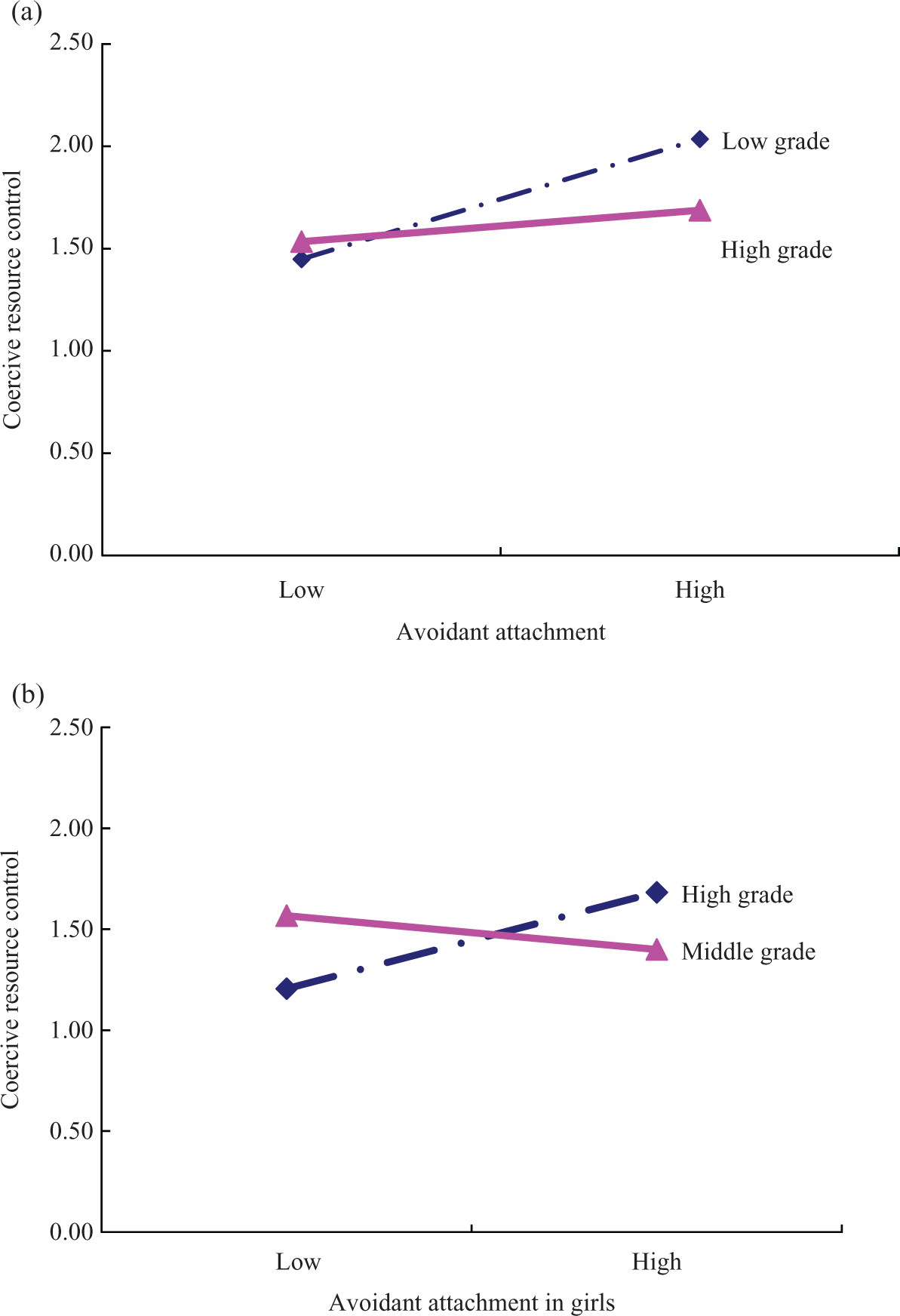
The association between avoidant attachment and coercive resource control strategy as a function of grade level (low vs. middle grade).
Regression of resource control behaviors on sex, grade and attachment
Note. * p < .05; ** p < .01; *** p < .001; a p = .06.
We predicted that ambivalent attachment was associated with both coercive and prosocial resource control, especially in the late stage of middle childhood. Table 2 shows that ambivalent attachment was significantly associated with both coercive (β = .13, p < .01) and prosocial resource control (β = .08, p < .05). However, no significant interaction was found.
Discussion
The primary goal of the present study was to examine adaptive individual differences in insecure attachment styles in middle childhood and their relationships with resource control behaviors in light of the combined models of LH theory of attachment and RC theory. Overall, the results indicated that avoidant attachment was uniquely associated with the use of coercive strategies to control resources, whereas ambivalent attachment was associated with the use of both coercive and prosocial strategies to control resources. However, a number of interaction effects with grade levels were also observed. The results of the present study clearly indicated that the attachment systems that moderate different attachment styles to adapt to evolutionarily fitness-relevant challenges might still be suited to contemporary conditions and operate in basically the same way that they did during the evolutionary past.
The results first indicated that there were gender differences in both avoidant and ambivalent insecure attachment in middle childhood. That is, boys were more likely to develop avoidant attachment, whereas girls were more likely to develop ambivalent attachment. During middle childhood, which is a developmentally specific transitional stage in which attachment shifts from the parent–child relationship orientation to a romantic relationship orientation, both boys and girls have an opportunity to reorganize their attachment styles to more effectively adapt to the upcoming adult-oriented social environment (Del Giudice, 2008, 2009; Del Giudice et al., 2009).
In addition, avoidant attachment increases linearly with age, with higher graders showing higher avoidance attachment scores than lower graders. Our results are consistent with a longitudinal study (Ammaniti, van IJzendoorn, Speranza, & Tambelli, 2000) that suggested that avoidant attachment intensifies between 10 and 14 years of age. Most importantly, our findings also showed that the gender differences in avoidant attachment varied as a function of grade level. That is, although boys adopt more avoidant attachment behaviors than girls do, this effect was more pronounced during the middle and the late stages of middle childhood (9 years of age and older) than during the early stage of middle childhood (7 to 8 years of age). The absence of gender differences in avoidant attachment in the early stage of middle childhood may suggest that there is little difference in the timing of biological markers (e.g., adrenarche) that may drive the reorganization of attachment styles (Del Giudice, 2009).
Unexpectedly, there was a strong tendency for ambivalent attachment strategies to decrease with age. This may be because middle childhood, as a switching point in human ontogeny, provides an assessment and revision period before the actual onset of mating and parenting (Del Giudice & Belsky, 2011). Therefore children will experience a process of trial and error to assess whether their reorganized attachment style is optimal in the environment in which they live. That is to say, the initial revision of the ambivalent attachment strategy may not be successful, and further changes may be required.
In a brief summary, gender-biased reorganization of the attachment system occurs in middle childhood, and this reorganization mirrors the flexible and dynamic process of reshaping insecure attachment styles.
Extending these findings, we tested the hypothesis that insecure attachment may be an adaptive strategy to improve access to the resources within the peer group. Unique relationships between insecure attachment and resource control strategies were found in our study. Specifically, avoidant attachment was positively associated with the use of coercive strategies to control resources, and this association was not moderated by gender. As some researchers (B.-B. Chen & Li, 2009; Del Giudice, 2009) have suggested, both avoidant boys and avoidant girls in an insecure family environment must begin to fight in the face of unfavorable social reality and adopt more coercive strategies to compete with their peers. This can provide a basis for developing subsequent fitness-enhancing and reproductive strategies in adulthood.
Furthermore, this association was moderated by grade level. Specifically, avoidant children in lower grades were more likely to engage in coercive resource acquisition than were children in middle and higher grade groups. At the beginning of middle childhood, children begin to extend their social network into a new social environment, such as their peer group in school, which may give them new opportunities to actively reorganize their attachment styles and related behavioral correlates. However, our finding also indicated that avoidant attachment was more strongly associated with coercive resource control for girls in the late stage of middle childhood than in the middle stage of middle childhood. Relative to boys, more girls in the late stage of middle childhood are approaching puberty (Sun, 2006). A recent survey showed that the median menarcheal age is approximately 12.63 years in Chinese urban populations (T.-J. Chen & Ji, 2003). Therefore it will be interesting to examine in the future whether girls who adopt avoidant attachment in the later stage of childhood are more likely to engage in opportunistic reproductive strategies. For example, mating with multiple males could secure considerable resources and can also be seen as a coercive way to access resources (Hrdy, 1999).
Ambivalent attachment was associated with both coercive and prosocial resource control. Consistent with Belsky’s (1997) hypothesis that ambivalent attachment was associated with “helper-at-the-nest” behaviors, the ambivalently attached children in the current study were more likely to adopt prosocial strategies. In evolutionary terms, such prosocial behaviors as helping and cooperating are not unconditionally altruistic or selfless because the prosocial individuals gain either through their genetic relatedness to the beneficiary (e.g., Hamilton, 1964; Wilson, 1978) or by increasing the probability of receiving similar aid in the future (i.e., reciprocity; Trivers, 1971). Therefore prosocial behaviors can be seen as a strategy to control resources (Hawley, 1999). Ambivalently attached children who engage in prosocial resource control may have a good reputation, which benefits them when they extend their social network to their peer group later in their ontogeny. For example, prosocial children are more likely to form friendships with peers. As a result of reciprocal friendships, a variety of resources can be exchanged over the long term, including helping each other in times of stress and developing mutual dependence (MacDonald, 1996). At the same time, however, it should be noted that the ambivalent attachment strategy is shaped in the family context of willing but unable parental investment (Chisholm, 1996). It seems possible that ambivalent children, in response to unpredictable environments, adopt more flexible and mixed tactics to access resources. Particularly, the use of coercive behaviors to acquire depleting resources under harsh environmental conditions may be an optimal strategy for ambivalent children (Campbell, 2009; Del Giudice, 2009).
It should be noted that Belsky (1997) hypothesized that anxiously attached females should be more likely to become “helpers-at-the-nest.” In our study, however, ambivalent attachment strategies for both boys and girls were linked to prosocial resource control, at least in middle childhood. It may be that the national one-child family policy in China has reduced the degree of sexual dimorphism in ambivalent attachment and its behavioral correlates. That is to say, the lack of a gender moderator on this link may be due primarily to the fact that contemporary Chinese parents exercise little gender differential socialization of their single-gender offspring (Chang, Chen, & Ji, 2011). Furthermore, ambivalent attachment may be appropriate for middle childhood-aged children of both genders in directing mixed resource extraction (coercive and prosocial). Similar results were also found in a study based on an adult sample (Hawley et al., 2009). Although that study did not link resource control to LH theory, its findings on the relationship between attachment and resource control in adulthood suggest that this particular pattern of attachment reorganization in middle childhood may be used to prepare for resource competition in adulthood (Hawley, 2011b). In addition, grade had no moderating effect on the link between ambivalent attachment and two resource-competitive behaviors in our study. Ambivalent children’s interpersonal interactions with their peers are relatively low in middle childhood because they are more likely to become socially anxious over time (Brumariu & Kerns, 2008). Therefore the degree of competition throughout middle childhood will remain stable.
This study highlights the adaptive significance of insecure attachment’s correlation with resource control. However, there are several limitations in the present study. First, it was correlational in nature, limiting our ability to draw conclusions about causal links. It is possible that resource-directed competitive ability in peer groups plays a critical role in the reshaping of attachment strategies. Longitudinal data may help to clarify this issue, but the present study provides a first step in that direction. Second, this study was performed within a Chinese context. Without direct cross-cultural comparisons, it is difficult to determine the differential factors (e.g., one-child families) that may affect adaptive individual differences in attachment styles across cultures. Finally, this study relied exclusively on children’s self-reports of attachment and resource control strategies. Although these measures and the self-reporting method have been commonly used and proven valid and reliable in studies of insecure attachment and resource control, it is important to triangulate data from different sources and methods. Future research that includes multiple data collection methods (e.g., peer nomination, parent reports, or observation) may improve internal validity and provide additional breadth in investigating the associations addressed here.
Conclusion
As an attempt to explore the adaptiveness of insecure attachment, this study provides valuable information about the reorganizational nature of insecure attachment in middle childhood as a preparation for upcoming competition within the peer group. The present results provide the first empirical confirmation of the hypothesis that adaptive individual differences in insecure attachment styles are relevant to resource competition within the peer group. We have begun this process; however, more basic work must be performed before the field is sufficiently mature to produce definitive accounts of the adaptive significance of individual differences in attachment styles.
Footnotes
Acknowledgments
We thank Jay Belsky and Patricia Hawley for their invaluable encouragement of this research. Special appreciation is due to Marco Del Giudice for extensive discussion and suggestions on earlier versions of the paper. We also thank two anonymous reviewers for their helpful comments on earlier versions of this paper.
Funding
This research received no specific grant from any funding agency in the public, commercial, or not-for-profit sectors.