




Abstract
A hierarchical cluster analysis of the time course of the videotaped reactions of 75 Chinese 2–4-year olds to mothers’ toy-removal identified Distress, Low Anger, and High Anger behavior clusters. Anger often begins at low intensity; some children then escalate. The face-validity of Low and High Anger-cluster classifications was supported in that High Anger was displayed by a subset of the children who had first showed Low Anger. The three clusters had different and interpretable correlations with mothers’ temperament ratings. Developmentally, 2-year-olds displayed more Distress, including crying; 3-year-olds showed more Low Anger, including stamp-jump. While Low Anger is predominant during toy-removal in Chinese children, it is, contrastingly, the least-frequent component in the tantrums of North American children.
Young children’s negative emotions can be significant early indicators of temperament (Rothbart, Ahadi, & Evans, 2000), and in the clinical extreme, of current or future psychopathology (e.g., Belden, Thompson, & Luby, 2008; Wakschlag et al., 2012; Wakschlag, Tolan, & Leventhal, 2010). Excessive anger, for example, is associated with a lack of appropriate inhibitory regulation (He et al., 2010; Kochanska, 2003). Because young children’s verbal reports of their feelings are unreliable (Dearing et al., 2002; Levine, Stein, & Liwag, 1999), assessment of their emotions must rely on behavioral measures. However, the challenges and frustrations of a child’s daily life often elicit a confusing mix of emotional reactions, e.g., whining, crying, shouting, and screaming, making it difficult to determine whether, and with what intensity, anger, sadness/ distress, and/or other emotions are being expressed.
Application of statistical techniques for detecting the natural organization within response sets has shown that groupings of behaviors emerge in these challenging situations that can help characterize the emotions being expressed. Thus, factor analysis of 2-year olds’ responses to mishaps indicated that some of their behaviors grouped together in association with tension and anger while other behaviors related to sadness and reparation (Cole, Barrett, & Zahn-Waxler, 1992). This approach has also identified broad groupings of behaviors related to anger or to distress (sadness and comfort-seeking) in the tantrums of typically-developing American (mostly Caucasian) 18–60-month olds (Potegal & Davidson, 2003) as well as in 5–12-year-old child psychiatry in-patients (Potegal, Carlson, Margulies, Gutkovitch, & Wall, 2009). Thus, anger-related behaviors in both groups included stamp, hit, kick, pull/push (which included grabbing things), and shout and scream; distress behaviors included whine and cry. The identification of behavioral factors of anger and distress has been replicated in the tantrums of urban Canadian 3–5-year olds as the best-fitting solution of exploratory-confirmatory factor analyses using oblique factors (Giesbrecht, Miller, & Muller, 2010).
The groupings revealed by these analytic approaches also suggest that certain behaviors may be more likely at lower intensities of a given emotion while other behaviors are more likely at higher emotion intensities. Mascolo, Harkins and Harakal’s (2000) cluster analysis (CA) of the behaviors of a 39-month-old toddler across 25 episodes of social conflict revealed one grouping that can be interpreted as low anger-related behaviors (jump and throw, labeled “frustration”) and another grouping of higher anger behaviors (grab and scream, labeled “anger”). Factor analyses of anger-related behaviors in tantrums also yield subgroups ordered by intensity. Low, intermediate, and high anger factors were identified in the tantrums of both the typically-developing younger children (Potegal & Davidson, 2003) and the psychiatrically-disturbed older children (Potegal et al., 2009); the individual behavioral constituents were similar (e.g., Low Anger included stamp, High Anger included scream) in the two samples despite gross differences in age and psychopathological status. Belden et al. (2008) identified factor analytic groupings that distinguish levels of angry aggression in clinical and non-clinical samples of American 3–6-year olds. A recent analysis of the acoustic features of tantrum vocalizations has confirmed both categorical and intensity classifications: yelling and screaming were found to reflect lower and higher anger, respectively, while fussing, whining, and crying reflected progressively increasing distress (Green, Whitney, & Potegal, 2011).
For several reasons, classifying behaviors by the intensity of emotion with which they are associated may be as important as their categorical emotion classification. Firstly, a shift in behaviors can signal an intensification of emotion. This is especially true of anger. American 15-month olds, for instance, showed an ordered and nested escalation of responses to brief, gentle arm restraint: many initially struggled physically against the restraint, a subset of those then protested vocally, and a subset of those then showed facial expressions of anger (Potegal, Robison, Anderson, Jordan, & Shapiro, 2007). Escalation is important because adaptive responses to situational demands may be more likely at lower-emotion intensities while higher intensities involve a level of dysregulation that precludes adaptive responding (He, Xu, & Degnan, 2012; Lewis, Sullivan, Ramsay, & Alessandri, 1992). Conversely, there are developmental shifts in which high anger behaviors are replaced by low anger behaviors, e.g., in the tantrums of 3- versus 2-year-olds (Potegal, 2000). Such shifts may be crucial markers of the development of emotion regulation.
However, the behavior classification work to date has three methodological issues. Firstly, many of these analyses are based on parent report (Belden et al., 2008; Giesbrecht et al., 2010; Potegal & Davidson, 2003), that is, data were provided by untrained observers, raising concerns about reliability in general and precluding the use of facial expressions to characterize emotions in particular. Videotaped laboratory observations provide more reliable data for the analysis of emotional responses (Cole et al., 1992). At the same time, though, laboratory observations tend to be “snapshots” of a child’s functioning at a particular moment and can therefore be substantially affected by transient conditions like momentary mood, fatigue, illness, and so forth. In addition to the general desirability of using multiple measures, parent report on longer-term child temperament is specifically needed to complement brief direct observation (Rothbart et al., 2000).
Secondly, emotions differ not only in behavioral constituents, but in time course as well (e.g., Verduyn, Delvaux, Van Coillie, Tuerlinckx, & Van Mechelen, 2009). In tantrums, anger-related behaviors appear early and then decline while distress-related behaviors are distributed relatively evenly across the tantrum (Potegal et al., 2009; Potegal, Kosorok, & Davidson, 2003) or increase toward the end (Potegal et al., 2003). Time course has not yet been analysed in other instances of young children’s mixed emotional reactions and it is important to determine if temporal patterns distinguish emotion identity and intensity in other situations.
Thirdly, this kind of work has been done only with North American (Caucasian and African-American) youngsters, raising the question of cross-cultural generality. Emotions are thought to be pan-cultural, yet cultural differences have been observed (Ahadi, Rothbart, & Ye, 1993). For example, emotional expression tends to be dampened in some Asian cultures relative to North-American norms (e.g., Camras, Oster, & Bakeman, 2007; Kagan et al., 1994). Early in development, Chinese infants smile less, are less reactive and irritable and cry less than their American counterparts (e.g., Camras et al., 2007; Freedman & Freedman, 1969; Kagan et al., 1994). Does the anger-distress model of reactions to frustration apply to other ethnicities and cultures in which children are socialized in different ways and emotions are handled differently than in North America? One relevant, if still anecdotal, observation is that whining in the tantrums of Chinese children sounds more nasal, higher-pitched, and angry than that of North-American children (He, personal communication, March 25, 20111).
Fortunately, data previously collected in a larger study of emotional development in Chinese children provide an opportunity to address all these issues. In this study, emotional reactions were elicited by having mothers briefly take away a toy their child was playing with. Toy Removal (TR) mimics real life in that mothers sometimes do remove objects that are too delicate, expensive, or dangerous for a young child to handle, or because it is time to have dinner or go to bed. We use these TR data to test three specific hypotheses: (1) The anger-distress model of response to frustration has cross-cultural generality when emotion type (anger or distress) and intensity (low or high) are derived from grouping behaviors according to their time course. Identification of particular behavior clusters as indicating low vs. high intensities of the same emotion will be (dis)confirmed by testing against two logical corollaries of escalation: a) Presumptive lower intensity behaviors should occur before presumptive higher intensity behaviors, and b) presumptive higher intensity behaviors should be restricted to a subset of children who already expressed presumptive lower intensity behaviors. (2) Clusters that emerge from brief behavioral observation are meaningfully related to parent report of child temperament, such that children who respond with more and/or higher anger behaviors will have been pre-rated by parents as generally showing more anger and less inhibitory control (He et al., 2010; Kochanska, 2003). (3) Between ages 2 and 4 years, there is a switch from high to low anger. We tested these hypotheses by cluster analysis of the time course of the reactions of Chinese 2–4-year olds to frustrating toy-removal; then compared the clusters that emerged to parent report on the Chinese version of the Early Childhood Behavior Questionnaire (ECBQ; Putnam, Gartstein, & Rothbart, 2006).
Methods
Participants
A sample of 101 Chinese 2–4-year-olds (51 boys) and their mothers were recruited from local preschools in a city (Hangzhou) of mainland China through letters informing parents about the study. If they expressed interest, follow-up telephone calls explained the study in more detail. If the mother agreed to participate, she and her child were invited to the laboratory. Informed consent was obtained from the mother before testing began. Only the 75 children (40 boys, 23.4 to 59.0 months old) who reacted with at least one of the 12 emotion-related responses to TR described below were selected for the analyses reported here (the other 26 children showed no emotional reactions). The 75 reactive children did not differ from the 26 non-reactive children on temperament measures (ps > .36). Among the reactive children, 14 were 2 years old (M ± SD age = 26.5 ± 2.1 months), 37 were 3 years old (M ± SD age = 36.8 ± 3.3 months), and 24 were 4 years old (M ± SD age = 49.0 ± 4.9 months). All children were from intact, single-child families; the majority of the mothers (90.0%) had graduated from college. The sample mainly represented socioeconomically middle to upper-middle class in Hangzhou as reported by monthly family income (26.67% with ¥3,000–¥7,000; 32% with ¥7,000–¥10,000; 41.33% with more than ¥10, 000; the 2010 average monthly family income in Hangzhou was about ¥5,000).
Measures
Toy removal
Toy Removal (TR) is an easily-instrumented, convenient experimental manipulation that produces both anger and distress (Lab-TAB; Goldsmith, Reilly, Lemery, Longley, & Prescott, 1994). Although caution is warranted in using North-American laboratory tasks in other cultures (Camras et al., 1998; Saarni, 1998), this particular paradigm is culturally appropriate (Camras, Oster, Campos, & Bakeman, 2003) in the sense that the mother, rather than the experimenter, took the toy from the child [Chinese children express more anger and sadness in front of in-group individuals (e.g., mothers) than other adults (Liu, 2009; Zhou, Eisenberg, & Wang, 2004)]. Furthermore, none of the mothers thought TR was odd or unusual, or objected to it.
The child sat at a desk. The experimenter demonstrated how to play with an attractive toy (marbles) and encouraged the child to play with it on their own for about 30 s before she left. The mother sat at a nearby desk and, as previously instructed by the experimenter, took the toy away. She maintained a neutral vocal tone and facial expression, just stating she did not like it and did not want the child playing with it. If the child requested its return, she kept silent or repeated the statement about disliking the toy and wanting the child not to play with it. After 30 s, she returned the toy to the child, saying that she changed her mind. The episode was terminated early if the child reached maximum distress (full intensity crying for 20 s) or if the mother requested it due to the distress of the child? (no mother did). The TR period began whenever the toy was taken from the child (some mothers were unsuccessful at removing the toy on the first try, due to the child’s resistance). The coded behaviors described below did not differ between the children whose toy was removed at the first try versus later, ps > .16.
Response coding
The TR period was partitioned into 10 3-s epochs. Children’s facial expressions (anger and sadness) were coded as occurring or not in each epoch based on specific emotion prototypes in the Facial Action Coding System (FACS; Ekman, Friesen, & Hager, 2002). The main Action Units (AU) of anger were brow lower (AU4), upper lid raised (AU5), lid tighten (AU7), lip tighten (AU23) or lips part (AU25) / jaw drop (AU26); the main sadness AUs were inner brow raised (AU1), brow lowered (AU4), nasolabial furrow deeper (AU11) and lip corner depressed (AU15). No children displayed other negative emotions such as fear and disgust. Behaviors of hit-mother, grab-toy, slap-desk, flap-hands, stamp/jump, down (lie on the floor) and away (walk away from mother) as well as the negative vocalizations of whine, cry and scream/shout were likewise coded 0 or 1 for each epoch. According to Green et al. (2011), cry often has an up and down melody, seems effortful, and can be one consistent sound or interrupted vocalizations, as in sobbing. Whine is usually a longer duration melody with some verbal content, or a relatively high pitched monotonous noise without content. Scream is a loud, sometimes shrill, usually short-duration sound without verbal content, while shout is lower-pitched and has verbal content. Cohen’s kappa reliability coefficients for these 12 behaviors (including 2 facial expressions and 3 vocalizations), obtained with two trained coders using 25% of cases, ranged from .79 to .90.
Cluster analysis
To evaluate associations among the multiple responses to TR and reduce the variables to a more manageable number, a hierarchical cluster analysis (HCA) with average linkage was used (e.g., Johnson & Wichern, 2007). This analysis requires that a distance (similarity measure) between every pair of behaviors be defined. For each child, and each behavior, a vector of length 10 with component 0’s and 1’s representing the absence and presence of the behavior in each of the 10 epochs was generated. Combining across the 75 children yielded a vector of length 750 for each behavior. Using the Euclidean distance between any two corresponding 750-unit long vectors as a measure is a natural choice. Note that the Euclidean distance computed from these long vectors is robust in the face of possible correlation among repeated measurements with individual children. However, this distance measure would be dominated by the vector of the pair that has significantly more 1’s than the other. To overcome this drawback, before computing Euclidean distances, we first standardized each vector by subtracting the sample mean from each of its components and then dividing the subtracted components by the sample standard deviation. This standardization eliminates any problems created by differences in the frequency of occurrence of different behaviors. Based on the previous tantrum studies, we expected this analysis to yield 2 to 5 interpretable clusters. In HCA, pseudo F and pseudo T2 are used to determine the number of clusters; both of them determined the number of clusters to be 4. Besides the average linkage, we also tried the complete linkage HCA. It yielded similar results to those presented here.
Measures of dispositional emotionality and inhibitory control
Parents used the subscales of anger, sadness and inhibitory control of the ECBQ, Chinese version, to rate children’s negative emotionality (anger/frustration and sadness) and inhibitory control, on a 1–7 Likert-type scale. The ECBQ (Putnam et al., 2006) was translated and back-translated by two Chinese- and English-speakers as recommended by Brislin (1970) and validated in a Chinese sample (internal reliability indexes ranged from 0.58 to 0.87) (Tao & Xu, 2007). Anger/frustration included 12 items (e.g., “When s/he couldn’t find something to play with, how often did your child get angry?”, a = .73), sadness had 12 items (e.g., “When another child took away his/her favorite toy, how often did your child sadly cry?”, a = .82), and inhibitory control included 12 items (e.g., “When told ‘no’, how often did your child stop an activity quickly?”, a = .78).
Results
Prevalence profiles, timing and cluster analysis of emotional responses to TR
The prevalence of emotional behaviors in response to TR is shown in Figure 1 (middle column). The emotion-characteristics of the behaviors are identified in Figure 1 (left side), which presents the time-course cluster analysis classifications. The upper cluster, including down, away, hit-mother, and cry is labeled Distress. The middle cluster, including facial anger, stamp/jump, grab-toy and whine, is labeled Low Anger. The lower cluster, including flap-hands, slap-desk and scream/shout is labeled High Anger. Interpreting the dendrogram as yielding three clusters fits with expectation, while going one node further down the tree would yield 6 smaller and more difficult to interpret clusters. For each child, composite scores for each of the 3 clusters were created as the average of frequencies of each behavior within the cluster. Pair-wise correlations rs between these scores were ≤ 0.16, suggesting their mutual independence.

The cluster dendrogram of emotional responses to Toy Removal (left); prevalence of behaviors (percent of children exhibiting each behavior, middle column); time course of the summed behaviors within the three clusters (right). “Frequency” is the sum of all behaviors across all children within a cluster for each of the 10 epochs.
Consistency within, and differences between, the middle and lower Anger clusters is suggested by Low Anger-behavior prevalences of 25.8–48.5% vs. High Anger prevalences that all fall within a narrow range of 9.1–13.6%. The ordering of these clusters as Low and High Anger, respectively, was confirmed by analyses based on two corollaries of the supposition that anger begins at lower intensity and, with continuing frustration, sometimes rises to higher intensity. (1) If the ordering of the anger-related clusters is correct, children who exhibit behaviors associated with higher-intensity anger are very likely to have also exhibited low-intensity anger, but there is no necessity that children exhibiting behaviors associated with lower-intensity anger must also exhibit higher-intensity anger. This predicted inequality was demonstrated in a 2 × 2 test in which 45% of the children exhibited Low Anger but not High Anger-behaviors and only 2% exhibited the reverse, χ2 (1) = 6.74, p < .01, φc = 0.30. (2) For the 20 children exhibiting both Low and High Anger-behaviors, the expectation that Low Anger would precede High Anger was confirmed by finding that the first Low Anger-behavior occurred significantly earlier in the toy removal period (7.5 ± 5.6 s) than the first High Anger-behavior (13.7 ± 8.2 s), t(19) = −3.04, p < .01, Cohen’s d = 0.88.
The time course of the clusters differ markedly as would be expected from the cluster results (Figure 1, right). High Anger-behaviors occurred at a low, irregular level. The more prevalent Low Anger-behaviors increased up to about 15 s, and then declined toward initial levels. In contrast, Distress-behaviors increased up to 20 s and were still at their highest level when tests were terminated at 30 s. These results confirm Hypothesis 1.
Cluster-wise, 65% of the children exhibited at least one Low Anger-behavior, 22% exhibited at least one High Anger-behavior, and 34% exhibited at least one Distress-behavior. Thus, the predominant emotion response to TR across children was Low Anger.
Correlations between TR behavior clusters and ECBQ parental report
For each child, composite scores for each of the 3 clusters were created as the average of frequencies of each behavior within the cluster. Pairwise correlations rs between these scores were ≤ 0.16, suggesting their mutual independence. The skewness values of the three composite scores ranged from 1.12 to 1.75, which indicated that the variables were relatively normally-distributed (West, Finch, & Curran, 1995).
On the parental report of ECBQ, anger/frustration scores ranged from 1.83 to 6.06 (M = 3.79, SD = .88), sadness scores ranged from 1.25 to 5.25 (M = 3.24, SD = .80), and inhibitory control scores ranged from 1.82 to 5.75 (M = 3.94, SD = .78).
Correlations of observed behavior cluster scores with ECBQ parental report demonstrated some convergent validity. Controlling for age, the partial correlation of ECBQ Anger with TR High Anger-scores was significantly positive [pr(72) = .30, p < .01], while the correlations of ECBQ Inhibitory Control with both TR Low and High Anger-scores were progressively more negative [Low Anger: pr(72) = −.24, p < .05; High Anger: pr(72) = −.35, p < .01], and represented a moderate effect size (Cohen, 1992). These results confirm Hypothesis 2.
Gender and age effects on the behavior clusters
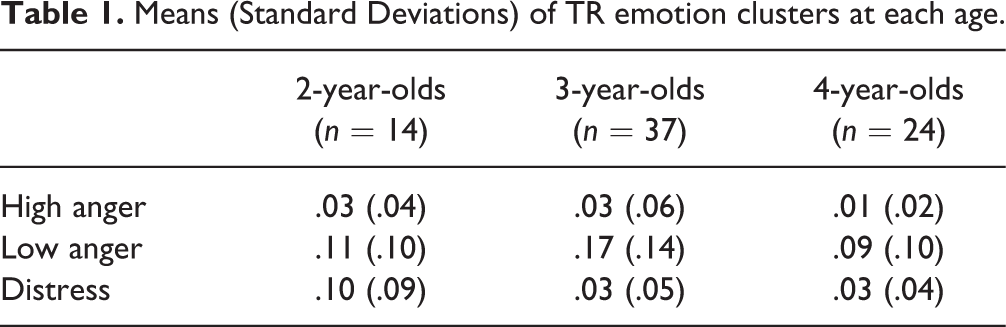
A two-way analysis of variance was used to examine the effects of gender and age on the cluster scores. There were no effects of gender on the three scores, ps > .57. Age effects for Low Anger-scores approached significance, F(2, 69) = 2.79, p = .07, ηp 2 = .08. Specifically, 3-year-olds expressed more low anger than 4-year-olds. In contrast, there were no age effects on High Anger-scores, ps > .27. There was an unanticipated significant effect of age on Distress-scores. Two-year-olds were more distressed than 3- or 4-year-olds [F(2, 69) = 7.77, p < .01, ηp 2 = .18, (see Table 1 for a summary of average scores)]. Thus, there was a reduction in emotional responding with increasing age, but it was more in distress than anger. Hypothesis 3 is only partially confirmed.
Means (Standard Deviations) of TR emotion clusters at each age.
Discussion
In general, our results extend the categorical and intensity distinctions of the anger-distress model of response to frustration to Chinese 2- to 4-year olds. In particular, the time courses of children’s various reactions to TR formed three clusters identifiable as High Anger, Low Anger and Distress. High Anger included slap-desk and scream/shout, consistent with the equivalent category of behaviors in the previous studies of tantrums (e.g., Potegal & Davidson, 2003). Flap-hands loaded on a lower anger factor in tantrums (Potegal & Qiu, 2010), but the High Anger category constituents are otherwise similar. Low Anger included angry facial expressions, whine, grab (the toy) and stamp/jump. The latter two behaviors also define lower anger in the previous tantrum study (Potegal & Qiu, 2010). Because it is difficult to maintain camera close-ups on a tantruming child, facial expressions have not yet been formally included in tantrum analyses (e.g., Potegal & Davidson, 2003). However, the inclusion of facial anger in TR Low Anger behaviors is consistent with Potegal & Qiu’s (2010) conjecture that there is a limit to how much of felt anger the face can express, that is, facial anger may be a sensitive marker in the lower to middle range of anger intensity. The inclusion of whine in TR Low Anger-behaviors, rather than in Distress-behaviors (Potegal & Qiu, 2010), accords with the perception that this vocalization by young Chinese sounds more angry than the whine of North American children. 1 This interesting, possibly culture-specific, finding is worthy of further exploration as it may provide some insights into processes of socialization in the eastern part of China.
Three separate lines of evidence support the general face-validity of the ordering of Low and High Anger-clusters. 1) The subset of children showing High Anger-behaviors were almost exclusively nested within the larger set showing Low Anger-behaviors. 2) High Anger-behaviors appeared later than Low Anger-behaviors among children showing both. These observations are consistent with findings that anger begins at lower intensity and then sometimes rises to higher intensity (Potegal & Qiu, 2010). 3) Mother-rated anger reactivity was highly correlated with the High Anger-cluster score. Furthermore, consistent with previous studies (He et al., 2010; Kochanska, 2003), Low Anger and High Anger-cluster scores had progressively more negative correlations with parental report of inhibitory control. Anger sometimes appears as a destructive emotion that leads to an aggressive response toward others (Lemerise & Dodge, 1993) and other times as a constructive motivation that increases effort toward desirable goals (Dennis, Cole, Wiggins, & Cohen, 2009; He et al., 2012). The lower and higher levels of children’s anger identified in TR and other situations suggest that emotion intensity may influence which effect predominates. Low Anger, which included angry facial expressions, was unrelated to parental report of anger, suggesting that this level of anger was not seen as problematic. On the other hand, facial anger was positively related with persistence during goal-blocked situations (He et al., 2012; Lewis et al., 1992). Thus, low levels of anger may be socially acceptable and motivationally adaptive in at least some situations (Campos, Mumme, Kermoian, & Campos, 1994; Carver & Harmon-Jones, 2009). In contrast, the correlation of High Anger in TR with parental report of anger and the stronger correlation of High Anger with low inhibitory control suggest that more intense anger is maladaptive. The association of excessive anger with childhood psychopathology (e.g., Belden et al., 2008; Wakschlag et al., 2010, 2012) supports this idea.
The TR Distress cluster includes cry and down, as it does for tantrums (Potegal & Qiu, 2010). In addition, TR Distress was unrelated to mother-rated inhibitory control, consistent with evidence that children with internalizing problems do not differ from non-clinical children in inhibitory control (Muris & Ollendick, 2005). However, other aspects are somewhat more difficult to interpret. TR Distress and sad expressions were unrelated to sadness in parental report, perhaps because of the low prevalence of these behaviors in the TR situation. Notably, Majdandžić and van den Boom (2007) found that sad expressions are the least consistent of children’s emotional responses observed in the laboratory and the most discrepant between laboratory observations and parent reports. The anomalous inclusion of hit-mother cannot be fully accounted for at this time (but note that hit-mother prevalence of 12.1% was within the narrow range of the High Anger-behaviors). However, the observation that distress-related behaviors were still at their highest level when tests were terminated is consistent with Distress being the most persistent aspect of tantrums (Potegal et al., 2003, 2009). Considering the differences in situation and culture, there is a recognizable similarity between the emotional composition of TR-behavior clusters and the factors previously identified in tantrums. Distress-scores declined with age. It makes sense that Distress, which conveys a child’s need for help, comfort, or support from caregivers (Buss & Kiel, 2004), is more common in the younger children who are less independent than older children.
Although the identity of the emotion clusters in response to TR is similar to those in tantrums of children in this age range, the prevalence profiles are different. That is, response to TR contained relatively more Low Anger-elements while tantrums contain relatively greater High Anger and Distress-elements (e.g., Potegal & Davidson, 2003). One possible explanation for this difference is that Chinese children tend to damp down both negative emotions (Camras et al., 2007; Kagan et al., 1994). In Chinese culture, display rules that encourage emotional restraint are often used in the presence of outsiders (Garrett-Peters & Fox, 2007). In parent-child interactions, e.g., when Chinese mothers discuss shared emotional experiences with their child, they tend to criticize emotion displays and focus on instilling proper, non-emotional conduct rather than on the understanding of emotions (Wang, 2001). These child-rearing attitudes and behaviors arise within the general group-orientation of Chinese culture, in which individual expression is less valued, while self-control and addressing the interests of others are emphasized (Chen, 2010) and the maladaptiveness of intense anger is especially salient (Eisenberg et al., 2007; Zhou et al., 2004).
Current limitations and future studies
The current analyses have some limitations. With regard to the anger-distress model, the low prevalence of some behaviors constrains confidence in their emotion category/intensity assignment. Theoretically, some behaviors may be associated with more than one emotion, but the presentation of this more complex model is beyond the scope of these data and this paper. Practically, the small sample size may have reduced the power to detect effects. Obviously, our conclusions pertain only to children who are reactive enough to respond to a TR challenge in a novel laboratory environment. With regard to possible cross-cultural differences, comparisons between Chinese and North American children’s emotional reaction profiles are indirect; direct comparisons will require analysis of Chinese children’s tantrums and North American children’s response to TR.
Summary
The current study found that the emotional reactions of young Chinese children faced with frustration formed three categorical and intensity clusters: High Anger, Low Anger and Distress. These three emotional-response clusters resembled those established in the anger-distress model of tantrums, and children’s individual cluster scores were consistent with more general maternal reports of temperament. Several lines of argument suggest that Low Anger-responses may be adaptive in increasing effort toward desirable goals, while High Anger-responses may be maladaptive in alienating others. Finally, Chinese children’s greater expression of Low Anger and less expression of High Anger and Distress relative to that seen in the tantrums of North-American children may reflect situational and/or cultural constraints. This question can be resolved by further studies of Chinese children’s tantrums and North-American children’s response to frustration.
Footnotes
Acknowledgement
We thank Xiaoqian Li, Jinjin Lai and Dexiang Chen for assistance in coding, and Fengji Geng, Jun Wang, Meihong Zhuo, Peipei Hong, and Ye Tao for running the visits. Our great thanks go to the families who participated in this project.
Funding
This study was supported by grants from the Natural and Scientific Foundation in Zhejiang Province, China (Y204321), the National Foundation for Fostering Talents of Basic Science (J0630760), the National Natural Science Foundation of China (31000467) and the American National Institute of Child Health and Human Development (R01-HD055343).