



Abstract
We investigated cultural influences on young children’s acquisition of social-cognitive concepts. A theory of mind (ToM) scale (Wellman & Liu, 2004) was given to 129 children (71 boys, 58 girls) ranging in age from 3 years 0 months to 7 years 10 months. The children were from three distinct cultural groups: (a) trash pickers (pemulung) living a subsistence lifestyle in Jakarta, Indonesia; (b) middle-class Jakartans living and attending preschools within 5 km of the pemulung group; and (c) middle-class Australians. All children were individually tested in their native language. Cross-group comparisons revealed no significant differences among the three groups in mastery of false belief (the traditional ToM indicator), despite their widely different socio-economic circumstances. However, the pemulung children were slower than the two middle-class groups in mastering two other ToM concepts, namely knowledge access and emotion concealment. These findings shed new light on patterns of cross-cultural consistency in false-belief mastery, as well as revealing cross-cultural variation in other ToM concepts that plausibly reflect variation in children’s everyday life circumstances.
All typically developing humans acquire a theory of mind (ToM) over the course of childhood. That is, they come to understand that they and other individuals experience subjective mental states, that those mental states can be discrepant from those of other people or from reality, and that mental states drive people’s behaviour. There is a history of debate about the roles of nature and nurture in ToM development: some scholars have argued that ToM concepts develop primarily via the maturation of an innate cognitive module which is universally present in all typically developing humans (Leslie & Thaiss, 1992; Scholl & Leslie, 1999), whereas others have championed the importance of linguistic input and social interactions to children’s development of ToM (Foote & Holmes-Lonergan, 2003; Ruffman, Perner, Naito, Parkin, & Clements, 1998; Ruffman, Perner, & Parkin, 1999; Slaughter, Peterson, & Mackintosh, 2007). One way to address this issue is with cross-cultural studies which can reveal universal versus culturally specific aspects of development in this domain. Here, we contribute to this enterprise with a comprehensive study of ToM development in Jakarta, Indonesia.
There are various social-cognitive concepts that constitute the mature ToM. The concept that has been most thoroughly investigated is that of false belief, involving recognition that an individual’s behaviour is based on how he mentally represents the world, rather than on objective reality. A major meta-analysis revealed that typically developing children in Western industrialized countries acquire this concept between the ages of 3 and 5 years (Wellman, Cross, & Watson, 2001). Cross-cultural studies to date indicate that false-belief understanding follows a similar developmental trajectory in diverse cultural groups including children from tribal Papua New Guinea (Vinden, 1999), remote West Africa (Avis & Harris, 1991), rural Peru, traditional agrarian Samoa, and modern urban India and Thailand (Callaghan et al., 2005). Thus it appears that the ToM concept of false belief develops on a consistent timetable across cultural groups.
A more complete picture of ToM development requires assessing understanding of other key ToM concepts in addition to false belief. Even before they can pass false-belief tasks, for instance, many children recognize that people may have different opinions about the same reality, and that people only know something about the world if they have had perceptual access to it. Wellman and Liu (2004) introduced a developmental ToM scale which reflects sequential acquisition of five key ToM concepts, including false belief. This comprehensive ToM assessment has recently been used in cross-cultural research to reveal reliable differences in children’s acquisition of some of the mental state concepts that precede an understanding of false belief. Specifically, preschoolers from the United States of America (USA) and Australia master mental state concepts in the following order (see Table 2 for detailed descriptions of the tests used): diverse desires (DD), diverse beliefs (DB), knowledge access (KA), false belief (FB) and, finally, hidden emotion (HE; Peterson & Wellman, 2009; Peterson, Wellman, & Liu, 2005). By contrast, preschoolers from mainland China and from Iran both follow a slightly different developmental ToM trajectory in which the understandings of how knowledge is acquired (KA) versus diversity of people’s beliefs (DB) are reliably reversed (Shahaiean, Peterson, Slaughter, & Wellman, 2011; Wellman, Fang, Liu, Zhu, & Liu, 2006). These findings confirm that, amidst broad consistency in children’s acquisition of ToM concepts, there are also subtle cultural variations which can guide research on how experience shapes different facets of social-cognitive understanding.
In the current study we used the five-step scale to compare the development of ToM concepts in city-dwelling Indonesian and Australian children. We had a unique opportunity to test children from two distinct micro-cultural groups within urban Jakarta: the educated middle class and the unschooled underclass of trash pickers. Jakarta (population 9.5 million) is home to an estimated 400,000 trash pickers or pemulung who live a subsistence lifestyle collecting recyclable trash (plastic, cardboard, glass, etc.) from the city streets and rubbish dumps, and then selling the pickings by weight (Theunissen, 2010). The pemulung live in makeshift camps which are overseen by a coordinator who maintains water supply and toilet facilities for the camp as a whole, and purchases the marketable trash. Many pemulung families stay in Jakarta for 6 to 8 months of the year supporting themselves through trash picking, and during the remainder of the year they work in rural areas planting and harvesting rice. Because of this migrant lifestyle and their families’ extremely limited financial means, the vast majority of pemulung children have no experience of formal preschool or primary education, in contrast to all the middle-class Indonesian and Australian children we tested. Indeed, most of the parents in the pemulung group had very little formal education themselves, often consisting of only a few years at primary school to achieve basic literacy and numeracy sufficient to enable simple monetary transactions. Given that pemulung children grow up without any formal preschooling and in otherwise severely disadvantaged circumstances, one prediction is that their social-cognitive development of ToM concepts may be severely delayed.
Alternatively, if children’s everyday social and conversational experiences are formative to their developing ToM concepts, then we might predict that the pemulung children, irrespective of lack of formal preschooling, would develop concepts of mind on a typical timetable. Indeed, Avis and Harris (1991) found that unschooled children living in a remote traditional African village acquired the false-belief concept on a developmental trajectory similar to that of Western children. Vinden (2002) observed that unschooled children in north Cameroon acquired false belief on a similar developmental timetable to Western children, albeit on a somewhat slower timetable compared to their schooled counterparts from the same region. However, a confound for Vinden’s (2002) sample was that the schooled children, but not the unschooled, were exposed to a second language in the classroom, which is important since bilingual children appear to develop ToM especially rapidly (Goetz, 2003).
A novel contribution of our study to this debate follows from our focus on other ToM concepts in addition to false belief. In particular, it seems plausible that early formal preschooling may favour the development of an understanding of how knowledge is acquired. If so, then it may be that pemulung children, entirely lacking in such experience, will be particularly slow to acquire an understanding of knowledge access relative to both their Indonesian and Australian preschool-experienced peers.
Method
Participants
The total sample consisted of 129 children (71 boys, 58 girls) in three groups: Jakartan trash pickers, Jakartan middle class and Australian middle class.
Jakartan trash pickers
Sixty of the children (31 boys, 29 girls) were from pemulung families living in a cardboard box shantytown in south Jakarta (Johansson, 2010). The pemulung children ranged in age from 3 years 1 month to 7 years 10 months (M age = 5 years 6 months). None of these children had ever attended any formal childcare, preschool or school of any kind. They spent their days playing with siblings or peers in their shantytown while their parents travelled on foot around the district collecting recyclable trash to sell. Some of the older children occasionally accompanied their parents helping to collect trash, or spent time sorting through the recovered recyclables. Many of these children were second or third generation in the pemulung subculture.
In recruiting the pemulung children, an experimenter native to the local area (the second author) initially contacted the pemulung camp coordinator who provided information on the number of children living in the camp, and their approximate ages. At the time of testing there were around 80 children between the ages of 3 and 7 years living at the camp. The experimenter began visiting the camp, getting acquainted with the pemulung parents and children, and explaining her research aims. Those parents who were interested in participating with their children were informed orally about the objectives of the study and the testing procedure. Parents who provided verbal informed consent then also provided the following information to the experimenter: child’s date of birth and number of siblings, mother’s education and languages spoken. At that time or at another agreed time, the experimenter visited the child’s home, engaged in a warm-up play session and then tested the child while his/her mother looked on. The testing session lasted approximately 30 minutes.
Information provided by the pemulung mothers indicated that seven of these women (12%) had themselves attended no more than three years of primary school. Most of the remainder (n = 42; 70%) had completed primary school but had no education beyond that. Eight of the mothers (13%) had attended some secondary school but none had graduated. One mother did not provide information about her educational background.
Despite their unfamiliarity with educational contexts, all of the pemulung children were willing research participants, encouraged by their mothers who themselves were articulate and eager to interact with the experimenter. To ensure that all pemulung mothers, despite their lack of formal education, had sufficient linguistic skills to have been able to supply their children with the kind of verbal and conversational input known to contribute to ToM development (e.g., Brown, Donelan-McCall, & Dunn, 1996), we made observations using four maternal linguistic fluency items, taken from the Home Observation for Measurement of the Environment (HOME) inventory (Caldwell & Bradley, 2003). This measure was applied to the pemulung mothers only, since the educational attainments of the other two groups independently attested to adequate maternal verbal fluency. The items were: (a) “Mother appears to readily understand interviewer’s questions”; (b) “Mother initiates verbal exchanges with the interviewer, asks questions, makes spontaneous comments”; (c) “Mother expresses ideas freely and easily using statements of appropriate length for conversation”; and (d) “Mother’s speech is clear and audible”. As per the HOME manual, each item was coded as either 1 = present or 0 = absent. Cronbach’s test showed that the 4-item scale had good internal consistency (alpha = .80). Furthermore, 63% of the pemulung mothers earned perfect scores and the mean score for the group was 3.23 (SD = 1.24), indicating a high level of linguistic fluency for these women, despite their generally limited educational background.
During testing, all of the children were alert and focused on the ToM tasks. They were given crayons and a colouring book as a reward after testing was completed and observation of their responses to the gift revealed that all had age-appropriate fine motor skills and awareness of how to use a crayon to mark on paper. As is typical of Jakarta residents, these children were fluent speakers of Bahasa Indonesia and at least one local dialect (Betawi and/or Sundanese). They were tested in their dominant language, Bahasa Indonesia, by a native speaker and Jakarta resident.
Of the pemulung children, 13 (22%) were only children, 20 (33%) had only one sibling and 27 (45%) had two siblings or more.
Jakartan middle class
The second group in this study was a local comparison group including 41 middle-class Jakartan children (22 boys, 19 girls) ranging in age from 3 years 0 months to 6 years 6 months (M age = 4 years 6 months). These middle-class children lived in the same district (within 5 km) of the pemulung children but in affluent residential areas. They were all recruited from local preschools (including the child study preschool located on campus in the Faculty of Psychology at Universitas Indonesia) or local primary schools. To recruit this sample, the experimenter (the first author) initially contacted the director of local area preschools to explain the aims of the project and obtain permission to distribute parental consent forms. Following this gatekeeper approval, standard written consent forms including a description of the research aims and the testing procedure were sent home with children. The consent form also asked for information about the child’s date of birth, number of siblings, mother’s education and languages spoken by the child. Those children whose parents signed their consent were then tested one-on-one at their school with the mother in attendance if she wished. Like their pemulung counterparts, these children were fluent in Bahasa Indonesia as well as a local dialect. They were tested in Bahasa Indonesia by a native speaker.
Maternal education information was provided by 33 (80%) of the mothers in the middle-class Jakartan group. Only one had failed to complete primary school and all the others had not only completed high school but had also obtained a post-secondary qualification of some kind. Specifically, there were five (15%) with a technical/academy diploma or degree, 20 (61%) with a university bachelor’s degree and seven (21%) with a master’s or PhD. This is a higher level of education than the norm across Indonesia, where tertiary education enrolment is just over 23% (United Nations Educational, Scientific and Cultural Organization [UNESCO] Institute for Statistics, 2012).
Family constellation data were available for 80% of the Jakartan middle-class group. Of these, 14 (40%) were only children, 14 (40%) had one sibling and seven (20%) had more than one sibling.
Australian middle class
This group included 28 Australian children (18 boys, 10 girls) ranging in age from 3 years 3 months to 7 years 9 months (M age = 4 years 6 months). These children were recruited from preschools and primary schools in predominantly middle-class neighbourhoods of Brisbane, Australia. All children spoke English as their sole or primary language, and they were tested in English by a native speaker. All of the children’s parents were born either in Australia (73%) or in a culturally similar English-speaking country (New Zealand, Canada, the United Kingdom [UK] or the USA). The Australian children were recruited in the exact same manner as the Jakartan middle-class sample.
Information on mothers’ education was available for 89% of the Australian group. Of these, all had completed high school, and all but one (96%) had gone on to complete some type of post-secondary course or qualification. Specifically, there were seven (29%) with a technical/academy diploma or degree, 14 (58%) with a university bachelor’s degree and two (8%) with a master’s degree. Proportions with, versus without, university degrees were the same as in the Jakartan middle-class group, χ2(1) = 1.72, N = 57, p > .15.
For the Australian middle-class group, family constellation data were available for 82% of the sample. Of these, four (17%) were only children, 14 (61%) had one sibling and five (22%) had more than one sibling.
Matching of groups
Table 1 shows the main demographic background characteristics of the three groups. To check on the comparability of the two middle-class groups, we computed t-tests and chi-squared analyses on the variables of child age, gender balance of the group, number of siblings and maternal education. No significant differences were evident: child age t(68) < 1, p > .40; gender balance χ2(1) < 1, N = 69, p > .50; number of siblings t(54) = 1.37, p > .15; or mean years of maternal education, t(56) = 1.02, p > .30. Among those in the two cultural groups with highly educated mothers, proportions with diplomas versus bachelor’s degrees versus postgraduate degrees were equivalent, χ2(1) = 2.77, N = 55, p > .20. Thus the two middle-class groups were well matched on the demographic variables we had available for analysis.
Mean total ToM scale scores and key descriptive variables by group.
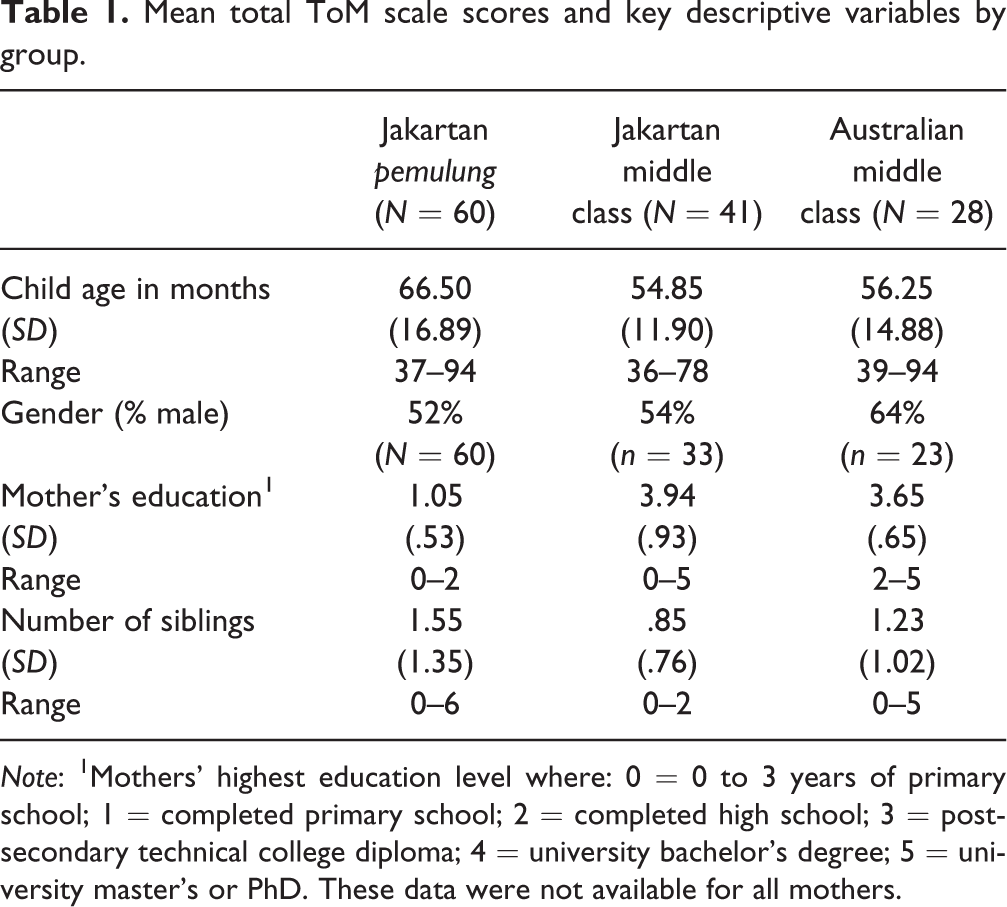
Note: 1Mothers’ highest education level where: 0 = 0 to 3 years of primary school; 1 = completed primary school; 2 = completed high school; 3 = post-secondary technical college diploma; 4 = university bachelor’s degree; 5 = university master’s or PhD. These data were not available for all mothers.
As expected, the mothers of the pemulung children had significantly less education than the mothers in the two middle-class groups, F(2, 114) = 229.94, p < .001 (see Table 1 for the 6-point scale used to quantify maternal education). They also had significantly more children than the two middle-class groups, F(2, 116) = 4.10, p < .02, although post-hoc Tukey tests showed that children in the Australian middle-class group and in the pemulung group had equivalent numbers of siblings (p > .20). There was a significant age difference among the three groups, F(2, 126) = 8.79, p < .001, which Tukey post-hoc tests showed was attributable to children in the pemulung group being older than the other two groups. Nevertheless, even among the pemulung children, 29 (48%) were aged 5 years 6 months or younger, which is well within the range for false-belief concept acquisition (Wellman et al., 2001).
Procedure
All children were tested one-on-one by a female experimenter. For the middle-class groups, testing was done in a quiet corner of the preschool. For the pemulung group, testing was done in a relatively roomy box in the shantytown with the children’s mother in attendance.
Children in all three groups were given the five-task ToM scale used in previous research (Shahaiean et al., 2011; Wellman & Liu, 2004). For the two Indonesian groups, the tasks were translated into Bahasa Indonesia and familiar local items or locations were substituted where appropriate. Back-translation from Bahasa Indonesia was done by the first and second authors and the resulting transcripts were confirmed (by the fourth author) to be exactly comparable to the original English versions used to test the Australian group.
Table 2 includes brief descriptions of the tasks, which were taken exactly from Wellman and Liu (2004) apart from the minor changes noted. The tasks were given in the order presented in Table 2. Each task includes a focal ToM test question and comprehension control questions. For the hidden emotion task, two test questions were asked; namely, how the boy’s face looked and how he felt inside, when he was attempting to stop his peers’ teasing. On all tasks, children had to answer all control and test questions correctly in order to pass. A total ToM score (0 to 5) was calculated over the sum of the individual tasks each child passed.
Summary of ToM scale tasks and percentages (and numbers) of children who passed, by group.

Notes: 1For the Jakartan pemulung group, carrots were replaced with papaya and cake was replaced with fried snacks; 2For the Jakartan pemulung group, the garage was replaced with a gerobak (a wooden trolley for carrying garbage); 3Number of steps passed on the ToM scale; maximum = 5.
Results
Group comparisons: False-belief understanding
Using chi-square tests, we first evaluated whether the traditional litmus test of ToM understanding, false-belief (FB) performance, differed either between Australia and Indonesia or, within the latter, between the middle class versus pemulung groups. Comparing FB scores across the three groups revealed no significant differences, χ2(2) = 2.71, N = 129, p > .26. Nor did the Jakartan middle-class children differ significantly from the pemulung children, χ2(1) = 1.83, N = 101, p > .15. Thus all three culturally diverse groups were comparable in their attainment of one of the key ToM concepts, FB understanding. Observed power was .31 for the comparison of the two middle-class groups, and .28 for that of the two Jakarta samples. Owing to the difficulty of testing such a unique group as the pemulung, it was impossible to increase that sample further, so this pattern of equivalent performance on the FB task across groups should be interpreted with some caution.
As shown in Table 1, the pemulung children were chronologically older than the other two groups. Thus we conducted an additional analysis to evaluate whether the same pattern of FB performance applied when child age was equated. To do this, we selected those children in each group who were 5 years 6 months of age or younger. We chose this as the upper age limit based on previous studies which indicated that most of the variance in children’s FB task performance occurs between the ages of 3 and 5, in Western industrialized countries and elsewhere (Wellman et al., 2001). Although this procedure further reduces the sample sizes, it does allow us to rule out the possibility that the pemulung’s relatively good performance on FB was driven by the older children in the group.
Table 3 shows the ToM task scores, including FB, for these age-matched subsamples. As also shown in Table 3, there was no significant age difference among the three groups, F < 1, p = .61. Confirming the pattern seen in the full sample, there was no significant difference among the three groups in false-belief understanding, χ2(2) = 4.66, N = 84, p = .097. Thus, despite their highly divergent socio-cultural circumstances, understanding of false belief did not differ between even the youngest pemulung, middle-class Indonesian and middle-class Australian children.
Age and percentages passing each ToM task for age-matched young children (range = 3 years 0 months to 5 years 6 months), by group.

Group comparisons: ToM scale
Next we examined the growth of children’s ToM understanding across all five items of Wellman and Liu’s (2004) ToM scale. Table 2 shows percentages of children by group who passed each of the five ToM scale tasks. There were no statistically significant group differences for three of the five: FB (as reported earlier), DD and DB (all ps > .25). The same was true, as shown in Table 3, when only the age-matched younger subsets of children in the three cultural groups were considered (all ps > .09).
For two scale tasks, however, the groups did differ significantly. Knowledge access was passed by significantly more of the middle-class children in Indonesia and Australia than by the pemulung group. This was true both for the full sample, χ2(2) = 16.94, N = 129, p < .001, and for the age-matched subsets, χ2(2) = 13.90, N = 84, p < .01. There was no significant difference in either case between the Australian and Indonesian middle-class groups, χ2(1) = 2.17 and 2.27, respectively, both ps > .10. This means that poor performance of the pemulung group on this task was responsible for the overall group difference.
The most conceptually advanced ToM scale task, HE, also displayed significant overall group differences for both the full sample, χ2(2) = 11.47, N = 129, p < .001, and the age-matched subsets, χ2(2) = 15.56, N = 84, p < .001. The Indonesian and Australian middle-class groups did not differ from one another in either case (both χ2[1] < 1, both ps > .60). Again, this indicates that the pemulung group’s performance was responsible for the significant overall contrast. Indeed, despite uniformly doing well on the HE control question, only seven children in the pemulung group managed to pass this advanced test of ToM understanding, and all of them were over 6 years old.
Next we compared the three groups in terms of their total scores on the ToM scale (calculated by summing the number of scale items passed). Given the age differences among the groups, we did this using one-way analysis of covariance (ANCOVA) with group as the between subjects variable and age as the covariate. The contrast among the three groups was highly significant, F(2, 125) = 19.64, p < .001, η2 = .24. Follow-up comparisons using Fisher’s least significant difference (LSD) indicated that the pemulung group total ToM score means were significantly lower than those of the two middle-class groups (both ps < .05), whereas the latter two did not differ significantly. Thus the micro-cultural differences between the two groups of Jakartan children were more important to the overall pace of ToM development than the macro-cultural differences between Indonesia and Australia, at least within these subgroups of children in each culture whose parents are well-educated and who themselves have had access to educationally oriented preschool or primary school.
Scale consistency in Indonesia
In addition to our major focus on exploring contrasts among these three groups of children, the other unique feature of our cross-cultural study was to explore the Guttman scaling properties of Wellman and Liu’s (2004) ToM scale in an Indonesian sample. Specifically, we evaluated scale performance of our full Indonesian sample to find out whether their patterns of success and failure on the five ToM scale tasks would prove to conform to a consistently sequential Guttman scale. If so, we were interested in whether the order of task mastery in Indonesia would match the sequence that has previously been confirmed with large samples from countries including the USA (Wellman & Liu, 2004), Australia (e.g., Peterson et al., 2005) and Germany (Kristen, Thoermer, Hofer, Aschersleben, & Sodian, 2006). Another possibility was that the Indonesian scaling might conform instead to the alternative sequence observed previously in China (Wellman et al., 2006) and Iran (Shahaiean et al., 2011). We combined data from the pemulung and middle-class Jakartan groups, for two reasons. One was to maximize the sample size. Another was because perusal of the individual task performances suggested that, despite delay in acquisition of KA and HE, the pemulung children’s pattern of concept acquisition appeared to be the same as that of the middle-class Jakartans. Guttman scaling statistics require an exact match between observed data and a perfectly ordered scale, whereby no task is passed after the first one in the sequence has been failed (Green, 1956). Thus it was conceivable that the Indonesian children’s response patterns would not prove sequentially scalable at all.
Our results revealed that the Indonesian children’s response patterns were reliably scalable and, furthermore, they matched the Western cultural sequence previously observed in the USA, Australia and Germany (e.g., the developmental sequence of DD > DB > KA > FB > HE). Green’s (1956) coefficient of replicability (Rep), which assesses goodness of fit to a predicted sequence, was .92, indicating significant scale conformity. This compares closely with Wellman and Liu’s (2004) Rep of .96 for the same ToM scale sequence in a USA sample, and with a Rep of .97 for the same sequence observed in Australia (Peterson & Wellman, 2009).
As a subsidiary exploration, especially given our finding that the pemulung children’s ToM task performance differed somewhat from that of the Indonesian middle-class children (e.g., slower acquisition of the concepts KA and HE), we compared the conformity to each of the possible ToM scale sequences within each of these two Indonesian groups separately. In other words, we assessed each individual Indonesian child’s pattern of ToM scale task successes and failures to see how closely each matched one or other of the two previously established scale sequences, namely (a) the Western DD > DB > KA > FB > HE pattern versus (b) the alternative Chinese/Iranian pattern: DD > KA > DB > FB > HE.
For the pemulung children, 19 of them showed a pass–fail response pattern across the five tasks that perfectly fit one or other scale sequence but not both (or neither). For these, 18 (95%) matched the Western scale sequencing pattern while only one (5%) matched the Chinese/Iranian sequence, p < .001 (binomial test, two-tailed). Similarly, in the Jakartan middle-class group, all eight of the children (100%) whose response patterns were consistent with only one of the two available sequences matched the Western pattern. In other words, for the Jakarta sample as a whole, and for the socially disadvantaged pemulung children and middle-class children separately, the sequence of acquiring ToM concepts proceeded in the same reliable and invariant order as observed previously in the USA, Australia and Germany while diverging from that for children in Iran and the People’s Republic of China.
Discussion
This study made a number of novel contributions. First, we found that false-belief understanding, the most widely investigated ToM concept to date, emerged just as early in an extremely disadvantaged sample of uneducated Jakartan trash-pickers’ children as among their socially advantaged Indonesian and Australian middle-class counterparts with well-educated parents and preschool experience. Although, as noted earlier, this conclusion must be taken with caution due to sample size limitations, this finding is in line with past studies which suggested that the timetable for acquisition of false-belief understanding is highly consistent, even across diverse socio-cultural contexts (Avis & Harris, 1991; Callaghan et al., 2005; Wellman et al., 2001).
At the same time, our data from the pemulung children provide a richer developmental picture, based on our use of the five-step developmental scale that encompasses ToM concept developments prior to and following false-belief mastery. These results indicated that, despite overall consistency in the ordering of the five ToM scale steps, the gaps between one step and the next were not identical across cultural groups. Instead, the disadvantaged pemulung children had difficulty, relative to their middle-class peers, in mastering the concepts of knowledge acquisition and hidden emotion. Additional research is required to determine whether this specific pattern of relative delay is unique to the pemulung micro-culture in Jakarta, Indonesia. In the meantime, we speculate that the everyday environment of the pemulung, while rich in informal interpersonal interaction, is also one in which education is not highly valued and has been largely unavailable even to the parental generation. It is conceivable that exclusion from formal preschool and primary school settings slows these children’s understanding of how people come to know things, since they miss out on daily exposure to the explicit contrast between knowledgeable people (e.g., teachers) and ignorant ones (e.g., peers). Furthermore, pemulung parents themselves might be less likely to adopt a didactic role in interaction with their children, owing to their own limited exposure to formal schooling. These factors could play a role in the pemulung children being relatively slow to master the concept of knowledge access.
The pemulung children were also significantly delayed relative to middle-class children in mastering the final ToM scale concept of hidden emotion. Again speculatively, we suggest that this finding also could be related to the micro-cultural context in which the pemulung children grow up. The cardboard box shantytown that is their home for most of the year is exceptionally crowded and there is no privacy, either within or between families (Johansson, 2010). As a result, the pemulung are widely held to be frank, emotionally expressive individuals with no pretensions. In this context, it may be that the pemulung children have little experience of hidden emotion. Alternatively, it may be that some aspect of the hidden emotion task methodology may have made the task difficult for the pemulung group. For instance, the HE task differed in having two consecutive test questions that had to be answered correctly; this additional complexity might have been confusing for this group of children who are unused to being tested.
Another contribution of our study was the examination of developmental sequencing for ToM concept mastery in Indonesia. Our results revealed that Indonesian children, whether from unschooled pemulung or educated middle-class families, reliably acquired sequenced ToM concepts in the same order as American, Australian and German children. Although it is sometimes popularly assumed that contemporary Indonesian culture incorporates East Asian collectivist/interdependent values and is markedly less individualistic than Anglo-European culture, empirical evidence in support of this view is lacking. In fact, recent systematic comparisons of Indonesian versus Western (UK, Germany) adults have revealed no significant differences in values orientations along the dimensions of individualism, independence or collectivism (Basabe & Ros, 2005; Goodwin & Giles, 2003; Trommsdorf & Schwarz, 2007). One study of young adults actually observed stronger support for individualism by Indonesians compared to Australians (Marshall & Lee, 1998). Thus the fact that developmental ToM concept acquisition in our Indonesian samples matched that of the Anglo-European cultures studied to date is consistent with the idea that broad cultural context influences children’s acquisition of at least some social cognitive concepts. Additional cross-cultural studies that directly measure individualistic/collectivistic orientations of the participants are now warranted.
While the unique micro-cultural environment of the Jakartan pemulung could conceivably be influential in the ways we have suggested, an alternative (or possibly overlapping) hypothesis is that the group differences we have observed are attributable to family socio-economic status (SES). Past studies of false-belief acquisition that have examined SES contrasts in samples from the USA (Holmes, Black, & Miller, 1996), Puerto Rico (Shatz, Diesendruck, Martinez-Beck, & Akar, 2003) and the UK (Cutting & Dunn, 1999) suggest that low SES delays mastery of the concept of false belief, compared to middle-SES samples. However, some more recent studies have found no independent effect of SES on false-belief understanding (e.g., Garner, Curenton, & Taylor, 2004; Lucariello, Durand, & Yarnell, 2007). Thus it is not clear that SES per se influences ToM development, particularly since confounding factors such as parental and child language ability, parental education, and family constellation (e.g., number of siblings) often co-vary with SES. Further research is needed to clarify the role of the global SES variable as a predictor of ToM-test performance.
Another conceivable explanation for our findings is that the pemulung children may have been slower than the two middle-class groups to master language or executive-functioning skills, consistent with their lack of access to formal preschool and primary-school education. With respect to the potential influence of variations in language ability, it is most notable that the prototypic language ability correlate, false belief (Lucariello et al., 2007; Milligan, Astington, & Dack, 2007), was not delayed in the pemulung group. Thus it is puzzling why only knowledge access and hidden emotion, yet not false belief, should have been affected by domain-general cognitive or linguistic skills. It is also notable that past research using the ToM scale (e.g., Peterson, Wellman, & Slaughter, 2012) has shown no link between language ability and any of the ToM scale tasks in either typically developing or language-delayed populations. Nonetheless, it remains the case that the pemulung children may have differed from the middle-class children on one or more cognitive and/or mental health variables, and these variables can account, at least in part, for the group differences we observed. Further research on ToM development in these and other micro- and macro-cultures should include such covariates where possible.
Overall, this cross-cultural study provides additional evidence that the specific ToM concept of false belief is acquired on a highly consistent developmental timetable across cultural groups. At the same time, we found that children’s understandings of knowledge access and hidden emotion varied significantly across two distinct micro-cultures in Jakarta, suggesting environmental influences on some aspects of ToM development. And although the pemulung and middle-class Indonesian children differed in their rates of mastery of knowledge access and hidden emotion, they nevertheless followed identical developmental trajectories in acquiring the five ToM concepts we tested. These complex findings highlight the value of broadening the systematic exploration of children’s ToM to encompass: (a) a range of different macro-and micro-cultures; and (b) sequences of developmentally ordered ToM tasks including, but not limited to, inferential false-belief tests.
Footnotes
Funding
This research received no specific grant from any funding agency in the public, commercial, or not-for-profit sectors.