




Abstract
The quality of functional autobiographical memories was examined in young, middle-aged, and older adult Trinidadians (N = 245). Participants wrote about an event that served a self, social, and directive function, and reported on the memory’s quality (e.g., significance, vividness, valence, etc.). Across age groups, directive memories were the most negative, and social function memories were the most positive. Social function memories were also talked about most. Compared to younger adults, older adults’ functional memories, regardless of the type of function, were positive and talked about often, and middle-aged adults’ memories were significant and vivid. The discussion encourages researchers to continue to simultaneously consider both why humans remember so much of their life, and what they remember when doing so.
Over the past 20 years, researchers have begun asking why people remember so much of their life (Bluck, 2009). What function does it serve humans to remember events from the past as they move through day to day activities (e.g., Baddeley, 1988; Bruce, 1989; Neisser, 1978)? The field seems to be converging on three broad theoretical autobiographical memory functions: self, social, and directive (see Bluck & Alea, 2002, for a review). The self function involves remembering life events in an effort to maintain a sense of self-continuity over time (e.g., Barclay, 1996; Bluck, Alea, Habermas, & Rubin, 2005; Conway, 2005) or to maintain a positive view of one’s self (e.g., Wilson & Ross, 2000). The social function of autobiographical memory involves using memories to develop, maintain, and enhance social bonds (Alea & Bluck, 2003; Neisser, 1988; Nelson, 1993; Rasmussen & Habermas, 2011) in casual conversations (Hyman & Faries, 1992; McLean & Lilgendahl, 2008; Pasupathi, Lucas, & Coombs, 2002) and to foster intimacy in committed relationships (Alea & Bluck, 2007; Alea & Vick, 2010). The directive function involves using past experiences to help a person make decisions about current problems (e.g., Cohen, 1998; Pasupathi et al., 2002) and to guide choices and actions for the future (e.g., Bluck, Dirk, Mackay, & Hux, 2005; Kuwabara & Pillemer, 2010; Pillemer, 2003). The evidence that humans use autobiographical memories for at least these three functions is mounting (e.g., Bluck & Alea, 2011; Hyman & Faries, 1992; Pasupathi et al., 2002; Pillemer, 2003; Rasmussen & Habermas, 2011; Webster, 1995).
However, what is also emerging in relatively recent work is that the extent to which self, social, and directive memory functions are utilized seems to vary in systematic ways. The relative use of the three functions seems to depend on the type of event that was experienced (that is, positive or negative; e.g., McLean & Lilgendahl, 2008; Pasupathi et al., 2002; Rasmussen & Berntsen, 2009a), the way that events are brought to mind (that is, volitionally or involuntarily; Rasmussen & Berntsen, 2009b), and the personality (Rasmussen & Berntsen, 2010) and age of the person remembering (e.g., Alea & Vick, 2010; Bluck & Alea, 2009; Singer, Rexhaj, & Baddeley, 2007; Webster, 1995). Finding systematic differences in the extent to which the three functions of autobiographical memory are used supports a functional perspective. It bolsters the argument that people will get what they need from autobiographical memory when they need it; that autobiographical memory is functional (Bluck, Alea, & Demiray, 2010). With this in mind, the goal of the current study was to examine two systematic variations in self, social, and directive memory functions that have been examined in previous work, but not in tandem: the age of the person remembering, and the quality (e.g., valence, vividness, etc.) of the memory for the event. Below we thus discuss these two literatures: work on adult age group differences in the functions of autobiographical memory, and research which has examined the quality of self, social, and directive memories.
Adult age group differences in the functions of autobiographical memory
Lifespan theories (e.g., Baltes, Staudinger, & Linderberger, 1999; Erikson, 1980; Heckhausen, Wrosch, & Schulz, 2010; Labouvie-Vief, Hakim-Larson, & DeVoe, 1989) broadly emphasize that as an individual moves through their life, the goals, tasks, and foci associated with each life phase changes. If autobiographical memory is supposedly functional for humans, then the relative use of the self, social, and directive memory functions should vary concomitantly with life phase changes (Bluck & Alea, 2002). Research supports this assertion.
Young adulthood is a time for exploring and consolidating ones sense of self (Erikson, 1968, 1980; Habermas & Bluck, 2000; Mc-Adams, 1999) and for focusing on goals and making plans that will move a person closer to adult life (Ebner, Freund, & Baltes, 2006; Neugarten, 1979). Consistent with the young adulthood task of creating a clear and coherent identity, younger adults report and narrate using autobiographical memory in an attempt to forge a sense of self-continuity more often than other age groups (e.g., Bluck & Alea, 2008, 2009; McLean & Lilgendahl, 2008; Rice & Pasupathi, 2010; Webster 1995). Even more convincing, however, is that it is not necessarily being “young” per se that necessitates the use of the self function of autobiographical memory more often by this age group, but rather it is younger adults’ lower levels of self-concept clarity which partially explains the relation (Bluck & Alea, 2008, 2009). Self understanding and identity clarification is needed at this point in the lifespan, and autobiographical memory in a very functional way steps in to meet this demand.
It has also been shown that younger adults are more likely than older adults to use the past for the directive function: to guide current and future thoughts and behaviors (Alea & Bluck, 2012; Bluck & Alea, 2009; McLean, 2008; Webster, 1995). This is consistent with the critical shift in middle adulthood in time perspective (Carstensen, Issacowitz, & Charles, 1999; Neugarten, 1979): one’s view of life changes from time since birth, or focusing on one’s autobiographical history, to time until death, or an orientation towards a seemingly limited future amount of time (e.g., Fingerman & Perlmutter, 1995; Lang & Carstensen, 2002). Younger adults’ more expansive view of their future and the opportunities awaiting them (Cate & John, 2007) is consistent with the notion that this is a period of life where there is a developmental need to plan for one’s future adult life (Ebner et al., 2006). Thus, making decisions today and planning for tomorrow are likely to be at the forefront of younger adults’ day-to-day activities. This is not to say that older adults do not make decisions about very important matters in the present or plan for the future; they do (e.g., Berg, Meegan, & Klaczynski, 1999). Instead, what is proposed is that the need to do so from a developmental perspective is perhaps less so in older adulthood and thus memory is used to a lesser extent for the directive function in old age. In fact, when future time perspective is controlled for in analyses, age group differences in the frequency of using autobiographical memory for the directive function are eliminated (Bluck & Alea, 2009).
Empirical work mostly indicates that there are no significant differences in the use of the social function of autobiographical memory between young and older age groups (Alea & Vick, 2010; Bluck & Alea, 2009; Cappeliez & O’Rourke, 2006; Webster, 1995). 1 This has also been demonstrated in experimental research (Alea & Bluck, 2007): Both young and older adults report enhanced feelings of warmth and closeness in romantic relationships after remembering autobiographical relationship-relevant experiences compared to a control memory condition. This lack of age group differences may reflect that social bonding occurs across adulthood, though perhaps in different ways. Young adulthood is a time for forming intimate relationships (Erikson, 1980; Havighurst, 1972; Neugarten, 1979), whereas late life is associated with a pruning of peripheral relationships and a focus on maintaining and enhancing the quality of relationships that already exist (e.g., Fiori, Smith, & Antonucci, 2007; Lang & Carstensen, 2002). The social-bonding function of autobiographical memory has also been considered the most evolutionarily adaptive because social relationships are necessary for human survival (Nelson, 1993, 2003), at all points in the lifespan. Thus, perhaps adaptive significance of the social function of autobiographical memory makes it so that no age group effects are found. Social bonding is paramount at all points in adulthood and autobiographical memory meets this need in daily life.
In summary, the pattern of age group differences in the use of self, social, and directive memory functions seems fairly consistent: Young adults use autobiographical memory for self and directive functions more often than older adults, and no age differences seem to exist for the social-bonding function of autobiographical memory. The purpose of the current study was not to replicate this effect. Instead, we wanted to know whether the age group pattern in the use of autobiographical memory for self, social, and directive functions would be reflected as age group differences in the quality of autobiographical memories used to meet these functional demands.
The quality of functional autobiographical memories across adulthood
The qualities of autobiographical memories are diverse (Larsen, 1998), ranging from, for example, emotionally neutral to emotionally charged (e.g., Comblain, D’Argembeau, & Van der Linden, 2005), mundane to significant (e.g., Brown & Schopflocher, 1998), and often shared to rarely spoken about (e.g., Alea, 2010). Thus, it is difficult to ask why humans remember or what function autobiographical memory serves, without simultaneously considering what humans remember. What are memories like that serve self, social, and directive functions? Stated differently, will a memory with only certain qualitative characteristics serve particular functions or are all memories created equal from a functional point of view? As was the case with age group effects, there seems to be systematic differences in the quality of memories that are used to meet functional demands in daily life.
The most consistent results regarding differences in the quality of functional autobiographical memories is for memory valence. Memories used for the self function of autobiographical memory are more positive than memories used to meet other memory functions (McLean & Lilgendahl, 2008; Pasupathi, et al., 2002; Rasmussen & Berntsen, 2009a). For example, McLean and Lilgendahl (2008) found that memories for high points in one’s life were reported by both young and older adults to more often be used for the purpose of developing a sense of identity compared to low points in life. This finding fits well with models of memory construction (Conway & Pleydell-Pierce, 2000), where the goals of the working self dictate much of what is recalled and reconstructed about life experiences. One goal of the self is to maintain a positive view of the self (Wilson & Ross, 2000). Thus, memories used for the self function of autobiographical memory reflect the working-self’s goals and tend to be on the positive end of the valence scale. This positivity effect for self-function memories is also influenced by age (e.g., Singer et al., 2007): self-defining memories are more positive in late life compared to younger adulthood. This positivity bias in old age for memories that are self-relevant may be reflecting a more integrative and consolidated sense of self at this point in adult development.
The valence effect regarding social function memories is also fairly consistent: memories that are used to initiate and sustain social bonds also tend to be positive (McLean & Lilgendahl, 2008; McLean, Pasupathi, & Pals, 2007; Pasupathi, et al., 2002; Rasmussen & Berntsen, 2009a). Sharing of memories, which is one way to promote social bonding (Alea & Bluck, 2003), is associated with a reduction in negative affect (Pasupathi, 2003). Both young and older adults report that autobiographical events which had been disclosed to others were more positive than events which were kept to oneself (Alea, 2010). This might be particularly true in late life. In one study using an experience sampling methodology, Pasupathi and Carstensen (2003) found that being engaged in mutual reminiscing, which meant that the participant was currently sharing an autobiographical experience with another person, was associated with greater positive affect with increasing age.
The opposite pattern with regards to memory valence exists, however, for memories used as directives. Memories used as directives are likely to be negative (McLean, et al., 2007; Pasupathi, et al., 2002; Rasmussen & Berntsen, 2009a) compared to memories used to meet self and social demands. Pillemer (2003), in fact, suggests that traumatic events may be some of the most powerful directives in an individual’s life. A single negative event can have long-lasting implications for a person’s thoughts and behaviors today and in the future. The directive power of negative events perhaps is a reflection of evolutionary adaptivity (Pillemer, 2003; Rasumussen & Berntsen, 2009a): negative events signal a call for action; a directive for behavior.
Thus, there seems to be a link between memory function and memory quality, and systematic differences are emerging, at least for the valence of functional memories. The patterns reported above have also been demonstrated in a study by Rasmussen and Berntsen (2009a), which is probably the most comprehensive study examining the quality of self, social, and directive memories because they: (i) moved beyond examining only memory valence; and (ii) asked participants to both indicate the quality of self, social, and directive memories, and to think about specific positive and negative events, and report on the extent to which such events are used for self, social, and directive functions. Across their two studies, Rasmussen and Berntsen (2009a, 2009b) found that social function memories were rated higher for phenomenological properties of the memory (e.g., vividness of olfactory and auditory cues, mentally travelling back in time and reliving the event) compared to self and directive memories. Self and directive memories, on the other hand, were rated higher for the consequentiality of the event on a person’s life. Further, in their study, they found, as would be expected, that social function memories were also more often talked about and shared with others, compared to self and directive memories. The only major limitation of Rasmussen and Berntsen’s study is that only individuals ranging from young to middle-adulthood were included in their samples, and no age-related patterns were reported. The current study thus hopes to provide additional support for the link between memory quality and memory function while considering the possibility that adults from different age groups do not place a similar emphasis on each of the three types of functional memories.
The current study: Expectations
The purpose of the current study is to adopt an approach taken by Rasmussen and Berntsen (2009a) and examine the quality of memories that serve self, social, and directive functions. We move a step beyond their work however, because we also consider that the quality of these functional memories may vary by life phase because, as reviewed earlier, young and older adults tend to emphasize memory functions consistent with life-phase goals. This emphasis should be reflected in the quality of adults’ functional memories. A midlife sample is included in the current study, which is noticeably absent in previous research. Finally, although research supports the existence of the three functions of autobiographical memory in a variety of different cultures (e.g., America; Bluck & Alea, 2011; China; Kukolfsky, Wang, & Koh, 2009; Denmark; Rasmussen & Berntsen, 2009a), the current study will examine, for the first time, the functions of autobiographical memory in an underdeveloped Caribbean society (Beckford, 1999), Trinidad and Tobago. Culture undoubtedly impacts the way people remember (Nelson, 2003) and a particular function of autobiographical memory may be more or less relevant in any particular culture (e.g., Kukolfsky et al., 2009). However, the goal of the current study was not to examine cross-cultural differences in the functions of autobiographical memory, but instead to show that that the systematic differences in the quality of functional memories found in other cultures would also be found in Trinidad, and to explore potential age differences. We had no initial reason to believe that the quality of adults’ functional memories in Trinidad would be different from those found in other societies.
Study expectations consider the main effects of the function of autobiographical memory on memory quality, and interactions with age group. Memories used to direct behavior are expected to be more negative than those used to serve self and social functions. Memories used to serve self and directive functions are expected to be more significant or consequential for the person compared to social-bonding memories. Memories used for the social function are expected to be more vivid and more often talked about, compared to memories used to serve self and directive functions. These main effects are expected to interact with age group in ways that correspond to the importance that the various age groups place on memories that serve self, social, and directive functions. Specifically, self and directive function memories are expected to be particularly significant in young adulthood, and thus these memories may also be rated as being more significant, vivid, and talked about by younger adults compared to the two other age groups. Since social-bonding is critical at all points of adulthood, the quality of social function memories is not likely to vary among the three age groups in the study.
Methods
Design
The study was a 3 (age: young, midlife, old age) × 3 (type of memory: self, social, directive) mixed design. Age was measured cross-sectionally. Gender differences were also explored (see Note 6). Type of memory was a within-subjects variable: participants remembered events that served each of the three functions. Five memory qualities were assessed: memory significance, vividness, valence, and how often the memory was thought and talked about.
Participants
There were 245 participants (M age = 37.18, SD = 16.54), 87% were women. The racial distribution was similar to that of the population of Trinidad: 43% were African, 32% were East Indian, 23% were Mixed, and 1% of the sample indicated they were from an “Other” ethnic group. 2 Lifespan developmental theories (e.g., Erikson, 1968) and cultural variation in average life expectancy (i.e., the average life-expectancy is 10 years younger in Trinidad compared to developed countries; World Health Statistics, 2011) led to age groups demarcated as: young adults, ranging from 18–29-year-olds (n = 110; 88% women; M age = 22.33, SD = 3.10); middle-aged adults, ranging from 30–49-year-olds (n = 71; 80% women; M age = 38.82; SD = 5.89); and older adults, which were individuals 50 and over (n = 64; 94% women; M age = 60.91; SD = 6.70). There were no significant age group differences on a 6-point Likert-scale subjective health measure compared to own-age peers (Maddox, 1962), F(2, 244) = 3.12, p > .05, nor differences in the number of years of formal schooling, F(2, 236) = 2.66, p > .05. 3 Younger and middle-aged adults were undergraduate university students and received partial credit towards a course research requirement. Older adults were recruited from community organizations (e.g., Senior Centers) and compensated with the equivalent of US$15.
Procedure and measures
Informed consent was obtained from all participants. Data were collected as part of a larger study (e.g., Alea, Ali, & Arneaud, 2012; Alea & Bluck, 2012) that also assessed the self-reported frequency of using the past for self, social, and directive functions (Thinking About Life Experiences Scale; Bluck & Alea, 2011) and psychological well-being (Scales of Psychological Well-being; Ryff, 1989). Study measures for the current study, which included a demographic questionnaire and the elicitation of self, social, and directive memories, were counterbalanced. The entire procedure took approximately 75 minutes. Participants were tested in a quiet, comfortable, moderately-sized group setting. Participants worked through the study materials at their own pace. Young, female research assistants were available to answer questions.
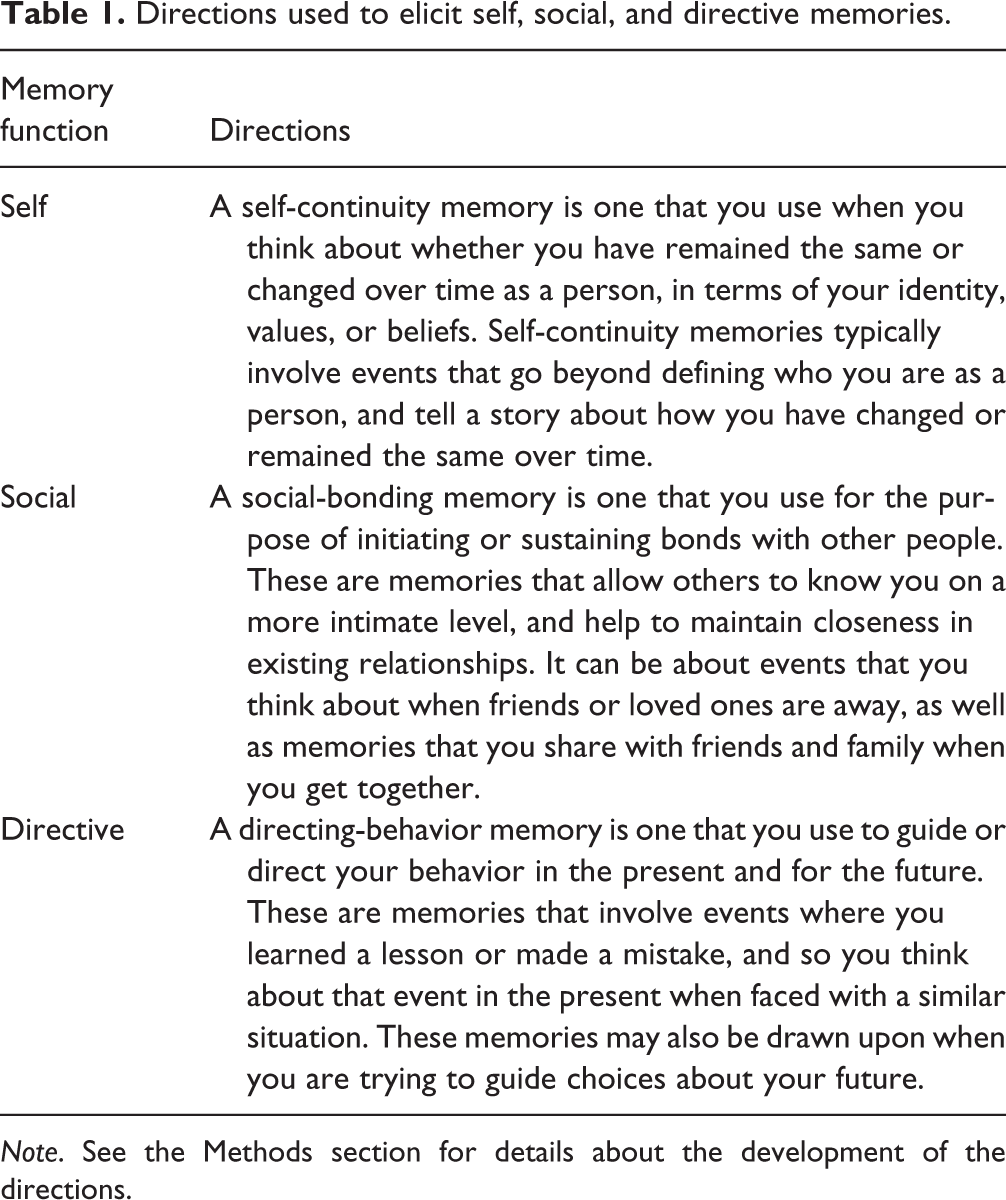
To assess the quality of self, social, and directive memories, participants were asked to write about a memory (on half of a letter-sized page) serving each of the three functions, and then answer quality questions about that memory. Initial directions emphasized that the remembered event must have been personally-experienced, specific (i.e., not lasting for more than a day), and at least 1 year old. Directions used to elicit self, social, and directive memories were developed based on: (i) a review of the theoretical literature on the three functions of autobiographical memory, (ii) measures that assess the self-reported uses of autobiographical memory (Thinking About Life Experiences Scale, TALE; Bluck & Alea, 2011), and (iii) previous research which has elicited autobiographical memories corresponding to specific functions (Rasmussen & Berntsen, 2009a). The exact directions are given in Table 1, and the rationale for the development of the directions is further explained below.
Directions used to elicit self, social, and directive memories.
Note. See the Methods section for details about the development of the directions.
Directions used to elicit memories that serve a self function emphasize theoretical accounts which espouse that autobiographical memory is not merely about using memory for self definition, but that autobiographical memory is used to promote self-continuity and coherence of the self over time (e.g., Barclay, 1996; Conway, 1996; Fivush, 1998; McLean, 2008). This self-continuity function of autobiographical memory is reflected in the most recent version of the TALE scale, as well (e.g., thinking and talking about the past “when I want to feel that I am the same person that I was before,” “when I am concerned about whether my beliefs have changed over time;” Bluck & Alea, 2011). The directions used to elicit memories that serve a self function in the current study moved beyond previous research which had participants describe a memory that, “tells you something about your identity” (Rasmussen & Berntsen, 2009a), and were thus closely aligned with present-day theory and empirical work.
The directions to cue social function memories focused on the social-bonding role that memories serve (Alea & Bluck, 2007; Alea & Vick, 2010; Bluck & Alea, 2002; Webster, 1995). It is recognized that other social functions of autobiographical memory (Alea & Bluck, 2003), such as sharing memories with others to empathize (e.g., Bluck, Baron, Ainsworth, Gesselman, & Gold, 2013), to teach and inform (e.g., McLean & Lilgendahl, 2008), and simply for entertainment and conversation (e.g., Hyman & Faries, 1992; Pasupathi et al., 2002) are not reflected in the directions used in the current study. Our directions adhere more closely to self-report measures of the social function of autobiographical memory which emphasize bonding and intimacy maintenance (e.g., Bluck & Alea, 2011; Webster, 1995). The directions to elicit social function memories includes both memories that are shared with others, consistent with previous work eliciting functional memories (Rasmussen & Berntsen, 2009a), as well as memories that may be used to maintain and enhance social bonds by reflecting on intimate experiences (Alea & Bluck, 2007).
The directions for eliciting the directive function memories emphasized that directive memories involve life experiences that are used to help solve problems and guide decisions today, but also in the future (Baddeley, 1988; Bluck & Alea, 2002; Pillemer, 1992, 1998). Much of the literature on directive memories has focused on events where lessons are learned and insights are gained through mistakes in life (Alea & Bluck, 2012; Bluck & Glück, 2004; McLean & Pratt, 2006; Pillemer, 1998, 2003). The two items on the TALE (Bluck & Alea, 2011) with the highest loading on the directing-behavior function subscale, for example, are also about using memories to learn from past mistakes. Thus, we included lesson-learning from previous mistakes as part of the directions to elicit directive function memories to be consistent with theoretical and empirical accounts. However, in doing so, it is recognized that the directions may bias people to recall negative experiences, if they focus on the portion of the larger set of directions which inform them that directive function memories may involve events where mistakes were made. This is addressed as a limitation in the Discussion. Thus, although our directions are not as neutral as those used in other work eliciting functional memories (i.e., “Try and recall a memory for an event that you think of in order to handle present or future situations,” Rasmussen & Berntsen, 2009a), the directions do closely align with conceptualizations in the literature.
After each memory was shared, participants completed the memory quality questions (adopted from Alea & Bluck, 2007; Bluck, Levine, & Laulhere, 1999). The measure includes five items that assess the self-perceived quality of a specific autobiographical memory. Quality variables include: how significant the memory is, how vivid or clear in one’s mind the memory is, the valence of the memory, and the extent to which the memory is thought and talked about. Responses are made on a 5-point Likert-scale, with indicators ranging from not at all to extremely for significance and vividness, extremely negative to extremely positive for valence, and from almost never to very frequently for the thinking and talking questions. Participants were also asked how old they were at the time of the event. The order in which the memories were elicited varied across participants.
Results
Analyses corresponded to study hypotheses and examined whether the quality (i.e., significance, vividness, etc.) of self, social, and directive memories differed, and if quality main effects were qualified by age group interactions. 4 A 3 (memory function: self, social, directive) × 3 (age group: young, middle, old) mixed multivariate analyses of variance (MANOVA) was conducted. Memory function was a within-subjects variable. Age group was a between-subjects variable. 5 The dependent variables were the five memory qualities assessed for memories used to serve each of the three functions (i.e., self, social, directive): significance, vividness, valence, thinking and talking. Univariate effects were considered only if the multivariate test was significant, and all possible pairwise comparisons used the Bonferroni correction (p = .02). 6
Cell descriptive statistics for age group by memory quality are reported in Table 2. However, the memory function by age group interaction was not significant, F(20, 400) = .88, Wilks’ λ = .92, p > .05, ηp 2 = .04. Thus, the initial expectation that there would be age group differences in the quality of self, social, and directive memories was not supported.
Means and standard deviations for the quality of self, social, and directive memories.

Note. The memory function by age interaction was not significant.
Main effects, however, did emerge consistent with expectations. The multivariate effect for memory function (i.e., self, social, directive) was significant, F(10, 199) = 12.71, Wilks’ λ = .61, p < .001, ηp 2 = .40. 7 The age group multivariate effect was also significant, F(10, 410) = 3.66, Wilks’ λ = .84, p < .001, ηp 2 = .08. The univariate and follow-up tests for the main effect of memory quality and age group are reported separately below.
Memory quality differences by memory function across age groups
Two memory quality variables showed univariate effects: valence and how often the memory was talked about. There were no significant differences between the types of functional memories, however, for memory significance, vividness, or how often the memory was thought about, Greenhouse-Geissser Fs(2, 416) < 1.00. The pattern of results is presented in Figure 1, and the significant effects for valence and how often the memory was talked about are discussed in detail below.
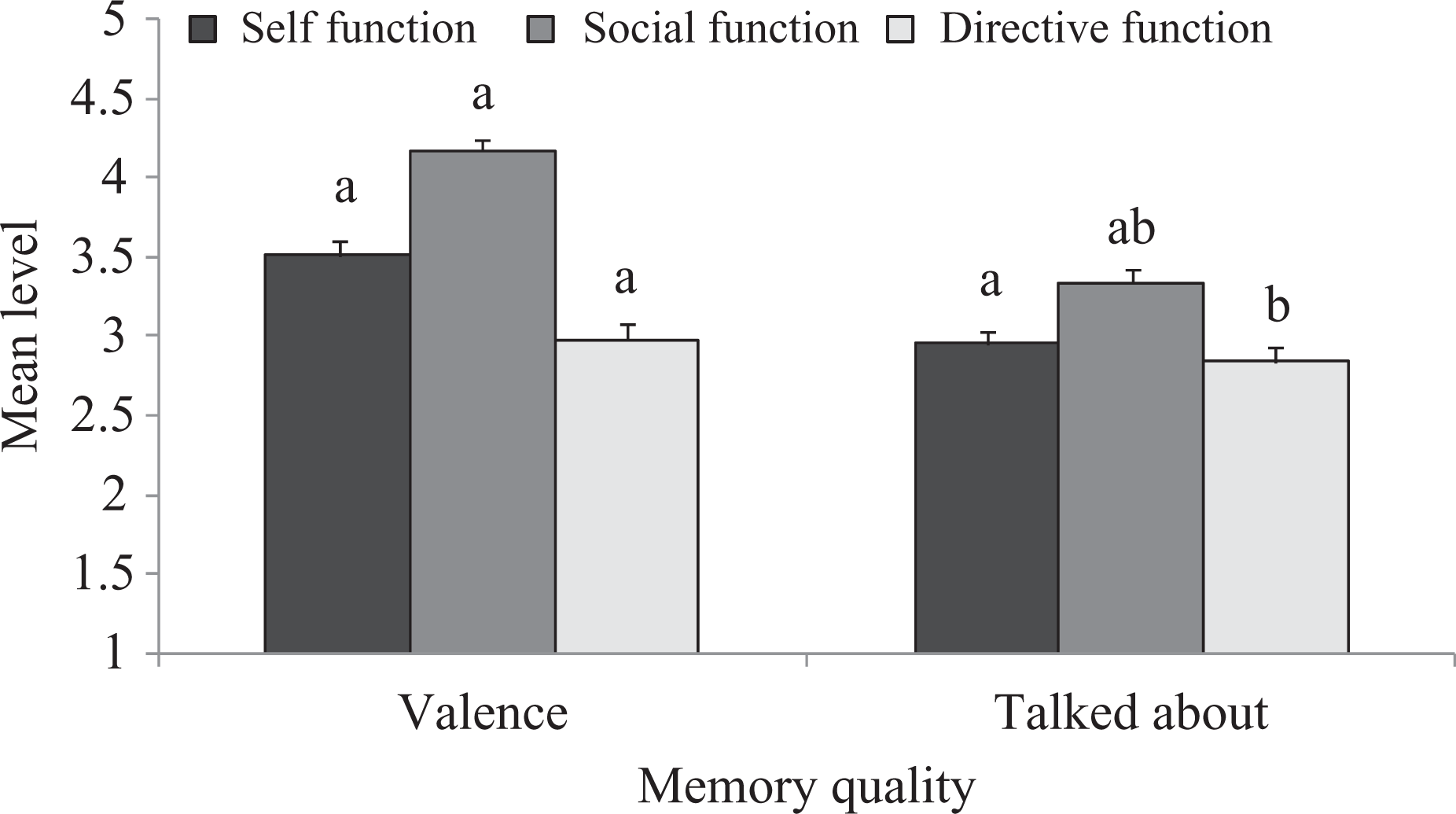
Differences between self, social, and directive memories for valence and how often the memory was talked about across age groups. Bars within each memory quality with the same superscript are different at p ≤ .001.
Memory valence
There were significant differences in the valence of the memory depending on the type of function the memory served, Greenhouse-Geissser F(2, 416) = 54.95, MS = 76.33, p < .001, ηp 2 = .21. As expected, directive function memories were the most negative. Directive function memories were more negative than memories used for the self-continuity function, t(210) = 4.36, p < .001, r2 = .08. Memories used for the directive function were also more negative than memories used to initiate and sustain social bonds (i.e., social function), t(210) = 10.40, p < .001, r2 = .34. A difference also emerged between self and social function memories: social function memories were more positive than self function memories, t(210) = 6.29, p < .001, r2 = .16.
Talking about the memory
The other significant univariate effect for the type of functional memory was for how often the memories were talked about or shared with others, Greenhouse-Geisser F(2, 416) = 12.99, MS = 14.16, p < .001, ηp 2 = .06. Across the age groups, social function memories were shared with others the most, which was expected. Social function memories were shared more often than both self, t(210) = 3.74, p = .001, r2 = .07, and directive function memories, t(210) = 4.73, p < .001, r2 = .10. There was no significant difference in how often memories used for self and directive functions were talked about, t(210) = 1.34, p > .02, r2 = .01.
Thus, across the three age groups, the pattern of results was consistent. Directive function memories were the most negative, and social function memories were the most frequently talked about. Both of these effects were expected, although contrary to expectations, there were no interactions with age group, nor were there any significant effects for memory significance and vividness.
Memory quality differences by age group across memory function
All of the memory qualities showed significant age group differences, except for how often the memories were thought about, F(2, 208) = 3.60, MS = 5.21, p > .05, ηp 2 = .03. Results are shown in Figure 2. Recall that there was no memory quality by age group interaction and thus the results are consistent across the type of functional memory. Finding age group effects in the quality of memories generally was not hypothesized.

Adult age group differences in the quality of functional memories. Bars within each memory quality with an asterisk are different at p < .01.
The pattern of results was similar for the significance, F(2, 208) = 5.90, MS = 5.84, p < .01, ηp 2 = .05, and vividness, F(2, 416) = 5.57, MS = 4.36, p < .01, ηp 2 = .05, of the memories. Middle-aged adults’ functional memories were more significant than younger adults’ memories, t(155) = 3.37, p < .01, r2 = .07. This was also true for memory vividness: middle-aged adults reported more vivid functional memories than younger adults, t(155) = 3.29, p < .01, r2 = .07. There were no statistically significant differences for memory significance or memory vividness between middle-aged and older adults’ memories (significance t(112) = 1.28, r2 = .01; vividness t(112) = 1.46, r2 = .02), or younger and older adults’ functional memories (significance t(152) = 1.87, r2 = .02; vividness t(152) = 1.63, r2 = .02), ps > .02.
Memory valence, F(2, 416) = 6.05, MS = 11.32, p < .01, ηp 2 = .06, and how often the memories were talked about, F(2, 416) = 6.27, MS = 11.44, p < .01, ηp 2 = .06, showed similar age group differences, though different from the pattern reported for memory significance and vividness. As seen in Figure 2, older adults’ functional memories were more positive than younger adults’ memories, t(152) = 3.47, p < .01, r2 = .07. Thus, across the type of functional memory that was shared, older adults’ memories were more positive than younger adults’ memories. Older and middle-aged adults’ memories did not differ significantly in valence, t(112) = 2.17, r2 = .04, nor did younger and middle-aged adults’ memories, t(155) = 1.05, r2 = .01, ps > .02. The same held true for how often the memories were talked about. Older adults talked about their functional memories more often than younger adults, t(152) = 3.55, p = .001, r2 = .08. Again, there were no significant age group differences in how often the functional memories were talked about between older and middle-aged adults, t(112) = 2.10, r2 = .04, and young and middle-aged adults, t(155) = 1.23,, r2 = .01, ps > .02.
Thus, main effects for age group in the quality of functional memories were found. Middle-aged adults’ memories were more significant and vivid than younger adults memories, across the type of function the memory served. Older adults’ functional memories were more positive and more often talked about than younger adults’ functional memories. It is important to note that the effect size for the age group differences in the quality of functional memories generally, however, were small to moderate. These effect sizes were smaller than quality differences between the types of functional memories.
Discussion
The current study was the first to examine adult age group differences in the quality of memories that were written in response to directions which explicitly asked for memories that served self, social, and directive functions. The directions to elicit self, social, and directive memories were developed from a thorough review of theoretical (e.g., Baddeley, 1988; Barclay, 1996; Bluck & Alea, 2002; Conway, 1996; Fivush, 1998; McLean, 2008; Neisser, 1978; Pillemer, 1992) and empirical work (e.g., Alea & Bluck, 2007; Bluck & Alea, 2011; Hyman & Faries, 1992; McLean & Lilgendahl, 2008; Pasupathi et al., 2002; Rasmussen & Berntsen, 2009a) on autobiographical memory functions. Two particularly unique aspects of the study were that it included comparisons between young adults, middle-aged adults, who are not often studied in the literature on memory functions, and older adults. Including middle-aged adults yielded some interesting effects: their functional memories, regardless of the type of function served, were more significant and vivid than younger adults’ memories, but not different from older adults’ memories. This may be a reflection of better self-integration with memory (Pasupathi & Mansour, 2006) and peaked autobiographical reasoning in midlife (Bauer & McAdams, 2004; Bluck & Glück, 2004). It certainly suggests that individuals in midlife should be included in future research. Second, the study was conducted in Trinidad. We expected to replicate results for differences in the quality of self, social, and directive memories found in previous work even with the Trinidadian sample, and mostly we did.
However, we did expect that including adults from different age groups would matter: it was thought that the various goals and psychosocial tasks associated with each life phase (e.g., Baltes et al., 1999; Ebner et al., 2006; Erikson, 1968, 1980; Heckhausen et al., 2010; Labouvie-Vief et al., 1989; Neugarten, 1979) would impact upon the quality of memories used to meet self, social, and directive needs. In short, an age group by memory quality interaction was expected; however, a non-significant effect was found. Our initial interaction expectation was based primarily upon research using Likert-type scales to assess the overall frequency of using memory for the three functions (e.g., Bluck & Alea, 2011; Webster, 1995). In these studies, younger adults report using self and directive functions of autobiographical memory more often than older adults (Bluck & Alea, 2008, 2009; McLean & Lilgendahl, 2008; Webster, 1995). In the current study, however, a different methodological approach, one that was also employed by Rasmussen and Berntsen (2009a), was taken: specific functional memories were elicited. This methodological difference might account for the null finding. Thus, if an older adult is asked to remember a life experience that they use to direct their current and future thoughts and behaviors, they can and did, and the quality of this directive memory was not significantly different from young or middle-aged adults’ memories relative to other functional memories. Age group differences in the quality of functional memories, regardless of the type of function, did emerge, but the effect sizes were actually quite small. Instead, differences in the quality of memories used to serve self, social, and directive functions, regardless of a person’s age, emerged as the statistically significant and relatively important, in magnitude, effects. These results are discussed next.
Directive memories are more negative than self and social function memories
As discussed in the Introduction for the study, the most consistent finding in the literature regarding differences in the quality of functional memories is that memories used for the directive function are more negative than self and social function memories. This systematic variability in the valence of functional memories has been found in studies employing a variety of methodologies, including: content coding (e.g., Pasupathi et al., 2002), and asking people to rate the extent to which positive and negative memories serve each of the three functions, as well as rating the valence of memories which specifically serve each or one of the three functions (Rasmussen & Bernsten, 2009a). Directive memories in the current study were also the most negative. This was true across age groups even though older adults’ memories generally were more positive than the younger adults’ memories, reflecting a positivity bias (e.g., Comblain et al., 2005; Fernandes, Ross, Wiegand, & Schryer, 2008; Kennedy, Mather, & Carstensen, 2004; Walker, Vogl, & Thompson, 1997). Thus, it seems that memories used for directives in life are grounded in learning difficult lessons when dealing with life’s disappointments (Pillemer, 1998, 2003). These difficult times from one’s past, particularly when the challenge remains unresolved (Beike, Adams, & Naufel, 2010), are used in the present in order to make decisions and plans today and for the future.
Although the negative valence of directive memories was expected, we unexpectedly found that memories used to meet self-continuity needs were more negative than social function memories, which were the most positive. One component of the self function of autobiographical memory is to maintain self continuity in the face of change (e.g., Bluck & Alea, 2008; Conway, 2005; Robinson, 1986; Weeks & Pasupathi, 2011), or when the self-concept is threatened (Pillemer, Ivcevic, Gooze, & Collins, 2007). It seems possible that the directions used to elicit self function memories (see Table 1) may be one reason for this unexpected finding. The directions, guided by empirical and theoretical work, cued people to remember moments in life that remind them of whether they have remained the same or changed over time in terms of their beliefs and values. It seems likely that such experiences would involve some difficult questions about one’s self, and thus perhaps have some negative affect associated with the event. Negative experiences are difficult to self-integrate (Weeks & Pasupathi, 2011) and to make meaningful (e.g., Thorne, McLean, & Lawrence, 2004). We return to the potential influence of the directions used in the current study on the results in the Limitations section below.
Social function memories are talked about more than self and directive memories
Social function memories, as expected, were talked about most often, more than memories used to meet self-continuity needs, and those used to direct behavior. Also as expected, this effect did not interact with age group, even though older adults reported talking about their memories, regardless of function, more often than younger adults. The social function of autobiographical memory is evolutionarily adaptive (Nelson, 1993), as it aids survival by helping people to initiate, sustain, and enhance social bonding (Alea & Bluck, 2003). Given the role of such memories in everyday life, it is not surprising that memories used to meet social-bonding demands are shared often with others. Sharing autobiographical memories happens naturally in conversational contexts (Pasupathi et al., 2002), and happens often. In one study with university students (McLean, 2005), for example, 90% of the self-defining memories that were remembered had been shared with others, and sharing the memory for intimacy maintenance was among one of the top reasons for memory sharing. Similarly, Alea (2010) found that relationship memories were commonly shared by individuals from young adulthood to old age, with no age group variation: 73% of the memories collected in the study had been disclosed to others.
We are not suggesting that autobiographical memories have to be shared in order to serve a social function for a person. In fact, Alea and Bluck (2007), in experimental work, demonstrated that thinking about a romantic relationship event was enough to enhance feelings of warmth and closeness towards’ one’s partner (see also Webster’s 1995 intimacy function). Memories were shared with a researcher, not with one’s partner, and yet feelings of intimacy towards one’s partner increased. We are also not suggesting that sharing an autobiographical memory automatically leads to social-bonding. However, it does seem that if the three types of functional memories are compared, social function memories tend to be overtly talked about with other people more often than memories that are used to serve self and directive functions (Rasmussen & Berntsen, 2009a).
Enhanced sharing of social function memories by participants in the study, across age groups, could relate back to differences in the valence of social-bonding memories compared to self and directive memories. Social function memories were the most positive; and positive, compared to negative, life events are more likely to be shared with others (e.g., Alea, 2010; Pasupathi, 2003; Pasupathi & Carstensen, 2003). Social function memories were also expected to be more vivid than other functional memories. This expectation was based upon previous work which had a more fine-grained assessments of vividness (e.g., olfactory details; Rasmussen & Bernsten, 2009a) compared to the general, overall vividness question used in the current study. Perhaps this is why the difference in vividness by type of memory function did not emerge.
Limitations and future directions
There seems to be two major limitations of the current study: one is related to the sample, and the other related to the directions used to elicit functional memories. The sample size across the three age groups was not equal. The older adult sample was relatively young, and also, there were mostly women in the study. The demarcation of “older adult” in the current study began at age 50 years, mostly because Trinidadian life expectancy is approximately 10 years younger than developed countries, like the United States (World Health Statistics, 2011). The hypotheses about age group by type of functional memory interactions, however, were developed based on lifespan developmental theories, and research conducted in developed countries, where individuals over the age of 60 years usually represent an older adult age group. It seems possible then that no age group by type of functional memory interactions emerged because the older adults, whom most hypotheses were about, were not particularly old in the current study. Looking at smaller age demarcations (i.e., by decade) might prove useful in future research. It may also be that our expected interaction effects were not found because of cultural differences in the use of autobiographical memory for the three theoretical functions. We cannot address this speculation in the current study, but instead propose that future research employ cross-cultural comparisons, like those that have been done examining Western and Eastern cultures (e.g., Kulkofsky et al., 2009).
The other limitation with regards to the sample is that it was primarily women, and gender differences could not be thoroughly explored. There are some fairly consistent differences in the quality of men’s and women’s autobiographical memories. Women, compared to men, find more joy in purposefully reminiscing (e.g., Pillemer, Wink, DiDonato, & Sanborn, 2003), report more often sharing memories with others (e.g., Alea, 2010), and have memories that are more detailed (Davis, 1999) and emotional (e.g., Bauer, Stennes, & Haight, 2003; Ross & Holmberg, 1992). Women access more emotional memories and do so faster than men (e.g., Davis, 1999; Seidlitz & Diener, 1998). This gender difference seems to be accentuated for traumatic memories (Berntsen, Rubin, & Johansen, 2008). Further, research sometimes, though not always (e.g., Beike, et al., 2010; Bluck & Alea, 2009, 2011; Rasmussen & Berntsen, 2009a), has found that women report using autobiographical memory for solving problems (i.e., the directive function) more often than men (e.g., Niedzwienska & Swiezy, 2010; Pillemer, 2003; Webster, 1995). Together, this work suggests that potential gender differences in the quality of functional memories should be more systematically explored in the future.
The major methodological limitation is related to the directions used to elicit the self, social, and directive autobiographical memories. As detailed in the Measures section, the directions (see Table 1) were developed based on a thorough review of the theoretical (e.g., Baddeley, 1988; Bluck & Alea, 2002; Conway, 1996; Pillemer, 1992) and empirical work on the functions of autobiographical memory (e.g., Rasmussen & Berntsen, 2009a), drawing specific wording, for example, from the TALE scale (Bluck & Alea, 2011). This, however, may have led to directions that biased the quality of reported memories, particularly with regards to the affective quality of the functional memories. After all, social function memories were elicited by asking people to remember events that are used to initiate or sustain “intimacy” and “closeness” in social relationships. These terms are relatively positive. This potential bias can be seen most concretely, perhaps, with the directions for eliciting the directive function memories, which asked people to remember events where lessons had been learned from mistakes that were made. Thus, if individuals focused on this portion of the directional set, then it is not surprising to find that the directive function memories were the most negative. However, it is important to point out that while we cannot eliminate this potential problem with the current data set, directing-behavior memories were not particularly negative. On the 5-point Likert scale, ranging from extremely negative to extremely positive, the mean was a 2.98, thus almost neutral on the scale. Also, Rasmussen and Berntsen (2009a) had affectively neutral directions to elicit directive memories, and similarly found that directive function memories are negative. Thus, although it is possible, we do not think that the findings for the directive memories were unduly influenced by the directional set. Even so, in future research specific types of directional events that might tend towards being positive, like memorable and symbolic messages that motive and inspire people (Pillemer, 1998), should be examined in conjunction with lessons learned and mistakes made.
The potential problems with the directions used in the current study need to obviously be eliminated in future research examining the quality of functional memories. One strategy to move the field forward is to eliminate explicit elicitation of functional memories, or even memories of a particular quality (i.e., significant) or valence, and to observe the functions of memory that emerge naturally in conversational settings as Pasupathi and colleagues (2002) have done with young and older married couples. Experience sampling methodology may be the way forward: the function and quality of memories that are being used in everyday life, as they are being used by men and women across adulthood, could be observed naturally without the need for elicitation of specific autobiographical episodes that meet self, social, and directive needs. This type of methodology would also bring the field closer back to theory: to ask why memory is used in everyday life (Neisser, 1978).
On the other hand, well-designed experimental paradigms that mimic real-life memory sharing might also be used to examine the quality of self, social, and directive memories across adulthood. For example, the social function of autobiographical remembering might be examined experimentally by having strangers in a room being assigned to a condition where they are asked to share autobiographical facts (e.g., name, date of birth) or another condition where they are asked to share specific autobiographical episodes in order to get to know another person. Feelings of closeness towards the stranger could be assessed after the implementation of the conditions. If autobiographical memory serves a social-bonding function, then those individuals in the autobiographical memory-sharing condition should feel enhanced closeness towards the stranger. Confederates could also be used to draw out a moment in person’s life when they might have used a memory to direct their decisions, by perhaps faking the need to solve a life problem themselves. Again, observing what emerges naturally by the participant, without explicit directions, would bring future research more closely in line with the functional theoretical framework. In each case, the autobiographical memories that are shared could be coded for a variety of memory qualities, including some that were not examined in this work but have been examined elsewhere (Rasmussen & Berntsen, 2009a), and particularly those that show adult age group differences that were not examined in the current study (e.g., complexity; Comblain, et al., 2005; field/observer perspective; Piolino et al., 2006).
Conclusion
In conclusion, results from the current study emphasized again that there seems to be systematic differences in the quality of functional memories that map on to and fill needs that are demanded by ecological contexts (Bluck et al., 2010). Negative memories guide and direct behavior and positive memories promote social bonds. The expected interactions with age did not emerge, and instead main age effects were found for the functional memories: older adults’ memories were more positive and talked about, and middle-aged adults’ memories were more significant and vivid, compared to younger adults. Creative ways to examine the quality of functional memories without using explicit directions to elicit memories need to be considered to avoid qualitative biases. These biases, however, might actually be pervasive in the theoretical work from which the directions used in the current study were developed. Social function memories promote intimacy; self function memories promote continuity; and mistakes from the past direct behavior. Theoretical accounts might do well to more seriously consider not only the adaptive value of remembering, but also to ask what the functions of memories might be when outcomes are not adaptive (e.g., intrusive memories in post-traumatic stress disorder; Berntsen et al., 2008; overgeneral memory in individuals with emotional disorders; Williams et al., 2007). Perhaps the quality of memories used to meet non-adaptive self, social, and directive functions are different than those used to meet the everyday functions currently examined in the literature. Regardless, the way forward seems to be for researchers who approach memory from a functional perspective to move towards simultaneously asking why humans remember what they remember.
Footnotes
Funding
This work was partially supported by a Campus Research and Publication Fund Award from the University of the West Indies, St. Augustine, Trinidad and Tobago [grant number: CRP.3.NOV07.11].