




Abstract
Despite the growing research on emotion regulation, the empirical evidence for normative age-related emotion regulation patterns is rather divergent. From a life-span perspective, normative age changes in emotion regulation may be more salient applying the same methodological approach on a broad age range examining both growth and decline during development. In addition, emotion-specific developmental patterns might show differential developmental trends. The present study examined age differences in seven emotion regulation strategies from early adolescence (age 11) to middle adulthood (age 50) for the three emotions of sadness, fear, and anger. The results showed specific developmental changes in the use of emotion regulation strategies for each of the three emotions. In addition, results suggest age-specific increases and decreases in many emotion regulation strategies, with a general trend to increasing adaptive emotion regulation. Specifically, middle adolescence shows the smallest emotion regulation strategy repertoire. Gender differences appeared for most emotion regulation strategies. The findings suggest that the development of emotion regulation should be studied in an emotion-specific manner, as a perspective solely on general emotion regulation either under- or overestimates existing emotion-specific developmental changes.
Much of the research on emotion regulation focuses either on infancy and childhood or on adulthood. However, adolescence and emerging adulthood are also relevant developmental phases for emotion regulation given the increased emotionality and the rapid developmental changes.
Adolescence is an age period with fast and fundamental alterations in biological, cognitive, social, and emotional domains (Lerner & Steinberg, 2009). During this developmental phase, many areas of life are accompanied by intense negative emotions in daily life (Silk, Steinberg, & Morris, 2003) with often unstable peer or romantic relationships (Furman & Collins, 2009), and a decrease in perceived support from parents (Furman & Buhrmester, 1992). However, there is also variation within the adolescent period. In particular, early adolescence is characterized by a higher rate of conflicts with parents (Laursen, Coy, & Collins, 1998) and a higher variability of negative emotions compared to late adolescence (Larson, Moneta, Richards, & Wilson, 2002). In contrast to early adolescence, during middle adolescence the conflicts with parents become more emotional (Laursen et al., 1998), and agreeableness and conscientiousness both decrease whereas neuroticism increases (Soto, John, Gosling, & Potter, 2011).
Beyond adolescence, emerging adulthood is perceived as a time of prolonged emotional insecurity regarding role status (Arnett, 2001) and new and challenging developmental tasks (Roisman, Masten, Coatsworth, & Tellegen, 2004). In this developmental phase, expressed anger only slowly decreases (Galambos, Barker, & Krahn, 2006) and depression may even increase until age 30 (Soto et al., 2011), especially for women. In contrast, in middle adulthood, around age 50, personality is characterized by emotional stability and increased self-control, with lower neuroticism and higher conscientiousness (Soto et al., 2011).
Thus, emotional stability seems to be low during adolescence and is still not yet established during emerging adulthood. This increased emotionality during early and middle adolescence may be caused by biological changes with an increased reward dependency and intense hormonal influences (Somerville, Jones, & Casey, 2010). However, it can also reflect the developmental changes in emotion regulation.
Emotion regulation includes all processes that are involved in changing current or expected emotional states regarding their intensity, quality, duration, speed of elicitation, and recovery in the service of adaptation (see Thompson, 1994). In contrast to coping, emotion regulation also includes processes of increasing arousal in the service of adaptation, anticipatory actions on potential emotion elicitors, and the regulation of positive emotions (Gross & Thompson, 2007). From infancy to adolescence executive functions, cognitive complexity, and emotion understanding relevant for monitoring and evaluating one’s emotional reactions (Thompson, 2011) become more sophisticated with the consequence that individual emotion regulation more often also includes long-term goals. Thus, during adolescence and emerging adulthood emotion regulation potentially becomes more flexible with an increase in coherence in recognizing and understanding own and others’ feelings, an increase in understanding the possible selectivity of own perceptions and evaluations, and an increased insight into own emotion related behaviors (Zimmermann, 1999) that are part of the emotional process (Saarni, Campos, Camras, & Witherington, 2006). Adaptive changes in goals, including long-term goals and an increasing selectivity, become even more relevant for emotion regulation during emerging adulthood (Arnett, 2001), and especially for the second half of life (Carstensen, Fung, & Charles, 2003). Sameroff (2010) suggested from a general perspective on human development a continuous increase in self-regulation, paralleled by a continuous decrease in social or external regulation from infancy to adulthood. A similar developmental change in the relative dominance of emotion regulation from primarily social emotion regulation in infancy to an increasing individual emotion regulation up to adulthood has been described for emotion regulation (Gross & Thompson, 2007; Zeman, Cassano, Perry-Parrish, & Stegall, 2006). However, social and individual emotion regulation co-exists at all ages. The use of these strategies depends on the intensity of the experienced emotion and the fit of the individual’s regulatory capacity to the given situation.
Research on emotion regulation from infancy to adolescence has increased tremendously over the last years (Adrian, Zeman, & Veits, 2011), revealing a surprisingly rich repertoire of emotion regulation strategies already in childhood. During middle childhood, studies suggest fewer age changes in the use of emotion regulation strategies compared to the general increase in strategy effectiveness (Cole, Dennis, Smith-Simon, & Cohen, 2008; Morris et al., 2011). During adolescence there is also no consistent developmental pattern. Silk, Steinberg, and Morris (2003) found no age differences in the use of emotion regulation strategies from early to middle adolescence, whereas Zeman and Shipman (1997) reported more use of emotion regulation in 14-year-olds compared to 11- and 17-year-olds. For expressive suppression, there are no age changes during early adolescence (Sullivan, Helms, Kliewer, & Goodman, 2008), only a small decrease for girls during middle adolescence (Gullone, Hughes, King, & Tonge, 2010) or an increased use only for sadness and only in middle adolescence compared to early and late adolescence (Zeman & Shipman, 1997). Studies assessing more than two emotion regulation strategies show an increasing use of all cognitive emotion regulation strategies from middle adolescence to late adolescence and adulthood (Garnefski & Kraaij, 2006), comparable to coping research (Seiffge-Krenke & Beyers, 2005). Blanchard-Fields and Coats (2008) found no age changes from late adolescence to adulthood and old age in instrumental problem-solving (cognitive analysis, planful problem-solving), but a steady increase in using passive emotion regulation (avoidance–denial–escape, suppression, passive-dependence) and a decrease of proactive emotion regulation strategies (emotional coping, reflection on emotions, seeking social support) up to old age. In contrast, John and Gross (2004) report less use of suppression and more use of reappraisal in middle adulthood compared to emerging adulthood.
The empirical evidence regarding normative age changes in emotion regulation from adolescence to adulthood reveals a mixed picture. One of the reasons for these diverging results could be that emotion regulation in adolescence and adulthood often is assessed as a general trait with the implicit assumption that the same regulation is applied to all emotions. However, emotion regulation strategies in infancy and childhood already differ in an emotion-specific manner regarding their use, their effectiveness, and the age at which they become effective. Thus, from infancy on, emotion regulation may develop in an emotion-specific manner and may less often follow a general course comparable for all emotions. Attention regulation in anger-eliciting situations, but not in fear-eliciting situations becomes more prominent and effective from infancy to toddlerhood, and comparable results for emotion-specific development and use of emotion regulation development have been reported for older children (Cole et al., 2011; Roque & Veríssimo, 2011). Similarly, during adolescence age differences in the use or the effectiveness of specific emotion regulation strategies vary between anger, fear, and sadness (Silk et al., 2003; Zeman & Shipman, 1997). Thus, comparably to childhood, emotion regulation during adolescence and adulthood may offer more insights into developmental processes when its assessment is emotion-specific. Sadness, fear, and anger are associated with different elicitors and action tendencies. Anger and fear are more activating emotions compared to sadness, and anger and fear are associated with different action patterns (Saarni et al., 2006). Given these functionalistic differences, emotion regulation may differ in strategy use and strategy effectiveness regarding the elicited or anticipated discrete emotion quality at all ages. Indeed, there is some evidence that the use of single emotion regulation strategies varies depending on the emotion quality (Endrerud & Vikan, 2007).
A second factor contributing to the diverging results in the development of emotion regulation during adolescence and adulthood may be the fact that most studies use different measurement approaches across age-groups (e.g., observation, self-report with varying numbers of emotion regulation strategies, interviews, vignettes, or experience sampling). This makes it difficult to compare age-groups and to detect whether the repertoire (Thompson, 1994) of emotion regulation strategies (i.e., the number of known or available regulating reactions) is changing. In addition, many studies only compare two age-groups (e.g., adolescents vs. adults) that have a huge age gap, in some studies from late adolescence to old age (Garnefski & Kraaij, 2006; John & Gross, 2004). Drawing conclusions on normative development from samples with huge age differences somehow neglects developmental processes that may emerge during adolescence, during emerging adulthood, and during adulthood. Assessing age changes in the use of emotion regulation strategies for age-groups that are more closely spaced offers the possibility to detect developmental changes that might be obscured if comparing only major age periods (e.g., adolescence vs. adulthood). Such an approach can detect age associated growth and decline in emotion regulation similar to research on personality development (Soto et al., 2011).
Finally, there is evidence for gender-specific preferences in emotion expression (Chaplin & Aldao, 2013) and emotion regulation that seem not to start before middle childhood or adolescence. Females more often report using social support, rumination, and primary control strategies. Males more often use avoidance or with increasing age passivity (Blanchard-Fields & Coats, 2008; Silk et al., 2003; Vierhaus, Lohaus, & Ball, 2007). Especially regarding the use of reappraisal and suppression, the empirical evidence is highly diverse (Nolen-Hoeksema & Aldao, 2011). These differences may develop out of gender roles or gender differences in socialization (Saarni et al., 2006). However, it is not yet clear whether gender-specific emotion regulation can be replicated in a larger sample of adolescents and emerging adults.
Aims of the present study
Despite the expectation from a general developmental perspective that emotion regulation will improve during adolescence, emerging adulthood, and adulthood, the existing empirical evidence is highly diverse. This may partly be due to the variety of studied age-groups with diverse assessment methods for emotion regulation and emotion-specific developmental trends.
We had four aims in this study. First, we wanted to examine whether we can reveal normative age changes in emotion regulation from early adolescence to middle adulthood by systematically applying the same assessment method for emotion regulation to a large age span with small age differences between the age-groups to be able to also detect changes within adolescence or adulthood, and not only between these age periods. Similar to the age-specific changes found in personality development and social development during middle adolescence when compared to early adolescence or late adolescence, we expected more problems with emotion regulation, and less use of social support seeking based on diminishing closeness to parents and still instable peer relations (Furman & Collins, 2009). Based on current empirical evidence, we expected an increase in social support seeking for emerging adulthood as social relationships stabilize, followed again by a reduction in social support seeking for middle-aged adults according to selectivity theory. In addition, adults are expected to show an increase in passivity and avoidance comparable to earlier findings (Blanchard-Fields & Coats, 2008). Second, we wanted to assess and compare both the general and the emotion-specific use of several emotion regulation strategies as we expected that the developmental patterns during adolescence and adulthood would be different in an emotion-specific manner, comparable to results found in childhood. We intended to test whether both growth and decline in the use of single emotion regulation strategies during adolescence and adulthood would emerge comparable to age-specific results found in personality development (Soto et al., 2011), and in line with life-span developmental psychology (Baltes, Lindenberger, & Staudinger, 2006). Third, we wanted to examine whether gender differences in emotion regulation can be found in a larger age-group, expecting that female participants will use more social strategies and show more dysfunctional rumination, whereas male participants will show more avoidance and expressive suppression. Finally, we intended to test the hypothesis that the repertoire of emotion regulation strategies is changing with growing age, expecting both growth and decline during development.
Method
Participants
The sample consisted of 1305 healthy German, mainly Caucasian, low-risk participants, 52% of them female. The sample was selected with a two-year difference between all age-groups during adolescence as we expected rapid developmental changes during that age period. For emerging adulthood, we expected a somewhat slower developmental change rate so that age differences were expanded from two years to three and four years. Finally, middle adulthood with age 50 was chosen as a standard comparison for emotion regulation in adulthood. The sample is divided into nine age-groups: 11 years (N = 174; mean age = 10.75 years; SD = .44), 13 years (N = 155; mean age = 12.70 years; SD = .46), 15 years (N = 172; mean age = 14.76 years; SD = .43), 17 years (N = 144; mean age = 16.86 years; SD = .35), 19 years (N = 170; mean age = 19.12 years; SD = .82), 22 years (N = 193; mean age = 21.87 years; SD = .82), 25 years (N = 137; mean age = 24.82 years; SD = .82), 29 years (N = 89; mean age = 28.98 years; SD = 2.25), and 50 years (N = 71; mean age = 49.61 years; SD = 2.42). For children and adolescents only participants with given written parental consent to participate were involved in the study. Participants were recruited from schools, universities, recreational facilities (e.g., church groups or sports clubs) or companies in North Rhine-Westphalia, Germany.
Measures
Emotion regulation was assessed by means of the Negative Emotion Regulation Inventory (NERI; Zimmermann, Scharf, & Iwanski, 2008). The NERI is a self-report questionnaire assessing emotional experiences and emotion regulation in specified situations commonly inducing the emotions of fear, anger, and sadness (two situations per emotion: e.g., end of a relationship for sadness, alone in a dark place for fear or renege on a promise for anger). The situations are written in a person-directed manner (e.g., your best friend neglects his/her promise). The selected situations had been developed and tested before in a separate study regarding their validity in eliciting emotions in two different cultures, in Germany and Israel. In all six chosen situations the expected emotion was rated as significantly higher compared to other emotions. In addition, the emotion regulation strategies have been significantly associated with trait anger, trait anxiety, and depression (Scharf & Zimmermann, 2009). The validity in eliciting the emotion as requested can be checked by the intensity ratings, assessed first of all in the questionnaire.
The questionnaire first asks for an intensity rating of experienced sadness, fear, anger, and joy for each presented situation on a seven-point Likert scale (1 = “not at all” to 7 = “very intense”). Mean scores for reported emotions are calculated for sadness in sadness-eliciting situations, fear in fear-eliciting situations, and anger in anger-eliciting situations. These scores can be used for a validity check regarding the associated emotionality.
Next, the use of emotion regulation strategies has to be reported. The NERI measures seven different emotion regulation strategies: adaptive emotion regulation (6 items per situation, e.g., I calm down first and then deal with the situation again; I concentrate on what to do next); social support seeking (4 items per situation, e.g., I am looking for comfort; I am talking to related persons; I ask for advice); passivity (5 items per situation, e.g., I just wait and see; I see no need to react); avoidant regulation (4 items per situation, e.g., I just go away; I do something else); expressive suppression (3 items per situation, e.g., I do not show how I feel; I dissemble); dysfunctional rumination (5 items per situation, e.g., I am brooding; I think about it all the time); and dysregulation (4 items per situation, e.g., I blame others, even if they are not responsible). For each of the six presented situations, the participants have to rate the use of 31 different reactions on a seven-point Likert scale (1 = “very untypical” to 7 = “very typical”). The seven resulting emotion regulation scales are computed as general emotion regulation strategies over all emotions (combining the strategies over all six situations) as well as emotion-specific regulation strategies for sadness, fear, and anger (combining two situations for each emotion).
Overall and age specific internal consistencies (Cronbach’s alpha) were good for all scales showing appropriate reliability: adaptive regulation α = .93, social support seeking α = .91, passivity α = .88, avoidance α = .78, suppression α = .87, dysfunctional rumination α = .91, and dysregulation α = .90. For age 11 alphas ranged from .69 to .93, for age 13 from .78 to .93, for age 15 from .75 to .89, for age 17 from .79 to .92, for age 19 from .78 to .93, for age 22 from .83 to .92, for age 25 from .78 to .94, for age 29 from .78 to .93, and for age 50 from .87 to .93. A factor analyses revealed a seven factor solution (all Eigenvalues > 1) confirming the intended seven emotion regulation scales of the NERI.
Results
As the NERI intends to assess emotion regulation, we examined the emotional potency of the presented situations in the questionnaire for eliciting emotions. First, we tested for possible age and gender differences in the reported emotions of sadness, fear, and anger in the respective situations. Two out of the 1305 subjects did not have complete emotion experience ratings and were excluded from the analysis. An age-group × gender MANOVA revealed a significant overall main effect of age (F(24,3855) = 9.67; p < .0001; η2 = .057), gender (F(3,1283) = 82.17; p < .0001; η2 = .161), and a significant age × gender interaction effect (F(24,3855) = 2.35; p < .0001; η2 = .014) on the reported emotions. The emotion ratings clearly showed that the presented situations are specifically associated with the intended negative emotions supporting the validity of the selected situations, with a mean range from 4.76 to 5.71 for sadness, 4.98 to 5.46 for fear, and 4.89 to 6.22 for anger. For all three emotions the intended emotion (e.g., anger in anger situations M = 5.78) was rated significantly higher than all other emotions (e.g., sadness M = 3.66 or fear M = 2.50 in anger situations) with p < .0001 for all paired t-tests. 1 Male participants rated their emotions in the presented situations significantly lower for sadness in sadness situations (M = 4.88, t = −11.57, p < .0001), and fear in fear situations (M = 4.70; t = −14.61, p < .001) compared to female participants (with M = 5.76, and M = 5.76, respectively). There was no significant gender difference in reported anger intensity for the presented anger situations (Mmales = 5.70, Mfemales = 5.83).
Next, we tested whether the intensities of the reported emotions were associated with the reported use of emotion regulation strategies by calculating bivariate correlations. Adaptive regulation, social support seeking, dysfunctional rumination, and dysregulation were significantly positively associated with emotion intensity for all three reported emotions (p < .005). Passivity was significantly negatively associated with sadness (p < .0001) and fear intensity (p < .002), whereas suppression was significantly negatively correlated with fear intensity (p < .007), and positively with anger intensity (p < .002).
As the intensities of the reported emotions were significantly associated with both age and emotion regulation strategies, the intensities of sadness, fear, and anger were controlled as covariates in further analyses, to avoid a confounding of age differences in emotion regulation with differences in reported emotional intensities. In addition, we only included those participants who had scores above one on each reported emotion scale. By that, we intended to control that the assessment of the emotion regulation strategies really was assessing emotion regulation and not solely cognitive problem-solving applied in the absence of emotions. Thus, the following analyses included 1260 subjects.
As a next step, we first analyzed age and gender differences for all emotion regulation strategies over all emotions, and then the emotion-specific age effects comparing the emotion regulation strategies for sadness, fear, and anger. For all analyses the intensities of reported sadness, fear, and anger based on the participants’ ratings were controlled as covariates. For all univariate follow-up tests regarding age differences for the nine age-groups for each emotion regulation strategy a Bonferroni correction was applied so that only results significant at p < .01 will be reported.
Overall age differences
An age × gender MANOVA with all seven overall emotion regulation strategies showed a significant main effect of age (F(56,8673) = 6.97; p < .0001; η2 = .043), gender (F(7,1233) = 24.76; p < .0001; η2 = .123), and no significant age × gender interaction on emotion regulation. Univariate post-hoc analyses revealed significant age differences for adaptive ER (F(8,1248) = 14.64; p < .0001; η2 = .108), support seeking (F(8,1248) = 5.49; p < .0001; η2 = .034), passivity (F(8,1249) = 2.28; p < .001; η2 = .020), avoidance (F(8,1248) = 3.93; p < .0001; η2 =.025), expressive suppression (F(8,1248) = 2.28; p = .035; η2 = .013), dysfunctional rumination (F(8,1248) = 1.97; p = .047; η2 = .012), and dysregulation (F(8,1248) = 5.77; p < .0001; η2 = .036). Significant gender differences were found for all strategies except adaptive ER and dysregulation (see Table 1).
Gender differences in emotion regulation.

Bold = Significant gender differences; p < .01.
Age differences for the seven emotion regulation strategies are shown in Figures 1 to 7, first for general emotion regulation, and then specifically for the regulation of sadness, fear, and anger. Univariate post-hoc tests are reported in Tables 2 to 8.

Adaptive emotion regulation from age 11 to age 50 (means and SE).
Adaptive emotion regulation – age differences and univariate post-hoc tests (age in years).

For general adaptive emotion regulation and social support seeking, we found a U-shaped change during adolescence followed by an increase for emerging adulthood. However, for adaptive emotion regulation we found increase to middle adulthood (Figure 1; Table 2), whereas general social support seeking shows a decline until middle adulthood (age 50) to a level comparable to middle adolescence (Figure 2; Table 3). General passivity, avoidance, and expressive suppression show different developmental patterns. Whereas general passivity decreased in use after early adolescence (except age 25) (Figure 3; Table 4), general avoidance remained relatively stable at a significantly lower level compared to middle adulthood. Only during middle adolescence (age 15) avoidance is used less often compared to adulthood (Figure 4; Table 5). Overall expressive suppression is reported less often during early and middle adolescence compared to emerging adulthood (Figure 5; Table 6). General dysfunctional rumination is relatively stable with early adolescents reporting more dysfunctional rumination than early emerging adults (Figure 6; Table 7). General dysregulation is reported significantly more by emerging adults and in middle adulthood compared to early and middle adolescence (Figure 7; Table 8).
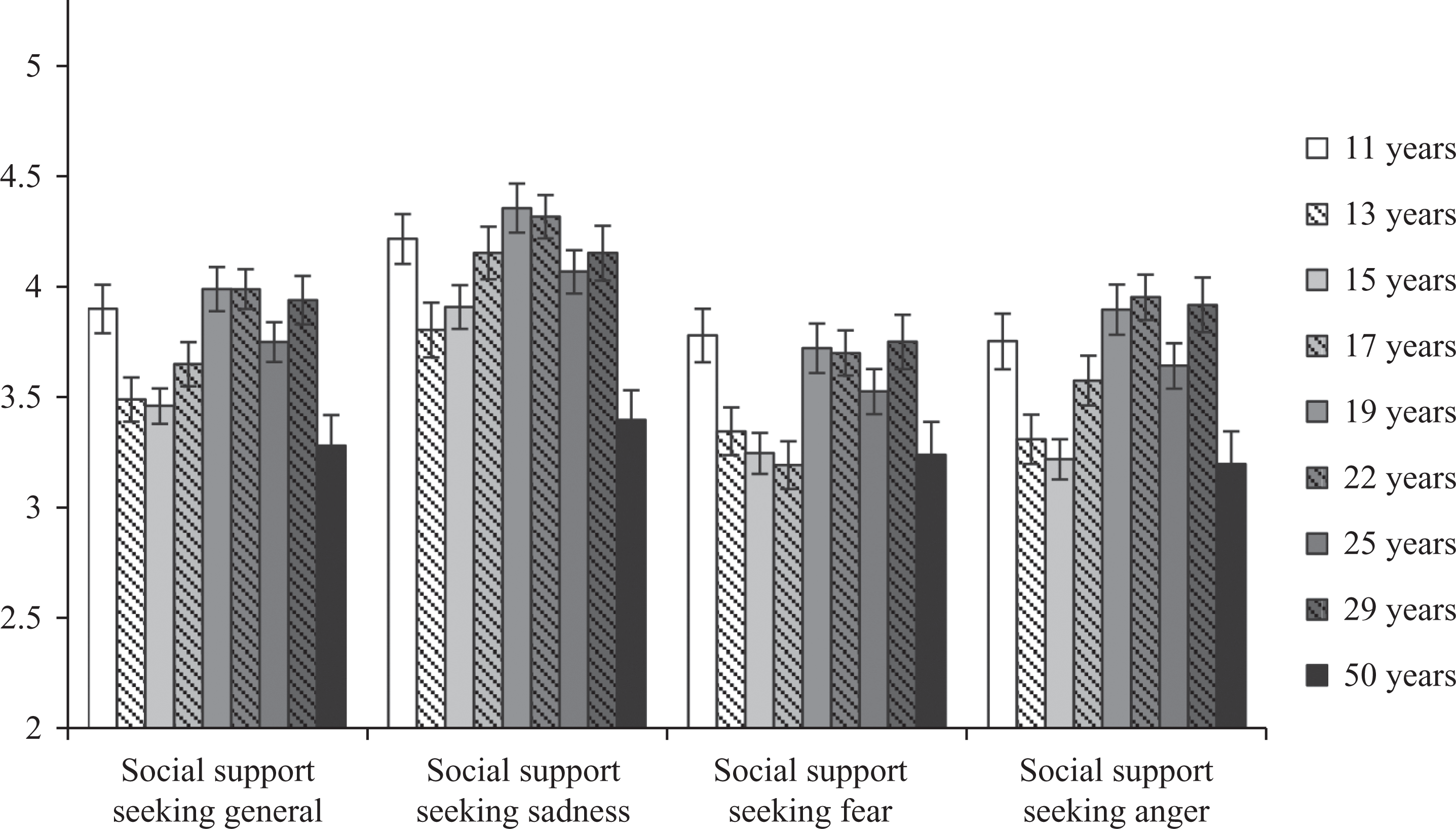
Social support seeking from age 11 to age 50 (means and SE).
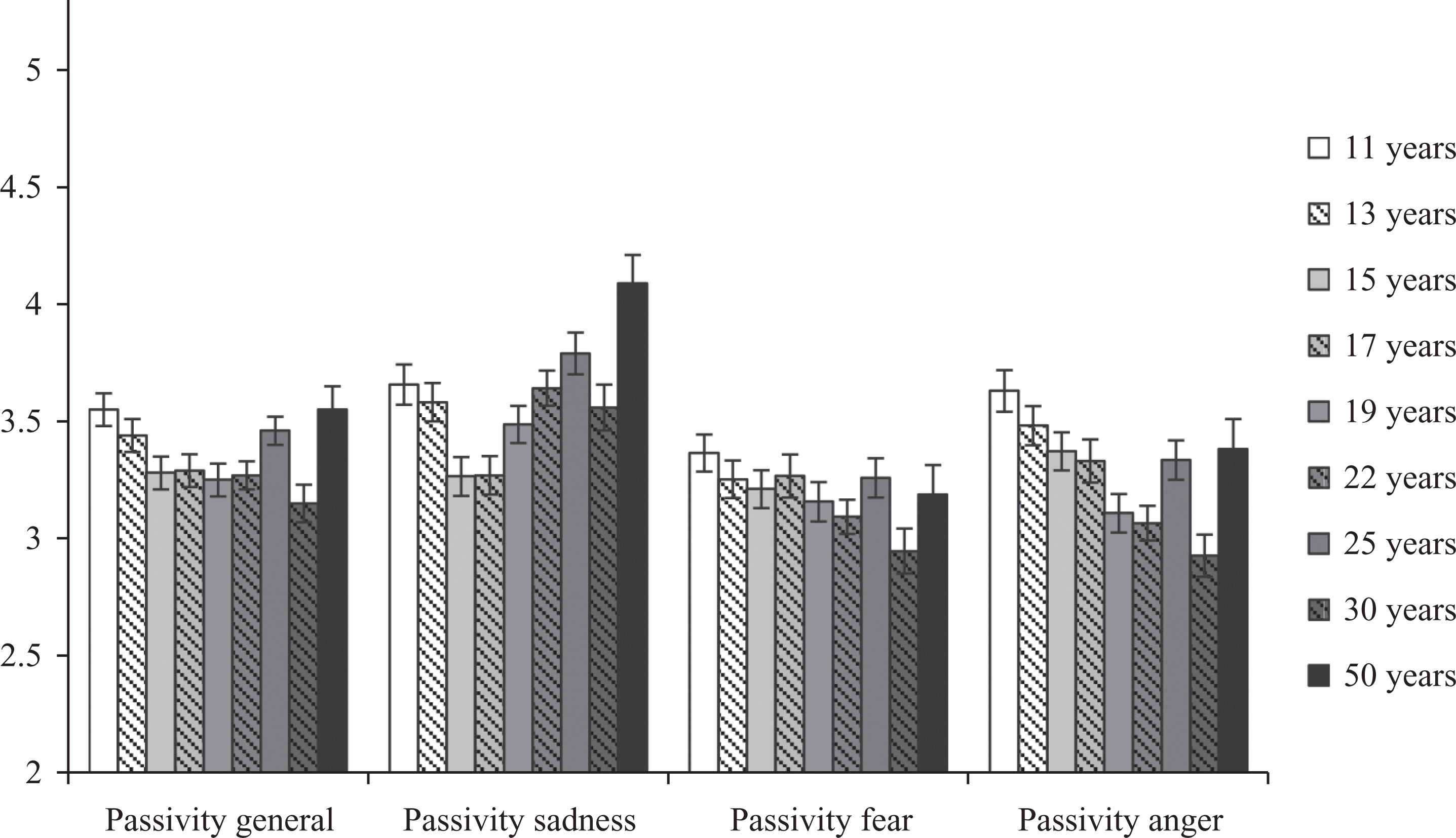
Passivity from age 11 to age 50 (means and SE).
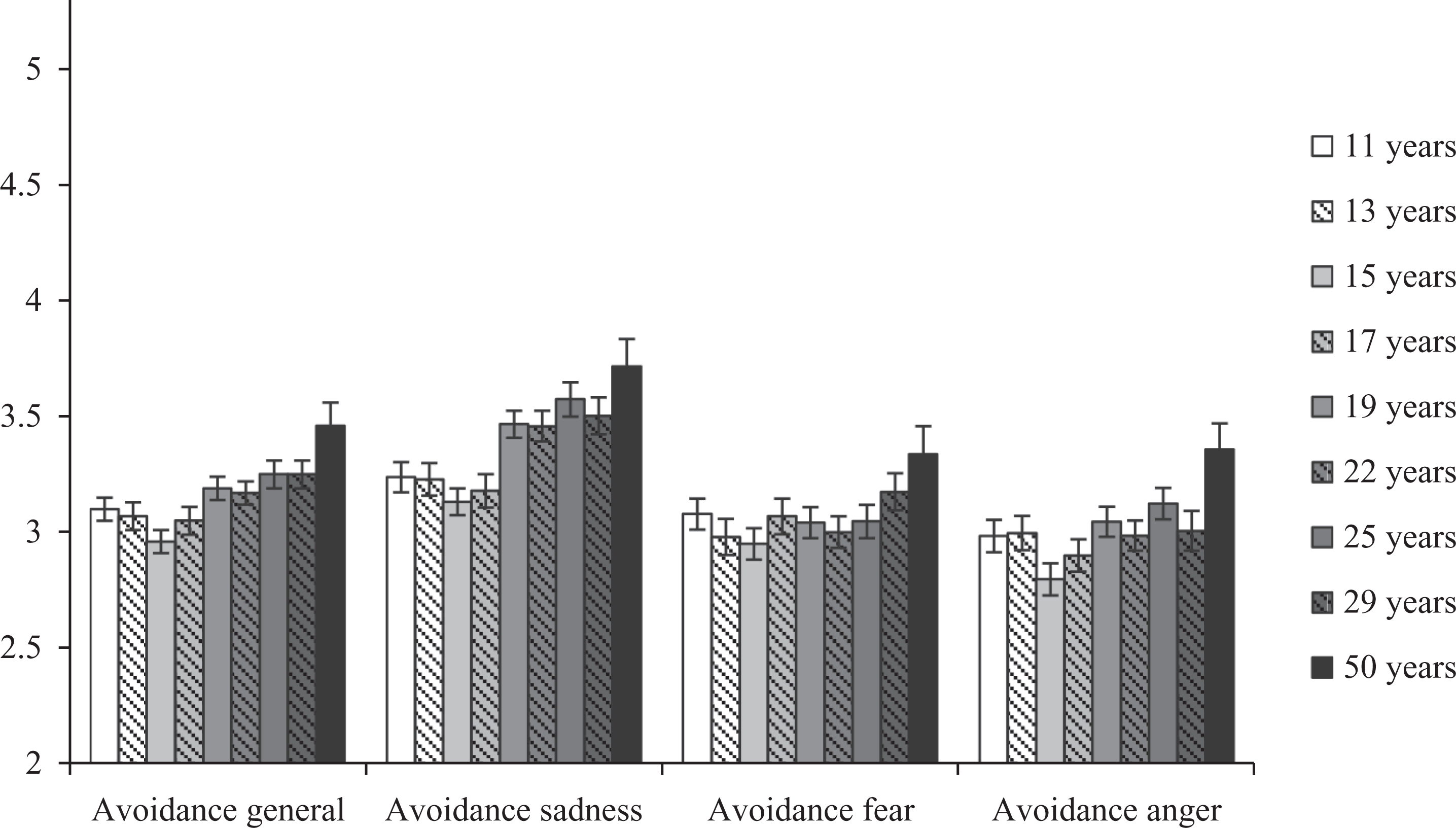
Avoidance from age 11 to age 50 (means and SE).
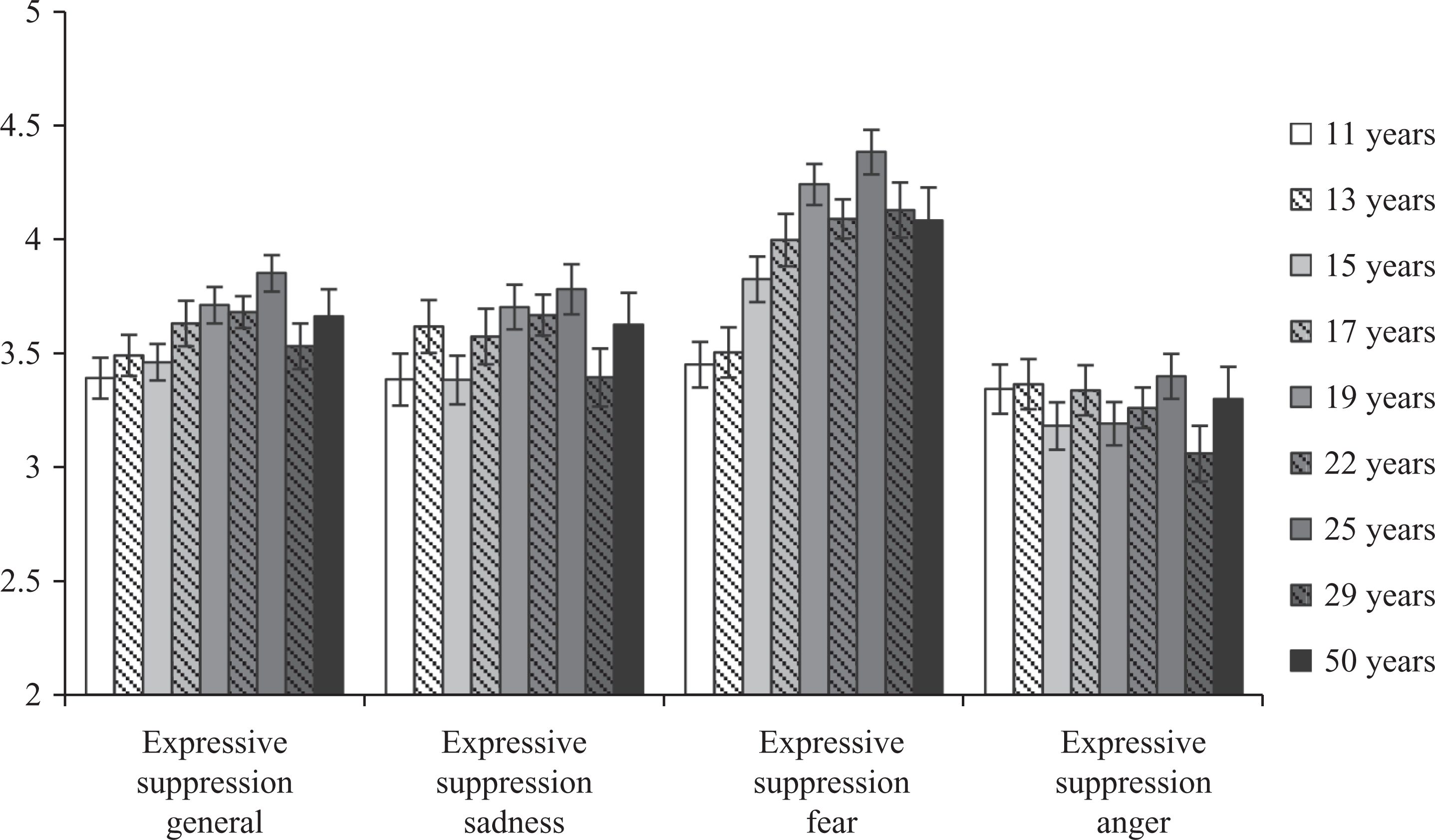
Expressive suppression from age 11 to age 50 (means and SE).

Dysfunctional rumination from age 11 to age 50 (means and SE).
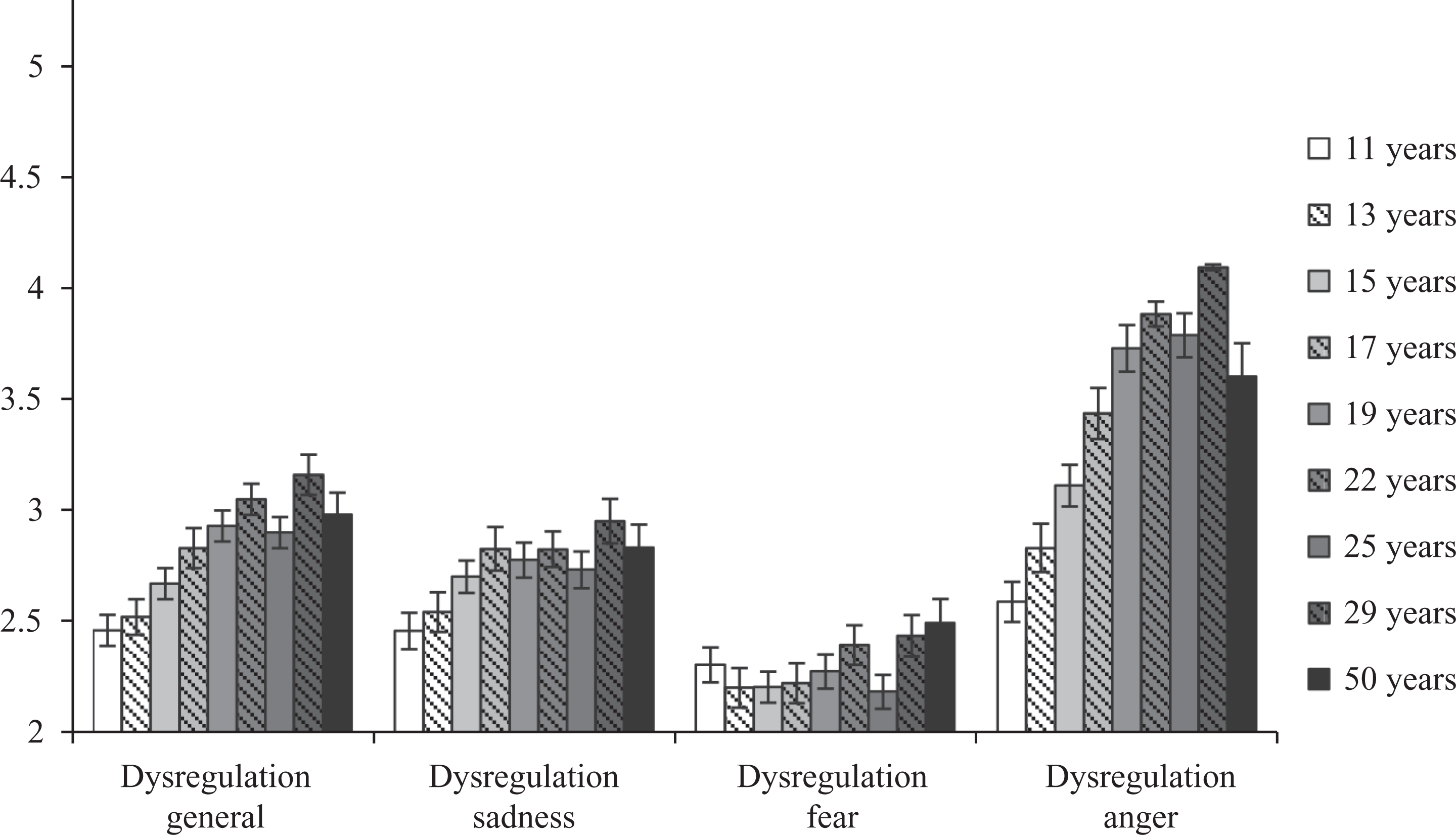
Dysregulation from age 11 to age 50 (means and SE).
Social support seeking – age differences and univariate post-hoc tests (age in years).

Passivity – age differences and univariate post-hoc tests (age in years).

Avoidance – age differences and univariate post-hoc tests (age in years).

Expressive suppression – age differences and univariate post-hoc tests (age in years).

Dysfunctional rumination – age differences and univariate post-hoc tests (age in years).

Dysregulation – age differences and univariate post-hoc tests (age in years).

Emotion-specific age differences in emotion regulation
Next, we tested age changes in all seven emotion regulation strategies for each of the three emotions of sadness, fear, and anger with a MANOVA on strategy use when experiencing sadness, fear, and anger with the between-subject factor age-group, and the within-subject factor emotion (sadness, fear, and anger).
Adaptive emotion regulation
A MANOVA on the use of adaptive emotion regulation strategies experiencing sadness, fear, and anger with the between-subject factor age-group and the within-subject factor emotion (sadness, fear and anger) showed a significant main effect of age (F(8,1246) = 18.86; p < .0001; η2 = .108), no significant emotion effect, and a significant age × emotion effect (F(16,2498) = 4.39; p < .0001; η2 =.029) on adaptive emotion regulation (Figure 1).
For sadness, emotion-specific post-hoc analyses showed a two-step increase in adaptive emotion regulation and a three step developmental increase for fear and anger, showing an emotion dependent developmental sequence for the use of this emotion regulation strategy (Table 2).
Social support seeking
For social support seeking the MANOVA revealed a significant main effect of age (F(8,1246) = 5.47; p < .0001 η2 = .034), a significant emotion effect (F(2,1248) = 155.44; p < .0001 η2 = .121), and a significant age × emotion effect (F(16,2498) = 3.32; p < .0001 η2 = .021) on social support seeking (Figure 2). A post-hoc test revealed that social support seeking was more often reported when experiencing sadness (M = 4.1) than fear (M = 3.5) (F(1,1259) = 319.91; p < .0001; η2 = .200) and anger (M = 3.6) (F(1,1259) = 101.76; p < .0001; η2 = .171) with social support seeking in fear situations being less often reported compared to anger situations (F(1,1259) = 15.95; p < .001; η2 = .013).
Post-hoc analyses for social support seeking revealed a significant decrease in social support seeking during adolescence, followed by a significant increase at emerging adulthood, and followed again by a significant decrease at middle adulthood for all three emotions. However, the developmental sequences differed in an emotion-specific manner regarding what age an increase in social support seeking started again and whether the level of social support seeking remained stable throughout emerging adulthood or even dropped below the level of adolescence in middle adulthood (Table 3).
Passivity
For passivity the MANOVA showed a significant main effect of age (F(8,1248) = 3.20; p = .001; η2 = .020), a significant emotion effect (F(2,1250) = 93.69; p < .0001; η2 = .074), and a significant age × emotion interaction (F(16,2502) = 7.43; p < .0001; η2 = .049) on passivity (Figure 3). Post-hoc tests revealed that passivity when experiencing sadness (M = 3.6) was significantly more often reported (F(1,1259) = 147,42; p < .0001; η2 = .105) than passivity while experiencing fear (M = 3.2) and anger (M = 3.3) (F(1,1259) = 80.1; p < .0001; η2 = .060) with passivity in fear situations being less often reported compared to anger situations (F1,1259) = 12,27; p < .0001; η2 = .010).
Follow-up analyses showed that age differences only appeared for passivity when feeling sad or angry but not for fear. Whereas changes in using passivity when feeling sad followed a U-shaped form from age 11 until 25, the use of passivity when feeling angry gradually seemed to decrease from age 11 until 22 (see Table 4). Exploratory analyses showed that passivity when feeling afraid decreased from early adolescence to adulthood.
Avoidance
The MANOVA for avoidance showed a significant main effect of age (F(8,1257) = 4.06; p < .0001; η2 = .025), a significant emotion effect (F(2,1257) = 133.65; p < .0001; η2 = .095), and a significant age × emotion effect (F(16,2500) = 2.53; p = .001; η2 = .017) on avoidance (Figure 4).
Post-hoc tests revealed that avoidance in sadness situations (M = 3.4) was significantly more often reported (F(1,1258) = 161.56; p < .0001; η2 = .114) than in fear (M = 3.1), and anger situations (M = 3.0) (F(1,1259) = 262.40; p < .0001; η2 = .172) with no significant difference in reported use of avoidance between the latter two.
The results clearly showed that age differences only appeared for avoidance when feeling sad or angry but not for fear. As shown in Figure 4, there seems to be a stepwise increase in the use of avoidance when feeling sad during development with relative mean stability during adolescence and an increase to more avoidance starting in emerging adulthood. For the use of avoidance when feeling angry there was a less clear picture of results. In middle adulthood we found the highest level of avoidance when feeling angry compared to the other age-groups, but only arbitrary age differences for all other age-groups. Exploratory analyses suggest an increase from middle adolescence to middle adulthood for avoidance in fear situations.
Expressive suppression
For expressive suppression the MANOVA revealed a significant main effect of age (F(8,1247) = 2.09; p = .034; η2 = .013), a significant emotion effect (F(2,1249) = 163.28; p < .0001; η2 = .121), and a significant age × emotion effect (F(16,2500) = 5.77; p < .0001; η2 = .039) on expressive suppression (Figure 5). Suppression in sadness-eliciting situations (M = 3.6) was significantly less often reported (F(1,1258) = 99.64; p < .0001; η2 = .073) compared to fear situations (M = 3.9) but more often compared to anger situations (M = 3.3) (F(1,1258) = 79.13; p < .0001; η2 = .059) with a significant difference (F(1,1259) = 318.63; p < .0001; η2 = .202) in reported use of suppression between fear and anger situations.
Age differences in expressive suppression only appeared for sadness and fear but not for anger (Table 6). The results suggest a stepwise increase in the use of expressive suppression when feeling afraid starting at a low level in early adolescence, increasing during middle adolescence, and increasing again to a higher level of expressive suppression starting in emerging adulthood. For sadness the results show fluctuations across adolescence and adulthood with a maximum in use at age 25 only significant different to early adolescence.
Dysfunctional rumination
For dysfunctional rumination the MANOVA revealed a significant main effect of age (F(8,1247) = 2.14; p = .029; η2 = .014), a significant emotion effect (F(2,1249) = 27.31; p < .0001; η2 = .023), and a significant age × emotion effect (F(16,2500) = 5.83; p < .0001; η2 = .034) on dysfunctional rumination (Figure 6). Dysfunctional rumination was significantly less often reported (M = 3.1.7) in sadness-eliciting situations (F(1,1258) = 41.13; p < .0001; η2 = .032) compared to fear (M = 3.33) and anger situations (M = 3.31) (F(1,1258) = 37.54; p < .0001; η2 = .028), with no difference between fear and anger situations.
Table 7 shows that for dysfunctional rumination age differences only appeared for sadness and fear with different developmental patterns. Whereas dysfunctional rumination for sadness seemed to show a stepwise decrease from early adolescence to middle adulthood, dysfunctional rumination for fear is more often reported during middle and late adolescence compared to early emerging adulthood (Table 7).
Dysregulation
Finally, for dysregulation a significant main effect of age (F(8,1247) = 5.72; p < .0001; η2 = .035), a significant emotion effect (F(2,1248) = 621.89; p < .0001; η2 = .379), and a significant age × emotion effect (F(16,2498) = 13.49; p < .0001; η2 = .103) on dysregulation appeared. Dysregulation was significantly more often used in anger situations (M = 3.4) compared to sadness (M = 2.7; F(1,1258) = 500.71; p < .0001; η2 = .285) and fear situations (M = 2.3; F(1,1258) = 1136.03; p < .0001; η2 = .475) with a significant difference in reported use of dysregulation between fear and sad situations (F(1,1258) = 315.26; p < .05; η2 = .201).
Follow-up analyses revealed age differences in dysregulation only for sadness and anger but not for fear. The results suggest a nearly gradual increase in the use of dysregulation when feeling angry every two years starting at a low level in early adolescence until emerging adulthood and a significant decrease at age 50. For sadness, significant differences are more pronounced between early adolescence and late adolescence to adulthood.
Developmental trends in strategy use
Besides the age changes in the use of specific emotion regulation strategies, we wanted to test whether increasing age is associated with a parallel increase in strategy use. For each emotion, we calculated the mean use of all seven emotion regulation strategies as an index for applied repertoire of emotion regulation (i.e., higher scores mean applying more of the seven strategies more typically). We tested the repertoire use of emotion regulation for each emotion controlling for reported emotion intensity as covariate respectively.
For sadness, fear, and anger, the repertoire of reported emotion regulation strategies revealed significant age effects with F(8,1250) = 5.31; p < .0001; η2 = .033, F(8,1250) = 5.37; p < .0001; η2 = .033, and F(8,1251) = 6.49; p < .0001; η2 = .040, respectively. Follow-up analyses with p < .01 showed that adolescents at age 15 reported least use of emotion regulation strategies when experiencing sadness and anger compared to early adolescents (age 11), late adolescents (age 19), and all adult groups. For fear, during middle adolescence (ages 13 and 15) significantly less strategy use compared to all older age-groups was reported. The four adult groups show no significant differences in strategy repertoire. 1
Discussion
Emotion regulation comprehends an array of processes that are relevant for monitoring and controlling emotions in current, anticipated or remembered situations. Even dysregulation is a form of emotion regulation (Cole, Martin, & Dennis, 2004). In this study we intended to measure emotion regulation strategies and not only the report of problem-solving skills independent of emotions. Therefore we assessed and examined the emotions that the participants associate with the presented situations in the questionnaire. The results confirm the emotion-specific validity of the presented situations for all age-groups and the high intensity of negative emotions that they associate with these situations. In addition, the exclusion of participants who reported no emotions associated with these situations enhances the validity of the assessment of emotion regulation strategies and not only of problem-solving strategies that can also be applied and reported without emotions.
Emotion effects on emotion regulation
In this study emotion regulation was associated with the quality and the intensity of the reported emotions. We found that in sadness situations social support seeking, passivity, and avoidance were more often used compared to fear or anger situations. In contrast, when experiencing fear, the use of expressive suppression and rumination was reported more often. Dysregulation and dysfunctional rumination were typically more applied in anger compared to sadness situations. In addition, the emotion intensity ratings were associated with the use of most emotion regulation strategies. These results are in concordance with other studies showing that the intensity and quality of the reported emotions are associated with the use of specific emotion regulation strategies (Rivers, Brackett, Katulak, & Salovey, 2007). Thus, we support a functionalist approach to emotions (Saarni et al., 2006), where the differential preferences of emotion regulation strategies might be an indicator of emotion-specific activation and functionality of emotion regulation strategies.
Moreover, the study revealed age differences in the reported emotional intensity. Thus, age differences in emotion regulation strategies might be confounded with age differences in associated emotional intensity influencing the use of specific emotion regulation strategies. In this case, the assessment of an emotion regulation strategy would not reflect solely the age specific use but also the fact that at certain ages sadness, fear or anger are more intense causing age specific emotion regulation patterns. So, the development of emotion regulation would be a consequence of the development of emotionality. The results of this study clearly reflect age differences in emotion regulation while controlling for the level of reported emotionality. We suggest including the individual’s emotionality as a covariate in studies on the development of emotion regulation in order to detect age-specific emotion regulation differences that are not caused by age-specific differences in emotional intensity. Nevertheless, the differential effectiveness of emotion regulation strategies also depends on the individual’s emotional reactivity (Eisenberg & Spinrad, 2004).
General or emotion-specific development of emotion regulation?
In contrast to infancy and childhood, most studies on emotion regulation during adolescence or adulthood assess emotion regulation as a general trait (John & Gross, 2004). However, as different emotions are characterized by different elicitors and action tendencies (Saarni et al., 2006) emotion regulation may develop in an emotion-specific manner. A central aim of this study was the comparison of general and emotion-specific developmental trends in the use of emotion regulation strategies. This approach offers insights into whether developmental changes for general emotion regulation would be a good estimate of the age differences in emotion regulation that are found for three different emotions: sadness, fear, and anger.
The results clearly support the notion that emotion regulation develops in an emotion-specific manner. Only two of seven assessed emotion regulation strategies, adaptive emotion regulation and social support seeking, show a somehow similar developmental trend for general and emotion-specific emotion regulation. However, also for these two emotion regulation strategies we found emotion-specific developmental changes. Adaptive emotion regulation for fear shows clear differences between the three age periods (adolescence, emerging adulthood, and middle adulthood). In contrast, for sadness only adolescence and adulthood differ from each other. In addition, the decline in adaptive emotion regulation from early adolescence to middle adolescence in the general developmental pattern was only found for sadness and anger but not for fear. For all other emotion regulation strategies the diversity of the emotion-specific developmental patterns is even more obvious. Passivity shows a nearly U-shaped change for sadness, no changes for fear, and a decline for anger regulation from adolescence to emerging adulthood. The increase in expressive suppression for fear from early adolescence to adulthood is in sharp contrast to the changes found for anger and sadness. Thus, the divergent empirical evidence regarding age trends in expressive suppression (John & Gross, 2004; Nolen-Hoeksema & Aldao, 2011) may also result from the diverging emotion-specific development.
We conclude that there is the danger of flawed estimate of the development of emotion regulation during adolescence and emerging adulthood when it is not assessed emotion-specific. Adjusting the use of emotion regulation strategies to specific emotions during development may reflect the adaptive nature of emotion regulation. Depending on age-specific biological, social, or environmental resources, and their age-specifically associated options, goals, and restrictions, emotion regulation strategies vary in functionality for different emotions. Thus, suppression of fear and dysregulation (as up-regulation) of anger may both be adaptive with increasing age, autonomy, and responsibility. Consequently, their use will be adjusted by the individual. From this perspective, the parallel increase of both suppression and dysregulation may not be contradictory but emotion-specific adaptive.
Growth and decline of emotion regulation during adolescence and adulthood
Theorists of a life-span development emphasize the existence of growth and decline in psychological characteristics over time (Baltes et al., 2006). This is already the case during adolescence, obvious in changes in personality or social relationships between early and middle adolescence (Laursen et al., 1998; Soto et al., 2011). The results of the present study show emotion-specific stability, growth, and decline in many emotion regulation strategies during adolescence and adulthood.
This is apparent for social support seeking. Early adolescents’ level of seeking social support in fear situations is comparable to emerging adulthoods’ level but is less often applied during middle adolescence and middle adulthood. Although trust and support seeking are prominent in peer and romantic relationships during middle and late adolescence (Collins, Welsh, & Furman, 2009) this does not seem to compensate for the decline in support seeking during middle adolescence. Romantic and peer relationships may not be stable enough during that age.
Moreover, during middle adolescence, at age 13 and especially at age 15, the total repertoire of emotion regulation strategies is small. There is a decrease in strategy use from early adolescence to middle adolescence to the lowest level of all age-groups. A low repertoire of emotion regulation strategies has been identified as a risk factor for psychopathology (Lougheed & Hollenstein, 2012). A look at the emotion-specific changes reveals that at ages 13 and 15 social support seeking for sadness, fear, and anger declines, adaptive emotion regulation for sadness and fear declines, passivity for sadness decreases, whereas suppression in fear situations and dysregulation in anger situations increase; only dysfunctional rumination remains stable. During middle adolescence, youths seem to reorganize their emotion regulation strategy use leading to less individual and social emotion regulation. At the same time they present themselves to their social environment as not being affected by fear (by expressive suppression) and are quickly blaming others when feeling angry. These changes in emotion regulation strategies leave them more vulnerable compared to early and late adolescence and might explain the parallel findings of increased emotional instability and neuroticism especially during middle adolescence (Soto et al., 2011) and an increased rate of psychopathology (Silk et al., 2003). The emotional difficulties and increased conflicts with parents that are reported in middle adolescence (Laursen et al., 1998) may also be the result of a diminished repertoire of emotion regulation strategies. Whether this is associated with parallel hormonal changes or changes in brain functioning (Somerville et al., 2010) needs further examination.
Emerging adulthood has been described as prolonged adolescence (Arnett, 2001) and similar to the emotion regulation pattern found for adolescents, the emerging adults in this study are also characterized by high dysregulation of anger, by suppression of fear, and additionally by high passivity and avoidance when feeling sad. However, in contrast to adolescents they report more social support seeking and more adaptive regulation. Thus, they have a higher competence in their individual and social emotion regulation, eventually associated with the successful completion of developmental tasks of establishing stable relationships (Roisman et al., 2004) that makes them more emotionally stable compared to middle adolescents (Soto et al., 2011).
There is increasing evidence that emotion regulation with growing age is more selective and effective (Carstensen et al., 2003). Indeed, we found that middle adulthood, compared to emerging adulthood, is characterized by increased adaptive emotion regulation for fear and anger. However, this is paralleled by increased avoidance when feeling angry, more passivity when feeling sad, and less seeking of social support when feeling sad and angry. Following the idea by Carstensen and colleagues (2003) these results suggest that middle-aged adults adapt their strategies based on experiences and their current life situations. Sadness eliciting situations are associated with loss and for these situations passivity can represent an accepting strategy (Blanchard-Field & Coats, 2008). Similarly, avoidance in anger eliciting situations can be effective for a short time. However, the reduction of social support seeking in middle adulthood may be the result of a reduction of the social network. Additional studies may be necessary to test whether this is intentional and adaptive or whether the reduction in the use of one’s social network may be a possible risk mechanism for that age-group.
The gender effects in emotion regulation in this study are in line with previous research (Silk et al., 2003; Tamres, Janicki, & Helgeson, 2002). Female participants reported more social support seeking and dysfunctional rumination and male participants reported more passivity, avoidance, and suppression. The empirical evidence for gender differences in suppression is more diverse (Nolen-Hoeksema & Aldao, 2011). Interestingly, we did not find gender differences in adaptive emotion regulation similar to results reported for reappraisal (John & Gross, 2004). Some authors suggest that gender differences may result from differences in emotional reactivity and regulation based on brain processes (Domes et al., 2010) or expressiveness (Chaplin & Aldao, 2013). However, this might not explain gender differences in this study because emotional intensity has been controlled. In future studies the long-term effects of socialization of gender differences in emotion regulation that are reported already for childhood (Saarni et al., 2006) should be examined more closely.
The study clearly has limitations that need to be considered in the interpretation and generalization. Social desirability or poor introspection may diminish the validity of the assessment of emotion regulation by self-report. Self-reports may not be consistent with the actual behavior in the same situations. Thus, there is the possibility that we assess perceived emotion regulation and not real strategy use. In addition, the cross-sectional nature of the study does not allow controlling the possibility of a confounding of age and cohort. This may especially be relevant when comparing middle aged adults and adolescents. Including external reports on emotion regulation and a longitudinal design will offer more complete evidence for the developmental trends in emotion regulation across that long age-period. Besides assessing the changes in use of emotion regulation strategies, the age specific effectiveness of strategies should be explored in future studies. For all age-groups, emotion regulation strategies may also be influenced by factors like personality (John & Gross, 2004), attachment or genetic differences (Zimmermann, Mohr, & Spangler, 2009) that need to be examined in more detail. Finally, the results presented here come from a western, industrialized country and may not be replicated in other countries or cultures (John & Gross, 2004; Scharf & Zimmermann, 2009), suggesting the need for cross-cultural replications of these findings.
Despite these limitations, our study suggests that emotion regulation develops in an emotion-specific manner differently and in line with a life-span perspective including stability, growth, and decline in general and emotion-specific use of emotion regulation strategies. Research on general development of emotion regulation either over- or underestimates the emotion-specific developmental trends. From middle adolescence to emerging adulthood up to middle adulthood the use of adaptive emotion regulation strategies continuously increases parallel to an increasing repertoire of emotion regulation strategies. However, emotion-specific developmental trends in the use of emotion regulation clearly seem to be more the rule than the exception.
Footnotes
Funding
This research received no specific grant from any funding agency in the public, commercial, or not-for-profit sectors.