



Abstract
The aim of the present study was to examine differences in emotion expression and emotion regulation in emotion-eliciting situations in early adolescence from a bio-psycho-social perspective, specifically investigating the influence of early mother-infant attachment and attachment disorganization on behavioural and adrenocortical responses. The sample consisted of 96 children of the Regensburg Longitudinal Study IV. At age 12 months, attachment security and disorganization were assessed in the Strange Situation. At age 12 years, the adolescents were observed together with their mother during a computer game (eliciting anger) and the “Talk Show Task” (eliciting fear). Analyses included self-ratings and mother-ratings of the adolescents’ emotions (anger and fear), observations of the adolescents’ emotional expression and emotional regulation (social regulation, effective regulation) as well as concurrent maternal emotional support. In addition, adrenocortical activity was assessed from saliva samples before and after observation. The findings revealed different patterns of social-emotional responses depending on early attachment security. Adolescents with secure infant attachment reported more anger, when anger was induced, were rated as less anxious by their mothers, and their emotion self-ratings were more similar to their mothers’ ratings compared to adolescents with an early insecure attachment. An increased adrenocortical response was only found in the group of adolescents with attachment disorganization in infancy, especially with increased fear.
In his conception of attachment theory, Bowlby (1969) emphasized the child’s protection as the biological function of the attachment relationship, while the psychological function of attachment refers to felt security (M. S. Ainsworth, 1989; Sroufe & Waters, 1977), and emotion regulation (see Zimmermann, 1999). In the first months of life, infants are very restricted in their emotional self-regulation and are reliant on the caregiver’s external regulation and organization (Spangler, Schieche, Ilg, Maier, & Ackermann, 1994). However, with development, the infants themselves increasingly contribute to their emotion regulation by acquiring and refining individual and social emotion regulation strategies. Autonomous emotion regulation and self regulation becomes more prominent with increasing age (Sameroff, 2010). However, individual differences in emotion regulation may remain throughout the life-span and, in part, are influenced by socialization and attachment.
Based on a transactional developmental model, attachment theory postulates that attachment in infancy and childhood influences adaption when children are confronted with later stage-salient issues (Bowlby, 1980; Cicchetti, Toth, Bush, & Gillespie, 1988; Sroufe & Waters, 1977). This has been shown empirically, especially for disorganized attachment for preschool, middle childhood, and adolescence with moderate but replicated associations, for example, regarding externalizing behavior or internalization of rules (Fearon, Bakermans-Kranenburg, van IJzendoorn, Lapsley, & Roisman, 2010; Kochanska et al., 2010; Zimmermann & Grossmann, 1997).
However, the effects of early attachment are not found in every domain and in all situations in later development (Kochanska & Kim, 2012; Zimmermann & Grossmann, 1997). As the attachment system is a security regulation system (Bowlby, 1980) that is elicited in situations inducing intense negative emotions, as it is the case in the strange situation procedure, the effects of infant attachment on later adaptation mainly may be observable in comparable situations in which the individual’s emotion regulation capacities are intensly challenged or overwhelmed. This was obvious in the Regensburg longitudinal study I where infant attachment only predicted cooperation (i.e., proximity) or disruptive withdrawal (i.e., avoidance) at age 16 when the adolescents experienced negative emotions (e.g. helpless, or insecure) induced by the task. If no intense negative emotions were elicited, no attachment-related differences in behavior appeared (Zimmermann, Maier, Winter, & Grossmann, 2001).
Attachment as emotion regulation
From that perspective, infant attachment as assessed in the strange situation (M. D. S. Ainsworth, Blehar, Waters, & Wall, 1978) can be interpreted as a first form of a specific organized emotion regulation pattern in reaction to the caregiver with specific social or individual emotion regulation strategies in contact with the caregiver when the attachment system is activated (Zimmermann et al., 2001). Differences in the quality of attachment can be described with respect to attachment security and attachment disorganization, which in infancy are commonly assessed by the strange situation. Depending on the infants’ behavioral strategies in the context of separation from and reunion with the attachment figure, infants are classified as securely attached, insecure-avoidantly attached, or insecure-resistantly attached. Securely attached infants use the caregiver as a secure base for exploration, show emotional concern and attachment behaviour after separation, and are able to gain their emotional stability again by establishing proximity or contact with the attachment figure. Thus, they use an effective social emotion regulation strategy in interaction with the caregiver. In contrast, infants with an insecure-avoidant pattern hardly show emotional concern or attachment behaviour during separation and avoid proximity upon reunion, masking their emotional expression despite high arousal and physiological stress (Spangler & Grossmann, 1993). This can be interpreted as ineffective individual emotion regulation, as the suppression of their emotional expression does not regulate their negative emotions. Insecure-resistantly attached infants are intensely distressed by the separation, and show ambivalent behaviour towards the caregiver after reunion. They are not able to re-establish emotional security and decrease their emotional arousal despite close proximity to the caregiver. Their emotion regulation pattern is social but ineffective. In children classified as disorganized regarding attachment (Main & Solomon, 1990) the core characteristic is the absence or a breakdown of a coherent attachment strategy in coping with the emotional challenge caused by the separation from the mother. In many disorganized infants, an underlying but not complete secure or insecure attachment pattern can be observed. Thus, attachment security and disorganization are regarded as two orthogonal and conceptually different behavioral dimensions of attachment by Main and Solomon (1990; see also Spangler & Grossmann, 1999). The ineffective emotion regulation of infants with insecure or disorganized attachment can also be shown at the biological level, especially in the reactivity of the adrenocortical system (Bernard & Dozier, 2010; Hertsgaard, Gunnar, Erickson, & Nachmias, 1995; Nachmias, Gunnar, Mangelsdorf, & Parritz, 1996; Spangler & Grossmann, 1993).
The influence of attachment experiences on emotional regulation even beyond the parent–child dyad and at later periods of development is explained by internal working models of attachment (Bowlby, 1969; Bretherton & Munholland, 2008; Zimmermann, 1999) that are based on caregiving experiences with the attachment figures. They include emotional and motivational characteristics as well as cognitive knowledge and scripts about when and how to show attachment behaviour, the availability of attachment figures, their expected reaction when displaying distress, and about the self as being worthy or unworthy of love. Internal working models of attachment are substantially involved in behavioural organization and emotional regulation (Bowlby, 1980; Cassidy, 1994; Zimmermann et al., 2001) and tend to stabilize over time. There is plenty of longitudinal evidence that these early attachment patterns are based on experiences of maternal sensitive responding to infants’ expression of needs and emotions (e.g. M. D. S. Ainsworth et al., 1978; Grossmann, Grossmann, Spangler, Suess, & Unzner, 1985), and are predictive of processes of emotional expression and regulation in toddlers (e.g. Matas, Arend, & Sroufe, 1978; Schieche & Spangler, 2005), and preschool children (Erickson, Sroufe, & Egeland, 1985; Lütkenhaus, Grossmann, & Grossmann, 1985; Suess, Grossmann, & Sroufe, 1992; see Thompson, 2008). Also at later age, in middle childhood or adolescence, there is evidence for concurrent associations between attachment security or attachment disorganization and characteristics of emotion expression, and regulation (Allen, Porter, McFarland, McElhaney, & Marsh, 2007; Kobak, Cole, Ferenz-Gillies, Fleming, & Gamble, 1993; Zimmermann, 1999; Zimmermann, Mohr & Spangler, 2009).
The existing evidence of attachment influences on emotion expression and emotion regulation in adolescence is mainly based on concurrent and not on longitudinal studies. In addition, many studies use using representational assessment procedures for attachment (e.g. story stem procedure, and child or adult attachment interviews) and no behavioural attachment assessments (e.g. separation-reunion paradigms). While there are many indicators for the validity of representational attachment procedures, there is only modest evidence for longitudinal stability between the two types of assessment from early infancy to adolescence (Becker-Stoll, Fremmer-Bombik, Wartner, Zimmermann, & Grossmann, 2008; Groh et al., 2013; Lewis, Feiring, & Rosenthal, 2000; Waters, Merrick, Treboux, Crowell & Albersheim 2000; Weinfield, Sroufe, & Egeland, 2000; Zimmermann, Fremmer-Bombik, Spangler, & Grossmann, 1997).
One of the reasons for this missing concordance may be that different levels of the organization of attachment are assessed during the different developmental periods. While in the strange situation attachment is assessed in terms of specific behavioural strategies when the attachment system is activated by eliciting fear and sadness, the assessment of attachment using the Adult Attachment Interview (George, Kaplan, & Main, 1996) provides patterns based on the coherence of the report and the evaluation of one’s attachment history (Zimmermann, 1999). Thus, beside the long time-span from infancy to adolescence there is a confounding of age and level of assessment, testing heterotypic continuity. Attachment patterns assessed at the behavioural level in negative emotion eliciting situations like in the separation-reunion paradigms constitute social interactive emotion regulation patterns with the caregiver. Predicting later social interactive emotion regulation in situations that elicit intense negative emotions from infant attachment patterns might also reflect an aspect of continuity of attachment over time (Zimmermann et al., 2000) in the sense of coherence over time (Sroufe, 1989). Such an approach comes closer to homotypic continuity as it compares similar behaviours or phenotypes across age periods (Caspi & Roberts, 2001). Thus, age-appropriate interaction situations, which challenge the adolescents’ emotion regulation capacities, offer the possibility to observe social emotion regulation with the caregiver where the attachment system comes into play.
Attachment effects on different assessment levels of emotion regulation
A comprehensive assessment of emotional processes necessarily includes different levels of assessment of emotions and emotion regulation, including psychological characteristics (e.g. subjective experience as feelings, expressive/communicative behaviours) as well as biological markers of the effectiveness of emotion regulation processes (that is, cortisol).
Bowlby (1969) suggested in concordance with many emotion theorists that emotions are phases enabling a person to immediately evaluate a given context and to activate behavioural strategies to cope with the situation. In addition to this internal function, the expression of emotions serves the social function of informing conspecifics about one’s own emotional state and to gain external support for emotion regulation (relational function, Campos, Campos, & Barrett, 1989; Coan, 2008). While the child’s or adolescent’s feelings (subjective experience) in a given context represent the affective component of emotion, the emotional expression can be observed in mimic responses or verbal communication indicative of the underlying emotions. The social function of emotions brought about by emotional expression depends on the perception of emotional expression by the caregiver.
There is empirical evidence that attachment patterns predict the concordance between the adolescents’ self-reports of own problems, symptoms, or negative emotions and the perception of other persons like parents, peers or independent observers. In self-reports, adolescents with insecure attachment representation often present themselves more positive, less distressed, and as suffering from fewer symptoms than they are described by parents or close friends (Berger, Jodl, Allen, McElhaney, & Kuperminc, 2005; Kobak & Sceery, 1988; Zimmermann, Gliwitzky, & Becker-Stoll, 1996). In addition, these adolescents show low concordance between their self-report on their current emotional states and their concurrent emotion expression either observed (Zimmermann et al., 2001) or assessed by electromyogram (EMG) (Spangler & Zimmermann, 1999). Thus, their communication of emotions in interactions is either restricted or they have difficulties in accessing their emotions or answer with social desirability.
In this study, we applied the conception of infant attachment patterns as emotion regulation patterns differentiating between social or individual and effective or ineffective regulation to adolescence. Likewise, for adolescents emotion regulation in interaction situations can be social (e.g. by signalling one’s emotions to others) or individual (e.g. by avoiding the situation, allocating attention away from the elicitor). In addition, the effectiveness of emotion regulation can be observed by assessing the duration of the emotion after the regulation strategy or can be derived from physiological responses (e.g. cortisol).
Aims of the study
The main objective of our study was to investigate influences of early attachment on emotional processing and regulation in early adolescence. The assessment of emotion and emotion regulation was accomplished in two different emotion-inducing situations (induction of anger and fear) and included the adolescent’s emotional expression and feelings, the perception of their emotions by their mothers, and the adolescent’s efforts of social emotion-regulation and the effectiveness of these emotion regulation strategies. In addition, the adolescent’s adrenocortical activity offers additional insights in the effectiveness of emotion regulation.
Regarding emotional expression and feelings, we expected that adolescents with early secure attachment would report their negative feelings more openly and in higher concordance with their mothers than those with early insecure attachment. We also expected that adolescents with a secure infant attachment history would communicate their negative feelings through directed expression of negative emotions as a form of social emotion-regulation. In addition, we expected an effect of infant attachment on the effectiveness of emotion regulation.
Maternal emotion ratings are expected to provide valid information about the adolescent’s current emotional state. Although we expected that all adolescents will experience increased negative emotions induced in the experimental situations, we assumed that depending on differences in the effectiveness of emotional regulation, lower maternal ratings of adolescents’ negative emotions should be expected in the group with secure infant attachment history.
According to Gunnar and Adam (2012), adrenocortical reactivity can be used as a physiological parameter of emotional regulation processes specifically in adolescence. From the psychobiological coping model, we would expect an increase of adrenocortical activity in insecurely attached adolescents during the emotion eliciting situations (see Spangler & Grossmann, 1993). However, as insecurely attached adolescents in contrast to adolescents with attachment disorganization in infancy may apply more individual emotion regulation strategies, the adrenocortical reactivity in the adolescents with attachment disorganization may be more intense.
Method
Participants
The current study was conducted as part of the 12-year longitudinal follow-up assessment of the Regensburg Longitudinal Study IV, a sample of, originally, 106 healthy German, Caucasian, low-risk infants (53 girls/53 boys), first assessed at 12 months of age. At the 12-year assessment, a total of 96 participants (49 girls/47 boys) and their mothers could be seen again. According to maternal education assessed at follow-up, the families represent a fairly wide range of socioeconomic status, including 28% high school education (including university entrance certificate), 33% medium-secondary school certificate, and 39% lower-secondary education (most of them with additional vocational training).
The complete data set for this report was not available for all subjects due to missing values (see Table 1). Missing values occurred because of inadequately filled in rating questionnaires, technical problems of video tapes in observational analyses and insufficient amounts of saliva for cortisol analyses. Due to the missing values sample size is somewhat reduced in the specific statistical analyses.
Descriptive statistics of the adolescent measures.

Procedures
At the age of 12 months, the infants were observed during the strange situation, a 20-minute situation involving a sequence of episodes which progressively activates the attachment system by an unfamiliar environment, the arrival of a stranger and two brief separations from the mother (M. D. S. Ainsworth et al., 1978). At the age of 12 years, adolescents and their mothers were invited to the university. After obtaining informed consent from the parents, the adolescents were interviewed to assess their attachment patterns. Afterwards, the adolescents and their mothers participated in two standardized interaction tasks designed to induce negative emotions (anger and fear), first a dyadic computer game (anger elicitation) and afterwards the dyadic “talk show” (fear elicitation).
Computer game (anger elicitation)
The dyadic computer game is a modification of a task used in adolescent aggression research to successfully induce anger (De Castro, Slot, Bosch, Koops, & Veerman, 2003). Both mother and adolescent together play a jump-and-run game with the aim to free a princess (“Esmeralda”) by controlling the play figure (“Quasimodo”) through several levels. The adolescent has two keys to play the game, the mother one key. Both were instructed about the game and asked not to press the “ESC-Key” (which was situated near both partners keys), because this led to a game crash. After a short exercise phase, both mother and adolescent played a manipulated version, in which shortly before successfully reaching the aim, the game stops with a sound announcing a game crash because the “ESC-Key” has been pressed. The adolescents’ behaviour was coded regarding emotion expression, and emotion regulation before and after the manipulated game crash. All analyses were carried out by independent and reliable coders using a standardized observational system.
Talk show (fear elicitation)
The dyadic “talk show” situation (Zimmermann et al., 2009) was designed to induce primarily fear by creating an age-appropriate social evaluative context, and to offer a context where parent-adolescent interaction and cooperation can be observed. Social evaluation is a major elicitor of fear in adolescence (Adrian, Zeman, & Veits, 2011; Westenberg, Gullone, Bokhorst, Heyne, & King, 2007). The talk show is divided into a preparation phase and a presentation phase. First, participants were informed that the mother had to interview the adolescent on personal topics in front of a public audience, and that they will be video-taped during the presentation. In the preparation phase, mother and adolescent had 10 minutes to develop and write down six personal topics which would characterize the adolescent best during the public presentation. Both mothers and adolescents could make suggestions and discuss them for the final list of questions. In the performance phase of the talk show, the adolescent was interviewed by the mother in front of a small audience and a video camera. The notion of the adolescent being under social evaluation was emphasized in the instructions to ensure the emotional impact of the situation. The 10 minutes of the preparation phase were videotaped and coded for adolescent attachment and autonomy behaviours, specifically indicating emotional expression, emotional communication, and emotion regulation. The Talk-Show Task is primarily designed to make adolescent’s attachment behaviour and emotion regulation in the parent–adolescent dyad observable. In contrast, other social-evaluative procedures (e.g. TSST, Kirschbaum, Pirke, & Helhammer, 1993) have the goal to globally induce stress independent of the participant’s specific emotion, emotion regulation, or attachment behaviour. All analyses were carried out by independent and reliable coders using a standardized observational system.
Measures
12 months attachment security and disorganization
The quality of infant-mother attachment was analysed by trained observers from the strange situation video tapes using the procedures described by M. D. S. Ainsworth et al. (1978) for the traditional ABC classification, and by Main and Solomon (1990) for the D-classification. Reliability was 90% (kappa = .87) for attachment security and 81% (kappa = .63) for disorganization. In case of disagreement, conference scores were used (for further details see Spangler & Schieche, 1998). Among the 96 subjects included in the 12-year assessment, infant attachment was secure in 61 cases and insecure in 32 cases (18 avoidant, 14 ambivalent). Moreover, infant attachment was disorganized in 23, and non-disorganized in 73 cases.
12-year measures of emotion expression and emotion regulation
The analysis of the 12-year emotion assessments included emotion expression, observed emotional regulation, and self-reported emotions during both tasks.
Emotion expression
In each of the two emotion induction situations, adolescents’ negative emotions were coded by means of an event-based coding system from their facial and verbal expressions of fear (including lower intensity level expressions, that is, uneasiness and discomfort), anger, and sadness. Inter-rater reliability was good (kappa = .75). In the talk show (fear induction), the frequency of fear expressions during the preparation phase was included for this analysis. For the computer game (anger elicitation) the frequency of anger expressions was coded during the complete task including the number of anger expression before and after the manipulated game crash.
Emotion regulation
Emotion regulation was assessed by coding behaviours that modulate or change the emotional arousal of the adolescent. This is in line with widely-used definitions of emotion regulation (Thompson, 1994). The coding separates the observed frequency or intensity of the emotion from the emotion regulation process (Cole, Martin, & Dennis, 2004). Two different emotion-regulation dimensions were assessed. The first dimension differentiates the person who regulates (social vs. individual emotion), the second dimension the effectiveness of the regulation (effective vs. ineffective reduction of emotion intensity). The coding is similar to the approach used by Buss and Goldsmith (1998), who separately assessed emotion regulation strategy and emotion expression after strategy use. Thus, each negative emotional event was coded regarding social or individual emotion regulation and regarding effective or ineffective emotion regulation. Social emotion regulation was coded each time the negative emotion was signalled or communicated directly towards the mother, addressing her verbally, visually, or physically by proximity-seeking. Individual emotion regulation was coded each time a negative emotion appeared and then the adolescent looked away from the caregiver, did not address her verbally or physically, or looked in mother’s direction only when mother looked away and no eye-contact was established. Each emotion regulation behaviour was coded as either effective when the adolescent’s emotion was reduced in intensity or no longer was expressed after a time interval of maximum 7 seconds, starting with the beginning of the emotional expression, followed by the emotion regulation strategy (e.g. turning to mother), and then coding the intensity of negative emotion afterwards. Emotion regulation was coded as ineffective if the duration of the negative emotion lasted longer. The time interval was chosen based on preliminary analyses of the video-tapes. The coding separates pure emotion expression as a symptom of emotion from intentional emotion signalling as appeal (Scherer, Mortilaro, & Mehu, 2013).Thus, each negative emotional event of the adolescent received two codes, one regarding the direction of emotion regulation and one regarding the effectiveness.
For the current analysis, we used the relative frequency of social and effective emotion regulation on all emotion regulation events (that is, dividing the frequency of the of social or effective emotion regulation events by the total number of all emotion regulation events). The proportion of social emotion regulation indicates the percentage of all negative emotions regulated by referring to the mother. The proportion of effective emotion regulation indicates the percentage of negative emotions that are reduced in intensity by either social or individual emotion regulation.
Self-reported emotions
Three-times during the assessment, the adolescent and their mothers were asked to rate the adolescent’s feelings by using a list of emotional adjectives and to rate the intensity of experienced feeling (child) or perceived feeling (mother) on a 7-point scale (from 1 indicating no specific emotion, to 7 indicating high intensity of the emotion). The emotion self-rating scales have already been used in earlier studies with adolescents and adults (e.g. Zimmermann et al., 2001) and show good internal consistency. The emotion ratings took place immediately after the computer game (anger elicitation) as well as after the preparation phase of the talk show (that is, before the performance phase) and after performance. The total anger ratings are calculated as mean scores of the single ratings of the emotional states anger and fury. The total fear scores were calculated as the mean of the single ratings of fear, uneasiness, and tension. The following measures were derived from the emotion ratings: adolescent’s self-rated and mother-rated anger after anger elicitation (computer game) and adolescent’s self-rated and mother-rated fear after fear elicitation (mean scores of ratings after the preparation and the presentation phase).
12-year assessment of maternal emotional support
Maternal emotional support during the talk show preparation phase was analysed by means of four nine-point scales: sensitivity, patience and emotional warmth, emotional motivation, and acceptance vs. devaluation. The scale “sensitivity,” derived from Ainsworth’s sensitivity scale (M. D. S. Ainsworth et al., 1978), describes the mother’s tendency to perceive and appropriately interpret the adolescent’s expression of emotion, and to promptly and adequately respond to them. The scale “patience and emotional warmth” describes the general tendency of the mother to be patient with the adolescent’s verbal contribution, to respond warmly and friendly, specifically to the adolescent’s contradictory and autonomous remarks to mother’s suggestions. The scale “emotional motivation” describes the mother’s tendency to adequately motivate the adolescent, to try to provide or facilitate fun and pleasure during the task. The scale “acceptance vs. devaluation” describes the mother’s tendency to accept vs. devaluate the adolescent in reacting to his/her suggestions, comments, and non-verbal behaviour during preparation of the talk show (fear elicitation). Ratings for these scales were done by two independent observers who were not involved in adolescent behaviour analyses. The scales were applied separately for each of three consecutive 3-minute intervals of the preparation phase. Reliability for the maternal scales was calculated by using Cohen’s kappa. Reliability for the scales (based on 31 to 40 intervals of different subjects) was .86, .87, .78, .83 for sensitivity, patience and emotional warmth, emotional motivation and acceptance vs. devaluation, respectively. For each scale, a mean score of the scores of the three intervals was calculated. The final score of emotional support is the mean of the four subscales.
12 year assessment of adrenocortical activity
The cortisol response was assessed from saliva. To collect saliva, the adolescents were asked to place a cotton roll into their mouth and to keep it until it was saturated. Saliva samples were collected immediately at the beginning of the laboratory assessment and before and after the emotion induction situations. All saliva samples were frozen until being assayed to −20 oC after the end of the assessment procedure. Cortisol analyses were conducted at the Department of Psychology at the Technical University of Dresden (Prof. Clemens Kirschbaum). After thawing, salivettes were centrifuged at 3,000 rpm for 5 min, which resulted in a clear supernatant of low viscosity. Salivary concentrations were measured using commercially available chemiluminescence-immunoassay with high sensitivity (IBL International, Hamburg, Germany).The intra and inter-assay coefficients for cortisol were below 8%. The present analysis includes the assessments before and after the emotion inducing situations. To control for extreme values, the cortisol scores were log-transformed. For correlational analyses, delta cortisol was calculated by subtracting the cortisol score before from the cortisol score after the situation. As there was a standardized time schedule, the time difference between the two measures was comparable (about 75 min) and therefore had not to be controlled for.
Due to the circadian rhythm of cortisol daytime of assessment has to be considered. The majority of assessments (76%) were conducted in the afternoon (starting between 13.00 and 17.00), 23% were conducted in the morning (starting between 9.00 and 12.00), one assessment was conducted in the evening (19.00). To control for circadian influences, all analyses resulting in significant associations with cortisol were repeated with controlling for daytime of assessment as a covariate. This did not result in substantial changes of the results in any analysis.
Overview of measures and statistical analyses
In sum, the independent measures or predictors in this study were two measures of infant attachment, attachment security (secure vs. insecure) and attachment disorganization (D vs. non-D) and observed maternal emotional support at age 12 years. The dependent measures included the adolescents’ anger and fear independently rated by the adolescents and their mothers and observed in expressive behaviour, the adolescents’ emotional regulation (social regulation, effective regulation) as well as their adrenocortical responses during the task.
For analyses of the predictability of the dependent measures by the independent measures, correlation and regression analyses were used. In addition, repeated measure analyses of variance were conducted with the attachment groups as independent measures.
Results
Preliminary analyses
Descriptive statistics of the adolescents’ measures are depicted in Table 1. First, t tests were conducted to test for possible gender differences. The only significant effect was found for social regulation of emotion in the fear situation indicating that girls more often applied mother directed social emotion regulation, t(89) = 2.08, p < .05.
In a next step, bivariate correlation analyses were conducted to assess the relations between raters (mother and adolescent) regarding the adolescents’ anger and fear, as well as the associations between the anger and fear ratings and the adolescents’ respective emotional expressions observed during the two tasks. Only one out of three correlations between adolescent self-rating and mother ratings was significant (that is, the anger rating after the computer game: r = .23, p < .05). Similarly, the adolescents’ self-ratings were not significantly associated with their emotional expression. One correlation approached significance (anger rating after the computer game: r = .19, p < .10). In contrast, maternal ratings of adolescent’s emotions were significantly associated with the adolescents’ emotional expression (r = .24, p < .05 for anger; r = .36, p < .001, for fear).
Contribution of adolescents’ emotional regulation to emotion rating, emotional expression, and adrenocortical response
Correlational analyses between adolescents’ emotional regulation and their emotional states and delta cortisol revealed no significant correlations between emotional regulation and the emotion ratings of both mother and adolescents. However, emotional regulation was significantly associated with measures of emotional expression and cortisol. During the computer game (anger elicitation), the frequency of anger expressions was negatively correlated with social emotion regulation (r = −.23, p < .05) and effective emotion regulation (r = −.47, p < .001). During the talk show (fear elicitation), the frequency of fear expression fear was negatively associated with effective emotion regulation (r = −.39, p < .001). Thus, adolescents who showed more social emotion regulation strategies exhibited less anger expression in the anger situation. In addition, effective emotion regulation resulted in a reduced frequency of emotion expression of anger and fear in the respective emotion inducing situations.
To analyse associations between emotion regulation and the cortisol response, we aggregated the relative frequency of social as well as effective regulation across the two situations. Effective emotion regulation was significantly negatively correlated with delta cortisol, r(84) = −.22, p < .05). Thus, less effective emotion regulation during the two emotion eliciting situations was associated with an adrenocortical increase.
Influence of maternal emotional support on emotional and adrenocortical regulation
Correlation analyses were conducted to test relations between maternal emotional support and measures of adolescent emotion expression, emotion regulation, and adrenocortical activity. There were no significant correlations between emotional expression and maternal emotional support. However, there was a significant positive correlation between maternal emotional support and effective regulation during the talk show (fear elicitation), r(90) = .34, p < .001. In addition, there was a negative correlation between maternal emotional support and the delta cortisol nearly approaching statistical significance, r(83) = −.21, p = .054), which indicates that an adrenocortical increase during the elicitation of negative emotions may be associated with low maternal emotional support.
Prediction of emotional rating, emotional expression, and emotional regulation in early adolescence by early attachment security and disorganization
In order to analyse the influence of early attachment experiences on the emotion ratings, two separate 2-way MANOVAs with rater (self, mother) as repeated measure factors and attachment security (secure, insecure) and attachment disorganization (disorganized, non-disorganized), respectively, as an independent factor were conducted for the computer game (anger elicitation) as well as the talk show (fear elicitation). While MANOVAS did not reveal any main effects or interaction effects on the emotion measures including attachment disorganization in both situations, there were significant effects of infant attachment security for both the anger and the fear situation.
Regarding the adolescent’s anger intensity after the computer game the MANOVA showed a main effect for rater, F(1, 88) = 23.27, p < .001, eta2 = .21, modified by an interaction between attachment security and rater approaching significance, F(1, 88) = 3.03, p < .10, eta2 = .033, on adolescents’ anger intensity. Post-hoc t tests revealed that adolescents who had been securely attached to mother in infancy reported feeling more anger after the anger situation than those who had been insecurely attached in infancy (p < .05, see Figure 1). However, this difference was not found for the mother-ratings. For both infant attachment groups, mother-rated anger after the anger situation was significantly higher than the adolescents self-rated anger (p < .05), but the difference was twice as much in the insecurely attached groups compared to the securely attached group. Thus, while according to the mother’s perceptions all adolescents seem to be angry after the anger-eliciting computer game, adolescents with a history of insecure attachment in infancy reported far less anger in the self-report than their mothers perceived. There seems to be more agreement between adolescent and mother regarding the adolescents’ anger in the securely attached group.
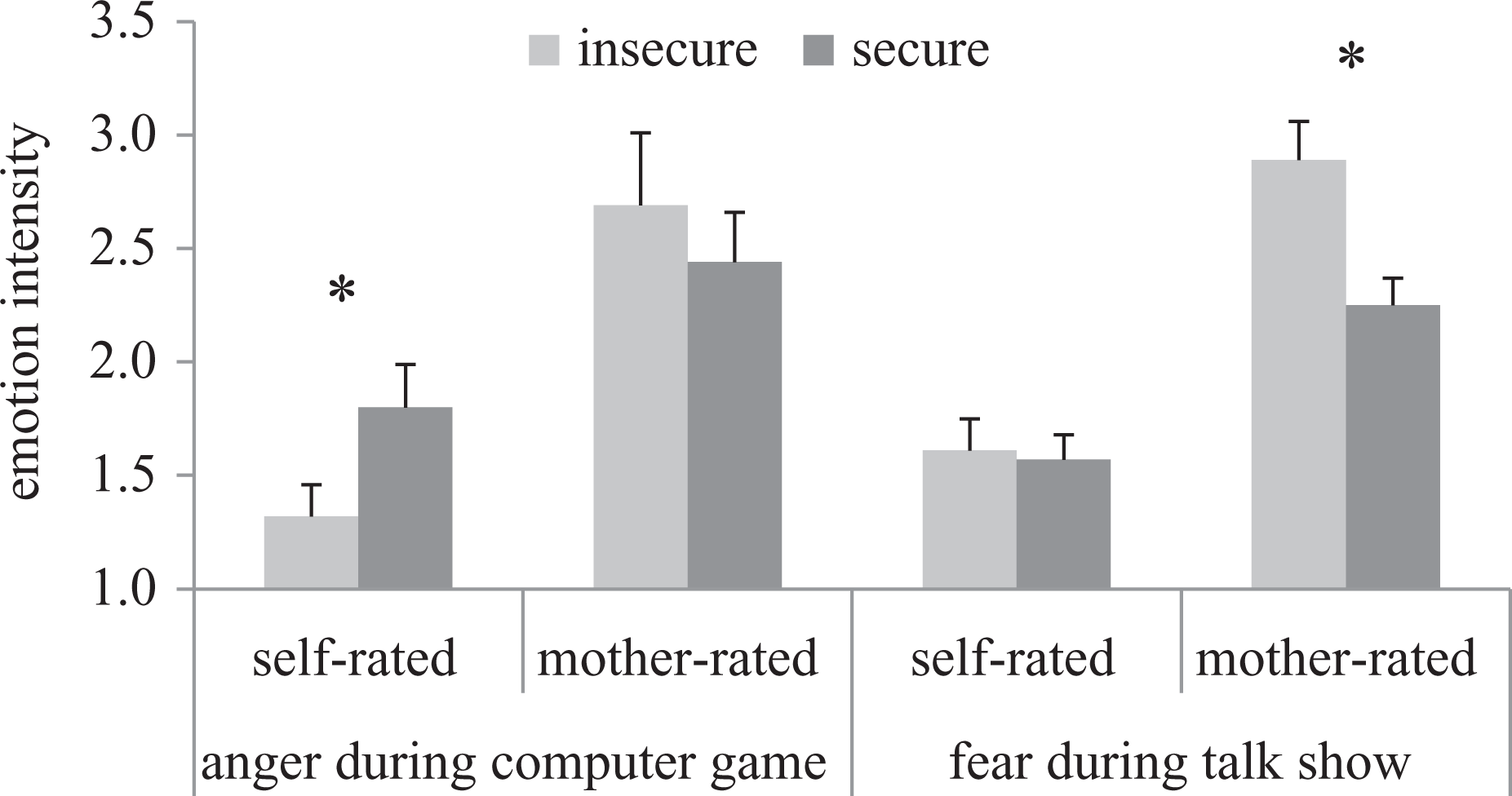
Self-rated and mother-rated adolescent anger in the computer game (anger elicitation) and adolescent fear in the talk show task (fear elicitation) depending on early attachment security; n = 31 and 59 for securely and insecurely attached children, respectively; an asterisk indicates significant differences between the 2 groups.
Regarding the fear-eliciting talk show situation, the MANOVA revealed significant main effects for rater, F(1, 88) = 62.44, p < .001, eta2 = .42, and for attachment security, F(1, 88) = 5.03, p < .05, eta2 = .054, modified by a significant interaction effect between these factors on adolescents’ fear, F(1, 88) = 5.99, p < .05, eta2 = .063. Post-hoc t tests revealed that there was a difference between securely and insecurely attached subjects regarding mother-rated adolescent fear (p < .05) with higher ratings for adolescents with insecure infant attachment (see Figure 1). In contrast, there was no difference between the two groups regarding adolescent-rated fear. For both groups, mother-rated scores were higher, but adolescent and mother-scores again were more similar in securely attached subjects. Thus, while the adolescents reported comparable levels of fear during the talk show (which were lower than the maternal ratings), mothers of adolescents with early insecure attachment reported higher fear levels for their children. Again, in the secure infant attachment group, there was a higher agreement between adolescent and mother ratings regarding adolescents’ fear compared to the insecurely attached group.
To test the predictability of the expression of anger and fear and the regulation measures in the emotion situations, t tests were conducted separately for attachment disorganization and security. While there were no effects for attachment disorganization, there was a significant finding for attachment security regarding social regulation. The proportion of emotion episodes socially regulated in the anger situations was higher in the group of adolescents with early secure attachment (M = .70) than in the group with early insecure attachment (M = .59; t(82) = 2.35, p < .05). The same difference was found for the talk show (M = .67 and .60 for the secure and the insecure group, respectively), but did not reach statistical significance.
Prediction of the adrenocortical stress response by early attachment security and disorganization
In a next step, we tested the influence of infant attachment patterns on the adolescents’ adrenocortical responses to the emotionally challenging situations. Two-way MANOVAs with a within subject factor for time (pre, post) and an independent factor for attachment security (secure, insecure) and disorganization (D, non-D), on the cortisol response revealed no significant main effect for attachment security or attachment disorganization on the cortisol response. However, we found a significant interaction of time and attachment disorganization, F(1, 82) = 4.21, p < .05, eta2 = .049) on the cortisol response. Post-hoc t tests revealed that cortisol-values in adolescents who had been disorganized in infancy did not, compared to non-disorganized ones, differ before the emotion-eliciting situations but were significantly higher afterwards (p < .05, one-tailed, see Figure 2).
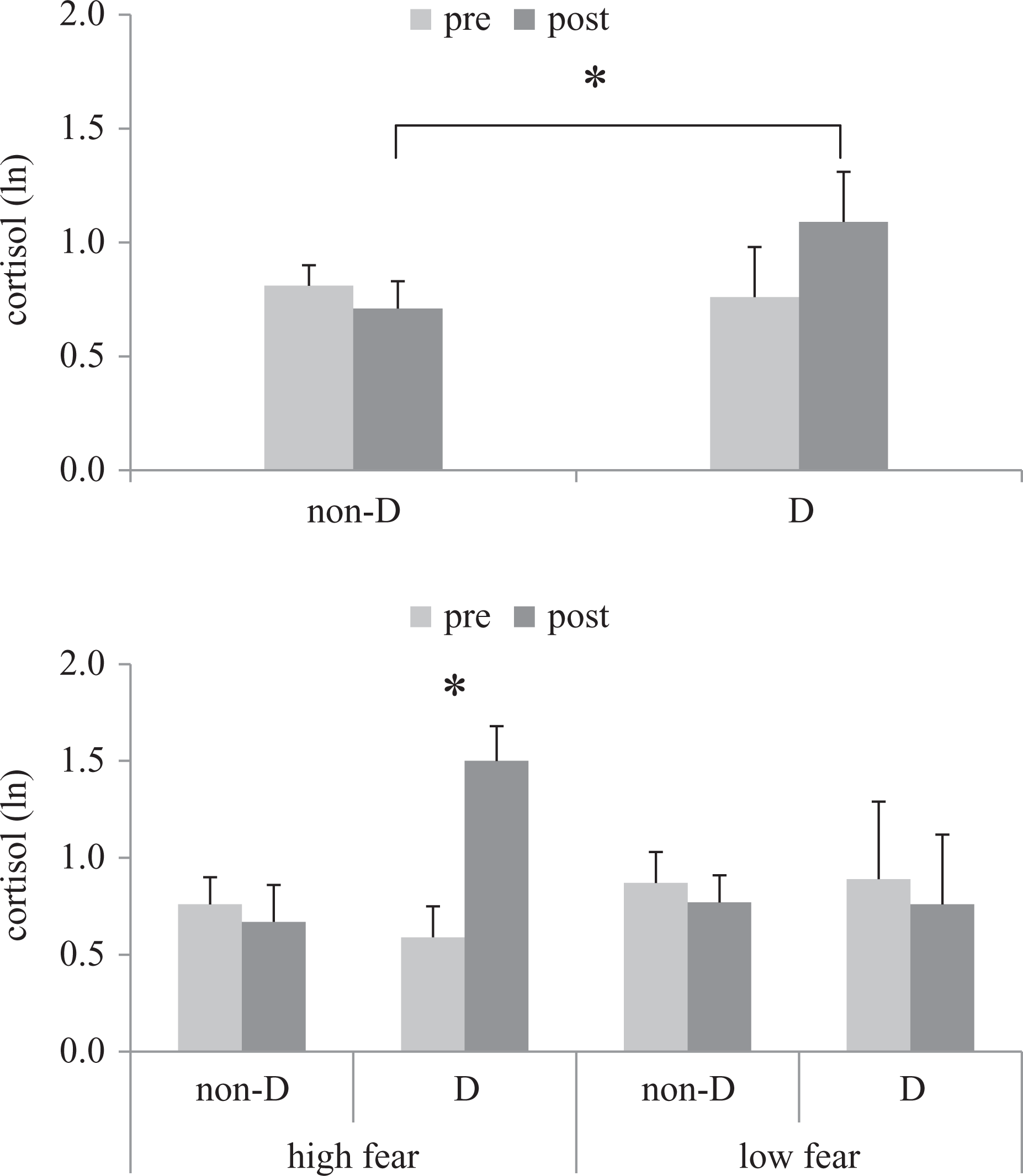
Adrenocortical activity before and after emotion elicitation depending on attachment disorganization (above) and depending on attachment disorganization and fear (below); n = 66 and 18 for non-D and D, respectively; n = 30 and 36 for low and high fear children, respectively, within non-D; n = 10 and 8 for low and high feat children, respectively, within D; an asterisk indicates significant differences between the 2 values.
The talk show intends to elicit fear in the adolescent. Thus, we further explored the role of fear in the cortisol stress response. The adolescents were grouped into a low- and high-fear group by median split based on their self-rated fear. A time (pre, post), attachment disorganization (D, non-D), and fear (low, high) MANOVA resulted in two significant two-way interactions between time and attachment disorganization, F(1, 80) = 5.76, p < .05, eta2 = .07, and between fear and time on the cortisol response, F(1, 80) = 6.58, p < .05, eta2 = .08, which were moderated by a three-way interaction between time, fear, and attachment disorganization, F(1, 80) = 6.43, p < .05, eta2 = .07. As can be seen from Figure 2, the effect of infant attachment disorganization on the adolescents’ adrenocortical response was most intense when the adolescents were feeling highly afraid during the negative emotion eliciting situation. Post hoc t tests revealed a significant increase only for this group.
As significant associations of adrenocortical activation were found with different concurrent and early measures, and these different predictors were inter-correlated, regression analysis was conducted predicting cortisol at task end in order to identify the specific contribution of each of these associated measures with simultaneous control of the other measures. To control for baseline differences, the cortisol level before task was entered in a first step. In a second step, the adolescent’s mean effective regulation and maternal emotion support were entered (stepwise), and in the third step early disorganization and the interaction term early disorganization × fear group were entered stepwise. As can be seen from Table 2, the results show that after control for baseline cortisol, effective emotion regulation made a significant contribution with a significant increase in explained variance and, then, the interaction term between attachment disorganization and fear made an additional significant contribution in explained variance. In the final model the beta was −.18 (t = 2.17, p < .05) for effective emotion regulation and .24 (t = 2.95, p < .01) for the interaction between attachment disorganization and fear.
Hierarchical multiple regression analyses: prediction of adolescents’ adrenocortical response.
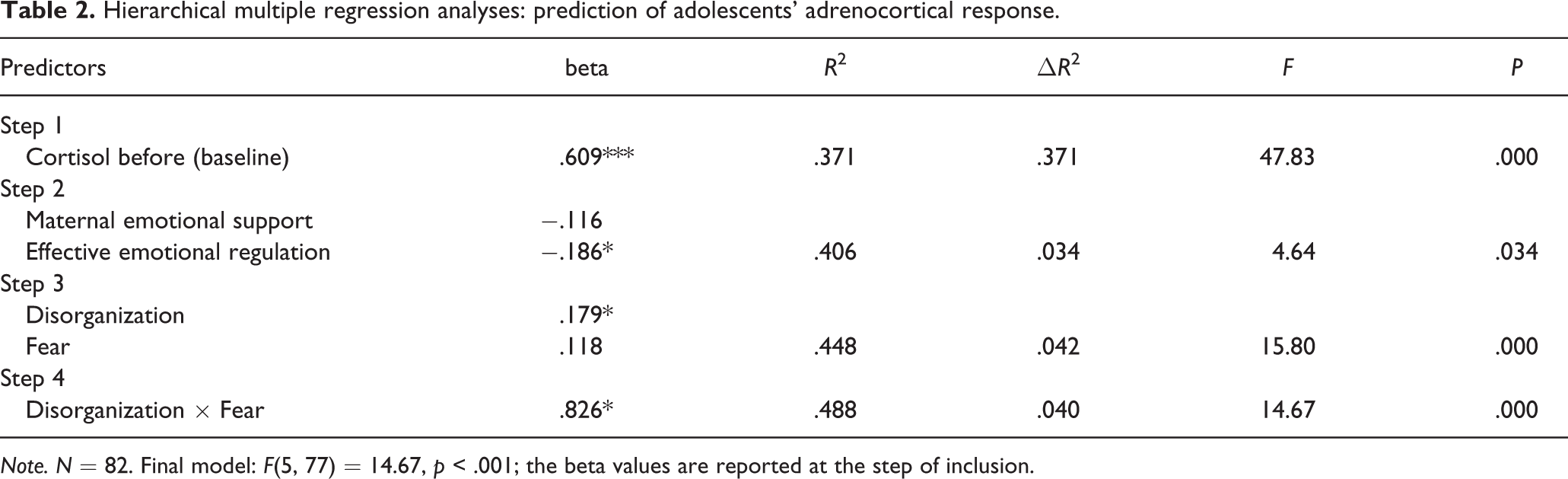
Note. N = 82. Final model: F(5, 77) = 14.67, p < .001; the beta values are reported at the step of inclusion.
Discussion
The findings of this study clearly demonstrate a longitudinal influence of infant attachment on emotional processes and emotional regulation in early adolescence. While early organized attachment security seems to be related to adolescents’ perception of own emotions (feelings) and social emotional regulations strategies, attachment disorganization in infancy predicts psychobiological processes of emotion regulation.
Emotion elicitation in the computer situation and in the talk show task
In line with recommended research strategies in emotion regulation (Cole et al., 2004), we intended systematically to elicit negative emotions, contrast different conditions, and assess the temporal relations between emotion and emotion regulation strategy. We used two different situational contexts designed to elicit negative emotions in adolescents. A blocked goal was the intended elicitor of anger in the computer game task and an expected threat to the self should elicit fear in the talk show task. Mothers’ ratings of their adolescents’ negative emotions, and to a smaller extent also the adolescents’ self-ratings, support the validity of these two situational contexts as emotionally challenging situations. Thus, it can be assumed that the situations were suitable to observe emotion regulation processes in adolescents (Adrian et al., 2011). Not all emotional stressors also may activate the attachment system (Allen & Miga, 2010), especially when they do not challenge the individual’s emotion regulation capacity enough and when no attachment figure is available. Therefore, we combined both the emotional challenge and the presence of an attachment figure (mother) to make attachment behaviour observable (Zimmermann et al., 2009).
Self-reported feelings, emotional expression, and emotion regulation in adolescence
The correlational pattern between the adolescent’s emotional expression, their self-reported feelings, and the maternal perception of their emotions indicated that the mothers seem to use the adolescent’s emotional expression as basis for their interpretation of the adolescents’ emotional states. This was found for the adolescent’s anger as well as for fear. However, a significant association between the adolescent’s emotional expression and their self-reported feelings only appeared for anger. Similarly, only in the case of anger the adolescent’s reported feeling showed some overlap with the maternal perception of their feelings. Thus, there seems to be some, albeit modest, common variance of the emotion measures for anger, while feelings of fear in the adolescents seem not to be reflected in their emotional expression as well as in the maternal perception of their feelings. In addition, mothers rated the intensity of the adolescent’s emotions higher compared to the adolescents themselves.
These low or even missing associations between the adolescent’s self-reported feelings and their emotional expression may have different sources. From a theoretical point of view, low associations may reflect the different sub-systems of emotions with their different functions (Campos et al., 1989). In addition, the adolescents’ display rules in the video-taped situations or their difficulties to openly admit negative emotions in the self-report questionnaire might explain these low associations. Possible attachment influences will be discussed below. Finally, from a methodological perspective the rated time sequence might be different for adolescents, their mothers, and the observers. Self-ratings were assessed after the emotion elicitation, whereas emotional expression was assessed during the tasks. Possibly, the adolescent’s self-rating was more focused on the current feeling afterwards, while the maternal rating referred more to the preceding time period while interacting with their adolescent child leading to higher emotional intensity ratings by the mothers. Similar discrepancies between emotion measures during an emotion regulation task have also been reported by Borelli, David, Crowley, and Mayes (2010) in late childhood. Thus, in agreement with Mauss and Robinson (2010), there seems to be little convergence between different emotion measures for a single emotion, emphasizing the necessity of multi-dimensional assessments of emotions.
Regarding emotional regulation, the results clearly showed that the adolescents mainly used social emotion regulation strategies while interacting with their mothers (about two thirds in each of the two situations). In addition, social emotion regulation strategies seem to be more effective. While in the talk show (fear elicitation), social emotion regulation was correlated with effective regulation, during the anger situation social emotion regulation was more effective than individual emotion regulation in reducing the incidence of anger episodes. Finally, in both situations, effective emotion regulation in specific episodes was associated with a lower incidence of negative emotion expressions. Thus, the findings suggest that social emotion regulation processes are quite important for effective regulation even in early adolescence.
Adolescents’ emotion regulation in interaction with the mother cannot be seen independently of the emotional support concurrently provided by the mothers. This was clearly observable in the talk show task. In dyads with emotionally highly-supporting mothers, the adolescents were more effective in regulating their negative emotions. As maternal emotional support was not directly related to the emotion measures, the effect of maternal support seems to be mediated by the effectiveness of the adolescent’s regulation efforts which significantly contributed to reduction of negative emotions. Thus, adolescents still gain in effectiveness of emotion regulation from the caregiver’s emotional support.
From a developmental perspective, we would expect increasing autonomous emotion regulation and self regulation competencies in childhood and adolescence, compared to infancy or early childhood where emotion regulation may more dominantly lie in the caregiver (Bell & Ainsworth, 1972; Matas et al., 1978; Schieche & Spangler, 2005; Spangler et al., 1994). The findings of this study show that adolescents, at least in situations in which the caregiver is available, still use the caregiver for emotional regulation. Thus, adolescents may try to be autonomous and not to rely on attachment figures, but they actually do rely if possible (Allen & Miga, 2010), when the caregiver is emotional available. Moreover, the findings show that social regulation of negative emotions with the concurrent support of the caregiver is still adaptive even in adolescence, as it still makes emotion regulation more effective.
Prediction of emotional expression and emotional regulation by early attachment
Bowlby (1980) emphasized the strong connection between attachment and intense emotional processes. The results of this study show that early attachment has this strong connection even over a long developmental period of 11 years. The longitudinal analyses revealed significant effects of infant attachment security on the adolescent’s feelings reported by themselves or reported by their mothers, and also on social emotion regulation strategies.
However, the findings differed depending on the situational context and the related emotion. During the anger-eliciting situation, mothers perceived increased anger in their adolescents independent of their attachment history in infancy. However, adolescents classified as securely attached in infancy reported more intense anger than the insecurely attached ones. In addition, adolescents’ and mothers’ ratings were similar in early securely-attached pairs compared to the early insecurely attached pairs validating the securely attached adolescents’ ratings. Thus, adolescents with a secure infant attachment history seem to be more aware of their angry feelings, the appropriate emotion in a situation designed to provoke anger, and they reported this openly in the self-report. In contrast, adolescents with insecure infant attachment may either have difficulties in their access to their negative emotions (Cassidy, 1994) or present themselves in a not affected way in the self-report. A closer comparison revealed a higher agreement between mother and adolescent concerning anger in the secure group which may facilitate sensitive regulation processes during interaction. In contrast, the high discrepancy in insecure adolescents, between themselves reporting only little anger and being perceived as angry by their mothers, may make interactions between them and their mothers more difficult and may hinder regulation processes.
In the talk show (fear elicitation) the adolescent’s report of feelings as well as their emotional expression did not vary according to early attachment security. This was in accordance with the associations to concurrent attachment at age 12 (Zimmermann et al., 2009). However, the mothers of the adolescents with a history of insecure attachment perceived more fear and uneasiness in their children than the mothers of earlier securely attached adolescents. Again, the difference between adolescent and mother ratings of adolescent feeling was smaller in securely attached adolescent–mother pairs than in insecurely attached pairs. Regarding the mothers as reliable observers of their children’s emotional state, these findings indicate that adolescents with an early insecure attachment history feel more intense fear during this situation compared to securely attached adolescents, but do not communicate their fear and uncertainty, neither by emotional expression nor in a questionnaire.
Regarding the prediction of emotional regulation by early attachment, our hypotheses were confirmed, at least in part. While there was no effect of infant attachment security on the effectiveness of emotion regulation, we found an effect on the proportion of social emotion regulation. Adolescents with a history of early secure attachment more often used social emotional-regulation towards their caregiver compared to their insecurely attached counterparts. This finding was indicated in both emotion-eliciting situations, however reached significance only in one of them.
Taken together, the findings indicate restrictions in feelings of anger and fear, and a discrepancy between the feelings and the maternal perceptions and interpretation in emotionally challenging situations in adolescents who had been insecurely attached in infancy. Similar to findings in infancy (M. D. S. Ainsworth et al., 1978; Spangler & Schieche, 1998) or preschool (Waters et al., 2010) individuals with a history of a secure attachment show an effective communication of their negative feelings still even in adolescence, resulting in a higher concordance between emotional self-perception and mother-perception. These longitudinal results expand empirical evidence from concurrent studies showing a higher concordance between self-rating of negative emotions or psychological symptoms in securely attached adolescents compared to their observed emotional expression (Zimmermann et al., 2001), their mimic reactions in the EMG (Spangler & Zimmermann, 1999) or from parents’ ratings (Berger et al., 2005).
Similar to results in preschool (Lütkenhaus et al., 1985), where infant attachment security did not predict the amount of the expressed negative emotions after failure but whether this was directed towards an adult (secure attachment) or away from an adult (insecure attachment), we did not find associations between infant attachment and frequency of negative emotional expression. This is in line with a concurrent attachment measure at the age of 12 years (Zimmermann et al., 2009). However, adolescents who had been securely attached in infancy showed more social emotion-regulation towards their mother than adolescents with an insecure infant attachment. Attachment behaviour may change in form but not in function during development. Whereas infants mainly use their repertoire of emotional expression as a communicative tool towards their caregiver, adolescents in addition have elaborated verbal abilities to communicate their emotional needs. Attachment behaviour develops from communicating emotion needs by emotional expression and bodily proximity seeking as age-appropriate in infancy to the verbal communication and psychological proximity-seeking as age-appropriate in adolescence (Zimmermann, 1999). Independent of the specific communicative tool, infant attachment influences the emotional communication towards the caregiver even later in adolescence.
According to attachment theory, securely attached children are able to freely perceive and experience as well as to openly express and communicate both positive and negative feelings, as they have experienced their parents as sensitive and accepting and promptly responding and providing emotional support (Cassidy, 1994; Laible & Thompson, 1998). As securely attached children’s conversations with the caregivers are characterized by a focus on emotions or internal states (Meins et al., 2002; Raikes & Thompson, 2006), they may come to an enhanced understanding of emotions, their causes, and their functions in a given context. In contrast, restrictions in emotional expression and communication of negative feelings can be expected in insecurely attached children, who, due to having experienced rejection and anger when expressing their feelings and basic emotional needs, are expected to show a restricted ability for perception and communication of negative feelings. According to Cassidy (1994), insecure avoidantly attached children may suppress their emotions and minimize emotional expression to avoid being rejected, and they do not rely on the caregiver’s support for emotional regulation, while insecure ambivalently-attached children, cannot rely on the caregiver’s availability (Cassidy & Berlin, 1994) and try to get and maintain the caregiver’s attention by maximization of emotional expression. A comparison of the two insecure attachment groups (avoidant vs. ambivalent) did not seem appropriate in this study because of the small sub-group sample sizes. On a descriptive level, the data of the two groups did not indicate huge differences between them.
While we were able to predict measures of feelings and emotional regulation from early attachment-security in this study, this was not the case for attachment disorganization. Disorganized children, due to having experienced frightened or frightening behaviour in attachment-related situations (Main & Solomon, 1990), or due to a generally restricted ability for behavioural organization (Spangler, Fremmer-Bombik, & Grossmann, 1996), may be overly alarmed by indications of negative emotions or may be hyper-vigilant to negative emotions (Steele, Steele, & Croft, 2008). During preschool age, however, they tend to acquire a strategy of controlling behaviour towards the caregiver to cope with their disorganization (Main & Cassidy, 1988; Wartner, Grossmann, Fremmer-Bombik, & Suess, 1994). The findings of this study did not indicate the expected restrictions in emotional regulation in adolescents with disorganized attachment history. The coding may not reflect the behavioural aspects of attachment disorganization as it did not include controlling behaviour. However, the adrenocortical responses of adolescents with a history of disorganized attachment in infancy may indicate that these adolescents have difficulties in effective emotion regulation appearing at a biological level, that are not obvious or not coded at the behavioural level in the sense of a fast reduction of negative emotional intensity.
Prediction of adrenocortical activity by early attachment
Gunnar and Adam (2012) argued in their review (with reference to Dickerson & Kemeny, 2004) that not all situations that provoke emotional responses necessarily may be suitable to provoke adrenocortical activity. Rather, uncontrollable and unpredictable situations, with threats to the social self, would activate the HPA axis. We assumed that the two challenging situations used for this study would have the potential for a certain amount of social threat. While the adolescents in one of the situations were threatened by an unexpected failure during the computer game, the talk show provided a potential threatening of the self by expecting to have to present oneself in front of a public audience. The findings showed that in a significant proportion of the adolescents there actually was an adrenocortical response to the emotion eliciting situations, and that this response was predicted by the adolescent’s ineffective emotion regulation, low maternal emotional support, and the adolescent’s early attachment disorganization.
Thus, interestingly and comparable to findings in early childhood or adulthood (Lam, Dickerson, Zoccola, & Zaldivar, 2009), similar individual and social processes are involved in adrenocortical regulation in early adolescence. Even at that age, we find indications that efficient emotional regulation on the behavioural level prevents an adrenocortical stress response (see Nachmias et al., 1996; Spangler & Grossmann, 1993). In addition, comparable to findings from early infancy (Gunnar, Larson, Hertsgaard, Harris, & Brodersen, 1992; Spangler et al., 1994) sensitive emotional support by the caregiver seems to contribute to adrenocortical regulation as an external organizer also during adolescence.
Adolescents with infant attachment disorganization showed an increase of adrenocortical activity compared to the non-disorganized group. This indicates intense emotional stress during these situations in this group indicating lowered competencies in adolescents who had been disorganized in infancy to effectively regulate negative emotions. This finding is in agreement infant studies on the associations between adrenocortical activation and attachment disorganization when observed in emotionally challenging situations (Hertsgaard et al., 1995; Spangler & Grossmann, 1993). According to a coping model, disorganized children and adolescents do not have coherent strategies for emotional regulation in contact with the parent. Their restrictions in behavioural strategies in stressful situations may lead to heightened cortisol.
The influence of early attachment disorganization on adrenocortical activity is even more prominent when the adolescents are feeling anxious. Comparable findings were reported by Schieche and Spangler (2005). In a challenging task situation, disorganized toddlers exhibited an increase in cortisol when they were behaviourally inhibited. Thus, with respect to Gunnar and Adam (2012), the activation of the adrenocortical system is manifested, when there is subjective threat (high anxiety) combined with restricted emotion regulation ability based on attachment disorganization.
In this longitudinal study, attachment security could not predict the adrenocortical response, neither as a singular predictor nor in interaction with the adolescent’s fear. This is in contrast to expectations from a coping model, and different from findings reporting a heightened adrenocortical response in insecurely attached children in infancy (Nachmias et al., 1996; Spangler & Grossmann, 1993; Spangler & Schieche, 1998). However, Borelli and colleagues (2010) did also not find associations with concurrent attachment security and an adrenocortical response in older children. It may well be that the organized forms of attachment in infancy offer a developmental basis for the development of emotion regulation capacities that offer a behavioural strategy that remains functional to some extent for the chosen emotion-eliciting situations in this study. It may well be that the insecure attachment patterns, due to their organized structures (Main & Solomon, 1990), enable these adolescents maintaining a behavioural organization at least to a certain degree, although, according to Main (1981), this may be “second best” strategies. However, for adolescents with insecure infant attachment history, the effect of the emotion-elicitation situations is observable at the level of emotions and communication of emotions. The breakdown of organized attachment strategies found in infant attachment disorganization seems to be replicated in adolescence.
The final regression model showed that the adolescents’ effective emotion regulation as observed in the tasks, as well as infant attachment disorganization, especially when concurrently being highly afraid, were the significant predictors of the adolescents’ adrenocortical response. In contrast, contemporary maternal emotional support did not explain additional variance. Thus, both concurrent competencies in individual psychological emotion regulation as well as early acquired deficits in emotional regulation within the attachment relationship influence the adrenocortical stress response. Although concurrent maternal emotional support is associated with the adolescents’ emotion regulation, the adrenocortical regulation depends more on the adolescents’ internalized ability to regulate negative emotions.
Conclusions and limitations
In conclusion, these findings suggest that abilities and strategies of emotional regulation developed on the basis of infant attachment organization may have power to predict emotional regulation processes even until early adolescence. While infant attachment security seems to be associated with social emotion regulation processes at the behavioural or psychological level, infant attachment disorganization seems to influence the psychobiological level of emotion regulation.
Clearly, limitations of this study must be taken into consideration, due to methodological issues. Although the sample size is not small compared to many longitudinal samples in attachment research, it was too small to allow for multivariate analyses combining attachment security and disorganization to detect interactions between these two dimensions. In addition, the effect sizes in the analyses of this study were quite small, indicating additional influences on variations in emotion regulation beside infant attachment. Furthermore, the two emotion-elicitation contexts were not counterbalanced so that we cannot disentangle whether one of them contributes stronger to the cortisol effects, or whether the situations have an additive effect. Finally, the mothers’ emotionality should be assessed in future studies using this paradigm and other social interaction situations eliciting negative emotions and other interaction partners (e.g. fathers, peers) should be considered as well. Thus, extended replications are required.
Despite these limitations, the longitudinal effects of infant attachment on adolescents’ emotion regulation corroborated the concept on coherence in development (Sroufe, 1989), where the effect of early secure attachment is still observable in later effective social emotion regulation.
Footnotes
Funding
This research was supported by the Koehler-Stiftung (Munich, Germany) and the German Research Foundation (SP 312/16-1 and ZI 511/13-1).
Acknowledgements
We want to thank Michael Schieche for organizing infancy data assessment and Fabienne Becker-Stoll and Klaudia Kramer for infant attachment analyses. Many thanks also to Clemens Kirschbaum and his laboratory at the University of Dresden for conducting cortisol analyses. We are very indebted to Iris Reiner for organizing early adolescent data assessment, Stephanie Ast-Scheitenberger, Melanie Pillhofer, and Julia Popp for conducting analyses of maternal behavior, and Fatma Celik for coding emotional expression and emotion regulation. Finally, we want to underline our gratitude to the families for their extraordinary cooperation over the years.