



Abstract
The objectives of this study were twofold: (1) Determine the English proficiency of English second-language learners (ELLs) at the end of preschool as referenced to monolingual norms, and in particular, to determine if they showed an asynchronous profile, that is, approached monolingual norms more closely for some linguistic sub-skills than others; (2) Investigate the role of home language environment in predicting individual differences in children’s English proficiency. Twenty-one ELL children (mean age = 58 months) from low socio-economic status (SES) backgrounds with diverse first-language backgrounds participated in the study. Children’s English proficiency was measured using a standardized story-telling instrument that yielded separate scores for their narrative, grammatical and vocabulary skills. A parent questionnaire was used to gather information about children’s home language environments. The ELL children displayed an asynchronous profile in their English development, as their standard scores varied in terms of proximity to monolingual norms; narrative story grammar was close to the standard mean, but mean length of utterance was below 1 standard deviation from the standard mean. No differences were found between the story-telling scores of the Canadian-born and foreign-born children, even though Canadian-born children were exposed to more English at home. Implications of the findings for clinicians and educators working with young ELLs are discussed.
Canada has become more multilingual over the past decade, with increases both in the number of minority languages spoken (over 200 in 2011) and the percentage of the population speaking languages other than French and English at home (20% in 2011) (Statistics Canada, 2011). This linguistic diversity extends to all ages of the population, as 16.6% of Canadian children aged 0–4 years spoke a minority language, exclusively or together with English, at home (Statistics Canada, 2011). As a result, children in preschool classes in Canadian metropolitan areas are increasingly linguistically and culturally diverse. The presence of minority first language (L1) children in English preschool programs in both Canada and the United States has long drawn attention due to concern about these children’s ability to continue developing their minority L1, and thus sustain their bilingualism, when the societal second language (L2) is introduced at a young age (e.g. Cummins, 2000; Wong Fillmore, 1991). More recently, research attention has also been given to the English L2 development of minority children, often referred to as English language learners (ELLs), who are enrolled in preschool, Head Start or junior kindergarten programs (Bedore et al., 2012; Bedore, Peña, Gillam, & Ho, 2010; Bohman, Bedore, Peña, Mendez-Perez, & Gillam, 2010; Cleave, Girolametto, Chen, & Johnson, 2010; Hammer, Davison, Lawrence, & Miccio, 2009; Hammer, Scarpino, & Davison, 2011; Hammer et al., 2012; Iglesias & Rojas, 2012; Rojas & Iglesias, 2013; Tabors, 2008; Vagh, Pan, & Mancilla-Martinez, 2009). One goal of this body of research has been to measure ELL children’s English proficiency, typically via standardized tests, to understand their language development trajectories and how they compare to their monolingual peers. Because ELL children entering a preschool class vary in their home language environments, a second goal has been to investigate how home language environment influences children’s performance on standardized English language measures. The goals of the present study are parallel to those of the prior research; however, the participants in this study represent an understudied population, as the vast majority of the prior research has been conducted with Spanish-English speakers in the United States.
Profile effects and narrative tasks with ELLs
L1 minority children lag behind age-expected monolingual norms on standardized measures of English oral language (Golberg, Paradis, & Crago, 2008; Hoff et al., 2012; Paradis, 2005; Paradis, Schneider, & Sorenson Duncan, 2013; Hammer et al., 2011; Oller & Eilers, 2002; Vagh et al., 2009). Thus, after just 1 year in a preschool program, ELLs would not be expected to achieve abilities in their English L2 akin to monolinguals. What is less understood is whether ELLs approach monolingual abilities synchronously or asynchronously across different sub-skills of language, e.g. vocabulary versus grammar. Oller, Pearson, and Cobo-Lewis (2007) showed that Spanish L1–English L2 children scored closer to monolingual age-based norms on tests of English pre-literacy skills than on tests of English receptive vocabulary. Oller et al. (2007) referred to this phenomenon as profile effects, and attributed the differences in outcomes to the nature of the skills examined. They argued that, because vocabulary knowledge is distributed across two languages while pre-literacy skills can be shared between them, bilingual children can advance to monolingual levels of performance earlier in development for literacy (shared) skills than vocabulary (distributed) skills. The presence of shared skills, or common underlying proficiencies (e.g. Cummins, 2000), in bilingual children is also evident in the bidirectional and crosslinguistic relationships between basic literacy skills and reading outcomes in L1 and L2 (Geva & Wang, 2000; Riches & Genesee, 2006). The present study extends the line of research on profile effects by examining ELLs’ abilities across different sub-skills of oral language – via narrative language sampling - for the presence of asynchrony in how ELLs approach monolingual norms.
Narrative tasks vary in details of execution, but they typically consist of recording the child story-telling from a series of pictures, and thus obtaining a language sample. The child’s language sample can then be transcribed, coded and analyzed for different sub-skills pertaining to narrative structure, as well as linguistic sub-skills such as, vocabulary and grammar. Narrative tasks have certain advantages for evaluating the language of young culturally/linguistically diverse children. First, they are less formal in structure than other kinds of tests, and so young children’s test-taking skills or familiarity with test-taking routines do not come into play (Bedore et al., 2010; Cleave et al., 2010). At the same time, story-telling from picture books is a familiar activity in a preschool, so children can be expected to understand the task, regardless of whether story-telling from book-looking is a frequent activity in the home. Second, because the language samples obtained from a narrative task can be analyzed for a range of language sub-skills, they constitute a comprehensive measure of a young child’s English-language abilities (Bedore et al., 2010; Cleave et al, 2010; Gutiérrez-Clellen, 2012; Rojas & Iglesias, 2013). Third, children with language disorders, both bilingual and monolingual, show deficits in their abilities with narrative structure, as well as with linguistic measures taken from narrative samples (Cleave et al., 2010; Gutiérrez-Clellen, 2012; Schneider, Dubé, & Hayward, 2006). Therefore, determining how typically-developing preschool ELLs perform on a narrative test would contribute to our understanding of how to use and interpret narrative instruments for language assessment with this population.
One example of a narrative structure skill is “story grammar,” which consists of the essential parts or events that make a coherent story, e.g. establishing the setting, describing an initiating event, a response, and an outcome (Gutiérrez-Clellen, 2012; Schneider et al., 2006). Analyzing a child’s narrative for story grammar entails examining the structure of the entire discourse beyond the individual sentence level, and it can be characterized as a cognitive-linguistic skill because a child’s understanding of what components to include when constructing a “good story” is not dependent on specific knowledge of grammar and vocabulary in that language. Thus, it could be considered a shared as opposed to a distributed skill (cf. Oller et al., 2007) in the context of bilingual/ELL children. Paradis et al. (2011) presented longitudinal standardized test performance from school-age ELLs showing that children converged on monolingual norms faster for story grammar in narratives than for more English-specific skills like accuracy with verb tenses. In another study with ELLs, Paradis et al. (2013) found that children were much more likely to perform within monolingual norms for story grammar than they were for lexical, grammatical or phonological-processing abilities. Pearson (2002) examined narrative samples from Spanish L1 ELLs and English monolingual age-mates that were analyzed for narrative structure elements and for accuracy with linguistic elements. She found that ELLs were much more likely to perform similarly to English monolinguals for narrative structure than for linguistic elements, and moreover, the narrative structure elements were more likely to be related across a child’s two languages than linguistic elements. Similarly, Cardenas-Hagen, Carlson, and Pollard-Durodola (2007) found that early literacy skills and narrative macrostructure skills are more likely to be associated between the two languages of bilingual children than more language-specific vocabulary and grammar abilities. Finally, Cleave et al. (2010) found no differences in story grammar abilities between English monolinguals with language impairment and predominantly English-speaking ELLs with language impairment the same age. In sum, these findings on story grammar abilities indicate that ELLs approach monolingual norms relatively early for this sub-skill, possibly because bilingual children are able to share the relevant cognitive-linguistic abilities between their two languages (cf. Cummins, 2000).
By contrast, another narrative structure skill, the use of referring expressions, is more embedded in specific language knowledge than story grammar (Gutiérrez-Clellen, 2012). The use of referring expressions to introduce characters or objects into a story for the first time to a naïve listener requires both understanding the concepts of shared and unshared knowledge, but also language-specific grammatical devices like definite and indefinite article use (Schneider & Hayward, 2010). For example, when introducing a character for the first time, it is appropriate to use an indefinite article, as in “and then
Home language environment and English L2 development
The relative proportion of the majority language, English, versus the minority language that is spoken at home varies among newcomer families (Hammer et al., 2011; Oller & Eilers, 2002; Paradis, 2011), with more English being spoken typically associated with longer residence and greater immigration depth (Hammer et al., 2011, 2012; Oller & Eilers, 2002). On one hand, many researchers have found a straightforward relationship between relative amount of English spoken at home and English outcomes in ELLs, i.e., more English is positively associated with stronger English abilities (Bedore et al., 2012; Hoff et al., 2012; Oller & Eilers, 2002; Place & Hoff, 2011). On the other hand, some studies have found that the quantity of English spoken at home did not reliably predict stronger English abilities in ELLs, and that input quality factors might play a role (Bohman et al., 2010; Golberg et al., 2008; Hammer et al., 2009, 2011, 2012; Paradis, 2011; Place & Hoff, 2011). In a longitudinal study of 72 preschool Spanish L1-English L2 children, Hammer et al. (2009) found that differential home language use influenced children’s L1 Spanish but not L2 English abilities, as measured by tests of vocabulary and comprehensive standardized measures. Golberg at al.’s (2008) longitudinal study of vocabulary development in school-age ELLs revealed that amount of English use at home was not associated with vocabulary test outcomes, but maternal education levels were. Paradis (2011) examined the impact of English input factors on standardized tests of vocabulary and grammar in 169 ELLs, aged 5 to 7 years. It was found that a qualitative measure, richness of children’s English experience outside school (e.g. number and frequency of English activities in a typical week, e.g. reading, television/computer viewing, and playing with native-speaker friends), and the length of time children had spent in a preschool/school program both contributed significantly and positively to English L2 children’s test outcomes. In contrast, the quantity of English, which varied considerably, spoken at home among family members, was not a significant predictor of children’s English test scores. In the Paradis (2011) and Golberg et al. (2008) studies, parents’ self-rated fluency in English was relatively low, and these researchers hypothesized that because some minority L1 children might be exposed to low proficiency, non-native speaker English input at home by their parents and siblings, this could be a reason why home exposure to the L2 might not have had a positive impact on their L2 development. Recent research supports this hypothesis: Both Place and Hoff (2011) and Hammer et al. (2012) found that input in English from non-native speaking/low proficiency mothers was not beneficial to Spanish L1 children’s English development.
The present study
We examined the English language abilities of preschool ELL children with diverse L1 backgrounds using a normed, standardized story-telling instrument. The main research questions were: What gains in English abilities did the ELLs make in the preschool program? Did they display profile effects in their English development? We predicted that children would have scores closer to monolingual norms for story grammar than for other narrative and linguistic sub-skills because the former draws more on shared as opposed to distributed knowledge. How did children vary in their English environment outside the preschool classroom? How did children’s English environment outside the classroom influence their English abilities at the end of the preschool program? We predicted that Canadian-born children would have more frequent and longer exposure to English at home than foreign-born children; however, we expected that English use at home might not have a strong impact on children’s story-telling test performance, based on prior findings.
Method
Participants
Twenty-one children participated in this study. All children were from low SES backgrounds, from first generation refugee or immigrant families, and were attending the same intercultural preschool program. Children’s mean age was 48 months (range = 43–52) in September and 58 months (range = 53–62 months) in June, when testing took place. Testing took place over two years, so children were not all from the same class. Children’s home language backgrounds were as follows: Somali (N = 12), Arabic (N = 3), Tigre (N = 1), Serbo-Croatian (N = 1), Urdu (N = 1), Dinka (N = 1), Nuar (N = 2). The majority of the children (17/21) were from east African refugee families. This intercultural preschool program was the children’s first formal early education experience; however, 7/21 children had some English-language childcare experience, full- or part-time, starting around 2 years of age.
The preschool and the families’ homes were located in a neighborhood in northeast Edmonton, Canada, where the median income is lower, the levels of unemployment higher, and the density of minority language families larger than the provincial average (ECMap, 2011). Information gathered from individual families (see Materials and Procedure) indicated that the average years of maternal education was 7, also signaling this was a group of children with low SES backgrounds. The children varied in their age of arrival in Canada, and in the quality and quantity of English spoken at home, as measured via questionnaire (see Materials and Procedure).
The inter-cultural preschool program was offered four mornings a week. There was an English-speaking, primary classroom instructor as well as L1 facilitators who were present in the classroom and participated in planning class activities. Instruction time was divided between English and two of the children’s L1s (Arabic, Somali), with a much greater proportion of English used overall (Kirova, 2012). Children’s L1 development was not a focus of this study.
Materials and procedure
Edmonton Narrative Norms Instrument (ENNI, Schneider, Dubé, & Hayward, 2006; http://www.rehabresearch.ualberta.ca/enni/)
Children were given a normed and standardized story-telling/narrative instrument developed locally, the ENNI, in June of their preschool year. Norms for the ENNI are based on 377 children aged 4–9 years, 300 with typical development and 77 with specific language impairment (Schneider et al., 2006; Schneider & Hayward, 2010). The ENNI includes norms for several narrative and linguistic sub-skills that can be derived from the transcribed stories, listed below. Research with the narrative sub-skills, story grammar and first mentions, has shown that the ENNI has good construct and concurrent validity, and discriminates between children with and without specific language impairment (Schneider et al., 2006; Schneider & Hayward, 2010). In particular, story grammar scores correctly classified 80% of the children as typically-developing or language impaired, although with superior specificity to sensitivity (Schneider et al., 2006).
The administration of the ENNI took place at the preschool, as follows: Children were asked to tell stories from pictures that were designed to increase in story complexity, i.e., number of events and characters. There are 6 picture series/stories in total, with animals as the characters. Children were first shown the pictures individually, but not told a story, and then were given the set of pictures in a book format held away from the view of the tester and then asked to tell the story. Thus, the ENNI is a story-telling rather than retelling task. Because the tester could not see the pictures, the children could not rely on pointing or joint eye gaze when telling the story. Children’s stories were recorded, transcribed using the CHAT/CLAN system (MacWhinney, 2000; http://www.childes.psy.cmu.edu), and analyzed for various sub-skills following the ENNI tester’s manual by a student research assistant. The ENNI sub-skills are described below:
Story Grammar: How many elements comprising a “good story” were included by the child, such as, establishment of setting/introduction of characters, the initiating event, the response to the initiating event, the outcome, or characters’ reactions. Importantly, children’s English-specific linguistic skills, like correct grammar and word choice, do not play a role in story-grammar scoring. The ENNI includes scoring sheets with lists of story-grammar elements for 2 of the 6 picture series, a simple and a complex story. We analyzed children’s use of story grammar for the complex story by assigning points based on the number of listed story-grammar elements they included.
First Mentions: What referring expressions a child used to introduce a character or an object for the first time in a story, and whether these were appropriate. For example, it is inappropriate to introduce a new character using expressions with the definite article, or with a pronoun, because this assumes prior knowledge on the part of the listener. Thus, in contrast to story grammar, children’s English-specific grammatical abilities play a role the scoring. Each potential character or object referent across all 6 stories is listed on a scoring sheet provided with the ENNI pictures. The adequacy of the expression used by the child to introduce that referent is given points on a scale of 0–3, where a first mention with an indefinite article such as, “and then
Utterance Length: The mean length of utterances in words across all stories (grammar). This was analyzed using the mlu command in CLAN.
Sentence Complexity: Proportion of sentences that have dependent clauses, i.e., proportion of complex sentences, across all stories (grammar). This was analyzed by identifying and totaling all dependent clauses used and dividing by the total number of sentences, following the ENNI manual guidelines.
Lexical Diversity: The number of unique word types used in telling the stories (vocabulary). This was analyzed using the freq command in CLAN.
Story Length: The total number of words used to tell the stories, not necessarily unique words (vocabulary). This was analyzed using the freq command in CLAN.
Fifty percent of the story corpus was transcribed and scored independently by a separate research assistant. Word-for-word comparisons of the transcriptions yielded a reliability score of 89%. Comparisons of scoring for story grammar, first mentions and sentence complexity (e.g. scoring that was not done automatically with CLAN), yielded reliability of 86%, 89% and 98%, respectively. Discrepancies in the scoring between the two research assistants were settled through consensus.
Alberta Language Environment Questionnaire (ALEQ, Paradis, 2011 ; http://www.chesl.ualberta.ca)
Parents were given the ALEQ either at home or at the preschool, and with the assistance of an interpreter/cultural broker. This instrument includes questions on the following topics: age of arrival in Canada, parent education and self-rated fluency in English (5-point scale with elaborated descriptors from 0 [no English] to 4 [very fluent in English]), current language use by family members in the home, age at which the child began to hear/use English at home, and the richness of the child’s English-language environment. Information on language use in the home was gathered through questions such as “What language does the mother speak with the child?” or “What language does the child speak with the mother?” where answers were on 5-point rating scales from 0 [English never/mother tongue always] to 4 [English almost always/mother tongue almost never]. The proportion of overall English use in the home (input–output), the proportion of English used by family members with the child (input), and the proportion of English the child used with family members (output) were calculated from these rating scales. Richness of the English environment was determined by calculating the number of English-language activities the child engaged in, i.e., book-looking, TV/computer watching, reciting songs/rhymes, playing with English-speaking friends, and the frequency of these activities per week, to yield a proportional score from 0–1.0 (see Paradis, 2011, and http://www.chesl.ualberta.ca for more details on this measure).
Results
ENNI scores, monolingual norms and profile effects
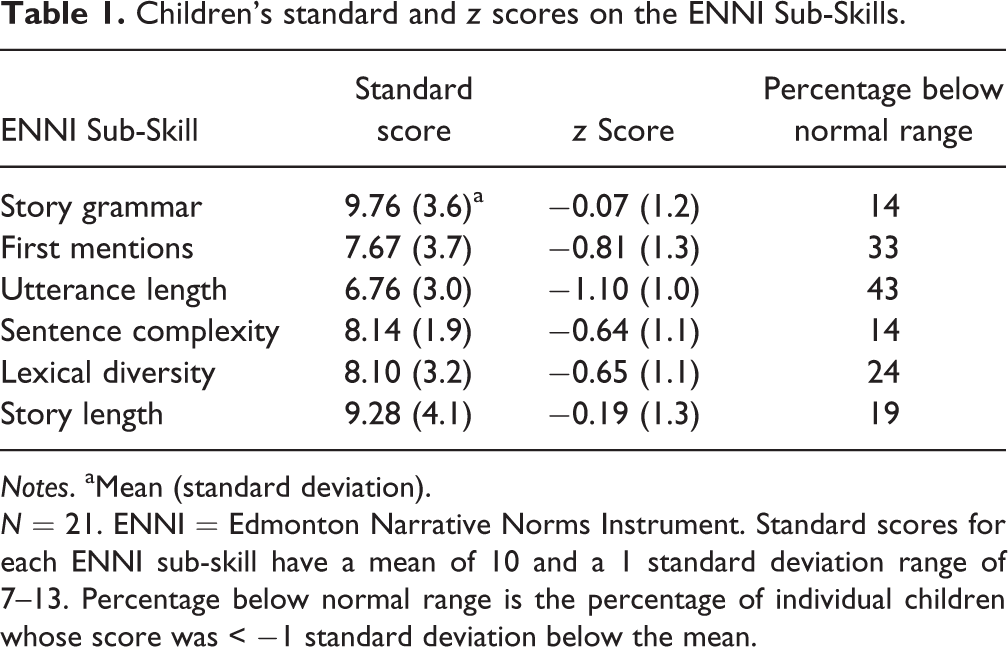
Table 1 displays children’s mean standard and z scores for the ENNI sub-skills, based on monolingual norms. For the ENNI, the standard mean is 10, with the normal (1 standard deviation [SD]) range being 7–13. The scores in Table 1 reveal the following: Children’s mean scores were within the monolingual normal range for all sub-skills except utterance length; however, the sizable SDs indicate that some individual children were scoring below the normal range. The rightmost column contains the percentage of individual children whose score for that sub-skill fell below −1 SD. For utterance length, first mentions and lexical diversity, nearly a quarter or more of the children had scores that fell below −1 SD.
Children’s standard and z scores on the ENNI Sub-Skills.
Notes. aMean (standard deviation).
N = 21. ENNI = Edmonton Narrative Norms Instrument. Standard scores for each ENNI sub-skill have a mean of 10 and a 1 standard deviation range of 7–13. Percentage below normal range is the percentage of individual children whose score was < −1 standard deviation below the mean.
Children appeared to show profile effects on the ENNI because their mean standard scores ranged from 9.76 (story grammar) to 6.76 (utterance length) (z scores −0.07 to −1.10). A significant repeated measures analysis of variance confirmed the observed uneven profiles, F(5, 16) = 7.016, p = .001, Wilks’ Lambda = .313, partial eta-squared = .687. Next, planned paired t-test comparisons were undertaken to test our prediction that story grammar scores would be higher than first mentions scores, as well as higher than utterance length, sentence complexity, lexical diversity and story length. Results confirmed our predictions for most of these comparisons: story grammar vs. first mentions (t(20) = 3.462, p = .002), vs. utterance length (t(20) = 4.954, p < .001), vs. sentence complexity (t(20) = 2.453, p = .023), vs. lexical diversity (t(20 = 3.208, p = .004). No significant difference was found between story grammar and story length.
Individual differences in home language environment and ENNI scores
Age of arrival was operationalized as a nominal, between-groups variable (foreign-born [N = 8] vs. Canadian-born [N = 13]). Six out of 8 foreign-born children had arrived shortly before their entry in the preschool program. We expected the Canadian-born children to have different English exposure factors than the foreign-born children, and this expectation was borne out by our analyses of the characteristics of both groups using Mann-Whitney U tests (Table 2). The Canadian-born and foreign-born children were the same age, and came from families of a similar size with similar and low levels of maternal education (low-SES). By contrast, the foreign-born children had mothers (p = .015) and fathers (p = .009) with lower English fluency than the Canadian-born children, had been hearing and using English for a shorter period of time (p = .020), were exposed to less English spoken in the home overall (p = .029), heard less English from family members (p = .037), and spoke less English with family members (p = .020). However, the two groups did not differ in the richness of the English environment at home.
Characteristics of foreign-born and Canadian-born children.

Notes. aMean (standard deviation); bNonparametric Mann Whitney U tests.
N = 8 (foreign-born) and 13 (Canadian-born). Mother’s and father’s self-rated English fluency are rated on a 0–4 scale, with 4 as the most fluent. Proportion of English use in the home, spoken to the child by family members and spoken by the child to family members is calculated between 0 and 1.0, with 1.0 as only English being used/spoken. Richness of the English environment is calculated between 0 and 1.0, with 1.0 as the richest possible English environment.
We next compared the scores for the ENNI sub-skills between the foreign-born and Canadian-born groups, to see whether the Canadian-born group had higher scores. A two-way mixed analysis of variance with ENNI sub-skills as the within-subjects factor and Group (Canadian-born vs. foreign born) as the between-subjects factor showed a significant main effect for ENNI sub-skills, F(5, 15) = 7.149, p = .001, Wilks’ Lambda = .296, partial eta squared = .704, but no significant main effect for group and no significant interaction. (There were no violations of homogeneity of variance for the between-subjects factor). The non-significant main effect for Group was not marginal, i.e., not the result of the Canadian-born children’s scores showing a trend to be higher but not sufficiently higher to achieve significance. On the contrary, the mean standard scores for the foreign-born children were slightly higher for every sub-skill except sentence complexity.
We undertook some follow-up analyses to probe for any association between children’s sources of exposure to English and their ENNI scores, regardless of whether they were Canadian-born or foreign-born. A series of Spearman’s rho correlations were conducted between English exposure factors (mother’s fluency, father’s fluency, months the child heard/used English, proportion English in the home, proportion English addressed to the child, proportion English used by the child, and English richness) and each sub-skill on the ENNI. The only significant correlation found was between first mentions and months the child had heard/used English (r = .451, p = .040). Finally, some of the children (15/21) had their L1 supported in the classroom via L1 facilitators, e.g. Arabic and Somali. In order to ascertain if this impacted their ENNI outcomes, we conducted a series of Mann Whitney U comparisons between the ENNI scores of children with and without their L1 supported; no significant results were found.
Discussion
The primary goal of this study was to examine the English L2 proficiency, as measured by a standardized story-telling instrument (ENNI), of ELLs at the end of a 1-year preschool program to understand how their proficiency compared to monolingual norms, and whether they showed an asynchronous profile in that they were closer to monolingual age-based expectations for some language sub-skills than others. The secondary goal was to understand how differences in children’s home language environments influenced their scores on the story-telling instrument.
Children’s mean standard scores for story grammar, sentence complexity, lexical diversity and story length were all within the monolingual normal range (7–13), with utterance length and first mentions below or on the border. Although some individual children’s scores fell below the monolingual norm for each sub-skill, overall, this group of children performed closer to monolingual expectations than what has often been reported for their counterparts in the United States with similar preschool experience (see e.g. Hammer et al., 2011 for standardized tests of vocabulary and oral comprehension). One reason for this discrepancy could be the size and diversity of minority language groups. Spanish-speakers constitute a large minority linguistic/cultural group in the United States, but as mentioned in the Introduction, there is great diversity in the non-official languages (not French or English) spoken in Canada. Thus, the size of minority linguistic/cultural groups in Canada is much smaller. It is possible that children who speak minority languages in such a diverse context have greater motivation and opportunity to acquire the classroom and societal L2 than children in a context with one predominant minority linguistic/cultural community. Future research is needed to investigate the validity of this explanation.
The ELL children in this study clearly displayed profile effects in their English L2 abilities, as significant differences were found amongst their ENNI scores for the sub-skills. As predicted, they showed lower scores for sub-skills more dependent on specific knowledge of English grammar and vocabulary, i.e., utterance length, sentence complexity, lexical diversity and use of referring expressions in first mentions, than for story grammar. However, children’s mean score for story length in words was also close to monolingual norms and not different from their story grammar scores. One reason for this outcome could be that a story length measure might be less sensitive to English-specific vocabulary knowledge than a measure like lexical diversity since it measures total number of words rather than unique words used. This might have enabled ELLs to achieve performance on this measure close to monolingual norms.
These results are consistent with prior research comparing narrative skills with grammar and vocabulary skills in older ELLs (Paradis, Genesee, & Crago, 2011; Paradis et al., 2013; Pearson, 2002) and support Oller et al.’s (2007) proposal about how bilingual-monolingual differences in test score profiles could be rooted in the distinction between shared and distributed knowledge. This is best illustrated in the contrast between children’s scores for story grammar and for use of referring expressions in first mentions. Both of these are narrative sub-skills, but the latter crucially depends on knowledge of the definite/indefinite article system in English, and thus, requires more distributed knowledge than the former. ELL children’s relatively advanced L2 story grammar skills could be a source of strength in their L2 literacy development, since narrative skills can be considered a bridge between oral and written language genres (Schneider et al., 2006), and cross-modal influence between narrative language and reading skills can be expected (Cardenas-Hagen et al., 2007; Riches & Genesee, 2006). One question that arises with respect to children’s story grammar skills concerns the potential role of cross-cultural differences in the narrative structure of stories. While our participant sample is culturally and linguistically diverse, this is unlikely to have had a large impact on children’s performance on the ENNI. First, children were given the ENNI in their preschool classroom, which should have reinforced a mainstream cultural influence in the narrative structure they assumed when telling the stories. Second, story-telling instruments like the ENNI are designed to constrain the kind of narrative children produce (Schneider et al., 2006), and as such, reduce the impact of individual or culturally-influenced variation. Indeed, ELL children include similar story grammar elements in telling the ENNI in Mandarin and Cantonese as they do in English (Jia, Yiu, Sorenson Duncan, & Paradis, 2010).
The uneven pattern of strengths and weaknesses for different language sub-skills, i.e., profile effects, is relevant to both clinicians and educators for purposes of assessing ELL children’s language abilities and for consideration of what to emphasize in language enrichment activities in the classroom. Children in early education programs are often assessed for language and learning disorders, and yet, those children in the process of acquiring English as an L2 pose special challenges to accurate assessment, with over-identification being a persistent risk factor for ELLs (Bedore & Peña, 2010; Cummins, 2000; Paradis et al., 2011; Tabors, 2008). The results of this study indicate that using a measure like narrative story grammar could overestimate an ELL’s general level of proficiency, while using a strictly grammatical measure like utterance length might underestimate it. Regarding pedagogical considerations, knowledge of profile effects could prompt educators to focus on those sub-skills that take longer for ELLs to develop when planning language-oriented activities in early education classrooms in order to ensure that children are provided with ample opportunities to develop these sub-skills. Overall, the presence of profile effects argues for the importance of conducting comprehensive language assessments with ELLs, and for increasing awareness of the “ELL profile” across language sub-skills among educators and clinicians.
Since preschool classes are often comprised of children whose English language experiences vary considerably, we examined the impact of home language environment factors on these children’s ENNI scores. First, children were divided into foreign-born and Canadian-born groups, and we found that these groups had different characteristics regarding children’s exposure to English (except for richness of the English environment), but were the same in terms of age, SES and family size. Results of between-group comparisons showed that even though the Canadian-born children were exposed to more English at home and for a longer period of time, they did not have higher scores on the ENNI than the foreign-born children. Follow-up correlations between home-language environment variables and ENNI outcomes regardless of group did not produce different results. Limited or non-influence of English use at home on children’s English L2 development has been found in other studies with ELLs (Bohman et al., 2010; Golberg et al., 2008; Hammer et al., 2009, 2011, 2012; Paradis, 2011; Place & Hoff, 2011). What could be the reasons for the lack of influence in this study? First, although the parents of the Canadian-born children had higher self-rated fluency in English than the parents of the foreign-born children, the scores for the mothers were not high for either group (1.5 and 2.5 out of 4, respectively), and since none of the parents in either group were native-speakers of English, this could have affected the quality of English the children were exposed to at home (cf. Hammer at al., 2012; Place & Hoff, 2011). Second, the two groups of children did not differ in terms of richness of their English environment outside of school. Paradis (2011) found that richness of the English environment was a significant predictor of individual differences in rate of English L2 development while the quantity of English spoken at home was not. Thus, because the richness, or quality, of English heard and used at home was the same for the two groups, this might explain the absence of between-group differences in ENNI scores. A third and related point is that a narrative task like the ENNI might represent a more academic English genre than the genres of English used and heard at homes in the families in this study. Consequently, the preschool program would have been the main source of academic English genres for these children, and since both the Canadian- and foreign-born children had equal time spent in this program and the ENNI was administered there, their English abilities as measured by the ENNI did not differ. Finally, we cannot rule out that the absence of home language influence on children’s ENNI outcomes is an artifact of our relatively small sample size.
Although the lack of an advantage for the Canadian-born ELL group found in this study needs to be viewed with caution because its source is unknown, its potential implications are worth exploring, especially given that similar findings have emerged from other studies. First, this finding could be important to keep in mind when setting expectations for young ELLs in an educational or clinical setting. Specifically, it might be inappropriate to expect more from children born in the host country than foreign-born children with respect to academic L2 skills like those measured by a narrative task. The lack of advantage is also relevant for considerations of age of onset in L2 acquisition. Contrary to the simplistic “earlier is better” notion, when it comes to the preschool years, children might be able to learn their L2 very efficiently when their exposure does not begin at home but instead in a preschool/school program, especially since older L2 children learn faster than younger ones (Bohman et al., 2010; Golberg et al., 2008; Paradis, 2011). Finally, the results of this study could inform the issue of what language newcomer families should be encouraged to speak at home with their children. The absence of any advantage for the Canadian-born group suggests, albeit indirectly, that their increased exposure to the L2 at home was not helping them advance their English skills. At the same time, other research indicates that increased use of English at home could negatively impact ELLs’ maintenance and development of the minority L1 (Cummins, 2000; Hammer et al., 2011; Wong Fillmore, 1991; see Paradis et al., 2011, for review). The lack of evidence for a positive role of English L2 use at home on children’s development of the societal language has prompted researchers to suggest that English L2 use at home by newcomer families should not be recommended (e.g. Hammer et al., 2009). To the extent that we can generalize from our small sample, the present study adds evidence to support this recommendation.
Footnotes
Funding
This research was funded by a grant from the Alberta Centre for Child, Family and Community Research (PI: Kirova).