



Abstract
Personal recollections constitute autobiographical memory that develops intensively during the preschool years. The two-wave longitudinal study focuses on gender differences in preschool children’s independent recollections. The same children (N = 275; 140 boys, 135 girls) were asked to talk about their previous birthday and the past weekend at the ages of 4 and 6. Interactions were coded for content. Boys talked more about themselves and about different nonsocial aspects of the events. Girls talked more about the other people with whom they had jointly experienced the past event. It seems that gender differences in children’s recollections appear early and increase during the preschool period.
Personal recollections constitute autobiographical memory and are important for one’s self. Autobiographical memory develops during the preschool years when children learn to provide accounts of themselves and their experience. During the preschool years, the ability to narrate one’s past experience undergoes refinement and the stories provided become more detailed, elaborate, and precise (Haden, Haine, & Fivush, 1997; Han, Leichtman, & Wang, 1998; Reese, Haden, & Fivush, 1993, 1996). Children’s ability to recount their experience also develops. Although children start to talk about their past experiences at the age of about 2.5 years, 3- and 4-year-old children still need some scaffolding and prompting by adults in order to provide cohesive reports of their past experience. “True” autobiographical memory emerges at the end of the preschool years (Hudson, 1990; Nelson, 1993). The present study focuses on the differences in the recollections of past experience provided by preschool children. By a longitudinal design, it attempts to track the changes in the content of past-experience stories provided by boys and girls in Estonia.
Autobiographical memory is influenced by the cultural context (e.g. Wang, 2004) and the social experience of the child (Fivush, Haden, & Reese, 2006, for review; Nelson, 1993; Nelson & Fivush, 2004). The social experience of reminiscing (i.e., discussing jointly experienced past events) is also important (Reese, 2002); children of mothers who provide more structure in the form of elaborations during joint reminiscing provide more elaborate memories with their mothers (Haden, Ornstein, Rudek, & Cameron, 2009) and can recall more of past events independently (Cleveland & Reese, 2005; Farrant & Reese, 2000; Reese & Newcombe, 2007). The social experience of joint reminiscing differs in girls and boys. Gender differences have been reported for parent–child reminiscing conversations: both mothers and fathers are more elaborative with their daughters, and therefore girls provide more information in past-event reminiscing than boys (Fivush, 1998; Reese & Fivush, 1993; Reese et al., 1996). Furthermore, when children are 3 years old, parents use more emotional utterances when discussing sad events with girls than with boys (Fivush, Brotman, Buckner, & Goodman, 2000). In the case of children of 6–7 years, it has been shown that parents discuss anger and refer to negative emotions more with sons than with daughters (Bird & Reese, 2006).
Studies of gender differences in joint reminiscing have also focused on children’s contribution to the reminiscing interactions with their parents. Haden, Haine, and Fivush (1997) report gender differences in the narrative structure of past event recollections. Namely, 3-year-old girls provided more narrative structure and spatial-temporal information than boys. Han, Leichtman, and Wang (1998) showed that 4- and 6-year-old boys have a lower ratio of other mentions to self-mentions meaning that they include more mentions of themselves—relative to other people—in their stories as compared to girls of the same age, and that holds for the Chinese, Korean, and US context. At the same time, 3- and 5-year-old girls have been found to differ from same-aged boys in that they refer to themselves and other people more than boys and talk more about relationships (Buckner & Fivush, 2000). Additionally, preschool girls provide more personal orientation, inner state information, (Haden et al., 1997), and emotional aspects of the event (Fivush, 1998; Fivush et al., 2000) in joint reminiscing with parents as compared to boys. At the age of 5 years, but not at the age of 4, girls also refer more to their own negative emotions (Bird & Reese, 2006). Thus, girls seem to have a social orientation in reminiscing talk with their parents, whereas boys are more focused on themselves.
Besides the above-mentioned gender differences in reminiscing, some of the results reported are inconsistent and controversial. For example, Lewis (2012) reports no differences in maternal style according to children’s gender. Han et al. (1998) report gender differences for the US preschool children in the length of past-event stories with girls providing longer descriptions of their past events than boys. These differences were, however, significant only when children’s words and not propositions were counted.
A few studies have addressed children’s recollections (i.e., independent recalls of autobiographical memory events). Here again, 8-year-old girls include more social context information and mention more emotions than boys in their independent memory narratives (Buckner & Fivush, 1998). However, preschool children’s independent recall of autobiographical past events has not been systematically studied for possible gender differences.
Reviewing studies of mother–child reminiscing indicates that one’s self and the social world could be more prominent topics for boys and girls, respectively. Besides self and others, objects and toys (the non-social context) are one of the major topics in children’s interactions (Marvin & Hunt-Berg, 1995; Marvin, Beukelman, Brockhaus, & Kast, 1994). The non-social context of past events is also prominent in mother–child reminiscing talk (Tulviste, Tõugu, Keller, Schröder, & De Geer, 2012; Tõugu, Tulviste, Schröder, Keller, & De Geer, 2012), and cultural contexts differ in the amount of attention that is paid to the non-social context in mother–child reminiscing (Tulviste et al., 2012). Mothers from rural families pay much less attention to the non-social context in mother–child reminiscing than mothers from urban middle-class families. At the same time, the topic predominated for all children including the children from the rural context. To our knowledge, possible gender differences in the discussion of non-social aspects of events have not been addressed.
It is known that the preschool years are an important time for the development of gender identity in children. Children become identified with their gender and understand its constancy (see Bandura & Bussey, 2004; and Maccoby, 2000 for an overview; Martin, Ruble, & Szkrybalo, 2002) and increasingly prefer same-sex playmates (Maccoby, 1990). Girls have been found to be slightly ahead of boys in verbal skills (Bornstein, Hahn, & Haynes, 2004; Eriksson et al., 2012) and both boys and girls have been shown to develop their own communicative styles (Leaper, 1991; Leaper & Smith, 2004) and narrative preferences (Nicolopoulou, 2002). Nicolopoulou (2002) showed that during the preschool years, prototypical sex-typed plots for narratives appear, which are told and retold to peers with further refinement. In light of the emergence of gender differences in language use, communication, and narrative content during the preschool years, it would be illuminating to analyze the possible gender-specific changes in the content of autobiographical memory narratives of preschool children.
The present study
The data for the study was collected in Estonia, a small EU country with a population of 1.4 million located in the north of Europe. During the past 25 years, after regaining independence, Estonia has witnessed many political, economic, and social reforms. Earlier research in Estonia on children’s family and peer conversations has provided few indications of gender differences in child socialization. For example, in the case of 4-year-olds the child’s gender did not reveal any differences in mother–child past-event reminiscing (Tõugu, Tulviste, Schröder, Keller, & De Geer, 2011). Amongst themselves, Estonian preschool children are more directive than their Nordic counterparts, but there are no differences in the conversational style of boys and girls (Tulviste, Mizera, De Geer, & Tryggvason, 2010). Furthermore, no gender differences have been found in the number of words used or talkativeness during interaction (Tõugu & Tulviste, 2010). Yet, gender differences were identified in some aspects: for example, boys refer to moral rules in dyadic and triadic play situations more often than girls (Tulviste & Koor, 2005; Tõugu & Tulviste, 2010).
The present two-wave longitudinal study addressed gender differences in preschool children’s independent recounts of personal past experiences. Autobiographical memory forms a part of one’s self (Conway, 2005; Conway, Singer, & Tagini, 2004), and during the time when gender identity develops in preschool, differences in the autobiographical recollections can be expected to appear. As noted, only a few studies have indicated gender differences in the content of children’s independent recounting of their past experiences, and none of them have been longitudinal. There is some indication that gender differences could be age-dependent (Bird & Reese, 2006; Fivush, 1998); therefore the longitudinal design was chosen to detect the appearance and changes in the gender-typed content in children’s independent recollections.
Moreover, most studies reporting gender differences in reminiscing with children or in children’s independent recollections focus on a few aspects, such as emotions, self, and other people (e.g. Buckner & Fivush, 2000; Han et al., 1998). In order to gain a more comprehensive picture of the possible differences, a more comprehensive investigation of the content of children’s recollections is necessary. The present study makes use of an exhaustive coding scheme to focus on such content categories as agency, co-agency, social context, non-social context, and rest (further described in the Method section).
As the preschool years are an important period for gender identity development, children are expected to display fewer gender differences in the content of their past event stories during the first wave of the study than during the second wave of the study. We expect girls to be more elaborate and provide more propositions in their past experience stories than boys. We also expect girls to have a social focus in their recollections, which means that they talk more of other people involved in the event than boys. At the same time, we expect boys to present themselves as protagonists of the events more than girls. No specific hypotheses are proposed for gender differences in the non-social context category.
Method
Participants
Two hundred and seventy-five children were interviewed twice: at first when they were about 4 years old (M = 4.28, SD = 0.56) and then before entering school at about the age of 6 (M = 6.16, SD = 0.56). One hundred and forty of the participating children were boys, and 135 were girls. All children were recruited from kindergartens all over Tartu (a town with a population of 100,000 in Estonia) in 2007/2008 and again in 2009/2010. All children were participants in a larger European study IDEFICs (Identification and Prevention of Dietary and Lifestyle Induced Health Effects in Children and Infants) (Ahrens et al., 2011). The present study focuses on children’s past event recollections that were a part of the Estonian additional block, which was devoted to the investigation of language and narrative development.
Children’s recounts of past experiences
On both occasions, children were asked to talk about their previous birthday and the past weekend. Children were interviewed in the kindergarten individually in a separate room by a female research assistant. First, the Comprehension Scale from the Reynell test (Edwards, Garman, Hughes, Letts, & Sinka, 1999) was administered. The Comprehension Scale of the test ends with several questions about a picture depicting a girl’s birthday party in a burger bar. This was considered as an introduction to the topic of birthdays, and children were encouraged to interpret the picture and engage in talk about the picture with the research assistant. After studying the picture, children were encouraged to talk about their previous birthday party. “Do you remember your last birthday party? Can you tell me something about it?” was the standard introductory phrase. Once the child started to talk about the event, the research assistant provided positive feedback and backchannel responses such as “yeah”, “really?”, “and then?” as in previous studies (Peterson, Jesso, & McCabe, 1999). The research assistants were instructed to elicit personal narratives if needed by asking children open question prompts like “And what happened then?”. The research assistants were warned against leading the child with yes/no questions. At the same time, they were allowed to repeat and rephrase the question, to repeat children’s answers, and to indicate involvement in the conversation verbally and non-verbally. When the children failed to provide any information about their birthday party following the standard introductory phrase (mainly during the first wave), the research assistants were instructed to ask simpler and more particular standard prompts (e.g., “Did you have a birthday party? What do you remember of it?”). And when the children (mainly the small children during the first wave) were not able to answer these questions either, even a simpler and more particular question was posed (e.g., “Was anyone else there and what did you (2nd person plural) do?”, etc.). When the children failed to provide any more information about the birthday party, they were asked to talk about the past weekend with a standard question “What did you do with your mom and dad at home this weekend?”. Similar rules were applied to continuing the conversation as to the talk about the birthday party. When children at a younger age failed to provide any information about the weekend in response to the initial question, a shorter version was used (“What did you do this Saturday–Sunday?”). When this failed to initiate a response, even simpler questions like “Did you do something this weekend? What did you do?” were asked. The interaction was continued until the child did not provide any more information. The interactions were audio-recorded and transcribed.
Coding
The transcribed interactions were coded for the content of children’s talk. First of all, topical content was distinguished from non-topical talk, which was not coded any further. Topical utterances were then coded for content. Each subject–verb clause or single content word answer by the child received a content code: Agency: propositions focusing on the child as the agent, e.g., “I played a computer game”. Co-agency: propositions indicating co-agency, e.g., “My mother and me went swimming”. Social content: propositions focusing on other people including parents and siblings present/involved in the event, e.g., “Grandma came for a visit”. Non-social: propositions focusing on non-social aspects, e.g., “A long yellow car was it”, “Pooh bear cards were there”. Rest: propositions that did not qualify for other categories, often propositions with “it” or “this” as the subject. “It already was”, “It was like that, there”.
The coding was exhaustive, and the codes were mutually exclusive. One fifth of the material was coded by a second coder for reliability; Cohen’s kappa was .81; all discrepancies were resolved in discussion.
Results
SPSS Mixed Models for Repeated Measures was used for the analysis with Gender, Category, and Wave of measurement as factorial fixed effects. Changes in the use of different categories were examined by tests of Wave x Category interaction and gender differences in category use were examined by tests of Gender x Category interaction. Results showed group main effects for Wave (F (1, 2475) = 81.86, p < .001), Category (F (1, 2475) = 64.79, p < .001), but not Gender. These results indicate that all children used a different number of propositions during the two waves of the study, but there were no gender differences in the number of propositions used. Pairwise comparison using the Bonferroni adjustment showed that children used more propositions during the second wave of the study (M = 15.21, SD = .58 and M = 20.83, SD = .71 during the first and the second wave, respectively) (see also Examples 1 and 2 towards the end of the section). The effect of Category indicates that across the waves of the study children use content categories to a different extent. Pairwise comparison of the number of propositions per category using the Bonferroni adjustment showed that such categories as agency (ps < .001; M = 5.12), rest (ps < .001; M = 2.14), and social context (ps < .001; M = 4.15) differed from all other categories and only the number of propositions in the category co-agency (M = 3.51) and non-social context (M = 3.08) did not differ from one another.
Analyses also revealed a Wave x Category interaction (F (4, 2475) = 5.65, p < .001), indicating that there was a significant difference in the propositions used per category for the two waves. Follow up tests showed a within subject effect for agency, (F (1, 273) = 6.37, p < .05, ηp 2= .02), co-agency, (F (1, 273) = 73.31, p < .001, ηp 2= .21), social context, (F (1, 273) = 4.38, p < .05, ηp 2= .02), non-social context, (F (1, 273) = 20.9, p < .001, ηp 2= .07), and rest, (F (1, 273) = 13.88, p < .001, ηp 2= .05). Children use agency (M = 4.71 vs. M = 5.56), co-agency (M = 2.36 vs. M = 4.65), social context (M = 3.8 vs. M = 4.5), non-social context (M = 2.54 vs. M = 3.62), and rest (M = 1.78 vs. M = 2.51) categories significantly more during the second wave as compared to the first one. The means and standard deviations for each category are presented in Table 1.
Number of propositions for each content category by boys and girls during the first and second wave of study.
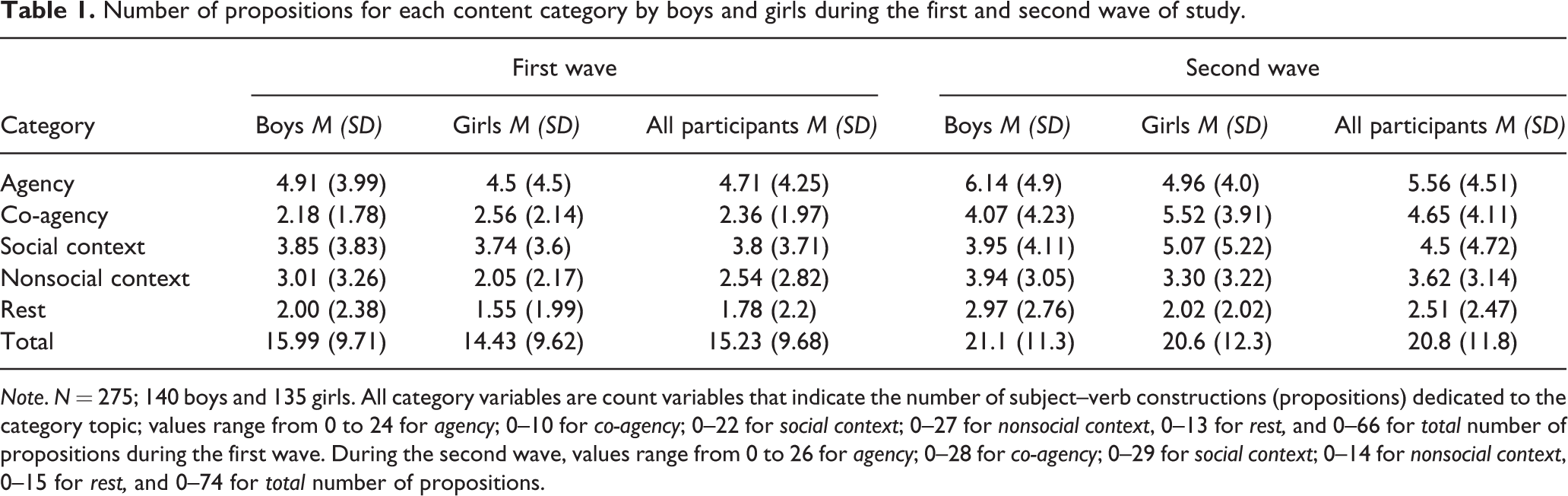
Note. N = 275; 140 boys and 135 girls. All category variables are count variables that indicate the number of subject–verb constructions (propositions) dedicated to the category topic; values range from 0 to 24 for agency; 0–10 for co-agency; 0–22 for social context; 0–27 for nonsocial context, 0–13 for rest, and 0–66 for total number of propositions during the first wave. During the second wave, values range from 0 to 26 for agency; 0–28 for co-agency; 0–29 for social context; 0–14 for nonsocial context, 0–15 for rest, and 0–74 for total number of propositions.
The Mixed Model for Repeated Measures also revealed a Gender x Category interaction (F (4, 2475) = 7.77, p < .001) indicating that there was a significant difference in the propositions used per category by boys and girls. To follow up, a multivariate test for gender effects on different categories during the first wave was carried out, which indicated a significant effect of gender, Wilks’ λ = .95, F (5; 269) = 3.02, p < .05, ηp 2 = .05. In order to study the effect of gender on the use of different categories, univariate tests for the effect of gender on each category were run. For the first wave of the study, the gender effect was only detectable for the non-social context category, (F (1, 273) = 8.24, p < .01, ηp 2= .03), with boys using the non-social context category more than girls. In line with the quantitative results, Example 1 provides segments of interaction with 4-year-old children in order to illustrate the similarity of children’s recounts at that time.
Example 1
An excerpt from the interaction with a 4-year-old boy:
But what did you do this Saturday–Sunday?
I slept. I played. And then I came to the kindergarten.
What games did you play on Saturday and Sunday?
On Saturday I played other games. On Sunday I looked through some books.
An excerpt from the interaction with a 4-year-old girl:
What did you do at home this Saturday–Sunday?
I played.
You played. What else?
I went out then in the morning and then…Mommy gave me some food and then we started eating and then we changed and then mommy…And then we went to town and bought some food and went to the sales.
A multivariate test for gender effects on different categories was also carried out for the second wave of the study, which indicated a significant effect of gender, Wilks’ λ = .9, F (5; 269) = 5.9, p < .001, ηp 2 = .1. As the univariate test indicates, for the second wave of the study, the gender effect was detectable for the use of agency, (F (1, 273) = 4.76, p < .05, ηp 2= .02), co-agency, (F (1, 273) = 5.77, p < .05, ηp 2= .02), social context, (F (1, 273) = 3.94, p < .05, ηp 2= .01), and rest, (F (1, 273) = 10.51, p < .01, ηp 2= .04) category with boys making more references to the agency and rest categories than girls and girls using co-agency and the social context category more often than boys. In order to illustrate the quantitative results, Example 2 provides four recounts provided by 6-year-old children during the second wave. One can notice that the boys present themselves as protagonists in both recounts while the girls’ recounts clearly include more references to other people who were involved in the event.
Example 2
An excerpt from an interview with a 6-year-old boy recollecting a fishing trip:
Here a couple of days ago. When it was still August or September. Then we went fishing. Then we…Then I first tried to catch one, but my daddy had told me of a place where the fish bites well. As I recall I caught five fish.
Uh-huh.
As I recall, daddy showed me how it goes. And then I…then daddy caught one fish with my rod. And then I caught myself. Then when I was with the last five…I don’t know just five or six…I caught six or four fish. Then I…Then I felt that it bit, for a second, it started pulling for a bit. Then I pulled the rod out and there was nothing. It only took the worm a bit.
An excerpt from an interview with a 6-year-old boy recollecting a birthday party:
Tell me about your last birthday.
I got too many #. I got too many presents.
You got a lot of presents.
Yes. One toy and one. But one puzzle. But I got a, a really cool toy. It opens up, but it is a ball indeed.
But tell me more about your birthday.
I got many different things. I got a dragon. And I got a Spiderman puzzle. And this, this and the ball that opens up, that was a Pakugan.
Uh-uh. Tell me something more about your last birthday.
Ah and then I got more like this, I got more. I don’t remember what else I got.
An excerpt from an interview with a 6-year-old girl recollecting her last weekend:
I went…When it was the first day off, the very first, then I went to the Aura pool. With my brother and Ott…Ott is my brother. Then I went with mother Tiina and I went with myself, daddy was at work then. And then I played at home for a little while and.…But the second day, then I was just at home and what did I really do? I don’t even know.
An excerpt from an interview with a 6-year-old girl recollecting a birthday party:
Tell me something about the birthday.
Mattias brought us a Kinder surprise for us there. A big bag.
Uh-uh.
And then Lotta had a little sister. And then we climbed to her brother’s and his bed. And then we put on other costumes. We ate and played.
Do you remember anything else about that birthday?
We used the computer. We did some drawing. And we jumped on their beds. And nothing else.
The means for boys and girls for the first and the second wave are plotted on Figure 1.

Mean use of different categories for boys and girls during the first and second wave of study. Note. N = 275; 140 boys and 135 girls.
Discussion
The aim of the present study was to reveal gender differences in children’s recollections of past experiences. The study set out with the hypothesis that girls provide longer recollections than boys. Additionally, it was predicted that as children grow older, gender differences in the content of their past event narratives increase and girls provide more stories with a social focus than boys. The latter concentrate more on themselves as the agent in their recollections of past events.
First of all, children’s recollections become longer with age showing an increase in their ability to produce narratives (see Nelson, 1993), which can also be observed in Examples 1 and 2. At the same time, no gender differences in the length of the recollection were detected. Previously, gender differences have been reported in the length of children’s past event reminiscing in the US, but not in China and Korea (Han et al., 1998; Reese et al., 1996). So, on the one hand, gender differences in the amount of elaborations provided could depend on the cultural context or the conversational style adopted with the child by the adults. Studies have shown that while gender differences in the style of reminiscing with the child have been reported for the US (Reese & Fivush, 1993; Reese et al., 1996), these differences in the maternal style have not been detected in Estonia (Tõugu et al., 2011), where the present study was carried out. On the other hand, the measurement method may have an effect: Han et al. (1998) reported gender differences in length when past event recollections were measured in words but not when measured in propositions. The present study focused on the amount of propositions. Therefore, in this case it seems that boys and girls are equally capable of providing short overviews of their past experiences when prompted by a relative stranger, and that ability increases with age.
As the ability to narrate one’s experiences increases when children get older, it is not surprising that there is also an observable increase practically in all content categories. A closer look at the mean number of propositions that children use in each category seems to indicate that the most prominent content of younger children’s recollections is the children themselves. (See also Example 1 in the Results section). As children grow older, agency remains an important content category of their recollections, but references to other categories increase, and there seems to be more variability in terms of content. In this particular study, co-agency seems to be an especially salient category. At the same time, this result should be treated with caution as the topic of the past weekend was introduced with a co-agentic focus by the research assistant during both waves. It is probable that children’s language abilities may have improved by the second wave, and they provided co-agentic responses to the prompt more often and needed fewer simple questions from the research assistant in order to provide their narratives.
It was also expected that there would be fewer gender differences at an earlier age as compared to the later age. This hypothesis was supported by the data. Children aged 3–5 recollected rather similar stories in terms of content. Yet, quite surprisingly, the gender difference in one content category is already detectable at the age of 4, when the children were first interviewed. The difference lies in the amount of information provided about the non-social context with boys focusing more on the material things relevant to the recollected experience than girls. During the second interview, gender differences had become more apparent, and the differences displayed also supported our hypothesis about the gender-typed content of children’s recollections: 5–7-year-old boys concentrated more on the agency and the rest category than the girls, which implies that they talked a lot about themselves and their experiences concerning the event and also about different non-social aspects that were referred to as “it” or “that” and therefore not coded under the non-social category. And 5–7-year-old girls as compared to boys were more focused on the co-agentic nature of the experience meaning that they talked more about the other people with whom they had jointly experienced the past event. (See also Example 2 in the Results section for excerpts to illustrate the gender differences.)
All in all, more gender differences emerged during the second wave of the study when children are about 6 years old. It seems that as children become more experienced and fluent in their narratives and probably also more independent of the interviewer and her helping questions, they increasingly provide narratives of similar events that are gender-specific in content.
Such results are particularly interesting as previous research has not indicated any gender differences in the socialization of children in mother–child reminiscing in Estonia, at least for 4-year-olds (Schröder et al., 2011; Tõugu et al., 2011). Schröder et al. (2011) did not find any gender differences in the ratio of self–other references in children’s reminiscing talk with their mothers and other studies focusing on mother–child interaction in Estonia have hardly ever reported gender differences. At the same time fewer studies have focused on peer socialization. In Estonia children’s recollections have not been studied with regard to gender differences, nor have narratives been studied with this particular focus. At the same time, Nicolopoulou (2002) showed that during the preschool age boys and girls increasingly prefer different plots for the stories they tell. In early childhood children spend more and more time in the company of their same-sex peers (see Maccoby, 2000), and Estonian studies have also indicated some gender differences in peer interaction during kindergarten (Tulviste & Koor, 2005; Tõugu & Tulviste, 2010). Fivush and Buckner (2003) also suggested that gender differences in autobiographical memories could be especially salient during childhood. It is possible that children playing with same-sex peers are subject to peer influence and socialization in kindergarten, and that socialization also affects the stories they tell about themselves. Further studies, especially longitudinal ones, would be necessary to establish the possible changes in the gender-typed narratives during late childhood and adolescence.
All in all, one could conclude that gender differences in children’s recollections of past events are a rather early phenomenon in their personal narratives. It also seems that the differences cannot be explained by the differences in how much they talk as no gender differences were found in the length of recollections. As children get older and their narrative abilities improve, the gender differences persist and increase. The gender differences are clearly observable when the so-called “true” autobiographical memory emerges (Nelson, 1993). It seems justified to conclude that rather young children reconstruct their past events in a gender-specific manner. Whether boys and girls approach the original events differently and consequently remember them differently in terms of content, or they are socialized to provide gender-typical recollections by parents and peers, remains to be revealed in future studies.
The present study provided an overview of the systematic gender differences in children’s recollections during the preschool years and by the longitudinal design also mapped the gender-specific changes that occur in the content of children’s personal recollections. It showed that gender differences in personal recollections are an early phenomenon in the development of personal narratives and that the differences increase during the preschool years as children become more fluent in their memory narratives. The results seem to indicate that as soon as children begin to construct their selves in terms of autobiographical memories, their selves as presented in personal narratives are gender-specific.
Footnotes
Acknowledgments

*This article accepted during Marcel van Aken’s term as Editor-in-Chief.
Funding
We gratefully acknowledge the financial support of the European Community within the Sixth RTD Framework Programme Contract No. 016181 (FOOD). Research for the article was supported by the Estonian Science Foundation (Grant No. 9033) and Estonian Research Council (IUT 20-409).