



Abstract
Reciprocal associations between the Big Five personality traits and parenting stress—including both parents’ feelings of their distress and perception of their incompetence as parents—were studied with 248 participants (49% of which were males). Longitudinal data, collected at ages 33/36, 42 and 50 years, were used. Cross-lagged path analysis revealed that in case of both mothers and fathers, neuroticism at age 33 predicted high parenting stress, and extraversion at age 33 predicted low parenting stress at age 42. Also, parenting stress at age 36 predicted high neuroticism and low extraversion at age 42. From age 42 to 50, only high parenting stress contributed to low neuroticism. Thus, more significant cross-lagged associations of neuroticism and extraversion with parenting stress were detected in early middle age, i.e., from age 33/36 to 42, as compared to later midlife, i.e., from 42 to 50 years of age. The reciprocal associations between parenting stress and neuroticism and extraversion were similar for both mothers and fathers. High conscientiousness at age 42, however, predicted low parenting stress at age 50 only in fathers.
Personality traits refer to relatively stable emotional, cognitive, and behavioural differences among individuals across a variety of situations. They have empirically been found to show high consistency across adulthood (e.g., McCrae & Costa, 2003; Rantanen, Metsäpelto, Feldt, Pulkkinen, & Kokko, 2007; Roberts & DelVecchio, 2000; Terracciano, Costa, & McCrae, 2006). Because of this consistency, personality traits are claimed to shape adult development through the way in which “individuals experience, interpret, and respond to the developmental tasks they face across the life course” (Caspi & Shiner, 2006, p. 339). Conversely, social roles that individuals adopt during the life course may induce personality changes since, along with new roles, individuals are often confronted with social expectations that require adaptation and a more mature personality—that is, one characterized by low neuroticism (i.e., high emotional stability), high agreeableness, and high conscientiousness (Roberts, Wood, & Caspi, 2008; Roberts, Wood, & Smith, 2005), although Staudinger and Kunzmann (2005) emphasizes this combination of personality traits as referring more to personality adjustment than to growth or maturity. For example, using longitudinal data on women and men at college entry and 4 years later, Robins, Fraley, Roberts, and Trzesniewski (2001) showed that young adults became more agreeable, conscientious and emotionally stable, implying increased levels of adaptation and psychological functioning, during this developmental transition. Similarly, engaging in a serious partnership for the first time in young adulthood was found to be associated with decreased neuroticism and increased conscientiousness (Neyer & Asendorpf, 2001). In addition to entering the workforce or establishing an intimate relationship, acquisition of the role of a parent is central and important for many adults (e.g., Parker & Wang, 2013). Parenting involves developmental tasks the accomplishment of which may contribute to one’s personality. In the present study, we used a longitudinal framework to study whether, on the one hand, personality traits shape individuals’ experiences in the parental role and, on the other hand, whether an individual’s experience of insufficiency as a parent fosters personality changes.
There is a growing body of evidence linking personality traits to the quality of parenting (for a meta-analysis, see Prinzie, Stams, Deković, Reijntjes, & Belsky, 2009), suggesting that parents who are emotionally stable, extraverted, open to experience, agreeable, and conscientious are successful in providing their children with warmth, clear expectations, and consistent limit setting. Considerably less research has been conducted on the interrelationships between personality traits and mothers’ and fathers’ parenting experiences, such as parenting stress. This study aims to contribute to filling this gap by applying a three-wave cross-lagged panel design to personality traits and parenting stress across adulthood, from age 33/36 to 50 years. We posed two main research questions. The first question concerned the extent and direction of the associations between personality traits and parenting stress over time and the possibility of reciprocal longitudinal associations. The second question concerned the strength of the possible reciprocal associations between personality traits and parenting stress, as these might differ between the stages of adulthood, in accordance with each individual’s age and, consequently, the average duration of their commitment to their parenting role. In addition, we took gender into account in order to detect any differences between mothers and fathers in the observed associations.
Reciprocal associations between personality traits and parenting stress
The five-factor model, or the Big Five, is a working consensus on the descriptive structure of personality traits (e.g., Caspi & Shiner, 2006). The five factors are neuroticism vs. emotional stability, extraversion, openness to experience (hereafter, openness), agreeableness, and conscientiousness (Caspi & Shiner, 2006; McCrae & Costa, 1991, 2003). The distinctive feature of neuroticism is a tendency to experience negative affect and to view the surrounding world as psychosocially distressing and threatening. Individuals high in extraversion are sensitive to positive emotions and potential rewards and are assertive, active, and vigorous in their actions and social relationships. Individuals high in agreeableness tend to be altruistic, compliant, and straightforward—characteristics that promote interpersonal bonding and social success. The characteristics of conscientious individuals—orderliness, dutifulness, self-discipline, and ambition—promote effectiveness in daily tasks and success in work. The core elements of openness in turn are “the breadth, depth, and permeability of conscientiousness, and the recurrent need to enlarge and examine experience” (McCrae & Costa, 1997, p. 826), as manifested in the imaginative, aesthetic, unconventional, and inquisitive nature of open individuals.
Parenting stress refers to parents’ perception that the demands associated with the parenting role exceed the resources available to deal with those demands (Deater-Deckard & Scarr, 1996). This perception may evoke strong sense of distress as well as feelings of incompetence as a parent (see also Abidin, 1992). Both parents’ perceptions of their own quality as parents (an aspect of the parent’s domain) and their perceptions of their children’s behaviours (an aspect of the child’s domain) are included in many parenting stress conceptualizations (Deater-Deckard, 2004). This, however, allows for the possible amalgamation of concepts, leading to the confounding of child problematic behaviour with parenting stress (Sabatelli & Waldron, 1995; Seginer, Vermulst, & Gerris, 2002). Therefore, we conceptualized parenting stress from the aspect of the parent domain as including both parents’ perception of their 1) distress (i.e., being overwhelmed by the demands of parenting) and 2) incompetence (i.e., feeling unable to meet the challenges of child-rearing, and having feelings of insufficiency as a parent) as parents.
As our conceptualization of parenting stress is not restricted only to negative feelings about parenting (an emotional component) but also includes a negative self-evaluation of oneself as a parent (a cognitive component), it bears a close resemblance to the concepts of parental sense of competence (i.e., the extent to which parents believe they can effectively manage parenting tasks; de Haan, Prinzie, & Dekovic, 2009), parental self-efficacy (i.e., parents’ self-estimations of their capability to perform tasks associated with the parental role; Coleman & Karraker, 1998), and parenting challenges (i.e., parental evaluation of being unable to cope with the parenting role and associated tasks; Hutteman et al., 2013). Hence, our overview of the literature below includes all of these constructs due to our broad conceptualization of parenting stress.
Longitudinal evidence linking personality traits to parenting stress emphasizes the predictive roles of extraversion, agreeableness, and emotional stability. For instance, Mulsow, Caldera, Pursley, Reifman, and Huston (2002) showed that an aggregate score of high extraversion, agreeableness, and emotional stability was associated with lower levels of parenting stress in mothers of newborns and decreased the odds of them being chronically distressed after 2 years. In another study, de Haan et al. (2009) showed that mothers and fathers with high extraversion and agreeableness perceived themselves as being competent enough to handle difficulties with their school-going children, to cope with the daily demands of parenting, and to exercise control over their children’s misbehaviours 6 years later, all of which in turn was reflected positively in their parenting behaviours. These longitudinal findings show that personality traits are linked with parenting stress during different phases of parenthood. They also emphasize the significance of personality traits in the creation of parents’ self-perception and complement earlier findings that have shown personality traits to be associated with the quality of parenting (e.g., Browne, Meunier, O’Connor, & Jenkins, 2012; de Haan, Dekovic, & Prinzie, 2012; Metsäpelto & Pulkkinen, 2003; Prinzie et al., 2009, 2012). It is worth noting that the constellation of significant personality predictors varies across studies, as in most studies only a selection of the Big Five traits has been used to predict parenting stress.
The association between personality traits and parenting stress may also run in the opposite direction, that is, parenting stress can affect personality development. Roberts et al. (2005) suggested that social roles may foster personality changes when individuals get feedback from significant others or observe themselves acting in a certain role or situation. Such feedback from significant others as well as self-observation may alter an individual’s deeper self-perception. These changes are likely to lead to personal maturity (i.e., low neuroticism, high agreeableness, and high conscientiousness) when one invests in and commits to social roles and conforms to the expectations that accompany them (Roberts et al., 2005, 2008). Conversely, less desirable personality changes are related to self-contradictory feedback and observation when one fails to accomplish age-salient developmental tasks, such as the successful acquisition of the parental role.
It has also been suggested that personality changes are driven by shifts in the self-regulatory processes individuals use to adapt their behaviour to meet the expectations inherent in the social roles they have adopted (Denissen, van Aken, Penke, & Wood, 2013). For instance, developing a more mature personality might be related to a parent redefining the “difficulties” of child-rearing as “challenges.” Regulatory resources that are insufficient to live up to the demands of parenting may, in turn, lead to decreases in emotional stability, extraversion, agreeableness, and conscientiousness. Together, the views of Roberts et al. (2005, 2008) and Denissen et al. (2013) acknowledge the malleability of personality traits and emphasize the significance of social roles and self-regulatory systems in personality change. They are supported by Hutteman et al. (2013), who found, for instance, that the more challenging mothers perceived the parenting of a newborn baby to be, the less agreeable, conscientious, and emotionally stable they became over a 4-year-period.
Hutteman et al. (2013) also reported cumulative cycles in which personality traits and parenting reciprocally influenced each other. They used a three-wave cross-lagged panel design with an approximately 1-year-long interval when parents were in middle age and their children were adolescents. Reciprocal associations were found between the parents’ perceived ability to deal with parenting challenges and parental agreeableness. Specifically, parents with high parenting self-efficacy became more agreeable over time, which in turn predicted subsequent increases in parenting self-efficacy. In addition, Hutteman et al. (2013) found that parents who experienced conflicts with their adolescent children showed a decrease in emotional stability (both parents) and conscientiousness (fathers only) over time. The reverse was also true, as low emotional stability and conscientiousness predicted increases in conflicts between parents and adolescents. These findings are valuable, because they show both positive and negative escalating cycles between personality and the mastering of parenting challenges over time. Reciprocal associations of this kind can only be detected using multi-wave cross-lagged data that allow controlling for pre-existing and concurrent associations, thereby enabling the influences from one domain of functioning to another to be evaluated from a developmental perspective (e.g., Bornstein, Hahn, & Haynes, 2010; Masten et al., 2005). Although a cross-lagged panel design does not provide definitive answers to the question of causality, it provides much stronger indication of the direction of the relations than is possible with a cross-sectional study.
The present study
This study investigated the cross-lagged reciprocal relations between personality traits and parenting stress over time, replicating the design used by Hutteman et al. (2013, part Study 2) with two extensions. First, whereas Hutteman et al. (2013) included the personality traits of agreeableness, conscientiousness, and emotional stability, we used all the Big Five personality traits forming the five-factor model of personality (Caspi & Shiner, 2006; McCrae & Costa, 1991, 2003). According to the meta-analysis by Prinzie et al. (2009), extraversion and openness are also relevant in terms of parenting behaviour. The role of extraversion in developing a higher sense of parental competence has also been validated through longitudinal analyses (e.g., de Haan et al., 2009). Second, Hutteman et al. (2013) used three measurement points with an interval of approximately 1 year between each to investigate middle-aged parents with children attending grades 4–8. In our study, the time frame is considerably longer. Parenting stress was first measured when our participants were age 36, second when they were age 42, and finally when they were age 50.
Our first research question examined the view that personality traits affect the way in which adults experience the developmental task of parenting (Caspi & Shiner, 2006). More specifically, Costa, Somerfield, and McCrae (1996) proposed that individuals high in neuroticism would be less able to deal effectively with stress, owing to avoidance, self-accusation, or blaming others for their difficulties. They also suggest that in a stressful situation, both extraverted and agreeable people would be very good at obtaining social support for coping, individuals high in openness would be willing to try out new strategies, and conscientious individuals would commit to carrying out well-planned problem-solving strategies. In line both with this reasoning and earlier longitudinal findings (e.g., de Haan et al., 2009; Mulsow et al., 2002), we expected that high neuroticism would make individuals more likely and high extraversion, openness, agreeableness, and conscientiousness less likely to experience parenting stress. Therefore, we posited our first hypothesis as follows:
Our second research question examined whether parenting stress affects personality. On the basis of earlier findings (e.g., Hutteman et al., 2013) and prior research indicating that successes and failures in key adult social roles may foster personality changes (Roberts et al., 2005, 2008), we expected that personality traits would be affected by parenting stress experiences. Feeling inadequate, overwhelmed and distressed by the demands of parenting involves negative self-perceptions and feelings toward oneself, which may be difficult to control and regulate. Consequently, we expected that high parenting stress would predict higher subsequent neuroticism and lead to lower extraversion, openness, agreeableness, and conscientiousness. We thus posited our second hypothesis as follows:
Our third research question concerned the associations between personality traits and parenting stress during different phases of adulthood. Although mothers and fathers grow and develop in their parenting role throughout adulthood, previous research has underlined the significance of the transition to parenthood for personality development. The birth of the first child includes reorganization of —and sometimes disengagement from—previous social roles and relationships, and the formation of new ones: therefore it is claimed that becoming a parent changes individuals in profound ways (Antonucci & Mikus, 1988). Accordingly, prior studies have suggested that the onset of the responsibilities of adult roles and the timing of personality maturation are related, with early commitment to adult roles being related to earlier personality maturation—an increase in agreeableness and conscientiousness and a decrease in neuroticism (Bleidorn et al., 2013; review by Roberts et al., 2005).
Prinzie et al. (2009) also concluded in their meta-analysis that the associations of agreeableness and emotional stability with parental warmth varied with the age of the parent and child: the older the parent and the child, the weaker the relations between agreeableness and warmth and between neuroticism and warmth. However, although the associations between parenting and personality traits might weaken, they are likely to persist. For example, van Aken, Denissen, Branje, Dubas, and Goossens (2006; see also Scollon & Diener, 2006), who researched a set of parents in their 40s over a period of 3 years, showed that the ways in which adults handled their social roles continued to be related to personality changes in middle age. Arguably, one could expect the reciprocal associations between personality traits and parenting stress to be stronger in early adulthood (ages 33/36 to 42) when the birth of the first child is in closer proximity compared to later adulthood (ages 42 to 50), when the children have grown older and parents have had time to adjust to parenting and its demands. It should be noted that all participants in the present sample had become first-time parents at age 36 at the latest. We posited our third hypothesis as follows:
We were also interested in possible gender differences in the reciprocal associations between parenting stress and personality traits. Personality has been suggested to affect the most valued domain of life (Belsky, Crnic, & Woodworth, 1995)—traditionally this means the family for women and work for men. Accordingly, Clausen and Jones (1998) showed that middle-aged women’s personalities were influenced by family experiences while men’s personalities were more influenced by work experiences. Similarly, van Aken et al. (2006) found that low work stress among fathers was related to their maturation in emotional stability and to an increase in extraversion. Therefore, in the present study, the reciprocal links between personality traits and parenting stress were expected to be more pronounced in women than in men, as women continue to shoulder the main responsibility for the family and child care (Parker & Wang, 2013). We posited our fourth hypothesis as follows:
Method
Participants
Participants were selected from the ongoing Jyväskylä Longitudinal Study of Personality and Social Development (JYLS), in which the development of the same individuals has been followed from 1968, when the participants were on average 8 years old, up to 2009 when participants were on average 50 years old. The intended sample in 1968 consisted of 369 pupils (196 boys and 173 girls) attending 12 randomly-selected complete urban and suburban second-grade school classes in the city of Jyväskylä. The classes participated in their entirety at the onset, so forming the initial sample. The adulthood sample, with a retention rate of 73% of the initial sample at age 50 (Pulkkinen & Kokko, 2012), did not differ in childhood from the initial sample either in socio-emotional behaviour or school success, and has continued to be representative of the Finnish age cohort born in 1959 in gender, marital status, number of children, and employment status (Pulkkinen, 2006; Pulkkinen & Kokko, 2010).
In the JYLS, data on parenting stress have been gathered at ages 36, 42, and 50. The present study population comprised all the JYLS participants who had had a child by age 36, n = 248 (121 men and 127 women). The mean age of the youngest child was six (sd = 3.98, range 0–18), 11 (sd = 4.67, range 0–25) and 16 (sd = 4.22, range 2–29), when the participants were at age 36, 42 and 50, respectively. At age 36, 85% of the participants were living with a partner (married, in a registered relationship, or cohabiting), 10% were divorced, and 5% were single. The corresponding figures at age 42 were 69%, 17%, and 14%, and at age 50 they were 81%, 15%, and 4%, respectively. The distribution of occupational status at ages 36, 42, and 50 was as follows: blue-collar workers 29%, 32%, and 24%; lower white-collar workers 54%, 42%, and 49%; and upper white-collar workers 17%, 26%, and 27%. At age 36, 76% of the participants were working, and 96% of them worked 30 hours or more per week (mean 42.16, sd = 11.53, range 4–90). At age 42, 88% of the participants were working, and 94% of them worked 30 hours or more per week (mean 42.66, sd = 12.90, range 8–100). At age 50, 90% of the participants were working, and 94% of them worked 30 hours or more per week (mean 40.10, sd = 9.12, range 3–70). Taxable annual income has been obtained for the participants only in connection with the major data collection waves at ages 42 and 50, when the mean was €24,959 (sd = 17,204.34, range 3,876.26–193,160.05) and €33,949 (sd = 21,711.32, range 3,153.00–180,349.00), respectively.
Attrition analysis
As the JYLS is an ongoing longitudinal study, the participation rate has varied slightly during the different data collection phases (Pulkkinen & Kokko, 2012). All the participants who had not refused to take part in the study (34 by age 50) or had not died (there were 12 deaths by age 50) were contacted in each data collection phase. The present study focused on the 248 JYLS participants who had had a child by age 36. Thus, 150 participants (61% of the sample) had taken part in all the main data collection phases at ages 36, 42, and 50, whereas 98 participants (39% of the sample) had missed one or two of these measurement phases. We compared these two groups at ages 36, 42, and 50 on the basis of sample demographics (i.e., gender, age of youngest child, partner’s status, occupational status, employment status, and weekly working hours), personality traits, and levels of parenting stress to determine whether they differed significantly from each other. We found only the following differences: those who had participated in all three phases had more often been employed at age 36, χ2(1) = 8.39, p = .004, and at age 42, χ2(1) = 81.79, p = .000, and were more agreeable at age 50 (t value = −2.10, p = .037) than those who had not participated in all three data collection phases.
Measures
Parenting stress was measured at ages 36 (1995), 42 (2001), and 50 (2009) as part of the major data collection phases of the JYLS, using four response items obtained from Abidin (1990): “I have a lot more problems raising my child than I expected;” “I often feel that the task of upbringing is too much for me;” “I find myself less able to take care of my child than I thought I would be;” and “When I think about the kind of a parent I am, I often feel guilty or bad about myself.” The response scale ranged from 1 = does not describe me at all to 4 = describes me very well. Cronbach’s alpha coefficients for men/women were .79/.73 at age 36, .82/.68 at age 42, and .78/.74 at age 50.
Personality traits were first measured at age 33 (1993), in connection with the international standardization of the 181-item NEO-PI Personality Inventory (Costa & McCrae, 1985) in the non-Indo-European languages of Estonian and Finnish (Pulver, Allik, Pulkkinen, & Hämäläinen, 1995). Later, at ages 42 and 50, in connection with the major data collection phases of the JYLS, the 60-item NEO Five-Factor Inventory (NEO-FFI; Costa & McCrae, 1989) was used, comprising 12 items for each of the personality traits of neuroticism, extraversion, openness, agreeableness, and conscientiousness. In the present study, only the same 60 items as used at ages 42 and 50 were selected from the respondents’ data at age 33. 1 Each item was assessed on a scale from 1 = strongly disagree to 5 = strongly agree. Cronbach’s alpha coefficients at ages 33, 42, and 50 were .86/.86 (men/women); .89/.84 and .86/.87 for neuroticism; .81/.68, .80/.78, and .82/.80 for extraversion; .77/.73, .76/.78, and .69/.78 for openness; .77/.74, .75/.82, and .76/.74 for agreeableness; and .72/.81, .74/.79, and .80/.79 for conscientiousness.
Data analysis
For descriptive information, Pearson product-moment correlations were used to examine the zero-order relations between personality traits and parenting stress. The equality of the correlation coefficients between men and women was tested using McNemar’s test (McNemar, 1969).
The cross-lagged relations between personality traits and parenting stress were investigated using structural equation modelling (SEM). As illustrated in Figure 1, we examined these cross-lagged relations one personality trait at a time. More specifically, we estimated a separate SEM model for each personality trait and parenting stress, including cross-lagged effects from Time 1 (T1) to Time 2 (T2) and from T2 to Time 3 (T3), and stability coefficients for each construct from T1 to T2 and from T2 to T3. In addition, each SEM model also included concurrent correlations between parenting stress and the personality trait in question. We had two reasons for the separate SEM models. First, the focus of the study was the reciprocal associations between each personality trait and parenting stress, not the reciprocal associations between the Big Five traits. Second, our sample size (n = 248) imposed limits on the SEM models that can be estimated with it. Therefore, in the measurement models, instead of using single items for the personality traits and parenting stress, we parcelled our items into two aggregate-level indicators per each latent factor, as illustrated in Figure 1. This kind of item-to-construct balancing approach (Little, Cunningham, Sharar, & Widaman, 2002) has previously been applied, for example, to the JYLS data on the personality traits (Rantanen et al., 2007) and to data on the personality traits and parenting by Hutteman et al. (2013). In each SEM model, parallel factor loadings were constrained to be equal across T1, T2, and T3, 2 and parallel indicator (parcel) residuals were allowed correlate across T1, T2, and T3.

Illustration of the reciprocal, longitudinal links between the Big Five personality traits and parenting stress estimated for each trait and parenting stress separately using structural equation modelling (SEM)
We first estimated our SEM models for the entire sample in order to determine which cross-lagged paths from personality traits to parenting stress (Hypothesis 1) and from parenting stress to personality traits (Hypothesis 2) were significant. Next, we used the scaled χ 2 -difference test for nested models (Satorra & Bentler, 2001) to test whether the cross-lagged relations between each personality trait and parenting stress were stronger from age 33/36 to 42 than from age 42 to 50 (Hypothesis 3), that is, whether parallel path coefficients could be constrained to be equal across time or not without significant loss in model fit. Thus, we used the different data collection phases (T1–T2 vs. T2–T3) as a proxy for the time parents had had to adjust to the parenting role.
After this, we estimated the same SEM models for men and women using a multi-group method to see whether the cross-lagged relations between each personality trait and parenting stress were stronger in women than in men (Hypothesis 4), that is, whether parallel path coefficients could be constrained to be equal between men and women without a significant loss in model fit. A test of the invariance across time and gender of the parallel path coefficients was conducted for one path at a time in order to obtain complete information about which paths were time- or gender-invariant and which were not. Note that in all SEM models, we chose a significance level of p < .10 for cross-lagged effects since we had clear hypotheses on the directions of these effects, that is, the two-tailed significance level of .10 reported here corresponds with the .05 significance level for one-tailed associations.
These SEM analyses were conducted using the Mplus statistical program (Version 5.12; Muthén & Muthén, 1998–2009) with the robust full information maximum likelihood ratio (MLR) as the method of estimation employed. This method includes the missing data method, which estimates models by utilizing all the data that are available but without imputing data. This method was chosen because it permitted the inclusion of participants who did not participate in each and every measurement phase.
The goodness-of-fit of the estimated SEM models with the data was considered acceptable if the following criteria were met: the χ 2-value had a non-significant p value, the root mean square error of approximation (RMSEA) had a value of 0.05 or less, and the comparative fit index (CFI) and Tucker-Lewis index (TLI) had a value of 0.90 or higher (Hu & Bentler, 1999; Kline, 2005). When comparing the freely estimated SEM models versus the time- or gender-invariant paths containing SEM models against each other, the significance of change in the χ 2-value was evaluated using the scaled χ 2 -difference test for nested models, which is a recommended procedure when using the MLR as a method of estimation (Satorra & Bentler, 2001).
Results
Descriptive results
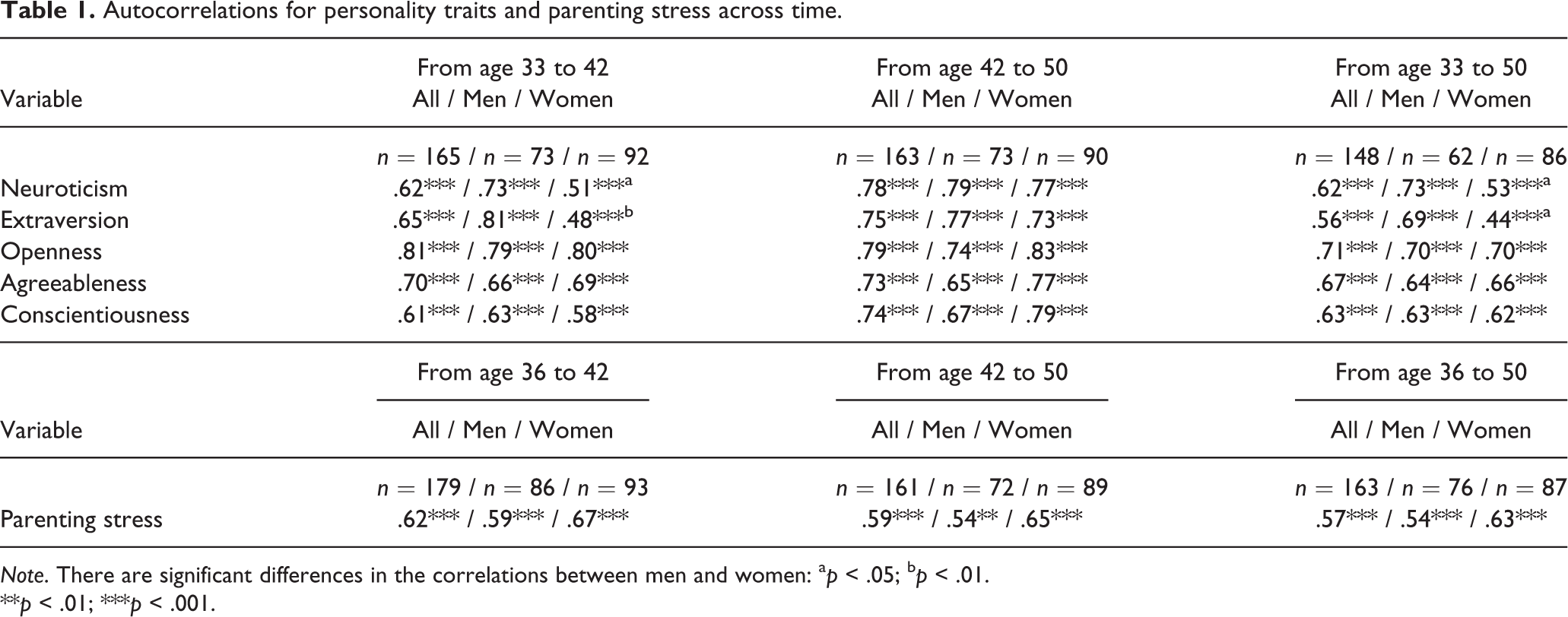
The autocorrelations for personality traits and parenting stress across time, shown in Table 1, revealed high rank-order stability for both personality traits and parenting stress. The rank-order stability of personality traits was not highly dependent on the length of the interval—the autocorrelations were very similar from age 33 to 42 and from age 33 to 50. The assessment at age 42 was, however, somewhat more predictive of personality traits at age 50 than the age-33 assessment. The autocorrelations were of almost the same magnitude (.73–.79) for all five personality traits between ages 42 and 50. The autocorrelations for parenting stress were also very similar across adulthood (.57–.62) and were highly significant.
Autocorrelations for personality traits and parenting stress across time.
Note. There are significant differences in the correlations between men and women: a p < .05; b p < .01.
**p < .01; ***p < .001.
The correlations between personality traits and parenting stress, presented in Table 2, showed, first, that among both men and women, neuroticism correlated positively with parenting stress concurrently at ages 33/36, 42, and 50 as well as across these ages. Second, among both men and women, extraversion correlated negatively with parenting stress concurrently at ages 42 and 50 and across ages 33/36, 42, and 50, with the exception of extraversion at age 33, which did not correlate with parenting stress at age 50. Third, among women, agreeableness at ages 33, 42, and 50 correlated negatively with parenting stress at ages 42 and 50, showing both concurrent and across-age associations. Fourth, among men, conscientiousness at ages 33, 42, and 50 correlated negatively with parenting stress at ages 36, 42, and 50, showing both concurrent and across-age associations. Fifth, openness had no significant associations with parenting stress and was therefore excluded from further analyses.
Correlations between personality traits and parenting stress.

Note. There are significant differences in the correlations between men and women: a p < .05; b p < .01.
*p < .05; **p < .01; ***p < .001.
Cross-lagged relations between personality traits and parenting stress
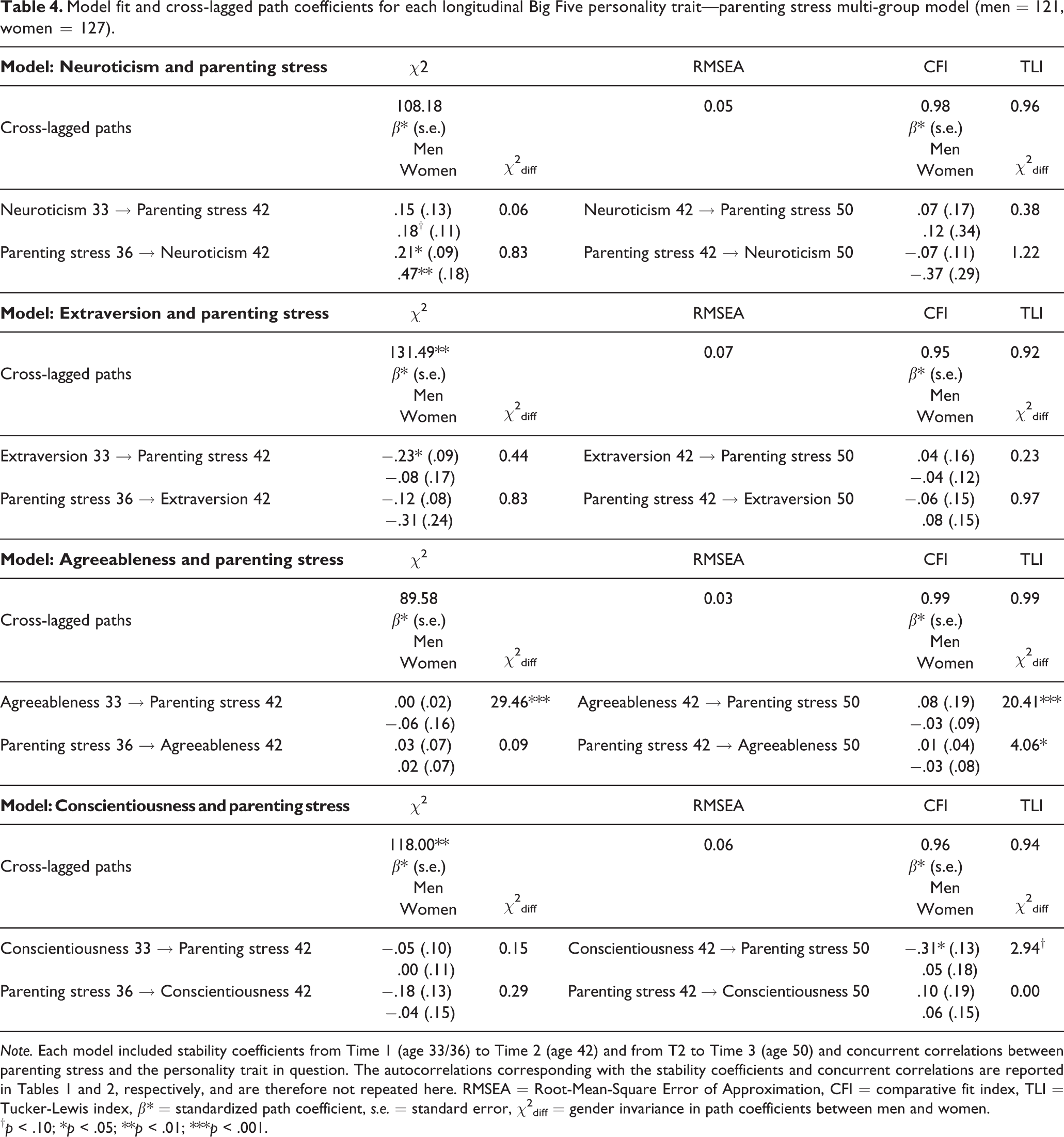
After controlling for the previous measurements of each construct, the SEM analyses revealed three significant cross-lagged relations between neuroticism and parenting stress, 3 as shown in Table 3 (see summarized cross-lagged relations in Figure 1). Neuroticism at age 33 predicted high parenting stress at age 42 (β* = .15 for all participants), parenting stress at age 36 predicted high neuroticism at age 42 (β* = .36), and parenting stress at age 42 predicted low neuroticism at age 50 (β* = −.18). The scaled χ 2 -difference tests reported in Table 3 showed that the significant path from neuroticism at age 33 to parenting stress at age 42, and the non-significant path from neuroticism at age 42 to parenting stress at age 50 did not differ significantly from each other in magnitude. Instead, the positive path from parenting stress at age 36 to neuroticism at age 42 differed significantly from the negative path of parenting stress at age 42 to neuroticism at age 50. The scaled χ 2 -difference tests, reported in Table 4, showed further that there were no significant differences between men and women in any of the cross-lagged paths between neuroticism and parenting stress.
Model fit and cross-lagged path coefficients for each longitudinal Big Five personality trait—parenting stress model in the whole sample (n = 248).

Note. Each model included stability coefficients from Time 1 (age 33/36) to Time 2 (age 42) and from T2 to Time 3 (age 50) and concurrent correlations between parenting stress and the personality trait in question. The autocorrelations corresponding with the stability coefficients and concurrent correlations are reported in Tables 1 and 2, respectively, and are therefore not repeated here. RMSEA = Root-Mean-Square Error of Approximation, CFI = comparative fit index, TLI = Tucker-Lewis index, β* = standardized path coefficient, s.e. = standard error, χ2 diff = time invariance in path coefficients between path from age 33/36 to age 42 and path from age 42 to age 50.
† p < .10; *p < .05; **p < .01; ***p < .001.
Model fit and cross-lagged path coefficients for each longitudinal Big Five personality trait—parenting stress multi-group model (men = 121, women = 127).
Note. Each model included stability coefficients from Time 1 (age 33/36) to Time 2 (age 42) and from T2 to Time 3 (age 50) and concurrent correlations between parenting stress and the personality trait in question. The autocorrelations corresponding with the stability coefficients and concurrent correlations are reported in Tables 1 and 2, respectively, and are therefore not repeated here. RMSEA = Root-Mean-Square Error of Approximation, CFI = comparative fit index, TLI = Tucker-Lewis index, β* = standardized path coefficient, s.e. = standard error, χ2 diff = gender invariance in path coefficients between men and women.
† p < .10; *p < .05; **p < .01; ***p < .001.
As shown in Table 3 and summarized in Figure 1, two significant cross-lagged relations were observed between extraversion and parenting stress: extraversion at age 33 predicted low parenting stress at age 42 (β* = −.19 for all participants) and parenting stress at age 36 predicted low extraversion at age 42 (β* = −.21). The scaled χ 2 -difference tests showed that the paths from extraversion at age 33 to parenting stress at age 42 and from extraversion at age 42 to parenting stress at age 50 could not be constrained to be equal without significant loss in model fit. The former path was significantly stronger in magnitude than the latter, non-significant path. Instead, the path from parenting stress at age 36 to extraversion at age 42 did not differ significantly from the non-significant path from parenting stress at age 42 to extraversion at age 50. The scaled χ 2 -difference tests, reported in Table 4, further showed that there were no significant differences between men and women in any of the cross-lagged paths between extraversion and parenting stress.
As shown in Table 3, no significant cross-lagged relations between parenting stress and agreeableness or conscientiousness were observed for the entire sample or, as shown in Table 4, for men or women in the multi-group model for agreeableness and parenting stress. Instead, in the multi-group model for conscientiousness and parenting stress, a significant negative path was found among men from conscientiousness at age 42 to parenting stress at age 50 (β* = −.31), which according to the scaled χ 2 -difference test also differed significantly in magnitude from the non-significant path observed for women (β* = .05).
Discussion
The present study, based on three-wave cross-lagged panel data on an age-representative sample of Finns, examined reciprocal associations between personality traits and parenting stress from age 33/36 to 42 and to 50 years. The key findings showed that neuroticism and extraversion at age 33 predicted, respectively, high and low parenting stress at age 42. In addition, parenting stress at age 36 predicted high neuroticism and low extraversion at age 42. From age 42 to 50, only high parenting stress contributed to low neuroticism. Thus, more significant cross-lagged associations of neuroticism and extraversion with parenting stress were detected in early middle age, from 33/36 to 42, as compared to later midlife, from 42 to 50 years of age. These findings were similar for mothers and fathers.
The first objective of the study was to examine the cross-lagged relationships between each of the personality traits and parenting stress. Traits have been proposed to define individuals’ experiences with age-graded developmental tasks, and evidence has linked personality traits to, for example, later success in intimate relationships and educational and work tasks (Caspi & Shiner, 2006). Our findings extend this literature by showing that neuroticism and extraversion are meaningfully associated with yet another important area of adult life, namely, parenting and, in particular, the stress associated with it across the early middle age years from age 33 to 42. Neuroticism, which is an individual’s tendency to experience negative affect and to perceive the world as distressing and threatening, was related to feelings of insufficiency as a parent and inability to meet the challenges of child-rearing. Conversely, high extraversion in assertive and active individuals, who tend to experience positive emotions, predicted lower levels of parenting stress.
These findings were in line with Hypothesis 1 and also supported the results of many previous studies (e.g., de Haan et al., 2009; Mulsow et al., 2002). They were also in line with prior studies that have underscored the key role of neuroticism and extraversion—the Big Two—in parenting (e.g., Metsäpelto & Pulkkinen, 2003) and in well-being among adults in general (Kokko, Tolvanen, & Pulkkinen, 2013). Our findings are important because they concern mothers and fathers who at the age of 36 have become parents relatively recently and have children who are on average at preschool age. The younger the children are, the more critical it is for their development that their parents feel relaxed and have trust in their abilities to take care of them.
The second objective of the study was to investigate whether parenting stress would longitudinally predict each of the personality traits. Our results were partly in line with Hypothesis 2, showing that higher parenting stress at age 36 was related to higher neuroticism and lower extraversion at age 42. These findings suggest that feelings of distress and inadequacy as a parent set the stage for higher neuroticism and lower extraversion, which are indicative of maladaptive developmental dynamics in which these negative characteristics shape each other across time. It seems possible that failures in the acquisition of the parenting role (Roberts et al., 2005, 2008) along with self-regulatory resources that are insufficient to cope with the demands of parenting (Denissen et al., 2013) lead to these unfavourable personality changes.
Compared with some earlier studies (de Haan et al., 2009; Hutteman et al., 2013) and contrary to our own Hypotheses 1 and 2, we failed to detect cross-lagged effects between parenting stress and agreeableness and conscientiousness. Since earlier studies have found reciprocal cross-lagged associations, for instance, between parents’ perceived ability to deal with parenting challenges and parental agreeableness (Hutteman et al., 2013), researchers should continue to investigate these linkages in order to understand the conditions under which significant associations emerge. One possible explanation for the differences in results between the present study and earlier ones may be our sample size, which is only a quarter (n = 248) of that studied by de Haan et al. (2009) (n = 1,107) and Hutteman et al. (2013) (n = 1,008). The path coefficients in these two studies are not very high (.06–.09), but these effects become statistically significant with larger samples. Hence, we cannot definitively conclude that parenting stress does not influence agreeableness and conscientiousness, or vice versa. Rather, it seems that the reciprocal effects of parenting stress and neuroticism and extraversion are more robust.
Contrary to prior studies and our Hypothesis 2, we found that higher parenting stress at age 42 was associated with lower neuroticism at age 50. A technical explanation can be offered for this association. It is possible that the positive effect from parenting stress at age 42 to neuroticism at age 50 in our SEM model emerges because of the high concurrent correlation between parenting stress and neuroticism at age 42 (r = .32) and high stability of neuroticism from age 42 to 50 (r = .78). Hence, the direct effect from high parenting stress at age 42 to low neuroticism at age 50 may be artificial and hence spurious. Alternatively, it is possible that at this age phase our sample contains groups or subtypes of parents for whom the associations between parenting stress and neuroticism vary. For some, the association between parenting stress and neuroticism might be positive, whereas for others it may be negative. For instance, parenting challenges such as raising a child with special needs or behavioural problems can increase parental feelings of inadequacy and being distressed by the demands of child-rearing. Yet, these feelings do not necessarily erode but they may also strengthen individuals’ personal resources when the parenting challenges in question are successfully overcome.
In the present study, the reciprocal cycles between neuroticism, extraversion, and parenting stress centred on early to middle age (from age 33/36 to 42), a period when most participants had under-aged children and were likely to be more committed to child-caring than later in midlife (age 42 to 50). This finding is in line with our Hypothesis 3 as well as with prior research suggesting that the onset of adult-role responsibilities and the timing of personality maturation are associated (Bleidorn et al., 2013). It also corroborates the meta-analytic conclusions of Prinzie et al. (2009), according to which the links between the parents’ personality traits and their parenting behaviour become less pronounced as both they and their children mature. Our findings are, however, tentative, as they only partially support our hypothesis. Specifically, when the statistical differences between the parallel across-time path coefficients were rigorously tested, we found that only the paths from high neuroticism to high parenting stress and from high parenting stress to low extraversion were distinct in the first measurement phase (i.e., from 33/36 to 42) compared to second phase of the study (i.e., from 42 to 50). Nevertheless, our findings are intriguing and merit further investigation in greater detail.
Although we expected the cross-lagged associations between personality traits and parenting stress to be stronger among mothers than fathers, we failed to detect any systematic gender differences (Hypothesis 4). We only found that in men, but not in women, higher conscientiousness at age 42 was linked to lower parenting stress at age 50. This result for men is in line with previous findings that have emphasized the key role of conscientiousness in fathers’ parenting. Specifically, Hutteman et al. (2013) found that conscientiousness in fathers predicted a decreased conflict between fathers and their adolescent children. They also found reversed effects, as fathers who experienced conflicts with their adolescent children showed a decrease in conscientiousness over time.
When interpreting the findings of this study, the following limitations should be considered. The first limitation concerns the parenting stress measure, which was based on an abridged, four-item scale. In addition, our measures both for personality traits and parenting stress were based on self-reports, which raises the question of potential bias in the results arising from shared method variance, especially for neuroticism and parenting stress due to similarities in item contents. Therefore, we conducted confirmatory factor analysis, which showed that neuroticism and parenting stress are clearly distinct constructs. 3 The neuroticism items refer to a generalized feeling of anxiety and vulnerability, whereas the parenting stress items are bound to a specific social role and an individual’s self-observed success in playing it. Because both personality traits and parenting stress inherently refer to perceptions and experiences that an individual has in relation to the self, they are also difficult to measure through any method other than self-reports, and it is not evident that other informants’ (e.g., spouses, children) evaluations of the respondent’s personality traits or level of parenting stress are any more reliable than self-reports. There is evidence to suggest that there is a considerable overlap in individuals’ self-assessment of their well-being and behaviour and the assessments of acquaintances and clinicians as well as assessments based on direct observations of social behaviours (Nave, Sherman, & Funder, 2008). Nevertheless, we acknowledge the possibility that the present results might have been different if we had used measures other than self-reports.
It would have been preferable to have had the same first measurement point for personality traits and parenting stress. The three-year difference was due to the fact that the JYLS was part of the NEO-PI inventory standardization project when the participants were age 33. This 181-item inventory was not re-administered in connection with the major data collection that occurred soon after at age 36, in order to limit the burden on the participants of answering several inventories. The shorter NEO-FFI form (60 items) was administered as part of the major data collections at ages 42 and 50. 1 The relative stability of personality traits is strong after age 30 and, as shown in Table 1, the rank-order stabilities of personality traits from age 33 to 42 were very similar to those from age 33 to 50. Hence, the longer time lag (from age 33 to 42 rather than from age 36 to 42) might have deflated the former paths, but it is also possible that the difference caused by the time lag is minor.
Finally, the findings concerning the strength of the associations between parenting stress and personality traits across different phases of the longitudinal study should be interpreted with caution. We used the different data collection phases (T1–T2 vs. T2–T3) as a proxy for the time parents have had to adjust to the parenting role. While our measure undoubtedly was imprecise, it was based on the assumption that occupying the parenting role triggers personality changes and that the greater the amount of time that elapses from the transition to parenthood, the less influence it exerts on personality. Although prior research has shown parenthood to have a profound effect on individual lives (e.g., Antonucci & Mikus, 1988), it would have been valuable to have actually measured the participants’ psychological commitment to the parenting role.
In conclusion, the main strength of the present study was the use of a prospective longitudinal design with multiple measurements across different phases of adulthood, as this enabled the examination of long-term associations between personality traits and parenting stress. Such a design is rare in this research field, although longitudinal studies with shorter time spans are available (e.g., de Haan et al, 2009; Hutteman et al., 2013; Mulsow et al., 2002). The main findings of the present longitudinal study show that parenting stress creates a reciprocal cycle with personality traits, influencing and being influenced by high neuroticism and low extraversion. This holds true especially in early middle age (between the ages of 33/36 and 42 years), when the participants in most cases were committed to child-rearing. These findings underline the value of adopting a dynamic approach to personality traits. Although personality traits show high consistency in adulthood, they also manifest meaningful changes over time. These changes support the view that personality traits can be influenced by the environment and life experiences throughout adulthood (Denissen et al., 2013; Roberts et al., 2005, 2008).
Footnotes
Funding
This research was supported by the Academy of Finland [grants number 118316, 127125, 135347, 138369].