




Abstract
The purpose of this research was to determine the influence of two subcomponents of auditory short-term memory on the developmental trajectories of behavior problems. The sample included 7,058 children from the NLSY79 – Children and Young Adult survey between the ages 5 and 14 years. Results suggested that anxious/depressed behavior increases during childhood and hyperactive and antisocial behavior problems decrease over the course of childhood. Children who scored higher on the Digit Span Backwards test demonstrated lower initial anxious/depressed, antisocial, and hyperactive behaviors, and children who scored higher on the Digit Span Forwards test demonstrated lower initial hyperactive behaviors. Some effects varied by sex; boys who scored higher on the Digit Span Forwards test decreased in antisocial behaviors at a slower rate than those who scored lower on the test. Thus, short-term memory associated with rehearsal mechanisms appears to influence initial levels of various problem behaviors for both males and females, while storage capacity influences initial hyperactive behavior for both males and females and the course of antisocial behavior in males.
Childhood behavior problems are the product of a myriad of influences which include the biological and psychological traits of the child, relationship problems with parents and teachers, and environmental influences such as family stress (Barkley, 1997). Much research is devoted to understanding the causes of behavior problems in school children due to the inherent distress caused to caregivers (Mash & Johnston, 1990) and because behavior problems predict other problems later in life such as substance abuse, anxiety disorders, and mood disorders (Reef, Diamantopoulou, van Meurs, Verhulst, & van der Ende, 2011). Researching antecedents of behavior problems is necessary because it allows practitioners to hypothesize why children engage in problem behaviors and allows them to implement interventions when the hypothesized causes of those behaviors can be manipulated. Developmental research is particularly important because it allows practitioners to target the causes of the developmental trajectories of behavior problems so that they can help children develop in a more adaptive manner.
Two subcomponents of short-term memory, the ability to hold information in immediate awareness, or phonological storage, and the ability to rehearse that information, or phonological rehearsal, may be important influences on behavior problems because phonological storage and rehearsal along with the visual sketchpad and the central executive are the primary components of working memory (Baddeley, 2003). Working memory, in turn, plays an important role in inhibition and self-control (Baddeley, 2007), and thus, deficits in working memory and its subcomponents may lead to difficulties in self-control and behavior problems. Specifically, individuals with self-control problems may be more likely to engage in aggressive forms of conflict dispute when frustrated or angry (Baddeley, 2007), and difficulties with inhibiting irrelevant information could lead to uncontrollable negative thoughts and thus increased internalization (Johnson & Gronlund, 2009; Joorman & Gotlib, 2008). Phonological storage and rehearsal may also influence behavior problems independently of the central executive because phonological storage and rehearsal influence language acquisition (Baddeley, 2003) which, in turn, impacts externalizing, inattentive, and hyperactive behaviors (Petersen et al. 2013).
Development of behavior problems
Various longitudinal studies have examined the developmental patterns of externalizing behavior problems, such as delinquency, aggression, and hyperactivity, and the developmental patterns of internalizing behavior problems, such as depression, anxiety, and withdrawal, over the course of childhood and adolescence. Previous research suggests a general decrease over time in externalizing behaviors between 24 months and first grade (Bub, McCartney, & Willett, 2007) and throughout elementary school (Fanti & Henrich, 2010; Grimm, Pianta, & Konold, 2009). Research examining specific types of externalizing behaviors, rather than externalizing as a whole, on the other hand, yields mixed results with some studies suggesting curvilinear increases in delinquent behaviors (Bongers, Koot, Ende, & Verhulst, 2003) and other research suggesting declines in delinquency (Kolfler et al., 2011). Results from studies of the developmental trajectories of internalizing behaviors are also mixed with some studies suggesting a decrease in internalizing behaviors before first grade (Bub et al., 2007) and other studies suggesting different growth patterns for different groups of children (Fanti & Henrich, 2010). Results also vary for elementary-aged populations with some research indicating increases in internalizing behavior (Reynolds, Sander, & Irvin, 2010) tapering off with the progression of adolescence (Bongers et al., 2003; Kolfler et al., 2011) and other research suggesting no systematic change in internalizing behavior (Grimm et al., 2009).
Despite varying results regarding the trajectories of differing types of behavior problems, research consistently demonstrates that individuals vary in initial levels and subsequent trajectories of behavior problems (Beyers & Loeber, 2003; Bub et al., 2007; Fanti & Henrich, 2010; Grimm et al., 2009; Kolfler et al., 2011; Reynolds et al., 2010). Additionally, developmental trajectories of behavior problems vary by sex. For example, Bongers et al. (2003) found sex differences in the developmental trajectories of anxious/depressed behaviors, somatic complaints, aggressive behavior, internalizing problems, externalizing problems, and total behavior problems. In the same study, initial group differences were also found in anxious/depressed behavior, aggressive behavior, delinquent behavior, externalizing behavior, attention problems, and total behavior problems with males generally demonstrating more externalizing behaviors and females generally demonstrating more internalizing behaviors.
Short-term memory and behavior problems
Several studies have examined the relation between short-term memory (STM) and externalizing behaviors. Previous research suggests that measures of STM are predictive of general externalizing behaviors (Schoemaker, Mulder, Deković, & Matthys, 2013), school expulsion (Ripley & Yuill, 2005), and delinquency (Lahey et al., 2006); although, not all research confirms these findings (Petersen et al., 2013). Metcalfe, Harvey, and Laws (2013) analyzed models to determine the direction of the relation between behavior problems and cognitive ability, which included measures of STM, and found that, when controlling for family background characteristics, aggressive behavior did not predict subsequent cognitive ability nor did cognitive ability predict subsequent aggression. Accordingly, results from studies examining the relation between externalizing behaviors and STM provide differing results and warrant clarification.
Cognitive abilities, including STM, and their relation to internalizing behavior problems have also been examined in multiple research studies. Research suggests that internalizing behaviors at 24 months and the development of internalizing behaviors between 24 months and first grade are related to subsequent cognitive ability (Bub et al., 2007). Additionally, anxiety (Owens, Stevenson, Norgate, & Hadwin, 2008) and depression (Moritz et al., 2002) are negatively related to recall of digits backwards test scores; however, the relation between STM and internalizing behavior problems may be more interrelated than unidirectional. Individuals with internalizing disorders, such as anxiety or depression, who engage in task-irrelevant worry or rumination, may allocate STM resources, which are finite, to irrelevant information (Eysenck & Calvo, 1992). Thus, their ability to use STM resources on task relevant information is diminished. However, individuals with internalizing disorders may also have difficulties expunging irrelevant information from STM. Thus, deficits in STM, especially as they relate to the ability to focus on and inhibit information, could influence depressive symptoms (Johnson & Gronlund, 2009; Joorman & Gotlib, 2008).
Attention and hyperactivity are also related to STM (Tillman, Eninger, Forssman, & Bohlin, 2011) but may relate to the subcomponents of STM differently. For example, Petersen et al. (2013) reported that a digit span task was predictive of initial levels of hyperactive/inattentive behavior while Hale, Hoeppner, and Fiorello (2002) found that the digits backwards task was more predictive of measures of sustained attention and impulsivity than the digits forwards task. Petersen et al. (2013), however, found that digit span was not predictive of the development of hyperactive/inattentive behavior. Of note, the digit span score used in the Petersen et al. study was an average score from ages 7–12 years rather than a score from a single age because it was used as a control variable. Nevertheless, additional research regarding the longitudinal relation between STM and inattention and hyperactivity is needed.
The current study
In summary, previous research suggests the following findings: first, behavior problems develop at different rates in children (Bongers et al., 2003; Bub et al., 2007; Fanti & Henrich, 2010; Grimm et al., 2009; Kolfler et al., 2011; Reynolds et al., 2010); second, sex moderates the development of behavior problems with males initially demonstrating higher eternalizing behaviors and females initially demonstrating higher internalizing behaviors (Bongers et al., 2003; Lahey et al., 2006); third, there are distinct subcomponents of STM (i.e., phonological storage and phonological rehearsal; Baddeley, 2003); and fourth, the subcomponents of STM are related to behavior problems (Bolden, Rapport, Raiker, Sarver, & Kofler, 2012; Hale et al., 2002). What is unknown, however, and what this study will uniquely examine, is whether phonological storage and rehearsal affect the development of behavior problems and whether sex moderates this effect. Because behavior problems develop differently in males and females, and because STM influences behavior problem development, it was hypothesized that phonological storage and rehearsal would have a larger effect on the development of anxious/depressed behaviors for females and a larger effect on the development of antisocial and hyperactive behaviors for males.
Method
Data set
This study used data from the NLSY79 – Children and Young Adults data set (Center for Human Resource Research, 2006). This data set includes over 11,000 participants who are the children of women of the National Longitudinal Survey of Youth (1979; NLSY79). These women were between the ages of 14 to 22 when they began participation in the NLSY79 survey. Data for the current study were gathered between 1986 and 2010. The NLSY79 – Children and Young Adults data set includes data from child assessments, self-reports, and relevant information from the NLSY79 interviews with the children’s mothers. Relevant to this study are measures of short-term memory, behavior problems, and family background characteristics. Additionally, because participants’ mothers were assessed in the NLSY79 survey, the two data sets can be linked using the mothers’ identification number to obtain further background information.
Participants
Participants were excluded from the data set if they were missing all data on either the independent or dependent measures. The resulting sample for the investigation included 7,058 children from the NLSY79 – Children and Young Adult survey. The sample consisted of 3,568 males and 3,490 females; 1,432 Hispanic, 2,127 African American, and 3,499 non-Hispanic/non-African American children; the average age of the participants at the first data point was 5.96 years; and their mothers had an average of 12.6 years of education.
The data include the children of the women who participated in the NLSY79, and 49.7% of the participants in the data set have brothers and sisters in the data set. To address the violation of the assumption that each observation is drawn independently from the sample, a maximum likelihood estimator was used to provide standard errors that are robust to non-independence of participants (Muthén & Muthén, 1998–2010).
Exclusion
Participants selected for this study were compared to those in the data set who were excluded from the study. Participants did not differ from nonparticipants in previous anxious/depressed, t(7,197) = −1.833, p = .067, or hyperactive, t(7,213) = −.068, p = .946, behavior problems; however, participants demonstrated more antisocial behaviors than non-participants, t(7,092) = −1.984, p = .047. Additionally, the mothers of participants had a higher mean level of education than the mothers of nonparticipants, M = 12.65 vs. 12.20; t(8,379) = −5.803, p < .001. Males (n = 3,568 out of 5,873) and females (n = 3,490 out of 5,630) were equally likely to be included in the study, χ2(1, n = 11,503) = 1.854, p = .173.
Attrition
Participants with complete data on dependent measures at the end of the study (n = 4,219) were compared to participants without complete data on dependent measures at the end of the study. Individuals with complete data at the end of the study did not differ from individuals without complete data at the end of the study in previous anxious/depressed behaviors, t(5,753) = −1.369, p = .171, hyperactive behaviors, t(5,763) = −.754, p = .451, antisocial behaviors, t(5,678) = −1.336, p = .182, or in the mean level of the mother’s education, t(6,136) = .213, p = .831. Males (n = 2,109 out of 1,459) and females (n = 2,110 out of 1,380) were equally likely to have incomplete data at the end of the study, χ2(1, n = 7,058) = 1.337, p = .248.
Measures
Short-term memory
Short-term memory was assessed with the Digit Span Forwards and Digit Span Backwards tasks from the Wechsler Intelligence Scales for Children–Revised (Wechsler, 1974) for each child at ages 7 to 8 years. The Digit Span Forwards measures phonological storage by requiring participants to listen to a series of numbers and repeat the numbers in the same order back to the examiner. The Digit Span Backwards measures phonological rehearsal by requiring participants to listen to a series of numbers and repeat the numbers to the examiner backwards. There were 2 trials for each memory load and 14 trials for each task. The participant’s raw scores, which were used in this investigation, are the sums of the number of correct trials. The average reliability of the Digit Span score according to Wechsler for children aged between 6.5 and 15.5 years is .78 (as cited in Baker & Mott, 1989), and the factor loadings of the Digit Span scores on their respective factor appear invariant across age and sex (Reynolds & Gutkin, 1980).
Behavior problems
Behavior problems were measured with the Anxious/Depressed, Hyperactive, and Antisocial subscales from the Behavior Problem Index (BPI), an instrument based on the Child Behavior Checklist (Achenbach & Edelbrock, 1983; Peterson & Zill, 1986). Each subscale consists of items that were dichotomized (0 = Not True, 1 = Often True and Sometimes True), resulting in a more normal distribution, and then summed. The Anxious/Depressed and Hyperactive scales are each comprised of five items, and the Antisocial scale is comprised of six items with higher scores for each item indicating that the mother observed the child completing behavior within the previous 3 months. Alpha coefficients were computed for each age group and ranged from .63 to .74 for the Anxious/Depressed scale, .72 to .78 for the Hyperactive scale, and .64 to .78 for the Antisocial scale. The current study uses data from the BPI gathered at ages 5 to 6 and then 2, 4, 6, and 8 years later.
Socioeconomic status
Maternal education and total family income were used as measures of socioeconomic status (SES). Maternal education was measured by the highest grade completed by the child’s mother. Income was reported in dollars; however, the amount of income reported for each family was divided by 1,000 to facilitate data analysis. All socioeconomic status variables were measured at ages 5 to 6 years.
Data organization
Each participant was assessed once every 2 years; however, while some children were assessed at ages 5, 7, 9, 11, and 13, other children were assessed at ages 6, 8, 10, 12 and 14. Accordingly, the data was organized so that the first time point in this study included children between the ages of 5 and 6, rather than just children at age 5 or 6. The second time point in the study consisted of data measured 2 years after the first time point. Similarly, the third, fourth, and fifth time points consisted of data measured 4, 6, and 8 years after the first time points.
Analysis
A multiple group model with anxious/depressed, hyperactive, and antisocial growth curves was estimated. The two groups in the model were males and females. Intercept and slope factors for anxious/depressed behavior, hyperactive behavior, and antisocial behavior were allowed to covary. Error variances of anxious/depressed, antisocial, and hyperactive variables of equal ages were allowed to covary to account for common variance shared between behavior problems for similar ages. Initially, each growth curve was constrained to be linear and to be equivalent for males and females. Then path constraints were systematically removed to test for nonlinear growth and invariance for males and females. This method of testing for linearity was chosen instead of adding a quadratic term because a quadratic term specifies a particular form of nonlinearity whereas freeing constraints of linearity allows the data to speak for itself.
Background and independent variables were then added to the model. Background variables included previous behavior problems (i.e., anxious/depressed, hyperactive, and antisocial behaviors measured at ages 5 to 6), whether the participant identified as African American or Hispanic, and SES variables. The digits forwards and digits backwards measures served as the independent variables. Dependent variables consisted of slope and intercept latent variables for anxious/depressed, hyperactive, and antisocial behaviors. Paths were estimated from background and independent variables to the dependent variables. All background and independent variables were allowed to covary (Figure 1).
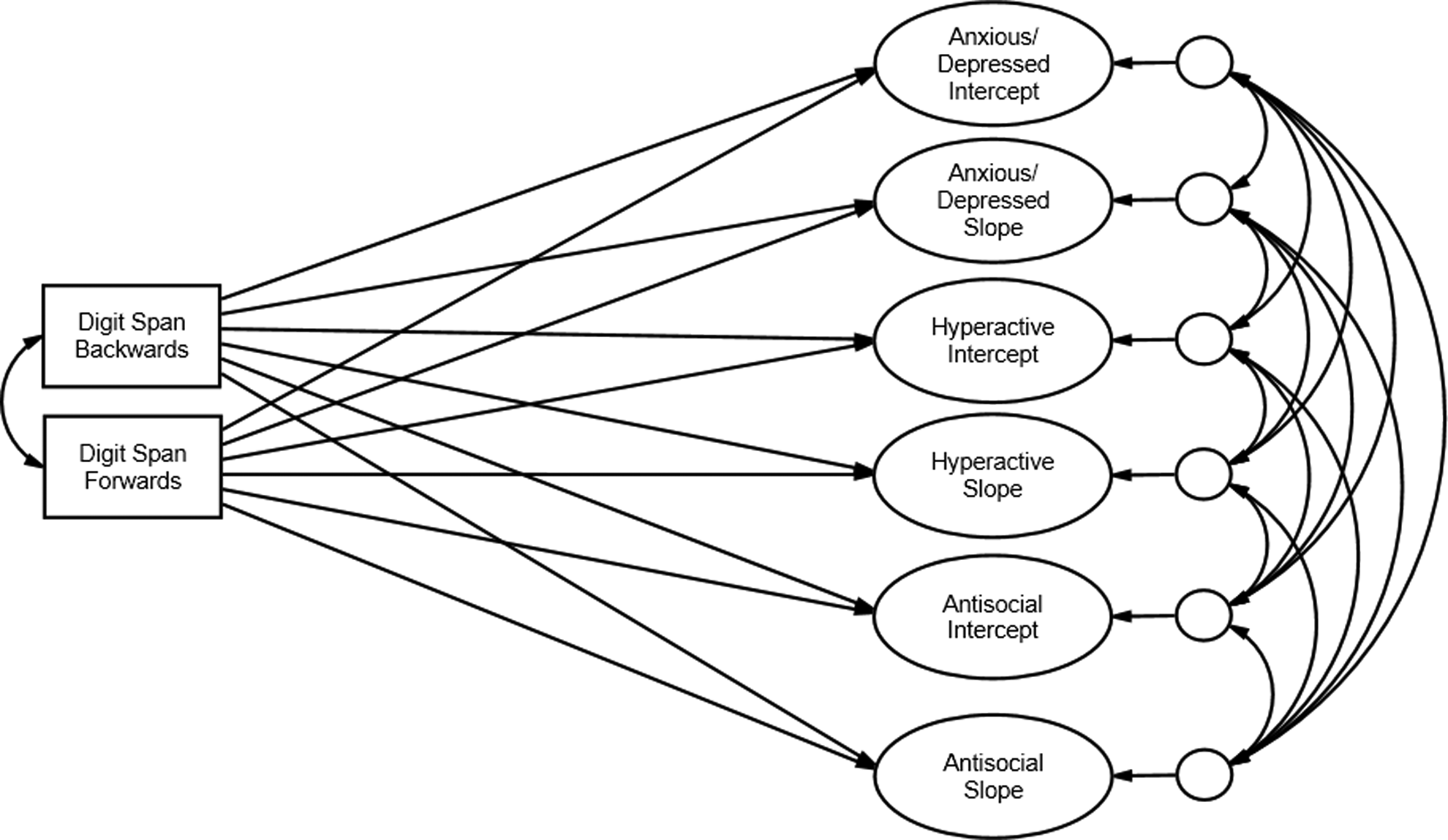
Proposed model including all latent growth curve factors and STM variables. Measured variables which index the latent variables and background variables are not shown in this figure.
Structural equation models are generally either retained or rejected based on the consistency between a proposed model and the data. To assess the fit of a single model, the Comparative Fit Index (CFI) was used in conjunction with the Tucker-Lewis Index (TLI) and the Root Mean-Square Error of Approximation (RMSEA). Values exceeding .95 for the CFI and TLI and below .05 for the RMSEA indicate that a model fits the data well (Hu & Bentler, 1998, 1999). The Satorra-Bentler scaled chi-square difference test was used to compare nested models (Muthén & Muthén, 2012). All analyses were computed with Mplus Version 6.12 (Muthén & Muthén, 2010) and maximum likelihood estimation was used to estimate missing data.
Results
Sample sizes, the range of values, means, and standard deviations for all independent, dependent, and background variables are reported in Table 1.
Descriptive statistics for independent, dependent, and background variables.
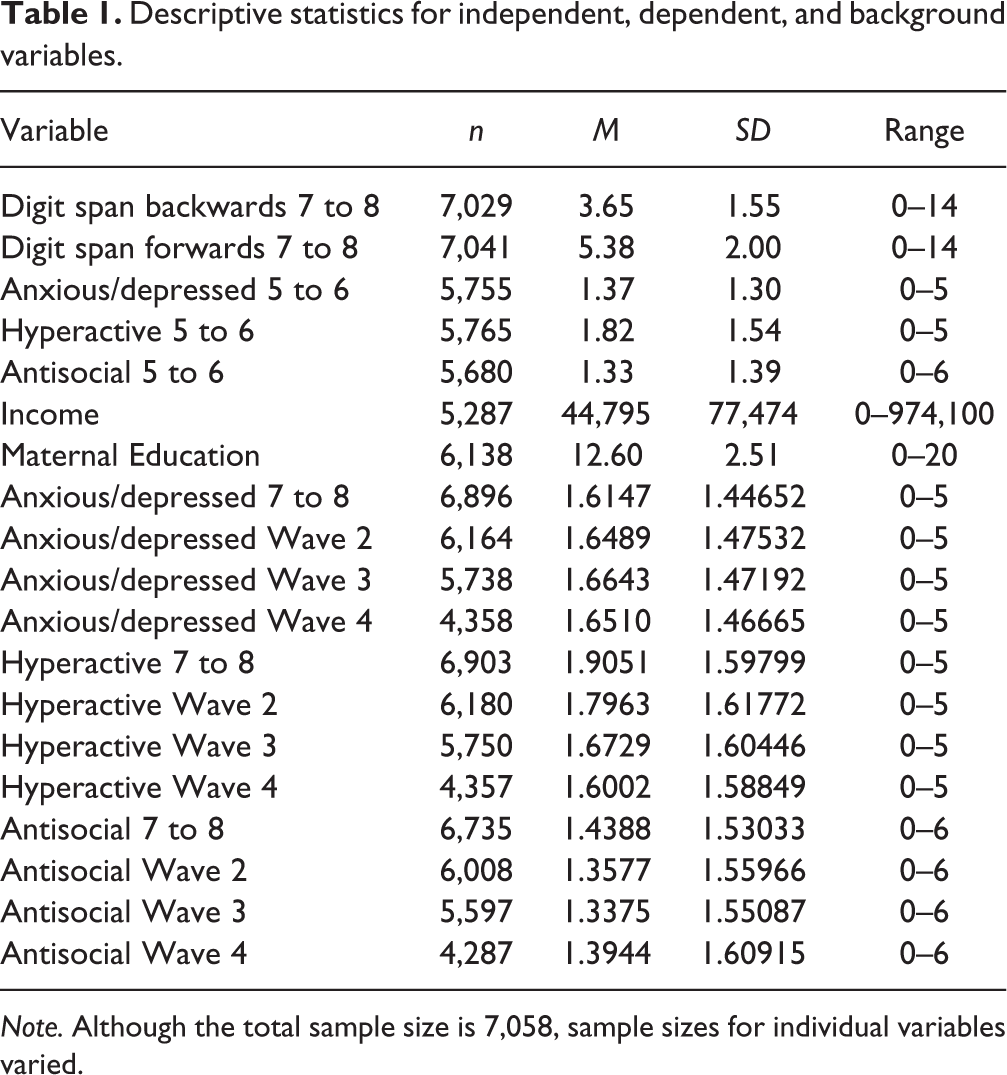
Note. Although the total sample size is 7,058, sample sizes for individual variables varied.
Initial growth model
Before a model was estimated with all possible influences included in the model, a multiple group model with just the behavior problems growth curves was estimated wherein all parameters were constrained to be equal across groups. This model fit the data poorly (CFI = .827, TLI = .831, RMSEA = .099). Parameter constraints were systematically released to determine whether growth was linear or nonlinear and whether parameters were invariant for males and females. Results suggested linear development in hyperactive behavior and nonlinear development in anxious/depressed and antisocial behavior; however, results also indicated that males and females differ significantly in their initial levels and developmental trajectories of anxious/depressed, hyperactive, and antisocial behaviors.
A model allowing for nonlinear antisocial, nonlinear anxious/depressed, and linear hyperactive growth curves while also allowing males and females to differ in initial behavior problems and their subsequent trajectories was estimated and fit the data well (CFI = .996, TLI = .993, RMSEA = .020). Results of this model indicated that males generally decreased in antisocial (p = .003) and hyperactive (p < .001) behavior over the course of childhood, but did not demonstrate significant growth in anxious/depressed behavior (p = .695). Females generally decreased in hyperactive (p < .001) behavior and increased anxious/depressed behavior (p < .001) over the course of childhood, but did not demonstrate significant growth in antisocial behavior (p = .094). For all behavior problems, latent intercept variables were significantly and negatively correlated with their respective latent slope factors.
Background variables were then added to the model. Paths were included from all background and STM variables to the slope and intercept latent variables for anxious/depressed, hyperactive, and antisocial scales. Paths were also included from all background variables to the STM variables. Background variables and the two STM variables were free to covary with each other. Paths from STM variables to slope and intercept factors were then constrained one at a time to determine whether the paths were equal for males and females. Finally, a model wherein the paths from background and STM variables were constrained to be equivalent except for those paths that were not equal for males and females was estimated and fit the data well (CFI = .992, TLI = .987, RMSEA = .019).
Model interpretation
The effects of phonological storage on the intercepts of anxious/depressed (b = .003, β = .005, p = .720) and antisocial (b = −.005, β = −.007, p = .520) behavior problems were not statistically significant, indicating that phonological storage does not affect initial anxious/depressed or antisocial behavior problems for either males or females. Likewise, phonological storage did not have an effect on the slope of anxious/depressed (b = −.007, β = −.047, p = .072) or hyperactive behavior (b = −.004, β = −.025, p = .305) for males or females. The phonological storage task, however, did have a significant effect on the intercept of hyperactive behaviors (b = −.016, β = −.054, p = .041) for males and females, indicating that children with greater ability to complete the phonological storage tend to show less initial hyperactive behaviors. Additionally, males with greater ability to complete the phonological storage task tend to show less decrease in antisocial behavior (b = .008, β =.057, p = .047; Figure 2) while there was no relation between the phonological storage task and antisocial behavior for females (b = −.003, β = −.024, p = .420).

Development of antisocial behavior in males divided into three groups based on digit span forwards scores
The effects of phonological rehearsal on the intercepts of anxious/depressed (b = −.028, β = −.039, p = .005), hyperactive (b = −.069, β = −.084, p < .001), and antisocial (b = −.034, β = −.038, p = .001) behavior problems were significant, indicating that both males and females with higher scores on the phonological rehearsal task demonstrated fewer initial anxious/depressed, hyperactive, and antisocial behavior problems. The effects of phonological rehearsal on the slopes of anxious/depressed (b = −.002, β = −.009, p = .721), hyperactive (b = −.009, β = −.045, p = .084), and antisocial (b = −.002, β = −.009, p = .706) behavior problems were not statistically significant, indicating that phonological rehearsal does not affect growth in anxious/depressed, hyperactive, or antisocial behavior problems for either males or females.
Many of the background variables also had statistically significant effects on the initial levels and developmental trajectories of anxious/depressed, antisocial, and hyperactive behavior problems. Results indicated that children whose mothers have a higher education generally demonstrate fewer initial antisocial (p < .001), anxious/depressed (p = .003), and hyperactive (p < .001) behavior problems. Maternal education also had a negative effect on the slope of antisocial behavior (p = .005). Coming from a household with a higher income, on the other hand, only had a negative effect on initial antisocial behavior (p = .014). African-American children demonstrated more antisocial (p < .001) and fewer anxious/depressed (p < .001) behaviors than peers, and demonstrated less decrease in antisocial behaviors (p = .004) and less increase in anxious/depressed behaviors (p = .024) than peers. Hispanic children demonstrated fewer anxious/depressed (p < .001) and hyperactive (p = .002) behaviors than peers.
Previous behavior problems also had significant effects on subsequent anxious/depressed, antisocial, and hyperactive behaviors. Each behavior problem at ages 5 to 6 significantly predicted initial levels of all behavior problems at ages 7 to 8. Additionally, each behavior problem at ages 5 to 6 predicted its own respective subsequent slope. Children aged 5 to 6 who demonstrated high antisocial and hyperactive behaviors tended to decrease in antisocial and hyperactive behaviors at a faster rate than children who initially demonstrated low antisocial and hyperactive behaviors, and children aged 5 to 6 who demonstrated low anxious/depressed behaviors tended to show more increase in anxious/depressed behaviors than children who initially demonstrated high anxious/depressed behaviors. Standardized path coefficients and their corresponding levels of significance are shown in Table 2 for the paths from all background variables to dependent variables.
Standardized path coefficients and levels of significance for the effects of background variables on behavior problem growth curve factors.

aThe β value shown in the table is for males; β = −.026 for females.
bThe p value shown in the table is for males; p = .469 for females.
cThe p value shown in the table is for males; p = .536 for females.
Discussion
The purpose of this research was to determine the effects of phonological storage and rehearsal on the developmental trajectories of behavior problems and to determine whether sex moderates these effects. Results suggested that children who had lower phonological rehearsal ability demonstrated higher initial levels of anxious/depressed, antisocial, and hyperactive behavior for males and females. The influence of STM on these behavior problems might be due to the relation between STM and working memory. Specifically, deficits in phonological rehearsal may be due to general working memory deficits. General working memory deficits, in turn, decrease inhibition and self-control (Baddeley, 2007) resulting in subsequent impulsivity and hyperactivity among other behavior problems.
A child’s ability on the phonological storage task, on the other hand, positively predicted the developmental trajectory of antisocial behaviors for males. The direction of this relation, however, was unexpected. Rather than individuals with high phonological storage capacity decreasing in antisocial behaviors at a faster rate, they decreased in antisocial behaviors at a slower rate. One explanation for this unexpected finding is low phonological storage capacity might only delay decreases in antisocial behaviors during early childhood until other cognitive abilities compensate for low phonological storage during later childhood. Nevertheless, phonological storage, and not rehearsal, predicts developmental change in antisocial behavior while phonological rehearsal appears to have a broader influence on initial behavior problems than phonological storage.
These results highlight the distinctiveness of the phonological rehearsal and phonological storage tasks. Some research suggests that the phonological rehearsal and phonological storage tasks are measures of a unidimensional short-term memory ability (Swanson & Kim, 2007). However, other research suggests that phonological rehearsal type tasks load with other working memory tasks on a working memory factor, distinct from memory span tasks like phonological storage, but that both working memory and memory span factors load onto a broad short-term memory factor (Phelps, McGrew, Knopik, & Ford, 2005). In the current study, the phonological rehearsal test helped explain the initial status of behavior problems but not the slopes of behavior problems while the phonological storage test accounted for developmental change in antisocial behavior for males and initial hyperactive behavior. Because these two tasks explained variance in different variables, and the phonological rehearsal task requires the transposition of information while the phonological storage task simply requires the rehearsal of information in immediate awareness, the results of this study support the finding that phonological rehearsal and phonological storage type tasks measure unique constructs. Although the transposition of digit order may not place sufficient demands on the central executive to qualify the Digit Span Backwards tests as a measure of working memory (Engle, Tuholski, Laughlin, & Conway, 1999), the extra cognitive demands of the transposition of numbers appear to distinguish the task from other measures of STM.
Similar to previous developmental research (Bongers et al., 2003), the results of this study suggested differences between males and females in their trajectories of problem behavior, and because males and females develop behavior problems at different rates, this research sought to determine whether the components of STM may contribute to the development of behavior problems in the same way for both sexes. Results suggested one path interaction; specifically, sex moderates the effect of phonological storage on the slope of antisocial behavior; however, Lahey et al. (2006) did not find that sex moderates the effect of STM on conduct problems. The difference between the findings of these studies may be due to the use of the Digit Span score as a combination of the phonological storage and phonological rehearsal as a single score in the study by Lahey et al., as opposed to the separate analysis of the effects of phonological storage and phonological rehearsal on behavior problems in the current study. And, just as Lahey et al. found other variables (e.g. maternal delinquency) that have varying effects on conduct problems for males and females, the results of this study found the residual variances in antisocial growth curve were not invariant across sex indicating that other variables not included in the present model have differential effects on conduct problems for males and females.
Results of this research also help clarify previous discrepant findings. Specifically, inconsistencies regarding the strength of the relation between STM and externalizing might be attributable to the type of externalizing behavior in the study. While STM is predictive of specific externalizing behaviors such as school expulsion (Ripley & Yuill, 2005), delinquency (Lahey et al., 2006), and, according to the results of this study, antisocial behavior, findings are inconsistent in regards to the relation between STM and general externalizing measures (e.g. Petersen et al. 2013 vs. Schoemaker et al., 2013). Accordingly, future research regarding the relation between cognitive abilities and externalizing behaviors should examine specific externalizing behaviors to better understand the implications of impaired cognitive functioning.
The findings of this study in combination with the findings of previous research also lead to some practical implications. Given the consistency between certain findings from this study and previous research regarding the relations between STM and anxious/depressed behaviors (Johnson & Gronlund, 2009), hyperactive behaviors (Hale et al., 2002; Petersen et al. 2013), and certain externalizing behaviors (Ripley & Yuill, 2005; Lahey et al., 2006), cognitive interventions might benefit children who demonstrate anxious/depressed, antisocial, and hyperactive behaviors. Cognitive interventions designed to improve STM indicate that STM deficits can be remediated (e.g. Holmes et al., 2010), but improvements in STM may not lead to behavioral change (Rapport, Orbana, Kofler, & Friedman, 2013). Accordingly, future research might investigate whether STM interventions might enhance other interventions that target specific behaviors and their predictors. For example, an intervention that targets STM in combination with language acquisition might lead to decreases in antisocial behavior at a faster rate than interventions that target language acquisition alone.
Future directions
The results of this study do not preclude the possibility of a bidirectional relation between anxious/depressed behaviors and the various subcomponents of STM and working memory, and further research is needed to untangle the relations between these variables. This research only tested the effect of STM as measured at one time point on the development of anxious/depressed behaviors, however, the development of STM can be modeled as well. Accordingly, future research might also test the possibility of a bidirectional relation between STM and anxious/depressed behaviors using bivariate latent change score models (McArdle, 2009). Such analyses would provide information regarding the effect of STM on anxious/depressed behaviors, the effect of anxious/depressed behaviors on STM, and which effect is stronger.
Limitations
One limitation of this study was the use of only one informant, the mother, to measure behavior problems. Not only will different informants have different perspectives, but they also may see children in different environments, which in turn may elicit different behaviors. Previous research suggests that growth curves of behavior problems based off of mother questionnaires differ from growth curves based on teacher questionnaires (Kraatz Keiley, Bates, Dodge, & Pettit, 2000). Accordingly, the use of multiple informants, such as teachers and self-reports, would have provided more accurate measurement of behavior problems.
Additionally, it is important to note that the data used in this research were nonexperimental in nature; there was no (nor could there be) experimental manipulation of STM to determine its subsequent effect on behavior problems. As a result, it should be understood that all statements that discuss the “effect” of one variable on another, or that focus on variables that “explain” an outcome, are dependent on the validity of the model. If the model is not a reasonable representation of reality, then the estimates are not accurate estimates of those effects. For example, if SES changes over time, then SES might be better represented as a growth curve to account for changes in maternal education and income. If the model is a reasonable representation of reality, then the estimates resulting from the model indeed show the extent of the influence of one variable on another. Regarding the previous example, models with SES variables modeled as growth curves were analyzed but either did not converge or yielded improper estimates.
Conclusions
Childhood behavior problems often develop into maladaptive behaviors in adulthood (Reef et al., 2011); accordingly, the study of the development of behavior problems and related antecedents may help researchers and practitioners understand how to curb maladaptive developmental trajectories. The results of this study confirmed the results of previous research indicating a link between STM and behavior problems but were unique in relation to the results of similar studies in two ways. First, short-term memory associated with storage capacity influences the course of antisocial behavior in males. Second, phonological rehearsal primarily influences initial behavior problems but not change in those behavior problems. These findings highlight the unique functions of phonological storage and rehearsal and how the effects of these functions are moderated by sex.
Footnotes
Acknowledgements
We thank the Center for Human Resource Research for the use of the data set.
Funding
This research received no specific grant from any funding agency in the public, commercial, or not-for-profit sectors.