




Abstract
In the present study, we examined the extent to which the responses of teachers and mothers toward a particular child are similar in respect to their instructional support and affect, and whether child characteristics predict these responses. The data of 373 Finnish child–teacher–mother triads (178 girls, 195 boys) were analysed. Teachers and mothers reported their instructional support and affective responses toward a child in the school/homework context in Grades 1, 2, 3, and 4. At the beginning of Grade 1, the children’s performance in reading and math was tested, and teachers evaluated the children’s externalizing and internalizing problem behaviour. The results demonstrated that mothers and teachers showed similar instructional support and affective responses toward a particular child at the end of Grade 1. Moreover, children’s poor performance in reading and math at the beginning of Grade 1 was associated with high amounts of both teachers’ and mothers’ instructional support at the end of Grade 1, while children’s externalizing problem behaviour was strongly related particularly to teachers’ but also to mothers’ negative affective responses at the end of Grade 1. The results provide evidence for the evocative impact of child characteristics on the child’s interpersonal environment at the start of child’s school career.
Interpersonal environments play an important role in children’s academic performance and adjustment (e.g., Bronfenbrenner, 1979, 1999). In addition to the effects of the environment on the child, some researchers have proposed that child characteristics, such as academic performance and problem behaviour, may provoke affective and behavioural responses from their interpersonal environment (Bell, 1968; Nurmi, 2012; Scarr & McCartney, 1983). Although there is some evidence to suggest that child characteristics predict instructional support and affective responses among teachers (Hargreaves, 2000; Nurmi, Viljaranta, Tolvanen, & Aunola, 2012; Pakarinen, Lerkkanen, Poikkeus, Siekkinen, & Nurmi, 2011) and parents (Levin et al., 1997; Pomerantz & Eaton, 2001; Silinskas, Niemi, Lerkkanen, & Nurmi, 2013), in most previous studies, only one interpersonal context at a time has been investigated. Therefore, we know little about how similarly teachers and parents respond in terms of their instructional support, guidance, and affective responses to different child characteristics. Thus, in the present study, we examined to what extent the instructional support and affective responses of teachers and mothers to a particular primary school child are similar and to what extent a child’s characteristics (academic performance and externalizing and internalizing problem behaviours) predict these instructional support and affective responses.
Children’s evocative impact on their interpersonal environments
Bronfenbrenner’s ecological systems theory (1979, 1999) suggests that child development takes place under the influence of both proximal (e.g., family, school) and distal (e.g., socioeconomic, cultural) environmental systems. According to the theory, different systems interact with each other and produce unique and interconnected effects on the developing child. While it is widely acknowledged that teachers’ and parents’ involvement contributes to children’s academic outcomes (e.g., Dietrich, Dicke, Kracke, & Noack, 2015; Kiuru et al., 2012) and to their social adjustment (e.g., Howes & Matheson, 1992; Kiuru et al., in press; Pianta, Nimetz, & Bennet, 1997), children’s characteristics may also have an effect on their parents’ and teachers’ behavioural and affective responses (Bell, 1968; Hartup & Laursen, 1991; Rutter, 1997). The term “evocative effect” refers to adults’ behavioural and affective responses that arise from a child’s characteristics, such as academic performance or socio-emotional characteristics, rather than from children’s active efforts to influence their significant others, for example, by actively asking for help or instructional support (i.e., children’s agency; Scarr & McCartney, 1983).
Prior research on parents’ and teachers’ involvement in academic contexts has emphasized two distinct areas in which children’s characteristics may have an evocative effect. First, child characteristics have been found to direct both teachers’ instructional support (Nurmi et al., 2012; Rimm-Kaufman, Vorhees, Snell, & La Paro, 2003) and parents’ instructional support (Levin et al., 1997; Silinskas et al., 2013). Second, many studies have shown that child characteristics evoke various affective responses among teachers (Hargreaves, 1998, 2000; Sutton & Wheatley, 2003) and parents (Levin et al., 1997; Pomerantz & Eaton, 2001).
Moreover, existing research on the evocative effects has highlighted the importance of two types of child characteristics: academic performance and socio-emotional characteristics (Hargreaves, 1998; Hatch, 1993; Nurmi, 2012). Academic performance includes a wide range of child characteristics, such as academic achievement, academic skill development in different school subjects, learning difficulties, and cognitive abilities (Nurmi, 2012). In the present study, we examined children’s academic performance at the beginning of primary school by testing their performance in reading and math. The reason for the choice of these two subjects was that learning to read and learning math are among the most important academic challenges for school beginners, and acquisition of these skills can have important consequences for students’ later school careers (Landerl & Wimmer, 2008; Williamson, Appelbaum, & Epanchin, 1991). Children showing poor academic performance are likely to elicit heightened instructional support from their teachers in class (Pakarinen et al., 2011; Nurmi et al., 2012), and more help from their parents (Silinskas, Kiuru, Aunola, Lerkkanen, & Nurmi, 2015), for example, when doing homework together, as both teachers and parents may want to help the child to improve their skills. However, interacting with a low-achieving child in class or homework situations might be challenging for both teachers and parents and thus related to negative emotions during such interactions (Silinskas et al., 2014, 2015).
In turn, socio-emotional characteristics are typically described in terms of externalizing and internalizing problem behaviours, temperamental characteristics, and social skills. In the present study, we operationalized children’s socio-emotional characteristics as externalizing problem behaviours and internalizing problem behaviours. Intuitively, it is quite clear that externalizing behaviours may invoke negative responses both in terms of instructional support and affective responses. The “out-of-bounds” behaviour of students with externalizing problems, such as breaking rules and disturbing the classroom routines and instruction (Ladd & Burgess, 2001), causes stress and negative reactions among teachers (Birch & Ladd, 1998; Hamre & Pianta, 2001) and often forces them to intervene. Students’ disruptive behaviour may also cause them to overlook vital information and thus fail to follow teachers’ instructions (Atkins, McKay, Talbott, & Arvanitis, 1996). Similar responses could be expected from parents when teaching their child, such as in homework situations. The effect of internalizing behaviour, however, is less obvious, because children who are anxious or shy tend to be more quiet and reserved. However, also shyness and withdrawn behaviour can evoke negative responses from significant others, can lead to awkward interactions, and relations with an anxious and depressed individuals can be aversive (Rubin & Coplan, 2010). Also, there is some evidence to suggest that internalizing problems lead to negativity in teacher–student relationships (Birch & Ladd, 1998; Buyse, Verschueren, Doumen, Van Damme, & Maes, 2008; Ladd, Birch, & Buhs, 1999). There are situations where one could imagine that internalizing behaviour (e.g., increased crying, fear of test-taking, lack of interest to classmates) could also lead to negativity among teachers and parents.
Findings on children and their teachers
Teachers differ in their teaching practices and classroom instructional support (Connor, Morrison, & Slominski, 2006; Howes et al., 2008; Stipek, 2004). However, there is evidence that at least some of them choose or adapt their practices on the basis of their students’ level of reading and math performance (Borko & Putnam, 1996; Calderhead, 1996; Connor, Morrison, & Katch, 2004). Previous research also indicates that low-achieving students receive more instructional support and individual attention from their teachers than high-achieving students do (Babad, 1990, 1998; Nurmi et al., 2012). Children’s academic performance has also been found to be related to teachers’ affect and teacher–child relationships. For example, in a recent meta-analysis, Nurmi (2012) reported that children’s good academic performance was negatively associated with conflict and positively associated with closeness in the teacher–child relationship. Also, teachers have been shown to report more positive affect toward high-achieving students (Babad, 1990, 1998; Babad, Bernieri, & Rosenthal, 1989).
A child’s internalizing and externalizing problem behaviours also influence teachers’ instructional support and affective responses toward the child. There is wide agreement that children’s behavioural problems relate to a lower quality of child–teacher relationships and an increased amount of child–teacher conflicts (Buyse et al., 2008; Henricsson & Rydell, 2004). Students’ misbehaviour also activates negative affect among teachers, and thus leads to disciplinary acts (Emmer, 1994; Silinskas et al., 2014). In addition, teachers’ negative emotions, such as frustration and anger, have been shown to arise from students’ misbehaviour and violation of rules (Emmer, 1994; Hargreaves, 2000).
Findings on children and their parents
Previous research in the home context has shown that children’s academic performance affects their parents’ instructional support (Pomerantz & Eaton, 2001; Silinskas, Leppänen, Aunola, Parrila, & Nurmi, 2010) and affect (Levin et al., 1997; Pomerantz & Eaton, 2001; Xu & Corno, 1998) in homework situations. For example, Levin et al. (1997) found that first-graders’ poor academic performance predicted a higher level of parental help (see also Silinskas et al., 2010, 2013). Also, negative emotions among parents, such as stress, frustration, and worrying, have been observed more often when a child shows poor academic performance (Pomerantz & Eaton, 2001; Pomerantz, Wang, & Ng, 2005; Xu & Corno, 1998). Moreover, Levin and colleagues (1997) reported that the influence of children’s academic performance on mothers’ negative affect may be mediated through mothers’ perceptions of their children’s learning difficulties.
In addition, there is some evidence showing that children’s socio-emotional characteristics are related to parental instructional support (Fantuzzo, McWayne, Perry, & Childs, 2004) and affective responses (Deater-Deckard & O’Connor, 2000). For instance, Fantuzzo and colleagues (2004) found that children’s hyperactivity, behavioural problems, and inattention/passivity were negatively associated with their parents’ home-based involvement in pre-school activities. Deater-Deckard and O’Connor (2000) found that parent–child dyads that were higher in mutuality in terms of emotional responsivity, cooperation, and parent–child responsiveness were observed to express more positive affect. Given these results on the correlates to children’s socio-emotional adjustment, it can be expected that children’s externalizing and internalizing problems will also relate to increased parental instruction and negative affect in homework context.
Limitations of previous research
There are some limitations in the previous research on the evocative effect of child characteristics on their parents’ and teachers’ instructional support and affective responses toward the child. First, although a lot of effort has been made to study the effects of children’s characteristics on their parents and teachers separately, parents’ and teachers’ instructional support and affective responses toward a particular child have rarely been examined in the same study. Therefore, to our knowledge, no previous research has directly tested to what extent teachers’ and parents’ instructional support and affective responses are associated—in other words, to what extent teachers and parents respond to a particular child in a similar way. Investigating the concordance or the lack of concordance in mother–child and teacher–child interactions will promote our understanding of why some children are at-risk of negative interactions in many interpersonal contexts (Hamre & Pianta, 2001; Ladd et al., 1999). This is important to know because consistent negative responses from both teachers and parents may be especially detrimental for a developing child. Second, prior research has typically focused on the impact of either children’s academic performance or their problem behaviour on teachers’ and parents’ instructional support and affect. Therefore, understanding of the relative importance of academic performance and problem behaviours on teachers’ and parents’ instructional support and affective responses is thus far limited.
Research questions
In a sample of primary-school children, their teachers, and their parents, we examined the following research questions: Do teachers and mothers react toward a particular child in a similar manner in respect to their instructional support and affective responses? As teachers (Houts, Caspi, Pianta, Arseneault, & Moffitt, 2010; Nurmi, 2012) and parents (Pomerantz, Moorman, & Litwack, 2007; Silinskas et al., 2015) have been shown to be responsive to children’s characteristics, we expected that the levels of teachers’ individual instructional support in the classroom and mothers’ instructional support in homework situations toward a particular child would be closely related (Hypothesis 1a). Similarly, we expected that also the levels of teachers’ and mothers’ affective responses toward a particular child would resemble each other closely (Hypothesis 1b). To what extent do child characteristics, that is, reading and math performance, and externalizing and internalizing problem behaviour, predict teachers’ and mothers’ affective and instructional responses toward a particular child? We expected that children’s poor academic performance (i.e., low reading and math performance) would predict high levels of instructional support and negative affect among their teachers (Hypothesis 2a; Hargreaves, 1998, 2000; Nurmi, et al., 2012) and their parents (Hypothesis 2b; Levin et al., 1997; Pomerantz & Eaton, 2001). Moreover, we expected that children’s high levels of externalizing and internalizing problem behaviour would predict high levels of instructional support and negative affect among their teachers (Hypothesis 2c; Nurmi, 2012; Silinskas et al., 2014) and their parents (Hypothesis 2d; Deater-Deckard & O’Connor, 2000; Fantuzzo et al., 2004).
Method
Participants and procedure
A total of 373 Finnish child–teacher–mother triads were analysed across five time-points: the beginning of Grade 1, and the end of Grade1, Grade 2, Grade 3, and Grade 4. Participating children were selected randomly from the sample of a large-scale longitudinal study (Lerkkanen et al., 2006–2017), in which the development of 1,970 children in the family and school contexts has been followed across kindergarten and primary school. The reason for creating the subsample was to examine child characteristics and teachers’ and mothers’ instructional and affective responses in greater detail. Because teachers were asked to rate themselves and the target children on several items (i.e., the amount of instructional support they provided, the affect that they felt when instructing a particular child, and children’s problem behaviour), creating the subsample was meant to decrease teachers’ workload. The random sample was created by selecting 1–4 (M = 2.5 ± .7) children from each Grade 1 classroom (number of children varying by the size of the classroom). Only children whose parents gave their written consent to their participation were included in the study. The sample was highly homogeneous in ethnic, language, and cultural background, which is typical of a school population outside of the metropolitan regions in Finland.
Children
In the fall of the year of their seventh birthday, Finnish children enter Grade 1. For the present study, the data of 373 target children (178 girls, 195 boys) were used. Due to the fact that of the 139 teachers originally contacted, 12 failed to provide ratings for the children in their classes, only 316 children out of 373 were rated by their teachers. When the sample of 316 children in Grade 1 was compared to the children whose teachers did not participate (n = 57), no statistically significant differences were found between the groups in terms of the children’s reading performance, math performance, internalizing problems, and externalizing problems.
Teachers
Teachers were asked to evaluate their instructional support and affect when instructing a particular child at four time-points: in April at the end of Grades 1, 2, 3, and 4. Prior to that, teachers were also asked to evaluate children’s socio-emotional characteristics at the beginning of Grade 1. Teachers were asked for their written agreement to participate. Out of the 139 teachers who were contacted, 127 first-grade teachers from 72 schools agreed to participate in the study and filled out the questionnaires at the beginning of Grade 1. A total of 124, 126, 120, and 111 teachers filled out the questionnaires at the end of Grades 1, 2, 3, and 4, respectively. In Finland, teachers and the composition of the classrooms typically change as children move from kindergarten to Grade 1. However, the composition of primary-school classrooms (Grades 1 to 6) remains largely unchanged, and the teachers of Grades 1–2 and 3–4 tend to remain the same. In the present study, only 23 teachers stayed the same across Grades 1–4; about two thirds of the teachers continued from Grade 1 to Grade 2 and from Grade 3 to 4, whereas about one third of the teachers continued from Grade 2 to Grade 3. Of the teachers, 45% had more than 15 years of teaching experience, 36% had from 6 to 15 years of experience, 15% from 1 to 5 years of experience, and 4% had less than 1 year of experience. Eighty percent of the teachers had at least a master’s degree in education, and the remaining 20% a bachelor’s degree in education, while both degrees include an elementary school teacher’s qualification.
Mothers
Mothers were asked to fill out identical questionnaires during the spring term of Grade 1 (March), Grade 2 (March), Grade 3 (March), and Grade 4 (March). The number of mothers of children from the sub-sample was 279, 285, 273, and 244 for Grades 1, 2, 3, and 4, respectively. Non-participating mothers at the end of Grade 1 had children with lower reading performance, lower math performance, and higher externalizing problem behaviour at the beginning of Grade 1 compared to those of participating mothers.
Measures
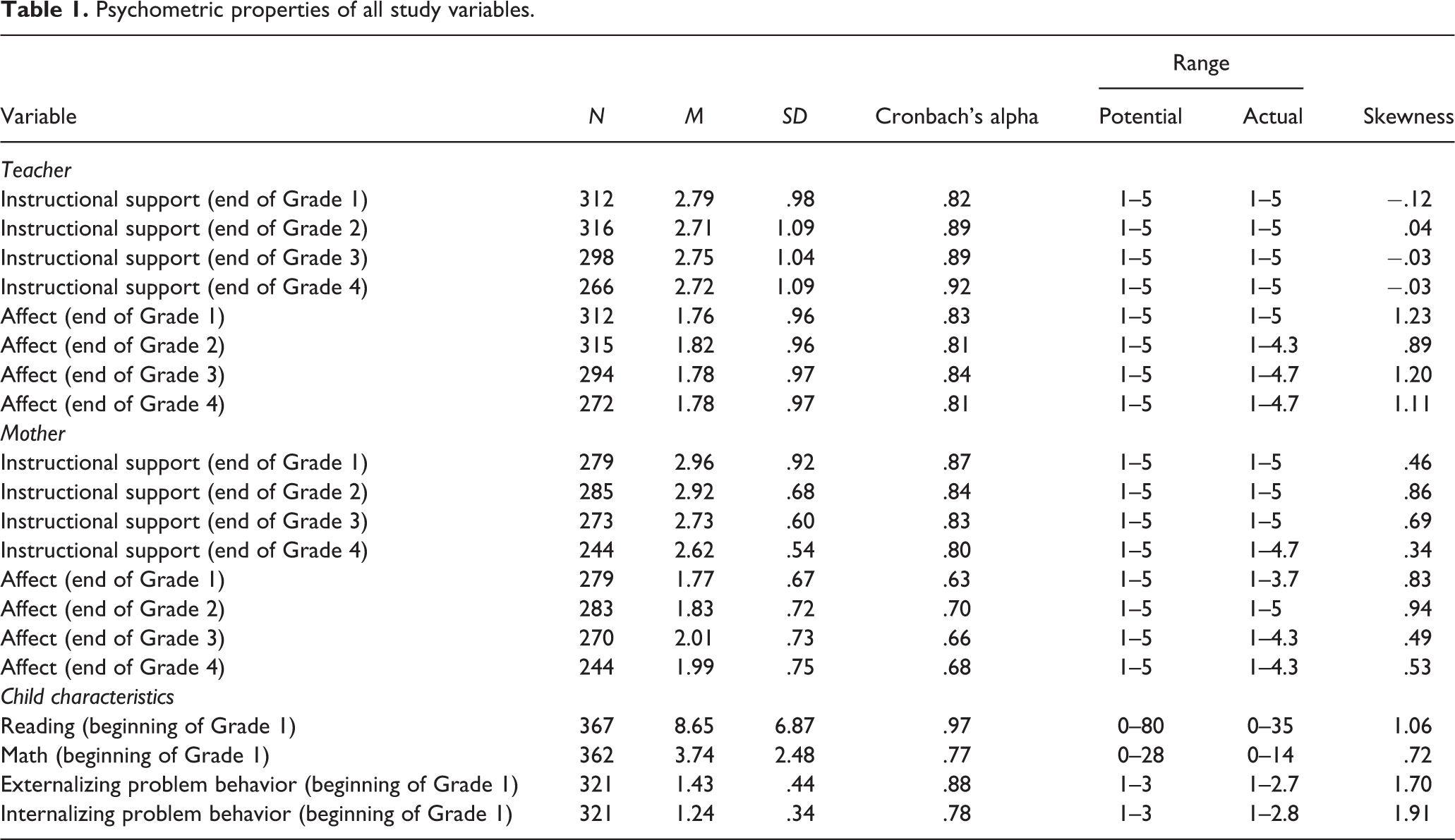
The psychometric properties of the used variables and the number of N for each measure are presented in Table 1. All variables reported in Table 1 are averages of item scores Correlations between all study variables are presented in Table 2.
Psychometric properties of all study variables.
Correlations between manifest variables.

Note. N = 371. *p < .05, **p < .01.
Teachers’ questionnaire
Teachers’ instructional support
In Grade 1, the score for teachers’ instructional support and attention for a particular child was a mean score of three questions concerning teachers’ support in (1) reading, (2) writing, and (3) math. In Grades 2, 3 and 4, teachers’ support and attention was a mean score of four items, as the questions concerning math were divided into two items: support and attention in math numerical assignments, and support and attention in math verbal assignments. The teachers rated, on a 5-point scale, the extent to which they provided support for and gave attention to a particular child in connection with literacy and math learning during normal class time, as compared to the support and attention they gave to other students in the classroom. The original scale ranging from −2 to + 2 was recoded into a scale ranging from 1 to 5 in the following way (original scale values shown in parentheses): 1 (−2) = Substantially less than to other students, 2 (−1) = Somewhat less than to other students, 3 (0) = An equal amount as to other students, 4 (+1) = Somewhat more than to other students, and 5 (+2) = Substantially more than to other students.
Teachers’ negative affect
Teachers rated their affective responses while working with a child using a modified scale taken from Poulou and Norwich (2002). Teachers’ negative affect when teaching an individual child was measured by three items. When you teach this child, to what extent do you feel the following: (1) I feel helpless; (2) I feel frustrated/stressed; (3) I feel joy (reversed). Answers were given on a 5-point scale (1 = not at all; 5 = very much).
Children’s externalizing and internalizing problem behaviour
Children’s externalizing and internalizing problem behaviours at the beginning of Grade 1 were assessed by using a teacher rating form of the Finnish version of the Strengths and Difficulties Questionnaire (SDQ; Goodman, 1997; Goodman & Scott, 1999). Teachers rated 25 items on a scale from 1 to 3 (1 = not true; 3 = certainly true). Of the original five SDQ subscales, a mean score of a hyperactivity scale (five items; e.g., “restless”) and a conduct problems scale (five items; e.g., “fights”) was used as an indicator of externalizing problem behaviour (Goodman, Lamping, & Ploubidis, 2010). A mean score of an emotional symptoms scale (five items; e.g., “worries, unhappy”) was used to form an indicator of internalizing problem behaviour. The SDQ questionnaire has been shown to have good psychometric properties among Finnish children and adolescents (Koskelainen, Sourander, & Kaljonen, 2000). Moreover, teacher ratings have been shown to have the best internal consistency among self-, parent-, and teacher-reported SDQ scores (Koskelainen et al., 2000).
Mothers’ questionnaire
Mothers’ instructional support
To measure the extent to which mothers provide instructional support, we used a parental help with homework scale (Silinskas et al., 2015). Mothers’ instructional support during their children’s homework was measured by four items: (1) Do you instruct your child in his/her homework? (2) Do you help or guide your child in his/her homework? (3) Do you help your child in his/her homework related to reading? (4) Do you help or guide your child in his/her homework related to mathematics? Answers were given on a 5-point scale (1 = never at all; 5 = always).
Mothers’ negative affect
Mothers’ negative emotions in homework situations were measured by three items. How do you feel in situations where you help or guide your child in doing the home assignments: (1) I feel helpless; (2) I feel frustrated/stressed; (3) I feel joy (reversed). Answers were given on a 5-point scale (1 = not at all; 5 = very much), identical to that used to assess teachers’ affect.
Children’s tests
Trained investigators administered group tests in reading and math in the children’s classrooms.
Reading
Word-reading skills were tested in a group situation at the beginning of Grade 1. We used a test from a standardized national reading performance test battery (ALLU; Lindeman, 1998). Form A with small letters was used. In the word-reading test, the child was asked to select the correct word from four phonologically similar alternatives and link this to a picture by drawing a line between the two. In the task, a maximum of 80 attempts can be made within the duration of the test, which in this case was 2 minutes. The score is the number of correct responses marked within the time limit.
Math
Math performance was tested in a group situation at the beginning of Grade 1. Math performance was assessed by the Arithmetic test (Räsänen & Aunola, 2007; see also Räsänen, Salminen, Wilson, Aunio, & Dehaene, 2009) consisting of 14 addition (e.g., 2 + 1 = ____; 3 + 4 + 6 = ____) and 14 subtraction (e.g., 4 − 1 = ____) tasks. In the test, a maximum of 28 trials is permitted within a 3-minute time limit.
Data analysis
To examine the extent to which teachers’ and mothers’ responses in terms of their instructional support and affect when instructing a particular child relate to each other, we estimated a set of latent growth models (LGMs). First, we estimated univariate latent growth models separately for teacher instructional support, teacher affect, mother instructional support, and mother affect. These four models included an intercept (representing the initial level at the end of Grade 1) and a slope (representing the rate of change from Grade 1 to Grade 4). To specify intercept, the values of the observed variables at four time-points were fixed to 1; to specify the model growth, the value at the first measurement point was fixed to 0, the value at the fourth measurement point was fixed to 1, and the values at time-points 2 and 3 were freely estimated. Intercepts and slopes in all the models were allowed to correlate. Second, the four separate models were combined into one single parallel process latent growth model. The intercepts and the slopes of teacher instructional support, teacher affect, mother instructional support, and mother affect were allowed to correlate.
To answer our second research question about the evocative effect of children’s characteristics on their teachers’ and mothers’ instructional support and affective responses, we entered children’s academic performance (i.e., reading and math) and problem behaviour (i.e., externalizing and internalizing) to predict the initial levels and the rates of change of the previously specified parallel process LGM. Again, the intercepts and the slopes of teacher instructional support, teacher affect, mother instructional support, and mother affect were allowed to correlate. Also, all four child variables were allowed to correlate with each other.
All the analyses were conducted using the Mplus statistical package (Version 7.3; Muthén & Muthén, 1998–2012). The proportions of missing data for all study variables ranged from 1.6% to 34.9% (M = 23.05%, SD = 7.31%). Our data was missing completely-at-random (Little’s MCAR test: χ2 = 1587.18, df = 1478, p = .155). The parameters of the models were estimated using the full-information maximum likelihood estimation with standard errors that are robust against non-normal distributions (Muthén & Muthén, 1998–2012). This allowed us to use all available data. For all the models, goodness-of-fit was evaluated using five indicators: χ2 (df), the comparative fit index (CFI), the Tucker-Lewis Index (TLI), the Root Mean Square Error of Approximation (RMSEA), and the Standardized Root Mean Square Residual (SRMR). According to Hu and Bentler (1999), TLI and CFI values above .95, RMSEA values below .06, and SRMR values close to .08 can be considered to be indicators of a good model fit to the data.
Results
To what extent are teachers’ and mothers’ responses when supporting a particular child associated?
To investigate the associations between teachers’ instructional support, teachers’ affect, maternal instructional support, and maternal affect, we first constructed four separate latent growth models that each included two latent factors: (a) an intercept factor representing the initial level and (b) the slope factor representing the rate of change from Grade 1 to Grade 4. Because the models showed negative variance for the slopes of teacher instructional support and teacher affect, these parameters were set to zero. A good model fit was obtained for teacher instructional support, χ2(8) = 35.318, p = .000; TLI = .938; CFI = .918; RMSEA = .051; SRMR = .046, teacher affect, χ2(8) =15.436, p = .051; TLI = .976; CFI = .968; RMSEA = .051; SRMR = .046, maternal instructional support, χ2(3) = 3.122, p = .373; TLI = .999; CFI = 1.000; RMSEA = .011; SRMR = .047, and maternal affect, χ2(3) = 5.868, p = .118; TLI = .975; CFI = .988; RMSEA = .054; SRMR = .038.
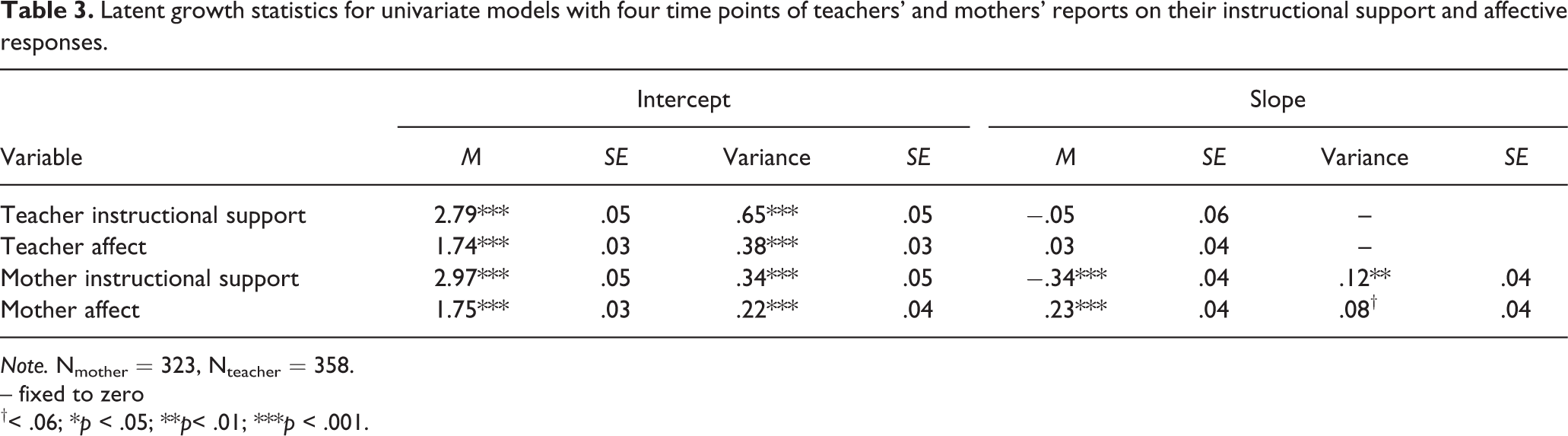
Table 3 presents the results of the four univariate LGMs with four time points (across Grades 1 and 4). The parameter estimates for the mean of the change (slope from Grade 1 to Grade 4) were non-significant for teacher instructional support and teacher affect, suggesting that, on average, teachers’ responses did not change across time. Instead, the mean of the change (slope from Grade 1 to Grade 4) was statistically significant for maternal instructional support and for maternal affect. Overall, these results suggest that, on average, mothers’ instructional support decreased and their negative affect increased from the end of Grade 1 to the end of Grade 4.
Latent growth statistics for univariate models with four time points of teachers’ and mothers’ reports on their instructional support and affective responses.
Note. Nmother = 323, Nteacher = 358.
– fixed to zero
†< .06; *p < .05; **p< .01; ***p < .001.
There was significant individual variation in the initial levels of teacher instructional support and teacher affect. Similarly, there was a statistically significant individual variation in the initial level and in the slope of maternal instructional support, and in the initial level of maternal affect. However, the variance of the slope of maternal affect was significant only at the .06 level. Overall, these findings suggest that teachers varied in their instructional support and affective responses in the spring of the children’s first school year, but there was no variance in the change of these responses from Grade 1 to Grade 4. Mothers, however, differed not only in terms of their instructional support and affective responses during the first school year, but also in terms of how these responses changed over time.
Next, we combined the four separate models into one parallel process latent growth model. The parallel process latent growth model (without predictors) fitted the data well, χ2(99) = 121.711, p = .060, CFI = .986, TLI = .984, RMSEA = .025, SRMR = .051. The results are presented in Figure 1, in which only significant correlations are shown. First, the results showed significant and substantial associations between the intercepts of teachers’ instructional support and mothers’ instructional support (Hypothesis 1a), and the intercepts of teachers’ negative affect and mothers’ affect (Hypothesis 1b). Teachers’ instructional support was also highly correlated with their negative affect, as well as with maternal affect. However, maternal instructional support was not associated with maternal affect. Moreover, the intercepts of maternal instructional support was negatively related to the slope of maternal instructional support from Grade 1 to Grade 4. In other words, mothers who started out with a high initial level of instructional support reported, on average, greater decrease across Grades 1 and 4 than the other mothers or, reversely, the lower the initial level of maternal instructional support, the less decrease in maternal instructional support occurred from Grade 1 to Grade 4. Finally, there was a significant negative relation between the intercepts of teacher instructional support and the slope of maternal instructional support, suggesting that initially high teachers’ instructional support related to greater decrease in mothers’ instructional support from Grade 1 to Grade 4, or, alternatively, low initial teachers’ instructional support related to less decrease across Grades 1 and 4, on average, in mothers’ instructional support. Also, there was a marginally significant positive association between the intercept of teacher affect and the slope of maternal affect, suggesting that teachers’ initial negative affect related to a stronger increase of mothers’ negative affect across Grades 1 and 4.

Associations between intercepts and slopes of teacher instructional support, teacher affect, mother instructional support, and mother affect. Standardized solution with 95% confidence intervals.
To what extent do child characteristics predict teachers’ and mothers’ affective and instructional responses?
As the final step of our analyses, we constructed a structural model where children’s characteristics were added to predict the intercepts and slopes of the previously specified model. Child characteristics were allowed to correlate with each other. Also, intercepts and slopes of all four parallel processes were allowed to correlate with each other. The final model was trimmed so that it included only statistically significant paths. The final model showed a good model fit to the data, χ2(151) = 203.047, p = .003; CFI = .975, TLI = .969, RMSEA = .030, SRMR = .050. The standardized model results are presented in Figure 2. In line with Hypotheses 2a and 2b, a child’s reading and math performance at the beginning of Grade 1 uniquely predicted teachers’ and mothers’ responses at the end of Grade 1 (intercepts): Poor reading performance was associated with high levels of teacher instructional support and teacher negative affect at the end of Grade 1. In addition, poor reading performance at the beginning of Grade 1 was related to the higher initial level and the greater decrease of maternal instructional support from Grade 1 to Grade 4. Poor math performance at the beginning of Grade 1 was associated with high levels of teacher instructional support, maternal instructional support, and maternal negative affect at the end of Grade 1.
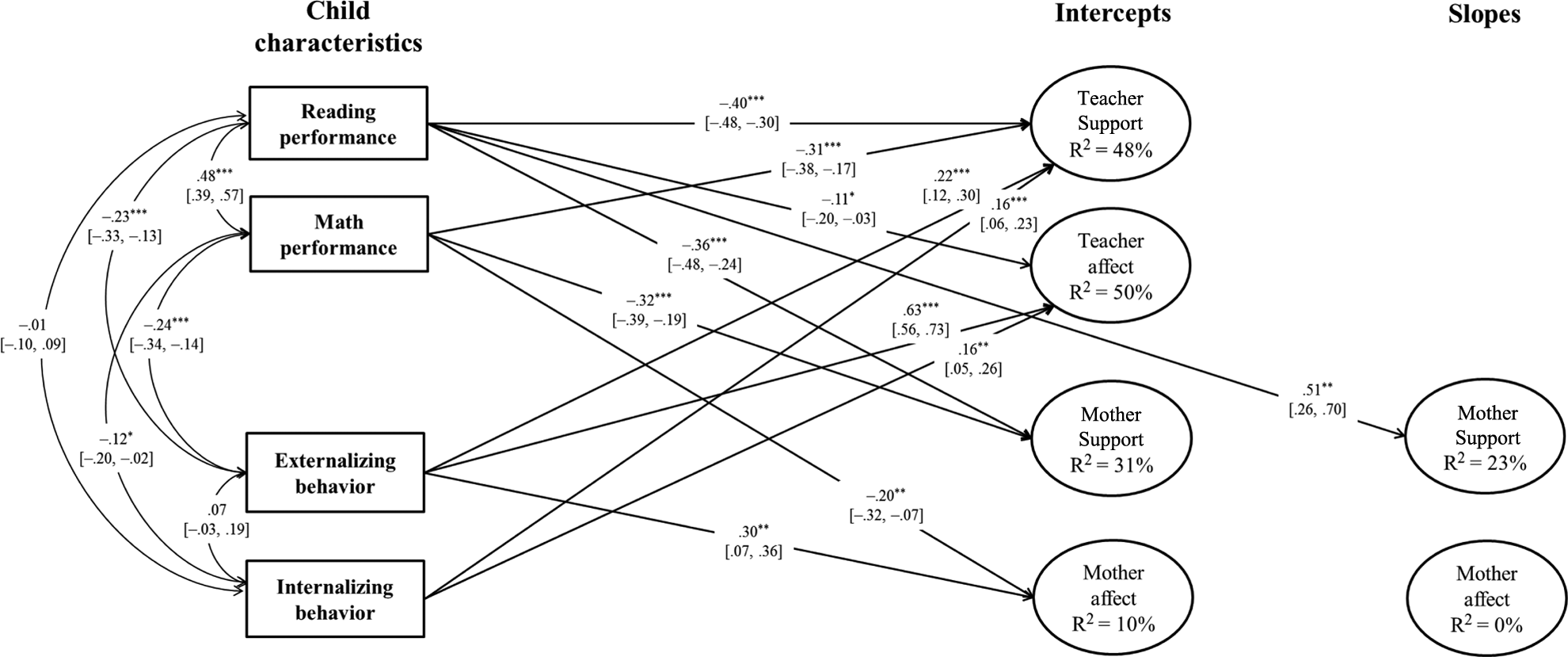
Evocative effect of child characteristics (academic performance and problem behavior) on intercepts and slopes of teacher instructional support, teacher affect, mother instructional support, and mother affect. Standardized solution with 95% confidence intervals, only correlations among child characteristics and paths of the trimmed model are shown. Associations among intercepts and slopes are estimated, but not depicted.
In line with Hypotheses 2c and 2d, child externalizing and internalizing problem behaviour at the beginning of Grade 1 also predicted teachers’ and mothers’ responses at the end of Grade 1 (intercepts): Externalizing problem behaviour at the beginning of Grade 1 was associated with high levels of teacher instructional support, teacher negative affect, and maternal negative affect at the end of Grade 1. Also, internalizing problem behaviour at the beginning of Grade 1 was associated with high levels of teacher instructional support and teacher negative affect at the end of Grade 1.
Discussion
In the present study, we examined to what extent teachers and mothers respond to a particular child in a similar manner in terms of their instructional support and affective responses in classroom and homework situations; and to what extent child characteristics predict teachers’ and mothers’ responses toward a particular child. The results showed, first, that at the end of Grade 1 mothers and teachers showed a highly similar level of instructional support toward a particular child. Moreover, mothers and teachers evidenced moderately similar affective responses toward a particular child. Second, teachers’ instructional support and affective responses toward a particular child were relatively stable across Grades 1 and 4. In turn, mothers’ responses toward a particular child evidenced significant change (i.e., maternal instructional support decreased and negative affect increased across Grades 1 to 4), and there were also individual differences in the rate of change of maternal instructional support and maternal negative affect. Third, children’s poor performance in reading and math at the beginning of Grade 1 was associated with high amounts of both teachers’ and mothers’ instructional support at the end of Grade 1 in particular, while children’s externalizing problem behaviour was associated with teachers’ and mothers’ negative affective responses.
Do mothers and teachers respond to a particular child in a similar way?
While previous research have examined mothers’ and teachers’ instructional responses toward a child in separate studies, our study adds to the existing literature by showing that a child tends to receive similar environmental responses in both school and home contexts. First, children who were provided a high amount of instructional support at school at the end of Grade 1 were also likely to receive a high amount of instructional support at home. Second, we found that at the end of Grade 1 mothers and teachers resembled each other in their affective responses to a particular child in classroom and homework situations, although the effect size was smaller than in the case of instructional support. In other words, children who experienced negative affect from their mothers were also likely to experience negative affective responses when interacting with their teachers. In addition, our findings on teachers showed that those who gave heightened levels of instructional support for child had a strong tendency to experience negative affect in teaching situations.
Overall, the results suggest that both teachers and parents recognize that a child is struggling with schooling, and consequently, they try to support the child by providing more help and instructional support. This in itself is a positive finding. However, teachers’ tendency to often experience negative affect when giving high levels of instructional support dampens a positive interpretation. If additional support is given in an intrusive way and with a lack of emotional support, it likely has detrimental consequences for the child’s motivation and engagement with academic tasks (Pakarinen et al., 2011; Pomerantz et al., 2007). Similarly, negative affective responses from both teachers and parents may be particularly harmful for a child, because such feedback can lead to poor academic performance and low academic adjustment, which may then lead to a negative maladaptive cycle of interactions (Myers & Pianta, 2008).
Moreover, unlike teachers, mothers’ instructional support at the end of Grade 1 was not related to their affective responses. This result suggests that whereas teachers’ experience of giving a particular child more attention and support leads to negative affective reactions, for example, because of frustration with the child’s low responsiveness and slow progress, the same is not true among mothers. This difference between mothers and teachers may be due to the fact that mothers’ relationship with their child is close and supportive independently of the amount of additional support a child needs with homework.
The results on the development of teachers’ and mothers’ instructional support and affective responses across Grades 1 and 4 showed further that teachers’ instructional support and affective responses toward a particular child stayed very similar over the first school years. Our findings correspond to earlier research indicating that teachers’ responses to a child’s academic performance show high stability across time (Nurmi et al., 2012). In fact, high stability of teachers’ instructional support and affective responses toward a particular child may become counterproductive for the academic development of the child, especially as these tend to occur together (Malecki & Demaray, 2003; Roorda, Koomen, Spilt, & Oort, 2011). Concerning mothers, our findings indicate that, unlike teachers, mothers changed their instructional and affective responses toward their child over the first school years. One possible reason for this result is that mothers are willing and also are more able to closely follow their children’s academic achievement and adjustment at school, and then make an effort to respond to any negative signs of development by changing their instructional activities and affect toward the child. Teachers, in turn, typically have many students in their classroom and therefore they may count more on their previous knowledge and beliefs of a child’s development and adjustment.
Do child characteristics predict the responses of their teachers and parents?
Our second research question was the extent to which a child’s academic performance and socio-emotional characteristics at the beginning of Grade 1 would be associated with teachers’ and mothers’ instructional support and affective responses. The results showed that the poorer a child’s performance in reading and math was at the beginning of Grade 1, the more instructional support that child received from their mothers and teachers at the end of Grade 1. These results are similar to previous studies demonstrating an evocative effect of child academic performance on instructional responses from parents (Levin et al., 1997; Pomerantz & Eaton, 2001; Silinskas et al., 2010), as well as from teachers (Doumen et al., 2008; Nurmi et al., 2012; Pakarinen et al., 2011). Our study adds to previous research by showing that mothers and teachers do respond similarly to a particular child depending on the child’s academic performance.
In respect to mothers’ and teachers’ affective responses to children’s performance, our results showed that students’ low reading (but not math) skills at the beginning of Grade 1 predicted teachers’ negative affect at the end of Grade 1, whereas students low math (but not reading) skills at the beginning of Grade 1 related to mothers’ negative affect at the end of Grade 1. The finding on teachers could reflect the fact that teachers may find teaching reading and writing to low-achieving children at the beginning of school more important than teaching math, because learning to read in Grade 1 is more emphasized than learning math. Also, because of almost 100% orthographic transparency of Finnish language (Seymour, Aro, & Erskine, 2003), 25% of Finnish children learn to decode before Grade 1 (Holopainen, Ahonen, & Lyytinen, 2001), and the majority of Finnish-speaking children learn to read during the first semester of Grade 1 (Leppänen, Niemi, Aunola, & Nurmi, 2004; Lerkkanen, Rasku-Puttonen, Aunola, & Nurmi, 2004). Thus, particularly children’s low performance in reading may increases teachers’ frustration and stress when providing instructional support for a child at the end of Grade 1. The finding on mothers, in turn, could be related to maternal beliefs about the child. That is, mothers may think that reading is a skill, which their child can learn while math is a talent their child either has or does not have (Mägi, Lerkkanen, Poikkeus, Rasku-Puttonen, & Nurmi, 2011). Consequently, low performance in math may cause more worries and associated negative affect in academic mother–child interactions compared to low performance in reading.
Concerning children’s socio-emotional characteristics, we found that the more externalizing problem behaviour children exhibited at the beginning of Grade 1, the more teachers experienced negative affect when supporting a particular child at the end of Grade 1. A similar pattern was also found among mothers: Mothers experienced negative affect when teaching a child who shows externalizing problem behaviour. These findings accord with previous research indicating that children with externalizing problem behaviour come up against problems with their social environment (Tremblay, Pihl, Vitaro, & Dobkin, 1994). Importantly, our study shows that both teachers and parents react similarly to a child with externalizing problems. One possible reason for this is that children with externalizing symptoms have difficulties in understanding the perspectives, feelings, and intentions of others (Crick & Dodge, 1994; Rubin, Bream, & Rose-Krasnor, 1991), which then triggers increased negative emotions from teachers and parents. Teachers in particular can be assumed to view children with problem behaviours as requiring more direction and more disciplinary activities, which is also evidenced in their increased attention toward children exhibiting such behaviour (Keogh, 2003; for a meta-analysis, see Nurmi, 2012).
Our findings also point to some more differentiated associations between children’s socio-emotional characteristics and responses from teachers and parents. That is, we found that externalizing problem behaviour was associated with a high level of instructional support from teachers but not from mothers. One possible explanation for this result may be that teachers and mothers interact with children in very different contexts: group situations versus individual child interactions. In addition, children may behave differently in school and at home and do not show similar out-of-bounds behaviour in homework situations when getting individual attention compared to the classroom setting.
Moreover, the more internalizing problem behaviour a child exhibited at the beginning of Grade 1, the more teachers gave instructional support and the more teachers experienced negative affect when instructing that particular child at the end of Grade 1. These results are in accordance with the suggestion that children’s internalizing problem behaviour is a reflection of psychological over-control, which hinders effective interaction with others, leading to the development of distant and difficult interpersonal relationships (Hymel, Rubin, Rowden, & Le Mare, 1990; Rubin & Burgess, 2002). Children with internalizing behaviours do tend to be less connected socially, can be shy and reticent, and display anxious and/or depressed moods. Such children’s feelings and behaviour may be particularly harmful when dealing with teachers and peers, whereas in the home environment with mothers, shyness, anxiety, and depression may not play such a big role, as in most cases, the parent–child relationship is close and supportive. Accordingly, we did not find any evidence that children’s internalizing problem behaviour would be associated with their mothers’ instructional support or affective responses.
Overall, the results of our study showed that each of the child characteristics included in the study was a unique predictor of some responses of their interpersonal environment when other characteristics were controlled for. Although not examined in the present study, it is also possible that certain combinations of child characteristics, such as poor academic performance and external problem behaviour, may have a particularly strong impact on mothers’ and teachers’ instructional support and affective responses. Consequently, there is an evident need to investigate whether certain patterns of child characteristics have even more detrimental effects on mothers’ and teachers’ instructional support and affective responses than individual child characteristics do.
Limitations
This study has some limitations that need to be taken into consideration when attempting to generalize its results. First, self-report questionnaires were used to measure mothers’ and teachers’ instructional support and affective responses. The findings should be replicated using, for example, observational and physiological measures. It is worth remembering, however, that the data were gathered from multiple respondents (i.e., mothers reported on the amount of their instructional support and affect, teachers reported on their instructional support and affect, children’s performance was measured by tests), which adds to the likelihood of obtaining trustworthy results.
Second, children’s socio-emotional characteristics (externalizing and internalizing problem behaviour) were measured by teacher ratings, which could have inflated the correlations between/among socio-emotional child characteristics and teacher’s instructional support and affect. Also, it may be much more difficult for teachers to reliably assess internalizing problem behaviour than more visible and disturbing externalizing problem behaviour. Furthermore, teacher ratings may only reflect problem behaviours at school, and children’s behaviour may be different outside the school. Finally, it should be noted that part of the teachers (i.e., raters of the child problem behaviour) changed across the follow-up. Thus, it is possible that our null findings for the growth of teacher-reported variables (e.g., non-significant mean of growth factor of teachers’ instructional support and teachers’ affective responses across Grades 1 and 4) are due to error introduced by a change in raters.
Third, although our analyses were based on longitudinal data, we have to be careful in drawing conclusions about the direction of effects. For example, despite the fact that child characteristics were measured at the beginning of Grade 1 and maternal responses at the end of Grade 1, it is possible that maternal behaviour and affect had influenced children’s problem behaviour and academic performance before our study started. However, our measures of maternal homework-related instructional support and affective responses during homework situations were specifically tapping mothers’ behavioural and affective responses in the school context. Thus, we believe that our study captured the initial pattern of associations between child characteristics and responses from children’s interpersonal environments in academic context.
Conclusions
The present study adds to the existing literature in many ways. For example, because the major adult figures (teachers and mothers) in a child’s life were found to keep responding to the child in a similar manner, and a child’s characteristics to trigger similar responses from their significant adults, both teachers and parents should be helped to become aware of the possible benefits and harms of increased instructional support and negative affect. Although children with low academic skills and externalizing behavioural problems receive increased instructional support from their teachers and mothers, this support is often linked to negative affective responses, which may diminish the possible positive outcomes of the increased instructional support (see also Silinskas et al., 2014, 2015). Moreover, the results of the present study emphasize the importance of taking into account several child characteristics and several adults’ responses at the same time in order to better understand the mechanisms that influence child development, and how they function together to form different outcomes.
By becoming aware of the evocative impact that particular child characteristics have on the affective and instructional support of the child’s significant others, teachers and parents can be more sensitive in their own instructional support and affective responses in order to better support the development of the child’s academic skills and adjustment to the learning environment. For instance, although a teacher shows a high level of sensitivity when noticing the children in need of support in classroom situations, providing continuous additional individual attention and support can create a negative atmosphere that is unlikely to form a fruitful basis for children’s motivation to practice their skills. Since a teacher is a particularly important role model in early primary grades (Pianta, Hamre, & Stuhlman, 2003), and as the affect that teachers show for students can have far-reaching consequences for students’ academic skills (Roorda et al., 2011), it would be important to target interventions for strengthening teachers’ positivity in their interaction and communication with students who need attentional support in their learning (Hamre & Pianta, 2005).
Footnotes
Funding
This study has been financed by the Academy of Finland (Nr. 213486, Nr. 125811, Nr. 268586, Nr. 252304, Nr. 277299, and Nr. 266851).